
Vimana: The Vedic Aerial Chariots
In the great Sanskrit epics of ancient India — the Ramayana and the Mahabharata — gods, sages, and kings travel the sky in vimanas: jeweled, self-moving aerial cars capable of crossing continents in hours. Since the late 1960s, paleocontact writers led by Erich von Däniken have read these passages as garbled memories of real ancient aircraft, or even extraterrestrial technology. A separate and far more direct claim — that a 20th-century document called the Vaimanika Shastra preserves actual ancient blueprints for building one — was tested by aeronautical engineers at the Indian Institute of Science in 1974 and found to be a modern, aerodynamically nonsensical composition first dictated in 1918–1923. This file separates what the epics actually say, in their original literary and religious context, from what the paleocontact movement claims they say, and from the specific, well-documented forgery case of the Vaimanika Shastra.
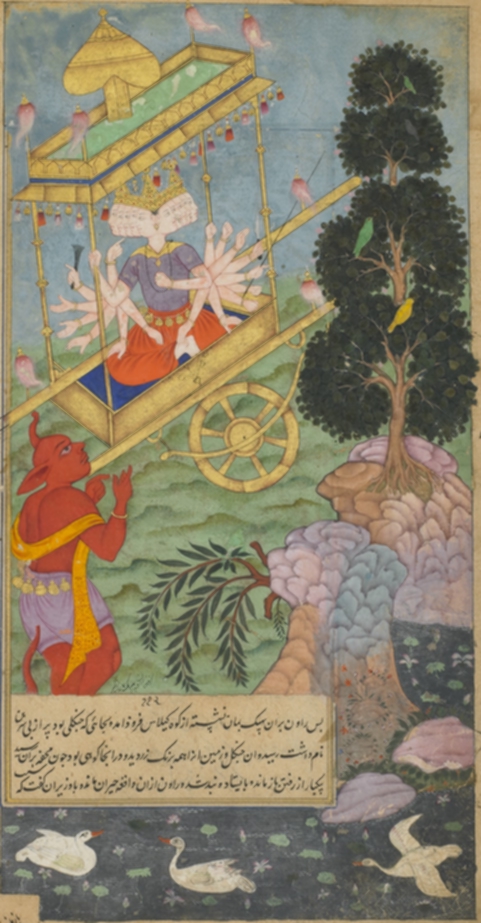
Ravana seizes the Pushpaka chariot from Kubera — folio from the Freer Ramayana, Mughal India, c. 1597–1605. Public domain (PD-India, copyright expired), Smithsonian Freer Gallery of Art, F1907.271.297.
Theoretical Alignment
Three distinct claims are routinely blended together in popular treatments of "ancient Indian aircraft," and this file keeps them separate. The genuine epic references to vimanas in the Ramayana and Mahabharata align strongly with a literary-mythological reading — they behave exactly as divine chariot imagery behaves everywhere else in world epic poetry: as markers of status, sanctity, and cosmic order, not as engineering specifications. The paleocontact/ancient-astronaut reading, popularized by Erich von Däniken and expanded by writers such as David Hatcher Childress, has moderate surface alignment (the texts do describe flying, noise, light, and speed) but collapses under close philological scrutiny, which shows the descriptions evolving in step with the earthbound technology of each era rather than describing a stable, external machine. The third claim — that the 20th-century Vaimanika Shastra is an authentic ancient aeronautical manual — is not merely unsupported but affirmatively disproven, and is treated on this page as a confirmed forgery/hoax.
Five Observables Assessment
Assessment: Unlike a modern radar/FLIR-documented UAP case, there is no instrumented, physical, or archaeological data to test against the Five Observables framework here — only text. Vimanas are consistently described as brilliant, loud, and visually spectacular (the opposite of low observability), drawn or crewed rather than silently self-propelled, and their "speed" is expressed with the same stock Sanskrit similes used for horses, arrows, thought, and wind elsewhere in the epics. Where the Vaimanika Shastra goes further and claims specific antigravity and invisibility mechanisms, the 1974 Indian Institute of Science analysis found the described mechanisms violate basic Newtonian mechanics and cannot function as written, so those specific claims are scored absent/failed rather than merely speculative.
Sensor & Instrumentation Detection Profile
No physical instrumentation applies to a 2,000–2,500-year-old text. The relevant "instruments" here are philological and forensic-documentary: manuscript dating via paleography and comparative recension analysis (used to date the Ramayana and Mahabharata's textual layers), linguistic register analysis (used by the 1974 IISc team to show the Vaimanika Shastra's Sanskrit and technical vocabulary could not predate the 20th century), and provenance tracing (interviews with Pandit Subbaraya Shastry's associates, examination of the exercise-book manuscripts, and publication history). None of these methods detected anything consistent with an operating aircraft; all of them are well suited to detecting anachronism and literary convention, which is exactly what they found.
Environmental & Geospatial Context
The Ramayana's vimana narrative moves between Ayodhya in the Gangetic plain and Lanka in the far south; the Mahabharata's vimana episodes are set around Dwaraka on India's western coast and the Kuru heartland of the north. Both epics were composed and transmitted across a wide swath of the Indian subcontinent over many centuries, with no fixed "crash site," debris field, or physical location ever associated with a vimana — a sharp contrast with modern UAP incident files. The one genuinely traceable geography in this story is 20th-century: Mysore, Karnataka, where Pandit Subbaraya Shastry reportedly dictated the Vaimanika Shastra between 1918 and 1923 and where G.R. Josyer later founded the International Academy of Sanskrit Research; and Bangalore, home of the Indian Institute of Science, where the manuscript was subjected to formal aeronautical analysis in 1974.
Observer Credibility & Occupational Profile
The "observers" in this file fall into three very different credibility tiers, profiled in full under Key Figures below: traditional poet-sages of essentially legendary status (Valmiki, Vyasa) whose historicity and authorship are themselves debated by scholars; a 20th-century Sanskrit pandit and his promoter with no aeronautical training who produced and marketed the Vaimanika Shastra; and credentialed 20th-century professionals — five aeronautical and mechanical engineers at a top Indian technical university, plus independent Sanskritists at Brown University and elsewhere — who subjected the modern claims to peer-reviewable analysis. The credibility gradient across these three groups is the single most important fact for evaluating this case.
Physical & Material Assays
No vimana debris, wreckage, or archaeological trace has ever been recovered, published, or peer-reviewed. The only "physical" evidence in this file is documentary: 23 exercise books of dictated Sanskrit verse (the working manuscript behind the Vaimanika Shastra), the 1973 printed edition with engineering-style drawings by draughtsman T.K. Ellappa, and the palm-leaf and paper manuscript traditions behind the Ramayana and Mahabharata themselves. See Material Analysis below for a full breakdown of what materials and mechanisms the texts actually describe, and how they hold up under engineering scrutiny.
Historical Precedents & Archive Matches
The vimana motif did not appear fully formed in the epics; it has a documented prehistory in the older Vedic hymns and a documented afterlife in later Puranic literature and Hindu temple architecture. The Rigveda (compiled roughly 1500–1200 BCE, centuries before the epics) already describes the divine twin horsemen the Ashvins riding a marvelous chariot: hymn 1.118.1, in H.H. Wilson's 1866 translation, calls it "swift as a hawk... quick as the mind of man, surmounted, showerers (of benefits) by three columns, and rapid as the wind," and other hymns in the same cycle describe the Ashvins' car as triple-wheeled and "flying like birds with pinions." This is the same register later applied to vimanas: divine, marvelously fast, compared to birds and to thought — but drawn by animals, wheeled, and never described as a self-contained machine with an engine.
By the time of the Puranas (composed roughly 3rd–10th century CE, after both epics), the vimana motif had been elaborated further — the Bhagavata Purana's retelling of the Salva/Saubha episode adds embellishments not present in the Mahabharata's own account. Centuries later, the same Sanskrit word was repurposed by temple architects for an entirely unrelated meaning: in South Indian and Odishan temple architecture, "vimana" denotes the tower or superstructure rising over a temple's inner sanctum (garbhagriha), a pyramidal stone structure with no connection to flight whatsoever. This architectural sense is first attested in temple-building treatises of the early medieval period and remains the term's primary meaning in Indian art history today — a linguistic history that paleocontact writers frequently elide when they cite "vimana" references in architectural or ritual texts as if they were describing aircraft.
Historical & Literary Background
The Ramayana and the Mahabharata are the two great Sanskrit epics of India, together forming the core of the itihasa ("thus it was" — traditional history/legend) genre of classical Indian literature, alongside the later Puranas. Both are traditionally attributed to single authors — the sage Valmiki for the Ramayana and the sage Vyasa for the Mahabharata — but both scholarly traditions and internal textual evidence indicate they took shape over centuries as growing oral compositions before being fixed in writing, with multiple regional recensions that differ from one another in length and detail.
The Ramayana comprises seven books (kandas) and roughly 24,000 couplet verses (shlokas). Sanskritist Robert P. Goldman, general editor of the Princeton University Press critical translation, dates the earliest oral composition to roughly 750–500 BCE, with the archetype unlikely to be much older than the start of the 7th century BCE; the epic's outer books (the first and last) are demonstrably later additions, and elaboration continued into the early centuries CE. The Mahabharata is far longer still — eighteen books (parvas) and over 100,000 verses, roughly ten times the combined length of Homer's Iliad and Odyssey — with modern scholarship placing its core composition between the 3rd century BCE and 3rd century CE and its oldest preserved material no earlier than about 400 BCE, reaching a stable form by the early Gupta period (4th century CE).
Both epics are devotional and dynastic narratives first and foremost: the Ramayana follows Prince Rama's exile, the abduction of his wife Sita by the demon king Ravana, and Rama's war to recover her; the Mahabharata follows the dynastic war between the Pandava and Kaurava cousins and embeds within it the Bhagavad Gita, one of Hinduism's central philosophical texts. Vimanas appear in both as narrative set-pieces — vehicles owned by gods, demons, and kings that mark the owner's cosmic status, are won and lost as trophies of divine favor, and are frequently destroyed as demonstrations of a hero's or a god's superior power. Understanding this narrative function is essential background for everything that follows: vimanas exist in the text to do literary work (signaling divinity, luxury, villainy, or triumph), and any reading that strips them of that narrative function to treat them as isolated technical specifications is already working against the grain of the source material.
Complete Timeline
| Date | Event |
|---|---|
| c. 1500–1200 BCE | Rigvedic precedent. The Rigveda describes the Ashvins' triple-wheeled, bird-swift divine chariot — the earliest layer of the "marvelous flying vehicle of the gods" motif that later feeds into the vimana tradition. |
| c. 750–500 BCE | Oral composition of the Ramayana begins (per Robert P. Goldman's dating), including the episode in which Ravana's Pushpaka Vimana is described. |
| c. 400 BCE – 400 CE | Composition and redaction of the Mahabharata, including the Salva/Saubha aerial-city episode in the Vana Parva and the account of King Uparichara Vasu's celestial car in the Adi Parva. |
| c. 3rd–10th century CE | Puranic elaboration. Texts such as the Bhagavata Purana retell and embellish the epics' vimana episodes with additional supernatural detail. |
| Medieval period | Semantic shift in temple architecture. "Vimana" is adopted by South Indian and Odishan temple-building treatises to denote the tower over a temple's inner sanctum — an entirely separate meaning from the aerial chariot. |
| 1866 | H.H. Wilson publishes an early English translation of the Rigveda, including the Ashvins' chariot hymns later cited in vimana discussions. |
| 1870s–1889 | Ralph T.H. Griffith publishes the first widely circulated complete English verse translation of the Ramayana, making Sundara Kanda's Pushpaka episode accessible to a Western readership for the first time. |
| 1918–1923 | The Vaimanika Shastra is dictated. Pandit Subbaraya Shastry, a Mysore-based scholar, reportedly dictates roughly 3,000 Sanskrit verses over 23 exercise books to a scribe, claiming the material is being psychically transmitted to him by the sage Bharadvaja. No manuscript or record of this text predates 1918. |
| 1952 | G.R. Josyer publicly reveals the existence of the Vaimanika Shastra for the first time, attributing it to Subbaraya Shastry. |
| 1959 | A Hindi translation of the Vaimanika Shastra is published. |
| 1968 | Erich von Däniken publishes Chariots of the Gods? (German: Erinnerungen an die Zukunft), quoting a translation of the Ramayana's Pushpaka episode as evidence for ancient astronaut visitation. The book eventually sells tens of millions of copies and launches the modern paleocontact movement. |
| 1970 | Von Däniken is convicted of fraud and embezzlement in Switzerland after falsifying hotel records to secure loans; he serves roughly one year of a 3.5-year sentence, writing his second book, Gods from Outer Space, in prison. |
| 1973 | Josyer publishes the full Sanskrit text of the Vaimanika Shastra with an English translation and engineering-style illustrations by draughtsman T.K. Ellappa. |
| 1974 | The Indian Institute of Science study. Aeronautical and mechanical engineers H.S. Mukunda, S.M. Deshpande, H.R. Nagendra, A. Prabhu, and S.P. Govindaraju publish "A Critical Study of the Work Vaimanika Shastra" in Scientific Opinion, concluding the described craft are aerodynamically impossible and the text dates to no earlier than 1904. |
| 1976 | Ronald Story publishes The Space Gods Revealed, a systematic point-by-point rebuttal of von Däniken's claims, including his use of the Pushpaka Vimana passage. |
| 1984–2016 | Robert P. Goldman and collaborators publish the seven-volume Princeton University Press critical translation of Valmiki's Ramayana, the modern scholarly standard. |
| Jan 4, 2015 | Indian Science Congress controversy. Captain Anand J. Bodas and Ameya Jadhav present "Ancient Indian Aviation Technology" at the 102nd Indian Science Congress in Mumbai, citing the Vaimanika Shastra as historical evidence. NASA scientist Ramprasad Gandhiraman's petition against the talk draws hundreds of signatures from scientists worldwide. |
| 2015 | Aerospace scientist Roddam Narasimha, astrophysicist Jayant Narlikar, and economist Amartya Sen publicly state there is no credible evidence of aviation in ancient India, reigniting mainstream media coverage of the 1974 IISc findings. |
| Jan 10, 2026 | Erich von Däniken dies in Unterseen, Switzerland, at age 90, having published more than 40 books over his career. |
The Primary Texts
This section presents what the Ramayana and Mahabharata actually say about vimanas, in translation, with citations to the specific verses and translators used.
The Pushpaka Vimana (Ramayana)
The most famous vimana in Sanskrit literature is the Pushpaka ("flowery") chariot. According to the epic's own account, it was built by the divine architect Vishvakarma for the god Brahma, later given to the wealth-god Kubera, and then seized by force by Kubera's half-brother, the demon king Ravana, who used it to abduct Sita and carry her to Lanka. After Rama kills Ravana and rescues Sita, he uses the Pushpaka to fly the entire party home to Ayodhya — the episode most frequently quoted by paleocontact writers, since Griffith's Victorian-era verse translation renders it in dramatic, machine-like language.
The fullest description of the vehicle itself comes earlier, in Sundara Kanda, Sarga 7, when Hanuman first discovers it inside Ravana's palace. In the verse-by-verse English rendering hosted at sanskritdocuments.org, the passage (verses 5.7.7–5.7.14) describes it as:
"...a great aerial car, the best among best of aerial cars, shining with the name of Pushpaka with the rays of precious stones, and capable of traveling long distances... like a beautiful cloud endowed with many hues, like the sky illumined by planets including the moon, decked with numerous precious stones."
The same passage goes on to describe the car's ornamentation in specifically decorative, not mechanical, terms: artificial birds fashioned from cat's-eye gems and silver-coral, jeweled serpent motifs, sculpted horses, lotus-garlanded elephant figures, and an image of a goddess worked into the structure. Nowhere in this description — the single most detailed vimana passage in either epic — is there any mention of an engine, a fuel source, a control mechanism, or a means of propulsion. The vehicle is elsewhere said to be "yoked with mule-like, ghost-faced horses" and to be capable of changing size and traveling at the will of its owner, both explicitly supernatural (siddhi) powers attributed to it as a divine object, not engineering features.
King Vasu's Celestial Car (Mahabharata, Adi Parva)
Early in the Mahabharata, the pious king Uparichara Vasu is rewarded by the god Indra with a crystal aerial vehicle (vaihayasam, "sky-going") that allows him to travel above ordinary mortals, a mark of his exceptional piety and one of the reasons he becomes known as "Vasu of the sky-chariot." As with the Pushpaka, the point of the episode is status and divine favor, not technology: the vehicle is a gift explicitly tied to the king's virtue, and its narrative function ends once that point has been made.
The Saubha of King Salva (Mahabharata, Vana Parva)
The most extended and violent vimana episode in either epic is the story of Salva's aerial city, Saubha. According to the Vana Parva (roughly chapters 15–23 in the standard parva division), King Salva, an enemy of Krishna's Yadava clan, obtains the flying city Saubha as a boon from Shiva, built for him by the divine artificer Maya. Salva uses it to attack Krishna's capital, Dwaraka, flying the city through the air, appearing and disappearing at will, and raining weapons down on the defenders below. Krishna eventually pursues Salva, and in the climactic battle destroys both Salva and the city of Saubha with his discus weapon, the Sudarshana Chakra. Later Puranic retellings, notably in the Bhagavata Purana, further embellish this same episode.
As with the Pushpaka, the Saubha's most consistently emphasized traits are supernatural and moral rather than mechanical: it is explicitly a magical object obtained through religious austerity and divine boon, it possesses "illusory powers" (maya) that let it vanish and reappear, and its destruction is framed as a triumph of righteous power (Krishna, an avatar of Vishnu) over wrongfully acquired power (Salva, who besieges a city and is explicitly styled a villain). A vehicle that flies because a god granted it magical illusion-powers, and that a rival god-hero destroys with a discus weapon, is describing theology, not aerospace engineering.
What the Primary Texts Do Not Say
It is worth being explicit about the gap between these primary passages and the claims frequently attributed to them online. The genuine epic verses do not mention mercury, fuel tanks, control levers, named alloys, or reproducible construction techniques — all claims that originate not in the Ramayana or Mahabharata but in the 20th-century Vaimanika Shastra, discussed in its own section below, or in paraphrases by 20th-century paleocontact authors that are frequently mistaken for direct epic quotations. Independent researcher Jason Colavito has documented at least one widely circulated "Ramayana quotation" about vimanas that actually descends from a 1945 paraphrase in James Churchward's The Children of Mu, itself derived from a loose 1914 popular summary — three removes from Valmiki's actual Sanskrit, with each retelling adding more machine-like vocabulary than the last.
The Paleocontact / Ancient-Astronaut Interpretation
The modern popular association between vimanas and extraterrestrial spacecraft begins almost entirely with one book: Swiss author Erich von Däniken's Chariots of the Gods? (1968), which argues that many ancient monuments, artworks, and texts encode garbled folk memories of visits by technologically advanced extraterrestrials in prehistory. Von Däniken quotes a Ramayana translation describing Rama's chariot rising "up to a mountain of cloud with a tremendous din" as one of several pieces of textual "evidence," alongside his readings of Egyptian pyramids, Nazca lines, and biblical passages such as Ezekiel's vision. The book sold an estimated 70 million copies and, alongside its sequels and the History Channel series it later inspired, is the single largest reason "ancient Indian aircraft" entered global popular culture.
Von Däniken's own credibility is a documented part of this story rather than incidental biography: he had no academic background in archaeology, history, or Sanskrit, worked as a hotel manager while writing his first book, and in November 1968 — the same year Chariots of the Gods? was published — was arrested and later convicted in Switzerland of fraud and embezzlement for falsifying hotel financial records to secure roughly $130,000 in loans, serving about a year of a three-and-a-half-year sentence. Archaeologist Kenneth Feder has characterized von Däniken's interpretive method as an "inkblot" approach that projects modern technological imagery onto ambiguous ancient artwork and texts regardless of their documented cultural context; astronomer Carl Sagan, reviewing the ancient-astronaut genre in 1976, called it "pseudoscience" built on "sloppy thinking." Von Däniken died on January 10, 2026, at age 90, having published more than 40 books; even his sympathetic obituaries in the skeptical press describe his life's work as, in the words of one Skeptical Inquirer retrospective, an entertaining but "entirely delusional" body of pseudo-scholarship.
Later writers extended the vimana claim considerably further than von Däniken's original brief mention. American self-published author David Hatcher Childress, in books including Vimana: Flying Machines of the Ancients, presents the Vaimanika Shastra as if it were a genuinely ancient document — at different points dating it to "between 400 BCE and 1000 CE" or claiming it as "a fourth century B.C. text ... discovered in 1875," dates that Jason Colavito has shown are simply invented and contradict the text's own well-documented 20th-century origin. Other popular writers have gone further still, reading Mahabharata battle descriptions of Indra's weapon (the "Brahmastra") and other divine armaments as accounts of a literal ancient nuclear war, a claim with no support in mainstream Sanskrit scholarship and no archaeological correlate (no anomalous radiation signature, vitrified site, or isotopic anomaly consistent with a nuclear detonation has ever been documented at any South Asian archaeological site). These extensions illustrate a general pattern in paleocontact literature: each retelling of the vimana story tends to add more specific, more "technological" detail than the previous one, moving further from Valmiki's and Vyasa's actual Sanskrit with each iteration rather than closer to it.
The Vaimanika Shastra Controversy
The Vaimanika Shastra ("Science of Aeronautics") deserves its own dedicated treatment because it is a fundamentally different kind of claim from the epic passages discussed above — not a debate about how to interpret an authentically ancient text, but a specific, well-documented, and largely settled case of a modern forgery being marketed as ancient wisdom. Hoax / Debunked
Origin: A Channeled Text, Not a Recovered Manuscript
According to its own promotional history, the Vaimanika Shastra was not discovered in any archive, temple library, or archaeological excavation. Its publisher, G.R. Josyer, stated that it was dictated between August 1, 1918 and August 23, 1923 by Pandit Subbaraya Shastry (1866–1940), a Sanskrit scholar in Mysore who claimed the roughly 3,000 verses were being transmitted to him psychically, through automatic dictation, by the ancient sage Bharadvaja. A scribe recorded the material across 23 exercise books. Josyer did not reveal the text's existence publicly until 1952, nearly three decades after the dictation supposedly concluded and twelve years after Shastry's death; a Hindi translation followed in 1959, and the full Sanskrit text with an English translation and technical-style illustrations by draughtsman T.K. Ellappa was finally published in 1973 through Josyer's own International Academy of Sanskrit Research. Crucially, no manuscript, citation, or reference to this text exists anywhere in the historical record prior to 1918 — a point that is not seriously disputed even by the text's modern promoters.
The 1974 Indian Institute of Science Study
In 1974, five researchers in the aeronautical and mechanical engineering departments at the Indian Institute of Science (IISc) in Bangalore — H.S. Mukunda, S.M. Deshpande, H.R. Nagendra, A. Prabhu, and S.P. Govindaraju — published "A Critical Study of the Work Vaimanika Shastra" in the journal Scientific Opinion. It remains the definitive technical analysis of the text and reached three connected conclusions:
- Aerodynamic infeasibility. The researchers concluded the described aircraft were, in their words, "at the best poor concoctions" rather than "expressions of something real," with none of the described planes possessing "properties or capabilities of being flown." Regarding the "Rukma Vimana" design specifically — the one design the study treated most charitably — the authors wrote: "If the craft is taken to mean what the drawing and the text say, it can be stated that the craft is a decided impossibility."
- Violations of basic physics. The propulsion and lift principles described in the text were found to be "largely perfunctory and incorrect, in some cases violating Newton's laws of motion," and the text was found to emphasize decorative and mystical "propulsive devices" while almost entirely neglecting aerodynamics.
- A modern date of composition. By tracing the manuscript's provenance, interviewing people who had known Subbaraya Shastry, and analyzing the linguistic register of the Sanskrit itself, the study concluded the text could not have been composed earlier than approximately 1900–1904, and most likely dates to the 1918–1923 dictation period claimed by its own promoters. The researchers also noted that illustrator T.K. Ellappa's drawings appear influenced by early-20th-century machinery he would have been familiar with as a working draughtsman, rather than by anything in the Sanskrit text itself, and that text and illustrations frequently contradict one another.
In short: subjected to the same kind of scrutiny an engineering thesis would receive, the Vaimanika Shastra failed on every axis — it doesn't describe anything that could fly, its underlying physics is wrong, and its own internal evidence points to a 20th-century author rather than an ancient sage.
The 2015 Indian Science Congress Controversy
The Vaimanika Shastra resurfaced in a major public controversy on January 4, 2015, when Captain Anand J. Bodas, a retired pilot-training-school principal, and co-presenter Ameya Jadhav delivered a session titled "Ancient Indian Aviation Technology" at the 102nd Indian Science Congress in Mumbai, citing the Vaimanika Shastra as historical evidence that ancient Indian aircraft could travel "from one country to another, from one continent to another, and from one planet to another" and could fly "left, right, as well as backwards," unlike modern aircraft. NASA Ames Research Center scientist Ramprasad Gandhiraman organized an online petition, eventually signed by several hundred scientists and academics worldwide, calling it "appalling" that a major scientific conference would platform what the petition described as pseudoscience.
Leading Indian scientists spoke out in the aftermath. Roddam Narasimha, former director of India's National Aerospace Laboratories, stated flatly that there is "no credible evidence that aviation existed in ancient India." Astrophysicist Jayant Narlikar, founding director of the Inter-University Centre for Astronomy and Astrophysics, warned that "if we start making outlandish claims, the scientific community of the world will not look up to us." Nobel laureate economist Amartya Sen remarked, "If ancient India had airfare technology, we would like to see some evidence." The session was nonetheless allowed to proceed as scheduled, and the episode is widely cited in Indian science journalism as a case study in the platforming of pseudoscience at institutional venues.
Why This Matters for the Broader Vimana Question
The Vaimanika Shastra case is important precisely because it is not ambiguous the way the genuine epic passages are. There is no serious scholarly dispute about whether it is ancient (it is not), whether it describes flyable aircraft (it does not), or whether it should be treated as evidence for paleocontact claims (it should not). Its persistent citation in paleocontact media — frequently without any mention of its 1918–1923 dictation date or the 1974 IISc findings — is one of the clearest examples in this entire subject area of a fabricated source being laundered into "ancient wisdom" through repetition alone.
The Mainstream Academic / Sanskritist Interpretation
Professional Sanskritists who work directly with the epics in the original language read the vimana passages in a substantially different way from either the paleocontact camp or the Vaimanika Shastra promoters. James L. Fitzgerald, the Purandara Das Distinguished Professor of Sanskrit at Brown University and translator of Books 11 and 12 of the University of Chicago Press critical Mahabharata translation, has stated plainly that vimanas "are literary fantasies and should be treated as such" — a judgment shared broadly across the field of classical Indology. Encyclopaedia Britannica's own framing, cited across multiple secondary treatments of this topic, notes that epics such as the Ramayana were composed to convey "moral, spiritual and cosmic truths," not scientific or technical fact.
British Sanskritist John Brockington, whose The Sanskrit Epics (Brill, 1998) remains a standard scholarly reference on the composition history of both epics, situates vimanas within the broader convention of alamkara (poetic ornamentation) and atishayokti (hyperbole) that pervades Sanskrit court and epic poetry: gods, kings, and their possessions are routinely described in maximally superlative terms — the brightest light, the loudest sound, the fastest speed — as a mark of narrative and devotional emphasis, not as literal specification. This is the same interpretive move scholars make with comparable superlative imagery elsewhere in world epic literature (a hero's sword that "shines like a thousand suns," a ship that "outraces the wind"), and Sanskritists generally see no reason to treat the vimana passages differently just because a later popular movement chose to.
Independent researcher and pseudo-history critic Jason Colavito has traced the historical development of the term in detail: in the earliest Vedic material, vimana-like vehicles are horse-drawn, following the model of an earthly chariot (ratha); by the time of the Ramayana and Mahabharata (composed centuries later), these vehicles fly independently but — tellingly — still retain wheels and other structural features inherited from their terrestrial chariot ancestry, a detail that makes far more sense as literary continuity within a poetic tradition than as a description of an actual flying craft, which would have no functional need for wheels. Colavito has also directly documented cases where popular "ancient astronaut" authors, most notably David Hatcher Childress, misattribute paraphrased or invented passages to the Ramayana that do not appear in any actual translation of the text, and misdate the Vaimanika Shastra by more than two thousand years in different books by the same author.
The etymology of the word itself supports this literary reading. Monier Monier-Williams's standard 1899 Sanskrit-English dictionary defines vimana as, at root, "measuring out" or "traversing," and glosses its narrative usage as "a car or a chariot of the gods, any self-moving aerial car... sometimes serving as a seat or throne," explicitly noting that some descriptions present it "more like a house or palace." This is a term whose primary semantic field is divine status and dwelling, only secondarily "vehicle," and only in a subset of contexts "aerial vehicle" — consistent with a poetic-religious symbol of exaltation rather than a fixed technical term for an aircraft.
Comparative Analysis
Divine flying or sky-traversing vehicles are a near-universal motif in world mythology, which is itself a strong argument for a literary-symbolic origin rather than a shared memory of real technology or extraterrestrial contact, since these cultures were not in meaningful contact with one another when the motif independently appears. In Greek religion, the sun-god Helios drives a golden chariot pulled by four fire-named horses (Pyrois, Aeos, Aethon, and Phlegon) from east to west across the sky each day, then returns eastward by night in a great golden cup floating on the river Oceanus — a structure of daily solar movement strikingly similar in narrative function, though not in physical description, to some vimana passages. Egyptian religion gives the sun-god Ra a solar barque that sails across the sky by day and through the underworld by night; Hindu mythology itself separately gives the sun-god Surya a chariot drawn by seven horses (or one horse with seven heads), distinct from the epic vimana tradition and closer kin to the Rigvedic Ashvin chariot discussed above; Norse mythology gives the sun goddess Sol a horse-drawn chariot pursued eternally by a wolf; and Slavic mythology gives the sun-god Khors a similar horse-drawn solar chariot. The Hebrew Bible's account of the prophet Elijah's ascent to heaven "in a chariot of fire" (2 Kings 2:11) is a related but structurally distinct motif — a single miraculous ascension rather than a recurring vehicle of the gods — and is treated at length in this site's separate Ezekiel's Wheel entry rather than duplicated here.
What these parallels demonstrate, according to mainstream comparative mythology, is not a shared ancient technology but a shared narrative logic: cultures across the ancient world independently reached for the same solution — a marvelous, swift, radiant vehicle — to represent the movement of divine or exceptional beings through the sky, because the chariot was, in each of these societies, the fastest and most prestigious mode of transport available to elites. The vimana of the Sanskrit epics fits this pattern precisely: like Helios's chariot or Ra's barque, it is a culturally specific elaboration of a cross-culturally recurring symbol of divine mobility and status, built from the most impressive real technology of its own time (the chariot) rather than a garbled memory of a technology that did not yet exist anywhere on Earth.
Material Analysis
The genuine epic passages describe vimana construction materials almost exclusively in terms of precious substances associated with wealth and divinity rather than engineering: gold, silver, crystal, coral, and gemstones (the Pushpaka's description in Sundara Kanda emphasizes cat's-eye gems, silver-coral birds, and jeweled serpent ornamentation), consistent with the vehicles' narrative role as symbols of fabulous royal or divine wealth. No epic passage specifies a fuel, an engine material, or a reproducible construction method.
The Vaimanika Shastra is a different matter, since it explicitly claims to be an engineering manual and therefore makes falsifiable material and mechanical claims: it describes several named metal alloys supposedly used in vimana hulls, mercury-based propulsion mechanisms, and solar-energy collection devices, alongside detailed technical drawings. Because these are specific, testable engineering claims rather than poetic imagery, they are exactly the kind of material the 1974 IISc team was equipped to evaluate — and did.
What the Vaimanika Shastra Claims
- Several named metal alloys ("somaka," "soundalika," and others) allegedly used in vimana construction, with claimed properties not found in any known metallurgical tradition, ancient or modern
- A mercury-vortex engine as the primary propulsion mechanism for at least one described craft type
- Solar-energy collection apparatus integrated into the vehicle's structure
- Seven or eight distinct vimana types, each illustrated with technical-style cutaway drawings by T.K. Ellappa
- Claimed capability for antigravity lift, invisibility, and interplanetary travel
What the 1974 IISc Engineering Analysis Found
- The described propulsion principles are "largely perfunctory and incorrect, in some cases violating Newton's laws of motion"
- The "Rukma Vimana" design, treated most charitably by the study, was found to be "a decided impossibility" if taken as depicted
- Named alloys and materials have no correlate in known metallurgy and are not independently attested in any other Sanskrit technical or alchemical (rasashastra) text of any period
- Text and accompanying illustrations frequently contradict one another, and the illustrations appear influenced by early-20th-century machinery familiar to their draughtsman rather than by the Sanskrit text
- No trace of mercury-vortex propulsion, or any propulsion system resembling it, appears in the independently attested and much older Vedic, epic, or classical Indian scientific (e.g. astronomical or alchemical) literature
Evidence Assessment
Points Cited By Paleocontact Proponents
- Both epics unambiguously describe flying vehicles, with vivid imagery of light, sound, and speed
- The Pushpaka and Saubha episodes describe capabilities (invisibility, great speed, size-changing) that superficially resemble later science-fictional and UFO-lore tropes
- The Vaimanika Shastra presents itself using the vocabulary and format of a genuine technical manual, with named parts and illustrated cutaway diagrams
- The sheer number and cross-cultural spread of "divine flying vehicle" myths is cited by paleocontact writers as suggestive of a shared real referent
- Some passages describing weapons in the Mahabharata (e.g. the Brahmastra) use imagery later readers have compared to descriptions of powerful modern weapons
Points Supporting the Literary / Hoax Explanation
- Every detailed vimana description in the primary epics is explicitly tied to divine boon, magical illusion (maya), or ornamental luxury — never to a described mechanism
- Sanskritists including James Fitzgerald and John Brockington read the passages as conventional epic hyperbole (atishayokti), consistent with how other superlative imagery functions throughout both texts
- Vimanas retain wheels and chariot-derived structural features throughout the epic tradition, exactly what literary evolution from the earthbound ratha (chariot) would predict and exactly what a genuinely airborne vehicle would not need
- The single text that makes literal, falsifiable engineering claims — the Vaimanika Shastra — has no attested existence before 1918, and was found by independent aeronautical engineers in 1974 to describe aerodynamically impossible, Newton-violating designs
- Cross-cultural "divine flying chariot" motifs (Helios, Ra, Surya, Sol, Khors) appear independently across cultures with no plausible contact, strongly favoring convergent literary symbolism over a shared external technology
- No physical trace, debris, archaeological correlate, or independent non-textual evidence of any kind has ever been produced for any vimana
- Popularizers of the theory, from von Däniken (convicted of fraud) to Childress (documented inventing dates for the Vaimanika Shastra), have well-documented records of misrepresenting their source material
The Conventional Explanation Candidate: Epic Poetry, Not Engineering
Three non-paleocontact explanations account for the vimana material, and each can be assessed on its own evidentiary merits.
1. Sanskrit Poetic Convention (Atishayokti / Alamkara)
Classical Sanskrit epic and court poetry makes routine, systematic use of hyperbolic ornamentation to signal divinity, royalty, and moral significance — the fastest chariot, the brightest jewel, the loudest battle-cry. Vimana descriptions fit this convention precisely and use the same stock similes (swift as thought, swift as wind, bright as the sun) applied elsewhere in the same texts to entirely mundane objects like arrows and warhorses. This explanation accounts for the full range of vimana passages in both epics without requiring any external referent. Plausibility Rating: HIGHLY PLAUSIBLE.
2. Semantic Drift Into Temple Architecture
Centuries after the epics were composed, "vimana" was independently repurposed by South Indian and Odishan temple-architecture treatises to mean the stone tower over a temple's inner sanctum — a structure with no aerial function whatsoever. This demonstrates that the word's core semantic content was always closer to "a magnificent, elevated structure befitting a deity" than to "flying machine" specifically, and that later Indian tradition itself did not treat "vimana" as inherently meaning aircraft. Plausibility Rating: PLAUSIBLE as reinforcing evidence, though it is a secondary linguistic development rather than a full explanation on its own.
3. Vaimanika Shastra as Early-20th-Century Devotional/Nationalist Composition
The Vaimanika Shastra fits a documented pattern of early-20th-century Indian spiritualist and revivalist literature that presented new devotional or nationalist compositions as recovered ancient wisdom, a period when psychic channeling and automatic writing were widely practiced and publicly discussed across both Indian and Western spiritualist circles. Its internal linguistic evidence, total absence from the historical record before 1918, and definitive 1974 engineering debunking all converge on this explanation. Plausibility Rating: CONFIRMED — this is not a competing hypothesis but the documented, evidence-backed history of the text.
Taken together, these three conventional explanations account for the full body of vimana material in ancient and modern Sanskrit-adjacent literature without requiring extraterrestrial contact, a lost human aviation industry, or any technology unattested by physical evidence.
Why "Unverified" (Epics) and "Hoax" (Vaimanika Shastra)
This file assigns two distinct credibility judgments because it is describing two distinct kinds of claims. The genuine Ramayana and Mahabharata vimana passages are classified UNVERIFIED as evidence of real ancient aviation or extraterrestrial contact — not because the passages themselves are in doubt (they are well-attested, extensively studied Sanskrit literature) but because the specific paleocontact interpretation of them as literal technology has no supporting physical, archaeological, or independent textual evidence, and runs contrary to how the passages function within their own narratives and to how professional Sanskritists read comparable hyperbolic imagery throughout the epic tradition. This is the same evidentiary standard applied elsewhere on this site to disputed but not disprovable claims: the texts are real, ancient, and important; the literal-spacecraft reading of them is not supported.
The Vaimanika Shastra receives the stronger classification of HOAX because, unlike the epics, it is not a matter of interpretation. Its own promotional history places its composition in 1918–1923; no manuscript, citation, or reference to it exists before that date; and when its specific engineering claims were tested by qualified aeronautical engineers in 1974, they were found to violate basic physics and to be, in the study's own words, "poor concoctions." A text that did not exist before 1918, was never independently attested earlier, and fails engineering review when its claims are actually tested meets every reasonable definition of a modern forgery presented as ancient knowledge, regardless of whether its original author, Subbaraya Shastry, intended deception or sincerely believed he was receiving genuine psychic transmission.
Key Figures
Valmiki (traditional)
Revered in Hindu tradition as the "first poet" (adikavi) and traditional author of the Ramayana. Modern Sanskrit scholarship treats Valmiki's single authorship as a traditional attribution rather than an established historical fact, consistent with the epic's demonstrable growth over centuries through oral transmission before its outer books were finalized.
Vyasa (traditional)
Credited in Hindu tradition as the compiler of the Mahabharata and, notably, also appears as a character within the epic itself. As with Valmiki, modern scholarship treats Vyasa's authorship as a traditional framing device for a text that was compiled and expanded by many hands over roughly six to seven centuries.
Pandit Subbaraya Shastry
A Sanskrit pandit in Mysore who reportedly dictated the Vaimanika Shastra's roughly 3,000 verses between 1918 and 1923, claiming psychic transmission from the sage Bharadvaja. Had no formal training in aeronautics, physics, or engineering. Died in 1940, twelve years before his text's existence was first publicly revealed by G.R. Josyer.
G.R. Josyer
Revealed the existence of the Vaimanika Shastra in a 1952 press release and later published the full Sanskrit text with English translation and technical illustrations in 1973. Founded the International Academy of Sanskrit Research to promote the text. No aeronautical credentials; his promotional framing of the text as ancient aviation science is the direct source of most later paleocontact claims about it.
Erich von Däniken
Swiss author who popularized the modern ancient-astronaut/paleocontact movement, quoting a Ramayana vimana passage as evidence for extraterrestrial visitation in his best-selling first book. Had no academic background in archaeology, history, or Sanskrit; worked as a hotel manager before writing his first book, and was convicted of fraud and embezzlement in Switzerland in 1970 for falsifying hotel financial records. His work is characterized by the scientific and archaeological mainstream as pseudohistory. Died January 10, 2026, at age 90.
H.S. Mukunda and Co-Authors
H.S. Mukunda, S.M. Deshpande, H.R. Nagendra, A. Prabhu, and S.P. Govindaraju authored the definitive 1974 technical study "A Critical Study of the Work Vaimanika Shastra," published in Scientific Opinion. As credentialed aeronautical and mechanical engineers at one of India's most respected technical institutions, their peer-reviewable engineering analysis remains the single most authoritative source on the text's aerodynamic infeasibility and 20th-century origin, and has never been successfully rebutted in the technical literature.
James L. Fitzgerald
American Indologist and translator of Books 11 and 12 of the University of Chicago Press critical edition of the Mahabharata. Holds a Ph.D. in Sanskrit and South Asian Civilizations from the University of Chicago. Publicly and directly states that vimanas "are literary fantasies and should be treated as such," representing the mainstream Sanskritist reading of the material discussed throughout this file.
Related Entries
Confirmed Documents & Institutional Records
The definitive aeronautical engineering analysis proving the Vaimanika Shastra's designs are unflyable and dating the text to the 20th century. Hosted with scanned pages by the Rare Book Society of India.
PUBLIC (digitized scan)Digitized scan of the original printed Sanskrit-English edition, including T.K. Ellappa's technical illustrations, hosted by the Rare Book Society of India.
PUBLIC (digitized scan)Full museum record for the Mughal-era illustrated manuscript folio depicting Ravana seizing the Pushpaka Vimana, used as this file's hero image.
PUBLIC (open access)Verse-by-verse Sanskrit and English translation archive of the canto containing the Pushpaka Vimana's fullest description, cited extensively in this file.
PUBLICSearch Sanskrit & Archival Resources Directly
Essential Viewing
Experts Reveal The Truth Behind Chariots of the Gods
Erich von Däniken Official channel retrospective examining the claims and legacy of the 1968 book that launched the modern paleocontact movement, including its use of the Pushpaka Vimana passage.
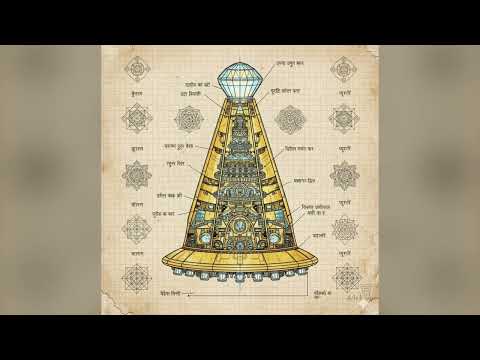
The Four Vimanas of Vaimanika Shastra
A close look at the specific vimana designs described in the 1973-published text and the questions surrounding their construction and feasibility.
Vimana — Mysteries in the Skies of Ancient India
A general-audience documentary survey of the vimana legend across the Ramayana, Mahabharata, and later folklore, useful as an overview of how the popular version of this story is typically told.
Further Reading
The Rāmāyaṇa of Vālmīki: An Epic of Ancient India, Volume V: Sundarakāṇḍa
The standard modern scholarly critical translation of the specific book of the epic — Hanuman's flight to Lanka — that contains the Pushpaka Vimana's fullest description, with extensive annotation on composition history and dating.
The Mahabharata: Volume 1
The opening volume of Debroy's complete, unabridged ten-volume modern English translation of all eighteen parvas, based on the critical Sanskrit edition prepared at the Bhandarkar Oriental Research Institute — the standard scholarly entry point for the epic's later vimana episodes (the Salva/Saubha and King Vasu's celestial car).
The Sanskrit Epics
The standard academic study of the composition, dating, and literary conventions of the Ramayana and Mahabharata, essential context for reading vimana passages as their original audience would have understood them.
Chariots of the Gods?
The foundational paleocontact text that introduced the Pushpaka Vimana to a global popular audience as evidence of extraterrestrial visitation. Essential primary reading for understanding the claim under scrutiny in this file, though academically discredited.
The Space-Gods Revealed: A Close Look at the Theories of Erich von Däniken
A systematic, source-by-source rebuttal of von Däniken's claims, with a foreword by Carl Sagan, including his use of Sanskrit vimana passages, written within a decade of the original book's publication.
Sources
- Valmiki. Ramayana, Sundara Kanda, Sarga 7 (verses 5.7.7–5.7.14). Sanskrit text & English translation, sanskritdocuments.org
- Rig Veda 1.118.1, trans. H.H. Wilson (1866), via Wisdom Library
- "Vimana," Wikipedia, en.wikipedia.org/wiki/Vimana
- "Vimana (architectural feature)," Wikipedia, en.wikipedia.org/wiki/Vimana_(architectural_feature)
- "Vaimānika Shāstra," Wikipedia, en.wikipedia.org/wiki/Vaimānika_Shāstra
- "2015 Indian Science Congress ancient aircraft controversy," Wikipedia, en.wikipedia.org
- "Erich von Däniken," Wikipedia, en.wikipedia.org/wiki/Erich_von_D%C3%A4niken
- "Chariots of the Gods?," Wikipedia, en.wikipedia.org/wiki/Chariots_of_the_Gods
- "Ramayana," Wikipedia, en.wikipedia.org/wiki/Ramayana
- "Mahabharata," Wikipedia, en.wikipedia.org/wiki/Mahabharata
- "James L. Fitzgerald," Wikipedia, en.wikipedia.org/wiki/James_L._Fitzgerald
- "Helios," Wikipedia, en.wikipedia.org/wiki/Helios
- Mukunda, H.S., Deshpande, S.M., Nagendra, H.R., Prabhu, A. & Govindaraju, S.P. "A Critical Study of the Work Vaimanika Shastra." Scientific Opinion, 1974. Digitized at Rare Book Society of India
- Shastry, Subbaraya (trans. G.R. Josyer). Vaimanika Shastra. Coronation Press, Mysore, 1973. Digitized at Rare Book Society of India
- "Vyamanika Shastra is a big fat hoax: Claims of aviation in ancient India debunked 40 years ago." Kannadiga World, kannadigaworld.com
- Colavito, Jason. "Vimana Aircraft of India: More Sloppy Scholarship from David Childress." jasoncolavito.com
- "Erich von Däniken: A Legacy of Pseudoscience." Skeptical Inquirer, skepticalinquirer.org
- "The Ramayana (Tales of Rama; The Freer Ramayana), Volume 2." Smithsonian National Museum of Asian Art, asia-archive.si.edu
- "File: Ravana seizes the chariot Puspaka from Kuvera.jpg." Wikimedia Commons, commons.wikimedia.org
- Monier-Williams, Monier. A Sanskrit-English Dictionary (1899), digital edition. University of Cologne Sanskrit Lexicon
- "Krishna Destroys Saubha, Slays Salva — Epic Battle in Kamyaka." Mahabharata summary (Vana Parva). wisdomlib.org
- "Battle of Dwaraka: Pradyumna Vs Salva in Epic Clash." Mahabharata summary (Vana Parva). wisdomlib.org
- "Controversy over 2015 Indian Science Congress session on Vedic aeronautics." South Asia Citizens Web, sacw.net
- Goldman, Robert P., ed. The Rāmāyaṇa of Vālmīki: An Epic of Ancient India. Princeton University Press, 1984–2016 (multivolume critical translation).
- Debroy, Bibek, trans. The Mahabharata. Penguin Classics, 2010–2014 (10-volume unabridged translation).
- Brockington, John. The Sanskrit Epics. Brill, 1998.
- Story, Ronald. The Space Gods Revealed: A Close Look at the Theories of Erich von Däniken. Harper & Row, 1976.
See something inaccurate? Have additional Sanskrit sources or corrections?
Suggest an Edit →Last Updated: August 2026