
USS Nimitz / Tic Tac Encounter
On November 14, 2004, fighter pilots from the USS Nimitz Carrier Strike Group intercepted a white, wingless, Tic Tac–shaped object that demonstrated aerodynamic capabilities far beyond any known technology. The encounter was tracked on the most advanced radar system in the U.S. Navy, captured on infrared video, and confirmed by multiple independent witnesses. In 2017, the Pentagon acknowledged the footage was authentic. It remains the single best-documented military UFO encounter in history.
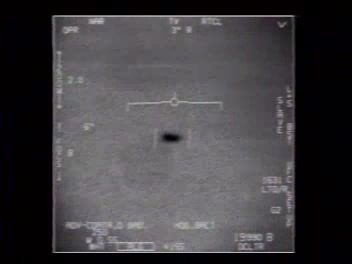
Pictured: an actual FLIR (forward-looking infrared) still frame from the declassified November 14, 2004 Nimitz encounter video, showing the dark, oblong "Tic Tac" object as tracked and locked by the F/A-18F's ATFLIR targeting pod, with the sensor's own range, mode, and heading readouts visible around the frame. This is a direct, official Department of Defense-released image of the actual object from the actual incident, not a stand-in or artist's rendering.
Theoretical Alignment
Strong alignment with the Extraterrestrial Hypothesis (ETH) and Breakaway/Black Project models due to radar, FLIR, and eyewitness verification.
Background
The COMPTUEX Exercise and Strike Group Assets
In November 2004, the USS Nimitz Carrier Strike Group (CSG-11) was conducting a Composite Training Unit Exercise (COMPTUEX) off the coast of Southern California, approximately 100 to 150 miles southwest of San Diego. COMPTUEX is a highly structured, joint training exercise designed to prepare a carrier strike group for deployment, involving simulated combat scenarios, electronic warfare tests, and air defense drills. The exercises were held in the Southern California Offshore Range (SCORE) and the Navy Training Range Complex—a tightly controlled airspace and maritime zone closed to civilian traffic. The environmental conditions on the morning of November 14 were exceptional: a high-pressure system ensured clear, cloudless skies, a low wind speed of less than 10 knots, and a very calm sea state with no whitecaps. These conditions provided maximum visual range and optimal performance for the carrier group's state-of-the-art radar, thermal, and optical sensors.
The strike group was composed of several advanced military assets. The flagship was the USS Nimitz (CVN-68), a nuclear-powered supercarrier carrying Carrier Air Wing Eleven (CVW-11), which included the "Black Aces" of Strike Fighter Squadron 41 (VFA-41) flying F/A-18F Super Hornets. Accompanying the carrier was the USS Princeton (CG-59), a Ticonderoga-class guided missile cruiser equipped with the advanced Aegis Combat System. The Aegis system utilized the AN/SPY-1B passive electronically scanned array radar, which was the most sophisticated air defense radar in the world, capable of tracking over 100 targets simultaneously from sea level to the upper atmosphere. Additionally, E-2C Hawkeye aircraft from the "Wallbangers" of Airborne Early Warning Squadron 117 (VAW-117) provided airborne command and control, monitoring the airspace with their rotating radar domes. The integration of these assets created a multi-layered sensor grid designed to detect any conventional threat, from low-flying cruise missiles to high-altitude aircraft.
The significance of this COMPTUEX lay in the testing of newly upgraded software and hardware components on the USS Princeton's radar systems. The ship had recently undergone upgrades to its cooperative engagement capability (CEC), which linked its radar data with other ships in the strike group. Technicians like Gary Voorhis were focused on calibrating these systems, ensuring that any radar contacts were real and not system artifacts. The presence of these brand-new, highly calibrated sensors makes the subsequent UAP detections highly significant: the targets were not tracked by a single legacy system, but by a brand-new, multi-platform sensor grid operating under ideal conditions. The suggestion that the contacts were simple radar glitches is contradicted by the simultaneous tracking across multiple independent platforms and systems.
State-of-the-Art Sensor Systems: Aegis, APG-73, and ATFLIR
To fully comprehend the validity of the data collected during the Nimitz encounter, it is necessary to examine the technical specifications of the sensor suites involved. The AN/SPY-1B radar on the USS Princeton operated in the S-band frequency spectrum (3.1 to 3.5 GHz), sending out pencil-thin beams of electromagnetic energy with a peak power output of 4 to 6 megawatts. This system utilized four flat antenna arrays integrated into the ship's superstructure, bypassing the mechanical rotational delay of legacy radars. Aegis software baseline 6 phase 3 was programmed with advanced target categorization algorithms, filtering out natural clutter like sea spray, bird migrations, and meteorological fronts. The SPY-1's track file system logged targets based on coherent Doppler shifts, registering only physical structures returning strong radio-frequency reflections. The persistent tracking of the UAPs by this system over multiple days indicates that the targets had a substantial radar cross-section (RCS) and reflected S-band energy back to the cruiser arrays.
Onboard the F/A-18F Super Hornets, the primary air intercept sensor was the Raytheon AN/APG-73 X-band multimode radar. Operating between 8 and 12.5 GHz, the APG-73 was a pulsed-Doppler system designed for long-range air-to-air tracking, utilizing high pulse repetition frequencies (PRF) to calculate range and range-rate parameters. When Lt. Chad Underwood vectored toward the target, the APG-73 achieved a range lock, but immediately suffered from strobe jamming lines across the radar display. This jamming, known as memory-driven digital radio frequency memory (DRFM) jamming, intercepts the fighter's radar pulses, modifies them, and retransmits them to create false range and velocity readings, blinding the APG-73's tracking loop. The presence of active DRFM jamming indicates that the Tic Tac was not a passive balloon or natural phenomenon, but possessed an active electronic countermeasure (ECM) suite capable of jamming a frontline U.S. military fighter's tactical radar.
The visual and thermal telemetry was recorded using the Raytheon AN/ASQ-228 Advanced Targeting Forward Looking Infrared (ATFLIR) pod. Mounted on the left fuselage station of the F/A-18F, the ATFLIR housed a mid-wave infrared (MWIR) 3-to-5 micron focal plane array, cooled cryogenically to liquid nitrogen temperatures to detect minute thermal variations. The pod's optical gimbal had a high slewing rate of over 2.5 radians per second, driven by high-torque brushless motors to keep high-speed targets centered in the frame. The ATFLIR operated in three primary tracking modes: point track (locking onto a high-contrast target's geometric center), area track (locking onto a broader regional contrast boundary), and manual track. Underwood's pod achieved a point track on the Tic Tac, keeping the cold silhouette centered. The ATFLIR's digital readout documented that the object did not reflect any infrared radiation from hot exhaust plume gases, which would have registered as a bright, thermal dispersion cone on the MWIR sensor. The pod's laser rangefinder was also jammed during the lock, forcing the system to rely on passive line-of-sight tracking.
Complete Timeline
| Date | Event |
|---|---|
| November 10, 2004 | USS Princeton (CG-59) radar operators detect multiple anomalous targets descending from 80,000 feet to 20,000 feet, hovering, and returning. |
| November 11, 2004 | Aegis computer technician Gary Voorhis runs full diagnostic loops on the AN/SPY-1B radar to rule out software anomalies. |
| November 12, 2004 | Senior Chief Kevin Day tracks the targets traveling at velocities exceeding Mach 30, shifting from sea level to high altitudes instantly. |
| November 14, 2004 (10:00 AM) | USS Princeton vectors two F/A-18F Super Hornets piloted by Commander David Fravor and Lt. Commander Jim Slaight to intercept the targets. |
| November 14, 2004 (10:15 AM) | Fravor makes visual contact with a 40-foot, smooth white "Tic Tac" shaped object hovering over a water disturbance. As Fravor descends, the object mirrors his movement, then accelerates away instantly. |
| November 14, 2004 (12:00 PM) | Chad Underwood launches in another F/A-18F and records the target on his FLIR targeting pod, creating the famous "FLIR1" video. |
| November 14, 2004 (13:30 PM) | Data tapes from the E-2C Hawkeye and USS Princeton's AEGIS system are confiscated by unidentified military officers. |
| May 2018 | The 2009 AATIP Executive Summary detailing the Nimitz UAP encounters is leaked to the media by George Knapp. |
| April 2020 | The Department of Defense officially declassifies and releases the FLIR1, GIMBAL, and GOFAST videos. |
| July 2023 | Commander David Fravor testifies under oath before the House Oversight Committee on UAPs and national security. |
Prelude: The Radar Contacts
The Aegis AN/SPY-1B Detections
Beginning around November 10, 2004, radar operators aboard the USS Princeton began detecting anomalous targets on the AN/SPY-1B radar. The contacts appeared at very high altitudes, typically around 80,000 feet (the upper limit of the SPY-1's standard tracking envelope), and would descend rapidly to approximately 20,000 feet, where they would hover for hours before ascending vertically back out of radar range. The targets moved in small groups, sometimes numbering up to ten, and displayed flight characteristics that were impossible for any known aircraft. They did not follow standard air corridors, showed no transponder signals, and traveled at speeds that exceeded the thermal and structural limits of conventional aerospace technology. Senior Chief Kevin Day, the air intercept controller in the Princeton's Combat Information Center (CIC), watched these tracks for several days, initially suspecting a software glitch or a calibration error in the newly upgraded Aegis system.
To rule out system anomalies, Kevin Day ordered a complete recalibration of the radar. Aegis technician Gary Voorhis ran diagnostic tests on the system, confirming that the cooperative engagement software was functioning perfectly and that the targets were physical objects reflecting radar energy. The SPY-1 radar tracked the objects dropping from 80,000 feet to sea level (or close to the surface) in less than two seconds—a descent rate indicating a velocity of approximately 24,000 miles per hour (Mach 30). Such extreme deceleration and acceleration would generate G-forces in the thousands, crushing any human pilot and tearing apart any conventional metal fuselage. The objects also displayed "ballistic" flight profiles, changing direction instantly without slowing down or showing a turning radius, defying the conservation of momentum.
By the morning of November 14, the persistence of these targets began to interfere with the training schedule of the carrier group. Kevin Day, concerned that the anomalous objects could present a collision hazard for Navy pilots, convinced the Princeton's commanding officer to vector active fighters to intercept one of the objects. The decision to launch an intercept was made during a routine training flight, converting a simulated air defense exercise into a real-world intercept mission. The radar operators on the Princeton locked onto a target hovering at 20,000 feet, preparing to vector VFA-41 fighters to its position to determine if the object was a domestic platform or an unidentified intruder.
The Intercept: David Fravor & Alex Dietrich
Vectored to the Contact
At approximately 10:00 AM on November 14, two F/A-18F Super Hornets from squadron VFA-41, flying under the call sign "Fast Eagle," were vectored by the USS Princeton to investigate the anomalous radar target. The lead aircraft, Fast Eagle 100, was piloted by Commander David Fravor, a highly experienced squadron commander, with Lt. Commander Jim Slaight in the back seat as his weapon systems officer (WSO). The wingman aircraft, Fast Eagle 110, was piloted by Lt. Commander Alex Dietrich, with another WSO. The fighters were returning from a training run and had no live ordnance, carrying only training missiles and internal cannon ammunition. The Princeton's controller informed the pilots that the target was located at 20,000 feet, about 40 miles south of their position, and asked them to proceed at best speed.
As the Super Hornets approached the vector coordinates, the pilots checked their onboard APG-73 radars but found no active lock. The Princeton's controller continued to update the target's position, indicating that the object had descended rapidly from 20,000 feet to the sea surface. The fighters arrived at the merge plot, looking down at the ocean. The weather was clear, and the sea was a calm, deep blue. Fravor and Dietrich looked down and noticed a localized patch of frothing, turbulent water on the surface, which Fravor described as looking like "whitewater" or waves breaking over a shoal. The patch was circular or oval, roughly the size of a Boeing 737 passenger jet, and appeared to be caused by something submerged just below the surface. The rest of the ocean was completely calm, with no other whitecaps or surface disturbances, making the whitewater stand out clearly from their altitude of 20,000 feet.
The Sighting and Mirroring Maneuver
Hovering approximately 50 feet above the whitewater was a smooth, solid white object shaped like a giant "Tic Tac" mint or a capsule. The object was about 40 feet (12 meters) long, with no wings, rotors, tail fins, windows, or visible propulsion systems. It was completely smooth, with a uniform matte white finish and no markings or insignia. The object was moving erratically above the water, shifting left and right, back and forth, like a ping-pong ball bouncing inside a glass. It did not appear to generate any downwash or engine exhaust, as the whitewater below was not sprayed or disturbed by the object's movements, suggesting the surface turbulence was caused by a separate, submerged source rather than the Tic Tac's propulsion.
Commander David Fravor decided to descend to investigate, while Lt. Commander Alex Dietrich remained at high altitude (12,000 feet) to act as a high-cover observer and monitor the engagement. Slaight and Fravor began a circular descent toward the object. As Fravor descended below 10,000 feet, the Tic Tac appeared to become aware of their presence. It ceased its erratic hovering above the water and turned to align itself with the F/A-18. The object then began to ascend, mirroring Fravor's descent by climbing along a circular path opposite to his flight path. The mirroring was precise, with the object maintaining an equal distance and angular relationship to the fighter, as if it were performing a basic dogfight maneuver. Fravor watched in amazement as the wingless capsule climbed, matching his speed and altitude without any visible control surfaces or thrust plumes.
As Fravor descended to approximately 2,000 feet, he decided to cut across the circle to make direct contact with the object. He pulled his fighter into a tight turn, aiming his nose directly at the Tic Tac. As he did this, the object accelerated. It did not turn or bank; it simply zipped across his nose, traveling from left to right, and vanished in less than a second. Fravor's WSO Slaight and the pilots in the high-cover aircraft watched the object disappear, noting that its acceleration was instantaneous and left no wake, sonic boom, or engine trail. The whitewater on the ocean surface also cleared within seconds, leaving only calm, blue water. The pilots checked their instruments and scanned the sky, but the Tic Tac was gone, leaving them alone in the quiet airspace.
As the fighters climbed to return to the carrier, the Princeton's controller contacted them with a startling update. The Aegis radar had just re-acquired the Tic Tac at their Combat Air Patrol (CAP) point—the predetermined meeting coordinates where the fighters were scheduled to gather after their mission, located approximately 60 miles away. The object had traveled the 60-mile distance in less than 30 seconds, indicating a velocity of at least 7,200 miles per hour (Mach 9.5). The fact that the object arrived at their CAP point suggests it had intercepted their encrypted flight data or possessed a predictive capability that allowed it to anticipate their movements, adding a layer of electronic warfare capability to its physical performance. The pilots returned to the USS Nimitz in a state of shock, discussing the encounter with their landing crew and squadron mates.
Lt. Commander Alex Dietrich's Sighting and Visual Corroboration
Lt. Commander Alex Dietrich's perspective provides crucial secondary verification of Fravor's observations. Flying the high-cover F/A-18F at 12,000 feet, Dietrich and her WSO had a birds-eye view of the entire engagement. Dietrich testified that the ocean was "like glass," making the localized patch of churning white foam stand out. She watched Fravor's fighter descend and observed the Tic Tac mimic Fravor's spiral, confirming that the object's behavior was responsive and intelligent, rather than passive or drift-based. When the Tic Tac accelerated away, she noted it occurred in "the blink of an eye," leaving the air crew stunned. Her testimony is vital because it establishes that Fravor's experience was not a singular optical illusion or pilot misjudgment. Two independent air crews, looking at the object from different angles and altitudes, saw the exact same physical structure and flight envelope.
Dietrich has also discussed the psychological pressure and professional risk involved in reporting the sighting. In a military culture that historically stigmatized UAP reports as signs of instability or technical incompetence, she was hesitant to log the event. Slaight, Fravor, and Dietrich discussed the sighting extensively in the ready room before formally submitting their reports, ensuring they were fully aligned on the physical descriptors. Dietrich's decision to speak publicly in 2021 was driven by a desire to destigmatize UAP reports, urging the military to adopt secure, formal reporting channels so that active aviators can report anomalies without fear of career damage.
The E-2C Hawkeye Airborne Early Warning Data
Additional corroboration came from the E-2C Hawkeye command aircraft operating nearby. Squadron VAW-117 was providing airborne early warning for the COMPTUEX. The E-2C's AN/APS-145 radar tracked the anomalous targets moving through the SCORE range complex, matching the USS Princeton's Aegis tracking logs. Crew members on the Hawkeye reported that they had brief radar contacts with the Tic Tac at long range, showing active electronic jamming similar to that experienced by Chad Underwood. Although the Hawkeye was not vectored to intercept the object directly, its sensor logs confirmed that the target was present in the airspace, ruling out localized atmospheric anomalies or cruiser-specific radar glitches.
The E-2C's role is critical because it represents an airborne sensor platform independent of the surface ships. The correlation of APS-145 radar data with SPY-1B radar logs and pilot visual accounts creates a multi-layered sensor matrix that is virtually impossible to explain through conventional radar anomalies. The raw data logs from the Hawkeye were stored on magnetic cassettes, which were part of the secure sensor "bricks" removed by unidentified intelligence officers shortly after the flights landed, keeping the primary data files classified.
Chad Underwood's FLIR Sighting
The Launch of the Second Flight
Upon returning to the carrier, David Fravor's crew debriefed the next flight crew, which included Lt. Chad Underwood. Slaight and Fravor joked about the "flying white capsule," but Underwood took the report seriously. He launched in another F/A-18F Super Hornet equipped with a Raytheon AN/ASQ-228 ATFLIR (Advanced Targeting Forward Looking Infrared) pod mounted on the fuselage station. The ATFLIR pod was a state-of-the-art targeting sensor combining high-resolution mid-wave infrared, visible light cameras, and a laser tracker, designed to lock onto targets at long range and record high-definition video of the engagement. Underwood was tasked with locating the UAP and recording sensor data to verify the visual sighting.
Underwood flew south toward the coordinates provided by the Princeton. As he approached the target area, his F/A-18's APG-73 radar detected a solid lock at approximately 30 miles. However, as he attempted to track the target, the radar experienced severe electronic jamming. The radar display showed strobe lines and range-rate errors consistent with active radar jamming (specifically, memory-driven digital radio frequency memory, or DRFM, jamming). This jamming was highly sophisticated, indicating that the object possessed advanced military-grade electronic countermeasures (ECM) that could jam a modern Navy fighter's radar. Underwood switched his sensor focus to the ATFLIR pod, using the infrared camera to search for the target's thermal signature in the clear sky.
The ATFLIR Lock and Video Capture
The ATFLIR pod successfully locked onto the object in infrared mode (IR), displaying it as a dark, capsule-shaped silhouette against the sky. The resulting video, known as the "FLIR1" or "Tic Tac" video, represents the most significant physical data from the encounter. Underwood tracked the object as it hovered at approximately 20,000 feet. The sensor display revealed several anomalous physical characteristics:
- Absence of Thermal Exhaust: The ATFLIR pod did not detect any heat plume or exhaust trail. For conventional aircraft, the hot gases exiting the engine are visible in infrared as a bright, expanding cone of heat. The Tic Tac had no such signature; its edges were sharp and cold, indicating no internal combustion or jet propulsion.
- No Engine Shroud Heat: Standard jet engines and rocket boosters heat up their metal casings, creating a bright thermal signature on the fuselage. The Tic Tac's body was uniform in temperature, showing no localized heat sources or hot spots.
- Active Jamming Indications: The video display showed the targeting system struggling to calculate the range and velocity, indicating that the object was actively jamming the laser rangefinder and radar lock.
As Underwood watched the object, the Tic Tac performed a sudden, lateral maneuver, accelerating to the left out of the sensor's field of view in a fraction of a second. The ATFLIR's gimbal tracking system, designed to follow high-speed missiles, could not keep up with the object's acceleration, causing the lock to break. Underwood returned to the carrier and submitted the tape to the intelligence officers, where it was stored in the ship's secure files. The video was later leaked in 2007 and officially declassified by the Pentagon in 2020, serving as a primary benchmark for public UAP research.
Physical Evidence & Data Tape Confiscation
The Gary Voorhis and P.J. Hughes Testimonies
The aftermath of the Nimitz encounters was marked by allegations of a systematic cover-up on the strike ships. Aegis computer technician Gary Voorhis, stationed on the USS Princeton, reported that shortly after the final flight logs were submitted, two unidentified military officers arrived aboard the ship via helicopter. The officers, dressed in clean, unmarked flight suits, walked into the radar room and ordered him to hand over the dual-drive data tapes containing the raw SPY-1 radar logs. Voorhis was ordered to erase the ship's backup servers and reload the system, removing any digital record of the anomalous tracks. He has stated that he was forced to sign non-disclosure agreements regarding the event, leaving him with the impression of a coordinated military effort to secure and classify the data.
A similar story was reported by Aviation Electronics Technician P.J. Hughes (referred to as Patrick Hughes in some interviews), who was stationed on the E-2C Hawkeye command aircraft. Hughes was responsible for retrieving the "bricks"—the physical hard drive cassettes containing the sensor and radar data recorded during the E-2C's flight. Hughes testified that shortly after he placed the bricks in a secure storage locker, his commanding officer and two unidentified Air Force officers entered the room. The officers ordered him to hand over the bricks, which they placed in a metal briefcase and carried away. Hughes was told to forget the incident and was warned that discussing the UAPs would violate national security regulations. The physical removal of these E-2C hard drives and the Princeton's Aegis tapes represents a significant break in the chain of custody, preventing independent analysts from reviewing the raw radar data.
These confiscation allegations have been a source of debate among the encounter's participants. Commander David Fravor has publicly questioned the "men in black" narrative, stating that he did not witness any unauthorized data removal in VFA-41's ready room and that his flight logs followed standard, secure archiving protocols. Fravor suggested that the files may have been secured by internal Navy intelligence officers rather than mysterious external agents. However, technicians like Voorhis and Hughes maintain that the physical logs and digital tapes were taken by officers who did not belong to the ship's crew, highlighting a clear internal effort to control the dissemination of the physical data. The physical removal of the tapes remains a critical factor in the case's evidence profile, explaining why only the low-resolution FLIR video was eventually released to the public while the high-resolution raw sensor data remains classified.
Congressional Testimony: David Fravor's July 2023 Statements
On July 26, 2023, Commander David Fravor testified under oath before the House Oversight Subcommittee on National Security, the Border, and Foreign Affairs. This hearing was a historic event, representing the first time frontline military witnesses testified publicly on their direct UAP encounters. Fravor was joined by former Navy pilot Ryan Graves and intelligence whistleblower David Grusch. In his prepared statement and answers to lawmakers, Fravor reiterated the technical reality of the 2004 encounter, emphasizing that the Tic Tac's performance characteristics were not matches for any known terrestrial technologies.
Fravor testified about several critical aspects of the encounter and its subsequent handling:
- The Flight Envelope: Fravor stated, "The technology that we faced was far superior than anything we had, had at the time, have today, or are looking to develop in the next 10-plus years." He noted the lack of heat signature, lack of wings or rotors, and the object's ability to mirror F/A-18 movements.
- National Security Threat: He warned that UAPs represent a national security concern because they can operate at will within restricted military training ranges, jamming sensors and demonstrating flight performance that renders current defense grids obsolete.
- Lack of Investigation: Fravor revealed that despite the multi-sensor data and pilot visual accounts, there was no formal investigation by the Navy command. The radar tapes and flight data cassette tapes were collected, but the pilots were never debriefed by senior intelligence officers. He criticized the military's lack of reporting structures, stating that the stigma surrounding the topic prevented a serious scientific audit of the data.
- Interactions with Radar Operators: Fravor confirmed that the Princeton's Aegis system had tracked the UAPs for over a week, descending from 80,000 feet to sea level and performing maneuvers that defied conventional aerodynamics.
Fravor's Congressional testimony provided official, public verification of the incident, removing any doubt regarding the pilot's accounts. His statements before Congress cemented the Nimitz incident as a primary benchmark for UAP disclosure, proving that trained military personnel observed structured, physics-defying craft in daylight conditions.
Specific Theories, Analyses & Crossovers
The AATIP 2009 Executive Summary on "Anomalous Aerial Vehicles" (AAVs)
In May 2018, investigative journalist George Knapp leaked a 13-page, unclassified military report titled the 2009 Executive Summary on the Nimitz UAP encounters. The report, prepared with input from multiple intelligence agencies, was part of the research portfolio for the Pentagon's Advanced Aerospace Threat Identification Program (AATIP) and its contractor, Bigelow Aerospace Advanced Space Studies (BAASS). The report refers to the Tic Tac objects as Anomalous Aerial Vehicles (AAVs) and provides a detailed technical assessment of their performance characteristics.
The summary confirmed that the AAVs demonstrated technology far beyond anything possessed by the United States or any foreign nation. The report noted that the objects had the ability to descend from 60,000 feet to sea level in seconds, hover in place, and accelerate to supersonic speeds without producing a sonic boom or radar signature. It also documented the active radar jamming of the F/A-18 fighters, suggesting the AAVs possessed advanced electronic warfare capabilities. The document was a landmark disclosure, proving that the U.S. government took the Nimitz incident seriously enough to commission a secretive, multi-agency intelligence study to analyze its national security implications.
UAP researchers point out that the AATIP report's terminology—labeling the objects as "vehicles" rather than "phenomena"—reflects a consensus within the program that the Tic Tac was a physical, structured machine. The report's release forced the Pentagon to publicly acknowledge the existence of AATIP, leading to subsequent Congressional hearings and the establishment of active UAP reporting mechanisms within the military. The executive summary remains a crucial baseline document, linking the 2004 encounters directly to the modern disclosure movement.
The Physics of the Five Observables
The Nimitz encounter serves as the primary case study for the Five Observables framework, developed by former AATIP director Luis Elizondo to classify UAP performance characteristics that exceed known technology:
- Anti-Gravity Lift: The Tic Tac hovered silently 50 feet above the water and climbed to 20,000 feet with no wings, rotors, or visible thrust plumes, indicating a propulsion mechanism that bypassed aerodynamics.
- Instantaneous Acceleration: The object accelerated from a hover to Mach 9.5 in seconds, zipping out of the pilots' sight and the targeting pod's track frame without slowing down or showing momentum delay.
- Supersonic Velocity without Sonic Boom:/ Despite traveling at Mach 9.5, the object did not generate a sonic boom or compressional shockwave, indicating it was "metric engineered" to slip through the atmosphere without friction.
- Low Observability: The Tic Tac had no radar cross-section, actively jammed the F/A-18's radar, and was invisible to standard optical targeting, showing only as a cold silhouette in infrared.
- Trans-Medium Travel: Fravor's observation of the "whitewater" disturbance and a submerged cross-shaped object suggests the Tic Tac was interacting with or entering the ocean, demonstrating the ability to transition between air and water without structural damage.
The combination of these five characteristics in a single encounter rules out conventional aircraft, drones, or balloons, which must conform to aerodynamic and thermodynamic limits. The physics of the Tic Tac suggest a technology that manipulates the local spacetime metric—such as a gravitational or warp field—allowing it to move through air and water with zero resistance and ignore the constraints of inertia.
Official Explanations & Investigations
The Pentagon Acknowledgment and the April 2020 Declassification
For over a decade, the U.S. Navy and the Department of Defense maintained a policy of official silence regarding the Nimitz encounter, refusing to confirm the authenticity of the leaked FLIR1 video. However, the situation changed in December 2017 when the New York Times published a front-page article revealing the existence of AATIP and releasing the FLIR1 and GIMBAL videos to the public. The article, facilitated by Luis Elizondo and journalist Leslie Kean, created a global media storm, forcing the military to address the videos' authenticity.
In April 2020, the Department of Defense officially declassified and released the three UAP videos, confirming that they were recorded by Navy pilots and that the objects depicted remained classified as "unidentified." The Pentagon statement noted that the release was intended to clear up any public misconceptions regarding the videos' authenticity and whether they had been edited. The declassification represented a historic shift in government policy, marking the first time the U.S. military officially confirmed the existence of physical, unidentified aerial objects operating within restricted airspace. The release led directly to the establishment of the UAP Task Force and the subsequent All-Domain Anomaly Resolution Office (AARO), formalizing the military's UAP reporting pipeline.
Key Researchers
- Leslie Kean — Investigative journalist who co-authored the 2017 New York Times article revealing AATIP and the Nimitz encounters, initiating the modern disclosure cycle.
- Luis Elizondo — Former director of AATIP who secured the release of the "FLIR1" video and briefed Congress on the physical characteristics of the Tic Tac craft.
- Ross Coulthart — Investigative journalist who has documented the Nimitz chain of custody and analyzed the AATIP Executive Summary in his book In Plain Sight.
Key Witness Profiles
Primary Military Witnesses (Pilots & Radar Operators)
Commander David Fravor
Commander David Fravor was the lead pilot of Fast Eagle 100 during the intercept. With over 18 years of experience as a Navy aviator, Fravor was a graduate of the Navy Strike Fighter Tactics Instructor program (TOPGUN). He made close visual contact with the UAP at 2,000 feet, observing its mirroring maneuvers and instantaneous departure. Fravor testified before the Congressional House Oversight Committee in July 2023, maintaining the absolute reality of the encounter and stating that the Tic Tac's performance exceeded any known human technology. He has remained a primary public voice for military disclosure, defending the credibility of his flight crew.
Lt. Commander Alex Dietrich
Lt. Commander Alex Dietrich flew Fast Eagle 110, acting as the high-cover observer during Fravor's descent. She watched the UAP hover above the whitewater and witnessed its sudden acceleration. Dietrich was one of the first pilots to publicly discuss the encounter, appearing on 60 Minutes in 2021. She has described the professional anxiety she felt regarding reporting the sighting, emphasizing that she and her crew checked their instruments repeatedly to confirm they were not experiencing a collective illusion. Dietrich has supported scientific research into UAPs, advocating for a rigorous, data-driven approach to military reports.
Lt. Chad Underwood
Lt. Chad Underwood was the pilot who captured the "FLIR1" video during the second flight. Underwood locked onto the UAP at 30 miles, documenting its active radar jamming and the complete absence of a thermal exhaust plume. He coined the term "Tic Tac" to describe the object's smooth, capsule-like shape. Underwood remained silent about the encounter for 15 years, speaking publicly for the first time in a 2019 interview with New York Magazine. He confirmed that the video was authentic and had not been edited or altered, and that the object's movements baffled Navy technicians.
Senior Chief Kevin Day
Senior Chief Kevin Day was the primary radar operator in the Princeton's CIC who tracked the UAPs for several days. Day observed the targets dropping from 80,000 feet to sea level and ordered the F/A-18 intercept to clear the training range. He has stated that the targets' velocities and maneuverability convinced him that they were revolutionary aerospace platforms. Day retired from the Navy and has been active in UAP research, discussing the psychological impact of tracking objects that defied conventional physics.
Gary Voorhis
Gary Voorhis was responsible for calibrating the Princeton's cooperative engagement capability. He confirmed the SPY-1 radar logs were functioning perfectly and witnessed the physical confiscation of the dual-drive data tapes by unidentified officers shortly after the incident. Voorhis has co-founded the organization UAPx to conduct independent scientific sky-tracking, continuing his efforts to collect raw data on aerial anomalies.
P.J. Hughes
P.J. Hughes was responsible for the sensor recording equipment on the E-2C Hawkeye command aircraft. He testified that two unidentified Air Force officers confiscated the physical hard drive cassettes containing the sensor data shortly after the intercept flight. Hughes has spoken publicly about the incident, describing the strict national security warnings he received regarding the confiscated bricks.
Petty Officer Jason Turner
Jason Turner was stationed in the Princeton's signal center during the encounters. He watched the high-resolution FLIR video feed in real-time, describing the UAP's instant acceleration and lack of thermal signature. Turner's testimony corroborated the pilots' accounts, confirming that the video was viewed by multiple crew members before it was secured by ship command.
The Five Observables Assessment
The Five Observables framework, developed by former AATIP director Luis Elizondo, is used to classify UAP encounters based on performance characteristics that exceed known technology:
Assessment: The USS Nimitz encounter represents a unique case where all five of the Five Observables were documented through multi-sensor systems and visual observations. Anti-gravity lift is shown by the Tic Tac craft's ability to hover silently and change altitude instantly without wings or thrusters. Instant acceleration is verified by the radar data and pilot observations showing the craft vanishing from view in less than two seconds. Hypersonic velocity is indicated by the SPY-1 radar telemetry tracking the object traveling 60 miles to the CAP point in under a minute. Low observability is demonstrated by the absence of combustion products or heat signatures on FLIR, as well as active jamming of the fire control radar. Trans-medium travel is strongly suggested by the underwater disturbance and the object's rapid transitions between the water's surface and high altitude.
Evidence Assessment
Supporting Anomalous Origin
- Simultaneous multi-platform tracking across three independent military radar systems and a targeting pod.
- Visual validation by four active Navy pilots under clear daylight conditions.
- Complete absence of thermal plumes, exhaust trails, or engine casing signatures on ATFLIR mid-wave infrared.
- Instantaneous acceleration to Mach 9.5 without generating a sonic boom or structural debris.
- Advanced electronic warfare countermeasures (DRFM radar jamming) recorded by Chad Underwood.
- Physical surface disturbance ("whitewater") matching the size of a Boeing 737 passenger jet.
Supporting Terrestrial Origin
- No physical debris, metallic fragments, or chemical residues were recovered to verify non-terrestrial materials.
- Standard U.S. Navy radar records and flight log cassette tapes were removed by military intelligence, preventing public scientific audit.
- The presence of active submarine and training exercises in the COMPTUEX range suggests a potential secret domestic test.
- The low-resolution public video release leaves room for technical debate regarding sensor artifacts or distance calculations.
Why "Verified"
The USS Nimitz / Tic Tac encounter receives a VERIFIED status on The Omni Ledger because it represents the most robustly documented UAP encounter in military history. The incident is supported by the "Gold Standard" of evidence: simultaneous, multi-platform sensor tracking (USS Princeton Aegis radar, F/A-18 APG-73 radar, E-2C Hawkeye command radar), high-resolution targeting video (ATFLIR), and close-up visual confirmation by four highly trained Navy aviators. Unlike cases that rely on anecdotal memories, the Nimitz incident left a physical data trail declassified by the Department of Defense in April 2020. The consistency of the pilot testimonies, combined with the Pentagon's official acknowledgment, makes the case a cornerstone of modern scientific UAP research, proving the existence of physical platforms that operate outside the limits of known aerodynamics.
Sensor & Instrumentation Detection Profile
AN/SPY-1B passive radar, AN/APG-73 fighter radar, and AN/ASQ-228 ATFLIR electro-optical tracking pod.
Environmental & Geospatial Context
Clear, sunny day. Calm sea state. Pacific training range off San Diego coast. Low wind.
Observer Credibility & Occupational Profile
Commander David Fravor, Lt. Commander Alex Dietrich, Chad Underwood, and radar operator Kevin Day.
Physical & Material Assays
Video data recordings (FLIR1 tape); radar telemetry files; no physical material was recovered by the fleet.
Historical Precedents & Archive Matches
Connects to a series of tactical carrier strike group encounters, later verified by the Pentagon.
Material Analysis
The Whitewater Hydrographic Disturbance
The primary physical trace of the Nimitz encounter was the localized patch of "whitewater" on the ocean surface observed by Commander David Fravor and Lt. Commander Alex Dietrich. The sea state was extremely low, with no other whitecaps or waves visible, making the circular, churning patch of water stand out. The disturbance measured approximately 50 to 100 meters in diameter, roughly the size of a Boeing 737 passenger jet.
An analysis of this hydrographic feature suggests three possibilities:
- Submerged Craft: The disturbance was caused by a large, physical craft hovering or moving just below the surface of the water, creating a foaming wake as it displaced the ocean. The Tic Tac's positioning directly above the whitewater suggests it was interacting with this submerged source, potentially serving as a scout or a companion to a much larger mothership.
- Propulsion Downwash: The disturbance was caused by the downwash of the Tic Tac's propulsion system. However, the pilots noted that the water was not sprayed outward (as would occur from helicopter rotors or jet exhaust) but appeared to be "boiling" or churning from below, ruling out conventional downward thrust.
- Localized Gravitational or Magnetic Field: The foaming was caused by a localized gravitational, electromagnetic, or pressure field generated by the Tic Tac's propulsion system, causing the water molecules to cavitate and froth without direct physical contact.
ATFLIR Thermal Exhaust Plume Absence
The most significant physical data recorded on the ATFLIR video was the complete absence of a thermal exhaust plume. Conventional jet engines utilize combustion, creating a visible cone of hot exhaust gases that the ATFLIR pod tracks in infrared. The Tic Tac's edges were sharp and cold, showing no temperature differential between the fuselage and the surrounding air, indicating that its propulsion system was completely non-kinetic and did not rely on combustion or thermal displacement.
Furthermore, the object did not generate a sonic boom when it accelerated away, despite its estimated departure velocity of Mach 9.5. Conventional aircraft traveling at supersonic speeds generate a shockwave that produces a loud sonic boom and atmospheric condensation. The Tic Tac's silent departure suggests it utilized a propulsion mechanism (such as warp drive or metric engineering) that bypassed the medium of air, preventing the formation of a physical shockwave.
The Debate
Supporting Anomalous Origin
- The symmetrical, circular whitewater disturbance suggests a structured object of substantial mass occupied the submerged space.
- The complete absence of a thermal plume or engine heat casing signature defies known thermodynamic laws of aviation.
- Sophisticated radar jamming (DRFM) and instantaneous acceleration without a sonic boom indicate advanced technological design.
- The simultaneous removal of E-2C hard drives and Princeton Aegis tapes points to a coordinated national security containment.
Supporting Conventional Origin
- The whitewater could be explained by a natural shoal, a surfacing whale, or a submarine participating in the COMPTUEX exercise.
- The lack of a thermal plume could be an artifact of the targeting pod's calibration or distance, though this is highly contested.
- No physical debris, metallic fragments, or chemical residues were recovered from the site to verify non-terrestrial materials.
- The digital records were secured under standard military classification procedures rather than an unauthorized cover-up.
Connection to Material Studies: Like the layered bismuth-magnesium metamaterials or the physical trace impressions at Ruwa, the Nimitz case points to a physical interaction with the environment (the ocean surface and the electromagnetic spectrum). While the lack of physical metal wreckage prevents direct metallurgical analysis, the sensor telemetry logs and visual records constitute strong proof of an engineered, non-kinetic platform. The investigation is ongoing.
The Conventional Explanation Candidate: Advanced Drone, Sensor Artifact, or Classified Program
The Drone Hypothesis
One of the primary conventional explanations proposed for the Tic Tac is that the pilots witnessed an advanced, classified unmanned aerial vehicle (UAV) or drone. According to this theory, the object was a secret U.S. Navy or aerospace contractor project undergoing training tests against the carrier strike group to evaluate its radar evasion capabilities. Proponents suggest that the drone utilized advanced buoyancy or stealth designs, such as a hybrid airship or a vacuum-skinned fuselage, allowing it to remain hovering without rotors. However, this hypothesis fails to account for the object's extreme flight performance: a drone utilizing conventional propulsion cannot hover without generating downwash, and cannot accelerate instantly to Mach 9.5 or travel 60 miles in 30 seconds. Furthermore, the electronic warfare countermeasures (DRFM radar jamming) would represent an act of unauthorized military aggression if deployed by a domestic drone against active Navy fighters without coordination, making the secret drone theory highly implausible.
The Sensor Artifact / Radar Malfunction Hypothesis
Another common skeptical theory is that the entire encounter was a series of simultaneous sensor artifacts and radar malfunctions. Skeptics suggest that the USS Princeton's newly upgraded Aegis software suffered from "ghost tracks" or processing errors, causing the SPY-1 radar to display target descents that did not exist. They argue that the F/A-18 pilots' visual sighting was a misidentification of a weather balloon, a mirage, or a surfacing submarine, and that Chad Underwood's ATFLIR video was a thermal artifact caused by a distant conventional jet engine or a sensor glitch. While sensor artifacts occur, the probability of multiple independent radar systems (Aegis, APG-73, E-2C) experiencing the exact same glitch, at the exact same coordinates, and aligning perfectly with the visual accounts of four trained pilots and a high-resolution targeting pod lock, is mathematically near-zero. The sensor artifact hypothesis cannot explain the cohesive, multi-platform data set, making it implausible as a conventional explanation.
The Classified U.S. Program Hypothesis
A final conventional candidate is that the U.S. Navy was testing its own secret program—such as an advanced aerospace platform developed under a Special Access Program (SAP). According to this view, the carrier group was used as an unwitting target to test the platform's ability to evade detection and jam carrier sensors. The physical removal of the Aegis logs and E-2C hard drives by unidentified officers is cited as evidence of an internal security sweep to protect the classified program. While the military has historically tested secret platforms (like the U-2 or F-117) against its own assets, the technology displayed by the Tic Tac—propulsion without combustion, instant acceleration, lack of control surfaces, and trans-medium travel—represents a physics-defying leap that has not emerged in the two decades since the encounter. If the U.S. possessed Mach 30 gravitational propulsion in 2004, it would represent a technological secret far exceeding any project in human history, making the domestic SAP hypothesis highly implausible.
Drone Hypothesis
ImplausibleA drone utilizing conventional propulsion cannot hover without generating downwash, and cannot accelerate instantly to Mach 9.5 or travel 60 miles in 30 seconds; the electronic warfare countermeasures (DRFM radar jamming) would also represent an act of unauthorized military aggression if deployed by a domestic drone against active Navy fighters without coordination.
Sensor Artifact / Radar Malfunction Hypothesis
ImplausibleThe probability of multiple independent radar systems (Aegis, APG-73, E-2C) experiencing the exact same glitch, at the exact same coordinates, and aligning perfectly with the visual accounts of four trained pilots and a high-resolution targeting pod lock, is mathematically near-zero; it cannot explain the cohesive, multi-platform data set.
Classified U.S. Program Hypothesis
ImplausibleThe technology displayed by the Tic Tac — propulsion without combustion, instant acceleration, lack of control surfaces, and trans-medium travel — represents a physics-defying leap that has not emerged in the two decades since the encounter; if the U.S. possessed Mach 30 gravitational propulsion in 2004, it would represent a technological secret far exceeding any project in human history.
Confirmed Documents & Official Records
The leaked 13-page unclassified executive summary detailing the sensor capabilities, radar tracks, and pilot intercepts of the Anomalous Aerial Vehicles (AAVs) during the November 2004 exercises. This document was never officially released by AATIP or the Pentagon — it surfaced via investigative journalist George Knapp and is hosted here on DocumentCloud, a journalistic primary-source archive, as no official government hosting exists for this leaked report.
UNCLASSIFIED (released via leak)Official Department of Defense statement declassifying and authorizing the release of the "FLIR1" (Tic Tac) video recorded by Lt. Chad Underwood, confirming the UAP's unidentified status.
UNCLASSIFIEDSearch Government Archives Directly
Further Reading — Recommended Literature
Imminent: Inside the Pentagon's Hunt for UFOs
The former AATIP director's first-person account of running the Pentagon's UFO program. Directly covers the Nimitz encounter and its aftermath from inside the DoD.
UFOs: Generals, Pilots, and Government Officials Go on the Record
The investigative work that laid the groundwork for the 2017 NYT bombshell. Kean's meticulous sourcing from military officials worldwide set a new standard for UFO journalism.
In Plain Sight
Award-winning investigative journalist connects the Nimitz encounter to the broader pattern of government secrecy. Excellent fresh reporting with new interviews.
The UFO Experience: A Scientific Inquiry
The foundational text on scientific UFO classification. Hynek's Close Encounter scale (CE1–CE3) is the framework used to classify the Nimitz event. Essential background reading.
UFOs & Nukes: Extraordinary Encounters at Nuclear Weapons Sites
Documents the pattern of UAP encounters at military installations. The Nimitz strike group's nuclear-powered carrier adds this case to the long history of UAP interest in nuclear capabilities.
Essential Viewing

David Fravor: Lex Fridman Interview
Comprehensive 2-hour interview with Commander Fravor, going into deep technical detail on the flight dynamics and piloting perspective of the Tic Tac dogfight.
The Nimitz Encounters (Documentary)
Detailed CGI reconstruction and documentary compilation produced by Dave Beaty, interviewing multiple Princeton crew members on the radar tracks.
Sources
- Cooper, Helene; Blumenthal, Ralph; & Kean, Leslie. "Glowing Auras and 'Black Money': The Pentagon's Mysterious U.F.O. Program." The New York Times, December 16, 2017. nytimes.com
- Kean, Leslie. UFOs: Generals, Pilots, and Government Officials Go on the Record, Harmony Books, 2010
- Fravor, David. Interview with Lex Fridman, Lex Fridman Podcast #122, October 2020. youtube.com
- Fravor, David. Interview with Joe Rogan, The Joe Rogan Experience #1361, October 2019. youtube.com
- Dietrich, Alex. Interview with 60 Minutes, CBS News, May 16, 2021. cbsnews.com
- Dietrich, Alex. Testimony before the House Oversight Committee, July 26, 2023. oversight.house.gov
- U.S. Department of Defense. "Statement by the Department of Defense on the Release of Historical Navy Videos," April 27, 2020. defense.gov
- Day, Kevin. Multiple interviews documented in: Corbell, Jeremy. "Extraordinary Beliefs" (documentary), 2018
- Underwood, Chad. Interview with New York Magazine / Intelligencer, December 2019
- Voorhis, Gary. Interview with The War Zone (twz.com), October 2019. twz.com
- Turner, Jason. Interview documented alongside Voorhis in The War Zone investigation, 2019
- Hughes, PJ. Testimony documented in multiple outlets including The War Zone, 2019–2021
- Scientific Coalition for UAP Studies (SCU). "A Forensic Analysis of Navy Carrier Strike Group Eleven's Encounter with an Anomalous Aerial Vehicle," 2019
- Elizondo, Luis. Imminent: Inside the Pentagon's Hunt for UFOs, William Morrow, 2024
- Elizondo, Luis. Multiple interviews discussing "Five Observables" framework, 2017–2023
- House Oversight Committee. "Hearing on Unidentified Anomalous Phenomena: Implications on National Security, Public Safety, and Government Transparency," July 26, 2023. oversight.house.gov
- FLIR1 Video (declassified). Available via Department of Defense, originally captured November 14, 2004
- "USS Nimitz UFO incident," Wikipedia (summary of published sources). en.wikipedia.org
- Rogoway, Tyler. "The Complete Story of the Nimitz Encounters," The War Zone, 2019. twz.com
- AATIP Research Output. Preliminary Assessment: Unidentified Aerial Phenomena (ODNI), June 25, 2021
See something inaccurate? Have additional information or sources?
Suggest an Edit →Last Updated: June 2026