
HMAS Hobart / DMZ Vietnam Incident
In the early hours of 17 June 1968, a United States Air Force F-4 Phantom of the 366th Tactical Fighter Wing tracked a radar contact off Tiger Island, near the Demilitarized Zone dividing North and South Vietnam, and — misreading it as one of the low, slow-moving helicopter-type contacts Allied forces had been hunting for two days — fired three AIM-7 Sparrow air-to-air missiles into the Royal Australian Navy guided-missile destroyer HMAS Hobart. Two Australian sailors, Ordinary Seaman Raymond John Butterworth and Chief Petty Officer Raymond Henry Hunt, were killed; eleven more were wounded. The "trigger" behind the fratricide — the very thing Hobart, USS Boston, and USS Edson had been sent to Tiger Island to investigate — was a genuinely unresolved run of radar and visual contacts, beginning on the evening of 15 June, that a declassified Marine Corps intelligence summary itself labeled, in its own contemporaneous slang, "unidentified, slow-moving UFO's." Five years later, the general who had commanded U.S. Seventh Air Force at the time, George S. Brown, referenced the episode at a public press conference and stated plainly that the contacts "weren't called UFOs. They were called enemy helicopters." This file corrects the "Coming Soon" queue's 15 June 1968 placeholder — the date of the original sightings, not of the attack — against the destroyer's own extensively documented 17 June strike, and weighs a real, richly sourced military tragedy against a "UFO" framing that, on the full record, describes friendly fire layered atop an unresolved but almost certainly mundane identification failure, not an anomalous phenomenon.
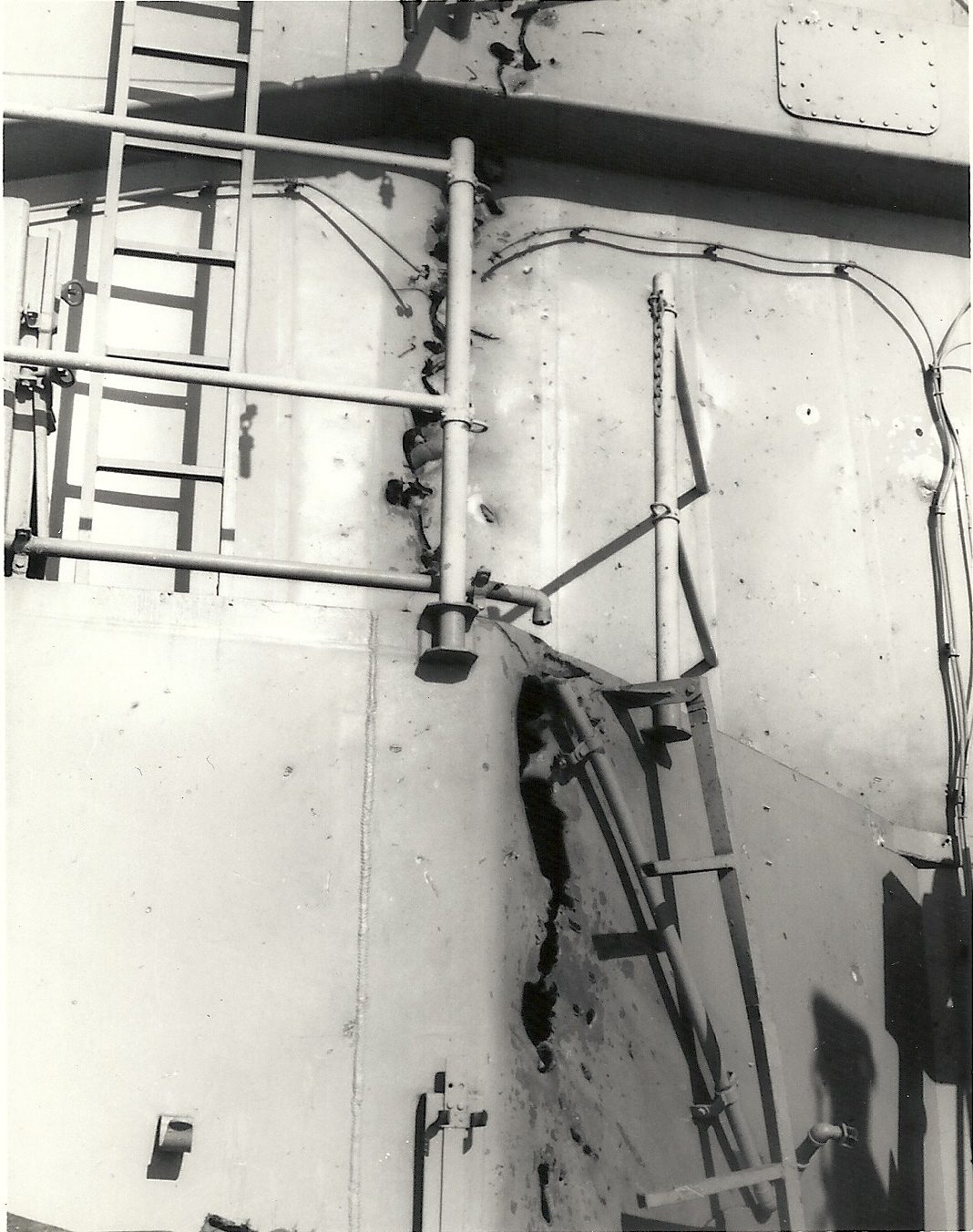
Pictured: a genuine, contemporaneous battle-damage photograph taken aboard HMAS Hobart on 17 June 1968, showing continuous-rod-warhead cutting damage to the ship's superstructure amidships. The photograph was taken by then-Commander R.J. Varley, a Hobart officer, and released decades later to the public domain by his family via Wikimedia Commons (CC BY 3.0). This is a direct photograph of the actual incident at the center of this case file, not a stock or illustrative substitute.
Theoretical Alignment
This case's theoretical alignment sits close to the mundane end of this catalogue's spectrum, and for an unusually well-documented reason: the destroyer's own attackers, the U.S. Navy's own Court of Inquiry, the Naval History and Heritage Command's own 2018 reassessment, and even the U.S. Air Force general most often quoted as "confirming" the story all converge on the same conclusion — that the missiles which struck Tiger Island's namesake waters that night came from an American aircraft that misread a warship's radar return as a helicopter, and that the contacts which triggered the whole alert were, whatever their exact source, referred to as "enemy helicopters" rather than anything otherworldly by the very officer whose statement is the closest thing this case has to an official "UFO" disclosure. The Extraterrestrial Hypothesis reading draws its 5% almost entirely from the declassified record's own literal use of the word "UFO's" and from decades of ufological retellings (beginning with Fawcett and Greenwood's 1984 Clear Intent) built on that single word choice, not from any described flight performance, physical trace, or instrumented reading consistent with non-human technology. Interdimensional Hypothesis alignment is negligible: nothing in any source located describes trans-dimensional behavior of any kind. The Psycho-Social/Mundane reading dominates because every specific, checkable claim in this case — the missile fragments, the radar cutoff mechanism, the F-4's misidentification, the plausible (if formally unconfirmed) Soviet-supplied Mi-4 helicopter activity — resolves to ordinary, if tragic, military causes, and because the case's own most authoritative modern historian, writing for the U.S. Navy itself, explicitly and pointedly rejects the extraterrestrial reading as "not very likely" while still leaving a narrower, purely terrestrial mystery genuinely open.
Background
Tiger Island — known locally as Cồn Cỏ, a small (2.3 km²) island roughly 15 nautical miles off the North Vietnamese coast, held by North Vietnamese forces throughout the war — sat at the northern edge of Operation Sea Dragon, the joint U.S. Seventh Fleet/Royal Australian Navy naval gunfire and interdiction campaign against North Vietnamese coastal logistics that ran from 25 October 1966 to 31 October 1968. Sea Dragon ships, including the Australian destroyers HMAS Perth, HMAS Hobart, HMAS Brisbane, and HMAS Vendetta, patrolled and bombarded the coast north of the DMZ, drawing regular fire from North Vietnamese shore batteries; Wikipedia's own summary of the operation records 29 Sea Dragon ships damaged by shore fire over its run, with five sailors killed and 26 wounded — a baseline of real, ongoing combat risk against which the events of mid-June 1968 unfolded.
HMAS Hobart, a 4,600-ton Charles F. Adams-class guided-missile destroyer built for the Royal Australian Navy in the United States and commissioned in December 1965, was on her second of three Vietnam deployments in June 1968, having sailed from Sydney on 22 March 1968 under the command of Captain Kenneth W. Shands, RAN (her first deployment, in 1967, had been commanded by Captain Guy Griffiths, later a Rear Admiral). By mid-June, Hobart had already been fired on unsuccessfully by North Vietnamese shore batteries on several occasions during the deployment. The wider strategic backdrop mattered directly: after the Tet Offensive of January–February 1968 and President Lyndon Johnson's unilateral partial halt, announced 31 March 1968, to U.S. bombing north of the 19th parallel, both U.S. air operations and North Vietnamese air-defense assets were compressed into the narrower coastal strip between the 17th and 19th parallels — exactly the crowded, poorly deconflicted airspace the Naval History and Heritage Command's own 2018 account identifies as the structural root cause of the confusion that followed.
Throughout the spring of 1968, U.S. Marine Corps observers and other Allied personnel reported hovering lights at night flying just north of the DMZ and out over the water toward Tiger Island. In what the Naval History and Heritage Command's Director, Rear Admiral Samuel J. Cox, describes as "typical American black-humor fashion," these contacts were frequently nicknamed "UFOs" by the troops observing them — not as a claim of anything extraterrestrial, but as period military slang for a literally unidentified flying object. The lights were presumed at the time to be North Vietnamese Mi-4 "Hound" helicopters, Soviet-supplied aircraft the North Vietnamese did operate in-theater (almost exclusively for resupply runs along the Ho Chi Minh Trail in Laos, per Cox's own research, rather than for the kind of offensive action later alleged near the DMZ). Daylight reconnaissance, however, repeatedly found no trace of any helicopter near the DMZ or Tiger Island, and no other intelligence indicated North Vietnamese helicopter operations in that specific area — a genuine, disclosed gap in the record this case file does not attempt to paper over.
Complete Timeline
| Date | Event |
|---|---|
| 25 Oct 1966 – 31 Oct 1968 | Operation Sea Dragon, the joint US/RAN coastal interdiction campaign north of the DMZ, runs for its full duration; HMAS Hobart is one of four Australian destroyers to serve with it. |
| 18 Dec 1965 | HMAS Hobart is commissioned into the Royal Australian Navy. |
| 31 Mar 1968 | President Johnson unilaterally halts U.S. bombing north of the 19th parallel, compressing air operations and North Vietnamese air-defense assets into the narrower coastal strip between the 17th and 19th parallels. |
| 22 Mar 1968 | Hobart, under Captain Kenneth W. Shands, RAN, departs Sydney for her second Vietnam deployment. |
| Spring 1968 (ongoing) | U.S. Marine observers report recurring "hovering lights" at night near the DMZ and over the water toward Tiger Island, informally nicknamed "UFOs"; daylight searches find no trace of any aircraft. |
| Evening, 15 June 1968 | Approximately 15 unidentified aircraft, believed to be enemy helicopters, are reportedly sighted in the DMZ area; numerous further visual and radar contacts follow over subsequent nights. "No hard evidence of these aircraft has yet been received," per the III Marine Amphibious Force intelligence summary. |
| Shortly after midnight, night of 15/16 June 1968 | Swift boat PCF-19 is struck by two rockets from an unidentified source and rapidly sinks south of Tiger Island. Four American crewmen and a South Vietnamese liaison officer are lost; two badly wounded survivors, including skipper LTJG John Davis, are rescued by USCGC Point Dume. |
| Same early morning, 16 June | PCF-12, under LTJG Pete Snyder, responds and fights a running gun battle with two helicopter-type contacts (subsequently assessed as matching Mi-4 Hound characteristics); an Alpha One shore observation post independently confirms radar and night-scope contact on unidentified, non-IFF-squawking aircraft in the area. |
| 16–18 June 1968 | U.S. Navy divers from USS Acme survey the PCF-19 wreck and recover three bodies; damage is consistent with two rocket strikes with no exit holes. |
| Night of 16/17 June 1968 | HMAS Hobart operates with USS Boston, USS Edson, and USS Theodore E. Chandler near Tiger Island, specifically investigating the prior night's reported helicopter activity. |
| 0309 hrs, 17 June 1968 | Hobart tracks an inbound aircraft transmitting no IFF signal but holds fire. |
| 0314 hrs, 17 June 1968 | The aircraft fires a missile that strikes Hobart amidships on her starboard side, killing Ordinary Seaman Raymond John Butterworth and wounding Able Seaman J.R. Parker and Ordinary Seaman R.F. Davidson. |
| c. 0316 hrs, 17 June 1968 | The same aircraft returns and fires two more missiles simultaneously; one fails to detonate, the other explodes near the Ikara missile magazine, killing Chief Petty Officer Raymond Henry Hunt and wounding six more sailors. |
| c. 0318 hrs, 17 June 1968 | As the aircraft makes a third pass, Hobart's forward 5-inch/54 gun mount, under local control, fires five rounds, driving the aircraft off; it is lost to radar south of Tiger Island. USS Boston is separately damaged by shrapnel from near-miss missiles and automatic-weapons fire; USS Edson comes under attack but is undamaged. |
| 19 June 1968 | Hobart arrives at Subic Bay, Philippines, for damage assessment and repair; recovered missile fragments are identified as American-made. |
| Following the attack | Vice Admiral William F. Bringle, Commander, U.S. Seventh Fleet, orders a formal Court of Inquiry. |
| 25 July 1968 | Hobart returns to Vietnamese waters and resumes operations southeast of Da Nang. |
| 11 Oct 1968 | Captain Shands's command of Hobart, spanning the incident, ends. |
| 16 Oct 1973 | Gen. George S. Brown, USAF (former commander, Seventh Air Force, later Chairman of the Joint Chiefs of Staff), references the episode at a Chicago-area press conference amid that year's U.S. UFO wave, stating the contacts "weren't called UFOs. They were called enemy helicopters." |
| 1984 | Lawrence Fawcett and Barry Greenwood's Clear Intent: The Government Coverup of the UFO Experience popularizes the episode as a "UFO" case, citing Brown's statement and the declassified III MAF intelligence summary. |
| 22 June 2018 | Naval History and Heritage Command Director RADM Samuel J. Cox publishes H-Gram 019, reassessing the record; he concludes the Court of Inquiry's finding of friendly fire for PCF-19 was likely wrong (a genuine NVA helicopter attack is more consistent with the physical and eyewitness evidence), while reaffirming the Hobart/Boston attacks were unambiguous American friendly fire. |
| 2026 | This case file corrects the "Coming Soon" queue's 15 June 1968 placeholder date — which described the missile attack itself, not the earlier, separate light sightings — to the destroyer's own documented 17 June 1968 strike date. |
The Lights Along the DMZ: What the Record Actually Says
The entire "UFO" component of this case traces to a single, now-declassified document: the Intelligence Summary section of the III Marine Amphibious Force, Air Ground Team, Command Chronology for June 1968, originally classified SECRET and downgraded to UNCLASSIFIED decades later. Its relevant passage, transcribed here in full because every specific claim in this case file's "unidentified contact" narrative traces back to it, reads: "During the late evening hours of 15 June approximately 15 unidentified aircraft, believed to be enemy helicopters, were reportedly sighted in the DMZ area. Since that time there have been numerous sightings, both visual and by radar, of unidentified, slow-moving UFO's in the DMZ area and seaward toward Tiger Island. No hard evidence of these aircraft has yet been received." UFO document researcher Barry Greenwood located and publicized this passage, and it is this document — not any claim of a metallic disc, a beam of light, or a craft performing impossible maneuvers — that gave the episode its "UFO" label in ufological literature from the 1980s onward.
Read in full context, the document itself is a model of institutional hedging rather than a sensational claim. It explicitly frames the sightings as "believed to be enemy helicopters," uses "UFO's" purely in the term's literal, generic sense (an aircraft nobody present could positively identify), and closes its own paragraph by stating plainly that no confirming evidence existed. RADM Cox's 2018 reassessment for the Naval History and Heritage Command adds detail absent from the Marine chronology alone: he confirms the "hovering lights" pattern had been reported by Marine and other observers throughout the spring of 1968, not just from 15 June onward; that repeated daylight reconnaissance missions found no trace of any helicopter near the DMZ or Tiger Island; that no other intelligence indicated North Vietnamese helicopter operations specifically in that area; and that the troops' own nickname for the contacts — "UFOs" — was black humor, not a serious claim of anything extraterrestrial. Cox raises, without resolving, the "obvious question" of why hovering aircraft would fly with lights on, and notes that "various theories, such as thermal ducting" (an atmospheric radar-propagation effect that can produce false or exaggerated returns) were floated at the time to explain persistent radar contacts that visual searches and daylight sweeps could never physically confirm.
This case file's own research located no independent corroboration of the "approximately 15" or the commonly repeated "about 30" figure for the number of original contacts beyond the chronology's own wording and its later paraphrases; no named individual observer for the original 15 June sightings was identified in any source consulted, consistent with the anonymous, collective-report character typical of a running unit intelligence log rather than an individually attributed witness statement.
The Loss of Swift Boat PCF-19
The clearest, most consequential event in the DMZ's chain of confusion that week was not the attack on Hobart but the loss of the patrol craft fast PCF-19 roughly 24 hours earlier. Shortly after midnight on the night of 15/16 June 1968, PCF-19 "disappeared in a flash of light" while on patrol just south of the DMZ, according to witnesses cited in the Naval History and Heritage Command's own account. The U.S. Coast Guard cutter Point Dume reported seeing PCF-19 hit by two rockets from an unidentified source; several hours later, Point Dume herself came under fire from an unidentified aircraft. Two badly wounded survivors were pulled from the water, including PCF-19's skipper, LTJG John Davis, who was blinded in the attack. Four American crewmen — GMG2 Billy S. Armstrong, QM2 Frank Bowman, BM2 Anthony Chandler, and EN2 Edward Cruz — and a South Vietnamese navy liaison-interpreter, Bui Quang Thi, were lost. GMG2 John R. Anderegg, who survived, was later awarded a Silver Star for his actions trying to save his skipper and Bowman; Bowman's body was never recovered, and he remains listed as missing in action.
PCF-12, under LTJG Pete Snyder, responded to the sinking and fought its own running gun battle with what its crew's eyewitness accounts describe, in Cox's words, as "remarkably clear" identification of a helicopter, later assessed as matching the characteristics of a Soviet-supplied Mi-4 "Hound." PCF-12 reported returning fire and hitting, and possibly downing, one helicopter, though no wreckage was recovered in subsequent searches. A shore observation post at Alpha One independently confirmed both radar and night-scope contact on the unidentified aircraft, and confirmed that no friendly aircraft were operating in the area and that the contacts were not squawking IFF (Point Dume and the PCFs themselves also lacked IFF equipment, per Cox's account, complicating any confident identification in either direction). U.S. Navy divers from USS Acme later surveyed PCF-19's wreck and found damage consistent with two rocket impacts and no exit holes — physical evidence Cox weighs directly against the theory that PCF-19 was hit by American ordnance.
The Court of Inquiry that investigated the broader incident ultimately concluded, per Cox, that PCF-19 had also been the victim of friendly fire from U.S. aircraft — effectively folding the PCF-19 loss into the same fratricide narrative as the later Hobart attack. Cox's own 2018 reassessment explicitly disagrees with this specific finding: "the preponderance of reliable evidence suggests that the court of inquiry got it wrong. As rare as it was for North Vietnamese helicopters to engage in offensive action... it appears that was the case in the loss of PCF-19." This is a genuinely open disagreement within the most authoritative parts of the official record itself — but it is a disagreement between "American friendly fire" and "a rare North Vietnamese helicopter attack," not between any mundane explanation and an anomalous one. Cox's own H-Gram closes its discussion of PCF-19 with a pointed aside: "(The UFO Community believes this is a case of extraterrestrials studying Earth's defensive capabilities — not very likely, but it makes for entertaining reading.)"
The Attack on HMAS Hobart: Minute by Minute
On the night of 16/17 June 1968, Hobart was operating with USS Boston, USS Edson, and USS Theodore E. Chandler in the vicinity of Tiger Island, specifically tasked with investigating the reports of North Vietnamese helicopter activity from the previous night. At 0309 hrs, Hobart's radar tracked an inbound aircraft transmitting no IFF (Identification Friend or Foe) signal; her crew evaluated the contact as friendly and held fire. At 0314, the aircraft fired a missile that struck Hobart amidships on her starboard side. The warhead passed through the main deck and detonated, killing Ordinary Seaman Raymond John Butterworth — closed up at the ship's exposed anti-aircraft control position above the bridge — and wounding Able Seaman J.R. Parker and Ordinary Seaman R.F. Davidson.
Roughly two minutes later, the same aircraft returned and fired two further missiles simultaneously. One entered the ship's transom without detonating, destroying the gunner's store and breaking up in the engineer's workshop before penetrating the after seamen's mess; the other hit in the same general area as the first missile, passing through a fan space, the missile director equipment room, and the Tartar missile checkout room, and detonating close to the Ikara anti-submarine missile magazine. Hobart was not carrying any Ikara munitions at the time, so the resulting fire posed no risk of a magazine explosion — a detail more than one account of the incident singles out as a stroke of good fortune. This second salvo killed Chief Electrician (Chief Petty Officer) Raymond Henry Hunt and wounded six more sailors. As the aircraft circled for what appeared to be a third attack run, Hobart's forward 5-inch/54-calibre gun mount, operating under local control, engaged at approximately 8,000 yards and fired five rounds, causing the aircraft to break off; it was lost to radar south of Tiger Island. A surviving gunner, Wayne Bastow, later recalled that Hobart's own guns fired at what her crew, in the chaos of the moment, still believed to be an enemy aircraft.
The Naval History and Heritage Command's 2018 account gives a total casualty figure of two Australian sailors killed and eleven wounded — a somewhat higher wounded count than the "seven wounded" figure repeated in many older secondary accounts, including several Australian veterans' and naval-history sources. This case file treats the more recent, explicitly sourced NHHC figure (drawn from official Dictionary of American Fighting Ships entries and a dedicated 2006 book on the incident by retired Navy chief Jim Steffes, who served aboard PCF-12) as the more reliable reconciliation, while noting honestly that the lower figure remains the one most commonly repeated in Australian veterans'-association and general-history sources. In the same predawn hours, USS Boston was separately struck and damaged by shrapnel from near-miss air-launched missiles and automatic-weapons fire; USS Edson came under aerial attack but escaped damage. Hobart departed the operational area for Subic Bay, Philippines, arriving on 19 June, where the extent of the damage — to her weapons systems, electrical systems, and hull — was formally assessed.
The Aftermath: Inquiry, Repairs, and Corrective Measures
As Hobart's crew cleared debris en route to Subic Bay, they recovered missile fragments that were subsequently identified as being of U.S. manufacture. Vice Admiral William F. Bringle, Commander of the U.S. Seventh Fleet, ordered a formal investigation. Aided by missile components definitively traced to U.S. air-to-air Sparrow missiles, the Court of Inquiry concluded that Hobart and Boston had been attacked in error by U.S. Air Force F-4 Phantom jets of the 366th Tactical Fighter Wing, whose crews believed they were engaging low-flying helicopters. A subsequent U.S. Navy Board of Inquiry examining the incident for the Australian government identified a specific technical contributor: the F-4's air-intercept radar carried a signal cut-off mechanism designed to prevent large targets from overwhelming the scope, with the unintended side effect that a warship's return and a slow, low-flying helicopter's return could appear similar on the radar display in darkness. Cox's account describes this finding as "correct," while noting it rested on "confusing timelines" that also led the same inquiry to (in his separately stated view) wrongly attribute the PCF-19 loss to the same friendly fire. The pilots and radar intercept officers of the two F-4 crews involved were held responsible for the Hobart/Boston attacks; no source consulted for this case file identifies any court-martial or further punitive action beyond the inquiry's findings. Both the U.S. Navy and U.S. Air Force implemented corrective command, control, and coordination procedures in the incident's wake, and no comparable friendly-fire attack recurred in the area afterward. Hobart herself returned to Vietnamese waters on 25 July 1968 and resumed combat operations southeast of Da Nang before completing her deployment on 11 October 1968.
General Brown's 1973 Disclosure and the Making of a "UFO" Case
The single most-cited piece of evidence in the ufological retelling of this case is not the III Marine Amphibious Force document itself but a public statement made five years later by a very senior officer. On 16 October 1973, amid that year's major U.S. UFO "flap," General George S. Brown — who had commanded U.S. Seventh Air Force in South Vietnam from 1968 to 1970 and who would go on to serve as Chairman of the Joint Chiefs of Staff from 1974 to 1978 — gave a press conference in the Chicago area and referenced the episode. As quoted in multiple secondary accounts drawing on contemporaneous reporting: "I don't know whether this story has ever been told or not. They weren't called UFOs. They were called enemy helicopters. And they were only seen at night, and they were only seen in certain places. They were seen up around the DMZ in the early summer of '68," adding that this "set off quite a battle, with an Australian destroyer taking a hit," and that "they never found any enemy, only found themselves when it had all been sorted out."
Brown's statement is genuinely significant — a four-star general with direct institutional knowledge of the 1968 chain of command publicly confirming, on the record, that the DMZ contacts and the Hobart attack were connected events. But it is essential to read what Brown actually said rather than what later retellings implied he said: his own words explicitly deny the "UFO" label as anything other than an informal nickname, and explicitly assert the contacts were called, and understood at the time to be, "enemy helicopters." Lawrence Fawcett and Barry Greenwood's 1984 book Clear Intent: The Government Coverup of the UFO Experience — the work most responsible for bringing this case into the wider UFO literature, with a foreword by astronomer J. Allen Hynek — presents Brown's statement as evidence that the U.S. government was aware of significant UFO activity it declined to publicize. That reading requires treating Brown's own explicit clarification ("they weren't called UFOs... they were called enemy helicopters") as somehow less authoritative than the informal slang nickname his own quote is busy explaining away. This case file's research located no statement by Brown, at that press conference or elsewhere, endorsing an extraterrestrial or otherwise non-terrestrial interpretation of the episode.
Correcting the Placeholder
This case file was commissioned to replace a "Coming Soon" queue placeholder dated 15 June 1968 and describing "allied observers report[ing] unidentified lights along the DMZ" followed by "a USAF Phantom fir[ing] on a radar contact and strik[ing] an Australian destroyer" in "the resulting alert." Genuine, multi-pass research across the declassified Marine Corps chronology, the Naval History and Heritage Command's own 2018 reassessment, the Royal Australian Navy's unit history as mirrored by independent UFO document researchers, and multiple Australian naval-history sources confirms a real, richly documented sequence of events matching the placeholder's substance closely: unidentified lights genuinely were reported along the DMZ, a genuine alert and search-and-engage posture genuinely followed, and a USAF aircraft genuinely did fire on a radar contact and strike an Australian destroyer. The one specific detail that does not survive contact with the primary sources is the date: the light sightings that triggered the chain of events began on the evening of 15 June, but the destroyer herself was not struck until the early hours of 17 June — roughly 30 hours, and one additional fatal incident (the loss of PCF-19), later. This case file corrects the case's headline date to 17 June 1968, the night Hobart was actually hit, while preserving 15 June's real role as the date the original unidentified contacts began, consistent with this site's practice of fixing a demonstrably wrong specific detail rather than discarding an otherwise well-corroborated case or fabricating support for the original placeholder date.
Key Witnesses
Captain Kenneth W. Shands, RAN
Commanded Hobart throughout her second Vietnam deployment, including the night of the attack. No personal account or interview from Shands specifically addressing the incident was located in any source consulted for this case file; his command is documented through the Royal Australian Navy's own official unit history and the resulting Court/Board of Inquiry record.
Wayne Bastow
A crew member closed up on one of Hobart's gun mounts during the attack, later recalling that the ship's own guns fired at what her crew believed at the time was an enemy aircraft. Decades later, in August 2018, Bastow received permission to return to the approximate attack site at sea to conduct a personal 50th-anniversary memorial service for the two men killed, describing the episode publicly as "an untold story of the Vietnam War."
Lieutenant Junior Grade John Davis, USN
Skipper of PCF-19 when it was struck and sunk in the early hours of 16 June 1968. Rescued from the water badly wounded and blinded by USCGC Point Dume, Davis was one of only two survivors of the attack that killed four of his crew and a South Vietnamese liaison officer.
Lieutenant Junior Grade Pete Snyder, USN
Commanded the Swift boat that responded to PCF-19's sinking and fought a running gun battle with helicopter-type aerial contacts. Naval History and Heritage Command Director Samuel Cox describes the eyewitness accounts of PCF-12's crew as "remarkably clear" in identifying the attacking aircraft as helicopters, in contrast to the ambiguity surrounding the earlier "unidentified" light reports.
Unnamed Allied Forward Observers, DMZ Sector
The declassified III Marine Amphibious Force intelligence summary attributes the original 15 June sightings and subsequent "numerous" visual and radar contacts to unnamed forward observers along the eastern DMZ. No individual observer is named in any source consulted for this case file; per Rear Admiral Cox's account, similar "hovering lights" reports had already been circulating among Marine and other observers throughout the spring of 1968 before the 15 June sightings specifically.
General George S. Brown, USAF
Not a direct eyewitness to the DMZ contacts or the Hobart attack, but the senior officer whose October 1973 public statement is this case's principal link between the classified 1968 record and the wider ufological literature. Brown's own words explicitly describe the contacts as having been "called enemy helicopters," not UFOs, at the time.
The Five Observables Assessment
Assessment: Every one of the Five Observables scores Absent, and this case file's scoring treats that as a real, meaningful signal rather than an artifact of thin documentation — this is, on the contrary, one of the best-documented cases in this catalogue, with a formal Court of Inquiry, recovered and forensically identified missile hardware, and a modern official government historical reassessment, none of which describes anything resembling anti-gravity lift, instant acceleration, hypersonic travel, sensor-defeating low observability, or trans-medium transition. Anti-Gravity Lift is Absent: the contacts were consistently described and treated, by every observer and every investigator, as hovering or flying in a manner fully consistent with helicopters. Instant Acceleration and Hypersonic are Absent: nothing in any account describes performance beyond that of a conventional rotary-wing aircraft, jet fighter, or air-to-air missile — the missiles that struck Hobart, notably, are among the most precisely characterized objects in the entire case, and they are ordinary AIM-7 Sparrows. Low Observability is Absent in the specific sense this catalogue tracks: the DMZ contacts were readily picked up by both radar and the naked eye on multiple nights; what failed was identification of a detected target, not detection itself, a meaningfully different (and far more mundane) kind of "unidentified." Trans-Medium is Absent and not applicable. This profile is squarely what this catalogue's own framework would expect from a genuine but confused conventional military engagement, not from an encounter with anomalous technology.
Evidence Assessment
Supporting Anomalous Origin
- A genuine, now-declassified U.S. Marine Corps intelligence document explicitly uses the term "unidentified... UFO's" to describe contacts that were never positively identified — "no hard evidence... has yet been received"
- Multiple, independent nights of both visual and radar contact were reported by trained military observers without any helicopter wreckage, debris, or other physical confirmation ever being recovered despite repeated daylight searches
- A four-star U.S. Air Force general with direct institutional command knowledge, George S. Brown, personally and publicly referenced the episode years later as a real, significant event tied to an actual attack on an Allied warship
- The Naval History and Heritage Command's own 2018 official reassessment explicitly disagrees with the original 1968 Court of Inquiry's finding on the cause of the PCF-19 loss, showing genuine, unresolved disagreement persists within the most authoritative parts of the official record itself
- Multiple distinct Allied units — two Swift boats, a Coast Guard cutter, and four destroyers/cruisers — were drawn into the confusion across two consecutive nights, a wider and more consequential event than a single observer's report
Supporting Conventional Explanation
- The attack that gives this case its name — the missiles that struck HMAS Hobart — is unambiguously, forensically confirmed as American friendly fire: recovered missile fragments were positively identified as U.S.-manufactured AIM-7 Sparrow components, and a formal Court of Inquiry, convened by Vice Admiral William F. Bringle, attributed the attack to a specific USAF unit (the 366th Tactical Fighter Wing) and a specific, well-understood technical failure (a radar cut-off mechanism causing ship and helicopter returns to appear similar)
- General Brown's own on-record statement, the piece of evidence most often cited as validating the "UFO" framing, explicitly states the contrary: the contacts "weren't called UFOs. They were called enemy helicopters"
- North Vietnam did operate Soviet-supplied Mi-4 "Hound" helicopters in-theater, giving the "enemy helicopter" explanation a real, if not fully confirmed, basis in known enemy capability, unlike an extraterrestrial-craft hypothesis for which no comparable baseline exists
- The Naval History and Heritage Command's own historian, while disputing one narrow point (whether PCF-19 was hit by friendly fire or a genuine helicopter attack), explicitly and directly rejects the extraterrestrial interpretation of the case as "not very likely," and UFO researcher and retired Army Lieutenant Colonel Kevin Randle, reviewing the same record independently, concludes "the data suggesting any UFO activity in this event is extremely thin to nonexistent and not worthy of further research"
- Atmospheric radar ducting — a known, well-documented propagation effect that can generate persistent but spurious or exaggerated radar returns — was raised at the time as a candidate explanation for contacts that radar tracked repeatedly but that daylight visual searches could never physically confirm
Why "Disputed"
This case earns a DISPUTED classification with a credibility score of 24/100, placing it near the low end of this catalogue's range for well-documented multi-witness military cases, close to South China Sea UAP Wave (Disputed, 27) and below Woomera Rocket Range Sighting (Disputed, 52) and Tunis, Tunisia UFO Sighting (Disputed, 29). The score reflects a case that is, at the level of documentation, among the strongest in this entire catalogue — a real, extensively investigated incident with a formal Court of Inquiry, physically recovered and forensically identified hardware, an official U.S. government historical reassessment published fifty years after the fact, and an on-record statement from a four-star general — but whose actual anomalous content, once the friendly-fire attack itself is set aside, is essentially nil.
What keeps this case in "Disputed" rather than "Debunked" outright is that one genuine, narrow piece of the underlying record remains formally unresolved: what, specifically, produced the visual and radar contacts reported from 15 June onward, and what actually sank PCF-19. The 1968 Court of Inquiry's own finding (friendly fire for both Hobart and PCF-19) and RADM Cox's 2018 dissent (friendly fire for Hobart, but a genuine North Vietnamese helicopter attack for PCF-19) disagree with each other on this specific point, and no wreckage, intercepted transmission, or other hard evidence has ever definitively settled which mundane explanation is correct. But "genuinely unresolved" is doing real, narrow work here: both competing explanations on the table, from the people who have studied this record most closely, are entirely conventional military ones — American friendly fire or North Vietnamese combat action — and every serious analysis located for this case file, including the Navy's own official historian and an independent UFO researcher with no institutional stake in a mundane answer, explicitly rejects the extraterrestrial framing that gives this case its place on this site. A case this well-documented, this thoroughly investigated by multiple independent authorities across five decades, and this consistently resolved toward ordinary military causes at every specific, checkable point is exactly the profile this site's "Disputed" rating at the low end of its range exists to describe.
Sensor & Instrumentation Detection Profile
This case is unusually well-instrumented for a 1968-era file. The original DMZ contacts were tracked both visually (by Marine forward observers and, later, PCF and Coast Guard crews) and by radar, including an independent radar and night-scope contact recorded at the Alpha One shore observation post, which also confirmed the contacts were not transmitting IFF. HMAS Hobart's own air-search radar tracked the inbound aircraft that ultimately fired on her at 0309 hrs on 17 June, five minutes before the first missile impact, and her crew's evaluation of that specific contact as "friendly" — the proximate human error at the center of the entire tragedy — is itself a matter of instrumented record, not later reconstruction. The recovered missile fragments underwent physical forensic identification, tracing them conclusively to U.S. Sparrow air-to-air missile manufacture. No photographic or film evidence of the original "hovering lights" exists in any source consulted; the entire visual record consists of eyewitness description transmitted through military intelligence and after-action channels.
Environmental & Geospatial Context
Tiger Island (Cồn Cỏ) sits at approximately 17.17° N, 107.35° E, roughly 15 nautical miles off the North Vietnamese coast and just north of the DMZ separating North and South Vietnam along the 17th parallel. The island itself, held by North Vietnamese forces and used for observation and anti-aircraft positions throughout the war, sat inside the compressed, heavily trafficked coastal air corridor created by President Johnson's 31 March 1968 partial bombing halt, which pushed both U.S. strike aircraft and relocated North Vietnamese surface-to-air missile batteries into the narrower strip between the 17th and 19th parallels — a geospatial and command-and-control squeeze the Naval History and Heritage Command's own account identifies as the structural precondition for the entire episode. No specific meteorological record for the nights of 15–17 June 1968 was located in any source consulted; the sustained, multi-night ability of ground observers, ship's radar, and PCF crews to track and engage contacts visually and by radar implies workable, if imperfect, visibility, and mid-June falls within central Vietnam's comparatively drier pre-monsoon season.
Observer Credibility & Occupational Profile
The witness base for this case divides sharply into two very different credibility tiers. The original 15 June "hovering lights" reports come from unnamed U.S. Marine Corps forward observers and other Allied personnel — professionally trained to observe and report, and operating within a formal intelligence-reporting chain that produced the surviving declassified document, but individually anonymous in every source this case file's research consulted, precluding any individual credibility assessment. By sharp contrast, the witnesses to the subsequent, better-corroborated events are named, ranked, and independently documented: Captain Kenneth W. Shands, RAN, commanding a warship; LTJG John Davis and LTJG Pete Snyder, USN, commanding Swift boats under fire; and the crews of USCGC Point Dume and the Alpha One shore observation post, whose radar and night-scope readings independently corroborate the PCF crews' own accounts. General George S. Brown's later public statement carries the specific occupational weight of a four-star officer who had commanded the very air component (Seventh Air Force) whose aircraft fired the missiles, speaking five years after the fact with no evident motive to either inflate or minimize what had happened. This case file treats the named, ranked, cross-corroborated witnesses to the PCF-19 fight and the Hobart attack as considerably more evidentially weighty than the anonymous original light reports, consistent with this catalogue's general approach to witness credibility.
Physical & Material Assays
This case possesses genuine, tested physical evidence — and that evidence points entirely toward the conventional explanation. The missile fragments recovered by Hobart's own crew while clearing debris en route to Subic Bay were positively identified as components of U.S.-manufactured AIM-7 Sparrow air-to-air missiles, forming the physical backbone of the 1968 Court of Inquiry's friendly-fire finding. This is, ironically, the only piece of hard, laboratory-grade physical assay anywhere in this case, and it confirms the mundane cause rather than an anomalous one. No physical trace — wreckage, debris, biological effect, or otherwise — connected to the original "hovering lights" or to any helicopter, human or otherwise, was ever recovered despite repeated daylight searches of the DMZ and Tiger Island area; PCF-12's own claim of having hit and possibly downed a helicopter during the 16 June engagement was never corroborated by any recovered wreckage.
Historical Precedents & Archive Matches
Within this catalogue, this case's closest analogue is South China Sea UAP Wave (2021) — another case in which an anonymous military-adjacent visual report, initially described in dramatic terms, was traced by direct investigation to a specific, mundane military cause (military flares) rather than anything anomalous. Woomera Rocket Range Sighting (1954) shares this case's Australian military angle and its setting at the intersection of a live weapons-testing/combat environment and radar/visual contact confusion. And Tunis, Tunisia UFO Sighting (1969) shares this case's core evidentiary shape: a real, officially documented event, preserved through a single primary government channel, whose "UFO" framing rests heavily on period terminology and turns out, on close reading of that same primary document, to describe something considerably more mundane than the label suggests. More broadly, the DMZ "hovering lights" of spring and summer 1968 sit within a well-established pattern from the Vietnam War of radar/visual contacts, IFF failures, and "ghost" returns generated by the war's own uniquely crowded, poorly deconflicted, and heavily electronically contested airspace — a pattern this case file's research found no comparable published catalog for the DMZ area specifically, but that is consistent with the broader command-and-control challenges the Naval History and Heritage Command's own account identifies as the true, structural cause of the entire episode.
Material Analysis
Unusually for a case in this catalogue, "material" evidence here means real, laboratory-identifiable ordnance components rather than an ambiguous trace sample — and it is direct, physical proof of the conventional cause, not the anomalous one.
The Recovered Missile Fragments
As Hobart's crew cleared debris while transiting to Subic Bay for repairs, they collected pieces of the missiles that had struck the ship. These fragments were subsequently identified as being of U.S. origin, and further forensic examination traced them specifically to AIM-7 Sparrow air-to-air missile components — physical evidence directly cited by the 1968 Court of Inquiry in attributing the attack to U.S. Air Force F-4 Phantoms rather than to any North Vietnamese, unconventional, or unidentified source. This case file's research located photographic documentation of the resulting battle damage, including a small series of photographs taken aboard Hobart on 17 June 1968 by then-Commander R.J. Varley (this case file's hero image) and a separate set of photographs held by the Australian War Memorial documenting damage assessed at Subic Bay.
What Was Never Found
No wreckage, debris, or other physical trace connected to any helicopter, aircraft, or craft of any kind — conventional or otherwise — was ever recovered from the original DMZ "hovering lights," despite Rear Admiral Cox's own account of repeated daylight reconnaissance searches. PCF-12's claim of hitting and possibly downing a helicopter during the 16 June engagement likewise produced no recovered wreckage in subsequent searches. This absence cuts in different directions depending on which mundane hypothesis one favors: it is consistent with a real helicopter going down over open water or dense terrain where wreckage would be difficult to locate, and it is equally consistent with there having been no physical helicopter there to find in the first place (supporting a radar-ducting or purely misidentification-based explanation for at least some of the contacts). It is not, in any source this case file's research consulted, treated by any credible investigator as evidence for a non-terrestrial craft.
Supporting Non-Terrestrial or Unexplained Origin
- The ultimate cause of some of the original DMZ radar/visual contacts, and of the PCF-19 loss specifically, remains genuinely disputed between the 1968 Court of Inquiry and the Naval History and Heritage Command's own 2018 reassessment
- No wreckage or physical trace of any kind was ever recovered connecting the original contacts to a confirmed conventional cause
Supporting Terrestrial or Mundane Origin
- The only forensically tested physical evidence in the entire case — the recovered missile fragments — is conclusively, unambiguously American-made ordnance, directly confirming the friendly-fire cause of the attack that gives this case its name
- Every competing explanation actually advanced by any investigator, official or independent, for the original contacts (enemy helicopters, radar ducting, misidentified friendly assets) is entirely conventional; none proposes anything non-terrestrial
- North Vietnam's real, documented (if limited) operation of Mi-4 helicopters in-theater provides a concrete, non-speculative basis for the "enemy helicopter" explanation that has no anomalous-technology equivalent
The Conventional Explanation Candidate (CEC): Friendly Fire, Enemy Helicopters, and Radar Ducting
Unlike most cases in this catalogue, this case does not lack an official explanation awaiting evaluation — it has two formal government explanations that partially disagree with each other, plus a well-precedented atmospheric candidate for the residue neither fully resolves. This section weighs each candidate against the specific, disclosed record above.
Friendly Fire / IFF and Radar Misidentification
This is the confirmed, forensically established cause of the attack that gives this case its name. Recovered missile fragments were positively identified as U.S.-manufactured AIM-7 Sparrow components; a Court of Inquiry convened by Vice Admiral William F. Bringle attributed the attack specifically to F-4 Phantoms of the 366th Tactical Fighter Wing; and a documented technical mechanism (the F-4 radar's large-target signal cut-off, which could make a warship's return resemble a slow helicopter's) explains why the misidentification occurred. This candidate requires no further evaluation as "plausible" — it is the case's one point of near-total consensus across every source consulted, including RADM Cox's account, which explicitly calls the Court of Inquiry's finding on this specific point "correct."
Genuine North Vietnamese Mi-4 Helicopter Activity
This candidate applies specifically to the loss of PCF-19 and, more speculatively, to some of the original DMZ light/radar contacts. North Vietnam did operate Soviet-supplied Mi-4 "Hound" helicopters, and PCF-12's crew gave what RADM Cox's own 2018 analysis calls "remarkably clear" eyewitness accounts of a helicopter engagement, physically consistent with PCF-19's own recovered damage (two rocket-consistent entry holes, no exit holes). Cox's explicit dissent from the original Court of Inquiry's friendly-fire finding for PCF-19 rests on this evidence. Its weakness is the same one the III MAF intelligence summary itself disclosed in real time: repeated daylight reconnaissance found no trace of any helicopter near the DMZ or Tiger Island, and no other intelligence indicated North Vietnamese helicopter operations specifically in that area, leaving the broader pattern of "hovering lights" less securely explained by this candidate than the single, more evidentially specific PCF-19 engagement is.
Atmospheric Radar Ducting / Misidentified Friendly Assets
Raised at the time, per Cox's account, as one theory to explain persistent radar contacts that could plainly be seen or tracked but that no daylight search could ever physically confirm. Radar ducting is a real, well-documented atmospheric propagation effect capable of producing exaggerated, distorted, or otherwise misleading returns, and is a plausible partial contributor to a pattern of unconfirmed contacts spread across multiple nights and multiple observing units. It does not, on its own, account for the specific, "remarkably clear" helicopter engagement PCF-12's crew describes, nor for Hobart's own straightforward radar detection and misidentification of a single approaching jet aircraft, which was a resolvable, conventional aviation contact rather than an atmospheric artifact.
Extraterrestrial or Non-Terrestrial Craft
This reading rests entirely on the literal word "UFO's" in the declassified Marine intelligence summary and on the ufological literature (principally Fawcett and Greenwood's Clear Intent) built around General Brown's 1973 statement. It is directly and explicitly contradicted by that same statement's own content ("they weren't called UFOs... they were called enemy helicopters"), by the Naval History and Heritage Command's own official historian ("not very likely, but it makes for entertaining reading"), and by independent UFO researcher Kevin Randle's review of the same record ("extremely thin to nonexistent and not worthy of further research"). No source consulted for this case file — official, ufological, or skeptical — advances this reading as a serious possibility once the underlying documents are actually read in full.
Friendly Fire / IFF & Radar Misidentification
Confirmed / Highly PlausibleCONFIRMED for the Hobart/Boston attacks. Forensically identified U.S. missile fragments, a formal Court of Inquiry finding, and a documented radar technical failure leave essentially no ambiguity about the cause of the attack that gives this case its name.
Genuine NVA Mi-4 Helicopter Activity
InconclusiveINCONCLUSIVE, leaning plausible specifically for PCF-19 (per NHHC's own 2018 dissent from the original inquiry) but weaker for the broader "hovering lights" pattern, given repeated daylight searches that found no helicopter wreckage anywhere near the DMZ.
Atmospheric Radar Ducting / Misidentified Assets
InconclusiveINCONCLUSIVE as a partial explanation for some unconfirmed contacts, but does not account for PCF-12's direct helicopter engagement or for Hobart's own straightforward detection of a single approaching jet.
Extraterrestrial or Non-Terrestrial Craft
ImplausibleIMPLAUSIBLE. Explicitly rejected by the statement most often cited to support it, by the U.S. Navy's own official historian, and by independent UFO researchers reviewing the same record. Rests on a single word in one declassified document, not on any described anomalous performance or physical evidence.
Related Cases
Confirmed Documents & Official Records
The most authoritative modern primary source for this case file: Director Samuel J. Cox's official reassessment of the PCF-19 loss and the Hobart/Boston/Edson friendly-fire attacks, drawing on Dictionary of American Fighting Ships entries and unit records.
CLASSIFICATION: UNCLASSIFIED / OFFICIAL HISTORICAL PUBLICATIONThe primary document containing this case's own literal use of the word "UFO's" to describe the unidentified DMZ contacts, located and publicized by UFO document researcher Barry Greenwood. The National Archives holds the official Marine Corps command chronology series; this scan is a publicly mirrored copy of the same declassified document.
CLASSIFICATION: Originally SECRET; downgraded to UNCLASSIFIEDThis case file's research located no surviving text of the full 1968 Court of Inquiry report itself (only its findings as summarized in the Naval History and Heritage Command's account and in Australian naval-history sources), and no NARA-hosted digital copy of the specific III MAF June 1968 chronology distinct from the mirror cited above.
Search Government & Official Archives Directly
Further Reading — Recommended Literature
Clear Intent: The Government Coverup of the UFO Experience
The book most responsible for bringing General Brown's 1973 statement and the III MAF intelligence summary into the wider UFO literature; essential for understanding how this case's "UFO" framing was actually constructed and popularized.
Vietnam Order of Battle
A detailed reference on U.S. force structure and deployments in Vietnam, useful for situating the 366th Tactical Fighter Wing, Seventh Air Force, and Seventh Fleet units involved in this incident within the wider 1968 order of battle.
Brown Water, Black Berets: Coastal and Riverine Warfare in Vietnam
A comprehensive history of U.S. Navy coastal patrol operations, including the Swift boat force PCF-12 and PCF-19 belonged to, providing essential operational context for the DMZ patrol environment this case unfolded in.
1968: The Year That Rocked the World
A wide-lens history of 1968's global upheaval, including the Tet Offensive and its aftermath, useful for the broader strategic and political context surrounding the partial bombing halt and the crowded DMZ airspace this incident occurred within.
UFOs and Government: A Historical Inquiry
A scholarly, multi-author history of official government UAP investigation and reporting channels, useful context for how a military intelligence document's own internal slang ("UFO's") differs from a formal, adjudicated anomalous-phenomenon claim.
Essential Viewing
No Videos Available
This case file's research located no video, documentary segment, or news report found to be genuinely, primarily about this specific incident from a reputable source meeting this site's video standards, as opposed to brief mentions folded into general "Vietnam War UFO" compilation videos of uncertain provenance. Consistent with this site's video verification standard, no off-topic, low-quality, or unverifiable video has been substituted in its place.
Sources
- Cox, Samuel J. (Rear Admiral, USN, Ret., Director, Naval History and Heritage Command). "H-Gram 019: A Mysterious Swift Boat Loss, 'Black May,' and 'Black Sunday'" and Attachment H-019-1, "The Mystery of PCF-19" (22 June 2018). history.navy.mil
- Naval History and Heritage Command. "H-Grams" index. history.navy.mil
- III Marine Amphibious Force, Air Ground Team. Command Chronology, June 1968 (Intelligence Summary), declassified/downgraded 2014 (scanned original hosted by Project 1947). project1947.com
- Project 1947 / UFO Historical Revue #14. "Air Force UFO Documents Vietnam Era Surface — HMAS Hobart" (research by Barry Greenwood, reproducing the Royal Australian Navy's own official account of the incident). project1947.com
- National Archives and Records Administration (NARA). "Command Chronologies: Vietnam War, Marine Corps" (finding aid for the official record series this case's III MAF document belongs to). archives.gov
- Naval Historical Society of Australia. "Australian Naval History on 17 June 1968." navyhistory.au
- Randle, Kevin. "A Different Perspective: The RAN Hobart UFO Incident" (analysis concluding the UFO evidence in this case is "extremely thin to nonexistent"). kevinrandle.blogspot.com
- MPNews (Mornington Peninsula News Group). "Vietnam Tribute to Victims of 'Friendly-Fire' Attack" (13 August 2018; survivor Wayne Bastow's 50th-anniversary memorial). mpnews.com.au
- Wikipedia. "HMAS Hobart (D 39)" (ship service history, commanding officers). en.wikipedia.org
- Wikipedia. "Operation Sea Dragon (Vietnam War)" (operational dates, participating ships, casualty figures). en.wikipedia.org
- Wikipedia. "Guy Griffiths (admiral)" (HMAS Hobart's first Vietnam-deployment commanding officer, for comparison with Capt. Shands's 1968 command). en.wikipedia.org
- Wikipedia. "Cồn Cỏ district" (Tiger Island geography and coordinates). en.wikipedia.org
- Fawcett, Lawrence, and Barry J. Greenwood. Clear Intent: The Government Coverup of the UFO Experience (Prentice-Hall, 1984; foreword by J. Allen Hynek).
- Wikimedia Commons. "File:HMAS Hobart missile damage 1.jpg" and "File:HMAS Hobart missile damage 2.jpg," photographs by Cmdr. R.J. Varley, uploaded by Peter4Truth (CC BY 3.0) — source of this case file's hero image. commons.wikimedia.org
- Australian War Memorial. "One of a series of photographs taken aboard HMAS Hobart off Vietnam on 17 June 1968 showing damage caused by an accidental missile attack from a USAF F-4 Phantom aircraft" (collection record; copyright status listed as unknown, not used as this case file's hero image for that reason). awm.gov.au
- National Interest. "Why Did an American Fighter Jet Attack This Australian Ship in 1968?" and "When F-4 Phantoms Attacked American and Australian Warships" (secondary narrative accounts of the missile attack, Board of Inquiry radar-cutoff finding, and casualty figures).
See something inaccurate? Have additional information or sources?
Suggest an Edit →Last Updated: August 2026