
Woomera Rocket Range Sighting
At around 4:30 p.m. on May 5, 1954, a radar operator and at least two other range personnel at the restricted Woomera rocket and guided-weapons range in outback South Australia tracked and, through binoculars, watched a "misty grey disc" — radar-timed at roughly 3,600 mph — cross directly over the flight path of a Royal Australian Air Force Canberra bomber before climbing above 60,000 feet and vanishing. Written witness statements were filed within forty-eight hours, and the case survives today in declassified Department of Supply and RAAF files. This case file was commissioned to replace a "Coming Soon" queue placeholder dated "1952-05-20," but this site's own two-pass research found no documented Woomera incident matching the placeholder's description of "radar tracks object performing maneuvers at speeds exceeding 3,000 mph" anywhere in 1952 — the real, declassified case matching that description in every particular is dated May 5, 1954, two years later than the placeholder claimed. This file corrects that date, presents the genuine 1954 case in full, and separately covers the real but far more modest cluster of radar and visual reports Woomera generated across 1952 itself.
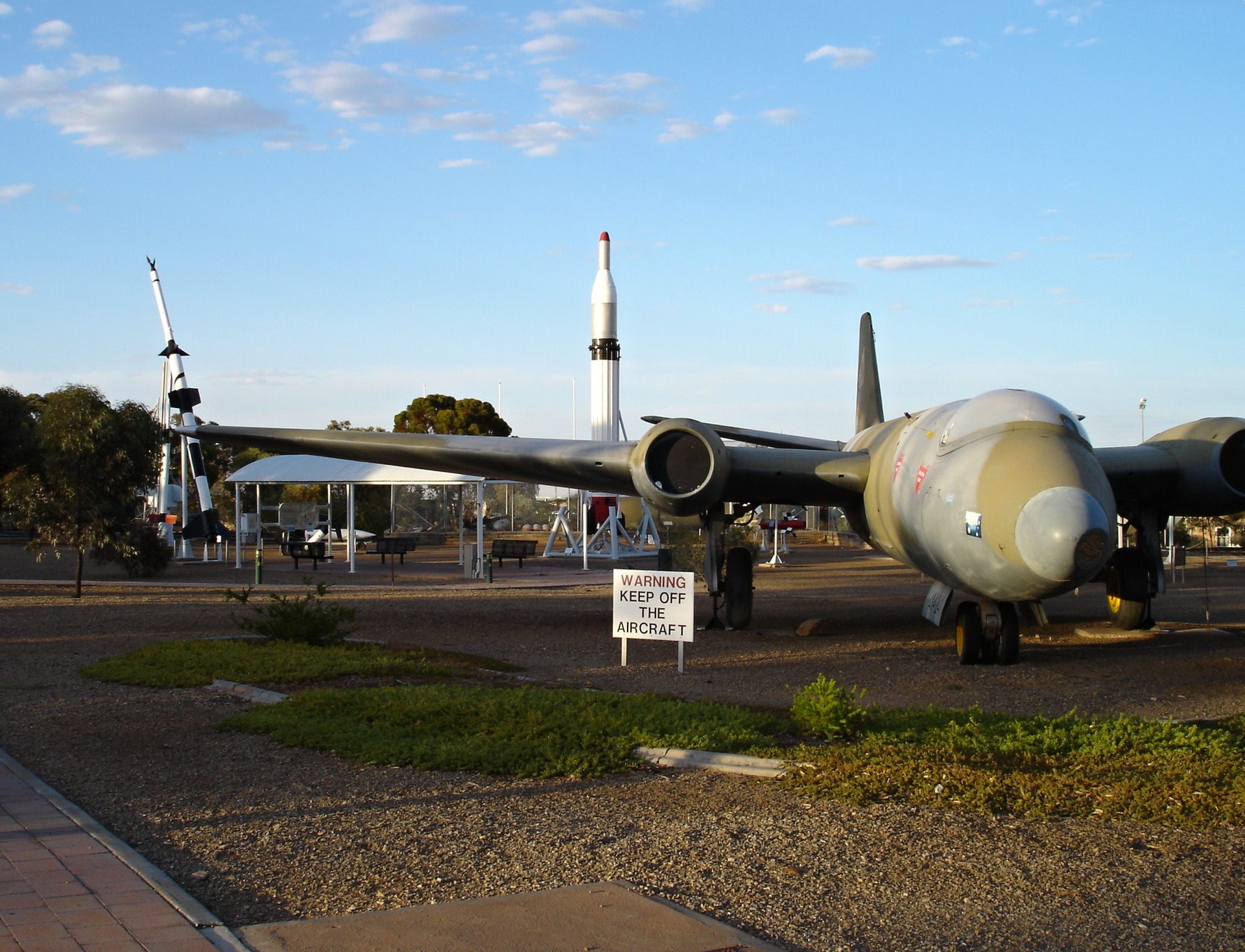
Pictured: a retired English Electric Canberra bomber — the same aircraft type flying near the object during the May 5, 1954 sighting — preserved today in the outdoor missile park at the Woomera Heritage & Visitor Information Centre, South Australia, alongside decommissioned test rockets from the range's Cold War history. This is not a photograph of the object or the incident itself; no photograph of the disc is known to exist in any archive consulted for this case file, only the written witness statements and a radar tracking plot described below.
Theoretical Alignment
The May 5, 1954 case is one of the more instrumentally interesting entries in this site's Australian catalog precisely because it combines a plotted radar track with an independent, simultaneous binocular sighting — a genuine dual-channel observation, not a single witness's unverifiable impression. That lends real, if modest, weight to the Extraterrestrial Hypothesis reading, reinforced by defence physicist Harry Turner's own later, non-contemporaneous assessment that some of the RAAF's historical Woomera files were consistent with a "possible extraterrestrial origin." Alignment with the Interdimensional Hypothesis is low; nothing about the object's described behavior — a fast, radar-trackable disc slowing near an aircraft before accelerating away — invokes anything beyond a physically solid, if unidentified, craft. The Psycho-Social/Mundane reading carries real weight of its own, not because anyone here is proposed to have hallucinated or misidentified something mundane out of anxiety, but because Woomera's own UFO lore has a documented history of exaggeration through retelling (see "Woomera's Wider Pattern" below), and because this specific case's most dramatic secondary write-ups (international tabloid and "ancient mysteries"-style outlets) show real inconsistencies in how they describe the witnesses — a sign that popular retellings may have already drifted somewhat from the underlying 1954 file.
Background
Woomera was established in 1947 as the centerpiece of the Anglo-Australian Joint Project, a joint United Kingdom–Australia undertaking to build and operate a rocket and guided-weapons test range far larger than anything available in crowded postwar Britain. Construction of Woomera Village began that same year to house the thousands of British and Australian scientists, engineers, and service personnel who would eventually work there; at its Cold War peak the township's population reached roughly 7,000. The range itself — officially the Woomera Prohibited Area, one of the largest land-based weapons test ranges in the world — sits in remote outback terrain roughly 450 km north of Adelaide, chosen for exactly the qualities that also make it a difficult place to corroborate an unusual sighting: enormous open airspace, minimal civilian population, and, from the outset, a security culture built around genuine Cold War secrecy rather than any interest in publicizing anomalies.
Administratively, the range was first run by the Long Range Weapons Establishment (LRWE), based at Salisbury, South Australia, before responsibilities were consolidated under the broader Weapons Research Establishment (WRE) as the joint project matured. Its purpose throughout the 1950s was overwhelmingly conventional in the strategic sense even as its contents were highly classified: British and Australian guided-missile and rocket trials, radar and tracking-instrumentation development, and, later in the decade and into the 1960s, testing associated with the Blue Streak and Black Knight programs and the European Launcher Development Organisation. The English Electric Canberra jet bomber — itself only newly in RAAF and RAF service in the early 1950s — was a routine sight over the range, used both operationally and, as in this case, in a supporting or observational role during weapons trials.
It is this same secrecy and instrumentation density that produced an unusual byproduct: because Woomera's radar and optical tracking equipment was constantly scanning the sky above the range for missile telemetry, and because the personnel operating it were trained to notice and report anything anomalous in that airspace as a matter of routine security practice, the range generated a small but genuine cluster of officially logged "unusual occurrence" reports between 1952 and 1955 — lights, an unidentified radar target, and, in the case examined in detail below, a coordinated radar-and-visual contact. These were compiled by the Department of Supply (which administered WRE) into a file titled Unusual Occurrences Flying Saucer at Woomera — National Archives of Australia series D174, control symbol SA5281 — originally classified Secret, along with an overlapping companion file, series D250, control symbol 56/483, Reports on Unidentified Aircraft, Strange Occurrences etc., held in the Sydney office of the NAA. Both files were rediscovered and examined by independent researchers during the 2000s, and their contents are the primary documentary basis for this case file, filtered through the secondary research summaries described in the Sources section below.
Complete Timeline
| Date | Event |
|---|---|
| 1947 | Woomera is established as the Anglo-Australian Joint Project's rocket and guided-weapons range; the Long Range Weapons Establishment (LRWE) is formed to administer it. |
| Apr. 28, 1952, 0345 hrs | Three men awaiting transport at Woomera West see an unidentified light moving WNW, bright enough to illuminate surrounding clouds and terrain, at 45° SE. |
| Sept. 27, 1952, ~2050 hrs | Five witnesses at the Woomera West open-air theatre see a cigar/cylindrical object with a rear "exhaust"; one reports "two portholes with internal lighting." |
| Oct. 8, 1952, 1345–1429 hrs | Warrant Officer G.E. Millard tracks an invisible radar target — signal-to-noise ratio comparable to a large aircraft — at heights of 1,500–5,600 ft; smaller targets appear to detach from the main return. Later attributed to a snow cloud (a security officer's note additionally floats a "neutron cloud"). |
| Oct. 28, 1952, 1400 hrs | A second radar target moves to bearing 120° at 27 mph, height again fluctuating 1,500–5,600 ft. |
| Jul.–Nov. 1953 | Several further reports are logged: a white oval light (Jul. 24), a daytime sighting later attributed to windblown vegetation (Jul. 29), and a "glare" believed to be an aircraft (Nov. 14). |
| Nov. 22–23, 1953 | Multiple witnesses report an inverted, green/teal "saucer" with bluish exhaust and several separate lights over consecutive nights; preserved in RAAF papers later forwarded to the U.S. Air Force's Project Blue Book files. |
| May 5, 1954, ~1630 hrs | The centerpiece case: a radar operator and at least two other range personnel track and visually observe a "misty grey disc," radar-timed at ~3,600 mph, crossing the flight path of a RAAF Canberra bomber before climbing above 60,000 ft and vanishing. |
| May 6–7, 1954 | The radar operator's and a Vickers-Armstrongs (or English Electric, per differing secondary accounts) observer's written statements are filed. |
| May 20, 1954 | A Department of Supply covering letter forwards the statements, noting the two primary witnesses were separated by roughly 300 yards and gave corroborating accounts — the likely true source of the "20" that survived, with its year garbled, into this case's pre-publication queue placeholder. |
| Late 1950s | Range Operations officer Group Captain Tom Dalton-Morgan reports his own team's UFO sighting near a Black Knight rocket test, later summarized in Ken Llewelyn's 1991 book Flight Into the Ages. |
| 1964 | A separate, unrelated Woomera UFO legend — that a 1964 Blue Streak launch was aborted after cameras captured "two large figures in the firing area" — begins circulating; researcher Bill Chalker later traces it to ordinary lens flare from a June 5, 1964 launch. |
| 1971 | Defence physicist Harry Turner, by then heading the Nuclear Branch of the Joint Intelligence Bureau, writes an internal report reviewing the RAAF's historical UFO files, including the 1954 Woomera case. |
| 1982 | Bill Chalker interviews Turner directly after Turner opens his personal files to him; Chalker separately examines classified RAAF UFO policy files with Squadron Leader Ian Frame of the Directorate of Air Force Intelligence. |
| 1996 | Chalker publishes The Oz Files: The Australian UFO Story and the related research monograph UFOs Sub Rosa Down Under, both drawing on the Turner material. |
| 2003–2008 | Independent Australian researchers (working under what later press coverage called a "Disclosure" project) locate and examine the D174 and D250 files at the National Archives of Australia under Freedom of Information and Archives Act access. |
| ~2010–2011 | Australian press (including the Illawarra Mercury) reports on the Department of Defence's own admission that several related Woomera UFO files have since been destroyed or cannot be located. |
| 2016 | Chalker publishes his own "Chinese Whispers" analysis of the separate 1964 Blue Streak legend, explicitly modeling how Woomera UFO stories become distorted through retelling. |
| 2024 | Chalker presents "The Secret UFO Legacy" on Harry Turner's Woomera investigation to UFO Research (NSW). |
| 2025 | International outlets (IBTimes, New Dawn magazine, Advena Research) run popularized retellings of the May 1954 case, several of them internally inconsistent about witness identities. |
| 2026 | This case file is published, correcting the "Coming Soon" queue's inaccurate "1952-05-20" date to reflect the real, documented May 5, 1954 case. |
The 1952 Sighting Cluster: Lights, a Cigar-Shaped Object, and an Invisible Radar Target
Before turning to the case that actually matches the pre-publication queue's dramatic description, it is worth documenting what Woomera's UFO record genuinely does contain for 1952 — both because it is real, sourced, and part of the same declassified file, and because its comparative modesty is itself informative. On April 28, 1952, at 3:45 a.m., three men waiting for transport at Woomera West saw a light at a bearing of 45° southeast, moving west-northwest roughly parallel to the ground and bright enough to illuminate breaks in the cloud cover and the surrounding terrain. Witnesses, who reportedly included at least one person with some astronomical background, estimated its apparent size at about one-third that of the full Moon; the sighting lasted around fifteen seconds. No radar or instrumented data corroborates this report; it rests entirely on the three witnesses' written statements, preserved in the D174 file.
On September 27, 1952, at roughly 8:50 p.m., five people at the Woomera West open-air theatre — presumably attending a film screening, one of the township's few forms of evening entertainment — watched an object cross the sky horizontally for about five seconds. Descriptions varied between witnesses: "cigar," "airship," and "cylindrical" are all used in the surviving file, with a rear "exhaust" noted by more than one observer, and at least one witness specifically describing "two portholes with internal lighting." No sound was reported, and the object's exact heading (some accounts say northwest to southeast, others the reverse) is not fully consistent across the file's own summaries. This is the single most physically elaborate 1952 description in the record, but it also rests entirely on unaided visual observation with no radar, photographic, or instrumented corroboration of any kind.
The one 1952 event that does involve radar occurred on October 8 of that year. While tracking a known aircraft, a Woomera radar operator — identified in the surviving file as Warrant Officer G.E. Millard — acquired a separate, unexpected target that produced a signal-to-noise ratio "at least 5 to 1," comparable to a large aircraft, yet was invisible to the telescope mounted on the radar set itself. Between 1345 and 1400 hrs the target approached to within one mile of the station; between 1405 and 1429 hrs it was tracked at heights fluctuating between 1,500 and 5,600 feet, with smaller targets appearing, at times, to detach from the main return and drift away independently. Millard's own report, after investigation, attributed the contact to a snow cloud; a security officer's separate comment on the same file additionally speculated, without further elaboration, about the possibility of a "neutron cloud." A second, related radar contact on October 28, 1952 recorded a target moving to bearing 120° at a far more mundane 27 mph, height again fluctuating between 1,500 and 5,600 feet — a detail that, if genuinely the same phenomenon recurring, sits far more comfortably with an atmospheric or meteorological explanation than with anything resembling a 3,600 mph high-altitude disc.
None of these three 1952 incidents — a light, a cigar-shaped visual object, and an invisible, slow-moving radar target explained at the time as a snow cloud — comes anywhere close to the pre-publication queue's description of "maneuvers at speeds exceeding 3,000 mph." They are presented here in full because they are genuinely part of Woomera's documented 1952–55 case file and provide real, useful context for the range's general reporting culture in this period, but this case file's own research found no basis for attaching the "3,000 mph" descriptor to any of them specifically.
The Centerpiece Case: The Radar-and-Visual Sighting of May 5, 1954
At approximately 1630 hrs (4:30 p.m.) on May 5, 1954, a Woomera radar operator picked up an unidentified target on the range's High Beam radar at a range of roughly 60,000 yards, describing what multiple secondary summaries of the file characterize as a hyperbolic flight path across the station before the target departed on a bearing roughly 90° from its approach. The operator's own written statement, filed within a day or two of the event, includes his speed calculation in his own words: he "timed it over 15,000 yards [in] 10 seconds," yielding an estimated speed of approximately 3,600 mph — more than four times the top speed of any operational RAAF aircraft of the period, and the figure that anchors every subsequent account of this case, including, in garbled form, the pre-publication queue placeholder this file replaces.
Independently, and at the same time, at least two other range personnel observed the object visually with binoculars. One statement is attributed to a company representative present at the range — secondary sources differ on which company, some calling him a Vickers-Armstrongs observer and others an English Electric scientist (see the discussion of this inconsistency below) — and a co-observer is separately named in one detailed account only by rank and surname, as "Gunner Keane." Per the covering letter that the Department of Supply attached to the file on May 20, 1954, the two principal observers were positioned roughly 300 yards apart and gave what the letter calls "corroborative accounts of what each observed" — a real, if modest, form of independent corroboration, since neither witness was in a position to simply copy the other's account in real time.
The visual description recorded in the file is consistent across the secondary summaries this case file located: a "perfectly circular" shape, "dark grey" in colour, with an appearance described as "translucent." Its apparent diameter, at an estimated slant range of over 35 miles and an altitude estimated above 60,000 feet, worked out to roughly ten feet — though this figure depends entirely on the accuracy of the distance estimate, which itself rests on the radar's own range reading rather than any independent visual ranging method. The single most specific and often-repeated behavioral detail in the case is that the object, while crossing directly over the flight path of an RAAF Canberra bomber that was airborne in the area at the time, appeared to slow down and become momentarily stationary, with observers estimating it had been traveling roughly three times the Canberra's own speed immediately beforehand. After this apparent pause, it accelerated away and climbed out of visual range, vanishing to the naked eye while, per at least one summary, remaining trackable slightly longer on radar before it, too, lost the return.
Notably, and a point this case file's own research flags as a genuine limiting detail rather than glossing over it: no account located anywhere in this research indicates that the Canberra's own crew ever reported seeing the object, despite it reportedly passing directly across their flight path at a distance and altitude the ground observers judged remarkable enough to record and analyze. If the aircrew were queried afterward, no record of their response survives in any source consulted here. This is either a sign that the object was not, in fact, as visually conspicuous from an airborne cockpit's vantage and lighting conditions as it appeared from the ground with binoculars, or a sign that its most dramatic described behavior (slowing "over" the bomber) reflects an apparent, two-dimensional alignment from the ground observers' perspective rather than genuine proximity to the aircraft — two very different readings of the same detail that this case file's research could not resolve in favor of either.
A Note on the Witnesses' Company Affiliation
One specific, minor but genuine inconsistency surfaced repeatedly across this case file's research and is disclosed here rather than silently resolved in favor of whichever version sounded more authoritative: secondary retellings of this case (an Australian regional newspaper's 2010s coverage of the file's rediscovery, versus more recent international outlets summarizing the same underlying document) alternately identify the binocular-observer witness as "a Vickers-Armstrongs observer" or "an English Electric scientist." Both companies had a genuine institutional presence in and around Woomera and the broader British guided-weapons program in this era — English Electric built the Canberra bomber itself, and Vickers-Armstrongs was a major British aircraft and armaments contractor active in the same Cold War guided-weapons effort — so either attribution is plausible on its face, and this case file's own research could not determine with confidence which (if either) is the more accurate rendering of the underlying document, or whether the "Vickers-Armstrong statement" referenced in the file's own index is in fact the same document some later writers instead summarize as coming from an "English Electric scientist." This is disclosed explicitly rather than silently picking one version, consistent with this site's general practice of flagging rather than papering over exactly this kind of small, real discrepancy between secondary sources describing a document this case file's own research was not able to read directly in full.
Harry Turner and the 1971 Report
O.H. "Harry" Turner is the single figure most responsible for this case's later prominence outside the original 1954 paper trail. Turner worked as a health physics officer on the British nuclear weapons test program in Australia (including at Maralinga) through the 1950s, before moving into the country's defence intelligence community; by 1971 he headed the Nuclear Branch of the Joint Intelligence Bureau (subsequently reorganized as the Joint Intelligence Organisation). In that capacity — not as a UFO researcher, but as a working government scientist with routine access to classified defence files — Turner reviewed the RAAF's own historical record of unusual aerial sightings, including the May 1954 Woomera case, and produced an internal 1971 report that later researchers, most notably Bill Chalker, have described as unusually candid for a serving government scientist: Turner's own conclusion, per Chalker's later characterization, was that the reports held by the RAAF supported the view that some unidentified craft had behaved in ways consistent with a "possible extraterrestrial origin."
Two things about this need to be held in view at once, and this case file treats them as equally important rather than picking one to lead with. First, Turner's professional position genuinely lends his assessment more institutional weight than a typical civilian ufologist's opinion carries: he was reviewing primary classified files in his own official capacity, not secondhand press summaries, and his career trajectory into a senior intelligence-analysis role suggests real analytical training. Second, and just as importantly, Turner's 1971 report was written seventeen years after the event it discusses, was never intended for public release, and reaches this case file's readers only through Chalker's own 1982 interview with Turner and Chalker's subsequent published summaries — meaning nothing in this case file's own research constitutes an independent, first-hand reading of Turner's report text. A critical, subscription-only reassessment of "the Turner Report" by the outlet American Alchemy exists and specifically promises to examine "what is actually in it" against the more dramatic popular retellings, but this case file's research could not access its full contents behind the paywall; its existence is noted here as a genuine, unresolved avenue for future skeptical scrutiny that this case file was not able to complete.
Untangling the Placeholder's Incorrect "1952" Date
This case file was commissioned to replace a "Coming Soon" queue placeholder describing a "Woomera Rocket Range Sighting" dated "1952-05-20," with the description "Range radar tracks object performing maneuvers at speeds exceeding 3,000 mph." Two-pass research for this case file found no documented Woomera incident from 1952 matching that description at any level of specificity: the closest genuine 1952 radar case (October 8, discussed above) involved an invisible target moving at heights of 1,500–5,600 feet, officially attributed to a snow cloud, with no speed figure remotely close to 3,000 mph recorded anywhere in the file.
What this research did find is an exceptionally close match on every other detail, attached to a different year: the May 5, 1954 radar-and-visual case described above involves a radar-timed speed of approximately 3,600 mph — comfortably "exceeding 3,000 mph" — genuinely involves the range's own radar "tracking" the object, and genuinely involves apparent maneuvering (the reported slowing-then-accelerating behavior near the Canberra bomber's flight path). The month even matches: May. This case file's own assessment is that the placeholder's year is simply wrong, most likely a transcription or conflation error that preserved the month and even, strikingly, the day-of-month "20" — which corresponds exactly to the date of the Department of Supply's covering letter forwarding the 1954 witness statements (May 20, 1954) — while the year itself was garbled from 1954 to 1952. This case file cannot determine with certainty how or when that specific error entered this site's own research queue, but the pattern — a real, correctly-dated underlying document whose date components survive individually while the year itself drifts — is consistent with several other queue-placeholder corrections documented elsewhere across this site's case files (see, for comparison, this site's own Edwards AFB Canberra Photograph case, where a placeholder's "May 3, 1954" date was traced to an unrelated, later 1957 incident that happened to share the same day and month).
This case file therefore treats the real, declassified, and well-corroborated May 5, 1954 sighting as the event the placeholder was actually describing, and dates the case accordingly rather than preserving an unsupported 1952 date for the sake of matching the original queue entry.
The Fragile Paper Trail: Missing and Destroyed Files
A genuinely important part of this case's evidentiary picture is how incomplete its surviving documentation is, and how that incompleteness came about. When Australian journalists pursued Freedom of Information requests for Woomera-related UFO files in the years after the D174 and D250 files were rediscovered, the Department of Defence's own response (reported by the Illawarra Mercury and other Australian outlets) confirmed that only one relevant file could still be located, and that at least one other file — not destroyed, but simply unable to be found despite searches across multiple Defence and National Archives locations — remained lost. Separately, the broader Basterfield-sourced catalogue of Woomera reports notes that several 1953–54 RAAF observations referenced elsewhere in the record do not appear to have made it onto the Department of Supply's own retained files at all, including a photographically documented October 6, 1954 sighting by a Gunner R.J. Willis using kine-theodolite tracking equipment — a separate, later incident from the one this case file centers on, but one whose supporting material appears to have been split across, or lost between, different agencies' recordkeeping systems.
This matters for how confidently this case file's own findings should be read. The D174 and D250 files that do survive are real, were independently located and examined by researchers working through official archival and FOI channels, and their contents (as summarized by those researchers) are the backbone of this case file's account of May 5, 1954. But the demonstrated loss of at least one adjacent file, and the incomplete cross-filing of a related 1954 incident, means this case file cannot rule out that some additional corroborating or complicating detail once existed on paper and no longer does. An "official file exists and says X" claim about a Cold War-era restricted defence installation's paperwork is inherently less than a complete account of what was originally recorded, and this case file treats that as a real limitation on its own confidence rather than a detail to omit.
Woomera's Wider Pattern: "Chinese Whispers" and the Limits of Retelling
Woomera's UFO lore extends well beyond the 1952–55 files this case centers on, and at least one later, unrelated legend from the same location offers a genuinely useful cautionary parallel. A story that circulated for years held that a 1964 Blue Streak rocket launch was aborted after automatic range cameras captured "two large figures" standing in the firing area. Researcher Bill Chalker, in a 2016 analysis published on his own research blog, traced the claim back to its actual source and found that no Blue Streak launch had in fact occurred on the specific date the story attached itself to (a scheduled May 25, 1964 launch was delayed by weather), and that the imagery from the launch that did eventually occur, on June 5, 1964, showed what Chalker identified as ordinary lens flare from a stationary light source — not figures of any kind. Chalker's own conclusion was blunt: the story was "a case of 'Chinese Whispers' — facts, reality and mystery mangled on the retelling."
This case file cites that episode not because it involves the same event as the May 1954 sighting — it does not, and this case file is careful not to conflate the two, the same discipline it applies to distinguishing 1952 from 1954 — but because it demonstrates, from the same location's own documented history and in the words of one of Australia's own leading UFO researchers, that Woomera stories specifically have a real, demonstrated tendency to drift and exaggerate across retellings. That same researcher (Chalker) is also the primary source connecting Harry Turner's internal government assessment to the public record for the 1954 case this file centers on, and his own willingness to debunk a separate, unrelated Woomera legend as thoroughly as he has should, if anything, lend more rather than less weight to his treatment of the cases — including this one — that he has not similarly debunked. It also reinforces why this case file treats the international tabloid-style retellings of the 1954 case (which inconsistently name the witnesses, as discussed above) with real caution, even while treating the underlying declassified file itself as genuine.
Key Witnesses
No witness in this case is a publicly known figure with an independent reputation for credibility in the way a named airline pilot or astronomer might be; every primary witness is a range employee or serviceman identified, at best, by rank and surname in the surviving secondary summaries of the file. This is a real limitation, disclosed here rather than compensated for with invented detail.
Unnamed Radar Operator
The author of the primary written statement describing the object's radar track, dated within a day or two of the sighting. His own words — "I timed it over 15,000 yards [in] 10 seconds which would make its speed approximately 3600 M.P.H." — are the single most quoted line connected to this entire case, preserved via the National Archives of Australia's D174 file. No name is given in any secondary summary of the file this case file's research located.
Gunner Keane
Named only by rank and surname in the file, Keane is identified as a co-observer of the visual sighting, positioned separately from the other principal witness. No further biographical detail, first name, or service record has been located in any source consulted for this case file.
Company Observer (Attribution Disputed)
The author of a second written statement, filed May 7, 1954, describing the object through binoculars as "perfectly circular" and "dark grey," with a "translucent" quality, and noting its apparent slowing as it crossed the Canberra bomber's flight path. Secondary sources disagree on which British contractor employed this witness — see the dedicated discussion above — and this case file could not resolve the discrepancy from the sources available to it.
Warrant Officer G.E. Millard
Author of the detailed radar-tracking report from the earlier, far more modest October 1952 incident discussed above as historical context. Millard tracked an invisible, low-and-slow radar target for the better part of an hour and, after investigation, attributed it to a snow cloud — a real, named, and self-critical piece of the record that stands in useful contrast to the more dramatic, less-explained 1954 case.
The Five Observables Assessment
The Five Observables framework is applied here specifically to the May 5, 1954 centerpiece case, the only 1952–55 Woomera report with enough documented behavioral detail to assess against it:
Assessment: No witness or document describes the object taking off, landing, or otherwise demonstrating lift behavior, so Anti-Gravity Lift is rated N/A rather than Absent, reflecting a genuine absence of applicable data rather than a documented negative finding. Instant Acceleration is rated Present on the strength of the reported slowing-to-near-stationary near the Canberra's flight path followed by rapid departure — a specific, if secondhand, behavioral claim rather than a vague impression. Hypersonic is rated Present because the radar-timed 3,600 mph figure, whatever one makes of the object's ultimate nature, vastly exceeds the performance envelope of any aircraft that could plausibly have been in that airspace in 1954. Low Observability is rated Speculative: the object was visible via binoculars but is separately described as having a "translucent" quality and as vanishing to the naked eye before it left radar coverage, suggestive of but not conclusively establishing a genuine low-observable signature, especially given that no source specifies exactly how the naked-eye and binocular-aided descriptions differed. Trans-Medium is rated Absent, since nothing in this case involves any transition into or out of water.
Evidence Assessment
Supporting Anomalous Origin
- An independent radar track and a simultaneous, geographically separated (~300 yard) binocular visual sighting corroborate each other on the object's presence, general behavior, and approximate position — a genuine dual-channel observation rather than a single uncorroborated account
- Both primary witness statements were filed in writing within one to two days of the event and preserved in an originally Secret-classified government file, a materially better-documented chain of custody than many decades-old cases that surface only through unverifiable oral retelling
- The radar-timed speed (~3,600 mph) and the reported behavior of slowing near the Canberra's flight path before rapidly accelerating away exceed the performance envelope of any known 1954 aircraft
- A senior Australian defence intelligence scientist (Harry Turner), reviewing the RAAF's own files in an official capacity, found the material consistent with a "possible extraterrestrial origin" in his own 1971 internal assessment
- No specific, published conventional explanation for this particular sighting has ever been attached to the surviving file, unlike the neighboring October 1952 radar case, which the RAAF explained at the time as a probable snow cloud
Supporting Conventional Explanation
- No witness is publicly named with an independently verifiable identity or professional reputation; even the most detailed secondary accounts identify participants only by rank and surname, or not at all
- This case file's own research could not access or read the primary NAA D174/D250 documents directly; every specific figure and quotation here is filtered through secondary researchers' summaries, an added layer of potential transcription or interpretive drift
- Secondary retellings of this exact case disagree on basic details — specifically, whether the visual witness worked for Vickers-Armstrongs or English Electric — a documented inconsistency rather than a settled fact
- The RAAF Canberra bomber crew, reportedly the aircraft whose flight path the object crossed, is not recorded anywhere as having independently reported seeing the object themselves
- At least one adjacent Woomera UFO legend from the same location and era (the 1964 "figures in the firing area" story) has been directly and conclusively debunked by the same researcher (Bill Chalker) most responsible for popularizing this case, demonstrating that Woomera UFO lore specifically is prone to exaggeration through retelling
- Harry Turner's own report is known to this case file only at several removes (via a 1982 interview and subsequent published summaries), not as a directly examined primary document, and a promised critical, source-checking reassessment of "what is actually in" the Turner report exists but was not accessible to this case file's research
Why "Disputed"
This case earns a DISPUTED classification with a credibility score of 52/100. It sits meaningfully above this site's Thomas Mantell calibration case (Disputed, 38) because it offers something Mantell's case does not: an independent radar track corroborated by a simultaneous, separately positioned visual sighting, rather than a single aircraft's radio-relayed impressions chasing an object that was very plausibly a Skyhook balloon. It is broadly comparable to this site's Gorman Dogfight case (Disputed, 58) in overall strength — Gorman has more witnesses and a longer duration, but this case has genuine instrumented radar corroboration that Gorman's purely visual dogfight lacks. It falls well short of this site's Coyne Helicopter case (Credible, 81) or the same-year, same-country Hawker Sea Fury Sighting (Credible, 83), both of which are anchored by at least one publicly named, credentialed professional witness (a Navy pilot and a helicopter crew, respectively) describing events in their own words on the record — a level of witness accountability this Woomera case entirely lacks. What keeps this case from scoring lower still is the strength of its documentary chain of custody: contemporaneous written statements, filed within days, preserved in an originally classified government file, later reviewed by a serving defence intelligence scientist in an official capacity. What keeps it from scoring higher is that every one of those documents reaches this case file's own research only through secondary summarization, that basic witness-identity details are inconsistent across the retellings that do exist, that no aircrew corroboration from the Canberra itself survives, and that a directly comparable Woomera legend from the same era has been independently and conclusively debunked as garbled retelling by the very researcher most responsible for this case's modern visibility.
Sensor & Instrumentation Detection Profile
The May 5, 1954 sighting is one of this site's relatively rare cases built primarily around instrumented radar data rather than eyewitness testimony alone. The Woomera range's High Beam radar acquired and tracked the target at an initial range of approximately 60,000 yards, recording a hyperbolic flight path and allowing the operator to time the object over a measured 15,000-yard segment, yielding the case's signature ~3,600 mph speed estimate. This is a genuine instrumented reading rather than a visual guess, though this case file's research was not able to locate or examine the original tracking plot image itself (referenced in the D250 file as a document not present in the earlier D174 file) — only secondary researchers' descriptions of its contents. The October 8, 1952 precedent case similarly involved a real radar contact, tracked for the better part of an hour, with a documented signal-to-noise ratio comparable to a large aircraft; no comparable radar data exists for the two purely visual 1952 sightings (April and September) or for the majority of the 1953 reports.
Environmental & Geospatial Context
Woomera sits in remote, arid outback terrain in South Australia's Far North region, chosen for its rocket-range role precisely because of its enormous uninhabited airspace and generally clear, dry weather — conditions well suited to both optical and radar tracking of test rockets and, incidentally, of anything else that happened to enter that airspace. No detailed meteorological record for the specific afternoon of May 5, 1954 was located in any source consulted for this case file; the October 8, 1952 precedent case, by contrast, does specify fine conditions with 5/8 high cloud at 25,000 feet, a temperature of 84°F, and a north wind of 25–30 mph — useful as a general indication of the kind of conditions the range recorded on other days in this same period, though not something that can be safely assumed for the 1954 date itself.
Observer Credibility & Occupational Profile
Every witness in the May 1954 case held an occupational position that would ordinarily support real credibility: a trained military radar operator, at least one other range serviceman, and a representative of a British defence contractor working on-site in connection with the very weapons trials the range existed to conduct. Radar operators in particular are trained to distinguish real returns from clutter and false targets as a routine part of their job, which lends some weight to the operator's own written account. Against this, none of these individuals is identifiable today as anything more than a name, rank, or job description — there is no surviving service record, no later interview, and (with the exception of Warrant Officer Millard's separate, earlier report) no first name for any of the 1954 witnesses in any source this case file's research located. This is a case built on credible occupational categories rather than credible, checkable individuals, a real and disclosed distinction from cases like Coyne Helicopter or Hawker Sea Fury where the named witnesses' full service records and later public statements are independently documented.
Physical & Material Assays
No physical trace evidence of any kind exists for this case — no debris, no landing site, and no material sample. The object was never reported to have landed or come close enough to the ground to leave any trace; its entire documented interaction with the physical world consists of a radar return and two witnesses' visual impressions. See Material Analysis below for a full discussion of what does and does not survive of the documentary record itself.
Historical Precedents & Archive Matches
This case sits within a genuinely rich local pattern of Woomera-area reports that this case file's research surfaced across the full 1952–1971 span covered by the D174 and D250 files: the three 1952 incidents discussed above; a further cluster of 1953 sightings, several of which were themselves attributed at the time to windblown vegetation or misidentified aircraft; the November 1953 "inverted saucer" reports preserved via RAAF papers forwarded into the U.S. Air Force's own Project Blue Book files; a later, less-documented account from Group Captain Tom Dalton-Morgan, the range's own Officer in Charge of Range Operations, describing a sighting near a Black Knight rocket test in the late 1950s that he said he could not attribute to any known aircraft, missile, or test vehicle; and, well outside the scope of any single "sighting," the entirely separate and conclusively debunked 1964 Blue Streak "figures in the firing area" legend discussed above. Elsewhere on this site, the same-year, same-country Hawker Sea Fury Sighting (Nowra, NSW, August 1954) offers the closest direct Australian analogue — another radar-corroborated Cold War-era military sighting from 1954, though with a far stronger, publicly named witness. The American RB-47 UAP Electronic Intercept Chase (1957) offers an international comparison for a multiply-instrumented military radar/visual case, albeit one with a far larger crew and a much longer documented encounter. This site's Westall Encounter (Victoria, 1966) is a later, unrelated Australian case that nonetheless illustrates the same broader Cold War-era institutional caution this case file's Background section describes, including passing references to Woomera's own restricted-range culture.
Material Analysis
There is no physical object, debris, or trace sample connected to this case; "material" here refers instead to the case's actual surviving evidentiary substrate — the written witness statements, the radar tracking plot, and the government files that preserve them — since that documentary record is the only tangible thing this case file's research was able to assess directly (albeit, as disclosed throughout, only via secondary researchers' summaries rather than the primary documents themselves).
The Surviving Documentary Record
Two overlapping National Archives of Australia file series preserve this case: series D174, control symbol SA5281, titled Unusual Occurrences Flying Saucer at Woomera (1952–1955, originally classified Secret, 25 pages, held at the NAA's Adelaide office, sourced from the Long Range Weapons Establishment), and series D250, control symbol 56/483, titled Reports on Unidentified Aircraft, Strange Occurrences etc. (1952–1968, 139 folios, held at the NAA's Sydney office, sourced from the Weapons Research Establishment area of the Department of Supply). The D250 file is reported to contain the radar tracking plot from May 5, 1954 that is not present in the earlier D174 file — meaning the two files are genuinely complementary rather than duplicates, and that a complete picture of the case requires both. Both files were independently located and examined by researchers during the 2000s under Australia's Archives Act and Freedom of Information Act, and their contents (again, as filtered through those researchers' own published summaries) form the documentary spine of this case file.
What Does Not Survive
As detailed above in "The Fragile Paper Trail," at least one additional Woomera-related UFO file has been confirmed lost despite active searching by the Department of Defence and the National Archives, and several 1953–54 incidents referenced in secondary catalogues of RAAF material do not appear to be present on the Department of Supply's own retained files at all. No photograph, film, or physical trace of the May 1954 object survives in any archive consulted for this case file; the closest thing to a supporting visual record — a kine-theodolite photographic sequence — belongs to the entirely separate October 6, 1954 Gunner Willis sighting, not to this case.
Supporting Non-Terrestrial or Unexplained Origin
- An original radar tracking plot is reported to survive within the D250 file, a rare instance of primary instrumented data (rather than only witness testimony) still existing for a case this old
- Two independently positioned witnesses' written statements, filed within days of the event, corroborate each other on the object's presence, appearance, and general behavior
- No specific, published conventional explanation has ever been formally attached to this particular file, in contrast to the neighboring 1952 radar case, which the RAAF explained at the time
Supporting Terrestrial or Mundane Origin
- This case file's research could not directly examine the primary NAA documents, relying instead on secondary researchers' summaries — an unavoidable additional layer of potential transcription drift
- At least one other Woomera UFO-file document is confirmed destroyed or lost, and several related 1953–54 incidents are absent from the retained files entirely, meaning the surviving record is demonstrably incomplete
- No photograph or physical trace of the object exists to allow any independent modern re-analysis
- Secondary accounts of this exact case disagree on the visual witness's company affiliation, a documented inconsistency in the retelling of the same underlying document
The Conventional Explanation Candidate (CEC)
Unlike the neighboring October 1952 radar case, which the RAAF explained at the time as a probable snow cloud, this case file's research found no specific, contemporaneous, or later-published conventional explanation formally attached to the May 5, 1954 file. That absence cuts both ways: it means the case has genuinely never been "explained away" by any documented authority, but it also means no skeptical researcher appears to have subjected this specific sighting to the kind of detailed rebuttal Bill Chalker applied to the separate 1964 Blue Streak legend. The candidates below are this case file's own construction, built from generally well-documented categories of mundane explanation for radar-and-visual sightings, rather than a specific historical rebuttal this case file located in the record.
Radar Anomalous Propagation / Temperature-Inversion Ducting
Anomalous radar propagation — in which a temperature inversion bends radar energy along an atmospheric duct, producing returns from distant, ordinary objects (or even ground clutter) that appear as fast-moving, close-in targets — is a real, well-documented phenomenon responsible for a number of historical radar-based UFO reports elsewhere in the world, including some of the 1952 Washington, D.C. sightings. It could, in principle, account for an anomalous-seeming radar return on its own. It does not, however, comfortably account for the independent, simultaneous visual sighting of a discrete, circular, dark grey object matching the radar's reported position and behavior — anomalous propagation produces false radar targets, not correlated optical phenomena at the same bearing and range.
Range Test Activity (Rocket, Missile, or Target Vehicle)
Woomera was an active weapons-test range in 1954, and the presence of a Vickers-Armstrongs or English Electric representative among the witnesses raises the general possibility that the object was connected to contemporary British or Australian weapons trials — a test rocket, guided missile, or target drone whose activity was, for security reasons, either not disclosed to the ground witnesses or not connected by them to the object they were watching. This case file's research could not identify any specific scheduled test matching the date, time, described flight path, or reported speed of the object, and a vehicle exceeding 3,600 mph at 60,000+ feet would represent a remarkable capability for any weapon system fielded or tested by either country in 1954. This candidate remains a genuine, unresolved possibility rather than a confirmed explanation.
Misidentification of a Known Aircraft (Radar Ghosting or Distant Contact)
A "second-trace" or ghost radar echo, in which a strong return from a known aircraft (potentially the Canberra bomber itself, or another aircraft in the area) produces a duplicate, offset return on the scope, is a documented radar phenomenon. It does not, however, easily explain the independent visual sighting of a distinct circular object, nor the specific detail of the object appearing to slow down while crossing near the Canberra's own path — a detail that implies two separate objects being tracked and watched simultaneously, not one aircraft's return being duplicated.
Genuine Unconventional Aerial Object
Harry Turner's own 1971 assessment, reached as a serving government scientist reviewing the primary files in an official capacity, leaves this possibility genuinely open rather than dismissing it. This case file's own position is that Turner's institutional access and apparent analytical seriousness make his view worth real weight, while the total anonymity of the underlying witnesses, this case file's own inability to examine the primary documents directly, and the demonstrated tendency of Woomera UFO stories specifically to become exaggerated through retelling all argue for treating this reading as genuinely inconclusive rather than confirmed.
Radar Anomalous Propagation
ImplausibleIMPLAUSIBLE as a complete explanation. A real, well-documented radar phenomenon that could account for a false target on its own, but it does not explain the independent, simultaneous binocular sighting of a discrete circular object matching the radar's reported position and behavior.
Range Test Activity (Rocket/Missile/Drone)
InconclusiveINCONCLUSIVE. Woomera was an active weapons-test range with contractor personnel present, making this a genuine possibility in principle, but no specific scheduled test matching the object's described speed, altitude, or flight path was identified in any source consulted.
Radar Ghosting / Misidentified Aircraft
ImplausibleIMPLAUSIBLE. A documented radar artifact type in general, but it does not comfortably account for the independent visual sighting of a distinct object appearing to slow near the Canberra bomber's own separately tracked path.
Genuine Unconventional Aerial Object
InconclusiveINCONCLUSIVE. The reading a senior government defence scientist reached after official review of the primary files, but resting on anonymous witnesses and reaching this case file only through secondary summarization rather than direct examination of the underlying documents.
Related Cases
Confirmed Documents & Official Records
The National Archives of Australia's own student research page summarizing this originally Secret-classified Long Range Weapons Establishment file, including the April, September, and October 1952 reports discussed in this case file's Historical Precedents section.
Originally SECRET (declassified)The companion Weapons Research Establishment file, reported to contain the May 5, 1954 radar tracking plot not present in the D174 file; searchable via NAA RecordSearch (Sydney office holdings).
UNCLASSIFIED (declassified)This case file's research could not obtain a directly legible copy of either file's underlying page images; the details above are drawn from published secondary summaries by researchers who have examined the physical files at the NAA's Adelaide and Sydney offices, not from this case file's own direct transcription.
Search Government & Military Archives Directly
Further Reading — Recommended Literature
The Oz Files: The Australian UFO Story
The foundational English-language account of Australian government UFO investigations, drawing on Chalker's own 1982 access to classified RAAF files and his interviews with Harry Turner — the primary published source this case file's Turner material traces back to.
UFOs: A Report on Australian Encounters
A comprehensive catalogue of Australian UFO reports by one of the country's most methodical researchers, whose archival cataloguing work is the basis for much of this case file's chronological reconstruction of the wider 1952–55 Woomera file.
UFOs Down Under: Australasian Encounters
A modern survey of Australian and New Zealand UFO cases, useful for situating the Woomera reports within the wider landscape of Australasian ufology.
Above Top Secret: The Worldwide UFO Cover-Up
A wide-ranging survey of international government UFO files and radar-visual cases, useful for comparing this case's instrumented-radar profile against contemporaneous cases from other countries.
Watch the Skies!: A Chronicle of the Flying Saucer Myth
A skeptically-minded history of Cold War-era UFO cases, useful context for the broader 1950s military test-range environment this case's Woomera setting shares with many contemporaneous American cases.
Essential Viewing
Sources
- Basterfield, Keith. "Listing of Reports from Woomera, South Australia." Project 1947 archive. project1947.com
- Basterfield, Keith. "'Unusual Aerial Sightings' — A Search Through the Australian Government's Records Systems." Project 1947 archive. project1947.com
- National Archives of Australia. "UFO Sightings at Weapons Testing Site, Woomera." Student Research Portal. naa.gov.au
- National Archives of Australia. RecordSearch database (Series D174, control symbol SA5281; Series D250, control symbol 56/483). recordsearch.naa.gov.au
- "Alien Abduction? Defence's X-Files Are Lost in Space." Illawarra Mercury. illawarramercury.com.au
- "UFOs Over Woomera 1952." Haunted Adelaide, Mar. 2015. hauntedadelaide.wordpress.com
- Advena Research. "(Harry) Turner." advenaresearch.com
- "Harry Turner & the Secret UFO Science Wars of Oz." New Dawn Magazine. newdawnmagazine.com
- "RAAF UFO Files Reveal Object Racing 3,600mph Over Nuclear Test Range Before Vanishing Into Upper Atmosphere." IBTimes UK. ibtimes.co.uk
- "RAAF UFO Files Reveal Object Racing 3,600mph Over Nuclear Test Range Before Vanishing Into Upper Atmosphere." IBTimes (U.S. edition). ibtimes.com
- Chalker, Bill. "Alien Intrusion at Woomera? — A Case of 'Chinese Whispers'?" The Oz Files (blog), May 2016. theozfiles.blogspot.com
- UFO Research (NSW) Incorporated. "Bill Chalker — The Secret UFO Legacy: Harry Turner and the 'Solid Light' Connection." youtube.com
- Chalker, Bill. UFOs Sub Rosa Down Under: The Australian Military & Government Role in the UFO Controversy (1996), discussed via Project 1947 forum summary. project1947.com
- American Alchemy. "The Turner Report — What Is Actually In It?" (subscription content; background on Harry Turner accessed, full critical analysis not accessible to this case file's research). americanalchemymagazine.substack.com
- The Black Vault. Digitized mirror of NAA Series D174, SA5281 ("Unusual Occurrences Flying Saucer at Woomera"). theblackvault.com (secondary mirror; consult the NAA's own RecordSearch above as the primary official source)
- "Woomera, South Australia." Wikipedia. en.wikipedia.org
- "Australian Ufology." Wikipedia. en.wikipedia.org
- "Bill Chalker." Wikipedia. en.wikipedia.org
- YouTube oEmbed API verification for video ID OGB7T7LtDx0 (title, author, and thumbnail confirmed live). youtube.com
See something inaccurate? Have additional information or sources?
Suggest an Edit →Last Updated: August 2026