
The Coyne Helicopter Incident
Shortly after 11:00 PM on October 18, 1973, an Army Reserve UH-1H "Huey" helicopter crewed by four decorated and credentialed servicemen — pilot-in-command Captain Lawrence J. Coyne, copilot First Lieutenant Arrigo Jezzi, crew chief Sergeant Robert Yanacsek, and flight medic Sergeant John Healey — nearly collided with a large, gray, cigar-shaped object over Mansfield, Ohio. The object hovered directly in front of the aircraft, swept a green beam of light through the cockpit, and then departed to the northwest — but not before the helicopter, according to all four crewmen and its own instruments, was pulled upward roughly 1,000 to 1,800 feet in a matter of seconds while Coyne's collective pitch control remained fully bottomed in a full-power descent. The magnetic compass never worked correctly again. Investigated independently by the Federal Aviation Administration, the U.S. Army, and civilian ufologist Jennie Zeidman on behalf of J. Allen Hynek's newly founded Center for UFO Studies (CUFOS), the Coyne case remains, more than fifty years later, one of the most thoroughly documented and stubbornly unresolved instrumented UAP encounters ever logged by a U.S. military flight crew.
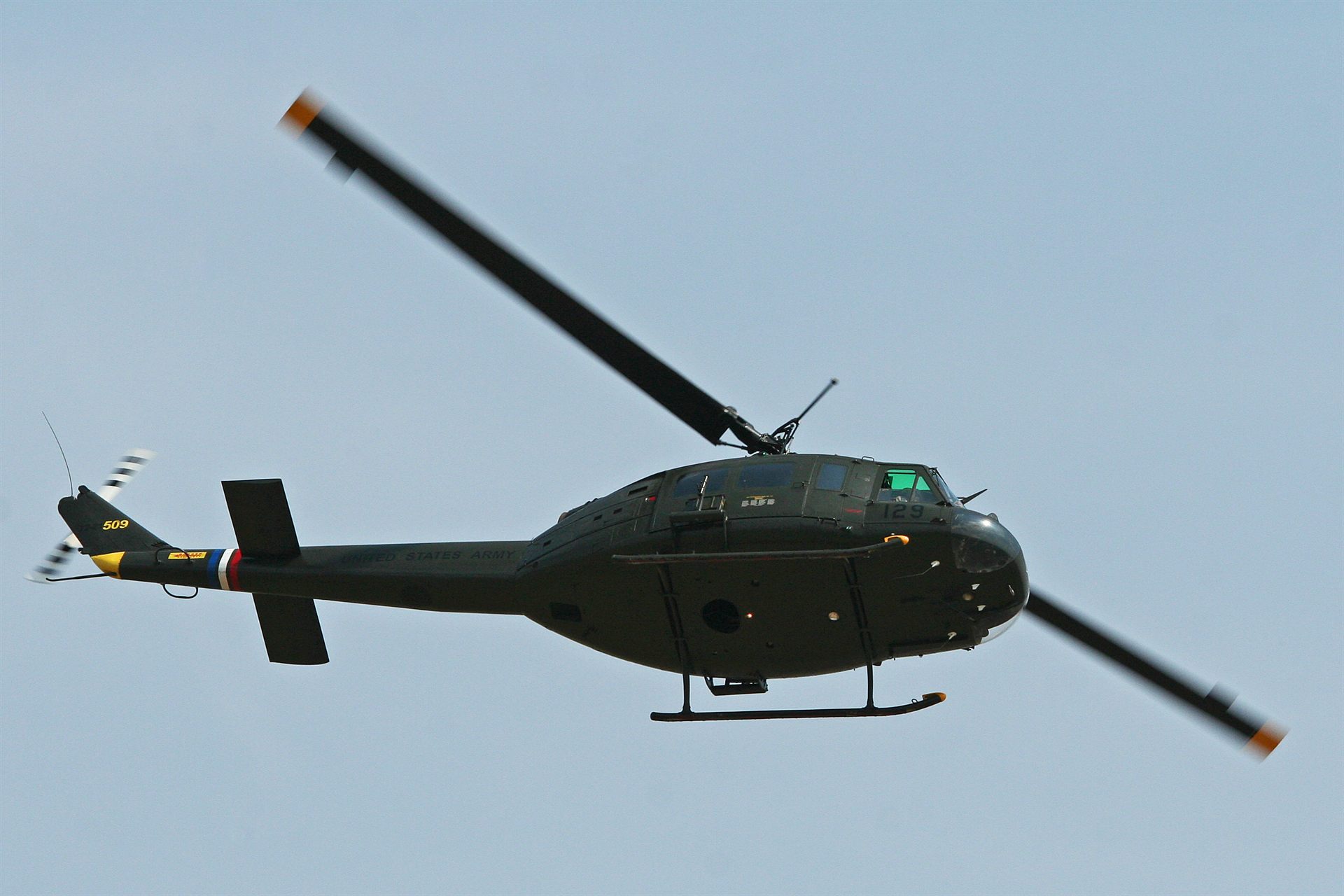
Pictured: a Bell UH-1H "Huey" helicopter in genuine U.S. Army olive-drab colors — the same airframe type Capt. Lawrence Coyne's Army Reserve crew was flying, but not their actual helicopter and not a photograph from the October 18, 1973 encounter near Mansfield, Ohio. The near mid-air collision happened at night in under five minutes with no camera aboard, so no image of the cigar-shaped object or the crew's specific aircraft from that night exists.
Theoretical Alignment
The Coyne case is unusual among UAP encounters in that it pairs an extremely high-credibility witness pool — four trained military aviators and medics, none with any prior public interest in UFOs, all reporting essentially identical observations independently to Army and FAA investigators within hours — with a genuinely instrumented anomaly: an altimeter and collective-pitch reading that, if taken at face value, describe a helicopter climbing under an external force its own pilot could not counteract. That combination pushes the case's ETH alignment higher than most "lights in the sky" reports, though it stops well short of confirming an extraterrestrial craft, since no propulsion mechanism, occupant, or physical trace was ever observed. The Psycho-Social Hypothesis explains comparatively little here: PSH accounts for social contagion and misperception well, but it does not easily explain a coordinated instrument reading witnessed simultaneously by two trained pilots in physical control of the aircraft, nor the near-identical descriptions independently supplied by ground witnesses miles away who had no contact with the crew. The Interdimensional Hypothesis finds essentially no support in the case's physical or testimonial record, which describes a conventional atmospheric near-collision rather than any trans-dimensional or Vallée-style "high strangeness" element beyond the light and the climb themselves.
Background
By October 1973, official U.S. government UFO investigation had been formally closed for nearly four years. Project Blue Book, the U.S. Air Force's public UFO-investigation office, had ceased operations in December 1969 following the Condon Committee's largely dismissive 1968 report, leaving no standing federal apparatus dedicated to collecting or evaluating sighting reports. Into that vacuum stepped J. Allen Hynek, the Northwestern University astronomer who had served as Blue Book's scientific consultant for over two decades and had grown convinced, against his own early skepticism, that a meaningful fraction of reports resisted conventional explanation. In 1973 Hynek founded the Center for UFO Studies (CUFOS) in Evanston, Illinois, intending to apply more rigorous scientific method to sighting investigation than the Air Force ever had. The Coyne case, arriving within months of CUFOS's founding, would become one of the young organization's first major test cases and helped cement its reputation in the field.
The crew flying that night belonged to the 316th Medical Detachment (Helicopter Ambulance), an Army Reserve MEDEVAC unit based at Cleveland's fixed Army Reserve facility. Their Bell UH-1H "Huey," tail number 68-15444, had departed Port Columbus International Airport at approximately 10:30 PM on October 18, 1973, bound for Cleveland Hopkins International Airport roughly 96 nautical miles to the north-northeast, after the four-man crew completed routine annual flight physical examinations in Columbus. Command of the aircraft rested with 36-year-old Captain Lawrence J. Coyne, a 19-year aviation veteran; at the controls sat 26-year-old First Lieutenant Arrigo Jezzi, a chemical engineer in civilian life. Behind them rode 35-year-old Sergeant John Healey, a Cleveland police detective serving as flight medic, and 23-year-old Sergeant Robert Yanacsek, a computer technician, in the crew-chief position. It was an unremarkable Thursday-night administrative flight of exactly the kind military reservists fly routinely — until, cruising at 2,500 feet on a heading of roughly 030 degrees over the darkened farmland southeast of Mansfield, Yanacsek noticed a single red light on the horizon that did not behave like any aircraft he had seen before.
Complete Timeline
| Date | Event |
|---|---|
| December 1969 | Project Blue Book, the U.S. Air Force's public UFO investigation office, formally closes following the Condon Committee report, leaving no standing federal UFO-reporting apparatus. |
| 1973 | J. Allen Hynek founds the Center for UFO Studies (CUFOS) in Evanston, Illinois, intending a more scientifically rigorous, Blue Book-independent investigative body. |
| Early October 1973 | A cluster of Ohio UFO reports begins, including sightings near Zanesville and a widely reported encounter by Ohio Governor John J. Gilligan and his wife. |
| October 18, 1973 — ~10:30 PM | Army Reserve UH-1H Huey (tail number 68-15444), crewed by Capt. Lawrence Coyne, 1Lt. Arrigo Jezzi, Sgt. John Healey, and Sgt. Robert Yanacsek, departs Port Columbus for Cleveland Hopkins after routine flight physicals. |
| ~10:50 PM | Healey observes a single red light to the west that appears to move south, an early sighting later folded into the broader timeline of the night's activity. |
| ~11:00–11:02 PM | Yanacsek spots a red light on the southeast horizon near Charles Mill Lake. The light appears to parallel the helicopter's course, then turns directly toward it on what Coyne judges to be a collision course, closing at an estimated speed in excess of 600 knots. |
| ~11:02 PM (immediately following) | Coyne takes the controls, radios Mansfield tower, and initiates a power descent, dropping from 2,500 to roughly 1,700 feet at up to 2,000 feet per minute and accelerating to about 100 knots to avoid impact. Radio contact with Mansfield tower is lost on both UHF and VHF. |
| ~11:03 PM | Rather than colliding, the object abruptly decelerates and comes to a hover directly in front of and slightly above the helicopter for approximately 10–12 seconds, filling nearly the entire width of the windshield — a gray, metallic, slightly domed, cigar-shaped hull roughly 60 feet long, with a red light forward, a white light aft, and a distinctive green light beneath. |
| ~11:03 PM | The object's green light pivots upward and sweeps through the cockpit, bathing the crew in intense green illumination; Coyne and Jezzi both later describe it as pyramid- or cone-shaped, sweeping "like a spotlight." |
| ~11:03–11:04 PM | Simultaneously, ground witnesses on Route 430 near Charles Mill Lake — a woman (identified in Zeidman's report as "Mrs. Erma C.") driving with several children, and separately the Elias family, including 14-year-old John Elias, at their home southeast of Mansfield — independently observe the green-lit helicopter and the hovering object. |
| ~11:04 PM | The object accelerates away to the northwest at high speed, passing near Mansfield's Lahm Airport before departing the area. |
| Immediately after | Jezzi and Coyne, checking instruments, find the altimeter reading approximately 3,500 feet and climbing at 1,000 feet per minute — despite the collective pitch control remaining in the full-down position the entire time, a configuration that should produce a descent, not a climb. |
| Moments later | Coyne pulls up on the collective at roughly 3,800 feet; the crew feels a distinct "bump," and the anomalous climb ceases, restoring normal control response. |
| Later that night | The crew notices the magnetic compass disk rotating continuously at approximately four revolutions per minute; it never functions correctly again and is later replaced. |
| October 18–19, 1973 | The crew reports the near mid-air collision to the FAA Flight Service Station and is directed to the FAA General Aviation District Office (GADO) in Cleveland; Army channels are separately notified. |
| November 23, 1973 | The U.S. Army's official disposition-form report on the incident is filed, documenting the near-collision, the descent-to-avoid maneuver, and the instrument-recorded climb with the collective bottomed. |
| Late 1973 | The case reaches J. Allen Hynek and CUFOS; Columbus-based investigator Jennie Zeidman, a former Project Blue Book staffer, begins an independent field investigation, eventually logging more than 18 hours of interviews with the crew and locating additional ground witnesses. |
| 1973 | A National Enquirer "Blue Ribbon Panel" of UFO researchers awards the Coyne crew $5,000 for the most scientifically valuable UFO report of the year. |
| 1978 | Skeptic Philip J. Klass publishes his counter-explanation attributing the sighting to an Orionid meteor fireball combined with pilot error, touching off a lengthy public dispute carried out partly in the letters pages of OMNI magazine. |
| March 1979 | Jennie Zeidman publishes her full CUFOS field report, A Helicopter-UFO Encounter over Ohio, concluding the sighting remains unexplained after ruling out meteor, aircraft, and balloon explanations. |
| November 28, 1978 | Lt. Col. Lawrence Coyne testifies in person before the United Nations General Assembly's Special Political Committee in New York, at a hearing on UFO phenomena sponsored by the government of Grenada and featuring Hynek and Jacques Vallée. |
| 1999 | Retired NASA-Ames scientist Richard Haines, founder of NARCAP (the National Aviation Reporting Center on Anomalous Phenomena), later cites the Coyne case as ranking among the highest-credibility pilot encounters he has reviewed. |
The Approach: "It's Going to Hit Us"
The UH-1H had been in the air for roughly half an hour, cruising uneventfully at 2,500 feet, when crew chief Robert Yanacsek, seated at the right rear of the cabin, noticed a single steady red light on the horizon to the southeast. His first instinct was that it was a radio tower beacon or a distant aircraft's anti-collision strobe; he mentioned it in passing. Over the next several seconds, though, the light's behavior stopped making sense in those terms — rather than staying fixed or slowly crossing the sky the way a distant aircraft would, it appeared to parallel the helicopter's own course and then, decisively, turn to intercept it. Yanacsek's report to the cockpit grew urgent: the light was closing fast, and it looked like it was going to hit them.
Captain Coyne, in the right front seat as aircraft commander, confirmed the threat visually and took the controls from Lieutenant Jezzi. By his own later account and the Army's official report, Coyne judged the object to be closing on a collision course at a speed he estimated in excess of 600 knots — far beyond anything a conventional aircraft would present at that altitude in that airspace. Standard emergency procedure for an imminent midair collision is a rapid, aggressive descent, and Coyne executed exactly that: dropping the collective to enter a power descent from 2,500 feet, increasing his rate of descent to roughly 2,000 feet per minute, accelerating to approximately 100 knots, and radioing Mansfield tower to report the converging traffic. It was, in the crew's telling, a textbook avoidance maneuver against what every instinct told them was another aircraft on a disastrous intercept course. Radio contact with the tower, which had briefly acknowledged their call sign, went dead moments later on both UHF and VHF — and stayed dead for what the crew estimated afterward as roughly ten minutes.
The Hover and the Green Light
Rather than colliding or passing overhead as a conventional aircraft would, the object did something no aircraft of 1973 was capable of: it decelerated, in Coyne's words, from an estimated 600 knots to match the helicopter's own speed almost instantaneously, and came to a dead hover directly in front of and slightly above the UH-1H's nose. For a stretch the crew estimated at ten to twelve seconds — Zeidman's later reconstruction, incorporating the ground-witness timeline, extended the total period the object remained continuously visible to roughly five minutes — the crew had an unobstructed, close-range view of a solid, gray, metallic-looking hull, described consistently by Coyne and Jezzi as cigar- or torpedo-shaped, slightly domed on top, and essentially featureless: no wings, no visible rotors, no vertical or horizontal stabilizers, no windows, no seams. Coyne estimated its length at roughly 60 feet and its apparent width as nearly filling the entire windshield. A red light glowed at what the crew took to be the object's nose or bow; a white light showed at its tail.
Then, according to all four crewmen, a bright green light near the object's lower surface pivoted — described variously as pyramid- or cone-shaped — and swept upward and forward, passing through the helicopter's chin bubble and windshield and flooding the cockpit with intense green illumination, briefly bathing the instrument panel, the crew's faces, and the cabin interior in green light bright enough that Coyne compared it to being under a spotlight. It was this same green light, independently and without any knowledge of what the helicopter crew was experiencing, that ground witnesses miles away would separately describe seeing illuminate the sky and, in at least one account, the interior of a parked car.
Departure and the Anomalous Climb
As abruptly as it had appeared, the object broke off. Crew accounts describe it accelerating away to the northwest at extremely high speed, passing in the general direction of Mansfield's Lahm Airport before vanishing from sight. In the moments immediately following, Coyne and Jezzi both turned their attention back to the aircraft's own instruments — standard cockpit discipline after any near-miss — and found something that neither pilot could reconcile with normal flight dynamics: the altimeter read approximately 3,500 feet and was climbing at a steady 1,000 feet per minute, even though Coyne's collective pitch control remained exactly where he had left it during the evasive descent — full down, the configuration that produces a power-off descent, not a climb. In a fixed-wing aircraft an updraft or wind shear might explain an unplanned altitude gain; in a helicopter with the collective bottomed, sustained climb without a corresponding power input is aerodynamically anomalous. Coyne's own later description was direct: "I had made no attempt to pull up. Yet we had climbed from 1,700 to 3,500 feet with no power in a couple of seconds," with no G-forces or unusual strain felt by the crew during the ascent. At roughly 3,800 feet, Coyne finally pulled up on the collective; the crew felt a distinct bump, and the aircraft's normal control response returned, allowing them to continue the flight to Cleveland Hopkins without further incident.
The compass anomaly discovered afterward compounded the puzzle. The magnetic compass disk was found rotating continuously at approximately four revolutions per minute, rendering it useless for navigation; ground maintenance crews at Cleveland were unable to correct the fault, and the entire compass assembly ultimately had to be replaced — a small, mundane-sounding maintenance detail that nonetheless represents one of the case's few pieces of physical, verifiable aftermath evidence beyond eyewitness recollection.
Ground Witnesses at Charles Mill Lake
What distinguishes the Coyne case from countless "crew says, we believe them" cockpit-only reports is that it did not depend solely on the four airmen's word. Independent ground observers, with no knowledge of what was happening in the helicopter above them and no contact with the crew until investigators later connected the accounts, reported closely matching phenomena from the ground. On Route 430 near Charles Mill Lake, a woman identified in Jennie Zeidman's report only as "Mrs. Erma C.," driving with several children including two thirteen-year-old cousins who got out of the car for a better look, described the sky and surrounding landscape suddenly bathed in green light and recalled seeing both the low-flying helicopter and what she described as an object "like a blimp," "as big as a school bus," and "sort of pear shaped" moving in proximity to it. Separately, southeast of Mansfield, Jeanne Elias and her family heard a helicopter passing unusually low overhead; her fourteen-year-old son John was awakened by a bright green light that, in his words, "lit up the bedroom." A further independent ground witness, identified in some secondary accounts as Jim Carver, reported observing three lights maneuvering with what he described as unusual precision and speed over the same stretch of countryside that night. None of these ground observers had any means of coordinating a false account with the flight crew, and their descriptions of timing, color, and general behavior line up closely enough with the crew's own testimony that CUFOS investigators treated the ground reports as meaningful corroboration rather than coincidence.
Reporting the Incident: FAA, Army, and the Absence of Blue Book
Because Project Blue Book had already been closed for nearly four years by October 1973, the Coyne crew's near mid-air collision followed an entirely different reporting chain than earlier Air Force-era cases like Washington, D.C. or Lakenheath-Bentwaters. As a near mid-air collision involving a military aircraft in civil airspace, the incident triggered two separate, mundane, non-UFO-specific reporting channels: standard FAA near-miss procedure, which required the crew to notify the Flight Service Station and subsequently report in person to the FAA's General Aviation District Office (GADO) in Cleveland, and standard U.S. Army incident-reporting procedure, which produced the formal disposition-form report filed on November 23, 1973, documenting the descent-to-avoid maneuver and the instrument-recorded climb. Neither agency was equipped or mandated to investigate the object's identity as a UFO matter; both simply logged the near-collision as reported. It was only afterward, through informal channels — word of the case reaching Ohio-based ufologists and, from there, Hynek's newly formed CUFOS — that any organization undertook to investigate what the crew had actually encountered, rather than simply record that a near-collision had occurred.
The CUFOS Investigation: Jennie Zeidman's Field Report
Jennie Zeidman, a Columbus-based researcher who had worked as J. Allen Hynek's first secretary and research assistant during the early years of Project Blue Book before later becoming an independent CUFOS field investigator, took on the Coyne case as one of the young organization's first major assignments. Her investigation was unusually thorough by the standards of contemporaneous ufology: she conducted what she and later reviewers described as more than 18 hours of direct interviews with the four crewmen, separately and together, cross-checking their accounts against each other and against the Army's own paperwork; she tracked down and interviewed the ground witnesses at Charles Mill Lake independently of the crew; and she built a second-by-second reconstructed timeline of the encounter meant to test it against mundane explanations. Her central methodological finding was that the object remained continuously in view, in some form, for at least five minutes when the ground-witness observations were integrated with the crew's account — a duration Zeidman and later reviewers considered fundamentally incompatible with a meteor, which by definition burns through the atmosphere in a matter of seconds. Zeidman published her findings as the CUFOS monograph A Helicopter-UFO Encounter over Ohio in March 1979, concluding, in agreement with Hynek's own assessment, that the case remained genuinely unexplained after conventional aircraft, balloon, and meteor hypotheses had each been examined and found wanting.
Before the United Nations, 1978
The Coyne case achieved a level of formal international attention almost no other UFO encounter has matched. On November 28, 1978, the United Nations General Assembly's Special Political Committee convened a hearing on UFO phenomena, sponsored by the government of Grenada under Prime Minister Eric Gairy, who had campaigned for years for the UN to take an official interest in the subject. The hearing featured expert testimony from both J. Allen Hynek and Jacques Vallée, but its most striking moment came from a firsthand military witness: by then promoted to Lieutenant Colonel, Lawrence Coyne personally recounted the October 1973 encounter to the assembled delegates, explicitly speaking as a private citizen rather than as a representative of the U.S. military. "I am convinced this object was real," Coyne told the committee, "and that these types of incident require a thorough investigation," calling for coordinated international protocols to protect aircrews who might encounter similar phenomena. The U.S. military neither authorized nor obstructed Coyne's appearance, and no evidence has surfaced that his career suffered as a result of speaking publicly about the case — itself a notable data point for researchers who track how the armed services have historically responded to service members reporting UAP encounters.
Circumstantial Evidence
- Four independent, professionally credentialed military witnesses — a veteran pilot, a chemical engineer, a police detective, and a computer technician — gave substantially consistent accounts to Army and FAA investigators within hours of the encounter, with no apparent motive to fabricate.
- Two of those witnesses, Coyne and Jezzi, were both qualified pilots who independently observed and cross-checked the same anomalous altimeter reading in real time from the cockpit.
- Independent ground witnesses at Charles Mill Lake and near Mansfield, with no contact with the flight crew, reported closely matching descriptions of green illumination and an object near the low-flying helicopter.
- The helicopter's magnetic compass was permanently disrupted and required full replacement — a documented, verifiable maintenance record rather than eyewitness recollection alone.
- Radio contact with Mansfield tower was lost on both UHF and VHF frequencies for approximately ten minutes, with no corresponding recording on the tower's own equipment.
- J. Allen Hynek's Center for UFO Studies, applying its most rigorous available field-investigation methodology through Jennie Zeidman, formally concluded the case remained unexplained after examining and rejecting meteor, balloon, and conventional-aircraft hypotheses.
- Lawrence Coyne's willingness to testify under his own name before the United Nations in 1978, years after the case could have quietly faded, is difficult to reconcile with a hoax or a simple misperception the crew privately doubted.
The Ohio UFO Wave of October 1973
The Coyne encounter did not occur in isolation. It fell within a roughly two-week cluster of Ohio sightings in mid-to-late October 1973 that local and national press quickly dubbed a UFO "flap" or "wave," occurring just before Halloween amplified public attention further. Within days of the Mansfield encounter, sheriff's deputies near Zanesville, Ohio reported three pulsating globes of light hovering over a local cemetery. Then-Ohio Governor John J. Gilligan and his wife reported their own encounter, describing an amber-colored, vertically oriented object that paced their car for approximately thirty minutes — an account made all the more notable by the witness's status as a sitting governor with every institutional incentive not to invite ridicule. A police sergeant near Cincinnati separately pursued a white-and-yellow maneuvering light in his patrol car. Hynek himself, an Ohio State University-trained astronomer intimately familiar with the state, characterized the cluster as "a memorable wave" meriting serious scientific attention rather than dismissal, and the timing helped ensure that when the Coyne case specifically reached CUFOS, it did so within an organizational and public context already primed to take a credentialed military report seriously rather than treat it as an isolated curiosity.
The Klass-Oberg Controversy: Meteor, Pilot Error, or Something Else
The Coyne case's most prominent and durable skeptical challenge came from Aviation Week senior editor and veteran UFO debunker Philip J. Klass, who by 1978 had concluded, based primarily on a small number of long-distance telephone interviews and a brief television appearance rather than any in-person field investigation, that the crew had most likely been startled by a bright meteor fireball from the Orionid shower — whose activity window overlapped the night of the sighting — and that the anomalous instrument climb could be explained by inadvertent, panic-driven control input from one of the pilots rather than any genuine external force acting on the aircraft. Klass's explanation received wide circulation and became, for years, the default "skeptical answer" cited whenever the Coyne case came up in general UFO literature.
The "Oberg" half of the controversy comes from aerospace journalist and analyst James Oberg — a former NASA Johnson Space Center flight controller who wrote OMNI's regular "UFO Update" column and would go on to author UFOs and Outer Space Mysteries: A Sympathetic Skeptic's Report (1982). In his December 1978 column, Oberg reported on Klass's meteor/pilot-error explanation for the Coyne case and characterized Klass's investigative approach as more careful and scientific than the case's proponents credited it with being — a framing that, rather than Klass's original explanation alone, is what drew immediate and pointed criticism from researchers who had actually worked the case in the field. Writing in the letters pages of OMNI magazine in response, correspondent Charles Labbe directly contrasted Klass's methodology with Jennie Zeidman's, noting that Klass's investigation "consisted of only three long-distance phone calls and a brief TV talk show conversation, with no face-to-face contact with the witnesses," while Zeidman's own fieldwork ran to more than eighteen hours of direct interrogation and identified five corroborating ground-based witnesses Klass's remote inquiry had never located. Investigators pointed to several specific facts difficult to reconcile with a meteor: Zeidman's timeline reconstruction placed the object continuously in view for roughly five minutes, several orders of magnitude longer than any meteor fireball, which typically burns out in one to a few seconds; the crew described a structured, detailed morphology — a defined cigar-shaped hull, distinct red/white/green lighting, and a controllable, sweeping searchlight beam — none of which a meteor can exhibit; and Klass's own search turned up no corroborating fireball reports from other ground observers in the region that night, an odd gap if a genuinely bright bolide had passed low over populated north-central Ohio.
Author and retired military intelligence officer Kevin Randle, himself a trained Army helicopter pilot, separately challenged Klass's proposed "unconscious pilot input" explanation for the climb on procedural grounds: Army flight discipline required an explicit verbal handoff of the controls ("I've got it") before either pilot took action, making an unannounced, unconscious collective input by either Coyne or Jezzi inconsistent with their training, even under acute stress. A separate, more recent alternative theory, circulated informally online and attributing the encounter to a mistaken nighttime rendezvous with a military aerial-refueling tanker aircraft whose navigation lights and searchlight the crew misread as a structured craft, has not been adopted by CUFOS, Zeidman, or subsequent investigators as a serious competing explanation, and does not account for the specific compass and radio anomalies documented in the Army's own report. Taken together, the debate over the Coyne case's conventional explanations remains, more than four decades later, genuinely unresolved rather than conclusively settled in either direction.
Legacy and Cultural Impact
The Coyne case became, within the field of ufology, a touchstone example of what a "good" case looks like: multiple credentialed witnesses, prompt official reporting through mundane institutional channels rather than sensationalized media, a documented instrumented anomaly, and a rigorous independent field investigation. It helped establish Hynek's newly founded CUFOS as a serious research organization capable of producing detailed, methodical case studies rather than mere anecdote collection, a reputation the organization carried through the following decades. The case was also cited in multiple national UFO documentaries of the later 1970s that drew on the CUFOS investigation for their retelling of the encounter. Decades later, NASA-Ames retired scientist Richard Haines, who founded the National Aviation Reporting Center on Anomalous Phenomena (NARCAP) in 1999 specifically to collect and analyze pilot UAP reports using aviation-safety methodology, would cite the Coyne case as ranking among the very highest-credibility pilot encounters he reviewed across a career spanning hundreds of aviation-related reports — a modern institutional echo of the case's original claim to credibility: not that it proves an extraterrestrial craft, but that it represents an unusually well-documented, professionally reported aviation safety anomaly that has never been conclusively explained.
Key Witnesses
Capt. (later Lt. Col.) Lawrence J. Coyne
A 36-year-old, 19-year aviation veteran and civilian police officer, Coyne took the controls the instant the approaching light appeared to threaten collision, executed the evasive descent, and was one of the two pilots who directly observed the anomalous climb on the aircraft's own instruments. He filed the crew's official Army report, cooperated extensively with Jennie Zeidman's CUFOS investigation, and in November 1978 personally testified before the United Nations Special Political Committee. He maintained the substance of his account without variation for the rest of his life.
1st Lt. Arrigo Jezzi
Seated at the flight controls throughout the critical seconds of the near-collision and the hover, Jezzi was the other pilot who directly observed the altimeter's anomalous 1,000-foot-per-minute climb reading with the collective bottomed. In later interviews Jezzi offered a somewhat more measured characterization of the climb's severity than Coyne's account, noting it "could have been less" dramatic than initially described — a nuance investigators and skeptics alike have cited on both sides of the case's central instrument-anomaly debate.
Sgt. Robert Yanacsek
The first crew member to spot the approaching red light on the southeast horizon near Charles Mill Lake, Yanacsek's initial alert to the cockpit began the chain of events leading to Coyne's evasive maneuver. At 23 the youngest member of the crew, he gave an account of the object's approach, hover, and departure that closely matched the other three crewmen's independent statements to Army and FAA investigators.
Sgt. John Healey
A 35-year-old Cleveland police detective serving as the crew's medic, Healey reported an earlier, separate red-light sighting to the west shortly before Yanacsek's more urgent report of the converging object, and was among the crew members bathed in the green light that swept through the cabin. In a 2011 public program decades later, Healey remained willing to discuss the case publicly, describing the helicopter itself as a maintenance-troubled "hangar queen" — testimony investigators have cited as evidence he had no motive to embellish an already extraordinary story.
Jennie Zeidman
A former Ohio State University astronomy student who had served as J. Allen Hynek's first secretary and research assistant during Project Blue Book's early years, Zeidman conducted the case's definitive independent investigation: more than 18 hours of crew interviews, direct interviews with the Charles Mill Lake ground witnesses, and a second-by-second reconstructed timeline that became the primary basis for ruling out a meteor explanation. Her March 1979 CUFOS monograph, A Helicopter-UFO Encounter over Ohio, remains the single most detailed primary investigative record of the case.
Ground Witnesses: The "Erma C." Family and the Elias Family
A woman identified in Zeidman's report as "Mrs. Erma C.," driving on Route 430 with several children, and separately the Elias family southeast of Mansfield — including 14-year-old John Elias, awakened by green light "lit up" in his bedroom — independently reported observing the green-illuminated helicopter and, in the "Erma C." family's case, the object itself, described as resembling a blimp or a school bus in size. Neither family had any contact with the flight crew before investigators connected their accounts, making their testimony an important corroborating data point independent of the aircrew.
The Five Observables Assessment
The Five Observables framework, developed by former AATIP director Luis Elizondo, is used to classify UAP encounters by performance characteristics exceeding known technology of their era:
Assessment: The Coyne case is one of the relatively few UAP encounters in which "Anti-Gravity Lift" style behavior is rated present rather than merely speculative, because the effect was not only witnessed but cross-checked in real time against a physical cockpit instrument (the altimeter) by two independent, trained pilots, with the collective pitch control documented in a configuration that should have produced the opposite result. Instant Acceleration is likewise rated present: the object's deceleration from an estimated 600-plus-knot closing speed to a dead hover in a matter of seconds, followed by its equally abrupt high-speed departure, was reported consistently by all four crewmen. Hypersonic Velocity is rated only speculative because the 600-knot closing-speed estimate rests on visual judgment under high stress rather than any radar or instrumented measurement — extraordinary if accurate, but unverifiable. Low Observability is rated absent: the object was, if anything, unusually conspicuous, brightly lit with red, white, and green lights and clearly visible to both the aircrew and multiple independent ground witnesses. Trans-Medium travel is rated absent, as no transition between air, water, or space was ever reported.
Evidence Assessment
Supporting Anomalous Origin
- Four independent, credentialed military witnesses with no prior UFO interest gave consistent, immediate accounts to official investigators.
- The anomalous climb was documented via aircraft instruments (altimeter, collective position) and cross-checked by two qualified pilots simultaneously.
- Independent ground witnesses with no crew contact corroborated the green light and the object's presence near the helicopter.
- Jennie Zeidman's second-by-second timeline reconstruction found the object visible for approximately five minutes — far longer than any meteor.
- The permanently damaged magnetic compass represents a documented, physical (if secondary) piece of aftermath evidence.
- CUFOS, applying its most rigorous contemporary field methodology, formally classified the case as unexplained rather than solved.
- Coyne's public, on-the-record United Nations testimony in 1978, made under his own name and rank years after the event, is difficult to attribute to attention-seeking given the professional risk it represented.
- NASA-Ames scientist Richard Haines, founder of NARCAP, later rated the case among the highest-credibility pilot encounters he reviewed across a career studying hundreds of aviation UAP reports.
Supporting Conventional Explanation
- The encounter occurred in the same general window as the Orionid meteor shower's annual activity period, offering a plausible mundane trigger for an initial misidentification.
- Skeptic Philip Klass argued the altitude/climb anomaly could reflect inadvertent or unconsciously applied control input by a startled pilot rather than any external force.
- 1st Lt. Jezzi himself later offered a more measured account of the climb's severity than Coyne's original description, introducing some inconsistency into the crew's testimony.
- No radar or other independent sensor data exists to corroborate the crew's estimated closing speed or the object's flight path, leaving the case dependent entirely on visual estimation under high stress.
- Klass's competing explanation received significant public attention, and some researchers have proposed the sighting could reflect a misidentified aircraft (including a rejected but circulated tanker-refueling misidentification theory) rather than a genuinely anomalous craft.
Why "Credible"
The Coyne Helicopter Incident earns a CREDIBLE rating on this site's scale because it combines an unusually strong witness pool with a genuinely instrumented anomaly, while stopping short of the kind of independent, physical, or sensor-based corroboration that would justify a "Verified" rating. On the strength side: four Army Reserve servicemen with no prior interest in UFOs and clean professional records gave consistent, near-immediate statements to Army and FAA investigators; two of them, both qualified pilots, cross-checked the same anomalous altimeter reading against each other in real time from the cockpit; independent ground witnesses with no contact with the crew reported matching phenomena; and the case's magnetic-compass damage represents documented, physical aftermath evidence rather than eyewitness recollection alone. J. Allen Hynek's Center for UFO Studies, applying its most rigorous available field methodology through Jennie Zeidman's exhaustive investigation, formally concluded the case remained unexplained. On the other hand, the case lacks any radar track, photograph, film, or laboratory-testable physical sample; its central kinematic claims (the 600-knot closing speed, the precise severity of the climb) rest on visual and instrumental estimation under high stress rather than independently verified measurement; and a real, if contested, conventional explanation — Philip Klass's Orionid meteor and pilot-error hypothesis — has never been fully and uncontroversially ruled out, even though CUFOS's own timeline analysis argues strongly against it. That combination — exceptionally strong, multiply-corroborated witness testimony paired with a documented instrumented anomaly, but without independent sensor or physical confirmation — places the Coyne case solidly in "credible" territory: one of the strongest cockpit-crew UAP reports on record, but not a closed case.
Sensor & Instrumentation Detection Profile
Unlike many classic UFO cases, the Coyne incident was not captured by any external radar, camera, or government sensor network — Project Blue Book had closed in December 1969, nearly four years before the encounter, so there was no standing Air Force apparatus to receive or cross-reference the report. What the case does have, unusually, is onboard aircraft instrumentation functioning as an inadvertent sensor system: the helicopter's own altimeter, its collective-pitch control position, its magnetic compass, and its UHF/VHF radios all recorded anomalous behavior that two qualified pilots — Coyne and Jezzi — independently read and cross-checked in real time inside the cockpit. The altimeter registered a sustained 1,000-feet-per-minute climb, and Coyne testified the collective was bottomed in a full-power-off descent configuration the entire time, a combination that should have been aerodynamically impossible in still air. Radio contact with Mansfield tower, which had acknowledged the crew's initial position report ("This is Mansfield Tower, go ahead Army 1-5-triple-4"), went dead on both UHF and VHF frequencies for roughly ten minutes during the encounter, and the tower's own recording equipment held no tape of any transmission from that period. After the object departed, the helicopter's magnetic compass disk was observed rotating continuously at roughly four revolutions per minute; ground maintenance crews at Cleveland Hopkins were unable to correct it, and the entire compass unit ultimately had to be replaced.
Environmental & Geospatial Context
The encounter unfolded on a clear, dry, moonless mid-October night over the gently rolling farmland of north-central Ohio, in the vicinity of Charles Mill Lake just southeast of Mansfield — open, rural terrain with scattered lakes and reservoirs, well outside any major metropolitan light pollution but directly beneath a regional general-aviation corridor connecting Port Columbus and Cleveland Hopkins International Airport. The night fell just before the annual Orionid meteor shower's traditional mid-to-late-October activity window, a timing coincidence that would become central to the case's most prominent skeptical explanation. Geospatially, the sighting occurred at the leading edge of what local Ohio newspapers were already calling a UFO "flap": within the same ten-day stretch of October 1973, sheriff's deputies near Zanesville reported pulsating lights over a cemetery, then-Ohio Governor John J. Gilligan and his wife reported a thirty-minute sighting of an amber, vertically oriented object while driving, and a Cincinnati-area police sergeant pursued a maneuvering light in his patrol car — all occurring in the same general region and week as the Coyne encounter, and all feeding directly into the wave context J. Allen Hynek would later describe as "a memorable wave" worth serious scientific attention.
Observer Credibility & Occupational Profile
Few UAP cases anywhere in the historical record match the occupational credibility of the Coyne crew. All four men were serving members of the U.S. Army Reserve's 316th Medical Detachment (Helicopter Ambulance), a tenant reserve unit of the Cleveland U.S. Army Reserve Fixed Facility Army Center, returning from a mandatory flight physical examination — meaning all four had just been certified medically fit, with no evidence of fatigue-driven impairment, immediately before the encounter. Coyne himself was, in civilian life, a police officer and a 19-year veteran aviator holding both fixed-wing and helicopter certifications; he would later be promoted to Lieutenant Colonel and personally testified before the United Nations. Jezzi, at the flight controls throughout the critical seconds of the encounter, was a chemical engineer by profession. Healey was a Cleveland police detective serving as the crew's flight medic. Yanacsek, the crew chief who first spotted the approaching light, worked as a computer technician. None of the four had any prior connection to ufology, none sought publicity, and all four gave independent, substantially consistent statements to Army and FAA investigators within hours of landing — a pattern investigators consider strong evidence against fabrication or contagion effects, though it does not by itself establish what the object actually was.
Physical & Material Assays
No debris, landing trace, or recoverable material of any kind is associated with the Coyne case, and none has ever been claimed. The case's physical evidentiary record instead consists of documented, secondary effects on the aircraft itself: the permanently disrupted magnetic compass, which required full replacement after ground crews at Cleveland Hopkins could not correct its continuous four-revolutions-per-minute rotation; the roughly ten-minute loss of both UHF and VHF radio contact with Mansfield tower, for which the tower's own equipment retained no recording; and the instrument-documented altitude gain itself, cross-verified in real time by two qualified pilots watching the same gauges. None of these effects were independently laboratory-tested in the way a soil sample or metal fragment might be — there was nothing to submit for isotopic or metallurgical analysis — but they represent a rare category of quasi-physical evidence: verifiable, mechanical aircraft-system anomalies reported by trained operators immediately after the fact, rather than eyewitness recollection alone.
Historical Precedents & Archive Matches
The Coyne case sits at the head of a recognizable sub-genre of UAP reporting: the aircrew near-collision paired with instrumented or electromagnetic aftereffects. It shares its core structure with the Iranian Air Force's 1976 Tehran encounter, in which F-4 Phantom fighter crews reported weapons and communications systems failing during pursuit of an unidentified object, and with the 1957 RB-47 bomber chase, another U.S. military aircrew case involving simultaneous radar, visual, and signals-intelligence anomalies. It also echoes, in miniature, the physical/electromagnetic-effects profile later associated with cases like the Rendlesham Forest incident. Within Ohio itself, the case was the highest-profile entry in the brief but intense "Ohio wave" of October 1973, and it became, by design, one of the first flagship cases handled by the newly created Center for UFO Studies — CUFOS had been incorporated by Hynek only months earlier, and the Coyne investigation helped establish the organization's methodology and reputation for the following decade.
Material Analysis
The Coyne case produced no physical debris, trace residue, or recoverable artifact of the object itself, and no witness or investigator has ever claimed otherwise. What it does contain is a narrower category of secondary physical evidence: documented, verifiable damage to the aircraft's own systems. The magnetic compass, functioning normally before the encounter, was found afterward rotating continuously at roughly four revolutions per minute and could not be corrected by ground maintenance crews, ultimately requiring full replacement — a repair-log-level fact rather than a subjective impression. The loss of both UHF and VHF radio contact with Mansfield tower for approximately ten minutes, with no corresponding recording surviving on the tower's own equipment, is a second, independently documented systems anomaly. Neither effect has ever been laboratory-analyzed in the way a physical sample might be, since neither produced a substance or artifact that could be submitted for testing; their evidentiary value instead rests on being verifiable maintenance and communications-log facts rather than purely subjective testimony, distinguishing them from the far more common UFO case that offers eyewitness recollection alone.
Supporting a Genuine Anomalous Effect
- The compass fault was severe and persistent enough to require full unit replacement, rather than resolving on its own or reflecting a simple, pre-existing mechanical fault noticed only in hindsight.
- The radio outage was corroborated by the tower's own absence of any recorded transmission, rather than resting on crew memory alone.
- Both effects align temporally and functionally with a close-range electromagnetic disturbance rather than being unrelated coincidental malfunctions.
Supporting a Mundane Origin
- 1970s-era Army UH-1H helicopters, including this specific airframe, were documented by crew member John Healey as having "ongoing mechanical issues," raising the possibility the compass fault was a pre-existing or coincidental maintenance problem.
- Radio blackouts over rural terrain at low altitude can result from mundane line-of-sight limitations to distant ground stations, an explanation Klass specifically proposed for the communications gap.
- No independent electromagnetic-field measurement was taken during or immediately after the encounter, leaving the causal link between the object and the instrument anomalies inferential rather than measured.
The Conventional Explanation Candidate: Orionid Meteor Fireball
The most publicly prominent conventional explanation, advanced by Philip J. Klass in 1978, holds that the crew encountered an unusually bright meteor fireball associated with the Orionid meteor shower, whose activity period overlapped mid-to-late October, and that the startling brightness and apparent proximity of a bright bolide, combined with the disorientation of a sudden evasive maneuver at night, produced both the crew's perception of a structured, hovering craft and an inadvertent, panic-driven control input that produced the apparent climb. It deserves serious evaluation because bright fireballs genuinely can startle pilots into misjudging distance, size, and duration, and meteor activity was plausibly elevated around the date in question.
Where the Meteor Theory Falls Short
Its central weakness is duration and behavior. Jennie Zeidman's independently reconstructed timeline, built from both crew and ground-witness testimony, placed the object continuously visible for approximately five minutes — several orders of magnitude longer than any meteor fireball, which by definition burns out within a few seconds of atmospheric entry. A meteor also cannot decelerate, hover, reverse or redirect a beam of light, or depart under its own power in a new direction, all of which the crew and ground witnesses consistently described. Klass's own investigation, limited to a small number of telephone interviews rather than field research, failed to locate any independent fireball report from other observers in the region that night, an unusual gap if a bolide bright enough to illuminate a cockpit green had genuinely passed over populated north-central Ohio.
Pilot Error and Inadvertent Control Input
A second, related conventional candidate holds that the anomalous instrument climb resulted not from any external phenomenon but from a startled pilot unconsciously pulling up on the collective during the high-stress evasive maneuver, with the crew's shared adrenaline and expectation afterward causing them to misremember the control position. This candidate is procedurally weak: Kevin Randle, a trained Army helicopter pilot himself, has noted that Army flight discipline required an explicit, verbalized handoff of aircraft control between pilots, making an unannounced, unconscious control input by either Coyne or Jezzi inconsistent with standard training even under acute stress, and both pilots independently and consistently maintained that the collective was bottomed throughout the climb.
Misidentified Aircraft or Refueling Tanker
A third, less widely adopted theory proposes the crew mistook a military aerial-refueling tanker aircraft's navigation and searchlight configuration for a structured, hovering craft during a nighttime rendezvous maneuver. This candidate has never been endorsed by CUFOS, Zeidman, or any investigator who conducted primary fieldwork on the case, and it does not account for several specific documented details: no tanker rendezvous was scheduled or logged in the airspace that night, the object's reported deceleration from an estimated 600-plus knots to a dead hover exceeds any tanker aircraft's performance envelope, and the theory offers no mechanism for the specific compass and radio anomalies independently documented in the Army's own incident report.
Orionid Meteor Fireball
ImplausibleIMPLAUSIBLE as a complete account: Zeidman's reconstructed timeline placed the object continuously visible for roughly five minutes, orders of magnitude longer than any meteor fireball, and a meteor cannot decelerate, hover, redirect a light beam, or depart under its own power the way the object was consistently described doing. Klass's own telephone-based inquiry turned up no corroborating fireball report from any other regional observer that night. Cannot be entirely ruled out as a contributing initial trigger for the sighting.
Pilot Error / Inadvertent Control Input
ImplausibleIMPLAUSIBLE: Army flight discipline required an explicit, verbalized handoff of aircraft control between pilots, making an unannounced, unconscious collective input by either Coyne or Jezzi inconsistent with standard training even under acute stress, and both pilots independently and consistently maintained the collective was bottomed throughout the climb.
Misidentified Aircraft / Refueling Tanker
ImplausibleIMPLAUSIBLE: never endorsed by CUFOS, Zeidman, or any investigator who conducted primary fieldwork on the case. No tanker rendezvous was scheduled or logged in the airspace that night, the object's reported deceleration from an estimated 600-plus knots to a dead hover exceeds any tanker aircraft's performance envelope, and the theory offers no mechanism for the documented compass and radio anomalies.
Related Cases
Confirmed Documents & Official Records
National Archives finding aid covering UAP-related textual holdings; useful starting point for any surviving FAA or military correspondence connected to 1970s-era near mid-air collision reports, since the Coyne case predates Project Blue Book's own closed microfilm archive by four years.
UNCLASSIFIEDSearch portal for the UN General Assembly's Special Political Committee official records, including the November 28, 1978 session at which Lt. Col. Lawrence Coyne testified alongside J. Allen Hynek and Jacques Vallée.
PUBLIC RECORDSearch Government Archives Directly
Further Reading — Recommended Literature
A Helicopter-UFO Encounter over Ohio
The original CUFOS field-investigation monograph, built from more than 18 hours of crew interviews and independent ground-witness corroboration; the single most detailed primary source on the case.
The Hynek UFO Report
Written by the Center for UFO Studies founder whose organization investigated the Coyne case from its earliest days, distilling decades of Blue Book-era case evaluation into the classification framework still used to assess cases like this one.
Project Blue Book Exposed
Written by a retired military intelligence officer and trained Army helicopter pilot who has published detailed procedural rebuttals of Philip Klass's pilot-error explanation for the Coyne climb.
Watch the Skies!: A Chronicle of the Flying Saucer Myth
A rigorously skeptical, well-documented history of American UFO cases spanning the post-Blue Book 1970s, useful as a counterweight to more credulous treatments of the Coyne case and the 1973 Ohio wave.
The UFO Encyclopedia, 4th Edition
The definitive UFO reference work, with an extensively cited entry on the Coyne/Mansfield helicopter case situating it within both the 1973 Ohio wave and the broader history of aircrew UAP encounters.
Essential Viewing
1973-10-18: Lt Col Coyne's UFO Mansfield Ohio
A focused case walkthrough covering the flight timeline, the near-collision, and the instrument anomaly.
Coyne Helicopter-UFO Encounter over Ohio 1973
A dedicated overview of the encounter, drawing on the crew's own testimony and the CUFOS investigation.
CASE FILES: 003 | The Coyne Helicopter UFO Incident
In-depth case-file style analysis from the "Somewhere in the Skies" UFO research podcast/channel.
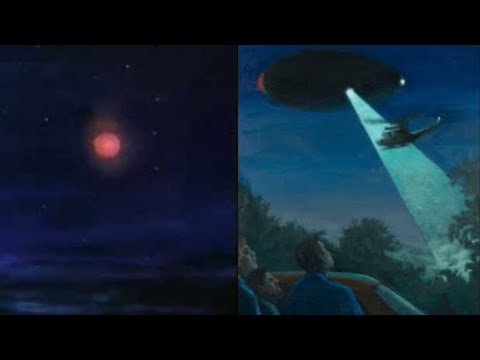
The Unexplained Coyne Helicopter UFO Incident with Military Pilots in 1973
A dedicated retrospective focused specifically on the military-pilot testimony at the center of the case.
Sources
- National Investigations Committee on Aerial Phenomena (NICAP). "Mansfield, Ohio Helicopter-UFO Encounter, October 18, 1973" — full case report. nicap.org
- NICAP. Coyne case directory / EMCAT electromagnetic-effects listing. nicap.org
- Gross, Patrick. "UFOs at Close Sight: The Coyne Case, Mansfield, Ohio, 1973." ufologie.patrickgross.org
- Gross, Patrick. "The Coyne Case, Mansfield, Ohio, 1973 — The Official Report" (transcription of the U.S. Army disposition-form report). ufologie.patrickgross.org
- Zeidman, Jennie. A Helicopter-UFO Encounter over Ohio, Center for UFO Studies, Evanston, IL, March 1979 (CUFOS field investigation monograph).
- Center for UFO Studies (CUFOS). "J. Allen Hynek Biography." cufos.org
- Center for UFO Studies (CUFOS). "International UFO Reporter" archive index. cufos.org
- "Center for UFO Studies," Wikipedia. en.wikipedia.org
- Ohio Magazine. "The Case of Ohio's Best Documented UFO." ohiomagazine.com
- Richland Source. "Out of This World: Coyne Incident Focused UFO Attention on North Central Ohio in 1973," April 29, 2022. richlandsource.com
- Ashland Source. "Coyne Incident over Charles Mill Lake Was Most Credible UFO Sighting of 1973," October 4, 2020. ashlandsource.com
- Richland County History. "UFOs Over Richland County: 1973," September 2, 2019. richlandcountyhistory.com
- Cleveland Ufology Project. "Coyne Helicopter Incident — 1973." clevelandufo.com
- Cleveland Ufology Project. "Coyne Helicopter Incident — 1973 — Epilogue" (fate of tail number 68-15444 and crew follow-up). clevelandufo.com
- HuffPost. "Army Helicopter's UFO Scare Still A Mystery, 40 Years Later," October 18, 2013. huffpost.com
- Randle, Kevin D. "A Different Perspective: October 18, 1973: The Coyne Helicopter Case and Philip Klass," A Different Perspective blog, June 2015. kevinrandle.blogspot.com
- Parabunk. "The 1973 Coyne/Mansfield Helicopter UFO Incident Finally Explained," April 2018 (alternative skeptical analysis). parabunk.blogspot.com
- OMNI Magazine. "UFO Update" reader correspondence on the Klass-Zeidman Coyne case controversy, December 1978 issue, archived at UFO Magazines Archive. ufomagazines.com
- Free Press (Columbus, OH). "Ohio Against the Universe: 50th Anniversary of the UFO Wave During Halloween 1973." freepress.org
- Sprague, Ryan. "The Coyne Helicopter UFO Incident," Medium. medium.com
- Enigma Labs. "Mansfield, Ohio, October 18, 1973 (Coyne Sighting)" case library entry. enigmalabs.io
- Podcast UFO. "A Helicopter Crew Encounters a UFO" (episode page). podcastufo.com
- The Living Moon. "Captain Lawrence Coyne UFO Helicopter Case, 1973." thelivingmoon.com
- Copycat Effect (blog). "Project Blue Book's First Secretary Jennie R. Zeidman, 88, Dies," April 2020 (obituary and biography). copycateffect.blogspot.com
- Clark, Jerome. The UFO Encyclopedia, 4th Edition, Visible Ink Press, 2023 (entry on the Coyne/Mansfield helicopter case).
- Peebles, Curtis. Watch the Skies!: A Chronicle of the Flying Saucer Myth, Smithsonian Institution Press, 1994.
See something inaccurate? Have additional information or sources?
Suggest an Edit →Last Updated: August 2026