
The RB-47 Bomber Chase
In the pre-dawn hours of July 17, 1957, a USAF RB-47H electronic reconnaissance bomber flying a routine training mission out of Forbes Air Force Base, Kansas, was shadowed by an unidentified target for more than an hour across four states. The six-man crew detected the object on the aircraft's own electronic-intelligence (ELINT) receivers, watched it visually as an intensely bright light that outmaneuvered their jet, and had its position independently confirmed by an Air Defense Command ground radar station near Duncanville, Texas — three physically distinct detection systems reporting the same target at the same moments, including simultaneous disappearances and reappearances. Investigated (badly, and two months late) by Project Blue Book and later re-examined by the Condon Committee, the case has never been closed to the satisfaction of either side of the UFO debate.
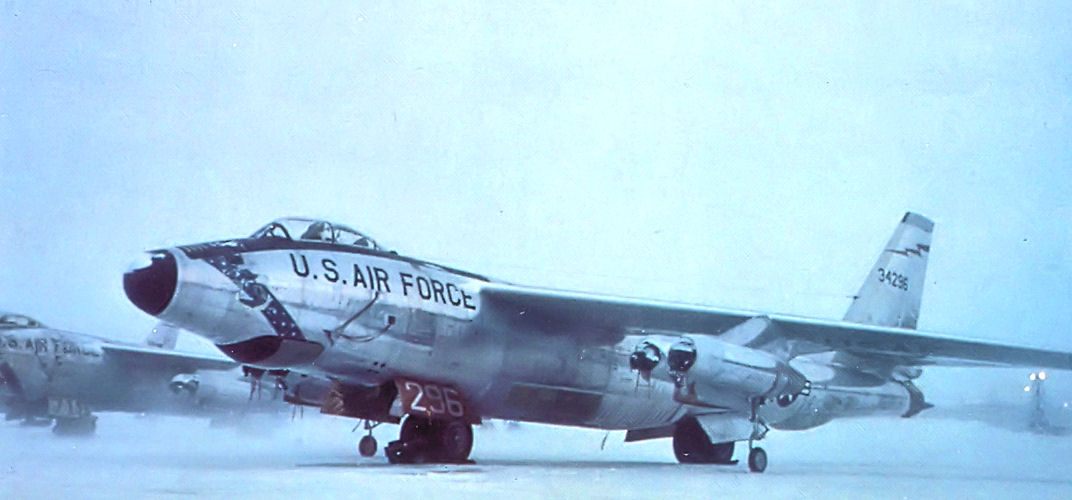
Pictured: a Boeing RB-47H Stratojet (serial 53-4296) of the 55th Strategic Reconnaissance Wing — the same unit and airframe type as the incident aircraft, but not the actual plane. The reconnaissance jet that flew the July 17, 1957 mission, serial 53-4299, is not known to have been photographed in a dedicated, identifiable image that survives in the public record separate from unit group shots like this one.
Theoretical Alignment
The RB-47 case does not lend itself cleanly to any single theoretical framework. It is a poor fit for the Psycho-Social Hypothesis (PSH) because the core evidence is instrumental, not narrative — two independently operated ELINT receivers and a physically separate ground radar cannot experience shared misperception the way a group of eyewitnesses can, though PSH retains partial relevance in explaining why the visual sightings alone (absent instrument correlation) might otherwise be dismissed as fatigue or misidentification. It is essentially inapplicable to the Interdimensional Hypothesis (IDH), for which this case offers no supporting detail. The case is most often cited by proponents of the Extraterrestrial Hypothesis (ETH) or, more cautiously, a generic "genuine anomalous craft" hypothesis, on the strength of the multi-sensor correlation — though even here, mainstream ETH advocates such as James McDonald treated the case as strong evidence of an anomalous phenomenon rather than proof of any specific extraterrestrial origin. The most intellectually honest theoretical framing may be the narrowest one: this is a data-rich "unknown" whose significance lies in demonstrating that instrumented, cross-corroborated UFO reports exist in the historical record, independent of any larger hypothesis about what such objects are.
Background
By the summer of 1957, the Forbes Air Force Base-based 55th Strategic Reconnaissance Wing was one of Strategic Air Command's premier electronic-intelligence (ELINT) units, flying the Boeing RB-47H — a modified B-47E Stratojet medium bomber in which the bomb bay had been replaced by a pressurized capsule housing three Electronic Warfare Officers ("Crows") and their signal-monitoring gear. The RB-47H's mission was to fly along or near the borders of the Soviet Union and its allies, passively recording the frequencies, pulse characteristics, and locations of foreign radar installations. It was, in effect, a flying signals-intelligence laboratory, crewed by some of the Air Force's most technically proficient personnel and equipped with instruments capable of measuring a radar emitter's frequency, pulse width, and pulse-repetition frequency to a fine degree of precision.
The mid-1950s were also the peak years of the first great wave of American UFO "flap" activity following the 1947 Kenneth Arnold sighting and the 1947 Roswell incident. Radar-visual cases involving military aircrews and Air Defense Command (ADC) ground radar had already become a recurring and troubling pattern for the Air Force: the 1952 Washington, D.C. radar flap, the NATO exercise sightings documented in the Operation Mainbrace case file, and numerous Air Defense Command scramble reports had all produced technically puzzling, multi-witness data that Project Blue Book — the Air Force's official UFO investigation office, headquartered at Wright-Patterson Air Force Base — struggled to resolve. It was against this backdrop that an RB-47H crew, flying a routine composite training mission across the Gulf Coast and south-central United States, encountered something that would become, in the assessment of at least one prominent atmospheric physicist, the most instrumentally well-documented UFO case in the Blue Book files.
What sets the July 17, 1957 encounter apart from the vast majority of UFO reports is not any exotic physical evidence — there is none, no debris, no photographs, no film — but the sheer number of physically independent technical systems that reported detecting the same target at the same times over an extended engagement: the aircraft's own navigational and search radar, the ELINT direction-finding receivers normally used to characterize hostile ground radar, an Air Defense Command ground radar station, and the direct visual observations of two flight officers with two decades of combined high-performance flying experience between them. When the target vanished, it vanished from all of these systems simultaneously. When it reappeared, it reappeared on all of them simultaneously. That pattern of cross-system correlation, repeated multiple times over more than an hour and 600–700 miles of track, is what has kept the case in serious scientific discussion for nearly seven decades.
Complete Timeline
| Date | Event |
|---|---|
| July 17, 1957 (~0100–0300 CST) | An RB-47H Stratojet (s/n 53-4299) of the 55th Strategic Reconnaissance Wing departs Forbes AFB, Topeka, Kansas, on a composite training mission: simulated gunnery/interception exercises over the Texas Gulf coast, celestial navigation practice over open water, and an ECM (electronic countermeasures) exercise scheduled for the return leg. Six officers are aboard: pilot Maj. Lewis D. Chase, copilot Capt. James H. McCoid, navigator Capt. Thomas H. Hanley, and three Electronic Warfare Officers: Capt. John J. Provenzano (No. 1 monitor), Capt. Frank B. McClure (No. 2 monitor), and Capt. Walter A. Tuchscherer (No. 3 monitor). |
| ~0358–0400 CST | Near Gulfport, Mississippi, over the Gulf of Mexico, McClure's No. 2 monitor (an ALA-6 passive direction-finder) registers an intense, unfamiliar signal around 2,800–3,000 MHz. The strobe appears to orbit around the RB-47's position rather than behaving like a fixed or distant ground emitter. McClure does not report it immediately, assuming a possible equipment artifact. |
| ~0410 CST (approx. 1010Z) | Near Winnsboro, Louisiana (approx. 32°00′N, 91°28′W), pilot Chase and copilot McCoid see an intense white light with a bluish tint at their 11 o'clock position and altitude. The light crosses the aircraft's flight path from left to right at an angular velocity Chase — a pilot with roughly two decades of flying experience — later says he had never seen matched by any known aircraft, then "blinks out." |
| ~0430 CST | McClure reacquires a strong signal at approximately 3,000 MHz on the No. 2 monitor. Provenzano's independent No. 1 monitor (an APD-4 direction-finder on a different frequency band and antenna set) corroborates the same bearing, ruling out a single-receiver malfunction. Both operators cross-check their equipment against known, charted ground-radar stations and find no match. |
| ~0439 CST | Approaching the Duncanville, Texas area, Chase visually spots a massive light roughly 5,000 feet below the RB-47's cruising altitude of approximately 34,500 feet. The night sky is described as perfectly clear with unlimited visibility. |
| ~0440 CST | McClure reports two simultaneous signal bearings, at approximately 40° and 70° relative. Chase and McCoid visually confirm red lights at the corresponding positions. Chase radios ADC Radar Station "Utah" — the 745th Aircraft Control and Warning Squadron site at Duncanville — requesting permission to deviate from the filed flight plan to investigate. Permission is granted. |
| ~0448 CST | Radar Station Utah reports back to Chase that its ground radar has detected an "uncorrelated target" — a return with no associated flight plan — at the same position McClure had been reporting from the air. Three independent systems (Chase's visual sighting, McClure's ELINT bearing, and Utah's ground radar) are now tracking the same target simultaneously. |
| ~0450–0452 CST | The object appears to stop or slow abruptly. The RB-47, closing at high speed, overshoots the target. At approximately 0452, the object "blinks out" — disappearing simultaneously from Chase's visual sighting, McClure's ELINT scope, and Utah's ground radar at the same instant. Chase banks the RB-47 into a hard port turn; the object reappears — again simultaneously on all three channels. |
| ~0452–0455 CST | The object appears to descend from roughly 34,500 feet to approximately 15,000 feet, then vanishes from every sensor system at once. Chase, now low on fuel reserves for the deviation, radios Utah that he must terminate the pursuit and resume the flight plan toward Oklahoma. |
| ~0457–0458 CST | The signal and a brief visual contact are reacquired as the RB-47 resumes its northbound course. |
| ~0500–0540 CST | McClure continues to track the 3,000 MHz signal from the tail of the aircraft, at bearings between roughly 180° and 190° relative, as the RB-47 flies north through Texas into Oklahoma. The signal gradually fades and is lost near Oklahoma City. Total elapsed time of the engagement: over one hour (some technical reconstructions place the full ELINT-to-fade duration closer to 90 minutes); total ground track: approximately 600–700 miles across Mississippi, Louisiana, Texas, and Oklahoma. |
| July 17, 1957 (post-flight) | The crew is debriefed on landing at Forbes AFB. A three-page TWX (teletype message) is filed by the 745th Aircraft Control and Warning Squadron at Duncanville at 1557Z. Wing Intelligence Officer Capt. E.T. Piwetz of the 55th Strategic Reconnaissance Wing prepares a four-page case summary, transmitted to Air Defense Command Headquarters at Ent AFB, Colorado. |
| October 25, 1957 | A twelve-page "Airborne Observer's Data Sheet" is forwarded from Air Defense Command to Project Blue Book at Wright-Patterson AFB — more than three months after the event, and evidently the first time Blue Book's staff received any notice of the case. |
| 1957 (Blue Book review) | Project Blue Book's file resolves the case as "Identified" — specifically as American Airlines Flight 655, referencing a documented near-collision between two American Airlines DC-6 airliners near Salt Flats, Texas (roughly 50 miles from El Paso), at 14,000 feet, at approximately 3:30 a.m. That incident occurred more than 300 miles from the Duncanville/Fort Worth area where the RB-47's primary radar-visual-ELINT convergence took place, and at a different time and altitude than reported by the RB-47 crew. |
| June 1967 | Pilot Lewis Chase, who had not discussed the case publicly for a decade, approaches University of Colorado UFO Project investigator Dr. Roy Craig at a conference in Boulder, Colorado, and volunteers his account, prompting the Condon Committee to open a formal file on the case. |
| 1968 | University of Colorado physicist Gordon David Thayer completes the Condon Committee's technical case study. Thayer calls the Air Force's American Airlines explanation "literally ridiculous" and states the case "must be listed as unidentified." An initial research error — Condon investigators mistakenly analyzed radar and weather data for September 19, 1957, rather than July 17 — is later corrected after physicist Dr. James E. McDonald independently locates and corrects the case files. |
| December 1968 | Dr. James E. McDonald presents a detailed independent technical analysis of the case at a symposium of the American Association for the Advancement of Science (AAAS) in Boston, calling it one of the most compelling radar/ELINT cases in the entire Blue Book archive. |
| 1969 | The Condon Report ("Scientific Study of Unidentified Flying Objects") is published, formally classifying the RB-47 case as an unresolved "unknown" while the report's own summary chapter downplays the case's significance — a discrepancy McDonald and others would later criticize. |
| 1971 | The American Institute of Aeronautics and Astronautics (AIAA) UFO Subcommittee selects the RB-47 case as a sample case study, concluding the controversy "cannot be resolved without further study in a quantitative scientific manner." |
| 1974 | Skeptic Philip J. Klass publishes a detailed alternative explanation in UFOs Explained, proposing that the ELINT signal was a stray reception of ground radar from Kessler Air Force Base, Mississippi, combined with a meteor or bright star for the initial visual sighting and a genuine airliner for the later visual contacts. |
| 1998 | Researcher Brad Sparks publishes an extensive rebuttal and case update in Jerome Clark's The UFO Encyclopedia (Vol. 2), arguing Klass had misidentified compass bearings and erred on the Kessler radar's operating schedule. |
| 2012 | Skeptical researcher Tim Printy counters Sparks on his Bad UFOs blog, presenting evidence that Kessler AFB's radar training schedule did operate through the overnight hours in July 1957, keeping the ground-radar-reception hypothesis technically viable, though not conclusively proven. |
Detailed Narrative
The Mission
The RB-47H that departed Forbes Air Force Base in the small hours of July 17, 1957, was not on an unusual assignment. Composite training missions combining gunnery practice, celestial navigation exercises, and ECM (electronic countermeasures) training were routine for the 55th Strategic Reconnaissance Wing, whose real-world job was flying ELINT collection sorties along the periphery of the Soviet bloc. The RB-47H variant carried a three-man Electronic Warfare Officer compartment in place of the bomb bay, equipped with passive direction-finding receivers — the ALA-6 (operated by the No. 2 monitor, sweeping roughly 1,000–7,500 MHz on belly-mounted antennas) and the APD-4 (operated by the No. 1 monitor, on wing-tip antennas covering a different frequency range). These receivers did not transmit; they listened passively for radar emissions and used rotating directional antennas to establish a bearing to the source. It was, by any measure, one of the most sophisticated passive electronic-detection platforms flying in 1957, crewed by specialists trained to distinguish real signals from noise and to recognize the signatures of known ground radars.
The planned route took the aircraft south from Kansas, across Oklahoma and Texas, out over the Gulf of Mexico for navigation practice, then back inland near the Mississippi coast before turning west across Louisiana and Texas and north again toward home. It was on this final leg, in the hours before dawn, that the crew's instruments and eyes began reporting something none of their training had prepared them for.
First Contact Near the Gulf Coast
The earliest indication came not from a human eye but from a machine. Near Gulfport, Mississippi, Electronic Warfare Officer Capt. Frank McClure, manning the No. 2 ALA-6 monitor, picked up an unusually intense signal in the 2,800–3,000 MHz band. What made the reading strange was not the frequency — that range was consistent with a typical S-band ground search radar — but the way the strobe behaved on his scope: rather than holding a fixed bearing consistent with a stationary ground installation, it appeared to sweep around the aircraft's position, as though the source itself were airborne and moving. McClure, aware that ELINT receivers are prone to occasional artifacts and side-lobe reception of distant or reflected signals, initially said nothing. It would not be the last time that night the same signal appeared.
The Louisiana Encounter: A Light That Outran the Jet
Passing near Winnsboro, Louisiana, pilot Maj. Lewis Chase and copilot Capt. James McCoid saw an intensely bright, white light with a bluish tinge appear at roughly their eleven o'clock position, at the same altitude as the RB-47. In sworn statements and later interviews, Chase — by then a pilot with roughly two decades of flying experience, including combat time — described the light crossing directly in front of the aircraft's flight path, moving from left to right, at an angular velocity he said he had never observed matched by any conventional aircraft before or since. The light then abruptly "blinked out." No corresponding radar contact was noted by the crew at this specific moment — it was, at this stage, a purely visual event, brief and unconfirmed by any other instrument. That would soon change.
Convergence Over Texas: Three-Channel Confirmation
As the aircraft continued toward the Dallas-Fort Worth area, the case entered its most scientifically significant phase. McClure's No. 2 monitor reacquired the roughly 3,000 MHz signal, and this time Capt. John Provenzano's independently operated No. 1 monitor — a physically separate receiver, on a different antenna system and frequency coverage — registered a corroborating bearing to the same source. Two independent EWOs, using two independent pieces of hardware, were now reporting the same unidentified emitter. Both men checked their readings against the known locations and characteristics of charted ground-based radar stations in the region and found no match consistent with the bearing and behavior they were observing.
Near Duncanville, Texas, Chase visually acquired an enormous light approximately 5,000 feet below the RB-47's cruising altitude of roughly 34,500 feet, in perfectly clear night air with, by his account, unlimited visibility. Minutes later, McClure reported two simultaneous signal bearings — approximately 40 and 70 degrees relative to the aircraft — and Chase and McCoid visually confirmed red lights at the corresponding positions in the sky. At this point Chase made the decision that would define the case: he radioed the Air Defense Command's ground radar installation, Radar Station "Utah," operated by the 745th Aircraft Control and Warning Squadron at Duncanville, requesting authorization to break from his filed flight plan to pursue and investigate. Permission was granted.
Within minutes, Station Utah reported back: its ground radar scope was independently tracking an "uncorrelated target" — a return with no filed flight plan — at the same position McClure had been calling out from the air. For the first time in the encounter, three physically and technologically distinct detection systems — a human eye, a passive airborne ELINT receiver, and an active ground-based search radar — were reporting the same object, at the same location, at the same time.
The Chase and the Simultaneous Vanishing
What followed is the detail most frequently cited by researchers on both sides of the case. As Chase maneuvered to close on the target, the object appeared to stop or drastically slow; the RB-47, still carrying substantial forward speed, overshot it. At approximately 0452 CST, the object "blinked out" — and it did so, according to the case files, simultaneously across all three channels: it disappeared from Chase's visual sighting, from McClure's ELINT scope, and from Station Utah's ground radar at the same instant. Chase immediately put the RB-47 into a hard port turn. The object reappeared — again, simultaneously, on all three systems. The object was then reported descending from roughly 34,500 feet to approximately 15,000 feet before vanishing from every sensor at once a second time.
This pattern — not merely a single loss of contact, but repeated, correlated, simultaneous appearance and disappearance across independently operated systems using entirely different physical principles (reflected light to the human eye, passively received electromagnetic radiation on an ELINT receiver, and actively transmitted/reflected radar energy on a ground search set) — is the technical core of why this case has resisted easy dismissal for almost seventy years. A single system glitching, or a single observer's eyes playing tricks, is a mundane and common occurrence. Three independent, physically distinct systems glitching in the same way, at the same instant, on multiple occasions, is a substantially harder coincidence to explain away, and it is precisely this feature that both proponents and the most careful skeptics of the case have spent decades arguing over.
Return Leg Through Oklahoma
With fuel reserves for the unplanned deviation running low, Chase radioed Station Utah that he was terminating the pursuit and resuming his original flight plan northward. Contact with the target was briefly reacquired around 0457–0458 CST, both visually and on McClure's monitor, before the RB-47 continued its course. For the next several dozen minutes, McClure reported tracking the same roughly 3,000 MHz signal from the tail of the aircraft — at bearings around 180 to 190 degrees relative, consistent with a source that was now trailing the bomber — as it flew north through Texas and into Oklahoma. The signal gradually weakened and was lost somewhere near Oklahoma City. By the time the RB-47 landed back at Forbes AFB, the crew had experienced more than an hour of intermittent contact — some technical reconstructions of the ELINT log place the full engagement closer to 90 minutes — across a ground track of 600 to 700 miles spanning Mississippi, Louisiana, Texas, and Oklahoma.
Silence: Why the Case Took a Decade to Surface
Despite the crew being required to file detailed post-flight reports, the case did not become public, and was barely investigated internally, for years. The paper trail that does exist is telling: a same-day teletype message from the 745th Aircraft Control and Warning Squadron, a four-page summary from 55th Wing Intelligence Officer Capt. E.T. Piwetz sent up the Air Defense Command chain to Ent AFB, and, remarkably, no indication that Project Blue Book itself learned of the case until an "Airborne Observer's Data Sheet" was forwarded more than three months later, on October 25, 1957. When Blue Book did process the case, its resolution — "Identified" as American Airlines Flight 655, referencing a documented near-collision between two DC-6 airliners near Salt Flats, Texas, more than 300 miles from the Duncanville engagement, at a different time and altitude — was, in the words of Condon Committee investigator Gordon Thayer, "literally ridiculous."
Pilot Lewis Chase himself did not discuss the case publicly for a full decade. It was not until June 1967, when he happened to approach University of Colorado UFO Project investigator Dr. Roy Craig at a conference in Boulder, Colorado, that Chase volunteered his account and the Condon Committee opened a formal file. The reasons for Chase's silence have never been definitively established; some researchers have suggested standard Cold War-era reticence about discussing SAC reconnaissance operations, while others note that military aircrew were, at the time, generally discouraged from publicizing UFO encounters regardless of classification concerns.
Project Blue Book's Delayed and Mistaken Investigation
The three-month gap between the incident and Blue Book's first notification, and the demonstrably incorrect "American Airlines" resolution that followed, are among the most frequently cited procedural failures in the case's history. Blue Book's explanation did not merely stretch the facts — it referenced an incident that occurred in a different location, at a different time, involving a different type of encounter (a near mid-air collision between two airliners, not a UFO sighting), separated from the RB-47's primary Duncanville engagement by well over 300 miles. When the Condon Committee's Gordon Thayer reviewed the file in the late 1960s, he found the mismatch so severe that he described the official explanation as untenable on its face.
The Condon Committee Re-Examination
The University of Colorado UFO Project, commissioned by the Air Force and led by physicist Edward U. Condon, took up the case in 1967–1968 following Chase's decade-late disclosure. The Committee's own investigation was not free of error: in an ironic echo of Blue Book's earlier mistake, Condon Committee researchers initially pulled and analyzed weather and radar data for September 19, 1957 — the wrong date entirely — a mix-up not caught until physicist Dr. James E. McDonald, working independently, tracked down the correct case files and corrected the date. McDonald, an atmospheric physicist at the University of Arizona and one of the era's most persistent scientific UFO investigators, went on to present a detailed technical breakdown of the case at a 1968 American Association for the Advancement of Science symposium in Boston, calling it among the most evidentially compelling cases in the entire Blue Book archive precisely because of its multi-system instrumented corroboration.
Once corrected, Thayer's write-up for the published 1969 Condon Report concluded the case "must be listed as unidentified" and, elsewhere in the same report, that it represented "an unusual, intriguing, and puzzling phenomenon." Thayer also explicitly rejected several conventional explanations that had been floated, stating the evidence did not support the object being "a plasma or an electrical luminosity" of atmospheric origin. Notably, the Condon Report's own summary chapter — written separately from the detailed case studies and widely understood to reflect Condon's own skeptical overall conclusions about the UFO phenomenon — downplayed the case's significance relative to Thayer's more cautious internal assessment, a discrepancy that critics of the Condon Report, including McDonald, seized upon as evidence of editorial bias in how the report's conclusions were framed for public consumption.
The Skeptical Rebuttal and the Ongoing Technical Dispute
The most detailed conventional explanation for the case was developed by aviation and technology journalist Philip J. Klass, published in his 1974 book UFOs Explained. Klass proposed a composite, multi-stimulus explanation: that the initial ELINT signal near Gulfport was a stray reception of ground radar from Kessler Air Force Base, a technical training facility near Biloxi, Mississippi, whose radar sets operated on similar frequencies; that the Louisiana visual sighting was a meteor, fireball, or possibly the bright star Vega; and that at least one of the Texas visual contacts was a genuine airliner. Klass argued that anomalous radar propagation — atmospheric ducting effects that can cause a ground radar to return an apparent target where none exists, or to display a distant real target at an incorrect apparent range — could account for Station Utah's "uncorrelated target."
Researcher Brad Sparks published an extensive rebuttal in Jerome Clark's The UFO Encyclopedia (1998), arguing that Klass had made a significant compass-direction error in his analysis, and disputing whether Kessler's radar would have been operating during the pre-dawn hours in question, suggesting the facility might have been in a summer training lull. Skeptical researcher Tim Printy later countered on his Bad UFOs blog, presenting evidence that Kessler AFB's training schedule in fact ran overnight classes through the summer of 1957, keeping Klass's core hypothesis technically viable — though, notably, even Printy's rebuttal addresses only the initial Gulfport ELINT detection and does not by itself explain the later, more dramatic three-channel simultaneous vanishing-and-reappearing sequence over Texas. The dispute between Sparks and Printy over the Kessler radar's operating schedule has never been definitively resolved with primary Kessler AFB duty logs, and remains, as of this writing, the sharpest unresolved technical fault line in the case.
Key Witnesses
Maj. Lewis D. Chase
The RB-47's pilot and aircraft commander, with roughly two decades of flying experience by 1957. Chase was the primary visual witness throughout the encounter, reporting the initial Louisiana light crossing his flight path at an angular velocity he said he had never seen matched by a conventional aircraft, the massive light near Duncanville, and the red lights that corresponded to McClure's ELINT bearings. It was Chase who made the operational decision to contact Radar Station Utah and request authorization to deviate from the flight plan to pursue the target — a decision that produced the case's critical three-channel ground-radar corroboration. Chase did not discuss the case publicly for a decade, finally volunteering his account to Condon Committee investigator Roy Craig in June 1967.
Capt. James H. McCoid
McCoid independently corroborated Chase's visual sightings at multiple points during the encounter, including the initial Louisiana light and the red lights observed near Duncanville that matched McClure's simultaneous ELINT bearings. As a second trained cockpit observer confirming the pilot's account in real time, McCoid's testimony is a key element in ruling out a single-witness misperception for the visual component of the case.
Capt. Thomas H. Hanley
Hanley was responsible for tracking the aircraft's position throughout the mission and its unplanned deviation to pursue the target, providing the navigational data that allowed investigators to correlate the RB-47's position with Radar Station Utah's independent ground-radar returns and to reconstruct the case's approximately 600–700-mile ground track across four states.
Capt. John J. Provenzano
Operating a direction-finding receiver physically and technically separate from McClure's No. 2 monitor, Provenzano's independent corroboration of McClure's signal bearing over Texas is one of the case's most technically significant details: it demonstrates that the ELINT detection was not the product of a single malfunctioning receiver, since two different instruments on two different antenna systems registered the same unexplained emitter.
Capt. Frank B. McClure
McClure was the first crew member to detect any anomaly, registering the unusual 2,800–3,000 MHz signal near Gulfport that seemed to orbit the aircraft rather than behave like a fixed ground source. Over the following hour, McClure's log of signal bearings tracked in near-real-time correlation with the crew's visual sightings and with Radar Station Utah's ground returns, including the simultaneous "blink out" and reappearance events near Duncanville. McClure's later technical remark that the source "would have to have had an antenna bigger than a bomber to put out that much signal" is frequently quoted as evidence the source's apparent power output was inconsistent with a small aircraft or a simple ground reflection.
Capt. Walter A. Tuchscherer
Tuchscherer's monitor covered a lower frequency range than McClure's and Provenzano's instruments and was not directly implicated in the primary signal detections, but his post-flight statement corroborates the crew's overall account of the mission profile and the sequence of events reported to Wing Intelligence.
745th Aircraft Control and Warning Squadron — Radar Station "Utah"
The unnamed ground radar operators on duty at ADC Site Utah independently confirmed detection of an "uncorrelated target" — a return with no associated flight plan — at the same position McClure was calling out from the RB-47, and reported the same simultaneous loss and reacquisition of contact experienced aboard the aircraft. Because Site Utah's radar was a physically separate, ground-based, actively transmitting system with no connection to the RB-47's onboard equipment, its corroboration is considered by researchers on both sides of the case to be the single most important technical data point supporting the reality of a genuine, physically present unidentified target rather than an onboard equipment or perceptual artifact confined to the aircraft.
The Five Observables Assessment
Assessment: The RB-47 case aligns with the Five Observables framework more directly on some points than most Cold War-era cases, because it is instrumented rather than purely anecdotal. Instant Acceleration is rated present based on the abrupt stop-and-overshoot behavior described by Chase, in which the object went from matching the RB-47's speed to appearing stationary within the span of the pursuit — behavior inconsistent with any known 1957-era aircraft's performance envelope. Low Observability is rated present on the basis of the object's repeated, correlated disappearance from all three detection channels simultaneously, a pattern that (if not attributable to a shared propagation artifact) implies a target capable of eluding radar, ELINT, and visual detection at will. Hypersonic velocity is speculative: while the object's apparent angular motion during the initial Louisiana sighting was extreme, no precise speed measurement exists. Anti-gravity lift is speculative and inferential only, based on the object's apparent hovering/stopping behavior. Trans-medium travel is not applicable; the entire engagement occurred in the atmosphere.
Evidence Assessment
Supporting an Anomalous/Unexplained Phenomenon
- Three physically independent detection systems — visual, ELINT, and ground radar — repeatedly reported the same target at the same times, including simultaneous appearance and disappearance events
- Two separate, independently operated ELINT receivers (different hardware, different crew members) corroborated the same signal
- Two cockpit observers (Chase and McCoid) independently confirmed the visual sightings in real time
- An entirely separate Air Defense Command ground radar station, with no technical connection to the aircraft, independently reported an uncorrelated target at the matching position
- Project Blue Book's official "American Airlines" explanation is demonstrably wrong on geography and timing
- Condon Committee physicist Gordon Thayer, no friend to sensational UFO claims, called the case "unidentified" and rejected several proposed mundane explanations outright
- Independent physicist James McDonald, investigating specifically to find conventional explanations, considered this among the strongest cases in the Blue Book archive
- The crew's professional training as electronic-warfare and reconnaissance specialists makes an unrecognized equipment artifact, while possible, less likely than for an untrained observer
Supporting a Conventional Explanation
- No physical evidence, photographs, or film exists; the entire case rests on instrument logs and crew recollection
- The recorded ELINT signal's frequency, pulse width, and PRF are all consistent with a conventional, known type of ground search radar — not an unclassifiable signal type
- Kessler Air Force Base, a real radar training facility, was operating in the same general area and frequency band, and per Tim Printy's research plausibly during the relevant overnight hours
- Passive ELINT receivers cannot verify signal origin by any means other than bearing, which is susceptible to anomalous propagation effects
- The crew's formal reports were not filed with Project Blue Book for over three months, and Chase did not discuss the case publicly for a decade — both factors that complicate precise reconstruction of testimony and raise the possibility of memory refinement over time
- The Condon Committee's own investigators initially analyzed the wrong date's data, illustrating how easily this class of case can be poorly documented or handled even by professional investigators
Why "Open"
The RB-47 case is classified OPEN rather than "Credible," "Disputed," or "Debunked" because, uniquely among the classification options available, it accurately reflects a case where the strongest available conventional explanation is technically serious but incomplete, and the strongest available proponent case rests on genuinely extraordinary but real, documented, multi-system instrument correlation rather than testimony alone. Project Blue Book's official explanation is definitively wrong and has been rejected by essentially every subsequent investigator, proponent and skeptic alike — which rules out "Debunked." The case has never been proven to involve a genuinely unknown craft, exotic technology, or extraterrestrial origin — which rules out "Verified" or a stronger "Credible" rating implying a settled leaning toward the anomalous. What remains is an unusually well-documented technical puzzle: a repeated, cross-corroborated, simultaneous multi-sensor detection event that the best mundane explanation (Klass's composite theory) can plausibly account for in outline but has never definitively nailed down in its specific, most distinctive detail — the synchronized, repeated loss and reacquisition of contact across three independent physical systems. Both Gordon Thayer's formal Condon Committee classification of "unidentified" and James McDonald's independent scientific assessment converge on the same conclusion nearly sixty years after the fact: this is a genuinely open case, not a solved one, and not one that has produced positive proof of anything beyond the documented fact that something — whatever its ultimate nature — was detected by six trained officers and a ground radar crew, on four kinds of instruments, for over an hour, across four states.
Sensor & Instrumentation Detection Profile
The RB-47 case is frequently cited as the single most heavily instrumented UFO encounter in the Project Blue Book archive, because it was detected — independently and repeatedly — on four physically distinct systems operating on entirely different physical principles.
1. Airborne Search/Navigation Radar
The RB-47H's onboard K-system radar, used primarily for navigation and bombing/gunnery training, provided the aircraft's own positional reference throughout the encounter and allowed the crew to correlate their position with ground-radar-reported target bearings, though the K-system itself is not consistently credited in the case files with an independent target lock on the object — its role was primarily supportive of navigation rather than a fourth independent detection channel.
2. Electronic Intelligence (ELINT) Receivers
Two physically separate, passive direction-finding receivers — the No. 2 monitor's ALA-6 (operated by Frank McClure, sweeping roughly 1,000–7,500 MHz via belly-mounted rotating antennas) and the No. 1 monitor's APD-4 (operated by John Provenzano, on wing-tip antennas covering a different band) — independently registered the same approximately 2,800–3,000 MHz signal, with a measured pulse width of roughly 2.0 microseconds and pulse-repetition frequency of approximately 600 cycles per second, at an estimated power output on the order of 40 kilowatts. Because these receivers are purely passive — they do not transmit and cannot "paint" a false target the way an active radar theoretically could — their agreement is considered strong evidence that a real electromagnetic emission, from some physical source, was received by the aircraft. What remains disputed is the identity of that source: a genuine airborne emitter of unknown origin, or a secondary/anomalous reception of a known ground radar (the Kessler AFB hypothesis).
3. Ground-Based Air Defense Command Radar
Radar Station "Utah," operated by the 745th Aircraft Control and Warning Squadron at Duncanville, Texas, independently reported an "uncorrelated target" (a return with no filed flight plan) at the same position and times reported by the RB-47's ELINT operators, including the repeated simultaneous disappearance and reappearance events during the pursuit phase. As an actively transmitting, ground-based system with no physical or electronic connection to the aircraft's onboard equipment, Site Utah's corroboration is the piece of evidence most frequently cited as ruling out a purely onboard equipment malfunction or a phenomenon confined to the aircraft's own instrumentation.
4. Direct Visual Observation
Pilot Lewis Chase and copilot James McCoid independently and repeatedly observed lights whose position, bearing, and behavior (including the "blink out"/reappearance sequence) correlated in real time with the ELINT and ground-radar data being called out over the intercom. Two trained cockpit observers agreeing on bearing and timing, cross-checked against two further independent instrument systems, is an unusually strong evidentiary configuration by the standards of 1950s-era UFO reporting, most of which rests on uncorroborated single-witness or radar-only accounts.
Taken together, these four data streams — airborne navigation reference, dual independent ELINT receivers, ground-based active radar, and dual cockpit visual observation — produced the case's defining feature: not merely simultaneous detection, but simultaneous loss and reacquisition of contact across systems that share no common electronics, software, or physical mechanism by which a single glitch could propagate between them. This is the technical basis for the case's enduring status as one of the strongest instrumented UFO reports of the Cold War era, and also the specific feature that skeptical explanations — which must account for the correlation, not just the individual detections — have found hardest to fully resolve.
Environmental & Geospatial Context
The encounter took place on a clear, dry summer night with, according to the flight crew, unlimited visibility — conditions that argue against several common radar-visual confounders such as low-level temperature inversions associated with humid, hazy, or stormy weather (a frequent factor in many 1950s ADC radar-anomaly cases). The flight path traversed a geographically varied but entirely conventional corridor: the northern Gulf of Mexico near Gulfport, Mississippi; rural northeastern Louisiana near Winnsboro; the increasingly urbanized Dallas-Fort Worth corridor of north Texas, home to significant civil and military air traffic and to the Air Defense Command's regional radar coverage; and finally rural south-central Oklahoma. The primary engagement zone near Duncanville placed the object within the coverage envelope of at least one dedicated Air Defense Command ground radar site, a coverage density that was considerably higher along this corridor than in the more remote stretches of the flight, which likely explains why ground-radar corroboration was obtained specifically during the Texas phase of the encounter rather than during the earlier Mississippi or Louisiana legs. No unusual solar or geomagnetic activity has been documented in connection with the date; the case predates the Space Age by just over ten weeks (Sputnik 1 launched October 4, 1957) and long predates any satellite reentry or space-debris explanations relevant to modern UAP cases.
Observer Credibility & Occupational Profile
The RB-47 crew represents one of the highest-credentialed witness groups in the UFO literature. All six men were commissioned USAF officers assigned to a Strategic Air Command electronic-reconnaissance wing — a posting that required security clearances, specialized technical training, and (for the three Electronic Warfare Officers in particular) expert-level familiarity with distinguishing genuine radar signals from noise, interference, and known friendly or hostile emitters as a core function of their job. Pilot Lewis Chase was, by 1957, a veteran aviator with roughly two decades of flying experience, a background frequently cited by researchers as lending particular weight to his assessment that the object's motion during the initial sighting exceeded anything he had witnessed a conventional aircraft perform.
The case's credibility is further reinforced by its subsequent scientific review chain: University of Colorado physicist Gordon David Thayer conducted the formal Condon Committee case study, and University of Arizona atmospheric physicist James E. McDonald — a scientist with no institutional stake in a pro-UFO conclusion, who investigated dozens of cases specifically to test whether they could be explained conventionally — independently corrected the Condon Committee's dating error and presented a detailed technical analysis to a mainstream scientific audience at the AAAS. On the skeptical side, the case has been scrutinized by two generations of technically literate researchers: Philip Klass, an aviation industry journalist with decades of experience covering avionics and radar systems for Aviation Week, and more recently Tim Printy, a Navy-trained radar technician whose blog analysis engages directly with the operating schedules and technical characteristics of period Air Force radar installations. Few UFO cases from any era have been subjected to this level of sustained, technically qualified scrutiny from both proponents and skeptics.
Physical & Material Assays
No physical debris, landing traces, photographs, or recovered material of any kind exist for this case — a limitation shared with the vast majority of radar-visual UFO reports, which by their nature document a distant aerial phenomenon rather than a close-range or crash-retrieval event. The closest analog to physical evidence in this case is the quantitative ELINT signal data itself: recorded frequency (~2,800–3,000 MHz), pulse width (~2.0 microseconds), pulse-repetition frequency (~600 cycles per second), and estimated power output (on the order of 40 kW), all logged by trained EWOs using calibrated military receivers designed specifically for this kind of signal characterization. While this data does not constitute "physical evidence" in the traditional sense of recovered material, it is unusually precise, quantitative, and technically falsifiable data for a UFO case of this era — it can be, and has been, checked against the known operating parameters of contemporaneous ground radar installations, which is exactly the exercise both Klass and Sparks undertook in their competing analyses.
Historical Precedents & Archive Matches
The RB-47 case sits within a well-documented cluster of Cold War-era radar-visual UFO cases involving U.S. and NATO military personnel, several of which share its core evidentiary signature of cross-corroboration between airborne and ground-based sensors. The most frequently compared precedent is the 1956 Lakenheath-Bentwaters incident in England, in which RAF and USAF ground radar, airborne intercept radar aboard a scrambled RAF fighter, and visual observation all reportedly tracked objects performing high-speed maneuvers and instantaneous stops — a case the Condon Report itself, notably, also could not adequately explain. The 1952 Operation Mainbrace NATO exercise produced multiple simultaneous radar and visual sightings by military personnel across allied forces. The 1952 Washington, D.C. radar flap similarly involved Air Defense Command ground radar operators and commercial and military pilots reporting coincident unidentified targets over multiple nights, prompting the Air Force's largest press conference since World War II. Within Project Blue Book's own statistics, of 12,618 total sightings investigated between 1947 and 1969, the Air Force listed 701 as officially "Unidentified" — the RB-47 case remains one of the most frequently cited members of that residual category specifically because of its multi-sensor instrumentation, placing it alongside a small number of cases (including the later 2004 USS Nimitz "Tic Tac" encounter) that are considered by researchers to represent the strongest available evidentiary class within the broader UFO/UAP archive: cases corroborated by multiple, physically independent detection technologies rather than testimony alone.
Material Analysis
Because no physical debris exists in this case, "material analysis" here refers instead to the closest available proxy: forensic evaluation of the recorded electromagnetic signal itself as a form of physical, instrument-captured trace evidence, and the ongoing technical dispute over whether that signal's characteristics are more consistent with an unknown airborne emitter or a terrestrial radar reception artifact.
Supporting an Anomalous/Unknown Airborne Source
- Two independent, passive ELINT receivers (ALA-6 and APD-4), on separate antenna systems and operated by separate crew members, registered the same signal — ruling out a single-receiver malfunction
- The signal's bearing behavior (maintaining a fixed relative bearing despite the RB-47's own high-speed travel) is consistent with an airborne, moving source rather than a fixed ground installation
- The signal's estimated power output struck McClure, an experienced EWO, as inconsistent with a small aircraft-mounted emitter ("an antenna bigger than a bomber")
- The signal's appearance and disappearance repeatedly correlated in time with the independently observed visual sightings and Radar Station Utah's ground-radar contacts
Supporting a Terrestrial/Mundane Source
- The recorded frequency, pulse width, and PRF are all consistent with a standard 1950s-era S-band ground search radar — not an exotic or unclassifiable waveform
- Kessler Air Force Base, a technical training facility approximately 30 miles from the initial Gulfport detection point, operated radar sets in a compatible frequency range, and per Tim Printy's research, may have been running overnight training classes at the relevant hour
- ELINT receivers of this era were passive and non-discriminating about signal origin; anomalous propagation (ducting) could plausibly deliver a distant ground radar's signal to the aircraft under certain atmospheric conditions, mimicking an airborne source's bearing behavior over short observation windows
- Brad Sparks' rebuttal of the Kessler hypothesis rests on a disputed compass-bearing correction and an unresolved claim about Kessler's summer training schedule, meaning neither side's technical case is fully closed
Conventional Explanation Candidates
Commercial Airliner Misidentification (Project Blue Book's Official Explanation)
Very LowBlue Book's own file resolution attributed the case to American Airlines Flight 655, referencing a documented near mid-air collision between two American Airlines DC-6 aircraft near Salt Flats, Texas, roughly 50 miles from El Paso, at approximately 14,000 feet and 3:30 a.m. This explanation fails on basic geographic and temporal grounds: the referenced incident occurred more than 300 miles from the Duncanville/Fort Worth area where the RB-47's primary three-channel engagement took place, at a different altitude, and does not account for the ELINT signal, the ground-radar corroboration, or the repeated simultaneous appearance/disappearance pattern. Condon Committee investigator Gordon Thayer's assessment that the explanation was "literally ridiculous" reflects the consensus among nearly all subsequent researchers, proponent and skeptic alike. The explanation does not survive basic fact-checking against the case's own documented geography and timeline.
Ground-Radar Reception Artifact (The Kessler AFB / Klass Hypothesis)
Low-Moderate (Initial Detection) Low (Complete Explanation)Philip Klass's more technically serious hypothesis proposes that the No. 2 monitor's initial signal detection near Gulfport was a stray or anomalously propagated reception of Kessler Air Force Base's training radar, located roughly 30 miles away near Biloxi, Mississippi, on a compatible frequency. This is a mechanically plausible explanation for the earliest ELINT detection alone: passive receivers cannot distinguish signal origin by any means other than bearing and signal strength, and atmospheric ducting was (and remains) a documented cause of anomalous long-range radar reception. However, the hypothesis, even if correct, addresses only the opening minutes of a more-than-hour-long, multi-phase encounter; it does not explain the later, independently corroborated Texas engagement, where the signal was tracked by two separate ELINT receivers and simultaneously confirmed by an entirely separate ground radar station (Site Utah) that itself reported an uncorrelated target with no relationship to Kessler's installation. The technical dispute between Brad Sparks (who argues Kessler's radar was not the source) and Tim Printy (who argues it plausibly was, at least for the Gulfport phase) remains genuinely unresolved for lack of surviving primary Kessler duty logs.
Meteor, Fireball, or Bright Star Misidentification
Low (Initial Sighting) Very Low (Overall)For the initial Louisiana visual sighting specifically, Klass proposed a meteor, fireball, or the bright star Vega as a candidate explanation for the intense white/blue light Chase and McCoid observed crossing their flight path. Meteors and fireballs are a well-documented and common source of dramatic, fast-moving nighttime lights, and pilots at altitude have an unusually wide, unobstructed sky view that can make ordinary meteors appear extraordinarily close and fast. However, this explanation addresses only a single, brief visual event; it does not explain the ELINT signal correlation, the ground-radar confirmation, or the repeated stop-and-reverse, blink-out/blink-on behavior observed later over Texas, none of which is consistent with a meteor's characteristic single, unidirectional streak of light.
Anomalous Radar Propagation (Temperature Inversion Ducting)
LowAtmospheric temperature inversions can cause radar energy to become "ducted" along an atmospheric layer, producing false targets, ghost returns, or distorted apparent ranges on both active ground radar and passive ELINT receivers. This is one of the best-documented mundane causes of anomalous radar returns in aviation history and has explained numerous other Cold War-era radar-visual cases. However, the crew explicitly reported clear, dry conditions with no unusual weather — the meteorological signature typically associated with strong ducting layers (humid, hazy, or post-frontal conditions) was reportedly absent, and ducting alone does not explain the crew's independent, correlated visual sightings of moving lights. Weather conditions reported by the crew argue against strong ducting, though it cannot be entirely ruled out without contemporaneous upper-air soundings for the exact time and location, which were not preserved in the case file.
Composite Multi-Stimulus Event (Klass's Full Theory)
ModerateKlass's complete published theory does not rely on any single explanation but proposes a chain of several independent, unrelated mundane events — a stray Kessler radar reception, a meteor or star, and a genuine airliner — occurring in sequence during the same flight and being perceptually and narratively woven together by the crew into a single continuous "chase" during a stressful, fatiguing overnight mission. This is, in a sense, the most complete skeptical account, since it does not require any single conventional phenomenon to explain everything. Its weakness is the same one that affects all composite explanations: it requires accepting several independent coincidences occurring within the same encounter, and it still does not fully explain the specific, repeated, simultaneous three-channel "blink out/blink on" correlation that both Thayer and McDonald identified as the case's most scientifically distinctive feature. It is the most defensible skeptical position overall, but one that requires multiple independent coincidences and still leaves the simultaneous multi-channel correlation only partially addressed.
Related Cases
Confirmed Documents & Official Records
National Archives holdings for Project Blue Book, the U.S. Air Force's official UFO investigation program (1947–1969), including case files, microfilm rolls, and administrative records covering the RB-47 case and 12,618 other investigated sightings.
UNCLASSIFIED (declassified)The FBI's FOIA reading room collection of declassified UFO-related documents, covering the Bureau's role investigating and coordinating with the Air Force on unidentified flying object reports during the Cold War period.
UNCLASSIFIED (released via FOIA)The Department of Defense's modern successor office to Project Blue Book, established 2022, publishing declassified records, historical case reviews, and analytical white papers on unidentified anomalous phenomena.
UNCLASSIFIEDSearch Government Archives Directly
Further Reading — Recommended Literature
The UFO Encyclopedia: The Phenomenon from the Beginning (2-Volume Set)
Contains Brad Sparks' detailed case-history entry on the RB-47 incident, including his rebuttal of Philip Klass's Kessler AFB hypothesis. The standard reference encyclopedia for serious UFO case research.
The UFO Evidence
NICAP's foundational compendium of the most persuasive UFO reports of the 1940s–1960s, including chapters devoted to radar tracking and military-pilot sightings from the same era as the RB-47 encounter.
The Condon Report: Scientific Study of Unidentified Flying Objects
The official government-commissioned study containing Gordon Thayer's formal case analysis of the RB-47 incident and its classification as "unidentified."
UFOs and the National Security State: Chronology of a Cover-up, 1941–1973
A chronological history of the U.S. military and intelligence community's documented engagement with UFO reports through 1973, situating the RB-47 case within the broader Cold War pattern of military radar-visual encounters.
Watch the Skies!: A Chronicle of the Flying Saucer Myth
A skeptical, meticulously researched history of American UFO reporting from 1947 through the Condon era, covering the investigative record and institutional handling of major Blue Book cases.
Essential Viewing
No Videos Available
Sources
- National Archives and Records Administration (NARA). "Project BLUE BOOK: Unidentified Flying Objects." archives.gov
- FBI Vault. "UFO" FOIA Records Collection. vault.fbi.gov
- All-domain Anomaly Resolution Office (AARO), U.S. Department of Defense. "UAP Records/Information Papers." aaro.mil
- NICAP. Sparks, Brad. "RB-47 Case Update." nicap.org, 2008
- Gross, Patrick. "RB-47 radar-visual multiple witnesses case, July 17, 1957." ufologie.patrickgross.org
- Gross, Patrick. "AIAA and the UFO problem, the RB-47 case." ufologie.patrickgross.org
- The Black Vault. "The RB-47 UFO Encounter, July 17, 1957." theblackvault.com
- UFO Casebook. "The RB-47 UFO Encounter." ufocasebook.com
- The Debrief. "The RB-47 Incident: Mystery at 2800 Megacycles." thedebrief.org
- Printy, Tim. "The RB-47 Encounter of 1957 — Ufology's Best Evidence?" Bad UFOs blog, 2012
- UFO Insight. "High-Speed Chase At 30,000 Feet: The RB-47 UFO Encounter." ufoinsight.com
- The History Reader (Macmillan). "Two Critical UFO Events in History." thehistoryreader.com
- Internet Archive. Condon, Edward U. et al. Scientific Study of Unidentified Flying Objects (full text). archive.org
- McDonald, James E. "The 1957 Gulf Coast RB-47 Incident," Flying Saucer Review, Vol. 16, No. 3, 1970 (reprint). hosted via Princeton University
- Wikipedia contributors. "Boeing RB-47 Stratojet." en.wikipedia.org
- Wikipedia contributors. "Project Blue Book." en.wikipedia.org
- GlobalSecurity.org. "RB-47H" technical/operational reference. globalsecurity.org
- Infinity Explorers. "The Deadly Encounter of USAF RB-47 With UFOs: Chased By Mysterious Flying Objects." infinityexplorers.com
- Latest UFO Sightings. "The 1957 RB-47 UFO Encounter: Unraveling a Secret Signal." latest-ufo-sightings.net
- Connecting Sirius. "Pilot Sightings: The RB-47 UFO Encounter." connectingsiruius.blogspot.com
- Wikimedia Commons. "Boeing RB-47H-1-BW Stratojet 53-4296, 55th Strategic Reconnaissance Wing" (U.S. Air Force photo, public domain). commons.wikimedia.org
See something inaccurate? Have additional information or sources?
Suggest an Edit →Last Updated: August 2026