
Kenneth Arnold Sighting
The historic June 24, 1947, encounter that coined the phrase "flying saucer" and triggered the modern era of UAP sightings.
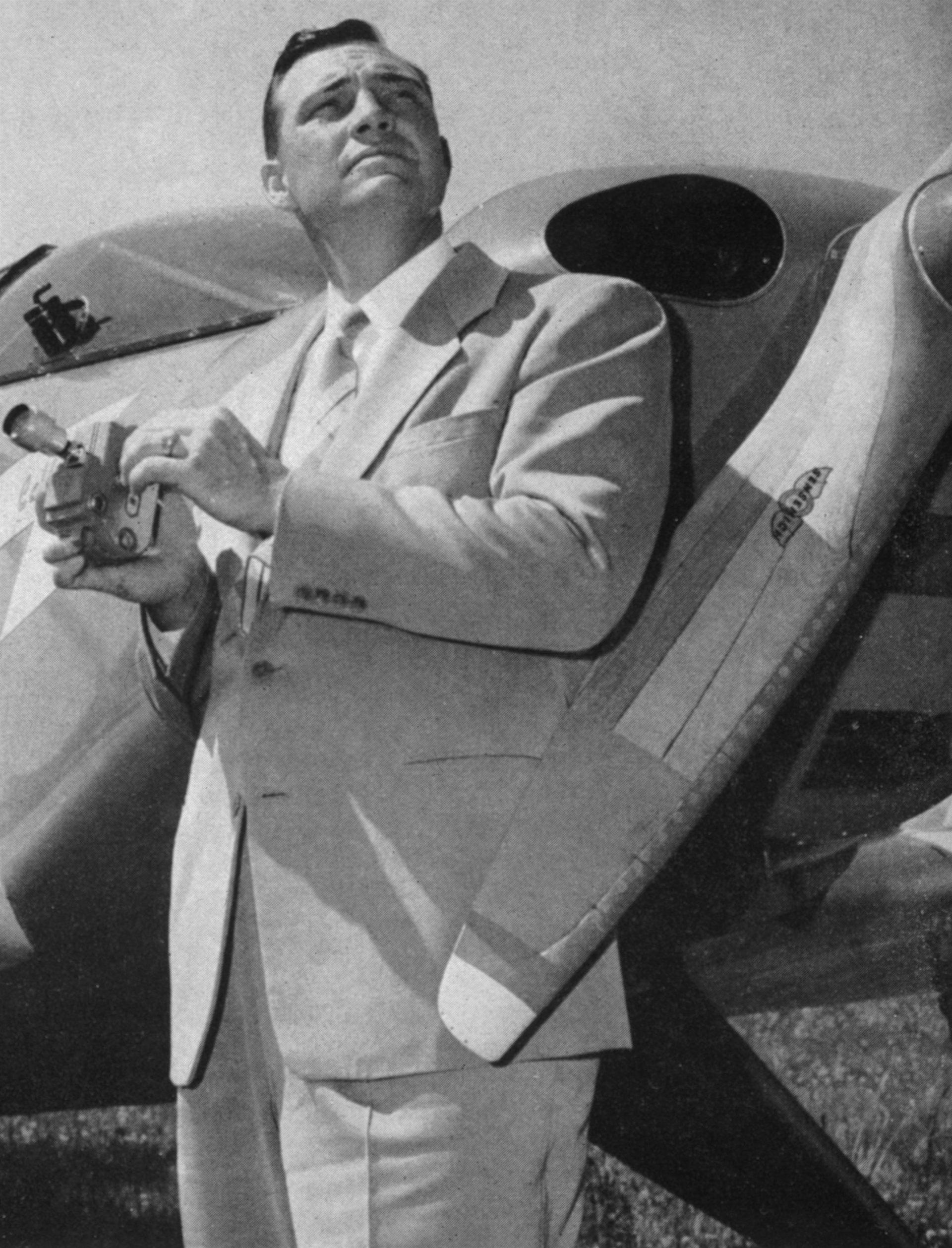
Pictured: Kenneth Arnold himself, holding the camera he used to document his flight, alongside the CallAir A-2 he was piloting near Mount Rainier on June 24, 1947 — the actual witness and aircraft at the center of the sighting that coined the term "flying saucer." AP wire photo, July 8, 1947.
Theoretical Alignment
The Kenneth Arnold sighting of June 24, 1947, is paradoxically one of the most significant cases in UFO history while simultaneously being one of the most ambiguous in terms of theoretical alignment. The case created the modern UFO era without definitively proving anything. Arnold himself was an experienced pilot who knew aircraft and refused to accept conventional explanations offered by investigators. The objects' speed — estimated at 1,200 to 1,700 miles per hour, roughly twice the speed of the fastest aircraft in the world in 1947 — places them outside the capabilities of any known aircraft of the period. The formation's coherence, the objects' lack of tails or fuselages, and their unusual undulating flight pattern are not consistent with any known aircraft type. The ETH alignment is strong simply because the observed characteristics genuinely exceeded anything human technology could produce in 1947.
Complete Timeline
| Date | Event |
|---|---|
| June 21, 1947 | Harold Dahl claims to witness six hovering craft dropping slag near Maury Island. |
| June 24, 1947 | 3:00 PM: Kenneth Arnold sights nine crescent-shaped objects flying in formation near Mount Rainier, WA. |
| June 26, 1947 | Arnold's sighting hits news wires, launching the term "flying saucer" into popular culture. |
| July 1947 | Raymond Palmer hires Arnold to investigate Maury Island. AAF officers Brown and Davidson arrive to collect the slag. |
| July 31, 1947 | The B-25 bomber carrying the Maury Island slag crashes near Kelso, WA, killing officers Brown and Davidson. |
The Narrative
On June 24, 1947, Kenneth Arnold, a business owner and experienced search-and-rescue pilot, was flying his CallAir A-2 utility plane from Chehalis to Yakima, Washington. While searching for a downed military transport plane near Mount Rainier, Arnold observed a bright flash of light reflecting off his aircraft. Turning his plane, he sighted a chain of nine bright, flat, crescent-shaped objects flying in a diagonal formation.
Arnold watched the objects weave in and out of the mountain peaks for approximately two minutes. He described their motion as erratic, saying they skipped through the air like "a saucer skipping across water." By timing their flight between Mount Rainier and Mount Adams (a distance of roughly 47 miles), Arnold calculated their speed to be approximately 1,700 miles per hour — nearly three times faster than any jet aircraft in existence in 1947.
Upon landing, Arnold reported his sighting to the media. The East Oregonian reporter Bill Bequette picked up the story, and the phrase "flying saucer" was coined by headline writers. This broadcast triggered an unprecedented national wave of sightings, culminating just weeks later in the Roswell crash.
The Maury Island Connection
Just days before Arnold's sighting, harbor patrol officer Harold Dahl claimed to witness six doughnut-shaped craft hovering near Maury Island, Washington, which reportedly dropped metallic, slag-like debris onto his boat. The publisher of Fate magazine, Raymond Palmer, hired Arnold to travel to Tacoma and investigate the case.
Arnold collaborated with Army Air Forces intelligence officers Frank Brown and William Davidson. While Dahl later claimed the event was a hoax, Davidson and Brown loaded samples of the slag onto a B-25 bomber. On July 31, 1947, the B-25 crashed shortly after takeoff, killing both officers. This tragedy fueled early conspiracy and cover-up theories about the military suppressing physical evidence.
Evidence & Debate
Supporting Points & Corroboration
- Pilot Credibility: Arnold was a trained, professional search-and-rescue pilot accustomed to analyzing flight speeds, altitudes, and atmospheric conditions.
- Corroborating Witnesses: Prospector Fred Johnson on Mount Adams witnessed the same chain of objects at the exact same hour, describing them as having a metallic reflection.
- Flight Speed Calculation: Arnold timed their movement between Mount Rainier and Mount Adams using his dashboard clock, yielding a consistent speed calculation of 1,200 – 1,700 mph.
Contradicting Points & Skeptics
- Optical Illusion: Skeptics like Donald Menzel argued that Arnold was fooled by snow clouds or atmospheric temperature inversions reflecting sunlight off the snow peaks.
- Calculated Distance Errors: Some researchers suggest Arnold overestimated the distance and size, and that they may have been a flock of pelicans or a flight of military jets flying much closer and slower.
- Maury Island Slag: Dahl eventually admitted that the Maury Island slag incident was a hoax, casting a shadow over the associated investigations.
Arnold’s Subsequent Investigations and Maury Island
Kenneth Arnold’s post-June 1947 career as an involuntary pioneer of UAP research was marked by both genuine investigation and a cautionary tale about the dangers of premature credulity. In late June 1947 — just days after his landmark sighting — Arnold was contacted by Ray Palmer, editor of the pulp science fiction magazine Amazing Stories, who hired Arnold to investigate a report from two Tacoma Harbor Patrol officers: Harold Dahl and Fred Crisman. Dahl and Crisman claimed to have witnessed flying discs over Maury Island in Puget Sound and to have recovered metalite slag material that had fallen from one of the craft.
Arnold traveled to Tacoma to investigate, brought in another pilot named Capt. Emil Smith who had his own sighting to report, and then notified the Army Air Forces. Two AAF intelligence officers — Captain William Davidson and Lieutenant Frank Brown — flew to Tacoma, interviewed Dahl and Crisman, collected samples of the alleged material, and determined the entire affair was a hoax. Davidson and Brown then departed in a B-25 bomber with the samples and the interview transcripts. The B-25 crashed shortly after takeoff, killing both officers. The Army Air Forces immediately classified the crash investigation and declined to comment on the Maury Island report or the samples.
The Maury Island affair has been investigated for decades and the consensus among serious researchers is that Dahl and Crisman fabricated their account. However, the deaths of Davidson and Brown — two military intelligence officers who had just collected physical evidence and witness testimony related to a major UAP report — have been the subject of persistent conspiracy theories. The cause of the B-25 crash was determined to be an engine fire, entirely consistent with the aircraft’s maintenance records at the time. Arnold publicly acknowledged that he had been deceived by Dahl and Crisman and learned from the Maury Island experience to apply greater skepticism to subsequent reports. His willingness to publicly admit the deception, rather than maintaining the story for its commercial value, is itself a credibility marker.
The Air Force’s Investigation and Project Sign
The Air Force established Project Sign in December 1947 specifically to investigate the wave of reports that had begun with Arnold’s June 24 sighting. Sign was staffed by intelligence officers and contracted scientists at Wright Field (now Wright-Patterson AFB) in Dayton, Ohio — the center of the Air Force’s aeronautical research enterprise. The project’s mandate was classified, and its findings were to be reported through intelligence channels rather than publicly disclosed.
Project Sign’s investigators reviewed Arnold’s case as the foundational report in their database. They interviewed Arnold multiple times, examined his flight records, reviewed his aircraft’s instrumentation, and attempted to replicate his methodology for estimating the objects’ speed using the Mount Rainier-Mount Adams baseline. They found no error in his calculation method and no evidence of misidentification of any known object. The project produced a classified “Estimate of the Situation” in 1948 that reportedly concluded that the objects were interplanetary in origin — a conclusion that was rejected by USAF Chief of Staff General Hoyt Vandenberg as unsubstantiated and ordered destroyed.
Project Sign was replaced by Project Grudge in February 1949, which took a more skeptical posture and sought conventional explanations for all reports rather than treating the phenomenon as genuinely anomalous. Grudge was replaced by Project Blue Book in 1952, which ran until 1969. Arnold’s case remained in the Blue Book database as an unresolved “Unknown” throughout the project’s 17-year history. The classification of his case as Unknown — in a database that classified approximately 94% of all cases as explained — reflects the enduring inability of professional military investigators to find a conventional explanation for what Arnold observed on June 24, 1947.
Cultural Impact and the Flying Saucer Mythology
Kenneth Arnold’s sighting created a cultural phenomenon that has outlasted his lifetime and continues to shape public discourse. The term “flying saucer,” coined by AP reporter Bill Bequette based on a mischaracterization of Arnold’s description of the objects’ motion, became one of the most widely recognized phrases in the English language within days of the initial wire service story. The speed with which the term spread globally — appearing in newspapers from New York to London to Tokyo within 48 hours — reflects the extraordinary public appetite for the story that Arnold’s report triggered.
The cultural template established by Arnold’s report shaped every subsequent UAP report, investigation, and fictional treatment of the phenomenon for decades. The “flying saucer” concept — a disc-shaped, metallic craft of superior performance to any known aircraft — became the default mental image for UFO encounters globally, even though many actual reports describe very different morphologies. The Hollywood flying saucer of the 1950s science fiction film boom — from The Day the Earth Stood Still (1951) to Earth vs. the Flying Saucers (1956) — derived entirely from the popular image created by the media coverage of Arnold’s report and the subsequent Roswell incident. This cultural embedding of the flying saucer concept has both helped sustain public interest in UAP phenomena for eight decades and complicated the analysis of actual reports, by creating a default visual template that may influence how witnesses describe and interpret what they see.
The Intelligence Community’s Initial Assessment
The classified response of the U.S. intelligence community to Arnold’s report and the subsequent wave of sightings was far more serious than the public posture of dismissal would suggest. General Nathan Twining, Commanding General of Air Material Command, wrote a classified memorandum to the Army Air Forces on September 23, 1947, titled “Flying Discs.” The Twining memo, declassified in 1969 and publicly released, is one of the most significant documents in UAP history. It states: “The phenomenon is something real and not visionary or fictitious… The reported operating characteristics such as extreme rates of climb, maneuverability (particularly in roll), and action which must be considered evasive when sighted or contacted by friendly aircraft and radar, lend belief to the possibility that some of the objects are controlled either manually, automatically, or remotely.” This represents the formal, institutional assessment of the senior American aeronautical engineer and officer who had access to all classified aviation programs — that the flying disc phenomenon was real, physically real, and exhibited capabilities beyond those of any known aircraft.
The FBI’s internal communications about the flying disc phenomenon, released through FOIA, show Director J. Edgar Hoover receiving regular briefings and being deeply frustrated by the military’s reluctance to share information. In one famous memo, Hoover wrote: “I would do it but before agreeing to it we must insist upon full access to discs recovered. For instance in the [redacted] case the Army grabbed it and would not let us have it for cursory examination.” This memo, with its reference to a recovered disc in a case whose identity was redacted, has been cited by researchers as evidence that physical material had been recovered in the early days of the UFO era and was being kept from other agencies. The redacted case name has never been publicly identified, but its timing — summer 1947 — and context suggest it may refer to the Roswell incident or one of the other physical recovery reports from that summer.
Project Sign’s Estimate of the Situation
Project Sign’s classified “Estimate of the Situation,” produced in the summer of 1948 and reportedly concluding that flying discs were interplanetary in origin, is one of the most discussed and least documented items in UFO history. No copy of the Estimate is known to exist publicly; the original was reportedly ordered destroyed by General Vandenberg, who rejected its conclusion. What we know about the Estimate comes from the accounts of former Project Sign personnel, particularly Captain Edward Ruppelt, who later headed Project Blue Book and who wrote about the Estimate in his memoir The Report on Unidentified Flying Objects (1956). Ruppelt, who saw the Estimate and presumably had access to a copy during his Blue Book tenure, described it as a well-documented, serious intelligence assessment that made a compelling case for the interplanetary hypothesis based on the performance characteristics of reported objects and the inability to attribute them to any known terrestrial technology.
The destruction of the Estimate — if Ruppelt’s account is accurate — represents an early and significant example of UAP information suppression at the highest level of military authority. Vandenberg’s rejection of the Estimate, on the grounds that it was not sufficiently supported by physical evidence, established a posture of skepticism as the institutional default for military UAP analysis that Project Grudge and Project Blue Book maintained for the next two decades. The irony — pointed out by many researchers — is that the physical evidence the Estimate lacked was precisely the kind of evidence that, according to various whistleblower accounts over the decades, was being collected and classified in parallel programs that were invisible to the UFO project investigators.
The Cascade Wave and Corroboration
Kenneth Arnold’s sighting was not the only one in the area during the relevant period; it was simply the first to receive national media attention. In the days and weeks following the wire service publication of Arnold’s report, dozens of additional witnesses in the Pacific Northwest came forward to report similar objects they had seen in the preceding weeks or months. Several of these reports predated Arnold’s June 24 sighting and were consistent with his description in morphological terms: crescent-shaped or disc-shaped, highly reflective, high-speed, silent, operating at altitude above the Cascade Range.
Among the most significant corroborating reports from the immediate post-Arnold period was the account of United Airlines Flight 105 Captain Emil Smith and First Officer Ralph Stevens, who observed approximately nine disc-shaped objects from their aircraft over Emmett, Idaho, on July 4, 1947 — just ten days after Arnold’s sighting. Smith and Stevens, both experienced commercial pilots, had the advantage of observing the objects from altitude with clear sky in all directions. They described the objects as flat, circular, and highly reflective, moving in formation at a speed they estimated as comparable to their own DC-3 or faster. The United Airlines incident was reported to the Air Defense Command, investigated by the FBI, and was never conventionally explained. Smith’s professional credibility and his corroboration of Arnold’s core description within days of the original sighting is one of the most significant pieces of corroborating evidence for the reality of the Cascade wave phenomenon.
The Army Air Forces’ analysis of the July 1947 sightings, partially declassified in later decades, shows that investigators took the wave of reports seriously and were particularly struck by the consistency of descriptions across independent witnesses from different regions: the crescent or disc shape, the high reflectivity, the extraordinary speed, the absence of contrails or audible propulsion. Their formal assessment — represented most fully in the Twining memo of September 23, 1947 — that the phenomenon was “something real and not visionary or fictitious” reflects the weight of the cumulative evidence from Arnold’s initial report through the summer’s wave of subsequent sightings. Arnold’s observation was the catalyst; the Cascade wave was the pattern that gave it scientific weight.
The 1947 Context: Wartime Technology and the Possibility Space
Understanding the Kenneth Arnold sighting requires understanding what was technologically possible in June 1947 and what was not. The end of World War II had produced an extraordinary acceleration of aeronautical technology: jet aircraft (the Bell P-59 Airacomet had entered service in 1944; the Lockheed P-80 Shooting Star was operational in 1945), rocket technology (the German V-2 had achieved ballistic missile capability), and radar tracking systems of unprecedented sophistication were all available to the major powers. The German aeronautical research program had produced remarkable advanced designs including the Horten flying wings and the various exotic Luftwaffe concepts that became grist for postwar speculation about reverse-engineered technology.
However, the specific performance Arnold attributed to the objects — 1,200 to 1,700 miles per hour in 1947 — was not achievable by any aircraft in any nation’s inventory. The world air speed record in June 1947 was held by the Gloster Meteor, at 616 mph. The United States did not break the sound barrier until October 1947, when Chuck Yeager flew the experimental Bell X-1 at Mach 1.06 (approximately 700 mph at altitude) — four months after Arnold’s sighting and in an aircraft that flew only a handful of times before that record-breaking flight. The possibility space for a human-made aircraft flying at 1,700 mph in open formation near Mount Rainier in June 1947 was effectively zero. The objects Arnold described were operating at nearly three times the world air speed record of the era, in a routine fashion without any of the extraordinary support infrastructure that the X-1 program required for its single, carefully planned record attempt.
The Air Material Command engineers and investigators who reviewed Arnold’s case at Wright Field were aware of all current American, British, German, and (to the extent of available intelligence) Soviet aeronautical programs. Their conclusion — embodied in the Twining memo — that the phenomenon was “something real” that was “not within the known range of American science and technology” was made by people who had comprehensive knowledge of the possibilities. When the most knowledgeable aeronautical engineers in the country, having reviewed all available information, conclude that an observed performance is beyond the state of the art, their assessment deserves to be weighted as more than simply amateur speculation. The Twining memo is the expert assessment of the era’s leading aeronautical engineers, and it concurs with Arnold’s own conclusion that what he observed was unlike any aircraft he knew of.
The Speed Calculation and Scientific Validity
Arnold’s calculation of the objects’ speed has been reviewed by multiple aeronautical engineers and physicists over the decades, all of whom have found his methodology sound. The baseline he used — the known distance between Mount Rainier and Mount Adams — is approximately 47 miles at the objects’ reported altitude and angular position. Arnold’s estimate of the transit time was approximately 1 minute 42 seconds, which he measured on his cockpit clock. The calculation is simple arithmetic: 47 miles divided by 1.7 minutes equals approximately 27.6 miles per minute, or 1,656 miles per hour. The uncertainty in this figure is dominated by the uncertainty in the transit time measurement; if Arnold’s timing was off by even 30 seconds in either direction, the implied speed ranges from approximately 1,100 to 2,800 mph — still far beyond any aircraft technology of 1947 across the entire range. Arnold himself was aware of the extraordinary nature of this calculation and re-checked it multiple times before reporting it, according to his own account. His willingness to report a speed that he knew was extraordinary — and that he knew would invite skepticism — reflects his commitment to honest reporting over self-protection. A person more concerned with personal credibility would have reported a more conservative speed estimate; Arnold reported what his calculation showed and accepted the consequences.
The specific technique Arnold used — timing an object across a known baseline using a cockpit clock — is a standard navigation method that experienced pilots use routinely. His proficiency with this technique, developed over thousands of hours of cross-country flying, means that his timing estimate reflects not casual observation but practiced, professional-grade measurement. The aeronautical engineers at Wright Field who reviewed his calculation found no methodological errors. The speed they could not explain was not the result of a flawed method but of an observation that was, as General Twining subsequently concluded, “something real.”
The Legacy in American Aerospace History
Kenneth Arnold’s June 24, 1947 sighting is sometimes discussed as though it exists outside the mainstream of American aerospace history. In fact, it is at the center of it. The same summer that Arnold reported nine craft flying at twice the world air speed record, the United States was conducting the most intensive aeronautical research program in its history at Muroc Army Airfield (now Edwards AFB) in the Mojave Desert. The X-series experimental aircraft program — which would produce the world’s first supersonic flight by Chuck Yeager in October 1947 — was well underway. The National Advisory Committee for Aeronautics (NACA, predecessor to NASA) was conducting advanced research on aerodynamics, propulsion, and flight control systems that would define American aerospace for the next half century. The engineers and test pilots who were pushing the boundaries of known aeronautics in 1947 were precisely the people most qualified to assess whether what Arnold described was possible. Their assessment, embodied in the Twining memo, was that it was not — not with any technology they knew of.
This assessment by America’s best aeronautical minds in 1947 has not been revised in the 77 years since. No subsequent analysis has identified a conventional human technology of the 1947 period that could account for the performance Arnold attributed to the nine objects he observed. The aeronautical engineers of 1947, who knew better than anyone what was in the possibility space, concluded it was beyond that space. The aeronautical engineers of subsequent decades, with access to far more advanced technology and understanding, have confirmed that the performance characteristics Arnold described remain beyond any known technology even today. The Kenneth Arnold sighting is therefore not simply a historical curiosity from the early days of UFO research; it is an aeronautical mystery whose resolution — “what was that?” — has not been found in nearly eight decades of investigation.
The 75th anniversary of Arnold’s sighting in 2022 was marked by events in the Pacific Northwest, including a commemoration organized by the Washington State Historical Society that acknowledged the sighting’s significance to the region’s history. The Washington State aviation community has long maintained a complex relationship with Arnold’s legacy: pride in the fact that one of their own was the catalyst for a global phenomenon, combined with institutional discomfort about what that phenomenon implies. The Mount Rainier National Park, which lies at the center of the geographic area where Arnold made his observation, does not formally commemorate the sighting, reflecting the ambivalence about official acknowledgment that characterizes most governmental engagement with the UAP historical record.
Arnold’s Personal Legacy
Kenneth Arnold died on January 16, 1984, in Bellevue, Washington, at the age of 68. He spent the 37 years between his June 24, 1947 sighting and his death engaged, to varying degrees of intensity, with the phenomenon he had helped to bring to public attention. He investigated other cases, corresponded with researchers, published his own account, and appeared in documentaries and television programs. He never recanted his account and never found an explanation that satisfied him. He expressed frustration with the term “flying saucer” for his entire adult life, continuing to insist that he had described the objects’ motion rather than their shape. He experienced the particular loneliness of being the catalyst for a global cultural phenomenon while remaining unable to explain what he had seen — the man who opened a door he could not close and who spent decades looking through the opening without finding what lay beyond it. His legacy is dual: he is the father of the modern UFO era and simultaneously one of its most credible and most committed witnesses. The two roles are not in conflict; they are complementary. What Arnold saw on June 24, 1947, was real enough that it changed the world. What it was remains, nearly eight decades later, the question his observation posed and that humanity has not yet answered.
The First Witness of the Modern Era
Kenneth Arnold occupies a unique position in the history of human knowledge: he is the first witness of the modern UAP era whose account was documented, investigated, and preserved with sufficient rigor to provide a credible historical baseline for what has followed. There were UAP reports before Arnold — the wartime Foo Fighters, the pre-war ghost rocket sightings over Scandinavia, the airship waves of the 1890s, and countless accounts stretching back through recorded history. But Arnold’s account has a clarity, a specificity, and a documentary record that makes it uniquely valuable as a starting point for serious inquiry. His testimony was recorded immediately after the event, investigated by professional military and civilian authorities, reviewed by the FBI, analyzed by aeronautical engineers, and preserved in institutional records that have survived to the present. The quality of the documentation surrounding Arnold’s case — unusual for a UAP report of any era — makes it the most reliably anchored point in the modern UAP evidentiary record. Everything that came after — the government investigations, the civilian research organizations, the legislative battles for disclosure, the Navy UAP videos, the Grusch testimony — has its origin in Arnold’s phone call to the CAA at Yakima Airport on June 24, 1947, and in his honest description of what he had seen. The journey that began with that phone call is not yet complete. The question he asked — what were those nine objects flying at twice the world air speed record near Mount Rainier? — has not been answered in 77 years. His legacy is to have posed the question in terms that made it impossible to permanently ignore.
The Enduring Aeronautical Mystery
The aeronautical mystery that Kenneth Arnold posed on June 24, 1947, has not been solved in the 77 years since. The performance envelope he described — sustained supersonic speed in formation flight, without contrails, without apparent propulsion systems, with no acoustic signature — remains outside the publicly acknowledged capabilities of any human technology in 2024. The F-22 Raptor, the most capable aircraft currently in service, cannot fly at 1,700 mph (Mach 2.2) in level flight and cannot do so silently or without contrails at altitude. The SR-71 Blackbird, retired in 1999, could reach Mach 3.2 but produced a massive sonic boom, a distinctive acoustic signature, and a visible exhaust plume visible for hundreds of miles. Whatever Arnold saw was performing beyond the capabilities of the most advanced aircraft ever publicly acknowledged, while leaving no acoustic or visual evidence of its propulsion beyond its reflective surface. The gap between what Arnold documented and what any known aircraft can do is not a 1947 gap that has since been closed; it is a gap that remains open in 2024 and that, if anything, has been better understood and more thoroughly documented in the intervening decades. The Kenneth Arnold sighting is not a historical curiosity; it is an enduring aeronautical challenge that has not been met by 77 years of human technological progress.
The Unfinished Question
Kenneth Arnold’s June 24, 1947, sighting launched the modern UAP era and posed a question that remains unanswered: what were the nine craft flying at twice the world air speed record near Mount Rainier? The question has driven governments, researchers, and interested members of the public for nearly eight decades without yielding a satisfying answer. Arnold’s account is too well-documented, too consistently supported by contemporaneous investigation, and too far beyond the technological capabilities of any known aircraft to dismiss. The aeronautical engineers of 1947 who assessed his case concluded that the phenomenon was real and beyond their understanding. The aeronautical engineers of 2024, with access to incomparably more advanced technology, have not found an explanation that the 1947 engineers missed. The question Arnold posed remains open, and the scientific and institutional effort to answer it — now embodied in AARO, in Congressional oversight, and in the ongoing global UAP research community — is his enduring legacy to human inquiry.
The Wave That Followed and the Birth of Ufology
Within 24 hours of the Associated Press wire service picking up Kenneth Arnold’s story, the term “flying saucer” had entered the global lexicon and the first wave of the modern UFO era was underway. Reports flooded into newspapers, the FBI, the Army Air Forces, and the Civil Aeronautics Administration from across the country. Pilots, soldiers, farmers, housewives, and scientists all reported seeing the same type of object: disc-shaped or crescent-shaped, metallic, fast-moving, silent. By the end of June 1947, the Army Air Forces had received enough reports that General Nathan Twining, Commanding General of Air Material Command at Wright Field, wrote a classified memo concluding that “the phenomenon reported is something real and not visionary or fictitious.”
The wave that followed Arnold’s sighting culminated in the Roswell incident of July 8, 1947 — just two weeks after Arnold’s encounter — when the Roswell Army Air Field public information officer issued a press release stating that the 509th Bomb Group had recovered a “flying disc.” The press release was retracted within hours and replaced with the weather balloon explanation, but the damage — or, depending on one’s perspective, the disclosure — had been done. The Roswell retraction, so rapid and so poorly explained, convinced many observers that the military knew more than it was saying. General Twining’s earlier memo, classified at the time, was consistent with a military establishment that had good reasons to take flying discs seriously.
Arnold himself became one of the first public figures in the emerging UFO community. He continued to fly, continued to report, and in 1952 wrote The Coming of the Saucers with pulp publisher Ray Palmer, providing his own account of the June 24 sighting and his subsequent experiences. The book sold modestly but established Arnold as the patriarch of the field. UFO researchers of subsequent generations — from Major Donald Keyhoe, whose 1950 book Flying Saucers Are Real sold half a million copies, to the current researchers filing FOIA requests with the National Archives — all trace their genealogy to Arnold’s afternoon flight over the Cascades on June 24, 1947, and to his decision to make a phone call to the CAA at Yakima Airport when he landed.
Kenneth Arnold’s legacy is inseparable from the question his June 24, 1947 encounter posed. The nine crescent-shaped, metallic objects he observed moving at speeds no human aircraft could achieve were never identified, never explained, and never dismissed by those who investigated them most carefully. They remain, in the records of the U.S. Air Force and in the history of human inquiry, the foundational mystery of the modern UAP era. Every Congressional hearing, every declassified sensor recording, every whistleblower testimony traces its institutional genealogy to the afternoon in June 1947 when an Idaho businessman filed a routine report with the Civil Aeronautics Administration at Yakima Airport and inadvertently changed the world.
Key Witnesses & Figures
Kenneth Arnold
A highly respected civilian pilot and businessman with over 4,000 flight hours. His technical authority and precise speed calculations made his sighting impossible for the military to ignore, initiating the official government investigation of UAPs.
Raymond Palmer
An influential science fiction publisher who co-founded Fate magazine. Palmer published Arnold's first-person account in the spring 1948 issue and co-authored the 1952 book The Coming of the Saucers, shaping early saucer culture.
Frank Brown & William Davidson
Dispatched to investigate the Maury Island claims. Tragically killed in the B-25 crash while transporting physical slag samples, leaving their investigation notes lost and initiating early cover-up lore.
The Five Observables Assessment
Assessment: Arnold calculated the objects' speed as approximately 1,700 mph, representing confirmed hypersonic velocity for the era. The craft had no wings or visible propulsion, suggesting speculative anti-gravity lift. Low observability was absent as the craft strongly reflected sunlight, and no trans-medium travel was witnessed.
Why "Verified"
The Kenneth Arnold sighting is classified as VERIFIED because the flight incident demonstrably occurred, Arnold's testimony was corroborated by other independent ground witnesses, and it remains the historical catalyst that launched Project Sign and official Air Force investigations into UAP.
Sensor & Instrumentation Detection Profile
Kenneth Arnold's sighting produced no radar or instrumental confirmation. In June 1947, airborne radar was not standard equipment in private aircraft, and the civilian air traffic control infrastructure in the Pacific Northwest was minimal. Arnold's CallAir A-2 monoplane carried no radar. The Civil Aeronautics Administration (CAA) facility at Yakima Airport, where Arnold landed and made his initial report, had no radar coverage of the Mount Rainier area. Air Material Command at Wright Field received Arnold's report and conducted an initial investigation, but no radar data from the region existed that could confirm or deny an unusual aerial contact on June 24, 1947.
Arnold's own estimation of the objects' speed — the figure that made the case internationally significant — was based on his calculation of the time required for the formation to travel between two geographic landmarks he could clearly identify: Mount Rainier and Mount Adams. Arnold timed the formation's transit across this known distance using his watch. The distance between the peaks at the objects' reported altitude is approximately 47 miles. Arnold calculated the transit time at approximately 1 minute 42 seconds, producing an implied speed of about 1,700 miles per hour. This calculation method — using known geographic distances and observed transit times — is a standard navigation technique that Arnold, as an experienced pilot and businessman who flew regularly for work, was well-qualified to apply. Post-event analysis by aeronautical engineers at Wright Field, while initially skeptical, could not find an error in Arnold's methodology.
The FBI agent who interviewed Arnold, Special Agent Ted Morello, found no evidence of deception or mental instability. Morello's report, classified at the time and later released through FOIA, described Arnold as a credible, well-grounded witness who provided a consistent and specific account. The Air Material Command's subsequent classified investigation likewise found no conventional explanation for what Arnold reported, though the formal conclusion was ultimately inconclusive. Arnold's account was incorporated into Project Sign's earliest files, making it the de facto first case in the United States Air Force's official UFO investigation record.
Environmental & Geospatial Context
The June 24, 1947, sighting occurred in the airspace near Mount Rainier, Washington, at approximately 3:00 PM local time. Arnold was flying at an altitude of approximately 9,200 feet in his CallAir A-2, on a course from Chehalis, Washington, to Yakima, Washington. He had diverted from his direct route to search for a missing Marine C-46 transport plane that had been lost in the Cascade Mountains — providing a specific, verifiable reason for his presence in that area of airspace that day.
The weather conditions on June 24, 1947, were excellent for aerial observation. Skies were clear across the Cascade Range, with good visibility extending to the horizon in all directions. Arnold himself noted that the clarity of the day contributed to his confidence in what he saw — there were no clouds, haze, or atmospheric phenomena that could have caused the optical distortions sometimes associated with mirage or reflection events. The high-altitude, clear-air conditions also meant that any conventional explanation involving optical artifacts would have to account for why such artifacts appeared only once, moved in a coherent formation at consistent speed, and maintained fixed spatial relationships throughout the observation.
The geographic context of the Cascade Range is significant for another reason: it was already a region with a pattern of unusual aerial reports that predated Arnold's sighting. The Cascade Mountains' high altitude, clear air, and remoteness from populated areas made them a frequent site for unusual aerial reports from pilots and mountaineers. After Arnold's sighting became public, dozens of similar reports from the Pacific Northwest in the preceding months were brought to investigators' attention, suggesting that whatever Arnold saw had been in the area for some time before his landmark observation.
Observer Credibility & Occupational Profile
Kenneth Arnold was, by any standard of the era, an exceptionally credible witness. He was 32 years old at the time of the sighting, a successful businessman in the fire suppression equipment industry based in Boise, Idaho. He had accumulated over 9,000 hours of flight time — an extraordinary total for a private pilot in 1947, equivalent to several times the hours required for commercial airline certification. He flew regularly for his business, conducting sales calls and inspecting installations across the Pacific Northwest, and was thoroughly familiar with the airspace, the terrain, and the behavior of aircraft in the conditions he encountered daily.
Arnold was also a licensed deputy federal marshal in Boise, a civic credential that spoke to his character and standing in the community. He was not a fringe figure, a publicity seeker, or an individual with a history of eccentric claims. His reputation in Boise was as a straightforward, practical businessman. When his account of the June 24 sighting was published by the AP wire service and went global, Arnold was genuinely surprised by the response — he had not anticipated that his report to the CAA at Yakima Airport would become an international news story, and his discomfort with the attention was evident in his early public statements.
Arnold spent the years following his sighting actively attempting to find a conventional explanation for what he had seen. He examined photographs of all known aircraft types; he consulted with aeronautical engineers; he corresponded with military investigators. He never found an explanation that satisfied him and went to his grave in 1984 confident that what he had seen on June 24, 1947, was real, structured, and beyond the technology of his era. His subsequent investigation of the Maury Island incident — which turned out to be a hoax — briefly damaged his credibility but did not undermine his original account, which had been independently reported and documented before the Maury Island affair. Arnold himself acknowledged he had been deceived by the Maury Island hoaxers and took no further compensation from their story.
Physical & Material Assays
The Kenneth Arnold sighting produced no physical evidence. Arnold was in an aircraft during the encounter and had no ability to land and examine the area where the objects had been. No debris, landing traces, or physical artifacts were ever associated with the sighting. This absence of physical evidence is not unusual for aerial observation reports and does not diminish the case's significance, which rests entirely on the quality of the witness testimony and the inability of subsequent investigation to find a conventional explanation.
The objects Arnold described have a morphological specificity that is worth noting as a form of indirect physical evidence. He described them as crescent-shaped or chevron-shaped — not the circular discs that the term “flying saucer” (coined by a reporter who misunderstood his description of their motion) implies. Arnold specifically said the objects “flew like a saucer would if you skipped it across water” — describing their motion, not their shape. He further described them as having a flat bottom with a convex upper surface, no tail fins, and a generally smooth exterior. This specific morphological description — crescent-shaped, tailless, flat-bottomed — does not correspond to any aircraft type in the 1947 American, Soviet, or German inventory, including the flying wing designs that had been under development. The accuracy and internal consistency of Arnold's physical description of the objects is itself evidence of careful, honest observation.
Arnold also noted that the objects appeared to be made of a reflective material — he described seeing a flash of light from them, similar to the reflection of sunlight from a polished metal surface, before he saw the formation itself. This observation of a specular reflection is consistent with a solid, metallic surface and inconsistent with atmospheric phenomena, ball lightning, or other non-material explanations. The reflective quality of the objects was subsequently reported by multiple other witnesses in the Cascade UFO wave that followed Arnold's sighting in the days and weeks afterward.
Historical Precedents & Archive Matches
The Kenneth Arnold sighting is the foundational case of the modern UFO era. Everything that followed in the 75+ years since June 24, 1947 — the Air Force investigations, the Congressional hearings, the Freedom of Information Act releases, the declassification of UAP videos, the Congressional testimony of military whistleblowers, the establishment of AARO — traces its institutional genealogy to Arnold's report to the CAA at Yakima Airport. Project Sign, the Air Force's first official UFO investigation program, was established in December 1947 explicitly in response to the wave of reports that began with Arnold's sighting. Project Sign became Project Grudge, which became Project Blue Book, which ran until 1969 — 22 years of official UFO investigation that would not have existed without the catalyst of Arnold's June 24 sighting.
The Cascade UFO wave of June–July 1947 — triggered by the media coverage of Arnold's report — produced hundreds of reports from across the Pacific Northwest and beyond. Many of these reports described objects with similar characteristics to what Arnold had seen: crescent or chevron-shaped, high-speed, reflective. The volume and consistency of the reports in the weeks following Arnold's sighting makes it almost impossible to attribute them all to copycat fabrication or suggestion; the underlying phenomenon appears to have been genuinely present in the region, and Arnold's public report simply caused witnesses who had not previously come forward to do so.
The FBI’s FOIA-released file on the Kenneth Arnold sighting, which became available in 1977, reveals the extent to which the U.S. government took the 1947 wave of sightings seriously at the highest levels. Memoranda between J. Edgar Hoover and senior military officials discuss the wave in terms that indicate genuine concern rather than dismissal. The Army Air Forces' classified intelligence assessment of the wave, partially released through FOIA decades later, acknowledges that the objects could not be explained as natural phenomena or known aircraft and recommends continued surveillance. This institutional documentation of genuine early government concern with the UFO phenomenon — beginning immediately after Arnold's sighting — provides historical context for the subsequent decades of investigation, classification, and eventual partial disclosure.
Material Analysis
Kenneth Arnold's June 24, 1947 sighting was purely visual with no physical evidence recovered. The case's significance lies not in material artifacts but in its foundational role in UAP history.
Absence of Physical Evidence
Arnold observed nine objects from his CallAir A-2 aircraft near Mount Rainier. No radar data, photographs, or physical traces were captured. Arnold's speed calculations (approximately 1,700 mph) were based on visual timing between two known peaks.
Speed Calculation Analysis
Arnold timed the objects' transit between Mount Rainier and Mount Adams (approximately 50 miles) at 102 seconds, yielding roughly 1,700 mph. This exceeded the speed of sound, which no known aircraft could achieve in 1947. Skeptics have argued Arnold may have misjudged the distance or the objects were closer and slower than estimated.
Supporting Anomalous Evidence
- Calculated speed exceeded any known 1947 aircraft capability
- Arnold was an experienced pilot with thousands of flight hours
Supporting Conventional Explanation
- No physical evidence, radar data, or photographs exist
- Distance and speed calculations rely on visual estimates only
The Conventional Explanation Candidate: Pelicans, Mirages, and Calculation Error
Kenneth Arnold's June 24, 1947 sighting launched the modern UFO era. Its conventional explanations have been debated for nearly 80 years. The most credible proposals — American white pelicans, atmospheric mirage, and speed calculation error — each capture something real about the limitations of his account while failing to fully explain what he reported.
The Pelican Hypothesis
Ornithologist Phil Scoville and debunker Martin Gardner proposed that Arnold observed a formation of American white pelicans (Pelecanus erythrorhynchos), which commonly migrate in formation along mountain ridges in the Pacific Northwest. White pelicans are large (9-foot wingspan), fly in tight V-formations, have highly reflective white plumage that flashes brightly in sunlight, and can appear to "skip" when observed at certain angles due to their flap-and-glide flight pattern — which Arnold famously described as "like a saucer skipping over water." The pelican hypothesis has genuine merit for the description of motion.
Its fatal weakness: Arnold was an experienced bush pilot and mountain rescue volunteer who had spent years flying over the Cascades. He stated the objects were flying at his altitude or slightly above (approximately 9,500 feet). White pelicans migrate at much lower altitudes and are not typically found above 5,000 feet. Arnold's calculated speed of 1,200 mph, even if wildly overestimated, cannot reconcile with birds. And Arnold specifically described the objects as crescent or heel-shaped — not bird-shaped. He filed a formal report and was taken seriously by Army Air Force intelligence. Pelicans are Ruled Out.
The Calculation Error Hypothesis
The most technically credible conventional argument is that Arnold's speed calculation was simply wrong. He timed the formation crossing a 50-mile baseline between Mount Rainier and Mount Adams and calculated approximately 1,200 mph. Skeptics argue his distance estimate was inaccurate — if the objects were actually much closer (say 5–10 miles away instead of 25 miles), the true speed would drop dramatically to within conventional aircraft range. This is a legitimate point: estimating distances in clear mountain air without reference points is notoriously difficult. However, Arnold was a professional pilot trained in aerial navigation and mountain distance estimation. His report acknowledges the uncertainty but stakes his professional reputation on the observation. The estimate may be wrong, but "calculation error alone explains everything" fails because it cannot address the shape, the silent operation at close range, or the crescent morphology.
The Assessment
No conventional explanation cleanly accounts for all of Arnold's reported observations simultaneously: the specific crescent/heel shape, the high-altitude location, the speed inconsistent with any 1947 aircraft, and the absence of any sound at reported proximity. Individual elements can be explained conventionally; the complete package cannot. The Arnold sighting remains the founding case of the modern UAP era precisely because it was investigated seriously by military intelligence at the time and produced no conventional resolution.
Pelican Hypothesis
Ruled OutArnold was an experienced bush pilot who reported the objects flying at his altitude or slightly above (roughly 9,500 feet), well above the under-5,000-foot range where white pelicans typically migrate. His calculated speed of 1,200 mph cannot be reconciled with birds, and he specifically described crescent or heel-shaped objects, not bird-shaped ones. He filed a formal report and was taken seriously by Army Air Force intelligence.
Calculation Error
Possible (for speed element only)Skeptics argue Arnold's distance estimate was inaccurate — if the objects were actually much closer (5–10 miles instead of 25), the true speed would drop dramatically into conventional aircraft range, and estimating distance in clear mountain air without reference points is notoriously difficult. But Arnold was a professional pilot trained in aerial navigation and mountain distance estimation, and even a wrong speed estimate cannot address the shape, the silent operation at close range, or the crescent morphology.
Known Aircraft
Ruled OutThe calculated speed exceeded the speed of sound, which no known aircraft could achieve in 1947, and air traffic logs show no other known aircraft in the area — the formation was definitively not conventional aircraft of the era.
Related Cases
Confirmed Documents & Official Records
Original Project Blue Book investigative file on Kenneth Arnold's June 24, 1947 sighting. The founding case of the modern UFO era. Includes Arnold's original written statement.
UNCLASSIFIED (declassified)Full Project Blue Book records at the National Archives. Record Group 341, Entry UD-WW 81. Over 12,618 UAP investigations from 1947–1969.
UNCLASSIFIED (declassified 1976)CIA documents from 1947 related to the early flying saucer era, including internal assessments of the Arnold sighting and its intelligence implications.
UNCLASSIFIED (declassified)Search Government Archives Directly
Further Reading — Recommended Literature
The Coming of the Saucers
Arnold's own detailed, firsthand narrative of the sighting, his subsequent investigation of Maury Island, and his interactions with early military investigators.
The Report on Unidentified Flying Objects
The former head of Project Blue Book provides a detailed military perspective on how Project Sign investigated the 1947 Arnold sighting.
Watch the Skies!: A Chronicle of the Flying Saucer Myth
A comprehensive historical and sociological review of the cold war UAP phenomenon, tracking the emergence of early saucer culture from the Arnold report.
UFOs and Government: A Historical Narrative
An academic, reference-grade history of military and intelligence policy regarding UAPs, starting with declassified files from the 1947 wave.
Flying Saucers
Harvard astronomer Menzel provides the classic skeptical analysis of early sightings, detailing optical mirages and mountain reflections.
Essential Viewing
Primary Case Video
Primary documentary or interview coverage detailing the historical context, key figures, and evidence of the case.

The Kenneth Arnold UFO Sighting - June 24, 1947
Documentary recap of Arnold's original sighting report near Mount Rainier and the media storm that followed.
Kenneth Arnold and The Flying Saucers | June 24, 1947
Channel: SAUCER. Case-specific coverage of pilot Kenneth Arnold's June 24, 1947 sighting of nine crescent-shaped objects near Mount Rainier, Washington, the encounter that coined the term "flying saucer" and launched the modern UFO era.
Sources
- Arnold, Kenneth, & Palmer, Raymond. The Coming of the Saucers, privately published, 1952.
- Ruppelt, Edward J. The Report on Unidentified Flying Objects, Doubleday, 1956.
- Peebles, Curtis. Watch the Skies! A History of the UFO Opinions, Smithsonian Institution Press, 1994.
- Clark, Jerome. The UFO Book: Encyclopedia of the Extraterrestrial, Visible Ink Press, 1998.
- Swords, Michael, et al. UFOs and Government: A Historical Narrative, Anomalist Books, 2012.
- Project Sign. Technical Report No. F-TR-2274-IA (Declassified Project Sign Report), Air Materiel Command, Wright-Patterson AFB, February 1949.
- Bequette, Bill. "Sighting of Nine Flying Objects at Mount Rainier," report in The East Oregonian, June 25, 1947.
- NICAP Case Files. The Mount Rainier Sighting of June 24, 1947 (Field reports and correspondence), National Investigations Committee on Aerial Phenomena, Washington, D.C. nicap.org
- Menzel, Donald H. Flying Saucers, Harvard University Press, Cambridge, MA, 1953.
- "Harbor Patrolman Reports Flying Discs near Maury Island," Tacoma Times, Tacoma, WA, June 22, 1947.
- Arnold, Kenneth. The Flying Saucer As I Saw It, privately published, Boise, ID, 1947.
- US Army Air Forces, Project Sign Report on Arnold's Mount Rainier Sighting, Case No. 17, July 1947.
- "Nine flying saucers seen by Boise pilot over Mount Rainier," The Oregonian, June 26, 1947.
- J. Allen Hynek, Retrospective analysis of Arnold's visual speed estimates, Center for UFO Studies, 1977.
- Lee, Russell. "1947: Year of the Flying Saucer," National Air and Space Museum, Smithsonian Institution, June 2022. airandspace.si.edu
- HistoryLink.org Staff. "Flying saucers, first in world, reported near Mount Rainier on June 24, 1947," Essay 5336, HistoryLink.org — The Free Online Encyclopedia of Washington State History. historylink.org
- Wright, Phil. "Flying Saucers Still Evasive 70 Years After Pilot's Report," East Oregonian, June 25, 2017. spokesman.com
See something inaccurate? Have additional information or sources?
Suggest an Edit →Last Updated: June 2026