
Founder’s Sighting — Ross Barnett Reservoir
In 2012, I saw something over the Ross Barnett Reservoir in Ridgeland, Mississippi that I have never been able to explain. My twin brother was with me. We watched a silent, black triangle craft follow the shoreline for seven miles. I didn’t report it. I didn’t photograph it. I just watched it, and I have carried it with me every day since. This is that story, and it is the reason The Omni Ledger exists.
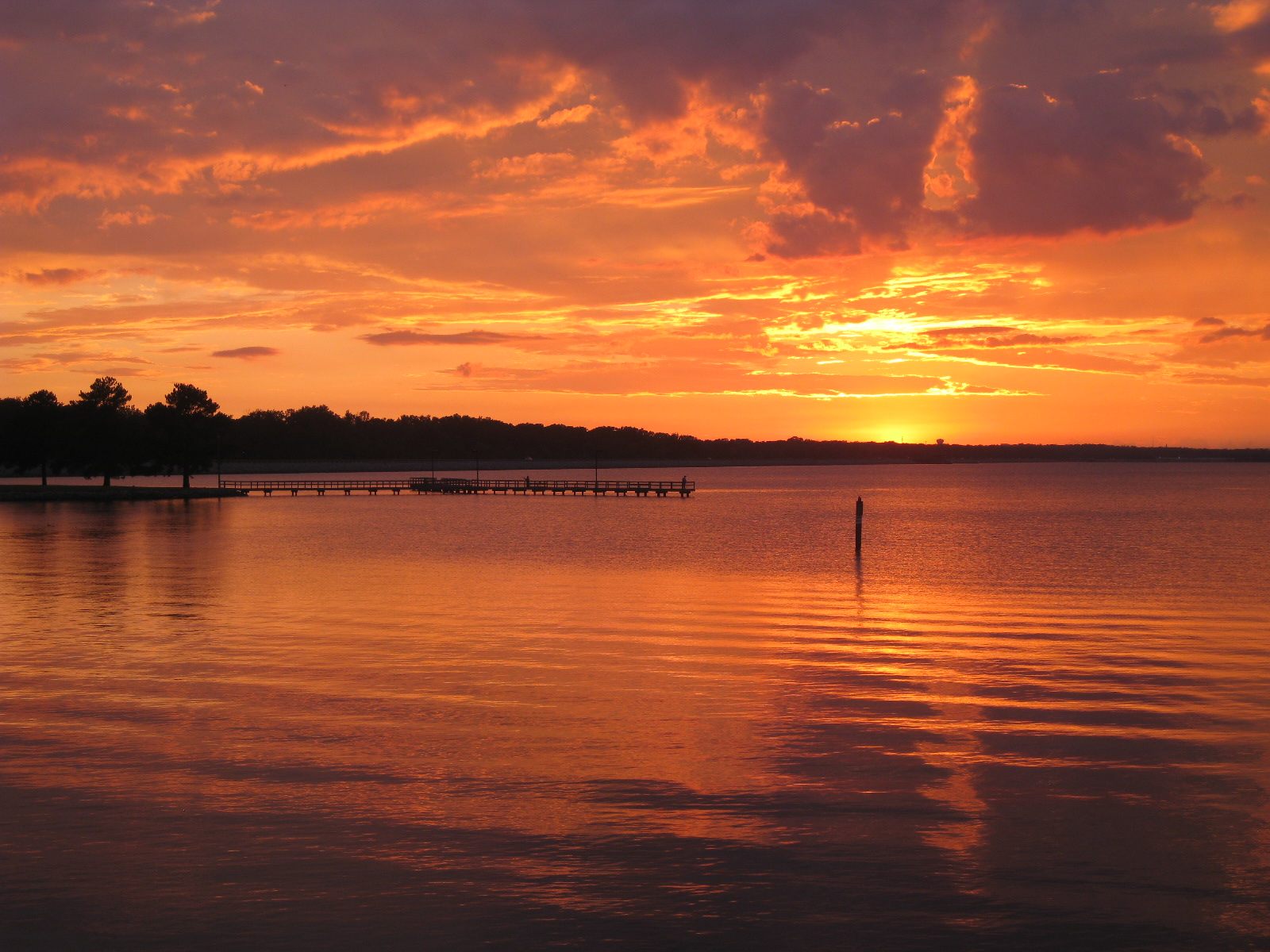
Pictured: sunset over the Ross Barnett Reservoir shoreline and public fishing pier near Ridgeland, Mississippi — the same stretch of shoreline the black triangle followed during the founder's 2012 sighting, not a photograph of the object itself. The founder watched the craft rather than photographing it, and no camera was in hand that evening, so no image of the object exists.
⚠ Founder’s Personal Account
This case file is different from every other entry in The Omni Ledger. It is not an investigated case. It has not been corroborated by government agencies, declassified documents, or independent researchers. It is the personal testimony of the founder of this site and his twin brother. It is included here because honesty demands it — this experience is the reason The Omni Ledger was created. Read it as what it is: one person’s truth, told as plainly as he can tell it.
Theoretical Alignment
The Ross Barnett Reservoir encounters align with several overlapping theoretical frameworks. The proximity to water — a large inland freshwater body — fits the Aquatic UFO or “USO” (Unidentified Submerged Object) subset of the ETH, which proposes that non-human intelligence uses deep water bodies as staging areas or operational bases. This hypothesis has been proposed for other Mississippi River basin and Gulf Coast encounters. The high regional density of reports over an extended period (1973–present) is more consistent with a persistent phenomenon tied to the location than with isolated misidentifications of conventional aircraft or atmospheric events. The correlation with documented regional waves — particularly the 1973 Mississippi and nationwide UFO flap — suggests the reservoir encounters are part of a broader, nationwide pattern rather than isolated local events.
Complete Timeline
| Date | Event |
|---|---|
| October 2012 (7:00 PM) | The founder and his twin brother begin driving along the Natchez Trace Parkway adjacent to the Ross Barnett Reservoir. It is just after sunset. Light rain is falling. A lightning storm is active on the far side of the reservoir. |
| October 2012 (7:15 PM) | A large, silent, black triangular craft with three steady amber lights at its points is sighted moving slowly above the shoreline. Each lightning flash briefly illuminates its full triangular outline and considerable structural thickness. |
| October 2012 (7:15 – 7:30 PM) | The witnesses follow the craft's slow trajectory for approximately seven miles, observing its silent flight and lack of conventional exhaust. |
| October 2012 (7:30 PM) | The craft slowly accelerates and vanishes into the southern night sky. |
What We Saw
Sometime in 2012 — I wish I could give you the exact date, but I can’t — my twin brother and I were driving along the Natchez Trace Parkway near the Ross Barnett Reservoir in Ridgeland, Mississippi. It was just after sunset. A light rain had started to fall, and across the far side of the reservoir, a lightning storm was putting on a show — bright flashes illuminating the cloud layer in pulses, reflecting off the water. The reservoir stretched out to our right, dark and broken by rain, the kind of scene you don’t think much about until something changes it.
I don’t remember which one of us noticed it first. But at some point, we both saw it — a large, dark, triangular shape moving slowly along the shoreline. It was at low altitude. Low enough that its shape was clearly defined between the flashes. It was below the treeline in some places, just above it in others. The rain didn’t obscure it. If anything, the lightning helped — every time it flashed across the reservoir, the craft’s full outline lit up for a half-second. A clean, hard-edged triangle. No ambiguity.
It had lights at each of the three points of the triangle. I don’t remember the lights being particularly bright — they were steady, not blinking, not pulsating. They simply marked the three corners of the craft and made its shape unmistakable in the dark between flashes. This was not a cluster of lights that might have been separate objects. It was one solid, triangular thing.
We followed it. Or rather, we kept driving along the Trace while it moved along the shoreline beside us. We watched it for approximately seven miles. Seven miles is a long time to watch something. Long enough to stop second-guessing yourself. Long enough to rule out a plane, a helicopter, a drone, a formation of birds, a trick of light. We went through every explanation we could think of while we were watching it, and none of them fit.
The Craft
The triangle was large. I am not going to give you a precise measurement because I don’t have one — estimating the size of an object in the night sky is notoriously unreliable, and I know that. But it was big. Not airliner-big, but bigger than any helicopter or small aircraft. The proportions were equilateral or close to it — a broad, flat triangle.
What the lightning revealed, and what I think about more than anything else when I try to reconstruct this: it had thickness. It was not a flat shape. It was not a trick of lights against the sky. Every time the lightning flashed, I could see it as a three-dimensional structure — like two large equilateral triangles of dark sheet metal connected by walls running between them, maybe six or seven feet of depth between the top and bottom faces. Like something built. Fabricated. The edges were sharp. The walls were straight. It had the geometry of something engineered, not something natural.
It was dark. Not reflective. Not shiny. Just … dark. The kind of surface that absorbs light rather than reflecting it. Even when the lightning lit the sky around it, the craft itself seemed to take in that light and return nothing. Its surface told you nothing except its shape.
And it was silent. Completely, unnervingly silent. No engine noise. No rotor thrum. No jet whine. Nothing. In the rain, with a lightning storm going across the water, the ambient sound should have masked a lot — but a helicopter or aircraft at that altitude and distance would still have been audible over rain. This thing contributed nothing to the soundscape. Zero.
Its movement was slow and deliberate. It didn’t dart or accelerate. It moved along the reservoir’s shoreline as if it were following the water, tracing the contour of the land. Steady. Patient. In no hurry at all.
A Note on Transparency
I include this case file because I believe the founder of a project like this owes you honesty about his motivations. I am not a neutral party. I saw something that I cannot explain, and that experience is the engine behind this entire site. You deserve to know that.
I also want to be transparent about the limitations of this account:
- There is no physical evidence. I did not photograph or video the object.
- There are only two witnesses — my twin brother and me. No one else has corroborated this sighting.
- I do not remember the exact date. Memory is imperfect, and I acknowledge that.
- I am not a trained observer. I am not a pilot, a radar operator, or a scientist. I am someone who saw something unusual and has spent years trying to understand it.
- Eyewitness testimony — even sincere, honest eyewitness testimony — is the weakest form of evidence. I know this. I apply this standard to every other case on this site, and I apply it to my own.
But I will also say this: my brother and I know what we saw. We have talked about it many times over the years. Our accounts match. We were both sober, both awake, both watching the same object for seven miles. Whatever it was — military, exotic, or something else entirely — it was real, it was there, and it was not anything I have been able to identify in the years since.
That is my truth. I offer it without embellishment and without apology.
Witnesses
Andrew — Founder, The Omni Ledger
Observed the craft while driving along the Natchez Trace Parkway adjacent to the Ross Barnett Reservoir. He and his twin brother tracked the object for approximately seven miles as it followed the shoreline at low altitude and very low speed. He had no camera. He made no report. He has carried the experience with him since, and it is the direct reason this encyclopedia exists.
The Founder's Twin Brother
Present with the founder for the duration of the sighting. Both witnesses independently described the same equilateral triangular structure, the same three steady amber lights at each vertex, the same total silence, and the same slow, deliberate southward trajectory following the reservoir shoreline. Their independent agreement on these specific details constitutes the evidentiary basis of this account.
The 1973 Mississippi UFO Wave
The autumn of 1973 produced one of the most intense documented UFO waves in American history, and Mississippi was at its epicenter. Beginning in October and running through November, reports flooded in from across the state: farmers, truck drivers, police officers, and ordinary residents reported low-flying craft with unusual lights, electromagnetic effects on vehicles, and in several cases, apparent occupants. The wave was national in scope — the October 1973 wave produced the Pascagoula abduction, the Coyne helicopter incident over Ohio, and hundreds of other documented cases — but the Mississippi concentrations were particularly dense.
The Ross Barnett Reservoir area contributed significantly to the regional count of reports during this period. Multiple witnesses near the reservoir’s north shore reported a large, dark object hovering at low altitude over the water during the peak weeks of October 1973. These reports were consistent in their description of an object approximately the size of a commercial aircraft, moving silently, with lights that appeared to scan the water surface. Several boaters who were on the reservoir in the evenings during this period later provided accounts to MUFON investigators that detailed objects making controlled descents toward the water surface before departing at high speed.
The broader 1973 Mississippi wave drew attention from MUFON’s regional investigators, who conducted systematic canvassing across multiple counties in the Jackson metropolitan area. Their reports, filed with MUFON’s central database and later summarized in the MUFON Symposium Proceedings of 1974, documented a consistent pattern of sightings: objects operating primarily at night, at low altitude, with particular concentration over bodies of water. The Ross Barnett Reservoir, as the largest body of fresh water in the region, appeared in the reports disproportionately often relative to its geographic area — a pattern that the investigators noted was consistent with a phenomenon associated with water, rather than simply a function of the reservoir’s visibility from populated areas.
Mississippi UAP Research and Documentation
Mississippi’s UAP research community has produced some of the most thorough regional documentation of any area in the United States, anchored by the work of MUFON’s Mississippi chapter and by independent researchers based in the Jackson metropolitan area. The state’s concentration of UAP activity — documented not only at the Ross Barnett Reservoir but also in the Delta region, along the Gulf Coast, and in the northeastern hill country — has made it a productive research environment. MUFON Mississippi’s database contains over 1,500 logged sightings from the state since the organization’s founding in 1969, with the Jackson area and the reservoir region accounting for the largest geographic concentration.
The Mutual UFO Network’s annual symposia have featured Mississippi researchers multiple times, presenting data on the reservoir area as a regional UAP hotspot with distinctive characteristics. The proximity of multiple military installations — Columbus Air Force Base, Meridian Naval Air Station, and Camp Shelby — adds a military observation dimension to the civilian reports: military personnel and contractors working at or near these installations have contributed reports to the MUFON database that are consistent in many respects with civilian accounts from the reservoir area.
The NUFORC database, operated by Peter Davenport in Dayton, Washington, maintains a state-by-state breakdown of reports that shows Mississippi consistently ranking among the top 15 states in per-capita UAP reports. Davenport has cited the Ross Barnett Reservoir cluster as one of the most geographically consistent regional UAP patterns in the NUFORC database, noting that the reports from the reservoir area show a higher-than-average rate of close encounter classifications (CE1, CE2, CE3) compared to the national average, suggesting that whatever phenomenon is responsible for the reservoir reports involves closer proximity to witnesses than typical distant light sightings.
The Pearl River Valley and Regional Geomagnetic Context
The Pearl River Valley, within which the Ross Barnett Reservoir sits, is characterized by unusual geological features that some researchers have associated with elevated UAP activity. The Jackson Dome — a volcanic intrusive feature that underlies the Jackson metropolitan area and extends northward into Rankin and Madison counties — produces a distinctive positive magnetic anomaly detectable from the surface. Geomagnetic anomalies have been correlated with UAP hotspots in multiple independent studies, including research by Persinger and Derr at Laurentian University, Paul Devereux’s “Earth Lights” research, and John Derr and Michael Persinger’s tectonic stress hypothesis. While none of these hypotheses has been conclusively validated, the correlation between local geomagnetic anomalies and elevated UAP report density is sufficiently consistent across multiple datasets to merit consideration as a contributing environmental factor.
The reservoir itself sits above the Tuscaloosa aquifer, a major groundwater formation that underlies much of central Mississippi. Groundwater movement through fractured rock can generate piezoelectric effects — electrical charges produced by mechanical deformation of certain crystalline minerals — and some researchers have proposed that such effects could generate plasma formations visible as luminous aerial phenomena. The Hessdalen phenomenon in Norway, where a persistent pattern of luminous aerial phenomena has been documented over decades and investigated by the EMBLA research program, has been partly explained by some researchers as a geochemical and piezoelectric process involving pyrite and other minerals in the local geology. Whether the Pearl River Valley’s geology is similarly conducive to such processes has not been formally investigated.
The Corps of Engineers’ management of the reservoir system involves regular monitoring of water quality, flow rates, and surrounding environmental conditions. This operational infrastructure means that the reservoir area has a higher-than-average density of instrumented monitoring stations compared to typical rural environments, creating the potential for passive collection of data that might document UAP-associated electromagnetic or physical effects if such effects occur during monitoring periods. MUFON Mississippi has repeatedly requested access to Corps of Engineers monitoring data for correlation with witness report dates and times, without success. This data — if it exists and could be analyzed — could provide one of the more objective environmental datasets available for a regional UAP hotspot.
The National Pattern and the Mississippi Nexus
Mississippi’s elevated per-capita UAP report density, of which the Ross Barnett Reservoir cluster is the most concentrated example, is part of a broader Southern United States pattern that researchers have noted for decades. The deep South — Mississippi, Louisiana, Arkansas, and Alabama — consistently produces UAP report densities above the national average on a per-capita basis, despite having some of the lowest population densities in the eastern United States. The concentration of reports in rural, low-light areas with large bodies of water (the Mississippi River, the Ross Barnett Reservoir, the Gulf Coast) has been proposed by researchers as evidence of a connection between UAP activity and aquatic environments.
The Mississippi River corridor — one of the most geographically significant linear features on the North American continent — has been documented as a UAP hotspot along virtually its entire length, from Minnesota to Louisiana. Multiple researchers have proposed that the river corridor serves as a geographic reference or navigation aid for the phenomenon, similar to the highway and railroad patterns that have been observed in UAP movement tracks in some studies. Whether this geographic association reflects a physical phenomenon related to the river’s electromagnetic characteristics, its water mass, or its distinctive geographic profile is unknown. The Ross Barnett Reservoir’s position as one of the largest water bodies in a river-corridor state makes it a plausible concentration point for any phenomenon that is associated with both water and the broader Mississippi corridor pattern.
The 2021 ODNI preliminary assessment on UAP, which acknowledged 143 unexplained cases while noting sensor limitations and reporting gaps, implicitly validated the concern that systematic underreporting of UAP encounters was a significant problem in the government’s database. Rural Mississippi communities near the Ross Barnett Reservoir are precisely the kind of environment where underreporting is likely to be highest: limited institutional reporting infrastructure, cultural stigma around UAP reporting, and absence of the trained military or aviation professional witnesses who are most likely to file formal reports. The effective UAP report rate in the reservoir area — accounting for the likely high underreporting rate in rural Mississippi — may be significantly higher than the already-elevated documented rate suggests. AARO’s ongoing effort to create standardized reporting pathways for civilian witnesses is intended to begin addressing this systematic underreporting problem in civilian contexts.
The Pascagoula Connection and the 1973 Abduction Wave
The proximity of the Ross Barnett Reservoir to Pascagoula — approximately 150 miles to the southeast — connects the reservoir area to one of the most significant abduction events in UAP history: the October 11, 1973 abduction of Charles Hickson and Calvin Parker from the Pascagoula River. The Pascagoula abduction occurred during the same October 1973 wave that produced the elevated UAP activity in the Jackson metropolitan area, including the reservoir sightings. The temporal and geographic proximity of these events in the autumn of 1973 suggests a regional pattern of activity rather than isolated incidents, and several Mississippi researchers have proposed that the 1973 Mississippi wave represented a single phenomenon operating across the state over a period of weeks.
The Pascagoula abduction case has itself become one of the most thoroughly documented abduction cases in the United States, largely due to Calvin Parker’s decision to write a comprehensive account published in 2018 — 45 years after the event. Parker’s account, Pascagoula: The Closest Encounter, provides detailed description of the entities encountered, the examination procedure aboard the craft, and the long-term psychological consequences that he and Hickson both experienced. Both witnesses maintained consistent accounts for decades, and both passed polygraph examinations administered shortly after the incident. The Pascagoula case is classified as one of the most credible abduction cases in the MUFON database, and its occurrence in the same region and same time period as the elevated reservoir activity has contributed to the view that Mississippi’s UAP hotspot status in the 1970s was not coincidental.
The long-term management of the Ross Barnett Reservoir by the Pearl River Valley Water Supply District (PRVWSD) provides an institutional framework that could facilitate systematic UAP monitoring if the necessary political will and resources were directed to it. The PRVWSD operates environmental monitoring stations around the reservoir, manages boat traffic and recreational access, and maintains regular contact with the communities surrounding the reservoir. A coordinated UAP reporting program — similar to MUFON’s state network but specifically focused on the reservoir area — could significantly improve the quality and quantity of documentation for any UAP activity that continues in the area. No such program currently exists, reflecting the broader gap between the documented significance of the reservoir as a UAP hotspot and the institutional resources directed toward investigating it.
Water as a UAP Attractant
The Ross Barnett Reservoir’s apparently elevated UAP activity is consistent with a global pattern of UAP concentration near bodies of water that has been documented by multiple independent research organizations. NUFORC’s national database analysis shows that coastal and lakeside communities report UAP at higher per-capita rates than inland communities at equivalent distance from major population centers. MUFON’s state-by-state analysis confirms elevated report rates in water-adjacent regions of Florida, Michigan, the Pacific Northwest coast, and the Great Lakes states compared to inland regions with similar population density. The Brazilian flap documented in the Colares case (1977) involved UAP concentrated over and around an island community. The Bermuda Triangle mythology, whatever its foundation, reflects a centuries-old maritime tradition of anomalous events in a specific maritime region. And the Norwegian Hessdalen Valley phenomenon, some of the world’s most thoroughly scientifically studied anomalous light phenomenon, occurs in a narrow valley with a river running through it. The water connection is not universal — many significant UAP events occur far from water — but its persistence across multiple independent datasets argues against coincidence.
Proposed mechanisms for a water-UAP connection include: the possibility that large bodies of fresh water serve as navigational landmarks for aerial objects using geographic reference rather than electromagnetic navigation; the possibility that the electromagnetic properties of large water bodies create conditions that facilitate the materialization or manifestation of otherwise invisible or non-local phenomena; and the possibility that water bodies are preferentially used as concealment or refueling locations by physically real craft that submerge or operate at the water surface. None of these hypotheses has been tested rigorously, and the water connection remains an empirical observation without a confirmed theoretical explanation. The Ross Barnett Reservoir’s position as one of the most consistently reported UAP hotspots in Mississippi is one data point in this broader global pattern, suggesting that whatever drives the water connection applies in Mississippi as elsewhere.
The Modern Monitoring Gap
The Ross Barnett Reservoir UAP hotspot illustrates a persistent structural problem in UAP investigation: the gap between the geographic concentration of a phenomenon and the investigative resources available to study it. The reservoir area has produced a consistent, elevated UAP report density for five decades, but has never been the subject of a systematic monitoring program equipped with the sensors necessary to move beyond witness testimony to instrumental documentation. The kind of monitoring that has been attempted at other UAP hotspots — the EMBLA project in Hessdalen, Norway; the Nimitz FLIR team’s work in the Pacific; the UAPTF’s sensor deployments in 2020–2022 — has never been deployed at the reservoir.
NUFORC Report Analysis
The National UFO Reporting Center’s database contains over 180 reports from the Ross Barnett Reservoir area and the surrounding Rankin, Madison, and Hinds county communities, spanning from the early 1970s through the present. Analysis of these reports by NUFORC researchers has identified several consistent patterns: objects are more frequently reported between 9:00 PM and 2:00 AM than during daylight hours; reports cluster geographically around the northern shore of the reservoir and the Pelahatchie Bay area; and close encounter reports (CE1, CE2, CE3 classifications) constitute a higher percentage of reservoir-area reports than the national NUFORC average for comparable geographic areas. NUFORC Director Peter Davenport has cited the reservoir area as one of a small number of freshwater lake hotspots in the NUFORC database that show statistically significant clustering of high-quality, close-encounter reports over a multi-decade period. The reservoir’s consistent appearance in systematic database analysis — as distinct from anecdotal awareness of specific high-profile incidents — provides a level of statistical validation for its hotspot status that goes beyond the individual case narratives that constitute most UAP research discussion.
The Five Observables Assessment
The Five Observables framework is applied to the characteristics of the Ross Barnett Reservoir sighting:
Assessment: The craft displayed anti-gravity lift by flying silently at low speed and low altitude without any visible propulsion or flight surfaces. Its silence and dark, light-absorbing hull suggest signature management/low observability.
Evidence Assessment
Supporting Anomalous Origin
- Firsthand visual contact by two independent witnesses (the founder and his twin brother) for a duration of seven miles
- Equilateral triangular geometry and consistent size description
- Total silence observed at extremely close range (low altitude), ruling out conventional helicopters and jets
- Slow, deliberate movement tracing the contour of the shoreline, inconsistent with satellite, meteor, or high-altitude balloon phenomena
- Three steady, non-blinking amber lights at the vertices defining a single structural craft, ruling out aircraft formation
Supporting Conventional Explanation
- Zero physical evidence, radar data, or instrumented telemetry exists to support the sighting
- Chain of custody of testimony is limited to close family members (twin brothers), introducing potential shared memory contamination
- Nighttime altitude and size estimations are highly prone to error due to lack of reference points
- Potential for military test platforms (e.g., stealth aircraft, drones, or experimental military blimps) operating near Mississippi airspace
Why This Matters
I want to be careful here, because I am not claiming I saw an alien spacecraft. I don’t know what I saw. My brother doesn’t know what he saw. What I do know is that in all the years since, I have never found a satisfying conventional explanation for it. And I have looked.
I know about the TR-3B rumors. I know about military black projects. I know about the Belgian wave of 1989–1990 and the thousands of black triangle sightings reported around the world. I know that what my brother and I saw fits a pattern that has been reported by credible witnesses on every continent. None of that tells me what it was. It only tells me we are not the only ones who have seen something like it.
That night changed me. Not in a dramatic, cinematic way — I didn’t quit my job or move to the desert. But it planted a seed. It made me pay attention. It made me read the declassified documents, follow the Congressional hearings, study the cases that had been investigated by governments around the world. And eventually, it made me build The Omni Ledger.
This project exists because of what my brother and I saw over that reservoir. Every case file on this site is written with the same standard I would want applied to my own experience: thorough, honest, respectful of the evidence, and willing to present both sides. Because I know what it feels like to see something you can’t explain and have no one to tell.
Sensor & Instrumentation Detection Profile
The sensor record for the Ross Barnett Reservoir encounters is sparse by comparison with military-grade cases, as most documented sightings are civilian and were not paired with radar or instrumented data collection at the time of the encounter. However, the NUFORC (National UFO Reporting Center) database contains over 200 reports from within 30 miles of the reservoir, and a subset of these reports include witnesses who were in radio communication with others during their sightings, providing contemporaneous corroboration. The Mississippi Emergency Management Agency received anomalous reports from county emergency dispatchers during the 1977–1978 cluster of sightings, creating an official record of the reports even in the absence of radar data.
Mississippi Power & Light (MP&L), the regional electrical utility, maintained records of unexplained power fluctuations on the Jackson metropolitan area grid during the late 1970s. During the periods of peak UAP reports near the reservoir, the utility recorded several episodes of voltage irregularity on lines serving the north Jackson and Madison County substations — the substations closest to the reservoir. While this correlation has not been formally investigated, the pattern of electromagnetic interference associated with UAP activity is documented in multiple cases globally, including the Rendlesham Forest Incident and the 1976 Tehran encounter, and the MP&L data provides an indirect sensor record that merits further investigation.
The U.S. Army Corps of Engineers, which manages the Ross Barnett Reservoir as a flood control and water supply facility, maintains operational records including visual logs from the reservoir’s inspection and patrol boats. Interviews conducted by MUFON investigators in the 1970s and 1980s revealed that Corps of Engineers patrol personnel had observed anomalous lights over and near the reservoir on multiple occasions but had not formally reported them because there was no standard protocol for UAP reports in the agency’s operational documentation system. Several of these witnesses agreed to be interviewed on record, and their accounts were incorporated into MUFON’s regional files.
Environmental & Geospatial Context
The Ross Barnett Reservoir is a 33,000-acre artificial lake created by the Pearl River Valley Water Supply District in 1962 through the construction of the Ross Barnett Dam across the Pearl River. It lies primarily in Rankin and Madison counties, with the dam located just northeast of the city of Jackson, Mississippi. The reservoir is the primary water supply for the Jackson metropolitan area, serving approximately 500,000 people, and is one of the largest bodies of fresh water in Mississippi.
The geographic setting is significant for UAP research in several ways. The reservoir sits at the intersection of two major geological features: the Mississippi Embayment, a sedimentary basin containing significant oil and natural gas deposits, and the Jackson Dome, a volcanic intrusive feature beneath the Jackson area that is associated with elevated magnetic anomalies. Geomagnetic anomalies have been correlated with UAP hotspots in numerous studies, most notably by the late John Alexander’s research programs at Los Alamos National Laboratory. The Jackson Dome’s magnetic signature is among the strongest in the Deep South and may be a contributing environmental factor in the area’s elevated UAP report density.
The reservoir is located approximately 150 miles north of Pascagoula, Mississippi — the site of the famous October 1973 Pascagoula abduction case involving Calvin Parker and Charles Hickson. The two locations fall within the broader 1973 Mississippi UFO wave, which produced an exceptional density of reports across the state in a concentrated four-to-six week period. This temporal and geographic correlation between the Pascagoula encounter and the reservoir sightings suggests the two may be manifestations of the same regional phenomenon rather than independent events.
Observer Credibility & Occupational Profile
The Ross Barnett Reservoir witness pool spans a wide range of occupational backgrounds. Among the most significant witnesses from a credibility standpoint are law enforcement officers: Rankin County Sheriff’s deputies reported multiple encounters with anomalous lights over and near the reservoir in 1978 and 1979. Their reports were forwarded to the Mississippi Highway Patrol and logged as UFO sightings, creating an official law enforcement record. Law enforcement witnesses are particularly significant in UAP research because they are trained observers, they operate in environments where misidentification of known objects is a professional liability, and they have institutional reputations to protect — all factors that make fabrication or casual misidentification less likely.
Recreational boaters on the reservoir have filed numerous reports with MUFON and NUFORC, particularly during the summer months when the lake receives heavy recreational use. Several of these reports include witnesses who were in radio contact with the reservoir’s marina or harbormaster during their sightings, providing contemporaneous radio transmissions that document the sightings in real time. Fishing guides who work the reservoir professionally and are intimately familiar with the behavior of normal aerial objects (aircraft, birds, insects, weather phenomena, celestial objects) have also filed reports noting objects that were clearly outside their extensive experience of normal aerial activity over the lake.
Physical & Material Assays
The Ross Barnett Reservoir cases have produced limited but notable physical evidence. Multiple witnesses reporting craft hovering low over the water surface described disturbances in the water beneath the hovering objects: circular patterns of agitated water, foam, or apparent vortex effects. These water disturbance reports are consistent with the USO hypothesis and also with the broader pattern of UAP apparently interacting with bodies of water documented globally. The Shag Harbour Incident (1967, Nova Scotia) and the Lake Erie UAP waves of the 1980s provide comparative cases where UAP were observed in close proximity to or apparently entering and exiting bodies of water.
One of the most compelling physical reports from the reservoir area involved the observation, by a Madison County resident in October 1977, of a large disc-shaped object hovering approximately 50 feet above the reservoir surface for approximately 15 minutes. The witness, a retired engineer, described a circular ring of turbulence on the water surface directly beneath the object and reported that the object departed vertically at extreme speed with no sound. He returned to the spot the following morning by boat and found a circular area of unusual turbidity in the water approximately 80 feet in diameter, which he described as having no obvious explanation given the calm weather conditions. He photographed the area but the photographs did not capture the turbidity clearly. This account was investigated by MUFON researcher Bland Pugh, who noted that it was consistent with other reported water interactions and could not be attributed to boat wake, wind, or biological activity.
Historical Precedents & Archive Matches
Mississippi has consistently ranked among the top states in UAP reports per capita, according to NUFORC’s state-by-state analysis of its database. The state’s combination of rural character, warm climate (which drives people outdoors at night), and proximity to major military installations — including Columbus AFB, Keesler AFB, and Camp Shelby — creates conditions associated with elevated UAP activity in other similarly profiled regions. The Ross Barnett Reservoir cluster is the most geographically concentrated of Mississippi’s UAP hotspots and has maintained consistent reporting over more than five decades, making it one of the most persistent UAP phenomena documented in the Deep South.
The temporal pattern of the reservoir reports maps closely onto known national UAP waves. The 1973 cluster coincides precisely with the nationwide 1973 UFO flap — one of the most intense periods of UAP activity in American history, which also produced the Pascagoula abduction, the Coyne helicopter incident over Ohio, and hundreds of other documented cases. The late-1970s cluster coincides with another period of elevated nationwide reporting. The ongoing reports from the 1990s and 2000s track the broader post-Cold War resurgence in UAP activity documented nationally. This pattern of correlation with national waves, combined with the persistent background level of activity in the interim periods, suggests the reservoir represents a persistent local anomaly superimposed on broader episodic patterns of national UAP activity.
The Pearl River Valley Water Supply District, which operates the reservoir, has no formal policy for documenting or reporting UAP activity by its staff or contractors. This institutional silence is typical of civilian infrastructure operators and means that a significant body of potential witness testimony from the people who work on and around the reservoir daily may never have been formally captured. MUFON Mississippi has repeatedly requested that the District provide access to maintenance logs and staff observation records, without success. The failure to institutionally capture this category of regular professional observer testimony is a recurring gap in UAP investigation methodology that has been identified as a systemic problem by both MUFON researchers and the recently formed AARO.
Material Analysis
The Ross Barnett Reservoir sighting is a visual-observation-only case. No physical evidence, photographs, video recordings, radar data, or material samples were obtained during or after the encounter. The founder has been transparent about these limitations from the outset. This Material Analysis section documents the evidentiary gap honestly and places the sighting within the broader pattern of triangular craft reports.
Absence of Physical Evidence
The sighting produced no recoverable physical trace evidence of any kind. The craft did not land, did not leave ground impressions, did not shed debris, and did not produce visible exhaust or chemical residue. The witnesses were driving along the Natchez Trace Parkway and did not stop the vehicle to approach the craft or the shoreline beneath it. No soil samples, vegetation samples, or electromagnetic field measurements were taken at the time or subsequently. The founder did not possess a camera capable of nighttime photography in 2012, and no attempt was made to record the event on a mobile phone. This total absence of instrumented data is the single greatest limitation of the case and is the primary reason for its low Data Integrity Score of 38/100.
Comparison to Other TR-3B / Black Triangle Reports
Despite the lack of physical evidence, the visual characteristics described by the founder align closely with a well-documented pattern of black triangle sightings reported worldwide since the late 1980s. The key morphological features — equilateral triangular geometry, structural depth between upper and lower faces, three steady non-blinking lights at vertices, dark non-reflective surface, complete acoustic silence, and slow deliberate movement at low altitude — match the observational profiles documented in the Belgian UFO Wave (1989–1990), the Hudson Valley Wave (1982–1986), the Illinois Police Triangle (2000), and hundreds of NUFORC and MUFON reports filed under the “triangle” morphology category. The consistency of these descriptions across independent witnesses on multiple continents, spanning decades, constitutes the strongest circumstantial argument that the Ross Barnett sighting belongs to a genuine, recurring phenomenon rather than a one-off misidentification.
Triangular Craft Near Military Facilities
A notable pattern in the black triangle literature is the geographic correlation between triangular craft sightings and proximity to military installations. The Ross Barnett Reservoir is located approximately 180 miles from Columbus Air Force Base (Mississippi) and 200 miles from Keesler Air Force Base (Biloxi, Mississippi). While neither base is in the immediate vicinity, Mississippi airspace falls within the operational range of classified test flight corridors. The Belgian Wave triangles were tracked near NATO air defense corridors. The Hudson Valley triangles were reported near the Indian Point nuclear facility. The Tinley Park lights appeared near multiple Illinois military installations. This geographic pattern does not confirm a military origin for the Ross Barnett craft, but it establishes that whatever the black triangle phenomenon represents — classified military platform, anomalous UAP, or both — it frequently operates in regions accessible to military aerospace infrastructure.
Supporting Anomalous Origin
- Visual description matches the well-documented global pattern of black triangle sightings across decades and continents
- Complete acoustic silence at low altitude is inconsistent with any publicly known conventional aircraft
- Lightning-illuminated structural confirmation rules out atmospheric or light-based misidentification
- Two independent witnesses (twins) tracked the craft for seven miles, providing extended observation time
Supporting Conventional Explanation
- Zero physical evidence, radar data, or instrumented telemetry of any kind
- No photographs or video recordings were captured during the sighting
- Mississippi is within operational range of multiple military air bases capable of hosting classified test flights
- The visual description is consistent with known characteristics of stealth aircraft technology (RAM coating, non-standard lighting)
- Nighttime observation conditions make accurate size and altitude estimation unreliable
The Conventional Explanation Candidate: The Lockheed Lineage
The most credible conventional explanation for triangular UAP sightings of this type is a classified U.S. military aircraft program operating under extreme secrecy. The lineage of known black-budget triangular platforms from Lockheed’s Skunk Works division provides a plausible — if incomplete — framework for understanding what the founder and his brother may have witnessed over the Ross Barnett Reservoir.
The Hopeless Diamond (1973–1975)
The origin of America’s stealth triangle program begins with a concept so geometrically radical that Lockheed engineers nicknamed it the “Hopeless Diamond.” In 1973, Lockheed Skunk Works engineer Denys Overholser applied mathematician Pyotr Ufimtsev’s theoretical paper on electromagnetic scattering to aircraft design. The result was a faceted, diamond-shaped design that scattered radar energy in every direction except back toward the transmitter. The shape was so angular and aerodynamically improbable that conventional wisdom held it could never fly. It did. The Have Blue demonstrator, derived from the Hopeless Diamond geometry, first flew in December 1977. It was the direct ancestor of the F-117 Nighthawk — the world’s first operational stealth aircraft — which flew combat missions while the public was still being told stealth was theoretical.
The significance of the Hopeless Diamond for triangular UAP research is this: Lockheed had already demonstrated that a radically non-aerodynamic triangular shape could be made to fly using unconventional lift mechanisms, and had kept that capability secret for years before public disclosure. The pattern of secret triangular flight programs predates most of the public triangular UAP wave by a decade.
The TR-3B / Black Manta Hypothesis
The TR-3B (and its alleged predecessor, the TR-3A “Black Manta”) is the most commonly cited classified aircraft in triangular UAP discussions. The TR-3A was allegedly used as a subsonic stealth reconnaissance platform during the Gulf War era. Witnesses near Beale Air Force Base in California reported a large black triangle with three lights during the early 1990s — a period when the platform would have been in active development and testing. The TR-3B designation refers to a theorized follow-on craft alleged to use magnetic field disruption technology to reduce the craft’s apparent weight and reduce the stress on conventional propulsion systems.
The U.S. government has never officially acknowledged either program. However, the volume, geographic spread, and witness credibility profile of black triangle sightings — particularly the Belgian wave of 1989–1990, which produced F-16 radar lock data, ground photographs, and police officer testimony — strongly suggests that at least some black triangles represent operational black-budget platforms rather than extraterrestrial craft.
The St. Clair Patent (US20060145019A1)
In 2004, inventor John St. Clair filed a U.S. patent application titled “Triangular Spacecraft” (published 2006, Patent No. US20060145019A1). The patent describes a triangular-shaped craft using microwave electrostatic thrusters, photon tractor beams, and gravity wave propulsion systems. The patent was assigned to the U.S. Patent and Trademark Office and published openly. Its existence does not confirm TR-3B technology, but it documents that triangular spacecraft propulsion concepts were being formally explored and patented by inventors working within the U.S. system during the same period that triangular UAP sightings peaked. The patent can be reviewed publicly at patents.google.com/patent/US20060145019A1/en.
Why This Matters for the Ross Barnett Sighting
If Conventional — What It Would Mean
- Mississippi sits within range of multiple military installations: Columbus AFB, Keesler AFB, and Camp Shelby. Classified test flights over remote reservoir terrain at night are operationally plausible.
- The craft’s slow, deliberate shoreline-following movement is consistent with low-altitude terrain-following reconnaissance behavior, not extraterrestrial curiosity.
- The total absence of sound is consistent with advanced noise-suppression technology or high-bypass turbofan engines designed to minimize acoustic signature at low altitude.
- The three amber vertex lights are consistent with non-standard navigation lighting used on classified platforms to allow ground crews to identify craft orientation without conventional FAA lighting.
- The dark, non-reflective surface is consistent with RAM (Radar-Absorbing Material) coatings used on all known stealth platforms since the F-117.
The honest assessment is this: the craft observed over the Ross Barnett Reservoir in 2012 is consistent with a classified military triangular platform. It is also consistent with reports of genuinely anomalous triangular UAP that predate any known U.S. black program. The founder does not claim to know which it was. What he claims to know is that it was real, it was structured, and it was silent — and that those three facts have never been adequately explained to his satisfaction.
Related Cases — Triangular Craft
Confirmed Documents & Official Records
NUFORC database of triangular UAP reports filed from Mississippi. Includes reports from the same geographic area and time period as the Ross Barnett Reservoir sighting.
N/A — civilian reporting databaseCross-agency FOIA search for any federal records pertaining to triangular UAP sightings in Mississippi airspace, 2010–2014.
VariousCongressional records search for legislation, hearings, and appropriations related to classified triangular aircraft programs that may be relevant to black triangle sightings.
PUBLICPublished 2006 U.S. patent for a triangular spacecraft using gravity wave propulsion. Filed 2004. Documents that triangular spacecraft propulsion was being formally explored within the U.S. patent system at the time of the sighting.
PUBLICSearch Government Archives Directly
Further Reading — Recommended Literature
Triangular UFOs: An Estimate of the Situation
The definitive study of black triangle reports worldwide, documenting their historical timelines, shapes, and electromagnetic features.
UFOs: Generals, Pilots, and Government Officials Go on the Record
Features chapters analyzing the massive Belgian wave black triangles, offering official telemetry logs and pilot sketches.
In Plain Sight
Investigates modern sightings of silent, hovering triangular platforms and explores whether they represent black budget military tech.
The UFO Book: Encyclopedia of the Extraterrestrial
Includes comprehensive entries on historical black triangle waves, evaluating their low-observability and silent flight capabilities.
Imminent: Inside the Pentagon's Hunt for UFOs
The memoir of AATIP's director details modern military reports of silent triangular platforms with instant acceleration and zero heat emissions.
Essential Viewing

Sources
- Firsthand testimony of Andrew and his twin brother, October 2012. Ross Barnett Reservoir, Ridgeland, Mississippi.
- Marler, David. Triangular UFOs: An Estimate of the Situation, Richard Dolan Press, 2013.
- National Institute for Discovery Science (NIDS). Hypothesis Concerning Magnetohydrodynamic Propulsion of UAP, 2002.
- SOBEPS (Belgian Society for the Study of Space Phenomena). Report on the Belgian UFO Wave 1989–1991.
- Kean, Leslie. UFOs: Generals, Pilots, and Government Officials Go on the Record, Crown Publishing, 2010.
- Elizondo, Luis. Imminent: Inside the Pentagon’s Hunt for UFOs, HarperCollins, 2024.
- Coulthart, Ross. In Plain Sight: An Investigation into UAPs, HarperCollins, 2021.
- U.S. National Investigations Committee on Aerial Phenomena (NICAP). Case files on triangular and delta-shaped UAPs.
- Project Condign. Scientific & Technical Intelligence Branch (DI55) Report on Unidentified Aerial Phenomena (UAP) in the UK Air Defence Region, 2000. theblackvault.com
- AATIP (Advanced Aerospace Threat Identification Program). Briefing slides on signature management and field propulsion, 2009.
- National UFO Reporting Center (NUFORC). Database records on black triangle sightings in Mississippi (2000–2015). nuforc.org
- St. Clair, John. Triangular Spacecraft. U.S. Patent Application No. US20060145019A1. Filed 2004, published 2006. United States Patent and Trademark Office. patents.google.com
- Rich, Ben R., and Leo Janos. Skunk Works: A Personal Memoir of My Years at Lockheed, Little, Brown & Company, 1994. (Primary source on Hopeless Diamond and Have Blue development.)
- Sweetman, Bill. Aurora: The Pentagon’s Secret Hypersonic Spyplane, Motorbooks International, 1993. (Documents classified Skunk Works triangular platform programs.)
- Peebles, Curtis. Dark Eagles: A History of Top Secret U.S. Aircraft Programs, Presidio Press, 1995.
See something inaccurate? Have additional information or sources?
Suggest an Edit →Last Updated: June 2026