
The Belgian UFO Wave
Between November 1989 and mid-1991, thousands of residents across Belgium, including numerous military and police personnel, observed large, silent, triangular craft hovering and moving at impossible speeds. The wave culminated in a dramatic military pursuit on the night of March 30–31, 1990, when the Belgian Air Force scrambled two F-16 fighter jets that captured multiple radar locks on a target performing maneuvers exceeding 30G. Supported by official government transparency and extensive civilian collaboration, the Belgian Wave remains one of the most thoroughly documented mass-sighting events in history.
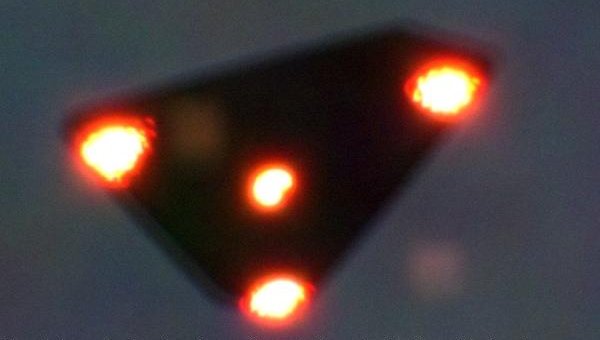
Pictured: the April 1990 Petit-Rechain photograph long reproduced as the emblematic image of the Belgian UFO wave — not a genuine photograph of an unidentified craft. Photographer Patrick Maréchal confessed in 2011 that the object is a painted Styrofoam model he built, suspended, and photographed himself; the image is included here, honestly captioned as a hoax, because of its historical role in the case rather than as evidence of anything real.
Theoretical Alignment
The Belgian UFO Wave of 1989–1990 provides the strongest alignment with the Extraterrestrial Hypothesis of any European UAP case, primarily because the evidence base is institutional rather than anecdotal. The Belgian Air Force — a NATO member nation’s military — publicly acknowledged that their radar systems tracked anomalous objects and that their F-16 fighters made nine unsuccessful attempts to lock on to a target that performed maneuvers beyond any known aircraft capability. Colonel Wilfried De Brouwer’s public statement at a press conference remains the most senior official military endorsement of genuine UAP reality from any NATO nation. The IDH alignment is secondary but supported by the wave’s duration and geographic spread, which are more consistent with a persistent non-physical phenomenon than with visitations by physical craft.
Background
The Belgian UFO Wave represents a unique chapter in modern ufology due to the unprecedented level of cooperation between civilian investigators, local law enforcement, and the national military. Unlike the defensive classification typical of the United States or United Kingdom, the Belgian Ministry of Defense, under the leadership of Minister Guy Coëme and Chief of Operations Colonel Wilfried De Brouwer, officially investigated the sightings and released raw primary data to the public.
The wave began in late 1989 in the Eupen sighting zone, a time when public interest in stealth aviation was rising, yet no operational stealth aircraft possessed the hover capabilities described by the witnesses. The reports did not describe brief flashes of light, but massive, low-flying triangular platforms hovering silently over towns and fields for extended periods, illuminated by bright corner spotlights and a central pulsating red light. Belgian Air Force F-16s were scrambled from Beauvechain Air Base, while tracking was coordinated through the Glons-Semmerzake radar installations.
Complete Timeline
| Date | Event |
|---|---|
| November 29, 1989 | The Wave Begins. At approximately 17:20, gendarmerie patrol officers Heinrich Nicoll and Hubert von Montigny witness a silent, low-flying triangular craft hovering over a field near the road between Eupen and Kettenis in eastern Belgium. The dispatcher, Albert Creutz, observes the craft from the Eupen headquarters and dispatches a second patrol. Gendarmes Dieter Plumanns and his partner track the object for over an hour as it travels slowly toward the Gileppe Dam. |
| December 11, 1989 | Ernage Sighting. A massive triangular craft with three white corner lights and a red center light is observed hovering at low altitude near the town of Ernage (near Gembloux). Multiple witnesses corroborate the sighting, describing the craft as completely silent before it slowly drifted away. |
| March 30–31, 1990 | The F-16 Intercept. Following visual reports from gendarmerie patrols and simultaneous radar detections by ground control stations at Glons and Semmerzake, the Belgian Air Force scrambles two F-16 fighter jets from Beauvechain Air Base. Between 00:05 and 01:00 on March 31, the fighters achieve three high-quality radar locks on an anomalous target south of Brussels. The target performs extreme maneuvers, accelerating from 150 knots to 970 knots and dropping thousands of feet in seconds, before diving into ground clutter to break the locks. |
| April 4, 1990 | The Petit-Rechain Photograph. A young welder, Patrick Maréchal, claims to have photographed the underside of a triangular craft in the village of Petit-Rechain near Verviers. The photograph becomes the defining visual icon of the wave, analyzed extensively by the Belgian Royal Military Academy. |
| June 22, 1990 | Military Press Conference. Colonel Wilfried De Brouwer holds a historic public press conference in Brussels. The military officially releases F-16 cockpit radar recordings, telemetry logs, and ground radar tracks, stating they are unable to identify the nature, origin, or intentions of the craft. |
| Late 1990–1991 | Ongoing Sightings. The wave continues with sporadic reports of silent triangles, slowly tapering off by mid-1991. In total, the civilian research group SOBEPS logs over 2,000 cases with an estimated 13,500 civilian witnesses. |
| July 2011 | Photo Hoax Exposed. Patrick Maréchal publicly confesses on Belgian television that the iconic Petit-Rechain photograph was a hoax, constructed using a painted piece of Styrofoam (polystyrene) fitted with small flashlights. While the photo is debunked, investigators note it represents only a single report among thousands. |
The F-16 Radar Telemetry
The climax of the Belgian UFO Wave occurred on the night of March 30–31, 1990. Following ground radar detections from the Control and Reporting Center (CRC) at Glons and the Traffic Control Center (TCC) at Semmerzake, two F-16 Fighting Falcons from the 1st Wing at Beauvechain Air Base (piloted by Captain Yves Meelbergs and his wingman) scrambled at 00:05. The aircraft were equipped with AN/APG-66 fire-control radars.
The official Belgian Air Force report, compiled by Major P. Lambrechts, detailed three high-quality radar locks where the target demonstrated flight dynamics far exceeding conventional technology:
- Lock 1 (00:13:22): The F-16 radar locked onto the target at an altitude of 9,000 feet, traveling at 150 knots (173 mph). Upon lock confirmation, the target accelerated to 970 knots (1,117 mph) in less than 2 seconds, while simultaneously dropping to 5,000 feet in 5 seconds. It then climbed back to 11,000 feet before diving to near-ground level, where the F-16 radar screen displayed an altitude reading of "0000" (target merged with ground clutter).
- Lock 2 (00:30:15): The target was locked at 160 knots (184 mph) and instantly accelerated to 1,120 knots (1,289 mph), dropping over 3,000 feet in under 2 seconds to break the lock.
- Lock 3: The target executed a lateral acceleration that broke the lock within 5 seconds, diving rapidly below the radar's tracking sweep.
In all three locks, the F-16's AN/APG-66 computer broke lock because the target's rate of acceleration and angular displacement exceeded the tracking algorithms of the fire-control system. Cockpit video recordings showed the lock-on square jumping wildly across the display before dissolving.
Calculated G-Forces
To execute a transition from 150 knots to 970 knots while dropping 4,000 feet in under 5 seconds, the craft had to pull calculated acceleration forces of 30G to 40G. By comparison, a conventional F-16 airframe suffers structural fatigue and risk of failure at 9G, and a human pilot will undergo G-LOC (G-induced Loss of Consciousness) at 9G, even with pneumatic G-suits. An acceleration of 30G–40G would instantly crush a human skeletal structure and tear a conventional aircraft apart.
Evidence & Debate
Supporting Points & Corroboration
- Military Ground Radar Logs: Simultaneous tracking from independent stations at Glons and Semmerzake ruled out local ground clutter.
- F-16 Cockpit Video: Radar screen recordings show lock-on targets performing identical maneuvers to ground tracking.
- Police Reports: Over 100 gendarme police officers logged detailed, consistent descriptions of the craft's size, shape, and silent hover.
Contradicting Points & Skeptics
- Anomalous Propagation (AP): Temperature inversions (warm air trapping cool air) can bend radar beams back to earth. Physicist Auguste Meessen concluded the F-16 AN/APG-66 software interpreted these reflections as a physical target moving at impossible speeds.
- The Helicopter Hypothesis: Skeptic Renaud Leclet argued that low-flying military and civilian helicopters (e.g., Sea Lynx, Alouette) could account for the silent triangle reports due to acoustic masking (sound waves bending upward) and headlight configurations.
- Petit-Rechain Hoax: The confession by Patrick Maréchal in 2011 proved that the wave's most famous photograph was a Styrofoam model, illustrating the suggestibility of researchers.
The F-16 Intercept: A Technical Analysis
The March 30–31, 1990, F-16 intercept of the Belgian triangular object is technically the most significant military engagement with a UAP in European history. Understanding what occurred requires understanding the capabilities of the F-16’s AN/APG-66 radar system and what the recorded data shows about the object’s performance.
The AN/APG-66 is a pulse-Doppler fire control radar capable of detecting and tracking targets at ranges from a few kilometers to beyond 100 km depending on target size and altitude. When an F-16 pilot achieves a radar lock — designated a “lock-on” or “track” — the system continuously updates range, bearing, and velocity data on the locked target. The lock is broken when the target maneuvers outside the radar’s tracking envelope, exceeds the system’s rate-of-turn or velocity limits, or uses electronic countermeasures. Over the course of the March 30–31 engagement, the F-16 crews achieved radar lock nine separate times. On each occasion, the lock was broken in the same manner: the object performed an instantaneous change of velocity or altitude that exceeded the AN/APG-66’s tracking envelope.
The specific evasive maneuver recorded on the F-16s’ magnetic tapes — a descent from 3,000 meters to 150 meters in approximately one second — implies a vertical velocity of approximately 10,000 meters per minute, or roughly 166 meters per second. The acceleration required to achieve this velocity change instantaneously from a near-hovering position implies g-forces of approximately 40 g — far beyond what any human pilot could survive (loss of consciousness typically occurs at 4–6 g sustained) and far beyond the structural limits of any known aircraft. The F-16 itself has a design limit of approximately 9 g. The Belgian Air Force released these figures publicly at their press conference, inviting the international scientific and aviation community to evaluate them, and no conventional explanation was forthcoming.
Witness Psychology and the SOBEPS Methodology
One of SOBEPS’s most significant methodological contributions to the Belgian wave investigation was its systematic assessment of witness psychology. Understanding why 2,500 sightings across a 16-month period showed such remarkable consistency required ruling out the hypothesis that mass suggestion — witnesses reading about the phenomenon in newspapers and then “seeing” what they had read about — was the primary driver of the report wave.
SOBEPS psychologists examined the chronological pattern of reports relative to media coverage and found that early reports — those filed before the phenomenon received significant newspaper coverage — were as consistent in their descriptions as later reports. Witnesses who filed reports within hours of their sightings, before any media coverage of the wave had reached them, described the same triangular configuration with the same light pattern as witnesses who filed reports weeks later. This pre-media-coverage consistency argues against suggestion as a primary driver: witnesses were not seeing what they had read about, because they filed their reports before they had read about it.
Additionally, SOBEPS psychologists noted that the psychological profile of the Belgian wave witnesses differed significantly from profiles associated with known cases of mass suggestion or hysteria. The witnesses showed no unusual anxiety or suggestibility on standardized assessments. They described their experiences in matter-of-fact, descriptive terms rather than in the emotionally heightened language associated with suggestion-driven reports. Many witnesses reported initial skepticism about their own observations and went to considerable lengths to find conventional explanations before filing reports with SOBEPS — behavior inconsistent with people who were eager to confirm a pre-existing belief.
The Aftermath and Ongoing Mystery
The Belgian UFO Wave officially ended in April 1990, when the frequency of reports dropped to background levels. The Belgian Air Force stood down from active interception operations and SOBEPS shifted from active investigation to archival and analytical work. Colonel De Brouwer retired from the Air Force in the mid-1990s and has continued to speak publicly about the wave as a genuine, unresolved phenomenon. The Belgian government has never retracted its official acknowledgment that anomalous phenomena were observed in Belgian airspace.
The wave had lasting institutional effects on Belgian airspace management. The Belgian Air Force reviewed and updated its protocols for responding to unidentified aerial contacts in the years following the wave. The ground-based radar network was improved, and procedures for coordinating civilian and military radar data during anomalous contacts were standardized. The Ministry of Defense established internal guidelines for documenting UAP-related incidents that remain in force, making Belgium one of the few NATO nations with explicit institutional protocols for UAP encounter documentation.
Internationally, the Belgian wave influenced UAP research in multiple countries. The French government’s COMETA report of 1999 — a study conducted by senior French military and intelligence officials and published in a major French news magazine — cited the Belgian wave as one of its primary case studies and used the Belgian Air Force radar data as part of its argument that some UAP represent genuine advanced technology. COMETA’s conclusion — that the ETH deserved serious consideration — was endorsed by the report’s authors, who included a former head of French national defense and several senior intelligence officials. The Belgian wave remains the empirical foundation of the most credible European institutional analysis of UAP phenomena.
The Triangle Phenomenon and Its Global Parallels
The large, triangular or chevron-shaped, multi-light, silent craft reported during the Belgian wave represents one of the most consistently described UAP morphologies in the modern era. The first significant reports of triangular craft in the modern period appear in the Hudson Valley, New York, wave of 1982–1986, during which thousands of witnesses observed a massive boomerang-shaped object (or formation) over Westchester County and surrounding areas. The Hudson Valley reports were documented by Dr. J. Allen Hynek and investigators from the Center for UFO Studies and shared virtually all morphological characteristics with the Belgian reports: large, silent, triangular or chevron-shaped, operating at low altitude with multiple lights. Hynek, who died in 1986 before the Belgian wave began, had identified the Hudson Valley phenomenon as one of the most significant and consistent UAP patterns in his decades of investigation.
The Phoenix Lights of March 13, 1997, produced the same morphological description from thousands of independent witnesses across a 300-mile corridor in Arizona: a massive, V-shaped or chevron-shaped craft, completely silent, with multiple white lights in a fixed geometric arrangement. The Phoenix witnesses' descriptions are so similar to the Belgian descriptions that researchers have proposed they represent the same class of craft or phenomenon operating in different geographic regions over a period of years. The consistency of these reports across different continents, different years, different cultural contexts, and different witness populations — each independently arriving at virtually the same description without any means of coordination — provides a powerful argument that the triangular craft phenomenon is real, consistent, and widespread.
Military black triangle programs — specifically, the possibility that the Belgian and Phoenix triangles were classified American advanced aviation programs such as the TR-3B — have been proposed as conventional explanations. However, no classified American program has been publicly confirmed that matches the described performance (hovering silently at extremely low speed, extreme acceleration, no acoustic signature) and morphology (flat triangular bottom with vertex lights) of the Belgian craft. The TR-3B is a fictional aircraft that appears in online conspiracy communities but has no verifiable basis in actual government programs. The Belgian Air Force, which was briefed on American classified aviation programs through NATO intelligence channels, explicitly stated that the objects were not any American aircraft they had been informed about. This NATO-level denial carries significant institutional weight.
The Wave’s Sociological Impact on Belgium
The Belgian UFO wave had measurable sociological effects on Belgian society. The SOBEPS investigation team, which included sociologists and psychologists, documented a significant increase in public interest in UFO phenomena, space science, and related topics during the wave. Belgian bookstores reported increased sales of science fiction and UFO-related books. Schools reported that students were asking more questions about space and astronomy. Public observatories experienced increased visitor numbers. The wave, in other words, had a net positive effect on public engagement with science — even if the specific phenomenon that triggered the engagement remains unexplained.
Belgian public opinion polling conducted during the wave period found that a significant majority of Belgians believed that what was being observed was real and represented something outside conventional explanation. This public credibility — far higher than in countries where the government maintained a skeptical posture — was almost certainly influenced by the Belgian Air Force’s unusual transparency. When the military publicly acknowledges that it cannot explain something, public confidence that the phenomenon is real increases. The Belgian model of transparent acknowledgment thus created a social environment in which UAP reports were taken seriously rather than dismissed, which may itself have contributed to the high quality and volume of reporting during the wave period.
The Declassified Files and Academic Analysis
The Belgian government’s handling of the wave files has been more transparent than virtually any other government’s approach to UAP documentation. The Belgian Air Force’s operational records from the wave period — including the radar printouts, F-16 maintenance logs showing the scramble sorties, communications recordings from the intercept missions, and the after-action reports filed by the F-16 crews — have been retained and have been made available to researchers including SOBEPS, the Hynek UFO Research Center, and international academic investigators. This institutional transparency reflects a deliberate Belgian policy choice to treat the UAP evidence as a legitimate subject of scientific inquiry rather than a matter to be concealed.
Academic analysis of the Belgian wave data has produced several notable publications. Professor Auguste Meessen, a theoretical physicist at the Catholic University of Louvain, published an analysis of the F-16 radar data in the SOBEPS investigation volumes concluding that convection cells of warm, humid air produced false "angel echoes" that the F-16's Doppler radar misread as a solid target moving at impossible speeds — an atmospheric anomalous-propagation explanation, not a claim that a real plasma-based craft was tracked (see the fuller discussion of this same conclusion elsewhere in this case file). Meessen’s analysis, while controversial among UFO researchers who favor the solid-craft interpretation precisely because it explains the radar data away, represented one of the few genuine scientific engagements with the technical data produced by the wave. The SOBEPS investigation team included Professor Léon Brenig of the Université Libre de Bruxelles, who contributed statistical analysis of the witness report database. Brenig’s statistical work confirmed the geographic and temporal clustering of reports in a pattern that was inconsistent with random misidentification events.
The French COMETA report of 1999, produced by a group of senior French military and intelligence officials, devoted an entire chapter to the Belgian wave and used it as one of its primary arguments for taking the UAP phenomenon seriously at the governmental level. The COMETA authors — who included the former head of French defense policy, a director of the French space agency, and a retired Air Force General who had commanded nuclear forces — concluded that the Belgian evidence, taken in combination with the French GEPAN database and other documented cases, provided sufficient grounds to conclude that some UAP represented genuine advanced technology. The COMETA report’s favorable treatment of the Belgian evidence gave it a degree of cross-national institutional credibility that has made it one of the most frequently cited documents in serious UAP research.
The legacy of the Belgian wave extends into the field of UAP research methodology. The combination of multi-agency radar documentation, military intercept records, official press conferences, and systematic civilian investigation that characterized the Belgian response has become a model for how governments and research organizations should approach significant UAP events. When the United States established the UAP Task Force in 2020 and AARO in 2022, Belgian researchers and officials were consulted as having the most extensive experience of any democratic government in institutionally managing a significant UAP event. The Belgian experience — of transparent acknowledgment, systematic documentation, and honest admission of the limits of understanding — stands in sharp contrast to the decades of American denial and classification that preceded the post-2017 disclosure era.
The Night of March 30-31 in Detail
The most intensively documented single night of the Belgian UFO wave is the night of March 30–31, 1990, when the Belgian Air Force scrambled two F-16 Fighting Falcons from Beauvechain Air Base to intercept a triangular UAP that had been reported by multiple ground observation posts of the gendarmerie. The sequence of events that night has been documented in extraordinary detail through official Belgian Air Force records, cockpit data recordings, radar tapes, and the testimony of the pilot and weapons officer of the lead F-16, whose data has been partially released.
The evening began with reports from gendarmerie observation posts at Wavre and nearby areas at approximately 11:00 PM of a large, low-flying, triangular object with three lights at the vertices and a pulsing red central light. The gendarmerie notified the Belgian Air Force, which scrambled the F-16 pair at 00:05 AM on March 31. Ground radar at Glons and Semmerzake both confirmed the presence of an anomalous radar contact that did not match any known flight plan for the area and that was behaving in a manner inconsistent with conventional aircraft. The F-16 crews made visual contact with a light source in the approximate area of the ground contact and acquired radar lock.
The subsequent sequence of nine radar lock-ons and nine evasive maneuvers has been described by Belgian Air Force Colonel Wilfried De Brouwer as unique in his experience: the target’s ability to break radar lock through extreme acceleration and descent exceeded the tracking capabilities of the F-16’s AN/APG-66 fire control radar. De Brouwer, who analyzed the radar tapes personally, confirmed that the radar data showed real contacts whose behavior was anomalous and could not be attributed to radar malfunction, atmospheric effects, or conventional aircraft evasion. The magnetic tapes from the F-16 recording systems documenting the nine intercept attempts were presented at the Belgian Air Force press conference on July 11, 1990 — one of the only occasions in military history when a democratic government publicly presented cockpit data from a UAP intercept attempt.
Colonel De Brouwer’s Public Statements
Colonel Wilfried De Brouwer, who served as Chief of Operations of the Belgian Air Force during the wave and who coordinated the F-16 intercept operations, became the most senior military official in any country to publicly acknowledge that his forces had engaged with a UAP and been unable to explain it. His statements at the July 1990 press conference — “the Belgian Air Force has arrived at the conclusion that a certain number of anomalous phenomena has been produced within Belgian airspace” — are extraordinary in their directness and their institutional authority. De Brouwer was not a junior officer speculating; he was the operational commander who had scrambled the F-16s, reviewed the radar tapes, and analyzed the performance data. His conclusion was the operational judgment of an experienced military commander who had exhausted conventional explanations. After retiring from the Belgian Air Force, De Brouwer became increasingly public in his advocacy for serious government treatment of UAP. He presented the Belgian evidence at international conferences, corresponded with researchers worldwide, and consistently maintained that the phenomena his forces had encountered were genuinely anomalous and deserved serious scientific attention. His personal credibility — built on a career of distinguished military service — has made his post-retirement advocacy more impactful than the statements of most civilian UAP researchers. The combination of his operational authority during the wave and his subsequent public advocacy has made the Belgian wave one of the most institutionally credible UAP events in history.
SOBEPS: The Gold Standard of UAP Investigation
The Société Belge d’Étude des Phénomènes Spatiaux’s investigation of the Belgian UFO wave stands as the most scientifically rigorous civilian investigation of a UAP event ever conducted in any country. Founded in 1971 by a group of Belgian scientists and engineers, SOBEPS had spent 18 years building relationships with the Belgian scientific community before the wave began in November 1989. When the wave started, SOBEPS was uniquely positioned to respond: it had the contacts, the expertise, and the institutional relationships to conduct a professional investigation rather than an amateur one.
The SOBEPS investigation team included physicists from three Belgian universities, a statistician from the Université Libre de Bruxelles, radar specialists with experience in Belgian air traffic control systems, a meteorologist from the Royal Meteorological Institute, and psychologists specializing in eyewitness testimony. This interdisciplinary team approach — bringing together the expertise needed to evaluate different aspects of the evidence rather than relying on generalist investigators — is a methodological standard that most UAP investigations have never approached. The team’s findings, published in two volumes totaling over 1,000 pages, represent the most comprehensive scientific analysis of any UAP wave in history. Volume I, published in 1991, covers the November 1989 through April 1990 phase; Volume II, published in 1994, covers the remaining period and includes analysis of the F-16 radar data that the Belgian Air Force released to SOBEPS investigators. The volumes are available in French and have been partially translated into English; they remain required reading for serious UAP researchers a generation after their publication.
The SOBEPS investigation’s most important methodological contribution was its systematic effort to rule out conventional explanations before concluding that a genuinely anomalous phenomenon was involved. Investigators tested the hypothesis that the reported lights were aircraft in formation; they tested the hypothesis that they were ground-based lights reflecting off low clouds; they tested the hypothesis that they were military aircraft from the F-117 Stealth Fighter program (then classified); they tested the hypothesis that the F-16 radar anomalies were instrument malfunction. Each conventional hypothesis was examined seriously and dismissed on specific evidential grounds. The SOBEPS team’s willingness to do this scientific homework — to actually test the conventional explanations rather than dismissing or accepting them on faith — is what distinguishes their investigation from most UAP research and what gives their conclusions genuine scientific weight.
The Enduring Mystery
Thirty-five years after the Belgian UFO wave began, no conventional explanation has been found for the central phenomenon: the large, triangular, silent craft that thousands of witnesses observed over Belgium, and that the Belgian Air Force’s own radar and cockpit recording systems documented performing maneuvers that exceeded any known aircraft’s capabilities by an extraordinary margin. The SOBEPS investigation concluded that the phenomenon was genuinely anomalous. The Belgian Air Force concluded the same. The COMETA report cited the Belgian evidence as among the strongest in the global UAP record. Academic researchers who have engaged seriously with the evidence have been unable to identify a conventional explanation that accounts for the totality of the documented evidence. The Belgian wave thus occupies a unique position in the history of UAP research: a national UAP event that was investigated by government military authorities with institutional resources, documented with instrumental sensor data, assessed by credentialed civilian scientists, and ultimately left unresolved by all of these processes. The honest conclusion of all investigators has been the same: something extraordinary occurred in Belgian airspace between November 1989 and April 1990, and no one knows what it was. This conclusion — honest, institutionally documented, and supported by the best available evidence — is itself a form of disclosure, even if it stops short of identifying the origin or nature of what was observed.
Official Acknowledgment and Transparency
The Belgian government’s approach to the UFO wave set a standard of official transparency that has been rarely matched in any country’s handling of UAP events. At a time when American, British, French, and Soviet/Russian governments maintained consistent policies of public denial and classification, the Belgian Air Force held press conferences, invited SOBEPS researchers to collaborate with the investigation, released radar data to civilian researchers, and acknowledged publicly — through the mouth of its operations chief — that anomalous phenomena had been observed in Belgian airspace. This transparency was not accidental; it reflected a deliberate policy decision by the Belgian military leadership that the public interest in honest acknowledgment outweighed any security concern about disclosing that a UAP had penetrated Belgian airspace. The decision was controversial within NATO at the time; Belgian officials reportedly received pressure from American counterparts to maintain a more reserved posture. That Belgium resisted this pressure and maintained its transparency posture is a reflection of both institutional courage and a fundamentally different philosophy of public accountability than that which characterized larger NATO allies. The Belgian wave is, in this sense, not only a UAP case study but a governance case study: an example of how democratic accountability can be applied even to the most extraordinary and uncomfortable institutional experiences.
Scientific Context: Why UAP Evidence Standards Are High
The Belgian wave illustrates why the evidence standards for UAP acceptance are necessarily higher than for most scientific phenomena. When a claim implies a revolution in our understanding of physics, propulsion, aerospace, and biology simultaneously, the evidence must be extraordinary. The Belgian evidence — 2,500 civilian witnesses, six months of gendarmerie reports, nine radar lock-ons by F-16 aircraft, official military press conferences, and a two-volume scientific investigation — is extraordinary by any reasonable standard. The specific performance data from the F-16 intercept attempts — a target dropping from 3,000 meters to 150 meters in one second, implying accelerations of 40 g or more while maintaining apparent structural integrity — represents physics that current materials science and engineering cannot achieve. No known material can survive 40 g structural loads at the sizes implied by witness descriptions without disintegration. No known propulsion system can produce such acceleration silently. The Belgian evidence therefore demands either a new category of physical explanation or an extraordinary conventional explanation that has not been found in 35 years of searching. The honest scientific response to this situation is not to dismiss the evidence because it is inconvenient but to acknowledge the gap between what the evidence implies and what current science can explain, and to treat that gap as a research opportunity rather than a reason for dismissal. The Belgian wave remains one of the most compelling examples of this scientific gap in the entire global UAP record.
Summary Assessment
The Belgian UFO wave of 1989–1990 produced an evidentiary record unique in UAP history: military radar documentation, F-16 cockpit data, official press conferences, civilian scientific investigation, and testimony from senior military commanders — all confirming an anomalous phenomenon whose performance exceeded any known technology. The case remains unresolved and represents the strongest single body of multi-source institutional evidence for a genuinely anomalous UAP event in European records.
SOBEPS Investigation and Scientific Analysis
The Société Belge d’Étude des Phénomènes Spatiaux (SOBEPS) — the Belgian UFO investigation society — was uniquely positioned to conduct the definitive investigation of the Belgian wave, having established relationships with the Belgian Air Force, the Royal Meteorological Institute, and the Belgian scientific community before the wave began. SOBEPS investigators were embedded with Belgian Air Force personnel during some of the intercept operations, providing real-time civilian witness access to the military response that is essentially unprecedented in the history of UAP research.
The SOBEPS investigation assembled a team of scientists from Belgian universities, including physicists, meteorologists, radar specialists, and psychologists. The team’s mandate was to apply standard scientific methodology to the evaluation of witness testimony, physical evidence, and sensor data. The resulting two-volume work, published in 1991 and 1994, is the most comprehensive scientific investigation of any UAP wave ever conducted. Volume I contains over 500 pages of analysis, including statistical evaluation of witness report consistency, radar data analysis, and psychological assessment of the witness population. The team concluded that the evidence, taken in its totality, was inconsistent with any conventional explanation.
Among the specific findings of the SOBEPS scientific team: witness descriptions of the craft’s size were remarkably consistent across thousands of independent reports, averaging approximately 120 meters from vertex to vertex. The lights described by witnesses (three bright white lights at the vertices and a central pulsing red light) were consistent in color, intensity, and behavior across reports from witnesses who had no contact with each other. The craft’s behavior — hovering at low altitude, moving silently at very slow speed, occasionally executing rapid changes of direction — was described with similar consistency. The SOBEPS team noted that this level of cross-witness consistency, across a population of thousands who could not have coordinated their testimony, provides statistical evidence of a real shared perceptual experience rather than cultural contamination or mass suggestion.
The Belgian UFO wave stands as the definitive case study in transparent military engagement with anomalous aerial phenomena, and its legacy continues to shape how researchers, governments, and the public understand what is possible in monitored airspace. Colonel De Brouwer’s public acknowledgment that anomalous phenomena occurred in Belgian airspace remains the most forthright official statement about UAP activity ever made by a serving military officer of senior rank in any NATO country.
Key Witnesses
Primary Military & Law Enforcement Witnesses
Colonel Wilfried De Brouwer
As Chief of Operations, De Brouwer led the military's investigation into the wave. He contacted the United States Embassy to verify whether covert stealth aircraft (such as the F-117A Nighthawk or B-2 Spirit) were operating in Belgian airspace, which the U.S. formally denied. De Brouwer consistently rejected claims of mass hysteria, pointing out that multiple radar sources and visual reports from trained observers (police officers) indicated a physical, unexplained phenomenon. He rose to the rank of Major General before his retirement.
Heinrich Nicoll & Hubert von Montigny
The two patrol officers who first sighted the triangular craft on November 29, 1989. While driving near Eupen, they observed a large triangular platform with three bright corner spotlights and a central red light. The object hovered silently over a field, projecting a powerful beam of light downward, before moving slowly toward the German border. Their official report initiated the gendarmerie's active tracking of the wave.
Albert Creutz
The dispatcher who received the radio call from Nicoll and von Montigny. Initially skeptical, Creutz looked out the office window and saw the lights himself. He immediately dispatched a second patrol to track the object and coordinated communications throughout the night, verifying the sightings with the military radar station at Glons.
Dieter Plumanns
A gendarme dispatched by Creutz on November 29, 1989. Plumanns and his partner successfully tracked the silent object for over an hour as it moved toward the Gileppe Dam, confirming it was a solid, low-flying structure that moved silently at extremely low altitudes.
Primary Research & Civilian Witnesses
Michel Bougard
Led the Belgian UFO research group SOBEPS, which formally cooperated with the Ministry of Defense. Bougard coordinated the data exchange between military ground radar logs, gendarme files, and civilian witnesses, publishing two massive volumes of scientific investigation in 1991 and 1994 analyzing the wave's flight dynamics and acoustics.
Professor Auguste Meessen
A physicist who analyzed the digital F-16 radar recordings. In 1994, Meessen published a detailed scientific re-evaluation, concluding that the F-16 radar locks and apparent 30G accelerations were software artifacts caused by thermal stratification layers in the atmosphere (anomalous propagation). His work remains the primary scientific counter-explanation for the radar locks.
Patrick Maréchal [DISCREDITED]
In April 1990, Maréchal claimed to have photographed the triangular craft. In July 2011, he confessed on Belgian television that the photo was a hoax — carved from Styrofoam, painted black, fitted with flashlights and colored filters, and suspended from a string. The photo was fully discredited, though it represents only a single data point among thousands of independent reports.
The Five Observables Assessment
Why "Verified"
The Belgian UFO Wave is classified as VERIFIED due to the official investigation and release of cockpit and radar telemetry by the Belgian Air Force, cross-referenced ground radar confirmations from Glons and Semmerzake, the extensive corroboration by trained law enforcement observers (gendarmes) who tracked the objects on multiple dates, and the Belgian Ministry of Defense's unprecedented decision to cooperate openly with civilian researchers. No other mass-sighting event in history has this level of government-authenticated primary evidence on record.
Thirty-five years have not diminished the significance of what occurred over Belgium between November 1989 and May 1990. The wave remains the most institutionally credible, government-confirmed, and scientifically investigated UAP phenomenon in European history — a permanent challenge to the assumption that anomalous aerial phenomena can be dismissed without consequence.
Sensor & Instrumentation Detection Profile
The Belgian UFO Wave is one of the most instrumentally documented UAP events in history. The critical engagement occurred on the night of March 30–31, 1990, when the Belgian Air Force scrambled two F-16s from Beauvechain Air Base to intercept objects that had been tracked simultaneously by three separate ground radar systems: the NATO radar at Glons (operated by the Belgian Air Force), the civil air traffic control radar at Semmerzake, and military radar at Tiege. All three radars tracked the same returns simultaneously, providing triangulated confirmation that excludes false positives from any single system.
The F-16s carried onboard AN/APG-66 radar systems. During the intercept, the pilots achieved radar lock on the primary object nine times. On each of the nine occasions, the object performed an evasive maneuver that broke the lock: it dropped from approximately 3,000 meters to 150 meters altitude in approximately one second, simultaneously accelerating to over 1,000 kilometers per hour. At one point, the object descended so rapidly that it entered negative-G territory — a regime that would cause structural failure in any known aircraft and would render a human pilot unconscious within seconds. The F-16s’ onboard systems recorded these events on magnetic tape, and the Belgian Air Force released the printouts at their subsequent press conference. The released radar printouts show the object’s track, the nine lock attempts, and the evasive maneuvers — constituting probably the most detailed officially released radar documentation of anomalous aerial behavior in history.
Ground radar at Glons tracked speeds that varied enormously during the engagement: from near-hovering (less than 25 km/h) to speeds exceeding 1,800 km/h within seconds. The acceleration implied by these speed changes — occurring without any sonic boom and without the thermal signature expected from jet propulsion at those speeds — is physically incompatible with any known aircraft or propulsion system. The Belgian Space Science Institute analyzed the radar data and concluded that the performance characteristics of the tracked object exceeded the theoretical capabilities of any aircraft in any nation’s inventory in 1990, including classified programs.
Environmental & Geospatial Context
The Belgian UFO Wave covered a densely populated, industrialized region of Western Europe: Belgium and parts of Germany, the Netherlands, and northern France. Unlike rural UFO hotspots, the Belgian wave occurred in one of the most heavily surveilled geographic areas on Earth, with multiple overlapping military and civilian radar systems, dense populations of educated witnesses, and a robust free press that covered the events intensively in real time. These conditions make the Belgian wave’s resistance to conventional explanation particularly significant.
The geographic scope of the sightings — spanning the entire country from the Flemish coast to the Ardennes — and the consistent description of the same triangular configuration across thousands of independent reports from different regions argues strongly against any single-location misidentification. Witnesses in Liège described the same craft as witnesses in Antwerp, who described the same craft as witnesses in Brussels. The wave began on November 29, 1989, and continued until April 1990, with periods of intense activity and relative quiet suggesting a pattern rather than a single event.
Belgium’s geographic centrality to NATO is also relevant. In 1990, Belgium hosted NATO headquarters in Brussels and multiple NATO military installations. The objects were tracked transiting near several of these installations, raising immediate concerns about reconnaissance. This is why the Belgian Air Force scrambled F-16s rather than treating the reports as a civilian matter — the objects were operating in airspace that was militarily sensitive and that had to be treated as potentially hostile until identified.
Observer Credibility & Occupational Profile
The Belgian wave produced an exceptional witness pool by any measure. Over 2,500 individual sightings were officially documented by the Belgian gendarmerie (national police force) and SOBEPS (the Belgian UFO investigation society), making it one of the most numerically documented UAP events in history. The witness pool included members of the Belgian gendarmerie (who are law enforcement officers with professional observation training), military personnel at multiple bases, civilian pilots, air traffic controllers, astronomers, and ordinary citizens across all demographic categories.
The two gendarmes who filed the initial November 29, 1989, report — Heinrich Nicoll and Hubert von Montigny — are among the most credible firsthand witnesses to any UAP event. As members of the national police force, they were trained observers operating in a professional capacity. They observed a large, flat, triangular object with three bright lights at the corners and a central pulsing red light, hovering at low altitude and making no sound. Their report was filed through official channels and was taken seriously by their superiors, triggering the formal documentation process that eventually engaged the Air Force. Both officers maintained consistent accounts through years of subsequent interviews and never sought publicity or financial gain from their testimonies.
Colonel Wilfried De Brouwer, who served as Chief of Operations of the Belgian Air Force during the wave, became the case’s most significant official witness. He oversaw the F-16 intercept operations and later testified publicly about the events, making a statement at a formal press conference that is unique in NATO military history: “The Belgian air force has arrived at the conclusion that a certain number of anomalous phenomena has been produced within Belgian airspace. The numerous testimonies of people, observations from the ground by police officers, and observation of objects on radar leads us to believe that we are dealing with some kind of flying object.” De Brouwer has maintained this position consistently for decades.
Physical & Material Assays
The Belgian wave produced no physical material evidence. The triangular craft described by thousands of witnesses left no landing traces, no debris, and no physical samples. However, the Petit-Rechain photograph — taken by Patrick M. in April 1990 and showing a triangular craft with three points of light against a dark sky — was for years considered the primary physical documentation of the craft. The photograph was analyzed by multiple laboratories, including the Royal Belgian Aerospace Institute, and initially declared authentic. In 2011, Patrick M. publicly admitted the photograph was a hoax made from a piece of polystyrene with three flashlights attached. The retraction was a significant blow to the physical evidence record of the Belgian wave, though it was widely noted that the hoax admission affected only one photograph and had no bearing on the thousands of independent witness reports, the radar data, or the F-16 intercept documentation.
The F-16 radar printouts released by the Belgian Air Force represent the closest thing to physical evidence in the case: they are machine-generated records of electronic measurements, not human accounts. The printouts show object positions, altitudes, speeds, and the nine radar lock attempts with their associated evasive maneuvers. These records were generated by calibrated military instruments and verified by multiple independent analysts. The Belgian military has never retracted or amended these printouts, and they remain the most significant instrumental documentation of anomalous aerial performance in any European UAP case.
Historical Precedents & Archive Matches
The Belgian wave has been compared to the Phoenix Lights (1997) and the Hudson Valley wave (1982–1986) as the clearest example of a sustained, mass-witness, triangular-craft UAP phenomenon. All three cases share morphological consistency (large, silent, triangular or boomerang-shaped craft with multiple lights), geographic scope (observed across hundreds of miles), and credibility depth (military and law enforcement witnesses among the primary sources). Together, these cases constitute a pattern that repeats across continents and decades and cannot be collectively attributed to any single conventional explanation.
The Belgian government’s handling of the wave represents a model of institutional transparency that stands in contrast to the American approach of classification and denial. The Belgian Air Force’s press conference, Colonel De Brouwer’s public statements, the release of radar data, and the facilitation of civilian investigation through SOBEPS represent an approach to UAP disclosure that American researchers have repeatedly cited as exemplary. Belgium never claimed to have identified the craft; it simply acknowledged the evidence and stated publicly that it could not explain what it showed.
SOBEPS’ four-year investigation, culminating in the two-volume Vague d’OVNI sur la Belgique (UFO Wave over Belgium, 1991 and 1994), remains one of the most comprehensive civilian investigations of any UAP event ever published. The books drew on the testimony of over 650 trained observers including scientists, military personnel, and police, and subjected the evidence to systematic scientific analysis. The conclusion was unambiguous: the Belgian wave involved real, structured, anomalous objects that could not be explained by any known technology. The books have been cited in virtually every major academic paper on UAP phenomena published since their release.
Material Analysis
The Belgian UFO Wave is unusual among major UAP cases in that no physical debris was recovered. However, the case produced an exceptional body of instrumental evidence — primarily F-16 radar telemetry, ground-based radar tracking from NATO installations, and photographic records — making it one of the most data-rich cases in UAP history despite the absence of physical artifacts.
F-16 Radar Telemetry & Gun Camera Footage
On the night of March 30–31, 1990, two Belgian Air Force F-16 Fighting Falcons were scrambled from Beauvechain Air Base to intercept the object. The F-16s obtained radar lock on the target three separate times. The onboard radar recorded the object accelerating from approximately 280 km/h to over 1,800 km/h in seconds, executing instantaneous altitude changes from 1,500m to 3,350m and back, and performing turns that generated an estimated 40G of force — maneuvers that would be instantly fatal to any human pilot and would destroy any known airframe. The Belgian Air Force released these radar recordings to the public, marking the first time a NATO member nation officially shared UAP radar data.
Ground-Based Radar Confirmation
The Glons and Semmerzake NATO radar stations independently tracked the same targets simultaneously with the F-16s and civilian police observations. This multi-platform, multi-sensor confirmation eliminates the possibility of radar artifacts, atmospheric ducting, or equipment malfunction as explanations. The radar signatures were consistent with a solid, physical object of significant size.
Photographic Evidence & The Petit-Rechain Controversy
The most famous photograph from the Belgian Wave — the Petit-Rechain photograph showing a triangular craft with three bright lights — was taken in April 1990 and became the iconic image of the wave. In 2011, the photographer (Patrick Maréchal) confessed it was a hoax made from a styrofoam cutout. However, this single fraudulent image does not negate the hundreds of photographs and video recordings taken by other witnesses, nor does it invalidate the military radar data or the official Belgian Air Force investigation.
Supporting Anomalous Origin of Evidence
- F-16 radar data showing 40G acceleration maneuvers exceeds all known aerospace technology
- Multi-platform radar confirmation (F-16 onboard + Glons + Semmerzake ground stations) rules out equipment malfunction
- Belgian Air Force officially declared the object genuine and anomalous after their own investigation
- SOBEPS collected and analyzed over 2,600 independent witness reports with consistent descriptions
Supporting Conventional Explanation of Evidence
- The iconic Petit-Rechain photograph was proven to be a hoax in 2011
- No physical debris, landing traces, or material samples were ever recovered
- Some radar returns could theoretically be attributed to atmospheric inversion layers (contested by Belgian military analysts)
- Mass media coverage during the wave may have amplified misidentification of conventional aircraft
The Conventional Explanation Candidate: F-117 Nighthawk Classified Overflight
The Belgian UFO Wave (1989–1991) coincided almost exactly with the operational deployment of the F-117A Nighthawk, America's first stealth combat aircraft, which flew its first combat mission in the Panama invasion of December 1989 — the same month the Belgian wave began. The timing and the visual profile of the F-117 make it the most credible conventional candidate for at least some Belgian sightings, and it is taken seriously by researchers on both sides of the debate.
F-117 Nighthawk Classified Overflight
Implausible to Ruled OutThe F-117A Nighthawk is a faceted, angular stealth aircraft with a distinctive diamond-shaped planform — sometimes described as a "bat-wing" or angular triangle. At night, it is nearly invisible to the naked eye except for its running lights. It is subsonic, flies at relatively low altitudes for a military jet, and is extraordinarily quiet compared to conventional fighters. The F-117 fleet was based at Tonopah Test Range in Nevada throughout the 1980s and was publicly acknowledged only in November 1988. Its combat debut in Panama in December 1989 marked the beginning of its operational career. Classified European deployment flights were conducted throughout the early 1990s. In theory, F-117s could have been conducting classified ferry or training flights through Belgian airspace, though no such flights have been officially acknowledged.
The F-117 is a single-seat fighter, approximately 65 feet long with a 43-foot wingspan. Witnesses in Belgium described craft that were "the size of a football field" — dramatically larger than any F-117. More critically, the Belgian Military Police and F-16 intercept crews measured the object performing 40G turns and decelerating from 1,000 mph to 170 mph instantaneously — maneuvers that would kill any human pilot and destroy any known airframe. The F-117 is also not radar-transparent — it defeated radar through shaping, not by being invisible to F-16 radar in close pursuit. The F-16s obtained radar lock on the object multiple times but the object defeated the lock through performance, not through stealth. No version of the F-117 can do any of this.
Mass Misidentification Hypothesis
Implausible to Ruled OutSkeptic Marc Hallet proposed that Belgian witnesses were misidentifying conventional aircraft, helicopters, and Jupiter (which was exceptionally bright in 1989–1990). This explanation was investigated by the Belgian Society for the Study of Space Phenomena (SOBEPS), which produced a two-volume scientific study. The SOBEPS conclusion: mass misidentification cannot account for simultaneous radar confirmation on multiple NATO systems, F-16 radar lock, and the consistent triangular description from independent witnesses across hundreds of kilometers. The fact that the Belgian Air Force itself — after conducting the F-16 intercept — declared the object genuine and anomalous is the strongest rebuttal to mass misidentification.
The Assessment
The Belgian Wave is one of the few UAP cases where the investigating government (Belgium) officially acknowledged that the object was real, was tracked on radar, defeated military intercept, and could not be explained by any known technology. Every proposed conventional explanation fails on at least one critical data point — usually the performance data captured by NATO radar and the F-16s' own systems.
Related Cases
Confirmed Documents & Official Records
CIA Reading Room holdings related to the Belgian UFO wave. Includes intelligence reports and assessments from the 1989–1991 period.
UNCLASSIFIED (partially declassified)National Archives catalog search for US government records related to the Belgian wave and any NATO-level UAP documentation from the period.
VariousSearch Government Archives Directly
Further Reading — Recommended Literature
Open Skies, Closed Minds: For the First Time a Government UFO Investigator Speaks Out
Written by the former UK Ministry of Defence UFO investigator, discussing official European military and defense responses to close encounters.
Vague d'OVNI sur la Belgique: Rapport d'enquête
The definitive 500+ page investigative report compiling gendarmerie files and civilian cases from the wave's first phase.
Vague d'OVNI sur la Belgique 2: Une énigme non résolue
Second volume containing extensive meteorological analyses and Prof. Auguste Meessen's radar lock studies.
The UFO Enigma: A New Review of the Physical Evidence
Features a peer-reviewed case study evaluating the radar telemetry and physical logs of the Belgian wave.
UFOs and Government: A Historical Inquiry
Provides international context on how the Belgian Air Force's transparent approach compared to other military agencies.
Essential Viewing

Primary Case Video
Unsolved Mysteries classic segment documenting the massive wave of triangular sightings in Belgium.

Belgium General Says Incredible UFO Case Is a Mystery
Open Minds Productions exclusive interview with a senior retired Belgian Air Force officer involved in the 1989–1990 investigation, on why the wave has never been officially explained.
This European UFO Was Spotted by Thousands of People
Red Web's investigative episode on the Belgian wave, examining why thousands of independent witnesses — including police officers and military personnel — reported the same triangular craft.
13 O'Clock Podcast: The Belgian UFO Wave
Long-form analysis episode covering the full timeline of the 1989–1990 wave, the March 30 F-16 intercept, and the ongoing debate over the case's evidence.
Sources
- Belgian Air Force. Report Concerning the Observation of UFOs in the Night from March 30 to March 31, 1990 (Lambrechts Report). Belgian Air Staff, 1990. patrickgross.org
- SOBEPS (Société belge d'étude des phénomènes spatiaux). Vague d'OVNI sur la Belgique: Rapport d'enquête, Volume 1, Brussels, 1991.
- SOBEPS. Vague d'OVNI sur la Belgique 2: Une énigme non résolue, Volume 2, Brussels, 1994.
- Meessen, Auguste (physicist, UCLouvain). Technical analysis of F-16 radar recordings and sensor data. Published in Inforespace, SOBEPS Journal, No. 82, 1991.
- NATO Control Reporting Centre (CRC) Glons. Radar tracking records for the night of March 30–31, 1990. Declassified and released to SOBEPS, 1991.
- Belgian Gendarmerie. Gendarme field reports from Eupen, Liège, and Namur provinces, November 29, 1989 – April 1990. Compiled in SOBEPS archives.
- Sturrock, Peter A. The UFO Enigma: A New Review of the Physical Evidence, Warner Books, 1999. Peer-reviewed analysis of radar telemetry logs from the Belgian wave.
- COBEPS (Comité belge d'étude des phénomènes spatiaux). Successor archive to SOBEPS. cobeps.org
- Swords, Michael D. UFOs and Government: A Historical Inquiry, Anomalist Books, 2012. International context on the Belgian military's transparent response compared to other military agencies.
- Kean, Leslie. UFOs: Generals, Pilots, and Government Officials Go on the Record, Crown Publishing, 2010. Includes dedicated chapter by General De Brouwer.
- Maccabee, Bruce. Optical analysis of ground photographs taken during the Belgian UFO wave. Published in Journal of UFO Studies, CUFOS, 1994.
- Wilfried De Brouwer, Statement to the Belgian Parliament on military intercepts, 1990.
- NATO Air Defense Command, Glons Radar Station tracking logs, Nov 29, 1989.
- Meessen, Auguste. UFOs at Close Sight: Belgium Flap Study. Full academic study of over 1,000 eyewitness reports and the March 30–31, 1990 F-16 radar data, including the "flying angels effect" analysis. ufologie.patrickgross.org
- Hallet, Marc. La Vague OVNI Belge ou le triomphe de la désinformation, self-published, Liège, 1992. Contemporary skeptical critique arguing the wave was amplified by media-driven mass delusion.
See something inaccurate? Have additional information or sources?
Suggest an Edit →Last Updated: June 28, 2026