
The Yukon UAP Shootdown
On February 11, 2023, a United States Air Force F-22 Raptor fired an AIM-9X Sidewinder missile at an unidentified cylindrical object flying at high altitude over Canada's Yukon Territory. The shootdown was authorized by Canadian Prime Minister Justin Trudeau in coordination with U.S. President Joe Biden, after NORAD radar detected the object transiting from Alaskan airspace into Canadian sovereign territory. It was the second of three unidentified objects destroyed over North American airspace in a 72-hour period — part of an unprecedented military response that followed the shootdown of a confirmed Chinese surveillance balloon on February 4. Canadian Forces attempted a ground recovery operation in the remote Yukon wilderness but were unable to locate any wreckage before the search was officially called off on February 17. The object has never been identified. No debris has ever been publicly recovered or analyzed. The NORAD commander, General Glen VanHerck, stated publicly that he had “not ruled out anything” — including an extraterrestrial origin. AARO later suggested the objects were “likely benign” but provided no proof. The Yukon object remains one of the most significant officially unidentified aerial phenomena in modern history: an object detected by military radar, intercepted by fighter jets from two nations, destroyed with a heat-seeking missile, and yet never recovered or explained.
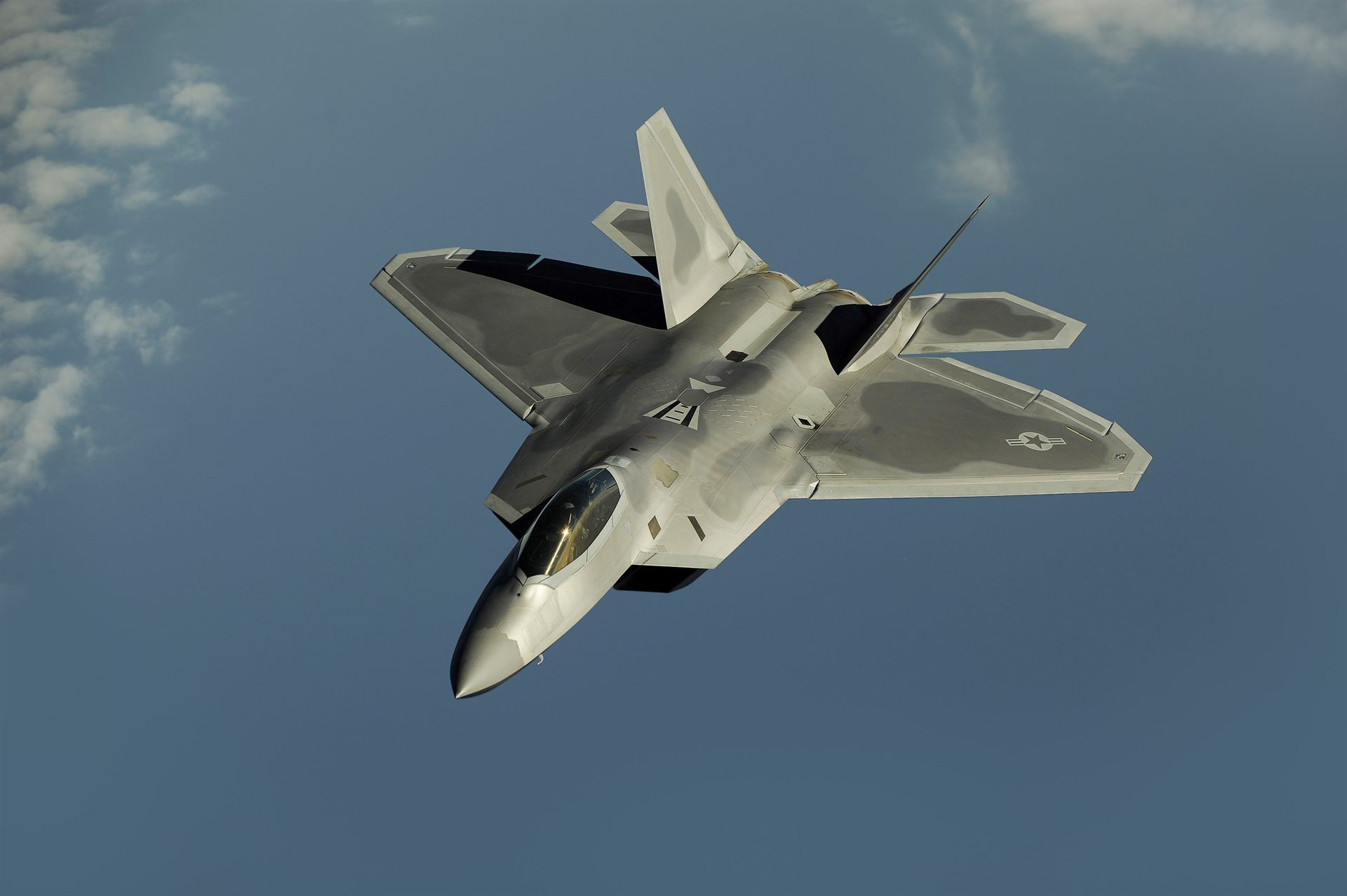
Pictured: a U.S. Air Force F-22 Raptor, the same type of aircraft that fired the AIM-9X Sidewinder missile which destroyed the unidentified object over the Yukon Territory on February 11, 2023. This is not the object itself. The only image of the object ever released — a single grainy, low-resolution photograph the Canadian government disclosed in September 2024 under Access to Information requests — remains too indistinct to reproduce meaningfully, and no clearer photograph has ever been made public; the object's wreckage was never recovered from the Yukon wilderness.
Theoretical Alignment
The Yukon object's characteristics — slow speed, high altitude, lack of propulsion system, cylindrical shape — align most strongly with a conventional balloon hypothesis (commercial, research, or hobbyist). However, the complete absence of recovered wreckage, the failure of the intelligence community to provide a definitive identification, and the NORAD commander's refusal to rule out any explanation leave the case formally unresolved. Foreign surveillance cannot be entirely discounted given the geopolitical context of the Chinese balloon incursion.
Background
The Yukon UAP shootdown occurred during the most intense week of military aerial engagement over North American airspace since the end of the Cold War. The sequence began on January 28, 2023, when a massive high-altitude balloon — later confirmed to be a Chinese People's Liberation Army surveillance platform — was detected entering U.S. airspace over Alaska after drifting from the Pacific. The balloon, estimated to be approximately 200 feet tall with a payload the size of three school buses, transited across the entirety of the continental United States before being shot down on February 4, 2023, by an F-22 Raptor off the coast of Myrtle Beach, South Carolina, using an AIM-9X Sidewinder missile. The Navy subsequently recovered the balloon's surveillance payload from the Atlantic seabed, confirming it carried solar-powered sensors, multiple antennas, and intelligence-collection equipment linked to the PLA.
The political fallout was enormous. Secretary of State Antony Blinken cancelled a planned diplomatic trip to Beijing. Congressional leaders from both parties demanded explanations for how a surveillance platform had traversed U.S. sovereign airspace for nearly a week before being engaged. The Pentagon came under immense pressure to demonstrate that it was capable of detecting and neutralizing threats in the high-altitude domain.
In direct response, NORAD took the unprecedented step of recalibrating its ground-based radar networks. Normally, NORAD radar employs “velocity gates” — filters that exclude slow-moving objects from the operational picture to reduce clutter from weather systems, birds, and other benign aerial phenomena. General VanHerck acknowledged that these filters had inadvertently created a “domain awareness gap” that allowed balloon-type objects to transit North American airspace undetected. By lowering the velocity thresholds, NORAD's radar screens suddenly lit up with objects that had likely been present but invisible to the defense system for years. It was in this newly recalibrated environment that the three subsequent unidentified objects were detected over Alaska, the Yukon, and Lake Huron in rapid succession.
The political and military context is essential to understanding the Yukon shootdown. The Biden administration was under extraordinary domestic pressure to appear decisive on airspace defense. Congressional leaders were demanding action. The public was alarmed by the spectacle of a Chinese surveillance balloon floating undisturbed across the country for days. In this atmosphere, any unidentified radar return at high altitude became a potential threat — and the political calculus favored engagement over caution. This context does not necessarily mean the objects were benign; it does mean that the decision threshold for lethal force had been dramatically lowered compared to normal peacetime operations.
Complete Timeline
| Date | Event |
|---|---|
| Jan 28, 2023 | Chinese Surveillance Balloon Detected. NORAD detects a large high-altitude balloon entering U.S. airspace near the Aleutian Islands, Alaska. The object is tracked but not immediately engaged, generating significant controversy. |
| Feb 1–3, 2023 | Balloon Transits Continental U.S. The Chinese balloon crosses Montana (home to nuclear ICBM silos), prompting military airspace closures. The Biden administration decides to wait until the balloon is over water before engagement to prevent civilian casualties from falling debris. |
| Feb 4, 2023 | Chinese Balloon Shot Down. An F-22 from the 1st Fighter Wing fires an AIM-9X Sidewinder missile at the balloon off the coast of Myrtle Beach, South Carolina, at approximately 58,000 feet. Navy divers recover the payload from the Atlantic seabed. |
| Feb 4–9, 2023 | NORAD Radar Recalibration. Under pressure from Congress and the White House, NORAD adjusts its radar velocity gates to detect slower-moving, smaller objects at high altitude. General VanHerck acknowledges a “domain awareness gap” in prior radar filtering. New objects begin appearing on radar screens across North America. |
| Feb 10, 2023 | Alaska Object Shootdown. An unidentified object, described as roughly the size of a small car and flying at approximately 40,000 feet, is detected by NORAD over Alaska. An F-22 Raptor from Joint Base Elmendorf-Richardson shoots it down over the frozen Beaufort Sea near Deadhorse, Alaska, using an AIM-9X Sidewinder. President Biden authorizes the engagement. Recovery teams are dispatched but find no debris. |
| Feb 11, 2023 (AM) | Object Detected Over Alaska. NORAD radar detects a second unidentified object in U.S. airspace near Alaska. Two F-22 Raptors from JBER are scrambled to intercept and shadow the object. Pilots report a cylindrical shape, roughly the size of a small car, with a metallic upper section and a white lower section. A 20-foot wire or tether with a suspended payload is observed hanging beneath the object. |
| Feb 11, 2023 (midday) | Object Crosses Into Canadian Airspace. The object drifts from U.S. airspace into Canadian sovereign territory over the Yukon Territory. Royal Canadian Air Force CF-18 Hornet fighters and a CP-140 Aurora maritime patrol aircraft scramble from Canadian bases to join the intercept formation. |
| Feb 11, 2023 (afternoon) | Trudeau & Biden Authorize Shootdown. Prime Minister Justin Trudeau and President Joe Biden communicate directly. Both leaders authorize the engagement of the object. The decision is made jointly, described as taken “out of an abundance of caution and at the recommendation of their militaries.” |
| Feb 11, 2023 (3:41 PM EST) | Object Destroyed. A USAF F-22 Raptor fires an AIM-9X Sidewinder heat-seeking missile, striking and destroying the object over the Yukon Territory. Debris falls into remote, mountainous wilderness blanketed in deep snow. |
| Feb 11–17, 2023 | Canadian Forces Recovery Operation. Canadian Armed Forces personnel deploy to the estimated impact zone in the Yukon wilderness. Search teams face extreme cold (below -30°C), deep snow, limited daylight, and roadless terrain. Helicopter access is intermittent due to weather. No wreckage is located. |
| Feb 12, 2023 | Lake Huron Object Shootdown. A third unidentified object, described as octagonal, is detected over Montana and tracked as it moves east. A U.S. Air National Guard F-16 from the 148th Fighter Wing shoots it down over Lake Huron using an AIM-9X Sidewinder. Recovery operations are launched but initially find no debris. |
| Feb 12, 2023 | VanHerck Press Conference. At a Pentagon press briefing, General Glen VanHerck, Commander of NORAD and U.S. Northern Command, is asked whether he has ruled out an extraterrestrial origin for the unidentified objects. He responds: “I’ll let the intel community and the counterintelligence community figure that out. I haven’t ruled out anything at this point.” The statement generates global headlines and intensifies public speculation. |
| Feb 13, 2023 | White House Walks Back ET Speculation. White House Press Secretary Karine Jean-Pierre states explicitly: “There is no indication of aliens or extraterrestrial activity with these recent takedowns.” National Security Council spokesman John Kirby provides additional briefings emphasizing no foreign intelligence collection capabilities were observed. |
| Feb 14, 2023 | Pico Balloon Speculation Emerges. The Northern Illinois Bottlecap Balloon Brigade (NIBBB), an amateur radio hobbyist group, reports that its pico balloon K9YO-15 — a small silver Mylar balloon approximately 32 inches in diameter carrying a 10-gram payload — went “missing in action” on February 11. The balloon had been aloft for 123 days, was on its seventh circumnavigation of the globe, and last transmitted near Hagemeister Island, Alaska, at 00:48 UTC on February 11. Weather models suggest the balloon’s trajectory would have placed it over the Yukon at the approximate time of the shootdown. |
| Feb 16, 2023 | Biden Presidential Address. President Biden delivers a formal address stating the intelligence community’s assessment is that the three non-balloon objects were “most likely balloons tied to private companies, recreation, or research institutions.” He asserts: “There is no — let me say this again — no indication of aliens or extraterrestrial activity.” He makes no apology for ordering the shootdowns, citing civilian aviation safety. |
| Feb 17, 2023 | Yukon Recovery Called Off. Canadian Forces officially suspend their search and recovery operation in the Yukon, citing extreme weather, rugged terrain, and the inability to locate any debris. |
| Feb–Mar, 2023 | Congressional Briefings. The Biden administration provides classified briefings to the Senate Armed Services Committee and other congressional committees. Lawmakers from both parties express frustration at the lack of definitive identification and the failure to recover debris. |
| Mar 2023 | Lake Huron Debris Discovered (disclosed Nov 2024). Canadian officials quietly recover debris from the shores of Lake Huron. Documents later suggest this may have been a module from a weather monitoring equipment company, though officials could not definitively confirm it was from the object that was shot down. |
| Sept 2024 | Canadian Government Releases Image. Through Access to Information requests, the Canadian government releases a single grainy, low-resolution image of the Yukon object (designated “UAP 23”) captured during the intercept, along with partially redacted emails. The image shows a small, indistinct shape but provides insufficient detail for conclusive identification. |
| May 2026 | Pentagon Declassifies Footage. The Pentagon releases newly declassified footage of the February 2023 aerial engagements as part of its ongoing UAP reporting initiative, including video of at least one of the shootdowns. The footage does not resolve the identification of the objects. |
The Object
The object shot down over the Yukon was described by military officials and pilots as a small, cylindrical airborne object, roughly the size of a small car. F-22 pilots who visually inspected the object during the intercept reported that it had a metallic upper portion and a white lower section. A notable feature was a 20-foot wire or tether with a suspended package hanging beneath the main body, suggesting either a sensor payload, a communications relay, or a scientific instrument package.
Officials consistently described the object as lacking any visible propulsion system. It was not self-propelled in any recognizable sense — no jet exhaust, no propeller, no rotary system. The object appeared to be moving at high altitude with the prevailing winds, which is consistent with balloon-type behavior. However, officials at the time were careful not to call it a “balloon.” General VanHerck specifically stated: “I’m not going to categorize them as balloons. We’re calling them objects for a reason. I am not able to categorize how they stay aloft. It could be a gaseous type of balloon inside a structure, or it could be some type of a propulsion system. But clearly, they’re able to stay aloft.”
The object was flying at an altitude that posed a potential risk to civilian commercial aviation, which was one of the primary justifications given for the shootdown. The exact altitude has not been officially disclosed but has been reported in multiple sources as being in the range of 40,000 feet, well within the flight levels used by commercial airliners on transatlantic and transpolar routes that frequently cross Canadian Arctic airspace.
The fact that the AIM-9X Sidewinder — an infrared-guided, heat-seeking missile — successfully tracked and destroyed the object is significant. The AIM-9X requires a thermal signature to lock onto its target. This means the object was emitting detectable heat, which could come from solar-heated surfaces, electronic equipment, or some other thermal source. A simple Mylar pico balloon would present a very small thermal cross-section, raising questions about whether the Yukon object was truly as small and simple as a hobbyist balloon.
The Pico Balloon Hypothesis
One of the most discussed theories is that the Yukon object may have been a pico balloon launched by the Northern Illinois Bottlecap Balloon Brigade (NIBBB), an amateur radio hobbyist group. The group's balloon, designated K9YO-15, was a small silver Mylar balloon approximately 32 inches in diameter carrying a solar-powered WSPR (Weak Signal Propagation Reporter) transmitter weighing approximately 10–11 grams. The balloon had been aloft for 123 days and was on its seventh circumnavigation of the globe when its last transmission was received near Hagemeister Island, Alaska, at 00:48 UTC on February 11, 2023.
Weather forecasting models and trajectory analysis suggested the balloon's flight path would have placed it over the Yukon Territory at approximately the time of the shootdown. The NIBBB publicly noted the coincidence but was careful to state that without recovered wreckage, there was no factual evidence to confirm their balloon was the object that was destroyed. The U.S. military has never confirmed or denied whether the object was K9YO-15 or any other pico balloon.
Critics of the pico balloon theory note several discrepancies. The object was described by F-22 pilots as having a metallic upper section, a white lower section, and a 20-foot tether with a suspended payload — a description that does not closely match a 32-inch Mylar party-balloon-sized object carrying a 10-gram transmitter. The AIM-9X missile that destroyed the object costs approximately $400,000, and the F-22 Raptor costs approximately $36,000 per flight hour to operate. If the military engaged a $12 hobbyist balloon with a $400,000 missile, the operational implications for NORAD's threat assessment protocols would be significant. However, the most parsimonious explanation — that NORAD's newly recalibrated radar detected a small, slow-moving object that would normally have been filtered out, and a heightened threat environment led to its engagement — remains plausible.
The Military Response
NORAD Intercept Operations
The intercept of the Yukon object represents a case study in binational military cooperation under the NORAD framework. NORAD — the North American Aerospace Defense Command — is a jointly operated U.S.-Canadian military organization headquartered at Peterson Space Force Base in Colorado Springs. It maintains continuous aerospace surveillance of North American airspace using a network of ground-based radar systems, satellite feeds, and airborne early warning aircraft.
When the object was first detected over Alaska, the response was immediate. Two F-22 Raptors from the 3rd Wing at Joint Base Elmendorf-Richardson were scrambled to intercept. The F-22 is the United States Air Force's premier air superiority fighter, equipped with advanced radar, electro-optical sensors, and infrared search-and-track systems. The pilots were tasked with visually identifying the object, assessing whether it posed a threat, and shadowing it as it crossed international boundaries.
As the object drifted from U.S. airspace into Canadian sovereign territory, the operation transitioned from a purely American response to a binational NORAD mission. The Royal Canadian Air Force scrambled CF-18 Hornet fighters and deployed a CP-140 Aurora maritime patrol aircraft. The CP-140 is a modified P-3 Orion equipped with advanced sensors for maritime and overland surveillance, providing additional sensor coverage of the object's trajectory and the eventual debris field.
The engagement was authorized through the highest levels of both governments. Prime Minister Trudeau and President Biden spoke directly by phone before both authorized the use of force. The White House later stated the decision was made “out of an abundance of caution and at the recommendation of their militaries.” At 3:41 PM EST on February 11, the F-22 fired an AIM-9X Sidewinder missile, which tracked the object's thermal signature and destroyed it over the Yukon wilderness.
Recovery Failure
The failure to recover any wreckage from the Yukon shootdown is perhaps the most significant aspect of the case. Canadian Armed Forces search teams were deployed to the estimated impact area within hours, but faced conditions that made a successful ground search nearly impossible. Temperatures in the Yukon in mid-February routinely drop below -40°C. The terrain is mountainous, heavily forested, and covered in meters of snow. There are no roads in the impact area. Helicopter access was severely limited by weather windows, and the short daylight hours (approximately six hours per day at that latitude in February) further compressed search operations.
The search was officially called off on February 17, 2023 — just six days after the shootdown. Canadian military officials cited the extreme conditions and the inability to locate any debris as the reasons for suspension. No recovery effort has been publicly announced since. This means that whatever the object was — a pico balloon, a research platform, a foreign surveillance device, or something else entirely — its physical remains are presumably still scattered somewhere in the Yukon wilderness, buried under snow and inaccessible in one of the most remote landscapes on Earth.
The failure to recover debris is not unique to the Yukon incident. The object shot down over Alaska on February 10 also yielded no recovered wreckage, despite searches over the frozen Beaufort Sea. Only the Chinese surveillance balloon (February 4) and possibly the Lake Huron object (February 12, debris found in March 2023 but not definitively linked) produced any physical material for analysis.
Political Fallout and Policy Reform
The February 2023 North American shootdowns triggered a cascade of political and policy consequences that continue to reshape the U.S. government's approach to airspace security and UAP identification. The most immediate consequence was the dramatic exposure of what General VanHerck called a “domain awareness gap” — the revelation that NORAD's radar systems had been inadvertently filtering out slow-moving, small objects for years, potentially allowing hundreds of unidentified aerial platforms to transit North American airspace completely undetected. The admission that the most sophisticated aerospace defense system in human history had a systematic blind spot for an entire category of objects prompted immediate operational changes and a broader strategic review of airspace monitoring capabilities.
Congress responded with multiple legislative initiatives. The Senate Armed Services Committee held classified briefings attended by senior officials from NORAD, the Pentagon, and the intelligence community. Both parties in Congress expressed frustration with the lack of definitive identification of the three non-balloon objects and with the apparent failure of existing protocols to prevent the incursions in the first place. Senator Marco Rubio, the ranking member of the Senate Intelligence Committee, stated publicly that the government’s handling of the February 2023 events was “inadequate” and called for a comprehensive review of airspace identification and response protocols. Senator Kirsten Gillibrand, a key architect of earlier UAP legislation, cited the February 2023 events as evidence that the UAP Disclosure Act she had co-sponsored was urgently needed.
The shootdowns also prompted urgent diplomatic activity. U.S. officials contacted counterparts in Canada, the United Kingdom, Australia, and other Five Eyes partners to determine whether any of those nations had launched or tracked the three non-balloon objects. None of the partner nations claimed the objects. The FAA issued new guidance to commercial operators regarding reporting protocols for unusual aerial contacts. The Transportation Security Administration reviewed its procedures for airspace anomaly documentation. These bureaucratic responses, taken together, represent an institutional acknowledgment that the February 2023 events revealed genuine systemic gaps in the U.S. government's ability to identify and respond to anomalous aerial objects.
Key Witnesses
General Glen VanHerck
As NORAD commander, VanHerck was the senior military officer responsible for the detection, tracking, and engagement of all four objects in the February 2023 shootdown series. During a Pentagon press briefing on February 12, 2023, he made the statement that launched a global media frenzy: “I’ll let the intel community and the counterintelligence community figure that out. I haven’t ruled out anything at this point.” He also explained the radar recalibration that led to the detection of the three non-balloon objects, acknowledging a “domain awareness gap” in prior NORAD capabilities. VanHerck was a four-star general with decades of operational command experience. His refusal to categorically exclude any possibility — including extraterrestrial origin — was widely interpreted as either remarkable candor from a senior military official or a carefully measured non-denial designed to avoid making statements that could later prove false. He declined to call the objects “balloons,” insisting on the term “objects” because their means of propulsion and method of staying aloft had not been determined.
Prime Minister Justin Trudeau
Trudeau personally authorized the shootdown of the Yukon object and announced the decision publicly. He stated: “I ordered the take down of an unidentified object that violated Canadian airspace.” His authorization was significant because the engagement was carried out by a U.S. military aircraft (an F-22 Raptor) firing a weapon over Canadian sovereign territory — an extraordinary act of binational military coordination that required explicit authorization from both heads of state. Trudeau was briefed by Canadian military and intelligence officials prior to making the decision and coordinated directly with President Biden by phone.
President Joe Biden
Biden authorized the U.S. F-22 to engage the object over Canadian airspace after coordinating with Trudeau. On February 16, 2023, he delivered a formal presidential address in which he stated the intelligence community's assessment that the three non-balloon objects were “most likely balloons tied to private companies, recreation, or research institutions.” He explicitly stated: “There is no — let me say this again — no indication of aliens or extraterrestrial activity.” Biden defended the shootdown decisions, saying he made “no apologies” for prioritizing the safety of the American people and aviation security. He also announced the creation of an interagency team to establish clearer protocols for detecting, analyzing, and disposing of unidentified objects.
John Kirby
Kirby served as the primary government spokesperson throughout the February 2023 shootdown series. A retired Navy Rear Admiral, he provided detailed briefings from the White House podium on the characteristics of each object, the decision-making process behind each engagement, and the status of recovery operations. Kirby was careful in his language, emphasizing that the objects posed “a reasonable threat to the safety of civilian flight” while avoiding definitive identification statements. He stated the administration had no intelligence suggesting the objects were related to Chinese surveillance or any foreign intelligence effort beyond the initial February 4 balloon.
Karine Jean-Pierre
Jean-Pierre delivered the White House's most definitive statement against extraterrestrial speculation, explicitly stating: “There is no indication of aliens or extraterrestrial activity with these recent takedowns.” Her statement came in direct response to General VanHerck's “I haven’t ruled out anything” comment, which had generated massive media coverage and public speculation. Her intervention represented a deliberate White House effort to control the narrative and reduce public anxiety about the unidentified objects.
The Five Observables Assessment
The Five Observables framework, developed by former AATIP director Luis Elizondo, is used to classify UAP encounters based on performance characteristics that exceed known technology:
Assessment: The Yukon object displayed none of the anomalous performance characteristics associated with “true” UAP encounters. It was slow-moving, wind-borne, and presented no evidence of instantaneous acceleration, hypersonic velocity, anti-gravity propulsion, or trans-medium travel. The only observable that receives even a speculative rating is Low Observability: the object was not detected by NORAD's standard radar configuration and only appeared after the velocity gates were specifically recalibrated to detect slower, smaller objects. This suggests the object had a low radar cross-section, though this is easily explained by small physical size rather than any active stealth capability. The Five Observables framework is most meaningfully applied to cases involving extraordinary flight performance, such as the USS Nimitz encounter. The Yukon object does not exhibit the characteristics of an anomalous craft and is far more consistent with a balloon or passive atmospheric platform. Its significance lies not in its performance characteristics but in the failure to identify and recover it, and in the extraordinary military and political response it provoked.
Evidence Assessment
Supporting Genuinely Unidentified Status
- Object detected by military-grade radar, visually confirmed by F-22 pilots, and destroyed by guided missile — it was unquestionably real
- No wreckage recovered despite six days of Canadian Forces search operations
- No government agency has ever definitively identified the object
- NORAD Commander VanHerck explicitly refused to exclude extraterrestrial origin
- AARO stated objects were “likely benign” but provided no proof of identification
- Pilot descriptions of size and tethered payload are inconsistent with the pico balloon hypothesis
- September 2024 declassified image is inconclusive and of insufficient quality for identification
- The complete absence of recovered material means no hypothesis can be confirmed or falsified
- The object was operating at commercial aviation altitudes, posing genuine safety risks
Supporting Mundane Explanation
- Object flight characteristics (slow, wind-borne, high altitude, no propulsion) are entirely consistent with a balloon
- NORAD radar recalibration specifically designed to detect the class of object engaged — these objects were always there, just undetected
- A known hobbyist pico balloon (K9YO-15) went silent on the same date along a matching trajectory
- The political environment demanded decisive action; the shootdown may have been disproportionate to the actual threat
- Biden administration's intelligence assessment concluded the objects were “most likely” commercial/research balloons
- White House explicitly stated “no indication of aliens or extraterrestrial activity”
- Recovery failure is readily explained by extreme Arctic conditions, not by any anomalous properties of the object
- No anomalous performance characteristics observed at any point during tracking or engagement
- Similar objects have been detected around the world as atmospheric monitoring balloon programs are catalogued
Why “Pending”
The Yukon UAP Shootdown receives a PENDING classification because the object remains officially unidentified. Despite the Biden administration's assessment that the three non-balloon objects were “most likely” commercial or research balloons, this assessment was never substantiated with physical evidence, recovered material, or a definitive identification linking the Yukon object to any specific balloon program, research institution, or commercial operator. The NORAD commander's refusal to rule out any explanation — including extraterrestrial origin — further underscores the genuinely unresolved nature of the case.
The Yukon incident sits in an unusual analytical position. The object displayed no anomalous performance characteristics and its flight behavior was entirely consistent with a balloon-type platform. On this basis alone, the case would merit a classification of “LIKELY CONVENTIONAL.” However, the total absence of recovered wreckage, the failure of any entity to claim ownership, the government's inability to provide definitive identification despite deploying the most advanced military sensors in the world, and the formal refusal of the senior responsible military commander to exclude any hypothesis — these factors together prevent a definitive conventional classification. The case will remain PENDING until either wreckage is recovered and analyzed, a balloon operator provides verifiable evidence of ownership, or a government investigation produces a conclusive identification. None of these things appears likely to happen.
The broader significance of the Yukon shootdown extends beyond the identity of any single object. The February 2023 series exposed fundamental vulnerabilities in North American airspace defense: NORAD's radar systems had been unintentionally blind to an entire class of airborne objects for decades. The political and military response — four shootdowns in eight days, including the use of $400,000 missiles against objects that may have been hobbyist balloons — raised serious questions about proportionality, threat assessment protocols, and the interface between political pressure and military decision-making. The incident also demonstrated that in the post-2017 UAP disclosure era, even routine (or potentially routine) aerial objects can trigger extraordinary military, political, and public responses when they cannot be immediately identified.
Sensor & Instrumentation Detection Profile
NORAD ground-based radar networks first detected the object as it entered U.S. airspace near Alaska. Two F-22 Raptors from Joint Base Elmendorf-Richardson (JBER) were scrambled to visually identify and shadow the object. As it crossed into Canadian airspace, Royal Canadian Air Force CF-18 Hornet fighters and a CP-140 Aurora maritime patrol aircraft joined the intercept formation. The object was tracked continuously by NORAD's integrated radar system until an AIM-9X Sidewinder infrared-guided missile achieved a direct hit. The AIM-9X is a heat-seeking weapon, confirming the object presented a sufficient thermal signature for engagement. NORAD had recently recalibrated its radar velocity gates — filters normally designed to exclude slow-moving clutter — in the wake of the Chinese spy balloon incursion, which is why the object was detected at all. Prior to this recalibration, NORAD acknowledged a “domain awareness gap” that had allowed similar objects to transit North American airspace undetected for years.
Environmental & Geospatial Context
The shootdown occurred over the Yukon Territory, one of the most remote and inhospitable regions of North America. February in the Yukon brings extreme cold (temperatures well below -30°C), limited daylight hours (approximately six hours per day at that latitude), deep snow cover, and rugged mountainous terrain. These conditions made any ground-based recovery operation extraordinarily challenging. The wreckage zone was estimated from the radar track and missile impact data but was located in dense, roadless wilderness far from any settlement. Canadian Forces search and recovery teams deployed to the area faced whiteout conditions, limited helicopter access windows, and terrain that made ground search operations dangerous and largely ineffective.
Observer Credibility & Occupational Profile
The primary observers in this case are among the most credible possible: NORAD radar operators operating military-grade surveillance systems, USAF F-22 pilots with visual confirmation of the object, RCAF CF-18 pilots who joined the intercept, and senior military leadership including General Glen VanHerck (NORAD/USNORTHCOM Commander). Political authorization came from Prime Minister Trudeau and President Biden, both of whom received classified intelligence briefings before authorizing lethal force. National Security Council spokesman John Kirby served as the primary government spokesperson throughout the incident.
Physical & Material Assays
No physical material from the Yukon object has ever been recovered or analyzed. Canadian Forces search teams deployed to the estimated impact zone were unable to locate any debris before the search was called off on February 17, 2023. In September 2024, the Canadian government released a single grainy, low-resolution image of the object (designated “UAP 23”) captured during the intercept, along with partially redacted emails related to the incident. The image shows a small, indistinct shape but provides insufficient detail for meaningful analysis. Without physical wreckage, no metallurgical, isotopic, or compositional analysis has been or can be performed. The absence of material evidence is the central frustration of this case: the object was positively tracked by radar, visually confirmed by fighter pilots, destroyed by a guided missile, and yet produced no recoverable physical evidence.
Historical Precedents & Archive Matches
The Yukon shootdown is directly connected to three other incidents in a single week: the Chinese surveillance balloon shot down on February 4, 2023, over South Carolina; an unidentified object shot down over the Beaufort Sea near Deadhorse, Alaska, on February 10; and an octagonal object shot down over Lake Huron on February 12. This cluster of military engagements against airborne objects over North American airspace is unprecedented in modern history. The only historical parallel is the Battle of Los Angeles (February 25, 1942), when anti-aircraft batteries fired over 1,400 rounds at unidentified objects over the city, though that event involved no confirmed hits or recovered material either. The February 2023 shootdowns also intersect with the broader post-2017 UAP disclosure timeline, occurring just months before David Grusch’s historic whistleblower testimony to Congress in July 2023.
The Cold War Precedent: Operation Mainbrace and the Radar Era
To fully appreciate the significance of the 2023 North American shootdowns, it is necessary to situate them within the long history of military encounters with unidentified aerial objects over sovereign airspace. In September 1952, NATO conducted Operation Mainbrace — one of the largest Cold War naval exercises in history — during which dozens of military personnel from multiple nations reported UFO encounters over the North Sea and Scandinavia. In one incident, a spherical, metallic object was observed by pilots from a British aircraft carrier and photographed. The British Air Ministry’s report concluded the objects were “not aircraft of any known kind.” The episode established a pattern that would recur for the next seven decades: structured objects of unknown origin appearing in militarily sensitive environments, observed by trained military witnesses, and then classified or quietly set aside.
The 1976 Tehran UFO incident offers one of the most directly comparable precedents. An Iranian Air Force F-4 Phantom scrambled to intercept a bright, maneuvering object over Tehran and twice experienced complete electronic failure of its weapons systems when attempting to fire. Radar contacts were confirmed, multiple pilots reported visual observations, and a Defense Intelligence Agency report rated the case as “outstanding.” Like the Yukon object, no physical evidence was recovered. Like the Yukon case, the DIA report acknowledged the object was real but could not identify it. The Iran incident showed that military aircraft could intercept UAP and have their weapons systems neutralized — a qualitatively different encounter than what occurred over the Yukon, where no anomalous system effects were reported, but the structural parallel of “confirmed real, never identified, no physical evidence” is directly applicable.
The Post-2017 UAP Disclosure Context
The December 2017 publication of the New York Times investigation into the Advanced Aerospace Threat Identification Program (AATIP) fundamentally changed the public and institutional framework surrounding UAP reports. For the first time in decades, serious mainstream journalists, members of Congress, and senior military officials were openly discussing the possibility that some unidentified aerial objects might represent genuine anomalies beyond the capabilities of any known nation-state. The U.S. Navy subsequently authenticated videos from the USS Nimitz (2004), USS Theodore Roosevelt (2014–2015), and USS Omaha (2019), acknowledging that these objects were “unexplained aerial phenomena.”
By 2021, the Director of National Intelligence had delivered a preliminary UAP assessment to Congress that acknowledged 143 cases that could not be explained, with 18 demonstrating what appeared to be unusual flight capabilities. In 2022, NASA convened an independent study team to assess UAP data collection methodologies. In 2023, the All-domain Anomaly Resolution Office (AARO) was formally established to coordinate UAP reporting across all military branches and intelligence agencies. The Yukon shootdown occurred squarely in the middle of this unprecedented institutional opening — at a moment when the government’s stated posture was one of serious investigation rather than dismissal.
This context matters enormously for interpreting the events of February 2023. When NORAD General VanHerck refused to rule out extraterrestrial origin, he was not speaking in a vacuum. He was speaking as the senior military commander responsible for North American air defense, in an institutional environment where the highest levels of government had explicitly acknowledged that some aerial objects remain genuinely unexplained. His statement was not speculation; it was a formal acknowledgment of the limits of available information.
Airspace Law and the Right to Shoot Down
The Yukon shootdown also raises important questions of international airspace law. Under the Chicago Convention on International Civil Aviation (1944) — to which both the United States and Canada are signatories — sovereign nations have complete and exclusive sovereignty over airspace above their territory. However, the use of lethal force to destroy an unidentified airborne object in peacetime is governed by a complex mix of customary international law, bilateral defense agreements, and domestic military rules of engagement. The NORAD Agreement between the United States and Canada, originally signed in 1958 and subsequently renewed and updated multiple times, authorizes joint air defense operations over both nations’ sovereign airspace. The February 2023 shootdowns were conducted under this joint framework, with each nation authorizing the engagement of objects in its own airspace. The use of an AIM-9X Sidewinder — a $400,000 heat-seeking missile — against what may have been a hobby balloon raised immediate questions about proportionality and the legal framework for such engagements going forward.
After the February 2023 incidents, both governments and NORAD undertook internal reviews of their rules of engagement for unidentified objects in sovereign airspace. The result was a more formalized threat assessment protocol that established multiple criteria an object must meet before a shootdown would be authorized. These criteria include flight altitude, radar cross-section characteristics, flight trajectory in relation to sensitive sites, and the ability to identify the object through any available means. The Yukon object apparently met the threshold for engagement under the post-Chinese-balloon framework, where extreme political sensitivity had dramatically lowered the bar for action.
The All-Domain Anomaly Resolution Office (AARO) and Institutional Response
In the immediate aftermath of the February 2023 shootdowns, the All-domain Anomaly Resolution Office assumed coordination responsibility for assessing the unidentified objects. AARO, established by the NDAA for FY2022 and operationalized under the direction of Dr. Sean Kirkpatrick, conducted classified reviews of radar data, pilot sensor imagery, and signals intelligence from all four incidents. AARO’s publicly stated conclusion — that the three non-balloon objects were “likely benign” — was notable for what it did not say. It did not say “we have identified these objects.” It did not name a specific balloon program, company, or research institution responsible for any of the three objects. “Likely benign” is a threat characterization, not an identification, and it leaves the fundamental question of “what were these objects?” entirely unanswered.
The Canadian government’s response to Access to Information requests about the Yukon incident was similarly revealing in its non-answers. The September 2024 release of a single grainy image and partially redacted emails confirmed that the Canadian military had been extensively involved in analyzing the event but had reached no conclusive identification. The emails, though heavily redacted, indicated that multiple Canadian agencies — including the Department of National Defence and Transport Canada — had engaged in serious discussions about the identity and origin of the object. The conclusion, as of the most recent public disclosures, is that the Yukon object remains formally unidentified by any government agency that has officially examined the evidence.
Material Analysis
The material analysis of the Yukon object is, by necessity, entirely theoretical. No physical material has ever been recovered from the shootdown site, making this one of the most unusual cases in UAP history: an object confirmed real by multi-sensor military detection, visually inspected by the most advanced fighter pilots in the world, destroyed with a guided missile, and yet producing zero physical evidence for scientific examination.
What the Sensor Data Tells Us
The available sensor data provides indirect information about the object's composition. The fact that it was detected by NORAD ground radar after velocity gate recalibration suggests a radar cross-section larger than typical weather clutter but smaller than a conventional aircraft. The AIM-9X Sidewinder's successful lock and engagement confirms a measurable infrared signature, indicating the object was either solar-heated, electronically powered, or both. The pilots' visual description of a metallic upper section and white lower section is consistent with a reflective metallic envelope (potentially Mylar or aluminum) with a lighter-colored lower structure.
The 20-Foot Tether Problem
The most intriguing physical characteristic reported was the 20-foot wire or tether with a suspended package. This description is inconsistent with a simple pico balloon (which carries a payload weighing grams attached directly to the balloon envelope) but is consistent with larger research balloons, radiosonde payloads, or scientific instrument packages. Tethered payload configurations are common in meteorological, atmospheric research, and military reconnaissance balloon systems. Without recovered material, it is impossible to determine whether the payload was a scientific instrument, a communications relay, an intelligence collection package, or something else entirely.
Supporting Anomalous / Unknown Origin
- Zero wreckage recovered despite extensive military search operations
- Object described as having a 20-foot tethered payload — inconsistent with a simple pico balloon
- NORAD commander refused to rule out any explanation, including extraterrestrial
- No definitive identification ever established by any government agency
- Object presented sufficient thermal signature for AIM-9X lock, suggesting active electronics or significant solar heating
Supporting Conventional / Terrestrial Origin
- Object behavior (slow, wind-borne, high altitude) entirely consistent with balloon-type platform
- NIBBB pico balloon K9YO-15 went missing on the same date along a trajectory consistent with the Yukon shootdown location
- NORAD detected the object only after radar recalibration specifically designed to find small, slow objects
- President Biden stated intelligence assessment was “most likely balloons tied to private companies, recreation, or research institutions”
- No anomalous flight characteristics observed; no performance beyond known technology
- Political pressure to act decisively after Chinese balloon embarrassment explains the unprecedented use of lethal force
Conventional Explanation Candidates
Three conventional explanations have been proposed for the Yukon object. Each must be evaluated on its merits and its limitations:
Hobbyist Pico Balloon (NIBBB K9YO-15)
PlausibleThe strongest specific conventional candidate is the K9YO-15 pico balloon launched by the Northern Illinois Bottlecap Balloon Brigade. The timing and trajectory are compelling: the balloon went silent on February 11, its predicted path crossed the Yukon, and the general description of a small metallic balloon is broadly consistent. However, the pilots' description of a “car-sized” object with a metallic upper section, white lower section, and 20-foot tether does not closely match a 32-inch Mylar balloon carrying a 10-gram transmitter. If the object was K9YO-15, the pilot descriptions would represent significant overestimation of size and structural complexity, which is possible but notable. The timing and trajectory match, but physical description discrepancies remain unresolved.
Commercial or Research Balloon
Highly PlausibleA larger commercial weather balloon, atmospheric research platform, or scientific balloon payload is consistent with all described characteristics: cylindrical shape, metallic and white coloring, tethered instrument payload, high-altitude operation, wind-driven trajectory. Numerous organizations launch such balloons routinely, including NOAA, university research programs, and private meteorological companies. No organization has publicly claimed ownership of the Yukon object, but this is not unusual — many research balloon programs are operated internationally, and a balloon drifting at high altitude for days or weeks could originate from virtually anywhere on the globe. This is the best match for the physical description; no ownership claim is the primary weakness.
Foreign Surveillance Device
Low But Not ExcludedGiven the confirmed Chinese surveillance balloon program and the geopolitical context, the possibility that the Yukon object was a foreign intelligence collection platform cannot be entirely excluded. China's balloon surveillance program was subsequently revealed to have been far more extensive than initially known, with operations spanning five continents. However, the Biden administration explicitly stated that the three non-balloon objects showed no evidence of intelligence collection capabilities, and the object's apparent lack of powered flight or maneuvering capability makes it a poor candidate for a sophisticated surveillance platform. There is no evidence of intelligence collection capabilities, though the geopolitical context makes it a background possibility.
Related Cases
Confirmed Documents & Official Records
Presidential address characterizing the three non-balloon objects as “most likely balloons tied to private companies, recreation, or research institutions.”
PUBLIC RECORDAARO's ongoing mission to resolve UAP reports, including assessments of the February 2023 shootdown series. The office has characterized many UAP reports as benign objects including balloons and drones.
OFFICIALSearch Government Archives Directly
Further Reading — Recommended Literature
Imminent: Inside the Pentagon's Hunt for UFOs
Former AATIP director's memoir covering the government's UAP investigation programs and the political dynamics of disclosure, including the February 2023 context.
UFO: The Inside Story of the US Government's Search for Alien Life Here—and Out There
Comprehensive history of the U.S. government's UAP investigations, providing essential context for the institutional dynamics behind the February 2023 shootdowns.
In Plain Sight
Award-winning investigative journalist's examination of the global UAP phenomenon, including the military and intelligence community's approach to unidentified objects.
American Cosmic
Religious studies professor explores the intersection of technology, belief, and UAP culture in America — essential reading for understanding how events like the shootdowns reshape public consciousness.
UFOs: Generals, Pilots, and Government Officials Go on the Record
The foundational modern book on UAP, documenting cases with military and government witnesses whose credibility parallels the February 2023 observers.
Essential Viewing
No Videos Available
Sources
- Washington Post. “U.S. jet shoots down unidentified object over Canada's Yukon.” February 11, 2023. washingtonpost.com
- CBS News. “Trudeau says he ordered shootdown of unidentified object over Yukon.” February 11, 2023. cbsnews.com
- The Guardian. “Canada shoots down unidentified object in Yukon airspace.” February 11, 2023. theguardian.com
- Pentagon Press Briefing. General Glen VanHerck remarks, February 12, 2023. “I haven’t ruled out anything at this point.” war.gov
- White House. President Biden remarks on unidentified aerial objects, February 16, 2023. bidenwhitehouse.archives.gov
- White House. Press Secretary Karine Jean-Pierre remarks re: extraterrestrial activity, February 13, 2023. bidenwhitehouse.archives.gov
- CTV News. “Unidentified object shot down over Yukon, Trudeau says.” February 11, 2023. ctvnews.ca
- Global News (Canada). “Biden, Trudeau authorized Yukon shootdown in close coordination.” February 11, 2023. globalnews.ca
- Air & Space Forces Magazine. “NORAD radar recalibration and domain awareness gap.” February 2023. airandspaceforces.com
- Defense News. “Congressional briefings on February 2023 aerial shootdowns.” February–March 2023. defensenews.com
- The Aviationist. “Leaked image: Yukon object had metallic top, white bottom, 20-foot tether.” February 2023.
- Northern Illinois Bottlecap Balloon Brigade (NIBBB). “K9YO-15 missing in action.” February 11, 2023. nibbb.org
- The Guardian. “US may have shot down $12 hobby balloon over Yukon, enthusiasts say.” February 16, 2023. theguardian.com
- Forbes. “Hobbyist pico balloon group says object shot down may have been theirs.” February 2023. forbes.com
- The War Zone. “New details emerge on objects shot down over North America.” February 2023. twz.com
- PBS NewsHour. “Biden defends decision to shoot down unidentified objects.” February 16, 2023. pbs.org
- Wikipedia. “2023 Yukon unidentified object shootdown.” en.wikipedia.org
- Wikipedia. “2023 Northern America balloon incidents.” en.wikipedia.org
- Task & Purpose. “Intelligence assessment: objects likely benign commercial balloons.” February 2023. taskandpurpose.com
- Canadian Government (ATIP Release). “UAP 23” declassified image and redacted emails, September 2024. abc17news.com
- AARO (All-domain Anomaly Resolution Office). UAP reporting and assessment framework. aaro.mil
See something inaccurate? Have additional information or sources?
Suggest an Edit →Last Updated: August 2026