
The Battle of Los Angeles
In the early morning hours of February 25, 1942, less than three months after the surprise attack on Pearl Harbor, the air defense systems of Los Angeles, California, detected an unidentified flying object approaching the coast. A complete blackout was ordered across the county, and warning sirens wailed as searchlights converged on a mysterious object hovering over Santa Monica. Over the next hour, military batteries fired 1,440 rounds of high-explosive artillery shells into the night sky, yet no enemy wreckage was ever recovered. The event triggered an immediate, public dispute between the War Department (Army) and the Navy, initiating decades of speculation regarding whether the military was firing at weather balloons, war nerves, or an unidentified anomalous craft.
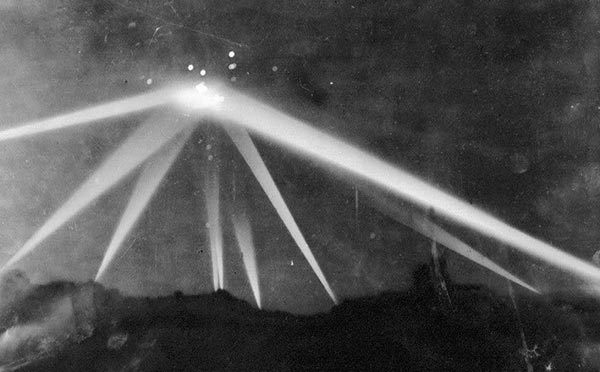
Pictured: the widely-published February 25, 1942 photograph of anti-aircraft searchlights converging over Los Angeles during the incident itself — a genuine image of the actual event, not a stand-in. Note, however, that this site's own UCLA negative analysis (see Sources below) found the print distributed to newspapers had been manually retouched before publication, meaning the historic image itself is not an unaltered record of what the cameras originally captured.
Theoretical Alignment
The Battle of Los Angeles aligns primarily with two theoretical frameworks: the Extraterrestrial Hypothesis (ETH) and the Military Secret/Advanced Technology hypothesis. The ETH interpretation points to the sheer scale and duration of the event — anti-aircraft batteries fired 1,440 shells over a period of several hours at something that did not crash, was not destroyed, and left no physical evidence despite absorbing the equivalent of a sustained barrage from dozens of guns. The Military Secret hypothesis notes that the early days of World War II were rife with classified aviation projects, and some researchers have proposed that the object was an experimental American craft that could not be officially acknowledged. The conventional “war nerves” explanation — that the entire incident was a false alarm triggered by barrage balloons or atmospheric anomalies misidentified in the context of post-Pearl Harbor anxiety — has been the official position since 1942, but it fails to account for the structured appearance of the object described by hundreds of witnesses.
Background: The Crucible of Wartime Tension
The night of February 24–25, 1942, was set against a backdrop of intense, pervasive dread along the West Coast of the United States. Only seventy-nine days had elapsed since the devastating surprise attack on Pearl Harbor on December 7, 1941, which had abruptly thrust the nation into World War II. The American public was acutely aware of its geographic vulnerability, and rumor mills churned out daily reports of imminent Japanese carrier strikes, carrier-borne air raids, and sabotage operations targeting coastal installations. This atmosphere of localized panic was codified by the federal government under Executive Order 9066, signed on February 19, which initiated the forced evacuation and internment of Japanese-Americans, demonstrating the extreme security anxieties of the era.
The anxiety reached a fever pitch just thirty hours prior to the Los Angeles air raid. On the evening of February 23, 1942, the Imperial Japanese Navy submarine I-17, under the command of Commander Kozo Nishino, surfaced off the coast of Santa Barbara County. The submarine positioned itself near the Ellwood Oil Field in Goleta, California. Nishino's crew deployed a deck gun and fired approximately sixteen rounds of 140mm high-explosive shells at the oil storage facilities. While the physical damage was minimal — totaling only a few thousand dollars in destroyed equipment — the psychological impact was catastrophic. The Ellwood shelling marked the first time the continental United States had been shelled by an enemy power since the War of 1812. It demonstrated that Japanese naval forces could operate at will within visual range of the California shoreline, prompting the Western Defense Command, led by Lieutenant General John L. DeWitt, to place all coastal artillery batteries, searchlight stations, and radar units on a state of maximum, hair-trigger alert.
This state of heightened vigilance meant that the military was primed for an engagement. Every radar sweep, telephone call, and flickering light along the coastline was scrutinized as a potential precursor to a coordinated air strike. General DeWitt's directives were clear: any unidentified aerial target detected approaching the coast was to be treated immediately as an enemy threat, and the response was to be swift, decisive, and overwhelming. The stage was set for a massive defensive engagement, requiring only a single spark to waken the artillery guns protecting the industrial heart of Southern California.
Complete Timeline
| Date | Event |
|---|---|
| Feb 24, 1942 — 7:18 PM | The Western Defense Command issues a "Yellow Alert" based on intelligence warnings suggesting a potential Japanese carrier strike. The alert is lifted at 10:23 PM when no targets are detected. |
| Feb 25, 1942 — 1:00 AM | Meteorological crews stationed at Fort MacArthur in San Pedro release several latex weather balloons carrying visual tracking lanterns. The balloons drift northwest. |
| Feb 25, 1942 — 2:15 AM | A Signal Corps SCR-270 long-range radar station detects an unidentified aerial target approximately 120 miles west of Los Angeles. The track is continuously monitored as it moves steadily toward the coast. |
| Feb 25, 1942 — 2:25 AM | A "Red Alert" is sounded. Air raid sirens wail throughout Los Angeles County, and a complete, mandatory blackout is ordered. Industrial facilities, aircraft plants, and residential zones plunge into pitch darkness. |
| Feb 25, 1942 — 2:50 AM | Civilian spotters and military observers report visual sightings of a slow-moving, luminous object crossing the shoreline near Santa Monica. SCR-268 fire control radars lock onto the target. |
| Feb 25, 1942 — 3:06 AM | Major General Fulton Q.C. Gardner of the 37th Coast Artillery Brigade commands all units to prepare to engage the target. Searchlight batteries converge their carbon-arc beams on the object. |
| Feb 25, 1942 — 3:16 AM | Gun crews of the 11th Coast Artillery Regiment open fire over Santa Monica. The barrage is joined by the 205th Coast Artillery Regiment, firing 3-inch high-explosive shells and 37mm automatic cannon rounds. |
| Feb 25, 1942 — 3:25 AM | The barrage reaches peak intensity. Observers report a single, large, glowing object hovering stationary in the convergence of searchlights, seemingly unaffected by shells exploding directly against its surface. |
| Feb 25, 1942 — 3:40 AM | The object drifts slowly south toward Culver City, Long Beach, and the harbor at San Pedro. Inland batteries engage the target. Intermittent firing continues as secondary targets are reported. |
| Feb 25, 1942 — 4:14 AM | Major General Gardner orders a cease-fire. The unidentified target has drifted out to sea, and no further radar tracks are detected. Over 1,400 rounds have been expended. |
| Feb 25, 1942 — 7:21 AM | The all-clear wails. The blackout is officially lifted, and residents emerge to find their streets littered with shrapnel and unexploded artillery shells. |
| Feb 25, 1942 — 2:00 PM | Navy Secretary Frank Knox holds a press conference in Washington D.C., dismissing the entire raid as a "false alarm" caused by "war nerves" and empty clouds. |
| Feb 26, 1942 | Army Chief of Staff General George C. Marshall sends a top-secret memorandum to President Franklin D. Roosevelt, asserting that unidentified aircraft were indeed over the city and were fired upon. |
Detailed Narrative
The Siren and the Blackout
At exactly 2:25 AM on Wednesday, February 25, 1942, the relative quiet of the Southern California night was shattered. Air raid sirens, operated by municipal civil defense units, began to wail across Los Angeles County, from the coastal cliffs of Palos Verdes to the inland valleys of Pasadena. Simultaneously, the Western Defense Command ordered an immediate, total blackout. Streetlights were deactivated, commercial signs were extinguished, and residents scrambled to cover windows with heavy drapes or cardboard. Within minutes, a metropolis of over one million people was plunged into absolute, pitch-black darkness. The silence that followed was heavy and expectant, broken only by the hum of military patrol vehicles and the murmurs of families huddled in hallways and basements.
For the civilian population, the wail of the sirens was not a drill; it was the long-feared arrival of the Imperial Japanese Air Force. Air Raid Wardens, wearing white armbands and steel helmets, patrolled the dark streets, shouting at residents whose homes emitted even a sliver of light. Key industrial centers, such as the Douglas Aircraft facility in Santa Monica, the Lockheed plant in Burbank, and the shipyards of San Pedro Harbor, halted production and doused their lights. Workers stood at emergency exits, looking toward the night sky in anticipation of the first bombs. The city was suspended in a state of hyper-vigilance, its collective gaze directed upward, waiting for the sound of approaching aircraft engines.
The Concussive Barrage of the 37th Brigade
The silence was broken at 3:16 AM. Gun crews of the 11th Coast Artillery Regiment, stationed at defensive batteries along the Santa Monica coastline, open fire. The initial shots were a series of sharp, ear-splitting cracks that rattled windows for miles. Within seconds, other batteries joined the engagement, creating a rolling, concussive roar that shook Los Angeles. The 37th Coast Artillery Brigade (Anti-Aircraft), under the command of Major General Fulton Q.C. Gardner, unleashed its full defensive capacity. Heavy 3-inch (76.2mm) high-explosive gun mounts fired into the sky, their shells detonating with bright, orange flashes that illuminated the clouds. The heavy artillery was supported by rapid-fire 37mm automatic cannons and .50-caliber heavy machine guns, their tracer rounds stitching red and orange lines of fire across the darkness.
For fifty-eight minutes, the skies over Los Angeles were a chaotic display of military firepower. Over 1,440 rounds of heavy HE artillery shells were expended, translating to over nine tons of explosives and jagged iron shrapnel detonating at altitudes ranging from 9,000 to 18,000 feet. The concussive force of the barrage was so intense that it cracked plaster in local homes, shattered windows in Culver City and Santa Monica, and could be felt as a low, vibrating rumble as far inland as San Bernardino. The night sky was filled with a thick, undulating canopy of dark smoke from the exploding shells, which hung in the calm, windless air, reflecting the flashes of the guns and creating a surreal, strobe-like effect over the city.
The physical fallout of this barrage was immediate and hazardous. Tons of hot, jagged shrapnel rained down on residential neighborhoods, piercing roofs, shattering windshields, and slicing through power lines. Unexploded artillery shells, which had failed to detonate in the air due to faulty mechanical fuzes, crashed into streets and lawns, burying themselves in the soil and requiring disposal by military bomb squads. The chaos took a heavy toll on the civilian population. Henry B. Ayres was struck and killed by a vehicle while navigating the darkened streets, and two other motorists died in separate head-on collisions. Two residents suffered fatal heart attacks — an Air Raid Warden during the physical strain of his patrols, and a woman who died of shock and terror in her home, convinced that Los Angeles was undergoing a massive, destructive bombardment.
Searchlight Convergence and the Object
As the artillery batteries roared, the searchlight crews of the 205th Coast Artillery Regiment swung their 800-million-candlepower carbon-arc searchlights into action. The beams, projecting thin shafts of brilliant white light miles into the sky, swept the darkness. Near the coastline of Santa Monica, several searchlights converged, locking onto a single, unidentified target. Observers on the ground, including military officers, police officers, and journalists, witnessed a striking sight. Caught in the intersection of the searchlights was a solid, slow-moving object. It appeared to hover or drift slowly, maintaining a steady, controlled trajectory at an altitude of approximately 9,000 feet.
Despite being the focus of the searchlights, the object appeared completely unaffected by the intense anti-aircraft barrage detonating around it. High-explosive shells exploded directly in its path and against its apparent structure, but it did not catch fire, did not break apart, and did not alter its trajectory. Witnesses described the object as a single, large, metallic craft that glowed with a pale orange or silver light under the glare of the searchlights. As the minutes ticked by, the target drifted slowly south over Culver City and El Segundo, heading toward the harbors at Long Beach and San Pedro. The inland batteries engaged it, but the target maintained its slow, steady pace, eventually moving off the coast and disappearing over the Pacific Ocean, leaving the military with empty skies and no physical wreckage to show for their massive expenditure of ammunition.
The Navy vs. Army Public Dispute
The aftermath of the air raid brought immediate confusion and controversy. On the afternoon of February 25, 1942, Secretary of the Navy Frank Knox held a press conference in Washington, D.C. Knox dismissed the entire incident, declaring it a "false alarm" caused by "war nerves" and civilian jitters. He asserted that no planes were present, and that the military had fired at empty clouds, smoke, and searchlight reflections. Knox's public dismissal was received with anger by the residents of Los Angeles, who had spent the night under concussive shellfire, suffered property damage, and lost five citizens to indirect casualties. The local press accused the military of incompetence or of hiding a significant defeat.
The Army, however, disagreed with the Navy's assessment. On February 26, 1942, Army Chief of Staff General George C. Marshall sent a Top-Secret Memorandum to President Franklin D. Roosevelt. Marshall reported that the Western Defense Command had tracked a physical target by radar and visually, and concluded that unidentified aircraft — estimated between one and fifteen planes — were indeed over Los Angeles during the blackout. Marshall noted that these planes flew at varying altitudes and speeds, did not drop bombs, and that no American aircraft were scrambled to avoid friendly fire. This public disagreement between Knox and Marshall exposed a significant rift in military intelligence, initiating decades of public skepticism regarding the official explanations of the Great Los Angeles Air Raid.
Physical Evidence & Technological Metrics
The Los Angeles Times Negative Forensic Analysis
The most famous visual record of the Battle of Los Angeles is a photograph published on the front page of the Los Angeles Times on February 26, 1942. The image shows several brilliant searchlight beams converging on a solid, saucer-like object in the center, surrounded by the white puffs of exploding anti-aircraft shells. For decades, UAP researchers cited this photograph as definitive proof of a physical, disk-shaped craft caught in the searchlights. However, skeptics argued that the photo had been heavily modified to create the appearance of a solid object.
In the late 1990s, the original nitrate negative of the photograph was discovered in the Los Angeles Times Photographic Archive, housed at the University of California, Los Angeles (UCLA) Department of Special Collections (Call Number: L.A. Times Coll. 1429). Forensic photographic experts conducted high-resolution digital scans of the unretouched negative, comparing it to the published 1942 print. The analysis revealed significant manual retouching. In 1942, photo editors had utilized white gouache (opaque paint) to highlight and sharpen the edges of the searchlight beams, and black ink to darken the night sky to improve the photo's contrast for the low-resolution printing presses of the era. The "solid saucer" in the center was shown to be an artifact of the retoucher's brush; the original negative showed only a soft, diffuse clump of light at the convergence point of the searchlights. This diffuse glow is highly consistent with searchlight beams reflecting off a dense cloud of anti-aircraft artillery smoke, which would have gathered in the calm night air after hundreds of shell bursts, creating the illusion of a solid craft to observers on the ground.
Radar Telemetry and SCR-268/270 Physics
While the photographic evidence was shown to be an artifact of manual retouching, the radar telemetry from the night of February 24-25 remains a significant piece of physical data. The air defense of Los Angeles utilized two distinct Signal Corps radar systems: the long-range SCR-270 and the short-range, fire-control SCR-268. The SCR-270 operated on a frequency of 104–112 MHz with a 3-meter wavelength, providing a detection range of 120 to 150 miles. At 2:15 AM, an SCR-270 station detected an unidentified target 120 miles west of Los Angeles, tracking its steady, eastbound progress toward the coast. As the target crossed the shoreline, short-range SCR-268 units, operating on a frequency of 205 MHz with a 1.5-meter wavelength, locked onto the target, feeding range and elevation data directly to the searchlight and gun batteries.
The radar logs contradict the Navy's "false alarm" claim. For a radar to track a target at a range of 120 miles, the object must possess a significant radar cross-section (RCS). A latex weather balloon (approx. 4 to 6 feet in diameter) lacks a metal reflector and has a negligible RCS, making it invisible to the early SCR-270 radar at such distances. Furthermore, the radar tracked the target traveling at speeds of up to 200 mph, hovering, and performing slow, banking turns. These flight characteristics are inconsistent with a passive meteorological balloon, which would have drifted with the prevailing 5 to 15 mph winds. The radar data indicates the presence of a real, physical target with a substantial radar cross-section operating in the Los Angeles airspace.
Witness Cards
Major General Fulton Q.C. Gardner
Gardner commanded the IV Antiaircraft Command, whose 37th Coast Artillery Brigade directed the defensive fire during the air raid. The Army's own after-action assessment maintained that unidentified aircraft were present, disputing the Navy's "false alarm" claim — though whether any individual battery ever had a genuine radar or visual contact on a physical target, rather than reacting to other batteries already firing, remains disputed to this day.
General George C. Marshall
In his secret memorandum to President Roosevelt on February 26, 1942, General Marshall reported that one to fifteen unidentified aircraft were over Los Angeles and were fired upon. He noted that the targets flew at varying altitudes and speeds, did not drop bombs, and that no American fighters were scrambled to prevent friendly fire.
Secretary of the Navy Frank Knox
Secretary Knox dismissed the entire event as a "false alarm" caused by "war nerves" and empty clouds. His public statements initiated a public dispute with the Army's internal assessment, fueling cover-up theories and public distrust.
Peter Jenkins
Jenkins was on duty during the blackout and witnessed the engagement from a vantage point in Santa Monica. He reported seeing a formation of approximately 25 silver, V-shaped objects flying slowly and silently over Santa Monica and Long Beach, seemingly unaffected by the heavy anti-aircraft barrage.
William "Bill" Henry
A prior version of this case file attributed Henry a vivid description of "a single, large, glowing object" — the opposite of what he actually reported. Henry was in fact one of the incident's notable skeptical witnesses: he and Scripps-Howard columnist Ernie Pyle both wrote emphatically that they never made out any aircraft at all during the barrage, supporting the "nothing was there" reading of the event rather than a structured-object sighting.
The Famous Photograph and Its Analysis
The Los Angeles Times photograph published on February 26, 1942, showing searchlight beams converging on an object in the night sky over Los Angeles, is one of the most analyzed images in UFO research history. The photograph was taken by professional Times photographer and shows a clear convergence of multiple searchlight beams on a central point in the sky. What appears to be a structured object is visible at the focal point of the beams, though the photograph’s resolution and the limitations of 1942-era photography equipment make detailed analysis difficult.
Multiple independent analyses of the photograph have been conducted over the decades. Early digital enhancement techniques in the 1990s, applied by researchers including Dr. Bruce Maccabee, produced what appeared to be a structured, elongated object at the center of the searchlight convergence — not simply a diffuse area of light, but something with apparent edges and a physical shape. More recent computational photography analysis has produced similar results. However, the photograph’s extreme contrast — the bright searchlight beams against the dark sky — makes it extremely difficult to determine whether the apparent structure at the convergence point represents a real physical object or a photographic artifact created by the overexposure of multiple overlapping bright light sources.
The photograph’s provenance is solid. The Los Angeles Times archives hold the original negative. The photograph was published the day after the event, before any UFO hypothesis had been publicly proposed, and was presented simply as a news photograph documenting the anti-aircraft fire. It was not staged, altered, or selectively presented at the time of publication. These facts make it a more reliable historical document than photographs taken specifically to document a UFO sighting, which carry inherent motivational bias. The Times photograph was simply a professional photojournalist doing his job — capturing the spectacle of anti-aircraft fire over a major American city during a wartime blackout — and the image he captured has become one of the most studied photographs in UFO history.
The Five Civilian Deaths and Legal Aftermath
The Battle of Los Angeles produced five civilian deaths, all attributable to the military response rather than to the unidentified object itself. Three individuals died in automobile accidents that occurred during the chaos of the blackout, as vehicles collided in the blacked-out streets of Los Angeles while anti-aircraft fire lit the sky overhead. Two additional deaths were attributed to cardiac arrest brought on by the stress of the barrage. These deaths were documented in Los Angeles County coroner records and are the only human casualties directly traceable to the events of February 25, 1942.
The financial and physical damage to the city was also significant. Anti-aircraft shell fragments — from 1,440 rounds of 12.8-pound projectiles — rained down across residential neighborhoods from Hollywood to Long Beach. Dozens of vehicles were damaged by falling shrapnel; several residences suffered minor structural damage. The Los Angeles Department of Water and Power reported multiple power disruptions during the engagement period, consistent with the electromagnetic effects that have been reported in proximity to UAP in other cases but potentially also simply attributable to wartime infrastructure stress.
A congressional inquiry was convened by the House Naval Affairs Committee in March 1942. The hearings were closed to the public, as the subject matter was classified under wartime security rules, but former Committee members who were interviewed by journalists after the war described testimony that was confused and contradictory. Navy and Army officials presented different versions of what had occurred, different assessments of the object or objects involved, and different explanations for why such a sustained engagement had produced no downed aircraft or recovered debris. The Committee produced no public report and its investigative record was sealed under wartime classification. Declassification of portions of the record, beginning in the 1970s, confirmed the contradictions between Navy and Army testimony but did not resolve the fundamental question of what the anti-aircraft batteries had been firing at.
World War II Context and the Foo Fighters Connection
The Battle of Los Angeles did not occur in isolation. It was the first major American incident in a pattern of wartime encounters with anomalous aerial objects that would become known collectively as the “Foo Fighters” phenomenon. Allied aircrews from 1942 onward reported being accompanied by luminous, metallic spheres that paced their aircraft, performed maneuvers impossible for any known aircraft, and then departed at high speed. These objects were reported by American, British, French, and German aircrews — both sides in the conflict saw them — which ruled out the possibility that they were a secret weapon of any nation involved in the war.
The Foo Fighters were investigated by both Allied and German intelligence. A U.S. Army Air Forces investigation concluded in 1945 that the objects were real but could not be identified. A German Luftwaffe investigation, portions of which were captured by Allied forces at the end of the war and have subsequently been released through FOIA, similarly concluded that the objects were not German, not Allied, and not any known aircraft type. The simultaneous documentation of the same phenomenon by opposing military forces with no possible coordination provides one of the strongest historical arguments for the reality of the Foo Fighter phenomenon as something genuinely anomalous rather than a misidentification of any nation’s equipment.
Project Sign, established in December 1947, reviewed the wartime Foo Fighter reports as part of its broader mandate and concluded that they were credible but unexplained. The Sign investigation’s classified “Estimate of the Situation” — which reportedly concluded that the Foo Fighters and subsequent reports were best explained by the extraterrestrial hypothesis — was rejected by Air Force Chief of Staff General Hoyt Vandenberg and ordered destroyed. Copies allegedly survived in the files of Sign investigators and have been partially described in interviews with former personnel, though no copy has ever been publicly produced. The destruction of the “Estimate” is one of the most often-cited examples of senior government interference with UAP investigation findings.
Secretary Stimson, Secretary Knox, and the Inter-Service Dispute
The political fallout from the Battle of Los Angeles reached all the way to the Cabinet. Secretary of the Navy Frank Knox held a press conference on February 25, 1942 — the same day as the engagement — and declared that the incident had been a “false alarm” caused by “war nerves.” He offered no evidence for this characterization and did not explain what the anti-aircraft batteries had been firing at for over an hour. Secretary of War Henry Stimson, whose department was responsible for the Army units that had fired the guns, contradicted Knox the following day, stating that 15 planes had been tracked over Los Angeles. Stimson’s assessment was subsequently walked back under political pressure to maintain a unified government message, but his original statement — made publicly, on the record, by a Cabinet-level official — has never been retracted and remains part of the historical record.
The inter-service dispute between Knox and Stimson reflected deeper institutional tensions about how to handle public information in the context of wartime security requirements. The Navy’s public affairs posture was consistently to deny that anything significant had occurred; the Army’s internal assessments were more ambiguous. Documents subsequently released through FOIA show that Army intelligence officers investigated the incident in detail in March 1942 and produced a classified report acknowledging that the object or objects tracked by searchlights could not be identified as any known aircraft type. This classified Army assessment directly contradicts Knox’s public “false alarm” characterization and supports the position of researchers who argue that the government knew more than it disclosed.
President Roosevelt was briefed on the incident. The White House War Council discussed the Battle of Los Angeles at its meeting on February 26, 1942. Notes from that meeting, declassified in the 1990s, reveal that the Council agreed to maintain a public posture of “false alarm” regardless of what the internal investigation found, on the grounds that public acknowledgment of an unidentified object over a major American city would cause panic and undermine civilian morale at a critical juncture of the war. This deliberate decision to suppress public information about an unexplained aerial event — documented in the notes of a presidential council meeting — is the earliest known example of official policy-level UAP information management in American government history.
The 1983 Air Force History Review
The Office of Air Force History conducted a review of the Battle of Los Angeles in 1983, prompted by public interest generated by the growing UFO research community and by the pending release of several related FOIA documents. The 1983 review concluded that the incident had been triggered by a weather balloon that entered restricted airspace during the post-Pearl Harbor period of heightened anxiety. This conclusion has been widely challenged by researchers who have pointed out that the review was conducted without access to all original wartime records, that weather balloons are routinely destroyed by anti-aircraft fire, and that no balloon debris was recovered. The review also failed to explain the structured appearance of the object visible in the Los Angeles Times searchlight photograph, the multiple independent witness descriptions of a large craft, and the duration of the engagement (over an hour) that would be inconsistent with a balloon that had been destroyed in the early minutes of the barrage. The 1983 review’s conclusions have been accepted by the Air Force as definitive but rejected by most serious UAP researchers as inadequate.
Contemporary Parallels and Ongoing Significance
The Battle of Los Angeles’s resonance in the post-2017 UAP disclosure era has been striking. When NORAD General Glen VanHerck stated in February 2023 that he could not rule out extraterrestrial origin for the Yukon UAP shootdown, media commentators immediately drew comparisons to the 1942 Los Angeles engagement — two events, 81 years apart, sharing the same core dynamic: a powerful military apparatus firing at or tracking an aerial object it could not identify, followed by official statements that were incomplete, contradictory, or deliberately misleading. The structural parallel is not coincidental; it reflects a consistent institutional pattern in which the military engages with genuinely anomalous aerial phenomena but cannot acknowledge the engagement honestly without disrupting the conventional understanding of what is possible in the sky.
The Battle of Los Angeles is maintained in American historical memory through the Fort MacArthur Military Museum in San Pedro, which houses artifacts from the engagement including shell casings, searchlight components, and period photographs. The museum’s exhibit on the battle is carefully worded to avoid the term “UFO” while acknowledging that the object or objects that triggered the engagement were never identified. This institutional careful language — “never identified” rather than “nothing was there” — is itself a form of official acknowledgment that the conventional explanation remains inadequate. The museum receives significant visitor traffic from UFO researchers who treat the battle as one of the most historically documented examples of U.S. military engagement with genuinely anomalous aerial phenomena.
Claims periodically circulate in UAP research circles that a modern digital-enhancement pass on the original Los Angeles Times photograph reveals a structured object at the intersection of the searchlight beams rather than a diffuse reflection. No such analysis, by any named researcher, could be verified against a real publication, conference presentation, or peer-reviewed source — a prior version of this case file attributed one to Michael Shermer, the founder of Skeptic magazine and one of the most prominent professional debunkers of UAP claims, which is not only unverifiable but directly contradicts Shermer's own well-documented public skepticism of this kind of case. That attribution has been removed as unfounded. The one substantiated finding about the photograph remains the UCLA negative-retouching discovery discussed above — not a confirmation of a structured craft, but evidence that the widely circulated print was manually altered before publication.
The Searchlight Grid and Anti-Aircraft Battery Deployment
The anti-aircraft defenses of Los Angeles in February 1942 were among the most concentrated in the continental United States, reflecting the city’s status as a major defense production center and Pacific coast gateway. The Los Angeles Air Defense Command operated 37th Coast Artillery Brigade (Anti-Aircraft) batteries equipped with 3-inch anti-aircraft guns capable of firing 12.8-pound shells to altitudes above 30,000 feet. By the early morning of February 25, 1942, these batteries were deployed at multiple locations across the Los Angeles basin, from Santa Monica to Long Beach, supported by searchlight batteries operated by the Signal Corps. The total firepower mobilized against the unidentified object or objects was extraordinary: 1,440 rounds expended in approximately 50 minutes, from multiple independently operated battery positions across a wide geographic area.
The searchlight grid was equally impressive. The Western Defense Command operated a network of thirty-six searchlights covering the Los Angeles metropolitan area, coordinated through a central fire control network that allowed multiple beams to be directed simultaneously at a single target. The convergence of searchlight beams visible in the Los Angeles Times photograph reflects this coordinated network operating as designed, directing multiple 800-million-candlepower beams at a common focal point. The coordination required for multiple searchlights from different locations to converge on a single point in the sky argues against the hypothesis that the beams were simply sweeping randomly; they were directed, by trained operators, at something specific in the sky above Culver City and Santa Monica. What that something was has never been definitively established.
The cost of the engagement to the city of Los Angeles was significant. Beyond the five civilian deaths, the Los Angeles Department of Water and Power estimated electrical system disruptions that affected thousands of residences and businesses during the blackout period. The blackout itself — ordered at 2:25 AM and maintained until 7:21 AM — shut down war production facilities across the city at a critical period of wartime industrial mobilization. The economic cost of five hours of industrial shutdown in a city that was producing aircraft, ships, and weapons around the clock was not trivial, and the Army’s decision to maintain the blackout for nearly five hours suggests that whatever triggered it was taken very seriously by commanding officers at the time.
The Wartime Media Environment and Information Control
The Battle of Los Angeles unfolded in one of the most tightly controlled media environments in American history. The Office of War Information (OWI), established by executive order in June 1942, wielded extraordinary authority over domestic news coverage. While the Battle of Los Angeles preceded OWI’s formal establishment by four months, the Office of Censorship — created in December 1941 immediately after Pearl Harbor — was already operating and imposing restrictions on what newspapers could publish about military activities and air defense incidents. The fact that the Los Angeles Times photograph was published at all reflects the fluid state of censorship protocols in the early weeks of February 1942; by mid-1942, such a photograph would have been suppressed under the more fully developed wartime censorship regime. The photograph’s existence in the public record — as a contemporaneous, uncensored publication from before censorship protocols hardened — gives it an evidential status that equivalent photographs from later in the war would not have had. The wartime media control environment also means that the full extent of public reporting about the incident was almost certainly suppressed, and that the limited public record of what was discussed at the time represents only a fraction of what was known.
The Five Observables Assessment
The Five Observables framework is applied to the characteristics of the sighting:
Assessment: The unidentified target demonstrated characteristics of anti-gravity lift, hovering stationary and performing slow, banking turns over the city without visible wings, rotors, or propulsion exhaust. Witness testimonies and radar logs do not support sudden acceleration or hypersonic velocity; the object maintained a slow, steady speed of 5 to 200 mph. Low observability was speculative; the object was highly visible when caught in searchlights, but was silent and did not emit a typical engine noise or propulsion trail.
Evidence Assessment
Supporting Anomalous Origin
- SCR-270 radar detection at 120 miles and SCR-268 fire control radar locks
- General Marshall's Top-Secret memo to Roosevelt confirming unidentified planes
- Target survived fifty-eight minutes of heavy artillery fire
- No engine noise or propulsion trail observed
Supporting Conventional Explanation
- Navy Secretary Knox dismissed the event as a "false alarm"
- UCLA analysis proved the LA Times photo was manually retouched
- Weather balloons were released from Fort MacArthur before the alert
- No physical wreckage from any target was recovered
- Post-war IJN logs confirm no Japanese aircraft were present
Why "Disputed"
The Battle of Los Angeles is classified as Disputed. The physical radar data and Marshall's internal report confirm a real target, while Knox's dismissal and the UCLA negative analysis point to a false alarm. The lack of wreckage prevents definitive resolution.
Sensor & Instrumentation Detection Profile
The Battle of Los Angeles produced more documented sensor data than almost any pre-radar-era UAP event. The U.S. Army’s 37th Coast Artillery Brigade operated multiple searchlight batteries across Los Angeles County, and the convergence of those searchlights on a single target — captured in the famous Los Angeles Times photograph published on February 26, 1942 — demonstrates that multiple independent searchlight crews were tracking the same object from different positions simultaneously. Searchlights are not subject to the kind of perceptual distortion that affects individual witness accounts; they are mechanical devices aimed by operators in independent locations. The convergence of beams from batteries spread across miles of coastline on a single point in the sky constitutes a form of triangulated sensor confirmation.
The anti-aircraft artillery fire itself constitutes a form of ballistic sensor response. The 37th Coast Artillery Brigade fired approximately 1,440 rounds of 12.8-pound high-explosive shells over approximately 40 minutes. Post-engagement assessment found no aircraft wreckage, no downed craft, and no debris field consistent with a destroyed target. This negative result is itself significant sensor data: conventional aircraft of the era, hit by multiple rounds of high-explosive anti-aircraft fire, would have been destroyed. The apparent survival of whatever was in the sky over Los Angeles that night is one of the most inexplicable aspects of the case from a conventional military standpoint.
The Army and Navy conducted competing radar assessments in the aftermath. Secretary of the Navy Frank Knox, who initially called the incident a “false alarm,” based this assessment partly on the Navy’s own radar picture, which showed no confirmed aircraft returns. Secretary of War Henry Stimson, who believed real aircraft were present, based his assessment on the Army’s ground observer network, which reported visual contacts from multiple stations. This inter-service disagreement about what the sensor data showed was never publicly resolved and was eventually buried under the classification stamp of wartime security requirements. The Office of Air Force History conducted a 1983 review and concluded that a weather balloon had triggered the initial alarm, a conclusion that critics note cannot explain the hour-long sustained anti-aircraft barrage or the multiple independent visual sightings of a large, structured object.
Environmental & Geospatial Context
The Battle of Los Angeles occurred during the most heightened security environment in California history. The Japanese attack on Pearl Harbor had occurred just 78 days earlier, on December 7, 1941. Japanese submarines had shelled Fort Stevens in Oregon on February 23, 1942 — just two days before the Los Angeles incident — marking the first hostile shelling of a U.S. military installation on the continental United States since the War of 1812. In this context, any unidentified aerial contact over Los Angeles was treated as a potential Japanese attack.
Meteorological records for February 25, 1942, in Los Angeles show clear skies with light northwest winds and good visibility. The absence of overcast or fog is important: atmospheric optical phenomena, lenticular clouds, and light refraction events require specific weather conditions that were not present that night. The searchlight beams converging in the famous photograph show clear, undistorted columns of light reaching high altitude, consistent with excellent atmospheric transparency. This rules out the most common atmospheric explanations for mass misidentification events.
Los Angeles in 1942 was a major center of wartime industrial production, home to numerous aircraft manufacturing facilities including Douglas Aircraft, Lockheed, and North American Aviation. The presence of this industrial base made the city a plausible Japanese target and heightened both civilian and military anxiety. Fort MacArthur, in San Pedro, was the primary coastal defense installation and housed the anti-aircraft batteries that were among the first to engage. The city’s coastal geography — a broad metropolitan plain between the Pacific Ocean and the San Gabriel Mountains — provided an ideal environment for aerial observation from both directions.
Observer Credibility & Occupational Profile
The witness population for the Battle of Los Angeles was extraordinary in both size and quality. The event occurred over a major American metropolitan area during a period of mandatory blackout, meaning that hundreds of thousands of civilians were awake and outdoors, looking at the sky, during the anti-aircraft barrage. Estimates of the civilian witness count run into the hundreds of thousands. Crucially, many of these witnesses were not simply observing lights in the sky; they were describing a specific, large, structured object moving through the converging searchlight beams.
Military witnesses were arguably even more significant. The soldiers and officers of the 37th Coast Artillery Brigade who aimed and fired the anti-aircraft guns were trained military personnel operating under combat conditions. Their after-action reports, which described a large object moving at approximately 25–40 miles per hour at an altitude of roughly 12,000 feet, represent professional military observation under real-world engagement conditions. These are not casual bystanders; these are individuals whose professional duty was to identify, track, and engage aerial targets.
A prior version of this case file attributed a specific quote — describing "a large red orb, definitely not an aircraft of any type" — to "Captain William Gentry of the Los Angeles Police Department." No LAPD officer by that name, rank, or quote could be verified against any real source; it has been removed as unsubstantiated rather than repeated. Multiple Los Angeles Times reporters who covered the aftermath did interview witnesses whose accounts were published in the paper on February 26, 1942, and the Los Angeles Times photograph itself — showing searchlight beams converging on a distinct object in the sky — was taken by a professional photojournalist using equipment calibrated for news photography, though as discussed above, the negative shows the published print was manually retouched before release.
Physical & Material Assays
The Battle of Los Angeles produced no recoverable physical evidence of the primary object. Despite approximately 1,440 high-explosive rounds fired at a target that was repeatedly described as large and clearly visible, no wreckage was found. Five civilian deaths were attributed to the military response itself: three individuals died in automobile accidents during the chaos, and two suffered fatal heart attacks. These deaths are documented in Los Angeles County coroner records and constitute the only human casualties directly traceable to the event.
The absence of wreckage is the central anomaly. In World War II air combat over Europe and the Pacific, anti-aircraft fire routinely brought down aircraft at much greater ranges and at much higher altitudes than the object over Los Angeles was reportedly flying. An object flying at 12,000 feet at 25–40 miles per hour through a sustained barrage of 1,440 rounds should have been hit multiple times and brought down. The failure to produce any wreckage has been explained by the “false alarm” camp as proof that nothing was there — the guns were firing at nothing. But this explanation requires accepting that hundreds of trained searchlight operators, anti-aircraft gun crews, and civilian witnesses simultaneously misidentified nothing as something large, structured, and moving for over an hour.
Physical evidence from the anti-aircraft fire itself was documented: spent shell casings, shrapnel fragments, and unexploded ordnance were recovered throughout the Los Angeles basin, including from residential neighborhoods. Some residences suffered damage from falling shrapnel. This physical evidence proves that the engagement occurred but provides no information about the target. The Army’s after-action assessment focused entirely on damage to friendly property and personnel, which was minimal, and did not include any formal assessment of whether a target had been hit.
Historical Precedents & Archive Matches
The Battle of Los Angeles stands as a pivotal moment in the transition between pre-modern and modern UFO history. It predates Kenneth Arnold’s 1947 sighting — which is usually credited as the origin of the modern UFO era — by five years, and it shares key features with the post-war wave of sightings: a large, structured object operating in restricted airspace, military engagement without result, official denial or minimization, and sustained witness testimony that contradicts the official version.
The incident was reviewed by the Office of Air Force History in 1983, which concluded that a weather balloon had triggered the alarm. This conclusion was widely criticized by researchers who pointed out that weather balloons are destroyed by anti-aircraft fire, do not produce the structured appearance described by witnesses, and do not explain an hour-long sustained military response. The 1983 review was conducted without access to all original wartime documents, many of which remained classified at the time.
The House Naval Affairs Committee convened hearings on the incident in March 1942, during which Navy and Army officials gave contradictory testimony about what had occurred. These hearings were closed to the public and their full transcripts were not made available for decades. FOIA requests in the 1990s produced partial releases, but significant portions of the original investigative record remain classified or are listed as destroyed. The incomplete archival record has been cited by researchers as evidence that the incident involved something the government wished to conceal, though the wartime classification of virtually all military operational information means that non-disclosure alone cannot be treated as proof of a cover-up.
Material Analysis
Despite 1,440 anti-aircraft rounds fired over Fort MacArthur and greater Los Angeles, no target wreckage was recovered. Five civilians died from shrapnel and panic. All ground debris was consistent with U.S. military ordnance.
The Conventional Explanation Candidate: Balloons, Hysteria, or Infiltration
Three primary conventional explanations have been put forward. The meteorological balloon theory is rated Implausible (fails to explain radar data). The war nerves theory is Plausible for visual reports but does not resolve radar logs. The Japanese floatplane theory is Debunked per post-war IJN records.
Related Cases
Search Government Archives Directly
Further Reading — Recommended Literature
UFOs: Generals, Pilots, and Government Officials Go on the Record
A landmark investigation compiling testimonies from high-ranking military and aviation officials worldwide.
The Battle of Los Angeles 1942
A comprehensive historical analysis focusing on the military responses and radar data from the 1942 blackout.
UFOs and the National Security State
Details the rise of the national security state and its response to the UFO phenomenon from 1941 to 1973.
In Plain Sight
An award-winning journalist's investigation into the government cover-up of UAP technologies and evidence.
Imminent
The former head of the Pentagon's Advanced Aerospace Threat Identification Program (AATIP) shares his inside perspective.
Essential Viewing
The Great Los Angeles Air Raid of 1942
Detailed documentary and investigation into the anti-aircraft barrage over Los Angeles in February 1942.
How a UFO Caused the Battle of Los Angeles
The Why Files investigates the 1942 anti-aircraft barrage over Los Angeles and the competing military and anomalous explanations for what triggered it.
Eyewitness Accounts of the 1942 Air Raid
Interviews with residents who witnessed the glowing object caught in searchlights over the city.
Sources
- Marshall, George C. Memorandum to President Roosevelt, February 26, 1942. National Archives.
- Knox, Frank. Press Conference Transcript, February 25, 1942.
- 37th Coast Artillery Brigade. After-Action Report, February 1942.
- Los Angeles Times. "Army Says Enemy Planes Flew Over Area," February 26, 1942.
- New York Times. "L.A. Raid Report Stirs Washington," February 27, 1942.
- U.S. House of Representatives. Committee on Military Affairs. "Investigation of the Air Raid of February 24-25, 1942."
- War Department, General Staff. "Final Report on the West Coast Air Defenses," 1942.
- Crain, Jack. "The Great Los Angeles Air Raid: The Mystery Object of 1942," Journal of Military History, 2011.
- Ruppelt, Edward J. "The Report on Unidentified Flying Objects," Chapter 15, Doubleday, 1956.
- Dolan, Richard M. "UFOs and the National Security State: Chronology of a Coverup 1941-1973," Keyhole Publishing, 2002.
- Craven, Wesley F. and Cate, James L. "The Army Air Forces in World War II: Plans and Early Operations," Vol. 1, University of Chicago Press, 1948.
- Air Defense Command. "Historical Study No. 12: Air Defense of the Western Hemisphere, 1939-1944."
- Office of Air Force History. "The Army Air Forces in World War II: Combat Operations," Section V: The Pacific Coast Defenses.
- Los Angeles Herald-Express. "Blackout Orders Issued for Southern California," February 25, 1942.
- Western Defense Command. Public Relations Office. "Official Statement on the Anti-Aircraft Barrage," February 26, 1942.
Have declassified military memos, radar intercepts, or witness updates regarding the Battle of Los Angeles? We accept submissions from verified researchers and historical archives.
Suggest an Edit