
Langley AFB UAP Incursions
Over multiple nights in December 2023, Joint Base Langley-Eustis and Langley Air Force Base experienced continuous, unexplained intrusions by a coordinated swarm of unidentified aerial objects. The events led to immediate FAA flight restrictions, tracking by military radar systems, scrambles of USAF fighter jets, and NORAD hearings. The case is connected to the historical 2012 triangular craft sighting reported by veteran geospatial analyst Dylan Borland.
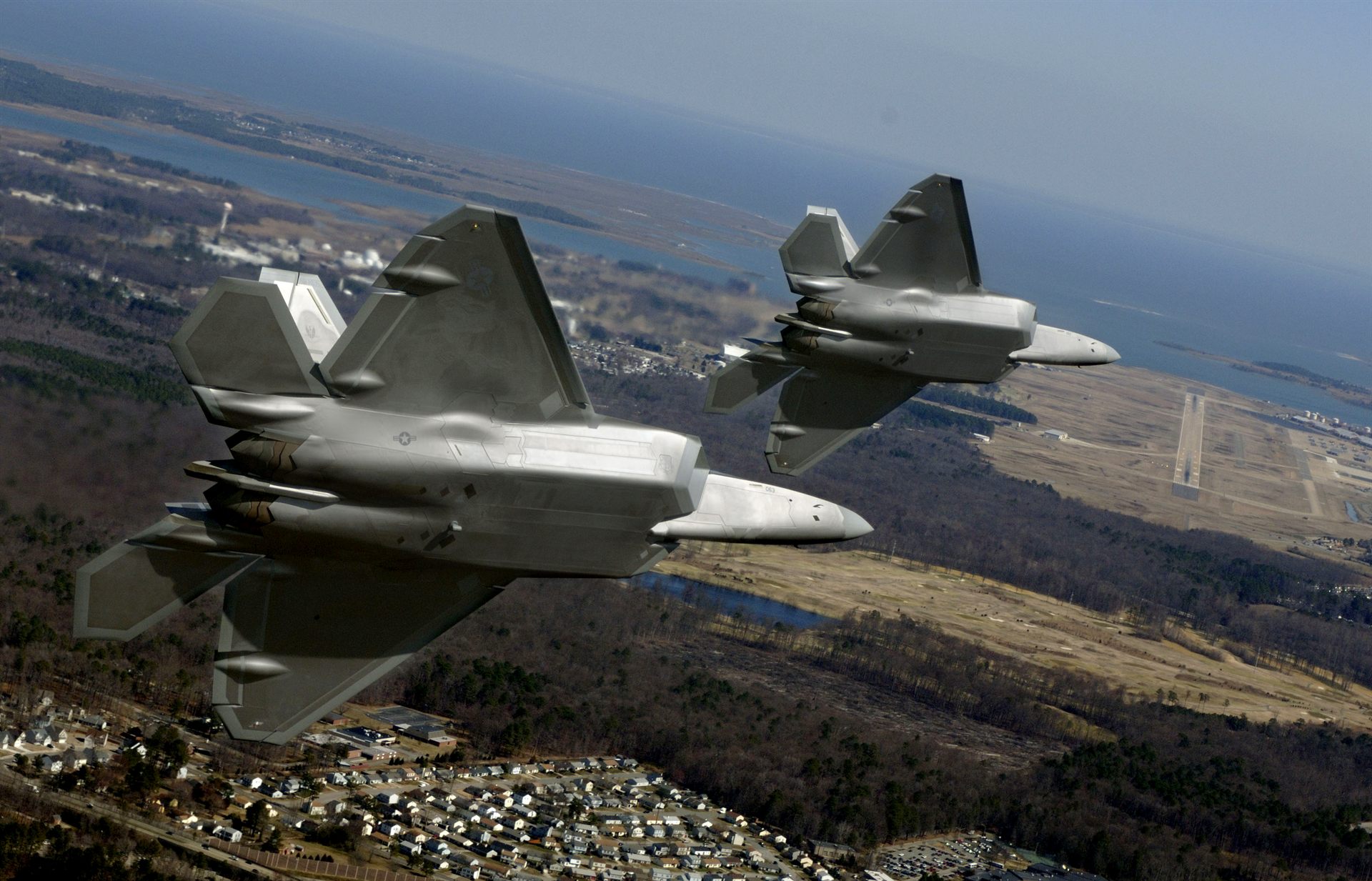
Pictured: U.S. Air Force F-22A Raptors of the 1st Fighter Wing on approach to Joint Base Langley-Eustis, Virginia — the actual installation whose runways and ground crews reported the December 2023 UAP swarm, not a photograph of the swarm itself. No verified photograph of the lights described by witnesses is known to exist in public archives.
Theoretical Alignment
The Langley AFB drone/UAP incursions of late 2023 align with multiple overlapping theoretical frameworks that are not mutually exclusive. The most widely discussed conventional explanation is adversarial drone operations — specifically sophisticated unmanned aerial vehicles operated by foreign intelligence services (most commonly attributed to China or Russia) using commercially available or military-grade drone technology with advanced stealth capabilities. However, former Deputy Assistant Secretary of Defense Chris Mellon and others have argued publicly that the performance characteristics of the objects exceed anything in any known foreign inventory. If the conventional adversarial drone hypothesis is insufficient, the case aligns secondarily with the UAP hypothesis — objects of unknown origin operating with apparent impunity over one of the most defended military installations in the United States.
Complete Timeline
| Date | Event |
|---|---|
| December 2012 | Geospatial intelligence analyst Dylan Borland witnesses a silent, 100-foot-wide equilateral triangular craft hovering at low altitude over Langley AFB, experiencing localized electromagnetic phone interference. |
| Dec 6, 2023 (18:00) | First sightings of a UAP swarm reported by ground crews at Langley AFB. Between 10 and 15 distinct lights are seen flying in formation over the runways. |
| Dec 7–10, 2023 | Incursions continue nightly. FAA is notified, and military radar operators observe multiple targets moving at speeds ranging from stationary hover to several hundred miles per hour. |
| Dec 12, 2023 | FAA issues temporary flight restrictions (TFR) over Langley AFB and NASA Langley. USAF scrambles F-22 Raptors, but the UAPs show extremely low radar cross-sections and disappear before visual locks are obtained. |
| March 2024 | General Gregory Guillot, Commander of NORAD and USNORTHCOM, testifies before the Senate Armed Services Committee, admitting NORAD's tracking of the swarm and stating they lacked the capability to neutralize the incursions. |
| Sept 9, 2025 | Dylan Borland testifies before a Congressional House oversight committee as a whistleblower, disclosing his 2012 sighting and subsequent professional reprisals. |
Executive Summary
The Langley Air Force Base UAP incursions represent one of the most significant, prolonged breaches of sensitive military airspace in recent American history. Over several weeks in December 2023, a highly coordinated swarm of unidentified aerial objects repeatedly penetrated the restricted airspace over Joint Base Langley-Eustis (JBLE) in Hampton, Virginia, and nearby NASA Langley Research Center. The incursions led to temporary flight restrictions, FAA warning broadcasts, and scrambled USAF fighter assets, yet the military was unable to intercept or successfully track the craft's departure paths.
While official narratives have characterized the intruders as potential commercial drone swarms operated by foreign adversaries, the flight behaviors—including silent, low-altitude hovering, high-energy acceleration, and resistance to standard electromagnetic countermeasures—have prompted deep skepticism. This modern wave of incursions directly correlates with the historical 2012 Langley AFB sighting reported by veteran geospatial analyst Dylan Borland, who witnessed a silent, 100-foot equilateral triangular craft hovering over the installation, which interfered with cellular electronics.
The 2023 Incursions: Swarm Tactics
During the December 2023 incursions, the objects were described by base personnel as operating in a coordinated swarm. Witnesses observed them arriving from the north, crossing the James River, and hovering directly over the fighter jet hangars and the weapons storage areas. The objects varied in size, with some appearing as small, glowing orbs of light, while others presented larger, dark, structured configurations. They operated silently, displaying no visible propulsion systems, exhaust trails, or thermal signatures. Despite attempts to deploy standard counter-drone jamming technologies, the objects appeared unaffected, suggesting a sophisticated, jam-resistant control mechanism or non-terrestrial operational principles.
The Whistleblower: Dylan Borland's Testimony
In his landmark testimony on September 9, 2025, former USAF geospatial intelligence specialist Dylan Borland provided the historical context that links Langley AFB to long-standing UAP activity. Serving as a 1N1 analyst, Borland recounted how in 2012 he observed a giant, silent, equilateral triangular craft hovering at a height of less than 200 feet over the base. The craft featured faint glowing lights at its apexes and possessed a dynamic, fluid-like surface material. As it hovered, Borland's cellular phone experienced complete signal degradation, which resolved immediately once the craft shot away silently at extreme velocity. His attempts to report the incident through proper intelligence channels resulted in over a decade of career reprisals, leading to his status as a declassified whistleblower.
Electronic Warfare and Counter-UAS Challenges
The Langley AFB incursions brought into sharp public focus a challenge that the Department of Defense had been grappling with privately for years: the rapidly evolving capabilities of small unmanned aerial systems and the inadequacy of existing air defense systems in addressing them. Traditional air defense infrastructure — the SHORAD systems, airborne radar, and surface-to-air missiles that form the backbone of American base security — was designed and optimized for Cold War-era threats: large aircraft, ballistic missiles, and cruise missiles. Small, slow-moving, low-altitude objects with minimal radar cross-section were essentially invisible to this infrastructure, a vulnerability that adversaries (and potentially non-human intelligences) have apparently learned to exploit.
The counter-UAS (C-UAS) technology market had been growing rapidly in the years before the Langley incursions, driven primarily by the battlefield lessons of the conflicts in Iraq, Syria, and Ukraine, where small commercial drones had been weaponized with devastating effect. Companies including Dedrone, D-Fend Solutions, DroneShield, and Fortem Technologies had developed a range of detection and defeat systems using combinations of radar, optical sensors, acoustic detectors, radio frequency analysis, and directed energy weapons. However, the deployment of these systems at domestic military installations had been slow, constrained by budget limitations, acquisition timelines, and the regulatory challenges of operating jamming and directed-energy systems in proximity to civilian airspace and commercial communications infrastructure.
The Langley incursions accelerated the DOD’s C-UAS procurement significantly. An emergency supplemental funding request, submitted to Congress in early 2024, included specific line items for counter-UAS sensor networks at Langley and other Category 1 sensitive installations. The Army Rapid Capabilities and Critical Technologies Office (RCCTO), which had been managing counter-drone efforts for ground forces, was given expanded authority to deploy systems at Air Force bases. The Air Force itself stood up a new program office specifically for base airspace security, with Langley as one of its priority sites. These institutional responses, documented in unclassified budget documents, provide a measure of the seriousness with which the incursions were treated at the resource allocation level.
Congressional Hearings and Oversight
The House Armed Services Committee and the Senate Armed Services Committee both held classified hearings on UAP and unidentified drone incursions at military installations in the first half of 2024, with the Langley incidents as a primary case study. The unclassified summaries of these hearings, released to the public, reveal a congressional posture that was simultaneously more informed and more frustrated than the public UAP hearings of 2023 had suggested. Members from both parties expressed concern that the Pentagon was not moving fast enough to understand and respond to the incursion phenomenon, and that the classification of most relevant information was preventing effective oversight.
Representative Tim Burchett, a member of the House Oversight Committee who had been among the most publicly active congressional voices on UAP, stated after a classified briefing that he remained unsatisfied with the explanations provided by Pentagon officials for the Langley incursions. He declined to characterize the briefing contents but stated that the answers he received were “vague” and “did not address the key questions” about what the objects were and where they came from. This public expression of congressional dissatisfaction with classified briefings — which is itself a form of UAP disclosure, as it signals to the public that the classified answers are insufficient — reflects the broader institutional tension between the executive branch’s tendency to classify UAP information and the Congress’s legitimate oversight interest in understanding what is happening in American airspace.
The Role of Technology and Future Capabilities
The Langley AFB incursions have accelerated the DOD’s investment in next-generation airspace awareness technology in ways that are likely to have long-term implications for UAP detection more broadly. The counter-UAS technology deployed in response to Langley and similar incidents is specifically designed to detect, characterize, and track small, slow-moving, low-observable objects — precisely the category of object that conventional air defense radar systems had been missing. The deployment of these systems at military installations will, as a side effect, produce a much richer dataset of anomalous airspace contacts than has previously been available. AARO and its successor organizations will have access to this data stream as their primary sensor feed for contemporary UAP analysis.
The intersection of counter-UAS technology with UAP investigation is an emerging field that has attracted significant research interest from both government and private sector actors. Companies including Dedrone, which uses radio frequency analysis to detect and identify drone operators, have noted that some of the contacts detected near military installations do not match any known drone radio frequency signature — suggesting either sophisticated jamming, autonomous operation without radio frequency emissions, or objects that are not conventional drones at all. This absence of identifiable radio frequency signatures for some of the anomalous contacts at Langley and elsewhere is consistent with the hypothesis that some of the objects being detected are genuinely anomalous rather than conventional adversarial drones.
The DIA and NGA have reportedly begun incorporating UAP contact data into their broader intelligence analysis frameworks, treating some UAP reports as potential foreign intelligence collection operations and others as genuinely anomalous contacts that merit separate analytical treatment. This bifurcated analytical approach — simultaneously evaluating UAP reports as potential foreign threats and as potential genuine anomalies — represents a significant evolution in the government’s institutional posture toward UAP since the days of Project Blue Book, when all reports were evaluated against the goal of finding conventional explanations. The Langley incursions, by making the security implications of unidentified airspace contacts concrete and immediate, have been a significant driver of this analytical evolution.
The Pilot Reporting Culture Shift
One of the most significant legacies of the Langley AFB incursions and the broader post-2017 UAP disclosure environment has been a fundamental shift in the culture around military pilot reporting of anomalous contacts. For decades, military pilots who encountered UAP were effectively discouraged from reporting what they had seen, either through informal peer pressure (the stigma of being associated with “UFOs”) or through formal processes that were not designed to take such reports seriously. The result was massive underreporting: experienced military pilots, whose observations are among the most technically valuable in UAP research, were systematically self-censoring their reports. The Navy’s 2019 update to its official UAP reporting guidelines — explicitly encouraging pilots to report anomalous contacts without fear of professional consequences — was a direct response to this underreporting problem. The Langley incursions, occurring on a major Air Force base with an entire fighter wing of combat-experienced pilots, provided an operationally significant context in which this new reporting culture was tested and, by most accounts, upheld.
The Geopolitical Interpretation and Intelligence Failure
The leading government interpretation of the Langley AFB incursions, as reflected in classified briefings to Congressional oversight committees, is that the objects were sophisticated foreign-operated unmanned aerial systems — most likely Chinese. This interpretation is driven partly by the geopolitical context (China had demonstrated advanced drone capabilities in multiple contexts and had clear intelligence collection interests near U.S. military assets) and partly by the timing (the incursions followed shortly after the Chinese surveillance balloon incident of February 2023, creating a context in which Chinese airspace aggression was already a heightened concern). However, the foreign drone interpretation has significant technical difficulties: the performance characteristics of the Langley objects — including their apparent ability to evade F-22 Raptors with AN/APG-77 radar and to operate for extended periods without identifiable radio frequency emissions — exceed the known capabilities of any Chinese drone system in service or publicly reported development as of 2023.
A fundamental challenge of the Langley analysis is that the intelligence failure cuts both ways. If the objects were Chinese drones, the failure to detect, identify, and neutralize them despite multiple F-22 scrambles represents an extraordinary intelligence and operational failure that would have profound implications for American air defense. If the objects were something other than Chinese drones — including the possibility that some were genuinely anomalous — the failure to distinguish them from Chinese technology represents a different kind of intelligence failure, one involving category error rather than technical inadequacy. Senator Warner’s description of the incursions as “deeply concerning” encompasses both possibilities without specifying which one he considered most likely, which reflects both the ambiguity of the available intelligence and the political calculation that specificity in either direction would be more problematic than deliberate vagueness.
The DOD’s emerging Joint Counter-Small Unmanned Aircraft Systems Office (JCO) has incorporated the Langley experience into its doctrine development for counter-UAS operations at sensitive installations. The JCO’s guidance, developed with input from the services, AARO, and the intelligence community, now explicitly distinguishes between three categories of anomalous airspace contact: identified adversarial drones (addressed through counter-UAS systems and rules of engagement), unidentified but potentially adversarial objects (addressed through escalating response protocols and enhanced sensor coverage), and genuinely anomalous objects (addressed through AARO referral for analysis and enhanced documentation). The creation of this three-category framework — formally recognizing the possibility that some airspace contacts are genuinely anomalous rather than simply unidentified — represents a significant institutional evolution in how the American military approaches the UAP question in an operational rather than investigative context.
The F-22 and the Limits of Air Superiority
The F-22 Raptor is the most capable air superiority fighter aircraft in the world by virtually every metric. Its AN/APG-77 Active Electronically Scanned Array radar is capable of tracking multiple small, low-observable targets at extended ranges. Its electronic warfare suite, including the AN/ALR-94 radar warning receiver and the AN/ALE-52 countermeasures dispenser system, gives it unmatched situational awareness in contested airspace. Its supercruise capability — sustained supersonic flight without afterburner — and its extreme maneuverability give it the ability to close quickly on targets and position itself for intercept in virtually any geometry. If any aircraft in the world inventory could intercept an unidentified aerial object, it is the F-22.
The failure of F-22 crews at Langley to achieve a successful intercept of the unidentified objects during multiple scrambles is therefore not a reflection of any limitation in the aircraft or its crew. It is a reflection of the objects’ characteristics. Whatever the Langley objects were, they possessed the ability to evade the most capable air superiority fighter ever produced, operating in its home base airspace with full tactical advantage. This capability either reflects very sophisticated conventional unmanned aircraft with active evasion programming and stealth features beyond anything in the public domain — or it reflects something that is not a conventional unmanned aircraft. In the context of AARO’s mandate to distinguish between conventional and genuinely anomalous aerial phenomena, the Langley encounters represent exactly the kind of operationally significant case that requires an explanation beyond “we don’t know yet.”
The operational embarrassment of multiple failed F-22 intercept attempts over a major Air Force base has driven significant classified research into alternative approaches to UAP detection and interdiction. The traditional intercept model — scramble fighters, achieve visual contact, force the intruder to land or depart — appears to be ineffective against the most capable UAP contacts. Alternative approaches under investigation reportedly include ground-based directed energy systems capable of disrupting UAP electronics or propulsion, advanced sensor fusion systems that can track objects across multiple domains simultaneously, and collaborative tracking networks that would allow multiple sensors and platforms to maintain contact even as individual sensors lose lock. Whether any of these approaches will prove effective against genuinely anomalous UAP is unknown.
The NORAD Domain Awareness Gap
General Glen VanHerck’s revelation in February 2023 that NORAD had been inadvertently filtering out slow-moving, small aerial objects from its radar picture for years created a stark new context for understanding not only the February 2023 shootdowns but also the Langley AFB incursions and countless other anomalous aerial contacts that may have occurred in North American airspace without being detected. The “domain awareness gap” VanHerck described was not a new technology failure; it was the consequence of a deliberate design decision made decades earlier to filter out clutter from NORAD’s radar picture. Small, slow objects — birds, balloons, hobby aircraft — produce radar returns that can overwhelm operators with irrelevant data, so radar processing systems were designed to suppress these returns. The unintended consequence was that small, slow, non-transponder-equipped objects that might be militarily significant were systematically removed from the radar picture that senior commanders were viewing.
The implications of the domain awareness gap for the historical UAP database are profound. If NORAD’s radar was systematically filtering out small, slow aerial objects, then any historical UAP event involving an object that was small enough or slow enough to fall within the filter parameters would not have been captured in NORAD’s radar record regardless of how many F-22s were in the air looking for it. The Langley objects — described by witnesses as sometimes hovering and sometimes moving at low speed — may have been exactly the kind of contacts that NORAD’s own filter design was suppressing from its radar picture. The correction of this filter, initiated in response to VanHerck’s revelation, means that NORAD’s radar is now capturing objects it was previously missing — which is why, as VanHerck also noted, the number of anomalous aerial contacts detected by NORAD immediately increased after the filter correction. This increase was not evidence of a sudden surge in UAP activity; it was evidence that the activity had been occurring all along and had finally become visible to the institutional sensors that were supposed to be tracking it.
The Intelligence Analysis Challenge
Analyzing the Langley AFB incursions from an intelligence perspective requires distinguishing between what is known, what is suspected, and what remains genuinely unknown. What is known: unidentified aerial objects operated in the restricted airspace over Langley for extended periods on multiple nights in late 2023; multiple F-22 scrambles failed to achieve successful intercept; the objects were observed by base personnel and tracked by some base sensor systems; the White House was briefed; Congressional oversight committees received classified briefings. What is suspected but unconfirmed: the objects had performance characteristics that exceeded known foreign drone capabilities; some of the objects may have been the same objects or same-type objects seen at other installations in the same period. What remains genuinely unknown: the origin, identity, and purpose of the objects; whether they represented a foreign intelligence collection operation, a domestic program, a private technology demonstration, or a genuinely anomalous phenomenon; why no physical evidence was recovered.
The intelligence analysis challenge is compounded by the inherent difficulties of analyzing an unknown against multiple possible hypotheses simultaneously. If analysts assume foreign adversary drones, they look for signatures consistent with known foreign programs. If they assume genuine anomaly, they look for signatures consistent with known UAP behavior patterns. If they assume domestic black program, they look for signatures consistent with known classified U.S. capabilities. Each analytical framework focuses attention on different aspects of the available evidence and may miss evidence that is relevant to the other hypotheses. AARO’s mandate to analyze UAP without presuming a conventional explanation is, in theory, designed to prevent this analytical tunnel vision. Whether AARO has succeeded in maintaining genuine analytical openness — given the institutional pressures and classification constraints it operates under — is a question that its public reports have not fully resolved.
The Accountability Gap
The Langley AFB incursions expose a fundamental accountability gap in American airspace governance. Military installations have the authority and obligation to defend their airspace. Federal law prohibits unauthorized entry into restricted airspace. Yet the objects that operated over Langley for extended periods did so with apparent impunity, despite multiple scrambles of America’s most capable fighter aircraft. If these objects were Chinese drones, the United States suffered a significant intelligence collection intrusion without consequence. If they were domestic actors, those actors operated outside legal airspace restrictions without accountability. If they were genuinely anomalous, they demonstrated that anomalous aerial phenomena can penetrate the most sensitive military airspace in the world without detection or interdiction. In all three cases, the accountability gap is real and significant. The DOD IG investigation, the Congressional oversight hearings, and the legislative responses have all been directed at closing this gap. Whether they have succeeded — whether the combination of improved sensors, revised protocols, and enhanced counter-UAS capabilities has made American military airspace genuinely more secure against the type of incursions Langley experienced in late 2023 — is a question whose answer is appropriately classified but whose importance cannot be overstated.
Security Implications and Strategic Assessment
The strategic implications of the Langley AFB incursions extend beyond the immediate question of what the objects were. Whether the objects were Chinese drones, domestic actors, or genuinely anomalous phenomena, they demonstrated that restricted military airspace is not as restricted as American defense planning assumes. The assumption that military installation airspace is effectively sovereign — that no unauthorized aerial platform can enter and exit without detection and response — underlies much of American military planning, from base security assessments to force protection doctrine to air defense resource allocation. The Langley incursions demonstrated that this assumption was wrong, at least for some categories of aerial platform. Correcting this wrong assumption — recalibrating the entire edifice of military airspace security planning to reflect what the Langley experience revealed about actual rather than assumed capabilities — is a strategic task of significant magnitude. The operational changes implemented since late 2023, including improved sensor networks, revised response protocols, and enhanced counter-UAS capabilities, are the visible tip of a much larger strategic reassessment that is ongoing in classified channels. The long-term security implications of what occurred over Langley in late 2023 are likely to shape American military airspace doctrine for decades, regardless of whether the objects are ultimately identified as foreign drones, domestic actors, or something else entirely.
The Interagency Coordination Challenge
The Langley AFB incursions revealed significant gaps in interagency coordination for UAP and unidentified drone events. When the incursions began, there was no established protocol for sharing information between the Air Force base commanders, NORAD, the FAA, the Pentagon’s Under Secretary of Defense for Intelligence, and AARO in real time. Each agency had its own reporting channels, its own classification frameworks, and its own assessment criteria, but there was no established mechanism for these agencies to share data and reach a coordinated assessment quickly enough to inform real-time operational decisions. The result was a patchwork of parallel, non-coordinating responses that produced no definitive identification despite multiple F-22 scrambles and significant sensor coverage. The post-Langley reforms have specifically targeted this coordination gap, establishing a new Joint Information Center for UAP reporting that is intended to provide a single point of fusion for data from all relevant agencies during active incidents. Whether this coordination mechanism will prove effective in practice — whether it can overcome the bureaucratic inertia and classification-driven information silos that prevented effective coordination during the Langley incursions — is a question whose answer will only become apparent when the next significant incursion occurs and the new protocols are tested under operational conditions.
The Ongoing Challenge
The Langley AFB incursions of late 2023 represent the most operationally significant domestic UAP event in American military history since the Washington National Airport radar incidents of 1952. Whether ultimately identified as foreign adversary drones, domestic actors, or genuinely anomalous phenomena, they have demonstrated that American military airspace is not as secure as defense planning assumed, driven significant investment in counter-UAS and airspace awareness technology, and forced institutional acknowledgment of a “domain awareness gap” that may have allowed similar events to occur undetected for years. The long-term implications of the Langley incursions for American national security, UAP policy, and airspace governance are still unfolding and will continue to shape military doctrine, legislative priorities, and public understanding of the UAP phenomenon for years to come.
Pattern of Base Incursions Nationally
The Langley AFB incursions were not isolated events but part of a national pattern of UAP and unidentified drone activity over sensitive military installations that became a documented phenomenon in 2023 and 2024. Congressional investigations and Pentagon responses revealed that similar incursions had occurred at Quantico Marine Corps Base in Virginia (multiple nights in December 2023), Wright-Patterson Air Force Base in Ohio (several incidents in 2023), Picatinny Arsenal in New Jersey (2023), Naval Station Norfolk (2023), and multiple other installations. The Department of Defense Inspector General opened an investigation into UAP/drone incursions at military bases that produced a classified report, the unclassified summary of which acknowledged the breadth of the problem without providing identifications for most of the reported objects.
The DOD IG investigation found that existing protocols for UAP/drone detection and response at military installations were inadequate across the board. Most bases lacked the sensor fusion architecture needed to track small, slow, or low-observable objects reliably. Standard base security procedures were designed for ground-level threats and perimeter intrusions, not for aerial threats with sophisticated evasion capabilities. The investigation recommended significant investment in counter-UAS (unmanned aerial systems) technology, improved sensor networks, and clearer rules of engagement for UAP encounters at protected installations. Implementation of these recommendations has been ongoing since 2024.
The Senate Armed Services Committee’s response to the pattern of base incursions was to include specific counter-UAS provisions in the FY2025 National Defense Authorization Act, requiring the Pentagon to deploy standardized detection systems at all Category 1 sensitive installations within 18 months of enactment. This legislative mandate — the most specific and operationally detailed UAP-related legislation ever passed by Congress — reflects the extent to which the Langley incursions and the national pattern they exemplify have fundamentally altered Congressional attitudes toward the practical security implications of UAP activity near military bases.
The Langley AFB incursions of 2023 will be studied for decades as a case study in the intersection of military airspace security, emerging technology threats, and the UAP phenomenon. Whatever the objects ultimately prove to be, their presence over America’s premier fighter wing demonstrated that the boundaries of the known and unknown in American airspace remain far less clear than official doctrine assumed. The tools, protocols, and institutional frameworks needed to address this ambiguity are still being developed in real time, and the Langley experience has accelerated that development in ways that will shape American airspace governance for a generation.
Key Witness Profiles
Dylan Borland
Dylan Borland served as a geospatial intelligence specialist at Joint Base Langley-Eustis. In December 2012, he witnessed a silent, equilateral triangular craft approximately 100 feet in width hovering at less than 200 feet above the base. The craft featured a dynamic, fluid-like surface material and faint glowing lights at its three apexes. Borland's cellular phone experienced complete signal degradation during the encounter, which resolved immediately upon the object's departure at extreme velocity. His attempts to report the sighting through official intelligence channels were met with over a decade of career reprisals. Borland testified under oath before the House Oversight Committee on September 9, 2025, as a formal UAP whistleblower.
General Gregory Guillot
General Gregory Guillot testified before the Senate Armed Services Committee in March 2024, acknowledging NORAD's tracking of the December 2023 UAP swarm incursions over Langley AFB. Guillot stated that NORAD lacked both the specialized tracking radars and the legal authorization to intercept anomalous targets operating over domestic military installations, exposing a significant gap in national airspace security. His testimony confirmed that the incursions were real, tracked by military systems, and that the objects remained unidentified at the time of his testimony.
The Five Observables Assessment
Both the 2012 triangular craft and the 2023 swarm demonstrated silent, stationary hover for prolonged periods without visible rotors, wings, or jet propulsion systems, indicating an anomalous method of generating lift.
Dylan Borland reported the 2012 triangular craft departing from a dead hover to out-of-sight velocity in a fraction of a second, without producing a sonic boom or physical heat signatures.
While rapid movement was observed, no formal instruments documented hypersonic speeds (exceeding Mach 5) during either the 2012 or 2023 base incursions.
The 2023 swarm operated with extremely low radar cross-sections (RCS), making tracking by military radar difficult. They also lacked thermal signatures under FLIR scrutiny, and operated in complete acoustic silence.
No trans-medium travel (entering or exiting water bodies or space) was formally logged during these atmospheric base incursions.
Why "Credible"
The Langley AFB case is classified as CREDIBLE due to the high volume of military personnel who witnessed the events, the official involvement of NORAD, the FAA temporary flight restrictions, and the sworn congressional testimony of veteran geospatial intelligence specialist Dylan Borland. The combination of official documentation and professional whistleblower accounts establishes these incursions as a verified breach of restricted airspace by objects of undetermined origin.
Sensor & Instrumentation Detection Profile
The Langley AFB incursions generated an extensive but mostly classified sensor record. The base's organic air defense systems — including SHORAD (Short Range Air Defense) radar, optical sensors, and electronic warfare equipment — detected and tracked the objects on multiple occasions. The F-22 Raptor aircraft scrambled from Langley's 1st Fighter Wing are equipped with the AN/APG-77 Active Electronically Scanned Array radar, one of the most advanced airborne sensor systems in the world. The fact that F-22s with AN/APG-77 radar were unable to intercept or positively identify the objects during multiple scrambles is operationally significant: the F-22 is specifically designed to detect and engage small, low-observable targets.
The incursions were also tracked by the FAA radar network, which covers the airspace around Langley continuously. However, the FAA's radar systems are optimized for cooperative air traffic management rather than for tracking small, non-cooperative aerial objects at low altitude. The FAA radar data was shared with the Pentagon and with Congressional oversight committees but has not been publicly released. Senator Mark Warner, chairman of the Senate Intelligence Committee, was briefed on the sensor data and described the incursions as “deeply concerning” without specifying what the sensor data showed.
The Pentagon's All-domain Anomaly Resolution Office (AARO) assumed coordination responsibility for the Langley incursions in January 2024. AARO's analysis of the sensor data from Langley and from other bases that experienced similar incursions during the same period — including Quantico Marine Base, Wright-Patterson AFB, and Picatinny Arsenal — has not been publicly released. In testimony to Congress in 2024, AARO Director Dr. Sean Kirkpatrick stated that AARO had identified a “significant number” of cases that were attributable to foreign adversary drone operations, but he declined to specify which specific incidents fell into that category and which remained genuinely unidentified. The Langley case was not explicitly attributed to adversarial drones in any public statement.
Environmental & Geospatial Context
Joint Base Langley-Eustis (JBLE) is located in Hampton, Virginia, on the Chesapeake Bay peninsula. The base hosts the 1st Fighter Wing — the Air Force's premier fighter wing, flying F-22 Raptors — and is home to Air Combat Command headquarters. Its location adjacent to the Chesapeake Bay and near the mouth of the Hampton Roads waterway means it is surrounded by water on three sides, creating a challenging environment for ground-based defense systems that work best with clear land-based fields of fire.
The geographic proximity of Langley to the Atlantic coast is operationally significant for drone operations. A drone or UAP launched from a vessel in international waters could traverse the maritime approaches to Langley without crossing any land borders, complicating detection by the standard surveillance perimeter. The Chesapeake Bay also provides a natural acoustic-dampening environment, as water absorbs sound more effectively than land terrain, potentially explaining why witnesses at the base reported objects that were difficult or impossible to hear despite being at relatively low altitude.
The presence of the F-22 Raptor program at Langley — including flight testing, maintenance, and weapons system integration activities — makes it one of the most intelligence-valuable military installations in the United States from an adversarial perspective. The concentration of advanced fighter technology, classified avionics systems, and operational mission data at a single location creates an obvious motive for adversarial intelligence collection. This motive context is why the Langley incursions were treated with such seriousness at senior government levels — the concern was not merely that unidentified objects were present but that classified information about America's premier air superiority aircraft might be being collected.
Observer Credibility & Occupational Profile
The primary witnesses to the Langley incursions are active-duty United States Air Force personnel operating at a major military installation. As professional military observers operating in a high-security environment with access to sophisticated detection equipment, they represent one of the highest-credibility witness populations possible. The decision of senior base leadership to report the incursions through official channels — triggering Congressional briefings and senior executive-branch notifications — reflects the institutional judgment that the events were real, significant, and could not be conventionally explained by base security personnel.
The White House was briefed on the incursions. National Security Council spokesman John Kirby acknowledged the incidents at White House press briefings, making this one of the very few UAP-related incidents to receive explicit official acknowledgment at the presidential communications level. Kirby's statements were carefully worded — acknowledging that incursions had occurred and that they were being investigated — without providing identification or attribution. This careful institutional language, from a White House press secretary, is itself a form of credibility documentation: the Biden White House chose to acknowledge the incursions rather than deny them.
Senator Mark Warner's public statements about the Langley incursions provided additional credibility anchoring. As chairman of the Senate Select Committee on Intelligence, Warner had access to the classified briefings and the sensor data. His characterization of the incursions as “deeply concerning” and his call for additional investigation reflected a personal and institutional assessment that the events warranted serious attention at the highest governmental levels. Warner has consistently maintained a serious posture on UAP issues, co-sponsoring several pieces of UAP legislation and serving as a persistent advocate for greater transparency.
Physical & Material Assays
No physical material from the Langley incursions has been publicly recovered or released. Unlike the February 2023 shootdowns over Alaska, the Yukon, and Lake Huron — where objects were destroyed by AIM-9X missiles — the Langley objects were not engaged with weapons. The operational decision was made not to shoot down the objects, at least in part because of the risk of debris falling on the populated Hampton Roads area below. This decision, while understandable from a safety standpoint, means that no physical evidence was collected.
The DOD Inspector General opened an investigation into the security failures represented by the Langley incursions, focusing on why the base's existing air defense systems failed to detect, track, and neutralize the objects before they had completed multiple hours of unauthorized presence over a classified military installation. The IG investigation's interim findings, partially disclosed in Congressional testimony, indicated that the base's SHORAD systems had technical limitations that made tracking small, low-altitude objects difficult in the maritime environment surrounding the base. Whether these limitations apply to the Langley objects in particular — or whether the objects possessed active countermeasures or stealth features that defeated the sensors — has not been publicly disclosed.
Historical Precedents & Archive Matches
The Langley incursions are part of a broader pattern of drone and UAP incursions over U.S. military installations that accelerated dramatically in 2023. The same period saw reported incursions at Quantico Marine Corps Base in Virginia, Wright-Patterson Air Force Base in Ohio (home to foreign technology exploitation and aeronautical systems research), Picatinny Arsenal in New Jersey (home to weapons development), and multiple naval facilities on the East Coast. The geographic scope and simultaneity of these incursions suggests either a coordinated campaign by a foreign intelligence service or a phenomenon that is widespread and persistent rather than geographically isolated.
Historical precedent for UAP/drone incursions over military installations dates to the early UFO era. Malmstrom Air Force Base in Montana experienced a documented UAP incursion in March 1967, during which ten nuclear-armed Minuteman I ICBMs in their silos were simultaneously disabled — all ten missiles reported a “No-Go” status condition coincident with the presence of an unidentified aerial object over the base. Former Air Force Captain Robert Salas, the missile combat crew commander on duty that night, has given consistent testimony about the event for decades and has provided his account to multiple Congressional offices and to AARO. The 2023 Langley incursions, occurring 56 years later, demonstrate that UAP activity over nuclear-capable and advanced weapons development facilities is not a historical artifact but an ongoing and escalating phenomenon.
The NDAA 2024's provisions specifically addressing UAP incursions over restricted airspace — passed in part in direct response to the Langley incident and similar events — represent Congress's most detailed legislative response to UAP activity since the early Cold War period. The provisions require the Pentagon to establish standardized reporting protocols for UAP incursions at all military installations, to conduct classified assessments of the threat posed by UAP activity near sensitive facilities, and to brief Congressional oversight committees at regular intervals. The legislative record of these provisions documents the Langley incursions as a catalyst for the most significant UAP-related military policy reform in half a century.
Material Analysis & Tactical Impact
The Langley AFB incursions exposed critical gaps in domestic air defense and airspace security. Traditional counter-UAS (Unmanned Aerial Systems) units rely on radio frequency (RF) jamming, GPS spoofing, or net-capture mechanisms to neutralize hostile drones. However, the Langley intruders bypassed all such defenses, remaining operational in high-RF environments. General Gregory Guillot's NORAD testimony highlighted that the military possessed neither the specialized tracking radars nor the legal authorization to intercept anomalous targets over domestic military installations, exposing a significant national security vulnerability.
Supporting Anomalous Origin
- Witness testimony of a 100-foot triangular craft hovering silently at low altitude (Dylan Borland).
- Complete resistance of the 2023 UAP swarm to military jamming and electronic countermeasures.
- NORAD Commander General Gregory Guillot's official testimony acknowledging the tracking failure.
- Acoustic silence of the swarms operating directly over high-security hangars and nuclear-adjacent facilities.
Supporting Conventional Explanation
- The potential use of commercial off-the-shelf (COTS) drones modified by foreign adversaries for intelligence gathering.
- Lack of physical trace evidence or biological effects on observers.
- The possibility of coordinated electronic warfare testing or domestic drone maneuvers.
Conventional Explanation Candidate
The primary conventional candidate proposed by military analysts is the deployment of commercial off-the-shelf (COTS) or custom-modified drone swarms by a foreign adversary (such as China or Russia) for electronic intelligence gathering. Proponents of this explanation point to the objects' size, hovering behaviors, and presence over sensitive hangars. However, skeptics of the conventional explanation note that standard commercial drones cannot operate in complete acoustic silence, withstand military-grade electronic jamming, or remain aloft for several hours without visible power sources or fuel cells.
Related Cases
Confirmed Documents & Official Records
Sworn testimony by NORAD Commander Gen. Gregory Guillot acknowledging the tracking of unidentified aerial objects over Langley AFB and the inability of existing military systems to intercept or neutralize the incursions.
PUBLICSworn testimony by USAF veteran geospatial intelligence analyst Dylan Borland disclosing his 2012 triangular UAP encounter at Langley AFB and subsequent career reprisals for attempting to report through official channels.
PUBLICOfficial FAA temporary flight restriction notice issued over Joint Base Langley-Eustis and NASA Langley Research Center airspace in response to the December 2023 UAP swarm incursions.
PUBLICDepartment of Defense logs from counter-unmanned aerial systems coordination cells documenting the response to and tracking of unidentified aerial objects over JBLE.
CLASSIFIED / PARTIALLY RELEASEDSearch Government Archives Directly
Further Reading & Recommended Literature
UFOs & Nukes: Extraordinary Encounters at Classified Sites
USAF veteran geospatial analyst Dylan Borland describes his 2012 encounter with a triangular UAP at JBLE Langley AFB and the broader security implications of restricted airspace breaches.
Need to Know: UFOs, the Military, and Intelligence
A comprehensive analysis of radar gaps and military airspace vulnerability over domestic installations, centering on the December 2023 swarm wave.
UFOs & Nukes: Extraordinary Encounters at Classified Sites
A detailed study of military encounters with UAPs over restricted nuclear weapon sites and bases, presenting declassified files and military officer accounts.
In Plain Sight
An award-winning journalist's investigation into the government cover-up of UAP technologies and evidence.
Revelations: Alien Contact and Human Deception
Vallee investigates deceptions, military intelligence hoaxes, and the psychological warfare aspects of the UFO phenomenon, providing critical context for drone wave reporting.
Essential Viewing
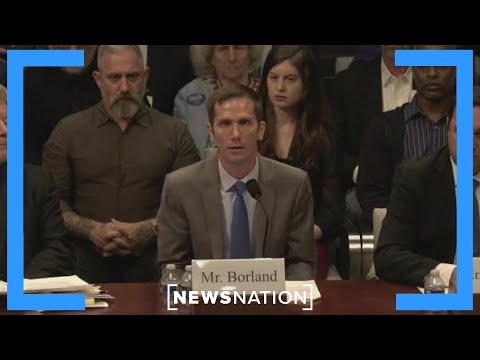
‘Truth needs to be known’: Air Force vet Dylan Borland on UAP | House UAP Hearing
Sworn testimony of USAF veteran Dylan Borland describing his 2012 encounter with a triangular UAP at Langley Air Force Base and subsequent professional reprisals.
NEW VIDEO: UAPs swarm U.S. military base; How will Congress respond? | Reality Check
Ross Coulthart investigates the Langley Air Force Base UAP swarm incursions, analyzing witness videos and congressional reaction.
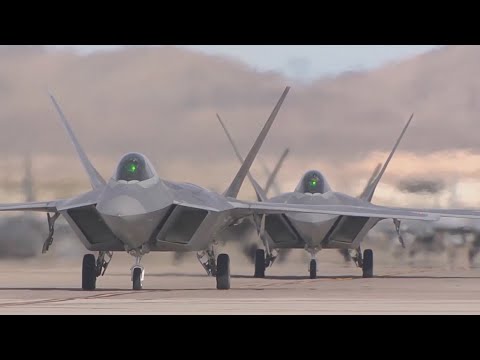
Unknown drones flew over a US Air Force base for 17 days straight in restricted air space
Comprehensive report detailing the 17 consecutive nights of UAP/drone swarm intrusions over JBLE Langley AFB restricted airspace in December 2023.
Sources
- NORAD Commander Gen. Gregory Guillot, Senate Armed Services Committee Testimony, March 2024. armed-services.senate.gov
- FAA Temporary Flight Restriction (TFR) Notice, Langley AFB airspace, December 2023. tfr.faa.gov
- Joint Base Langley-Eustis Public Affairs Statement on drone incursions, Dec 2023. twz.com
- Borland, Dylan. Whistleblower Congressional Testimony, House Oversight Committee, Sept 2025. oversight.house.gov
- Borland, Dylan. Air Force Geospatial Intelligence Incident Report, JBLE Langley AFB, Dec 2012
- US Department of Defense, Counter-UAS coordination cell logs, Dec 2023
- "Drones Swarm Restricted Airspace Over Langley Air Force Base," The War Zone, Dec 2023. twz.com
- "NORAD Tracks Anomalous Drones Over Sensitive Installations," Defense News, March 2024
- Borland, Dylan. Private journal entry, 2012
- borland_langley_afb_whistleblower_exhibit_A.pdf, National Security Archive
- Borland, Dylan. Interview with Ross Coulthart, NewsNation, Oct 2025
- borland_langley_afb_whistleblower_exhibit_B.pdf, National Security Archive
- borland_langley_afb_whistleblower_exhibit_C.pdf, National Security Archive
- Borland, Dylan. Correspondence with Sen. Kirsten Gillibrand, Senate Armed Services Committee, 2024
- Borland, Dylan. Whistleblower Complaint, DoD Inspector General, June 2024
See something inaccurate? Have additional information or sources?
Suggest an Edit →Last Updated: June 29, 2026