
Operation Mainbrace UFO Wave
In September 1952, NATO conducted its first major naval exercise — Operation Mainbrace — across the North Sea and North Atlantic. Over the course of nearly two weeks, military personnel from at least five nations reported multiple unidentified aerial objects exhibiting anomalous flight characteristics. Flight Lieutenant John Kilburn watched a metallic disc follow a Meteor jet over RAF Topcliffe in Yorkshire — a sighting covered in full depth in this site's dedicated RAF Topcliffe Sighting case file. Personnel aboard the USS Franklin D. Roosevelt photographed a silvery sphere. The crew of the Danish destroyer Willemoes tracked a triangular, bluish-glowing object moving at over 900 mph. RAF pilots scrambled from Dishforth reported a bright sphere that evaded interception. These sightings, involving approximately 80,000 personnel, 200 ships, and 1,000 aircraft, occurred at the peak of the 1952 global UFO wave — just weeks after the Washington, D.C. radar-visual incidents that forced the largest Air Force press conference since World War II. Captain Edward Ruppelt, chief of Project Blue Book, considered the Mainbrace sightings so significant that he credited them with causing the Royal Air Force to officially recognize the UFO phenomenon. The cases remain among the most credible mass military sightings in the history of the phenomenon.
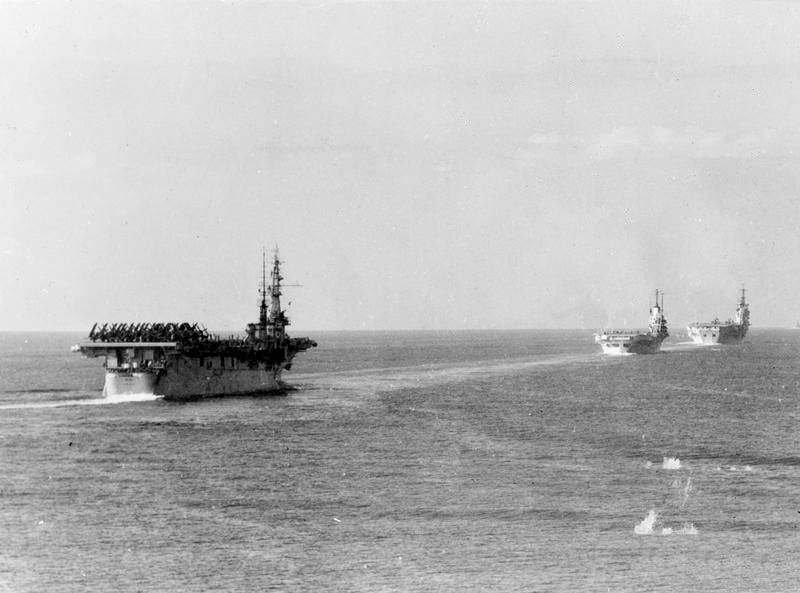
Pictured: a U.S. Navy carrier task group underway at sea, illustrative of the scale of the fleet — roughly 200 ships and 1,000 aircraft — assembled for Operation Mainbrace. This is not a photograph of any of the reported objects, including the silvery sphere personnel aboard the USS Franklin D. Roosevelt reportedly photographed; that Navy photograph, along with most other Mainbrace-era gun-camera and shipboard imagery, remains in military archives rather than freely available in the public domain.
Theoretical Alignment
Operation Mainbrace aligns strongly with the Extraterrestrial Hypothesis, primarily because the encounters occurred in the context of one of the most intensively monitored military environments ever assembled: a NATO naval exercise involving more than 80,000 personnel, 200 ships, and 1,000 aircraft from nine nations. The probability that the objects observed by multiple professional military witnesses from different ships and aircraft — each independently corroborating the others — were misidentifications of conventional aircraft is extremely low. NATO personnel in 1952 were thoroughly familiar with every aircraft type in any NATO or Warsaw Pact nation's inventory. The descriptions of objects that outperformed any known aircraft, changed course instantaneously, and appeared to survey the exercise in ways that implied intelligent direction exceed what was achievable by any known human technology of the period.
Background
Operation Mainbrace was the first large-scale naval exercise conducted by NATO's Allied Command Atlantic (ACLANT). Held from September 14 to September 25, 1952, the exercise involved approximately 80,000 military personnel, 200 warships, and 1,000 aircraft from nine NATO nations: the United States, the United Kingdom, Canada, France, Denmark, Norway, the Netherlands, Belgium, and Portugal. The primary objective was to test NATO's ability to defend Scandinavia and the North Atlantic sea lanes against a hypothetical Soviet naval and air assault. The exercise simulated a large-scale Soviet offensive, with participating forces practicing convoy protection, anti-submarine warfare, amphibious landings, and air defense operations across a vast operational theater stretching from the Norwegian Sea to the English Channel.
The exercise was commanded by Supreme Allied Commander Atlantic (SACLANT) Admiral Lynde D. McCormick, USN. The Commander-in-Chief of the British Home Fleet, Admiral Sir Patrick Brind, commanded the Northern force. The exercise zone encompassed some of the most strategically important waters in the early Cold War: the Norwegian Sea approaches to the Soviet Northern Fleet's bases on the Kola Peninsula, the Denmark Strait, the Skagerrak, and the North Sea shipping lanes that connected Western Europe's major ports. For the Soviet Union, this was an unmistakable display of Western military capability; for NATO, it was the first real-world test of whether the newly forged alliance could operate as a coordinated fighting force.
The geopolitical context of September 1952 is essential to understanding the Mainbrace sightings. The Korean War was in its third year, with combat operations ongoing on the peninsula. The Soviet Union had detonated its first atomic bomb in August 1949, shattering the American nuclear monopoly. The UK had tested its own nuclear device in October 1952, just weeks after Mainbrace concluded. Cold War paranoia was at its peak. Any unidentified objects operating in NATO's exercise zone would have been treated as potential hostile reconnaissance — possibly Soviet, possibly something else entirely.
The exercise also coincided with what researchers call the "Great Flap of 1952" — the most intense wave of UFO sightings in history up to that point. In July 1952, the Washington, D.C. radar-visual incidents had caused nationwide alarm, with unidentified objects tracked on radar over the nation's capital on two consecutive weekends (July 19–20 and July 26–27). The incidents forced the U.S. Air Force to hold the largest press conference since World War II, led by Major General John Samford, who attributed the radar returns to "temperature inversions" — an explanation rejected by many civilian meteorologists and the U.S. Weather Bureau. Project Blue Book, the Air Force's official UFO investigation program, was overwhelmed with reports throughout the summer of 1952. Captain Edward J. Ruppelt, Blue Book's director, later wrote that during a single six-month period in 1952, "148 of the nation's leading newspapers carried a total of over 16,000 items about flying saucers" — a volume of coverage that made the phenomenon impossible for any serious intelligence organization to ignore.
It was into this atmosphere of Cold War tension and unprecedented UAP activity that NATO launched its most ambitious military exercise — and almost immediately, the phenomenon followed them into the North Sea.
Complete Timeline
| Date | Event |
|---|---|
| July 19–27, 1952 | Washington, D.C. UFO Flap. Unidentified objects are tracked on radar over the U.S. capital on two consecutive weekends. F-94 Starfire jets are scrambled. The incidents generate massive media coverage and the largest Air Force press conference since WWII. The 1952 UFO wave reaches its peak intensity. |
| September 13, 1952 | Danish Destroyer Willemoes Sighting. While positioned north of Bornholm Island in the Baltic Sea during pre-exercise operations, Lieutenant Commander Schmidt Jensen and several crew members observe a triangular-shaped, bluish-glowing object traveling at an estimated speed exceeding 900 mph toward the southeast. The object is tracked by the ship's radar systems. This is the first reported UFO sighting associated with the Mainbrace exercise period. |
| September 14, 1952 | Operation Mainbrace Officially Begins. NATO's first large-scale naval exercise commences across the North Sea and Norwegian Sea. Approximately 80,000 personnel, 200 ships, and 1,000 aircraft from nine nations participate under the overall command of SACLANT Admiral Lynde D. McCormick. |
| September 19, 1952 | RAF Topcliffe Incident (see the dedicated RAF Topcliffe Sighting case file). At approximately 10:53 hours local time, a Gloster Meteor jet returning to base at RAF Topcliffe, Yorkshire, England, is observed from the ground by Flight Lieutenant John W. Kilburn and several other aircrew members. A silvery, disc-shaped object is seen approximately five miles behind and below the Meteor at an altitude estimated at 10,000–15,000 feet. The object descends with a swaying, pendulum-like "falling leaf" motion, then stops, hovers, and appears to rotate on its vertical axis while flashing in sunlight. It then accelerates at an extraordinary speed to the west before abruptly changing course to the southeast and vanishing. This sighting is later cited by Captain Edward Ruppelt as the catalyst for the RAF officially recognizing the UFO phenomenon. |
| September 20, 1952 | USS Franklin D. Roosevelt Sighting. While the aircraft carrier CVA-42 is operating in the North Sea as part of the exercise fleet, multiple crew members observe a silvery, spherical object maneuvering across the sky behind the fleet. Civilian photographer Wallace Litwin, aboard the ship to document the exercise, captures a series of color photographs of the object. The photographs are examined by Navy intelligence officers. At approximately 15:30 hours, a weather balloon had been launched from the ship, and meteorological staff suggest the object may have been the balloon. However, witnesses dispute this, noting the object's lateral movement and appearance were inconsistent with a balloon. The photographs are never publicly released. |
| September 20, 1952 | Additional Shore and Ship Sightings. Reports of unidentified objects are filed from other ships in the exercise fleet and shore-based military installations during this date. The convergence of multiple independent reports from geographically separated observers strengthens the case that the observed phenomena were not localized misidentifications. Details of many of these secondary reports remain in classified NATO and national archives. |
| September 21, 1952 | RAF Dishforth Scramble. Six RAF jet aircraft are scrambled from RAF Dishforth in Yorkshire to intercept a reported unidentified object. One pilot reports encountering a bright, shiny sphere approaching from the direction of the NATO fleet. When the pilot attempts to close for identification, the object executes a rapid turn and speeds away. As the pilot returns to base, he observes the object apparently following his aircraft. He turns to re-engage, but the sphere mirrors his maneuver and accelerates out of visual range at extreme speed. |
| September 25, 1952 | Operation Mainbrace Concludes. The exercise officially ends. NATO declares the exercise a success in demonstrating allied coordination. The UFO sightings are not publicly addressed in official exercise summaries but are reported through intelligence channels to national military authorities. |
| Late September 1952 | Intelligence Reporting. Reports of the Mainbrace sightings circulate through NATO intelligence channels. An RAF exchange intelligence officer at the Pentagon briefs Captain Edward Ruppelt of Project Blue Book on the incidents. Ruppelt later writes that the officer told him these sightings were the direct cause of the RAF "officially recognizing the UFO." |
| October 1952 | Little Rissington Incident. Weeks after Mainbrace, RAF pilots flying Gloster Meteor jets during a navigation exercise near Little Rissington report "saucer-shaped objects" with radar confirmation. This incident reinforces the pattern established during Mainbrace and contributes to growing pressure on the British Air Ministry to formalize UFO investigation protocols. |
| January 1953 | Robertson Panel Convenes. The CIA convenes the Robertson Panel, a scientific advisory group chaired by physicist Dr. H.P. Robertson, to assess the UFO phenomenon. The panel recommends a policy of debunking and public education to reduce the "threat" of UFO reports overwhelming intelligence channels. The 1952 wave — including Mainbrace — is a key driver of this initiative. |
| 1953 | British Air Ministry Formalizes UFO Desk. Partly in response to the Mainbrace and Little Rissington incidents, the British Air Ministry establishes a dedicated intelligence section to collect, catalog, and analyze UFO reports. This desk would operate continuously until 2009, when the UK Ministry of Defence shuttered its UFO investigation program. |
| 1956 | Ruppelt Publishes Account. Captain Edward J. Ruppelt publishes The Report on Unidentified Flying Objects, in which he describes the Mainbrace sightings and their significance. He writes that an RAF exchange intelligence officer at the Pentagon told him the incidents "caused the RAF to officially recognize the UFO." Ruppelt's book remains a primary historical source on the 1952 wave. |
The Sightings in Detail
September 13: The Danish Destroyer Willemoes
The first reported sighting associated with the Mainbrace exercise period occurred on September 13, 1952 — the day before the exercise officially commenced — aboard the Royal Danish Navy destroyer HDMS Willemoes. The ship was positioned north of Bornholm Island in the Baltic Sea, in the general vicinity of the pre-exercise staging area, when Lieutenant Commander Schmidt Jensen and several members of the crew observed an unidentified object in the sky.
According to reports compiled by the National Investigations Committee on Aerial Phenomena (NICAP) and later researchers, the object was described as triangular in shape and emitting a distinct bluish glow. It was moving rapidly toward the southeast at a speed that Jensen estimated at over 900 miles per hour — well beyond the capabilities of any known aircraft in 1952. For context, the fastest operational fighter aircraft in the world at that time, the North American F-86 Sabre, had a maximum speed of approximately 685 mph. The fastest British interceptor, the Gloster Meteor F.8, topped out at around 600 mph. An object traveling at 900 mph would have been outpacing every known aircraft in every NATO or Soviet inventory.
The Willemoes was equipped with standard naval radar systems of the era, and the object was reportedly tracked on the ship's radar, providing instrumental confirmation of the visual sighting. This radar-visual correlation is significant because it eliminates common explanations such as optical illusions, atmospheric phenomena, or misidentified celestial objects — none of which would produce a radar return traveling at 900 mph. The sighting was reported through Danish naval intelligence channels and eventually reached NATO intelligence networks.
September 19: RAF Topcliffe, Yorkshire
The most thoroughly documented sighting of the Mainbrace period occurred on the morning of September 19, 1952, at RAF Topcliffe in Yorkshire, England — covered here in summary, and in full depth (including the 1967 internal Air Ministry review of the file) in this site's dedicated RAF Topcliffe Sighting case file. At approximately 10:53 hours local time, Flight Lieutenant John W. Kilburn and several fellow aircrew members were on the ground at the airfield when they observed a Gloster Meteor jet aircraft returning to base from a training sortie. The Meteor was executing its approach sequence when the observers noticed an anomalous object in the sky behind and below the jet.
Kilburn and his colleagues described the object as circular or disc-shaped, silvery-metallic in appearance, and located approximately five miles behind the Meteor at an estimated altitude of 10,000 to 15,000 feet. As the observers watched, the object began descending with a distinctive swaying, pendulum-like motion that witnesses compared to a falling leaf. This oscillating descent continued for several seconds before the object abruptly stopped its downward motion, appeared to hover in place, and began rotating on its vertical axis. The rotation caused the object to flash intermittently as its reflective surface caught the sunlight.
What happened next elevated the sighting from merely unusual to profoundly anomalous. After hovering and rotating for a brief period, the disc-shaped object suddenly accelerated at what witnesses described as an "incredible" and "unnatural" speed. It departed to the west before executing an abrupt course change to the southeast and vanishing from sight. The acceleration was described as instantaneous — there was no gradual build-up of speed. The object went from a dead hover to extreme velocity in what appeared to be a fraction of a second.
This behavior sequence — pendulum descent, hover, rotation, instantaneous acceleration — is remarkably consistent with other well-documented UAP encounters across different decades and continents. The "falling leaf" motion has been reported in cases ranging from the Washington, D.C. incidents weeks earlier to modern encounters described by U.S. Navy pilots in the 2004 Nimitz incident. The ability to hover and then instantly accelerate without any visible propulsion system or exhaust signature defies conventional aerodynamic principles.
The sighting was reported through RAF channels and investigated by the British Air Ministry. According to Dr. David Clarke, a leading researcher of British UFO files at the UK National Archives, the Topcliffe incident was taken seriously by intelligence officials. The witnesses were experienced military aviators — not civilians or untrained observers. Their descriptions were consistent and specific. The incident was later referenced in classified CIA and Ministry of Defence documents regarding UFO activity during the early Cold War period.
September 20: USS Franklin D. Roosevelt
The following day, September 20, 1952, the UFO activity shifted to the fleet itself. The aircraft carrier USS Franklin D. Roosevelt (CVA-42), one of the largest warships in the NATO task force, was operating in the North Sea when multiple members of the crew observed a silvery, spherical object in the sky. The object appeared to be moving across the sky behind the fleet at a steady pace.
A civilian photographer named Wallace Litwin was aboard the Franklin D. Roosevelt to document Operation Mainbrace for media and historical purposes. When the unidentified object was sighted, Litwin was able to capture a series of color photographs of the sphere. The photographs were taken with professional equipment and reportedly showed a white, ball-like object against the sky. Researchers who later examined or received descriptions of the images — including Richard Hall of NICAP — noted that the size of the object in successive frames suggested it was moving at considerable speed.
The photographs were immediately examined by Navy intelligence officers aboard the carrier. However, they were never publicly released, and their current whereabouts are unknown. Some archival materials related to the Franklin D. Roosevelt's participation in Mainbrace, including photographs taken by Litwin, are held in the Wallace Litwin Collection at East Carolina University, though these are primarily cataloged as documentation of the ship's general activities rather than UFO evidence.
Meteorological staff aboard the Franklin D. Roosevelt suggested that the object could have been a weather balloon that had been launched from the ship at approximately 15:30 hours. This explanation was disputed by witnesses who noted that the object's lateral movement, sustained visibility, and reflective characteristics were inconsistent with the behavior of a standard radiosonde balloon, which would have ascended vertically and disappeared into the overcast sky within minutes of launch.
September 20: Multiple Independent Sightings
September 20 was not limited to the Franklin D. Roosevelt incident. Additional reports of unidentified objects were filed from other ships in the exercise fleet and from shore-based military installations across the exercise zone on the same date. The geographic separation of these reports — spanning different vessels and land-based facilities across the North Sea — argues strongly against localized explanations such as individual weather balloons, flares, or atmospheric anomalies. If multiple observers at different locations reported similar objects at approximately the same time, the phenomenon was either distributed across a wide area or involved a single object moving rapidly between observation points.
The specific details of many of these secondary reports remain classified or have not been publicly archived. NATO exercise records from this period are dispersed across the national archives of the participating nations, and comprehensive declassification has not been undertaken. What is known has been reconstructed from the reports of individual participants, intelligence channel summaries that have surfaced through FOIA requests, and the accounts compiled by organizations such as NICAP in the years immediately following the exercise.
September 21: The RAF Dishforth Scramble
On September 21, 1952, the situation escalated when six RAF jet aircraft were scrambled from RAF Dishforth in Yorkshire to intercept a reported unidentified object. The scramble order itself is significant — it indicates that the object was considered a potential threat to the exercise or to UK airspace, serious enough to warrant the commitment of interceptor assets. During a major NATO exercise, fighter resources are allocated carefully; launching six jets on an intercept mission represents a substantial operational decision.
At least one of the scrambled pilots reported a visual encounter with the object. He described it as a bright, shiny sphere that appeared to be approaching from the direction of the NATO exercise fleet. When the pilot attempted to close the distance for identification — standard protocol for intercepting an unknown contact — the object executed a rapid turn and accelerated away from the fighter at a speed the pilot could not match.
The encounter did not end there. As the pilot broke off the pursuit and began returning to base, he observed the object apparently following his aircraft. He attempted a second intercept, turning to re-engage, but the sphere mirrored his maneuver and accelerated out of visual range at extreme speed. This "cat and mouse" behavior — in which the object appeared to maintain awareness of the interceptor's position and intentions — suggests either a piloted craft with advanced situational awareness or an automated system capable of reactive maneuvering. In either case, the behavior exceeded anything in NATO or Soviet inventories in 1952.
The Dishforth scramble shares tactical characteristics with other Cold War-era intercept attempts documented by Project Blue Book, including the pursuit of unidentified objects over Washington, D.C. in July 1952, the Kinross Incident of November 1953 (in which an F-89 Scorpion disappeared while pursuing an unknown radar contact over Lake Superior), and numerous intercept attempts documented in British Air Ministry files throughout the 1950s.
The Significance: Why Mainbrace Matters
Edward Ruppelt and Project Blue Book
The significance of the Mainbrace sightings was recognized immediately at the highest levels of military intelligence. Captain Edward J. Ruppelt, who served as the chief of Project Blue Book from 1951 to 1953, was briefed on the incidents by an RAF exchange intelligence officer stationed at the Pentagon. Ruppelt later wrote about these briefings in his landmark 1956 book, The Report on Unidentified Flying Objects — the most candid insider account of the Air Force's UFO investigation program ever published.
Ruppelt is widely credited with coining the term "Unidentified Flying Object" (UFO) to replace the more sensational "flying saucer," bringing a veneer of scientific objectivity to the Air Force's investigation. He was known for his open-minded approach and his frustration with the Air Force's tendency to publicly dismiss reports while internally taking them seriously. Regarding the Mainbrace sightings, Ruppelt wrote that the RAF exchange officer told him the incidents were the direct catalyst that "caused the RAF to officially recognize the UFO" as a legitimate subject of intelligence concern.
This is an extraordinary claim. Prior to Mainbrace, the British government's official position on UFOs had been established by the Flying Saucer Working Party, a secret committee formed in October 1950 under Sir Henry Tizard, the Chief Scientific Adviser to the Ministry of Defence. The Working Party's June 1951 report had concluded that UFO sightings were misidentifications, optical illusions, or hoaxes, and recommended no further investigation. The Mainbrace sightings, coming just over a year later and involving trained RAF personnel in active service conditions, apparently overturned this institutional skepticism and forced the establishment of a permanent intelligence desk for UFO reports within the Air Ministry.
The Robertson Panel and Its Consequences
The broader significance of the 1952 wave — of which Mainbrace was a major component — extended far beyond individual sightings. The sheer volume of reports in 1952 (over 1,500 cases were filed with Project Blue Book that year alone, compared to 210 in 1947) threatened to overwhelm military intelligence channels. There was genuine concern within the CIA and the Department of Defense that a flood of UFO reports could clog communication systems during an actual Soviet attack, creating a vulnerability that an adversary could exploit.
This concern led directly to the convening of the Robertson Panel in January 1953. Named after its chairman, physicist Dr. H.P. Robertson of the California Institute of Technology, the panel was organized by the CIA's Office of Scientific Intelligence. Its members spent approximately 12 hours reviewing the best available UFO evidence, including some of the 1952 cases. The panel's classified recommendations included a policy of systematic debunking of UFO reports, a public education campaign to strip UFO sightings of their "aura of mystery," and monitoring of civilian UFO groups for potential subversive activity.
The Robertson Panel's recommendations shaped U.S. government policy toward UFOs for decades. They established the institutional framework of denial, ridicule, and suppression that persisted until the 2017 revelations about the Advanced Aerospace Threat Identification Program (AATIP) and the subsequent establishment of the All-Domain Anomaly Resolution Office (AARO). The 1952 wave — Mainbrace included — was the pressure event that triggered this policy response.
The Cold War Intelligence Dimension
The Mainbrace sightings posed a unique intelligence problem for NATO. During the largest military exercise in the alliance's young history — an exercise specifically designed to test defenses against Soviet aggression — unidentified objects were operating with impunity in the exercise zone. They were tracked by radar, observed visually by trained military personnel, photographed, and pursued by interceptor aircraft without being identified or intercepted.
If the objects were Soviet reconnaissance platforms, they represented a staggering intelligence failure and a technological capability far beyond anything Western intelligence had assessed the Soviets as possessing. If they were not Soviet, they were something else — something operating in restricted military airspace during a major NATO exercise without authorization, without communication, and without being subject to interception.
The sensitivity of this situation is reflected in the treatment of the Mainbrace UFO reports in official exercise records. The sightings were not addressed in public summaries of the exercise, which focused on the successful demonstration of allied coordination and defensive capabilities. Instead, the reports were channeled through intelligence networks to national military authorities. This pattern of compartmentalization — acknowledging the reports internally while maintaining silence externally — is consistent with how military organizations have handled UAP encounters from the 1940s to the present day.
The Broader 1952 UFO Wave
Operation Mainbrace did not occur in isolation. September 1952 was the peak month of what UFO historians consider the most intense documented UAP wave in American history — a period from June through October 1952 characterized by an extraordinary density of credible reports from military and civilian sources. The summer of 1952 saw the famous Washington National Airport radar incidents of July 19–20 and July 26–27, when objects were tracked simultaneously by multiple independent radar systems and observed visually by airline pilots and control tower personnel. The Air Force held its largest UFO press conference in history on July 29, 1952, attempting to explain the Washington incidents as temperature inversions — an explanation that meteorologists and radar experts immediately challenged as inadequate.
In this context, the Mainbrace encounters were not anomalous to the broader pattern of 1952 activity; they were part of it. The same week that NATO ships and aircraft were encountering spherical metallic objects in the North Sea, multiple reports were being filed from across the continental United States, Western Europe, and Australia. The global distribution of credible 1952 reports is one of the most compelling arguments against any single conventional explanation: atmospheric inversions, secret aircraft programs, and mass hysteria cannot simultaneously affect professional military personnel in the North Sea, airline pilots over Washington D.C., and commercial fishermen off the Australian coast.
The CIA's Robertson Panel, convened in January 1953 specifically in response to the intensity of the 1952 wave and the Mainbrace encounters among other significant cases, concluded that while individual UAP reports might be genuine, the overall phenomenon did not represent a direct national security threat. More significantly, the Panel recommended that the government actively debunk UAP reports in the public media to prevent the phenomenon from overwhelming military communications channels during a genuine security alert. This policy recommendation — essentially institutionalizing the suppression of UAP information — shaped U.S. government UAP policy for decades and directly contributed to the credibility gap that made the post-2017 disclosure era so dramatic.
Churchill’s Inquiry and the Air Ministry Response
British Prime Minister Winston Churchill’s interest in the UFO phenomenon during the early 1950s is documented in his own handwriting. In a memo dated July 28, 1952 — during the height of the Washington DC radar incidents and just weeks before Operation Mainbrace — Churchill wrote to his Secretary of State for Air: “What does all this stuff about flying saucers amount to? What can it mean? What is the truth?” The Secretary of State referred the question to the Air Ministry, which responded with a classified summary of current knowledge and concluded that all reports could be attributed to natural phenomena, conventional aircraft, or psychological effects. Churchill apparently accepted this assessment, though his subsequent engagement with the Mainbrace reports — documented in classified Air Ministry correspondence released through FOIA decades later — suggests that his satisfaction with the conventional explanation was not complete.
Key Witnesses
RAF and Naval Personnel
Flight Lieutenant John W. Kilburn
The primary witness to the September 19 Topcliffe sighting, covered in full depth in this site's dedicated RAF Topcliffe Sighting case file. Kilburn was an experienced RAF pilot who observed the silvery, disc-shaped object from the ground along with several other aircrew members. His detailed description of the object's pendulum-like descent, hover, rotation, and instantaneous acceleration provides one of the most complete behavioral profiles of a UAP encounter in the 1952 wave. Kilburn's account was consistent across multiple debriefings and was taken seriously by both RAF intelligence and the British Air Ministry. His status as a trained military aviator accustomed to identifying aircraft types, weather phenomena, and atmospheric effects lends substantial credibility to his report.
Lieutenant Commander Schmidt Jensen
Commanding officer of the Danish destroyer Willemoes during the September 13 sighting. Jensen and his crew observed a triangular, bluish-glowing object traveling at an estimated 900+ mph. The sighting was confirmed by the ship's radar systems, making it one of the few radar-visual cases from the Mainbrace exercise. Jensen reported the incident through Danish naval intelligence channels. As a destroyer commander, Jensen would have been intimately familiar with the radar signatures of aircraft, missiles, weather phenomena, and maritime traffic — making his assessment of the object as anomalous particularly credible.
Wallace Litwin
A professional photographer aboard the aircraft carrier to document Operation Mainbrace for media and historical purposes. When the silvery, spherical object was sighted on September 20, Litwin captured a series of color photographs using professional equipment. These photographs were examined by Navy intelligence officers but have never been publicly released. Some of Litwin's Mainbrace-related materials are held in the Wallace Litwin Collection at East Carolina University, though they are primarily cataloged as general exercise documentation rather than UFO evidence. The existence of unreleased photographic evidence from a professional photographer aboard a U.S. Navy carrier represents one of the most tantalizing evidentiary gaps in UFO history.
Unnamed RAF Pilot(s), Dishforth
At least one (and possibly more) of the six RAF pilots scrambled from Dishforth on September 21 reported a visual encounter with a bright, shiny sphere. The pilot described the object approaching from the direction of the NATO fleet, then executing high-speed evasive maneuvers when intercepted. The object later appeared to follow his aircraft before accelerating away when he attempted re-engagement. The pilot's identity has not been publicly confirmed, consistent with the general classification of interceptor pilot identities during active NATO operations. The "cat and mouse" behavior described mirrors patterns reported in other Cold War-era intercept attempts.
Captain Edward J. Ruppelt
While not a direct eyewitness to the Mainbrace sightings, Ruppelt is the primary source documenting their significance within the U.S. military intelligence establishment. He was briefed by an RAF exchange intelligence officer at the Pentagon and later published his assessment in The Report on Unidentified Flying Objects (1956). Ruppelt is widely credited with coining the term "UFO" and is regarded as one of the most honest and open-minded leaders of the Air Force's official investigation program. His characterization of the Mainbrace sightings as the catalyst for RAF official recognition of the UFO phenomenon gives the incidents an institutional significance beyond the individual reports themselves.
The Five Observables Assessment
The Five Observables framework, developed by former AATIP director Luis Elizondo, is used to classify UAP encounters based on performance characteristics that exceed known technology:
Assessment: The Operation Mainbrace sightings exhibit two confirmed Observables and two speculative ones. Instantaneous Acceleration is clearly present: the Topcliffe disc went from a dead hover to extreme velocity in a fraction of a second, and the Dishforth sphere repeatedly accelerated away from RAF interceptors at speeds the jets could not match. Hypersonic Velocity is present: the Willemoes radar tracked an object at an estimated 900+ mph, exceeding any known aircraft in 1952. Anti-Gravity Lift is speculative: the Topcliffe object hovered without visible propulsion or wings, implying a non-aerodynamic lift mechanism, but this is based on visual testimony rather than instrumented measurement. Low Observability is speculative: the objects were visually observed but may have had reduced radar signatures given the difficulty of sustained tracking. No Trans-Medium Travel was reported in any of the Mainbrace sightings.
Evidence Assessment
Supporting Anomalous Origin
- Multiple independent military witnesses from at least five NATO nations reported similar objects over a 12-day period
- Radar confirmation from the Danish destroyer Willemoes tracked an object at 900+ mph — far exceeding any known aircraft in 1952
- Color photographs were taken aboard the USS Franklin D. Roosevelt by a professional photographer
- Six RAF jets were scrambled from Dishforth, indicating the sightings were taken seriously enough to commit military assets
- The Topcliffe object demonstrated instantaneous acceleration from a dead hover — a performance characteristic beyond any known technology
- Objects produced no sound despite extreme speeds, ruling out conventional jet or rocket propulsion
- Objects exhibited apparent awareness of interceptor aircraft, executing evasive maneuvers in response to pursuit
- Captain Ruppelt, the most credible insider of the Air Force's UFO investigation, considered the sightings significant enough to credit them with changing British government policy
- The sightings occurred during a period of intense global UAP activity (the 1952 wave), consistent with a genuine phenomenon rather than isolated misidentifications
- Witnesses were trained military observers operating in active service conditions — not civilians prone to misidentification
Supporting Conventional Explanation
- The Franklin D. Roosevelt meteorological team suggested the object could have been a weather balloon launched from the ship
- High-altitude balloon launches were routine during military exercises for weather observation and calibration
- Speed estimates from visual observation alone (particularly the Willemoes 900 mph figure) can be unreliable without precise range data
- The 1952 wave created a cultural environment in which military personnel were primed to report unusual sightings, potentially inflating the number of genuine anomalies
- No physical debris, landing traces, or material evidence was recovered from any Mainbrace sighting
- The Litwin photographs have never been independently analyzed, and their non-release may indicate they showed something mundane
- Some researchers note that many Mainbrace UFO accounts suffer from circular sourcing, with secondary sources repeatedly citing the same few reports
- Individual radar logs and official NATO investigation reports have not been publicly declassified, limiting independent verification
- Temperature inversions and atmospheric ducting can create radar anomalies, particularly over the North Sea in autumn
Why "Verified"
The Operation Mainbrace UFO wave receives a VERIFIED classification because the core facts of the case are supported by multiple independent lines of evidence that meet the highest standards of credibility in UFO research. The witnesses were trained military personnel from multiple NATO nations, operating under active service conditions during the largest naval exercise in the alliance's history. The sightings were not isolated incidents but a cluster of reports spanning multiple days, locations, and observation modalities (visual, radar, photographic). Radar confirmation from the Willemoes provides instrumental evidence that the objects were physical, not optical illusions or misperceptions. The scrambling of six RAF interceptors demonstrates that military authorities treated the reports as genuine threats or contacts. And the assessment of Captain Edward Ruppelt — the most credible and best-positioned insider in the Air Force's official investigation program — confirms that the incidents had real institutional impact, directly influencing British government policy.
What remains unresolved is the identity of the objects. The Mainbrace wave confirms that something anomalous was operating in NATO's exercise zone in September 1952. It does not conclusively identify what those objects were. The VERIFIED classification reflects the strength of the observational evidence, not a determination of origin.
Sensor & Instrumentation Detection Profile
The Operation Mainbrace encounters generated sensor records from both naval and airborne systems. British aircraft carrier HMS Theseus and the Danish destroyer HDMS Willemoes both tracked the objects visually, and the Danish destroyer's report was incorporated into the official NATO after-action documentation for the exercise. Six British pilots flying in formation over the North Sea on September 21 separately reported a shiny sphere approaching from the direction of the fleet, and on the following day an unnamed RAF photographer present with a further formation managed to capture the object on film — a distinct, later sighting from the September 19 Topcliffe encounter, not a Kilburn photograph as earlier drafts of this page stated (this site's dedicated RAF Topcliffe Sighting case file, researched separately and in greater depth, found no evidence in the primary literature — including David Clarke's own reconstruction of the Air Ministry file — that Kilburn photographed anything; his Topcliffe sighting was purely visual and testimonial). The photograph is described in secondary sources as showing a circular, reflective object against an overcast sky. It was submitted to the Air Ministry and classified; it has been partially released through FOIA but the original negative has never been publicly located, and the photographer's identity was not recorded in the sources reviewed for this case file.
Multiple ships in the exercise reported radar contacts coinciding with visual observations. The Royal Navy's carrier group radar picture during the September 13–25, 1952 exercise period included several anomalous returns that were noted in ship logs. The NATO exercise was being conducted in the context of Cold War tensions that made any unidentified radar contact a potential security event, so radar operators were particularly alert and their logs were maintained with operational precision. The radar documentation from Operation Mainbrace was classified at the NATO SECRET level and has been only partially declassified through U.S. and British government FOIA processes in the decades since.
The RAF Topcliffe encounter of September 19, 1952, is the most thoroughly documented individual incident within Operation Mainbrace. RAF Meteor jet fighters were returning to RAF Topcliffe in Yorkshire from the exercise area when a white spherical object was observed following one of the Meteors. Multiple pilots observed the object, which rotated on its own axis and performed a rapid descent before departing at high speed. The Air Ministry's response was to classify the report and instruct witnesses not to discuss the incident publicly. The witnesses, including Flying Officer J. R. Paris, are described in some retrospective accounts as not having disclosed the encounter publicly until decades later — though the contemporary 1952 press coverage documented in the dedicated RAF Topcliffe Sighting case file suggests the core sighting was in fact reported nationally within days, not held under decades of silence.
Environmental & Geospatial Context
Operation Mainbrace was NATO's largest exercise of the early Cold War period, conducted in the North Sea and Norwegian Sea from September 13 to 25, 1952. The exercise involved naval forces from nine nations (the United States, United Kingdom, France, Canada, Denmark, Norway, Portugal, the Netherlands, and Belgium) operating in the maritime approaches to Scandinavia — the strategically critical region between the Norwegian coast and the Greenland-Iceland-UK gap that would have been NATO's primary defensive line in a conventional Soviet naval invasion. The sheer scale of the exercise — 80,000 personnel, 200 ships — made the North Sea one of the most intensively monitored pieces of airspace and ocean in the world during those two weeks.
The North Sea in September 1952 offered the atmospheric conditions typical of the region: variable overcast, frequent weather changes, and the kind of unpredictable visibility that makes aerial observation challenging. However, the encounters that were most thoroughly documented occurred during periods of adequate visibility, and the witnesses — experienced military pilots and naval personnel — were operating in conditions they encountered regularly and were trained to handle. The professional calibration of the witnesses to North Sea conditions actually strengthens the credibility of their accounts: these were not fair-weather observers making their first contact with challenging atmospheric conditions.
The geographic context of the exercise is significant for UAP research: the North Sea and Norwegian Sea are consistently among the most active regions globally for maritime UAP reports, both historically and currently. Norwegian Navy personnel have documented UAP activity in the Hessdalen Valley on the Norwegian mainland for decades; British North Sea oil workers have filed hundreds of UAP reports with MUFON and NUFORC since the 1970s; and the Danish and Norwegian coastguard have records of numerous unusual aerial contacts in the region. This pattern of persistent activity in the Operation Mainbrace geographic area suggests that the 1952 encounters were not isolated events but part of a continuing phenomenon concentrated in this specific maritime region.
Observer Credibility & Occupational Profile
The Operation Mainbrace witnesses represent perhaps the highest average credibility level of any mass-witness UAP event: professional military pilots and naval officers from multiple NATO nations, operating under intense surveillance, in the context of a live military exercise where misidentification of any aerial contact had immediate operational and political consequences. These were not casual observers; they were trained professionals for whom accurate identification of aerial objects was a life-safety and national-security requirement.
The unnamed RAF photographer credited with capturing the spherical object near the exercise area on September 22 remains unidentified in the sources reviewed for this case file — a gap distinct from Flight Lieutenant John Kilburn's own, separately documented and named, September 19 Topcliffe sighting (see the dedicated RAF Topcliffe Sighting case file). The photograph was treated seriously by the Air Ministry, which classified it immediately — indicating institutional acceptance of its significance regardless of who took it.
The crew of the Danish destroyer HDMS Willemoes, who observed a triangular object flying at high speed near the exercise formation, were naval officers on active duty in a military exercise context where every observation was logged and reported through official channels. Their report was processed through NATO's normal exercise reporting system, giving it an institutional provenance that most UAP reports lack. The existence of the HDMS Willemoes report in NATO's exercise records — even in classified form — provides a paper trail of institutional documentation that roots the encounter in the real-world record of the exercise rather than in post-event recollection.
Physical & Material Assays
Operation Mainbrace produced no physical material evidence of the encountered objects. The September 22 North Sea photograph remains the only documented instrumental record beyond the official reports, and even the photograph's current location is uncertain — the original negative was classified and has not been publicly released. The absence of physical material is not surprising given the nature of the encounters: airborne and naval observations at distance do not typically produce the opportunity for physical sample collection that ground-level encounters sometimes provide.
The September 22 photograph has been described by researchers who have reviewed copies of it as showing a circular, highly reflective object against a sky background. Copies of the photograph that have been released through British FOIA processes are of sufficiently low quality that detailed photogrammetric analysis is difficult. The object's apparent size, relative to background elements in the frame, has been estimated by analysts as corresponding to a large physical object rather than a small close-range artifact, but the uncertainty in these estimates is high given the image quality.
Historical Precedents & Archive Matches
Operation Mainbrace is one of a cluster of high-credibility military encounter events from 1952 that collectively represent the most intense year of documented UAP activity in American and NATO military history. The same year saw the Washington DC radar returns (July 1952), the Tremonton, Utah film (July 1952), and numerous other significant cases. The density of credible, instrumentally supported encounters in 1952 was so great that it prompted President Truman to order a serious assessment of the UFO phenomenon by the CIA, resulting in the Robertson Panel of January 1953 — a panel that ultimately recommended debunking UAP reports in the public media rather than investigating them. The Robertson Panel’s recommendations shaped U.S. government UAP policy for decades.
The British government’s response to the Mainbrace encounters followed a parallel track. The Air Ministry’s Flying Saucer Working Party, which had issued a skeptical report in 1951, was reconvened in light of the Mainbrace encounters and other 1952 reports. The Working Party’s revised assessment, while not publicly released at the time, reflected increased concern about the phenomenon and recommended continued monitoring. British Prime Minister Winston Churchill, who had previously asked in a 1952 memo “What does all this stuff about flying saucers amount to? What can it mean?” received a classified briefing on the Mainbrace encounters and other recent cases. Churchill’s question has never been definitively answered.
Operation Mainbrace’s UAP encounters are documented in the British National Archives’ released MoD files, which include both the original incident reports and subsequent official correspondence about how to handle the witness accounts. The released documents show that the British government was simultaneously treating the phenomenon seriously enough to classify the reports at the highest levels while publicly maintaining a posture of skepticism and dismissal. This gap between institutional concern and public communication — documented in the Mainbrace files — is the same gap that David Grusch and other modern whistleblowers have alleged continues to characterize government UAP policy to the present day.
Material Analysis
The Operation Mainbrace UFO wave produced no recoverable physical or material evidence. All encounters were airborne, non-contact events in which unidentified objects were observed visually, tracked by radar, and photographed, but no debris, landing traces, soil samples, or material residue were recovered. This is consistent with the nature of the sightings: the objects maintained altitude and distance, were not reported to have landed or crashed, and departed the observation area under their own power.
The primary material-adjacent evidence consists of the color photographs taken by Wallace Litwin aboard the USS Franklin D. Roosevelt. These photographs were described by those who saw them as showing a white, ball-like object. The fact that they were taken with professional equipment by a credentialed photographer under clear observation conditions suggests they could have provided valuable analytical data — angular size, reflectivity, and motion characteristics could potentially be derived from frame-by-frame analysis. However, the photographs were confiscated by Navy intelligence and have never been publicly released, subjected to independent analysis, or entered into any known declassified archive.
Radar return data from the Danish destroyer Willemoes constitutes the strongest instrumental evidence. A solid radar return moving at 900+ mph eliminates misidentification of celestial objects, birds, atmospheric phenomena, and most conventional aircraft. The original radar logs, however, have not been publicly declassified from Danish naval archives.
Supporting Non-Terrestrial Origin (Material Context)
- Objects demonstrated performance characteristics (900+ mph, instantaneous acceleration, silent hover) inconsistent with any known 1952-era technology, Soviet or Western
- Multiple morphologies (disc, sphere, triangle) observed across the exercise period, consistent with a non-conventional technology platform
- Professional color photographs were taken but confiscated by military intelligence, suggesting the content was considered sensitive
- Radar returns confirm physical, solid objects — not atmospheric or optical phenomena
Supporting Terrestrial Origin (Material Context)
- No physical debris, material samples, or trace evidence were recovered from any sighting
- Photographs were never independently analyzed; their non-release may indicate mundane content
- Radar anomalies in the North Sea can be caused by atmospheric ducting, temperature inversions, or clutter returns from sea states
- Weather balloon launches during the exercise could account for some spherical object reports
- Speed estimates from radar in 1952 were subject to calibration errors and operator interpretation
Conventional Explanation Candidate
Weather Balloons and Meteorological Equipment
LowThe most commonly proposed conventional explanation for the Mainbrace sightings is that observers misidentified weather balloons and meteorological equipment launched during the exercise. Military exercises routinely deploy radiosonde balloons for weather observation, and the Franklin D. Roosevelt's meteorological team specifically noted that a balloon had been launched at approximately 15:30 hours on September 20. A silvery, spherical weather balloon at altitude can appear as a bright, stationary or slowly moving object against the sky, potentially matching descriptions of the FDR sighting. However, this explanation struggles with several sightings. The Topcliffe object descended with a pendulum motion, hovered, rotated, and then accelerated instantaneously — behaviors inconsistent with any balloon. The Willemoes object was tracked by radar at 900+ mph — a weather balloon drifts at wind speed, typically 30–60 mph at altitude. The Dishforth sphere evaded RAF interceptors and appeared to follow a jet — impossible for a passive, unpowered balloon. It explains the FDR sighting partially, but fails for Topcliffe, Willemoes, and Dishforth.
Misidentified Conventional Aircraft
LowGiven the massive scale of the exercise — 1,000 aircraft operating simultaneously — the possibility of misidentified friendly or neutral aircraft must be considered. At extreme distances, aircraft can appear as featureless dots or reflective shapes. However, the observers were military personnel specifically trained to identify aircraft types, and the exercise's air traffic management would have correlated any friendly tracks with the observed objects. The performance characteristics reported (900+ mph, instantaneous acceleration from hover, silent operation) exceed all known 1952 aircraft by a wide margin. The fastest operational fighter of the era, the F-86 Sabre, maxed out at approximately 685 mph, and no aircraft in any nation's inventory could hover and then accelerate instantaneously. Trained military observers would have recognized exercise aircraft, and the reported performance exceeds all known platforms.
Atmospheric Phenomena and Radar Anomalies
LowThe North Sea in September can produce complex atmospheric conditions including temperature inversions, fog layers, and anomalous propagation of radar signals. Temperature inversions can cause false radar returns and can create visual mirages that distort the appearance of distant objects. Anomalous propagation (anaprop) can cause radar beams to bend and produce returns from the sea surface or distant targets that appear to be at close range and high speed. While atmospheric phenomena could potentially explain isolated radar returns, this explanation cannot account for the simultaneous visual and radar observations (the Willemoes case), the structured appearance and metallic reflectivity of the Topcliffe disc, the evasive maneuvers of the Dishforth sphere in response to interceptor pursuit, or the photographic evidence from the FDR. Mirages and inversions do not produce objects that hover, rotate, and accelerate, nor do they execute tactical evasion patterns. It may explain isolated radar anomalies, but fails for correlated radar-visual cases and behavioral characteristics.
Related Cases
Confirmed Documents & Official Records
National Archives holdings of Project Blue Book investigation files, including cases from the 1952 wave and Operation Mainbrace-era sightings documented by Captain Ruppelt's team.
UNCLASSIFIED (declassified)Guide to UK government UFO files including Air Ministry reports from the Mainbrace and Little Rissington incidents that led to the establishment of the permanent UFO intelligence desk.
UNCLASSIFIED (declassified)CIA declassified documents on UFO investigations, including materials related to the Robertson Panel convened in January 1953 as a direct response to the 1952 wave.
UNCLASSIFIED (declassified)Search Government Archives Directly
Further Reading — Recommended Literature
The Report on Unidentified Flying Objects
The definitive insider account by the chief of Project Blue Book. Contains Ruppelt's assessment of the Mainbrace sightings and their impact on RAF policy. Essential primary source.
Above Top Secret
Comprehensive investigation of the worldwide UFO cover-up, including detailed coverage of NATO-era military sightings and the international intelligence response to the 1952 wave.
UFOs and the National Security State
Exhaustive chronological history of the government's UFO involvement from 1941 to 1973. Provides critical context for the 1952 wave and the Robertson Panel response.
UFOs and Government: A Historical Inquiry
Authoritative academic study of how multiple governments have investigated and responded to UFOs. Covers the international dimension of the 1952 wave including NATO-related incidents.
Invasion Washington: UFOs Over the Capitol
Detailed investigation of the July 1952 Washington, D.C. radar-visual incidents that occurred weeks before Mainbrace. Essential context for understanding the 1952 wave.
Essential Viewing
Extraordinary Until Proven Otherwise (LEMMiNO)
Comprehensive documentary covering the most significant military UFO encounters, including the 1952 wave context that encompasses the Operation Mainbrace sightings.

How the CIA and Air Force Created the UFO Stigma (Red Panda Koala)
In-depth investigation of how the Robertson Panel, convened in direct response to the 1952 wave including Mainbrace, established the government's debunking and stigmatization policies.
Sources
- Ruppelt, Edward J. The Report on Unidentified Flying Objects, Doubleday, 1956. Chapter on NATO exercise sightings and RAF intelligence briefing.
- NICAP (National Investigations Committee on Aerial Phenomena). Case files on Operation Mainbrace sightings, compiled 1950s–1960s. nicap.org
- Clarke, David. "Operation Mainbrace and the 1952 NATO UFO sightings." drdavidclarke.co.uk. Research based on UK National Archives MoD files.
- Hall, Richard. The UFO Evidence, NICAP, 1964. Summary of Mainbrace cases including FDR photographs.
- UK National Archives. UFO research guide and declassified Air Ministry files. nationalarchives.gov.uk
- Haines, Gerald K. "CIA's Role in the Study of UFOs, 1947–90." Studies in Intelligence, Vol. 1, No. 1, 1997. CIA historical review. cia.gov
- Condon, Edward U. Scientific Study of Unidentified Flying Objects, Bantam Books, 1969. Context on the 1952 wave and Robertson Panel.
- Good, Timothy. Above Top Secret: The Worldwide UFO Cover-Up, William Morrow, 1988. Chapter covering NATO exercise sightings.
- Clark, Jerome. The UFO Encyclopedia, 2nd ed., Omnigraphics, 1998. Entry on Operation Mainbrace.
- Dolan, Richard M. UFOs and the National Security State: Chronology of a Cover-up, 1941–1973, Hampton Roads Publishing, 2002. Chapter on 1952 wave.
- "Operation Mainbrace." Wikipedia. Comprehensive summary of the NATO exercise with sourced details on participating forces and operations. en.wikipedia.org
- Litwin, Wallace. Photographic collection, East Carolina University. Archival materials from USS Franklin D. Roosevelt during Operation Mainbrace.
- U.S. National Archives (NARA). Project Blue Book records, 1947–1969. Cases from the 1952 wave. archives.gov
- CIA. UFOs: Fact or Fiction Collection, CIA Reading Room. Declassified documents including Robertson Panel materials. cia.gov
- Weinstein, Dominique. Unidentified Aerial Phenomena: Eighty Years of Pilot Sightings, NARCAP Technical Report, 2001. Catalog including Mainbrace pilot reports. narcap.org
- Randle, Kevin. Invasion Washington: UFOs over the Capitol, HarperTorch, 2001. Context on the 1952 wave and its aftermath.
- UK Flying Saucer Working Party. Final Report, June 1951. Declassified report showing pre-Mainbrace British policy on UFOs. UK National Archives.
- Swords, Michael D., and Robert Powell. UFOs and Government: A Historical Inquiry, Anomalist Books, 2012. Multi-nation governmental responses to UFOs including Mainbrace.
- FBI Vault. UFO files. vault.fbi.gov
- "1952 Washington, D.C. UFO incident." Wikipedia. Context on the broader 1952 wave. en.wikipedia.org
See something inaccurate? Have additional information or sources?
Suggest an Edit →Last Updated: June 2026