
RAF Topcliffe Sighting
Just before 11:00 a.m. on September 19, 1952 — six days into NATO's Operation Mainbrace exercise — ten Royal Air Force officers and aircrew on the ground at RAF Topcliffe, Yorkshire watched a silvery, disc-shaped object descend in a swaying, "falling sycamore leaf" motion roughly five miles behind a Gloster Meteor jet returning to base. The object stopped, hovered, rotated on its own axis, and then, in Flight Lieutenant John Kilburn's own words, accelerated westward "at a rate in excess of that of a shooting star" before vanishing. Splashed across the front page of the Sunday Dispatch two days later under the headline "SAUCER CHASED RAF JET PLANE," the sighting became one of the most consequential in British UFO history: Captain Edward Ruppelt, chief of the U.S. Air Force's Project Blue Book, credited it with the decision that "caused the RAF to officially recognise the UFO," leading directly to the Air Ministry's permanent UFO intelligence desk. A skeptical internal review fifteen years later reached a very different conclusion about what, exactly, the file actually proved.
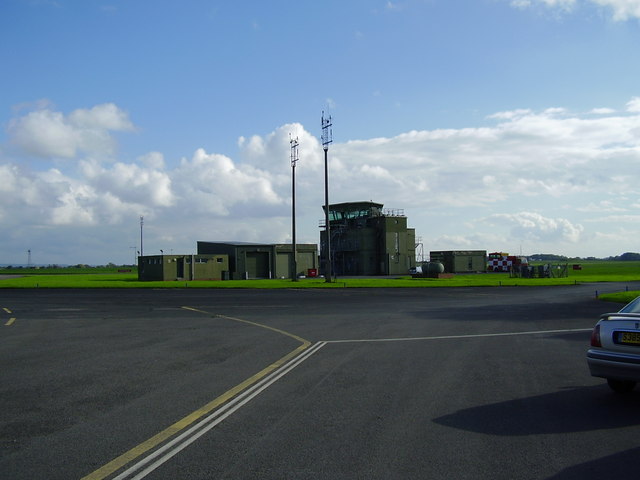
Pictured: the control tower at RAF Topcliffe, North Yorkshire, photographed in 2006 — not a photograph of the September 19, 1952 sighting itself, of which no photograph is known to exist. The tower and airfield remain standing today as an enclave within Alanbrooke Barracks; this is the same general vantage point from which Flt. Lt. Kilburn and the other nine witnesses would have been watching the returning Meteor jet and the object behind it.
Theoretical Alignment
The case aligns moderately with the Extraterrestrial Hypothesis on the strength of the described performance characteristics — a stationary hover followed by an "incredible," effectively instantaneous acceleration is not something any 1952 aircraft could replicate — but that alignment is capped well below the mid-century high-water-mark cases (like the Willemoes radar-visual sighting six days later) because Topcliffe has zero instrumented confirmation of any kind. It retains almost no weight under the Interdimensional Hypothesis, which finds no support in the plain, physically-described object Kilburn and his colleagues reported. The Psycho-Social framework carries real weight here specifically because of the 1967 Air Ministry review discussed below, which concluded the file's own evidence could not actually establish that the object was doing everything Kilburn's dramatic account implied — a genuine, internally-documented instance of the gap this framework predicts between an exciting group experience and what can be objectively verified from it afterward.
Background
The Topcliffe sighting did not occur in isolation. It happened on the sixth day of Operation Mainbrace, NATO's first major postwar naval exercise, which ran from September 13 to 25, 1952 across the North Sea and Norwegian Sea and drew roughly 80,000 personnel, 200 ships, and 1,000 aircraft from nine member nations. This site's own Operation Mainbrace case file covers that broader exercise and its full cluster of associated sightings — the Danish destroyer Willemoes's radar-tracked triangle on September 13, the USS Franklin D. Roosevelt's photographed sphere on September 20, and the RAF Dishforth interceptor scramble on September 21 — in detail, and readers looking for that wider context should start there. This file exists because the Topcliffe incident, among all of Mainbrace's individual reports, left the deepest and best-documented paper trail: a named, quoted witness statement, a surviving Air Ministry file reference, contemporary national press coverage, and a direct causal claim, made by the man who ran Project Blue Book, that this specific sighting changed how the British government treated the UFO question.
RAF Topcliffe itself had nothing unusual about it as a Cold War airfield. It opened in September 1940 as a Bomber Command station in the Vale of York, initially hosting No. 77 and No. 102 (Ceylon) Squadrons flying Armstrong Whitworth Whitley heavy bombers, before Royal Canadian Air Force squadrons — No. 419 and No. 424, flying Wellingtons and later Halifaxes — arrived as part of No. 6 (RCAF) Group. By the early 1950s the station's role had shifted from bombing to transport: the published operational record places No. 24 and No. 47 Squadrons at Topcliffe through this period, both flying Handley Page Hastings transports. The nearby fighter station at RAF Dishforth, a few miles to the east, was the more likely home base for the Gloster Meteor jet the witnesses saw returning from its own Mainbrace-related sortie, and several primary and secondary accounts of the sighting describe the Meteor as "approaching Dishforth aerodrome" even though the observers themselves were watching from the ground at Topcliffe.
Multiple published accounts of the Topcliffe sighting — including Dr. David Clarke's own detailed reconstruction of the incident, sourced from the surviving National Archives file — identify the primary witnesses as belonging to No. 269 Squadron, a Royal Air Force Coastal Command maritime-reconnaissance unit. This case file's own research could not fully reconcile that attribution with No. 269 Squadron's own published unit history, which places the squadron at RAF Ballykelly in Northern Ireland, flying Avro Shackleton patrol aircraft, throughout the second half of 1952 — not at Topcliffe. It is possible a 269 Squadron detachment or its aircrew were temporarily present at Topcliffe in connection with Mainbrace (large exercises of this kind routinely redeployed squadrons and aircrew away from their home stations for the duration), or that the squadron identification in the secondary literature is itself slightly mistaken; this file could not resolve the discrepancy from the sources available and states it plainly rather than silently picking one version. What is not in question, because it rests on the primary Air Ministry document itself rather than on any squadron history, is that Flight Lieutenant John Kilburn made a signed, quoted statement about what he and nine colleagues saw over Topcliffe that morning, and that statement reached the Air Ministry in London within hours.
The broader Cold War backdrop matters too. Mainbrace was NATO's most visible demonstration yet of its ability to fight as a unified alliance against a hypothetical Soviet assault on Scandinavia and the North Atlantic sea lanes, staged just three years after the Soviet Union's first atomic test and while the Korean War still ground on. It also landed at the peak of 1952's "Great Flap" — the most intense UFO reporting wave on record up to that point, capped by the Washington, D.C. radar-visual incidents of July 19–20 and 26–27, which had already forced the U.S. Air Force into its largest press conference since the Second World War. British service personnel taking part in Mainbrace were not encountering the "flying saucer" phenomenon in a vacuum; they were doing so during the single most saturated period of press coverage the subject had ever received on either side of the Atlantic, a climate that both increased the odds any genuinely anomalous sighting would be reported rather than dismissed, and increased the odds an ambiguous one would be interpreted through an already-primed cultural lens.
Complete Timeline
| Date / Time | Event |
|---|---|
| Sept. 13, 1952 | The Royal Danish Navy destroyer HDMS Willemoes tracks a triangular, radar-confirmed object over the Baltic — the first sighting of the Mainbrace period, detailed in this site's Operation Mainbrace case file. |
| Sept. 14, 1952 | Operation Mainbrace officially begins across the North Sea and Norwegian Sea under SACLANT Admiral Lynde D. McCormick. |
| Sept. 19, 1952, ~10:53 a.m. | A Gloster Meteor jet descending toward 5,000 feet on approach near RAF Topcliffe/Dishforth is observed from the ground with a silver, disc-shaped object roughly five miles astern and above it, at an estimated 15,900 feet. |
| Sept. 19, 1952, same morning | The object descends in a swaying "falling sycamore leaf" motion, stops, hovers, rotates on its axis while flashing in sunlight, then accelerates westward at extreme speed before curving away to the southeast. Ten RAF personnel, including Flight Lieutenants John Kilburn and Cybulski, Flying Officer J.R. Paris, and Master Signaller Thompson, witness the full sequence, which lasts an estimated 15–20 seconds. |
| Sept. 19, 1952, same day | A flash signal describing the sighting is sent from RAF Pitreavie Castle (Coastal Command's Scotland-based headquarters) to the Air Ministry in London. |
| Sept. 20, 1952 | The Yorkshire Evening Press runs the story on its front page — the sighting's first appearance in print. |
| Sept. 21, 1952 | The London Sunday Dispatch publishes the story nationally under the headline "SAUCER CHASED RAF JET PLANE," subtitled "What Intruded into Exercise Mainbrace?", with a photograph of five of the airmen including Kilburn. |
| Sept. 20–21, 1952 | Additional Mainbrace-related sightings are reported over the North Sea exercise fleet (USS Franklin D. Roosevelt) and from RAF Dishforth, detailed in the Operation Mainbrace case file. |
| Sept. 25, 1952 | Operation Mainbrace concludes. |
| Nov. 1952 | The Yorkshire Post publishes a follow-up noting that Air Ministry intelligence staff had failed to identify or explain the Topcliffe object. |
| Late 1952 | An RAF exchange intelligence officer at the Pentagon briefs Captain Edward Ruppelt of Project Blue Book on the Mainbrace sightings, telling him they were the direct cause of the RAF "officially recognising the UFO." |
| 1953 | The Air Ministry establishes a dedicated UFO intelligence desk, cryptically designated "AI3," within its Deputy Directorate of Intelligence — a program that would run continuously until 2009. |
| 1956 | Ruppelt publishes The Report on Unidentified Flying Objects, describing the Mainbrace briefing and crediting it with the RAF's change in policy. |
| 1967 | Air Ministry intelligence officer John Dickison (DI55) reviews the surviving Topcliffe file and writes an internal memo concluding the object "only appeared to come from the aircraft," with "no specific evidence…that the object tracked or came from the aircraft." |
| 1974 | The British Army takes over the bulk of the Topcliffe site, establishing Alanbrooke Barracks around the remaining RAF enclave. |
| 2008–2009 | The Ministry of Defence transfers its UFO files, including AIR 16/1199 and AIR 20/7390, to The National Archives at Kew in a series of public releases. |
| 2022 | Dr. David Clarke publishes a detailed 70th-anniversary retrospective on the Topcliffe sighting and the birth of the RAF's UFO project. |
The Sighting
The core account comes from Flight Lieutenant John Kilburn's own signed statement to the Air Ministry, supplemented by the recollections of his fellow witnesses as later compiled by researchers working from the surviving file. Shortly before 11:00 a.m. on September 19, 1952, a group of ten RAF officers and airmen were on the ground near the runway at Topcliffe when a Gloster Meteor jet, returning from a sortie connected to the Mainbrace exercise, began its approach at roughly 5,000 feet. One of the group — Flying Officer J.R. Paris — was first to notice something else in the sky: a silvery, circular object several thousand feet above and behind the jet, on what appeared to be the same general flight path.
Kilburn's own first impression, by his own admission, was mundane: he initially thought the object might be a parachute, or a piece of debris such as an engine cowling that had come loose from the Meteor. That impression did not survive what happened next. The object began to descend, but not in a straight line — it swung from side to side in what Kilburn described as "a pendular motion…similar to a falling sycamore leaf," a specific, visually memorable image that appears consistently across every primary and secondary account of his testimony. Estimates placed the object's altitude at the time at approximately 15,900 feet, roughly five miles astern of the descending Meteor.
As the Meteor continued its approach and then turned back toward the airfield, the object's behavior changed again. It stopped its pendulum descent and appeared to hold position, hovering, before beginning to rotate about its own vertical axis — a rotation the witnesses said caused it to flash intermittently as sunlight caught its reflective surface. Then, in Kilburn's words, "it accelerated at an incredible speed towards the west" and was gone. He later put it more starkly: "The acceleration was in excess of that of a shooting star. I have never seen such a phenomenon before. The movements of the object were not identifiable with anything I have seen in the air and the rate of acceleration was unbelievable." Other accounts note the object changed to a south-easterly heading before it finally disappeared from view. The entire sequence — from the pendulum descent through the hover, rotation, and departure — was over within an estimated fifteen to twenty seconds.
Nine other RAF personnel besides Kilburn watched some or all of this unfold: fellow aircraft captain Flight Lieutenant Cybulski; Flying Officer J.R. Paris, who had first spotted the object; Master Signaller Thompson; and roughly six further named-but-unrecorded aircrew, for a total of ten witnesses. The presence of two qualified aircraft captains among the group is significant to how seriously the report was subsequently treated: these were men whose professional competence rested specifically on being able to judge the altitude, distance, and relative motion of other aircraft accurately, under operational conditions, every working day. That two of them independently described the same anomalous behavior, rather than one experienced pilot's account being the sole basis for the report, is one of the case's genuine evidentiary strengths.
Press Coverage and Public Reaction
What happened next set the Topcliffe case apart from most other British service UFO reports of the period, which the Air Ministry and armed forces generally kept out of the newspapers. Word of the sighting reached the regional press within a day: the Yorkshire Evening Press ran it on its front page on September 20, 1952. The story then went national the following day, when the London Sunday Dispatch — then one of Britain's highest-circulation Sunday papers — splashed it across its own front page under the headline "SAUCER CHASED RAF JET PLANE," with the secondary line "What Intruded into Exercise Mainbrace?" The Dispatch's coverage included a photograph of five of the ten airmen involved, Kilburn among them — turning an internal service report into a story with named, photographed faces attached, which is itself unusual for a Cold War-era military UFO account and part of why the case remained traceable and re-investigable decades later, rather than fading into an anonymous line item in a classified file.
The publicity put the Air Ministry in a genuinely awkward position. Previous RAF and Royal Navy policy on flying saucer reports, formalized by the secret 1950 Flying Saucer Working Party under Sir Henry Tizard, had been to treat sightings as almost certainly misidentifications, optical illusions, or hoaxes, and to keep that assessment — and the reports themselves — out of public view entirely. The Topcliffe story broke that pattern by accident: it leaked to the press before intelligence staff could contain it, and a strictly internal matter became a story splashed across Sunday newspapers with named RAF officers attached to it. Two months later, in November 1952, the Yorkshire Post ran a follow-up piece noting, pointedly, that the Air Ministry's own intelligence staff had still failed to identify or explain what the Topcliffe witnesses had seen — keeping the story alive in the public record as an acknowledged unsolved case rather than a quietly closed one.
The Air Ministry's Response and the Birth of AI3
Internally, the Air Ministry took the report seriously enough to move it up the chain quickly: the flash signal from RAF Pitreavie Castle reached London the same day, and a one-page summary was subsequently circulated to the Commander-in-Chief, Air/East Atlantic, and to other government departments — the kind of routing normally reserved for reports considered operationally significant, not for reports intelligence staff privately regarded as obvious misidentifications. The surviving paper trail from this process is now held at The National Archives, principally under references AIR 16/1199 (Fighter Command papers) and AIR 20/7390 (Air Ministry and Ministry of Defence registered files).
The most consequential downstream effect, according to Captain Edward Ruppelt, was institutional rather than immediate. Ruppelt, who ran Project Blue Book from 1951 to 1953 and is credited with coining the term "UFO" itself, wrote in his 1956 book The Report on Unidentified Flying Objects that an RAF exchange intelligence officer stationed at the Pentagon told him directly that the Mainbrace sightings — Topcliffe chief among them — were what "caused the RAF to officially recognise the UFO." In 1953, the Air Ministry duly established a dedicated UFO intelligence desk, cryptically labeled "AI3," inside its Deputy Directorate of Intelligence. That desk, in one successor form or another, continued to receive, log, and (selectively) investigate British UFO reports for the next fifty-six years, until the Ministry of Defence formally closed the program in 2009 and transferred its accumulated files to The National Archives — the same transfer that ultimately made AIR 16/1199 and AIR 20/7390 available for the research this case file draws on.
It is worth being precise about what this institutional claim does and does not establish. Ruppelt's account demonstrates, credibly, that Topcliffe (and the wider Mainbrace cluster) had a real, traceable effect on British government policy — the UFO desk did not exist before 1953, and it did exist afterward, and RAF personnel told the man running the American government's own UFO project that this specific case was the reason. It does not, on its own, establish that the object Kilburn described was in fact an genuinely anomalous craft rather than something explicable that the Air Ministry simply could not immediately identify. An institution creating a bureaucratic desk to track and log reports is a rational response to sustained press and public pressure regardless of whether any individual report turns out to have a mundane explanation; it is evidence the case mattered politically, not direct evidence of what it actually was.
Revisiting the File: The 1967 Dickison Memo
Fifteen years after the sighting, the Air Ministry's own file on Topcliffe received a second, considerably more skeptical look. In 1967, intelligence officer John Dickison, working within the successor unit to the original AI3 desk and identified in the file under the designation DI55, reviewed the surviving Topcliffe papers and wrote an internal memo that has since become the case's most important, and least publicized, piece of evidence. Dickison's conclusion, in the file's own words, was that the "object" reported by Kilburn and the other nine witnesses "only appeared to come from the aircraft" — and that there was "no specific evidence…that the object tracked or came from the aircraft."
This is a genuinely significant finding, and it cuts directly against the case's most dramatic and most frequently repeated claim: that the object was behaviorally reacting to, or purposefully following, the Meteor jet. If Dickison's 1967 review is correct that the file itself never actually established a real geometric or trajectory relationship between the object and the aircraft — as opposed to the two simply appearing, from the ground observers' single fixed vantage point, to be aligned along roughly the same line of sight — then a substantial part of what makes the Topcliffe sighting compelling (an object descending toward a specific jet, pacing it, then accelerating away as if evading pursuit) may be an artifact of how a two-dimensional sky looks from one ground position, rather than a demonstrated fact about the object's actual three-dimensional flight path relative to the Meteor. Ten witnesses independently describing a pendulum descent, a hover, a rotation, and a rapid departure is still a real, well-corroborated set of observations; what Dickison's review specifically challenges is the more specific, more anomalous-sounding claim that those motions were happening in relation to the jet, rather than simply being observed at the same time as it, by coincidence of alignment.
Notably, Dickison's memo does not offer an alternative identification for what the object actually was — it is a negative finding (the file does not prove the tracking claim) rather than a positive one (here is what it definitely was instead). That distinction matters for how this case file treats the memo in the Conventional Explanation Candidate section below: it is genuine, official, internally-documented skepticism from within the very institution that took the original report seriously enough to create a UFO desk over it, but it resolves the mystery of Topcliffe's most dramatic claim without resolving the more basic mystery of what ten trained RAF personnel actually saw in the sky that morning.
RAF Topcliffe: From Bomber Station to Alanbrooke Barracks
The airfield where all of this took place has a long history independent of the events of September 1952. Opened in September 1940 as a Bomber Command station, RAF Topcliffe's first residents were No. 77 and No. 102 (Ceylon) Squadrons, both flying Armstrong Whitworth Whitley heavy bombers, before it passed to Royal Canadian Air Force control as part of No. 6 (RCAF) Group, hosting No. 419 and No. 424 Squadrons flying Vickers Wellingtons and later Handley Page Halifaxes on operations over occupied Europe. After the war the base transitioned through training and transport roles; by the early 1950s, its published squadron roster centers on No. 24 and No. 47 Squadrons flying Handley Page Hastings transports, with No. 210 Squadron re-equipping there with Lockheed Neptune maritime patrol aircraft the following year, in February 1953.
The base's military role wound down over the following two decades. In 1974, the British Army took over the majority of the site, establishing Alanbrooke Barracks around the remaining RAF presence — the airfield itself surviving today as an active enclave within the larger Army installation. The last RAF unit still based there is No. 645 Volunteer Gliding Squadron, which trains Air Cadets on Grob Viking gliders, and the Yorkshire Air Ambulance now flies its Airbus H145 helicopter out of the former control tower — the same building pictured at the top of this case file, and very close to the vantage point from which Kilburn and the other nine witnesses would have been standing on the morning of September 19, 1952.
Key Witnesses
John Kilburn
The sighting's primary witness and the author of the signed statement that became the Air Ministry's official record of the event. Kilburn was the first to notice the object begin its distinctive pendulum descent and provided the specific, memorable language — "similar to a falling sycamore leaf," acceleration "in excess of that of a shooting star" — that has anchored every subsequent account of the case for over seventy years. As a qualified aircraft captain, his professional competence at judging the relative motion, altitude, and speed of aircraft lends his report an evidentiary weight beyond that of an untrained observer, even though his own account was later the specific subject of the 1967 Dickison review's skepticism about the tracking claim.
Flight Lieutenant Cybulski
The second qualified aircraft captain among the ten Topcliffe witnesses, whose full first name has not surfaced in the sources reviewed for this case file. Cybulski's presence as an independent, professionally-trained second witness to the same sequence of events is one of the case's genuine corroborating strengths — the sighting does not rest on a single pilot's account alone.
J.R. Paris
The witness credited in multiple accounts with first noticing the object in the sky behind the returning Meteor, before drawing the attention of Kilburn and the rest of the group to it. Some secondary sources render his initials differently (as "R.N. Paris"); this file follows the "J.R. Paris" rendering used in this site's own Operation Mainbrace case file pending clearer primary-source confirmation.
Master Signaller Thompson
A senior non-commissioned aircrew specialist among the ten witnesses. As a Master Signaller, Thompson's trade required exactly the kind of careful, procedural observation and reporting the Topcliffe file ultimately depended on, adding another trained set of eyes to the group account beyond the two pilots.
David Clarke
Not a witness to the 1952 event, but the historian most responsible for the Topcliffe case's modern documentary record. Clarke worked with The National Archives during the Ministry of Defence's staged 2008–2009 release of its UFO files, has written the most detailed publicly available reconstruction of the Kilburn report and the surrounding Air Ministry correspondence, and located the 1967 Dickison memo that forms the basis of this case file's skeptical analysis. His 2022 retrospective on the seventieth anniversary of the sighting remains the single best synthesis of the primary file material available outside the archives themselves.
The Five Observables Assessment
The Five Observables framework is applied to the performance characteristics reported in this case:
Assessment: Instantaneous Acceleration is the case's strongest observable on testimony alone — every witness account agrees the object went from a dead hover to a departure Kilburn compared to a shooting star within a second or two — but it is qualified here as "testimony only" because no instrument of any kind measured it; the comparison to a shooting star is a vivid, human description of subjective impression, not a derived velocity. Anti-Gravity Lift is speculative on the same basis: the object hovered and rotated with no visible means of propulsion, but this rests entirely on unaided visual observation from roughly three miles away. Hypersonic Velocity is speculative rather than present because, unlike the Willemoes's radar-derived 900+ mph figure in the broader Mainbrace case, Topcliffe has no numeric speed estimate at all — only qualitative description. Low Observability is speculative for the same reason radar data would be needed to assess it and none exists. No Trans-Medium behavior was reported.
Evidence Assessment
Supporting Anomalous Origin
- Ten independent RAF witnesses, including two qualified aircraft captains trained specifically to judge the relative motion and speed of aircraft accurately
- A named, signed, contemporaneous witness statement (Kilburn's) reaching the Air Ministry the same day, rather than a report reconstructed from memory years later
- The described behavior sequence — pendulum descent, dead hover, axial rotation, then near-instantaneous acceleration — exceeds the performance envelope of any aircraft in any nation's 1952 inventory
- The Air Ministry treated the report as significant enough to route via flash signal to London and circulate to the Commander-in-Chief, Air/East Atlantic, the same day
- Captain Edward Ruppelt, the single most credible insider source on the U.S. Air Force's own UFO investigations, was told directly by an RAF exchange officer that this specific sighting caused the RAF's policy shift toward taking the phenomenon seriously
- The case produced a real, traceable institutional consequence — the 1953 creation of the Air Ministry's AI3 desk, which operated continuously for 56 years
- Unlike many UFO reports of the era, the story broke into the national press within 48 hours, with named, photographed witnesses, foreclosing later claims that the account was embellished or invented long after the fact
Supporting Conventional Explanation
- The Air Ministry's own 1967 internal review (the Dickison memo) concluded there was "no specific evidence…that the object tracked or came from the aircraft" — directly undermining the sighting's most dramatic claim
- No radar, photographic, or physical-trace evidence of any kind exists; the entire case rests on unaided visual testimony from a single group of observers at one location
- Kilburn's own first impression — that the object might be a parachute or a piece of debris such as an engine cowling — shows the initial visual data was genuinely ambiguous before the more dramatic behavioral interpretation took hold
- Operation Mainbrace involved roughly 1,000 aircraft and extensive meteorological-balloon activity across the exercise zone, creating real background misidentification risk during exactly this period
- No numeric speed, altitude, or size measurement exists independent of the witnesses' own visual estimation from a single fixed ground position roughly three miles from the object
- The specific squadron attribution given in most secondary accounts (No. 269 Squadron) does not straightforwardly match that squadron's own documented deployment to RAF Ballykelly for this period, an unresolved provenance detail that, while not undermining Kilburn's primary statement itself, has never been fully reconciled
- The case broke during the single most intense UFO press-coverage period on record (the 1952 "Great Flap"), a climate documented elsewhere to have primed both witnesses and the public to interpret ambiguous aerial phenomena through an already-activated "flying saucer" framework
Why "Disputed"
This case receives a DISPUTED classification because it contains two well-documented facts that pull in opposite directions, and neither can be waved away. On one side: ten RAF personnel, including two professionally-trained aircraft captains, gave a detailed, broadly consistent account of an object performing a sequence of motions — hover, rotation, near-instantaneous acceleration — that no 1952 aircraft could replicate, filed the same day through official channels, and taken seriously enough by the Air Ministry to generate a real, fifty-six-year institutional policy response. Captain Ruppelt's testimony that this specific case drove that policy shift is itself a well-sourced historical fact, not folklore.
On the other side: the Air Ministry's own 1967 internal review of the same file concluded that its central, most dramatic claim — that the object was behaviorally tracking or responding to the Meteor jet, rather than merely appearing, by coincidence of the observers' fixed vantage point, to be in the same general part of the sky — was never actually established by the evidence in the file. That is a rare thing in UFO case files: a specific, official, internally-documented skeptical rebuttal from inside the very institution that took the report seriously in the first place, rather than an external skeptic's after-the-fact reconstruction. Combined with the total absence of radar, photographic, or physical evidence, and an unresolved discrepancy in the witnesses' own squadron attribution, the case cannot honestly be called Credible or Verified. But a well-corroborated, multiply-witnessed, contemporaneously-documented sighting whose own investigating authority could only partially explain it away — rather than fully debunk it — is exactly the profile of a Disputed case, not a Debunked one.
Sensor & Instrumentation Detection Profile
No radar, photographic, film, or any other instrumented record of the Topcliffe object exists or has ever been located. This distinguishes it sharply from other Mainbrace-period sightings covered in this site's Operation Mainbrace case file — the Danish destroyer Willemoes's radar-confirmed contact six days earlier, and the color photographs reportedly taken aboard the USS Franklin D. Roosevelt the day after Topcliffe. The entirety of the Topcliffe evidentiary record consists of Flight Lieutenant Kilburn's signed statement, the corroborating recollections of the other nine witnesses as documented in the surviving Air Ministry file, and the file's own subsequent internal correspondence (including the 1967 Dickison review) — a purely testimonial and documentary record with no independent sensor confirmation of any kind.
Environmental & Geospatial Context
RAF Topcliffe sits in the Vale of York in North Yorkshire, England, at approximately 54.205°N, 1.382°W — flat, low-lying agricultural terrain roughly 30 km northwest of the city of York and well inland from the North Sea, where the main body of Operation Mainbrace's naval and air activity was concentrated. No independently-documented meteorological record for the morning of September 19, 1952 was located during this research; what can be inferred from the witness testimony itself is that conditions were bright enough for direct sunlight to visibly flash off the object's surface as it rotated, implying at least partially clear sky around mid-morning. Autumn in North Yorkshire in this period would typically bring a mix of clear spells and cloud, consistent with, but not confirming, the witnesses' description.
Observer Credibility & Occupational Profile
The Topcliffe witnesses represent one of the more professionally concentrated observer groups in this site's catalog: two qualified RAF aircraft captains (Kilburn and Cybulski), a flying officer (Paris), a senior aircrew specialist (Master Signaller Thompson), and roughly six further trained aircrew, all observing together at a working military airfield during an active NATO exercise. None were untrained civilians; all had a direct professional stake in being able to correctly identify aircraft and aerial phenomena as part of their ordinary duties. This is a genuine credibility strength for the case's baseline observational claims — that something unusual, performing motions inconsistent with any known aircraft, was seen in the sky that morning. It does not, on its own, resolve the more specific question the 1967 Dickison review raised: whether the group's shared, and understandably dramatic, interpretation of the object as tracking the Meteor jet was itself an accurate read of the underlying geometry, or a natural inference drawn by a group of observers all sharing the same single fixed vantage point.
Physical & Material Assays
No physical trace, debris, or material sample of any kind was recovered in connection with this sighting. The object was observed exclusively in flight at altitude and departed under its own apparent power; there was no landing, no close-range encounter, and no opportunity for physical evidence to be generated or collected. See Material Analysis below for a fuller discussion of this evidentiary gap.
Historical Precedents & Archive Matches
Topcliffe sits within the broader Operation Mainbrace cluster of September 1952 sightings, and within the still-larger context of the 1952 "Great Flap" that included the Washington, D.C. radar-visual incidents weeks earlier. Within the specific genre of British military-witnessed UFO cases later documented through Ministry of Defence file releases, it is a direct historical precedent for several other cases already published on this site, including the West Freugh UFO Sighting (1957) and the RAF Boulmer Sighting (1977) — both, like Topcliffe, cases where trained military personnel filed reports that later surfaced through the same declassified MoD UFO files research program associated with Dr. David Clarke. A further, closely related case from just five weeks after Topcliffe — the October 21, 1952 Little Rissington sighting, in which RAF instructor Michael Swiney and a Royal Navy student pilot saw three circular objects independently confirmed by ground radar — is documented in the secondary literature but does not yet have its own dedicated case file on this site.
Material Analysis
The Topcliffe case produced no physical or material evidence of any kind. This was a purely visual, at-altitude sighting with no landing, no close encounter, and no debris field; nothing was ever recovered for laboratory or forensic analysis, and no chain of custody for any physical sample exists because no physical sample was ever generated. This puts Topcliffe at the opposite evidentiary extreme from a case like this site's Florence Stadium Sighting, where a genuine same-day chemical analysis of fallen physical trace material exists — Topcliffe has nothing analogous, and any assessment of its non-terrestrial or terrestrial origin has to be made entirely on the strength of witness testimony and institutional response, not physical forensics.
What the Absence of Physical Evidence Does and Does Not Mean
The complete absence of physical evidence is not, by itself, either supporting or undermining of the sighting's anomalous interpretation — it is simply the expected evidentiary profile for any encounter that never involved a landing or close-range interaction, genuine or otherwise. A hoax, a misidentified aircraft or balloon, and a genuinely exotic craft would all be equally unlikely to leave physical trace evidence behind if the entire encounter took place at several thousand feet of altitude and several miles of lateral distance, exactly as described. What the absence of physical evidence does mean, practically, is that every downstream assessment of this case — the credibility rating, the Five Observables scoring, the Conventional Explanation Candidate analysis below — has to rest entirely on the internal consistency and corroboration of the testimony itself, and on the documented institutional response to it, rather than on any independently verifiable physical record.
Supporting Non-Terrestrial or Unexplained Origin (Behavioral Context)
- Ten independent witnesses, including two trained aircraft captains, described a consistent core behavior sequence (pendulum descent, hover, rotation, instantaneous acceleration) that no 1952-era aircraft, balloon, or known atmospheric phenomenon could replicate in full
- The Air Ministry's own contemporaneous handling of the report — same-day flash signal, circulation to senior commands — is inconsistent with intelligence staff privately regarding it as an obvious, easily-dismissed misidentification
- The case's real, documented institutional consequence (the 1953 creation of the AI3 desk) suggests the file was taken more seriously internally than a routine, easily-explained report would warrant
Supporting Terrestrial Origin (Behavioral Context)
- The Air Ministry's own 1967 internal review found no evidence establishing that the object's motion was actually related to the Meteor jet's flight path, as opposed to an unrelated object coincidentally sharing the same line of sight from the observers' single fixed position
- Kilburn's own initial, mundane interpretation (a parachute or detached engine cowling) demonstrates the raw visual data was genuinely ambiguous before the more dramatic narrative took shape
- No numeric measurement of speed, altitude, or size exists independent of unaided visual estimation, leaving room for ordinary misjudgment of scale and distance — a well-documented perceptual effect for small, high-altitude objects viewed against open sky with no reference points
- Operation Mainbrace's own scale (roughly 1,000 aircraft and routine meteorological-balloon launches across the exercise zone) created substantial background misidentification risk during exactly this nine-day window
The Conventional Explanation Candidate
Topcliffe's evidentiary profile — strong multi-witness testimony, zero instrumented data — means any conventional explanation has to work from the same testimony the anomalous interpretation relies on, rather than from an independent physical or sensor record. Four distinct candidates emerge from the case's own documented history and from the general Mainbrace-period context covered in this site's sister case file.
CEC 1: The Dickison Hypothesis — An Unrelated Object Coincidentally Aligned
The most specific, most official conventional explanation on record is the one raised by the Air Ministry's own 1967 internal review. Intelligence officer John Dickison concluded that the file contained "no specific evidence…that the object tracked or came from the aircraft," and that the object "only appeared to come from" the Meteor jet. Under this reading, the ten Topcliffe witnesses genuinely saw an anomalous or unidentified object performing a pendulum descent, hover, rotation, and rapid departure — but its apparent relationship to the returning Meteor (following it, reacting to it, then evading it) was an artifact of the observers' single, fixed ground vantage point rather than an established fact about the object's actual three-dimensional flight path. This hypothesis has the unusual credibility of coming from inside the very institution that took Kilburn's report seriously enough to route it to London the same day, but it stops short of identifying what the object actually was, resolving only the more specific "it was tracking the jet" claim rather than the sighting as a whole.
CEC 2: Meteorological Balloon
High-altitude meteorological balloons were launched routinely from RAF stations and from the Mainbrace exercise fleet for weather observation, and a silvery, reflective balloon at altitude, venting or losing buoyancy asymmetrically, can plausibly produce a swaying, pendulum-like descent broadly similar to what Kilburn described. This candidate accounts reasonably well for the descent phase of the sighting. It struggles considerably with the second half: an unpowered balloon does not stop, hold a stationary hover, rotate under apparent control, and then accelerate away at a speed witnesses compared to a shooting star — behavior that requires either wind shear dramatic enough to be independently remarkable, or a second, different object entirely.
CEC 3: Misidentified Conventional Aircraft or Exercise Debris
Given Mainbrace's scale — roughly 1,000 aircraft operating across the exercise zone in this window — the possibility of a misidentified aircraft, or genuine airborne debris such as the engine cowling Kilburn himself initially suspected, deserves consideration. It is weakened by the same core objection raised in this site's Operation Mainbrace case file for the broader wave: the witnesses were trained military aircrew, two of them qualified aircraft captains, operating in a period of intense NATO air activity they were professionally equipped to interpret, and the specific combination of a dead hover followed by near-instantaneous acceleration exceeds what any aircraft or falling debris in any nation's 1952 inventory could produce.
CEC 4: Optical or Atmospheric Phenomenon
A sun-glint reflection, ice-crystal halo, or similar optical effect could in principle explain a bright, silvery apparent object catching and losing sunlight as it "rotated." This candidate cannot fully account for the witnesses' description of clearly independent lateral and vertical motion (the pendulum descent, the directional acceleration to the west and then southeast) which a fixed atmospheric optical effect would not produce, but in the total absence of instrumented meteorological data for the exact time and place, it cannot be conclusively ruled out either.
The Dickison Hypothesis (Unrelated Object)
Partially PlausiblePARTIALLY PLAUSIBLE. Genuinely undermines the sighting's specific "tracking the jet" claim, on the Air Ministry's own official 1967 authority — but it identifies no alternative object and does not explain what the ten witnesses actually saw, leaving the sighting itself unresolved even if this specific dramatic detail is set aside.
Meteorological Balloon
Plausible (Partial) Implausible (Complete)PLAUSIBLE as a partial explanation for the initial pendulum descent phase, where a venting or unstable balloon fits the described motion reasonably well. IMPLAUSIBLE as a complete account: no unpowered balloon can hold a stationary hover, rotate under apparent control, and then accelerate away at the speed and manner Kilburn and the other nine witnesses described.
Misidentified Aircraft or Debris
ImplausibleIMPLAUSIBLE. Two trained aircraft captains and eight other RAF aircrew, operating during an active NATO exercise they were professionally equipped to interpret, would very likely have recognized a conventional aircraft or falling debris; the reported hover-then-instant-acceleration sequence exceeds any 1952 aircraft's performance envelope regardless.
Optical / Atmospheric Phenomenon
InconclusiveINCONCLUSIVE. A sun-glint or ice-crystal effect could account for the object's flashing appearance, but not easily for the witnesses' description of independent lateral and vertical motion; no meteorological instrument data exists for the exact time and place to confirm or rule out the conditions such an effect would require.
Related Cases
Confirmed Documents & Official Records
Official research guide to the Ministry of Defence's released UFO files, including the AIR 16/1199 (Fighter Command) and AIR 20/7390 (Air Ministry/MoD registered files) references that hold the surviving Topcliffe sighting record.
UNCLASSIFIED (declassified)National Archives holdings of Project Blue Book investigation files, including the period during which Captain Edward Ruppelt was briefed on the Mainbrace/Topcliffe sightings by an RAF exchange intelligence officer.
UNCLASSIFIED (declassified)No single, isolated Air Ministry file exists purely for the Topcliffe sighting; the surviving record is distributed across the broader AIR 16 (RAF Bomber, Coastal and Fighter Command papers) and AIR 20 (Air Ministry and Ministry of Defence registered files) series at The National Archives, Kew, released to the public in the Ministry of Defence's staged 2008–2009 UFO file transfer.
Search Government Archives Directly
Further Reading — Recommended Literature
The UFO Files: The Inside Story of Real-life Sightings
Drawing directly on the Ministry of Defence files newly released to The National Archives, this book gives the fullest published account of the Topcliffe sighting and its place among Britain's most significant Cold War UFO cases.
Out of the Shadows: UFOs, the Establishment and Official Cover Up
An earlier, foundational Clarke/Roberts investigation into how the British government actually handled UFO reports internally — essential context for understanding the birth of the Air Ministry's AI3 desk that Topcliffe helped create.
The UFOs That Never Were
A rigorous case-by-case skeptical re-investigation of nine well-known British UFO reports, useful here for understanding the same investigative method Clarke later applied to reconstructing the Topcliffe file.
How UFOs Conquered the World: The History of a Modern Myth
Clarke's broader cultural history of the UFO phenomenon, situating cases like Topcliffe within the wider story of how "flying saucer" reports moved from wartime folklore to an object of formal Cold War government policy.
The Report on Unidentified Flying Objects: The Original 1956 Edition
The primary published source for the claim that the Mainbrace/Topcliffe sightings directly caused the RAF to "officially recognise the UFO," written by the Air Force officer who was told this in person.
Essential Viewing

UFO File Release August 2009 (The National Archives UK)
The National Archives' own official video on its final major tranche of declassified Ministry of Defence UFO files — the same release program that made the Topcliffe file (AIR 16/1199, AIR 20/7390) publicly available.
UFO File Release May 2008, Part 1 (The National Archives UK)
An earlier official National Archives presentation on the Ministry of Defence's UFO file transfer program, audio narration with archival slides, from the same institutional collection this case file's primary documents come from.
Sources
- Clarke, David. "We See Everything – even Flying Saucers." Dr David Clarke, Sept. 18, 2022. drdavidclarke.co.uk
- Clarke, David. "We See Everything – even Flying Saucers." UAP Media UK. uapmedia.uk
- Clarke, David. "Operation Mainbrace UFOs." Dr David Clarke — Secret Files. drdavidclarke.co.uk
- Clarke, David. "Sign Historical Group — Topcliffe Incident." Project 1947. project1947.com
- "The UFO Sightings that Pushed the UK to Take 'Flying Saucers' More Seriously." HISTORY. history.com
- "The Discreet UFO Importance Of Operation Mainbrace." UFO Insight. ufoinsight.com
- Ruppelt, Edward J. The Report on Unidentified Flying Objects, Doubleday, 1956. Chapter on the Mainbrace-period RAF briefing and the RAF's official recognition of the UFO.
- UK National Archives. UFO research guide and declassified Air Ministry files. nationalarchives.gov.uk
- UK National Archives. Records of the Royal Air Force, series AIR 16 (Bomber, Coastal and Fighter Command papers). discovery.nationalarchives.gov.uk
- U.S. National Archives (NARA). Project Blue Book records, 1947–1969. archives.gov
- "RAF Topcliffe." Wikipedia. Airfield history, squadron roster, and current status as Alanbrooke Barracks. en.wikipedia.org
- "No. 269 Squadron RAF." Wikipedia. Unit history and 1952 deployment to RAF Ballykelly. en.wikipedia.org
- "Alanbrooke Barracks." Wikipedia. en.wikipedia.org
- "Exercise Mainbrace." Wikipedia. NATO exercise overview and participating forces. en.wikipedia.org
- Gross, Patrick. "UFOs at Close Sight: Operation Mainbrace Cases, 1952, a Press Article." ufologie.patrickgross.org
- Clarke, David. The UFO Files: The Inside Story of Real-life Sightings, The National Archives, 2009.
- Clarke, David & Roberts, Andy. Out of the Shadows: UFOs, the Establishment and Official Cover Up, Piatkus, 2002.
- Randles, Jenny; Roberts, Andy & Clarke, David. The UFOs That Never Were, Alien Books, 2000.
- Clarke, David. How UFOs Conquered the World: The History of a Modern Myth, Aurum Press, 2015.
- Wikimedia Commons. "Control Tower, RAF Topcliffe," photograph by P Glenwright, 2006, licensed CC BY-SA 2.0 via Geograph. commons.wikimedia.org
- The National Archives UK (YouTube). "UFO file release August 2009." youtube.com
- The National Archives UK (YouTube). "UFO file release May 2008 Part 1 (audio with slides)." youtube.com
See something inaccurate? Have additional information or sources?
Suggest an Edit →Last Updated: August 2026