
The West Freugh UFO Sighting
On the evening of April 4, 1957, civilian radar operators of the Ministry of Supply's Bombing Trials Unit, based at RAF West Freugh in Wigtownshire, southwest Scotland, were standing by to track a delayed test bombing run over Luce Bay from an aircraft of the Royal Aircraft Establishment, Farnborough, when they were told the trial had been postponed and their radar sets could be shut down. One trailer-mounted unit, at Balscalloch near Corsewall Point, never received the stand-down order and stayed live — and its operators found themselves watching a large, solid, almost stationary echo hovering roughly 20 to 25 miles north of Stranraer at 50,000 feet, a return they judged closer in size to a ship's echo than an aircraft's. Over the following 36 minutes the object climbed to 70,000 feet, was joined by others until as many as five separate objects had been logged, and was independently confirmed by RAF West Freugh's own air traffic control radar and by a second Ministry of Supply unit at Ardwell, 14 miles to the south. No one ever saw the objects; a low cloud base kept the entire encounter locked inside three separate radar scopes. RAF West Freugh's commanding officer, Wing Commander Walter Whitworth, told the press under Air Ministry–approved wording that it was "an object of some substance — quite definitely not a freak," and a Ministry of Defence technical intelligence assessment drafted three weeks later went further than almost any other surviving Cold War–era British document, concluding the case involved "five reflecting objects of unidentified type and origin" that were unlikely to have been conventional aircraft, meteorological balloons, or charged cloud. The surviving files — AIR 2/18564 and AIR 20/9320 among them — are open today at the National Archives at Kew, and the radar data itself has since been the subject of a rare independent technical reanalysis by British researcher Martin Shough.
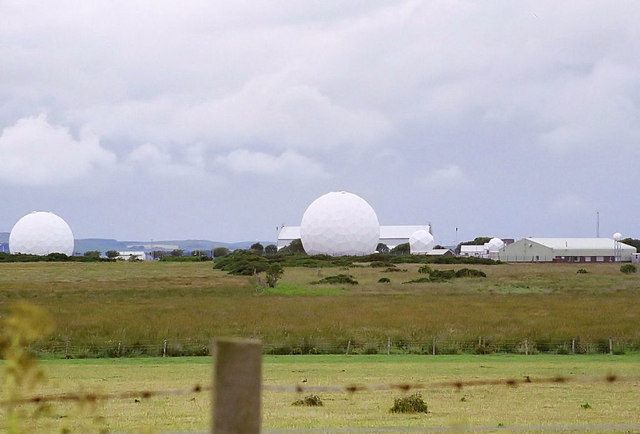
Pictured: radar domes at West Freugh Airfield, Wigtownshire — not the 1957 incident itself. No photograph of the radar traces or the encounter is known to survive in the public record; the original scope data remains inside the MoD's declassified paper files.
Theoretical Alignment
West Freugh earns a modest, rather than high, Extraterrestrial Hypothesis score because its strongest feature — independent same-night corroboration from three linked radar stations, staffed by qualified civilian specialists whose entire job was reading exactly this kind of scope trace — is a genuinely unusual evidentiary combination, but one built entirely on secondhand radar returns rather than on any morphology, structure, or behavior a human eye ever recorded. There is no shape, no color, no material description of any kind to weigh in favor of an artificial craft of any origin; there is only a large, persistent reflecting surface that behaved, for part of the encounter, in ways contemporary aircraft could not. The Psycho-Social Hypothesis scores low for the same underlying reason it scores low in every other radar-only case in this catalogue: PSH is built to explain misperception, expectation, and the psychology of an observer's own eyes and memory, and no eyes were involved here at all — the entire case exists as ink on a scope and typed prose in a file, with the human contribution limited to trained specialists reading and logging an instrument. What keeps the case's overall profile from tilting further toward genuine anomaly is a much more mundane, and much better-documented, category of radar physics: anomalous propagation and radar ducting are capable of producing exactly the kind of large, persistent, apparently high-altitude and apparently stationary false target this case describes, and of being observed simultaneously by more than one radar head sharing the same atmospheric layer. The Interdimensional Hypothesis has essentially nothing to contribute to a case resting entirely on conventional radio-frequency reflection physics.
Background
RAF West Freugh opened in 1937 as an armament training station on the Rhins of Galloway coast of Wigtownshire, in what is now Dumfries and Galloway, and expanded through the Second World War to train bomb aimers, navigators, and observers against the open ranges of Luce Bay. From August 1942 the airfield hosted the Bombing Trials Unit, a body that continued in various forms into 1957 and whose specific function — providing precision instrumented telemetry for live weapons trials rather than routine air-defence surveillance — is central to understanding what kind of radar network actually recorded the April 1957 case. By the mid-1950s the unit's day-to-day radar tracking was performed not by RAF personnel but by civilian technical staff of the Ministry of Supply, the government department then responsible for weapons research and procurement on behalf of bodies including the Royal Aircraft Establishment at Farnborough. This civilian-operated, precision-instrumented character of the West Freugh trials network is one of the case's most distinctive features, and one this file treats carefully throughout: the operators who held the April 1957 contact were not military personnel improvising an unfamiliar identification under pressure, but full-time radar specialists whose entire profession was reading scope traces to the exacting tolerances a live weapons trial demanded.
The evening of April 4, 1957 began as an entirely routine trials evening. An aircraft from the Royal Aircraft Establishment, Farnborough, was due to make a test bombing run over Luce Bay, and the Bombing Trials Unit's network of trailer-mounted tracking radars, sited at multiple points around the range, stood ready to record it. When the trial was delayed, controllers instructed the radar units to power down their sets while the delay was resolved. One unit did not receive that instruction.
Complete Timeline
| Date | Event |
|---|---|
| 1937 | RAF West Freugh opens as an armament training station on the Wigtownshire coast of southwest Scotland. |
| Aug. 1942 – Jan. 1957 | The Bombing Trials Unit operates from West Freugh, providing precision instrumented telemetry for live weapons trials on behalf of the Royal Aircraft Establishment, Farnborough, using civilian Ministry of Supply radar operators. |
| April 4, 1957, evening | A test bombing run over Luce Bay is delayed; radar units are instructed to power down. The Balscalloch unit near Corsewall Point does not receive the order and stays live. |
| Same evening | Balscalloch operators observe a large, solid, almost stationary echo roughly 20–25 miles north of Stranraer, holding at 50,000 feet for about 10 minutes before climbing to 70,000 feet. |
| Same evening | Balscalloch contacts RAF West Freugh air traffic control, reached by Flight Lieutenant Ken England, reporting several moving targets; West Freugh's own radar confirms. |
| Same evening | Balscalloch asks the Ministry of Supply unit at Ardwell, 14 miles south, to check its scope; operators Charles Hollands and Stanley Farley confirm a target considerably larger than a normal aircraft return at the same range and bearing. |
| Same evening | A third radar station confirms the target independently; over the encounter, echo behavior consistent with as many as five distinct objects is logged, including a phase in which four objects are tracked in line-astern formation near 14,000 feet alongside a larger fifth return. |
| Same evening | One tracked object reportedly rises vertically with no forward movement to roughly 60,000 feet in under a minute, then moves east, accelerating toward Newton Stewart while losing height, before turning sharply southeast and accelerating to roughly 240 mph toward the Isle of Man. |
| Same evening | Total radar tracking time across the encounter reaches approximately 36 minutes; no visual sighting is made at any point, the sky obscured by a cloud base near 1,000 feet. |
| April 6–7, 1957 | The story reaches the national press; the Sunday Dispatch publishes an account on April 7, prompting an Air Ministry spokesman to decline detailed comment pending study of the full report. |
| April 7, 1957 | Wing Commander Walter Whitworth issues an Air Ministry–approved statement confirming the object was "of some substance — quite definitely not a freak" and vouching for the qualifications of the Ministry of Supply operators. |
| April 17, 1957 | MP Stan Awbery asks the Secretary of State for Air, in a Commons written answer, what recent UFO investigations, photographs, and reports have been made; Under-Secretary George Ward replies that reports are continually investigated and most resolve as balloons or meteors. |
| April 30, 1957 | The Air Ministry's Directorate of Intelligence (Technical) — "DDI (Tech)" — completes its assessment, concluding the incident involved "five reflecting objects of unidentified type and origin" unlikely to be conventional aircraft, meteorological balloons, or charged cloud. |
| May 15, 1957 | MPs Major Patrick Wall and Frank Beswick question the Secretary of State for Air in the Commons on 1957 UFO detections; Ward states five objects that year remain unidentified and cautions that press-reported speeds were exaggerated relative to actual radar readings. |
| 1957 | Following the press coverage, the Air Ministry reportedly informs the Joint Intelligence Committee it is unable to explain several recent 1957 incidents, of which West Freugh was the most extensively documented. |
| 1971 | Wing Commander Whitworth, having heard nothing further about the case in fourteen years, is contacted by British UFO researcher Julian Hennessey; Whitworth seeks and receives Ministry of Defence permission to discuss the case with him. |
| 2002 | David Clarke and Andy Roberts discuss the case in Out of the Shadows: UFOs, the Establishment and Official Cover-Up. |
| 2009, rev. 2010 | Martin Shough publishes his independent technical study, "Study of Unusual Radar Observations near RAF West Freugh, Wigtownshire, SW Scotland, April 4 1957." |
| 2018 | David Clarke lists the AIR 20/9320 West Freugh file among his personal "Top 10 UFO documents at The National Archives." |
The Set That Stayed On
The sequence began, as best the surviving record reconstructs it, with an entirely mundane administrative delay. The Royal Aircraft Establishment's Farnborough aircraft due to fly a test bombing run over Luce Bay that evening was running late, and the Bombing Trials Unit's controllers instructed the network of trailer-mounted precision radars around the range to power down while the schedule was sorted out. This was a routine instruction with no operational significance of its own — the kind of stand-down order issued dozens of times a week at any active weapons range. What made the evening different was a communications failure rather than anything in the sky: the unit at Balscalloch, sited near Corsewall Point on the Rhins of Galloway, never received the order, and its operators kept their set live and scanning while every other unit on the range powered down around them.
Fifty Thousand Feet, Twenty Miles North of Stranraer
What the Balscalloch operators then found on their still-active scope was not the aircraft they had been waiting for. A large, solid radar return appeared roughly 20 to 25 miles north of Stranraer, almost completely stationary, holding at an estimated 50,000 feet for approximately ten minutes before its indicated height began to climb, eventually reaching 70,000 feet. The operators judged the echo considerably larger than any normal aircraft return they were accustomed to reading — closer, in their own description, to the kind of return a ship's hull would produce than anything airborne. For a unit whose entire professional function was distinguishing a single known trials aircraft from background clutter with exacting precision, an unexplained target of this size, at this altitude, holding almost perfectly still, was immediately and obviously outside the range of anything a routine evening's work would normally produce.
West Freugh and Ardwell Confirm
Rather than simply logging the anomaly and moving on, the Balscalloch operators radioed RAF West Freugh's own air traffic control, where Flight Lieutenant Ken England was on duty, to report that several moving targets were now visible on their scope. West Freugh checked its own radar picture and confirmed the same unexplained returns. Balscalloch then radioed a second Ministry of Supply unit, sited at Ardwell on the shore of Luce Bay some 14 miles to the south, and asked its operators, Charles Hollands and Stanley Farley, to check their own scope at the stated range and bearing. Hollands and Farley confirmed a target there too — again considerably larger than a normal aircraft return, at the same range and bearing Balscalloch had given them. A third radar station separately confirmed the contact as well, giving the case independent agreement across at least three physically separate sets rather than resting on any single station's reading.
Five Objects, Thirty-Six Minutes
As the encounter developed, the picture grew more complex rather than resolving. Accounts drawn from the surviving record describe the target behavior fragmenting into multiple distinct returns: at one stage, four objects were tracked flying in line-astern formation at an estimated 14,000 feet, alongside a fifth, larger return elsewhere in the same general airspace — consistent with the Air Ministry's own eventual conclusion that the incident involved five separate reflecting objects in total. Reported speeds across the encounter varied enormously and, as this file's evaluation of conventional explanations discusses below, not entirely consistently between different retellings: operators at points described movement "like nothing…had ever seen before," with figures in later secondary accounts reaching into the thousands of miles per hour, while other phases of the same track were logged at far more modest speeds, on the order of tens to low hundreds of miles per hour. One object was reported to rise vertically with no forward movement at all, climbing to roughly 60,000 feet in well under a minute, before moving east — slowly at first, then accelerating hard toward Newton Stewart while losing height — and finally turning sharply to the southeast in a maneuver operators and later summarizers alike described as "impossible," picking up speed to around 240 mph as it headed out over the sea toward the Isle of Man. Across the full sequence, radar contact with the phenomenon was sustained for approximately 36 minutes before the returns were finally lost.
"Not a Freak": Whitworth's Statement
Once the story reached the national press — the Sunday Dispatch ran an account on April 7, 1957, just three days after the sighting — an Air Ministry spokesman initially declined to make any detailed statement, saying the matter would need to be studied by experts before comment. Wing Commander Walter Whitworth, RAF West Freugh's commanding officer, was permitted a brief, ministerially approved public statement of his own, and what he said went well beyond a routine no-comment: "I have been ordered by the Air Ministry to say nothing about the object. I am not allowed to reveal its position, course and speed. From the moment of picking it up, it was well within our area. It was an object of some substance — quite definitely not a freak. No mistake could have been made by the [Ministry of Supply] civilians operating the sets. They are fully qualified and experienced officers." For a serving officer speaking under explicit ministerial sign-off, this is a striking form of language — not merely acknowledging that something unusual had been logged, but affirmatively ruling out equipment fault and operator error as the explanation, in terms his superiors had specifically cleared him to use.
The Press Leak and the Questions in Parliament
The story's escape into the national press generated exactly the kind of official attention a classified trials-range radar file was designed to avoid. Reporting from the period describes UK radar stations placed on a period of heightened alert status following the press coverage, and the case reached the floor of the House of Commons within days of its first publication. On April 17, 1957, MP Stan Awbery asked the Secretary of State for Air, in a written question, what recent investigations into unidentified flying objects had been made, what photographs had been taken, and what reports had resulted; Under-Secretary of State George Ward replied that reports were continually received and investigated wherever details were sufficient, that most objects turned out to be balloons or meteors, and that one recently publicized photograph had been faked. Nearly a month later, on May 15, 1957, MPs Major Patrick Wall and Frank Beswick pressed further, asking specifically how many UFOs had been detected over Great Britain that year and about a separate radar contact over the Dover Straits on April 29 that Ward confirmed had turned out to be two RAF Hunters on a training exercise. Ward told the House that "five flying objects reported this year are as yet unidentified, compared with six last year, none in 1955, and six in 1954" — and, when pressed about press reports of speeds reaching 1,000 mph, cautioned that "the speeds of the objects as tracked on the radar screen were nothing like so fast as reported in the Press," an official qualification this file weighs carefully against the West Freugh case's own more extreme speed claims below. Beswick went on to raise a pointed and genuinely serious concern — the risk that repeated unidentified radar contacts could produce false alarms with real implications for Fighter Command's nuclear-era readiness posture — underscoring that Parliament was treating the spring 1957 wave, West Freugh very much included, as a matter of live defence concern rather than a curiosity.
The DDI(Tech) Verdict: "Unidentified Type and Origin"
The most consequential document to emerge from the case was not a press statement at all, but an internal technical intelligence assessment. On April 30, 1957 — three weeks after the sighting and shortly after the parliamentary questioning began — the Air Ministry's Directorate of Intelligence (Technical), commonly abbreviated "DDI (Tech)" in surviving departmental correspondence, completed its own review of the West Freugh radar data. Its conclusion, preserved in the file and quoted by researcher David Clarke among others, reads: "It is concluded that the incident was due to the presence of five reflecting objects of unidentified type and origin. It is considered unlikely that they were conventional aircraft, meteorological balloons or charged clouds." Clarke has separately characterized this passage as possibly the closest the Air Ministry ever came, across the whole of its Cold War–era UFO files, to formally acknowledging that some unidentified radar returns remained genuinely inexplicable and were therefore of legitimate defence interest rather than simply misidentified mundane phenomena. This file treats that characterization carefully: the DDI(Tech) conclusion is a real, on-the-record, contemporaneous technical non-identification by the government's own intelligence apparatus, and it is a meaningfully stronger form of official acknowledgment than the more common bureaucratic pattern of simply declining further comment. It is not, however, a conclusion that the objects were craft of any kind, extraterrestrial or otherwise — only that the three most obvious mundane candidates had each been specifically tested against the radar data and found wanting.
Fourteen Years of Silence: Hennessey and the 1971 Correspondence
Having filed his classified report in April 1957, Wing Commander Whitworth reportedly heard nothing further about the case for well over a decade. That changed in 1971, when he was contacted by Julian Hennessey, a Scottish-born UFO researcher who had by then built a reputation within British ufology for a relentless, years-long letter-writing campaign to the Ministry of Defence and other official bodies, and who served as NICAP's European representative from 1968 while separately founding the "Euronet" project to collect UFO reports from airline pilots. Whitworth, apparently still bound by a sense of the case's original classification even fourteen years on, wrote to the Ministry of Defence seeking explicit permission before discussing the 1957 incident with Hennessey — permission that, after some internal hesitation on the department's part, was eventually granted. This episode, small as it is, is one of the more human details to survive in the case's paper trail: a serving officer's caution surviving long after the operational reason for it had presumably lapsed, and a private researcher's persistence eventually prying loose a firsthand account the government itself had never volunteered.
Out of the Shadows: Clarke and Roberts Reconstruct the Case
The fullest scholarly treatment of the West Freugh case in print appears in David Clarke and Andy Roberts's 2002 book Out of the Shadows: UFOs, the Establishment and Official Cover-Up, drawing on Clarke's long research relationship with the Ministry of Defence's UFO-handling secretariats and, later, his own formal role curating the National Archives' UFO-files project. Clarke has separately singled the case out for special attention: in a 2018 blog post ranking his personal "Top 10 UFO documents at The National Archives," he lists the AIR 20/9320 West Freugh file, describing it plainly as "the Air (Tech) Intelligence report on UFOs tracked by three ground radar stations in Scotland during April 1957" — placing it, in his own professional judgment as the researcher who has read more of the National Archives' declassified UFO material than almost anyone else, among the small handful of documents in the entire collection he considers most significant. British author Jenny Randles has separately documented the case in her own published UFO histories, noting specifically that the DDI(Tech) review had considered and explicitly rejected both weather balloons and heavily charged high-altitude rain cloud as candidate explanations before reaching its final "unidentified type and origin" conclusion.
Martin Shough's Radar Reanalysis
Martin Shough, a UK-based UAP researcher and research associate of the National Aviation Reporting Center on Anomalous Phenomena (NARCAP), authored the only detailed independent technical reanalysis of the West Freugh radar data to date: "Study of Unusual Radar Observations near RAF West Freugh, Wigtownshire, SW Scotland, April 4 1957," originally published in November 2009 and revised in March 2010. Shough's study confirms and sharpens several of the case's core technical parameters — that the unusual contacts were detected simultaneously on three tracking radars of the Bombing Trials Unit, sited at two separate locations near Luce Bay, and followed for 36 minutes; that the radars themselves were purpose-built tracking and telemetry instruments operated on behalf of the Royal Aircraft Establishment, Farnborough, through the Ministry of Supply rather than general-purpose air-defence sets; and that the cloud base of roughly 1,000 feet made any visual sighting from the ground physically impossible throughout the encounter, closing off in advance any possibility of independent optical confirmation. Shough separately confirms that when Balscalloch's operators asked Ardwell's Charles Hollands and Stanley Farley to check their own scope, the two men independently reported a target "considerably larger" than a normal aircraft return at the stated range and bearing — corroborating, from Shough's own examination of the primary case-file material, the same cross-station agreement described in every other account of the case. As a specialist whose broader body of published work focuses specifically on the technical physics of radar cross-section, propagation, and anomalous returns, Shough's engagement with West Freugh represents exactly the kind of rigorous, radar-literate reanalysis this catalogue treats as unusually strong sourcing for an instrumented case — a genuine attempt to test the surviving data against known radar physics rather than simply retell the 1957 press narrative.
"The UK's Most Reported UFO Incident"? Examining the Claim
A number of secondary sources describing this case repeat, in near-identical wording, the characterization that West Freugh was "the UK's most reported UFO incident." This file cannot independently verify that specific superlative claim, and has not found it traced to any single authoritative count or named study; it appears to have entered circulation through repeated copying between UFO-history websites, likely originating in an early, now-revised version of a general encyclopedia article on the case, and readers should treat it with the same caution this file applies to any unattributed superlative. What is independently verifiable, and arguably more informative than the claim itself, is the unusually dense trail of genuine official engagement the case actually generated: national press coverage within three days, an Air Ministry–approved statement from the station commander, two separate rounds of Parliamentary Questions across two Commons sittings three weeks apart, a formal Directorate of Intelligence (Technical) assessment, and reported briefing of the Joint Intelligence Committee. Few individual British UFO cases of the era can document that particular combination of press, parliamentary, and internal-intelligence attention converging on a single dated incident, which may be the more defensible basis for whatever claim to prominence the case actually holds.
Circumstantial Evidence
- Three physically separate, purpose-built precision trials radars — not general air-defence sets prone to routine clutter — independently logged the same unexplained target at the same range and bearing on the same evening.
- RAF West Freugh's own commanding officer, under explicit Air Ministry sign-off, publicly and specifically ruled out operator error, stating the Ministry of Supply civilians were "fully qualified and experienced" and that "no mistake could have been made."
- The Air Ministry's own Directorate of Intelligence (Technical) formally tested and rejected conventional aircraft, meteorological balloons, and charged cloud as explanations in a contemporaneous, dated technical assessment — a rare, on-the-record government non-identification.
- The case generated two separate rounds of Parliamentary Questions across two Commons sittings, and was reportedly briefed to the Joint Intelligence Committee — an unusually high level of contemporaneous official engagement for a single UK radar-UFO report.
- The National Archives' own catalogue independently confirms the survival of the primary case files, AIR 2/18564 and AIR 20/9320, corroborating the paper trail described in every secondary account rather than resting on secondhand claims alone.
- An independent, radar-literate technical reanalysis by researcher Martin Shough, published decades after the event, confirms the core multi-station tracking parameters rather than finding them to be later embellishment.
Key Researchers
- David Clarke — Investigative journalist and academic who, with Andy Roberts, discussed the case in Out of the Shadows (2002) and later ranked the AIR 20/9320 West Freugh file among his personal "Top 10 UFO documents" at the National Archives, drawing on his own role curating the Archives' declassified UFO-files collection.
- Andy Roberts — British Fortean and UFO researcher who co-authored Out of the Shadows with David Clarke, providing one of the earliest detailed published accounts of the case.
- Martin Shough — UK-based UAP researcher and NARCAP research associate who authored the only detailed independent technical reanalysis of the case's radar data, confirming its core multi-station tracking parameters from a specialist's examination of the primary material.
- Jenny Randles — British UFO author who documented the case in her own published histories, specifically noting that the Air Ministry's technical review had considered and rejected both weather balloons and charged rain cloud.
- Julian Hennessey — British UFO researcher and NICAP's European representative whose 1971 correspondence with Wing Commander Whitworth first drew the case out of official silence and into the wider ufological literature.
Legacy: A Trials-Range Radar File in an Age of Air-Defence Panic
West Freugh has never achieved the household-name recognition of later British radar cases like Rendlesham Forest or even RAF Boulmer, and the reasons are fairly clear from the record itself: it produced no surviving witness willing to give an extended modern interview, no widely reproduced photograph or memo, and — critically — no visual sighting at all to anchor the story in a human, describable encounter the way Boulmer's luminous hovering objects or Rendlesham's forest lights did. Its entire public profile rests on a chain of secondhand press accounts filtered through a single 1971 correspondence and a handful of subsequent researcher summaries, most tracing back to the same small set of primary sources. That comparative thinness in the secondary literature is itself informative for how this file weighs the case: unlike some more heavily mythologized British sightings, West Freugh has not visibly accumulated decades of embellishment layered onto a simple original account — if anything, the opposite risk applies, where a genuinely complex multi-phase, multi-object encounter has been flattened and occasionally garbled by 65 years of brief secondary retelling, producing the numeric inconsistencies in speed and altitude figures this file has flagged throughout.
Within the specific, narrower category of British Cold War–era radar UFO files, West Freugh occupies a genuinely distinctive niche: it is one of the few documented cases in which the corroborating instrumentation was not general-purpose air-defence radar built to survey the whole sky, but precision weapons-trials telemetry built to track one known aircraft with exacting accuracy — radar whose entire operational purpose depended on its operators being able to tell a real target from clutter or artifact with a reliability few ordinary early-warning stations required. That the same network, on an ordinary evening, produced a large, persistent, unexplained multi-object return corroborated across three separate sets is precisely the kind of evidentiary profile that led the Air Ministry's own technical intelligence directorate — not a government body inclined toward sensational conclusions — to put "unidentified type and origin" on paper in April 1957, and it is that specific, dated, internal government judgment, more than any subsequent retelling, that keeps this case a serious entry in the history of British radar-UFO reports rather than a curiosity that has simply survived by repetition.
Key Witnesses
Wing Commander Walter Whitworth
Filed the classified report on the incident and, under explicit Air Ministry sign-off, issued the case's most substantive public statement, affirming the object was "of some substance — quite definitely not a freak" and vouching directly for the training and reliability of the Ministry of Supply civilians who tracked it. In 1971, still apparently bound by the case's original sensitivity, sought and received MoD permission before discussing it with researcher Julian Hennessey.
Flight Lieutenant Ken England
The RAF officer on duty in West Freugh's air traffic control room when Balscalloch radioed in to report the unidentified contacts; confirmed the same unexplained returns on West Freugh's own radar picture, giving the case its second independent station of corroboration.
Charles Hollands
One of two Ministry of Supply specialists operating the Ardwell trials radar, 14 miles south of the initial contact. When asked by Balscalloch to check his own scope, independently confirmed a target considerably larger than a normal aircraft return at the same stated range and bearing.
Stanley Farley
Alongside Charles Hollands, jointly confirmed the Ardwell radar's independent reading of the unidentified target, giving the case its third documented station of cross-checked corroboration.
The Five Observables Assessment
The Five Observables framework, developed by former AATIP director Luis Elizondo, classifies witnessed UAP flight performance against the limits of known technology. West Freugh poses the same structural challenge to this framework that every purely radar-based case does: because a 1,000-foot cloud base made visual observation physically impossible throughout the encounter, there is no eyewitness morphology, color, or surface description of any kind to evaluate — only the behavior radar itself recorded, filtered through operator reports and a 65-year chain of secondary retelling that has not always agreed on the specific numbers involved.
Assessment: Anti-Gravity Lift is rated speculative because one tracked object was reported rising vertically with no forward movement at all, reaching roughly 60,000 feet in well under a minute — a profile with no obvious conventional aerodynamic analogue — but this description survives only in secondary retellings of operator testimony, not in any recovered scope trace or chart this file could independently examine. Instant Acceleration and Hypersonic Velocity are both rated speculative rather than present specifically because the case's own most extreme numbers — speeds described as "thousands of miles per hour" — sit awkwardly against Secretary of State George Ward's own Hansard caution, delivered about the same spring 1957 wave of contacts, that "the speeds of the objects as tracked on the radar screen were nothing like so fast as reported in the Press"; the government's own contemporaneous qualification of press-reported speed figures is exactly the kind of caution this framework should weigh before rating extreme kinematics as confirmed. Low Observability is rated absent: far from evading detection, the objects produced unusually large, persistent returns — described by operators as closer to a ship's echo than an aircraft's — and were tracked continuously across three separate stations for 36 minutes. Trans-Medium travel is rated absent, since no transition between air, water, or any other medium was ever reported. Taken as a whole, West Freugh's Five Observables profile is defined less by confirmed extraordinary performance than by a genuine and unresolved tension between operator testimony describing extraordinary maneuvers and the government's own on-record caution that contemporary press accounts of speed had outrun what the radar itself actually showed.
Evidence Assessment
Supporting Anomalous Origin
- Three physically independent, purpose-built precision trials radars corroborated the same unexplained target at the same range and bearing on the same evening.
- RAF West Freugh's own commanding officer, under Air Ministry sign-off, explicitly and publicly ruled out operator error or equipment fault.
- The Air Ministry's own Directorate of Intelligence (Technical) formally tested and rejected conventional aircraft, weather balloons, and charged cloud in a dated, contemporaneous technical assessment.
- The case generated two rounds of Parliamentary Questions and reported Joint Intelligence Committee briefing — an unusually high tier of contemporaneous official engagement.
- An independent, radar-literate technical reanalysis published decades later (Shough, 2009/2010) confirms rather than undermines the core multi-station tracking parameters.
Supporting Conventional Explanation
- No visual sighting of any kind occurred; the entire case rests on radar returns alone, with no morphology, color, or structure ever observed.
- The coastal, over-water siting of all three radar stations places the case squarely within the geography where anomalous propagation and radar ducting are most commonly documented on 1950s-era equipment.
- The case's most extreme reported speeds conflict with the government's own contemporaneous Hansard caution that press-reported figures for the period's radar contacts exceeded what the radar itself actually showed.
- No original radarscope photograph, tape, or chart survives in the public record to independently verify the specific numbers now circulating in secondary accounts.
- No physical evidence, trace, or recovered material of any kind exists to corroborate the radar data.
Why "Credible"
The West Freugh UFO Sighting earns a CREDIBLE classification because it combines an unusually strong tier of instrumented, multi-station corroboration and a rare, dated, on-the-record government non-identification with the total absence of visual or physical evidence that keeps this catalogue from rating any purely radar-based case higher. On the strength side: this is not a single operator's uncorroborated reading. Three physically separate radar stations, staffed by full-time precision-tracking specialists whose commanding officer went on record under Air Ministry sign-off to rule out equipment fault and operator error, independently agreed on an unexplained target's presence, range, and bearing over a sustained 36-minute encounter. That data was then formally reviewed by the Air Ministry's own Directorate of Intelligence (Technical), which explicitly tested and rejected the three most obvious mundane candidates — conventional aircraft, weather balloons, and charged cloud — in a dated contemporaneous document, generating real Parliamentary attention and, by most accounts, a Joint Intelligence Committee briefing. The surviving National Archives files corroborate this paper trail directly rather than requiring it be taken on secondary-source faith, and an independent, radar-literate technical reanalysis published decades later confirms rather than undermines the case's core parameters. Weighed against this: no visual sighting of any kind ever occurred, closing off the single strongest form of corroboration available to any other case in this catalogue; the coastal, over-water siting of every radar station involved places this case squarely within the geography where anomalous propagation is most commonly documented, and the Air Ministry's own specialists, while declining to close the file, never definitively ruled that mechanism out either; and the case's most extreme reported figures — speeds in the thousands of miles per hour, an "impossible" turn — sit in direct tension with the government's own contemporaneous Hansard caution that press coverage of the period's radar contacts had outrun what the instruments actually showed. That combination — genuinely strong, multiply-corroborated instrumentation and a real government non-identification on one side, and a well-documented, geographically apt naturalistic radar mechanism plus real internal inconsistency in the secondary record on the other — is precisely the profile of a case this site rates Credible rather than Verified or Disputed.
Sensor & Instrumentation Detection Profile
West Freugh is, structurally, one of the purest radar-only cases in this catalogue: every scrap of surviving evidence originates from ground-based tracking radar operated by trained specialists, and no human eye ever confirmed what the instruments were showing. The Ministry of Supply's Bombing Trials Unit at RAF West Freugh operated a network of trailer-mounted tracking radars sited around Luce Bay specifically to provide precision telemetry — range, bearing, height, and speed — for live weapons trials conducted on behalf of the Royal Aircraft Establishment, Farnborough. This was not an air-defence early-warning network of the kind that later corroborated the RAF Boulmer sighting; it was purpose-built precision trials instrumentation, designed and calibrated to track a single known aircraft accurately, not to survey the wider sky for unknown contacts. That distinction matters for how this file weighs the evidence: when three separate sets built for exacting single-target telemetry all independently logged the same unexplained return at the same range and bearing, the corroboration carries a different, arguably more exacting, technical character than a general-purpose air-defence radar picking up ordinary clutter. The unit at Balscalloch, near Corsewall Point, was first to hold the contact after failing to receive the stand-down order for the delayed bombing run; RAF West Freugh's own air traffic control set, manned by Flight Lieutenant Ken England, confirmed the return once alerted by radio; and the Ministry of Supply's second mobile unit at Ardwell, 14 miles south and operated by Charles Hollands and Stanley Farley, checked its own scope on request and confirmed a target at the same range and bearing, considerably larger than a normal aircraft return. No photographic radarscope camera record, magnetic tape, or paper strip-chart plot of the original tracks is known to survive in the released file; the technical record that does survive consists of the operators' contemporaneous verbal and written reports as reconstructed in the Air Ministry's own subsequent intelligence assessment.
Environmental & Geospatial Context
RAF West Freugh sits on the Machars-facing side of the Rhins of Galloway, roughly five miles southeast of Stranraer, its trials range extending out over Luce Bay and the wider Irish Sea — open, unobstructed airspace ideally suited to precision weapons telemetry and, coincidentally, to sustained multi-station radar tracking of anything else that happened to be present. The encounter's most operationally significant environmental detail is also its most limiting one: the sky over Wigtownshire that evening carried a cloud base estimated at only around 1,000 feet, low enough that no ground observer at any of the three radar sites could have seen an object at 50,000 to 70,000 feet even had they thought to look. This is not incidental scene-setting; it is the single fact that defines the entire evidentiary shape of the case, since it removes in advance any possibility of the visual corroboration that distinguishes cases like RAF Boulmer from purely instrumented ones. The coastal, maritime setting is separately significant to this file's evaluation of conventional explanations below: temperature and humidity layering over open water is a well-documented driver of radar anomalous propagation and ducting, and Luce Bay and the wider Irish Sea approaches sit exactly within the kind of marine boundary-layer environment where such effects are most commonly recorded on 1950s-era ground radar.
Observer Credibility & Occupational Profile
Every primary witness to the West Freugh case was, at the moment of detection, a trained specialist operating purpose-built precision radar as their full-time professional occupation — not RAF service personnel standing an ordinary duty watch, but civilian technical staff of the Ministry of Supply whose entire job was reading exactly this kind of scope trace accurately enough to guide live weapons trials. Wing Commander Walter Whitworth, RAF West Freugh's commanding officer, went on the public record in Air Ministry–approved language to vouch for them directly: "No mistake could have been made by the [Ministry of Supply] civilians operating the sets. They are fully qualified and experienced officers." That is a notably direct credibility endorsement for a serving commanding officer to commit to the press under ministerial sign-off, and it reads as a deliberate rebuttal to the most common dismissive explanation offered for any radar-UFO report — operator error or inexperience — rather than a routine administrative courtesy. Flight Lieutenant Ken England, running RAF West Freugh's own air traffic control radar, was a serving RAF officer whose job was to maintain an accurate real-time picture of everything in the station's airspace, not a passive bystander. Charles Hollands and Stanley Farley, running the Ardwell set, independently checked their own scope on request from Balscalloch and reported back a specific, technically framed confirmation — a target "considerably larger" than a normal aircraft return at the stated range and bearing — rather than a vague impression. Working against a fully frictionless credibility assessment is the same limitation present in every radar-only case in this catalogue: none of these witnesses ever saw anything, so the entire testimonial record consists of trained readings of an instrument rather than direct sensory description of an object, and the individual Balscalloch operators who first held the contact were never publicly named in any surviving account.
Physical & Material Assays
West Freugh generated no physical evidence in the conventional sense — no recovered material, no ground trace, no photograph or film of any object, and, per the case's own defining limitation, not even a visual sighting to corroborate the radar returns. This should be stated plainly rather than worked around, because it caps how far the case can be pushed toward a confirmed physical anomaly regardless of how strong the multi-station instrumentation record is on its own terms. What exists in place of physical trace evidence is a paper and radar-log record: written operator reports of range, bearing, height, and speed, cross-checked independently across three separate trials-radar sets rather than asserted by a single station, and formalized in the Air Ministry's own subsequent technical intelligence assessment. No radiation readings, electromagnetic interference reports, or equipment malfunctions connected to the sighting appear anywhere in the sources this file could verify.
Historical Precedents & Archive Matches
West Freugh sits inside the same first great wave of Cold War–era radar-corroborated British sightings that also produced the August 1956 Lakenheath–Bentwaters incident — itself catalogued in the same AIR 2/18564 case-paper series at the National Archives — and it directly triggered a wider spring 1957 flap that generated Parliamentary Questions covering incidents at multiple other RAF stations. Structurally, the case belongs to a small, specific sub-genre of radar-only UK military sightings that also includes elements of the American Kinross Incident of 1953 — both are defined by trained ground radar specialists tracking an unexplained return with no visual confirmation, and both were later revisited by independent researchers applying more rigorous technical scrutiny than the original service investigation received. West Freugh differs from the later, more publicized RAF Boulmer sighting of 1977 in one evidentially important respect: where Boulmer's radar corroboration followed and was bridged by an extended human visual sighting, West Freugh's radar data stands entirely alone, undiluted by eyewitness testimony but also unsupported by it. The case also belongs to the same broader body of declassified Ministry of Defence UFO paperwork later examined in detail by David Clarke and Andy Roberts, the researchers most closely associated with British MoD UFO-file scholarship across multiple cases in this catalogue.
Material Analysis
West Freugh is, by its own evidentiary nature, a case with no physical material to analyse. No fragment, residue, or recovered hardware connects to the sighting; nothing was ever found on the ground because nothing was ever reported at ground level, and the low cloud base meant even the sky itself was never actually seen. What exists instead is a paper and radar-log record: written operator descriptions of range, bearing, height, and speed, cross-checked independently across three trials-radar sets rather than asserted by a single station, and formalized into the Air Ministry's own dated technical intelligence conclusion. This is worth stating plainly rather than working around, because it caps how far the case can be pushed toward a confirmed physical anomaly regardless of how strong the multi-station radar corroboration is on its own terms — there is no laboratory test, isotopic assay, or metallurgical finding of any kind to weigh, positively or negatively, against the instrument and testimonial record that makes up the entirety of the file.
Supporting a Genuine Anomaly
- Independent, cross-station radar corroboration from purpose-built precision instrumentation is a materially stronger form of evidence than a single station's uncorroborated reading, even without recovered physical material.
- The Air Ministry's own technical intelligence directorate formally tested and rejected the three most obvious mundane radar-return candidates in a dated contemporaneous document, rather than the case resting on secondary speculation alone.
Supporting a Mundane, if Unconfirmed, Origin
- The total absence of any visual, photographic, or physical trace evidence means the case cannot be independently re-examined today beyond the surviving written record.
- 1950s ground radar operating over open coastal water was well documented as susceptible to anomalous propagation and ducting effects capable of producing large, persistent, high-altitude false targets.
The Conventional Explanation Candidate: Anomalous Propagation / Radar Ducting
The single most technically credible naturalistic explanation available for the West Freugh case is anomalous propagation, commonly called radar "ducting" — a well-documented atmospheric effect in which layers of temperature and humidity contrast in the lower atmosphere bend radar energy along an extended path rather than allowing it to travel in a straight line, producing returns that appear far more distant, far higher, or far more persistent than any physical target actually present. This candidate deserves serious weight for several concrete reasons specific to this case: all three radar stations sat on or near the Wigtownshire coast, directly overlooking open sea approaches where marine boundary-layer ducting is most commonly recorded even today; the primary target's behavior — large, solid, almost perfectly stationary for roughly ten minutes before a slow apparent climb — is close to a textbook description of a ducted false return rather than a maneuvering craft; and ducting effects are specifically capable of being observed simultaneously and consistently by more than one radar head sharing the same atmospheric layer, which would account for the multi-station agreement without requiring any physical object to be present at all. Where this candidate runs into genuine difficulty is the same place every naturalistic radar explanation in this catalogue eventually does: the Air Ministry's own DDI(Tech) technical intelligence assessment, produced by specialists with direct access to the original data and full contemporaneous knowledge of anomalous propagation as a known confounder, still concluded the returns represented "unidentified type and origin" rather than dismissing them as a routine ducting artifact — suggesting the department's own technical reviewers did not find the ducting explanation sufficient to close the file at the time, whatever weight later analysts might give it.
Conventional Aircraft, Weather Balloon, or Charged Rain Cloud
These three explanations deserve mention specifically because they were the ones the Air Ministry's own contemporaneous technical review actually tested and rejected, rather than candidates this file is proposing independently. A stray conventional aircraft would need to explain a return the operators judged considerably larger than any normal aircraft echo, at altitudes of 50,000 to 70,000 feet well beyond the routine operating ceiling of 1957-era civil or most military traffic; a meteorological balloon cannot readily account for the reported near-vertical high-speed climb or the sharp course change later in the encounter; and heavily charged high-altitude rain cloud, a genuine and period-appropriate radar-return candidate that researcher Jenny Randles has specifically noted was considered, struggles against the same size, persistence, and directional-maneuver problems. The Air Ministry's own specialists examined all three against the actual radar data in April 1957 and judged each unlikely.
Press Amplification and Reporting-Chain Distortion
A third, narrower candidate addresses not the core detection itself but specifically the case's most extreme secondary claims — speeds reported in the thousands of miles per hour and an "impossible" sharp turn. Secretary of State George Ward's own Hansard testimony from the same spring 1957 wave of contacts directly supports this candidate as a partial explanation: he told the Commons plainly that "the speeds of the objects as tracked on the radar screen were nothing like so fast as reported in the Press," a specific, contemporaneous, on-the-record government correction of exactly the kind of number inflation this file has found across different secondary retellings of the West Freugh case. This candidate is attractive because it requires no exotic mechanism and is directly supported by a government source with access to the actual radar data, but it cannot account for the case's core, better-corroborated feature — three independent radar stations agreeing on an unexplained target's presence, range, and bearing — even if it may satisfactorily explain away some of the more dramatic speed and maneuver figures that later entered popular retellings of the case.
Anomalous Propagation / Radar Ducting
Plausible InconclusivePLAUSIBLE as a partial technical explanation for the target's height, persistence, and multi-station visibility, but INCONCLUSIVE as a complete account, since the Air Ministry's own contemporaneous technical reviewers, working with the original data, explicitly declined to close the file on that basis.
Conventional Aircraft, Balloon, or Charged Cloud
ImplausibleIMPLAUSIBLE — already tested and rejected by the Air Ministry's own dated 1957 technical assessment.
Related Cases
Confirmed Documents & Official Records
The primary Air Ministry/Ministry of Defence registered file on the incident, covering the period from the April 1957 sighting through the 1971 correspondence with researcher Julian Hennessey.
UNCLASSIFIED (open document)Catalogued under Air Traffic Control and Radar & Radio Countermeasures subject codes; described by researcher David Clarke as containing the Air (Tech) Intelligence report on UFOs tracked by three ground radar stations in Scotland during April 1957.
UNCLASSIFIED (open document)Search Government Archives Directly
Further Reading — Recommended Literature
Out of the Shadows: UFOs, the Establishment and Official Cover-Up
The fullest published account of the West Freugh case, reconstructed by the two researchers most closely associated with British MoD UFO-file scholarship.
The UFO Files: The Inside Story of Real-Life Sightings
A comprehensive history of British government UFO investigation drawn directly from the declassified National Archives files, essential context for how the DDI(Tech) assessment and the AIR series files that document West Freugh actually came to exist.
Open Skies, Closed Minds
A firsthand account from the former head of the MoD's own UFO desk, offering direct insight into how the department that eventually inherited files like West Freugh's actually assessed and processed radar-corroborated sightings.
The UFOs That Never Were
A skeptically minded deconstruction of well-known British UFO cases by three of the country's most established researchers, useful for weighing how the same team that documented West Freugh approaches conventional explanations elsewhere.
The UFO Encyclopedia, 4th Edition
The definitive UFO reference work, situating West Freugh among the broader catalogue of radar-corroborated Cold War-era military sightings worldwide.
Essential Viewing
The Mysterious West Freugh UFO Incident of 1957
A dedicated overview of the April 1957 radar tracking incident, covering the Balscalloch, West Freugh, and Ardwell radar confirmations and the case's official handling.
1957: West Freugh incident
A concise case retrospective covering the radar tracking sequence, Wing Commander Whitworth's public statement, and the case's press coverage.
Sources
- The National Archives (UK). "UFO report: West Freugh 1957" (AIR 2/18564). beta.nationalarchives.gov.uk
- The National Archives (UK). AIR 20/9320, Parliamentary Question on Unidentified Flying Objects. beta.nationalarchives.gov.uk
- The National Archives (UK). "Unidentified Flying Objects (UFOs) — postwar records." nationalarchives.gov.uk
- UK Parliament, Historic Hansard. "Unidentified Flying Objects," Written Answers (Commons), April 17, 1957. api.parliament.uk
- UK Parliament, Historic Hansard. "Unidentified Flying Objects," Commons Sitting, May 15, 1957. api.parliament.uk
- Shough, Martin. "Study of Unusual Radar Observations near RAF West Freugh, Wigtownshire, SW Scotland, April 4 1957" (2009, rev. 2010). martinshough.com
- Clarke, David. "Top 10 UFO documents at The National Archives." drdavidclarke.co.uk
- Gross, Patrick. "The West Freugh Incident, 1957." ufologie.patrickgross.org
- Hennessey, J.J.A. "West Freugh UFO Sighting, 1957," Sign Historical Group / Project 1947. project1947.com
- Magonia Magazine (blog). "UFOs at the National Archives." magoniamagazine.blogspot.com
- Magonia Magazine (blog). "Julian Hennessey: Portrait of a British UFO Pioneer." magoniamagazine.blogspot.com
- Beams Investigations. "April 1957: UFO Incident RAF West Freugh, Wigtownshire, South-West Scotland, UK." beamsinvestigations.org
- The Hidden Truth. "1957: West Freugh incident." thehiddentruth.co
- Liquisearch. "RAF West Freugh — West Freugh Incident." liquisearch.com
- Center for UFO Studies (CUFOS). "Martin Shough." cufos.org
- "RAF West Freugh," Wikipedia. en.wikipedia.org
- "MOD West Freugh," Wikipedia. en.wikipedia.org
- "Luce Bay," Wikipedia. en.wikipedia.org
- "Stranraer," Wikipedia. en.wikipedia.org
- "David Clarke (journalist)," Wikipedia. en.wikipedia.org
- "Jenny Randles," Wikipedia. en.wikipedia.org
- Wikimedia Commons. "File: West Freugh Airfield - geograph.org.uk - 434249.jpg" (CC BY-SA 2.0, hero image source, photograph by John McLeish). commons.wikimedia.org
- Clarke, David & Roberts, Andy. Out of the Shadows: UFOs, the Establishment and Official Cover-Up, Piatkus, 2002, ISBN 0-7499-2290-7. amazon.com
- Clarke, David. The UFO Files: The Inside Story of Real-Life Sightings, The National Archives, 2009, ISBN 1-905615-50-7. amazon.com
- Pope, Nick. Open Skies, Closed Minds: Official Reactions to the UFO Phenomenon, Simon & Schuster, 1996, ISBN 0-684-81664-4. amazon.com
- Randles, Jenny, Roberts, Andy & Clarke, David. The UFOs That Never Were, Allison & Busby, 2000, ISBN 1-902809-35-1. amazon.com
- Clark, Jerome. The UFO Encyclopedia, 4th Edition, Visible Ink Press, 2023 (entry covering British Cold War–era radar-corroborated cases).
- YouTube. "The Mysterious West Freugh UFO Incident of 1957," The Disclosure Vault. youtube.com
- YouTube. "1957: West Freugh incident," The Hidden Truth. youtube.com
See something inaccurate? Have additional information or sources?
Suggest an Edit →Last Updated: August 2026