
The Kinross Incident
On the night of November 23, 1953, First Lieutenant Felix Moncla Jr. and Second Lieutenant Robert Wilson Jr. took off from Kinross Air Force Base in an F-89C Scorpion interceptor to identify an unidentified radar target over Lake Superior. Ground-based radar controllers at three separate stations watched the fighter's blip close on the unknown target, merge with it into a single return, and then vanish from every scope at once. No further radio contact was ever received. A five-day joint American-Canadian air and surface search covering thousands of square miles found no wreckage, no oil slick, no debris, and no trace of either airman. The U.S. Air Force's official explanation — that the target was a Royal Canadian Air Force C-47 Dakota transport that had strayed off its flight plan, and that Moncla's own jet crashed independently, likely after spatial disorientation during the high-speed descent — has never been accepted by Canadian officials, who have repeatedly denied that any RCAF aircraft was in the area that night. More than seventy years later, the aircraft, the crew, and the object they were sent to identify have never been found.
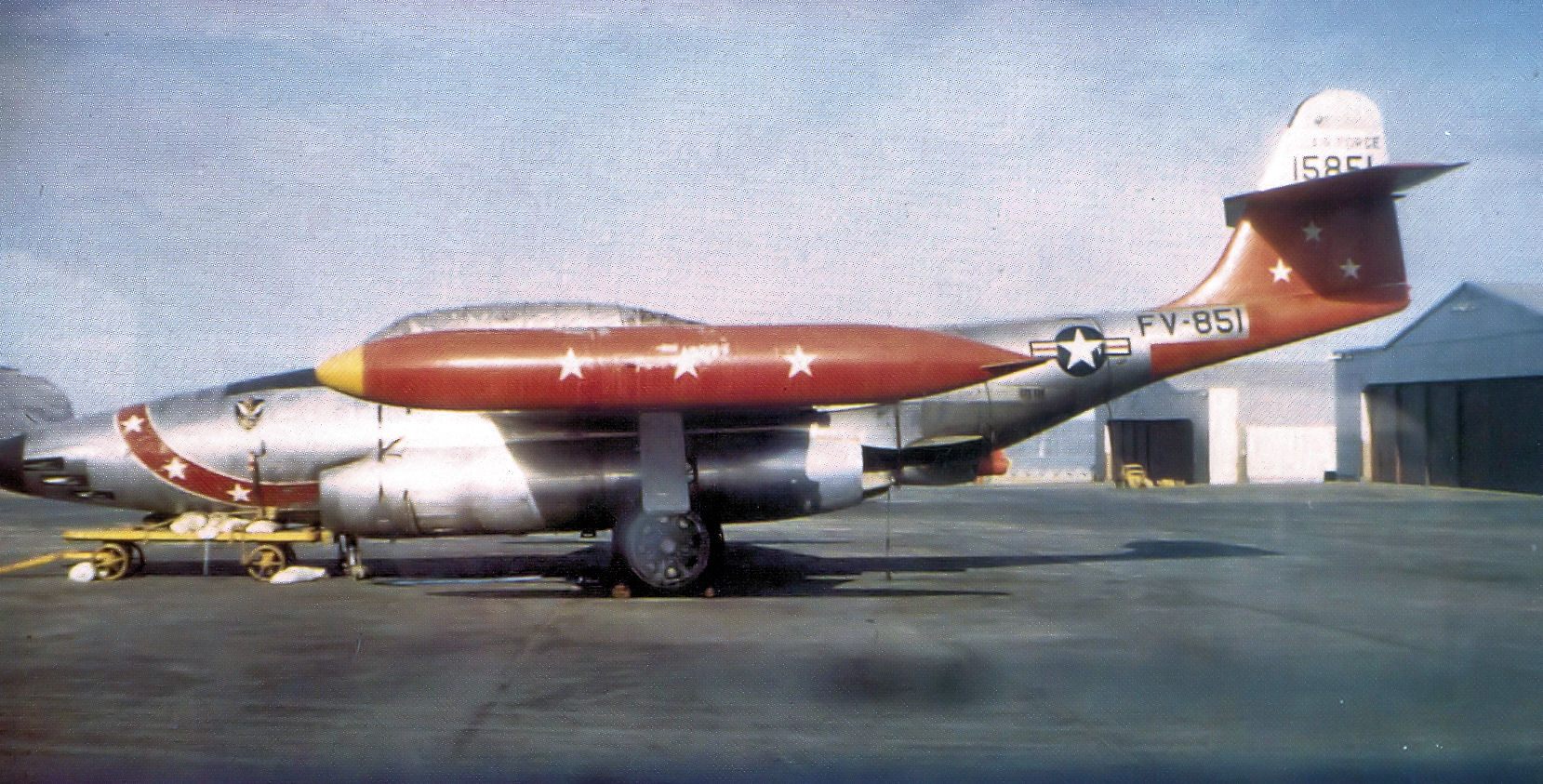
Pictured: a Northrop F-89C-40-NO Scorpion of the same 74th Fighter-Interceptor Squadron and production block, photographed at Presque Isle AFB, Maine in 1954 — not the actual aircraft (s/n 51-5853A) flown by Felix Moncla and Robert Wilson, which vanished over Lake Superior on November 23, 1953 and was never recovered. No photograph of that specific airframe is known to exist.
Theoretical Alignment
Kinross earns a modest ETH score not because any witness described a structured craft — no one ever did, since the object was tracked purely on radar and never seen — but because the case's central anomaly, a merged radar return that never separated again, has genuinely never been mechanically explained by the conventional account on offer. The Psycho-Social component reflects the substantial secondary mythology that has attached itself to the case over seven decades: a widow's phone call about a "flying saucer" collision, an uncorroborated late-night radio transmission claim, a hoaxed 2006 sonar "discovery," and a persistent rumor of a heard explosion, none of which appear in the contemporaneous 1953 official record. The bulk of the case's real uncertainty, however, sits outside all three of these frameworks entirely: this file's central finding is that the leading conventional explanation is not well-documented but is instead actively and specifically disputed by the government of the country whose aircraft was blamed — a different, narrower, and more concrete kind of unresolved status than "possible alien contact."
Background
Felix Eugene Moncla Jr. was born October 21, 1926, in Mansura, Louisiana, to Felix Moncla Sr., a high school science teacher and principal and a World War I veteran, and Yvonne Beridon Moncla, a seamstress. He attended Southwestern Louisiana Institute (now the University of Louisiana at Lafayette) on an athletic scholarship, playing football before earning his degree, and served in occupied Japan following World War II. He returned to military service with the outbreak of the Korean War in 1950, training as a U.S. Air Force pilot at Connally Air Force Base in Waco, Texas — where he met and married Bobbie Jean Coleman — then advanced pilot training at Reese Air Force Base in Lubbock, and finally F-89 Scorpion conversion training at Tyndall Air Force Base in Panama City, Florida, where the couple's first son was born. In July 1952 the family relocated to Madison, Wisconsin, where Moncla was assigned to the 433rd Fighter-Interceptor Squadron at Truax Field; a daughter was born roughly five months before his disappearance. By November 1953 he had logged more than 1,000 flight hours and held the rank of First Lieutenant.
Robert L. Wilson Jr., 22 years old and a native of Ponca City, Oklahoma, served as Moncla's radar intercept officer — the "backseater" responsible for operating the F-89C's onboard AN/APG-33 radar and guiding the pilot onto a target once ground control had made the initial vector. Comparatively little of Wilson's personal biography survives in the public record next to Moncla's, a common asymmetry in Cold War intercept-crew cases where the pilot's name becomes attached to the incident in public memory while the radar officer's role, despite being equally essential to the mission, receives far less documentation.
Both men were, in November 1953, on temporary duty (TDY) with Detachment 1 of the 433rd Fighter-Interceptor Squadron at Kinross Air Force Base in Michigan's eastern Upper Peninsula. Kinross had originally been built in 1943 as a small auxiliary airfield protecting the strategically vital Soo Locks and refueling aircraft bound for Alaska; it was reactivated by the Cold War-era Air Defense Command on July 1, 1952, specifically to help defend Sault Ste. Marie and the upper Great Lakes industrial corridor. The base's own permanent fighter unit, the 438th Fighter-Interceptor Squadron, activated in April 1953, was still transitioning from older F-94B Starfires to the newer F-89D Scorpion and was not yet fully operational for continuous alert duty that November — which is why F-89C-equipped aircraft and crews from the 433rd FIS at Truax Field, Wisconsin, several hundred miles to the south, were rotated through Kinross on temporary assignment to fill the region's northern air-defense alert requirement. It was this detachment arrangement, not a home-station assignment, that placed Moncla and Wilson at Kinross on the night of November 23.
Complete Timeline
| Date | Event |
|---|---|
| October 21, 1926 | Felix Eugene Moncla Jr. is born in Mansura, Louisiana. |
| 1950 | Moncla returns to U.S. Air Force service with the outbreak of the Korean War and begins pilot training. |
| July 1952 | Moncla and his family relocate to Madison, Wisconsin, as he joins the 433rd Fighter-Interceptor Squadron at Truax Field, flying the F-89C Scorpion. |
| November 23, 1953, ~6:00 PM EST | Radar operators at the 753rd AC&W Squadron ("NAPLES"), Sault Ste. Marie, Michigan, detect an unidentified target over the Soo Locks/Lake Superior area. |
| ~6:22 PM | An F-89C Scorpion (s/n 51-5853A), piloted by 1st Lt. Felix Moncla with 2nd Lt. Robert Wilson as radar operator, is scrambled from Kinross AFB under Air Defense Command control. |
| ~6:30–6:45 PM | Moncla climbs to roughly 30,000 feet before ground control, working through "PILLOW" at Calumet AFS, vectors him into a descent toward the target, which is reported changing course and giving Wilson difficulty maintaining a lock with the F-89's own onboard radar. |
| ~6:50 PM | Calumet controller 2nd Lt. Douglas A. Stuart reports the target at Moncla's 11 o'clock position, roughly 10 miles out, as the F-89 descends through 8,000–7,000 feet; this is the last order that receives an acknowledged response from the aircraft. |
| ~6:55 PM | The fighter's and the bogey's radar returns converge into a single blip on the GCI scopes at all three linked stations, then disappear simultaneously. No further transmission is received from the F-89. |
| ~7:00–7:30 PM | Ground control repeatedly attempts to raise Moncla and Wilson by radio without success; the aircraft is reported overdue and a search-and-rescue alert is issued. |
| 8:07 PM | With the F-89C's fuel endurance long since exceeded, the aircraft is formally declared missing. |
| Night of November 23–24, 1953 | U.S. Air Force and Royal Canadian Air Force search aircraft begin an overnight air search of the reported last-known position over Lake Superior; U.S. Coast Guard and Canadian surface vessels join at first light. |
| November 24, 1953 | Newspapers including the Wisconsin State Journal and the Capital Times report the disappearance of "2 Truax Men" and "2 Fliers Missing," reflecting the crew's home-station affiliation with Truax Field, Madison. |
| November 28, 1953 | The joint US-Canadian search, having covered an estimated 80 percent of the designated search area without finding wreckage, debris, or remains, is formally suspended. |
| Late 1953 | The U.S. Air Force publicly attributes the unidentified target to a Royal Canadian Air Force C-47 Dakota (tail VC-912), en route Winnipeg to Sudbury, that had allegedly strayed roughly 30 miles off its filed flight plan; the RCAF disputes the claim. |
| 1955 | Donald Keyhoe publishes an early account of the case in The Flying Saucer Conspiracy, quoting an Air Force Public Information Officer as privately confirming "the unknown in that case was a Canadian DC-3." |
| 1961 & 1963 | RCAF spokesmen, including Squadron Leader W.B. Totman, again publicly deny that any RCAF aircraft was involved, questioning the operational likelihood of the claimed intercept. |
| 1968 | Unverified local reports describe aircraft debris found near Lake Superior's shoreline; researchers were never able to confirm any connection to the missing F-89C. |
| 2004 | Researcher Gordon Heath locates and interviews retired RCAF pilot Gerald Fosberg, who states he was never off course that night and never saw the intercepting Scorpion. |
| August–September 2006 | An anonymous "Adam Jimenez," claiming to represent the "Great Lakes Dive Company," circulates side-scan sonar images allegedly showing an intact F-89 wreck and a nearby "metallic disc" on the lakebed; the claim spreads rapidly across UFO forums and is discussed on the Coast to Coast AM radio program. |
| October 2006 | MUFON International Director James Carrion and Great Lakes maritime historian Brendon Baillod establish that no "Great Lakes Dive Company" was ever registered in Michigan, that the accompanying Associated Press story was fabricated, and that the sonar images could not have been produced by the equipment claimed; the website and "Jimenez" vanish, and researchers publicly conclude the episode was a hoax. |
| 2020s | The case remains a recurring subject of Great Lakes regional history writing and UFO literature; no wreckage, debris, or remains connected to the F-89C or its crew has ever been publicly verified. |
The Scramble Over the Soo Locks
The sequence began, as best the surviving record reconstructs it, in the early evening of November 23, 1953, when radar controllers at the 753rd Aircraft Control & Warning Squadron station near Sault Ste. Marie, Michigan — call sign "NAPLES" — picked up an unidentified target in restricted airspace over the Soo Locks, the vital shipping channel connecting Lake Superior to the lower Great Lakes. The locks were considered a plausible Cold War sabotage or reconnaissance target, and any unidentified aircraft approaching them at night triggered an immediate, standard air-defense response rather than a leisurely investigation. An F-89C Scorpion on alert duty at Kinross Air Force Base, piloted by 1st Lt. Felix Moncla with 2nd Lt. Robert Wilson in the radar intercept officer's seat, was scrambled at approximately 6:22 PM under the direction of the 30th Air Division's regional control center at Willow Run — call sign "HORSEFLY." Moncla climbed initially to roughly 30,000 feet, a standard high-altitude search pattern, before ground control began vectoring him down toward the target's actual altitude as the intercept developed.
A Difficult Lock: Wilson's Radar and the Target's Course Changes
According to the reconstructed sequence, Wilson struggled through much of the intercept to establish and hold his own onboard radar lock on the target, a difficulty later accounts attribute variously to light snow interfering with the F-89's AN/APG-33 radar returns and to the target itself repeatedly changing heading — behavior that, if accurately reported, is difficult to reconcile with the straight-line, single-heading transit a commercial or military transport aircraft on a filed flight plan would normally fly. Ground control at Calumet Air Force Station on the Keweenaw Peninsula — call sign "PILLOW" — took over primary vectoring responsibility as the range closed, talking Moncla down from roughly 25,000 feet through 8,000 feet in a series of course corrections. At approximately 6:50 PM, controller 2nd Lt. Douglas A. Stuart reported the target at Moncla's eleven o'clock position, some ten miles out — the final vector instruction on record to receive an acknowledged response from the aircraft.
The Merge
What happened next is the single most consistently corroborated — and most difficult to explain — fact in the entire case. As the F-89C continued to close the remaining distance, controllers at all three linked radar stations watched two separate, clearly resolved returns converge into one. The 433rd Fighter-Interceptor Squadron's own contemporaneous unit history recorded the event in spare, procedural Air Force language: "The fighter and the bogey blips merged on the GCI radar scope. There was no further transmission from the fighter." No return separated back out afterward; both signatures simply disappeared from every scope simultaneously. Ground controllers, expecting to see the F-89's blip break off and turn for home once the intercept and identification were complete — the routine, unremarkable conclusion to hundreds of similar Cold War alert scrambles — instead watched the screen go empty where two aircraft had been a moment before.
The Search That Found Nothing
Ground control's attempts to raise Moncla and Wilson by radio went unanswered within minutes, and by roughly 7:00 to 7:30 PM the aircraft was reported overdue; it was formally declared missing at 8:07 PM once its fuel endurance had been exceeded regardless of what had actually happened. What followed was one of the larger air-and-surface search efforts mounted for a single aircraft loss in the region's history: U.S. Air Force search planes of the 49th Air Rescue Squadron and Royal Canadian Air Force aircraft flew overnight and through the following days, while U.S. Coast Guard cutters and Canadian surface vessels searched the reported last-known position and surrounding waters at first light. The effort continued for five days, covering an estimated 80 percent of the designated search zone, before being formally suspended on November 28, 1953. Nothing was found: no oil slick marking a crash point, no floating wreckage, no life raft, no personal effects, no human remains. This outcome is genuinely unusual for a jet-fuel-laden aircraft crash into open water — most such losses leave at least a debris field or a slick even when the airframe itself sinks — but it is not without regional precedent: Lake Superior, the largest, coldest, and deepest of the Great Lakes, has a well-documented history of consuming wrecks completely, from 19th-century schooners to, most famously, the freighter Edmund Fitzgerald in 1975, whose own wreckage was not located for weeks despite a far larger and more localized search area than the open-water search zone available to investigators in 1953.
The Official Explanation: A Royal Canadian Air Force C-47
Within days, and more fully in the weeks that followed, the U.S. Air Force offered its lasting public explanation: the unidentified target Moncla had been vectored onto was not anomalous at all, but a Royal Canadian Air Force C-47 Dakota transport, tail number VC-912, flying a routine transport leg from Winnipeg to Sudbury, Ontario, that had strayed roughly 30 miles south of its filed flight path and into the restricted airspace near the Soo Locks. Under this account, Moncla successfully completed his intercept and positive identification of the Dakota, then, while descending or turning to return to Kinross in the dark over open water, entered an uncontrolled dive — most likely the result of spatial disorientation, popularly described in period Air Force language as "vertigo," a well-understood physiological hazard of low-altitude night flight over featureless, horizon-less terrain such as open lake water. Donald Keyhoe, writing in his 1955 book The Flying Saucer Conspiracy, reported that an Air Force Public Information Officer confirmed to him privately: "the unknown in that case was a Canadian DC-3" — suggesting the explanation was settled upon internally well before it was ever fully explained to the public or to Moncla's own widow, who initial official accounts told only that her husband had "flown too low while identifying a Canadian aircraft and crashed."
The Canadian Rebuttal
Where this explanation runs into serious, still-unresolved trouble is with the country whose aircraft the U.S. Air Force blamed. The Royal Canadian Air Force denied from the outset that any of its aircraft had been operating in the area that night, and the denial was not a one-time press statement quietly walked back: RCAF officials repeated the denial publicly in 1961 and again in 1963, nearly a decade after the event, with Squadron Leader W.B. Totman specifically questioning whether the claimed intercept scenario was even operationally plausible. Researcher Gordon Heath, publishing a multi-year investigation of the case in 2003 in the UFOBC Quarterly Magazine, tracked down the Dakota's alleged pilot, Gerald Fosberg, directly. Fosberg stated flatly that he had never been thirty miles off his flight plan, described a night flight with "a solid cloud deck below and absolutely clear sky above," and said he had never seen the intercepting Scorpion and had not known he was being intercepted at all — a claim seemingly at odds with the very premise of a successful visual identification. At least one source cited by later researchers notes that Sudbury's airport itself was under construction at the time, raising an additional question about the RCAF flight's claimed destination that has never been fully resolved on the public record.
A Speed and Course Discrepancy
A further, more technical objection concerns the target's reported behavior before the merge. Several accounts of the initial radar detection describe the unidentified target moving at speeds "in excess of 500 mph" and changing heading during the pursuit — both descriptions difficult to reconcile with an unpressurized, propeller-driven C-47 Dakota, a Douglas-designed World War II-era transport with a normal cruising speed closer to 160–200 mph flying a routine, single-heading commercial-style transport leg. Researchers examining the case, including those cataloguing it at the long-running UFOBC.ca research archive, have flagged this apparent mismatch as one of the more concrete, non-speculative problems with the official identification, distinct from the broader and more easily dismissed embellishments layered onto the case in later decades. It remains possible that the higher speed figure describes an earlier, more distant radar contact before the target had been positively correlated with any specific aircraft, or that period press accounts simply conflated the F-89's own closing speed with the target's; the surviving primary documentation is not precise enough to resolve the question definitively either way.
The Air Force's Own Contradiction
Perhaps the strangest wrinkle in the official record is the Air Force's own later inconsistency about whether the case was ever formally investigated as a UFO sighting at all. Statements later obtained from the Air Technical Intelligence Center (ATIC), the Wright-Patterson-based body that would go on to oversee Project Blue Book, asserted that "there is no record in the Air Force files of sighting at Kinross AFB on 23 November 1953... there is no case in the files which even closely parallels these circumstances." Researchers with the National Investigations Committee on Aerial Phenomena (NICAP) separately reported finding that references to the mission had been "expunged from official records" by the time later FOIA-driven inquiries went looking for them. Taken together, these are not proof of an exotic cover-up so much as evidence of a genuinely confused or incomplete paper trail: an incident serious enough to trigger a five-day binational search and a squadron history entry, yet one the Air Force's own later record-keepers could not locate or acknowledge as a formal UFO case when asked.
Sensationalized Claims and the Case's Secondary Mythology
As with Mantell five years earlier, Kinross accumulated a layer of embellishment well beyond what the contemporaneous 1953 record supports, and this file treats that layer with the same caution. Donald Keyhoe reported receiving a phone call the night of the disappearance from a source claiming the F-89 had been "hit by a flying saucer," a claim that cannot be independently verified and that Keyhoe himself presented as secondhand. Investigator John Tenney has separately relayed a claim, again uncorroborated, that a witness present that night described hearing "Moncla's Cajun drawl" over the radio several hours after official contact was lost. An anonymous account, attributed only to an unnamed former airman at Battle Creek Air Force Base, claims two F-89s were actually scrambled that night rather than one, with the second returning early due to a mechanical fault, and describes radio channels becoming "increasingly infested with chaotic static" — a detail absent from every official document reviewed for this file. Workers with the Algoma Central Railway, on the Canadian shoreline, reportedly told researchers decades later that they heard an explosion the night of the disappearance, though this account, too, was not recorded contemporaneously. A widely repeated detail holds that Moncla deliberately left his wallet behind before the flight, a gesture some researchers have compared to behavior sometimes reported among pilots who did not expect to return — a poignant but fundamentally unfalsifiable claim more than seventy years after the fact. None of these accounts is treated in this file as established fact; they are catalogued here, attributed to their sources, precisely because the case's popular retelling routinely blends them into the primary 1953 record without distinguishing which is which.
The 2006 "Great Lakes Dive Company" Sonar Claim
In late summer 2006, an email reached NICAP researcher Francis Ridge from a contact identifying himself as "Adam Jimenez," representing an outfit calling itself the "Great Lakes Dive Company." The email claimed the company had used side-scan sonar during a 2005 survey to locate what appeared to be a mostly intact F-89 airframe resting on the bottom of Lake Superior in the vicinity of the 1953 loss, missing only a wing and horizontal stabilizer. Jimenez told researchers, "We expected, at best, to locate an engine, wing or other small debris. Finding the plane together was really unexpected." The claim escalated quickly: Jimenez further stated the team had located a "metallic disc" roughly 215 feet from the wreckage that appeared to bear an impact mark potentially matching the missing wing section, and that the object could not be sonar-imaged clearly because it was reportedly emitting some form of "radiation." The story spread rapidly across UFO forums including the UFO Updates List and UFO Digest, and researcher Linda Moulton Howe interviewed Jimenez for the syndicated radio program Coast to Coast AM on September 22, 2006.
The claim did not survive scrutiny. MUFON International Director James Carrion and Great Lakes maritime historian Brendon Baillod found no dive company by that name registered anywhere in Michigan, no industry recognition of "Adam Jimenez" among the region's actual wreck-diving community, and confirmation from Canadian authorities that no access restriction of the kind the story described had ever been imposed. A supposed Associated Press wire story circulated alongside the original claim was established to be fabricated. The published "sonar scans" themselves were assessed by researchers as far too clean and detailed to have been produced by a fish-finder-class unit at the roughly 500-foot depths claimed — genuine imagery of that quality and resolution would have required a towed, professional-grade side-scan array well beyond what the claimed operation described. By mid-October 2006 the Great Lakes Dive Company's website went blank, and "Jimenez" stopped responding to phone calls and email entirely. UFO researcher and blogger Frank Warren, summarizing the episode after the fact, put it bluntly: "The Great Lakes Dive Company debacle was a hoax created out of whole cloth." This file treats the 2006 claim accordingly — as a thoroughly discredited hoax, not as evidence of any kind, physical or otherwise, bearing on what actually happened to Moncla and Wilson's aircraft.
Circumstantial Evidence
- Three independent, linked GCI radar stations, staffed by on-duty trained controllers performing a live air-defense function, consistently corroborated the same sequence: a closing intercept, a merged blip, and simultaneous total loss of both returns.
- The 433rd Fighter-Interceptor Squadron's own contemporaneous internal unit history recorded the merge and total loss of contact in plain administrative language, with no incentive to embellish an already embarrassing operational loss.
- The government of the country whose aircraft the U.S. Air Force blamed for the "unknown" target has repeatedly and publicly denied the claim, across multiple decades (1953, 1961, and 1963), rather than the dispute fading after an initial statement.
- The RCAF pilot named by researchers as flying the disputed C-47 has, on the record, denied being off course and denied ever seeing the intercepting jet.
- Despite a five-day, binational air-and-surface search covering an estimated 80 percent of the target zone, absolutely no wreckage, debris, oil slick, or remains connected to the F-89C were ever recovered.
- The Air Force's own later Air Technical Intelligence Center review found no record of the sighting in its files at all, an internal contradiction rather than a resolution.
- The one claimed physical discovery in the case's history — the 2006 "Great Lakes Dive Company" sonar wreckage — was investigated in detail and conclusively established to be a hoax, removing rather than adding to the case's physical evidence base.
Key Researchers
- Donald Keyhoe (1897–1988) — Retired Marine Corps major and NICAP founder who published one of the earliest detailed accounts of the case in his 1955 book The Flying Saucer Conspiracy, including a reported private Air Force confirmation of the Canadian-aircraft identification.
- Gordon Heath — UFOBC.ca researcher who conducted a multi-year investigation of the case, published in the UFOBC Quarterly Magazine (2003), and personally located and interviewed RCAF pilot Gerald Fosberg in 2004.
- James Carrion — International Director of the Mutual UFO Network (MUFON) in 2006, who led the investigation that conclusively established the "Great Lakes Dive Company" sonar-wreckage claim was a hoax.
- Brendon Baillod — Great Lakes maritime historian whose independent research corroborated that no legitimate dive operation of that name or description existed, reinforcing Carrion's 2006 hoax findings.
- Donald Menzel (1901–1976) — Harvard astronomer and prominent UFO skeptic who proposed that ground radar operators likely observed a "phantom echo" of the F-89 itself, generated by atmospheric conditions, which briefly merged with and then vanished alongside the jet's own genuine return.
- Francis Ridge — Longtime NICAP web archivist who received and initially circulated the 2006 "Adam Jimenez" email, and whose subsequent research collaboration with Carrion and Baillod helped expose it as fraudulent.
Cultural Impact
Kinross has never achieved the broad household-name recognition of Roswell or even Mantell, a gap researchers attribute partly to minimal contemporary newspaper coverage outside Wisconsin and Michigan and partly to the case's fundamentally unphotogenic nature — a radar blip merging with another radar blip does not translate to a memorable image the way a photographed disc or a recovered crash saucer does. Within specialist Great Lakes maritime and aviation history circles, however, the case endures as one of the region's most durable unsolved mysteries, discussed alongside other Lake Superior disappearances in regional history writing, Michigan and Ontario local journalism, and long-running amateur research projects such as the Michigan Technological University-affiliated Open Skies Project. Felix Moncla's hometown memorial in Moreauville, Louisiana — a tall black crucifix at Sacred Heart Cemetery bearing a small plaque that reads, "Disappeared Nov. 23, 1953 intercepting an UFO over Canadian Border as Pilot of a Northrup F89 Jet Plane" — has itself become a minor pilgrimage site for UFO researchers and a frequently reproduced image in coverage of the case, a rare instance of a family's own memorial language explicitly adopting the UFO framing that official Air Force records never used.
Key Witnesses
1st Lt. Felix E. Moncla Jr.
A Korea-era pilot with more than 1,000 flight hours who trained on the F-89 Scorpion at Tyndall AFB and was assigned to the 433rd FIS at Truax Field, Wisconsin. On temporary duty at Kinross AFB the night of November 23, 1953, Moncla was scrambled to intercept an unidentified radar target over Lake Superior; his aircraft's radar return merged with the target's on ground scopes and both vanished. Neither he nor his aircraft was ever found.
2nd Lt. Robert L. Wilson Jr.
A 22-year-old radar officer from Ponca City, Oklahoma, Wilson occupied the F-89C's rear seat, responsible for operating the aircraft's onboard AN/APG-33 radar and guiding Moncla onto the target once ground control handed off the intercept. Contemporaneous accounts describe him having difficulty holding a stable radar lock as the target repeatedly changed course. He disappeared alongside Moncla and was never found.
2nd Lt. Douglas A. Stuart
The GCI controller who handled final vectoring of Moncla's intercept, reporting the target at the F-89's eleven o'clock position roughly ten miles out shortly before radio contact was lost — the last acknowledged instruction on record. Stuart and his fellow controllers subsequently watched the fighter's and the target's radar returns converge into a single blip and vanish.
Gerald Fosberg
The RCAF pilot the U.S. Air Force publicly identified, without naming him at the time, as flying the "unknown" target that night. Located and interviewed by researcher Gordon Heath in 2004, Fosberg firmly denied ever being thirty miles off his Winnipeg-to-Sudbury flight plan and said he never saw the intercepting Scorpion and did not know he was being intercepted — testimony directly at odds with the official U.S. explanation.
Donald Keyhoe
The retired Marine Corps major and prominent flying-saucer author was among the first to publish a detailed account of the Kinross disappearance, in his 1955 book The Flying Saucer Conspiracy, including a private Air Force confirmation that the target had been identified internally as a Canadian aircraft well before the public was given a full explanation.
The Five Observables Assessment
The Five Observables framework, developed by former AATIP director Luis Elizondo, is used to classify UAP encounters by performance characteristics exceeding known technology of their era. Kinross poses an unusual challenge for the framework: because the object was tracked exclusively by ground and airborne radar and was never visually observed by any witness, before or after the merge, there is no eyewitness morphology or flight-path description to evaluate against any of the five criteria — only the radar behavior itself.
Assessment: Anti-Gravity Lift is rated absent: with no visual observation of the object at any point in the encounter, there is no basis to describe any propulsion or lift mechanism, exotic or otherwise. Instant Acceleration is rated speculative only because the target reportedly changed heading repeatedly while Wilson attempted to hold a radar lock, a detail some researchers read as evasive maneuvering; the surviving record does not describe the rate or magnitude of any such course change precisely enough to call it anomalous rather than simply a normal turn by a conventional aircraft. Hypersonic Velocity is rated absent: even the disputed higher speed figures reported for the initial detection (around 500 mph) fall well within the performance envelope of ordinary jet aircraft of the era, including the F-89 itself. Low Observability is rated absent: the target was continuously and successfully tracked by radar throughout the entire encounter at three separate ground stations, showing no evidence of radar-evading behavior. Trans-Medium travel is rated absent; no transition between air, water, or space was ever reported for the object itself (as distinct from the F-89's own presumed descent into the lake). Taken together, the Five Observables data is essentially silent on the question of exotic origin, not because it argues against one, but because the case simply never generated the kind of visual or behavioral data the framework is built to evaluate.
Evidence Assessment
Supporting Anomalous Origin
- The Royal Canadian Air Force, the government whose own aircraft the U.S. explanation depends on, has repeatedly and publicly denied the claim across multiple decades rather than confirming it once challenged.
- The RCAF pilot named by researchers as flying the disputed C-47 has stated on the record that he was never off course and never saw the intercepting jet — directly contradicting the premise of a completed visual identification.
- Reported target speeds (in excess of 500 mph) and repeated course changes during the pursuit are difficult to reconcile with a slow, single-heading C-47 Dakota transport flight.
- No wreckage, debris field, oil slick, or remains were ever recovered despite an extensive five-day binational search — an outcome inconsistent with most jet-fuel-laden crashes into open water.
- The Air Force's own later Air Technical Intelligence Center review found no record of the sighting in its files, undermining confidence in the conventional explanation's own documentary basis.
Supporting Conventional Explanation
- The RCAF genuinely did operate C-47 Dakota transports on regional routes through the area during this period, and misidentified friendly traffic was a well-documented recurring problem for 1950s Ground Control Intercept operations generally.
- Spatial disorientation ("vertigo") during a low-altitude night descent over featureless open water, with no visual horizon reference, is a well-understood and still-occurring hazard in modern aviation, entirely sufficient on its own to explain a fatal crash independent of what the radar target actually was.
- Lake Superior has an extensive, well-documented history of fully consuming wrecks without a trace, including much larger vessels searched for far longer and more intensively than the 1953 effort — the total absence of debris is unusual but not without regional precedent.
- The most sensational secondary claims associated with the case — the "hit by a flying saucer" phone call, the late-night radio transmission, the Battle Creek witness account, the heard explosion — are uncorroborated, sourced to anonymous or secondhand accounts, and absent from the contemporaneous 1953 documentary record.
- The one claimed piece of physical evidence for anything unusual at the crash site — the 2006 sonar "discovery" — was investigated in detail and conclusively exposed as a hoax with a fabricated wire story and a nonexistent company.
Why "Disputed"
This file rates the Kinross Incident DISPUTED rather than "Credible" or "Debunked" because its central factual conflict — whether the radar target was really a stray RCAF Dakota — has never been resolved by either side producing decisive proof, and both sides have real, still-standing evidence behind them. What is not seriously disputed: three independent, credentialed on-duty radar stations corroborated the same sequence of a closing intercept, a merged blip, and a simultaneous total loss of contact; a five-day binational search recovered absolutely nothing; and the case's most sensational embellishments — the flying-saucer phone call, the late radio contact, the 2006 sonar hoax — have each been either uncorroborated from the start or specifically and conclusively debunked. What remains genuinely, concretely open is narrower and more unusual than in most "disputed" cases on this site: the government of the nation whose own aircraft the official U.S. explanation requires has repeatedly and publicly rejected that explanation for over sixty years, the named pilot has denied its central premise on the record, and the U.S. Air Force's own later internal review could not locate any file on the sighting at all. A case where the leading conventional explanation is not merely undocumented, as with Mantell, but is actively contested by the very foreign government it depends on, and where total physical loss of the evidence itself (unlike Mantell's fully recovered wreckage) leaves no wreckage to arbitrate the dispute either way, is precisely the kind of unresolved status this site's "Disputed" rating exists to describe.
Sensor & Instrumentation Detection Profile
Kinross is fundamentally a radar-only case, and an unusually well-instrumented one for 1953. Three linked Ground Control Intercept (GCI) radar stations tracked the intercept in real time: NAPLES, the 753rd Aircraft Control & Warning (AC&W) Squadron radar at Sault Ste. Marie, Michigan, which first detected the unidentified target and initiated the scramble; PILLOW, the 665th AC&W Squadron station at Calumet Air Force Station on the Keweenaw Peninsula, which handled the final intercept vectoring; and HORSEFLY, the 30th Air Division's regional control center at Willow Run, Michigan, which had overall situational awareness of the engagement. All three showed the same event: two distinct radar returns, one identified as Moncla's F-89C and one unidentified, closing steadily until they occupied a single position on the scope, at which point both returns disappeared simultaneously and never reappeared. No gun camera, photographic, or infrared data exists, since the F-89C's AN/APG-33 radar and fire-control system data were not independently recorded or recovered, and neither crewman transmitted any description of what, if anything, they could see. The case's evidentiary profile is therefore the inverse of a typical visual sighting: strong, multiply-corroborated instrument data describing behavior, with a complete absence of any visual, physical, or personal-account description of appearance.
Environmental & Geospatial Context
The intercept took place after dark on a late-November night over the open, frigid waters of eastern Lake Superior, roughly 70 miles northwest of Keweenaw Point and well out over water considered part of Canadian territorial waters near the international boundary. Weather records for the area describe several layers of scattered cloud with bases between 5,000 and 8,000 feet, light snow flurries, and a stable air mass with little reported turbulence — conditions that made visual reference to the horizon difficult for a pilot at night but were not officially characterized as hazardous flying weather. Lake Superior itself is geospatially significant to the case in a second, less obvious way: it is the largest, coldest, and deepest of the Great Lakes, with a long-documented history of fully consuming aircraft and vessel wreckage without a trace, a pattern separately explored below in this file's assessment of the search-and-recovery failure.
Observer Credibility & Occupational Profile
Every primary witness to the Kinross Incident was an on-duty U.S. Air Force radar controller performing an assigned wartime air-defense function, not a chance civilian observer — a credentialing profile closer to a modern instrumented intercept case than to a typical 1950s visual "flying saucer" report. 2nd Lt. Douglas A. Stuart, the controller who vectored Moncla onto his final intercept heading, was a trained GCI operator working a live air-defense scramble, not describing a fleeting personal impression. The 433rd Fighter-Interceptor Squadron's own contemporaneous unit history — an internal Air Force administrative document with no incentive to embellish, and every incentive to minimize an embarrassing loss — recorded in flat, procedural language that "the fighter and the bogey blips merged on the GCI radar scope. There was no further transmission from the fighter." Felix Moncla himself was an experienced pilot with more than 1,000 flight hours, evaluated fit for an active air-defense alert crew; Robert Wilson, his radar intercept officer, was a trained specialist whose entire job was to correctly interpret exactly the kind of airborne radar contact that was lost that night. Weighed against this credentialed radar-operator testimony is the case's single greatest evidentiary weakness: no one — not Moncla, not Wilson, not any of the three ground stations — ever visually observed the object, so no witness testimony exists about what it actually looked like.
Physical & Material Assays
No physical evidence connected to the unidentified object, the F-89C, or either crewman has ever been recovered, examined, or tested — a genuinely unusual outcome given the scale of the search effort mounted. Search aircraft from the U.S. Air Force's 49th Air Rescue Squadron and the Royal Canadian Air Force, along with U.S. Coast Guard cutters and Canadian surface vessels, combed the reported crash area for five days beginning the night of the disappearance; official accounts describe roughly 80 percent of the designated search zone as covered before the effort was formally suspended on November 28, 1953. No oil slick, no floating debris field, no wing section, no life raft, and no human remains were ever sighted or recovered, and no follow-up recovery operation in the decades since has produced verified aircraft wreckage at the site. The only claimed physical discovery in the case's history — a 2006 internet report of side-scan sonar imagery allegedly showing an intact F-89 airframe on the lakebed — was subsequently and thoroughly discredited as a hoax, discussed in full later in this file. As with Mantell's wreckage, which was fully recovered within hours, the total absence of any physical trace here is itself part of what this file must evaluate, rather than a footnote to skip past.
Historical Precedents & Archive Matches
Kinross sits inside the same first great wave of Cold War-era radar-visual and radar-only intercept cases that also produced the Gorman Dogfight (1948) and the Washington, D.C. UFO flap (1952), and it shares a specific, grim distinction with the Thomas Mantell case of 1948: both involve a decorated military pilot who died in the line of an official interception of an unidentified aerial object, and both were subsequently blamed on pilot physiology (hypoxia for Mantell, vertigo for Moncla) layered atop a conventional identification of the object itself. The case is also part of a smaller, less-discussed local pattern this file's research turned up: at least two other aircraft disappeared over or near Lake Superior within roughly a year of the Kinross loss — a civilian Beechcraft Bonanza that vanished on November 28, 1952 with four aboard, and the unrelated November 10–11, 1953 disappearance of a small plane carrying two self-described "contactees," Karl Hunrath and Wilbur Wilkinson, near Los Angeles — a coincidence of timing that period UFO literature seized upon but that has no established causal connection to the Kinross event. Within the Air Force's own institutional archive, Kinross occupies an anomalous position: unlike Mantell, which became Project Sign's first major case file, statements later obtained from the Air Technical Intelligence Center (ATIC) asserted flatly that "there is no record in the Air Force files of sighting at Kinross AFB on 23 November 1953... there is no case in the files which even closely parallels these circumstances" — meaning the incident that generated a five-day binational search and a squadron history entry was, by the Air Force's own later account, never properly filed as a UFO sighting at all.
Material Analysis
Kinross presents this catalogue's starkest possible material-evidence profile: absolutely nothing physical, from either the unidentified object or the missing F-89C itself, has ever been recovered, examined, or scientifically tested. This differs sharply from most other fatal military-pursuit cases in this archive, including Mantell, where the pursuing aircraft's own wreckage was found and analyzed within hours even though the object itself left no trace. Here, a five-day, binational, air-and-surface search covering an estimated 80 percent of the designated search zone produced no oil slick, no floating debris, no wing or fuselage section, no life raft, no personal effects, and no human remains. The only claimed physical material connected to the case — the 2006 "Great Lakes Dive Company" sonar imagery purporting to show an intact airframe and a nearby "metallic disc" — was investigated in detail by MUFON's James Carrion and maritime historian Brendon Baillod and found to be fabricated: the company did not exist, the accompanying wire-service story was forged, and the sonar imagery itself was judged incapable of being produced by the claimed equipment at the claimed depth. No legitimate side-scan sonar, magnetometer, or remotely operated vehicle survey has, to this file's knowledge, ever been conducted at the reported loss coordinates by a credentialed maritime archaeology or salvage organization.
Supporting a Genuinely Unresolved Loss
- The total absence of any wreckage after an extensive, well-resourced binational search is a genuinely unusual outcome for a fuel-laden jet crash into open water, and remains formally unexplained regardless of what caused it.
- No legitimate scientific survey of the reported loss site has ever definitively located, examined, or ruled out the presence of wreckage.
Supporting a Mundane (if Undocumented) Loss
- Lake Superior's depth, cold, and currents have a well-documented history of consuming wrecks completely, including vessels searched for far longer with far more advanced equipment than was available in 1953.
- The single claimed piece of physical evidence for anything at the site — the 2006 sonar "discovery" — was conclusively established as a hoax, meaning zero credible physical evidence exists pointing toward an exotic explanation either.
The Conventional Explanation Candidate: The RCAF C-47 Intercept and Vertigo Crash
The explanation the U.S. Air Force ultimately settled on, and the one still cited as the case's official resolution, holds that Moncla's radar target was a Royal Canadian Air Force C-47 Dakota transport that had strayed off its Winnipeg-to-Sudbury flight plan, and that Moncla successfully intercepted and identified it before losing control of his own aircraft, most likely due to spatial disorientation, during a low-altitude night descent over open water with no visual horizon. It deserves serious consideration because RCAF Dakotas genuinely did fly regional routes through the area, because misidentified friendly aircraft was a documented recurring hazard of the era's Ground Control Intercept operations generally, and because "vertigo" crashes during exactly this kind of low-altitude, horizon-less night flight remain a well-understood and still-occurring aviation hazard independent of what the radar target actually was.
Where the RCAF Explanation Falls Short
Its central weakness is that the government supplying the identified aircraft has never accepted it. The Royal Canadian Air Force denied the claim from the outset and repeated that denial publicly in 1961 and 1963; the pilot subsequently identified by researchers as flying the disputed Dakota, Gerald Fosberg, stated on the record that he was never off course and never saw the intercepting jet. Reported target speeds in excess of 500 mph and multiple in-flight course changes sit uneasily against the performance and flight profile of a routine C-47 transport leg. And the total absence of any recovered wreckage means the "vertigo crash" half of the explanation, while physiologically plausible in the abstract, has never been physically confirmed at the actual crash site the way Mantell's wreckage confirmed a structural-failure dive in 1948.
Radar Malfunction or Atmospheric "Phantom Echo"
A second candidate, favored by skeptical astronomer Donald Menzel among others, proposes that ground radar operators observed a "phantom echo" — a false, secondary return of the F-89's own genuine signal, produced by an atmospheric temperature inversion or radar-wave ducting layer, that appeared to merge with and then vanish alongside the real aircraft's blip as the jet itself was lost, whatever the cause of that loss actually was. This candidate is attractive because it requires no second physical aircraft in the sky at all, sidestepping the entire RCAF dispute, and because temperature-inversion radar artifacts were a documented, if imperfectly understood, phenomenon of the era's GCI systems. It struggles against the fact that the "unknown" target was independently detected and tracked well before the merge, across multiple GCI stations and apparently changing course during the pursuit — behavior a passive atmospheric artifact tied to the F-89's own signal would not be expected to display on its own, before any merge occurred.
Simple Mechanical or Structural Failure
A third, more general candidate holds that Moncla's F-89C suffered an ordinary mechanical or structural failure unrelated to any intercept target at all — a real risk given the type's documented early-production history of engine and wing structural problems, which had grounded portions of the F-89 fleet more than once in 1952 and 1953. Under this theory, the "merge" observed on radar could represent nothing more than the fighter descending rapidly and erratically toward the water as it broke up or lost control, its own degrading signal briefly overlapping the unrelated target's return by simple coincidence of position and timing. This candidate is undercut by the specificity of the controllers' contemporaneous description of two distinct blips converging and disappearing together, language that reads as a genuine merge event rather than a single aircraft's signal degrading in isolation, though the surviving documentation is not detailed enough to rule the possibility out entirely.
RCAF C-47 Intercept & Vertigo Crash
Plausible DisputedPhysiologically and operationally consistent, but actively rejected by the implicated government and named pilot, and never physically confirmed at the crash site.
Related Cases
Confirmed Documents & Official Records
National Archives finding aid for the Project Sign, Project Grudge, and Project Blue Book records transferred from Wright-Patterson AFB (Record Group 341), the broader collection within which any surviving Kinross-related Air Force paperwork would fall.
UNCLASSIFIED (declassified)Finding aid for Project Blue Book's textual and microfilm holdings; useful for researchers attempting to locate the 433rd Fighter-Interceptor Squadron's own contemporaneous accident and unit-history paperwork on the Moncla/Wilson loss.
UNCLASSIFIEDSummary of the institutional lineage from Project Sign through Project Grudge, Blue Book, and the modern AARO, including AARO's 2024 historical record review covering Cold War-era investigations such as Kinross.
UNCLASSIFIEDSearch Government Archives Directly
Further Reading — Recommended Literature
The Flying Saucer Conspiracy
Keyhoe's own contemporaneous account of the Kinross disappearance, published just two years after the event, including his claim of a private Air Force confirmation of the Canadian-aircraft identification well before it was made public.
The Report on Unidentified Flying Objects
Written by the first head of Project Blue Book, this remains the essential primary account of how the Air Force's investigative apparatus actually functioned during the exact period of the Kinross loss, including its Ground Control Intercept and radar-verification procedures.
Project Blue Book Exposed
A detailed case-by-case review of Blue Book's most significant files by a veteran Air Force intelligence officer and researcher, useful for placing Kinross's unusual "no record found" status within the wider pattern of Blue Book record-keeping failures.
Watch the Skies!: A Chronicle of the Flying Saucer Myth
A rigorously documented, skeptically minded history of American UFO cases that situates Kinross within the broader early-1950s wave of radar-intercept "unknowns" generated by Air Defense Command's rapidly expanding Cold War radar network.
The UFO Encyclopedia, 4th Edition
The definitive UFO reference work, with an extensively cited entry on the Kinross Incident that catalogues the full witness and researcher roster and carefully separates the documented 1953 record from decades of later embellishment.
Essential Viewing
The Creepy Missing F-89 Pilot — The Kinross UFO Incident
A detailed narrative walkthrough of the November 23, 1953 scramble, the radar merge, and the disputed RCAF C-47 explanation, from documentary channel Dark Docs.
Kinross Incident: Airmen & Jet Go Missing in 1953 After UFO Encounter
Den of Geek's "Talking Strange" series covers the disappearance, the GCI radar merge, and the case's enduring status as an unsolved Air Force loss.
1953's Strangest Air Force Mystery: The Kinross Incident
A focused deep-dive covering Moncla and Wilson's background, the intercept itself, and the case's lasting place in Cold War-era UFO history.
Sources
- "Felix Moncla," Wikipedia (comprehensive biography and incident summary with citations). en.wikipedia.org
- National Investigations Committee on Aerial Phenomena (NICAP). "Kinross Tragedy," including 433rd FIS unit history excerpts. nicap.org
- UFOBC.ca. "The Kinross Incident" (complete multi-page research archive: opening questions, witness accounts, newspaper articles, and official documents). ufobc.ca
- UFOBC.ca. "Great Lakes Dive Company Hoax." ufobc.ca
- Fear of Landing. "Another Unsolved Mystery: The Kinross Incident." fearoflanding.com
- Open Skies Project. "The Kinross Incident" (Michigan Tech-affiliated research group; radar station call signs and precise timeline). openskiesproject.org
- Think About It Docs. "1953: The Kinross Air Force Base Incident." thinkaboutitdocs.com
- UFO Insight. "The Kinross Incident — The Disappearance of Felix Moncla and Robert Wilson." ufoinsight.com
- Lost In Michigan. "The Kinross Incident" (Moncla gravestone inscription and Michigan regional context). lostinmichigan.net
- Visit Keweenaw. "Missing in the Keweenaw | The Kinross Incident." visitkeweenaw.com
- The UFO Chronicles. "The Mystery of 'The Kinross Incident' Deepens" (2006 hoax investigation, Frank Warren). theufochronicles.com
- "Kincheloe Air Force Base," Wikipedia (base history, 438th FIS activation, F-94B/F-89D transition). en.wikipedia.org
- "Northrop F-89 Scorpion," Wikipedia (aircraft specifications and service history). en.wikipedia.org
- Michigan Technological University, Military History of the Upper Great Lakes. "438th Fighter-Interceptor Squadron." ss.sites.mtu.edu
- Aviation Safety Network. "Accident Northrop F-89C Scorpion 51-5853, Monday 23 November 1953." aviation-safety.net
- Find a Grave. "1LT Felix Eugene 'Gene' Moncla Jr. (1926–1953)," Memorial #27943536, Sacred Heart Cemetery, Moreauville, Louisiana. findagrave.com
- Channel3000 / WISC-TV. Moe, Doug. "Disappearance of Two Madison Airmen in 1953 Remains a Mystery." channel3000.com
- WOODTV.com. "The Kinross Incident: Alien Encounter or a Fatal Flight Error?" woodtv.com
- "Kincheloe Air Force Base," Military Wiki (438th FIS operational timeline and Cold War context). military-history.fandom.com
- Wikimedia Commons. "74th Fighter-Interceptor Squadron Northrop F-89C-40-NO Scorpion 51-5851.jpg" (U.S. Air Force photograph, public domain). commons.wikimedia.org
- Keyhoe, Donald E. The Flying Saucer Conspiracy, Henry Holt and Co., 1955.
- Keyhoe, Donald E. Aliens From Space: The Real Story of Unidentified Flying Objects, Doubleday, 1973.
- Clark, Jerome. The UFO Encyclopedia, 4th Edition, Visible Ink Press, 2023 (Kinross Incident entry).
- Randle, Kevin D. Project Blue Book Exposed, Barnes & Noble Books, 1996.
- Ruppelt, Edward J. The Report on Unidentified Flying Objects, Doubleday, 1956 (context on 1950s Air Defense Command intercept procedures and Ground Control Intercept methodology).
- Peebles, Curtis. Watch the Skies!: A Chronicle of the Flying Saucer Myth, Smithsonian Institution Press, 1994 (1950s radar-intercept case context).
See something inaccurate? Have additional information or sources?
Suggest an Edit →Last Updated: August 2026