
The Washington, D.C. UFO Flap of 1952
On two consecutive weekends — July 19–20 and July 26–27, 1952 — unidentified targets appeared simultaneously on radarscopes at Washington National Airport and Andrews Air Force Base, in the most restricted airspace in the United States. Civilian and military radar operators tracked the objects performing abrupt, non-ballistic maneuvers; airline and Air Force pilots independently confirmed visual sightings that correlated with the radar returns in real time; and two rounds of F-94 Starfire interceptors were scrambled without ever closing the distance. The affair — nicknamed the "Washington Merry-Go-Round" by the press — reached President Truman's desk and culminated on July 29 in the largest Pentagon press briefing since the end of World War II, where Major General John A. Samford offered a temperature-inversion explanation that many of the men who worked the radarscopes that night never accepted. Project Blue Book closed its files on the Washington sightings, but never actually resolved them: to this day they remain officially catalogued among the small percentage of Blue Book cases left as "Unidentified."
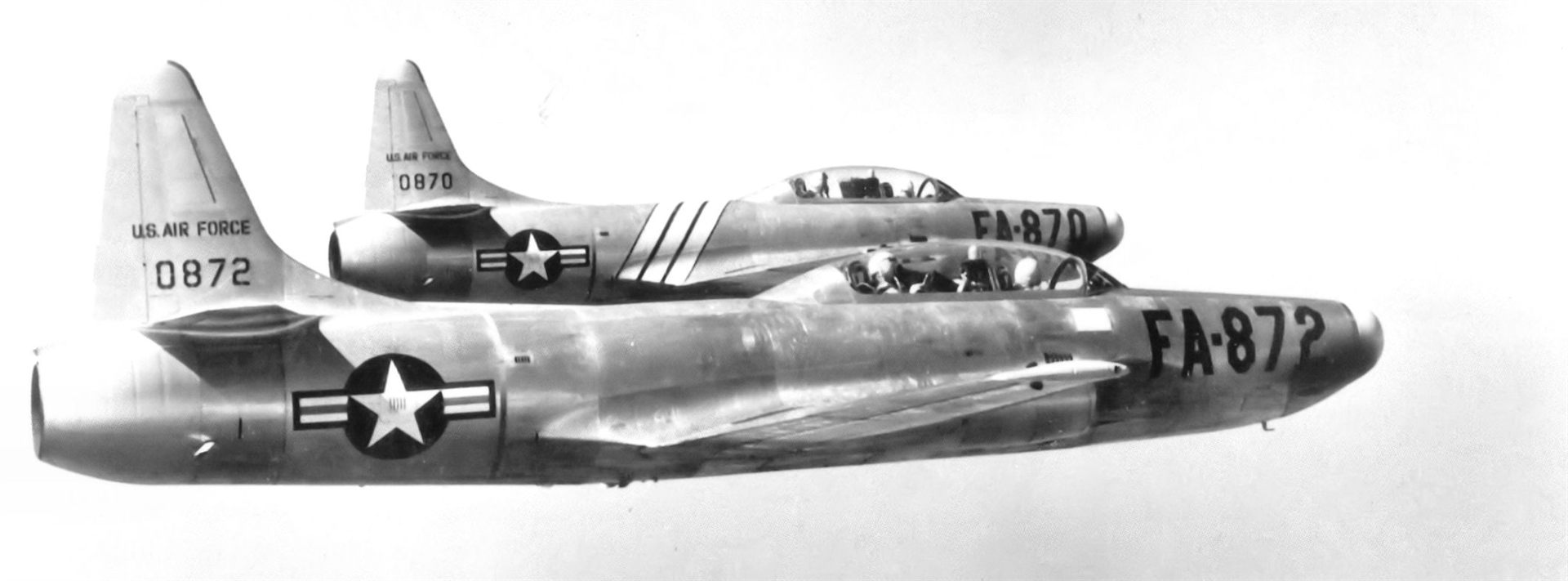
Pictured: a pair of U.S. Air Force Lockheed F-94 Starfire interceptors of the same type scrambled from New Castle Air Force Base, Delaware, during the July 1952 radar chases. This is a generic official Air Force publicity photo of the aircraft type, not the specific jets or pilots involved in the incident, and it shows no radar targets or unidentified craft; no photograph of the objects themselves is known to exist.
Theoretical Alignment
The Washington flap presents a genuinely difficult alignment problem. The vast majority of witnesses reported only unstructured lights and radar blips with no discernible shape or craft structure, never a vehicle, though at least one witness (civilian Joseph Gigandet) described a defined cigar-shaped object — this near-total absence of reported craft morphology across the flap as a whole caps how strongly the case can support the Extraterrestrial Hypothesis regardless of how anomalous the tracking data appears. At the same time, the Psycho-Social Hypothesis explains only part of the record: mass media excitement plausibly inflated the volume of marginal reports circulating that July (the Air Force's own count of 1952 sightings topped 700, versus roughly 15 per month in prior years), but it does not account for trained, on-duty radar operators at three separate scopes and an airline captain independently confirming targets in real time over a fourteen-minute radio exchange. That specific correlation — radar call, visual confirmation, radar call again — is the single hardest fact for both the ETH and the PSH camps to fully absorb, and it is why this case is best read as instrumented-but-unexplained rather than confidently assignable to any one framework.
Background
By the summer of 1952, the American "flying saucer" phenomenon was five years old and had never been more intense. The U.S. Air Force's investigative arm, first called Project Sign, then Project Grudge, had been reorganized in March 1952 as Project Blue Book under the command of newly promoted Captain Edward J. Ruppelt, a decorated World War II bombardier who insisted on a more rigorous, less dismissive approach than his predecessors. Ruppelt inherited an office that had logged 615 reports across the program's first four years; in 1952 alone it would receive more than 700 new ones, the great majority in June and July.
Washington, D.C. was no stranger to isolated reports that summer — scattered sightings had been logged in the capital region as early as July 12 — but nothing had prepared the CAA's National Airport radar room, a relatively new facility using state-of-the-art long-range and approach-control radarscopes, for what began just before midnight on Saturday, July 19. The airspace directly overhead was among the most heavily defended in the country: National Airport's traffic corridor threaded between the Pentagon, the White House, and the Capitol, all inside restricted zones that made any unauthorized aircraft activity a matter of immediate national-security interest. It was against this backdrop — a newly reorganized, more skeptical Blue Book; a capital city primed by a summer of saucer headlines; and some of the most sensitive airspace on the continent — that the events of the next two weekends unfolded.
Complete Timeline
| Date | Event |
|---|---|
| March 1952 | The Air Force reorganizes its UFO investigation as Project Blue Book under Capt. Edward J. Ruppelt, replacing the smaller, more dismissive Project Grudge. |
| July 12–13, 1952 | Scattered, lower-profile UFO reports begin circulating in the Washington, D.C. area, part of a national surge that would total over 700 Air Force reports for the month. |
| July 19, 1952 — 11:40 PM | CAA radar operator Edward Nugent at Washington National Airport spots seven unidentified blips on his scope, 15 miles south-southwest of the city, moving with no relation to any known flight path. Senior controller Harry Barnes confirms the returns are "completely radical" compared to ordinary aircraft. |
| July 19–20, ~midnight | Tower controllers Howard Cocklin and Joe Zacko independently spot a hovering, whitish-orange light outside the tower window that departs at extreme speed — correlating with a simultaneous radar disappearance. |
| July 20, ~12:40 AM | Barnes radios Capital Airlines Flight 807, piloted by Capt. S.C. "Casey" Pierman, near Martinsburg, West Virginia, and asks him to look for traffic. Over the next fourteen minutes Pierman visually confirms six separate lights, each coinciding with a radar target Barnes calls out in real time. |
| July 19–20, overnight | At Andrews Air Force Base, ten miles away, Airman William Brady and Staff Sgt. Charles Davenport independently observe an orange-red light making abrupt directional and altitude changes, unlike anything they had seen before. |
| July 20, ~3:00 AM | Two F-94C Starfire interceptors of the Delaware Air National Guard, scrambled from New Castle Air Force Base, arrive over Washington. Every radar return vanishes the moment the jets appear. |
| July 20, ~3:30–5:30 AM | The F-94s, low on fuel, depart the area; radar targets reappear within minutes. Barnes later concludes the objects were "monitoring radio traffic and behaving accordingly." Last unknown radar contact logged at 5:30 AM. |
| July 21, 1952 | Capt. Ruppelt, in Washington on unrelated business, learns of the weekend's sightings from the morning newspapers rather than through Air Force channels — a fact he later cited as evidence of how disorganized the initial Blue Book response was. |
| July 24, 1952 | Two Air Force colonels flying from Hamilton AFB, California, to Colorado Springs independently report unidentified triangular objects — part of the broader national wave feeding pressure on the Pentagon that week. |
| July 26, 1952 — 8:15 PM | A National Airlines pilot and stewardess report lights maneuvering above their aircraft as it approaches Washington, opening the second weekend's activity hours before nightfall. |
| July 26, ~9:30 PM | National Airport's radar room again tracks unidentified targets in every sector of the scope; controllers calculate speeds — based on the radar's own returns — that at times exceeded 7,000 miles per hour, though this figure is among the most disputed data points in the case. |
| July 26, ~11:30 PM | Two more F-94s scramble from New Castle AFB. Flight leader Capt. John McHugo is vectored toward returns but sees nothing. His wingman, Lt. William Patterson, reports four white glows surrounding his aircraft and radios the ground: "I see them now and they're all around me. What should I do?" No one on the ground has an answer. |
| July 27, after midnight | Blue Book's Pentagon liaison, Maj. Dewey Fournet, and Navy radar specialist Lt. John Holcomb arrive at the National Airport radar room to evaluate the returns firsthand. Holcomb receives a Weather Bureau call confirming only a slight inversion — in his professional judgment, insufficient to explain the "good and solid" targets on the scope. |
| July 27, dawn | Objects fade from all scopes as the sun rises, ending the second weekend's activity. Front-page headlines ("SAUCERS SWARM OVER CAPITAL") run nationwide that morning. |
| July 27, 1952 | President Harry Truman's Air Force aide, Brig. Gen. Robert Landry, telephones Capt. Ruppelt at Wright-Patterson AFB for an explanation; Truman listens silently on a second line without asking questions. Ruppelt, who has not yet formally investigated the sightings, offers temperature inversion as a preliminary hypothesis. |
| July 29, 1952 — 4:00 PM | Maj. Gen. John A. Samford, USAF Director of Intelligence, holds a press conference in Room 3E-869 of the Pentagon — the largest since the end of World War II — and publicly attributes the radar returns to temperature inversion. Maj. Gen. Roger M. Ramey and Blue Book officers including Ruppelt attend. |
| Late July–August 1952 | Reported UFO sightings nationwide drop sharply within about a week of the press conference, a decline the Air Force and skeptics later cited as evidence the explanation had "worked" — while proponents argued it merely discouraged reporting. |
| September 1952 | CIA's Office of Scientific Intelligence, alarmed by the volume and profile of the summer's reports, drafts a memo to Director of Central Intelligence Walter Bedell Smith recommending a formal scientific review of Blue Book's methods. |
| January 14–18, 1953 | The CIA convenes the Robertson Panel, chaired by physicist Howard P. Robertson, to review Blue Book's strongest cases, including Washington. The panel recommends a public "debunking" campaign and reduced publicity for unsolved sightings. |
| 1955 | Ruppelt publishes The Report on Unidentified Flying Objects, documenting his private doubts about the temperature-inversion explanation and revealing that radar and control-tower personnel almost universally rejected it. |
| 1968 | Physicist James E. McDonald testifies before Congress that the Air Force's 1952 explanation was, in his words, "physically impossible," after independently interviewing surviving radar and pilot witnesses. |
| 1969 | Project Blue Book closes permanently. The Washington radar-visual returns remain catalogued as officially "Unidentified" — among a small minority of the program's roughly 12,600 cases never assigned a conventional explanation. |
| 2002 | On the 50th anniversary, former controller Howard Cocklin tells the Washington Post his account is unchanged: "I saw it on the [radar] screen and out the window." Navy physicist Bruce Maccabee publishes a renewed technical defense of the radar data against the inversion hypothesis. |
The First Weekend: July 19–20, 1952
Just before midnight on Saturday, July 19, CAA radar operator Edward Nugent was working the long-range scope at Washington National Airport when seven unidentified targets appeared roughly fifteen miles south-southwest of the city. They were not following any commercial or military flight path, and nothing was scheduled to be in that airspace. Nugent called over his supervisor, senior controller Harry Barnes, who would become the most quoted witness of the entire flap. Barnes watched the scope and later described the moment plainly: "We knew immediately that a very strange situation existed. Their movements were completely radical compared to those of ordinary aircraft."
The sighting was not confined to one radar room. In the airport's control tower, controllers Howard Cocklin and Joe Zacko had their own radar repeater scope and, more strikingly, a direct view out the tower windows. Cocklin spotted a hovering light that then departed at a speed he could not reconcile with any aircraft, reportedly turning to Zacko and asking, "Did you see that? What the hell was that?" Fifty years later, when a Washington Post reporter tracked him down for the anniversary, Cocklin's account had not moved an inch: "I saw it on the screen and out the window."
Ten miles away at Andrews Air Force Base, Airman William Brady in the base control tower and Staff Sgt. Charles Davenport on the ground separately reported an orange-red light making sharp changes of direction and altitude — behavior neither man could match to any conventional aircraft, balloon, or celestial object. Brady's own description became one of the most quoted lines from the case: "An object which appeared to be like an orange ball of fire, trailing a tail. It was unlike anything I had ever seen before."
The most scientifically important moment of the night came around 12:40 AM, when Barnes reached Capital Airlines Flight 807 by radio. The pilot, Captain S.C. "Casey" Pierman, was flying near Martinsburg, West Virginia. Barnes asked him to look for traffic in a specific direction; Pierman came back immediately: "There's one, and there it goes!" Over the following fourteen minutes, Barnes called out radar contacts one at a time and Pierman visually confirmed six separate lights — described as white, tailless, and extremely fast — each sighting lining up with a corresponding radar pip. Barnes later summarized the exchange for investigators: "Each sighting coincided with a pip we could see near his plane." It was this real-time radar-to-visual correlation, repeated and mutually confirming, that most troubled Blue Book's own analysts and that neither Ruppelt nor, later, General Samford could ever fully explain away.
Around 3:00 AM, two F-94C Starfire jets of the Delaware Air National Guard's fighter-interceptor squadron, scrambled from New Castle Air Force Base, arrived over the capital. The instant they entered the area, every radar target vanished from all scopes. Low on fuel, the jets were forced to withdraw after a short search; within minutes of their departure, the unknown returns reappeared. Barnes drew the obvious, unsettling inference: the objects, whatever they were, appeared to be "monitoring radio traffic and behaving accordingly." The last unidentified return of the night was logged at 5:30 AM as the sky began to lighten.
The Week Between: Escalating National Pressure
Capt. Edward J. Ruppelt, the newly installed head of Project Blue Book, happened to be in Washington that week on unrelated Pentagon business. He learned about the July 19–20 sightings not through official Air Force channels but from the morning newspapers — a detail he later cited pointedly in his memoir as proof of how poorly coordinated the military's own internal reporting was, even for events occurring in restricted airspace directly over its own capital. When Ruppelt tried to investigate in person, he found himself denied a staff car (reserved under Pentagon rules for generals and senior colonels), and was forced to abandon fieldwork and fly back to Wright-Patterson Air Force Base in Ohio without personally interviewing a single radar operator or controller.
The story did not fade during the week. On July 24, two Air Force colonels flying from Hamilton Air Force Base in California toward Colorado Springs independently reported unidentified triangular objects — one of hundreds of reports feeding a national total that would top 700 for the month, an extraordinary multiple of the roughly 15-per-month average of the preceding several years. Newspapers ran saucer stories daily. By the time the second weekend arrived, the Pentagon was operating under intense and highly public pressure to produce an explanation.
The Second Weekend: July 26–27, 1952
The second weekend began even earlier than the first. At 8:15 PM on July 26, a National Airlines pilot and stewardess reported strange lights maneuvering above their aircraft as it approached the capital, well before full darkness. By 9:30 PM, the National Airport radar room was again tracking unidentified targets across every sector of the scope. Controllers calculated speeds for some of the returns that reportedly reached as high as 7,000 miles per hour — a figure that, if taken as a literal measurement of a physical object's velocity, would represent one of the most extraordinary kinematic claims in UFO history, and one that skeptics and proponents alike treat with real caution, since anomalous radar propagation can itself produce large, non-physical apparent-velocity artifacts on 1950s-era scopes.
This time, the civilian press spokesman for Project Blue Book, Albert M. Chop, was present at National Airport and restricted reporters' access to the radar screens on security grounds — a decision that, however defensible operationally, fed later suspicion that the Air Force was managing the story as much as investigating it.
Around 11:30 PM, two more F-94 Starfires scrambled from New Castle AFB. Flight leader Captain John McHugo was repeatedly vectored toward radar contacts but saw nothing from his cockpit. His wingman, Lieutenant William Patterson, had a very different night. Patterson reported four white "glows" that appeared to surround his aircraft; pushing his jet to maximum speed, he found he could not close the distance. Chop later recounted Patterson's radio transmission from memory: "I see them now and they're all around me. What should I do?" Nobody on the ground had an answer to give him. Patterson himself later described the pursuit more clinically: "I was at my maximum speed but…I ceased chasing them because I saw no chance of overtaking them."
After midnight, Blue Book's own Pentagon liaison officer, Major Dewey Fournet, and a Navy radar specialist attached to the investigation, Lieutenant John Holcomb, arrived at the National Airport radar room specifically to evaluate the returns in person. Holcomb received a telephoned update from the Washington National Weather Station confirming a slight temperature inversion was present — but in his professional assessment as a trained radar officer, it was "not nearly strong enough to explain the 'good and solid' returns" on the scope. Fournet later reported to his Blue Book superiors that virtually everyone present in the radar room that night was personally convinced the targets represented solid, metallic objects, not weather artifacts. Both men were conspicuously absent from the Pentagon podium three days later.
Civilian airline crews reported additional glowing objects that corresponded with radar blips through the small hours. As dawn broke on July 27, the returns faded from every scope, ending the flap's second and final major night of activity. That morning's newspapers ran the story nationwide — the Cedar Rapids Gazette's front page read simply, "SAUCERS SWARM OVER CAPITAL" — and for the first time the affair reached the White House itself.
The Truman Telephone Call
According to Ruppelt's own account, President Harry Truman's Air Force aide, Brigadier General Robert Landry — who had briefed Truman on UFO matters periodically since 1948 — telephoned Ruppelt at Wright-Patterson on the morning of July 27 asking for an explanation of the weekend's radar returns. Truman himself listened in on a second line but, by Ruppelt's account, never spoke or asked a question directly. Ruppelt, candidly admitting he had not yet interviewed a single witness or reviewed the raw radar logs, offered temperature inversion as his best preliminary guess — the same explanation that would, within 48 hours, become official Air Force policy at the Pentagon podium, effectively locking in a hypothesis that its own originator had proposed as a hunch rather than a finding. Press wire services that week additionally carried unconfirmed reports — never substantiated as official policy — that interceptor pilots nationwide had been placed on alert with informal instructions to attempt to force down or, if necessary, fire on any object that failed to respond to standard intercept procedures; no credible evidence has surfaced that any such order was ever formally issued or acted upon in Washington.
The Pentagon Press Conference, July 29, 1952
At 4:00 PM on Tuesday, July 29, Major General John A. Samford, the Air Force's Director of Intelligence, stepped to the podium in Room 3E-869 of the Pentagon for what is generally regarded as the largest press briefing held there since the end of World War II. Flanking him was Major General Roger M. Ramey, USAF Director of Operations, along with Ruppelt, Captain Roy James, and several other Blue Book analysts from Wright-Patterson.
Samford opened by acknowledging the volume and character of the reports without dismissing them outright: "We have many reports from credible observers of incredible things," he told the assembled press, adding elsewhere in the briefing that "there has remained a percentage of this total, in the order of twenty per cent of the reports, that have come from credible observers of relatively incredible things." He broke down the reporting base by occupation — roughly sixty percent civilian, eight percent airline pilots, and about twenty-five percent military personnel — underscoring that this was not a phenomenon confined to unreliable or inexperienced observers.
On the central question of a security threat, Samford was unambiguous: "There has been no pattern that reveals anything remotely like purpose or remotely like consistency that we can in any way associate with any menace to the United States," and, more expansively, "I think that the highest probability is that these are phenomena associated with the intellectual and scientific interests that we are on the road to learn more about, but that there is nothing in them that is associated with material or vehicles or missiles that are directed against the United States." Asked bluntly whether the Air Force was hiding a secret American weapon capable of the reported performance, Samford was equally direct: "We have nothing that has no mass and unlimited power!"
The explanation Samford offered for the radar targets specifically was temperature inversion — already associated publicly with Harvard astronomer Donald Menzel — a layer of warm, moist air sitting atop cooler, denser air that can bend radar signals and generate false returns from distant ground clutter. Notably, Samford did not present this as settled fact. Pressed by reporters, he was candid about the uncertainty: "The Menzel theory of temperature inversion…It's supported by some people. Other people…discredit it. So the gamble…is about a fifty-fifty proposition. It's appealing. It does satisfy certain concerns." When a reporter asked him directly to explain the Pierman-Barnes radar-to-visual correlation from the first weekend, Samford's answer was a rare, blunt admission: "I can't explain that. I can't explain it at all." On Lieutenant Patterson's jet-chase encounter, Samford offered a similarly qualified assessment: "He has no measuring devices to measure this thing," essentially conceding that the interceptor sighting, however sincere, could not be scientifically verified either way.
Two days later, on July 31, Samford appeared at a related, less formal press session alongside Marine Corps Major Donald Keyhoe, already a prominent flying-saucer author. Keyhoe used the platform to stake out the opposite position publicly: "With all due respect to the Air Force, I believe that some of them will prove to be of interplanetary origin," citing his own three-year survey of pilot testimony describing objects with apparent mass and extraordinary speed. Keyhoe would go on to found the National Investigations Committee on Aerial Phenomena (NICAP) in 1956, using the Washington case as one of its founding exhibits.
Circumstantial Evidence
- The sightings occurred over some of the most heavily monitored, security-restricted airspace in the country, directly astride the approach corridors serving the Pentagon, the White House, and the Capitol.
- Targets were tracked by three independent radar installations — National Airport's long-range and approach scopes and the separate Andrews Air Force Base radar — at times simultaneously, and at times vanishing from all three scopes together.
- The Capital Airlines Pierman sighting represents a rare, controlled, real-time radar-to-visual correlation, called out contact-by-contact over live radio rather than reconstructed after the fact.
- Radar targets consistently vanished when interceptor jets arrived and reappeared after the jets departed — a pattern senior controller Harry Barnes interpreted as evidence of deliberate, responsive behavior.
- Blue Book's own on-scene liaison officers, Maj. Dewey Fournet and Lt. John Holcomb, both trained specialists sent specifically to evaluate the returns, privately concluded the temperature-inversion explanation was inadequate — and were both absent from the Pentagon podium three days later.
- The case triggered a direct inquiry from President Truman's office and, six months later, a CIA-convened scientific review (the Robertson Panel) — a level of institutional escalation with no parallel in most other UFO cases of the era.
- Project Blue Book, despite offering temperature inversion as its public explanation, never reclassified the Washington radar cases as formally "Solved" — they remain catalogued as Unidentified in the program's own closed files.
The Temperature Inversion Controversy
No single explanation in UFO history has been more publicly offered, more immediately contested by the people closest to the event, and more durably unresolved than the Washington temperature-inversion hypothesis. It was championed publicly by Harvard astronomer Donald Menzel, whose 1953 book Flying Saucers argued that virtually all UFO reports, including Washington's, reduced to optical mirages, misidentified planets, and radar ducting caused by inversions. What was not publicly known until decades later — documented by researcher Stanton Friedman and reported in multiple subsequent biographies — was that Menzel simultaneously held a Top Secret Ultra security clearance and worked for more than thirty years as a classified cryptologic consultant to the National Security Agency and other intelligence bodies, a dual role that has fueled ongoing debate about whether his public skepticism was purely scientific or informed by non-public considerations. This detail does not by itself invalidate his physics; his temperature-inversion mechanism was and remains a real, well-understood radar phenomenon. It does, however, complicate any simple reading of "an independent scientist happened to agree with the Air Force."
The most immediate and consequential critique came from within the Air Force's own investigative structure. Capt. Edward J. Ruppelt, who had proposed the inversion idea to Truman's aide as an unverified guess, later documented in his 1955 book that mild temperature inversions occurred on the vast majority of Washington summer nights, yet the specific, coordinated, multi-scope radar returns of July 1952 appeared on only a handful of nights — a frequency mismatch that, in his view, undercut the explanation's core logic. Lt. John Holcomb, the Navy radar officer sent to evaluate the second weekend's returns in person, reached the same conclusion in real time: the inversion present that night was measurably too weak to produce "good, solid" targets of the kind on the scope in front of him.
The most sustained scientific rebuttal came 16 years later from physicist James E. McDonald of the University of Arizona's Institute of Atmospheric Physics. McDonald tracked down and re-interviewed several of the surviving pilots and radar personnel, including Harry Barnes, who told him the July 1952 targets "were not shapeless blobs such as one gets from ground returns under anomalous propagation" but were, in Barnes's professional judgment, solid, discrete contacts. Working through the quantitative radio-physics of ducting and beam-bending, McDonald concluded the Air Force's explanation was, in a phrase he used in later Congressional testimony, "physically impossible" as a complete account of what the radar had recorded.
Navy optical physicist and longtime UFO researcher Bruce Maccabee revisited the case for its 50th anniversary in 2002, arguing that the Air Force's own later technical literature on radar mirage effects — including a 1969 government study on the "quantitative aspects of mirages" — actually supported the conclusion that inversions of the strength present in July 1952 were insufficient to fully account for the returns. Skeptic Philip Klass took the opposing position in the same anniversary coverage, arguing that primitive 1950s radar was simply not sophisticated enough to reliably distinguish real targets from atmospheric artifacts, birds, or ground clutter, and noting that reports of radar-detected UFOs declined sharply once digital signal filtering became standard in the 1970s — a trend he considered strong circumstantial support for the mundane explanation. The dispute, in short, was never fully settled by either side, and it remains the central fault line in how historians assess the entire case.
The Robertson Panel and Institutional Aftermath
The Washington sightings did not end with the Samford press conference. By September 1952, the CIA's Office of Scientific Intelligence had grown sufficiently concerned about the volume, profile, and potential for panic or foreign exploitation of the summer's UFO wave that it recommended Director of Central Intelligence Walter Bedell Smith commission an independent scientific review of Project Blue Book's methods and conclusions.
That review took shape as the Robertson Panel, convened by the CIA from January 14 to 18, 1953, and chaired by Caltech physicist Howard P. Robertson. Over four days, the panel examined Blue Book's strongest documented cases — Washington chief among them — alongside supporting film and photographic evidence submitted by civilian researchers. Its declassified conclusions, released in stages beginning in 1975, found no evidence that UFO reports represented a direct threat to national security, but identified an indirect risk: that continued public fascination with unexplained sightings could overload military and civil-defense communication channels during an actual crisis, and could in theory be exploited by a hostile power to trigger false alarms or mask a real attack.
The panel's most consequential recommendation was cultural rather than scientific: that the Air Force undertake a public "training and debunking" campaign to reduce the aura of mystery around UFO reports, and that civilian UFO research organizations be discreetly monitored for possible subversive influence. In the years that followed, Project Blue Book's public posture shifted markedly toward de-emphasizing unsolved cases and favoring conventional explanations wherever plausible — a policy shift researchers including Ruppelt himself later criticized as prioritizing public reassurance over rigorous investigation. When Blue Book finally closed in December 1969, it had logged roughly 12,618 total reports; only about 701 remained officially Unidentified — among them, the Washington radar-visual sightings of July 1952.
Modern Re-Analysis: The VASCO Transient Study
In January 2024, more than seven decades after the flap, the Washington case acquired an entirely new and unexpected data point — not from declassified government files, but from astronomical archive research unrelated to UFO investigation. Dr. Enrique Solano and Dr. Beatriz Villarroel published "A bright triple transient that vanished within 50 min" in the peer-reviewed Monthly Notices of the Royal Astronomical Society (Vol. 527, Issue 3), documenting an anomaly the pair discovered while combing digitized plates from the First Palomar Sky Survey (POSS-I) as part of Villarroel's VASCO project (Vanishing & Appearing Sources during a Century of Observations) — a roughly 40-member international collaboration that systematically compares 1950s-era sky-survey photography against modern imaging to flag objects that have appeared or disappeared over the intervening decades.
The anomaly itself: three optically bright, roughly 16th-magnitude point sources, clustered within about 10 arcseconds of each other, appear on a red-filter POSS-I exposure taken at Palomar Observatory in California and timestamped 08:52 UT on July 19, 1952 — the same calendar date as the first night of the Washington radar-visual wave, though hours earlier and roughly 2,300 miles away. A follow-up blue-filter exposure taken only ten minutes later shows nothing at those coordinates: whatever produced the three points of light had vanished within an hour, and in some models within minutes. Solano and Villarroel's team returned to the same sky coordinates in 2023 with the 10.4-meter Gran Telescopio Canarias, imaging roughly ten magnitudes deeper than the original plates, and still found nothing — no star, no known object, no explanation consistent with any catalogued source has been identified there in over seventy years of follow-up observation.
The VASCO team's broader survey work, published separately, examined more than 298,000 candidate transient detections across the full POSS-I plate archive and found a second statistically notable multi-point alignment coinciding with July 27, 1952 — overlapping the flap's second weekend of sightings. Villarroel and her collaborators are explicit that this is a temporal correlation in historical data, not a claim that the same physical phenomenon was observed in both California and Washington, D.C., let alone evidence of any connection between the two; the triple transient was recorded on the opposite coast, hours before that evening's Washington sightings began, and nothing in the optical data ties it directly to the radar returns 2,300 miles away. What the VASCO papers do add to the case's evidentiary record is narrower but genuinely unusual: an independent, peer-reviewed astronomical finding that the two most statistically improbable multi-transient events VASCO has identified across its entire pre-Sputnik POSS-I dataset both fall on the exact two dates of one of the best-documented UFO waves in American history — a coincidence the researchers themselves describe as worth further investigation rather than as proof of anything, but one that had gone completely unnoticed by UFO researchers for 70 years because it required astronomical, not case-file, archival research to surface.
Key Researchers
- Edward J. Ruppelt (1923–1960) — Head of Project Blue Book during the flap. His 1955 memoir remains the single most important primary account of the case's internal Air Force handling, including his own private doubts about the temperature-inversion explanation he had originally suggested.
- Donald H. Menzel (1901–1976) — Harvard astronomer and the most prominent public advocate of the temperature-inversion and optical-mirage explanation for the Washington sightings and UFO reports generally.
- James E. McDonald (1920–1971) — Atmospheric physicist whose later quantitative critique of the inversion hypothesis, based on direct re-interviews of surviving 1952 witnesses, remains the most technically rigorous scientific rebuttal of the official explanation.
- Bruce Maccabee — Navy optical physicist and longtime UFO researcher who has published detailed technical defenses of the Washington radar data against the inversion explanation, including a 50th-anniversary reassessment in 2002.
- Philip J. Klass (1919–2005) — Aviation Week senior editor and leading UFO skeptic who defended the conventional-radar-artifact explanation and linked the later decline in radar UFO reports to the introduction of digital signal filtering.
- Kevin D. Randle — Retired military intelligence officer and author of Invasion Washington: UFOs Over the Capitol (2001), the most detailed book-length civilian investigation of the case.
- Donald Keyhoe (1897–1988) — Retired Marine major, UFO author, and later founder of NICAP, who publicly challenged the Air Force's explanation within days of the Samford press conference.
- Beatriz Villarroel — Nordita astronomer and leader of the VASCO project, whose 2024 archival re-analysis of Palomar sky-survey plates surfaced a statistically anomalous transient dated to the exact first night of the flap.
- Enrique Solano — Astronomer and lead author, with Villarroel, of the 2024 MNRAS "bright triple transient" paper connecting VASCO's archival findings to the Washington case.
Cultural Impact
The press quickly nicknamed the affair the "Washington Merry-Go-Round," a name that stuck permanently to the case and later lent itself to a 2019 dramatized episode of the History Channel series Project Blue Book, "The Washington Merry-Go-Round" (a dramatization, not a primary source, and not used as a research source for this file). The case remains one of the two or three most frequently cited "hard" UFO incidents in American history precisely because it does not depend on a single questionable witness or a chain-of-custody-compromised piece of physical evidence: it is, at bottom, a dispute over how to read instrumented data collected by working professionals in real time, which is exactly the kind of evidence modern UAP investigators — from the Robertson Panel's scientific heirs through to AARO in the 2020s — still consider the gold standard for a credible report. The Washington flap is frequently cited by contemporary UAP researchers and journalists as the direct ancestor of the radar-visual methodology used decades later in cases like Lakenheath-Bentwaters and the 2004 USS Nimitz encounter, both of which likewise pair simultaneous radar detection with independent visual and pilot testimony.
Key Witnesses
Harry G. Barnes
The most consistently quoted witness in the case. Barnes supervised the radar room on the night of July 19–20, confirmed the anomalous character of the returns to his own superiors, and personally orchestrated the fourteen-minute radar-to-visual correlation with Capital Airlines Capt. Casey Pierman. A career aviation professional with no prior interest in UFOs, Barnes concluded the objects were "monitoring radio traffic and behaving accordingly" based on their pattern of vanishing when interceptors arrived and reappearing when they left. He maintained his account without modification for the rest of his career.
Edward Nugent
The first person to detect the July 19 targets, spotting seven unidentified blips just before midnight, fifteen miles from the city and unrelated to any scheduled flight path. His initial detection triggered the chain of events that brought in Barnes, the tower crew, Andrews AFB, and ultimately the Pentagon.
Howard Cocklin
Watched both a radar repeater scope and the sky directly from the tower window, observing a hovering light of unusual color that departed at extraordinary speed. Fifty years later, in a 2002 interview with the Washington Post marking the sighting's anniversary, Cocklin's account had not changed: "I saw it on the screen and out the window."
Capt. S.C. "Casey" Pierman
A professional airline captain with no connection to Blue Book or the UFO subculture, Pierman was radioed in flight by controller Barnes and asked to look for traffic. Over fourteen minutes he visually confirmed six separate white, tailless, fast-moving lights, each corresponding to a radar contact called out to him in real time — producing the single most scientifically significant data point of the entire flap: an independent, live, two-way correlation between instrumented and visual detection.
Lt. William Patterson
Wingman on the July 26–27 intercept scramble from New Castle Air Force Base. Patterson reported four white glows appearing to surround his aircraft and radioed for guidance he never received; despite pushing his jet to maximum speed, he could not close on the objects. His case became the centerpiece of General Samford's press conference precisely because it could not be dismissed as a misidentification by an untrained observer, yet also could not be independently instrumented or verified.
Capt. John McHugo
Led both interceptor scrambles from New Castle AFB. Repeatedly vectored toward radar contacts by ground controllers, McHugo personally observed nothing on either night — a useful contrast to his wingman Patterson's sighting that illustrates how inconsistent visual confirmation was even among pilots flying the same intercept in the same airspace.
Airman William Brady
Independently observed an orange fireball trailing a tail from the Andrews AFB tower on the night of July 19–20, describing it as "unlike anything I had ever seen before." His sighting, corroborated by Staff Sgt. Davenport on the ground, gave the Andrews facility its own independent visual record separate from National Airport, ten miles away.
Staff Sgt. Charles Davenport
Watched an orange-red light make abrupt changes in altitude and direction from ground level at Andrews AFB, a description consistent with, but independent of, Airman Brady's simultaneous sighting from the tower.
Master Sgt. Charles E. Cummings
Observed lights during the flap and was explicit in ruling out the most obvious mundane explanation for his own sighting: "These lights did not have the characteristics of shooting stars. There was no trails. They traveled faster than any shooting star I have ever seen."
Maj. Dewey Fournet
Sent to the National Airport radar room in person on July 26–27 to evaluate the returns for Blue Book. Fournet reported back to his superiors that radar room personnel were, in his assessment, convinced the targets were solid, metallic objects — a conclusion notably at odds with the temperature-inversion explanation the Air Force would present publicly three days later, and one that likely explains his conspicuous absence from the Samford press conference.
Lt. John Holcomb
A trained Navy radar officer attached to the on-scene evaluation on July 26–27, Holcomb personally telephoned the Washington National Weather Station and confirmed only a slight temperature inversion was present that night — in his professional judgment, insufficient to account for the strength and consistency of the radar returns he was observing directly.
Albert M. Chop
The Air Force's public-facing liaison during the second weekend, present at National Airport when Lt. Patterson's jet-chase transmission came over the radio. Chop later recounted Patterson's exact words for investigators and journalists, becoming one of the most-cited secondhand sources for that night's events. He would later leave the Air Force and work publicly to promote a more open UFO investigation policy.
Joseph Gigandet
A civilian witness with military background who reported a red, cigar-shaped object roughly comparable in size to a DC-7 airliner, its side marked with a row of closely spaced lights. Gigandet stated that a neighbor who worked for the FBI witnessed the same object independently, illustrating how the flap's visual reports extended well beyond airport and military personnel into the surrounding civilian population.
The Five Observables Assessment
The Five Observables framework, developed by former AATIP director Luis Elizondo, is used to classify UAP encounters by performance characteristics exceeding known technology of their era:
Assessment: Radar operators described targets that hovered nearly motionless and then departed within seconds, and controllers calculated apparent speeds as high as 7,000 mph on the night of July 26–27 — behavior that, if taken as a literal record of a physical object's kinematics, would satisfy both Instant Acceleration and Hypersonic Velocity. Both are rated speculative rather than present, however, because 1950s-era radar was well known to be capable of producing large, non-physical apparent-velocity artifacts under anomalous propagation conditions — precisely the mechanism the Air Force invoked, and precisely the mechanism McDonald, Fournet, and Holcomb argued was too weak that night to fully explain what they saw. Anti-Gravity Lift is similarly speculative: the hovering-then-departing behavior is consistent with it, but no witness described an actual craft or propulsion mechanism, only lights and blips. Low Observability and Trans-Medium travel are rated absent: the targets were, if anything, unusually conspicuous — visible on three independent radar scopes and to the naked eye simultaneously — and no transition between air, water, or space was ever reported.
Evidence Assessment
Supporting Anomalous Origin
- Three independent radar installations tracked correlated, unexplained targets on both weekends, at times vanishing from all scopes simultaneously.
- Capt. Pierman's fourteen-minute visual confirmation of six radar-called contacts is a rare, controlled, real-time radar-visual correlation rather than a reconstructed or delayed report.
- Blue Book's own on-scene liaison officers, Fournet and Holcomb, both concluded the temperature-inversion explanation was insufficient — and neither appeared at the Pentagon podium.
- General Samford himself, under direct press questioning, admitted he could not explain the Pierman sighting: "I can't explain that. I can't explain it at all."
- Targets reportedly vanished when interceptors arrived and reappeared after they departed, a pattern controllers read as behavioral rather than coincidental.
- Witnesses across multiple independent locations (National Airport tower, National Airport radar room, Andrews AFB tower, Andrews AFB ground personnel, two airline crews, a civilian in Alexandria) reported broadly consistent phenomena without any apparent coordination.
- Physicist James E. McDonald's later quantitative review concluded the inversion explanation was, in his assessment, "physically impossible" given the strength of the returns reported by radar personnel.
- Project Blue Book's own files never formally reclassified the Washington radar returns as "Solved" — they remain listed as Unidentified.
Supporting Conventional Explanation
- A temperature inversion was independently confirmed present on both nights by the Weather Bureau, and CAA's own later technical review found inversions "indicated in almost every instance" of the reported targets.
- 1950s-era CAA and military radar was well documented to be susceptible to anomalous propagation, generating false, non-physical returns from ground clutter, temperature layers, and even flocks of birds.
- The calculated 7,000 mph speeds, if accepted as literal, exceed any known aircraft technology of 1952 by an enormous margin — itself circumstantial evidence that the radar was recording an artifact rather than a physical vehicle.
- Visual sightings on some nights may have included ordinary stars, meteors, and aircraft lights misidentified amid a media-driven atmosphere of heightened public alertness for "flying saucers."
- No pilot, including Lt. Patterson, possessed any instrument capable of independently measuring the size, distance, or speed of what he saw — a limitation Samford noted explicitly at the press conference.
- Aviation Week editor Philip Klass and other skeptics have argued that the primitive radar filtering of the era, later corrected by digital signal processing in the 1970s, accounts for the broader decline in radar-based UFO reports after that technology was introduced.
Why "Credible"
The Washington flap earns a CREDIBLE classification rather than "Verified" or "Disputed" because its evidentiary record is unusually strong and well corroborated by the standards of 1952-era instrumentation, yet it stops short of proving an anomalous craft and instead resolves into genuine, still-unsettled scientific disagreement about how to interpret contemporary radar data. What is not seriously disputed: three independent radar centers detected coordinated, unexplained targets on two separate nights; multiple trained professionals — controllers, radar operators, airline and military pilots — independently and repeatedly reported visual phenomena that correlated with those radar returns in real time; the event reached the President of the United States and produced the largest Pentagon press conference since World War II; and even Blue Book's own internal evaluators, sent specifically to assess the returns, privately rejected the explanation the Air Force ultimately presented to the public. What remains genuinely contested is whether that instrumented and eyewitness record reflects a physical, unexplained phenomenon or a scientifically plausible, if imperfectly demonstrated, meteorological artifact interacting with 1952-era radar limitations and a summer of saucer-primed public attention. That tension — strong corroboration paired with a serious, unresolved conventional candidate — is the textbook definition of "credible" rather than "verified" or "disputed" on this site's rating scale.
Sensor & Instrumentation Detection Profile
This is fundamentally a sensor case. Three independent radar installations — the Air Route Traffic Control Center (ARTC) long-range scope, the Civil Aeronautics Administration (CAA) approach-control scope inside the tower at Washington National Airport, and a separate radar unit at Andrews Air Force Base ten miles away — tracked unidentified, slow-moving-then-rapidly-accelerating targets on both weekends, with returns at times confirmed simultaneously across all three scopes before vanishing together. Visual corroboration came from the control tower windows at National, from Andrews AFB tower and ground personnel, from at least one Capital Airlines flight crew, from a National Airlines crew and stewardess, and from two F-94C Starfire interceptor crews scrambled from New Castle Air Force Base, Delaware. No photographic, film, or audio recording of the targets themselves is known to survive in the public record, though the Pentagon press conference itself was filmed and portions of the audio survive in the National Archives.
Environmental & Geospatial Context
Washington in mid-to-late July sits under exactly the humid, hazy, high-pressure conditions that produce nighttime temperature inversions along the Potomac basin — a fact both sides of the later dispute agreed on. The disagreement was over degree: CAA's own Technical Development and Evaluation Center later found an inversion "indicated in almost every instance," while Captain Edward J. Ruppelt pointed out that mild inversions occurred on the overwhelming majority of Washington summer nights without producing anything resembling the July radar returns. Geospatially, the sightings occurred over some of the most tightly monitored airspace on Earth — directly above National Airport's approach corridor, within the Air Defense Identification Zone protecting the capital, and along a line that controllers said passed near the Pentagon, the White House, and the Capitol, a detail that did as much as anything to force a response from the highest levels of the Air Force and the Truman administration.
Observer Credibility & Occupational Profile
The witness pool is unusually credentialed for a UFO case. The core reporters were on-duty aviation professionals performing their jobs at the moment of the sighting, not bystanders: CAA senior controller Harry Barnes and radar operator Edward Nugent at National Airport; tower controllers Howard Cocklin and Joe Zacko; Capital Airlines captain S.C. "Casey" Pierman, a professional pilot with thousands of logged hours; U.S. Air Force and Air National Guard interceptor pilots William Patterson and John McHugo; and Project Blue Book's own on-scene liaison officers, Major Dewey Fournet and Navy Lieutenant John Holcomb, both trained radar specialists sent specifically to evaluate the returns. None of these individuals had any prior public interest in UFOs, none profited from the reports, and several — notably Barnes and Cocklin — maintained their original account for the rest of their lives, including in interviews given decades after the Air Force had officially closed the case.
Physical & Material Assays
No physical debris, trace material, or recovered artifact of any kind is associated with this case, and none has ever been claimed. The entirety of the instrumented record consists of radar plots (calculated target speeds, headings, and positions logged by controllers and later summarized in Project Blue Book's files and Ruppelt's writings) and the observational testimony of the witnesses above. This absence is itself analytically important: unlike crash-retrieval cases, the Washington flap's evidentiary weight rests entirely on the correlation and consistency of independent, real-time sensor and eyewitness data rather than on any object that could be tested in a laboratory.
Historical Precedents & Archive Matches
The Washington sightings were the climax, not the origin, of the great 1952 UFO wave that followed Kenneth Arnold's 1947 sighting near Mount Rainier and the following year's wave that included the Arnold case itself and Project Blue Book's founding in March 1952. The Air Force logged over 700 new reports that July alone. Within weeks of the Washington press conference, NATO exercise Operation Mainbrace in September 1952 produced its own cluster of radar-and-visual sightings over allied naval forces in the North Atlantic, and the pattern of simultaneous radar-and-visual detection followed by inconclusive jet intercepts recurred four years later at Lakenheath-Bentwaters (1956) and again in the RB-47 bomber chase (1957) — both cases this file cross-references below. The Washington flap's most direct institutional legacy, however, was the CIA-convened Robertson Panel of January 1953, discussed in full later in this file, which reshaped how the U.S. government handled UFO reports for the next two decades.
Material Analysis
Unlike crash-retrieval cases such as Roswell, the Washington flap produced no physical debris, trace residue, or recoverable artifact of any kind, and no credible witness has ever claimed otherwise. Every piece of evidence in this case is either instrumented (radar plots and logged speeds/headings) or testimonial (eyewitness accounts from controllers, pilots, and military personnel). This absence of physical material is analytically significant in both directions: it removes an entire category of evidence that could be independently tested, measured, or dated in a laboratory, but it also removes an entire category of evidence that could be faked, contaminated, or planted. The case's credibility therefore rests entirely on the number, training, and independence of the human and instrumented observers involved, and on how well the leading conventional explanation (atmospheric radar ducting via temperature inversion) actually accounts for what those observers recorded.
Supporting an Anomalous Radar/Visual Phenomenon
- Three independently operated radar systems recorded correlated targets, reducing the odds of a single equipment malfunction or operator error.
- Trained Navy and Air Force radar specialists sent specifically to evaluate the returns (Holcomb, Fournet) both concluded, in real time, that the measured inversion was too weak to explain the targets.
- The Pierman radar-visual correlation was conducted live, contact-by-contact, over open radio — a methodology that is difficult to attribute to coincidence, hoax, or memory drift.
Supporting a Terrestrial/Atmospheric Origin
- A temperature inversion was independently confirmed present by the Weather Bureau on both nights in question, providing a real, documented physical mechanism.
- 1950s ground-based radar lacked the digital filtering that later, demonstrably, reduced UFO-type radar reports once introduced in the 1970s.
- No physical trace evidence of any kind exists to corroborate a solid, structured craft, which is consistent with (though does not prove) a purely atmospheric/optical origin for at least some of the reports.
The Conventional Explanation Candidate: Temperature Inversion & Anomalous Propagation
The official U.S. government explanation, offered by General Samford on July 29, 1952 and never formally revised by Project Blue Book, is that a temperature inversion over the Potomac basin caused anomalous propagation ("AP") of the National Airport and Andrews AFB radar beams, generating false returns from ground clutter, temperature-layer boundaries, or distant, ordinary objects. It deserves serious evaluation because it is a real, well-documented meteorological and radar phenomenon, independently confirmed as present on both nights by the Weather Bureau, and because CAA's later technical review found some degree of inversion present "in almost every instance" of the reported targets.
Where the Inversion Theory Falls Short
Its central weakness is the one Ruppelt himself identified: mild-to-moderate temperature inversions were common on Washington summer nights throughout June, July, and August of 1952, yet the specific, multi-scope, coordinated radar returns occurred on only a handful of nights within that period. If inversion strength alone explained the phenomenon, similar returns should have appeared far more frequently than they did. The two on-scene radar specialists sent by Blue Book itself to evaluate the July 26–27 returns — Holcomb and Fournet, both trained to recognize genuine anomalous propagation — independently judged the inversion present that night too weak to produce the targets they were watching. And the explanation does not touch the Pierman case at all: a live radar-to-visual correlation over fourteen minutes is not the kind of event anomalous propagation, which affects only the radar signal and has no bearing on what a pilot sees with his own eyes at a coincidentally correlated moment, can readily explain.
Misidentified Astronomical Objects & Meteors
The Air Force's secondary explanation, offered specifically for the visual sightings, was that witnesses had misidentified ordinary stars, planets, and meteors amid a summer of heightened "flying saucer" media attention. This candidate is plausible for isolated, brief reports by casual observers, and likely accounts for some fraction of the roughly 700 UFO reports the Air Force logged nationally that July. It struggles, however, against the case's best-documented reports specifically: Capt. Pierman's sighting was actively directed by ground radar in real time, not a spontaneous glance at the night sky, and Lt. Patterson's jet-chase encounter involved a trained interceptor pilot at flight speed attempting and failing to close on objects he could clearly track visually — not the kind of extended, sustained misidentification typically associated with a twinkling star or meteor streak.
Mundane Aircraft, Ground Clutter, or Birds
A third, more general candidate holds that some combination of ordinary aircraft traffic, ground-based radar clutter, and flocks of birds accounts for the remaining returns, particularly given known limitations of 1950s radar filtering. This is the weakest of the three candidates for the flap's core, best-corroborated incidents: National Airport and Andrews AFB were staffed by career air-traffic controllers and military radar operators whose entire job was distinguishing exactly these kinds of mundane returns from genuine unknown traffic, on some of the most tightly monitored airspace in the country, and several of them explicitly and immediately rejected mundane categories (Cummings: "these lights did not have the characteristics of shooting stars"; Barnes: "not shapeless blobs such as one gets from ground returns").
Temperature Inversion & Anomalous Propagation
Plausible ImplausiblePLAUSIBLE as a partial explanation for isolated radar returns. IMPLAUSIBLE as a complete account of the coordinated, multi-scope, radar-visual-correlated core incidents.
Related Cases
Confirmed Documents & Official Records
Official National Archives history of Project Blue Book with specific discussion of the July 1952 Washington radar-visual sightings and their role in the program's development.
UNCLASSIFIEDNational Archives overview of the ~130,000 pages of Project Blue Book case files (Record Group 341) transferred to NARA in 1976, including the Washington case materials.
UNCLASSIFIED (declassified)CIA Center for the Study of Intelligence historical study documenting the Agency's involvement in evaluating the 1952 Washington sightings and its role in convening the Robertson Panel.
UNCLASSIFIED (declassified)National Archives finding aid for Project Blue Book's 94 rolls of microfilm (T-1206) and related UAP textual holdings, the primary repository for the original Washington case documentation.
UNCLASSIFIEDSearch Government Archives Directly
Further Reading — Recommended Literature
Captain Edward J. Ruppelt: Summer of the Saucers — 1952
Built from Ruppelt's private papers and unpublished manuscript, this is the single most detailed account of how the man leading Project Blue Book personally experienced and privately doubted the Washington case as it unfolded.
Invasion Washington: UFOs Over the Capitol
The most thorough book-length civilian investigation devoted specifically to the 1952 Washington flap, written by a retired military intelligence officer.
The Report on Unidentified Flying Objects
The first serious insider account of official U.S. UFO investigation, written by the Project Blue Book chief who fielded Truman's inquiry and stood beside Samford at the Pentagon podium.
Watch the Skies!: A Chronicle of the Flying Saucer Myth
A rigorously skeptical, well-documented history of American UFO cases including Washington, useful as a counterweight to more credulous treatments of the case.
The UFO Encyclopedia, 4th Edition
The definitive UFO reference work, with an extensively cited entry on the Washington flap situating it within the broader 1952 national wave and Blue Book's institutional history.
Essential Viewing
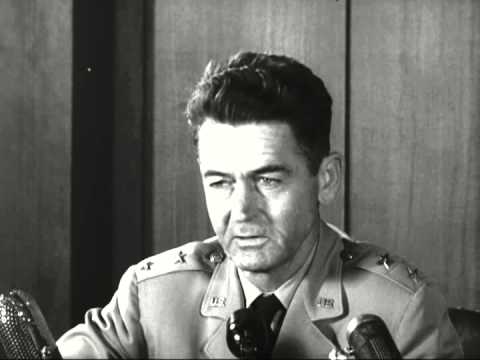
Maj. Gen. John A. Samford's Statement on "Flying Saucers" (July 31, 1952)
Original archival footage from the U.S. National Archives' official YouTube channel, preserving Samford's own words from his July 31, 1952 Pentagon press session — the follow-up appearance alongside Donald Keyhoe described elsewhere in this case, distinct from the main July 29 press conference.
UFO — The Washington Merry-Go-Round
A focused walkthrough of the two 1952 Washington weekends, the radar timeline, and the jet interceptions.
1952: The Invasion of Washington — Full Documentary
A full-length documentary treatment of the July 1952 wave, from the initial radar contacts through the Pentagon press conference.
Sources
- "1952 Washington, D.C., UFO incident," Wikipedia (comprehensive summary with citations to primary sources). en.wikipedia.org
- Ruppelt, Edward J. The Report on Unidentified Flying Objects, Doubleday, 1956 (multiple later editions)
- Minutes of Press Conference Held by Major General John A. Samford, Director of Intelligence, USAF, The Pentagon, July 29, 1952. Transcript reproduced at saturdaynightuforia.com
- Chop, Albert M. & Fournet, Dewey. Contemporary accounts of the July 26–27, 1952 radar room, documented in Ruppelt (1956) and subsequent secondary histories
- McDonald, James E. Statement to the House Committee on Science and Astronautics, Symposium on Unidentified Flying Objects, July 29, 1968. files.ncas.org
- "James E. McDonald," Wikipedia. en.wikipedia.org
- Central Intelligence Agency. "Report of Meetings of Scientific Advisory Panel on Unidentified Flying Objects Convened by Office of Scientific Intelligence, CIA, January 14–18, 1953" (the Robertson Panel Report), declassified January 21, 1975. Full text at en.wikisource.org
- Haines, Gerald K. "CIA's Role in the Study of UFOs, 1947–90," Studies in Intelligence, Semi-Annual Edition No. 1, 1997. cia.gov
- "Robertson Panel," Wikipedia. en.wikipedia.org
- National Archives and Records Administration. "Saucers Over Washington: The History of Project Blue Book," Pieces of History blog, December 19, 2019. prologue.blogs.archives.gov
- National Archives and Records Administration. "Public Interest in UFOs Persists 50 Years After Project Blue Book Termination." archives.gov
- Ghosts of DC. "1952 Washington UFO Sightings: Jets Scrambled Over the Capitol," February 26, 2018 (reproduces extended Samford press-conference transcript excerpts). ghostsofdc.org
- CNN. "In 1952, DC's skies were littered with US fighter jets chasing UFOs. More than 70 years later, the mystery persists," December 28, 2025. cnn.com
- MUFON. "UFOs over Washington, DC — 1952," May 14, 2021. mufon.com
- Seattle Times. "Something in the Air: 50 Years Ago, UFOs Streaked Over D.C.," July 27, 2002 (includes retrospective quotes from Philip Klass and Bruce Maccabee). archive.seattletimes.com
- Blue Blurry Lines. "General John A. Samford's 1952 UFO Disclosure," August 2017 (analysis of the Samford press conference and the disputed See magazine follow-up interview). blueblurrylines.com
- "John A. Samford," Wikipedia. en.wikipedia.org
- "Donald Keyhoe," Wikipedia. en.wikipedia.org
- Peebles, Curtis. Watch the Skies!: A Chronicle of the Flying Saucer Myth, Smithsonian Institution Press, 1994
- Randle, Kevin D. Invasion Washington: UFOs Over the Capitol, HarperTorch, 2001
- Hall, Michael D. & Connors, Wendy A. Captain Edward J. Ruppelt: Summer of the Saucers — 1952, Rose Press International, 2000
- Clark, Jerome. The UFO Encyclopedia, 4th Edition, Visible Ink Press, 2023
- Richard Crist. "The Washington, D.C. UFO Overflights of July, 1952," Medium. medium.com
- Enigma Labs. "Washington D.C. Incident" case library entry. enigmalabs.io
- United States Air Force. Major General John A. Samford, remarks and Q&A, Pentagon press conference, July 29, 1952; archival footage preserved by the National Archives and Records Administration.
- Solano, Enrique & Villarroel, Beatriz, et al. "A bright triple transient that vanished within 50 min." Monthly Notices of the Royal Astronomical Society, Vol. 527, Issue 3, January 2024, pp. 6312–6320. academic.oup.com / preprint: arxiv.org/abs/2310.09035
See something inaccurate? Have additional information or sources?
Suggest an Edit →Last Updated: August 2026