
The Lakenheath–Bentwaters Radar-Visual Incident
On the night of August 13–14, 1956, radar operators at RAF Bentwaters and RAF Lakenheath, two USAF-tenanted RAF stations in Suffolk, England, tracked a series of targets performing accelerations and turns that no aircraft of the era could match. Ground personnel and a passing C-47 crew reported a fast-moving light overhead; an RAF de Havilland Venom night-fighter was scrambled, achieved a radar gunlock on the target — and then watched it slip behind the aircraft. The case was classified Unidentified by the U.S. Air Force, praised by the Condon Committee as "the most puzzling and unusual case in the radar-visual files," and later thrown into fresh doubt when the actual Venom aircrews, tracked down decades afterward, denied the dramatic "chase" ever happened.
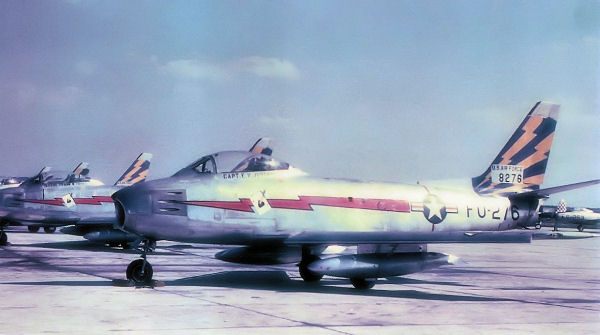
Pictured: a U.S. Air Force F-86 Sabre-type jet fighter of the kind based in the United Kingdom during the mid-1950s — not a photograph of RAF Lakenheath or RAF Bentwaters, the two airfields at the center of this case, and not the RAF de Havilland Venom NF.3 night-fighter that was actually vectored to intercept the radar target on the night of August 13–14, 1956. No rights-clear photograph of either airfield as it appeared in 1956, or of the specific Venom involved, is known to survive; this image stands in only for the era and class of interceptor aircraft operating in the region at the time.
Theoretical Alignment
The case aligns moderately with the Extraterrestrial Hypothesis (ETH) on the strength of its instrumented, multi-sensor redundancy — four independent radar sets and several visual observers reporting broadly compatible tracks. It aligns just as strongly, however, with a Psycho-Social explanation once the 2000s re-investigation is factored in: the most dramatic single element of the story, the ten-minute Venom "chase," rests on second-hand ground-crew testimony that the actual interceptor pilots directly contradict. Interdimensional framing is speculative and unsupported by any element of the primary record.
Background
By the summer of 1956, both RAF Bentwaters and RAF Lakenheath were RAF-owned airfields operated almost entirely by United States Air Force units under the wartime and Cold War basing agreements that placed American nuclear-capable aircraft on British soil. Lakenheath in particular hosted Strategic Air Command bomber units; barely two weeks before the incident, on July 27, 1956, a USAF B-47 Stratojet crashed on landing at Lakenheath and skidded into a storage igloo containing nuclear weapons components, an accident later declassified as one of the more serious "Broken Arrow" near-misses of the early Cold War. The base was, in short, a high-security nuclear installation operating under heightened institutional caution when the events of August 13–14 began.
The wider British defense establishment had already been taking the "flying saucer" question semi-seriously for several years. The Air Ministry's Flying Saucer Working Party, formed in 1950, had investigated a string of earlier reports, and in September 1952 a formation of RAF and Fleet Air Arm aircraft participating in the NATO exercise Operation Mainbrace generated radar-confirmed sightings over the West Country that, according to Project Blue Book chief Captain Edward Ruppelt, were what first "caused the RAF to officially recognise the UFO" as a subject worth investigating. The Bentwaters–Lakenheath events of August 1956 would eclipse all of this: they combined ground radar, airborne radar, and visual confirmation from multiple independent parties in a single continuous incident, and they would end with a fighter interceptor locking weapons radar onto an unidentified contact over English soil.
The night itself began unremarkably. August 13 was dry and largely clear, and multiple observers that evening independently commented on an unusually heavy number of shooting stars streaking overhead — the visible activity of the annual Perseid meteor shower, which reaches its yearly peak in the second week of August. This detail would later become one of the central battlegrounds in the case's technical post-mortem: was some or all of what was tracked on four different radar screens actually meteor activity, misidentified aircraft, or freak atmospheric radar propagation — or was it, as the U.S. Air Force's own investigating officer would conclude in his contemporaneous report, "real and not figments of the imagination"?
Chronology of Events
| Date / Time | Event |
|---|---|
| 21:30 GMT, Aug 13 | First Bentwaters contact (URE No. 1). The RAF Bentwaters AN/MPN-11A GCA radar picks up a target roughly 25–30 miles ESE of the station, tracking steadily westward. Time-and-distance calculations by the operator suggest a speed of anywhere from 4,000 to nearly 10,800 mph depending on assumed sweep rate. Contact is lost 15–20 miles WNW of the base. |
| ~21:35–21:55 GMT | URE No. 2: the merging cluster. A group of 12–15 individual radar returns appears about 8 miles SW of Bentwaters, moving together toward the northeast at a much more modest 80–125 mph — a speed and heading roughly consistent with the prevailing wind. The group merges into a single return "several times larger than a B-36 return under comparable conditions," pauses stationary for 10–15 minutes 40 miles NE of the station, moves again, pauses again, then exits radar range. |
| 22:00 GMT | URE No. 3. A third target is picked up roughly 30 miles east of Bentwaters and tracked to a point 25 miles west, a run covering some 55 miles in about 16 seconds — an apparent speed the operator logs as "in excess of 4,000 mph," with time-distance math suggesting closer to 12,000 mph. |
| 22:55 GMT | URE No. 4 — the first radar-visual convergence. A target approaches from the east at an estimated 2,000–4,000 mph, fades from the Bentwaters scope directly over the station (consistent with a radar's normal overhead blind zone), and reappears to the west. At the same moment, the Bentwaters control tower reports a bright light passing east to west "at terrific speed" around 4,000 feet, and the pilot of a transiting C-47 at the same altitude reports an identical light passing beneath his aircraft. Bentwaters telephones RAF Lakenheath, 40 miles to the northwest, to ask if their scopes show the same target. |
| ~23:00–23:10 GMT | Lakenheath ground personnel report several luminous objects visually, including two that make a sharp course change and appear to merge before departing — described as the angular size of "a golf ball held at arm's length," dwindling to a pinpoint as they receded, which investigators later argued ruled out a bright meteor or bolide. |
| ~23:10–23:40 GMT | URE No. 5 — the stationary target. Lakenheath RATCC controllers, alerted by the Bentwaters call, switch their CPS-5 set to full Moving Target Indicator (MTI) mode, eliminating all ground clutter. A controller then notices a stationary echo 20–25 miles SW of Lakenheath. Without warning it begins moving north-northeast at a calculated 400–600 mph — in the Watch Supervisor's words, "there was no build-up to this speed … it was constant from the second it started to move until it stopped." Over the following half hour it executes multiple abrupt directional changes and several stationary pauses of 3–6 minutes. |
| ~23:40–23:55 GMT | Scramble. An RAF de Havilland Venom NF.3 night-fighter of No. 23 Squadron RAF, based at RAF Waterbeach, is scrambled and vectored toward the Lakenheath contact. |
| ~00:00 GMT, Aug 14 | Gunlock. Lakenheath RATCC tells the Venom pilot the target is half a mile dead ahead. The pilot radios: "Roger … I've got my guns locked on him." He later tells investigators it was "the clearest target I have ever seen on radar." |
| Immediately after | The reversal. After a brief pause, the pilot radios, "Where did he go? Do you still have him?" Lakenheath RATCC reports the target made a swift circling movement and is now behind the Venom. The pilot confirms and attempts to shake it with evasive maneuvers; the radar continues to track a distinct second echo following the aircraft at a separation of over 500 feet, for roughly ten minutes. |
| ~00:10 GMT | Low on fuel, the first Venom pilot — reportedly sounding "pretty scared" — breaks off and returns to base. A second Venom is vectored toward the target's position but reports engine trouble before reaching it and also returns to base. Over the radio, the pilots are overheard: "Did you see anything?" / "I saw something, but I'll be damned if I know what it was." / "What happened?" / "He — or it — got behind me and I couldn't lose him … it was the damnedest thing I've ever seen." |
| ~00:10–03:30 GMT | The target continues to be tracked intermittently on the Lakenheath RATCC scope, making further short moves before finally departing to the north at roughly 600 mph and passing out of radar range around 50–60 miles out at approximately 03:30 GMT. |
| February 1968 | The Perkins letter. Twelve years after the event, retired Technical Sergeant Forrest Perkins, the Lakenheath RATCC Watch Supervisor on the night in question, writes directly to the U.S. Air Force-sponsored Condon Committee at the University of Colorado, providing the first detailed narrative account of the Venom interception. His letter becomes the primary evidentiary basis for the case's inclusion in the Condon Report. |
| 1969 | The Condon Report, Scientific Study of Unidentified Flying Objects, is published, including the Bentwaters–Lakenheath incident as Case 2 in Chapter 5, "Optical and Radar Analysis of Field Cases," authored by Condon Committee researcher Gordon D. Thayer. |
| 1970 | Atmospheric physicist James E. McDonald publishes his own independent analysis, "UFOs Over Lakenheath in 1956," in Flying Saucer Review, incorporating additional detail on the Bentwaters phase drawn directly from the original Project Blue Book file. |
| September 1971 | Thayer's case study is republished as "UFO Encounter II" in the American Institute of Aeronautics and Astronautics' magazine Astronautics & Aeronautics; a copy is later released, declassified, by the CIA through its FOIA reading room. |
| March 19, 1978 | The Wimbledon letter. Following newspaper coverage crediting skeptic Philip J. Klass with having "explained" the case, retired Flight Lieutenant Freddie Wimbledon — who had been the RAF Neatishead Ground Controlled Interception (GCI) controller that night — writes to the Sunday Times disputing the skeptical explanation and stating that it was his own station, not the USAF personnel at Lakenheath, that had actually vectored the two Venoms to the intercept. |
| 1978 | Civilian witness John Killock writes to the Daily Express describing his own August 1956 sighting of a fast white light and a Venom night-fighter near Ely, Cambridgeshire. |
| 2000s | The re-investigation. British researchers David Clarke, Andy Roberts, Martin Shough and Jenny Randles track down and interview the actual surviving Venom aircrews — Flying Officers David Chambers, John Brady, Ian Fraser-Ker and Ivan Logan of No. 23 Squadron — who state the interceptions were scrambled some two hours later than Perkins and Wimbledon recalled, that no tail-chase or evasive action occurred, and that no visual contact was ever made. |
Detailed Narrative
What follows is a reconstruction of the incident drawn primarily from the original 1956 USAF Project Blue Book file, the classified USAF teleprinter message sent three days after the event, Forrest Perkins' 1968 letter to the Condon Committee, and Gordon D. Thayer's 1969–1971 technical analyses of all of the above. Later sections address the significant complications introduced by subsequent research.
The Bentwaters Radar Returns
The night-watch crew at RAF Bentwaters' Ground Controlled Approach (GCA) shack logged four separate unidentified radar echoes (designated UREs 1 through 4 in the official file) between 21:30 and 22:55 GMT on August 13. The first, tracked steadily from the east-southeast to the west-northwest, produced wildly divergent speed estimates depending on which measurement method was used — the controller's own transit-time estimate came to roughly 4,800–6,000 mph, while a raw distance-per-sweep calculation implied 9,000–10,800 mph. The second contact was of an entirely different character: a loose cluster of twelve to fifteen individual blips moving together at a comparatively pedestrian 80–125 mph, a speed and heading that — as later analysts would note — roughly matched the prevailing upper winds, a detail with real technical significance for the anomalous-propagation debate addressed later in this file. The cluster eventually merged into one very large, very strong return, variously described as several times the radar cross-section of a Convair B-36 heavy bomber, before departing to the northeast.
A third, brief contact at 22:00 tracked from east to west across roughly 55 miles of screen in only sixteen seconds, an apparent transit speed the operator logged as exceeding 4,000 mph but which straightforward time-and-distance math put closer to 12,000 mph — though the file itself notes this return, unlike the others, "appeared normal, except for the last, which was slightly weaker than the rest," a detail some skeptical analysts would later seize upon as consistent with a radar-blind-zone artifact rather than a genuine fast-moving target.
The Radar-Visual Convergence
The fourth Bentwaters contact, logged at 22:55, is the pivot point of the entire case. A target approached from the east at an estimated 2,000–4,000 mph, faded from the scope as it passed directly over the station — a location where fixed-elevation ground radar of that era characteristically loses low, close-in targets in a blind cone directly overhead — and then reappeared on the western side. In the same window, and independently of the radar operators, the Bentwaters control tower crew reported watching "a bright light passing over the field from east to west at terrific speed" at roughly 4,000 feet, while the pilot of a U.S. Air Force C-47 Skytrain transport flying at the same altitude over the base radioed that an identical bright light had streaked underneath his own aircraft on the same heading at the same time. It was this three-way correlation — independent ground radar, independent visual tower sighting, and an independent airborne visual sighting, all reporting the same object on the same track within the same narrow window — that convinced the Bentwaters watch to telephone Lakenheath and ask, in the words later relayed by the night-watch supervisor there, whether they had "any 4,000-mph targets" on their own scopes.
The Stationary Target at Lakenheath
The call from Bentwaters prompted the RAF Lakenheath Radar Air Traffic Control Center (RATCC) crew, under the direction of Watch Supervisor Technical Sergeant Forrest Perkins, to switch their own CPS-5 radar into full Moving Target Indicator (MTI) mode — a setting that electronically filters out all stationary ground clutter, leaving only genuinely moving returns visible. Shortly after beginning this focused search, a controller noticed something that should, by definition, not have been there at all under MTI filtering: a completely stationary echo, sitting 20 to 25 miles southwest of the station. Then, without any gradual buildup, it began moving. Perkins later described the acceleration in terms that became the case's most quoted technical detail: there was, he wrote, "no build-up to this speed — it was constant from the second it started to move until it stopped." Calculated out, the sustained speed came to 400–600 mph, itself unremarkable for the jet age, but the manner of the acceleration — instantaneous, with no observable transition through intermediate velocities — was what the investigating officers found genuinely difficult to explain by any conventional aircraft of 1956. Over the following half hour the target made several more such transitions: straight-line runs of eight to twenty miles punctuated by stationary pauses of three to six minutes, a stop-and-go pattern with no obvious parallel in contemporary aviation.
The Scramble and the Gunlock
Some thirty to forty-five minutes after the stationary target was first noticed — roughly 23:40 to 23:55 GMT — the decision was made to scramble an RAF night-fighter to investigate. A de Havilland Venom NF.3, a two-seat, twin-boom jet interceptor of No. 23 Squadron based at RAF Waterbeach, was vectored toward the Lakenheath contact by ground radio direction. According to Perkins' account, the aircraft was picked up inbound on the RATCC scope and directed toward the position of the stationary target roughly sixteen miles southwest of the station. As the Venom closed to within half a mile, Lakenheath radioed the range; the pilot responded, "Roger … I've got my guns locked on him," employing the Venom's onboard AI (airborne interception) radar fire-control system. He would later tell a USAF investigator that it was "the clearest target I have ever seen on radar."
What happened in the next several seconds produced the case's single most famous exchange. After a short pause, the pilot's voice came back over the radio: "Where did he go? Do you still have him?" Lakenheath RATCC, still watching the scope, informed him that the target had executed a rapid circling movement and was now positioned directly behind his own aircraft. The pilot confirmed the same thing independently and began a series of increasingly violent evasive maneuvers, attempting to shake whatever was on his tail. Crucially, the ground radar continued throughout this maneuvering to track two entirely distinct echoes — the Venom's own transponder-equivalent return, and a second, separate echo pursuing it at an estimated separation of more than 500 feet — which, if accurate, rules out the simplest explanation that the pilot was simply seeing his own aircraft's radar ghost or a transient scope artifact. After approximately ten minutes of unsuccessful evasive flying and with fuel running low, the pilot broke off and turned for home, asking the ground station to keep him informed if the contact continued to follow. According to Perkins, the target trailed the departing Venom only a short distance before reverting to a stationary hover-like state.
A second Venom was then vectored toward the target's last known position, but its crew reported engine trouble before achieving any contact and also returned to base. The Lakenheath watch supervisor recorded the radio exchange between the two crews as they compared notes back on the ground: "Did you see anything?" "I saw something, but I'll be damned if I know what it was." "What happened?" "He — or it — got behind me and I couldn't lose him … it was the damnedest thing I've ever seen." The first pilot additionally stated that he had held a solid radar gunlock for several seconds, telling investigators afterward, "there was something there that was solid."
Departure and Loss of Contact
Following the aborted interception, the target did not immediately vanish. It made "a couple more short moves," in Perkins' words, before finally departing to the north at a steady 600 mph and passing out of the Lakenheath radar's normal detection range — some 50 to 60 miles out — at approximately 03:30 GMT, roughly six hours after the first Bentwaters contact of the evening. No further returns were logged, and no wreckage, debris, or photographic record of any kind exists from the incident. The entire six-hour episode left behind nothing but radar-scope notations, verbal witness accounts, and, eventually, a dense paper trail of investigative correspondence spanning the next half-century.
The Long Silence and the 1968 Perkins Letter
Remarkably, the incident attracted almost no public attention at the time. The USAF's classified teleprinter message, sent from the 3910th Air Base Group to Air Defense Command headquarters at Ent Air Force Base three days after the event, remained buried in the Project Blue Book files, and no contemporaneous press account of the interception appears to have circulated in Britain or the United States. The case would very likely have remained an obscure file-cabinet entry indefinitely had Forrest Perkins — by then a civilian, twelve years removed from his post as Lakenheath's overnight radar watch supervisor — not taken the initiative in February 1968 to write directly to the University of Colorado's UFO study, chaired by physicist Edward U. Condon and popularly known as the Condon Committee. Perkins' unsolicited letter supplied, for the first time in the open literature, a detailed first-person narrative of the Venom interception, including the exact radio exchanges quoted above. It was this letter — not the original Blue Book file, which the Committee had in fact already obtained too late for full incorporation — that became the primary basis for the Condon Report's treatment of the case, and it remains, to this day, the single most detailed surviving account of what allegedly happened in the cockpit and on the RATCC scope during the interception.
The Condon Committee Investigation
Gordon D. Thayer, the Condon Committee's optical and radar specialist, undertook a rigorous technical review of the Perkins letter alongside the recovered Blue Book file and the 1956 teleprinter message. His analysis, published as Case 2 in Chapter 5 of the 1969 Condon Report, systematically worked through the leading conventional explanations. He judged the meteor hypothesis effectively ruled out: contemporaneous observers, including the well-known astronomer and Air Force UFO consultant J. Allen Hynek, pointed out that witnesses that same evening explicitly distinguished the tracked objects from the unusually numerous Perseid shooting stars they could also see, which would be an odd distinction for someone actually misperceiving a meteor. Visual mirage was ruled out on geometric grounds — the tower and the C-47 pilot observed the light from substantially different vantage points and altitudes at the same moment, which a simple atmospheric mirage could not easily reproduce. Radar malfunction, specifically a faulty MTI unit as later proposed by skeptic Philip J. Klass, was considered but weighed against the fact that the target was independently tracked by the Lakenheath GCA set (a different radar type on a different frequency) and, according to the pilot, by the Venom's own airborne AI radar as well — a level of cross-system redundancy a single faulty ground unit could not produce. Anomalous propagation (AP) — false returns caused by radar energy ducting off temperature-inverted atmospheric layers — was judged a plausible partial explanation for the slow-moving URE No. 2 cluster at Bentwaters, whose speed and heading roughly tracked the prevailing wind, but Thayer concluded it could not plausibly account for the Lakenheath stop-and-go target, whose behavior was tracked on two radars of different frequencies and included genuinely stationary intervals inconsistent with a drifting atmospheric reflector.
Thayer's conclusion, reprinted in full in the Condon Report and widely quoted ever since, was carefully hedged but unmistakably striking for a government-commissioned study whose overall mandate had been to find prosaic explanations for UFO reports: "In conclusion, although conventional or natural explanations certainly cannot be ruled out, the probability of such seems low in this case and the probability that at least one genuine UFO was involved appears to be fairly high." Thayer later clarified, in the 1971 AIAA republication of his analysis, that his use of the phrase "genuine UFO" meant precisely and only what the acronym denotes — an unidentified object that was materially real and actually in flight — and explicitly did not imply an extraterrestrial or otherwise exotic origin. The Condon Report's own summary judgment on the case went further still: "this is the most puzzling and unusual case in the radar-visual files. The apparently rational, intelligent behavior of the UFO suggests a mechanical device of unknown origin as the most probable explanation of this sighting."
Publication as "UFO Encounter II"
In September 1971, Thayer's analysis was republished in a more polished form as "UFO Encounter II: Sample Case Selected by the UFO Subcommittee of the AIAA" in Astronautics & Aeronautics, the flagship magazine of the American Institute of Aeronautics and Astronautics. The AIAA's own UFO Subcommittee, composed of practicing aerospace engineers and scientists, selected the case specifically to give its professional readership "a flavor of the observational residue material which underlies the UFO controversy," explicitly declining to offer its own explanation and inviting readers to form independent judgments "as engineer or scientist." A copy of this article was later declassified and released by the Central Intelligence Agency through its Freedom of Information Act reading room, where it remains publicly available today — a curious but well-documented instance of a Cold War intelligence agency archiving a peer-reviewed aerospace society's UFO case study.
1978: The Wimbledon Letter and the Sunday Times Dispute
The case resurfaced in the British press in March 1978 after astronomer and journalist Ian Ridpath, writing in the Sunday Times, credited Philip J. Klass's skeptical analysis with having effectively resolved the mystery. This prompted a letter, published March 19, 1978, from retired Flight Lieutenant Freddie Wimbledon, who identified himself as the Ground Controlled Interception (GCI) controller who had been on duty at RAF Neatishead, a separate radar station on the Norfolk coast, on the night in question. Wimbledon's account corroborated the broad shape of Perkins' story — he too recalled a solid radar target chasing the intercepting Venom — but corrected an important institutional detail: he stated it had been his own Neatishead GCI team, not USAF personnel physically at Lakenheath, who had actually directed the two Venom interceptors to the target, with the Americans at Lakenheath essentially listening in on a shared frequency. Wimbledon firmly rejected Klass's proposed explanation, describing the target from his own recollection as a solid return tracked simultaneously by three separate ground radar sets plus the intercepting aircraft's own set. The same wave of 1978 press interest also produced a letter to the Daily Express from civilian witness John Killock, who described watching a fast-moving white light and, separately, a Venom night-fighter over Ely, Cambridgeshire that same August.
The 2000s Re-Investigation: A Very Different Picture Emerges
The most consequential development in the case's long history came decades later, when British researchers David Clarke, Andy Roberts, Martin Shough and Jenny Randles undertook to locate the actual Venom aircrews involved — the men whose voices, according to Perkins and Wimbledon, had been captured in the dramatic radio exchanges quoted throughout this file. They succeeded. Flying Officers David Chambers and John Brady, crew of the first Venom, and Flying Officers Ian Fraser-Ker and Ivan Logan, crew of the second, were all located and interviewed on the record. Their testimony diverged sharply from the established narrative in several critical respects. First, on timing: both crews confirmed they had actually been scrambled at 02:00 and 02:40 GMT respectively on August 14 — roughly two hours later than the interception window described by both Perkins and Wimbledon. Second, and far more significantly, on substance: both crews stated that the radar contacts they obtained were unremarkable, that no tail-chase or evasive maneuvering of any kind took place, and that neither crew ever achieved visual contact with anything. Chambers, the first pilot, told the researchers plainly: "my feeling is that there was nothing there, it was some sort of mistake." Logan, navigator on the second Venom, was equally direct: "all we saw was a blip which rather indicated a stationary target." At the time, in fact, No. 23 Squadron's own contemporaneous assessment was that the contact had most likely been a weather balloon.
The re-investigation uncovered still more layers of complication. A third Venom crew, Flying Officers Leslie Arthur and Grahame Scofield, was found to have been scrambled much earlier in the evening on an unrelated tasking, without being told the nature of their target, and forced to abort after a wingtip fuel-tank malfunction. Back at Waterbeach later that night, Scofield recalled monitoring the radio traffic of the later interception crews — and, oddly, his recollection of what he overheard matched the dramatic Perkins/Wimbledon version far more closely than it matched what Chambers, Brady, Fraser-Ker and Logan themselves later said had actually happened. Researchers also identified the path of Scofield's own aborted flight as a strong candidate explanation for John Killock's 1978 account of seeing a Venom over Ely. Finally, the researchers established that No. 23 Squadron's commanding officer, Wing Commander A. N. Davis, had himself separately been diverted to investigate the same radar returns while flying from RAF Coltishall — raising the possibility that Davis and an uncertain fourth crew member, rather than Chambers/Brady or Fraser-Ker/Logan, may in fact have been the "two" pilots Perkins and Wimbledon actually recalled hearing on the radio that night. No version of events fully reconciles all of these overlapping and contradictory threads, and no subsequent researcher has claimed to have done so definitively.
One further hypothesis has circulated in more recent, less rigorously sourced online discussions of the case: that the entire episode — or at least the interception phase — represented an undisclosed test of radar deception ("spoofing") technology, comparable to later confirmed Cold War electronic countermeasures programs. This theory should be treated with considerable caution. The specific historical radar-spoofing program most often invoked in connection with 1950s British radar-visual cases, the CIA's Project Palladium, is documented as having begun under Deputy Director for Science and Technology Albert "Bud" Wheelon starting in 1962 — six years after this incident — and researcher Martin Shough has separately argued it is far more plausibly connected to a different, contemporaneous East Anglian case: U.S. Air Force pilot Milton Torres' 1956–57 account of being scrambled from RAF Manston and ordered to fire on a radar target, not to the Lakenheath–Bentwaters events described here. No documentary evidence directly ties any spoofing exercise to the night of August 13–14, 1956, and the theory remains speculative.
Key Researchers & Investigators
- Gordon D. Thayer — Optical and radar physicist for the Condon Committee; authored the case's official 1969 government analysis and its 1971 AIAA republication, "UFO Encounter II."
- James E. McDonald (1920–1971) — Senior physicist at the University of Arizona's Institute of Atmospheric Physics and one of the most credentialed scientific UFO researchers of his era; published an independent technical analysis of the Bentwaters phase in 1970.
- Philip J. Klass (1919–2005) — Senior avionics editor at Aviation Week & Space Technology and the era's most prominent UFO skeptic; proposed a combined radar-malfunction and Perseid-meteor explanation.
- Ian Ridpath — British astronomer and science journalist whose 1978 Sunday Times article crediting Klass's explanation prompted Freddie Wimbledon's rebuttal letter.
- David Clarke — Journalism academic at Sheffield Hallam University and the UK's leading academic researcher of Ministry of Defence UFO files; co-led the 2000s re-investigation that located the actual Venom aircrews.
- Andy Roberts, Martin Shough and Jenny Randles — British Fortean and UFO researchers who collaborated with Clarke on the aircrew interviews and subsequent technical reassessment of the case, published collectively as "the Lakenheath Collaboration."
Key Witnesses
Technical Sergeant Forrest Perkins
The single most important witness in the case. Perkins was the senior USAF enlisted radar controller on duty at Lakenheath through the night of August 13–14, 1956, and it was his unsolicited February 1968 letter to the Condon Committee — written twelve years after the fact, once he was a civilian — that first supplied a detailed narrative of the Venom interception to outside investigators. Every quoted radio exchange from the "chase" phase of the incident traces back to his account. His story was independently corroborated in its broad outline a decade later by Flight Lieutenant Freddie Wimbledon, but was directly contradicted in its specifics by the Venom aircrews themselves when they were located and interviewed in the 2000s.
Flight Lieutenant Freddie Wimbledon
Wimbledon wrote to the Sunday Times in March 1978 to contest astronomer Ian Ridpath's assertion that skeptic Philip J. Klass had explained the case. He identified himself as the RAF radar controller who had actually vectored the two Venom night-fighters to the intercept from Neatishead, correcting the popular assumption that USAF personnel at Lakenheath alone had directed the interception. His account agreed with Perkins' on the core claim of a solid, radar-tracked pursuit of the aircraft, and he specifically disputed Klass's anomalous-propagation and equipment-malfunction explanations based on his own recollection of simultaneous, multi-set solid returns.
Flying Officer David Chambers & Flying Officer John Brady
Identified and interviewed by researchers David Clarke, Andy Roberts, Martin Shough and Jenny Randles decades after the event, Chambers and Brady stated they were scrambled from RAF Waterbeach at 02:00 GMT on August 14 — roughly two hours later than the timing given by Perkins and Wimbledon — and that the radar contact they obtained was unremarkable, involving no tail-chase, no evasive maneuvering, and no visual sighting of any object. Chambers' verdict, delivered decades after his name had become attached to one of the most famous UFO radio transcripts on record, was blunt: "my feeling is that there was nothing there, it was some sort of mistake." Their testimony is the single most important complicating factor in the entire case.
Flying Officer Ian Fraser-Ker & Flying Officer Ivan Logan
The crew of the second interceptor, scrambled at 02:40 GMT according to their own account (rather than reporting an engine malfunction shortly after takeoff, as the classic version of the story holds — their later testimony to Clarke and colleagues instead describes an unremarkable sortie). Navigator Logan's recollection was similarly deflationary: "all we saw was a blip which rather indicated a stationary target." At the time, No. 23 Squadron's own working theory was that the contact was most likely a weather balloon.
Wing Commander A. N. Davis
Research by David Clarke uncovered that Davis, the squadron's commanding officer, had also personally flown a Venom that night after being diverted from RAF Coltishall to investigate the same radar returns. Because his flight window overlaps with the interception described by Perkins and Wimbledon, some researchers now suspect that Davis — not Chambers/Brady or Fraser-Ker/Logan — may have been one of the "two" pilots whose radio traffic the ground controllers actually recalled. His involvement was not established until decades after the original accounts were published.
Flying Officer Leslie Arthur & Flying Officer Grahame Scofield
A third crew, scrambled earlier in the evening on a separate tasking and forced to abort after a wingtip fuel-tank malfunction. Scofield later recalled monitoring, from the ground at Waterbeach, radio traffic from the later interception that more closely matched the dramatic Perkins/Wimbledon narrative than the far more mundane account subsequently given by Chambers, Brady, Fraser-Ker and Logan — a discrepancy that has never been fully resolved. The flight path of this aborted sortie is now considered the most plausible explanation for civilian witness John Killock's 1978 account of a Venom seen over Ely.
1st Lieutenants Charles Metz & Andrew Rowe
Dispatched from Bentwaters early in the evening to visually investigate the first radar contacts, Metz and Rowe reported seeing nothing unusual in the sky apart from a single amber, star-like object subsequently identified as almost certainly the planet Mars, then low on the southeastern horizon. Their negative sighting is an important data point establishing that not every radar anomaly that night corresponded to a visible object.
John Killock
A civilian who wrote to the Daily Express in 1978 describing an August 1956 sighting from Ely of a rapidly traveling white light, together with a separate sighting of a Venom night-fighter and a group of odd amber lights. Subsequent research has tentatively connected his account to the flight path of Flying Officers Leslie Arthur and Grahame Scofield's earlier, aborted sortie rather than to the main interception described by Perkins and Wimbledon.
The Five Observables Assessment
Assessment: Instant Acceleration is the case's strongest and best-documented observable — the Lakenheath target's transition from a fully stationary radar return to a sustained 400–600 mph track with, in the Watch Supervisor's own words, "no build-up to this speed," is difficult to reconcile with any propeller or early jet aircraft of 1956. Hypersonic performance is rated speculative rather than present: the most extreme speed estimates (up to roughly 12,000–18,000 mph for several of the Bentwaters contacts) rest on fragile time-and-sweep-rate arithmetic that later analysts, including skeptical researchers, have argued is highly sensitive to unverified assumptions about radar sweep timing, and the more conservative, better-corroborated Lakenheath speeds are in the hundreds, not thousands, of miles per hour. Low Observability is speculative, based only on the target's tendency to fade in and out near the radar's overhead blind zone, which is at least as consistent with mundane radar geometry as with any deliberate signature reduction. Anti-Gravity Lift and Trans-Medium travel find no support anywhere in the record and are marked not applicable.
Evidence Assessment
Supporting a Genuine Unexplained Phenomenon
- Four physically independent radar systems, operating on different frequencies and belonging to different commands (USAF and RAF), reported broadly compatible unidentified tracks over the same six-hour window
- The Bentwaters URE No. 4 target was independently confirmed by ground radar, a control-tower visual sighting, and a C-47 pilot's visual sighting essentially simultaneously
- The Lakenheath target's "instant acceleration" — zero to 400–600 mph with no observed buildup — was noted as anomalous by the contemporaneous USAF investigating officer, who wrote that the sightings "were real and not figments of the imagination"
- The Venom pilot achieved a solid AI radar gunlock and described the target as "the clearest target I have ever seen on radar" and "something there that was solid"
- Ground radar tracked two distinct echoes — aircraft and target — simultaneously during the alleged pursuit, with over 500 feet of separation, arguing against a simple scope artifact
- The Condon Committee, whose overall mandate leaned toward finding conventional explanations, nonetheless concluded the probability of a "genuine UFO" was "fairly high" in this specific case
- Flight Lieutenant Freddie Wimbledon independently corroborated the core "chase" narrative in 1978, disputing the skeptical explanation from firsthand recollection as the actual GCI controller who vectored the intercept
- A classified USAF teleprinter message sent only three days after the incident broadly corroborates the "chase" episode, indicating the account was not invented years later
Supporting a Conventional or Testimonial Explanation
- The Venom aircrews actually involved — Chambers, Brady, Fraser-Ker and Logan — when located and interviewed decades later, denied any tail-chase, evasive maneuvering, or visual contact ever occurred
- The aircrews stated they were scrambled roughly two hours later than Perkins and Wimbledon's accounts claim, a substantial and unexplained timing discrepancy
- No. 23 Squadron's own contemporaneous internal assessment was that the contact was most likely a weather balloon
- The most extreme speed estimates (up to ~18,000 mph) depend on assumed radar sweep rates that cannot now be independently verified and may be significant overestimates
- The slower-moving Bentwaters URE No. 2 cluster moved at a speed and heading roughly consistent with the prevailing upper winds, a signature associated with anomalous radar propagation off temperature-inverted air layers
- The night featured an unusually active Perseid meteor shower, independently noted by multiple witnesses, providing a documented source of genuine aerial phenomena that could plausibly account for at least some visual reports
- Skeptic Philip Klass attributed the Lakenheath radar behavior to a malfunctioning MTI unit newly installed and unfamiliar to operators at the time
- The central "chase" account rests entirely on testimony (Perkins' letter) written twelve years after the event, with no contemporaneous written record of the specific radio exchanges it quotes
- Witness Grahame Scofield's recollection of overheard radio traffic matches the dramatic Perkins/Wimbledon account more closely than it matches what the actual pilots on the radios later said happened — suggesting some combination of misattribution, conflation of separate sorties, or reconstructed memory among the ground-based witnesses
Why "Disputed"
The Lakenheath–Bentwaters incident earns a DISPUTED classification rather than CREDIBLE or UNVERIFIED because it splits cleanly into two evidentiary tiers that point in different directions. The first four hours of the case — the Bentwaters radar contacts and the radar-visual convergence of Event 4 — rest on a genuinely strong foundation of independent, same-night, cross-system corroboration: separate radar operators, a control tower crew, and a transport pilot who did not know each other's reports all converged on the same object at the same time. That portion of the case has never been seriously undermined and is the reason the Condon Committee, an official U.S. government study with every institutional incentive to find mundane explanations, still concluded a "genuine UFO" was more likely than not involved.
The second tier — the Venom interception, the ten-minute "chase," the gunlock, and the now-famous radio transcript — is the part of the story that made this case legendary, and it is also the part that has been most seriously called into question. It survives in the record almost entirely through the recollections of two ground-based radar controllers, one of whom did not commit his account to writing until twelve years after the fact. When the actual pilots who flew the intercepting aircraft were finally identified and interviewed by independent researchers in the 2000s, they did not merely add nuance to the story — they flatly denied that the central dramatic episode, as popularly told, happened to them at all. This is not a case of fading memory or minor detail drift; it is a direct, first-person contradiction of the incident's signature moment, delivered by the men whose own voices supposedly appear in the transcript. Given that genuine conflict between two categories of credible, named, on-duty military witnesses — and given that no subsequent researcher has produced a reconciliation that satisfies both accounts — DISPUTED is the only classification that does not quietly favor one side of an unresolved, first-hand evidentiary contradiction.
Sensor & Instrumentation Detection Profile
Four physically separate radar systems were implicated across the night: the RAF Bentwaters AN/MPN-11A Ground Controlled Approach (GCA) set; the RAF Lakenheath CPS-5 Radar Air Traffic Control Center (RATCC) set, later switched to full Moving Target Indicator (MTI) mode; the Lakenheath CPN-4 GCA set; and the AI (airborne interception) Mk.10 radar carried aboard the intercepting de Havilland Venom NF.3. Visual sensors — unaided human eyesight only — were provided by the Bentwaters control tower, a transiting C-47 Skytrain crew, ground personnel at Lakenheath, and the Venom pilot himself.
Environmental & Geospatial Context
The night was dry and largely clear over Suffolk and the wider East Anglian coast, with observers independently noting an unusually heavy concentration of shooting stars — the natural result of the annual Perseid meteor shower, which peaks each year around August 11–13. Winds aloft were recorded at roughly 260°/45 mph at 10,000 feet and 260°/63 mph at 16,000 feet, a detail that becomes central to the later technical debate over anomalous radar propagation.
Observer Credibility & Occupational Profile
Every primary witness held an active-duty USAF or RAF role directly relevant to the observation: qualified GCA/RATCC radar controllers, a squadron commanding officer, commissioned fighter pilots and navigators, and a Ground Controlled Interception (GCI) station controller. None were civilian enthusiasts; several were later tracked down and interviewed on the record decades after the event, producing a body of testimony that is unusually well-corroborated in its outline but sharply divided over the most sensational details.
Physical & Material Assays
No physical debris, photograph, or film of any kind was recovered or produced. The entire evidentiary record consists of radar-scope observations (recorded contemporaneously as plots and later reconstructed from memory and message traffic), verbal and radioed witness testimony, a classified USAF teleprinter message, and a private letter written twelve years after the fact. This absence of physical or photographic trace evidence is itself a defining feature of the case's evidentiary profile.
Historical Precedents & Archive Matches
The case is frequently — and incorrectly — described as having been included in the U.S. Air Force's 1955 Battelle Memorial Institute study, Project Blue Book Special Report No. 14. That report's roughly 3,200-case statistical sample was compiled and closed out in 1954, a full two years before this incident occurred, so it could not possibly have been one of the cases analyzed. The confusion likely arises because Special Report 14's central finding — that better-documented, higher-quality sightings were more, not less, likely to be classified "Unknown" — is so frequently invoked in discussions of exactly this kind of high-credibility, multi-witness radar case. The case's genuine official pedigree is different but arguably stronger: it is Case 2 in the 1968 Condon Report, the U.S. government's second and final formal UFO study, and was subsequently republished by the Central Intelligence Agency's own reading room as a sample case study for the American Institute of Aeronautics and Astronautics (AIAA).
Material Analysis
Unlike crash-retrieval cases such as Roswell, the Lakenheath–Bentwaters incident produced no physical debris, no ground trace, and no photograph or film of any kind. Its entire evidentiary record is instrumental and testimonial: radar-scope plots (recorded contemporaneously as operator log entries rather than photographed or otherwise preserved as raw data), a classified teleprinter message, and witness recollection, some of it decades removed from the event. This absence of physical material is not unusual for a pure radar-visual case of this era — airborne and ground radar scopes of the 1950s were not routinely photographed or recorded to tape — but it does mean that every technical claim in the case, including the celebrated "instant acceleration" and "gunlock" details, ultimately rests on human transcription and memory of what a radar screen displayed, rather than on any independently reviewable physical or digital record.
The one quasi-physical artifact of note is the classified USAF teleprinter message sent from the 3910th Air Base Group to Air Defense Command headquarters at Ent Air Force Base just three days after the incident. Its existence and content were confirmed by the Condon Committee, which used it to cross-check Forrest Perkins' 1968 letter and found the two broadly consistent — a meaningful corroboration, since it demonstrates the "chase" narrative was already circulating in official channels within days of the event, rather than being invented or substantially embellished over the intervening twelve years before Perkins wrote his letter.
Supporting Instrumented Anomaly
- A classified internal USAF message corroborating the chase narrative exists from only three days after the event, predating any public account by over a decade
- Radar cross-section on at least one contact was described as "several times larger than a B-36 return," an unusually strong signal return difficult to attribute to a simple false echo
- Multiple independent radar frequencies and set types (GCA, RATCC/MTI, airborne AI) reported compatible target behavior during the Lakenheath episode specifically
Supporting Mundane or Testimonial Origin
- No radar-scope photography, magnetic tape recording, or other primary instrumental record survives from any of the radar systems involved
- All quantitative claims (speed, acceleration, separation distance) derive from operator estimation and post-hoc recollection rather than instrument telemetry
- The most dramatic testimonial claims are directly contradicted by the on-the-record statements of the pilots who allegedly generated them
Conventional Explanation Candidates
Three distinct terrestrial explanations have been seriously proposed for the Bentwaters–Lakenheath events, each addressing a different portion of the six-hour episode. None fully accounts for every element of the case as reported; each is evaluated below on its own merits.
1. Anomalous Propagation, Meteor Activity & Radar/MTI Malfunction
The leading skeptical explanation, most closely associated with Philip J. Klass, combines several conventional radar and atmospheric phenomena. Anomalous propagation (AP) — false targets produced when radar energy ducts and reflects off temperature-inverted atmospheric layers — is a well-documented source of spurious returns, and the slow-moving Bentwaters URE No. 2 cluster (80–125 mph, tracking roughly with the 40–63 mph prevailing wind) matches the AP signature closely enough that even Gordon Thayer's own Condon Report analysis conceded it as a plausible partial cause for that specific contact. Klass additionally proposed that the Lakenheath RATCC set's newly installed MTI unit, unfamiliar to its operators, may have been malfunctioning in a way that produced false "stationary-then-moving" targets, and that the unusually active Perseid meteor shower documented that same night provided a ready source of genuine but misidentified aerial activity to explain at least some of the visual reports.
This explanation runs into real difficulty, however, once it is asked to cover the full six-hour episode. Thayer's own technical analysis found that most of the individual contacts — including the pivotal URE No. 4 radar-visual convergence and the entire Lakenheath stop-and-go sequence — moved on headings that were inconsistent with, or opposite to, the prevailing winds, which argues against a simple AP explanation for those specific events. J. Allen Hynek separately noted that witnesses that night explicitly distinguished the tracked objects from the visibly numerous Perseid meteors they could also see, undercutting a simple meteor-misidentification account. And a malfunctioning MTI unit, while plausible for the Lakenheath RATCC set in isolation, cannot easily explain why an entirely separate GCA radar on a different frequency, and reportedly the Venom's own airborne AI set, tracked compatible targets at the same time.
Anomalous Propagation, Meteor Activity & Radar/MTI Malfunction
Plausible QuestionablePlausible, partially — covering the Bentwaters URE No. 2 cluster and some visual reports — but questionable as a complete explanation for the Lakenheath episode.
2. Testimonial Inflation & Conflated Sorties (the 2000s Re-Investigation Thesis)
The most evidentially grounded of the three explanations does not primarily dispute the radar data itself, but the human narrative built on top of it. On this account, something genuinely anomalous likely did register on Bentwaters and Lakenheath radar early in the night — consistent with a mix of misidentified aircraft, AP, and Perseid activity — but the case's most famous element, the Venom "chase," is a testimonial construction assembled from multiple overlapping, non-simultaneous events: an early, unrelated aborted sortie by Arthur and Scofield; a genuinely unremarkable, much-later intercept by Chambers/Brady and Fraser-Ker/Logan; and a separate, previously unknown diversion flown by squadron commander A. N. Davis. Under this reading, ground controllers Perkins and Wimbledon did not fabricate their accounts so much as sincerely misattribute overheard radio traffic and radar returns from several genuinely separate flights into a single, more dramatic composite narrative — a process plausibly aided by the fact that Perkins did not write anything down until twelve years after the fact.
This explanation is unusually well-supported for a UFO case specifically because it rests on primary, named, on-the-record testimony from the actual participants rather than on inference or statistical argument, and because it was developed through rigorous archival and interview-based research by credentialed investigators (Clarke, Roberts, Shough and Randles) rather than by a priori skepticism. Its chief weakness is that it, too, leaves loose ends: it does not fully explain why Scofield's own independent recollection of the overheard radio traffic matches the dramatic version rather than the mundane one, nor does it identify with certainty who Davis's Venom crewmate was or definitively place him at the actual gunlock moment.
Testimonial Inflation & Conflated Sorties
PlausibleThe best-evidenced explanation specifically for the Venom "chase" narrative, though it leaves the underlying early-evening radar contacts at Bentwaters unaddressed.
3. Genuine Unidentified Aerial Phenomenon
The explanation favored by the Condon Committee itself, and by independent physicist James E. McDonald, holds that at least the core radar-visual convergence at Bentwaters (Event 4) and the initial stationary-to-moving Lakenheath target represent a genuinely anomalous, radar-and-visually-confirmed aerial object whose nature remains undetermined. This position does not require or imply an extraterrestrial origin — Thayer was explicit that "genuine UFO" meant only "unidentified flying object" in the literal sense — but it holds that the AP, meteor, and equipment-malfunction explanations, individually and collectively, fail to account for the full pattern of cross-referenced, multi-system, multi-observer data from the early part of the night, regardless of what one concludes about the later, more contested interception.
Its principal strength is that it was reached by a government-commissioned scientific study with strong institutional incentive to find a conventional answer, using rigorous elimination of the leading alternatives; its principal weakness is that it is, definitionally, a statement of unresolved uncertainty rather than a positive identification, and it does not by itself grapple with the credibility problems introduced by the 2000s aircrew interviews, which postdate the Condon Report by several decades.
Genuine Unidentified Aerial Phenomenon
OpenCredible as a characterization of the early Bentwaters events specifically; unresolved and increasingly contested as an explanation for the Venom interception.
Related Cases
Confirmed Documents & Official Records
Full declassified text of Gordon Thayer's AIAA case study, archived in the CIA's CREST collection. Document CIA-RDP81R00560R000100010010-0, originally published in Astronautics & Aeronautics, September 1971.
UNCLASSIFIED (declassified, released via FOIA)The U.S. National Archives' holdings on Project Blue Book, the U.S. Air Force's UFO investigation program (1947–1969), including the original case file for this incident among roughly 12,618 catalogued sighting reports.
UNCLASSIFIED (declassified)The Department of Defense's All-domain Anomaly Resolution Office maintains an ongoing historical review of pre-2000s U.S. government UAP investigations, including the Project Blue Book "Unidentified" case files this incident belongs to, alongside its public UAP records reading room.
UNCLASSIFIEDOfficial research guide to the Ministry of Defence's declassified UFO correspondence, sighting reports, and policy files (DEFE 24 and AIR 2 series) held at The National Archives, Kew — the same series in which the 1956 Bentwaters–Lakenheath radar file and related 1950s RAF air-defence UFO correspondence are held.
UNCLASSIFIED (declassified, public)Search Government Archives Directly
Further Reading — Recommended Literature
The Condon Report: Scientific Study of Unidentified Flying Objects
The official Condon Report. Case 2 is this incident, analyzed in exhaustive technical detail by Gordon Thayer — the primary government-commissioned source for the entire case.
UFOs Explained
The definitive skeptical rebuttal, arguing the case reduces to anomalous propagation, a faulty MTI unit, and Perseid meteor misidentification. Essential for the counter-argument.
Out of the Shadows: UFOs, the Establishment and the Official Cover-Up
Draws on newly released Ministry of Defence files to reassess Britain's most significant UFO cases, including the earliest published groundwork for the later Lakenheath aircrew re-investigation.
The UFO Files: The Inside Story
Published in partnership with The National Archives, this official history draws directly on declassified MoD case files to place Lakenheath-Bentwaters within the broader story of British government UFO investigation.
Above Top Secret: The Worldwide UFO Cover-Up
A wide-ranging survey of government UFO investigations worldwide that situates the Lakenheath-Bentwaters case within the broader pattern of Cold War-era military radar-visual encounters.
Essential Viewing
No Videos Available
Sources
- Thayer, G. D. "UFO Encounter II: Sample Case Selected by the UFO Subcommittee of the AIAA — The Lakenheath England, Radar-Visual UFO Case, August 13-14, 1956." Astronautics & Aeronautics, September 1971, pp. 60–64. Declassified via CIA FOIA Reading Room, Document CIA-RDP81R00560R000100010010-0
- Condon, Edward U. (Project Director) & Gillmor, Daniel S. (ed.). Scientific Study of Unidentified Flying Objects. Bantam Books, 1969. Case 2, Chapter 5, "Optical and Radar Analysis of Field Cases," pp. 245–256. archive.org
- McDonald, James E. "UFOs Over Lakenheath in 1956." Flying Saucer Review, Vol. 16, No. 2, 1970, pp. 9–17. kirkmcd.princeton.edu
- McDonald, James E. "Science in Default." Paper presented to the American Association for the Advancement of Science, December 1969. kirkmcd.princeton.edu
- Klass, Philip J. UFOs Explained. Random House, 1974, pp. 214–215
- Perkins, Forrest. Letter to the Condon Committee, February 1968. University of Colorado UFO Project archive; reproduced in the Lakenheath Collaboration archive
- Wimbledon, F. H. C. Letter to the Sunday Times, published March 19, 1978, responding to Ian Ridpath, "The UFO Conspiracy"
- Wimbledon, F. H. C. Letter to Martin L. Shough, September 15, 1986. The Lakenheath Collaboration archive
- Killock, John. Letter to the Daily Express and to Martin Shough, February 1988. The Lakenheath Collaboration archive
- Ridpath, Ian. "The UFO Conspiracy." The Sunday Times, March 19, 1978
- "Lakenheath–Bentwaters incident." Wikipedia. en.wikipedia.org
- NICAP. "UFO Report: Bentwaters/Lakenheath, August 13, 1956." Case file compiled by Francis Ridge, with contributions by Brad Sparks. nicap.org
- NICAP. "The Lakenheath Case," analysis by Gordon D. Thayer. nicap.org
- Shough, Martin. "The RAF Lakenheath/Bentwaters/Neatishead Incidents, 13/14 August 1956: History and Background." martinshough.com
- Clarke, David. "Our Top 10 UFO Stories." Originally published in Fortean Times, 2007; revised. drdavidclarke.co.uk
- Clarke, David & Roberts, Andy. Out of the Shadows: UFOs, the Establishment and the Official Cover-Up. Piatkus, 2002
- Clarke, David. The UFO Files: The Inside Story of Real-Life Sightings. The National Archives, 2009
- Good, Timothy. Above Top Secret: The Worldwide UFO Cover-Up. William Morrow, 1988
- Robinson, Larry. "Lakenheath-Bentwaters: A Technical Reassessment." midimagic.sgc-hosting.com (skeptical technical analysis reconciling seven published accounts of the case)
- Battelle Memorial Institute (prepared for USAF Air Technical Intelligence Center). Project Blue Book Special Report No. 14. 1955. archive.org (cited here for statistical/methodological context only; this specific incident postdates the report's case sample and is not included in it)
- U.S. National Archives and Records Administration. "Project Blue Book." archives.gov
- The National Archives (UK). "Unidentified Flying Objects (UFOs): Research Guide." cdn.nationalarchives.gov.uk (Download PDF)
- Ruppelt, Edward J. The Report on Unidentified Flying Objects. Doubleday, 1956
- Wikipedia. "RAF Bentwaters." en.wikipedia.org
- Wikipedia. "48th Fighter Wing" (RAF Lakenheath history). en.wikipedia.org
- UFO Evidence. "Lakenheath and Bentwaters RAF/USAF Radar/Visual Case, 1956." ufoevidence.org
- History.co.uk (Sky HISTORY). "Lakenheath-Bentwaters Incident: The UK's Roswell." history.co.uk
See something inaccurate? Have additional information or sources?
Suggest an Edit →Last Updated: August 2026