
The Gorman Dogfight
On the night of October 1, 1948, 2nd Lt. George F. Gorman of the North Dakota Air National Guard, flying an F-51D Mustang over Hector Airport in Fargo, North Dakota, spotted a small, blinking, golf-ball-sized light and spent the next twenty-seven minutes trying to close on it, ram it, and outclimb it — and failing at all three. Two Hector tower operators tracked the object with binoculars from the ground, and a second pilot flying a Piper Cub in the same airspace independently confirmed it was outrunning Gorman's fighter. Edward J. Ruppelt, who would later run Project Blue Book, called it one of three "classic" 1948 cases — alongside the Mantell crash and the Chiles-Whitted airliner sighting — that convinced Air Force intelligence officers UFOs might be a genuine phenomenon rather than a fad. The Air Force's own investigators spent months on the case before settling, in early 1949, on a dual explanation: a lighted weather balloon released from Fargo ten minutes before the sighting, mistaken in its final phase for the planet Jupiter. That explanation accounts for a great deal of what Gorman reported. It has never fully answered the specific, still-debated objections — a documented mismatch between the balloon's tracked drift and Gorman's chase path, and the position of Jupiter itself that night — that kept the file from ever being closed as neatly as the Air Force wanted it to be.
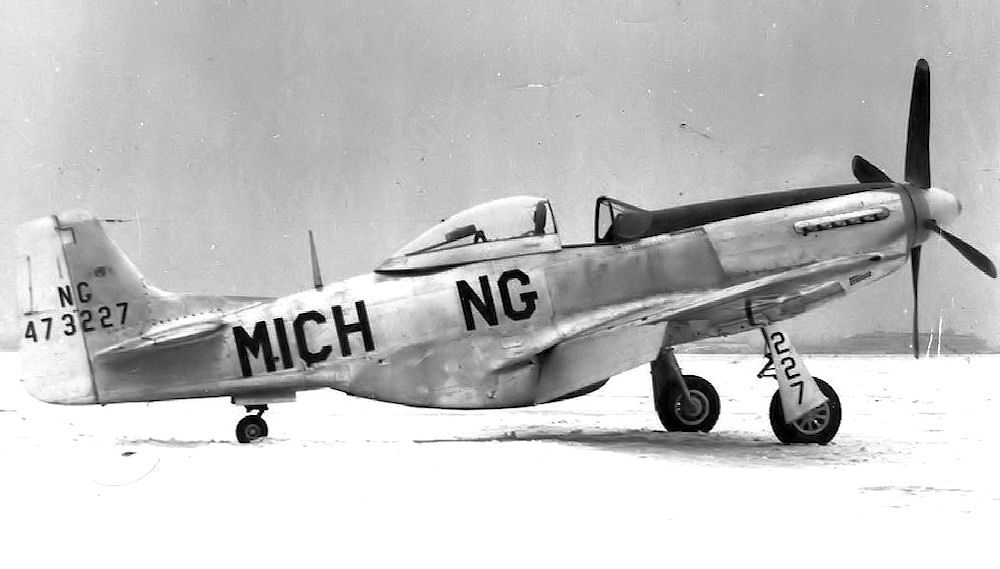
Pictured: a North American P-51D Mustang of the same type Lt. George Gorman flew, shown here marked to the Michigan Air National Guard rather than North Dakota's — no rights-clear photograph of a late-1940s North Dakota ANG Mustang was locatable, so a Mustang in a different state's period Guard livery stands in for the aircraft type. This is not a photograph of Gorman's actual fighter or of the object he chased over Fargo on October 1, 1948.
Theoretical Alignment
The Gorman Dogfight sits in an uncomfortable middle ground for any single hypothesis. No witness ever described a structured craft, occupants, or any visible means of propulsion — only a small, blinking, uniformly round light, which caps how strongly the case can support the Extraterrestrial Hypothesis regardless of how erratic the object's reported motion was. At the same time, the Psycho-Social Hypothesis explains only a narrow slice of the record: Gorman was a combat-trained aviator flying a routine night currency sortie, not a nervous civilian primed by saucer headlines, and two independent ground witnesses plus a second airborne pilot corroborated his account within minutes, not decades later. What keeps the ETH score from collapsing to near-zero, the way it does in the Mantell file, is that the Air Force's own conventional explanation is not fully closed: a documented conflict between the tracked balloon's drift direction and Gorman's actual chase path, first raised by Donald Keyhoe using the Weather Bureau's own theodolite data, and a genuine dispute over whether the planet Jupiter was even above the horizon during the pursuit's final phase, have never been definitively resolved by either side. This is a case best read as a plausible, well-evidenced conventional explanation that nonetheless stops short of an airtight one.
Background
George F. Gorman was born July 7, 1923, and by the time of the war was serving as a flight instructor training French aviation cadets on B-25 Mitchell bombers — a role that later press accounts sometimes simplified into "combat fighter pilot," though his own wartime record was principally in bomber instruction rather than fighter combat. When North Dakota's first postwar Air National Guard unit, the 178th Fighter Squadron, received federal recognition on January 16, 1947 and organized at Hector Field outside Fargo, Gorman was among its founding officers, retraining as an F-51D Mustang pilot and eventually holding the rank of second lieutenant. By the autumn of 1948, he was an experienced, current fighter pilot with the squadron, though his role that October night was routine: he had just returned from a cross-country training flight with several other Guard pilots and, with clear skies over Fargo, decided to stay airborne afterward to log night-flying currency time rather than land immediately at Hector.
The country Gorman was flying over that autumn had spent sixteen months absorbing a wave of "flying saucer" reports that the still-new United States Air Force — independent from the Army only since September 1947 — was struggling to organize a coherent response to. Project Sign, the Air Force's first dedicated UFO investigative office, had been running for barely a year, had already handled the high-profile Mantell fatality that January, and had only weeks before Gorman's encounter drafted the classified "Estimate of the Situation" — a document, never publicly confirmed to survive in any archive, that reportedly concluded the interplanetary hypothesis was the best explanation for the strongest cases on file, and that senior Air Force leadership under General Hoyt Vandenberg firmly rejected as insufficiently proven. It was against this backdrop of institutional uncertainty, barely one year into organized Air Force UFO investigation, that Gorman circled his Mustang above a lighted football stadium on the evening of October 1, 1948, waiting to spot something far stranger than another aircraft.
Complete Timeline
| Date | Event |
|---|---|
| June 24, 1947 | Kenneth Arnold's sighting near Mount Rainier launches the modern "flying saucer" era. |
| September 23, 1947 | The U.S. Air Force establishes Project Sign at Wright-Patterson AFB to investigate UFO reports. |
| January 16, 1947 | The North Dakota Air National Guard's 178th Fighter Squadron receives federal recognition and organizes at Hector Field, Fargo; George F. Gorman joins as a founding officer. |
| Late July 1948 | Project Sign personnel reportedly draft the classified "Estimate of the Situation," concluding some UFOs may be interplanetary; Air Force leadership rejects it as unproven. |
| October 1, 1948 — ~8:00 PM | North Dakota Agricultural College hosts Augustana in football at Dacotah Field, Fargo, ending a nine-game losing streak with a 14–6 win; skies over the city are clear with roughly 13.1 miles visibility. |
| ~8:50 PM | The Air Weather Service later documents that a lighted weather balloon was released from the Fargo area at approximately this time. |
| ~9:00 PM | Gorman, having stayed airborne after a cross-country flight to log night currency, circles the lighted football stadium and prepares to land at Hector Airport when he spots a blinking light to the west. |
| ~9:00–9:02 PM | Gorman radios the Hector tower and asks whether other aircraft are in the area; controllers confirm only Dr. A.D. Cannon's Piper J-3 Cub, flying roughly 500 feet below Gorman. |
| ~9:02–9:07 PM | Gorman closes to within about 1,000 yards of the object, describing it as "about six to eight inches in diameter, clear white, and completely round without fuzz at the edges." |
| 9:07 PM | Gorman commits to pursuit at full power (350–400 mph); the object, initially estimated near 250 mph, accelerates to roughly 600 mph and pulls away. |
| ~9:10–9:20 PM | The object executes a 180-degree turn and flies directly at Gorman's Mustang; Gorman attempts to intercept it head-on, and the object veers upward, passing roughly 500 feet over his aircraft. |
| ~9:20–9:25 PM | Gorman resumes the chase as the object climbs; his Mustang stalls out around 14,000–14,500 feet and he briefly loses control, recovering before impact. |
| 9:27 PM | The object climbs away and passes out of visual range for the final time; Gorman abandons the pursuit, ending a 27-minute encounter. |
| Night of October 1 | Tower operators Lloyd D. Jensen and H.E. Johnson independently confirm watching the object outdistance Gorman's fighter; Dr. A.D. Cannon and his passenger separately confirm seeing a light moving "much faster than the 51." |
| October 4, 1948 | Project Sign investigators arrive in Fargo to interview Gorman, Cannon and his passenger, and the Hector tower crew. |
| October 23, 1948 | Gorman signs a certified sworn statement: "I am convinced that there was definite thought behind its maneuvers ... [it] was able to attain a far steeper climb and was able to maintain a constant rate of climb far in excess of my aircraft." |
| Fall 1948 | The Air Materiel Command classifies details of the case Secret; Gorman later writes that release of further information "makes it a General Court Martial," and Air Force officials request that he and his commanding officer face court-martial proceedings over prior disclosures. |
| January 24, 1949 | The Air Weather Service furnishes the Air Technical Intelligence Center (ATIC) with an analysis matching a lighted balloon's release time and location to Gorman's initial sighting. |
| Early 1949 | Project Sign is downgraded and reorganized as the more skeptical Project Grudge; the Gorman case is officially attributed to a combination of a lighted weather balloon and, for its final phase, the planet Jupiter. |
| 1953 | Donald Keyhoe publishes Flying Saucers from Outer Space, disputing the balloon explanation and citing Weather Bureau theodolite tracking data he argues shows the balloon drifted in a different direction than the object Gorman chased. |
| 1956 | Edward J. Ruppelt publishes The Report on Unidentified Flying Objects, naming Gorman's case one of three "classics" of 1948 that first convinced Air Force intelligence specialists UFOs were a phenomenon worth serious study. |
| 1969 | The Condon Report reviews the case, notes both the Air Weather Service's balloon analysis and Keyhoe's rebuttal, and reaches no definitive conclusion of its own; Project Blue Book closes the same year with the case still catalogued among its files. |
| 1969 | Gorman retires from the North Dakota Air National Guard as a lieutenant colonel, having never spoken publicly at length about the encounter during his military career. |
| 1982 | Gorman dies of pancreatic cancer in Texas at age 59; those close to him later said he privately remained unconvinced he had spent 27 minutes chasing a lighted balloon. |
| 1998 | UFO historian Jerome Clark writes in The UFO Encyclopedia that the balloon explanation "seems plausible," while calling the case "the most overrated UFO report in the early history of the phenomenon" after Mantell's. |
| 2019 | The History Channel's dramatized series Project Blue Book features a fictionalized version of the case in its pilot episode — a dramatization, not a primary source, and not used as a research source for this file. |
The Football Game and a Night-Flying Exercise
The evening of October 1, 1948 began, for most of Fargo, as an ordinary autumn Friday night built around a football game. North Dakota Agricultural College's Bison hosted Augustana College's Vikings at Dacotah Field under the lights, snapping a nine-game losing streak and their first home win in nearly two years with a 14–6 final score. The skies overhead were clear and dry, with the Weather Bureau logging roughly 13.1 miles of visibility — the kind of night that, combined with a well-lit stadium full of spectators a short distance from Hector Airport, gave Lt. George Gorman an unusually large audience of illuminated ground reference points as he brought his F-51D Mustang back from a routine cross-country training flight with several other North Dakota Air National Guard pilots that afternoon.
Rather than land immediately with the rest of his flight, Gorman elected to stay airborne to log night-flying currency time, circling above the lighted football stadium as the game wound down. It was an unremarkable decision by an experienced pilot doing routine proficiency work — nothing about the flight plan or the weather suggested anything unusual was about to happen. At around 9:00 PM, as Gorman began his approach to land, he noticed the tail-light of what he assumed was another aircraft passing on his right. When he radioed the Hector tower to ask what other traffic was in the area, controllers told him the only other airplane aloft was a Piper J-3 Cub, flown by local optician and licensed pilot Dr. A.D. Cannon, roughly 500 feet below Gorman's altitude. Whatever Gorman had seen, it was not another airplane.
First Contact and the Decision to Investigate
Gorman closed on the light to get a better look, coming within roughly 1,000 yards of it. What he found was strange in its very simplicity: no wings, no fuselage, no navigation lights in the arrangement any aircraft would carry — just a small, blinking, brilliantly white light. In his later certified statement, Gorman described it in exact terms: "It was about six to eight inches in diameter, clear white, and completely round without fuzz at the edges." As he watched, the blinking light became steady and the object banked sharply, and Gorman made the decision that would define the next half hour of his evening: he would try to identify it by pursuit.
At 9:07 PM, Gorman pushed his Mustang to full power — 350 to 400 miles per hour — and gave chase. The object, which he initially judged to be moving at roughly 250 miles per hour, responded by accelerating to what Gorman estimated as 600 miles per hour, opening the distance between them almost immediately. It was Gorman's first concrete indication that whatever he was chasing could outperform his fighter in a straight line, and it would not be the last.
The Near-Collision
Unable to run the object down in a straight pursuit, Gorman tried to cut it off with turns instead. The most dramatic single moment of the encounter came when the object executed a hard 180-degree turn and flew directly at Gorman's oncoming aircraft. Rather than break away, Gorman held his course, later recounting: "When the object was coming head on, I held my plane pointed right at it, meaning to ram it if it came close enough. Just when we were about to collide I guess I got a little anxious and pulled my nose up slightly, and the object passed over my canopy at about 500 feet." He attempted to reverse and follow it, but by his own account the object had already changed direction again, executing maneuvers he could not match.
The apparent near-miss was witnessed, at least in its general outline, from the ground: tower operators Lloyd D. Jensen and H.E. Johnson, tracking the pursuit through binoculars from the Hector tower, confirmed the object was "traveling at a high rate of speed" and, according to Johnson, moving fast enough to "increase the spacing between itself and [Gorman's] fighter" whenever Gorman tried to close the gap. Neither controller could identify what they were watching, but both agreed it was not behaving like any conventional aircraft they had tracked before.
The Vertical Climb and the Blackout
Gorman's final and most physically dangerous attempt to close on the object came when it began a steep climb and he followed. Pushing his Mustang upward in pursuit, Gorman reached approximately 14,000 to 14,500 feet before his aircraft, straining at the edge of its performance envelope, entered a power stall. For a brief but genuinely frightening interval, Gorman lost control of the aircraft and blacked out, recovering consciousness and control before the situation became a second fatal pursuit crash to follow Mantell's nine months earlier. By the time he had stabilized the Mustang, the object had used the interruption to put distance between them for the final time.
At 9:27 PM, the light climbed away and disappeared from Gorman's sight for good. Physically and emotionally exhausted, and with his fuel state no longer permitting further pursuit, Gorman broke off the chase and returned to land at Hector Airport. The encounter, from his first sighting of the tail-light-like object to its final departure, had lasted twenty-seven minutes — long enough that Gorman would later call it, without hyperbole, "the weirdest experience I've had in my life."
Ground and Air Corroboration
What separates Gorman's case from a solitary pilot's report is the immediacy and independence of its corroborating witnesses. Jensen and Johnson in the Hector tower had no reason to embellish a routine night shift, and their binocular-assisted account matched Gorman's radio transmissions in real time rather than being reconstructed after the fact. Dr. Cannon, flying his Piper Cub roughly 500 feet below the action with a passenger aboard, was in an even better position to judge relative motion: from his vantage point, he and his passenger watched the unidentified light consistently outdistance Gorman's much faster fighter, later confirming it was moving "much faster than the 51." None of these three secondary witnesses had any prior connection to Gorman, the Air National Guard's saucer-reporting apparatus, or each other beyond being airborne or on duty in the same small airspace that night — a level of independent, same-night corroboration that is genuinely unusual for a 1948-era sighting and is a large part of why Project Sign treated the case seriously rather than dismissing it outright.
Project Sign Investigates
Project Sign investigators arrived in Fargo within days, on October 4, 1948, to interview Gorman, Cannon and his passenger, and the Hector tower crew separately. The investigation was thorough enough that Gorman did not give his final, certified account until three weeks after the encounter — a sworn statement dated October 23, 1948, in which he laid out both what he had seen and his own interpretation of it: "I am convinced that there was definite thought behind its maneuvers ... The object was not only able to out-turn and out-speed my aircraft, but was also able to attain a far steeper climb and was able to maintain a constant rate of climb far in excess of my aircraft." Investigators who interviewed Gorman directly came away describing him as credible and sincere, someone who "did not make the impression of being a dreamer."
Alongside the witness interviews, investigators ordered a Geiger counter test of Gorman's Mustang after it landed, and found it measurably more radioactive than other fighters that had not flown that evening. For a brief period this reading fed speculation that the object might be some form of atomic-powered craft; it was later attributed to the routine, well-understood increase in cosmic-ray exposure that any aircraft experiences at higher flight altitudes, unconnected to anything about the sighting itself, and has not been treated as significant evidence by any serious investigator since.
The Silence Order
In the weeks after the investigation, the Air Materiel Command moved to restrict further disclosure about the case, classifying elements of the file as Secret. Gorman himself later wrote that "the Air Materiel Command has issued orders classifying the information as Secret. And this makes it a General Court Martial to release any more information" — and Air Force officials went further, requesting that Gorman and his commanding officer face court-martial proceedings over information that had already been released to the press before the classification order came down. The episode left Gorman publicly close-mouthed about the encounter for the rest of his military career, a silence some later writers have read as suspicious and others have read simply as the predictable result of a young officer being threatened with a court-martial over a case he had not sought out or embellished in the first place.
The Weather Balloon Explanation
The explanation the Air Force ultimately settled on emerged months after the encounter, when the Air Weather Service furnished the Air Technical Intelligence Center with an analysis, dated January 24, 1949, showing that a lighted weather balloon had been released from the Fargo area at approximately 8:50 PM on October 1 — roughly ten minutes before Gorman's first sighting, and in a position consistent with where he and Cannon first spotted the light. On its face, the timing match was compelling: night-lighted weather balloons were a routine part of Air Weather Service operations at the time, released to track upper-atmosphere wind patterns, and a small, uniformly round, blinking light with no visible structure is exactly what a lighted balloon envelope would look like from a distance in the dark.
Investigators further proposed that many of the object's more extreme reported maneuvers — the apparent 600-mph acceleration, the tight turns, the abrupt climbs — could be explained by a combination of shifting high-altitude wind currents acting on a light, freely drifting balloon and the disorienting effect of Gorman repeatedly maneuvering his own aircraft relative to it in the dark, at night, while under real physical stress from oxygen-thin high-altitude flight. Skeptic Philip J. Klass, writing decades later about balloon-based UFO misidentifications generally, argued that a lightweight balloon caught in variable wind layers at different altitudes could plausibly appear to accelerate, reverse course, and climb erratically relative to a pursuing aircraft — not because the balloon itself was maneuvering intelligently, but because Gorman's own relative motion and a fast-moving pilot's difficulty judging the true distance, size, and speed of an unfamiliar light at night combined to produce the impression of a controlled, responsive object.
The Jupiter Complication
The balloon explanation alone struggled to account for every detail Gorman reported, particularly in the encounter's final phase, when the light appeared to climb away and hold a steady position rather than continuing to drift with the wind. Investigators and later commentators — most prominently Harvard astronomer Donald Menzel, who argued a similar dual-stimulus theory for other 1950s radar-visual cases — proposed that Gorman, physically exhausted and disoriented after nearly half an hour of high-stress night pursuit and a genuine loss of consciousness at altitude, may have shifted his attention at some point from the fading balloon to the bright planet Jupiter, which was prominent in the autumn night sky that season, and mistaken the fixed planet for a final, taunting maneuver by the same object he had been chasing.
The theory has a specific, documented weakness that has never been fully resolved: several later researchers examining the case's astronomical record have argued that Jupiter was positioned below or near the horizon during the relevant window of Gorman's pursuit, which, if accurate, would make it physically impossible for him to have mistaken the planet for the object during the vertical climb and near-collision phases of the chase. The Air Force's own dual explanation has never definitively addressed this specific objection, leaving the Jupiter component of the official explanation resting on a genuinely disputed astronomical premise rather than a settled one.
Keyhoe's Rebuttal and the Theodolite Data
The most sustained contemporary challenge to the balloon explanation came from Donald Keyhoe, the retired Marine major and best-selling UFO author, in his 1953 book Flying Saucers from Outer Space. Working from Weather Bureau theodolite tracking data — the standard optical instrument used at the time to plot a balloon's position and drift as it rose — Keyhoe argued that the balloon released that evening had drifted in a direction inconsistent with the flight path Gorman actually pursued, meaning the object he chased for twenty-seven minutes could not have been the same balloon the Air Weather Service later matched to the case on timing alone. Keyhoe's specific data-based objection has never been definitively rebutted by a matching, dated release record placing the correct balloon on Gorman's actual chase track, leaving a documented gap between the Air Force's timing-based match and the more detailed directional data Keyhoe raised.
The 1969 Condon Report, the most comprehensive independent scientific review of Air Force UFO cases ever conducted, revisited the Gorman file and explicitly noted both the Air Weather Service's balloon analysis and Keyhoe's rebuttal of it — without resolving the disagreement in either direction. The Condon Committee's failure to fully close the case, more than twenty years after the encounter and with access to Air Force records unavailable to earlier civilian researchers, is itself a meaningful data point: even a review commissioned specifically to put UFO cases to rest could not produce a fully documented, uncontested match between a specific balloon flight and everything Gorman, Jensen, Johnson, and Cannon independently reported that night.
Gorman's Later Life and Silence
Gorman continued his Air National Guard career quietly after 1948, rising through the ranks and eventually retiring as a lieutenant colonel in 1969 — the same year Project Blue Book itself closed. He rarely if ever discussed the encounter publicly during his military career, a reticence consistent with both his personality and the explicit threat of court-martial the Air Materiel Command had raised against him and his commanding officer in the case's immediate aftermath. Gorman died of pancreatic cancer in Texas in 1982, at age 59. According to those who knew him personally, he remained privately unconvinced by the official explanation for the rest of his life, telling friends in confidence that he did not believe he had spent twenty-seven minutes chasing a lighted balloon — a private doubt that, notably, he never chose to press publicly or turn into a book, media career, or campaign against the Air Force's account, in sharp contrast to some of the era's more publicity-seeking UFO witnesses.
Circumstantial Evidence
- Four independent witnesses — Gorman, two Hector tower operators, and an unrelated civilian pilot — corroborated the object's basic behavior within minutes of the encounter, without any opportunity to coordinate their accounts beforehand.
- The Air Weather Service documented an actual lighted balloon released from the Fargo area roughly ten minutes before Gorman's first sighting, matching the general time and location of the encounter's start.
- Donald Keyhoe's theodolite-based rebuttal, and the disputed position of Jupiter during the pursuit's final phase, represent genuine, specific, still-unresolved objections to the Air Force's official explanation rather than generalized skepticism.
- The Geiger counter reading from Gorman's aircraft, initially treated as significant, was later explained by the ordinary physics of cosmic-ray exposure at altitude and is not considered meaningful evidence by serious investigators today.
- The Air Materiel Command's classification order and court-martial threat against Gorman is independently documented in his own later writing, an unusual level of institutional pressure for a case the Air Force would ultimately attribute to a routine weather balloon.
- No contemporary 1948 statement from any of the four named witnesses describes a structured craft, windows, occupants, or any detail beyond a small, blinking, round light — a notably restrained description compared to more embellished UFO reports of the following decade.
- UFO historian Jerome Clark, no reflexive skeptic of anomalous cases generally, concluded the balloon explanation "seems plausible" while considering the case itself overrated in significance — a notable assessment from within the UFO research community rather than from an outside debunker.
Key Researchers
- Edward J. Ruppelt (1923–1960) — Head of Project Blue Book from 1951, who named Gorman's case one of three "classic" 1948 incidents that first convinced Air Force intelligence specialists UFOs deserved serious study. His 1956 memoir remains a primary secondary source for how the case was regarded within the Air Force in the years after the investigation closed.
- J. Allen Hynek (1910–1986) — Project Sign's astronomical consultant during this period, whose later, broader observation that "commercial and military pilots appear to make relatively poor witnesses" (The Hynek UFO Report, 1977) is frequently cited by researchers discussing pilot-witness cases of the Gorman type, though it was not written specifically about this case.
- Donald Keyhoe (1897–1988) — Retired Marine major and UFO author whose 1953 book Flying Saucers from Outer Space raised the still-unanswered theodolite-tracking objection to the balloon explanation, based on Weather Bureau drift data.
- Donald Menzel (1901–1976) — Harvard astronomer who championed the dual balloon-and-Jupiter explanation for the case's final phase, part of his broader career-long project of finding atmospheric and astronomical explanations for reported UFO sightings.
- Philip J. Klass (1919–2005) — Aviation Week senior editor and leading UFO skeptic whose broader work on balloon-based misidentifications provided the wind-current mechanism most often cited to explain Gorman's reported acceleration and turns.
- James E. McDonald (1920–1971) — Atmospheric physicist whose broader critiques of Air Force explanations for radar- and visual-era cases established the methodological standard — matching specific instrumented or tracking data against a proposed conventional stimulus — that later researchers have applied to reassess the Gorman balloon claim.
- Jerome Clark — UFO historian and author of The UFO Encyclopedia, whose assessment that the balloon explanation "seems plausible" while the case remains "the most overrated" of its era is one of the most-quoted modern verdicts on the file.
- Kevin Randle — Retired military intelligence officer and UFO researcher whose case-by-case reviews of early Project Sign and Blue Book files, including Gorman's, scrutinize the strength and documentation gaps in the Air Force's period explanations.
Cultural Impact
The Gorman Dogfight entered UFO literature almost immediately as one of the era's defining "close pursuit" cases — a pilot, in his own aircraft, deliberately trying and failing to catch, ram, and outclimb an unidentified object, corroborated in real time by ground and air witnesses. Ruppelt's decision to group it with the Mantell and Chiles-Whitted cases as one of three "classics" gave it lasting institutional significance inside the Air Force's own UFO literature, even as the case's ultimate resolution — a plausible but imperfectly documented weather balloon — kept it from becoming as culturally totemic as Roswell or the Washington flap. Jerome Clark's blunt modern assessment, that the case is "overrated" precisely because the balloon explanation holds up reasonably well under scrutiny, reflects how the case is generally treated within serious UFO research today: taken seriously as a genuine, well-corroborated puzzle, but not treated as one of the strongest pieces of evidence for an exotic explanation. The History Channel's 2019 dramatized series Project Blue Book used a fictionalized version of the encounter in its pilot episode, introducing the case to a much wider modern audience, though the dramatization took considerable liberties with the actual documented events and is not treated as a source for this file.
Key Witnesses
2nd Lt. George F. Gorman
A World War II veteran flight instructor and founding officer of the North Dakota Air National Guard, Gorman spent twenty-seven minutes pursuing a small, blinking, uniformly round light over Fargo on October 1, 1948, attempting a head-on ramming maneuver and chasing the object to a stall-inducing 14,000-plus feet before it climbed away. His October 23, 1948 certified statement — "I am convinced that there was definite thought behind its maneuvers" — remains the case's central primary document. He retired as a lieutenant colonel in 1969 and died in 1982, reportedly still privately unconvinced by the Air Force's balloon-and-Jupiter explanation.
Lloyd D. Jensen
Tracked the pursuit through binoculars from the Hector tower alongside fellow controller H.E. Johnson, independently corroborating that the object was outdistancing Gorman's fighter throughout the chase. His written statement, taken within days of the encounter, remains one of the case's primary source documents preserved in Project Blue Book's files.
H.E. Johnson
Watching alongside Jensen, Johnson described the object as "traveling at a high rate of speed" and fast enough to "increase the spacing between itself and [Gorman's] fighter" whenever Gorman attempted to close the distance — an independent, real-time ground assessment that matched Gorman's own account of being consistently outrun.
Dr. A.D. Cannon
A local optician and licensed private pilot with no prior connection to Gorman or the Air National Guard, Cannon was flying his own aircraft roughly 500 feet below Gorman's altitude with a passenger when the pursuit began. His unprompted, independent confirmation that the object was moving "much faster than the 51" is one of the case's strongest corroborating details, coming from a witness with no institutional stake in the outcome.
The Five Observables Assessment
The Five Observables framework, developed by former AATIP director Luis Elizondo, is used to classify UAP encounters by performance characteristics exceeding known technology of their era. Applied to Gorman's case, the framework returns a mixed but modest result, weighted down by the plausibility of the balloon-and-wind explanation for most of what was reported:
Assessment: Anti-Gravity Lift is rated speculative: the object's apparent hovering and sudden vertical climbs are consistent with intelligent flight control, but are equally consistent with a lightweight balloon responding to shifting wind layers at different altitudes, and no witness described any visible propulsion mechanism. Instant Acceleration is likewise speculative rather than present: Gorman's estimated 250-to-600-mph acceleration is a dramatic figure, but it was a relative, visually estimated judgment made at night under real physiological stress, not an instrumented measurement, and skeptics including Philip Klass have argued ordinary wind-driven balloon motion combined with a pursuing pilot's own relative maneuvering can produce a convincing illusion of acceleration. Hypersonic Velocity is rated absent: even taken at face value, 600 mph is well within the performance envelope of period aircraft and nowhere near hypersonic speed. Low Observability is rated absent: the object was, if anything, unusually conspicuous, tracked continuously by four independent witnesses across nearly half an hour. Trans-Medium travel is rated absent; no transition between air, water, or space was ever reported. Taken together, the Five Observables data leans toward — without fully confirming — the conventional balloon explanation this file treats as most probable, while leaving real, documented room for doubt.
Evidence Assessment
Supporting Anomalous Origin
- Four independent, credentialed witnesses corroborated the object's erratic, seemingly responsive behavior within minutes of the encounter, without prior coordination.
- Gorman, an experienced military pilot with no history of exaggeration, judged the object's flight control "definite thought" in a certified sworn statement given three weeks later, not an impulsive first reaction.
- Donald Keyhoe's theodolite-based rebuttal has never been definitively answered with a matching, dated balloon-release record placing the correct balloon on Gorman's actual chase track.
- The disputed position of Jupiter during the pursuit's final phase remains an unresolved weakness in the Air Force's own explanation for that portion of the encounter.
- The 1969 Condon Report, the most thorough independent scientific review of the case, explicitly declined to declare the matter conclusively resolved.
Supporting Conventional Explanation
- The Air Weather Service documented an actual lighted balloon released from the Fargo area roughly ten minutes before Gorman's first sighting, at a matching general location.
- Wind-driven balloon motion, combined with the visual disorientation of a pursuing pilot maneuvering relative to an unfamiliar light at night, can plausibly account for much of the reported acceleration and directional changes.
- Every physical descriptor given by all four witnesses — small, round, white, blinking, silent, no visible structure — is consistent with a lighted balloon envelope and inconsistent with a solid, structured craft.
- The Geiger counter reading, once cited as evidence of an exotic power source, has a fully mundane explanation unrelated to the object.
- UFO historian Jerome Clark, writing from within the UFO research community rather than as an outside skeptic, judged the balloon explanation plausible.
Why "Disputed"
This file rates the Gorman Dogfight DISPUTED rather than "Credible" or "Verified" because its evidence points in a genuinely mixed direction that neither this catalogue nor seventy-plus years of subsequent investigation has fully resolved. What is not seriously disputed: four independent, credentialed witnesses — a current fighter pilot, two on-duty air traffic controllers, and an unaffiliated civilian pilot — corroborated an object behaving erratically over Fargo for twenty-seven minutes; the Air Force's own weather-balloon explanation is well documented for the timing and location of the object's first appearance; and the case's more sensational secondary claims (an atomic-powered craft, based on the Geiger counter reading) have been fully and satisfactorily explained by mundane physics. What remains genuinely open is narrower but real: Donald Keyhoe's theodolite-based objection that the tracked balloon drifted in the wrong direction to be Gorman's object has never been answered with a matching, dated record; the claim that Gorman mistook the object for Jupiter during the pursuit's final phase runs into a specific, still-debated problem with the planet's position that night; and the 1969 Condon Report — created specifically to resolve lingering cases like this one — explicitly declined to call the matter closed. A case with a plausible, well-documented conventional explanation that nonetheless leaves specific, sourced objections unanswered on both the timing-versus-direction and the astronomical fronts is exactly what this site's "Disputed" rating exists to describe.
Sensor & Instrumentation Detection Profile
Like most 1948-era encounters, this is a naked-eye and binocular case with no radar of any kind: Hector Airport in 1948 was a small municipal field shared with a newly formed Air National Guard squadron and had no radar installation capable of tracking the object. Detection relied entirely on human vision — Gorman's own eyes from the cockpit of his F-51D Mustang, tower operators Lloyd D. Jensen and H.E. Johnson watching through binoculars from the Hector tower, and Dr. A.D. Cannon and his passenger observing independently from a Piper J-3 Cub roughly 500 feet below Gorman's altitude. Gorman's Mustang carried no gun camera and no cockpit voice recorder; his own account was reconstructed from memory into a certified written statement three weeks after the encounter. The only instrumented data point in the entire case is negative and after-the-fact: a Geiger counter run over Gorman's aircraft on the ground registered measurably higher radioactivity than nearby grounded fighters that had not flown that evening — initially read by some as evidence of an atomic-powered craft, later attributed to the ordinary increase in cosmic-ray exposure at flight altitude, a mundane effect with nothing to do with the object itself.
Environmental & Geospatial Context
October 1, 1948 was a clear, dry autumn evening in Fargo, North Dakota, with the Weather Bureau recording roughly 13.1 miles of visibility and no precipitation — ideal conditions for a small light to be tracked clearly against a darkening sky for nearly half an hour without interference from haze or cloud. The city that night was unusually well-populated with potential sky-watchers: North Dakota Agricultural College's Bison football team was hosting Augustana under the lights at Dacotah Field a short distance from Hector Airport, ending a nine-game losing streak with a 14–6 win, and Gorman himself had been circling above the lighted stadium before he ever spotted the object. Geospatially, the pursuit carried Gorman from directly over the airport out to roughly 25 miles southwest of the city and up to an altitude of 14,000–14,500 feet — high enough, and cold enough at that time of year, that his stall and momentary loss of control during the final vertical chase carried real physiological risk on top of the mystery of what he was chasing.
Observer Credibility & Occupational Profile
The witness pool is small but professionally credentialed. George F. Gorman was a 25-year-old Army Air Forces veteran and founding officer of the North Dakota Air National Guard's 178th Fighter Squadron, actively current in high-performance fighter aircraft at the time of the sighting. Tower operators Lloyd D. Jensen and H.E. Johnson were trained air traffic controllers performing their assigned duty when they picked up the object through binoculars, independent of Gorman's radio calls. Dr. A.D. Cannon, the Piper Cub pilot, was a local optician and licensed private pilot with no connection to the Air National Guard and no prior interest in unusual aerial phenomena, making his unprompted, independent confirmation that the object was moving "much faster than the 51" one of the case's more valuable corroborating details. None of the four named witnesses had any documented history of hoaxing or embellishment before this encounter, Gorman gave his account under a certified sworn statement three weeks later rather than in an off-the-cuff press interview, and Air Force investigators who interviewed him directly described him as sincere and not "the impression of being a dreamer." Working against the witness pool's strength is its size: unlike the multi-installation corroboration in the Washington, D.C. flap, everyone who saw the object that night was within a few miles of Hector Airport, and no one beyond these four is on record as having reported it.
Physical & Material Assays
No physical debris, trace material, or recovered artifact connected to the object itself exists, and none has ever been credibly claimed. The single physical measurement in the case — the Geiger counter reading taken from Gorman's F-51D after it landed — showed elevated radioactivity relative to aircraft that had remained on the ground, but Air Force investigators and later researchers attributed this to the well-understood increase in cosmic-ray exposure at higher flight altitudes rather than to any emission from the object, and the reading has not been treated as significant physical evidence by any serious investigator since. No photograph, film, or audio recording of the object survives in the public record; the entirety of the documentary evidence consists of Gorman's certified statement, the independent written statements of Jensen, Johnson, and Cannon, and the Air Force's own field-investigation and Air Weather Service analysis paperwork.
Historical Precedents & Archive Matches
Gorman's pursuit came fourteen months after Kenneth Arnold's June 1947 sighting near Mount Rainier touched off the modern "flying saucer" era, and it landed inside a still-young Air Force investigative bureaucracy: Project Sign, founded September 23, 1947 at Wright-Patterson Air Force Base, had only weeks earlier drafted its internal, ultimately rejected "Estimate of the Situation" memo endorsing an interplanetary explanation for the strongest reports on file. Ruppelt would later group Gorman's case with two other 1948 incidents — the fatal Mantell pursuit in Kentucky that January, and the Chiles-Whitted airliner sighting over Alabama that July — as the three "classic" cases that first persuaded Air Force intelligence specialists the phenomenon deserved serious study rather than dismissal. The case's eventual weather-balloon resolution also connects it to a recurring pattern this site documents across the late 1940s and 1950s: high-altitude research and meteorological balloon programs generating "flying saucer" reports that Air Force investigators later worked to match against actual launch and drift records, a pattern that recurs on a larger and more classified scale in the Skyhook balloon explanation offered for Mantell's death nine months earlier.
Material Analysis
No physical material connected to the object itself was ever recovered, and no witness at any point claimed to have handled or retrieved debris — consistent with an object that continued flying away rather than crashing, and unlike crash-retrieval cases such as Roswell. The only physical evidence generated by this case is the postflight Geiger counter reading taken from Gorman's own F-51D Mustang, which registered measurably higher radioactivity than nearby grounded fighters that had not flown that evening. Air Force investigators and later researchers attributed this to the routine, well-documented increase in cosmic-ray exposure any aircraft experiences at higher flight altitudes — a mundane atmospheric-physics effect entirely unconnected to the object Gorman had been chasing, and not treated as meaningful evidence of an exotic power source by any serious investigator since the initial excitement over the reading faded.
Supporting a Genuinely Unusual Stimulus
- Four independent witnesses, credentialed and without prior UFO-reporting history, agreed the object's behavior did not match any conventional aircraft known to them in 1948.
- Specific, sourced objections to the official explanation — the theodolite drift mismatch and the disputed Jupiter position — remain unresolved more than 75 years later.
Supporting a Mundane Balloon Origin
- Every physical descriptor recorded by all four 1948 witnesses — small, round, white, silent, no visible structure — matches a lighted weather balloon envelope closely.
- The Air Weather Service documented an actual balloon release matching the sighting's initial time and location.
- The Geiger counter reading, the case's only instrumented physical data point, has a fully mundane explanation unrelated to the object.
The Conventional Explanation Candidate: Weather Balloon and Planetary Misidentification
The explanation the Air Force ultimately adopted, and the one this file treats as most probable for the bulk of the encounter, holds that Gorman pursued a lighted Air Weather Service balloon released from the Fargo area roughly ten minutes before his first sighting, with wind-driven balloon motion and the visual disorientation of night pursuit accounting for much of the reported acceleration and maneuvering. It deserves serious weight because the timing and general location of an actual documented balloon release matches the case closely, because every physical descriptor recorded by all four 1948 witnesses is consistent with a balloon envelope rather than a structured craft, and because balloon-based misidentification was a well-documented, recurring stimulus for "flying saucer" reports throughout the late 1940s and 1950s generally.
Where the Balloon Theory Falls Short
Its central weakness is directional, not temporal: Donald Keyhoe's 1953 analysis of Weather Bureau theodolite tracking data argued the documented balloon drifted in a direction inconsistent with the path Gorman actually flew during the pursuit, a specific, sourced objection that has never been answered with a matching, dated release record placing the correct balloon precisely on Gorman's chase track. The 1969 Condon Report, reviewing the same underlying data with the benefit of two more decades of Air Force records access, explicitly noted this unresolved conflict rather than declaring it settled — a meaningful signal that the timing match alone, while suggestive, does not amount to full documentary proof.
Astronomical Misidentification (Jupiter)
The Air Force's supplementary explanation for the pursuit's final phase, that Gorman mistook the planet Jupiter for a last maneuver by the same object, is weakened by a specific and still-disputed astronomical objection: several researchers examining the case have argued Jupiter was positioned below or near the horizon during the relevant window of the chase, which would make the misidentification physically implausible as reconstructed. Unlike the Mantell case's Venus theory, which collapsed quickly once its own proponent reviewed the data, the Jupiter component of the Gorman explanation has neither been fully retracted by the Air Force nor conclusively defended against this specific positional objection, leaving it in a genuinely unresolved state rather than a debunked or confirmed one.
Pilot Disorientation and Wind-Driven Balloon Motion
A third, complementary candidate holds that Gorman's own combat-trained but understandably stressed perception — flying at night, repeatedly maneuvering relative to an unfamiliar light, and ultimately suffering a genuine loss of consciousness at altitude — combined with ordinary shifting wind layers acting on a lightweight balloon to produce the impression of a controlled, responsive craft where none existed. This candidate is broadly consistent with J. Allen Hynek's later, general observation that pilots can make surprisingly unreliable witnesses under exactly these conditions, and with Philip Klass's specific wind-current mechanism for balloon-chase cases. It struggles against the case's best-documented detail: the near-simultaneous, independent corroboration from Jensen, Johnson, and Cannon means the "illusion" would have had to affect four separately positioned observers — one in a moving aircraft, two on the ground with binoculars, one in a second aircraft entirely — in a remarkably consistent way, a coincidence some researchers consider a stretch even if each individual misperception is plausible in isolation.
Weather Balloon and Planetary Misidentification
Plausible InconclusivePlausible: a well-documented timing match, favored by the Air Force and by later researchers including Jerome Clark. Inconclusive as a fully documented, direction-and-position-verified explanation.
Related Cases
Confirmed Documents & Official Records
National Archives finding aid for the roughly 130,000 pages of Project Sign, Project Grudge, and Project Blue Book case files transferred from Wright-Patterson AFB, the primary federal repository for the original Gorman case documentation (Record Group 341).
UNCLASSIFIED (declassified)Finding aid for Project Blue Book's 94 rolls of microfilm (T-1206) and related UAP textual holdings, including the Gorman case file among the collection's frequently requested early "classic" cases.
UNCLASSIFIEDThe All-domain Anomaly Resolution Office's 2024 historical review of U.S. government UFO/UAP investigative efforts since 1945, including the Project Sign era in which the Gorman case was originally investigated.
UNCLASSIFIEDSearch Government Archives Directly
Further Reading — Recommended Literature
The Report on Unidentified Flying Objects
The first serious insider account of official U.S. UFO investigation, written by the Project Blue Book chief who named Gorman's case one of three 1948 "classics."
Flying Saucers from Outer Space
The book in which Keyhoe first raised the still-unanswered theodolite-tracking objection to the Air Force's balloon explanation for the Gorman case.
The UFO Encyclopedia, 4th Edition
The definitive UFO reference work, with an extensively cited entry on the Gorman Dogfight that calls the balloon explanation plausible while judging the case overrated.
Watch the Skies!: A Chronicle of the Flying Saucer Myth
A rigorously documented, skeptically minded history of American UFO cases that situates Gorman within the broader 1948 "Classics" period of early flying-saucer reporting.
Project Blue Book Exposed
A detailed case-by-case review of Blue Book's most significant files by a veteran researcher who scrutinizes the documentation gaps in the Air Force's early "classic" cases.
Essential Viewing
1948-10-01: Gorman Dogfight
A focused, date-anchored walkthrough of the pursuit timeline, witness statements, and the balloon-and-Jupiter explanation.

The Gorman Dogfight
A narrative overview of Gorman's background, the pursuit itself, and the case's place in Project Sign's early history.
The Gorman UFO Incident of 1948
A full-length independent documentary treatment covering the encounter, the investigation, and the competing explanations in detail.
Sources
- "Gorman dogfight," Wikipedia (comprehensive summary with citations to Condon, Clark, Peebles, and Ruppelt). en.wikipedia.org
- Condon, Edward U., ed. Final Report of the Scientific Study of Unidentified Flying Objects ("The Condon Report"), Section V, Chapter 2: "UFOs: 1947–1968," 1969. files.ncas.org
- HISTORY. "When a US Fighter Pilot Got Into a Dogfight with a UFO." history.com
- Eriksmoen, Curt. "Pilot dueled with unknown object over Fargo," Bismarck Tribune. bismarcktribune.com
- West Central Tribune. "Fargo's most famous UFO sighting was in the skies above a 1948 Bison-Augustana football game." wctrib.com
- NICAP. "UFO Report" — Blue Book Archive index of Gorman case documents, USAF-SIGN3-2-39.pdf. nicap.org
- Miller, Mick (host). "The History Channel Mangles Project Blue Book, Mixing Fact with Fiction," Skeptical Inquirer, May 2019. skepticalinquirer.org
- Anomalien.com. "The Gorman UFO Dogfight: What Happened in 1948?" anomalien.com
- Prairie Public. "Gorman Dogfight," Dakota Datebook, April 25, 2022. news.prairiepublic.org
- The UFO Database. "George F. Gorman." theufodatabase.com
- The UFO Database. "Gorman Dogfight." theufodatabase.com
- Wikipedia. "Estimate of the Situation." en.wikipedia.org
- Wikipedia. "Investigation of UFO reports by the United States government." en.wikipedia.org
- Wikipedia. "178th Attack Squadron" (North Dakota Air National Guard lineage, 1947 federal recognition). en.wikipedia.org
- Wikipedia. "119th Wing" (North Dakota Air National Guard, Hector Airport, P-51D Mustang operations 1947–1954). en.wikipedia.org
- National Archives and Records Administration. Project Blue Book Records Research Guide. archives.gov
- National Archives and Records Administration. UAP Textual and Microfilm Records Research Guide. archives.gov
- All-domain Anomaly Resolution Office (AARO). Historical Record Report, Volume I, March 2024. media.defense.gov
- Ruppelt, Edward J. The Report on Unidentified Flying Objects, Doubleday, 1956, pp. 30–31.
- Keyhoe, Donald E. Flying Saucers from Outer Space, Henry Holt and Company, 1953.
- Clark, Jerome. The UFO Encyclopedia, 2nd Edition, Omnigraphics, 1998, pp. 452–453.
- Clark, Jerome. The UFO Encyclopedia, 4th Edition, Visible Ink Press, 2023.
- Peebles, Curtis. Watch the Skies!: A Chronicle of the Flying Saucer Myth, Smithsonian Institution Press, 1994, pp. 29–31.
- Randle, Kevin D. Project Blue Book Exposed, Barnes & Noble Books, 1996.
- Wikimedia Commons. "172d Fighter Squadron - North American P-51D-25-NA Mustang 44-73227" (Michigan Air National Guard, 1947, public domain U.S. federal government work; used here as an illustrative image of the aircraft type and era). commons.wikimedia.org
See something inaccurate? Have additional information or sources?
Suggest an Edit →Last Updated: August 2026