
The Thomas Mantell P-51 Crash
On the afternoon of January 7, 1948, Captain Thomas F. Mantell Jr., a decorated World War II pilot flying with the Kentucky Air National Guard, climbed his F-51D Mustang above 25,000 feet without an oxygen mask while pursuing a huge, metallic-looking object over Godman Army Airfield. He never leveled off. His fighter crashed in a farm field near Franklin, Kentucky, killing him instantly and making him the first American military pilot on record to die while chasing an unidentified flying object. The Air Force's first serious UFO investigators, working under Project Sign, initially floated the planet Venus as an explanation before quietly abandoning it; not until Captain Edward J. Ruppelt personally reopened the file in 1951–52 did the Air Force settle on its lasting public answer — a classified U.S. Navy high-altitude research balloon from the Skyhook program. That explanation remains the most probable account of what Mantell saw, but seventy-plus years later no single, dated Skyhook flight log has ever been produced that unambiguously places a balloon over Kentucky that afternoon, and even the Air Force's own investigators have never agreed on which base launched it. The gap between a highly plausible conventional explanation and a fully documented one is what keeps Case #038 filed as disputed rather than closed.
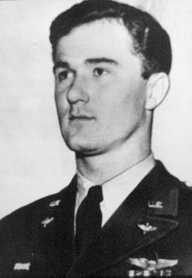
Pictured: Captain Thomas F. Mantell Jr. in his Kentucky Air National Guard portrait, taken before his death on January 7, 1948 — not a photograph of the object he pursued or of his F-51D Mustang's crash. No photograph of the object exists; it was tracked only by eyewitness sighting from Godman Field's tower and by Mantell's own radio transmissions before his aircraft went down near Franklin, Kentucky.
Theoretical Alignment
Of every case in this catalogue, Mantell is among the least supportive of an exotic origin, and this file says so plainly rather than inflating its numbers for drama. No witness ever described a structured craft, an occupant, or propulsion of any kind — only a large, pale, slow-moving shape consistent with a research balloon drifting on the wind, exactly the object class the Air Force eventually blamed. The modest Psycho-Social score reflects not mass hysteria at the scene (the on-duty military witnesses behaved like trained professionals, not a panicked crowd) but the enormous second-order mythology that grew up around Mantell's death in the following decade — contactee claims of death rays, riddled corpses, and government cover-ups that Ruppelt and others had to spend years debunking. The case earns its place in the catalogue not because the object was likely anomalous, but because it was the event that taught the nascent Air Force UFO program — and the American public — what a fatal, high-profile "unknown" actually looked like.
Background
Thomas Francis Mantell Jr. was born June 30, 1922, in Franklin, Kentucky, and graduated from Male High School in Louisville. He enlisted in the U.S. Army Air Corps on June 16, 1942, and completed flight training a year later, on June 30, 1943. During World War II he flew C-47 Skytrain transports with the 440th Troop Carrier Group's 96th Troop Carrier Squadron, 9th Air Force — among the aircraft that towed gliders and dropped paratroopers of the 101st Airborne Division into Normandy, France on D-Day, June 6, 1944, under sustained anti-aircraft fire. For that mission and others, Mantell was awarded the Distinguished Flying Cross and the Air Medal with three Oak Leaf Clusters. By the war's end he had logged 2,167 total flight hours and 107 hours of combat time — a genuinely experienced aviator, though notably a transport pilot, not a fighter pilot, for the bulk of his wartime career.
After the war Mantell returned to Louisville and, when the Kentucky Air National Guard's 165th Fighter Squadron was organized on February 16, 1947, he joined as one of its founding officers, retraining as an F-51D Mustang pilot. By January 1948 he had logged only about 67 hours in the type over roughly eight months — a fraction of his transport experience — and held the rank of Captain, flight-leading "C Flight" of the squadron. The country he was flying over that January was still adjusting to an entirely new phenomenon: seven months earlier, Kenneth Arnold's sighting of nine fast-moving objects near Mount Rainier had launched the term "flying saucer" into the American vocabulary, and the still-forming Air Force investigative body, Project Sign, based at Wright-Patterson Air Force Base in Dayton, Ohio, had been organized only months earlier, on September 23, 1947, specifically to evaluate the growing wave of reports. Mantell's flight of four Mustangs departed Marietta, Georgia early on the afternoon of January 7, 1948, on a routine ferry and training flight bound for Standiford Field in Louisville. Nothing about the mission was unusual until the flight neared Godman Army Airfield, the small airstrip serving the Fort Knox military reservation.
Complete Timeline
| Date | Event |
|---|---|
| June 30, 1922 | Thomas Francis Mantell Jr. is born in Franklin, Kentucky. |
| June 6, 1944 | Mantell flies C-47 transport missions towing gliders and dropping the 101st Airborne Division into Normandy on D-Day; later awarded the Distinguished Flying Cross. |
| February 16, 1947 | Mantell joins the newly organized Kentucky Air National Guard, 165th Fighter Squadron, as an F-51D Mustang pilot. |
| June 24, 1947 | Kenneth Arnold's sighting near Mount Rainier launches the modern "flying saucer" era. |
| September 23, 1947 | The U.S. Air Force establishes Project Sign at Wright-Patterson AFB to investigate UFO reports. |
| January 7, 1948 — ~1:20 PM | Godman Field tower operator T/Sgt. Quinton A. Blackwell receives a call relayed from Fort Knox military police, citing a Kentucky Highway Patrol report of an unusual circular object, roughly 250–300 feet across, over Maysville, Kentucky, moving westward. |
| ~1:45 PM | Blackwell and Pfc. Stanley Oliver visually spot a small white object in the southern sky from the Godman tower; more tower and base personnel are alerted, including 1st Lt. Paul I. Orner, Capt. James F. Duesler Jr., and Capt. Cary W. Carter. |
| ~2:30–2:45 PM | Base commander Col. Guy F. Hix observes the object and confirms it through binoculars; as Mantell's flight of four F-51s passes near Godman en route to Louisville, the tower radios to ask if they can investigate. |
| ~2:45 PM | Mantell agrees, and with 1st Lt. Albert W. Clements and 2nd Lt. Buford A. Hammond begins a climbing pursuit; 1st Lt. Robert K. Hendricks continues on the original flight plan toward Louisville rather than joining the climb. |
| ~3:15 PM | Mantell radios that he has the object in sight, describing it as appearing "metallic" and "of tremendous size," and reports passing 22,500 feet, intending to continue to 25,000 feet. |
| ~22,000–22,500 ft | Clements and Hammond, suffering hypoxia symptoms and lacking supplemental oxygen equipment rated for the altitude, break off their climb. Mantell continues alone. |
| 3:18 PM | Mantell's wristwatch stops — the most consistently corroborated data point in the case — marking the approximate moment his F-51D entered an uncontrolled dive and began breaking apart. |
| ~3:50 PM | Godman tower observers report the object fading from view to the north. |
| ~5:00 PM | Searchers locate the wreckage of Mantell's aircraft in a farm field roughly five miles southwest of Franklin, Kentucky, about 90 miles south-southwest of Godman Field. Mantell is found dead in the cockpit. |
| Evening, January 7, 1948 | Air Force alert crews report a similar bright object drifting northward over Clinton County Army Air Field, Ohio, and later over Lockbourne Air Force Base near Columbus, Ohio — a track consistent with a wind-driven balloon continuing along the same general course. |
| January 8, 1948 | Newspapers across the country report the crash; the Air Force's initial public statements decline to offer a firm explanation. |
| January 22, 1948 | The Mantell case becomes the first major fatality investigation handled by the newly formed Project Sign, which requests astronomical data on the positions of Venus and Jupiter for the day of the crash. |
| Early-mid 1948 | Astronomer J. Allen Hynek, then a Project Sign consultant, tentatively proposes that Mantell may have mistaken the planet Venus for the object. |
| 1948 | Hynek quietly recants the Venus explanation after further review shows Venus would have been only faintly visible, if at all, in the daytime winter sky and haze reported at the time. |
| 1949 | The classified Navy/General Mills Skyhook high-altitude balloon program, first flown in September 1947, is publicly acknowledged for the first time — though its full scope and flight records remain restricted for years afterward. |
| 1951–1952 | Capt. Edward J. Ruppelt, newly appointed head of the reorganized Project Blue Book, personally reopens the Mantell file, reviews classified Skyhook records for the first time, and concludes a Skyhook balloon is the most probable explanation. |
| 1956 | Ruppelt's memoir, The Report on Unidentified Flying Objects, publishes the Skyhook explanation for a general audience and directly rebuts years of sensationalized claims about the case. |
| 1996 | Former tower operator Quinton Blackwell, interviewed decades later for the TV series Sightings, adds new details — including that Mantell requested "hot guns" and described observation windows on the object — not present in his original 1948 written statement, reigniting debate about the reliability of late-life recollections in the case. |
| 2004 | Balloon engineer B.D. Gildenberg, a 35-year veteran of Skyhook-era operations, publishes a detailed technical defense of the balloon explanation in Skeptical Inquirer, while acknowledging the specific flight-log match was never conclusively nailed down. |
| September 29, 2001 | The Simpson County Historical Society dedicates a state historical marker to Capt. Mantell at the Interstate 65 exit near his hometown of Franklin, Kentucky. |
| 2023 | The 75th anniversary of the crash prompts renewed U.S. Army and Kentucky media retrospectives noting the case remains officially unresolved in its documentary specifics, even as the balloon explanation remains the accepted working theory. |
The Alert and the First Sightings at Godman Field
The chain of events began, as best the surviving record can reconstruct it, shortly after 1:00 PM on January 7, 1948, when the Kentucky Highway Patrol relayed reports from citizens near Maysville, in northeastern Kentucky, of a large, unidentified circular object — described in some reports as 250 to 300 feet in diameter — moving slowly westward at high altitude. Fort Knox's military police passed the report to the control tower at Godman Army Airfield, where Technical Sergeant Quinton A. Blackwell took the call at roughly 1:20 PM. Within about twenty-five minutes, Blackwell and Pfc. Stanley Oliver spotted a small white object hanging in the southern sky themselves, and additional personnel were summoned to the tower to confirm it, including 1st Lt. Paul I. Orner, Capt. James F. Duesler Jr., and Capt. Cary W. Carter.
The descriptions the Godman witnesses gave in their written statements — taken down within days of the sighting, not decades later — varied in specific imagery but agreed on the general shape: Oliver and Blackwell described something like "an ice cream cone topped with red"; Orner compared it to "a parachute" with sunlight reflecting off its upper surface and red coloring visible at the bottom; Duesler called it "a teardrop, round." Base commander Colonel Guy F. Hix was summoned to the tower and, watching through binoculars, judged the object "very white" and "like an umbrella with a red top and at times a red bottom," estimating its apparent size at roughly one-quarter that of the full moon — a description consistent with a large balloon and suspended instrument payload seen from many miles' distance and altitude, though Hix himself, like every other Godman witness, stopped short of declaring what it actually was.
The Pursuit Begins
Sometime around 2:30 to 2:45 PM, Captain Thomas Mantell's flight of four F-51D Mustangs, ferrying from Marietta, Georgia toward Standiford Field in Louisville, passed near Godman Field. The tower radioed the flight and asked whether they had fuel to spare to investigate the object; per the reconstructed transcript later published in Air Force files, the request read approximately: "National Guard 869 from Godman Tower. We have an object out south of Godman here that we are unable to identify, and we would like to know if you have gas enough; and if so could you take a look for us if you will?" Mantell agreed. Diverting from the flight's original course, he began a climbing turn toward the object, joined by wingmen 1st Lt. Albert W. Clements and 2nd Lt. Buford A. Hammond. The fourth pilot, 1st Lt. Robert K. Hendricks, continued on toward Louisville rather than joining the climb — accounts differ on whether he simply had insufficient fuel reserve or was never ordered to divert, one of several small but genuine inconsistencies in how the flight's composition during the actual chase has been reported over the decades.
As the Mustangs climbed, Mantell's radio reports grew more specific. Passing roughly 15,000 to 20,000 feet, he radioed that he had the object in sight above and ahead of him, moving at what he judged to be about half his own speed. Continuing to climb, he reported: "It appears to be a metallic object, or possibly a reflection of sunlight from a metallic object, and it is of tremendous size." None of the three Mustangs had cabin pressurization, and Air National Guard regulations of the period required supplemental oxygen for sustained flight above roughly 14,000 feet — a limit the wingmen felt acutely as the climb continued. Clements later described his own view of the object more modestly than Mantell's, calling it "a bright-appearing object, very small," positioned near the sun and difficult to resolve any real detail from, and speculated it might be no more than "the reflection of sunlight off of an airplane canopy." Around 22,000 to 22,500 feet, both Clements and Hammond, reporting blurred vision, dizziness, and other symptoms of oncoming hypoxia, broke off their climb and turned back toward Godman. Mantell, alone now, kept climbing.
Climbing Alone: The Final Ascent
Mantell's last confirmed radio transmission, relayed by the wingmen who were already descending and later reconstructed in Air Force statements rather than recorded verbatim, reported him passing approximately 22,500 feet and stating his intention to close to 25,000 feet for a better look. What happened above that altitude is undocumented by any direct radio transcript: no one at Godman or in the departing flight heard, or at least could later recall with confidence, anything further from Mantell's aircraft. His Air National Guard-issue F-51D was equipped with an oxygen system rated for high-altitude flight, and the postcrash investigation found it "checked and serviceable" — language that confirms the equipment was not obviously broken, but does not by itself establish that Mantell had actually donned his mask or that his bottle was fully charged for the flight, a genuine gap in the documentary record that has never been closed.
The generally accepted reconstruction, first proposed formally by Air Force investigators and never seriously challenged since, holds that Mantell lost consciousness from hypoxia somewhere above 25,000 feet without oxygen, most likely as his F-51 continued to climb on its own toward roughly 30,000 feet before nosing over into a diving spiral. The dive would have quickly built speed well beyond the aircraft's structural limits; postcrash analysis found evidence consistent with in-flight separation of the tail section, canopy, and a wing before the fuselage struck the ground, with the engine throttle found at roughly one-quarter open and the mixture control in idle cutoff. Mantell's wristwatch, recovered from the wreckage, had stopped at 3:18 PM — the single most consistently corroborated timestamp in the entire case, and the anchor point every subsequent chronology of the crash has been built around.
The Crash and the Discovery of the Wreckage
The F-51D came down in a farm field roughly five miles southwest of Franklin, Kentucky, Mantell's own hometown, approximately 90 miles south-southwest of Godman Field — itself a striking detail, since it means his aircraft traveled a considerable additional distance under only partial or no control after the point investigators believe he lost consciousness. Local residents and search parties located the wreckage by roughly 5:00 PM; Mantell was found dead in the cockpit, the canopy lock still engaged, indicating no attempt to bail out. In the days that followed, a wave of sensationalized rumors began circulating nationally — that Mantell's body had been found riddled with bullets, that it was missing from the wreckage entirely, that the plane had disintegrated in midair, and that the debris was radioactive. Every one of these claims was investigated and rejected by Air Force accident investigators, and Ruppelt devoted considerable space in his own 1956 book to methodically debunking them, noting that the physical evidence was fully consistent with an ordinary, if catastrophic, high-speed structural failure following a loss-of-control dive — tragic, but mundane in its mechanics regardless of what had triggered the climb in the first place.
The Investigation: Project Sign's First Major Case
The Mantell crash landed on the desk of the recently formed Project Sign at Wright-Patterson Air Force Base as its first genuinely high-profile fatality case, and it exposed the young program's limitations immediately. Investigators requested astronomical almanac data on the positions of Venus and Jupiter for the afternoon of January 7 and initially entertained the idea that Mantell, staring into a hazy winter sky, might have fixated on a bright planet and misjudged its distance and size while climbing — the kind of misperception documented in other, less consequential UFO reports of the era. Project Sign's internal culture during this period was famously split between officers who took the extraterrestrial hypothesis seriously enough to draft an internal "Estimate of the Situation" memo (later ordered destroyed by Air Force Chief of Staff General Hoyt Vandenberg, according to Ruppelt's later account) and officers who wanted every case closed with a conventional label as quickly as possible; the Mantell case, with a dead National Guard captain and a wave of press coverage, sat squarely in the crossfire between those factions and was not handled with anything like the rigor later applied by Ruppelt's Blue Book.
The Venus Theory and Its Collapse
The astronomer most closely associated with Project Sign in this period, J. Allen Hynek, initially lent qualified support to a Venus explanation, based on the planet's calculated position relative to Mantell's reported line of sight. The theory did not survive close scrutiny for long. Venus in January 1948 would have appeared, at best, as an exceptionally faint pinpoint of light in full daylight — nothing resembling the large, structured, apparently solid shape multiple ground witnesses independently described in far more visual detail than a simple point of light could account for — and the haze reported over Kentucky that afternoon would have further suppressed its visibility. Hynek himself acknowledged the planet was, in his words, "for all practical purposes invisible" under the conditions in question, and quietly withdrew the explanation once Ruppelt began his own more thorough reinvestigation in the early 1950s. The episode became an early, formative embarrassment for Hynek personally — one of several moments in his career, well before his famous transformation from Blue Book skeptic to open-minded advocate, that taught him how easily an official explanation offered under public pressure could outrun the actual supporting data.
The Skyhook Balloon and Ruppelt's Reinvestigation
The explanation that has endured, and the one the Air Force ultimately adopted as its lasting public position, emerged only after Edward J. Ruppelt took over the reorganized Project Blue Book in 1951 and personally revisited the Mantell file. By then Ruppelt had access to something Project Sign's original 1948 investigators had not: records, still partly classified, of the Navy and General Mills' Skyhook program — a series of enormous, unmanned polyethylene balloons, first flown in September 1947, that carried scientific payloads (initially cosmic-ray detection equipment) to altitudes as high as 100,000 feet. Fully inflated at altitude, a Skyhook balloon could reach roughly 100 feet in diameter with a suspended instrument gondola and cable rigging beneath it — a scale and silhouette strikingly close to what Godman's witnesses had reported, and one that would appear brilliantly reflective and metallic-looking in strong winter sunlight from many thousands of feet below or beside it.
Ruppelt's reasoning was reinforced by the era's single strongest independent scientific witness: Dr. Carl K. Seyfert, a professional astronomer at Vanderbilt University in Nashville, who had observed an object south of the city through a telescope that same afternoon and described what he saw in unambiguous instrument terms: a pear-shaped balloon with cables and a suspended basket attached, drifting first south-southeast and then west at roughly ten miles per hour, at an estimated altitude of 25,000 feet, observed between approximately 4:30 and 4:45 PM Central time. Seyfert's account was corroborated that same evening by U.S. Air Force alert crews roughly 150 miles to the northeast, at Clinton County Army Air Field in Wilmington, Ohio, and later at Lockbourne Air Force Base near Columbus — airmen including T/Sgt. Leroy Ziegler, Cpl. James Hudson, and S/Sgt. John P. Haag independently reported a bright object continuing north along a track consistent with the same wind-driven object continuing its journey after leaving Kentucky airspace.
The Disputed Launch Site
Where, exactly, that balloon had come from is where the case's documentary record genuinely runs out. Ruppelt's own analysis, working from wind-pattern data, pointed toward a Skyhook flight launched the day before, on January 6, 1948, from Camp Ripley, Minnesota — a considerable distance to the northwest, requiring the balloon to have drifted across several states overnight and into the following afternoon. A number of later secondary accounts instead identify Clinton County Army Air Field, Ohio — the same base whose alert crews reported the object that evening — as the likely launch point, on the theory that a balloon released there that morning could plausibly have drifted southwest over Kentucky before the prevailing winds carried it back north. Neither claim has ever been backed by a surviving, dated Skyhook launch log publicly matched to January 7, 1948, and at least one researcher has noted that General Mills' own operational records show sustained Skyhook launch activity from Clinton County did not begin in earnest until 1951 — a detail that, if accurate, would undercut the Ohio-launch theory specifically without resolving what balloon, if any, is the correct match. The result is a case where the general class of explanation (a Skyhook-type balloon) rests on strong circumstantial and eyewitness grounds, while the specific, single balloon responsible has never been documented beyond dispute.
Corroborating Analysis: Gildenberg's 2004 Study
The most detailed technical defense of the Skyhook explanation came more than half a century later, in 2004, from B.D. Gildenberg, a balloon engineer with more than three decades of hands-on experience in Skyhook-era high-altitude operations, writing in Skeptical Inquirer. Gildenberg detailed the balloons' true operational scale — fully inflated examples roughly twice the volume of the airship Hindenburg, with envelope diameters approaching 300 feet and flaccid lengths over 400 feet before full inflation — and argued that the combination of visual scale, reflectivity, altitude, and drift behavior made Skyhook balloons a well-documented, recurring stimulus for "flying saucer" reports throughout the late 1940s and 1950s generally, not just in the Mantell case specifically. Even Gildenberg, sympathetic to the balloon explanation and personally familiar with the program's operational patterns, stopped short of claiming a specific January 7, 1948 flight had ever been definitively logged and matched to the Kentucky sightings — the same evidentiary gap Ruppelt had acknowledged decades earlier.
Sensationalized Claims and Their Debunking
Almost from the moment of the crash, the Mantell case attracted a level of embellishment far beyond what the contemporary written record supports. Retired Marine Corps Major Donald Keyhoe, one of the era's most prominent flying-saucer authors, argued in print as early as 1949–1950 that hypoxia could not account for the crash and that Mantell had instead been struck down by some form of directed energy or "death ray" from the object, part of what he characterized as a deliberate Air Force cover-up of extraterrestrial contact. Contactee George Adamski went further still, claiming Mantell's aircraft had been torn apart by the object's own power field. Neither claim was ever supported by the crash investigation, and Ruppelt spent considerable effort in his 1956 book systematically rebutting them alongside the parallel rumors of a riddled or missing body and radioactive wreckage. The persistence of these claims for years after they had been factually addressed is itself part of why this file's Psycho-Social score, discussed above, is nonzero: much of the case's enduring cultural weight comes from mythology layered onto the event well after the fact, not from the primary 1948 evidentiary record.
A separate, more recent controversy concerns tower operator Quinton Blackwell's own account. In a 1996 appearance on the television series Sightings, Blackwell described new details absent from his original 1948 written statement — including a claim that Mantell had radioed a request for "hot guns" (i.e., armed weapons) before continuing his climb, and a description of visible "windows" on the object. Researchers examining the case have flagged the nearly fifty-year gap between the original statement and these additions as a serious reliability concern, consistent with well-documented patterns of memory reconstruction and embellishment in long-delayed interviews, rather than treating the newer account as a straightforward correction or expansion of the record.
The Disputed Radio Transmissions
One further, frequently overlooked problem runs through the entire case: none of Mantell's in-flight radio transmissions were recorded on any surviving audio medium. Every quotation attributed to him — including the widely repeated "it appears to be a metallic object…of tremendous size" and the closing line often rendered as "I'm still trying to close in for a better look" — was reconstructed after the fact from the memories of the tower personnel and wingmen who heard the transmissions live, then wrote statements days later. Ruppelt himself, reviewing the case years afterward, noted pointedly that "no one at the tower could recall Mantell's [exact] description" with full confidence, a caution that has been repeated by later researchers such as Jerome Clark but is nonetheless routinely dropped from popular retellings of the case, which tend to present the reconstructed quotes as a verbatim transcript. This is not a claim that Mantell said nothing like what has been attributed to him — the broad substance is corroborated across multiple independent witness statements — but it is a genuine, still-unresolved gap between the popular version of the story and what the contemporary documentary record actually supports word for word.
Circumstantial Evidence
- Multiple independent, on-duty military witnesses at Godman Field — including the base's own commanding officer — consistently described a large, pale, roughly conical or teardrop-shaped object rather than a defined solid craft.
- The era's single most scientifically qualified independent witness, astronomer Carl K. Seyfert, described the object in explicit balloon-and-payload terms through a telescope the same afternoon.
- Air Force alert crews at two separate Ohio installations reported a similar bright object continuing north that evening, consistent with a single wind-driven object rather than three unrelated sightings.
- The object's estimated drift speed (roughly 10 mph) and general track are consistent with prevailing January winds and with known Skyhook balloon behavior, not with any powered aircraft of the era.
- No contemporary 1948 statement, from any witness, describes a defined solid structure, windows, or occupants — those details appear only in Blackwell's disputed 1996 account and in unrelated contactee claims from the following decade.
- No physical trace, debris, or recovered material connected to the object itself has ever been produced, consistent with a balloon that continued drifting rather than crashing or being recovered.
- The exact Skyhook flight responsible has never been documented in a surviving, publicly released launch log, leaving the balloon explanation strong but not conclusively proven.
Key Researchers
- Edward J. Ruppelt (1923–1960) — Head of Project Blue Book from 1951, who personally reopened the Mantell file, reviewed classified Skyhook records, and concluded a balloon was the most probable explanation. His 1956 memoir remains the single most important primary account of the case's internal Air Force handling.
- J. Allen Hynek (1910–1986) — Project Sign's astronomical consultant, who initially proposed and then withdrew the Venus explanation; the episode was an early, formative lesson in the danger of premature official explanations that shaped his later, more cautious approach to Project Blue Book.
- Jerome Clark — UFO historian and author of The UFO Encyclopedia, whose detailed published analysis of the Mantell case (hosted by NICAP) reconstructs the full witness roster and flags the reconstructed, non-verbatim nature of Mantell's quoted radio transmissions.
- Kevin Randle — UFO researcher and retired military intelligence officer whose published analysis of the Mantell case scrutinizes the timeline, witness statements, and the strength of the Skyhook identification in detail.
- B.D. Gildenberg — Balloon engineer with more than three decades of Skyhook-program experience, whose 2004 Skeptical Inquirer article remains the most technically detailed defense of the balloon explanation, while candidly acknowledging the specific flight was never conclusively logged.
- Philip J. Klass (1919–2005) — Aviation Week senior editor and leading UFO skeptic whose broader work on radar and atmospheric misidentification of "flying saucers" provided context for evaluating early Air Force cases such as Mantell's.
- Donald Keyhoe (1897–1988) — Retired Marine major and flying-saucer author whose early, sensationalized "death ray" claims about Mantell's death were among the most widely circulated and most thoroughly debunked theories in the case's history.
- Carl K. Seyfert (1911–1960) — Vanderbilt University astronomer whose same-day telescopic observation, describing the object in explicit balloon terms, became a cornerstone of the later Skyhook conclusion.
Cultural Impact
The Mantell case became, almost overnight, the flying-saucer era's first genuine tragedy — the moment the phenomenon stopped being a curiosity confined to newspaper photographs of blurry lights and became a story about a real man's death. It is frequently cited as the case that forced the Air Force to take UFO investigation seriously as a matter of institutional and political necessity rather than idle curiosity, directly shaping the more rigorous approach Ruppelt would later bring to Project Blue Book. The case also became an early proving ground for the pattern this site documents across many later files: an initial official explanation offered under public pressure (Venus) collapsing on inspection, followed by a second, more technically grounded explanation (Skyhook) that resolves the bulk of the evidence without ever producing a fully documented paper trail. Mantell's hometown of Franklin, Kentucky dedicated a state historical marker to him in 2001, and the case remains a fixture of American UFO literature, cited in nearly every general history of the subject from Ruppelt's own 1956 memoir through Jerome Clark's modern encyclopedic treatment.
Key Witnesses
Capt. Thomas F. Mantell Jr.
A decorated World War II C-47 pilot who towed gliders into Normandy on D-Day, Mantell joined the Kentucky Air National Guard in 1947 as an F-51D Mustang pilot. On January 7, 1948, he led three wingmen in a climbing pursuit of an object over Godman Field, continuing to climb alone past 25,000 feet without oxygen after his wingmen turned back. His F-51 crashed near his own hometown of Franklin, Kentucky, making him the first American military pilot known to die while chasing a UFO.
1st Lt. Albert W. Clements
Flew with Mantell during the initial climb, reaching roughly 22,000 to 22,500 feet before breaking off due to lack of oxygen equipment rated for the altitude. Clements described the object more cautiously than Mantell, calling it "a bright-appearing object, very small," positioned near the sun, and speculated it might be nothing more than sunlight reflecting off another aircraft's canopy — a notably more skeptical account than his flight leader's.
2nd Lt. Buford A. Hammond
The second wingman on the climb, Hammond began experiencing hypoxia symptoms, including blurred vision, around 15,000 to 22,000 feet and broke off the pursuit alongside Clements, descending safely back toward Godman Field. His and Clements's decision to turn back is the clearest surviving evidence of just how quickly and dangerously the effects of oxygen deprivation set in during the climb Mantell chose to continue alone.
1st Lt. Robert K. Hendricks
The fourth Mustang pilot in the flight, Hendricks continued on the original ferry route toward Standiford Field in Louisville rather than joining Mantell's diversion toward the object. Accounts differ on the precise reason, and his limited role in the incident has meant his account receives far less attention than the other three pilots' in most retellings of the case.
T/Sgt. Quinton A. Blackwell
The first Godman Field witness, Blackwell took the initial Kentucky Highway Patrol report at approximately 1:20 PM and personally relayed the tower's request to Mantell's flight. His 1948 written statement remains a foundational primary source for the case; his considerably more elaborate 1996 television interview, decades later, introduced new and disputed details absent from that original account.
1st Lt. Paul I. Orner
Described the object through binoculars as resembling "a parachute" with sunlight reflecting off its surface and red coloring visible toward the bottom — a description that, alongside similar accounts from his colleagues, closely matches the general appearance a Skyhook balloon and its instrument payload would present from a distance.
Pfc. Stanley Oliver
Alongside Blackwell, one of the first two Godman personnel to visually confirm the object, describing it as resembling "an ice cream cone topped with red" — the description that gave the case one of its most enduring popular nicknames.
Col. Guy F. Hix
Summoned to the control tower as senior officer present, Hix personally confirmed the object through binoculars, describing it as "very white" and "like an umbrella with a red top and at times a red bottom," and estimating its apparent size at roughly one-quarter that of the full moon. As base commander, his corroboration lent institutional weight to a report that might otherwise have been dismissed.
Dr. Carl K. Seyfert
A professionally trained astronomer (later the namesake of the "Seyfert galaxy" classification), Seyfert observed an object through a telescope from south of Nashville, Tennessee that same afternoon and described it in precise instrument terms as a pear-shaped balloon with cables and a suspended basket, drifting at roughly ten miles per hour near 25,000 feet. His account, from the era's single most technically qualified independent observer, became a cornerstone of Ruppelt's later Skyhook conclusion.
Capt. James F. Duesler Jr.
One of the officers summoned to the tower to confirm the sighting, Duesler described the object as "a teardrop, round" — broadly consistent with, though not identical to, his colleagues' independent descriptions of the same object.
Capt. Cary W. Carter
Confirmed the object's visibility to fellow tower personnel and investigators, adding another independent, on-duty military witness to the Godman Field sighting roster.
The Five Observables Assessment
The Five Observables framework, developed by former AATIP director Luis Elizondo, is used to classify UAP encounters by performance characteristics exceeding known technology of their era. Applied to Mantell, the framework returns an unusually one-sided result for this catalogue:
Assessment: Anti-Gravity Lift is rated absent: no witness described any visible means of propulsion, and a passively drifting balloon requires none. Instant Acceleration is rated speculative only because sensationalized secondary accounts — chiefly Donald Keyhoe's early writings, which insisted the object performed "lightninglike maneuvers" — claim rapid directional changes; no contemporary Godman tower statement supports this, and the object's calculated drift speed (roughly ten miles per hour, per Seyfert) is consistent with ordinary wind, not any form of propulsion. Hypersonic Velocity is rated absent on the same basis: nothing in the primary record supports speeds beyond what a high-altitude wind could produce. Low Observability is rated absent: the object was, if anything, unusually conspicuous, tracked visually by more than a dozen witnesses across two states over several hours. Trans-Medium travel is rated absent; no transition between air, water, or space was ever reported. Taken together, the Five Observables data point clearly away from any exotic craft and toward the conventional balloon explanation this file ultimately favors.
Evidence Assessment
Supporting Anomalous Origin
- Every named 1948 witness at Godman Field agreed the object's behavior and appearance did not match any aircraft type known to them, and none could positively identify it at the time.
- Mantell himself, an experienced 2,167-hour combat veteran, judged the object "metallic" and "of tremendous size" and elected to continue pursuing it well past his safe operational altitude — a degree of professional conviction not easily dismissed.
- No definitive, dated Skyhook flight-log record has ever been publicly produced tying a specific balloon to Kentucky airspace on January 7, 1948, leaving the leading conventional explanation short of full documentary proof more than 75 years later.
- Investigators and researchers, including Ruppelt himself, have never fully agreed on which base launched the balloon in question, an unresolved internal dispute within the very camp that favors the conventional explanation.
Supporting Conventional Explanation
- Every physical descriptor given by 1948 witnesses — pale color, conical/teardrop/umbrella shape, red coloring near the base, slow drift, apparent size relative to the moon — matches a Skyhook-class balloon and instrument payload closely.
- The era's single most scientifically trained independent witness, astronomer Carl K. Seyfert, explicitly identified the object through a telescope as a balloon with cables and a basket, not a solid craft.
- Corroborating sightings that same evening at two separate Ohio Air Force installations describe an object continuing along a track consistent with a single wind-driven balloon.
- The dramatic "metallic object of tremendous size" and "lightninglike maneuvers" language most associated with the case in popular culture derives substantially from reconstructed memory and later sensationalized secondary accounts (Keyhoe, Adamski, Blackwell's 1996 interview), not from the contemporaneous 1948 written statements.
- Mantell's own death is fully explained by a well-understood physiological mechanism — hypoxia above 25,000 feet without supplemental oxygen — independent of what the object actually was.
Why "Disputed"
This file rates the Mantell case DISPUTED rather than "Credible" or "Verified" because the strength of its conventional explanation and the incompleteness of its documentary record point in opposite directions, and neither can be honestly resolved by this catalogue. What is not seriously disputed: multiple credentialed, on-duty military witnesses and one professionally trained astronomer described an object whose appearance, behavior, and drift speed align closely with a high-altitude research balloon; the once-favored Venus explanation collapsed under its own proponent's scrutiny within Hynek's own lifetime; and the sensationalized "death ray" and cover-up claims that have attached themselves to the case since the 1950s have been repeatedly and specifically debunked. What remains genuinely open is narrower but real: no single, dated Skyhook flight record has ever been produced that unambiguously places a balloon over Kentucky that afternoon, the case's own leading investigators have disagreed for decades over which base it might have launched from, and the most widely quoted lines attributed to Mantell were reconstructed from memory rather than recorded verbatim. A case this well-corroborated toward a mundane explanation, yet still missing its single most decisive piece of paperwork, is exactly what this site's "Disputed" rating is built to describe — not a toss-up between exotic and mundane explanations, but an honest acknowledgment that even a highly probable conventional answer has never been fully nailed down on the documentary record.
Sensor & Instrumentation Detection Profile
Mantell is fundamentally a pre-radar, human-observation case. Godman Field's control tower kept a written log of radio traffic and observations but had no radar capable of tracking the object; detection relied entirely on the naked eye, supplemented by 7x50 binoculars used by tower personnel and a telescope used by Dr. Carl K. Seyfert roughly 130 miles south in Nashville. Mantell's own aircraft carried no gun camera, no onboard recorder, and no radio transcription equipment; his transmissions were relayed by voice to the tower and written down from memory afterward rather than captured verbatim, a limitation that later fed real disputes about what he actually said. The most rigorous instrumented data in the case is negative evidence: the Air Force's 1952 review of classified Skyhook flight logs, which investigators used to try to match a specific balloon's launch time, ground track, and drift pattern to the Kentucky sightings — an exercise that narrowed the field of candidates without ever producing a single, unambiguous match.
Environmental & Geospatial Context
January 7, 1948 was clear and cold across central Kentucky, with witnesses at Godman Field and observers as far away as Franklin, Maysville, and Owensboro, Kentucky reporting good general visibility with a bright winter sun. That same clear, cold, high-pressure air mass is exactly the kind of atmosphere in which a Skyhook-class polyethylene balloon, reflecting sunlight against a pale sky, could appear brilliantly white and deceptively close, and it is also the kind of sky capable of producing optical effects like sundogs (parhelia) around a low winter sun — a competing possibility addressed later in this file. Geospatially, the object's reported track carried it on a roughly north-northwest path from the Maysville/Ashland area of eastern Kentucky, over Fort Knox, and ultimately toward Clinton County, Ohio and Columbus, Ohio by evening — a slow, wind-driven trajectory far more consistent with a drifting balloon than with any powered aircraft.
Observer Credibility & Occupational Profile
The witness pool is unusually credentialed for a UFO case, though small compared to later radar-era incidents. Every witness at Godman Field was an active-duty or National Guard officer, non-commissioned officer, or airman performing his assigned duty at the moment of the sighting: control tower operator T/Sgt. Quinton A. Blackwell, tower officer 1st Lt. Paul I. Orner, base commander Col. Guy F. Hix, and several other officers and enlisted men who separately confirmed the object from the ground. The three pilots who flew with Mantell — 1st Lt. Albert W. Clements, 2nd Lt. Buford A. Hammond, and 1st Lt. Robert K. Hendricks — were trained fighter pilots flying the same aircraft type as Mantell, giving their accounts unusual technical weight. The single strongest scientific witness in the case is Carl K. Seyfert, a professionally trained astronomer at Vanderbilt University (later namesake of the Seyfert galaxy classification), who observed the object through a telescope and described it in terms consistent with a balloon and suspended payload rather than any solid craft. None of these witnesses had any prior involvement with UFO reporting, and several — notably Hix and Blackwell — gave their accounts on the record within days of the event, though Blackwell's story would controversially expand decades later, discussed below.
Physical & Material Assays
No physical evidence of the object itself was ever recovered; nothing fell, landed, or left any trace connected to the sighting. The only physical evidence in the case is the wreckage of Mantell's own F-51D Mustang (serial number 44-63869), which Air Force investigators examined in detail after the crash. That examination found the throttle set to roughly one-quarter open and the mixture control in idle cutoff — consistent with a pilot who had lost consciousness and whose engine had subsequently starved or been throttled back during an uncontrolled descent — along with catastrophic in-flight structural failure of the airframe consistent with a high-speed spiral dive exceeding the aircraft's design limits. Persistent postwar rumors that the wreckage was radioactive, that it showed unexplained small perforations, or that Mantell's body was found mutilated or missing were investigated and explicitly rejected by Air Force investigators and later by Ruppelt, who devoted several pages of his own 1956 memoir to debunking them one by one.
Historical Precedents & Archive Matches
Mantell's death came just six months after Kenneth Arnold's June 1947 sighting near Mount Rainier touched off the modern "flying saucer" era, and it landed squarely inside the Air Force's brand-new investigative bureaucracy: the case became Project Sign's first major fatality case, logged within months of the project's own founding in September 1947 at Wright-Patterson Air Force Base. Mantell's crash, more than any single event before it, is what pushed the still-young Air Force UFO program from a curiosity into a program with genuine political and public-safety stakes — a dead pilot, a grieving Kentucky Air National Guard unit, and a national press eager for an explanation. The case's eventual Skyhook resolution also connects it directly to a broader pattern this site catalogues elsewhere: high-altitude classified balloon programs quietly generating "flying saucer" reports throughout the late 1940s and 1950s, a pattern that recurs in the Kecksburg file and, on a much larger institutional scale, in the 1950s Washington, D.C. radar-visual flap, where the Air Force again reached for an atmospheric explanation under intense public pressure.
Material Analysis
No physical material connected to the object itself was ever recovered — consistent with a balloon that continued drifting rather than crashing, and unlike crash-retrieval cases such as Roswell, no witness at any point in the Mantell case claimed to have handled or recovered debris from the unidentified object. The only physical evidence generated by this case is the wreckage of Mantell's own F-51D Mustang, which Air Force investigators examined closely in the days after the crash. That examination found the engine throttle set to roughly one-quarter open, the mixture control in idle cutoff, and evidence of in-flight structural separation of the tail, canopy, and a wing, all consistent with a high-speed, uncontrolled spiral dive following a loss of consciousness at altitude. Persistent rumors of radioactive wreckage, unexplained perforations, or a mutilated body were investigated and rejected by Air Force accident investigators and later, independently, by Ruppelt.
Supporting a Genuinely Unusual Stimulus
- Multiple independent, credentialed witnesses agreed the object did not match any aircraft configuration known to them in January 1948.
- The object's exact identity — which specific Skyhook flight, if any, produced it — has never been conclusively documented, leaving a genuine, if narrow, evidentiary gap.
Supporting a Mundane Balloon Origin
- Every physical descriptor recorded in 1948 — shape, color, drift speed, apparent size — matches a high-altitude research balloon and instrument payload closely.
- The most scientifically trained independent witness, astronomer Carl Seyfert, identified the object as a balloon through a telescope the same afternoon, in explicit technical terms.
- Corroborating sightings the same evening in Ohio describe an object continuing along a track consistent with a single wind-driven balloon, not a coincidental cluster of unrelated objects.
The Conventional Explanation Candidate: The Skyhook High-Altitude Balloon
The explanation the Air Force ultimately adopted, and the one this file treats as most probable, is that Mantell pursued a classified Navy/General Mills Skyhook research balloon — a large, unmanned polyethylene balloon capable of reaching 100,000 feet, first flown in September 1947 and still substantially classified at the time of the crash. It deserves serious weight because every physical descriptor recorded by 1948 witnesses matches such a balloon closely, because the era's single most scientifically qualified independent observer identified the object as exactly this kind of balloon through a telescope, and because corroborating sightings that same evening in Ohio describe an object continuing along a track consistent with wind-driven balloon behavior.
Where the Skyhook Theory Falls Short
Its central weakness is documentary, not physical: despite Ruppelt's 1951–52 review of classified flight records and decades of subsequent research, no single, dated Skyhook launch log has ever been publicly produced that unambiguously places a specific balloon over Kentucky on January 7, 1948. Ruppelt's own wind-pattern analysis pointed to a balloon launched from Camp Ripley, Minnesota the day before; other researchers have instead pointed to Clinton County, Ohio, whose own alert crews reported the object continuing north that evening — and at least one source has argued that sustained Skyhook operations from Clinton County did not actually begin until 1951, undercutting that specific theory without resolving the question. The result is an explanation that accounts for the phenomenology of the sighting extremely well while leaving its precise, single-flight identification an open question more than 75 years later.
Astronomical Misidentification (Venus)
Project Sign's original 1948 hypothesis, tentatively floated by J. Allen Hynek, held that Mantell and the Godman witnesses had mistaken the planet Venus for a solid object while climbing into a hazy afternoon sky. This candidate collapsed quickly and has not been seriously revived since: multiple independent ground witnesses described a large, structured, apparently solid shape in far more visual detail than a simple point of light could produce, Venus would have been at best faintly visible in the reported daylight and haze conditions, and Hynek himself withdrew the explanation once Ruppelt's more thorough review began. It remains useful in this file chiefly as a documented example of how quickly an under-supported official explanation can be issued and later retracted under a young investigative program's institutional pressure.
Optical Atmospheric Phenomena (Sundog/Parhelion)
A third, more general candidate proposes that some portion of the Godman witnesses may have observed a sundog, or parhelion — a bright, sometimes colored optical halo effect caused by sunlight refracting through ice crystals in high, cold winter air, exactly the atmospheric conditions present that afternoon. This candidate is worth taking seriously for the earliest, most distant reports relayed by the Kentucky Highway Patrol, since a bright halo near a low winter sun can plausibly be mistaken for a large stationary object at extreme range. It struggles, however, against the case's best-documented core evidence: a sundog cannot be tracked drifting across the sky over hours, cannot be independently confirmed through a telescope as a physical object with cables and a basket the way Seyfert described it, and cannot explain the corroborating Ohio sightings that evening, which describe a discrete object continuing to move along a consistent track rather than a fixed atmospheric effect tied to the sun's position.
Skyhook High-Altitude Balloon
Plausible InconclusivePLAUSIBLE — strong phenomenological match, favored by every serious post-1951 investigation. INCONCLUSIVE as a fully documented, single-flight-verified explanation.
Related Cases
Confirmed Documents & Official Records
National Archives finding aid for the roughly 130,000 pages of Project Sign, Project Grudge, and Project Blue Book case files transferred from Wright-Patterson AFB, the primary repository for the original Mantell case documentation (Record Group 341).
UNCLASSIFIED (declassified)Finding aid for Project Blue Book's 94 rolls of microfilm (T-1206) and related UAP textual holdings, including the Mantell case file, one of the collection's most frequently requested individual cases.
UNCLASSIFIEDSummary of the full institutional lineage from Project Sign (which handled the original Mantell case) through Project Grudge, Blue Book, and the modern AARO, including AARO's 2024 historical record review of Cold War-era investigations.
UNCLASSIFIEDSearch Government Archives Directly
Further Reading — Recommended Literature
The Report on Unidentified Flying Objects
Written by the Project Blue Book chief who personally reopened the Mantell file and concluded a Skyhook balloon was the most probable explanation; still the single most important primary account of how the Air Force actually handled the case.
Project Blue Book Exposed
A detailed case-by-case review of Blue Book's most significant files by a veteran researcher who has separately published an extended technical analysis of the Mantell case's timeline and witness statements.
Watch the Skies!: A Chronicle of the Flying Saucer Myth
A rigorously documented, skeptically minded history of American UFO cases that situates Mantell within the broader 1948 "Classics" period of early flying-saucer reporting.
The UFO Encyclopedia, 4th Edition
The definitive UFO reference work, with an extensively cited entry on the Mantell case that catalogues its full witness roster and the disputed nature of its most famous quotations.
Captain Edward J. Ruppelt: Summer of the Saucers — 1952
Built from Ruppelt's private papers, this biography documents how his personal reinvestigation of the 1948 Mantell case in 1951–52 shaped the far more rigorous approach he later brought to Project Blue Book.
Essential Viewing

Sightings: Mantell UFO Incident (1995)
A period segment from the long-running paranormal investigation series "Sightings," including interview footage related to the case.
Chasing The Unknown: The 1948 Mantell UFO Incident
A detailed walkthrough of the pursuit, the crash, and the competing Venus and Skyhook explanations from a well-established aviation-history channel.
The Unbelievable UFO Chase That Cost a Pilot His Life
A focused narrative deep-dive covering Mantell's background, the pursuit itself, and the case's lasting place in UFO history.
Sources
- "Mantell UFO incident," Wikipedia (comprehensive summary with citations to primary and secondary sources). en.wikipedia.org
- Ruppelt, Edward J. The Report on Unidentified Flying Objects, Doubleday, 1956, Chapter Three (pp. 44–56).
- DVIDS / U.S. Army. "Questions remain 75 years after mysterious Fort Knox UFO incident, downed pilot," January 2023. dvidshub.net
- Swopes, Bryan. "7 January 1948," This Day in Aviation. thisdayinaviation.com
- Stilwell, Blake. "The First Air Force Pilot to Die Chasing a UFO Was Actually Chasing a Secret Balloon," Military.com, October 31, 2022. military.com
- The Debrief. "What Was Pilot Thomas Mantell Chasing When His Plane Crashed in 1948?" thedebrief.org
- Vintage Aviation News. "F-51s vs UFOs." vintageaviationnews.com
- Gildenberg, B.D. "The Cold War's Classified Skyhook Program: A Participant's Revelations," Skeptical Inquirer, Vol. 28, No. 3, May/June 2004. skepticalinquirer.org
- Clark, Jerome. "The Mantell Incident," hosted by NICAP. nicap.org
- National Investigations Committee on Aerial Phenomena (NICAP). "Incident Statements — Mantell Case" (index of original 1948 witness statements from Godman Tower, Lockbourne AFB, and Clinton County Army Air Field). nicap.org
- NICAP. "Mantell: An Anatomy" (complete technical report, PDF). nicap.org
- Randle, Kevin D. "An Analysis of the Thomas Mantell UFO Case," hosted by NICAP (PDF). nicap.org
- NICAP. Contemporary newspaper account, Clarksville Leaf-Chronicle, January 8, 1948 ("Balloon, Flying Saucer, Celestial Body — Anybody's Guess"). nicap.org
- MUFON. "Mantell Case — 1948," May 14, 2021. mufon.com
- "Carl K. Seyfert," Wikipedia. en.wikipedia.org
- "Godman Army Airfield," Wikipedia. en.wikipedia.org
- "Skyhook balloon," Wikipedia. en.wikipedia.org
- "Investigation of UFO reports by the United States government," Wikipedia (institutional history from Project Sign through AARO). en.wikipedia.org
- Historical Marker Database (HMdb.org). "Captain Thomas F. Mantell, Jr." marker, Franklin, Kentucky (dedicated September 29, 2001). hmdb.org
- Find a Grave. "Capt Thomas Francis Mantell Jr. (1922–1948)," Memorial #14958603. findagrave.com
- Wikimedia Commons. "Kentucky National Guard portrait of Captain Thomas F. Mantell Jr." (public domain, U.S. federal government work). commons.wikimedia.org
- Wikimedia Commons. "USS Norton Sound (AV-11) launches a Skyhook balloon on 31 March 1949" (U.S. Navy Office of Naval Research, public domain). commons.wikimedia.org
- Klass, Philip J. UFOs Explained, Random House, 1974, pp. 35–39.
- Peebles, Curtis. Watch the Skies!: A Chronicle of the Flying Saucer Myth, Smithsonian Institution Press, 1994, Chapter 3.
- Craig, Berry. Hidden History of Western Kentucky, The History Press, 2011, pp. 40–43.
- Clark, Jerome. The UFO Encyclopedia, 4th Edition, Visible Ink Press, 2023.
See something inaccurate? Have additional information or sources?
Suggest an Edit →Last Updated: August 2026