
The RAF Boulmer Sighting
In the early hours of Saturday, July 30, 1977, a civilian telephone call alerted the night shift at RAF Boulmer, a Ground Environment radar and Sector Operations Centre on the Northumberland coast, to two bright objects hovering over the North Sea. The station's duty controller, Flight Lieutenant A.M. Wood, emerged with two non-commissioned officers, Corporal Torrington and Sergeant Graham, and watched two luminous, structured objects — the nearer described as round and four to five times the size of a Westland Whirlwind helicopter — hover roughly 5,000 feet up and three miles out to sea for one hour and forty minutes. After the objects climbed away and were lost to the naked eye, Boulmer's own radar picked up two unidentified contacts in the same airspace, a return independently confirmed by the controllers at RAF Patrington and RAF Staxton Wold and relayed to the UK's national air-defence data centre at RAF West Drayton. The Ministry of Defence's own report described all three men as "reliable and sober." The resulting file — part of the DEFE 24 series held at the National Archives — was withheld three years past its normal 25-year release schedule and only reached the public on January 27, 2005, days after the Freedom of Information Act took effect, following an internal paper trail its own custodians have described as unusually extensive for a single sighting report.
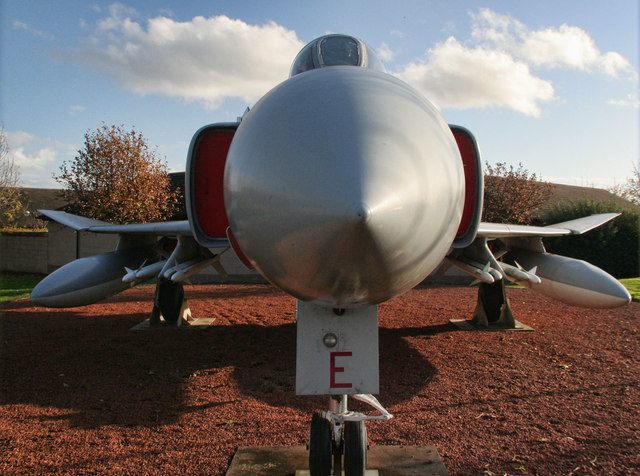
Pictured: the gate and perimeter of RAF Boulmer, Northumberland — not the 1977 encounter itself. No photograph of the sighting or the objects is known to survive; the RAF's own contemporaneous radar plots remain inside the MoD's declassified paper file.
Theoretical Alignment
Boulmer earns a moderate Extraterrestrial Hypothesis score not because any witness described anything resembling a conventional aircraft, but because the case's strongest feature — three trained, on-duty RAF personnel sustaining a close, detailed visual observation for one hundred minutes, followed by independent radar corroboration from three separate stations after the objects had already left visual range — is a genuinely unusual evidentiary combination that no single documented conventional candidate accounts for cleanly. The Psycho-Social Hypothesis scores low specifically because this is not a fear-driven, ambiguous, or fleeting report: it is a calm, extended, procedurally logged observation by men whose entire job was to identify unusual things in the sky, immediately followed by a request to cross-check the sighting against independent instruments rather than a dramatized retelling after the fact. The Interdimensional Hypothesis has essentially nothing to offer a case built on ordinary optical and radar physics — luminous round and shape-shifting objects reflected or emitting visible light, and radar returns behaving like ordinary if unidentified airborne contacts, with no claim of physical transition between media, dimension, or state. What keeps the ETH score from climbing higher is the case's own most important internal seam: the visual sighting and the radar detection did not overlap in time. The objects were gone from the men's sight before the duty controller thought to check the radar picture, meaning Boulmer offers strong witness testimony and strong radar data as two separate evidentiary strands rather than a single simultaneously instrumented event, and no photograph, film, or physical trace of any kind survives to bridge them.
Background
RAF Boulmer occupies a working stretch of the Northumberland coast a few miles from Alnwick, its origins tracing back to a wartime decoy airfield before its Cold War reinvention as a hardened ROTOR-programme radar station, opening in its underground R3 configuration on August 21, 1953. By the mid-1970s the station had grown into one of the more operationally significant nodes in Britain's air defence network, serving simultaneously as a Sector Operations Centre and a Control and Reporting Centre — the facility, known by the call sign Hotspur, responsible for maintaining the recognised air picture across a swathe of northern UK airspace and directing Quick Reaction Alert fighters around the clock. It was also, by 1977, home to ‘A’ Flight of No. 202 Squadron, which had arrived in 1975 to fly search-and-rescue missions in Westland Whirlwind HAR.10 helicopters — the same aircraft type that would, within weeks, become the size reference the station's own duty controller reached for to describe what he had just watched hovering over the sea.
The night of Friday into Saturday, July 29–30, 1977 began, by every surviving account, as an unremarkable overnight duty shift. A civilian telephone call reached the station reporting two bright objects visible over the North Sea — the detail that first pulled personnel out of the operations room to look for themselves. What happened next generated, within the Ministry of Defence's own internal handling, one of the more procedurally serious UFO files of the entire decade: a sighting logged by name, cross-checked against radar by the officer who witnessed it himself, independently confirmed by two further radar stations, and formally relayed up the chain to the RAF's national air defence data centre — all before the shift ended.
Complete Timeline
| Date | Event |
|---|---|
| Aug. 21, 1953 | RAF Boulmer's underground ROTOR-programme radar bunker (R3) officially opens, beginning the station's role as a Cold War air defence radar site. |
| 1974 | Boulmer is established as a Sector Operations Centre and Control and Reporting Centre (call sign "Hotspur") within the UK air defence network. |
| 1975 | ‘A’ Flight, No. 202 Squadron, arrives at Boulmer flying Westland Whirlwind search-and-rescue helicopters, giving station personnel a familiar size reference literally on their own airfield. |
| Early hours, Sat. July 30, 1977 | A civilian telephone call reports two bright objects hovering over the North Sea; duty controller Flight Lieutenant A.M. Wood and NCOs Corporal Torrington and Sergeant Graham go outside to look and see the objects for themselves. |
| Same night, over ~100 minutes | The three men watch two luminous objects hover roughly 4,000–5,000 feet up, three miles offshore; the nearer object is round and estimated at four to five times the size of a Whirlwind helicopter, while the farther object is described changing shape before both appear to part and climb. |
| Same night, minutes after visual loss | Wood checks with the station's senior radar operator whether the objects can be seen on the radar picture; two unidentified contacts are found 20–30 miles out to sea, moving northeast and climbing before parting, one to an estimated 9,000 feet moving east, the other holding 5,000–6,000 feet. |
| Same night | The controller at RAF Patrington independently confirms the same two unidentified blips on the Patrington radar picture; radar staff at RAF Staxton Wold separately confirm the contacts. |
| Same night | The combined radar picture is relayed directly to RAF West Drayton, home of the Linesman system's national Air Defence Data Centre. |
| 1977 | The report is filed within the Ministry of Defence secretariat then informally known in press accounts by the code "SF4," corresponding to the S4(Air) branch that David Clarke's National Archives research identifies as handling UFO sighting reports until 1978. |
| 2002 | David Clarke and Andy Roberts publish Out of the Shadows: UFOs, the Establishment and Official Cover-Up, giving the first detailed public account of the Boulmer sighting, including the westerly object's description as conical with a rotating apex before appearing arrowhead-shaped, years ahead of the file's own formal declassification. |
| Jan. 1, 2005 | The UK Freedom of Information Act 2000 comes into force for central government, ending the MoD's ability to withhold UFO files from public request on a discretionary basis. |
| Jan. 27, 2005 | The Boulmer file is released to the public, three years past the standard 25-year rule that would have opened it in 2002 — a delay independently confirmed by the National Archives' own catalogue entries for the DEFE 24 series, which record related 1977 UFO files as "originally closed until 2005." |
| 2014 | A second, independent possible sighting from the same general period and vicinity — recalled by a then-12-year-old, watching from roughly five miles away near Alnwick — is published by UFO Casebook, adding an unconfirmed but suggestive civilian corroboration to the RAF account. |
A Call from the Coast: The Sighting Begins
The sequence began, as far as the surviving record shows, with an ordinary night-shift telephone call. A civilian — never publicly named in the released file — rang RAF Boulmer to report two bright objects visible over the North Sea. For a working air defence radar station, a call like that was itself unremarkable; Boulmer's entire operational purpose was fielding exactly this kind of report and checking it against the station's own instrumentation. What made this call different was what happened when someone actually went to look. Duty controller Flight Lieutenant A.M. Wood, together with Corporal Torrington and Sergeant Graham, stepped outside the station's operations building and found that the caller had been right: two bright, distinct objects were plainly visible, hanging in the sky above the sea to the east.
One Hundred Minutes Over the North Sea
What the three men then watched, according to the MoD's own declassified paperwork and the fuller reconstruction later published by David Clarke and Andy Roberts in Out of the Shadows, was not a brief glimpse but a sustained, detailed observation lasting roughly one hour and forty minutes. The two objects appeared stationary at first, hovering at an estimated 4,000 to 5,000 feet, roughly three miles out over the water. The nearer of the two, to the east, was described as round and luminous, self-evidently large enough at that range for Wood to reach for a comparison sitting on his own airfield: it was, he estimated, four to five times the size of a Westland Whirlwind helicopter — the search-and-rescue type flown daily by 202 Squadron's ‘A’ Flight from Boulmer itself, a rotor diameter of roughly 53 feet that Wood and his colleagues would have seen at close range on a near-daily basis, making it an unusually well-calibrated size reference rather than a vague guess. The farther, westerly object behaved more strangely still: the surviving descriptions render it first as conical, apex uppermost, appearing to rotate, before its outline changed — described in different renderings of the same file as becoming "arrowhead-shaped" and, in press summaries of the same document, as turning "body shaped with projections like arms and legs." However the exact silhouette is best understood, every account agrees on the essential point: the object's apparent shape changed visibly during the observation, rather than remaining static the entire time. As the sighting continued the two objects appeared to move apart and then back together before slowly climbing into the clear sky, at which point they eventually passed from view.
The Objects Vanish, and the Radar Picks Up the Trail
It is what Wood did next that gives the Boulmer file its distinctive evidentiary shape. Rather than simply logging what the three of them had seen and moving on, the duty controller — per the MoD's own paperwork — "checked with the SRO as to whether he could see the objects on radar supplied from" a neighbouring station, initiating a real-time attempt at instrumented corroboration within minutes of the objects disappearing from sight. The answer came back affirmative and specific: Boulmer's own radar picture showed two unidentified contacts at a range of twenty to thirty miles out to sea, tracked moving slowly to the northeast as they climbed, before the two contacts parted — one climbing to an estimated 9,000 feet and moving east, the other holding at an estimated five to six thousand feet. Crucially, this was not a single station's radar reading taken on faith. The controller at RAF Patrington, an early-warning station further down England's east coast, independently confirmed that the same two unidentified blips were visible on the Patrington radar picture, and radar staff at RAF Staxton Wold — then, as now, among the longest continuously operating radar installations in the world — separately confirmed the contacts as well. The composite picture, cross-checked across three physically separate radar heads, was then relayed directly to RAF West Drayton, the Linesman system's national Air Defence Data Centre, which in the mid-1970s was responsible for integrating exactly this kind of multi-station surveillance picture for the whole of the UK Air Defence Region.
"Reliable and Sober": The MoD's Own Assessment
Whatever else the Boulmer file leaves unresolved, it does not leave the question of witness character unaddressed. The Ministry of Defence's own internal report on the incident described Wood, Torrington and Graham in three words that have been quoted in every subsequent press account of the file's release: "reliable and sober." That is a striking form of language for a routine internal government document to commit to paper — not merely noting that a report was received, but affirmatively vouching for the state and character of the men who made it. Read alongside the department's evident willingness to cross-check the sighting against three independent radar stations rather than dismiss it after a single look, the file reads less like a report processed and filed away, and more like one an internal MoD reviewer took seriously enough to want corroborated on paper — a pattern consistent with what later researchers found when they examined how thick, and how internally deliberated, the surrounding correspondence in the file actually was.
A File Held Back Three Extra Years
Ministry of Defence UFO files were, as a rule, subject to the UK government's standard 25-year closure rule, after which they would ordinarily transfer to the National Archives at Kew for public release. The Boulmer file did not follow that rule. Press coverage of its eventual release consistently reported that an additional three years had been added to its normal 25-year schedule — meaning a file generated in 1977 that should, by the standard rule, have opened to the public around 2002, was instead kept closed until 2005. This is not merely a claim repeated across secondary UFO-interest websites; it is independently verifiable in the National Archives' own catalogue. The relevant 1977 case papers survive in the Ministry of Defence's DEFE 24 series — specifically DEFE 24/1206, catalogued as "UFO reports and correspondence: April–October 1977," the period spanning the Boulmer sighting — and the National Archives' own record for that file states plainly that it was "originally closed until 2005." The neighbouring file, DEFE 24/1205 ("UFO reports and correspondence: October–December 1977"), carries an identical closure note. Both dates align exactly with the arithmetic that period press coverage reported: 1977 plus the standard 25 years would have opened the files in 2002; instead, both were held closed until 2005, precisely three years later. The file's actual public release came on January 27, 2005, just weeks after the Freedom of Information Act 2000 took effect for UK central government on January 1 of that year, ending the department's ability to withhold it on a purely discretionary basis. Contemporary press accounts of the release also noted that the case had been catalogued within a Ministry of Defence branch informally referred to in press coverage by the designation "SF4" — a name that corresponds closely to S4(Air), the defence secretariat branch that David Clarke's own published National Archives research guide identifies as the section responsible for handling UFO sighting reports from the late 1960s until 1978, precisely the period spanning the Boulmer sighting.
Out of the Shadows: How Clarke and Roberts First Reconstructed the Case
The fullest published account of the Boulmer sighting appeared not in 2005, when the file itself was formally released, but three years earlier, in David Clarke and Andy Roberts's 2002 book Out of the Shadows: UFOs, the Establishment and Official Cover-Up. Clarke's long-running relationship with the Ministry of Defence's UFO-handling branches — built over years of using pre-FOIA disclosure channels and direct correspondence with serving and retired personnel, well before he went on to formally curate the National Archives' own UFO-files project between 2008 and 2013 — allowed the two researchers to reconstruct the Boulmer case, including the specific detail of the westerly object's conical, rotating, arrowhead-like appearance, years ahead of the file's own statutory release. Their account remains the most detailed narrative reconstruction of the sighting available in print, and it is the source most subsequent case summaries, including the eventual 2005 press coverage of the file's formal declassification, ultimately draw on for the fullest description of what the two objects actually looked like.
A Second Witness, Decades Later
In 2014, UFO Casebook published an account from a man identified only as Phil, a qualified journalist who said that as a twelve-year-old he had watched two luminous discs from Meadowriggs, near Alnwick, roughly five miles from RAF Boulmer, in the company of two friends. Phil described the objects as shining with what appeared to be their own light rather than reflected light, with one performing vertical movements while the other hovered stationary, before both departed at what he described as extreme speed to the west; the whole episode, in his recollection, lasted around half an hour. He recalled that a friend's father, on hearing the account at the time, suggested the objects might have been "some new kind of flare" associated with RAF activity. This account cannot be definitively tied to the same night as the Boulmer file's own July 30, 1977 sighting — Phil's own dating was general to "the late 1970s" rather than a specific confirmed date, and the visual details (movement pattern, departure direction, and duration) do not match the RAF file's account point for point. It is presented here honestly as a suggestive, independently sourced possible civilian corroboration from the same base's immediate vicinity, not as confirmed evidence that it describes the identical event Wood, Torrington and Graham reported.
Circumstantial Evidence
- The Ministry of Defence's own file explicitly rated all three RAF witnesses "reliable and sober" — a direct, on-the-record credibility judgment rather than a routine administrative note.
- The duty controller who witnessed the objects personally initiated the radar cross-check within minutes of losing visual contact, rather than the case relying on a separate, unconnected radar operator noticing something independently.
- The radar contacts were independently confirmed by controllers at two further stations, RAF Patrington and RAF Staxton Wold, rather than resting on Boulmer's own radar reading alone.
- The composite radar picture was formally relayed to the RAF's own national air defence data centre at RAF West Drayton, indicating the sighting was treated as operationally significant rather than dismissed at station level.
- The National Archives' own catalogue independently confirms that the relevant DEFE 24 files covering this period were "originally closed until 2005" — verifying, from the government's own records rather than secondary press repetition, the claim that release was delayed three years beyond the standard 25-year rule.
- David Clarke and Andy Roberts' 2002 published account of the case, sourced years ahead of the file's own 2005 declassification, has never been publicly contradicted or retracted by the Ministry of Defence.
- No named, detailed, MoD-endorsed conventional explanation for the specific radar contacts has ever been published, in contrast to cases such as Mantell or Livingston where a specific rebuttal theory exists in the public record.
Key Researchers
- David Clarke — Investigative journalist and academic who, with Andy Roberts, published the first detailed public account of the Boulmer sighting in 2002, years ahead of the file's own formal declassification, drawing on his long-running direct research relationship with the Ministry of Defence's UFO-handling secretariats.
- Andy Roberts — British Fortean and UFO researcher who co-authored Out of the Shadows with David Clarke, providing the fullest published reconstruction of the objects' described shapes and the sighting's full 100-minute timeline.
- UFO Casebook — The research and archive site that both preserved the earliest detailed press-derived summary of the 2005 file release and, in 2014, published the independent possible civilian corroborating account from the Boulmer area.
Legacy: A Working Radar Station's Own Case File
Boulmer has never achieved the wide public recognition of Rendlesham Forest, the British case most people associate with a UFO sighting involving RAF personnel, and researchers who have compared the two files point to fairly obvious reasons why. Rendlesham unfolded over several nights, involved American service personnel willing to speak on the record decades later, produced a widely reproduced handwritten memo from the deputy base commander, and became entangled with later claims of recovered physical material and alleged government cover-up that kept it in the press for decades. Boulmer, by contrast, is a single-night, purely domestic RAF event with no claimed physical evidence, no controversial memo, and no surviving witness who has given an extended modern media interview about it; its entire public profile rests on a MoD file that sat unseen for twenty-eight years and a single 2002 book chapter that pieced the story together before the file's own release. That comparative obscurity is itself informative for how this catalogue should weigh the case: Boulmer was never adopted as a totemic story by ufology's mainstream, was never mythologised with decades of added embellishment the way Rendlesham accumulated, and its documentary record has stayed remarkably stable and consistent from the earliest 2002 published account through every subsequent 2005 press summary. In a field where sensational cases often grow more elaborate with each retelling, Boulmer has, if anything, stayed unusually contained — the same core facts, the same three named witnesses, the same radar stations, repeated consistently rather than expanded.
Within the specific, narrower category of British Ministry of Defence UFO files, Boulmer occupies a distinctive niche as one of the clearest documented examples of a sighting made by the very personnel whose job was to operate the sensors meant to detect exactly this kind of unidentified activity. Most MoD UFO reports released through the DEFE 24 series originate from members of the public, airline pilots passing through controlled airspace, or police officers responding to calls — witnesses with no personal access to the instrumentation that might independently corroborate what they saw. Boulmer is different in kind: the witnesses were already standing inside a live air-defence radar installation when the sighting began, and the same officer who watched the objects was professionally positioned, trained, and equipped to check whether his own station's radar agreed with his eyes within minutes of losing visual contact. That structural feature — witness and instrument operator being the same person, in the same building, on the same night — is rare enough in the broader UFO literature that it alone justifies the case's continued inclusion in serious discussions of the strongest British radar-visual reports, even without the wider public profile of Rendlesham or the physical-trace drama of cases like Livingston.
Key Witnesses
Flight Lieutenant A.M. Wood
The station's duty controller on the night of the sighting, Wood went outside after a civilian telephone report and watched both objects for the full observation period. He is the officer credited in the MoD's own file with checking the radar picture once the objects disappeared from sight — the action that produced the case's independent radar corroboration — and he, alongside his two NCOs, was described in the department's own report as "reliable and sober."
Corporal Torrington
One of two non-commissioned officers who watched the objects alongside Flight Lieutenant Wood for the full hundred-minute observation, giving an account the Ministry of Defence's file found consistent with the officer's own report.
Sergeant Graham
The second NCO present for the sighting, watching alongside Wood and Torrington for the duration of the encounter and corroborating the description of the objects parting and one changing shape as it moved west.
The Five Observables Assessment
The Five Observables framework, developed by former AATIP director Luis Elizondo, classifies witnessed UAP flight performance against the limits of known technology. Boulmer offers a genuinely unusual mix of data for this framework: a long, detailed visual observation with almost no reported dynamic flight behaviour during the visual phase, followed by radar-only data describing motion after the objects had already left visual range — meaning the case's visual and kinematic evidence come from two different phases of the same event rather than a single continuous track.
Assessment: Anti-Gravity Lift is rated speculative because the objects were described hovering stationary for an extended period with no visible means of support, no reported downwash, and no engine noise across three separate observers — consistent with a genuinely novel lift mechanism, but based entirely on visual impression at a distance of roughly three miles, never on any instrument reading of the objects' own physics. Instant Acceleration and Hypersonic Velocity are both rated absent: neither the visual witnesses nor the radar logs describe any high-speed departure; the radar-tracked climb rates (to roughly 9,000 feet, and a hold at 5,000–6,000 feet) are unremarkable and well within the performance of conventional aircraft. Low Observability is rated present because the objects were visually tracked by three trained observers for a hundred minutes yet were never definitively identified by type, and separately, their radar signature was only picked up after a deliberate cross-check rather than through routine, continuous surveillance — suggesting they were not producing an obvious, unmistakable radar profile throughout the encounter. Trans-Medium travel is rated absent, since no transition between air, water, or any other medium was ever reported. Boulmer's evidentiary profile is best summarised as a strong visual case and a separately strong radar case, bridged only by testimony rather than by any single instrument that captured both phases at once.
Evidence Assessment
Supporting Anomalous Origin
- Three on-duty, trained RAF radar personnel sustained a detailed visual observation for approximately 100 minutes, well beyond the fleeting glimpse typical of most UFO reports.
- The Ministry of Defence's own file explicitly rated the witnesses "reliable and sober" — an unusually direct credibility endorsement for an internal government document.
- The duty controller who saw the objects personally initiated an immediate radar cross-check, and unidentified contacts were found in the corresponding airspace.
- The radar contacts were independently confirmed by two further stations (RAF Patrington and RAF Staxton Wold), not asserted by Boulmer alone.
- The file was held closed three years past the standard 25-year rule — independently verified via the National Archives' own DEFE 24 catalogue entries — suggesting unusually extensive internal review or sensitivity.
- No specific, detailed, MoD-endorsed conventional explanation for the radar contacts has ever been published.
Supporting Conventional Explanation
- The visual sighting and the radar detection did not occur simultaneously; the objects had already left visual range before the radar was checked, meaning no single instrument captured both phases together.
- The North Sea corridor off Boulmer was a routine location for military exercise traffic, including illumination flares, and for maritime and low-level aircraft lighting that can be misjudged in size and distance over open water at night.
- No photograph, film, or physical trace evidence exists to independently verify the objects' described size, shape, or luminosity.
- A later, independently reported possible civilian sighting from the same general area (2014) describes different movement, duration, and departure details, undermining any assumption that all reported Boulmer-area lights that summer describe a single identical phenomenon.
- Radar returns from ships, aircraft, or atmospheric ducting effects are well-documented sources of unidentified contacts on 1970s-era ground radar of the type operated at Boulmer, Patrington and Staxton Wold.
Why "Credible"
The RAF Boulmer Sighting earns a CREDIBLE classification because it combines several of the strongest evidentiary features this catalogue looks for — multiple credentialed, on-duty military witnesses; an unusually long and detailed sustained observation; and genuine, independent, multi-station radar corroboration — without the specific instrumented overlap or recovered physical evidence that would justify a higher "Verified" rating, and without the well-documented, high-confidence conventional explanation that would justify rating it "Disputed" or lower. On the strength side: this is not a single uncorroborated witness or a fleeting glimpse. Three trained RAF radar-station personnel, explicitly rated "reliable and sober" by the Ministry of Defence's own internal review, watched two structured, luminous objects for roughly one hundred minutes at close range, and when the objects disappeared from sight, the officer in charge personally initiated a radar cross-check that found unidentified contacts in the same airspace — a check independently confirmed by two further stations and formally relayed to the RAF's own national air defence data centre. The file's unusually extensive internal correspondence and its three-year extension past the standard declassification schedule, verified directly against the National Archives' own catalogue rather than taken on secondary-source faith, both point toward a report the department itself treated with more than routine seriousness. Weighed against this: the visual and radar evidence, while both individually strong, never overlapped in time, meaning no single instrument or witness captured the full event as one continuous phenomenon; no photograph, film, or physical trace evidence of any kind survives; and while a specific, MoD-endorsed conventional explanation has never been published for this case, plausible generic candidates — military exercise flares, refracted maritime or aircraft lighting, and radar anomalous propagation — remain live, if individually incomplete, possibilities that a thin later civilian account and general knowledge of the exercise corridor keep genuinely open rather than closed. That combination — strong, multiply-corroborated testimony and instrumentation on one side, and a real but unresolved evidentiary gap between the visual and radar phases on the other — is precisely the profile of a case this site rates Credible rather than Verified or Disputed.
Sensor & Instrumentation Detection Profile
Boulmer is unusual among radar-visual cases in this catalogue because the instrumentation and the human eyewitnesses were, quite literally, the same men and the same building. RAF Boulmer was not a passive listening post; by 1977 it functioned as both a Sector Operations Centre and a Control and Reporting Centre within the UK's air defence network, its underground R3 operations room built during the Cold War ROTOR programme specifically to process live radar data for national air defence. When Flight Lieutenant Wood and his two NCOs went outside to look at what the civilian caller had reported, they were leaving a functioning radar control room to do it. According to the surviving MoD paperwork, once the objects had disappeared from view, the duty controller "checked with the SRO as to whether he could see the objects on radar supplied from" a neighbouring station — and the answer, remarkably, was yes: two unidentified contacts were picked up on Boulmer's own radar picture at a range of twenty to thirty miles out to sea, tracked moving slowly northeast as they climbed before parting, one estimated climbing through 9,000 feet and moving east, the other holding at five to six thousand feet. That same radar picture was independently checked and confirmed by the controller at RAF Patrington, an early-warning station on England's east coast, and separately by radar staff at RAF Staxton Wold in North Yorkshire — the world's oldest continuously operating radar site, tracing its lineage to the 1930s Chain Home network. The resulting composite picture was then relayed directly to RAF West Drayton in Middlesex, home of the Linesman system's Air Defence Data Centre, the master control facility that in the mid-1970s integrated and cross-checked surveillance data from every UK air defence radar head, including Boulmer's own R3 bunker. No photographic, gun-camera, or magnetic-tape radar recording of the contacts is known to have survived in the released file; the record consists of the written radar-log descriptions and the cross-station confirmations themselves.
Environmental & Geospatial Context
RAF Boulmer sits on the Northumberland coast near Alnwick, its radar heads and masts positioned to give clear, unobstructed sightlines out across the North Sea — precisely the geography that let three men standing on the station's own ground watch two objects hovering three miles offshore in enough visual detail to describe their shape, relative size, luminosity, and later, shape changes, continuously for the better part of two hours. The surviving file gives no indication of adverse weather; the sighting's own defining feature is duration and clarity rather than a fleeting glimpse through cloud or haze, and nothing in the released paperwork attributes the observation to fog, storm activity, or any other conventional obscuration. The coastal, offshore setting is geospatially significant for a second reason central to this file's evaluation of conventional explanations: it placed the objects directly over one of the busier maritime and low-level military training corridors on England's northeast coast, an area where fishing vessels, coastal shipping, and RAF and Royal Navy exercise traffic — including illumination flare drops — were a routine, if not nightly, occurrence, and where light sources at sea level or low altitude can behave optically in ways easily misjudged by an observer without a fixed reference point across open water at night.
Observer Credibility & Occupational Profile
Every primary witness to the Boulmer sighting was, at the moment of observation, an on-duty member of a working RAF radar station — not a chance civilian glancing skyward, but trained personnel whose entire professional function was identifying and classifying exactly this kind of unusual aerial activity. Flight Lieutenant A.M. Wood was the station's duty controller, the officer responsible that night for Boulmer's operational radar picture, and it was Wood who both watched the objects directly and, crucially, thought to check whether ground radar could independently confirm what his own eyes had seen — a methodical, procedurally minded response that is itself a credibility signal, since it shows a witness actively trying to corroborate rather than simply react. Corporal Torrington and Sergeant Graham, the two non-commissioned officers who watched alongside him for the full one hundred minutes, gave accounts the Ministry of Defence's own file found consistent with Wood's own report. The MoD's internal assessment of the three men, preserved in the declassified paperwork and repeated in every subsequent press account of the file's release, was blunt and specific: all three were "reliable and sober." That is a notably direct credibility judgment for a government file to commit to writing, and it reads as a deliberate rebuttal to the two most common dismissive explanations offered for any UFO report — unreliable witness character and impaired judgment — rather than a routine administrative formality. Working against a fully frictionless credibility assessment is the same limitation present in almost every visual UFO case: descriptive testimony, however carefully rendered by trained observers, remains testimony, and no independent civilian witness beyond the original anonymous telephone caller has ever been definitively identified and connected to the same sighting on the same night, though a possible independent civilian sighting from several miles away did surface decades later, discussed below.
Physical & Material Assays
Boulmer generated no physical evidence in the conventional sense — no recovered material, no ground trace, no photograph or film of the objects themselves. This absence should be stated plainly rather than passed over, because it is a real evidentiary limitation: the case's entire weight rests on descriptive witness testimony and written radar-log data, not on anything a laboratory could examine. What the file does contain, in place of physical trace evidence, is a paper record of the radar contacts themselves — range, bearing, altitude estimates, and heading, cross-logged independently at three separate stations rather than asserted by a single observer. This is a materially different, and in some ways stronger, category of corroboration than a typical unwitnessed visual report, even though it falls well short of recovered hardware or trace chemistry. No radiation readings, electromagnetic interference reports, or equipment malfunctions connected to the sighting appear anywhere in the released file or in any subsequent published account of it.
Historical Precedents & Archive Matches
Boulmer sits within a recognisable British sub-genre of Cold War-era radar-corroborated sightings at military installations, a category that also includes the September 1956 Lakenheath–Bentwaters incident, in which USAF and RAF ground radar, airborne radar, and visual observation from a scrambled interceptor all reportedly tracked the same anomalous target over East Anglia, and the later, far more publicised December 1980 Rendlesham Forest incident involving American personnel at RAF Woodbridge and RAF Bentwaters. Boulmer differs from both in one important respect: unlike Lakenheath–Bentwaters or Rendlesham, where the radar and visual elements of the case are contested or only loosely synchronised across different nights and different accounts, the Boulmer file describes a single, continuous, same-night sequence — a hundred-minute visual sighting immediately followed by a radar check that found something in the same airspace — documented in one station's own paperwork rather than reconstructed from scattered personal recollections years later. Boulmer also belongs to the same broader wave of MoD case files that produced the 1974 Berwyn Mountains Incident and the 1980s Calvine photograph, all handled at various points by the same small chain of Ministry of Defence secretariats and all later examined by the same core group of British archive researchers, David Clarke and Andy Roberts foremost among them.
Material Analysis
Boulmer is, by its own evidentiary nature, a case with no physical material to analyse. No fragment, residue, or recovered hardware connects to the sighting; nothing was left on the ground because nothing was ever reported at ground level. What exists instead is a paper and radar-log record: written descriptions of the visual sighting, and cross-station radar plots describing range, bearing, and estimated altitude for two contacts tracked after the objects left visual range. This is worth stating plainly rather than working around, because it caps how far this case can be pushed toward a confirmed anomaly regardless of how strong the witness testimony and radar corroboration are on their own terms — there is no laboratory test, isotopic assay, or metallurgical finding of any kind to weigh, positively or negatively, against the human and instrument testimony that makes up the entirety of the file.
Supporting a Genuine Anomaly
- Independent, cross-station radar corroboration of an unidentified airborne contact is a materially stronger form of evidence than uncorroborated witness testimony alone, even without recovered physical material.
- No conventional aircraft, vessel, or exercise activity has ever been definitively and publicly matched to the specific radar contacts described in the file.
Supporting a Mundane, if Unconfirmed, Origin
- The total absence of photographic, film, or physical trace evidence means the case cannot be independently re-examined today beyond the written record itself.
- 1970s ground radar was well-documented as prone to false or misidentified returns from shipping, aircraft, and atmospheric ducting, particularly over open water at extended range.
The Conventional Explanation Candidate: Military Flares or Exercise Illumination
The most concretely sourced conventional candidate for the Boulmer sighting comes not from the official MoD file itself, which offers no named explanation, but from the independent 2014 civilian account published by UFO Casebook: a friend's father, on hearing a description of lights near Boulmer, suggested at the time that the objects might have been "some new kind of flare" connected to RAF activity. This candidate deserves serious consideration because the waters off Boulmer sat within an active military exercise corridor, and RAF and Royal Navy illumination flares — bright, slow-descending, and capable of producing a luminous, roughly round appearance at a distance — were a genuinely routine feature of exercises along that stretch of coast during this period. It struggles against the specific details in the official RAF file: illumination flares descend and burn out over a period of minutes, not the roughly 100 minutes of continuous, stationary-then-shape-changing observation Wood, Torrington and Graham described, and flares do not independently generate a radar return of the kind logged at three separate stations after the objects had visually disappeared.
Ship or Aircraft Lights Distorted by Low Cloud or Temperature Inversion
A second, frequently proposed category of explanation for coastal radar-visual sightings generally holds that ordinary vessel or aircraft lights, viewed at long range and low elevation over open water, can appear unusually large, luminous, or structured when refracted or duplicated by a temperature inversion or a low, thin cloud layer — a documented optical effect behind numerous historical maritime light misidentifications. This candidate is attractive because it requires no exotic mechanism and because the North Sea shipping lanes off Northumberland carried routine coastal and fishing traffic. It struggles specifically against the shape-changing behaviour described for the westerly object — an inversion-distorted light source typically produces scintillation or apparent elongation rather than a coherent, describable change from a conical, rotating form to a distinctly different silhouette — and against the fact that no specific vessel or aircraft has ever been named in the public record as a candidate match for the sighting.
Radar Anomalous Propagation or Ducting
A third candidate addresses the radar phase of the case independently of the visual sighting: anomalous propagation, or radar "ducting," caused by temperature and humidity layering in the lower atmosphere, was a well-understood cause of false or exaggerated radar returns on 1970s-era ground radar systems of the type operated at Boulmer, Patrington and Staxton Wold, particularly over sea surfaces where ducting effects are common. This candidate is genuinely plausible as a partial explanation, since it would not require any real object to be present for radar operators at multiple stations to see a correlated return. It struggles against the fact that the radar contact directly followed, in the same location, an extended and detailed visual sighting of physical, luminous, apparently structured objects by three trained observers — meaning any explanation for the radar return in isolation still leaves the visual sighting itself, the more evidentially distinctive half of the case, unaddressed.
Military Flares / Exercise Illumination
Partially Plausible InconclusivePARTIALLY PLAUSIBLE for the visual phase alone, but does not account for the radar corroboration or the reported duration and shape change. INCONCLUSIVE overall, given no named conventional candidate has been publicly matched to the full combination of visual and radar evidence in the official file.
Related Cases
Confirmed Documents & Official Records
The Ministry of Defence case-paper series covering the exact period of the Boulmer sighting; the catalogue's own closure note independently confirms the file was withheld three years past the standard 25-year rule.
UNCLASSIFIED (declassified 2005)The neighbouring case-paper file in the same DEFE 24 series, carrying an identical "closed until 2005" catalogue note, corroborating the three-year extension applied across this period's UFO correspondence.
UNCLASSIFIED (declassified 2005)Search Government Archives Directly
Further Reading — Recommended Literature
Out of the Shadows: UFOs, the Establishment and Official Cover-Up
The first, and still fullest, published account of the Boulmer sighting, reconstructed years ahead of the file's own 2005 declassification by the two researchers most closely associated with British MoD UFO-file scholarship.
The UFO Files: The Inside Story of Real-Life Sightings
A comprehensive history of British government UFO investigation drawn from declassified National Archives files, essential context for how the MoD secretariats that handled Boulmer actually operated.
Open Skies, Closed Minds
A firsthand account from the former head of the MoD's own UFO desk, offering direct insight into how the department that handled the Boulmer file actually assessed and processed radar-corroborated sightings.
The UFOs That Never Were
A skeptically minded deconstruction of well-known British UFO cases by three of the country's most established researchers, useful for weighing how the same team that documented Boulmer approaches conventional explanations elsewhere.
The UFO Encyclopedia, 4th Edition
The definitive UFO reference work, situating Boulmer among the broader catalogue of radar-corroborated Cold War-era military sightings worldwide.
Essential Viewing
No Videos Available
A genuine search for video content dedicated specifically to the RAF Boulmer sighting — as opposed to general MoD UFO-file compilations or unrelated modern radar/UAP coverage — did not turn up any videos that could be verified as directly and primarily about this specific case via the required YouTube oEmbed check. Consistent with this site's standard of never padding a case file with mismatched or unrelated video content, no videos are listed here.
Sources
- The National Archives (UK). "UFO reports and correspondence: April–October 1977" (DEFE 24/1206). beta.nationalarchives.gov.uk
- The National Archives (UK). "UFO reports and correspondence: October–December 1977" (DEFE 24/1205). beta.nationalarchives.gov.uk
- The National Archives (UK). "Unidentified Flying Objects (UFOs) — postwar records." nationalarchives.gov.uk
- UFO Casebook. "RAF Boulmer Reports of UFO Sightings were Hushed Up, July 1977." ufocasebook.com
- UFO Casebook. "Eyewitness to 1977 RAF Boulmer Event Comes Forward" (2014). ufocasebook.com
- Northumberland Gazette. "Boulmer reports of UFO sightings were hushed up." northumberlandgazette.co.uk
- The Night Sky II. "Bizarre UFO Witnessed At RAF Boulmer." thenightskyii.org
- Clarke, David & Roberts, Andy. Out of the Shadows: UFOs, the Establishment and Official Cover-Up, Piatkus, 2002, ISBN 0-7499-2290-7. amazon.com
- Clarke, David. "The National Archives Research Guide — Unidentified Flying Objects (UFOs)," Sheffield Hallam University Research Archive. shura.shu.ac.uk
- "David Clarke (journalist)," Wikipedia. en.wikipedia.org
- "RAF Boulmer," Wikipedia. en.wikipedia.org
- "RAF Patrington," Wikipedia. en.wikipedia.org
- "RRH Staxton Wold," Wikipedia. en.wikipedia.org
- "RAF West Drayton," Wikipedia. en.wikipedia.org
- "No. 202 Squadron RAF," Wikipedia. en.wikipedia.org
- "Westland Whirlwind (helicopter)," Wikipedia. en.wikipedia.org
- RAF.mod.uk. "RAF Boulmer" (official station page). raf.mod.uk
- Subterranea Britannica. "Patrington GCI Radar Station." subbrit.org.uk
- atchistory. "LATCC (Mil) and RAF West Drayton." atchistory.wordpress.com
- Pope, Nick. Open Skies, Closed Minds: Official Reactions to the UFO Phenomenon, Simon & Schuster, 1996, ISBN 0-684-81664-4. amazon.com
- Randles, Jenny, Roberts, Andy & Clarke, David. The UFOs That Never Were, Allison & Busby, 2000, ISBN 1-902809-35-1. amazon.com
- Clarke, David. The UFO Files: The Inside Story of Real-Life Sightings, The National Archives, 2009, ISBN 1-905615-50-7. amazon.com
- Clark, Jerome. The UFO Encyclopedia, 4th Edition, Visible Ink Press, 2023 (entry covering British MoD radar-corroborated cases).
- Wikimedia Commons. "File: RAF Boulmer - geograph.org.uk - 1562877.jpg" (CC BY-SA 2.0, hero image source, photograph by Peter McDermott). commons.wikimedia.org
- Wikimedia Commons. "Category: RAF Boulmer." commons.wikimedia.org
- The National Archives (UK) Blog. "Guest blog: Do you believe in UFOs? Part 1 of 2." webarchive.nationalarchives.gov.uk
- Amazon.com. "Out of the Shadows," David Clarke & Andy Roberts. amazon.com
- Amazon.com. "The UFOs That Never Were," Jenny Randles, Andy Roberts & David Clarke. amazon.com
See something inaccurate? Have additional information or sources?
Suggest an Edit →Last Updated: August 2026