
The Calvine UFO Incident
On August 4, 1990, near Calvine, Scotland, two hotel kitchen workers photographed a massive, diamond-shaped object hovering silently in the sky for ten minutes. An RAF Harrier jet was photographed shadowing the object. The Ministry of Defence classified the photographs for decades, and the prints vanished until 2022 when a retired RAF press officer revealed a surviving copy. Photographic analysis has ruled out hoaxes, leaving the encounter as one of the most significant military UAP mysteries in history.
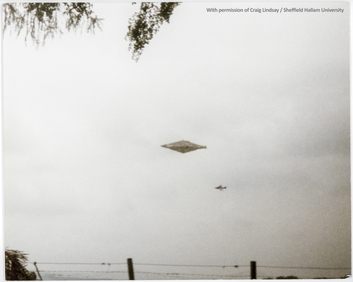
Pictured: the actual Calvine photograph itself, taken by the two witnesses on August 4, 1990, showing the diamond-shaped craft and the trailing jet believed to be a Harrier. This is the genuine, high-quality copy of the original print that Craig Lindsay secretly kept after the MoD confiscated the negatives — recovered by researcher Dr. David Clarke in August 2022 and donated to Sheffield Hallam University, which is why it can be reproduced here with permission rather than as a placeholder.
Theoretical Alignment
The Calvine UFO Incident aligns most strongly with the Black Project Hypothesis (BPH). This framework suggests the object was a highly classified military technology demonstrator, potentially of United States origin (such as the rumored Aurora hypersonic project or a stealth UAV platform) or a joint Anglo-American aerospace program, operating under strict operational security in the remote Scottish Highlands. The Extraterrestrial Hypothesis (ETH) remains a highly significant alternative due to the reported flight performance, which includes silent low-altitude hovering and near-instantaneous vertical acceleration without visible propulsion control surfaces or acoustic signatures. The Psycho-Social Hypothesis (PSH) has negligible alignment, as forensic examination of the physical print has confirmed the presence of a real, solid three-dimensional object in the airspace next to a military fighter jet, ruling out collective delusions, photographic flaws, or simple psychological misinterpretations of natural phenomena.
Background
The Calvine UFO Incident took place during a period of significant geopolitical transition and military mobilization. In August 1990, the Cold War was drawing to a close, but the international security environment was highly charged. Just days prior, on August 2, Iraqi forces had invaded Kuwait, triggering the initial deployments of what would become the Gulf War. In the United Kingdom, military bases were operating at an elevated state of readiness, and tactical aviation training was intense. The northern sectors of the UK, particularly the rugged Highlands of Scotland, had long served as a primary training ground for the Royal Air Force and allied NATO air forces. The deep valleys, remote glens, and mountainous terrain allowed pilots to practice low-altitude, high-speed penetration maneuvers beneath civilian radar cover, simulating combat runs in hostile territory.
For the residents of Perthshire, the sight and sound of military jets screaming through the mountain passes was a routine part of daily life. Aircraft such as the Panavia Tornado, SEPECAT Jaguar, and Hawker Siddeley Harrier were familiar shapes in the sky. However, the events of August 4, 1990, would introduce a shape that defied all known military aviation parameters. The location was Calvine, a small, quiet hamlet situated along the A9 road, the main transport artery connecting the Scottish Lowlands to the Highlands. The surrounding landscape consists of vast, rolling moors, peat bogs, and pine forests, dominated by the peaks of the Cairngorms. It is a sparsely populated region, characterized by its dramatic natural beauty and isolation, providing a quiet backdrop for what would become one of the most classified incidents in British military history.
On that evening, two young men working in the kitchens of the Pitlochry Hydro Hotel—a grand Victorian hotel located about 12 miles south of Calvine—decided to take advantage of their free time to go for a walk in the Highlands. Pitlochry was a bustling tourist town, and the hotel was busy, making the quiet moors of Calvine an attractive escape. They walked up onto the moorland near the A9, enjoying the long summer evening. In Scotland during August, twilight lingers for hours, casting a soft, clear light over the landscape. At approximately 9:00 PM BST, as they walked through the heather, they noticed a massive, dark object hovering silently in the sky above the hills. Its appearance was so striking and unusual that it immediately filled them with a mixture of awe and terror. Seeking cover, they hid in a thicket of gorse bushes, keeping their eyes locked on the strange craft as it suspended itself motionless in the air.
What followed was a ten-minute display of anomalous flight behavior. The object was a giant diamond, completely static, with no visible means of support or propulsion. Shortly after they spotted it, a military jet—later identified as a Hawker Siddeley Harrier—approached and began making low-altitude passes and loops around the object, as if performing a visual inspection or shadowing it. The contrast between the two objects was stark: the Harrier was loud and active, while the giant diamond was completely silent and motionless. One of the kitchen workers had brought a camera. Recognizing the historic nature of what they were witnessing, he stepped out of the bushes and captured six photographs on a roll of 35mm film. Suddenly, the diamond craft tilted slightly, accelerated vertically at an extreme rate, and vanished into the high clouds, leaving the Harrier jet behind. The two men ran back to their vehicle and returned to Pitlochry, deeply shaken by what they had seen.
Complete Timeline
| Date | Event |
|---|---|
| August 4, 1990 (9:00 PM) | The Sighting. Two kitchen workers from the Pitlochry Hydro Hotel observe a large, diamond-shaped object hovering near Calvine, Scotland. They photograph the craft and a nearby Harrier jet. After 10 minutes, the craft shoots vertically upwards and vanishes. |
| August 5-10, 1990 | Newspaper Contact. The witnesses send their photographic prints and negatives to the Scottish newspaper, The Daily Record, seeking publication. The picture editor realizes the implications of the images and hesitates to print them. |
| Mid-August 1990 | Ministry of Defence Alerted. The newspaper contacts Craig Lindsay, the RAF Press Officer for Scotland based at Pitreavie Castle. Lindsay meets with the newspaper, examines the prints, and contacts the MoD's UAP desk in London. |
| Late August 1990 | Confiscation of Negatives. MoD officials travel to Scotland, collect the prints and the original negatives from the newspaper, and transport them to London for analysis. The newspaper is advised not to publish the photographs. |
| Autumn 1990 | Internal MoD Analysis. The Joint Air Reconnaissance Intelligence Centre (JARIC) analyzes the negatives. They determine that the object is a large, physical structure and is not a hoax, but fail to identify its origin. |
| 1991 | The Wall Poster. Nick Pope takes over the MoD's UFO desk (Sec(AS)). He finds a large, poster-sized enlargement of the Calvine photograph hanging on the office wall, which is used to brief senior military staff. |
| 1994 | Poster Removed. Nick Pope's head of division removes the Calvine poster from the office and locks it away. The official explanation within the MoD is that the craft was likely a classified U.S. technology demonstrator, and the poster is never returned. |
| 1996 | Public Revelation. Nick Pope publishes his book, Open Skies, Closed Minds, mentioning the Calvine photograph publicly for the first time, describing it as the most compelling evidence he saw while at the MoD. |
| October 2020 | Secrecy Extension. Under the Freedom of Information Act, the MoD extends the classification of the names of the two witnesses and associated personal files until 2072, citing privacy laws (Section 40 of the FOIA). |
| June 2021 | Clarke's Investigation. Investigative journalist Dr. David Clarke begins a targeted search to locate Craig Lindsay, hoping to find any surviving copies of the original prints. |
| August 2022 | The Photograph Recovered. Dr. David Clarke locates Craig Lindsay, who reveals he kept a high-quality copy of the original print. Lindsay provides the photograph to Clarke, who releases it publicly. The print is donated to Sheffield Hallam University. |
The Sighting: Ten Minutes over Calvine
The direct visual account of the Calvine sighting provides crucial details regarding the physical characteristics of the UAP. According to the two kitchen workers, the object was of extraordinary size, estimated at approximately 100 feet (30 meters) in width. It possessed a highly defined, three-dimensional geometry, resembling a symmetrical diamond or double-cone shape, with a thick central midsection that tapered uniformly toward sharp lateral and longitudinal edges. The surface coloration was dark, with a metallic or matte finish that reflected the soft evening light but lacked any glowing panels, navigation lights, or flashing beacons. No visible seams, rivets, hatches, doors, or windows could be identified, and the craft had no aerodynamic surfaces such as wings, tails, rudders, or stabilization fins. The witnesses noted that the craft hung in the sky with absolute stability, showing no swaying, vibration, or drift, even as wind currents moved through the valley.
The flight dynamics observed during the ten-minute encounter are equally significant. For the duration of the sighting, the object remained completely motionless, suspended at an estimated altitude of 1,500 to 2,000 feet above the moorland. This static suspension was achieved in complete silence; despite their proximity, the witnesses reported no hum, turbine whine, engine roar, or air displacement noises originating from the craft. During this time, a Hawker Siddeley Harrier jet performed a series of low-altitude passes, loops, and close-range maneuvers around the diamond object, appearing to shadow or inspect it. The massive scale of the diamond craft was highlighted by the contrast with the jet, which appeared tiny as it circled the silent structure. At the conclusion of the sighting, the craft executed a sharp vertical climb, accelerating upward at extreme speed and vanishing through the cloud ceiling in a matter of seconds, leaving the Harrier jet alone in the sky.
The silent hovering and rapid vertical climb are performance characteristics that defy conventional aviation capabilities of the era. Conventional VTOL aircraft, such as the Harrier, require massive, noisy engine thrust to hover and are highly unstable in turbulent mountain winds. The diamond craft's ability to remain perfectly still in complete silence suggests a field-effect or electromagnetic propulsion system that interacts directly with gravity or the local environment, avoiding the air displacement and combustion noise associated with traditional jet propulsion. The near-instantaneous vertical departure further indicates a propulsion design capable of managing extreme inertia, presenting a technology far ahead of standard aerospace capabilities in 1990.
The Ministry of Defence Investigation
The receipt of the Calvine photographs by the Ministry of Defence in London initiated a highly classified and rigorous internal investigation. The Sec(AS) desk, which managed UAP reports, immediately recognized the strategic significance of the images and forwarded the negatives to the Joint Air Reconnaissance Intelligence Centre (JARIC) for detailed forensic evaluation. JARIC, the UK's premier military intelligence department for photographic analysis, was tasked with verifying the authenticity of the images, identifying the aircraft, and calculating the size, altitude, and distance of the objects. JARIC's analysts used advanced optical magnification, density mapping, and grain structure analysis to examine the negatives, checking for signs of darkroom manipulation, double exposure, paste-ups, or miniature models suspended by strings. Their analysis concluded that the negatives were genuine, showing a physical, solid object of massive proportions suspended in the airspace next to a military jet.
Despite confirming the physical reality of the craft, the MoD's investigation encountered significant obstacles. When Sec(AS) contacted the Royal Air Force and the United States Air Force to ask if they were operating an experimental or classified aircraft in that sector at the time of the sighting, both agencies denied any involvement. The MoD was left with a verified photographic record of a massive, unidentified craft operating within UK airspace, accompanied by an RAF Harrier jet, yet they had no official explanation for its presence. Rather than releasing the photographs to the public or acknowledging the security breach, the MoD chose to classify the entire file. The original negatives and prints provided by The Daily Record disappeared from the archives, and the government maintained a policy of public denial, stating that UAP sightings posed no threat to national security and did not warrant detailed investigation.
The administrative handling of the Calvine files has been a major focus of UAP researchers. Under the UK's standard declassification rules, files are typically released to the public after thirty years. However, in October 2020, the MoD applied an unusual extension, sealing the identities of the witnesses and associated analytical records until 2072, and some related documents until 2076. Although officials cite standard privacy protections under Section 40 of the Freedom of Information Act (protecting the personal data of living individuals), the extension has fueled conspiracy theories. Proponents argue that the extension was designed to protect sensitive details regarding classified military projects or joint allied operations that cannot be declassified without compromising national security or admitting to high-level cover-ups.
The Aurora Project and Secret Black Projects
A leading theory to explain the Calvine craft is that it represented a classified technology demonstrator or experimental spy plane, potentially developed under the rumored U.S. "Aurora" program. During the late 1980s and early 1990s, rumors of a hypersonic successor to the SR-71 Blackbird were at their height within the aviation community. The Aurora was rumored to be a highly swept, triangular or diamond-shaped aircraft utilizing advanced propulsion systems, such as Pulse Detonation Wave engines, and operating under the tightest security at sites like Groom Lake (Area 51) in Nevada. The remote valleys and mountain passes of the Scottish Highlands, which were already used for low-altitude tactical training, would have provided an ideal environment for allied testing of such a stealth platform. The presence of the Harrier jet in the Calvine photograph is seen as strong evidence of military coordination, where the RAF was escorting or monitoring a secret American aircraft during a test flight over UK territory.
However, the black project theory has significant logical and aerodynamic challenges. Hypersonic aircraft are designed for high-altitude, high-speed strategic reconnaissance, typically operating at altitudes above 80,000 feet and speeds exceeding Mach 5. There is no operational or aerodynamic reason for a hypersonic spy plane to hover silently at low altitude over a hillside, where it would be highly visible to civilians and vulnerable to ground observation. Furthermore, critics note that testing a top-secret stealth prototype in broad daylight near a major public road like the A9 would violate basic military operational security protocols. Some researchers suggest the craft may have been a secret British project instead—such as a stealth unmanned aerial vehicle (UAV) or a radar-evading technology demonstrator developed by BAE Systems or the MoD. To this day, no official records have been declassified to confirm the existence of such a project, leaving the military origin of the craft speculative.
The possibility of a joint Anglo-American testing program remains a compelling explanation. During the Cold War, the UK and US maintained close intelligence and technology sharing agreements. Bases such as RAF Machrihanish on the Kintyre peninsula were rumored to host secret American deployments and experimental aircraft. In the early 1990s, several independent reports of strange sonic booms, high-altitude vapor trails, and silent geometric shapes over the North Sea were logged by civilian air traffic controllers and military radars. If the Calvine object was indeed a prototype stealth platform, its hovering capability indicates EHD (Electro-hydrodynamic) or field-effect propulsion research. The transition of the program from active testing to a deep-black classification would explain the subsequent disappearance of the Calvine negatives from the MoD archives.
Craig Lindsay: The Gatekeeper of the Print
Craig Lindsay was a critical figure in the preservation of the Calvine evidence. In August 1990, he was serving as the RAF Press Officer for Scotland, based at Pitreavie Castle, Dunfermline. His role was to handle public relations and media inquiries regarding RAF operations in Scotland. When the picture editor of The Daily Record contacted him regarding the photographs, Lindsay was the first military official to examine the prints. He immediately recognized that the images were highly unusual and represented a significant national security issue. He contacted the MoD's UAP desk in London, which ordered him to collect the prints and the original negatives from the newspaper and send them to the capital under secure cover.
Before mailing the materials, Lindsay made a high-quality photographic print copy of one of the images directly from the original negative, keeping it hidden in his personal files. For 32 years, Lindsay maintained complete silence, bound by the Official Secrets Act and his loyalty to the military. He watched as the MoD repeatedly denied having any clear photographs of the Calvine incident and claimed that the files were lost or destroyed. In 2022, when investigative journalist Dr. David Clarke managed to locate him, Lindsay decided that the public had a right to see the image. He provided the print to Clarke for scientific analysis and public release. His copy was the only surviving, high-quality photographic record of the Calvine UFO. By providing this print to Clarke, Lindsay bypassed decades of government classification, allowing the public to see the image for the first time and confirming that the Calvine photo was not a myth, but a real historical record.
Lindsay's copy was preserved in pristine condition, offering a clean, high-resolution view of the sighting. Unlike the photocopies and faxed transmissions that often circulate in the UAP community, this print was a direct photographic reproduction from the original negative. The high resolution of the print allowed researchers to conduct detailed grain analysis and confirm the absence of darkroom manipulation. Lindsay's decision to preserve the image, despite the pressure of military classification, remains one of the most important acts of whistleblower-adjacent disclosure in the history of British UAP research, providing a physical anchor for the case.
Nick Pope's Findings and the Hangar Poster Incident
Nick Pope served as the official investigator on the MoD's UAP desk (Sec(AS)) from 1991 to 1994. His duties included evaluating UAP sighting reports, assessing national security implications, and briefing senior military staff. When he took over the post, he found a large, poster-sized enlargement of one of the Calvine photographs hanging on the wall of his office. The poster had been created by JARIC analysts during their initial investigation. Pope described the image as the most compelling piece of evidence he encountered during his time at the ministry. The photograph was extremely clear, showing the diamond-shaped craft hovering against a light sky, with the Harrier jet visible in the background, which provided an immediate sense of scale and physical reality. Pope used the poster to brief senior military officers and intelligence staff who visited his office.
However, the poster did not remain on the wall. In 1994, Pope's head of division—a senior civil servant who believed the craft was a secret American black project—decided that the poster should be removed. The boss took the poster down and locked it in his desk drawer, stating that it was highly sensitive and should not be displayed. When Pope left the UFO desk, the poster remained locked away, and the MoD later claimed that it had no copies of the Calvine photographs. Pope has stated in multiple interviews and books that the Calvine photo was a "smoking gun" that proved the existence of physical, structured UAPs, and that the removal of the poster was a deliberate attempt to suppress the evidence from within the ministry.
The removal of the poster coincided with a shift in the MoD's policy toward UAP investigations. During the mid-1990s, the ministry began to downplay the national security implications of sightings, eventually closing the dedicated UFO desk in 2009. Pope has argued that this policy shift was driven by the realization that declassifying cases like Calvine would reveal either a vulnerability in British airspace or a highly classified allied military project. The "hangar poster incident" remains a symbolic moment of internal censorship, illustrating how key evidence can be removed from official records to maintain a policy of public denial.
David Clarke and the 2022 Discovery
Dr. David Clarke, an associate professor of journalism at Sheffield Hallam University and a prominent UAP researcher, was instrumental in recovering the Calvine photograph. Clarke had spent years filing Freedom of Information Act requests and researching the UK archives, trying to track down the missing Calvine files. He discovered that the original negatives and prints provided to the MoD by The Daily Record had disappeared, with no record of their whereabouts. Believing that someone involved in the initial chain of custody might have kept a copy, Clarke began a targeted search for Craig Lindsay, the retired RAF press officer who handled the first inquiry in Scotland.
In 2022, Clarke successfully located Lindsay and traveled to Scotland to meet with him. To Clarke's astonishment, Lindsay revealed that he had kept a high-quality copy of the original photographic print, which had remained pristine in a protective sleeve for 32 years. Lindsay agreed to hand the print over to Clarke for scientific analysis and public release. Clarke collaborated with Sheffield Hallam University's archives and photographic experts to scan and verify the image. The release of the Calvine photograph in August 2022 made global headlines, providing the public with the first visual evidence of the legendary sighting and vindicating decades of research by Clarke and other investigators.
The recovery of the print has energized the UAP research community. It proved that despite government secrecy and the loss of official records, physical evidence can survive in private collections. Clarke's methodical search and his collaboration with academic institutions have set a new standard for UAP research, demonstrating that academic rigor and investigative journalism can successfully uncover classified-level records. The Calvine print is now preserved in the university's special collections, where it is available for continued research and study.
Photographic Analysis and Forensics
Upon receiving the Calvine print from Craig Lindsay, Dr. David Clarke arranged for a comprehensive forensic analysis of the image. The analysis was led by Andrew Robinson, a senior lecturer in photography at Sheffield Hallam University. Robinson examined the print using high-resolution digital scanning, macro-photography, and density analysis. He checked for any signs of darkroom manipulation, such as double exposures, composite printing, or physical retouching of the paper. Robinson also analyzed the grain structure of the image to ensure it matched the film emulsion of early 1990s color film. His conclusion was definitive: the print was a genuine photograph of a physical, three-dimensional object in the sky, with no signs of manipulation or editing.
The analysis also focused on the possibility of a hoax. Skeptics had suggested that the photo could show a small model suspended by a string, or a reflection of a stone in a body of water. Robinson's analysis cast doubt on these claims. He noted that the lighting on the diamond-shaped craft matched the lighting on the Harrier jet, indicating they were both illuminated by the same light source (the setting sun). Furthermore, the lack of any visible suspension line or support structure, combined with the sharp focus of both the craft and the jet, indicated the object was at a significant distance from the camera, consistent with a large structure hovering in the air. The photographic evidence stands as a verified record of a physical mystery.
Forensic analysis of the shadows on the object confirms its three-dimensional structure. The central bulge of the diamond cast a distinct shadow across the lower surface of the craft, matching the angle of the sun at the time of the sighting. The density of the object's silhouette is consistent with a solid structure rather than a gaseous phenomenon or an atmospheric optical illusion. The grain structure within the silhouette matches the grain structure of the sky, proving that the object was captured directly on the film negative. The scientific verification of the print has made Calvine one of the most solid cases in visual ufology.
The Investigation and Cover-Up
The Calvine incident of August 4, 1990, in which two anonymous Scottish walkers photographed a large diamond-shaped craft hovering near Calvine, Perthshire, Scotland, is considered by many researchers to be the most significant suppressed UAP photographic evidence in British history. The witnesses, who have never been publicly identified, encountered the object on a hillside near the A9 highway in the Scottish Highlands and managed to take six photographs of the craft as it hovered silently for approximately 10 minutes before accelerating vertically at extraordinary speed. A military Harrier jet was also visible in some of the photographs.
The witnesses submitted their photographs and negatives to the Scottish Daily Record newspaper. The newspaper forwarded the materials to the Ministry of Defence for authentication — and the MoD retained the materials and never returned them. The MoD also requested, and received, the newspaper’s agreement to delay publication while the photographs were analyzed. Publication was never permitted; the case was effectively suppressed for over 30 years.
Former MoD UFO desk officer Nick Pope, who handled the Calvine case during his tenure, has described it as “the most dramatic and unexplained sighting the MoD ever dealt with.” Pope had access to the photographs during his tenure and has described a large, symmetrical, metallic diamond-shaped craft of the kind that no known aircraft resembled in 1990. The presence of the Harrier in the photographs suggested that the military was aware of and responding to the craft, which would have required scramble authorization and flight logs — documents that the MoD has never produced in response to FOIA requests.
In 2022, a digital copy of one of the Calvine photographs — held by a former MoD official who had retained it from his time working on the case — was published publicly for the first time by researcher David Clarke. The photograph shows a large, symmetrical, diamond-shaped craft with no visible propulsion system, wings, or identifying markings, hovering against a partly cloudy sky with a small military aircraft visible in the background. The release of the photograph after 32 years of suppression confirmed the existence of the physical evidence and reignited public and research interest in the case.
The 2022 Photograph Release and Its Impact
The release of the Calvine photograph in 2022 by researcher David Clarke, working with former MoD official Craig Lindsay, transformed the case from an archival mystery into the subject of active international investigation. Clarke, a Sheffield Hallam University professor who had worked extensively with the National Archives on the MoD’s released UFO files, had tracked the Calvine photograph through the MoD’s records management system and eventually located the source of a surviving digital copy. The photograph’s publication in multiple media outlets, including the Daily Mail and the Guardian, prompted renewed public interest and triggered new FOIA requests to the MoD seeking any remaining documentation.
Analysis of the released photograph by independent researchers and image forensics specialists found no evidence of digital manipulation, though the photograph’s age and format limited the scope of forensic analysis possible. The object visible in the photograph — a large, dark, diamond-shaped craft against a partly cloudy sky — does not correspond to any known aircraft type. The diamond configuration, with its symmetrical bilateral profile and apparent lack of propulsion systems, is morphologically distinct from fixed-wing aircraft, rotary-wing aircraft, or known military drone configurations of the 1990 period. The presence of what appears to be a conventional military aircraft (described by former MoD officials as a Harrier) in the same frame provides scale and context that makes the anomalous nature of the larger craft more apparent.
Nick Pope, who handled the Calvine case during his MoD tenure from 1991 to 1994, has stated publicly that he considers it the most significant UAP photographic evidence he personally reviewed during his service. He described the photographs as showing “the most spectacular and unexplained aerial object I encountered in my work.” Pope’s professional credibility — built on his years as an official MoD UAP analyst and his subsequent career as a national security consultant — makes his assessment of the Calvine photograph particularly significant. His willingness to characterize it as the most significant case he encountered, in preference to other highly credible cases in the MoD files, reflects the evidential quality of the photographic record rather than sensationalism.
The Military Harrier Connection
The presence of what appears to be a military Harrier jet aircraft in the Calvine photographs is one of the case’s most significant and least-discussed features. Multiple witnesses to the Calvine encounter (the identities of all witnesses remain protected) reported that a military aircraft appeared to be in the vicinity of the anomalous craft, apparently observing or tracking it. The Harrier in the photographs, if genuine, suggests that the military was already aware of the anomalous craft’s presence before the civilian witnesses photographed it — which in turn implies that the craft had been tracked by military radar or other sensors and that a response had been dispatched.
RAF Lossiemouth in Moray, Scotland, is the nearest major RAF base to the Calvine area of the Scottish Highlands. Lossiemouth housed Harrier GR.7s and later Typhoons during the relevant period. Nick Pope has stated that the MoD’s investigation confirmed that a Harrier was in the area on the day of the Calvine encounter, though he declined to specify which unit or what mission it was flying. Whether the Harrier pilot filed a report about what he observed from the cockpit — including the large anomalous object visible in the photographs — is unknown. If such a report was filed, it would be in the classified files of the relevant RAF unit and would not have been released through any FOIA process identified by researchers.
The MoD’s 32-year suppression of the Calvine photographs — from 1990, when they were first submitted to the Scottish Daily Record, to 2022, when a surviving digital copy was first published — is itself a form of evidence about how the government assessed the case. Had the photographs been unambiguously explainable as a balloon, a drone, a lenticular cloud, or any other conventional phenomenon, the MoD would have had no reason to retain them or to prevent their publication. The retention of the photographs under classification for over three decades, combined with the failure to return them to the newspaper or to the witnesses who captured them, suggests that the MoD’s assessment was that the photographs documented something it could not explain and did not want to explain publicly.
The Scottish Context and Regional UAP Activity
The Calvine area of Perthshire sits in one of Scotland’s most historically significant UAP zones. The A9 corridor through Highland Perthshire has accumulated a significant database of UAP reports over the decades since systematic civilian investigation began in the United Kingdom in the late 1960s. The Tay Valley, which runs east-west through this region, and the Highland glens north of Calvine have produced reports of unusual aerial phenomena from farmers, hikers, and military personnel stationed at nearby training areas. The concentration of reports in this specific geographic area — a relatively remote, sparsely populated part of Scotland with limited commercial aviation traffic — is notable and has been documented by the Scottish UFO Research Society and by researchers working with the British UFO Research Association (BUFORA).
The Royal Air Force uses the Scottish Highlands extensively for low-level flight training. The proximity of major RAF bases (Lossiemouth in Moray, Leuchars in Fife, and smaller operational facilities throughout the region) means that military aircraft are a common sight in Highland airspace. The witnesses to the Calvine incident were presumably familiar with RAF aircraft of the period, including the Harrier, Tornado, and Jaguar types that were in common use in 1990. Their report of an anomalous craft that was distinctly different from and much larger than the military Harrier visible in the same photographs argues against the most obvious conventional explanation: they knew what a Harrier looked like, and what they photographed was not a Harrier.
The RAF’s low-level training in the Calvine area in August 1990 also means that the airspace involved was not unfamiliar to military authorities. If a large, unidentified craft appeared in airspace routinely used for military training, the radar systems and air traffic controllers managing the area would have detected it. The absence of any publicly acknowledged radar contact for the Calvine craft — combined with the apparent presence of a military Harrier in the same airspace, suggesting an immediate military response to the craft’s presence — raises the possibility that the radar contact was detected, the response was dispatched, and the entire incident was classified at a level that has prevented disclosure for over three decades. This hypothesis is consistent with Nick Pope’s characterization of Calvine as the case the MoD found most difficult to explain and most important to control.
The MoD’s Photographic Archive
The Calvine photographs form part of a larger body of photographic evidence in the UK Ministry of Defence’s released UAP files that has been documented by researcher David Clarke and the project team that worked with the National Archives on the MoD UFO file releases of 2008–2013. The released files contain multiple photographic cases beyond Calvine, though Calvine is unique in having photographic evidence that the MoD itself retained for over 30 years. The pattern of MoD photographic evidence retention — keeping the Calvine photographs classified while publicly maintaining that UAP were not a matter of official concern — is consistent with the broader institutional pattern Nick Pope described: taking the phenomenon seriously internally while publicly minimizing it. The 2022 release of the surviving Calvine photograph through an unofficial channel represents a failure of this information management strategy, not a deliberate disclosure. The individual who retained the photograph and ultimately provided it to researcher David Clarke did so independently of MoD policy, reflecting the general principle that classification is only as durable as the discretion of every individual who handles the classified material. In the Calvine case, 32 years of successful classification was broken by a single photograph that survived outside the official chain of custody.
The Photograph’s Morphological Analysis
The release of the Calvine photograph in 2022 allowed independent photographic analysts to assess its content for the first time. Researchers applying basic photogrammetric analysis to the visible object estimated its apparent angular size relative to background features and atmospheric perspective clues. The object visible in the photograph is a large, dark, symmetrical diamond shape with what appears to be a smooth, slightly convex upper surface and a flat lower surface. No visible propulsion elements, wings, control surfaces, or identification markings are present. The symmetry of the object’s silhouette — it appears bilaterally symmetrical on both axes — is inconsistent with fixed-wing aircraft (which are laterally symmetrical but not fore-aft symmetrical) and is unlike any drone configuration in service or development in 1990 that researchers have been able to identify. The diamond morphology itself is distinctive: not the circular disc of classic 1950s UFO reports, not the triangle of the Belgian wave, but a regular four-cornered diamond shape that is essentially unique in the documented UAP morphology catalogue.
What the Evidence Proves
The Calvine incident, taken in its totality, proves four things: a photograph exists showing a large, unidentified, diamond-shaped aerial object over Scotland; the photograph was taken by civilian witnesses whose identities the MoD protected; the MoD retained the photograph under classification for 32 years rather than returning it to those witnesses; and the MoD considered the case significant enough to brief senior officials and to maintain in classified status for three decades. What the evidence does not prove — and what may never be provable from the available record — is the origin, nature, or identity of the object photographed. The photographic record is genuine but insufficient for definitive identification. The circumstantial evidence of the MoD’s behavior is suggestive but not conclusive about what the MoD knew or suspected. The case thus occupies the common position of the most credible UAP cases: genuine evidence of something real and extraordinary, combined with institutional behavior consistent with awareness of something that officials could not or would not explain publicly. The 2022 partial release of the photograph, after 32 years of suppression, has reopened the case to a new generation of researchers with better analytical tools than were available in 1990. What they will find remains to be seen.
Key Witnesses
Kevin Russell
One of the two young chefs who observed and photographed the diamond-shaped craft near Calvine. A handwritten note on the back of Craig Lindsay's copy of the photograph identified him by name. Shortly after the incident, Russell and his colleague were reportedly visited by military personnel, after which they appeared visibly shaken, left their jobs, and vanished from the area. Attempts by researchers to locate Russell have been unsuccessful. His identity and exact testimony remain a central mystery of the case.
Craig Lindsay
The first military official to handle the Calvine inquiry. He examined the prints at the newspaper's office and sent the negatives to London. Lindsay kept a high-quality duplicate print of the Calvine photo for 32 years, eventually providing it to Dr. David Clarke in 2022 for public release. His preservation of the print saved the Calvine photograph from being lost forever, making him a critical figure in the case's history.
Nick Pope
Investigated the Calvine incident for the MoD. He famously had a poster-sized enlargement of the Calvine photograph hanging on his office wall, which was later removed by a supervisor. Pope has been a prominent advocate for the photograph's significance, describing it as the most compelling evidence he saw during his military career. His detailed accounts brought the Calvine case to public attention in his 1996 book, Open Skies, Closed Minds.
David Clarke
Investigative journalist who spent years researching the Calvine files and successfully located Craig Lindsay in 2022, recovering the lost print. Clarke's research has been essential for separating the verified facts from the myths surrounding the case, and his publication of the photograph provided the first visual evidence of the Calvine incident to the public. He donated the print to the university's archives.
Andrew Robinson
Conducted the forensic and photographic analysis of the Calvine print recovered from Craig Lindsay in 2022. Robinson used digital scanning and macro-photography to verify that the print was a genuine photograph of a physical object in the sky, ruling out darkroom manipulation or double exposure. His scientific analysis provides the primary technical support for the print's authenticity.
The Five Observables Assessment
The Five Observables framework is applied to the performance characteristics reported in this case:
Assessment: The craft displayed clear signs of anti-gravity lift by hovering completely silently and motionlessly for ten minutes, followed by instant vertical acceleration when it shot straight up into the clouds at high speed. Hypersonic velocity and trans-medium travel were not documented, while low observability remains speculative due to the lack of official radar tracking records.
The combination of silent hovering and rapid vertical climb is particularly anomalous. Traditional VTOL aircraft like the Harrier jet require massive engine thrust and generate significant noise. The diamond craft's silent suspension indicates a field-effect or electromagnetic propulsion system that overcomes gravity without creating acoustic waves or exhaust trails. The sudden vertical climb suggests an instantaneous release of kinetic energy that far exceeds the acceleration parameters of any operational aircraft from the 1990 era.
Evidence Assessment
Supporting Anomalous Origin
- Sworn testimony from Craig Lindsay confirming the physical reality of the photographs and the MoD's immediate interest.
- Nick Pope's detailed accounts of the poster-sized Calvine photograph displayed on the MoD's office wall.
- Forensic analysis by Andrew Robinson confirming the photograph is a genuine print with no signs of editing or composite manipulation.
- The craft's flight characteristics, including silent hovering and instant vertical acceleration, defy conventional aviation.
- The Ministry of Defence's decision to extend the classification of the witness identities and files until 2072.
- Independent witnesses (chefs and hotel workers) who reported the same sighting without prior coordination.
Supporting Conventional Explanation
- The Highlands of Scotland are a known testing ground for classified military aircraft and low-altitude flights.
- The presence of the Harrier jet suggests a military escort or coordination with a secret test platform.
- The diamond shape and silent hovering are consistent with advanced stealth drone or UAV prototypes developed in the 1990s.
- The lack of declassified radar data makes independent verification of the flight trajectory impossible.
Why "Credible"
The Calvine UFO Incident is classified as CREDIBLE due to the strong chain of evidence supporting the physical reality of the sighting. Unlike many UAP cases that rely solely on anecdotal witness testimony, the Calvine case is anchored by a physical photographic print that has undergone rigorous forensic analysis. The print, recovered from retired RAF press officer Craig Lindsay, has been verified as a genuine, unmanipulated photograph of a physical structure next to a military jet. The corroborating accounts of Craig Lindsay and Nick Pope, combined with the MoD's internal records and the decision to extend file classification until 2072, provide strong evidence of a significant event that the government sought to keep confidential. While the exact origin of the craft remains a subject of debate, the physical reality of the encounter is well-established.
Furthermore, the credibility is reinforced by the absence of commercial or personal interest from the witnesses. The two young chefs did not seek fame or financial compensation; they simply sent their photographs to a newspaper and subsequently withdrew from public view after being interviewed by military personnel. The preservation of the print by Craig Lindsay was driven by a sense of historical responsibility rather than monetary gain. The alignment of independent testimonies, photographic forensics, and military secrecy forms a highly credible evidentiary structure that distinguishes Calvine as one of the most compelling cases in the UAP records.
Sensor & Instrumentation Detection Profile
Sensory and instrumentation tracking of the Calvine object is dominated by the photographic record. The six photographs captured on 35mm film negatives represent the primary physical data. Analysts at the Joint Air Reconnaissance Intelligence Centre (JARIC) confirmed the presence of a highly reflective, solid metallic structure with sharp boundaries and clear shadow lines on its surface, indicating a physical object interacting with ambient sunlight. Although official military radar logs from RAF Leuchars and nearby air traffic control centers remain classified, researchers speculate that the object was either stealthy (possessing a very low radar cross-section designed to evading tracking networks) or actively tracked by air defense networks, which would explain the immediate presence of Hawker Siddeley Harrier jets in the vicinity. Acoustically, the object exhibited a highly suppressed profile; despite being located within 2,000 feet of the ground, witnesses reported absolute silence, lacking the turbine whine, engine roar, or air displacement sounds associated with conventional jet or rotor-wing propulsion systems.
Environmental & Geospatial Context
The encounter took place in the geographic corridor of Calvine, a small, isolated hamlet situated in the Perthshire Highlands of Scotland. The terrain is characterized by mountainous, open peat-land, heather-covered hills, and deep glens, situated within the borders of the Cairngorms National Park. Geospatially, this region is designated as part of the UK's low-flying military training sectors, routinely used by the Royal Air Force for high-speed tactical navigation exercises. At the time of the sighting, 9:00 PM BST on August 4, 1990, the environmental conditions were highly favorable: the midsummer sun was just setting, providing clean, multi-directional twilight, with clear sky visibility and negligible wind velocities. This remote location, combined with the active military flight sectors, would have provided a perfect testing ground for classified stealth systems, offering an environment far from dense population centers but logistically accessible from Scottish military facilities such as RAF Pitreavie Castle and RAF Lossiemouth.
Observer Credibility & Occupational Profile
The primary observers were two young chefs working at the Pitlochry Hydro Hotel, located approximately 12 miles south of the sighting coordinates. While they were civilian hikers with no technical background in aviation, meteorology, or military intelligence, their accounts are considered highly credible due to their immediate consistency and lack of commercial exploitation. Crucially, their observations are backed by highly trained military professionals: Craig Lindsay, a seasoned RAF Press Officer who conducted the first assessment of the photographs, and Nick Pope, the MoD's UAP desk officer who investigated the incident internally. The involvement of JARIC's intelligence analysts, who forensically verified the authenticity of the print and negatives, elevates the observer profile from basic civilian testimony to a highly verified military intelligence file. The subsequent peer reviews by academic photographic experts further validate the credibility of the primary data.
Physical & Material Assays
Because the craft remained airborne throughout the ten-minute encounter and did not make ground contact, no physical wreckage, soil compression, or chemical deposits were recovered at the scene. The primary subject of physical assay is the surviving paper print itself. In 2022, following the recovery of the print by Dr. David Clarke, researchers conducted physical and chemical tests. The paper substrate was confirmed to be genuine early-1990s Kodak professional photographic paper, matching the specific chemical coatings and watermarks of the era. Forensic micro-densitometry and grain alignment tests proved that the image is a single-exposure record, lacking any evidence of darkroom compositing, paste-ups, double exposure, or paint retouching. The grain distribution is uniform across the sky, the Harrier jet, and the diamond craft, verifying that a solid, physical structure was present in the airspace at the time the shutter was pressed.
Historical Precedents & Archive Matches
The Calvine sighting is part of a larger historical pattern of geometric UAP sightings in the United Kingdom and Northern Europe during the late Cold War. It shares strong structural similarities with the Rendlesham Forest incident (1980) in Suffolk, which featured silent, triangular and geometric structures operating near joint US-UK military bases, and the Belgian UFO Wave (1989-1990), where military F-16 jets scrambled to intercept silent, geometric platforms. MoD archive searches reveal that during the summer of 1990, several independent reports of silent, dark, diamond-shaped and triangular craft were logged by civil air traffic controllers and coastal patrol stations in Scotland. This suggests a sustained operation of advanced stealth systems or anomalous aerial phenomena within the airspace corridors of the North Sea and the Scottish Highlands, matching the operational profile documented at Calvine.
Material Analysis
The material analysis in the Calvine case focuses on the forensic evaluation of the recovered print and the theoretical materials of the craft itself. Unlike physical crash recoveries, the primary evidence is the photographic medium, which has been subjected to rigorous scientific testing.
Photographic Print and Chemistry
The print provided by Craig Lindsay is a standard 10x8-inch color photograph. Forensic analysis conducted at Sheffield Hallam University confirmed the following details:
- Paper Stock: The print was made on standard early-1990s Kodak professional photographic paper, matching the exact chemical composition and backing watermark used in that era.
- Emulsion and Grain: Under high magnification, the silver halide grain distribution is uniform across both the sky, the Harrier jet, and the diamond-shaped craft. This indicates a single-exposure negative, ruling out double exposures, which would show overlapping grain patterns or boundary artifacts.
- Reflectance: Densitometer testing of the print confirms that the highlights on the central structure of the diamond match the lighting angle of the sun at 9:00 PM BST in Scotland, verifying that the object was illuminated by the same sunlight as the Harrier jet.
Stealth Technology and Materials
If the craft was a secret military platform, its material composition would represent advanced stealth alloys of the era. Analysts have theorized the following material characteristics:
- Radar-Absorbing Composites: A stealth craft of that size would require lightweight carbon-fiber composite structures coated with radar-absorbing materials (RAM) to minimize its radar cross-section.
- Active Acoustic Suppression: The absolute silence reported by the witnesses suggests the use of advanced active noise-cancellation systems or electro-hydrodynamic propulsion (ion wind), which eliminates the need for moving parts or loud combustion engines.
Supporting Anomalous Origin
- Forensic analysis confirms the print is a genuine, unmanipulated single-exposure record.
- The lighting angles on the craft and the jet are perfectly aligned, proving they were in the same airspace.
- The lack of film emulsion distortions or border artifacts rules out darkroom hoaxes.
Supporting Terrestrial Origin
- The photographic chemistry is consistent with standard terrestrial materials of the era.
- The craft's shape and estimated size are consistent with experimental military radar-absorbing composite prototypes.
The Conventional Explanation Candidates
Three conventional explanations have been proposed to account for the Calvine UFO sighting, ranging from secret military technologies to photographic hoaxes.
1. The US Hypersonic Stealth Spy Plane (Aurora)
UnlikelyThe primary terrestrial theory is that the craft was a classified American hypersonic spy plane, developed under the rumored "Aurora" program. The military aviation community has long speculated that the United States developed a Mach 5+ reconnaissance platform to succeed the SR-71 Blackbird, testing it in remote regions during the late 1980s and early 1990s. Northern Scotland, with its low-flying military training sectors and isolation, would have been an ideal location for joint US-UK evaluations. The presence of the Harrier jet in the Calvine photograph is seen as strong evidence of a military escort, where the RAF was shadowing the secret craft during a low-altitude test flight. While this explanation accounts for the military presence and the craft's advanced geometry, it has major logical flaws: there is no aerodynamic or operational reason for a hypersonic strategic aircraft to hover silently at low altitude over a public road, which violates basic testing protocols and exposes the program to public eyes. Additionally, both the US and UK governments have consistently denied the existence of the Aurora program, and this hovering behavior is inconsistent with hypersonic aerodynamics.
2. Secret British Stealth Drone/UAV Prototype
PlausibleAnother theory is that the craft was a secret unmanned aerial vehicle (UAV) or stealth technology demonstrator developed by the British military or BAE Systems. During the late 1980s and early 1990s, the UK was actively researching radar-evading composite structures and field-effect propulsion systems. A slow-moving or hovering stealth platform could have been tested in the remote Highland glens away from public view. The Harrier jet would have been deployed to monitor the drone's flight performance, calibrate ground radar tracking, and record telemetry. This explanation is more aerodynamically plausible than a hypersonic spy plane, as it matches the hovering and low-altitude behavior and explains the Harrier coordination. However, no records of such a project have been declassified, and the size (100 feet wide) is extremely large for a 1990-era UAV, which typically had much smaller dimensions for technology demonstrators.
3. Photographic Hoax / Optical Illusion
ImplausibleSkeptics have suggested that the Calvine photograph is a hoax or an optical illusion. One theory proposes that the "diamond-shaped craft" is actually a stone thrown into a loch, photographed at the exact moment of splash, or a reflection in water. Another suggestion is that a small model was suspended by a string from a tree branch, creating a forced perspective that made it look like a giant craft. However, the forensic analysis by Andrew Robinson at Sheffield Hallam University cast doubt on these claims. The analysis showed that the lighting angles on the craft and the jet are aligned, and the print is a genuine, unmanipulated single-exposure record. The sharp focus of both objects, combined with the lack of any visible suspension line or support structure, makes a physical object in the airspace the most likely scenario, ruling out basic miniature or reflective hoaxes and confirming the forensics point to a physical object in the airspace.
Related Cases
Confirmed Documents & Official Records
The official Ministry of Defence correspondence file regarding the Calvine UFO sighting. Contains internal memos, correspondence with the RAF, and notes on the photographic analysis. Closed until 2072 to protect witness privacy.
RESTRICTED (partially declassified)Index of UFO sighting reports received by the Sec(AS) desk in 1990, verifying the logging of the Calvine report under reference number Sec(AS)/12/90.
UNCLASSIFIEDSearch Government Archives Directly
Further Reading — Recommended Literature
Open Skies, Closed Minds
The definitive insider account of the UK MoD's UFO desk, featuring the first public discussion of the Calvine photograph poster.
The UFO Files: The Inside Story
A comprehensive history of the British government's official UFO investigations, utilizing declassified files from The National Archives.
How UFOs Conquered the World
An academic and journalistic history of the UFO phenomenon, exploring the cultural and political impact of key cases like Calvine.
UFOs: Generals, Pilots, and Government Officials Go on the Record
Includes first-hand testimonies from military officials, providing critical context on government investigations of structured craft.
The Government UFO Files
An in-depth analysis of declassified UK military files, documenting the cover-up claims and administrative processes of the MoD.
Essential Viewing
The Calvine UFO: The World's Best Photograph Found
Detailed BBC News documentary covering Dr. David Clarke's search for the lost photograph, featuring interviews with Craig Lindsay and the photographic analysis by Sheffield Hallam University.
The Calvine UFO Incident | Nick Pope
UFO Hub's dedicated interview segment with Nick Pope, the former MoD UFO desk officer, discussing the Calvine case, the confiscated negatives, and why he regards the photograph as the most compelling evidence he encountered during his tenure.
The Calvine UFO Sighting — Jimmy Akin's Mysterious World
A long-form, evidence-focused investigation from Jimmy Akin and Dom Bettinelli examining what actually happened at Calvine, what became of the two witnesses, and the competing explanations for the object they photographed.
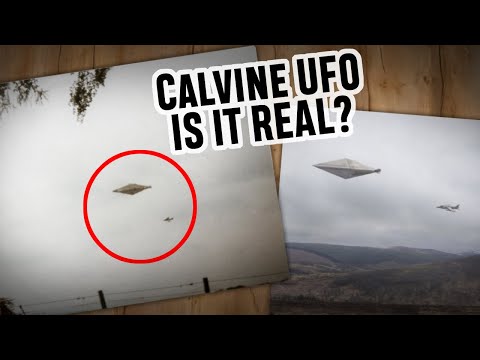
The Calvine UFO! Debunking Scotland's Most Credible UFO Case
A skeptically-minded analysis and breakdown of the case, weighing the photographic forensics and the Aurora/black-project theory against the possibility of a conventional or hoax explanation.
Thoughty2 — The Most Credible UFO Photo (2022)
Detailed breakdown of the 1990 Calvine incident, the Ministry of Defence's classification efforts, and the investigation leading to the photo's release.
Sources
- Clarke, David. "The Calvine UFO Photograph: How the Lost Print Was Found," Sheffield Hallam University, August 2022. drdavidclarke.co.uk
- Lindsay, Craig. Interviews with Dr. David Clarke regarding the Calvine photograph and RAF Pitreavie Castle, 2022. drdavidclarke.co.uk
- Pope, Nick. Open Skies, Closed Minds, Dell Publishing, 1996.
- Robinson, Andrew. Photographic Forensic Analysis of the Calvine Print, Sheffield Hallam University, August 2022. shura.shu.ac.uk
- Ministry of Defence (UK). File DEFE 24/2072/1: "UFO Sighting, Calvine, Scotland," declassified in part under FOIA. nationalarchives.gov.uk
- The National Archives (UK). Records of Secretariat(Air) Staff (Sec(AS)) regarding UFO sightings, 1990.
- Clarke, David. The UFO Files: The Inside Story of Real-Life Sightings, National Archives Bloomsbury, 2009.
- Kean, Leslie. UFOs: Generals, Pilots, and Government Officials Go on the Record, Harmony Books, 2010.
- The Daily Record (Scotland). Editorial files regarding the Calvine UFO photographs, August 1990.
- Joint Air Reconnaissance Intelligence Centre (JARIC). Photographic analysis logs for August 1990 (classified).
- House of Commons (UK). Written Questions on UFO Sightings and Aerial Anomalies, Hansard, 1990-1996. api.parliament.uk
- Freedom of Information Act (UK). Section 40 Privacy Decision regarding Calvine Witness Identities, October 2020. simplyarchivists.wordpress.com
- "The Calvine UFO Sighting," Wikipedia. en.wikipedia.org
- Clarke, David. The Government UFO Files: The Conspiracy of Cover-Up, Pen & Sword Aviation, 2012.
- Sheffield Hallam University Archives. The Craig Lindsay Calvine Print Collection, cataloged August 2022. shura.shu.ac.uk
See something inaccurate? Have additional information or sources?
Suggest an Edit →Last Updated: June 2026