
Florence Stadium Sighting
On the afternoon of October 27, 1954, a referee halted a Fiorentina–Pistoiese friendly at Florence's Stadio Comunale so that roughly 10,000 spectators and both teams could watch two or three unidentified objects maneuvering silently overhead — one of the largest single-location mass sightings in European UFO history, and part of the broader autumn 1954 European "flap." Minutes later, a sticky, fibrous white substance the Italian press dubbed bambagia silicea ("angel hair") drifted down over the city center, was chemically analyzed the same afternoon by University of Florence chemists, and then vanished from the historical record when the only sample was consumed in testing. Six decades later, Italian skeptics matched its chemistry to standard military radar chaff — a specific, well-corroborated candidate for the substance that leaves the initial aerial sighting itself, witnessed by a full Italy international footballer among thousands of others, honestly unresolved.
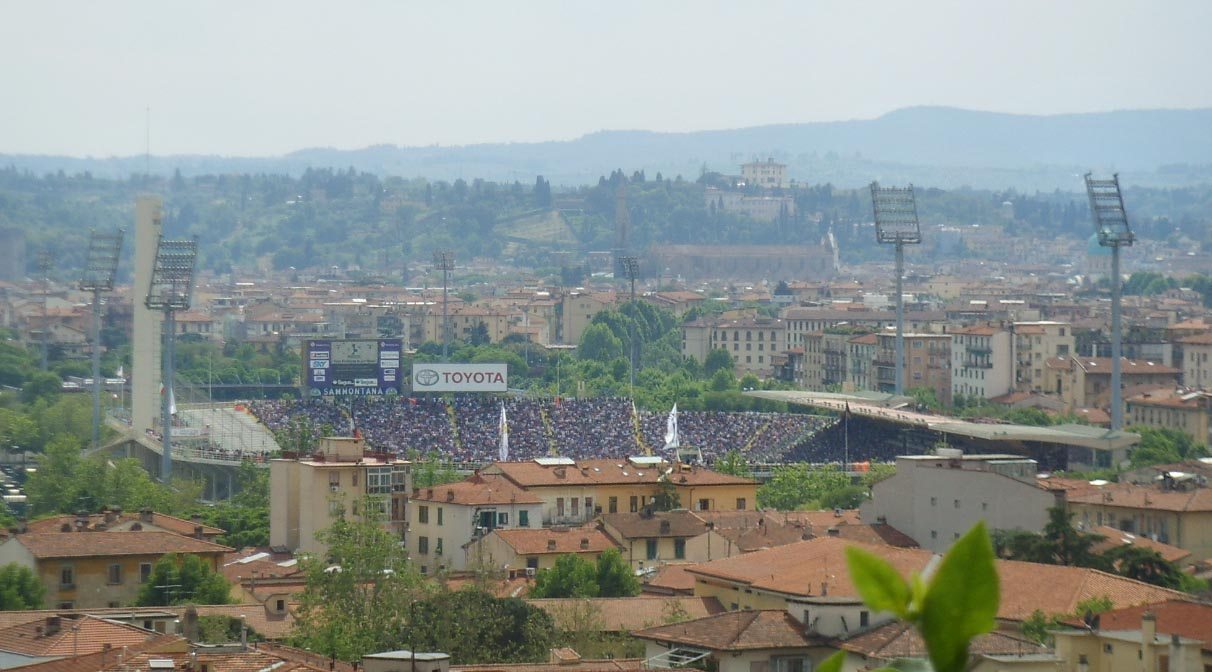
Pictured: the exterior of the Stadio Artemio Franchi (known in 1954 as the Stadio Comunale) in Florence — the same Pier Luigi Nervi-designed, reinforced-concrete grandstand structure, largely unchanged in outline, that stood over the pitch during the October 27, 1954 sighting. No photograph of the objects themselves or of the falling "angel hair" is known to survive; 1950s Italy had no amateur cameras trained on the sky at a lunchtime football friendly, and no press photographer captured the brief event before it ended.
Theoretical Alignment
The case aligns most strongly with a mundane/psycho-social framework in which a real, distant, and ambiguous aerial event (very plausibly a high-altitude military exercise) was watched by an excited, densely packed crowd with no shared vocabulary for what they were seeing, producing a genuinely divergent set of shape descriptions. It retains only weak alignment with the Extraterrestrial or Interdimensional Hypotheses, both of which struggle against the good chemical match between the fallen substance and conventional radar chaff.
Background
By the autumn of 1954, Europe was in the middle of what remains, alongside the American 1947 and 1952 waves, one of the three or four most historically significant flying-saucer flaps of the early Cold War. French researcher Aimé Michel would later devote his 1958 book Mysterieux Objets Celestes to chronicling that autumn's sightings in detail, eventually developing his controversial "orthoteny" theory of geometrically aligned sighting corridors directly out of the pattern of reports he collected. Roughly 75% of that autumn's worldwide sightings concentrated in Europe; of the European total, France accounted for about 70% and Italy for roughly 8%, with the remainder spread across Austria, Switzerland, Britain, Spain, Portugal, Belgium, Germany, Scandinavia, and the Balkans. France's own most consequential case that season, the Marius Dewilde Sighting at Quarouble on September 10, 1954, had already been making headlines for six weeks by the time attention turned to Tuscany.
Florence itself in October 1954 was a city still rebuilding from the Second World War — the Ponte Vecchio had survived the German demolition of the Arno bridges in 1944 only because of a direct order from the retreating Wehrmacht command, while several of the city's other historic crossings had not. The Stadio Comunale, Fiorentina's home ground since 1931, was one of the more architecturally significant modern structures in the city: a reinforced-concrete grandstand and cantilevered roof designed by engineer Pier Luigi Nervi, later renamed the Stadio Artemio Franchi in 1991 and still standing today in essentially the same outline. Fiorentina itself, though not yet the Scudetto-winning club it would become the following season (1955–56, its first Italian championship), fielded a squad anchored by defender Ardico Magnini, who that same summer had represented Italy at the 1954 FIFA World Cup in Switzerland.
The specific fixture on October 27, 1954 was an unremarkable mid-week friendly (amichevole) against provincial neighbor Pistoiese — notable mainly because it was scheduled for early afternoon on a working Wednesday, and yet still drew roughly 10,000 spectators to a non-championship match, a genuinely unusual crowd for a friendly of that stature. The informal match official that day was Arturo Maffei, a decorated former Olympic long jumper then serving as Fiorentina's assistant coach and athletic trainer — not a professional referee, which was itself not unusual for a friendly of this kind, but a detail that later added a note of informality to how the stoppage was handled and recorded.
Nothing in the days immediately preceding October 27 marked Florence out as an unusual flashpoint within the broader European wave, beyond the wave's general intensity that autumn. What set this specific date apart was the coincidence of an extremely large, captive daytime crowd — already looking generally skyward across an open stadium bowl, already primed by weeks of national press coverage of "flying saucers" over France and elsewhere in Italy — with whatever, in fact, appeared over the city that afternoon.
The autumn of 1954 also sat squarely within a period of intense Western naval and air-force activity across the Mediterranean, a theater NATO planners regarded as strategically critical to containing Soviet influence in southern Europe. Italy had joined NATO in 1949 and, by 1954, hosted a growing U.S. and allied military presence, including regular U.S. Sixth Fleet port calls at Naples, Livorno, and Genoa. Carrier air wings routinely conducted electronic-warfare and radar-countermeasure training — including chaff-dispersal exercises — over international and, with permission, Italian airspace during these deployments, activity that was not published in advance to the civilian population and would not have been recognizable to an ordinary spectator at a football match. This is the specific military context the CICAP chaff hypothesis situates the Florence sighting within: not a single unexplained anomaly, but one civilian encounter with a class of routine, classified-at-the-time NATO training activity that was genuinely happening in Italian skies throughout this period, largely invisible to public record until long afterward.
Civil awareness of this activity was minimal by design. Unlike a modern military exercise, which is typically announced via a NOTAM (Notice to Airmen) or coordinated with civil aviation authorities, exercises in the mid-1950s Mediterranean were frequently conducted with only the barest advance coordination, especially for classified electronic-warfare training. An Italian civilian in 1954 had essentially no independent way of knowing that a NATO carrier was conducting radar-countermeasure drills off the Tuscan coast that week, which is precisely the condition under which an ordinary military exercise can be misread, by a large and otherwise credible crowd, as something unexplained. That asymmetry of information — the military services fully aware of their own scheduled activity, the civilian population and even the local press entirely unaware of it — recurs across a great many mid-century mass sightings later tied to classified exercises, and is one reason this case file treats the chaff hypothesis as a serious, well-motivated candidate rather than a dismissive afterthought.
Complete Timeline
| Date / Time | Event |
|---|---|
| Sept. 10, 1954 | The Marius Dewilde Sighting at Quarouble, France, opens the autumn 1954 European UFO wave that Florence's case would become part of six weeks later. |
| Oct. 27, 1954, ~14:15–14:35 | A first, separate sighting is reported over central Florence near the Cathedral of Santa Maria del Fiore (the Duomo); La Nazione staff reportedly climb onto their own newsroom roof to observe it directly. |
| Oct. 27, 1954, ~14:30 | University engineering student Alfredo Jacopozzi collects a sample of falling fibrous material and reports it to La Nazione's newsroom. |
| Oct. 27, 1954, ~15:10–15:20 | During the Fiorentina–Pistoiese friendly at the Stadio Comunale, with the score locked at 2–2 around the first/second-half interval, two or three objects are seen approaching from the northwest; referee Arturo Maffei halts play so an estimated 10,000 spectators and both teams can watch. |
| Oct. 27, 1954, ~15:20–15:35 | The objects maneuver for roughly fifteen minutes before departing toward the southeast; witnesses report a silvery mist or glitter descending as they recede. |
| Oct. 27, 1954, ~15:30–16:00 | Sticky, thread-like white filaments — "bambagia silicea," or "angel hair" — fall over Florence's historic center for roughly thirty minutes, draping rooftops, wires, and trees; the play resumes and Fiorentina wins 6–2. |
| Oct. 27, 1954, afternoon | Professor Giovanni Canneri and assistant Danilo Cozzi at the University of Florence's Institute of Analytical Chemistry perform microscopic and spectrographic analysis on Jacopozzi's sample the same day, before it fully degrades. |
| Oct. 28, 1954 | Rome reports its own, very similar "fall of siliceous wool" alongside separate sightings — an immediate geographic and temporal echo of the Florence event, cited by later researchers as evidence the two are connected phenomena rather than coincidence. |
| 1958 | Aimé Michel publishes Mysterieux Objets Celestes, situating the Florence case within his broader chronicle of the autumn 1954 wave. |
| 2014 | On the 60th anniversary, CICAP researcher Vincenzo Gassi publishes an investigation proposing that the "angel hair" was military chaff, matching its chemistry to a documented U.S. Navy carrier air wing exercise that week. |
| 2020 | Ardico Magnini dies at 91, having given consistent on-record accounts of the sighting across roughly six decades of interviews. |
The First Sighting: Over the Duomo
The version of this case that made global headlines is the stadium interruption, but the Italian record is clear that it was not the day's first reported appearance. Sometime around 14:15–14:20 in the early afternoon, an object or objects were reported over central Florence in the vicinity of the Cathedral of Santa Maria del Fiore — the Duomo, whose dome remains the city's dominant skyline feature. This first phase reportedly lasted about fifteen minutes. Staff at La Nazione, the city's main daily and the paper that would go on to define the case's contemporary press record, are said in multiple retrospective accounts to have climbed onto their own building's roof in the city center to watch the phenomenon directly as reports of it reached the newsroom — placing some of the same journalists who would write up the story among its first-hand witnesses.
It was in the immediate aftermath of this first appearance, at approximately 14:30, that engineering student Alfredo Jacopozzi managed to gather a handful of a sticky, fibrous white material that had begun drifting down over the historic center, and brought or reported it directly to La Nazione's newsroom. This detail matters for the case's internal chronology: it means the fibrous fallout that would become the case's most scientifically interesting element began falling before, not after, the more famous stadium episode roughly forty-five minutes later — consistent with a single, sustained aerial event (or a closely spaced pair of them) drifting across the city rather than two entirely unconnected incidents.
The Stadium Interruption
The Fiorentina–Pistoiese friendly kicked off in early afternoon to accommodate a working-day schedule, and by the time of the disruption the match stood at 2–2. Accounts differ, in a genuinely minor and unresolved way, on whether the objects appeared in the last minutes of the first half or the first minutes of the second — several contemporary Italian retrospectives place it at approximately 15:10, "just before halftime," while the Italian Wikipedia summary of the case places it at 15:27, into the second half. Both figures agree on the broader half-hour window and on the halftime score, and the discrepancy is best read as an example of how even well-documented mass sightings accumulate small, non-material inconsistencies in the exact minute across seventy years of retelling, rather than as a substantive dispute about what happened.
What is not disputed is that spectators began pointing skyward, play stopped on the field, and referee Arturo Maffei — not a professional match official but Fiorentina's own assistant coach and athletic trainer, a role for which a decorated 1936 Olympic long jumper was an unusual but not implausible choice — formally halted play rather than attempting to continue with an inattentive crowd and inattentive players. Multiple sources describe two or three objects, approaching from the northwest, that performed slow aerial maneuvers for roughly fifteen minutes before departing toward the southeast.
The witness descriptions of the objects' actual shape are where the case becomes genuinely inconsistent. Defender Ardico Magnini, who gave on-record interviews about the sighting for the rest of his life, consistently described "something that looked like an egg, moving slowly, slowly, slowly," elsewhere recalling it as resembling "a wheel stopped in the sky." Fan Gigi Boni instead described the object as shaped "like a Cuban cigar." Other contemporary and retrospective accounts add a white, "seagull wing" shape and a comparison to a Chinese mandarin's hat — four distinct visual impressions from the same fifteen-minute event, witnessed by the same crowd, at the same time. As the objects withdrew, multiple witnesses, including Magnini, described a silvery mist or glitter descending from where they had been — the first visible sign of what would shortly become the case's physical-trace evidence.
The Angel Hair Fall
In the wake of the objects' departure, sticky, thread-like white filaments began falling steadily over Florence's historic center, continuing for roughly thirty minutes. The Italian press immediately reached for an existing name for this kind of fallout: bambagia silicea, literally "siliceous cotton," rendered in English-language coverage as "angel hair" (capelli d'angelo). The term itself was not new even in 1954 — Italian aviation writer and ufologist Renato Vesco had coined "capelli d'angelo" roughly two years earlier to describe a similar "snowfall" reported at Oloron-Sainte-Marie and Gaillac, France, in October 1952, meaning Florence's fallout was immediately slotted into an existing folk-taxonomy of UFO-associated debris rather than treated as an unprecedented event.
The material draped over rooftops, telephone and tram wires, and trees across the city center, and its single most distinctive property — reported with striking consistency across every account of the case, from the 1954 press to CICAP's 2014 re-investigation — was that it disintegrated on contact. Most Florentines who tried to gather a handful found it dissolving into a fine powder or simply vanishing between their fingers within roughly an hour of landing. This property alone eliminated the two most obvious mundane candidates that any 1954 observer would likely have reached for first: it was not ordinary spun cotton or textile waste (which does not dissolve), and, notably, it behaves differently from the classic spider-gossamer "angel hair" explanation invoked in many other cases of this type, since dry ballooning spider silk is comparatively durable and does not typically disintegrate on handling the way Florence's sample did.
The Same-Day Scientific Analysis
What separates the Florence case from the great majority of "angel hair" reports worldwide is that a real chemical analysis exists, performed the same afternoon, by credentialed university scientists, on a sample collected within minutes of the fall. Professor Giovanni Canneri, director of the University of Florence's Institute of Analytical Chemistry, and his assistant Danilo Cozzi, subjected Alfredo Jacopozzi's sample to microscopic and spectrographic examination. Their findings, as reported at the time and consistently cited in every subsequent serious re-investigation of the case: a fibrous material with notable mechanical resistance to traction and torsion, chemically composed of boron, silicon, calcium, and magnesium — a profile consistent with a borosilicate glass fiber — that browned and left a fusible, transparent residue when heated, and showed no radioactivity.
This finding is the single most important, and most under-appreciated, fact in the entire case. It rules out spider silk (a protein-based fiber built from carbon, hydrogen, nitrogen, and oxygen, chemically nothing like a boron-silicon-calcium-magnesium glass) as an explanation for this specific sample, even though ballooning spider migration correctly explains a great many other "angel hair" reports around the world. It also rules out ordinary combustion byproducts, volcanic ash from any known nearby source, and simple atmospheric ice or dust. What it does closely match is the chemistry of standard military chaff — the short, fine glass or metal-coated filaments air forces and navies have dispersed since the late 1930s to jam and confuse enemy radar, typically manufactured from exactly this kind of borosilicate glass fiber. The tragedy for modern researchers is that Canneri's sample was entirely consumed in the course of 1954-era testing, so no isotopic dating, fiber-diameter measurement, or coating analysis can ever be performed on the original material; every later comparison, including CICAP's, is necessarily a comparison against Canneri's written 1954 results rather than against a physical specimen.
Press Reaction and the Wider Wave
Florence's sighting became national, and quickly international, news within days — helped enormously by the sheer size of the stadium crowd, the involvement of a recognizable professional football club, and the timing within an already-attentive European news cycle following weeks of French coverage of the Marius Dewilde Sighting and other reports. The very next day, October 28, Rome reported a strikingly similar "fall of siliceous wool" of its own alongside separate sightings — a coincidence that later researchers, including Aimé Michel, treated as evidence that Florence and Rome were not two unrelated local anomalies but two data points in a single, larger phenomenon moving across Italy that week, geographically and temporally consistent with an extended military exercise rather than with two independent and unrelated genuine anomalies occurring on consecutive days in the same country.
Over the following decades, the case's decades-later retellings — particularly in English-language coverage aggregating older Italian sources secondhand — have shown a documentable tendency to drift toward more dramatic framing than the primary Italian record supports. Several English aggregator pieces describe the aerial phenomenon lasting "an hour and a half" or ninety minutes; the earliest and most detailed Italian sources instead describe roughly fifteen minutes of aerial maneuvers at the stadium, plus a separate roughly-fifteen-minute appearance near the Duomo forty-five minutes earlier — a real and well-documented event, but a substantially shorter one than some retrospective accounts imply. This case file treats the shorter, earlier, more specific Italian-language timeline as the more reliable one, and flags the inflated duration claims explicitly as an example of embellishment accumulating in translation and retelling rather than in the primary record.
Renato Vesco and the "Angel Hair" Taxonomy
By the time Florence's substance fell in October 1954, Italian aviation engineer and ufologist Renato Vesco had already given the phenomenon a name. Two years earlier, in October 1952, a strikingly similar sticky, thread-like fallout had descended over Oloron-Sainte-Marie and, ten days later, Gaillac, in southwestern France — cases in which witnesses reported cylindrical objects releasing a trailing white film that settled over trees, telephone wires, and rooftops before dissolving. Vesco applied the term capelli d'angelo ("angel hair") to that French fallout, borrowing a phrase already loosely associated in European folklore with unexplained fibrous or web-like material said to accompany celestial apparitions. When Florence's own fibrous fallout appeared two years later, Italian journalists reached immediately for the same, already-established label rather than treating the event as something unprecedented.
This detail cuts in an interesting direction for how the case should be read. On one hand, it means Florence's "angel hair" was never a novel phenomenon invented specifically for this case — it fit a recognized, if poorly understood, pre-existing category, which lends the description some circumstantial credibility as a real, recurring observable rather than a one-off fabrication. On the other hand, it also means the label itself carried interpretive baggage: by 1954, "angel hair" was already popularly associated with UFO activity in the European press, which likely predisposed both witnesses and reporters to connect the falling fibers to the aerial sighting overhead, whether or not the two were in fact causally related. The folkloric lineage runs further back still — commentators researching the phenomenon type have connected it to the fibrous "manna" reportedly gathered by pilgrims after the 1917 Marian apparitions at Fátima, Portugal, and, more distantly, to descriptions of unusual filaments in the 1561 Nuremberg celestial phenomenon already cataloged elsewhere on this site. Later 20th-century cases in the same folkloric category include a substantial fall at Évora, Portugal in November 1959, and, much more recently, an "angel hair" report from Polonnaruwa, Sri Lanka in 2014 that made international news. None of these later cases carries anything close to Florence's combination of scale, contemporaneous scientific analysis, and named professional-athlete testimony, which is precisely what keeps this specific case, rather than the broader phenomenon type, worth a dedicated file.
Pinotti versus CICAP: The Ongoing Italian Debate
The clearest illustration of how differently this case can be read from the same set of facts is the decades-long, still-unresolved disagreement between Italy's leading pro- and anti-anomalous research bodies. Roberto Pinotti, founder of the Centro Ufologico Nazionale (CUN) and a Florence-trained sociologist who has investigated Italian UFO cases since 1960, treats the Florence stadium sighting as one of Italian ufology's most significant mass sightings, characterizing the objects in his own words as "intelligent, technological, and not associated with any known occurrence on Earth." Pinotti's argument rests substantially on the chemical mismatch between Canneri's 1954 findings and ordinary spider silk: if the generic "it's just spiders" explanation reflexively offered for angel-hair cases elsewhere does not fit Florence's specific chemistry, he argues, then no ordinary explanation has actually been established, and the case remains genuinely open.
CICAP's Massimo Polidoro and researcher Vincenzo Gassi accept exactly the same chemical mismatch with spider silk as a real and important finding — but draw the opposite conclusion from it, arguing that Canneri's boron-silicon-calcium-magnesium result should instead be compared against military chaff, a material Pinotti's own published rebuttals do not appear to address directly. This is a genuinely productive disagreement rather than a simple believer-versus-skeptic standoff: both camps rely on the same 1954 laboratory data, both reject the same weak explanation (spider silk) for the same correct chemical reason, and the entire dispute reduces to which of two very different manufactured/natural materials with roughly compatible elemental compositions is the better match — a question this case file's own research could not fully settle, given that the original sample no longer exists for direct comparison against either.
No formal, published rebuttal from CUN specifically addressing CICAP's 2014 chaff hypothesis on the merits could be located during this research, and no updated CICAP investigation revisiting Pinotti's objections has surfaced either — the debate appears to have settled into parallel, largely non-interacting positions rather than a resolved exchange, which is itself a useful data point about how mid-century mass sightings without surviving physical samples tend to age: not toward consensus, but toward two increasingly fixed institutional readings of the same seventy-year-old laboratory report.
Key Witnesses
Ardico Magnini
A starting defender on the pitch when play was halted, Magnini gave consistent, detailed, on-record interviews about the sighting for the rest of his life — describing "something that looked like an egg, moving slowly, slowly, slowly," with silvery fragments falling from the sky, and elsewhere comparing it to "a wheel stopped in the sky." As a full international footballer with two 1954 World Cup appearances that same summer, he is the case's single most identifiable and repeatedly interviewed named witness, though his testimony is anecdotal, decades-removed in most of its recorded forms, and describes a fundamentally different shape than several other named witnesses.
Gigi Boni
A fan in the stadium crowd, remembered specifically for describing the object as shaped "like a Cuban cigar" — directly at odds with Magnini's "egg" description from the same event and the same general vantage point, underscoring how divergent the crowd's individual visual impressions of the same object(s) actually were.
Arturo Maffei
A 1936 Berlin Olympics long jump finalist who missed the bronze medal by one centimeter in a final contested directly against Jesse Owens, Maffei was serving as Fiorentina's athletic trainer when he made the operational decision to halt the match rather than continue play with a distracted crowd and players — the single decision that turned an aerial curiosity into a documented, dateable, attendance-anchored historical incident rather than a diffuse and harder-to-verify set of individual sky-watching reports.
Giorgio Batini
A career Tuscan journalist who spent over fifty years at La Nazione, Batini's own newsroom received the first reports of the earlier Duomo-area sighting and, per multiple retrospective accounts, staff climbed onto the paper's roof to watch it directly — placing the paper's own senior editorial staff among the case's first-hand witnesses, not merely its chroniclers, and helping explain the speed and prominence of the case's contemporary press coverage.
Alfredo Jacopozzi
The witness whose quick thinking produced the case's only physical evidence: within minutes of the fall, Jacopozzi collected a handful of the dissolving "bambagia silicea" and delivered or reported it to La Nazione, which routed it to the University's chemistry institute before it could fully degrade. Without Jacopozzi's specific action, the case would consist of testimony alone.
Giovanni Canneri
Not an eyewitness to the aerial event, but the scientist whose same-day microscopic and spectrographic analysis, performed with assistant Danilo Cozzi, produced the case's only hard data: a fibrous, boron-silicon-calcium-magnesium composition consistent with borosilicate glass, with no radioactivity, that would become the central exhibit in every later attempt — both anomalist and skeptical — to explain what actually fell on Florence that afternoon.
The Five Observables Assessment
The Five Observables framework is applied to the performance characteristics reported in this case:
Assessment: This case is a striking outlier against the Five Observables framework in a way that itself carries evidentiary weight: every witness account describes the objects moving slowly, with no reported instant acceleration, no hypersonic transition, and no water or subsurface interaction. The only observable with any plausible support is Low Observability, rated speculative only because no radar data exists either confirming or ruling out a return — the absence of any exotic flight characteristics in a case with thousands of witnesses and ample viewing time is itself more consistent with a distant, conventional aircraft or exercise than with a craft demonstrating anomalous propulsion.
Evidence Assessment
Supporting Anomalous Origin
- One of the largest single-location mass sightings in European history — an estimated 10,000 independent witnesses at the stadium alone, plus a separate crowd near the Duomo
- Named, identifiable, on-record witnesses, including a full international footballer (Ardico Magnini) who repeated a consistent core account across six decades of interviews until his death in 2020
- A genuine same-day scientific chemical analysis exists — a rarity among "angel hair" cases worldwide, most of which have no physical sample at all
- The falling substance's chemistry (boron, silicon, calcium, magnesium; no radioactivity) is not explained by the most commonly invoked generic "angel hair" answer (spider silk), which is chemically a completely different, protein-based material
- Contemporary, same-day press coverage by a major regional daily (La Nazione), rather than a report surfacing only after later ufological interest
- A geographically and temporally connected second event — Rome's near-identical "siliceous wool" fall the very next day — suggesting a genuine, extended phenomenon rather than an isolated local misperception
- A referee's operational decision to formally halt a professional football fixture is a real, dateable, externally verifiable action, not merely a retrospective claim
Supporting Conventional Explanation
- Named witnesses give genuinely inconsistent shape descriptions of the same objects at the same time — an egg, a disc, a "seagull wing," a Chinese mandarin hat, and a Cuban cigar are not the same object, and this level of divergence is a classic signature of a distant, ambiguous stimulus rather than a clearly observed structured craft
- No radar, photographic, or film evidence of any kind exists, despite a captive crowd of 10,000 people with a clear, extended, roughly fifteen-minute view
- The fallen substance's chemistry (borosilicate glass fiber; brittle; disintegrates on contact) is a very close match to standard military chaff, which was in active use by NATO navies in exactly this period and region
- A documented U.S. Navy carrier air wing (aboard USS Lake Champlain, CV-39) was operating in the Mediterranean and Italian theater in this exact window, having departed for its first postwar Mediterranean deployment on September 28, 1954
- Every reported motion characteristic (slow, deliberate, no instant acceleration) is consistent with an aircraft or exercise formation observed from a great distance rather than with the exotic flight profiles reported in other cases on this site
- Several widely circulated English-language retellings of the case's duration ("ninety minutes") are demonstrably inflated relative to the earliest and most detailed Italian sources, which describe two roughly fifteen-minute phases — a documented pattern of embellishment accumulating over decades of retelling
Why "Disputed"
This case receives a DISPUTED classification because its two components — the aerial sighting and the physical-trace fallout — deserve, and receive, genuinely different confidence levels, and neither one is simple. The sighting itself is superbly well-corroborated as a historical event — there is no serious question that something was seen by thousands of people, that a professional football match was formally halted because of it, and that a major regional newspaper covered it the same day. What remains unresolved is what was seen: the named witnesses' shape descriptions conflict with each other in ways that a genuine, clearly observed craft should not produce, and no instrumented data of any kind exists to adjudicate between "distant exercise aircraft, glinting and indistinct at altitude" and "something stranger."
The substance, by contrast, has a specific and fairly compelling conventional explanation: the CICAP chaff hypothesis correctly predicts the exact chemistry Professor Canneri measured in 1954, correctly predicts the observed disintegration-on-contact behavior that rules out ordinary spider silk, and lines up with a documented, dated U.S. Navy deployment to the Mediterranean that autumn. It is not, however, fully proven — this case file could not independently verify CICAP's specific claim that the carrier's air wing was operating out of Livorno and conducting chaff exercises on the exact dates cited, since English-language U.S. Navy squadron and ship histories consulted confirm the deployment and the squadron's presence aboard but do not themselves mention Livorno or an October 21–27 exercise window by name. A well-matched but not fully documented explanation, combined with an honestly unresolved visual sighting behind it, is exactly the profile of a Disputed case: too well-attested to dismiss, too well-explained on its most testable point to rate as strongly anomalous.
Sensor & Instrumentation Detection Profile
No radar, photographic, film, or FLIR record of the aerial objects exists. The only instrumented data connected to the case is the same-day microscopic and spectrographic laboratory analysis performed on the fallen substance by the University of Florence's Institute of Analytical Chemistry — genuine period chemistry, but applied to the physical trace rather than to the sighting itself.
Environmental & Geospatial Context
Florence sits in the Arno river valley in central Tuscany, roughly 80 km inland from the Ligurian Sea and within a few hundred kilometers of both the Larderello geothermal field to the southwest and, at the time, U.S. Sixth Fleet operating areas in the Tyrrhenian and Ligurian Seas. Conditions on October 27, 1954 were clear and dry, with no storm activity reported — typical of the near-cloudless skies under which "angel hair" falls are most often described.
Observer Credibility & Occupational Profile
The case's strength is the sheer number and mix of independent witnesses rather than any single highly credentialed observer: a sitting Italy international footballer (Ardico Magnini), a veteran Olympic athlete serving as the match's informal official (Arturo Maffei), a senior professional newspaperman (Giorgio Batini), a university science student (Alfredo Jacopozzi), and roughly 10,000 uncredentialed spectators. No one among them was a trained aerial observer, and their shape descriptions genuinely diverge.
Physical & Material Assays
A real, same-day chemical assay exists — microscopic and spectrographic analysis identifying boron, silicon, calcium, and magnesium, consistent with a borosilicate glass fiber — but the original sample was destroyed in the course of testing, so no modern re-analysis, isotopic study, or independent replication is possible. See Material Analysis below for full detail.
Historical Precedents & Archive Matches
Florence sits inside the internationally significant "autumn 1954" European UFO wave, alongside France's Marius Dewilde Sighting six weeks earlier and a near-identical "fall of siliceous wool" reported in Rome the very next day. It is also one entry in a much longer folkloric lineage of angel-hair-type reports stretching back to the 1561 Nuremberg celestial phenomenon and the 1917 Fátima apparitions, and forward to 1959 Évora, Portugal and 2014 Polonnaruwa, Sri Lanka.
Material Analysis
The only physical evidence in this case is the "bambagia silicea" sample collected by Alfredo Jacopozzi and analyzed the same afternoon at the University of Florence's Institute of Analytical Chemistry. This is a genuinely unusual level of physical-trace documentation for a 1950s European sighting — most "angel hair" reports from this era have no chemical analysis at all, relying entirely on eyewitness description of the material's appearance and behavior.
What the 1954 Analysis Found
Professor Giovanni Canneri and assistant Danilo Cozzi examined the sample under microscope and performed spectrographic analysis, reporting a fibrous material with notable resistance to traction and torsion — not the loose, easily-crumbled texture one might expect from a dust or ash fallout — composed of boron, silicon, calcium, and magnesium. When heated, it browned and left a fusible, transparent residue. No radioactivity was detected. Taken together, this profile is consistent with a fine borosilicate glass fiber, a category of material that includes both common fiberglass insulation and, significantly, standard radar-countermeasure chaff.
Why the Original Sample No Longer Exists
Nineteen-fifties analytical chemistry was frequently destructive: spectrographic analysis of the era typically required burning or dissolving a portion of the sample to excite its component elements into an observable emission spectrum. Canneri's sample was consumed in the course of this legitimate, contemporaneous scientific process, not lost through negligence or suppressed by any authority — but the practical result is the same for modern researchers: there is no physical specimen left to re-test with modern instrumentation (electron microscopy, isotopic mass spectrometry, or fiber-coating analysis), so every subsequent comparison, including CICAP's 2014 chaff hypothesis, is necessarily a comparison against Canneri's written 1954 results rather than against the material itself.
Supporting Non-Terrestrial or Unexplained Origin
- The material's specific combination of properties — fibrous, mechanically resistant, yet fully disintegrating within roughly an hour of landing — is not a perfect match for any single ordinary household or industrial material that a 1954 observer would have immediately recognized
- No chain-of-custody irregularity or contamination of Jacopozzi's sample prior to analysis has ever been alleged, unlike several other famous "angel hair" cases where sample provenance is directly disputed
- The University of Florence's institutional chemistry department, not a private ufology group, performed the original analysis — a credibility advantage most physical-trace cases lack
Supporting Terrestrial (Chaff) Origin
- Boron-silicon-calcium-magnesium borosilicate glass fiber is the standard material composition of mid-20th-century radar chaff, independent of the UFO context
- The disintegration-on-contact behavior is inconsistent with dry, ballooning spider silk (the most commonly invoked generic "angel hair" explanation) but is fully consistent with the brittle, friable nature of chaff filaments
- A documented U.S. Navy carrier deployment to the Mediterranean began exactly one month before the sighting, placing a plausible chaff-dispensing platform in the general theater during this period
- No isotopic or trace-element signature inconsistent with earthly manufacturing was ever reported by Canneri — the analysis found an ordinary industrial glass composition, not an anomalous one
The Conventional Explanation Candidate: Military Chaff Exercise
The strongest, most specific conventional explanation for this case was proposed in 2014 by CICAP (Comitato Italiano per il Controllo delle Affermazioni sulle Pseudoscienze) researcher Vincenzo Gassi, and popularized in Italy by CICAP co-founder Massimo Polidoro. It deserves serious evaluation because, uniquely among the candidates below, it is the only one grounded in a documented, dated military deployment whose chemistry independently matches Professor Canneri's 1954 laboratory findings.
USS Lake Champlain (CV-39), an Essex-class aircraft carrier, departed the United States on September 28, 1954 for her first postwar Mediterranean deployment, operating with the U.S. Sixth Fleet through April 1955. Aboard was Fighter Squadron VF-84 "Sidewinders," flying F9F-5 Panther jets and freshly adopting that squadron nickname in April 1954. CICAP's research holds that the carrier's air wing was operating off Livorno and conducted chaff-dispersal exercises in Italian skies specifically between October 21 and 27, 1954 — radar countermeasure exercises in which aircraft release clouds of fine glass or metal-coated filament to jam or spoof enemy radar, a standard NATO training activity by the mid-1950s. Chaff of this era was typically manufactured as a fine borosilicate glass fiber, sometimes aluminum-coated — a composition that lines up closely with Canneri's boron-silicon-calcium-magnesium spectrographic result, and which, like the observed "bambagia silicea," is brittle and disintegrates readily rather than persisting like a durable synthetic fiber or natural spider silk.
This case file's own research independently confirmed the ship and squadron deployment details (the September 28, 1954 departure date, VF-84's presence aboard, and the operational window through April 1955) via official U.S. Navy and squadron-lineage histories. It could not, however, independently verify CICAP's more specific claim that the carrier or its air wing was operating out of Livorno, or that chaff exercises specifically occurred October 21–27 — the English-language service histories consulted mention Naples and Gibraltar port calls during this deployment but do not themselves name Livorno or describe a chaff exercise in this window. This is a real, honest gap in independent corroboration, not a fatal flaw in the hypothesis: unit-level exercise logs of this kind are not always digitized or English-language-searchable, and CICAP's Italian-language research may well draw on period Italian naval-observation or air-defense records not consulted here.
The Spider Ballooning Hypothesis
Elsewhere in the "angel hair" literature, and specifically raised for the Florence case by at least one BBC-featured astronomer, the default explanation for falling gossamer fibers is mass ballooning migration by small spiders, particularly of the family Linyphiidae, which spin long silk threads and allow wind currents to carry them aloft over considerable distances, sometimes depositing enormous quantities of silk simultaneously. This is a real, well-documented natural phenomenon that correctly explains many other "angel hair" reports around the world.
It does not, however, fit Florence's specific chemistry. Spider silk is a protein (fibroin), built from carbon, hydrogen, nitrogen, and oxygen; it contains no boron, and only trace silicon or calcium at most, nothing resembling the composition Canneri measured. Roberto Pinotti of the Centro Ufologico Nazionale has specifically and, on the chemistry, correctly rejected the spider hypothesis for this case on exactly these grounds, even while drawing the opposite ultimate conclusion (that the sighting itself was therefore something genuinely unexplained) from the same chemical mismatch that CICAP uses to support the chaff hypothesis instead.
The Geothermal Mineral Aerosol Hypothesis
A more speculative, minority hypothesis — raised not by any UFO-research body but in a 2014 Geological Society of London blog post — notes that Tuscany's Larderello geothermal field, the site of the world's first commercial geothermal power plant, and the wider Monte Amiata area have exploited boron-rich fumarolic and hot-spring deposits since the early 19th century, and that the region's geology includes tremolite-asbestos minerals (a calcium-magnesium-silicate). The hypothesis speculates that exploratory drilling releasing high-pressure steam through boron- and asbestos-bearing strata could, in principle, loft a fibrous mineral aerosol cloud with roughly the reported chemistry. Its own author frames this explicitly as circumstantial: no drilling log, well record, or wind-trajectory analysis has ever been produced tying a specific October 1954 borehole event to Florence, which sits 50 or more kilometers from the nearest such geothermal field.
Military Chaff Exercise
PlausiblePLAUSIBLE. The chemistry match to Canneri's 1954 findings is close and specific, the disintegration behavior fits, and a real, dated carrier deployment placed a plausible chaff-dispensing air wing in the theater that exact week — though the precise Livorno/October 21–27 exercise details rest on CICAP's own research rather than on independently verified naval records.
Spider Ballooning Migration
ImplausibleIMPLAUSIBLE for this specific sample. A real and common explanation for "angel hair" cases generally, but chemically incompatible with Canneri's boron-silicon-calcium-magnesium spectrographic result, since spider silk is a carbon-based protein fiber with no comparable mineral composition.
Geothermal Mineral Aerosol
InconclusiveINCONCLUSIVE. Chemically compatible in principle with regional geology, but entirely circumstantial — no documented drilling event, well log, or trajectory analysis connects any specific October 1954 borehole to Florence, and its own proponent presents it as speculative.
Distant Exercise Aircraft (Visual Sighting)
InconclusiveINCONCLUSIVE. A high-altitude aircraft or small formation, seen at great distance and in unfamiliar (chaff-dispensing) configuration, would plausibly appear indistinct and be described inconsistently by untrained observers — but no radar, photographic, or instrumented data exists to confirm or rule this out, leaving the visual sighting itself genuinely open regardless of how well the chaff hypothesis explains the fallout.
Related Cases
Confirmed Documents & Official Records
Official Navy Department history confirming USS Lake Champlain's departure on September 28, 1954 for her first postwar Mediterranean deployment — the deployment CICAP's chaff hypothesis rests on, though this record does not itself name Livorno or an October chaff exercise.
No U.S. or Italian government agency is known to have formally investigated the Florence sighting itself — unlike Project Blue Book cases in the United States, this was a foreign civilian event with no Air Force or defense-ministry case file on public record. The chaff hypothesis rests on squadron/ship deployment history rather than on any declassified investigation of the sighting.
Search Government & Naval Archives Directly
Further Reading — Recommended Literature
UFO's in Space: Anatomy of a Phenomenon
Vallée's first English-language book, a serious statistical appraisal of the 1954 wave and other flying-saucer reports of the era, written by one of the field's most methodologically rigorous researchers.
The UFO Encyclopedia, 4th Edition
The definitive English-language UFO reference work; its entries on the European 1954 wave and on "angel hair"/"siliceous cotton" reports place Florence within the full context of that autumn's continent-wide sightings.
The Emergence of a Phenomenon: UFOs from the Beginning Through 1959
Covers the pre-1960 era in depth, including the specific mechanics and international spread of the autumn 1954 European sighting wave that Florence belongs to.
Secrets of the Psychics: Investigating Paranormal Claims
Fifteen-plus years of investigative work by CICAP's co-founder, useful here for understanding the Italian skeptical-investigation methodology — documented sourcing, chemical/physical comparison, chain-of-custody scrutiny — that produced the chaff hypothesis for this exact case.
UFO Investigations Manual
A practical, methodologically grounded guide to evaluating exactly the kind of physical-trace evidence ("angel hair," chaff, ground traces) central to this case, from a working British UFO investigator.
Essential Viewing
UFO Files #4: UFO su Firenze — La grande ondata del 1954
CICAP co-founder Massimo Polidoro's own analysis of the Florence case and the broader 1954 Italian wave, including the chaff hypothesis for the "bambagia silicea" fallout.
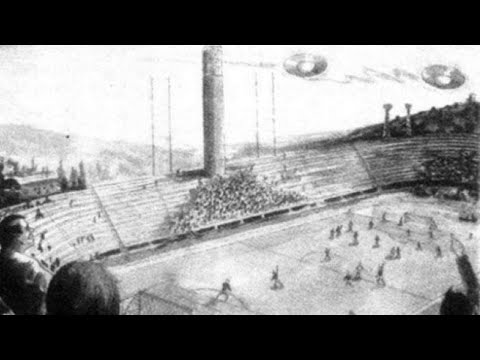
Fiorentina-Pistoiese del 1954: la partita interrotta perché 10.000 persone videro gli UFO
A historical-culture retelling of the match and the sighting from Vanilla Magazine, an established Italian digital history publication.
27 Ottobre 1954, Avvistamento UFO sullo Stadio Franchi
A regional broadcast news retrospective on the 1954 sighting from ToscanaTV, produced for its anniversary.
Sources
- "Avvistamento di UFO a Firenze," Wikipedia (Italian). it.wikipedia.org
- "Ondata di avvistamenti dell'autunno 1954," Wikipedia (Italian) — context on the broader European wave. it.wikipedia.org
- "Bambagia silicea," Wikipedia (Italian) — general context on the "angel hair" phenomenon type. it.wikipedia.org
- Gassi, Vincenzo. "1954, UFO e bambagia silicea su Firenze: Il CICAP propone la soluzione." CICAP, 2014. cicap.org
- "1954: UFO e bambagia silicea su Firenze." Query Online (CICAP), Nov. 10, 2014. queryonline.it
- "27 ottobre 1954: gli Ufo fermano la Fiorentina." Panorama. panorama.it
- "27 ottobre 1954, Fiorentina-Pistoiese viene sospesa per qualche minuto. Colpa degli UFO." TuttoMercatoWeb. tuttomercatoweb.com
- "Neanche gli ufo fermarono Fiorentina-Pistoiese il 27 ottobre 1954." Viola News. violanews.com
- "The Eye in the Tuscan Sky: The Day a UFO Sighting Stopped a Fiorentina Match." These Football Times, Apr. 21, 2020. thesefootballtimes.co
- "The Bizarre 1954 UFO Sighting In Florence, Italy." Grunge. grunge.com
- "Bambagia silicea o ballooning." Silverland.info. silverland.info
- "Firenze, 1954: UFO su Firenze e bambagia silicea." Reccom.org. reccom.org
- "Door 9: Football, geothermal energy and the 1954 wave of UFOs." Geological Society of London Blog, Dec. 9, 2014. blog.geolsoc.org.uk
- "Soccer Match UAP Sighting Over Tuscany, Italy." Enigma Labs case catalog. enigmalabs.io
- "27 ottobre 1954 Fiorentina - Pistoiese 6-2." Tonyface (Fiorentina historical match-report archive), 2015. tonyface.blogspot.com
- U.S. Naval History and Heritage Command. "Lake Champlain II (CV-39)." Dictionary of American Naval Fighting Ships. history.navy.mil
- "VFA-86," Wikipedia — squadron lineage confirming VF-84's September 1954 deployment aboard USS Lake Champlain. en.wikipedia.org
- "USS Lake Champlain (CV-39)," Wikipedia — ship deployment history. en.wikipedia.org
- "Pinotti Roberto." Ufopedia.it. ufopedia.it
- "Fiorentina in lutto: è morto Ardico Magnini, eroe del primo scudetto." La Nazione. lanazione.it
- "Lutto per il giornalista e scrittore Giorgio Batini." La Nazione, Apr. 7, 2009. lanazione.it
- "Addio Maffei, l'atletica saluta uno dei suoi grandi." Federazione Italiana di Atletica Leggera (FIDAL). fidal.it
- Polidoro, Massimo. "UFO Files #4: UFO su Firenze - La grande ondata del 1954." YouTube video.
See something inaccurate? Have additional information or sources?
Suggest an Edit →Last Updated: August 2026