
The Nuremberg Celestial Phenomenon
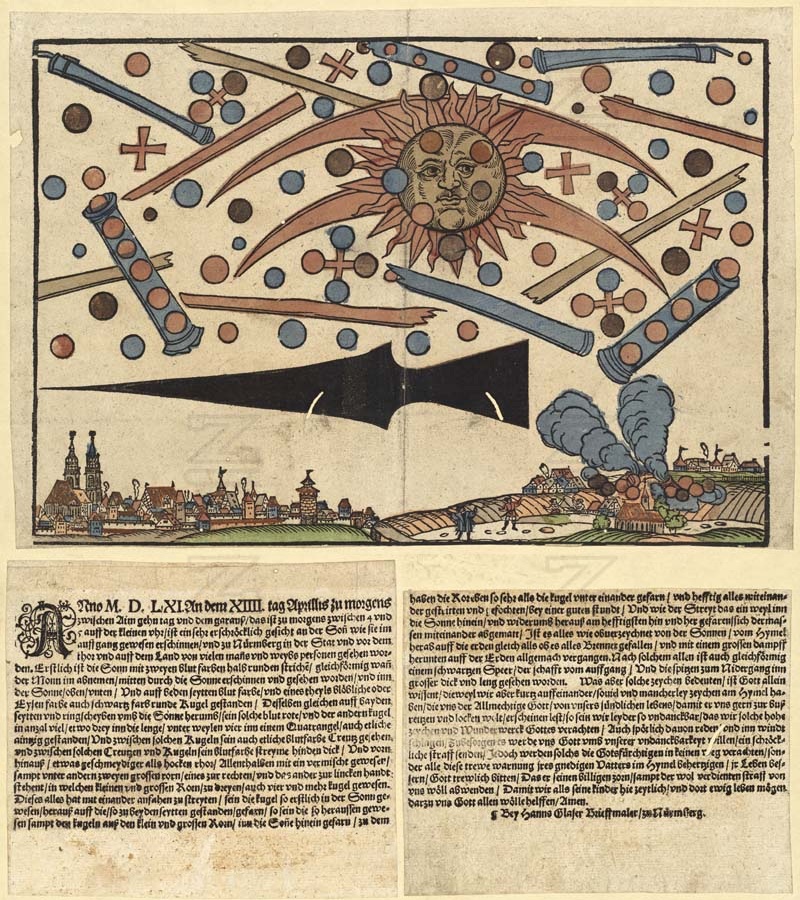
At daybreak on April 14, 1561, the sky above Nuremberg filled with a chaos of globes, crosses, tubes, and colored streaks that seemed, to the many townspeople who watched from the streets, the city gates, and the surrounding countryside, to be locked in open combat. The spectacle lasted more than an hour before the combatants "fell from the sun down upon the earth," and a huge black, spear-like object plunged to the ground outside the city walls. Within weeks, printer Hans Glaser published an illustrated broadsheet describing and depicting the event — a document that survives today in the Wickiana collection of the Zentralbibliothek Zürich and stands as one of the most reproduced and most argued-over primary sources in the entire literature of historical UFO sightings. Four centuries later, psychiatrist Carl Jung revived the case for a modern audience, while atmospheric scientists and art historians built a competing case that the whole affair was a spectacular sundog filtered through the conventions of 16th-century religious tabloid journalism.
Theoretical Alignment
Unlike modern UAP cases, the Nuremberg phenomenon has no radar track, no photograph, and no recovered material — only a single professionally produced news pamphlet. The weight of specialist opinion (art historians, meteorologists, and most ufological skeptics) favors a natural atmospheric display — almost certainly a complex solar halo event — refracted through the religious and commercial conventions of the 16th-century "wonder-sign" broadsheet trade. The Psycho-Social Hypothesis, which reads the report as a collective response to genuine civic trauma (Nuremberg's near-destruction nine years earlier) filtered through Reformation-era apocalyptic anxiety, is treated here as a strongly overlapping companion explanation rather than a rival to the atmospheric reading. The Paleocontact/genuine-anomaly interpretation, championed largely by ancient-astronaut popularizers rather than the case's original modern discoverer (Jung, who explicitly did not endorse a literal extraterrestrial reading), is rated speculative.
Sensor & Instrumentation Detection Profile
There is no instrumentation record of any kind. The entire "sensor" for this event was the unaided human eye, multiplied across an unspecified but apparently large number of residents of a free imperial city of roughly 40,000–45,000 people, and then filtered a second time through the hand of a single print-shop proprietor who was not himself a trained observer of celestial phenomena. No mechanical clock precision beyond "between 4 and 5 on the small clock" survives; no compass bearing, no altitude estimate in any modern sense, and no corroborating civic or ecclesiastical record (city council minutes, sermon logs, or a rival pamphlet) has ever been located. This absence of any independent second written source is one of the central weaknesses repeatedly raised by modern researchers, including the case-skeptical Medium essay by "Hereditarius" and the broader analysis catalogued by Wikipedia's editors.
Environmental & Geospatial Context
Nuremberg sits at approximately 49.45°N, 11.08°E, in the Franconia region of modern Bavaria, Germany. April 14 in that latitude places sunrise at a low elevation angle in the eastern sky at the reported 4–5 a.m. hour — precisely the geometry under which sundogs (parhelia), circumhorizontal arcs, sun pillars, and full 22-degree halos are most likely to appear together, since these effects depend on sunlight refracting through horizontally oriented, plate-shaped hexagonal ice crystals in high cirrus cloud, an effect strongest when the sun sits near the horizon. Cool, clear pre-dawn spring air over central Europe is a favorable, unremarkable setting for such ice-crystal optics. No solar or lunar eclipse, comet apparition, or other independently documented astronomical event is associated with April 14, 1561, in the surviving record — a point of contrast with the comparable 1566 Basel broadsheet, whose reported phenomena coincided with an actual, verifiable total lunar eclipse. No meteorological instrument readings exist for the date, as instrumented weather observation did not yet exist.
Observer Credibility & Occupational Profile
Every named party in this case is a print-trade professional rather than a disinterested official witness. Hans Glaser, the broadsheet's publisher, held the formal Nuremberg trade designation of Brieffmaler — literally "letter-painter," the guild title for an artisan who hand-colored printed woodcuts — and is documented in the city's own trade records from 1538. By 1561 he had already produced at least two earlier "miracle sign" broadsheets (a 1554 apparition over Waldeck Castle and a 1554 sky spectacle over Plech), meaning the Nuremberg sheet was not an isolated act of civic duty but the third entry in an established commercial specialty. No source claims Glaser personally witnessed the event; multiple analysts, including the German Wikipedia article on the broadsheet and independent researcher Ulrich Magin, conclude he compiled the account from secondhand testimony gathered after the fact. The "many men and women" of the text are entirely anonymous and occupationally undifferentiated — no named burgher, cleric, city councilor, or university scholar is on record. This stands in sharp contrast to modern instrumented cases, or even to Roswell's chain of named military officers, and is the central reason the case cannot rise above a "disputed" rating regardless of which physical explanation is favored.
Historical Precedents & Archive Matches
The Nuremberg sheet was not produced in a vacuum. It belongs to a well-documented German and Swiss print genre of Wunderzeichen ("wonder-sign") literature, and it has close relatives inside the same archive that preserved it. Glaser himself had already published two comparable sky-apparition broadsheets in 1554. Five years after Nuremberg, in 1566, Basel printers Samuel Apiarius and Samuel Coccius produced a strikingly similar broadsheet describing black and fiery spheres "fighting" before the sun — discussed in full in the Comparative Analysis section below. Further back, the 1535 Stockholm sky display later commemorated in the Vädersolstavlan panel painting provides a rare case of an accurately observed and painted sundog display from the same broad historical period, offering a useful visual control against which to measure the stylization of Glaser's woodcut. All of these documents, plus hundreds of others recording comets, monstrous births, and celestial signs, were gathered by Zurich pastor Johann Jakob Wick into the 24-volume Wickiana archive between 1559 and 1588 — effectively the first systematic archive of "unexplained aerial phenomena" reporting in European history, two centuries before the term existed.
Historical Background
In 1561, Nuremberg was one of the most important cities in the Holy Roman Empire: a Free Imperial City answering directly to the Emperor rather than to any regional prince, a frequent host of the Imperial Diet, and by long-standing reputation an "unofficial capital" of the Empire. The city had formally adopted the Protestant Reformation in 1525, and the Nuremberg Religious Peace signed within its walls in 1532 had held off outright war between Lutherans and Catholics for over a decade. It was also, since 1470, one of the birthplaces of the European printing industry — Anton Koberger had opened Europe's first dedicated print shop there, and by the mid-16th century Nuremberg's presses were a major node in the continent-wide production of illustrated news.
The city's recent history was not tranquil. In 1552, during the so-called Second Margrave War, the mercenary forces of Margrave Albert Alcibiades of Brandenburg-Kulmbach devastated the countryside around Nuremberg and inflicted serious damage and expense on the city itself, which paid enormous sums in ransom, indemnity, and rebuilding costs over the following decade. Psychiatrist and historian Otto Billig, writing in the 20th century, would later argue that this trauma — unresolved civic anxiety, war debt, and heavy taxation still being felt nine years on — forms an important psychological backdrop to how the 1561 apparition was perceived and reported, an argument that anticipates the modern Psycho-Social Hypothesis by decades.
Print culture of the period had a specific, recognizable genre for events like this: the Wunderzeichen or "wonder-sign" broadsheet, part of the wider category of single-sheet news prints known as Einblattdrucke. These combined a woodcut image with a letterpress-printed account, were produced quickly and cheaply after a notable event, sold on the street or at fairs, and were explicitly understood by contemporaries to be moralizing and admonitory as much as descriptive — unusual astronomical events, monstrous births, comets, and floods were near-universally framed as divine warnings calling the population to repentance. This was, in the most literal sense, an early mass medium: sensational, commercially motivated, religiously inflected, and produced by tradesmen who specialized in exactly this kind of content. Understanding the Nuremberg broadsheet requires reading it simultaneously as a possible eyewitness record and as a commercial product of that genre.
Printing in a Free Imperial City like Nuremberg was not an unregulated free-for-all. Print shops operated under civic oversight, and researchers who have traced Glaser's career note that he was not immune to that oversight — the Amusing Planet historical blog specifically records that city authorities had previously issued warnings to Glaser over unauthorized reproductions and exaggerated content in his broadsheets, meaning his output was neither invisible to nor unquestioned by Nuremberg's own civic government. That the "dreadful apparition" broadsheet nonetheless reached print and circulated freely suggests either that the council saw no reason to suppress it, or simply that a fast-moving news pamphlet of this kind could outrun any review process built for a slower-moving print culture. Either reading is consistent with the broadsheet functioning as commercial news product first and official record a distant second.
The survival of the sheet at all is due to a second, separate act of professional specialization: Zurich minister Johann Jakob Wick's decades-long project of building the Wickiana. Wick did not merely file broadsheets that happened to cross his desk; contemporary accounts of his method describe him actively soliciting reports, letters, and printed sheets from a network of correspondents scattered across German-speaking Europe, systematically assembling what art historians and librarians today recognize as one of the first purpose-built news archives in European history. Without that second layer of professional specialization — a Zurich pastor's private hobby of archiving exactly this kind of ephemeral street literature — the Nuremberg sheet, printed on cheap paper and designed to be discarded after its news value expired, would have essentially zero chance of surviving to the present day. Only a small fraction of the broadsheets printed and sold in 16th-century German cities are known to survive in any copy; the Wickiana is disproportionately responsible for the survival rate of exactly this "wonder-sign" sub-genre.
Complete Timeline
| Date | Event |
|---|---|
| 1538 | Hans Glaser is first recorded in Nuremberg's city trade books as a Brieffmaler ("letter-painter") — a woodcut hand-colorist, block-cutter, and print publisher. |
| 1552 | The Second Margrave War brings mercenary devastation to the countryside around Nuremberg; the city itself is threatened and pays crippling indemnities in the years that follow. |
| 1554 | Glaser publishes two earlier "miracle sign" broadsheets — one describing an apparition over Waldeck Castle, another a sky spectacle over Plech — establishing his personal specialty in celestial-omen reporting seven years before Nuremberg. |
| April 14, 1561 (c. 4:00–5:00 AM) | At daybreak, "a dreadful apparition" is first reported on and around the rising sun: blood-red, semicircular arcs, followed by numerous globes described as dull red, blue-black, or fiery, plus two large crescents. |
| April 14, 1561 (shortly after) | Additional forms appear: several crosses, wide tubes or cylinders "from which three, four, and more globes emerged," rod-like objects, and long blood-colored streaks and bands, all moving erratically against and around the sun. |
| April 14, 1561 (over >1 hour) | The objects appear to the crowd to be fighting one another. The broadsheet states the combat continued "for over an hour," visible "in the city, before the gates, and in the country" — a citywide, not localized, sighting. |
| April 14, 1561 (culmination) | The combatants grow "fatigued" and fall from the sun down toward the earth "as if they all burned," dissolving on the ground amid "immense smoke." A separate, especially large black object, described as spear- or rod-shaped, falls to earth outside the city walls. |
| April 1561 | Glaser publishes the broadsheet from his print shop near the parish church of St. Lorenz, combining a hand-tinted woodcut with a letterpress account closing with the line "only God knows what such signs mean." |
| 1561–1588 | A surviving copy is acquired by Zurich minister Johann Jakob Wick and bound into his 24-volume compilation of contemporary "wondrous and horrifying" broadsheets, later known as the Wickiana. |
| 1566 | A closely comparable broadsheet is printed in Basel, Switzerland, describing black and fiery spheres in battle formation before the sun; it too is later preserved in the Wickiana. |
| 1588 | Johann Jakob Wick dies; his archive eventually passes into the holdings of what is today the Zentralbibliothek Zürich. |
| 1573 | Hans Glaser dies in Nuremberg; his widow remarries former apprentice Wolf Drechsel, who continues operating the workshop using Glaser's original printing blocks. |
| 1958 | Psychiatrist Carl Jung reproduces the Glaser woodcut and discusses the case in Flying Saucers: A Modern Myth of Things Seen in the Skies, introducing it to a modern, international, English-reading audience for the first time. |
| 1976 | Ufologist Colman S. Von Keviczky publishes an English translation of the broadsheet text by Ilse von Jacobi in Official UFO magazine — the rendering most widely quoted in later ufological literature. |
| 1999 | Physicist and historian of science Stanley L. Jaki discusses the Nuremberg broadsheet in God and the Sun at Fátima, situating it within a longer history of religiously interpreted solar phenomena. |
| 2010 | Jacques Vallée and Chris Aubeck catalog the Nuremberg case within Wonders in the Sky, their systematic compendium of pre-modern aerial phenomena reports. |
| 2012 | Skeptical researcher Frank Johnson (writing for Ancient Aliens Debunked) and blogger/researcher Jason Colavito independently publish detailed sundog/halo-based rebuttals of the extraterrestrial reading. |
| Present day | The original broadsheet is held under shelfmark PAS II 12/60 in the Graphische Sammlung (Prints and Drawings Collection) of the Zentralbibliothek Zürich, and has been fully digitized and made freely available via the library's e-manuscripta platform. |
The Primary Source Document
The document at the center of this case is a single-leaf broadsheet (Einblattdruck) measuring 26.2 by 38.0 centimeters, combining a hand-colored woodcut image above a block of letterpress text below. It was printed and published "bey Hanns Glaser Brieffmaler" ("by Hans Glaser, letter-painter") in Nuremberg in April 1561. The surviving copy was removed at some point from Johann Jakob Wick's bound manuscript compilation (catalogued today as part of Ms. F 24) and is now held as a separate sheet under shelfmark PAS II 12/60 in the Graphische Sammlung und Fotoarchiv (Prints, Drawings and Photography Collection) of the Zentralbibliothek Zürich. It has been digitized in full color and is publicly viewable, without charge, through the library's e-manuscripta.ch platform under a Public Domain Mark.
The woodcut depicts the walled skyline of Nuremberg beneath a chaotic sky: multiple spheres and half-spheres in red, black, and blue-grey tones; two large crescents; several plain crosses; long tube- or cylinder-shaped objects that appear to be releasing smaller spheres; rod-like forms; and, dominating the lower half of the composition, a single large black object, elongated and pointed like a spear or lance, falling toward the ground outside the city walls. Armed horsemen and cannon are visible in the clouds in some details of the composition — a detail Ulrich Magin has pointed to as evidence that Glaser was reusing stock battle-scene visual vocabulary rather than depicting a literal, freshly observed event.
The Text, In Translation
The most widely circulated English translation of the broadsheet's letterpress text derives from a rendering by Ilse von Jacobi, published by ufologist Colman S. Von Keviczky in Official UFO magazine in 1976, and subsequently requoted across the ufological and skeptical literature alike, including by the Wikipedia editors who assembled the modern English-language article on the case. The opening lines read:
"In the morning of April 14, 1561, at daybreak, between 4 and 5 on the small clock, a dreadful apparition occurred on the sun, and then this was seen in Nuremberg in the city, before the gates and in the country — by many men and women."
The text goes on to describe blood-red semicircular arcs near the sun, and then "within these arcs" numerous blood-colored spheres, plus others that were "blue or black," roughly three in number, appearing "on all sides," alongside two large crescents, "one at the upper right, and one on the lower left," and several crosses "the color of blood," among cylindrical objects "resembling large cannon barrels" from which smaller spheres emerged. The climax of the account, again per the same widely reproduced translation, states:
"These all started to fight among themselves… for over an hour. And when the conflict… was most intense, they became fatigued to such an extent that they all… fell from the sun down upon the earth 'as if they all burned' and they then wasted away on the earth with immense smoke."
The German original closes the account not with a claim of certainty but with an explicit admission of interpretive humility, rendered in the period's Early New High German orthography as (per the German Wikipedia's reproduction of the primary text): "was aber solche zeychen bedeuten/ ist Gott allein wissent" — "but what such signs mean, only God alone knows." The broadsheet's own conclusion, in other words, was not a confident ufological or even fully confident theological claim; it was an appeal to divine mystery, framed as a call to repentance rather than a scientific report.
Witnesses and the Chain of Testimony
Hans Glaser (Hans Wolff Glaser, c. 1500–1573)
The sole named individual connected to the case, and the only person whose account we actually possess. Documented in Nuremberg's own trade records from 1538, Glaser operated a print workshop first in the Schmelzhütten district and, from 1553, near the parish church of St. Lorenz. He is not known to have claimed personal eyewitness status; researchers including Ulrich Magin conclude the broadsheet was compiled from testimony gathered after the fact. By 1561 he had already published at least two prior "miracle sign" broadsheets (Waldeck Castle and Plech, both 1554), making the Nuremberg sheet the third entry in an established commercial line of work rather than an isolated act of reporting. He continued producing broadsheets until shortly before his 1573 death, after which his widow's second husband, former apprentice Wolf Drechsel, continued the workshop using Glaser's original printing blocks.
The Citizens of Nuremberg
The broadsheet attributes the sighting to "many men and women," seen simultaneously "in the city, before the gates and in the country" — language implying a genuinely citywide event rather than an isolated observation by one or two individuals. No individual witness is named, occupationally identified, or independently interviewed in any surviving record. No city council minute, sermon, private diary, or second pamphlet corroborating the sighting has ever been located, making this the single largest evidentiary gap in the case: everything traces back to one commercial print product.
Johann Jakob Wick (1522–1588)
Not a witness to the Nuremberg event itself, but the individual single-handedly responsible for its survival. A Reformed minister at Zurich's Grossmünster church, Wick spent nearly three decades (1559–1588) systematically collecting broadsheets, letters, and illustrations documenting "allerlei Wundersames und Schreckliches" ("all manner of wondrous and horrifying things") from across German-speaking Europe, binding them into 24 folio volumes. The Glaser broadsheet was preserved as part of this project; without Wick's archival instinct, the Nuremberg sheet would very likely not exist in any known copy today. The Wickiana as a whole is now recognized by historians as one of the earliest systematic archives of unusual-phenomena reporting in European history.
The Paleocontact / Ancient-UFO Interpretation
The Nuremberg broadsheet's modern fame rests almost entirely on one man: Carl Jung. The Swiss psychiatrist reproduced Glaser's woodcut and discussed the case at length in his 1958 book Flying Saucers: A Modern Myth of Things Seen in the Skies, and it was this book — not any ufological source — that pulled the four-century-old pamphlet out of specialist German antiquarian and print-history circles and into the international UFO literature, where it has remained a fixture ever since, frequently cited as one of the oldest and most detailed "historical UFO reports" on record.
It is important to be precise about what Jung actually argued, because his position is regularly overstated in both directions. Jung did treat the Nuremberg sighting as a genuine historical report worth serious analysis — a real precursor data point in the long history of sky-phenomena testimony, not a fabrication to be dismissed out of hand. But he explicitly did not conclude that literal extraterrestrial spacecraft had fought over the city. His interest was archetypal and psychological: he read the paired, often four-fold groupings of globes and crosses as expressions of mandala symbolism and what he called "crossed marriage quaternities," and he proposed that if the objects were imagined as living things at all, "one would think of a swarm of insects rising with the sun, not to fight one another but to mate and celebrate the marriage flight" — a strikingly gentle reading of an event the broadsheet itself frames as violent combat and divine warning. For Jung, the case was primary evidence not of alien visitation but of how a natural or ambiguous stimulus gets involuntarily reorganized by the human mind into the symbolic vocabulary — here, military and religious — that a given culture already has on hand.
Jason Colavito, among others, has pointed out the resulting irony: Jung introduced the case specifically to argue against a literal ET interpretation, treating flying saucers as a "modern myth" in the Jungian technical sense of an unconscious psychological phenomenon, yet later ancient-astronaut and paleocontact writers have routinely stripped that framing away and repurposed his reproduction of the woodcut as if it were expert testimony for the reality of the craft depicted. Colman S. Von Keviczky's 1976 Official UFO magazine article, and the English translation commissioned for it, pushed the case much further in a literal direction than Jung ever had, treating the broadsheet as a plausible eyewitness combat report between distinct types of aerial vehicles. This more literal reading is the version that has propagated most widely through paleocontact-oriented websites and video content in the decades since, generally without Jung's own psychological caveats attached. Jacques Vallée and Chris Aubeck's 2010 catalog Wonders in the Sky includes the Nuremberg case within a deliberately broad, non-committal compendium of historical anomaly reports spanning antiquity to the 19th century, treating it as a data point worth preserving and comparing rather than adjudicating outright — a more cautious posture than either the strict paleocontact or strict-skeptic camps.
The Mainstream Meteorological & Art-Historical Interpretation
The leading conventional explanation is atmospheric: a complex solar halo display, likely combining parhelia (sundogs), a circumhorizontal or circumzenithal arc, and possibly a sun pillar, all of which can occur simultaneously under the right combination of low sun angle and high-altitude cirrus ice crystal cloud — conditions well satisfied by an April dawn over central Europe. Multiple independent skeptical analyses converge on this reading, including researcher Frank Johnson's widely cited 2012 article for Ancient Aliens Debunked and a separate, independently argued analysis on the blog Histories, Mysteries, and Strangeness, both of which propose that the "falling" objects and smoke correspond to ice-crystal fallstreaks (virga-like trails sometimes called "punch-hole" clouds), rather than literal falling craft.
The sundog reading is not without friction, and honest treatment of the case requires stating that friction plainly. As the Wikipedia article on the case notes, the woodcut "does not fit the usual classic description of the phenomenon" — sundogs are typically compact, symmetrical bright patches roughly 22 degrees to either side of the sun, not the sprawling, multi-object battle scene Glaser depicted. This is precisely where the art-historical half of the skeptical case becomes essential. Historian Ulrich Magin, in his detailed critical analysis, and art historian Wiebke Schwarte, in her study Nordlichter, both argue that Glaser's broadsheet should be read primarily as "popular religiously-themed reading material, more akin to tabloids than to a truthful record of the event." Schwarte characterizes such sheets as instruments of ecclesiastical and civic messaging as much as documentation. Magin further points to apparent chronological and iconographic inconsistencies in the woodcut's depiction of Nuremberg's own skyline — details that would have been anachronistic or simply wrong for the city as it actually looked in 1561 — as evidence that Glaser assembled a stock, formulaic "celestial battle" composition around secondhand testimony rather than sketching what he or any single named observer had personally seen.
A useful visual control exists in the 1535 Stockholm sky display commemorated by the Vädersolstavlan panel painting, the oldest known depiction of sundogs in European art, which renders a halo display with comparatively restrained, geometrically plausible arcs and mock suns against an accurate contemporary city skyline. Set beside the Nuremberg woodcut's crosses, cannon-barrel tubes, mounted horsemen in the clouds, and a giant falling black spear, the contrast supports the art-historical argument: Glaser's sheet reads as a deliberately dramatized, genre-conforming composition rather than a restrained technical rendering of an optical phenomenon.
Independent Nuremberg researcher and Medium essayist "Hereditarius" adds a economic dimension often missing from purely optical debunkings: by 1561, Glaser had "already built something close to a specialist trade" in exactly this kind of broadsheet, having profited from at least two comparable "miracle sign" sheets in 1554 alone. The Amusing Planet historical blog independently reports that Glaser had a documented local reputation for "printing sensational stories" and had previously drawn warnings from city authorities over unauthorized reproductions and exaggerated content — a genuine, if secondhand, credibility flag against treating the broadsheet as disinterested reportage. Jacques Vallée, in the German Wikipedia's summary of his position, contributes a final, structural critique: pre-modern "heaven battle" reports across multiple centuries and regions tend to reuse nearly identical vocabulary — spheres, crosses, cylinders, combat — suggesting a formulaic literary tradition for describing ambiguous sky events rather than a series of independently verified encounters with a consistent physical phenomenon.
Five Observables Assessment
The Five Observables framework, developed decades later by former AATIP director Luis Elizondo to classify modern UAP performance characteristics that exceed known technology, is included here for structural consistency with the rest of The Omni Ledger's case files, but it does not meaningfully apply to a pre-instrumentation, text-and-woodcut source. Every category below is necessarily assessed as not applicable or, at most, weakly speculative, based solely on the broadsheet's own narrative description rather than any measured performance data.
Assessment: Four of the five categories cannot be assessed at all from a text-and-woodcut source with no distance, speed, or altitude data; they are marked N/A rather than "absent" in the sense of having been ruled out. Only "Low Observability" receives even a speculative mark, and only because the broadsheet describes objects appearing and vanishing rather than following any continuously tracked flight path — a description equally consistent with a shifting, evolving halo display as with any exotic craft. The Five Observables framework, designed around modern FLIR and radar data, is simply the wrong tool for a document of this kind, and its inclusion here should not be read as suggesting genuine performance evidence exists.
Comparative Analysis
The 1566 Basel Celestial Phenomenon
The closest documented parallel is the celestial phenomenon reported over Basel, Switzerland, in the summer of 1566. Between July 27 and August 7 of that year, Basel residents reported an unusually colored sunset turning "vermilion," a genuine total lunar eclipse with a red-rising sun the following morning, and then, on August 7, "large black spheres coming and going with great speed and precision before the sun," described as fighting one another before crumbling and extinguishing. Basel printers Samuel Apiarius and Samuel Coccius produced an illustrated broadsheet (18.2 by 23.8 cm) depicting the event, which — like the Nuremberg sheet — was compiled from secondhand accounts rather than direct authorial witness, and which was likewise eventually absorbed into Johann Jakob Wick's Wickiana archive. The Swiss National Museum's own historical blog explicitly notes "striking similarities" between the two broadsheets, both of which employ "militaristic symbolism" and frame ambiguous sky events through the lens of political and religious conflict — in Basel's case, explicitly tied to contemporary fear of Ottoman military advances. Crucially, the Basel event is anchored to a verifiable astronomical event (the lunar eclipse), which strengthens the case that period observers were prone to weaving a real astronomical trigger together with embellished, formulaic "battle" imagery — exactly the process skeptics propose occurred, independently, five years earlier at Nuremberg.
The Vädersolstavlan (Stockholm, 1535)
A quarter-century before Nuremberg, Stockholm experienced a halo display, on April 20, 1535, that was memorialized in a panel painting traditionally attributed to "Urban the Painter" and known today through a 1636 copy as the Vädersolstavlan ("Sun Dog Painting") — the oldest surviving depiction of sundogs in European art and the oldest color depiction of Stockholm. Commissioned by Swedish reformer Olaus Petri during the religiously and politically turbulent early years of the Swedish Reformation, the painting renders a genuinely halo-like, geometrically plausible arrangement of mock suns against an accurate contemporary cityscape. Its comparative restraint against Nuremberg's chaotic battle scene is one of the strongest single pieces of visual evidence in the skeptical case: it shows that period artists were entirely capable of rendering a sundog display accurately when working from or close to direct observation, which throws Glaser's far more elaborate and militarized composition into sharper relief as a probable dramatization.
Wider Wickiana "Wonder-Sign" Patterns and Other Documented Sky-Battle Reports
Beyond Basel and Stockholm, the Wickiana corpus as a whole documents dozens of comparable 16th-century reports of comets, parhelia, monstrous births, and other prodigies interpreted as divine warnings, indicating that Nuremberg 1561 sits inside a broad, well-established genre rather than standing as a singular, anomalous data point. The Omni Ledger's own Ancient Mysteries hub separately documents two other pre-modern "celestial battle" reports worth comparing on structural grounds: the Sigiburg Castle apparition of c. 776 CE, in which medieval Frankish chroniclers described two flaming shields maneuvering over a besieging Saxon army, and the reports of flying shields said to have startled Alexander the Great's forces during the Siege of Tyre in the 4th century BCE. All three cases share a recurring vocabulary — shields, spheres, crosses, combat — that Jacques Vallée has argued points toward a persistent literary and testimonial convention for describing frightening, ambiguous sky phenomena across very different eras and cultures, rather than a consistent underlying physical phenomenon recurring by coincidence.
Material Analysis
There is no physical trace evidence associated with this case in the sense familiar from modern UAP investigations — no metal, no soil anomaly, no recovered fragment of the broadsheet's own "large black object" that reportedly fell outside the city walls. The entire physical evidentiary record is the paper artifact itself: a single hand-colored woodcut-and-letterpress sheet, printed on period rag paper, 26.2 by 38.0 centimeters, produced using the two dominant reproduction technologies of 1561 Nuremberg — relief woodblock printing for the image and movable-type letterpress for the text — and finished with hand-applied color, consistent with Hans Glaser's own guild designation as a Brieffmaler, a specialist colorist of printed sheets. This combination of image and hand-tinting was standard commercial practice for high-value news broadsheets of the period and is not, by itself, evidence of anything unusual about this particular sheet's contents.
Supporting the Document's Reliability
- The broadsheet survives as an original period artifact, not a later copy or forgery, with continuous, traceable provenance through the Wickiana collection to the present-day Zentralbibliothek Zürich
- Its language claims a specific, citywide, multi-witness event ("many men and women," "in the city, before the gates and in the country") rather than a single individual's report
- Its date and basic details are internally consistent across the original German text and every major modern translation
- It fits a well-attested and independently verifiable genre (Wunderzeichen broadsheets) known to have circulated widely and been taken seriously by contemporaries
Undermining the Document's Reliability as an Eyewitness Record
- No named individual eyewitness, and no corroborating civic, ecclesiastical, or rival-press source has ever been located
- The publisher, Hans Glaser, is not established as a personal eyewitness and had an existing, documented commercial specialty in exactly this genre
- The woodcut includes iconographic elements (armed horsemen, cannon-like tubes) that read as stock battle-scene imagery rather than an attempt at documentary precision
- Ulrich Magin identifies apparent anachronisms in the depicted Nuremberg skyline inconsistent with the city's actual 1561 appearance
- Glaser had a documented local reputation for sensationalism and had previously received warnings from city authorities over exaggerated or unauthorized print content
Confirmed Archival Holdings
The full-color digitization of the original Hans Glaser broadsheet, shelfmark PAS II 12/60, held in the library's Graphische Sammlung (Prints and Drawings Collection).
PUBLIC DOMAIN (freely accessible)Institutional description of Johann Jakob Wick's 24-volume archive of 16th-century "wonder-sign" broadsheets, of which the Nuremberg sheet is one part.
PUBLICLY ACCESSIBLE ARCHIVEPublic-domain, full-resolution scan of the broadsheet woodcut, sourced from the Zentralbibliothek Zürich, with file-level provenance and licensing metadata.
PUBLIC DOMAINSearch Primary Archives Directly
Evidence Assessment
Supporting a Genuine Anomalous Phenomenon
- A real, dated, provenanced period document exists, describing a specific, citywide, multi-witness event rather than a private vision or dream
- The language explicitly claims observation "by many men and women" across the city, gates, and countryside — a large, distributed, simultaneous sighting rather than an isolated report
- Carl Jung, a serious 20th-century scholar with no ufological agenda, judged the case worth sustained analysis as a genuine historical sky-phenomenon report
- The skeptical "classic sundog" explanation is itself imperfect: the Wikipedia article on the case notes the woodcut "does not fit the usual classic description of the phenomenon"
- Jacques Vallée and Chris Aubeck, both cautious, non-sensationalist researchers, judged the case substantial enough to include in their systematic historical catalog
Supporting a Natural / Documentary Explanation
- No named eyewitness, and no corroborating civic, ecclesiastical, or competing press account has ever been found — the entire case rests on one commercial publisher
- Hans Glaser had an established, pre-existing, and lucrative specialty in "miracle sign" broadsheets, with at least two prior productions of the same genre in 1554
- Dawn, low sun angle, and central European spring cirrus cloud are precisely the conditions under which complex, multi-form sundog and halo displays occur
- Art historian Wiebke Schwarte and researcher Ulrich Magin both argue the woodcut's iconography (stock battle imagery, possible skyline anachronisms) reflects genre convention rather than direct observation
- Carl Jung himself, the case's own modern discoverer, explicitly framed it as psychological myth-making rather than a literal extraterrestrial encounter
- The closely comparable 1566 Basel broadsheet demonstrates the same publishing culture independently converting a verified natural event (a real lunar eclipse) into near-identical "battle in the sky" imagery
Conventional Explanation Candidates
Because this is a pre-instrumentation documentary case rather than a physical-evidence case, its Conventional Explanation Candidates (CEC) evaluate the reported phenomenon and the reporting process together. Four candidates are assessed below, each with an explicit plausibility rating.
1. Complex Solar Halo Display (Sundog / Parhelia / Circumhorizontal Arc)
The dominant scientific explanation. Sundogs form when sunlight refracts through horizontally oriented, plate-shaped hexagonal ice crystals in high cirrus cloud, producing bright patches roughly 22 degrees on either side of the sun; under favorable conditions these can combine with circumhorizontal arcs, sun pillars, and full 22-degree halos into an elaborate, multi-part display, particularly at low solar elevation angles such as dawn. April, at Nuremberg's latitude, at 4–5 a.m., is a well-matched setting for exactly this kind of display. The 1535 Stockholm Vädersolstavlan proves period observers could and did witness genuine, complex halo events. This candidate explains the basic stimulus — something bright, strange, and multi-part appearing around the sun — extremely well, even though it does not, on its own, fully explain the woodcut's specific battle iconography.
Plausibility Rating: LIKELY (as the underlying physical stimulus)
2. Meteor Procession or Fireball Fragmentation
A secondary, supplementary candidate specifically for the account's single most dramatic detail — the large black, spear-shaped object that falls to earth outside the city amid "immense smoke." A bright daytime fireball breaking into fragments during atmospheric entry, or a meteor procession, could independently account for a falling, smoking, elongated dark object distinct from the halo phenomenon described earlier in the same account — though no crater, fragment, or meteorite has ever been recovered or claimed, and no astronomical record independently corroborates a fireball on this date.
Plausibility Rating: POSSIBLE (unverified, no physical corroboration)
3. Wunderzeichen Genre Convention & Commercial Sensationalism
This candidate does not explain the sky phenomenon itself so much as it explains the document: Hans Glaser's established, profitable specialty in "miracle sign" broadsheets, his apparent absence as a personal eyewitness, his prior 1554 productions in the identical genre, his documented local reputation for exaggeration, and the formulaic battle-scene iconography identified by Magin and Schwarte together make a strong case that whatever was actually seen in the sky was substantially dramatized, standardized, and moralized in translation from testimony to woodcut. This is, in effect, the print-history equivalent of a modern tabloid rewrite of a real but far more mundane event.
Plausibility Rating: HIGHLY PLAUSIBLE (best explains the document's form, independent of the underlying stimulus)
4. Genuine Anomalous / Paleocontact Phenomenon
Included for completeness, per this site's standard framework. No positive physical or corroborating documentary evidence supports a literal, non-natural aerial phenomenon over any of the three competing candidates above; the case for it rests almost entirely on the dramatic character of the woodcut itself and on its adoption by paleocontact-oriented popularizers following Jung's 1958 book — a chain of transmission that, as detailed above, systematically dropped Jung's own psychological caveats along the way.
Plausibility Rating: SPECULATIVE / UNVERIFIABLE
Why "Disputed"
The Nuremberg celestial phenomenon receives a DISPUTED rather than "debunked" classification because, while the balance of specialist evidence clearly favors a natural atmospheric trigger reported through a commercially motivated, genre-conforming broadsheet, the case has never been fully and finally closed by direct physical or corroborating documentary proof in either direction. What is not disputed: a real, dated, archivally provenanced 1561 document exists; it describes a specific, citywide, multi-witness sky event; it was compiled and published by a named professional with an established prior specialty in exactly this kind of report; and it went on, four centuries later, to become one of the most frequently reproduced primary sources in the entire literature of historical UFO sightings, chiefly on the strength of Carl Jung's 1958 discussion of it. What remains genuinely open: no second, independent eyewitness or civic record has ever surfaced to corroborate or contest Glaser's account, meaning the "classic sundog" explanation — while well-supported by atmospheric physics and by comparison to the accurately rendered 1535 Stockholm case — cannot be proven with total certainty against a single, non-corroborated, professionally dramatized source. The Omni Ledger classifies the case as Disputed to reflect a real, unresolved evidentiary gap, while noting clearly that the weight of specialist opinion leans decisively toward the natural-phenomenon-plus-Wunderzeichen explanation over any literal paleocontact reading.
Cultural & Scholarly Legacy
Few 16th-century print artifacts have had a stranger afterlife. For roughly four hundred years, Hans Glaser's broadsheet was, at most, a specialist reference point for German antiquarians, print historians, and the handful of scholars working through the Wickiana. Carl Jung's 1958 book changed that permanently: within a generation, the woodcut had become close to inescapable in English-language UFO literature, reproduced in encyclopedias, magazine features, and eventually across the early web as one of the standard "proof" images cited for the antiquity of the UFO phenomenon. Colman S. Von Keviczky's 1976 Official UFO magazine translation cemented a specific English rendering of the text that is still the version quoted, almost word for word, across dozens of blogs, listicle sites, and paranormal-interest publications nearly fifty years later — a striking example of how a single mid-20th-century translation choice can calcify into the presumed "original" wording for a much older document.
The case has also become a fixture of paleocontact-oriented broadcast media, most prominently through repeated coverage on History Channel's Ancient Aliens franchise — a program The Omni Ledger's own editorial standards explicitly treat as an unreliable source for analysis (see this site's video-sourcing policy), precisely because of its track record of presenting speculative paleocontact readings without the caveats, translation provenance, or skeptical counter-evidence assembled here. That contrast is instructive: the same primary document that a psychiatrist used in 1958 to argue against a literal spacecraft reading has, through decades of media recirculation, been steadily stripped of that original argument and reintroduced to new audiences as comparatively uncomplicated evidence of ancient extraterrestrial contact.
On the academic side, the broadsheet continues to serve a legitimate scholarly function entirely apart from ufology: as a primary teaching example within the history of print culture, the study of Wunderzeichen literature, and Reformation-era popular religion. Lorraine Daston and Katharine Park's academic treatment of the broader "wonder" tradition, Jonathan Green's study of prognostication and print, and Wiebke Schwarte's specific analysis of the Nuremberg and related northern-lights broadsheets all treat Glaser's sheet as a valuable data point in the history of media and religious sensibility — a status entirely independent of, and largely unconcerned with, the question of whether extraterrestrial craft were involved. The Zentralbibliothek Zürich's own public-facing exhibitions and digitization work on the Wickiana collection likewise present the sheet in this documentary-historical frame rather than a ufological one, which is the framing this entry follows for its primary classification.
Related Entries
Further Reading — Recommended Literature
Flying Saucers: A Modern Myth of Things Seen in the Skies
The book that made the Nuremberg broadsheet famous. Jung reproduces Glaser's woodcut and reads the case through the lens of archetypal psychology rather than literal extraterrestrial visitation.
Wonders in the Sky: Unexplained Aerial Objects from Antiquity to Modern Times
A systematic, deliberately non-committal catalog of over 500 historical anomaly reports, including the Nuremberg and Basel broadsheets, cross-referenced and sourced from original documents.
Flying Saucers — Magic in the Skies: A Psychohistory
A psychiatrist's extended argument that historical and modern UFO reports, including Nuremberg, function as collective responses to civic trauma and unresolved cultural anxiety.
Wonders and the Order of Nature, 1150–1750
The definitive academic history of European "wonder" literature — monsters, celestial signs, and prodigies — essential context for understanding the Wunderzeichen genre that produced the Nuremberg sheet.
Printing and Prophecy: Prognostication and Media Change, 1450–1550
An academic study of how early German printing shaped popular astrology, prophecy, and omen literature — the commercial and technological world Hans Glaser worked within.
Essential Viewing
16th Century UFOs over Nuremberg?
rewboss — a well-researched, skeptically-minded look at the case from a long-running German-history and culture channel, addressing the sundog explanation directly.
The Battle of Nuremberg, 1561 (Mass UFO Sighting)
Abhijit Chavda — historical-education channel discussion covering the broadsheet, its context, and competing interpretations.
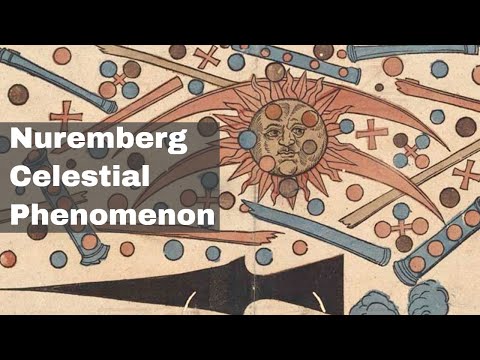
14th April 1561: The Nuremberg Celestial Phenomenon
HistoryPod — a concise "on this day in history" treatment situating the event and broadsheet within its April 1561 date.
Sources
- "1561 celestial phenomenon over Nuremberg." Wikipedia. en.wikipedia.org
- "Nürnberger Flugblatt von 1561." Deutsche Wikipedia (includes original German text and Ulrich Magin/Wiebke Schwarte analysis). de.wikipedia.org
- "Celestial Phenomenon Over Nuremberg, April 14th, 1561." The Public Domain Review. publicdomainreview.org
- Glaser, Hans. "Himmelserscheinung über Nürnberg vom 14. April 1561." Original broadsheet, digitized. Zentralbibliothek Zürich / e-manuscripta. e-manuscripta.ch
- "Mirackel, Zeichen, Schröcklichkeiten — The Wickiana." Zentralbibliothek Zürich. zb.uzh.ch
- "File: Himmelserscheinung über Nürnberg vom 14. April 1561.jpg." Wikimedia Commons. commons.wikimedia.org
- "Category: Wickiana." Wikimedia Commons. commons.wikimedia.org
- "Wickiana." Wikipedia. en.wikipedia.org
- Colavito, Jason. "The UFO Battle over Nuremburg." jasoncolavito.com
- Heiser, Michael S. "UFO Battle Over Nuremberg in 1561?" drmsh.com
- "A UFO Battle over Nuremberg or an Atmospheric Phenomenon?" Histories, Mysteries, and Strangeness. histmyst.blogspot.com
- "The Mysterious Sky Battle Over Nuremberg in 1561." Amusing Planet. amusingplanet.com
- "Celestial Phenomenon Over Nuremberg, April 14th, 1561." Flashbak. flashbak.com
- "10 Things You Should Know About the 1561 Mass UFO Sighting Over the City of Nuremberg." Curiosmos. curiosmos.com
- "UFOs over Nuremberg, 1561." Think Anomalous. thinkanomalous.com
- Hereditarius. "The Sky Show That Never Was: Hans Glaser's Nuremberg Cash Grab." Medium. herentv.medium.com
- "Hans Glaser." Wikipedia. en.wikipedia.org
- "Nuremberg." Wikipedia (Free Imperial City status, Reformation history, printing industry). en.wikipedia.org
- "1566 celestial phenomenon over Basel." Wikipedia. en.wikipedia.org
- "The Celestial Event Over Basel in 1566." Swiss National Museum Blog. blog.nationalmuseum.ch
- "Sun dog." Wikipedia (formation and optics of parhelia). en.wikipedia.org
- "Vädersolstavlan." Wikipedia. en.wikipedia.org
- Jung, C.G. Flying Saucers: A Modern Myth of Things Seen in the Skies. Princeton University Press (Bollingen Series), 1958/1978.
- Vallée, Jacques & Aubeck, Chris. Wonders in the Sky: Unexplained Aerial Objects from Antiquity to Modern Times. Tarcher/Penguin, 2010.
- Billig, Otto. Flying Saucers — Magic in the Skies: A Psychohistory. Schenkman Books, 1982.
- Von Keviczky, Colman S. (trans. Ilse von Jacobi). English translation of the 1561 Nuremberg broadsheet text. Official UFO magazine, 1976 (as reproduced in secondary literature).
- Magin, Ulrich. Ein Ufo im Jahr 1561? (critical analysis, as cited in Deutsche Wikipedia, "Nürnberger Flugblatt von 1561").
- Schwarte, Wiebke. Nordlichter, pp. 88–99 (as cited in Deutsche Wikipedia, "Nürnberger Flugblatt von 1561").
- Jaki, Stanley L. God and the Sun at Fátima. Real View Books, 1999 (situates the Nuremberg case among religiously interpreted solar phenomena).
- "Carl Jung." The Omni Ledger Key Figures. key-figures.html
See something inaccurate? Have additional information or sources?
Suggest an Edit →Last Updated: August 2026