
The Petare Close Encounter
In the early hours of November 29, 1954 (the encounter began the night of November 28), delivery drivers Gustavo González and José Ponce found the street outside a sausage-processing plant in Petare, a suburb of Caracas, Venezuela, blocked by a brilliantly lit sphere hovering just above the pavement, its glow illuminating the roadway "as if it were noon." When González approached, a small, hairy, clawed humanoid moved toward him; he seized it, found it startlingly light yet immovably strong, and was thrown to the ground before a second being blinded him with a beam of light and the creature broke free, leapt back into the object, and watched it climb away in total silence. González was left bruised and scratched along his left side. Within thirty minutes both men reported the encounter to Petare's Transit Police, where officers Manuel Moreno and E. Domínguez recorded that neither man showed any sign of intoxication or mental disturbance, and a same-day medical examination and X-ray documented González's injuries. Within days the story — soon known simply as "the Petare case" across Latin American ufology — became the opening chapter of one of the most intense and least-resolved humanoid waves in the hemisphere's history: a monthlong cluster of strikingly similar "hairy dwarf" reports across Venezuela in December 1954, relayed to American researchers by the Aerial Phenomena Research Organization's Caracas correspondent and later noted in Jacques Vallée's catalog of the era's close encounters. It remains one of ufology's earliest and most vivid accounts of a witness physically grappling with an alleged non-human entity — a distinction that is also the file's central weakness, since the account rests almost entirely on the word of two men whose fantastical description of their attacker has never been corroborated by a photograph, a footprint, or any second identified eyewitness to the being itself.
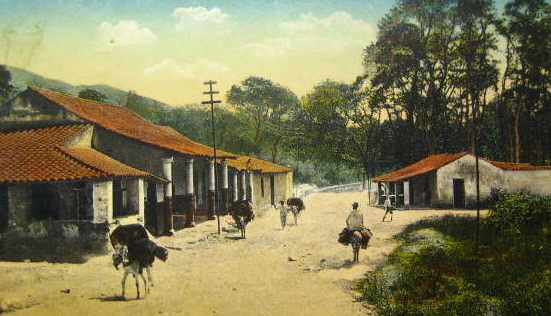
Pictured: the road into Petare, photographed in the early twentieth century, decades before the 1954 case — not a photograph of Buena Vista Street or of the event itself. No photograph of the actual encounter site as it appeared in 1954, of the sphere, or of the entity has ever surfaced; the only known contemporaneous record is the written Transit Police statement and the next-day newspaper account, neither of which was illustrated with photography of the scene.
Theoretical Alignment
Petare is a genuine outlier in this catalogue: a direct-contact case in which a witness claims to have physically held a non-human entity, yet one built on the testimony of only two men with no instrumented data of any kind. That combination pulls the Theoretical Alignment scores in two directions at once. The Extraterrestrial Hypothesis draws a real, if modest, score because a physical-contact account, if taken at face value, is about as strong a form of evidence as the ETH can ask for — there is no ambiguity about whether something was "seen" versus "touched." But that same score is capped well below cases with instrumented or multi-witness corroboration, because nothing beyond González's and Ponce's own words establishes that the entity was anything other than what they believed it to be. The Psycho-Social Hypothesis scores highest of the three, not because the two primary witnesses showed any sign of instability — police records describe them as sober and coherent — but because the case sits at the head of a wave of nearly identical "hairy dwarf" reports that swept Venezuela within weeks, the textbook signature of a shared narrative template amplifying and homogenizing whatever real, ambiguous, and frightening event or events actually occurred in the Caracas suburbs that December. The Interdimensional Hypothesis finds little purchase in a case built around a solid, physically graspable entity and a conventional-seeming craft rather than any transitional or portal-like phenomenon.
Background
By late 1954, Venezuela was in the middle of its own "platillos voladores" (flying saucer) news cycle, part of a global surge of press interest in unidentified aerial objects that had built steadily since Kenneth Arnold's 1947 sighting in the United States. Caracas newspapers, chief among them El Universal, regularly ran wire-service stories on saucer sightings from Europe and North America, priming Venezuelan readers — and, by extension, the country's press editors — to recognize and quickly publish a domestic story if one arrived with the right ingredients: named witnesses, an official police report, and physical injury. Petare itself was a working-class industrial suburb on Caracas's eastern edge, home to food-processing plants that ran overnight shifts and predawn delivery routes to supply the capital's markets before daybreak. Gustavo González, a 25-year-old Cuban-born tradesman who had relocated to Venezuela, and his assistant José Ponce made one such run several mornings a week, driving González's panel van (Distrito Federal plate D.F.4-11382) to the National Sausage Industry's Schefer plant to load pork products for delivery before dawn. Nothing about the night of November 28–29, 1954 was unusual until the two men turned onto the street outside the plant.
Complete Timeline
| Date | Event |
|---|---|
| January 1952 | Jim and Coral Lorenzen found the Aerial Phenomena Research Organization (APRO) in Sturgeon Bay, Wisconsin, later building the international network of national representatives that would carry the Petare case to the United States. |
| November 28, 1954 (evening) | Peasants near Palmarito, Mérida state, reportedly observe a landed globular craft and three small figures — a thinly documented case first published only 15 years later. |
| November 29, 1954, ~2:00–2:30 AM | Gustavo González and José Ponce encounter a hovering luminous sphere and a small, hairy, clawed humanoid on a street in Petare; González grapples with the being before it and at least two others retreat into the object, which departs vertically and silently. |
| ~2:30 AM | Both men report the encounter at the Petare Transit Inspectorate; officers Manuel Moreno and E. Domínguez take statements and note neither man appears intoxicated or disturbed. |
| ~3:00 PM, November 29 | González is examined and X-rayed at a Caracas medical facility; physicians find bruising and muscular distension on his left side, with no fractured rib. |
| November 29, 1954 | El Universal (Caracas) publishes the first newspaper account of the encounter. |
| Late November–early December 1954 | APRO's Caracas-based correspondent, Joseph Rolas, relays a report on the case to APRO's Tucson, Arizona headquarters, where director Coral Lorenzen begins tracking the developing Venezuelan wave. |
| Early December 1954 | José González Waite, a New York-based UFO-society representative, proposes hypnosis and sodium pentothal testing to probe González's memory of the encounter further; González declines. |
| December 16, 1954 | Near San Carlos del Zulia, Jesús Paz is found by friends unconscious beside the road, covered in scratches and bleeding, after stepping into roadside brush alone. |
| December 19, 1954, ~11:00 PM | Eighteen-year-old jockey José Parra, training on foot near Valencia, Carabobo state, reports six small, hairy beings loading rocks into a hovering disc-shaped craft; one paralyzes him with a beam of violet light before the group departs. |
| Late December 1954 | The Venezuelan humanoid wave, by then covering multiple states, begins to taper off in frequency. |
| January 1955 | Reports of the wave slow to a trickle and effectively stop. |
| February 13, 1955 | U.S. newspapers, including at least one Texas daily, carry wire-service coverage of the Petare case months after the original Venezuelan reporting. |
| 1966 | Coral Lorenzen discusses the Venezuelan wave, including Petare, in her book Flying Saucers: The Startling Evidence of the Invasion from Outer Space, introducing the case to a wide English-language readership. |
| 1969 | Jim and Coral Lorenzen publish the first account of the earlier, thinly documented Palmarito case, retroactively situating it as a possible precursor to Petare. |
| December 2013 | Researcher Scott Corrales publishes a full English translation and revisiting of the case on his Inexplicata blog, drawing on a Spanish-language compilation by researcher Carlos Sainz and Planeta UFO's Guillermo D. Giménez. |
| January 2014 | Spanish journalist Pablo Villarrubia Mauso travels to Petare to research the case for the Spanish television program Cuarto Milenio. |
| 2020s | The case continues to be cited in retrospectives on Venezuelan and Latin American ufology, including feature coverage marking its 70th anniversary in Venezuelan and regional press. |
The Light on Buena Vista Street
As González and Ponce turned onto the street fronting the National Sausage Industry's Schefer plant — recorded in most accounts as Buena Vista Street, though at least one detailed catalog renders it "Bella Vista," a discrepancy this file has not been able to resolve from the surviving sources — the darkness ahead of them gave way, without warning, to a brightness witnesses would later compare to broad daylight. The source, once their eyes adjusted, was a spherical object roughly two to four meters in diameter, hovering motionless less than a meter above the pavement and blocking the road outright. Accounts describe it as metallic or intensely luminous, in some versions fitted with what looked like rectangular window-like openings and a small dome, though these structural details come from later, more elaborated retellings rather than the earliest recorded statements, which focus overwhelmingly on the light itself and what emerged from it. Both men stopped the van. What happened next is the part of the story that has never left Latin American ufology's collective memory.
The First Approach
A figure moved toward the stalled vehicle: by every account, startlingly short — roughly one meter, or three feet, tall — covered in stiff, dark hair or bristles over its entire visible body, wearing nothing but a loincloth-like garment, and barefoot. Descriptions converge on a face with no visible nose, ears, or mouth, dominated by two large, glowing eyes variously described as yellowish, cat-like, or simply "brilliant." Its hands, several versions agree, ended in four sharp claws. Ponce, by his own account, reacted first and most decisively: he ran, or began to run, back toward the relative safety of the van, leaving González to face the approaching figure largely alone — a detail that matters for evaluating the case, since it means the single most detailed physical description of the entity comes from one witness under direct, close-range threat, not two independently corroborating observers.
The Struggle
González did not run. Several accounts agree he judged, in the instant available to him, that the small figure posed a manageable threat and moved to seize it — wrapping his arms around the being in an attempt to hold or capture it outright. What followed became the detail that has defined the case ever since: despite its small stature and startlingly light apparent weight (some tellings put it as low as twenty kilograms), the being proved immovably, disproportionately strong, wrenching free of González's grip and, in most versions, throwing him bodily to the ground or several meters away. González, according to the most detailed retellings, then drew a knife — a pocket or boy-scout-style blade — and attempted to stab or slash the creature; the blade, in every version of this detail, failed to penetrate, glancing off the being's body as if it had struck something as hard as steel or, in one comparison, rhinoceros hide. It was at roughly this point, accounts agree, that additional figures entered the scene: at least one, and by some tellings two more, emerged from nearby bushes or brush carrying handfuls of soil, as though gathering samples, before leaping with startling agility — nearly two meters straight up, in some versions — into an opening in the hovering sphere.
Paralysis and Departure
As González continued to grapple with, or stand off against, the original being, a second entity is said to have aimed a tube- or wand-like device at him, emitting a light so intense it left him temporarily blinded, and, in several versions of the account, accompanied by a vibrating or humming sensation some retellings describe as a paralyzing effect. His original antagonist used the moment to break free entirely and leap back into the craft. With all of the beings aboard, the sphere is uniformly described as ascending vertically, rapidly, and in complete silence — no engine noise, no rush of displaced air, no visible exhaust or afterglow — before shrinking from view within seconds. González was left standing, or in some accounts sitting, on the pavement, bruised along his left side and disoriented, with Ponce returning from the van once the danger had visibly passed.
The Report to the Transit Police
What happened next is, in evidentiary terms, the single most important sequence in the entire case. Rather than going home, discussing the story privately, or waiting to see whether anyone would believe them, González and Ponce drove directly to the Petare Transit Inspectorate (Inspectoría General de Tránsito) and reported the encounter at approximately 2:30 AM — within perhaps thirty minutes of the sphere's departure. Officers Manuel Moreno and E. Domínguez took their statements and, according to the surviving record, explicitly noted that neither man showed signs of alcohol intoxication or mental disturbance — an observation made by trained officers with no stake in the outcome, at a time when the men had had no opportunity to rehearse or embellish a story for public consumption. A more senior officer, recorded in various sources as Jesús Antonio Yanes, is said to have characterized the report as "extremely unusual" or simply "unique," reflecting the department's own evident surprise rather than routine skepticism or dismissal. Venezuela's national security apparatus is separately reported to have conducted a search of the area in the encounter's aftermath, though the surviving record of what, if anything, that search found is thin.
The Medical Examination
Later that same day, González sought or was directed to medical attention for the pain along his left side. Physicians examined the area, noted visible bruising and a deep scratch, and ordered an X-ray specifically to rule out a fractured rib. The result, per the surviving account, was negative for a fracture but positive for what was recorded as muscular distension — consistent with a hard fall, a blow, or forceful contact of some kind, though the X-ray and physical exam could not and did not identify what had caused it. This detail deserves to be stated with precision rather than overstated: the medical record corroborates that González sustained a real, physical injury that same night, examined by a professional with no reason to fabricate a diagnosis. It does not, and cannot, corroborate that a humanoid entity caused it, since no instrument in a 1954 Caracas emergency room was capable of distinguishing "struck by an alleged alien being" from any number of mundane physical traumas that produce identical bruising and muscular strain.
Neighbors in the Dark: Corroborating Reports Across Petare
In the days following the encounter, investigators and journalists working the story identified a number of Petare residents who separately reported unusual lights or sounds in the same general area and rough timeframe, though none claimed to have witnessed the entity itself or the physical struggle. Dr. Julio Garcés, associated with the local Hospital Pérez de León, reported hearing a scream or cry of terror from the direction of Buena Vista Street around the time of the incident. Residents including María Antonieta Avellaneda and Manuel María Soria independently described a piercing whistling sound and, in Soria's case, an intense light that briefly flooded the interior of a vehicle he was in. Concepción Garrachán reported having seen a luminous device in the sky earlier the same night, before the direct encounter occurred. Elsa Duderstadt and her family, along with residents of the nearby Los Caobos and Francisco Leal sectors, separately described a bright, sometimes color-changing light passing over or near their homes. None of these reports, taken individually, is strong evidence of anything beyond an unusual light or noise in the area that night; taken together, they establish that something out of the ordinary was genuinely happening across a wider stretch of Petare that same predawn window, independent of whether González and Ponce's specific account of a struggle with a humanoid is accurate in every detail.
El Universal and the Story Spreads
El Universal, one of Caracas's leading daily newspapers, published the first account of the Petare encounter on or around November 29, 1954, drawing directly on the men's police statement and the surrounding neighborhood reports. The story spread quickly through the rest of the Venezuelan press and, within weeks, into the broader Latin American and eventually North American wire services; at least one U.S. newspaper is recorded as carrying a version of the story as late as February 1955, months after the original Venezuelan coverage, reflecting how UFO-flap stories of the era often traveled slowly and secondhand across language and distance before reaching English-language readers. The story's rapid uptake by the Venezuelan press — itself already primed by a steady diet of wire-service saucer stories from abroad — is a detail this file treats as double-edged: it demonstrates the case's newsworthiness and the seriousness with which Venezuelan editors treated a police-documented, medically corroborated report, but it also created exactly the conditions under which a shared, sensational narrative template could spread and shape how subsequent, independent nighttime experiences across the country came to be interpreted and told.
A Proposal Refused: Hypnosis and Sodium Pentothal
As the case's profile grew, it drew international attention from ufology circles beyond Venezuela's borders. José González Waite, identified in period accounts as a representative of a New York-based UFO research society, proposed subjecting González to hypnosis and sodium pentothal ("truth serum") testing in an effort to recover additional detail or verify the consistency of his account under altered mental states — a proposal consistent with investigative techniques used elsewhere in 1950s ufology, though one modern researchers now regard with far more skepticism given decades of subsequent research into the unreliability of hypnotically recovered memory. González declined the proposal. This file treats his refusal as evidentially neutral rather than suspicious: sodium pentothal use for memory verification was already a controversial and physically invasive practice in 1954, and a civilian truck driver's reluctance to submit to it says as much about reasonable personal boundaries as it does about the underlying truth of his account.
The December Wave: San Carlos, Valencia, and Beyond
Petare did not remain an isolated incident. On December 16, 1954, near San Carlos del Zulia in western Venezuela, a young man named Jesús Paz asked friends driving him home to stop so he could step into roadside brush; they found him minutes later lying unconscious, covered in scratches, and bleeding, with no clear account of what had happened to him in the brief interval he was out of sight — a case with far less witnessed detail than Petare, since Paz himself could offer no coherent narrative of an encounter, only its physical aftermath. On the night of December 19, 1954, near Valencia in Carabobo state, an eighteen-year-old jockey named José Parra, out training on foot to make weight, reported coming upon six small, hairy beings loading rocks into a disc-shaped craft hovering less than three meters off the ground; as he tried to flee, one of the beings aimed a device emitting a beam of violet light at him, and he found himself paralyzed until the group finished loading, boarded the craft, and departed. Investigators who later visited Parra's reported location found unidentified footprints they characterized as matching neither known animal nor human tracks — itself a claim resting entirely on the investigators' own unverified assessment rather than any preserved cast or photograph. Taken together with Petare and the thinly documented Palmarito report from the night before Petare's own encounter, these cases form the core of what Venezuelan and international ufology now remembers as the December 1954 Venezuelan wave — a cluster unusual not for its size relative to other national UFO flaps, but for how consistently its entity descriptions converge on the same short, hairy, immensely strong physical type across witnesses who, as far as the surviving record shows, had no direct contact with one another.
APRO, Coral Lorenzen, and the Case's Journey North
The case crossed Venezuela's borders into English-language ufology chiefly through the Aerial Phenomena Research Organization, the volunteer-network research group Jim and Coral Lorenzen had founded in Sturgeon Bay, Wisconsin in January 1952 and by 1954 had relocated to Tucson, Arizona. APRO's Caracas-based representative, identified in the surviving record as Joseph Rolas, compiled and forwarded an account of the Petare case and the developing wider wave to APRO headquarters, where it was logged, discussed in the organization's bulletin, and eventually folded into Coral Lorenzen's own broader writing on the case for an American readership, most substantially in her 1966 book Flying Saucers: The Startling Evidence of the Invasion from Outer Space. This transmission path — a national representative relaying a foreign case to APRO's American leadership — mirrors almost exactly the mechanism by which the Lorenzens' Brazilian representative, Olavo Fontes, would bring the Ubatuba magnesium fragments case to APRO's attention barely three years later, underscoring APRO's early and pivotal role as the primary conduit through which Latin American UFO cases reached the broader English-language ufological literature in the 1950s and 1960s.
Skepticism, Silence, and a Fifty-Year Afterlife
For all its early press attention, the Petare case never received the kind of sustained, official scientific or governmental investigation later afforded to some U.S. cases of the same decade. No Venezuelan government agency is known to have opened a formal inquiry into the encounter, and no contemporary scientific body examined González's injuries or the reported physical evidence with an eye toward ruling specific mundane explanations in or out. Researcher Scott Corrales, whose Inexplicata blog republished a detailed English translation of the case's Spanish-language record in December 2013, has observed pointedly that mainstream media and scientific institutions have largely been "unwilling" to seriously study or even acknowledge cases like Petare — a characterization this file treats as a fair description of the case's institutional neglect, though not, by itself, evidence that closer scrutiny would have validated the anomalous account rather than explained it. The case's profile was revived decades later when Spanish journalist Pablo Villarrubia Mauso traveled to Petare in January 2014 to research the story for the Spanish television program Cuarto Milenio, and it continues to surface in Venezuelan and international ufology retrospectives to the present day — a durability owed as much to the vividness of the "man who fought an alien" narrative as to the underlying strength of its evidence.
Key Researchers
- Coral Lorenzen — APRO co-founder and director who tracked the developing Venezuelan wave through APRO's Caracas contact and introduced the case to English-language readers in her 1966 book.
- Joseph Rolas — APRO's Caracas-based representative, who compiled and relayed the earliest detailed account of the Petare case to APRO headquarters in the United States.
- Jacques Vallée — Computer scientist and UAP researcher whose catalog of worldwide close encounters includes the 1954 Venezuelan wave among its documented entries.
- Jerome Clark — UFO historian whose UFO Encyclopedia situates Petare among the small number of "classic" 1950s cases involving a claimed physical struggle with an entity.
- Scott Corrales — Bilingual researcher and editor of Inexplicata: The Journal of Hispanic Ufology, whose December 2013 English translation and revisiting of the case remains the most detailed English-language treatment of the original Spanish-language record.
- Loren Gross — Historian whose ongoing UFOs: A History project devotes a dedicated multi-page section to the Petare case and the wider November–December 1954 period, cataloguing it alongside dozens of contemporaneous global reports.
- Pablo Villarrubia Mauso — Spanish journalist who traveled to Petare in January 2014 to research the case for the television program Cuarto Milenio, helping revive international interest in the case sixty years after the fact.
Key Witnesses
Gustavo González
A 25-year-old Cuban-born tradesman who had settled in Venezuela and worked as a delivery driver, González approached and physically grappled with the entity, sustaining bruising and a scratch along his left side that was documented by X-ray the same day. He reported the encounter to Transit Police within roughly thirty minutes and later declined a proposal to undergo hypnosis and sodium pentothal testing.
José Ponce
González's Venezuelan-born assistant on the predawn delivery route, Ponce reportedly ran toward the van as the first entity approached, then observed additional beings emerging from nearby bushes before the object departed. He corroborated González's account to Transit Police the same night, though his own close-range observation of the entity itself was, by most versions, briefer than González's.
Manuel Moreno
One of two Transit Police officers who took González's and Ponce's statements at approximately 2:30 AM, within minutes of the reported encounter. The surviving record credits Moreno and his colleague with noting that neither man appeared intoxicated or mentally disturbed — a contemporaneous, disinterested observation that remains the case's strongest single piece of documentary corroboration.
E. Domínguez
Co-signed the same-night police statement alongside Manuel Moreno, jointly documenting the witnesses' report and demeanor within roughly half an hour of the encounter's reported end.
Dr. Julio Garcés
A corroborating secondary witness who reported hearing a scream or cry of terror from the direction of Buena Vista Street at approximately the time of the encounter, independently supporting that something distressing was audible in the neighborhood that night, without claiming to have witnessed the entity or craft directly.
Jesús Antonio Yanes
A more senior police official who reviewed the witnesses' report and is recorded as characterizing the incident as "extremely unusual," reflecting the department's own genuine surprise at the account rather than a routine dismissal.
José González Waite
Traveled to or corresponded with investigators in Venezuela in the weeks following the encounter and proposed hypnosis and sodium pentothal testing to further probe González's memory of the event — a proposal González ultimately declined.
Antonio Cherchi
González and Ponce's employer, who vouched for both men's character to investigators and reporters, describing them as serious, hard-working, and reliable employees with no history of erratic behavior — testimony offered specifically to counter skepticism about the men's fantastic story.
The Five Observables Assessment
The Five Observables framework, developed by former AATIP director Luis Elizondo, is used to classify UAP encounters by performance characteristics exceeding known technology of their era. Petare's evidence for each observable comes entirely from two eyewitnesses' recollection of a rapid, high-stress encounter, with no instrumented data of any kind:
Assessment: Anti-Gravity Lift and Instant Acceleration are both rated speculative because the sphere's reported vertical, silent, rapid ascent is consistent with either genuine exotic propulsion or with ordinary dramatic embellishment of a fast-departing light source by two frightened witnesses — there is no independent measurement of speed, altitude, or acceleration to evaluate. Hypersonic Velocity is rated absent: no witness described sustained high-speed travel over any measurable distance, only a rapid initial climb before the object vanished from view. Low Observability is rated absent, and emphatically so — the object was, by every account, extraordinarily conspicuous, described as illuminating an entire street "like daylight," the opposite of any stealth characteristic. Trans-Medium Travel is rated absent; no transition between air, water, or any other medium was reported. On balance, the Five Observables framework returns a thin, largely inconclusive picture for Petare — unsurprising for a case whose evidentiary center of gravity is a claimed physical struggle with an entity rather than any observed craft performance characteristic.
Evidence Assessment
Supporting Anomalous Origin
- Both primary witnesses reported the encounter to Transit Police within roughly thirty minutes, before there was any opportunity to rehearse or embellish a public-facing story, and responding officers explicitly recorded that neither man appeared intoxicated or mentally disturbed.
- A same-day medical examination and X-ray documented real, physical bruising and muscular trauma to González's left side — independent clinical confirmation that something physically struck or forcefully affected his body that night.
- Several named neighborhood residents independently reported unusual lights and sounds in the same area within the same general timeframe, without any indication they had coordinated their accounts with González or Ponce.
- González and Ponce's employer vouched for both men's character as serious, reliable employees with no history of fabrication or erratic behavior.
- The case has never been resolved by any specific, dated, documented conventional event (unlike, for example, the Skyhook balloon eventually tied to the Mantell case), leaving a genuine evidentiary gap more than seventy years later.
Supporting Conventional Explanation
- The entire account of the entity's appearance and the physical struggle rests on two civilian witnesses with no training in observation under stress, one of whom (Ponce) reportedly disengaged and fled early in the encounter rather than closely observing it.
- No physical trace of the object or the entities themselves — no debris, footprint, or recovered material — was ever found, despite investigators visiting the site.
- The medical evidence confirms an injury occurred; it cannot and does not establish what caused it, leaving open any number of mundane physical explanations for the bruising and scratch.
- Petare's entity description — small, hairy, clawed, immensely strong, glowing-eyed — matches, in close detail, an entire wave of similar reports that emerged across Venezuela within the following weeks, the classic signature of a shared cultural narrative shaping how ambiguous or frightening nighttime experiences were subsequently interpreted and told.
- No Venezuelan government or scientific body ever opened a formal investigation, meaning no contemporary institutional analysis exists to weigh against the witnesses' own account.
Why "Disputed"
This file rates Petare DISPUTED with a comparatively low score, and both halves of that judgment are deliberate. On the credibility side, the case has real, tangible strengths that many humanoid-encounter reports of its era lack entirely: two named, employed civilian witnesses who went straight to the police rather than the press, a same-night statement from officers with no reason to embellish their own notes, and a contemporaneous medical exam and X-ray that document a genuine physical injury rather than a claim invented after the fact for public consumption. Those are not nothing, and this file does not pretend they are. But the case's central claim — a physical struggle with a small, hairy, clawed, immensely strong non-human being — is exactly the kind of extraordinary assertion that requires evidence beyond what two frightened, untrained civilian witnesses can supply on their own, and Petare simply does not have it: no photograph, no recovered material, no second independent witness to the entity itself, and no government or scientific investigation that might have systematically tested alternative explanations while the trail was still fresh. Layered on top of that evidentiary thinness is the case's inescapable context: it is the opening chapter of a several-week wave of near-identical "hairy dwarf" reports across Venezuela, a pattern this file treats as genuine evidence of a shared, rapidly spreading cultural narrative at least as much as evidence of a real, recurring non-human presence. A case this evidentially modest on its central claim, however well-documented its immediate aftermath, cannot honestly be scored above a low-end Disputed rating.
Sensor & Instrumentation Detection Profile
Petare is, in instrumentation terms, one of the thinnest cases in this catalogue. There was no radar, no camera, no tape recorder, and no third-party observer with any kind of measuring device present at the moment of the encounter itself; detection was entirely unaided human vision, at close range, in the dark, under acute stress. The only quasi-instrumented data point in the entire file is medical: an X-ray taken at a Caracas emergency facility the same day, which examined González's bruised left side for a fractured rib and found instead what physicians recorded as muscular distension consistent with a hard fall or blow — real clinical evidence of a physical trauma, though one that documents an injury, not its cause. Several secondary witnesses in the surrounding neighborhood independently reported unusual light and sound at roughly the same time — a bright light flooding a parked car, a hissing or whistling noise, a distant detonation — but none of those reports came from any instrument more sophisticated than a human ear or eye, and none was cross-referenced against the primary encounter in real time. No Venezuelan military or civil aviation authority is known to have logged a radar contact that night, and no photograph or film of the object has ever surfaced despite nearly seven decades of research interest.
Environmental & Geospatial Context
Petare sits at roughly 10.48°N, 66.82°W in Miranda state, immediately east of central Caracas and now fully absorbed into the Venezuelan capital's metropolitan sprawl; in 1954 it was a smaller, semi-industrial suburb built around food-processing plants like the National Sausage Industry (Industria Nacional de Embutidos Schefer) that employed González and Ponce. Late November falls within Caracas's wet season, when overnight skies can range from clear to broken cloud, but no primary witness statement records specific weather conditions beyond the object's own brilliant light overpowering the street's normal darkness. Geospatially, the case is unusually compact: the encounter itself, the neighbors who reported related lights and sounds, the Transit Police station where the report was filed, and the hospital where González was examined were all within a few kilometers of one another in the same Petare district, allowing the same-night chain of witness-to-police-to-physician custody that gives the case what documentary strength it has. The wider December 1954 wave, by contrast, ranged across a much larger swath of the country — from Palmarito in Mérida state near the Colombian border, to San Carlos del Zulia in the west, to Valencia in Carabobo state roughly 160 km from Petare — a geographic spread more consistent with a widely circulated press narrative shaping how ambiguous nighttime experiences were interpreted and reported than with a single localized phenomenon.
Observer Credibility & Occupational Profile
The credibility profile here is modest but not negligible. Gustavo González, 25, was a Cuban-born tradesman who had settled in Venezuela and worked as a delivery driver; his Venezuelan assistant José Ponce rode with him on the same predawn supply run the two men made most mornings. Neither had any prior involvement with UFO reporting, and the plant manager who employed them, Antonio Cherchi, is recorded as describing both as "serious, hard-working people" with no history of erratic behavior — a character reference offered specifically because it was needed, given how extraordinary their story was. Critically, their account did not wait to be evaluated after the fact: they drove directly to the Transit Police station and gave a statement within roughly thirty minutes of the encounter, to officers who had every institutional incentive to note if the men appeared drunk, delusional, or otherwise unreliable, and who instead recorded the opposite. That same-night, contemporaneous chain of custody — witness to police to physician, all within hours — is the single strongest asset in this file and is precisely the kind of documentation many later, more sensationalized "hairy dwarf" reports from the same weeks lack. Working against the pair's credibility is simply the ordinariness of their circumstances: two civilian truck drivers, not trained observers, pilots, or scientists, whose account of the entity itself has no second, independent witness to corroborate the specific details of its appearance and behavior — Ponce's own attention, by most versions of the story, was focused on fleeing rather than closely observing.
Physical & Material Assays
No physical trace of the object or the entities themselves was ever recovered — no debris, no landing marks, no material sample of any kind, despite investigators visiting the site in the encounter's immediate aftermath. The only physical evidence generated by the case is medical: contusions and a deep scratch along González's left side, examined and X-rayed at a Caracas facility on the day of the incident, with physicians ruling out a fractured rib while confirming real soft-tissue trauma consistent with a hard fall or blow. That finding corroborates that something happened to González's body that night; it cannot, by its nature, establish what caused it. No knife believed to have been used in the struggle survives in any known archive for later examination, and no photograph exists of the reported scratch or bruising itself — the record rests entirely on the contemporaneous written medical and police notes rather than on any preserved physical specimen.
Historical Precedents & Archive Matches
Petare sits at the head of a documented pattern this site tracks across several catalogued cases: a short, intense "flap" of small, hairy, aggressive humanoid reports clustering within weeks of one another and sharing an unusually consistent physical description, distinct from the more common single-occupant "gray" or tall-humanoid reports of other eras. Within days of Petare, peasants near Palmarito in Mérida state reported a landed globular craft and three small men (a case so thinly documented — first published only in 1969 — that this file treats it as suggestive context rather than independent corroboration); by mid-December, similar hairy-dwarf encounters were reported at San Carlos del Zulia and Valencia, discussed in full below. The pattern recurs, on a different continent and in a different physical-evidence register, in the December 1954 U.S. flying-saucer publicity climate that also produced sensationalized contactee claims, and it prefigures later Latin American humanoid waves this catalogue has already documented, including Brazil's 1977 Colares "Chupa-Chupa" flap and Argentina's 1963 Trancas Case. Petare's specific "grappled with the entity" motif also anticipates the U.S. Kelly-Hopkinsville siege less than a year later, in August 1955, in which farm-family witnesses fired directly at similarly small, aggressive beings — a case this file treats as a genuine structural cousin of Petare despite the two encounters' independent origins on different continents.
Material Analysis
Unlike crash-retrieval or trace-evidence cases elsewhere in this catalogue, Petare produced no physical sample of the craft or its occupants for any laboratory to examine — no metal fragment, no soil anomaly, no burn mark, and no cast footprint, despite investigators reportedly visiting the encounter site in its immediate aftermath. The only "material" this case can genuinely analyze is biological: the documented bruising and scratch along González's left side, examined and X-rayed at a Caracas medical facility the same day, with physicians finding muscular distension and no fractured rib. That finding is real and contemporaneous, but it is fundamentally a record of an effect, not a cause; 1954 medical imaging had no capacity to determine whether the trauma resulted from a struggle with an unusually strong small being, a fall, a collision with the van or the pavement during a struggle with a conventional attacker or animal, or any other blunt-force mechanism. The reported soil-gathering behavior of the additional entities — scooping handfuls of dirt before boarding the craft — is a striking narrative detail with no surviving physical corollary: no sample of the supposedly disturbed soil was ever collected or preserved for analysis, leaving this detail, like most of the case's most vivid imagery, entirely dependent on witness memory.
What Remains Genuinely Unexplained
- The specific, real physical trauma to González's body, confirmed by same-day medical examination, for which no conventional cause was ever definitively established.
- The brief window (roughly thirty minutes) between the reported encounter and the men's arrival at the police station, which leaves little plausible time for elaborate story construction if the account is a fabrication.
What Has Been Resolved or Overstated
- Claims that the case includes verified footprints, recovered soil samples, or any preserved physical trace of the craft or entities do not hold up; no such material has ever been produced or catalogued by any researcher.
- The most elaborate structural details of the craft (windows, a dome) and the specific choreography of the struggle appear more prominently in later, secondary retellings than in the earliest recorded statements, suggesting some degree of narrative elaboration over time is highly likely regardless of the core event's nature.
The Conventional Explanation Candidate
Nocturnal Animal Misidentification Compounded by Fear and Darkness
The most frequently proposed skeptical account holds that González and Ponce genuinely encountered something startling and physically confrontational that predawn morning — but that the "something" was a real, mundane animal rather than a non-human entity. Venezuela's fauna includes several nocturnal species capable, in principle, of producing elements of the reported description under conditions of extreme fright and near-total darkness: capuchin and other small monkeys are agile, surprisingly strong for their size, and can appear disturbingly humanoid in silhouette and movement when startled into a defensive posture; large owls, including species with prominent facial disks and reflective, glowing-appearing eyes in torchlight or headlights, are a documented source of "hairy dwarf" and similarly cryptid-adjacent misidentifications elsewhere in Latin American folklore. Under this reading, González's attempt to physically restrain a frightened, clawed animal would straightforwardly account for both his real injuries and the animal's surprising strength and difficulty to hold onto, while the bright hovering light — whatever its true source, whether an unusual atmospheric electrical phenomenon, a vehicle's own headlights reflecting unusually off the scene, or simple contagious fright amplifying an ordinary light source into a "sphere" in retrospective memory — provided the frightening, disorienting backdrop against which an ordinary animal encounter could plausibly be reconstructed as a UFO landing after the fact, particularly once local press coverage began supplying a ready-made "hairy dwarf" template for the men and their neighbors to describe what they had experienced.
Elaborate Tale or Embellishment
A second, harder-edged candidate treats some or all of the account as an invented or substantially embellished story, whether to explain an injury sustained by more mundane and possibly embarrassing means (a fall, a fight, an accident during the delivery run), to attract attention, or simply because Venezuela's saucer-primed press climate made a fantastic tale an appealing and low-risk story to tell. This candidate accounts cleanly for the case's total absence of independent physical evidence and for the striking similarity between Petare's entity description and the "hairy dwarf" template that dominated Venezuelan reporting for the following month. It struggles, however, against the same-night, disinterested police corroboration of the men's sobriety and coherence, the genuine medical documentation of a real injury, and the character testimony offered by their employer — none of which rules out embellishment of specific details, but none of which is easily explained if the entire episode were invented from nothing.
Cultural Contagion Within the December 1954 Wave
A third candidate addresses less the Petare encounter's own origin than the pattern it triggered: once González and Ponce's story reached the Venezuelan press in a country already primed by imported saucer coverage, it supplied a vivid, specific, and easily repeated narrative template — small, hairy, clawed, glowing-eyed, immensely strong, associated with a hovering light — that plausibly shaped how subsequent, genuinely ambiguous nighttime experiences elsewhere in Venezuela (an animal encounter, a fright in the dark, an unrelated assault, an unusual atmospheric light) came to be interpreted, remembered, and reported over the following weeks. This candidate does not require Petare itself to be false; it only requires that its rapid, high-profile press coverage measurably influenced the content of later reports, a well-documented phenomenon in UFO-wave research generally. It is most useful for explaining the wave's overall uniformity rather than Petare's own specific origin, and it leaves open, rather than resolves, what actually happened to González and Ponce on the night the pattern began.
Nocturnal Animal Misidentification (Fear-Compounded)
PlausibleConsistent with the real physical injuries and the described strength and evasiveness of the "entity," though no specific animal has ever been definitively matched to the account.
Elaborate Tale or Embellishment
InconclusiveExplains the total lack of physical trace evidence but sits uneasily against the same-night police corroboration of the witnesses' sobriety and the documented medical injury.
Cultural Contagion Within the Wider Wave
PlausibleStrong explanation for why so many nearly identical reports followed Petare within weeks, though it addresses the wave's spread rather than the origin of the Petare encounter itself.
Related Cases
Confirmed Documents & Official Records
Finding aid for Project Blue Book's microfilm and related UAP textual holdings; no Blue Book file specific to the Petare case is known to exist, since it was never investigated by any U.S. government body, but this guide indexes the broader era's foreign-case cross-references collected by U.S. Air Force investigators.
UNCLASSIFIEDNo Venezuelan or U.S. government agency is known to have ever opened a formal investigative file on the Petare case specifically — a genuine point of contrast with later, officially investigated Latin American cases such as Brazil's Colares/Operation Prato flap. The links below search the general holdings of the relevant U.S. archives for any tangential or cross-referenced material from the broader 1950s UFO period.
Search Government Archives Directly
Further Reading — Recommended Literature
Passport to Magonia: On UFOs, Folklore, and Parallel Worlds
Vallée's seminal catalog of worldwide close encounters situates the 1954 Venezuelan "hairy dwarf" wave, including Petare, within a much longer folkloric and cross-cultural tradition of entity encounters.
Flying Saucers: Serious Business
A period bestseller by a prominent American broadcaster that helped introduce the Petare case and the broader December 1954 Venezuelan wave to English-language readers not long after it occurred.
Chupacabras: And Other Mysteries
Written by the bilingual researcher whose 2013 English translation remains the most detailed accessible account of the Petare case, this book situates it within his broader career investigating Latin American humanoid and cryptid encounters.
Humanoid Encounters 1950–1954: The Others Amongst Us
A dedicated chronological compilation of humanoid-encounter reports from exactly Petare's own five-year window, drawn from the world's largest privately maintained humanoid-case database.
The UFO Encyclopedia, 4th Edition
The definitive UFO reference work, with an entry situating Petare among the handful of 1950s "classic" cases involving a witness's claimed direct physical struggle with a non-human entity.
Essential Viewing
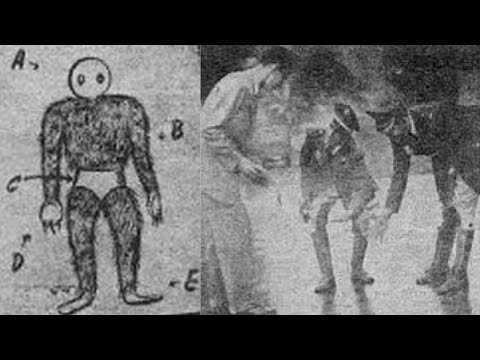
Truck Drivers' Violent Encounter with an Alien, Venezuela, 1954
Eyes On Cinema's detailed narrative walkthrough of the Petare encounter, drawing on the original Spanish-language case record.
The Venezuelan UFO Wave of 1954: Invasion of the Hairy Humanoids
Published UFO researcher and author Preston Dennett places Petare within the full arc of the December 1954 Venezuelan humanoid wave.
El Encuentro de Petare
Venezuelan channel Expediente Secreto Venezuela covers the case from a local, Spanish-language research perspective.
Conmoción en Venezuela: Dos Hombres se Enfrentaron al OVNI de Petare
A Spanish-language recap focused specifically on the struggle between González and the entity.
Caso Petare 1954
An independently produced Spanish-language retrospective on the case's original 1954 record.
Sources
- Gross, Patrick. "URECAT-000061 — November 29, 1954, Petare, Miranda, Venezuela, Gustavo Gonzales and Jose Ponce," UFOs at Close Sight. ufologie.patrickgross.org
- Gross, Patrick. "URECAT-000067 — December 19, 1954, Valencia, Carabobo, Venezuela, José Parra," UFOs at Close Sight. ufologie.patrickgross.org
- Gross, Patrick. "URECAT-000060 — November 28, 1954, Palmarito, Mérida, Venezuela, a group of peasants," UFOs at Close Sight. ufologie.patrickgross.org
- Corrales, Scott. "Venezuela: A Classic CE3K Revisited — The 1954 José Ponce / Gustavo González Incident," Inexplicata — The Journal of Hispanic Ufology, December 2013. inexplicata.blogspot.com
- Gross, Loren E. "UFOs: A History, 1954: November–December (Supplemental Notes)," Sign Oral History Project. sohp.us
- Espacio Misterio. "Ovnis en Venezuela: El Extraño Caso Petare." espaciomisterio.com
- Villarrubia Mauso, Pablo. "En los Bastidores de 'Cuarto Milenio': Petare, la Barriada Venezolana de los Ovnis," January 5, 2014. villarrubia.wordpress.com
- Anticipaciones. "El OVNI de Petare, Venezuela," June 9, 2017. anticipaciones.wordpress.com
- Project Black Echo. "Petare Close Encounter Case: Gustavo González, Hairy Humanoids and the 1954 Venezuela Incident." projectblackecho.com
- Ecency (aquiexisten). "La Historia del OVNI en Petare." ecency.com
- Prensa Mercosur. "El Inquietante Caso Petare de 1954: La Madrugada en la que Caracas Registró Uno de sus Expedientes OVNI Más Famosos." prensamercosur.org
- La Guía de Caracas. "Aparición OVNI en Petare." laguiadecaracas.net
- Encyclopedia.com. "Aerial Phenomena Research Organization (APRO)" (biographical/institutional entry). encyclopedia.com
- The Sol Foundation. "Jacques Vallée" (institutional biography). thesolfoundation.org
- Lorenzen, Coral E. & Lorenzen, Jim. Flying Saucers: The Startling Evidence of the Invasion from Outer Space, Signet, 1966.
- Lorenzen, Coral E. & Lorenzen, Jim. UFOs Over the Americas, Signet, 1969 (earliest published account of the related Palmarito case).
- Vallée, Jacques. Passport to Magonia: On UFOs, Folklore, and Parallel Worlds, Contemporary Books, 1993 (catalogs the 1954 Venezuelan wave among its close-encounter entries).
- Clark, Jerome. The UFO Encyclopedia, 4th Edition, Visible Ink Press, 2023.
- Wikimedia Commons. "Road to Petare.jpg," early 1900s photograph, public domain. commons.wikimedia.org
See something inaccurate? Have additional information or sources?
Suggest an Edit →Last Updated: August 2026