
The Ubatuba Magnesium Fragments
On September 14, 1957, Rio de Janeiro society columnist Ibrahim Sued devoted part of his daily column in O Globo to an anonymous letter from a reader who claimed to have been fishing near the beach at Ubatuba, on the coast of São Paulo state, when he watched a disk-shaped object climb rapidly and then explode into "thousands of fiery fragments" over the sea. Enclosed with the letter were three small pieces of a light, dull, grayish metal the writer said he had gathered from the beach afterward. Sued passed the fragments to Dr. Olavo T. Fontes, the Brazilian representative of the American Aerial Phenomena Research Organization (APRO), who began a chain of laboratory testing that has now run for more than 65 years — from a Brazilian government spectrograph in 1957, to Oak Ridge National Laboratory in 1958, to the U.S. government's own Condon Committee in 1968, to a peer-reviewed isotope-ratio study published in the Journal of Scientific Exploration in 2022. Every single one of those analyses agrees on one point: the material is genuinely, unusually pure magnesium — on the order of 99.9% or better — carrying a trace strontium impurity that commercial magnesium of the 1950s was not known to contain. What none of those analyses, and none of the extensive searching Fontes and APRO conducted for decades afterward, has ever been able to establish is who wrote the letter, who if anyone actually stood on that beach, or whether an event actually happened there at all. Ubatuba is, by a wide margin, the most laboratory-tested physical sample in this catalogue — and the case with the least first-hand human testimony behind it.

Pictured: Praia do Flamengo, one of the more than 100 beaches along Ubatuba's Serra do Mar coastline — not the actual beach where the anonymous letter-writer claimed to be fishing, which he never specified and which has never been identified. No photograph of the claimed 1957 event, the actual fragments' recovery site, or the letter-writer exists or could exist, since no eyewitness to any part of the story has ever been located; this image instead documents the general coastal setting the letter described.
Theoretical Alignment
Ubatuba does not fit the usual shape of a UAP case, and its Theoretical Alignment scores reflect that directly. There is no witnessed encounter to misperceive, so the Psycho-Social Hypothesis scores modestly here for a different reason than usual: not crowd contagion or a garbled recollection of a real stimulus, but the possibility of an outright fabrication crafted to generate exactly this kind of sensational newspaper story, a pattern documented elsewhere in 1950s "silly season" journalism. The Extraterrestrial Hypothesis draws a real, if limited, alignment score not because any craft or occupant was ever described in verifiable terms, but because the underlying physical material genuinely has resisted a fully satisfying terrestrial explanation for 65 years: no researcher, skeptical or otherwise, has ever produced a specific, documented 1950s industrial process that explains why a chip of commercial-grade magnesium would carry a strontium impurity in the hundreds of parts per million. The Interdimensional Hypothesis finds essentially no purchase in a case built entirely around a stationary physical sample rather than any reported anomalous motion, transition, or portal-like phenomenon.
Background
In the mid-1950s, Brazil was in the middle of its own "flying saucer" craze, running roughly parallel to the wave of reports that had swept the United States since Kenneth Arnold's 1947 sighting. Rio de Janeiro's O Globo, then as now one of Brazil's largest newspapers, ran a daily society column by Ibrahim Sued, a photographer-turned-columnist who had joined the paper in August 1954 and whose "Reportagem Social" made him one of the country's most widely read chroniclers of Rio's elite social life — not, by trade or reputation, a UFO reporter of any kind, which is itself part of why the letter he received stood out. Three years earlier, in January 1952, American UFO investigators Jim and Coral Lorenzen had founded the Aerial Phenomena Research Organization (APRO) in Sturgeon Bay, Wisconsin, building a network of volunteer national representatives around the world to investigate and forward reports; by 1957, that network's man in Brazil was Dr. Olavo T. Fontes, a physician on the faculty of Rio's National School of Medicine.
It was against that backdrop — a widely read non-specialist columnist, a young but internationally networked UFO research organization, and a country already primed by several years of its own saucer reports — that an envelope reached O Globo's offices in September 1957. What made it different from the wave of ordinary letters any newspaper covering "flying saucers" might expect was what accompanied it: not just a story, but three small pieces of metal the writer said were physical evidence.
Complete Timeline
| Date | Event |
|---|---|
| January 1952 | Jim and Coral Lorenzen found the Aerial Phenomena Research Organization (APRO) in Sturgeon Bay, Wisconsin. |
| 1941 | Dr. Fritz Feigl, an Austrian-born analytical chemist who fled the 1938 Anschluss, becomes head of Brazil's Mineral Production Laboratory under the Ministry of Agriculture. |
| August 1954 | Ibrahim Sued begins his daily "Reportagem Social" column in O Globo, Rio de Janeiro, where he remains for the rest of his career. |
| On or shortly before September 14, 1957 | An anonymous, "very educated" letter and three small fragments of light, dull, grayish metal reach O Globo's offices, addressed to Sued. |
| September 14, 1957 | Sued publishes the letter in his column under the headline "Um Fragmento de um Disco Voador!" ("A Fragment from a Flying Disk!"), describing the writer's claim of a disk exploding over the sea near Ubatuba. |
| September 1957 | Sued turns the three fragments over to Dr. Olavo Fontes, APRO's Brazilian representative, who subdivides Sample No. 1 for testing and retains Samples 2 and 3. |
| September 24, 1957 | Dr. Luisa Maria A. Barbosa performs the first spectrographic analysis at the Mineral Production Laboratory, reporting magnesium "of unusual purity with no detectable inclusion of other elements." |
| Autumn 1957 | Fontes and journalist João Martins travel to the Ubatuba coast to canvass residents for anyone who recalls the claimed explosion; they locate a fisherman with only a vague, secondhand recollection of vacationers discussing gray metal, and no other lead. |
| October 24, 1957 | Elson Teixeira, a Mineral Production Laboratory chemist with more than 50,000 prior spectrographic determinations, performs a second, confirming analysis using the lab's Hilger spectrograph. |
| Late 1957 | Fontes forwards a portion of the samples to Coral Lorenzen at APRO in the United States. Around the same time, Fontes and APRO open their investigation of farmer Antônio Vilas-Boas's claimed October 1957 encounter. |
| 1958 | Per Fontes's own later report to APRO, two Brazilian intelligence agents visit him, initially with veiled threats and then a request that he surrender his notes and remaining samples — a single-source claim from an interested party that this file treats as unverified. |
| September 1958 | Oak Ridge National Laboratory chemists Dr. Ellison Taylor and Dr. Cyrus Feldman, physicist Dr. T.A. Welton, and metallurgist Dr. Robert Gray test a fragment, finding 99.8% magnesium purity with Fe, Si, and Al traces, and lattice fissures consistent with high-temperature oxidation. |
| March 1960 | The APRO Bulletin publishes the Brazilian lab's finding in terms that read as "100% pure magnesium," a framing that becomes the origin of the case's enduring, and technically overstated, "impossibly pure" reputation. |
| 1966 | Coral Lorenzen discusses the Ubatuba case in her book Flying Saucers: The Startling Evidence of the Invasion from Outer Space, introducing it to a wide popular readership. |
| December 1961 | Dow Chemical tests a fragment by electron-beam microprobe, finding 99.98% purity with strontium and barium each at roughly 30 parts per million — a combination its own chemists found unusual for commercial magnesium. |
| February 1968 | The University of Colorado UFO Study (the Condon Committee), under field investigator Dr. Roy Craig, has the government's own Alcohol & Tobacco Laboratory test a sample via neutron activation, finding 99.9% purity with Sr, Ba, Zn, Mn, Cr, and Cu traces, and attempts (unsuccessfully, as later shown) to measure the sample's magnesium isotope ratios. |
| October 31, 1968 | The published Condon Report briefly and, as later research showed, inaccurately summarizes the isotope finding, omitting the lab's own numeric result. |
| 1970 | Metallurgists W.W. Walker and R.W. Johnson publish "Further studies on the Ubatuba magnesium samples," continuing the case's unusually long tail of independent technical re-examination. |
| 1987 | Coral Lorenzen turns her portion of the remaining samples over to Dr. Peter Sturrock, a Stanford University professor of applied physics who had begun organizing rigorous scientific review of UFO physical evidence. |
| March–Spring 1997 | Sturrock arranges new testing at Elemental Research (Vancouver) using laser-ablation ICP-MS, detecting 37 trace elements, and at Charles Evans and Associates using SIMS to re-examine the magnesium isotope ratios. |
| 2001 | Sturrock publishes "Composition Analysis of the Brazil Magnesium" in the Journal of Scientific Exploration (Vol. 15, No. 1), the first full synthesis of more than 40 years of prior testing. |
| 2008 | CUFOS researcher Michael Swords, reviewing Roy Craig's original 1968 papers at Texas A&M's Cushing Library, discovers the Condon Committee's magnesium isotope calculation had never been correctly reported. |
| 2018 | Researcher Brad Sparks identifies a further, compounding error in the 1968 lab's arithmetic — the wrong sample weight had been used in the original calculation. |
| July 2017 – July 2018 | Robert M. Powell, Michael Swords, Mark Rodeghier, and Phyllis Budinger obtain a fragment from Sturrock and commission the first modern HR-ICPMS isotope analysis, at Cerium Laboratories (Austin, TX) and independently at ICP-MS Services (Cleveland, OH). |
| May 22, 2022 | Powell, Swords, Rodeghier, and Budinger publish "Isotope Ratios and Chemical Analysis of the 1957 Brazilian Ubatuba Fragment" in the Journal of Scientific Exploration (Vol. 36, No. 1), concluding the magnesium isotopes fall within terrestrial limits while the trace-element isotopes remain genuinely inconclusive. |
| 2021–2024 | Stanford pathologist Garry Nolan, working separately through the Sol Foundation, states in public interviews that further nanoSIMS testing of additional Ubatuba-linked fragments found some pieces with magnesium isotope ratios deviating substantially from terrestrial norms while other pieces from the same source tested as ordinary — a claim not yet published in a peer-reviewed paper. |
The Letter and the Fragments
What Ibrahim Sued printed in his September 14, 1957 column was, on its face, unremarkable: one more piece of reader correspondence in a country already accustomed to saucer stories. The letter's author identified himself only by an illegible signature and described, in what Fontes's later report characterized as clearly educated prose, a scene of fishing near the coastal town of Ubatuba when a disk-shaped object appeared, climbed rapidly, and then detonated into what he described as thousands of fiery fragments. Most of the debris, by his account, fell into the sea; a handful landed on the beach, and he said he collected some of it. Three of those pieces — small, light, dull gray metal chips — were enclosed with the letter itself. It is worth stating plainly what this evidence is and is not: it is a secondhand written account from an unidentified source, accompanied by an unprovenanced physical sample. Nothing about the letter's arrival at a busy newsroom constitutes chain of custody back to any actual explosion, and nothing in the sixty-five years since has changed that basic fact.
Fontes Takes Custody: The First Brazilian Tests
Sued, not a UFO investigator himself, did what a Brazilian journalist encountering this kind of story in 1957 would reasonably do: he passed the material to someone equipped to evaluate it. Dr. Olavo Fontes, a physician at Rio's National School of Medicine and APRO's Brazilian representative, took custody of all three fragments and moved quickly to have them examined by a real analytical laboratory rather than simply taking the letter's claims at face value. He subdivided the largest fragment, Sample No. 1, into pieces for separate testing, retaining Samples 2 and 3 intact. Fontes personally delivered material to the government's Mineral Production Laboratory, whose chief chemist, Dr. Fritz Feigl, was by that point an internationally recognized authority on analytical spot-test chemistry. According to Fontes's own report to APRO, Feigl's first reaction was itself informative: he rejected an initial suggestion that the material might be meteoritic, reportedly telling Fontes the fragments were "too light to be fragments of a meteorite," and ordered basic qualitative screening with phosphomolybdic acid and hydrochloric acid simply to confirm the material was a genuine metal before committing lab time to a full spectrographic workup.
That workup came in two independent passes. On September 24, 1957, Dr. Luisa Maria A. Barbosa ran the first spectrographic analysis and reported magnesium of unusual purity with no other elements detectable by her equipment. A month later, on October 24, 1957, Elson Teixeira — a chemist with more than fifteen years' experience and, per the lab's own records, over 50,000 prior spectrographic determinations — ran a second, independent analysis using the lab's Hilger spectrograph with additional controls, and reported the same result: no trace elements at all were detectable, meaning the sample registered as, in the spectrographic sense, 100% pure. A separate X-ray diffraction analysis, run by Dr. Elysiario Tavora Filho, confirmed the purity finding by an independent method and additionally identified surface deposits of magnesium hydroxide rather than magnesium oxide — a detail consistent with prolonged contact with seawater, and thus modestly supportive of the letter's own claim that the debris had fallen into the ocean. A density measurement on one polished chip came back at 1.866 g/cc, noticeably higher than the 1.741 g/cc expected for ordinary terrestrial magnesium, an anomaly early researchers flagged as potentially significant, though it was not independently replicated by later labs using more precise equipment and is treated by this file as an early, likely instrumental artifact rather than an established fact about the material.
The Search That Found No Witness
To their credit, neither Sued nor Fontes treated the letter as self-authenticating. In the autumn of 1957, Fontes traveled to the Ubatuba coast together with journalist João Martins specifically to try to locate the letter's author or anyone else who might corroborate the story. What they found, after canvassing residents along the beaches near the town, was thin: a local fisherman who recalled — secondhand and without corroborating detail — that vacationers from an inland town had once discussed an incident and displayed a piece of gray material, but who could supply no name, no date, and no way to trace the story further. No eyewitness to any actual explosion was ever located. No original letter-writer ever came forward, then or in the decades since, despite the case's growing prominence in UFO literature and despite APRO's continuing interest in identifying him. This is, without qualification, the case's central and permanent evidentiary weakness: sixty-five years of increasingly sophisticated chemistry have been applied to a sample whose connection to any actual witnessed event has never been established by anything more than an anonymous letter's own say-so.
One further, more unusual claim belongs in the record for completeness, clearly labeled as what it is: in his own 1958 report to APRO, Fontes wrote that he had been visited by two men he identified as Brazilian intelligence agents, who he said made veiled threats before asking him to surrender his notes and remaining samples. Fontes speculated this meant the original witnesses might have separately reported the incident to an official channel and been persuaded to stay silent. This claim comes from a single, interested source — Fontes's own account to the organization he represented — with no independent corroboration from any Brazilian government record, and this file treats it accordingly: a genuine part of the documentary history of how the case was reported, not an established fact about what happened.
Oak Ridge, Dow Chemical, and the First Independent American Tests
Word of the Brazilian lab's "100% pure magnesium" finding reached APRO's American network and, from there, the broader scientific community interested in physical UFO evidence. In September 1958, a sample reached Oak Ridge National Laboratory in Tennessee, where chemists Dr. Ellison Taylor and Dr. Cyrus Feldman, physicist Dr. T.A. Welton, and metallurgist Dr. Robert Gray examined it using an arc-burn technique and a two-meter grating spectroscope. Their result already complicated the "impossible purity" narrative that had begun circulating: Oak Ridge measured 99.8% magnesium, not the spectrographically undetectable trace-element level the Brazilian lab had reported, with real, measurable amounts of iron and silicon (100–1,000 ppm), aluminum in the same range, and calcium and copper at 1–10 ppm. Crucially, Oak Ridge's equipment could not have detected strontium or barium below roughly 1,200 ppm — meaning the Brazilian lab's "pure" finding and Oak Ridge's own result were both artifacts of instrument sensitivity limits, not evidence the material was actually, absolutely pure. The Oak Ridge team also examined the sample's crystalline lattice and found fissures consistent with rapid oxidation at high temperature — a detail that lent some physical support to the letter's own account of an explosion, while the metallurgists simultaneously concluded the material's form ruled out both ordinary pyrotechnic composition and any aircraft or missile component that had simply burned up during a conventional in-atmosphere failure. Oak Ridge's own report characterized the sample as plausibly still man-made, but sufficiently unusual to merit further study — a notably measured, non-sensationalized conclusion from a government nuclear-research laboratory with no stake in the UFO question either way.
Dow Chemical, then one of the world's leading industrial magnesium producers, tested a fragment in December 1961 using an electron-beam microprobe capable of resolving composition to within a few microns of the surface. Their result — 99.98% purity, with strontium and barium each present at roughly 30 parts per million and calcium at 100 ppm — was, in a specific and telling way, the most significant data point in the case's early history: Dow's own metallurgists, the very people most likely to know what an ordinary batch of commercial 1950s magnesium actually contained, were reportedly surprised by the strontium. Strontium was not, at the time, a standard or expected trace additive in commercially produced magnesium ingots, and its consistent appearance across independently run labs using entirely different instruments — Dow's microprobe, and later the Condon Committee's neutron activation analysis — is the one finding in this case that has never been explained away as an instrument artifact, because multiple different kinds of instruments, calibrated independently, kept finding it.
The Condon Committee and a Buried Error
By 1968, Ubatuba's growing reputation had reached the University of Colorado's federally funded UFO Study — the Condon Committee — whose field investigation leader, Dr. Roy Craig, arranged for a sample to be tested by the U.S. government's own National Office Laboratory of the Alcohol and Tobacco Division (NOLAT). Using neutron activation followed by gamma-ray spectroscopy, NOLAT measured 99.9% magnesium purity, with strontium at 500 ppm, barium at 160 ppm, zinc at 500 ppm, manganese at 35 ppm, chromium at 32 ppm, and copper at 3 ppm — the most detailed trace-element profile obtained up to that point, and one that pushed the measured strontium level an order of magnitude above what Dow Chemical had found seven years earlier. Craig's own notes on the case, later reviewed by researchers, explicitly flagged that strontium traces were "not known to be added to commercial Mg" as of the time the sample was made.
NOLAT's lab also attempted the case's first isotopic measurement, examining the abundance of the magnesium-26 isotope specifically. What happened to that result is one of the case's stranger footnotes: the lab reported an abundance figure that did not, on close reading, actually match nominal terrestrial values, and Craig's own published Condon Report simply omitted the lab's numeric result altogether, asserting instead in general terms that the Brazil sample "did not differ significantly" from ordinary magnesium — a claim that later, more careful researchers were unable to reconcile with the underlying lab data once they tracked it down. In 2008, CUFOS researcher Michael Swords located Craig's original 1968 case files at Texas A&M University's Cushing Archival Library and discovered the discrepancy directly. A decade later, in 2018, researcher Brad Sparks identified a further compounding error: NOLAT's original calculation had apparently used the weight of the wrong prepared sample, which, corrected, would have shifted the reported isotope abundance dramatically. Whether the original figure was 14.3% or a corrected 23.1% against a nominal value of 11.01%, the 2022 re-analysis team concluded plainly that "this first attempt at measuring the isotope ratio was a failure" — not evidence of anything exotic, simply bad 1968 laboratory arithmetic that went unexamined for forty years.
Sturrock, Stanford, and the Modern Chain of Custody
The samples' custody itself became part of the story in the following decades. Coral Lorenzen held APRO's portion for thirty years before turning it over in 1987 to Dr. Peter Sturrock, a British-American professor of applied physics at Stanford University who had, by the late 1990s, become the most prominent academic figure organizing rigorous scientific review of UFO physical evidence — work that culminated in his 1998 Rockefeller-funded scientific panel and his 2000 book The UFO Enigma: A New Review of the Physical Evidence. In the spring of 1997, Sturrock arranged two further rounds of testing: a laser-ablation ICP-MS analysis by Elemental Research of Vancouver, which detected 37 distinct trace elements (most in the parts-per-billion range and likely surface contamination from decades of handling and prior seawater exposure, including elevated calcium, sodium, and titanium consistent with salt water), and a Secondary Ion Mass Spectrometry (SIMS) isotope analysis by Charles Evans and Associates that, for the first time, measured all three magnesium isotopes rather than just one. Sturrock published the definitive synthesis of more than forty years of prior testing as "Composition Analysis of the Brazil Magnesium" in the Journal of Scientific Exploration in 2001 — the paper every subsequent re-analysis, including the 2022 study, explicitly builds on.
The 2022 Isotope Study: Terrestrial Magnesium, an Unresolved Trace Puzzle
The most rigorous analysis to date came two decades after Sturrock's synthesis. Between July 2017 and July 2018, Robert M. Powell of the Scientific Coalition for UAP Studies, together with Michael Swords, Mark Rodeghier, and Phyllis Budinger, obtained a small piece of an original Ubatuba fragment from Sturrock and commissioned High-Resolution Inductively Coupled Plasma Mass Spectrometry (HR-ICPMS) testing — a technique capable of resolving isotope ratios far more precisely than any instrument available to earlier researchers — independently at two commercial labs: Cerium Laboratories in Austin, Texas, and ICP-MS Services in Cleveland, Ohio. Their published result, in the Journal of Scientific Exploration (Vol. 36, No. 1, May 2022), is the most carefully hedged and, for that reason, the most credible modern statement on the case: the magnesium isotope ratios measured by the Cleveland lab fell on the same diagonal fractionation line as ordinary terrestrial magnesium samples (Amazon River magnesium, Dead Sea magnesium, and standard reference material all included for comparison), while the Austin lab's magnesium results fell noticeably off that line — a discrepancy the authors attribute to probable laboratory measurement error at Austin rather than evidence of anything anomalous, since both labs tested the same dissolved sample solute.
For the trace elements — strontium, barium, zinc, and copper — the two labs' isotope measurements did not consistently agree with each other, and the authors concluded plainly that "no conclusion can be drawn" about whether the trace-element isotopes fall outside normal terrestrial ranges. What the study does establish with confidence is the one finding every laboratory, across 65 years and a dozen different instruments, has agreed on without exception: the sample is genuinely, consistently about 99.88% pure magnesium, with a real strontium impurity that is "not a normal by-product in the manufacture of magnesium and would have been intentionally added" — in the authors' own words, "it is still a mystery as to how high purity magnesium with the addition of strontium impurities showed up at a Brazilian newspaper office in 1957." That sentence, from a peer-reviewed 2022 paper explicitly cautious about overclaiming extraterrestrial origin, is the most precise and defensible statement of what remains genuinely unexplained about Ubatuba — not proof of anything non-terrestrial, but a real, specific, still-open materials-science puzzle.
A More Recent, Unpublished Claim: Garry Nolan's NanoSIMS Results
Separately from the peer-reviewed 2022 study, Stanford pathologist Garry Nolan, working through the Sol Foundation and discussing his findings in public venues including a 2022 appearance on the Lex Fridman podcast, has described testing additional Ubatuba-linked fragments using nanoSIMS instrumentation and finding that some individual pieces showed magnesium isotope ratios deviating substantially — by Nolan's own description, on the order of 30% — from expected terrestrial abundances, while other pieces from the same original source tested as entirely ordinary, terrestrial magnesium. Nolan has stated publicly that he is unaware of any established industrial or scientific reason humans would deliberately alter the isotope ratios of a simple structural metal like magnesium. This claim is worth including for a complete record of the case's ongoing scientific interest, and this file does exactly that — while being explicit that, unlike the 2022 Powell/Swords/Rodeghier/Budinger study, Nolan's specific isotope claims have not, as of this writing, appeared in a peer-reviewed publication with disclosed methodology, error bars, or an independently reproduced result. Until they do, this file treats them as a preliminary, unverified follow-on report rather than confirmed science, sitting alongside rather than superseding the peer-reviewed 2022 study's more conservative, terrestrial-range conclusion.
Key Researchers
- Dr. Olavo T. Fontes — APRO's Brazilian representative, who took custody of the fragments, arranged the first laboratory tests, and personally searched the Ubatuba coast for the letter-writer.
- Coral Lorenzen — APRO co-founder and director who publicized the case internationally and held the remaining samples for three decades.
- Dr. Peter A. Sturrock — Stanford physicist who took custody of the samples in 1987, arranged renewed testing, and published the definitive 2001 synthesis of the case's first forty years.
- Robert M. Powell, Michael Swords, Mark Rodeghier & Phyllis Budinger — the Scientific Coalition for UAP Studies and Center for UFO Studies team behind the 2022 peer-reviewed HR-ICPMS isotope re-analysis, the most methodologically careful study the case has received.
- Garry Nolan — Stanford pathologist whose separate, not-yet-peer-reviewed nanoSIMS testing has raised additional, still-unverified isotope questions about further Ubatuba-linked fragments.
- Dr. Roy Craig — Condon Committee field investigation leader who arranged the 1968 government laboratory testing, whose own report's isotope summary was later found by Michael Swords to have omitted the lab's actual result.
Key Witnesses & Investigators
This section exists, in every other case file on this site, to document the people who actually saw something. Ubatuba has no such person, and this file states that plainly rather than padding the record with the investigators who came afterward. What follows instead are the people who actually shaped the case as it exists today: the unidentified original correspondent, and the chain of journalists, physicians, chemists, and physicists who tested and re-tested what he sent.
The Anonymous Letter-Writer
The case's sole original source: an unnamed correspondent whose September 1957 letter to Ibrahim Sued described watching a disk explode over the sea near Ubatuba and enclosed three metal fragments as claimed debris. Despite a genuine field search by Olavo Fontes and João Martins in late 1957, and decades of continued interest from APRO and later researchers, no name, address, or corroborating account has ever surfaced. He remains, 65+ years later, entirely unidentified.
Ibrahim Sued
The society columnist who received and published the original letter on September 14, 1957. Not a UFO researcher by trade — his daily "Reportagem Social" column covered Rio's elite social scene from 1954 until his death in 1995 — Sued's decision to hand the fragments to a credentialed investigator rather than simply running the story is the reason any laboratory chain of custody exists at all.
Dr. Olavo T. Fontes
The physician and APRO representative who took custody of the fragments from Sued, arranged their first laboratory analyses, personally traveled to the Ubatuba coast searching for the letter-writer, and forwarded material to APRO in the United States. Fontes went on, within weeks, to lead APRO's investigation of Antônio Vilas-Boas's claimed 1957 encounter, making him the central Brazilian investigative figure connecting the country's two most significant UFO cases of the decade.
Dr. Fritz Feigl
An internationally recognized Austrian-born analytical chemist, pioneer of spot-test chemistry, and head of Brazil's government mineral laboratory since 1941, Feigl oversaw the case's first tests, initially rejecting a meteorite hypothesis before ordering the qualitative and spectrographic analyses that produced the case's founding, and later much-qualified, "100% pure magnesium" claim.
Coral Lorenzen
Co-founded APRO with her husband Jim in January 1952 and, as its director, received Fontes's forwarded samples in late 1957, publicized the case in APRO's bulletin and her own 1966 book, and held custody of the remaining fragments for three decades before turning them over to Peter Sturrock in 1987.
Dr. Peter A. Sturrock
Took custody of the remaining Ubatuba samples from Coral Lorenzen in 1987, arranged new laser-ablation and SIMS isotope testing in 1997, and published the definitive synthesis of more than 40 years of prior analysis, "Composition Analysis of the Brazil Magnesium," in the Journal of Scientific Exploration in 2001 — the foundational reference for every re-analysis since, including the 2022 study.
Robert M. Powell
Lead author of the 2022 peer-reviewed Journal of Scientific Exploration study that commissioned the first modern HR-ICPMS isotope analysis of both the Ubatuba fragment's magnesium and its trace elements, concluding the magnesium isotopes fall within terrestrial limits while the trace-element isotope data remain genuinely inconclusive.
The Five Observables Assessment
The Five Observables framework, developed by former AATIP director Luis Elizondo, is used to classify UAP encounters by performance characteristics exceeding known technology of their era. Ubatuba is a genuinely difficult case to score against this framework, because it contains no verified observation of any craft behavior at all — only a secondhand, anonymous letter's description of a disk that "climbed rapidly" before exploding:
Assessment: Anti-Gravity Lift, Hypersonic Velocity, Low Observability, and Trans-Medium Travel are all rated absent for the simple reason that no verified observation exists to support any of them — the letter's account, even taken at face value, describes nothing more exotic than an object climbing and then exploding, with no claim of hovering, instant directional change, or medium transition. Instant Acceleration is rated speculative only because the letter's own secondhand phrase, "climbing rapidly," is the one piece of claimed flight behavior in the entire record, and this file has no way to independently evaluate a description from an unidentified source. This is, deliberately, an almost entirely negative scorecard: the Five Observables framework is built to assess witnessed craft performance, and Ubatuba's actual evidentiary weight lies elsewhere, in its laboratory chemistry rather than any claimed flight characteristics.
Evidence Assessment
Supporting Anomalous Origin
- Every laboratory to test the material across 65 years and a dozen independent instruments — Brazil's Mineral Production Laboratory, Oak Ridge National Laboratory, Dow Chemical, the Condon Committee, Stanford-arranged testing, and the 2022 peer-reviewed study — has found the same basic composition: extraordinarily pure magnesium carrying a strontium impurity not known to be a standard 1950s commercial additive.
- Dow Chemical's own metallurgists, among the people most likely to recognize ordinary commercial magnesium, were reportedly surprised by the strontium finding in 1961.
- The 2022 peer-reviewed study's own authors, while explicitly declining to claim extraterrestrial origin, state plainly that "it is still a mystery" how this specific composition ended up at a Brazilian newspaper office in 1957.
- X-ray diffraction analysis found magnesium hydroxide surface deposits and lattice fissures consistent with high-temperature oxidation — physical detail broadly consistent with, though not proof of, the letter's own account of an explosion.
Supporting Conventional Explanation
- No witness to any part of the claimed event has ever been identified, despite a genuine field search by Fontes and João Martins in 1957 and decades of continued interest since — the single largest evidentiary gap of any physical-evidence case in this catalogue.
- The material's own founding "100% pure magnesium" claim was an artifact of 1957 Brazilian spectrograph sensitivity limits, not a genuine finding of absolute purity; every subsequent, more sensitive test has found real trace elements the earliest test simply could not detect.
- The 2022 peer-reviewed re-analysis found the sample's magnesium isotope ratios fall within the normal terrestrial range — the single strongest and most direct scientific test available for non-terrestrial origin returned an ordinary, Earth-consistent result.
- Strontium compounds are a well-documented, ordinary additive in magnesium-based pyrotechnic and signal-flare compositions, where they produce a red flame color — a mundane industrial explanation for the exact trace element proponents have called the case's central mystery, though no researcher has definitively traced the sample to any specific flare or ordnance batch.
- The chain of custody for the entire case begins with an anonymous letter and unprovenanced metal chips reaching a busy newsroom — a scenario a well-resourced hoaxer with access to laboratory-grade or doped magnesium stock could, in principle, have staged without any need for an actual explosion to have occurred.
Why "Disputed"
This file rates Ubatuba DISPUTED at a comparatively low score, and both halves of that rating deserve to be stated honestly rather than softened. The material evidence is genuinely unusual and has held up, without ever being definitively explained, across 65 years of increasingly precise laboratory testing by disinterested, credentialed scientists who had no stake in the outcome either way — Oak Ridge National Laboratory, Dow Chemical, the federally funded Condon Committee, and a 2022 peer-reviewed isotope study all independently confirm the same basic, odd fact: unusually pure magnesium carrying a strontium trace that commercial 1950s magnesium was not known to contain. That is a real, specific, still-open materials-science puzzle, and this file does not pretend otherwise. But a physical sample, however carefully tested, is not a witnessed event, and Ubatuba's single greatest weakness is one no laboratory can fix: no person has ever been identified who claims to have seen anything happen at all. The letter-writer was never found despite a genuine search. No fisherman, vacationer, or resident of Ubatuba ever came forward in 65 years to corroborate so much as the basic outline of an explosion over the beach. Every fact in this case traces back, ultimately, to an anonymous piece of mail and the metal that arrived with it — and while that metal is real, tested, and still not fully explained, it cannot, by itself, establish that the story attached to it is true. A case this evidentially thin on the human side, no matter how much laboratory rigor has been thrown at its physical remnant, cannot honestly be scored as anything higher than a low-end Disputed rating.
Sensor & Instrumentation Detection Profile
No sensor of any kind — visual, radar, photographic, or otherwise — is associated with the alleged event itself, because no verified witness to the event exists. The entire detection record in this case consists of laboratory instrumentation applied after the fact to the physical fragments, and on that count Ubatuba is unusually well-instrumented: a Hilger spectrograph at Brazil's Mineral Production Laboratory in 1957; an arc-burn emission spectroscope at Oak Ridge National Laboratory in 1958; an electron-beam microprobe at Dow Chemical in 1961; neutron activation analysis and gamma-ray spectroscopy performed for the Condon Committee in 1968; laser-ablation and secondary-ion mass spectrometry (SIMS) arranged by Stanford physicist Peter Sturrock in 1997; and, most recently, High-Resolution Inductively Coupled Plasma Mass Spectrometry (HR-ICPMS) performed independently at two commercial laboratories in Austin, Texas and Cleveland, Ohio in 2017–2018 for a study published by Robert M. Powell and colleagues in the Journal of Scientific Exploration. That instrumentation chain is genuinely unusual for this catalogue — it is the material itself, not any human account, that has been placed under increasingly sophisticated scientific scrutiny for six and a half decades.
Environmental & Geospatial Context
Ubatuba sits on the Atlantic coast of São Paulo state, roughly 230 km northeast of the city of São Paulo, where the forested Serra do Mar mountain range runs directly down to the shoreline and more than 100 named beaches string along some 100 km of coastline. Because no witness location, date, or time of day was ever specified in usable detail by the anonymous letter, no meteorological, lunar, or solar reconstruction is possible for the alleged event — a genuine and permanent gap in the record, not a detail this file can responsibly reconstruct after the fact. Geospatially, the case's real, documented locations are not on the beach at all but in Rio de Janeiro, roughly 500 km up the coast: the newsroom of O Globo, where the letter arrived; Dr. Fontes's medical practice, where the chain of custody began; and the government Mineral Production Laboratory of the Ministry of Agriculture, where the first tests were run. The event's only claimed connection to Ubatuba itself is the letter's own unverified word.
Observer Credibility & Occupational Profile
This is the section where Ubatuba departs most sharply from every other file in this catalogue: there is no observer to profile. The letter-writer signed no name, gave no verifiable address or occupation beyond writing "in a very educated manner," and was never identified despite a genuine, sustained search — discussed in detail below — by Fontes and fellow investigator João Martins, who personally canvassed beaches near Ubatuba asking after the story. What credibility this case does possess belongs entirely to the people who tested the material rather than anyone who claims to have witnessed its origin: Dr. Fritz Feigl, an internationally recognized analytical chemist and head of Brazil's Mineral Production Laboratory since 1941; the Oak Ridge National Laboratory team of chemists and a metallurgist who examined the sample in 1958; Dr. Roy Craig, the Condon Committee's field investigation leader; and, most recently, Peter Sturrock, a Stanford professor of applied physics, and the Journal of Scientific Exploration team led by Robert Powell. Their professional credentials are real and substantial. But credentialed chemistry cannot substitute for an identified witness, and this file treats that absence as the single most important fact about the case, not a footnote to it.
Physical & Material Assays
The physical evidence is the case. Three small chips of a light, dull, grayish metal — described by the letter-writer as debris from the explosion — passed from Ibrahim Sued to Olavo Fontes in September 1957. Fontes subdivided the largest piece (designated "Sample No. 1") for testing while retaining Samples 2 and 3, and eventually forwarded material to Coral Lorenzen at APRO. What followed is close to a dozen independent laboratory examinations across 65 years, summarized here and detailed further in the Material Analysis section below: Brazil's own Mineral Production Laboratory (1957) found no trace elements at all with its Hilger spectrograph, reporting the material as functionally 100% magnesium — the origin of the case's most famous, and most overstated, claim. Oak Ridge National Laboratory (1958) found 99.8% purity with real, measurable traces of iron, silicon, aluminum, calcium, and copper, and noted lattice fissures consistent with high-temperature oxidation. Dow Chemical (1961) measured 99.98% purity with strontium and barium at 30 parts per million each — a combination its own chemists found surprising. The Condon Committee (1968) found 99.9% purity with strontium, barium, zinc, manganese, chromium, and copper all present at ppm levels, and its investigator explicitly noted that strontium was not known to be added to commercial magnesium at the time. A 2022 peer-reviewed HR-ICPMS re-analysis found the magnesium's own isotope ratios fall within the normal terrestrial range, while the isotope ratios of its trace elements remained genuinely inconclusive between two independent labs. No test, at any point in 65 years, has found the sample to be anything other than magnesium metal with a small, real, and still-unexplained set of trace impurities.
Historical Precedents & Archive Matches
Ubatuba belongs to a small, specific category this catalogue tracks separately from witnessed sightings: cases built around a physical sample rather than an eyewitness account, alongside the 1954 Campinas, Brazil landing-trace case, the 1971 Delphos, Kansas soil ring, and the 1981 Trans-en-Provence landing trace investigated by France's GEPAN. Within Brazilian ufology specifically, Ubatuba is the earliest and, in evidentiary terms, most laboratory-tested entry in a national tradition that later produced the Brazilian Air Force's official Operação Prato investigation into the 1977 Colares "Chupa-Chupa" wave and the Army's two formal inquiries into the 1996 Varginha incident — though unlike either of those, no Brazilian government body has ever formally investigated Ubatuba at all. Olavo Fontes's involvement is itself a cross-case thread: the same physician-investigator who chased down Ubatuba's chain of custody was, within weeks of this story breaking, beginning APRO's investigation of farmer Antônio Vilas-Boas's claimed October 1957 abduction — placing Fontes at the center of Brazil's two most significant UFO cases of the entire decade within a span of months.
Material Analysis
Stripped of every claim about its origin, the raw chemistry record is this: a fragment of magnesium metal measuring, across a dozen independent laboratories and 65 years of steadily improving instrumentation, consistently between 99.8% and effectively 100% pure by weight, carrying trace amounts of strontium (30–916 ppm depending on the specific test and sub-sample), barium (30–301 ppm), zinc, copper, manganese, and chromium, with surface deposits of magnesium hydroxide consistent with seawater exposure. No test at any point has found the material to be anything other than magnesium and its ordinary trace-metal companions — it is not a composite, not an alloy of any exotic design, and not, per the 2022 isotope study, isotopically distinguishable from terrestrial magnesium in its primary constituent. The case's entire scientific interest rests on a narrower and more specific question than "is this magnesium extraterrestrial": why does a 1950s-era sample of magnesium this pure carry a strontium impurity that was not, per multiple independent chemists across multiple decades, standard practice in commercial magnesium production of the period.
What Remains Genuinely Unexplained
- The consistent presence of strontium across every sensitive test since 1961, at levels too high to be incidental contamination and too specific to be a coincidental trace impurity from ordinary ore refining.
- No researcher, proponent or skeptic, has definitively traced the specific sample to any documented 1950s magnesium production batch, industrial process, or ordnance/flare formulation.
What Has Been Resolved or Overstated
- The founding "100% pure, therefore impossible to produce terrestrially" claim has not survived scrutiny; it was an artifact of 1957 Brazilian spectrograph detection limits, and every more sensitive subsequent test has found real trace elements.
- The 2022 peer-reviewed isotope study — the single most direct available test for non-terrestrial origin — found the sample's magnesium isotope ratios within the normal terrestrial range.
- The 1968 Condon-era claim of an isotopic anomaly was traced, by 2018, to a documented laboratory calculation error rather than any real deviation from terrestrial norms.
Conventional Explanation Candidates
Elaborate Hoax
The simplest explanation requiring no unexplained physics or chemistry is that the entire episode — letter, story, and fragments alike — was fabricated by a single individual with access to unusually pure, laboratory- or industrial-grade magnesium stock, who doped or selected material carrying a strontium trace either deliberately (to make it seem more unusual under later analysis) or incidentally (because it happened to come from a specific supplier or batch). Brazil's mid-1950s saucer craze provided ample motive and a receptive newsroom; a well-connected individual with access to a metallurgical, industrial, or military supply chain could plausibly have obtained magnesium of this purity without needing any exotic origin at all. This candidate's chief weakness is the same as every other: there is no positive evidence of a hoaxer either, no confession, no identified suspect, and no specific traced source for the material — the hoax theory explains the absence of a witness perfectly but does not, by itself, explain the strontium.
Unusually Pure Industrial or Military Magnesium
A second, non-exotic candidate holds that the fragments are simply real 1950s-era terrestrial magnesium of unusually, but not impossibly, high purity — produced by a specialized industrial, aerospace, or military process not widely publicized or well-documented in open literature at the time. Dow Chemical's own later ability to produce 99.98%-pure magnesium by the early 1960s demonstrates the general purity level was terrestrially achievable within a few years of the case; the open question is whether an equivalent process existed in 1957, and specifically whether strontium was ever intentionally added in any known military or industrial magnesium application of the period. Strontium salts are a well-established, ordinary additive in magnesium-based pyrotechnic and signal-flare compositions, prized specifically for producing a bright red flame color when burned — a mundane application that would neatly explain both magnesium as the bulk material and strontium as a deliberate, non-mysterious additive, though no researcher on either side of the case has definitively traced the Ubatuba sample to a specific flare, tracer round, or signal device batch.
Genuine, Unexplained Terrestrial Anomaly
A third possibility, distinct from both hoax and mundane industrial origin, is that the sample is real terrestrial magnesium manufactured through some specific, undocumented process whose details were never published or have simply been lost to time — not extraterrestrial, but also not yet matched to any known 1950s production record. This is, in effect, the position the 2022 peer-reviewed study's own authors take: the magnesium is isotopically terrestrial, but the strontium doping remains a genuine open question that "would have been intentionally added" by someone, without any confirmed identification of who or why.
Elaborate Hoax
PlausibleFully consistent with the total absence of any witness, though unproven and lacking a specific identified culprit or traced material source.
Unusually Pure Industrial/Military Magnesium (including flare-composition strontium doping)
PlausibleConsistent with known pyrotechnic chemistry and Dow Chemical's own demonstrated near-contemporary purity levels, though no specific matching batch or product has ever been identified.
Genuine, Unmatched Terrestrial Anomaly
InconclusiveThe position of the most recent peer-reviewed study itself; neither confirmed nor ruled out by 65 years of testing.
Related Cases
Confirmed Documents & Official Records
Complete online archive of the 1968 federally funded Scientific Study of Unidentified Flying Objects, which includes the Condon Committee's own 1968 laboratory testing of the Ubatuba fragment and its (later found to be flawed) magnesium isotope discussion.
UNCLASSIFIEDThe most recent and methodologically rigorous published re-analysis of the Ubatuba fragment, including a full review of every prior laboratory test back to 1957.
OPEN ACCESSNo U.S. or Brazilian government agency has ever opened a formal investigative file on the Ubatuba case specifically — a genuine point of contrast with Brazil's later, government-investigated Colares and Varginha cases. The links below search the general holdings of the relevant U.S. archives for any tangential or cross-referenced material.
Search Government Archives Directly
Further Reading — Recommended Literature
The UFO Enigma: A New Review of the Physical Evidence
Written by the Stanford physicist who personally held custody of the Ubatuba samples from 1987 onward and organized the era's most rigorous scientific review of UFO physical evidence, including this case.
UFOs Over the Americas: Flying Saucers, the CIA, and the Fight For Disclosure
Written by APRO's co-founders, who personally received the Ubatuba samples from Olavo Fontes in 1957 and held them for three decades — a first-hand account of the organization at the center of the case.
UFO Danger Zone: Terror and Death in Brazil...Where Next?
An eighteen-year investigation into Brazilian UFO cases by a veteran MUFON journal editor, situating Ubatuba within Brazil's broader and unusually well-documented national UFO history.
Above Top Secret: The Worldwide U.F.O. Cover-Up
A bestselling international survey of UFO cases and alleged government secrecy that situates Ubatuba's physical-evidence chain of custody within the wider history of the field.
The UFO Encyclopedia, 4th Edition
The definitive UFO reference work, with an extensively cited entry situating Ubatuba among the small handful of physical-trace cases with genuine, repeated laboratory analysis.
Essential Viewing
Analysis of the "Ubatuba" Material by Robert Powell
The lead author of the 2022 peer-reviewed HR-ICPMS isotope study, presenting for the Scientific Coalition for UAP Studies, walks through the sample's full 65-year testing history and the study's findings.
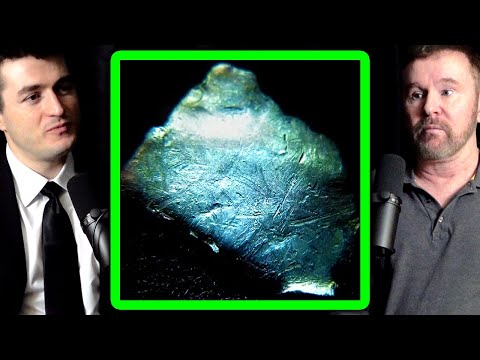
UFO Explosion Fragments from Ubatuba, Brazil
Stanford pathologist Garry Nolan discusses his own separate isotope testing of Ubatuba-linked fragments with Lex Fridman.
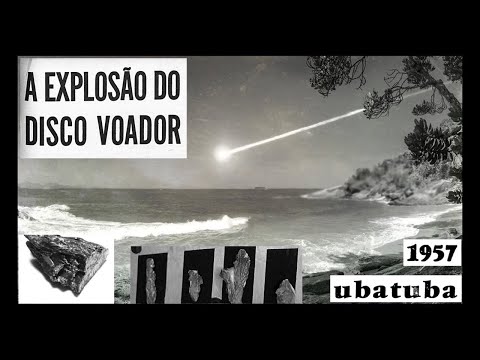
Exploded UFO (Ubatuba, Brazil, 1957): A 1964 Radio Broadcast
Archival audio discussion of the case's early material analysis, preserved and presented by Eyes On Cinema.
Sources
- Powell, Robert M.; Swords, Michael D.; Rodeghier, Mark; & Budinger, Phyllis. "Isotope Ratios and Chemical Analysis of the 1957 Brazilian Ubatuba Fragment," Journal of Scientific Exploration, Vol. 36, No. 1, Spring 2022, pp. 39–48. journalofscientificexploration.org
- Journal of Scientific Exploration. Full-text PDF of the above article (Download PDF). journalofscientificexploration.org
- Sturrock, Peter A. "Composition Analysis of the Brazil Magnesium," Journal of Scientific Exploration, Vol. 15, No. 1, 2001, pp. 69–95. researchgate.net
- Scientific Coalition for UAP Studies. "Isotope Ratios and Chemical Analysis of the 1957 Brazilian Ubatuba Fragment" (author summary). explorescu.org
- Fontes, Olavo T. "A Report on the Investigation of Magnesium Samples From a UFO Explosion Over the Sea in the Ubatuba Region of Brazil" (original 1957–58 report to APRO, archived). rr0.org
- UFO Evidence. "The Ubatuba, Brazil Fragments — Ubatuba, São Paulo, Brazil, 1957" (case summary with analysis chronology). ufoevidence.org
- UFO Casebook. "Ubatuba UFO Fragments — 1957." ufocasebook.com
- "UFO sightings in Brazil," Wikipedia. en.wikipedia.org
- "Ubatuba," Wikipedia (municipality geography, population, and history). en.wikipedia.org
- "Fritz Feigl," Wikipedia. en.wikipedia.org
- Encyclopedia.com. "Feigl, Fritz" (biographical entry, including his 1941 appointment to head Brazil's Ministry of Agriculture mineral production laboratory). encyclopedia.com
- Museu Brasileiro de Rádio e Televisão. "Ibrahim Sued" (biography). museudatv.com.br
- "Aerial Phenomena Research Organization," Wikipedia. en.wikipedia.org
- "Peter A. Sturrock," Wikipedia. en.wikipedia.org
- "Garry Nolan," Wikipedia. en.wikipedia.org
- National Capital Area Skeptics (NCAS). Condon Report full-text archive, including the Committee's 1968 Ubatuba fragment laboratory testing. files.ncas.org
- Lex Clips (Lex Fridman Podcast). "UFO explosion fragments from Ubatuba, Brazil | Garry Nolan and Lex Fridman," February 2022. youtube.com
- Vice. "Stanford Professor Garry Nolan Is Analyzing Anomalous Materials From UFO Crashes." vice.com
- "Antônio Vilas-Boas," Wikipedia (cross-referenced Brazilian case investigated by Olavo Fontes within weeks of Ubatuba). en.wikipedia.org
- Lorenzen, Coral E. & Lorenzen, Jim. Flying Saucers: The Startling Evidence of the Invasion From Outer Space, Signet, 1966.
- Walker, W.W. & Johnson, R.W. "Further Studies on the Ubatuba Magnesium Samples," 1970 (cited in Powell et al., 2022).
- Walker, W.W. "Scientific Studies of the Ubatuba Magnesium Fragments," 1992 (cited in Powell et al., 2022).
- Clark, Jerome. The UFO Encyclopedia, 4th Edition, Visible Ink Press, 2023.
- Wikimedia Commons. "Praia do Flamengo - Ubatuba.jpg," photograph by Stela Madruga, CC BY-SA 4.0. commons.wikimedia.org
See something inaccurate? Have additional information or sources?
Suggest an Edit →Last Updated: August 2026