
The Delphos Ring Sighting
Around 7:00 PM on November 2, 1971, sixteen-year-old Ronald Johnson was tending his family's sheep on their farm outside Delphos, Kansas when a glowing, mushroom-shaped object descended into a grove of trees roughly seventy-five feet away, hovered silently for several minutes, then climbed and departed in a blinding flash. When Ronald and his parents, Durel and Erma Johnson, returned to the spot, they found a glowing, doughnut-shaped ring of altered soil approximately eight feet across — dry, crusted, and strangely repellent to water — where the object had hovered. That ring outlasted the season, was still visible under snow more than a month later when physical-trace specialist Ted Phillips arrived to document it, and became the subject of chemical soil analyses performed nearly three decades apart by two independent chemists, Erol A. Faruk in the late 1980s and Phyllis A. Budinger in 1999, both of whom identified a genuine, non-volatile organic coating on the ring soil that did not match the surrounding, untouched ground. More than fifty years later, Delphos remains one of ufology's most laboratory-scrutinized physical-trace cases — and one of its most genuinely contested, caught between real, repeatable chemistry and equally real, unresolved conventional explanations.
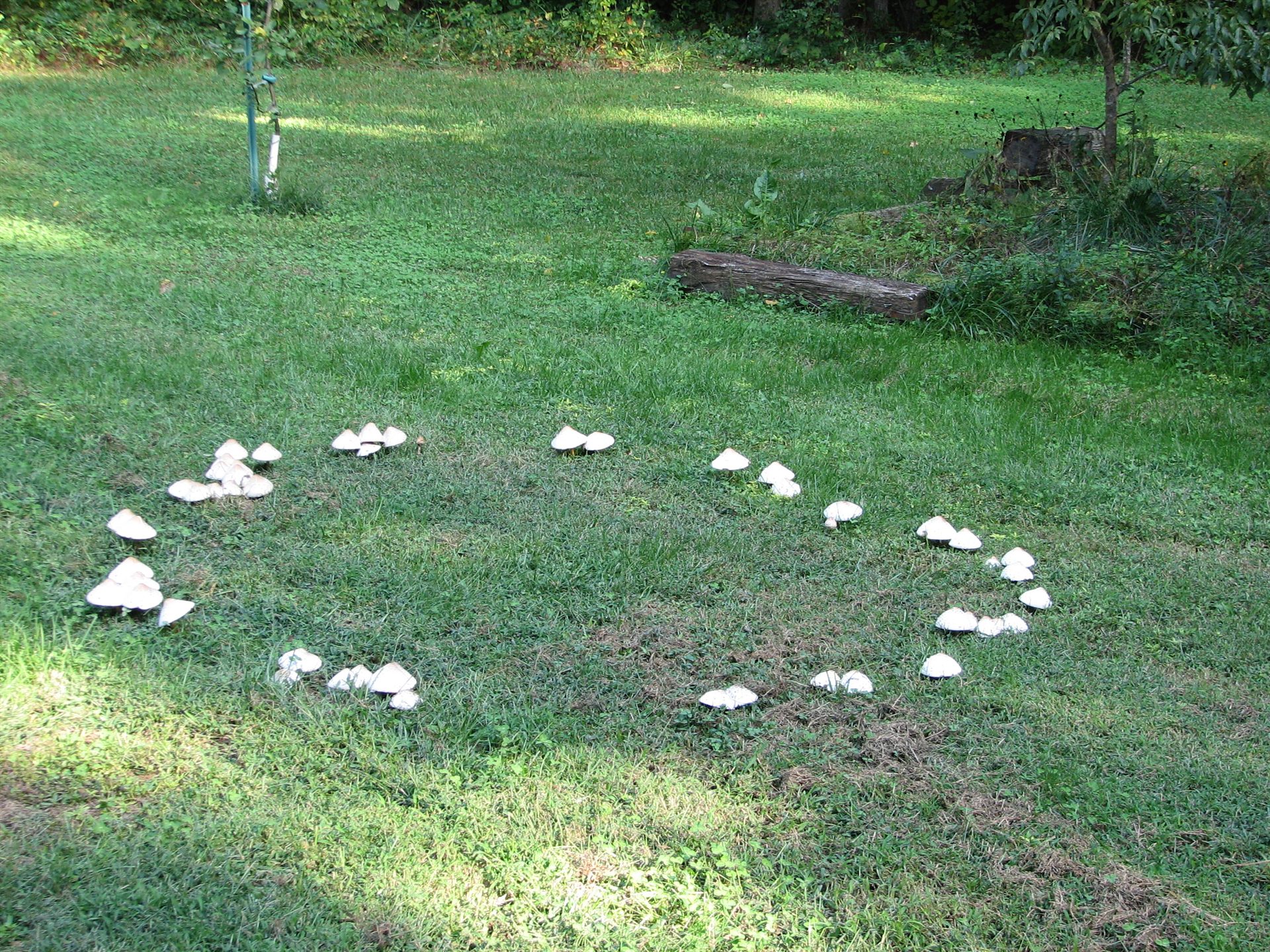
Pictured: a naturally occurring fungal "fairy ring," illustrating the conventional biological explanation some researchers have proposed for the Delphos ring — not a photograph of the Johnson farm itself. No public-domain or rights-clear image of the original 1971 ring is known to exist; the case's original news and investigative photographs remain under third-party copyright.
Theoretical Alignment
Delphos is, at its core, a chemistry dispute wearing a UFO sighting's clothes, and that shapes how it maps onto the standard hypotheses. The Extraterrestrial Hypothesis draws whatever support this case offers almost entirely from the ring's chemistry rather than from the sighting itself: a single teenage witness's account of a structured, glowing craft is the kind of report ufology logs by the thousands, but two independently commissioned chemical analyses, performed nearly thirty years apart, both found a real, non-volatile organic surface coating on the ring soil that did not match untouched control soil nearby — a genuinely unusual, repeatable physical finding that keeps ETH alive here in a way pure testimony could not. It is capped at a modest 25%, however, because neither analysis found anything unambiguously non-terrestrial in the coating's actual chemical makeup; both identified compounds — fulvic acid, calcium oxalate — that occur naturally in ordinary soil biology. The Interdimensional Hypothesis finds little purchase in a case built entirely around a physical soil deposit and a conventional-looking craft description, earning only a residual score. The Psycho-Social Hypothesis explains the initial sighting about as well as it explains any single-witness account, but it cannot on its own explain a chemically distinct residue that two independent chemists, using period-appropriate laboratory methods decades apart, both measured directly from preserved physical samples — soil chemistry is not something eyewitness misperception can manufacture after the fact, which is precisely why this case has survived on its physical evidence long after most single-witness 1970s sightings have faded from serious discussion.
Background
By November 1971, American ufology had spent nearly a quarter-century absorbing waves of eyewitness reports without ever settling on a body of physical evidence that both proponents and skeptics could examine together in a laboratory. Project Blue Book, the U.S. Air Force's public UFO investigation office, had closed nearly two years earlier in December 1969, leaving civilian organizations — the Aerial Phenomena Research Organization (APRO), the National Investigations Committee on Aerial Phenomena (NICAP), and, from 1973 onward, J. Allen Hynek's Center for UFO Studies (CUFOS) — to carry the burden of field investigation with no government funding or authority behind them. Within that landscape, a small but dedicated subset of investigators had begun arguing that eyewitness testimony alone, however sincere, could never resolve the UFO question, and that the field's future rested instead on cases that left something physical behind: scorched ground, broken vegetation, radiation traces, or chemically altered soil that could be sampled, preserved, and handed to a real laboratory.
The Johnson family — Durel and Erma Johnson and their teenage son Ronald — ran a modest sheep operation on a farm outside Delphos, a small farming community in Ottawa County, Kansas, roughly seventy-five miles north of Wichita and a short drive from the county seat of Minneapolis, Kansas. Like the vast majority of families who would go on to report a UFO encounter, the Johnsons had no documented prior interest in the subject, no connection to any UFO organization, and nothing in their public history to suggest they were seeking attention. Ronald's evening chores that first Tuesday of November were as ordinary as farm life gets: moving sheep near dusk, on a night made memorable only by what happened next.
Complete Timeline
| Date | Event |
|---|---|
| December 1969 | Project Blue Book, the U.S. Air Force's public UFO investigation office, formally closes, leaving civilian organizations to carry out field investigation with no government backing. |
| November 2, 1971, ~7:00–7:30 PM | Ronald Johnson, 16, tending sheep on the family farm near Delphos, Kansas, observes a glowing, mushroom-shaped object hovering roughly 75 feet away near a grove of trees. |
| Same evening | Ronald runs to the house; his parents Durel and Erma Johnson come outside in time to see the object climb, brighten intensely, and depart at high speed. |
| Same evening | The family finds a glowing, doughnut-shaped ring of altered soil roughly 8 feet in diameter at the site. Erma Johnson touches the material and her fingers go numb; the numbness reportedly persists for about two weeks. |
| Same evening | Farmer Lester Ensbarger, near Minneapolis, Kansas, independently reports a bright descending light in the Delphos area around 7:30 PM to a local deputy, unaware of the Johnsons' sighting. |
| November 3, 1971 | Local reporter Thaddia Smith visits the farm; the ring remains visible and dry despite overnight rain that has left the surrounding pasture muddy. |
| Within days | Ottawa County Undersheriff Harlan Enlow, Sheriff Ralph Enlow, and Kansas Highway Patrol Trooper Kenneth Yager visit the farm, photograph the ring, take a Geiger-counter reading (no abnormal radiation detected), and collect a soil sample. |
| Following weeks | Snowfall settles across the property except directly over the ring, which remains outlined in bare ground even as surrounding pasture is covered. |
| December 4, 1971 | Physical-trace investigator Ted Phillips makes his first visit to the farm, 32 days after the sighting, and documents the ring's persistence, dryness, and water-repellent surface. |
| March 12, 1972 | The National Enquirer publicly announces a "blue ribbon panel" competition, drawing on APRO-affiliated scientific consultants, to award $5,000 for the most scientifically valuable UFO evidence of the year — roughly four months after the Delphos sighting had already occurred and been reported. |
| May 27, 1973 | The National Enquirer announces the Johnson family has won the $5,000 prize for the most scientifically valuable UFO evidence of 1972, intensifying public scrutiny of the case and fueling hoax-for-profit suspicions. |
| 1973–1975 | Jacques Vallée and other researchers examine the white, fibrous material recovered from the ring; a biological laboratory identifies it as belonging to the bacterial order Actinomycetales, a filamentous, fungus-like group associated in some conditions with bioluminescent Basidiomycete fungi. |
| 1975 | Utah State University plant physiologist Frank B. Salisbury serves on a National Enquirer-convened scientific panel, alongside J. Allen Hynek, examining the Delphos evidence and other leading physical-trace cases. |
| 1985 | Ted Phillips publishes further findings on the Delphos case in the MUFON UFO Journal, drawing on more than a decade of continued contact with the Johnson family and repeated site visits. |
| 1989 | British organic chemist Erol A. Faruk, working with soil samples obtained through the University of Nottingham, publishes "The Delphos Case: Soil Analysis and Appraisal of a CE-2 Report" in the Journal of UFO Studies, identifying a water-soluble organic compound coating the ring soil. |
| September–October 1997 | Physicist Peter A. Sturrock convenes a four-day scientific workshop at the Pocantico Conference Center in Tarrytown, New York, reviewing physical evidence associated with UFO reports, including ground-trace cases from the same broad evidentiary category as Delphos. |
| December 7, 1998 | Preserved Delphos soil samples, held for years in CUFOS field investigator John Timmerman's personal files after the organization's Chicago office closed, reach analytical chemist Phyllis A. Budinger for renewed laboratory analysis. |
| January 27, 1999 | Budinger issues a technical addendum to her analysis, identifying the ring soil's non-volatile surface coating as roughly 85% fulvic acid and 5% calcium oxalate by composition, concluding the material was "neither proved nor ruled out" as being of extraordinary origin. |
| 2014 | Erol Faruk, with co-author Michael D. Swords, publishes The Compelling Scientific Evidence for UFOs: The Analysis of the Delphos, Kansas UFO Landing Report, situating his original findings within the broader Sturrock Panel review of UFO physical evidence. |
Tending Sheep at Dusk: Ronald Johnson's Sighting
Ronald Johnson's account, repeated consistently across more than five decades of interviews, begins with nothing more dramatic than an ordinary farm chore. Around seven o'clock on the evening of November 2, 1971, the sixteen-year-old was moving his family's sheep near a grove of trees at the edge of their Ottawa County pasture, accompanied, in some retellings of the story, by the family dog. What caught his attention was a glow near the trees that did not belong there — not a farm light, not a passing vehicle, but a self-luminous object hovering low, close to ground level, roughly seventy-five feet from where he stood. Johnson would later describe it as mushroom- or inverted-bowl-shaped, somewhere between eight and ten feet in diameter and roughly as tall, its entire surface washed in shifting, multicolored light — reds, oranges, and blues cited in various retellings — hovering a foot or two off the ground rather than resting on it. He recalled a low mechanical noise, likened in his own words to the vibration of "an old washing machine," emanating from the object as it hung motionless in the dusk air.
He watched it for what he estimated to be several minutes, transfixed and, by his own account, too startled to immediately run. Some retellings of Johnson's story note that he later found himself unable to account for a gap of roughly thirty minutes between when he believed he first noticed the object and when he finally reached the house — a detail treated cautiously by researchers, since missing-time claims are notoriously difficult to verify against any independent clock, but one Johnson himself raised unprompted rather than one investigators suggested to him. When the object began to rise, it brightened dramatically, and by his account and his parents' independent recollection, its ascent culminated in the object appearing "as big as the full moon" at its brightest before shrinking rapidly from view. Johnson ran for the farmhouse the moment the object began its climb.
The Object Departs and the Ring Is Found
Durel and Erma Johnson came outside at their son's urgent call in time to see only the encounter's final act: an intensely bright object rising rapidly from the direction of the tree grove before vanishing into the darkening sky. Neither parent witnessed the object's earlier, stationary hover the way Ronald had; their corroboration covers the departure and, more importantly, everything that followed once the three of them walked out together to the spot where Ronald said the object had been. What they found was a distinct, roughly circular disturbance in the ground — a ring shaped, in the recollection of multiple witnesses and later investigators, "like a big doughnut," with a drier, crusted rim and a similarly dry interior, sitting in stark visual contrast to the surrounding pasture, which recent rain had left soft and muddy. The ring measured approximately eight feet across. According to the family's account, it was still faintly glowing when they examined it that first night, a detail that would become one of the case's most frequently repeated — and least independently verifiable, since no outside witness saw the glow directly — claims.
Investigators who reached the property in the following days, including local newspaper reporter Thaddia Smith and Ottawa County law enforcement, confirmed the ring's basic physical description independently of the family: a well-defined, roughly circular zone of altered, unusually dry soil, sharply distinct from the surrounding wet ground, with a crusted texture some described as feeling almost crystallized underfoot. Investigators also noted damage in the same grove of trees where Ronald said the object had hovered — a broken branch or dead limb the family had not previously reported — though the connection between that damage and the object's presence, unlike the ring itself, was never independently dated or tested.
Numbness, Nightmares, and a Family's Physical Aftermath
What elevated the Delphos case beyond a visual sighting with an odd ground mark was the family's own physical reaction to the ring material, reported independently by more than one of them in the days that followed. Erma Johnson, examining the ring soon after it was found, picked up some of the crusted material directly; her fingers reportedly went numb on contact. When she attempted to wipe the substance off on her leg, the numbness spread to the patch of skin it touched there as well. By most accounts, the numbness in her fingers persisted, gradually fading, for roughly two weeks — though the family did not seek medical attention for the symptom, meaning no clinical record exists to independently confirm its severity or duration. Ronald, for his part, reported that his eyes became red, watery, and unusually sensitive to light in the day or two following the sighting, as though irritated by something well beyond an ordinary flashlight or headlight glare, and for roughly a week afterward he reportedly suffered nightmares severe enough to wake him screaming.
These physiological effects sit at an awkward evidentiary midpoint: they are exactly the kind of detail proponents cite as evidence the family encountered something physically real rather than merely visually striking, since a purely visual misperception would not obviously explain contact numbness or delayed eye irritation. At the same time, none of the symptoms were medically documented at the time, all were self-reported after the fact by the same three family members whose broader testimony is already central to the case, and the eventual 1999 chemical finding that the ring's coating contained calcium oxalate — a compound recognized as a skin and mucous-membrane irritant — offers a plausible, non-exotic chemical explanation for at least the numbness and eye irritation, whatever ultimately explains how that compound came to be concentrated on the ring's surface in the first place.
Undersheriff Enlow, Trooper Yager, and the First Official Investigation
Unlike many rural UFO reports that never reach any official channel, the Johnsons' account was examined by Ottawa County law enforcement within days of the sighting, giving the case an early layer of independent, professional corroboration that many single-family reports lack. Undersheriff Harlan Enlow and Sheriff Ralph Enlow visited the farm, interviewed the family, and personally examined the ring; Enlow's own written account described a "doughnut" shape with a completely dry interior and rim set against muddy ground outside its boundary — language that matches the family's description independently rather than simply repeating it. Kansas Highway Patrol Trooper Kenneth Yager joined the investigation, and together the officers photographed the site and collected a soil sample for safekeeping, along with taking a Geiger-counter reading that registered no abnormal radiation over the ring. In later retrospective coverage, Enlow was quoted describing his own reaction to the scene in blunt, non-technical terms — recalling a "white dry ring" sitting "in the middle of a mud field" like "a big donut," and stating that he personally found the Johnsons' account credible. That kind of on-the-record law-enforcement assessment, delivered by an official with no evident stake in the outcome, is one of the stronger pieces of circumstantial support in the case's favor, even though it speaks only to the ring's physical existence and the family's apparent sincerity, not to what actually produced either one.
Ted Phillips and the Physical-Trace Case Tradition
Ted Phillips reached the Johnson farm on December 4, 1971 — thirty-two days after the sighting — already established within American ufology as one of its foremost specialists in physical ground-trace evidence, a niche he had built specifically because he shared the view that eyewitness testimony alone could never resolve the UFO question. What Phillips found on his first visit was a ring still clearly defined more than a month after the encounter: dry, distinctly outlined, and, in a detail he and later investigators returned to repeatedly, still visibly water-repellent when tested by pouring water directly onto the ring soil, which beaded and ran off the surface rather than soaking in. Phillips continued to track the case for years afterward, maintaining contact with the Johnson family, revisiting the property, and eventually publishing further findings in the MUFON UFO Journal in 1985. His broader career-defining project, the 1975 CUFOS-published catalog Physical Traces Associated with UFO Sightings: A Preliminary Catalog, situated Delphos within a growing database of ground-trace reports Phillips continued expanding across the following decades, ultimately amassing thousands of catalogued incidents and helping to establish trace-case investigation as a distinct methodology within a field otherwise dominated by testimony collection. Phillips's consistent public position on Delphos specifically was that it represented one of the best-documented physical-trace cases on record — a case that, whatever ultimately explained it, had generated real, preserved, laboratory-testable material rather than only memory.
The Ring That Would Not Melt
Among the case's most-cited, if hardest to independently verify, details is the ring's behavior under snow. As winter set in on the Ottawa County property in the weeks following Phillips's first visit, investigators and the family both reported that snowfall settled evenly across the pasture except directly over the ring itself, which remained bare, its circular outline preserved in negative relief against the surrounding white field. Proponents have read this as consistent with a persistent thermal or chemical difference in the ring soil relative to its surroundings — whether from a residual heat source, an altered soil-moisture profile, or the same hydrophobic coating later confirmed chemically, snow simply not accumulating the way it did nearby. Skeptics note that a compacted or otherwise disturbed patch of ground can shed snow differently than surrounding vegetation for entirely mundane reasons having nothing to do with any exotic cause, and that no controlled thermal measurement was ever taken to distinguish between these explanations at the time. What is not in dispute is that the ring's basic visual outline demonstrably persisted through at least one Kansas winter, observed independently by multiple parties rather than reported only by the family — a level of physical durability well beyond what most reported UFO ground traces, which typically fade or are plowed under within days, ever achieve.
Erol Faruk and the First Detailed Chemical Analysis
Erol A. Faruk, a British organic chemist with a doctorate in the organic synthesis of carotenoid pigments and a career background spanning postdoctoral research at Oxford and Nottingham followed by long-term work as a pharmaceutical development chemist, took up the Delphos soil samples in the 1970s and completed a detailed chemical workup published in 1989 as "The Delphos Case: Soil Analysis and Appraisal of a CE-2 Report" in the Journal of UFO Studies, the peer-reviewed journal of the Center for UFO Studies. Working with the assistance of Frank Palmer at the University of Nottingham, Faruk identified a highly water-soluble organic compound coating the ring soil — described in his analysis as an alkali-metal salt of an organic carboxylic acid, with properties he characterized as potentially chemiluminescent, meaning capable of producing light through a chemical reaction rather than combustion or electrical excitation. Faruk explicitly considered and weighed the two leading conventional alternatives in his own published analysis: a deliberate hoax, which he judged unlikely given the compound's unusual chemical characteristics and its consistent orientation relative to the reported wind direction on the night of the sighting, and a naturally occurring fairy-ring fungal growth, which he argued the compound's specific chemistry did not straightforwardly explain either. His conclusion, stated with more confidence than most subsequent researchers have been willing to commit to, favored an extraordinary origin for the coating. Faruk's later, self-published 2014 book with co-author Michael D. Swords, The Compelling Scientific Evidence for UFOs: The Analysis of the Delphos, Kansas UFO Landing Report, revisited and expanded on his original findings, explicitly situating them within the broader framework of the 1997 Sturrock Panel's review of UFO physical evidence.
The National Enquirer's $5,000 Award and the Hoax Question
No account of Delphos is complete without confronting its most persistent shadow: money. On March 12, 1972 — roughly four months after the Johnsons' sighting had already occurred, been reported to local law enforcement, and been covered in the local press — the National Enquirer publicly announced a "blue ribbon panel" competition, drawing on scientific consultants largely affiliated with APRO, to award $5,000 to whoever supplied the most scientifically valuable UFO evidence of the year. On May 27, 1973, the tabloid announced the Johnson family as that year's winner, citing the Delphos ring as the most scientifically compelling physical evidence submitted. The prize inevitably invited the obvious skeptical reading: a financially struggling farm family fabricates a story and a ring for a cash reward. Researchers sympathetic to the case's authenticity have consistently pointed to the specific timing as the strongest available rebuttal — the Johnsons reported their sighting to Ottawa County law enforcement and the local press in early November 1971, months before the National Enquirer's competition even existed as a public incentive, making a premeditated hoax for that specific prize logically difficult, though it does not rule out either an opportunistic hoax staged for some other or no clear reason, or a family that told the truth and simply happened to be believed and rewarded for it later. Frank B. Salisbury, the Utah State University plant physiologist who joined a 1975 National Enquirer-convened scientific panel examining Delphos and other leading trace cases alongside J. Allen Hynek, is reported to have acknowledged the theoretical possibility of a hoax for financial gain even while regarding the underlying physical evidence as difficult to dismiss outright — a genuinely split assessment from a credentialed scientist who examined the case directly rather than secondhand.
Phyllis Budinger's 1999 Re-Analysis
The case's physical evidence might have ended with Faruk's 1989 paper had the original soil samples not survived in storage for another decade. Preserved samples had been kept for years in the personal files of CUFOS field investigator John Timmerman, following the organization's Chicago office closure, and on December 7, 1998 those samples reached analytical chemist Phyllis A. Budinger for a fresh, methodologically updated examination using laboratory techniques — including gas chromatography and infrared spectroscopy — that had advanced considerably since Faruk's original 1970s-era workup. Budinger's technical report, followed by an addendum issued January 27, 1999, offered the most granular chemical breakdown the case has ever received: a non-volatile coating amounting to roughly 2–3% of the ring soil's total weight, composed of approximately 85% (±10%) fulvic acid, a humic substance typically associated with biologically rich, mull-type soil humus; roughly 5% (±2%) calcium oxalate, a recognized skin and mucous-membrane irritant; about 1% calcium carbonate; and trace quantities of phosphate, sulfate, and sulfide- or mercaptan-type compounds. Crucially, Budinger's report reached a materially more cautious conclusion than Faruk's original 1989 paper: the coating had most likely been deposited onto the soil surface as an aqueous solution, its hydrophobic "beading" effect was attributable specifically to the fulvic-acid fraction and could be dissolved and removed with sufficient water and agitation, and — in the report's own explicit, frequently quoted phrasing — the analysis "neither proves nor rules out" an extraordinary source for the material. Budinger's team also noted the coating's concentration at the soil surface, rather than blended through the profile the way naturally accumulated humus typically would be, as the specific detail that kept a purely mundane explanation from fully closing the case.
The Sturrock Panel and the Wider Scientific Reception
In late September and early October 1997, physicist Peter A. Sturrock convened a four-day scientific workshop at the Pocantico Conference Center in Tarrytown, New York, under the auspices of the Society for Scientific Exploration, bringing together a panel of physical scientists to review the strongest available physical evidence associated with UFO reports — ground traces, radar returns, photographic material, and physiological effects among them — and assess whether continued investigation of such evidence was likely to be scientifically productive. The workshop's proceedings were published the following year, and Sturrock later distilled the project into his own 1999 book, The UFO Enigma: A New Review of the Physical Evidence. Delphos-type ground-trace evidence fell squarely within the categories of physical evidence the panel examined, and Faruk's own later book explicitly framed his Delphos findings as a direct contribution to that broader Sturrock Panel evidentiary review — one specific, laboratory-documented case offered as a test of whether the field's best physical evidence could withstand structured scientific scrutiny. The panel's own broader published conclusion was measured rather than triumphant: physical evidence of the kind Delphos represents was judged worth further study, not proof of anything, an assessment that maps closely onto how the Delphos soil chemistry itself has been received — genuinely unusual, genuinely worth taking seriously, and genuinely short of a decisive answer.
Skeptical Counter-Explanations: Fungus, Fairy Rings, and the Sheep Trough
Two distinct conventional explanations have been proposed for the ring itself, independent of the hoax question, and both deserve to be taken seriously on their own terms rather than dismissed reflexively. The first traces back to the white, fibrous material recovered from the ring soil, which a biological laboratory identified as belonging to Actinomycetales, an order of filamentous, gram-positive bacteria with a fungus-like growth habit that includes genera such as Nocardia and Streptomyces. Researcher Jacques Vallée discussed this identification at length in his book Dimensions: A Casebook of Alien Contact, noting that Actinomycetales organisms are sometimes found growing in association with Basidiomycete fungi capable of bioluminescence or fluorescence under certain conditions — raising the possibility that some triggering event, not necessarily anything exotic, spurred an unusually rapid, ring-shaped colonization of these organisms at that specific spot and moment. This is, in effect, a scientifically informed version of the much older "fairy ring" folk explanation for circular marks in grass and soil, which are in fact a well-documented natural phenomenon caused by fungal mycelium spreading outward from a central point. The difficulty for this explanation, acknowledged even by researchers otherwise sympathetic to a biological origin, is that it does not straightforwardly account for the ring's reported glow on the night of the sighting, its specific coincidence with the timing of Ronald Johnson's encounter rather than appearing independently at some unconnected point in the growing season, its unusually rapid appearance rather than the gradual weeks-to-months development typical of a genuine fairy ring, or the family's numbness and eye irritation.
The second leading conventional theory, advanced by longtime professional UFO skeptic Philip J. Klass, proposed a far more mundane mechanical origin: that the ring soil's altered chemistry and circular shape resulted from years of sheep congregating and urinating around a water trough that had once stood at that spot on the property, with mineral and organic residue building up in a ring pattern around the trough's base long before the trough itself was removed, leaving a chemically distinct circle in the soil that simply happened to be where Ronald Johnson later reported seeing his object. This explanation has the appeal of requiring no fungal growth spurt, no glow, and no unusual chemistry beyond ordinary livestock waste accumulation — but researchers who examined the site, including Faruk, have argued it struggles to explain the specific chemical profile the 1999 Budinger analysis actually documented, since calcium oxalate and fulvic-acid-dominated coatings are not the signature analysts would most readily expect from long-term sheep urine deposition, and it offers no mechanism at all for the reported glow, the family's contact numbness, or the ring's sudden, dated appearance on a single specific night rather than a gradual accumulation with no clear starting point. Neither the fungal-ring theory nor the sheep-trough theory has ever been definitively confirmed against the site's actual physical layout or ruled out by a direct, independent test; both remain live, unresolved candidates precisely because no one — proponent or skeptic — has ever produced the kind of dispositive follow-up study that would settle the matter either way.
Legacy: Delphos in the Physical-Trace Case Tradition
More than fifty years on, Delphos occupies a specific and durable niche in ufology's own internal hierarchy of evidence: not among the most spectacular sightings, and not among the cases with the largest number of witnesses, but consistently cited by researchers as one of the field's best examples of a genuinely reproducible, laboratory-testable physical trace. It appears in Jerome Clark's UFO Encyclopedia and in Jacques Vallée's published casework, was the subject of dedicated MUFON and CUFOS journal articles across three separate decades, and remains a frequent reference point whenever researchers discuss what a genuinely well-documented physical-trace case ought to look like. Kansas regional press has continued to describe Delphos as arguably the strongest single piece of UFO evidence to emerge from the state, distinct from the state's separate, self-styled "UFO Capital" tourist attraction built around the small town of Geneseo, roughly seventy-five miles to the southwest, whose own UFO-themed local museum and festival commemorate an unrelated set of Kansas sightings rather than the Johnson farm specifically. Some retrospective accounts report that the Johnson family found the years of continued public and investigative attention genuinely difficult, describing lasting strain on the household, while other secondary sources have claimed Ronald Johnson came to believe he had developed heightened intuitive or psychic sensitivities following the encounter — a claim considerably less rigorously documented than the case's physical evidence and one this catalogue treats as a loosely sourced personal account rather than an established fact. What is comparatively well established is that the family, tired of decades of trespassing UFO enthusiasts and continued attention, eventually chose to fill in and bury the original ring site rather than continue preserving it as a visible landmark — a quiet, practical ending for a case whose central piece of evidence spent most of its existence being measured, sampled, and argued over rather than simply left alone.
Circumstantial Evidence
- Ottawa County Undersheriff Harlan Enlow and Sheriff Ralph Enlow independently examined and photographed the ring within days, describing it in terms matching the family's account without having witnessed the object themselves.
- A Geiger-counter reading taken at the scene by law enforcement registered no abnormal radiation, ruling out one specific category of exotic contamination while leaving the ring's actual chemistry unexplained.
- The ring's dry, crusted, water-repellent character and general shape were independently confirmed by multiple parties — family, local press, law enforcement, and Ted Phillips — over a period of weeks, rather than resting on a single account.
- The ring remained visibly outlined against snow cover more than a month after the sighting, a level of physical persistence unusual among reported UFO ground traces, most of which fade or are disturbed within days.
- Two independent chemists, working nearly three decades apart with different laboratory methods, both confirmed a genuine, non-volatile organic surface coating on preserved ring soil that did not match control soil from just outside the ring.
- The National Enquirer's cash-prize competition was not publicly announced until roughly four months after the Johnsons had already reported their sighting to local authorities and the press, complicating a premeditated hoax-for-money explanation.
- Neither leading conventional counter-theory — the fairy-ring/Actinomycetales fungal explanation or Philip Klass's sheep-trough theory — has ever been definitively confirmed against the site's documented chemistry, leaving both live but unproven.
Key Witnesses
Ronald Johnson
Sixteen years old at the time, Ronald was tending his family's sheep near a grove of trees on the family farm when he observed a glowing, mushroom-shaped object hovering roughly seventy-five feet away. He was the only witness to the object's full approach and stationary hover; his parents saw only its departure after he ran to alert them. He reported temporary eye irritation and light sensitivity in the days following the sighting and nightmares severe enough to wake him screaming for about a week afterward. He never materially altered his account across more than five decades of interviews with journalists and investigators.
Durel & Erma Johnson
Alerted by their son, Durel and Erma Johnson reached the pasture in time to see the object climb rapidly, brighten to what they described as the apparent size of the full moon, and vanish. Together with Ronald, they discovered the glowing soil ring afterward. Erma directly handled the ring material and reported her fingers going numb on contact, with the numbness reportedly persisting for roughly two weeks; she never sought medical treatment for the symptom. Neither parent witnessed the object's earlier stationary hover.
Ted Phillips
Arriving at the Johnson farm on December 4, 1971 — thirty-two days after the sighting — Phillips documented the ring's persistence, its dry, crusted, water-repellent surface, and its continued visibility outlined against winter snow. He maintained contact with the family for years afterward, published further Delphos findings in the MUFON UFO Journal in 1985, and situated the case within his broader career-defining catalog of physical ground-trace reports, Physical Traces Associated with UFO Sightings (1975), which helped establish trace-case documentation as a distinct methodology within UFO field investigation.
Erol A. Faruk
A British organic chemist with postdoctoral research experience at Oxford and Nottingham, Faruk obtained preserved Delphos soil samples through the University of Nottingham and published the case's first detailed chemical analysis in the Journal of UFO Studies in 1989, identifying a water-soluble organic compound coating the ring soil that he judged difficult to explain as either a simple hoax or an ordinary fungal fairy ring. His 2014 book with Michael D. Swords, The Compelling Scientific Evidence for UFOs, expanded on his findings and connected them to the 1997 Sturrock Panel's broader review of UFO physical evidence.
The Five Observables Assessment
The Five Observables framework, developed by former AATIP director Luis Elizondo, is designed to classify witnessed UAP flight performance against the limits of known technology. Delphos is a poor structural fit for that framework, and it is worth saying so plainly: this is a landed, physical-trace case built around a brief, close-range hover and departure witnessed primarily by one teenager, not an instrumented flight-dynamics event with tracked speed, altitude, or maneuvering data. Most of the standard performance observables below were simply never measured or reported by anyone, rather than genuinely absent from an observed craft, and the assessment reflects that honestly rather than inferring flight characteristics no instrument or trained observer ever recorded.
Assessment: Anti-Gravity Lift is rated speculative rather than present because the object was described as hovering a foot or two off the ground with no visible support — consistent with a genuinely novel lift mechanism, but based entirely on one witness's visual impression rather than any instrumented measurement, and equally consistent with a much more mundane light source at close range. Instant Acceleration is similarly speculative: Ronald Johnson described the object's final climb and departure as rapid and accompanied by a dramatic increase in brightness, but no timed or instrumented measurement of its actual speed exists. Hypersonic Velocity is rated absent, since no witness made any claim of extreme speed comparable to cases involving trained aviation observers. Low Observability is rated absent, since the object was, by every account, extremely bright and conspicuous rather than stealthy. Trans-Medium travel does not meaningfully apply to a case in which the entire reported event took place near ground level over farmland with no medium transition of any kind — a marker of the case's fundamental category, a landed CE2 physical-trace report, rather than a flight-performance data point. The larger point stands: Delphos's evidentiary weight rests almost entirely on what was left on the ground after the object departed, not on any performance characteristic of the object itself while it was in the air.
Evidence Assessment
Supporting Anomalous Origin
- Ottawa County law enforcement independently examined, photographed, and sampled the ring within days, corroborating its physical existence and basic description without having witnessed the object.
- The ring persisted, visibly and physically distinct from surrounding ground, for at least several months, including remaining outlined against winter snow cover more than a month after the sighting.
- Erol Faruk's 1989 chemical analysis and Phyllis Budinger's independent 1999 re-analysis, using different laboratory methods nearly three decades apart, both confirmed a genuine, non-volatile organic coating on the ring soil not present in control soil nearby.
- A Geiger-counter reading taken at the scene ruled out one specific category of exotic contamination while leaving the ring's actual chemical anomaly unexplained.
- The National Enquirer's cash-prize competition was not publicly announced until roughly four months after the family had already reported the sighting to local authorities and the press, complicating a premeditated hoax-for-money reading.
- Ted Phillips, one of ufology's most experienced physical-trace investigators, personally examined the site repeatedly over more than a decade and consistently described the family as credible.
- None of Ronald Johnson's, Durel Johnson's, or Erma Johnson's core accounts materially changed across more than five decades of subsequent interviews.
Supporting Conventional Explanation
- The sighting of the object itself rests on a single sixteen-year-old primary witness; his parents corroborated only its final, most ambiguous departing seconds.
- The family ultimately received a $5,000 National Enquirer prize for the case, a real and eventually substantial financial incentive, however imperfectly timed relative to the original report.
- A biological laboratory identified white fibrous material in the ring as Actinomycetales, an organism associated with naturally occurring, sometimes bioluminescent, fairy-ring-type growth patterns.
- Philip Klass's sheep-trough hypothesis offers a fully mundane mechanism — years of livestock waste accumulation around a since-removed water trough — requiring no exotic explanation for the ring's basic chemistry or shape.
- Phyllis Budinger's 1999 analysis identified the ring coating's dominant component, fulvic acid, as a common humic substance and explicitly stated the findings "neither prove nor rule out" an extraordinary origin.
- No independent, controlled test has ever directly compared the ring's specific chemistry against either a documented natural Actinomycetales colonization or an actual sheep-trough residue sample from a comparable Kansas farm site.
Why "Disputed"
The Delphos Ring Sighting earns a DISPUTED classification because it is a case defined, more than almost any other in this catalogue, by real and repeatable laboratory evidence sitting in genuine, unresolved tension with equally credible conventional alternatives. On the strength side: this is not a case of memory alone. A ring of physically altered soil was independently examined and photographed by Ottawa County law enforcement within days of the sighting; it persisted, visibly, for months, including remaining outlined against snow cover; and two separate chemists, working with preserved physical samples using different analytical methods nearly thirty years apart, both confirmed — independently of one another and independently of the family's testimony — that the ring soil carried a genuine, non-volatile organic coating that did not match soil taken from immediately outside its boundary. That level of repeatable, laboratory-confirmed physical evidence is rare in ufology, and it is the single strongest reason this case has remained a reference point for physical-trace researchers for more than fifty years. On the other hand, the sighting itself rests on one sixteen-year-old witness for its most important details, with his parents corroborating only the object's final, most ambiguous seconds; a real financial incentive entered the picture within two years of the event, however imperfectly its timing maps onto a premeditated hoax; and neither leading conventional explanation for the ring — a rapid, coincidentally timed fungal/Actinomycetales growth event, or long-term chemical residue from a since-removed sheep trough — has ever been rigorously tested against the site and definitively eliminated, even by the researchers most sympathetic to an extraordinary explanation. Both Erol Faruk's 1989 analysis and Phyllis Budinger's more cautious 1999 re-analysis reached the same honest bottom line in different words: something real and chemically unusual was there, and neither proves nor disproves what put it there. That is precisely the profile of a genuinely disputed case — not a case built on weak or absent evidence, but one built on strong, specific, still-unreconciled evidence that credentialed researchers on multiple sides have examined directly and still cannot fully agree on.
Sensor & Instrumentation Detection Profile
No radar, camera, or government sensor of any kind recorded the Delphos encounter as it happened; Project Blue Book had only fifteen months left before its December 1969 closure would have made it moot in any case, and no military or civil aviation facility was in a position to track a low-altitude object over rural Ottawa County farmland. The case's only "instrumentation" arrived after the fact, in the hands of investigators examining what the object left behind. Ottawa County Undersheriff Harlan Enlow and Sheriff Ralph Enlow brought a Geiger counter to the farm within days of the sighting and recorded no abnormal radiation reading over the ring, a negative finding that at least ruled out one category of exotic contamination. Every other piece of analytical instrumentation applied to this case came far later and was aimed not at the object but at the soil: Erol A. Faruk's late-1980s organic-chemistry workup at the University of Nottingham, and chemist Phyllis A. Budinger's 1998–1999 re-analysis of preserved samples using period-current analytical chemistry techniques including gas chromatography and infrared spectroscopy. That both analyses were performed on soil rather than on any recording of the object itself is the single most important structural fact about this case: Delphos is not an instrumented sighting in the way a radar-visual case is; it is an instrumented aftermath, and everything the case can actually prove or disprove runs through the chemistry of what was left on the ground rather than through any direct measurement of what Ronald Johnson said he saw.
Environmental & Geospatial Context
The Johnson farm sat in the gently rolling wheat and sorghum country of Ottawa County, Kansas, a sparsely populated agricultural county in the Smoky Hills region north of Salina, with the small community of Delphos itself — population well under a thousand even at its historical peak — a short drive away. Early November in north-central Kansas brings cold, often damp evenings; the Johnsons and multiple later investigators specifically noted that recent rain had left the ground around the ring muddy and saturated, which made the ring's own bone-dry interior — reported dry to a depth of roughly one foot even as the surrounding pasture was soft with mud — stand out sharply to everyone who examined it in the days that followed. That contrast recurred through the following winter: when snow blanketed the property weeks later, observers recorded that it settled everywhere except directly over the ring, outlining its circumference in bare ground against an otherwise white field. The sighting occurred at a grove of trees at the edge of the sheep pasture, and investigators subsequently noted damage to at least one tree in that grove — a broken branch or dead limb consistent, in the family's account, with the object's arrival or departure. No nearby military installation, airport, or industrial facility offers an obvious source of stray radar, aircraft lighting, or chemical runoff; Ottawa County in 1971 was, and remains, thinly populated ranch and farm country with little to explain an isolated bright light other than the ordinary rural traffic of the era.
Observer Credibility & Occupational Profile
The case's evidentiary weight rests heavily on a single family with no prior involvement in ufology and no obvious motive to fabricate a story at the moment it happened. Ronald Johnson, sixteen years old and engaged in the utterly mundane task of moving sheep at dusk, was the only witness to the object's full approach and hover; his parents, Durel and Erma Johnson, saw only its final, most dramatic moments — an intensely bright object climbing away — after Ronald ran to fetch them. That distinction matters for how the case should be weighed: it is not a three-witness sighting of the full event, but a one-witness sighting of the encounter corroborated by a two-witness sighting of its departure, plus a family-wide sighting of the physical aftermath. None of the three had any documented history of UFO interest before that November evening, and their willingness to call in Ottawa County law enforcement within days — inviting official scrutiny rather than avoiding it — is generally read by proponents as inconsistent with a family trying to avoid outside attention. Working against that credibility profile is the same complication that shadows several of ufology's best-known trace cases: eighteen months after the sighting, the National Enquirer's "blue ribbon" panel of UFO consultants awarded the family $5,000 for supplying what the panel judged the most scientifically valuable UFO evidence of 1972, introducing a financial incentive that a small farm family would not have had at the moment they first reported the sighting, since the Enquirer's competition was not publicly announced until roughly four months after the encounter. Ted Phillips, who visited the family repeatedly over the following years as part of his broader physical-trace research, consistently described them as credible and non-sensationalized in his own field reports.
Physical & Material Assays
Delphos is defined by its physical evidence in a way few UFO cases are: rather than a photograph or a radar track, the record consists of an actual, sampled, laboratory-analyzed patch of altered soil that multiple investigators examined in person over a period of years. The ring itself was roughly eight feet in diameter, shaped like a doughnut with dry ground both inside and along the raised crust of its rim, contrasted against muddy, waterlogged pasture immediately outside its boundary. Witnesses and early investigators described the ring soil as slick and crusted, almost as though crystallized, and reported that it continued glowing faintly after dark on the night of the sighting. Undersheriff Harlan Enlow's contemporaneous investigation collected a soil sample and photographed the ring within days; Ted Phillips's more detailed physical-trace examination, beginning with his first visit on December 4, 1971 — thirty-two days after the sighting — documented that the ring remained clearly defined, water-repellent, and, once winter snow arrived, visibly outlined by bare, snow-free ground even as the surrounding field lay under a white blanket. Decades later, two independent chemists working from preserved samples of that same soil — Erol A. Faruk in analysis published in 1989, and Phyllis A. Budinger in a technical report issued in December 1998 with a follow-up addendum in January 1999 — both confirmed that the ring soil carried a genuine non-volatile organic coating, distinct from surrounding control soil, that repelled water on contact. Budinger's more detailed 1999 breakdown identified that coating as roughly 2–3% of the ring soil's total weight, composed mostly of fulvic acid (a common humic substance associated with biologically active soil) alongside a smaller fraction of calcium oxalate, a compound recognized as a tissue irritant that could plausibly account for the family's reported numbness and eye irritation. Neither analysis, in its own authors' words, proved or disproved an extraordinary origin for the coating; both established only that something real and chemically identifiable had been deposited on the ring's surface, and that it did not match soil taken from just outside the ring's boundary.
Historical Precedents & Archive Matches
Delphos belongs to a specific, well-defined sub-genre of UFO reporting: the Close Encounter of the Second Kind, or CE2, in which a witnessed object leaves a measurable physical trace rather than only a visual impression. It is frequently discussed alongside the 1964 Socorro landing, in which police officer Lonnie Zamora reported scorched, indented landing-leg marks distinct enough that they were plaster-cast and measured by Air Force investigators, and the 1980 Rendlesham Forest case, whose disputed ground impressions and radiation-reading controversy raise many of the same physical-evidence-versus-conventional-explanation questions Delphos does. It is also regularly grouped with two internationally significant trace cases that remain "coming soon" stubs in this catalogue as of this writing — the January 1966 Tully, Australia "saucer nests" case, in which flattened, swirled reed beds became a template for physical-trace investigation in the Southern Hemisphere, and the January 1981 Trans-en-Provence sighting in France, whose GEPAN-commissioned soil analysis for the French space agency CNES is frequently cited as Delphos's closest international analogue in methodology. Within American ufology specifically, Ted Phillips's own 1975 CUFOS-published catalog, Physical Traces Associated with UFO Sightings, situated Delphos among a growing database of documented ground-trace reports that Phillips continued to expand for decades, establishing physical-trace analysis as a distinct, if still marginal, sub-discipline within UFO investigation separate from eyewitness case collection.
Material Analysis
Delphos's entire evidentiary case rests on the material analysis of its soil ring, making this section functionally the heart of the file. The ring's basic physical description — a roughly eight-foot doughnut-shaped patch of dry, crusted, water-repellent soil sharply distinct from muddy surrounding pasture — was independently documented by Ottawa County law enforcement within days and by Ted Phillips within thirty-two days, then confirmed chemically twice more: first by Erol A. Faruk's 1989 published analysis, and again by Phyllis A. Budinger's more granular 1998–1999 re-examination of preserved samples using updated laboratory methods. Both chemists, despite reaching that finding independently and decades apart, agreed on the central physical fact: a real, non-volatile organic coating existed on the ring soil's surface and was measurably different from soil taken just outside the ring's boundary. Where they diverged was in confidence about what that finding meant. Faruk's original 1989 paper leaned toward treating the compound's specific properties as difficult to reconcile with either a simple hoax or an ordinary fairy ring. Budinger's 1999 breakdown, working with more advanced instrumentation, identified the coating's actual chemical composition — predominantly fulvic acid, a substance common in biologically active soil, plus a smaller fraction of the known irritant calcium oxalate — and explicitly declined to call the finding proof of anything beyond its own chemistry, noting only that the coating's concentration at the surface rather than throughout the soil profile was itself the detail hardest to explain conventionally.
Supporting a Genuine Anomaly
- Two independent chemists, using different methods nearly three decades apart, both confirmed the same basic finding: a real organic coating on ring soil not present in nearby control soil.
- The coating's concentration specifically at the soil surface, rather than distributed through the profile as naturally accumulated humus typically would be, is not straightforwardly explained by either leading conventional theory.
- The ring's physical persistence for months, including remaining outlined against snow, exceeds what most reported UFO ground traces demonstrate.
Supporting a Natural or Mundane Origin
- The coating's dominant identified component, fulvic acid, is a common, naturally occurring humic substance rather than an exotic or unidentifiable compound.
- Calcium oxalate, the coating's second-largest identified component, is a compound many fungi and plants naturally produce, lending some support to a biological growth-based explanation.
- Phyllis Budinger's own 1999 report explicitly concluded the analysis "neither proves nor rules out" an extraordinary source for the material.
Conventional Explanation Candidates
Three distinct terrestrial explanations have been proposed for the Delphos case across more than fifty years of investigation, and each deserves individual evaluation on its own merits rather than being treated as a single undifferentiated "skeptical" position.
1. A Naturally Occurring Fairy Ring / Actinomycetales Growth Event
The first candidate holds that the ring resulted from a rapid, localized colonization of Actinomycetales — the filamentous, fungus-like bacterial order identified in laboratory testing of the ring's white fibrous material — potentially growing in the kind of ring pattern long documented in ordinary fairy-ring fungal growth, and possibly associating with a bioluminescent Basidiomycete species that could account for the reported glow. It deserves serious consideration because fairy rings are a real, common, well-studied natural phenomenon, and because the specific organism identified in the ring soil is a genuine, verifiable laboratory finding rather than speculation.
Where the Fairy-Ring Theory Falls Short
Its central weakness is timing and speed. Genuine fairy rings typically develop gradually, over weeks to months or years, as fungal mycelium spreads outward from a central point; the Johnsons' ring, by every account, appeared coincident with a single specific evening's sighting, not as a slow, independently observable process the family would have noticed developing beforehand. The theory also does not naturally explain the reported glow witnessed that first night, nor the family's contact numbness, nor why chemical analysis found the coating concentrated at the surface rather than distributed as a growing organism normally would be through the soil it colonizes.
2. Residual Sheep-Trough Contamination
The second candidate, advanced by skeptic Philip J. Klass, proposes that the ring's chemistry and shape resulted from years of sheep congregating and urinating around a since-removed water trough that had stood at that location, leaving behind a chemically altered, roughly circular deposit long before Ronald Johnson's sighting. This explanation requires no unusual biological or chemical process at all, only ordinary, well-documented livestock behavior compounding over time.
Where the Sheep-Trough Theory Falls Short
Researchers who have examined the site's actual documented chemistry, including Faruk, have argued that a fulvic-acid- and calcium-oxalate-dominated coating is not the profile analysts would most readily expect from long-term livestock urine accumulation, and the theory offers no account at all for the ring's reported glow, its precise coincidence with the date of the sighting rather than a slow, undated accumulation, or the family's numbness on contact.
3. A Hoax Motivated by the National Enquirer Prize
The third candidate holds that the Johnson family fabricated the sighting and physically staged the ring, whether using a chemical agent or some other deliberate method, in pursuit of publicity or financial reward. This candidate deserves consideration precisely because the family did, in fact, ultimately receive a substantial $5,000 prize tied directly to this case, and financial motive is among the most common explanations for staged UFO evidence generally.
Where the Hoax Theory Falls Short
Its central weakness is chronology: the National Enquirer's prize competition was not publicly announced until roughly four months after the Johnsons had already reported their sighting to Ottawa County law enforcement and the local press, making the specific prize an implausible premeditated motive at the time the ring was first found and independently photographed by officials with no connection to the family. The theory also does not account for the specific, non-obvious chemistry later confirmed by two independent chemists using laboratory methods unavailable to a 1971 Kansas farm family, nor for Undersheriff Harlan Enlow's own on-the-record assessment that he found the family credible.
Each conventional candidate offers a genuinely mundane mechanism for some part of the case, but none accounts for the full combination of the ring's precise timing, its confirmed chemistry, its physical persistence, and the family's reported physiological effects, and none has ever been tested directly against the documented physical evidence to the point of confirmation or elimination.
Related Cases
Confirmed Documents & Official Records
National Archives finding aid covering UAP-related textual holdings, including Project Blue Book (RG 341); relevant background context though the Delphos case itself was never formally investigated by any federal agency, having occurred nearly two years after Blue Book's closure.
UNCLASSIFIEDSearch Government Archives Directly
Further Reading — Recommended Literature
The Compelling Scientific Evidence for UFOs: The Analysis of the Delphos, Kansas UFO Landing Report
Written by the chemist who conducted the case's first detailed soil analysis, this book expands his original 1989 findings and situates them within the Sturrock Panel's broader review of UFO physical evidence.
Physical Traces Associated with UFO Sightings: A Preliminary Catalog
Written by the physical-trace investigator who first documented the Delphos ring in December 1971, this CUFOS-published catalog established ground-trace analysis as a distinct methodology and situates Delphos within a much larger evidentiary database.
Dimensions: A Casebook of Alien Contact
Discusses the Delphos ring's Actinomycetales identification and the broader biological/fairy-ring interpretation of the case's physical trace evidence, from one of ufology's most methodical researchers.
The Hynek UFO Report
Written by the astronomer who personally served on the 1975 National Enquirer scientific panel examining the Delphos evidence alongside Frank B. Salisbury, distilling decades of case-evaluation methodology relevant to physical-trace cases like this one.
The UFO Encyclopedia, 4th Edition
The definitive UFO reference work, with an extensively cited entry situating Delphos among the small handful of UFO cases with genuinely laboratory-analyzed physical trace evidence.
Essential Viewing
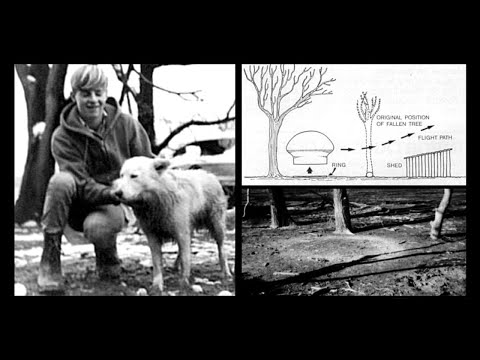
The 1971 Delphos, Kansas, UFO Landing With Physical Evidence, Witnessed by 15-Year-Old Ron Johnson
A focused case history from Eyes On Cinema covering the sighting, the ring, and the case's physical-trace evidence.

Science-Based Evidence May Indicate That UFO Landed In US Farm | Alien Contact
Quest TV documentary segment examining the soil chemistry evidence at the center of the Delphos case.

Family Has Permanent Physical Health Problems After UFO Encounter | Close Encounters
Quest TV documentary segment on the Johnson family's reported physiological effects following the encounter.
Sources
- The Black Vault Case Files. "Analysis of Soil Samples Related to the Delphos, Kansas November 2, 1971 [Case]." theblackvault.com
- Budinger, Phyllis A. "Technical Service Response No.: UT001" (soil analysis technical report and addendum). documents.theblackvault.com
- Close Encounter Project. "Delphos Ring." closeencounterproject.wordpress.com
- UFO Evidence. "Delphos, Kansas Landing Ring — November 2, 1971." ufoevidence.org
- Openminds.tv. "Alleged UFO Landing in Delphos, Kansas." openminds.tv
- UNILAD. "'Eye-opening' scorch marks on Kansas Farm show where family watched 'UFO' land." unilad.com
- Podcast UFO. "UFO Trace Evidence in Delphos, Kansas." podcastufo.com
- Think About It Docs. "1971: Delphos, Kansas Landing Ring." thinkaboutitdocs.com
- Phantoms & Monsters. "The Delphos, Kansas UFO Landing Ring." phantomsandmonsters.com
- US UFO Center. "Ufologist: Delphos Kansas UFO Sighting of 1971." usufocenter.com
- UFO Chronicles. "'Just One Good Example' of UFO Evidence, asks SETI's Seth Shostak." theufochronicles.com
- Canada Journal. "UFO and Alien Landing on earth, claims scientist." canadajournal.net
- Salina Public Library. "Off the Shelf: UFOs and Kansas." salinapubliclibrary.org
- High Plains Public Radio (HPPR). "Rural Kansas Once UFO Hot Spot." hppr.org
- UFO Casebook. "1971, The Delphos Kansas UFO Landing Ring." ufocasebook.com
- Amazon.com. "The Compelling Scientific Evidence for UFOs: The Analysis of the Delphos, Kansas UFO Landing Report," Erol A. Faruk & Michael D. Swords. amazon.com
- UFO Evidence. "Sturrock Panel — Physical Evidence Related to UFO Reports (Abstract, Summary and Introduction)." ufoevidence.org
- UFO Evidence. "Sturrock Panel" topic overview. ufoevidence.org
- "Delphos, Kansas," Wikipedia. en.wikipedia.org
- "Philip J. Klass," Wikipedia. en.wikipedia.org
- Wikimedia Commons. "File: Fairy Ring 0004.JPG" (public domain, hero image source). commons.wikimedia.org
- Wikipedia. "Fairy ring." en.wikipedia.org
- Clark, Jerome. The UFO Encyclopedia, 4th Edition, Visible Ink Press, 2023 (entry on the Delphos, Kansas ring case).
- Vallée, Jacques. Dimensions: A Casebook of Alien Contact, Contemporary Books, 1988 (discussion of the Delphos ring's Actinomycetales identification).
See something inaccurate? Have additional information or sources?
Suggest an Edit →Last Updated: August 2026