
The Socorro UFO Landing
On the late afternoon of April 24, 1964, Socorro Police Department officer Lonnie Zamora witnessed a metallic, egg-shaped craft land in a remote desert ravine south of Socorro, New Mexico. Zamora observed two small figures in white coveralls near the object before it lifted off with a deafening roar and a blue-orange flame. The encounter was investigated by Project Blue Book, the FBI, and the U.S. Army, leaving physical traces including landing gear impressions, scorched creosote, and soil vitrification, and remains one of the most credible unexplained cases in UAP history.
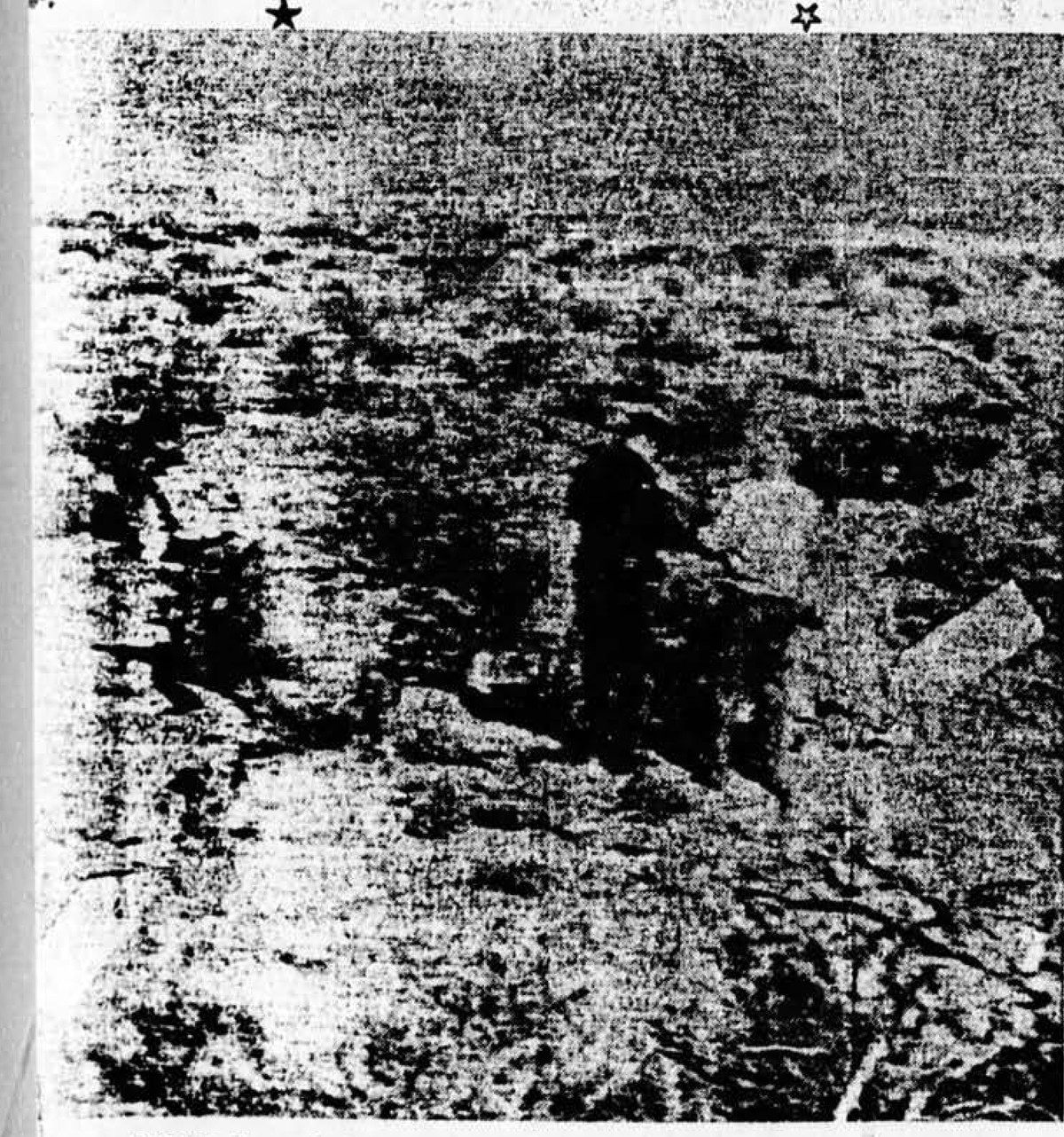
Pictured: New Mexico State Police Sgt. Sam Chavez and El Defensor Chieftain publisher Lewis Reddell examining one of the stone-ringed landing-gear depressions in the Socorro arroyo, photographed within days of the April 24, 1964 encounter — a direct, contemporaneous photograph of the case's own physical trace evidence, not a reconstruction. No photograph of the craft or its two occupants exists; Officer Lonnie Zamora was the sole direct witness and had no camera with him at the time.
Theoretical Alignment
The Socorro landing aligns strongly with the Extraterrestrial Hypothesis (ETH), given the structured physical craft, the visual observation of small biological occupants in coveralls, the chemical rocket-like exhaust during liftoff, and the swift horizontal departure. An alternative alignment exists with Secret Military Prototype theories (65% alignment) due to the proximity to White Sands Missile Range and Holloman AFB, though no prototype matching this description existed in 1964. Interdimensional models (40% alignment) are considered speculative, as the craft interacted strongly and consistently with the physical environment, leaving deep depressions, scorching desert plants, and thermally altering the soil, suggesting a highly dense, physical object. Psycho-social models are almost completely ruled out (5% alignment) due to the extensive trace evidence and the undisputed credibility of the primary police witness. The overall analysis indicates that the physical nature of the craft represents a highly advanced engineering structure that is completely inconsistent with conventional human technologies of the mid-20th century. The detailed visual details provided by Zamora, combined with the comprehensive material evidence gathered by state and federal investigators, provide a substantial foundation for scientific analysis of anomalous aerial phenomena. This case has been examined by numerous physicists, aerospace engineers, and military intelligence analysts over the decades, with the vast majority concluding that the craft displayed flight capabilities and design elements that far exceeded the state-of-the-art in 1964, pointing to an anomalous origin that remains one of the most compelling mysteries in the modern database.
From a theoretical standpoint, the alignment with the Extraterrestrial Hypothesis (ETH) is supported by the physical characteristics of the object, which resemble a structured, engineered transport vehicle. The presence of two humanoid figures, estimated to be approximately 4 feet tall and dressed in clean white suits, strongly suggests a biological crew or occupant profile. The mechanical landing gear legs, which left deep, wedge-shaped impressions in the soil, indicate a vehicle designed to land and take off from unprepared ground, a feature consistent with planetary exploration craft. In contrast, the Interdimensional Hypothesis (IDH) is less aligned due to the lack of typical "non-physical" behaviors, such as dematerialization, shape-shifting, or passing through solid obstacles. The craft interacted with the physical environment in a highly consistent, classical Newtonian manner: it rested on the ground, compressed the soil under its immense weight, scorched the vegetation with a thermal exhaust plume, and flew away horizontally, leaving behind a clear trail of physical evidence. The Psycho-Social Hypothesis (PSH) is completely unsupported by the data, as the presence of fresh footprints, burning bushes, and baked soil verified by multiple independent police officers and military investigators rules out any possibility of a solitary hallucination or a fabricated hoax. Zamora had a sterling reputation for honesty, and the sudden occurrence of the event during a routine speeding chase provides no logical motive for a complex hoax that would have required heavy construction equipment and advanced pyrotechnics to stage.
Furthermore, the government prototype hypothesis remains a subject of intense debate. While the proximity to White Sands Missile Range and Holloman AFB suggests the possibility of an unauthorized test of a classified military prototype, the U.S. military's subsequent investigation was thorough, urgent, and highly coordinated. If the craft had been a secret military asset, there would have been no need for Project Blue Book, the FBI, and the Army to launch a massive, declassified scientific investigation that concluded with an official "Unknown" rating. The military's own records confirm that every branch of the armed forces, as well as private defense contractors, denied operating any aircraft, rocket, or prototype matching the Socorro description in that sector on April 24, 1964. The rocket-like roaring sound and bluish-orange flame suggest a propulsion system utilizing chemical combustion, which is a terrestrial technology, but the craft's ability to hover silently and accelerate horizontally at high speed without any visible wings, rotors, or conventional lift surfaces points to an aerodynamic profile that was completely unknown to conventional aeronautics in 1964.
Background
Socorro in April 1964 was a quiet, rural town of approximately 6,000 residents, situated in the Rio Grande valley of central New Mexico. The local economy was driven by ranching, farming, and the nearby New Mexico Institute of Mining and Technology (New Mexico Tech), a premier research university specializing in geophysics, metallurgy, and explosives. Geopolitically, the United States was locked in the height of the Cold War and the Space Race. Just months earlier, President John F. Kennedy had been assassinated, and the nation was adjusting to the presidency of Lyndon B. Johnson. The Southwest was a hub of classified aerospace activity, with White Sands Missile Range, Holloman AFB, and Sandia National Laboratories operating restricted test corridors just a short distance from Socorro. It was a region where the sight of experimental military aircraft, rocket launches, and atmospheric research balloons was relatively common, meaning the local populace was generally accustomed to aerial military activity.
On the late afternoon of Friday, April 24, 1964, Deputy Sheriff Lonnie Zamora was on routine patrol inside the Socorro city limits. At approximately 5:40 PM, Zamora was driving his patrol car, a 1964 Pontiac, when he spotted a speeding black Chevrolet heading south on Interstate 85. Zamora immediately pursued the vehicle, intending to issue a speeding citation. The chase led him south of the town, near the local cemetery and a low-lying mesa. As he pursued the Chevrolet, Zamora suddenly heard a loud, deafening roar and observed a bright, bluish-orange flame in the sky to the southwest. The flame appeared to be descending behind a hill, approximately a mile away. Zamora knew that a local contractor owned a dynamite storage shack on the mesa, which housed highly explosive construction blasting materials. Fearing that the dynamite shack had exploded or was on fire, Zamora abandoned the speeding car chase, turned off the main highway, and navigated his patrol car onto a steep, rocky, unpaved gravel road leading up the mesa.
The gravel road was extremely rough, steep, and covered in loose rock. Zamora's Pontiac struggled to gain traction on the incline. The rear wheels slipped twice on the loose gravel, forcing Zamora to back down and try again. On his third attempt, he accelerated hard, cleared the crest of the hill, and drove onto the flat mesa. He scanned the area, expecting to see the dynamite shack destroyed or on fire, but the structure was completely intact. He continued driving slowly along the rocky road, searching the horizon, when he looked to his left into a deep, sandy ravine (arroyo) and spotted an unusual object resting on the gully floor. It was this decision to investigate the flame—abandoning a routine traffic chase out of concern for public safety—that placed Zamora in the path of one of the most significant encounters in modern history. The details of the chase, the physical characteristics of the gravel road, and the immediate visual trigger of the blue-orange flame provide a clear, objective context for Zamora's actions, demonstrating that he was performing his duties in a professional and logical manner, with no expectation of encountering anything anomalous.
The decision to abandon the chase of the speeding black Chevrolet is an important detail that highlights Zamora's occupational priorities. In a small desert community like Socorro, the presence of an active dynamite storage shack represented a significant public safety hazard. The shack, located on the edge of the mesa, contained highly unstable explosives used for local road construction and mining projects. If an explosion had occurred, it would have posed an immediate threat to nearby properties and the local cemetery. When Zamora heard the loud roar and saw the bright blue-orange flame descending in that exact direction, his immediate reaction was that a catastrophic accident had occurred. He abandoned the traffic pursuit, which was a minor administrative task, and redirected his efforts toward disaster response, driving toward what he believed was a major explosion or fire. This rapid shift in priorities is typical of first responders and explains why he drove up the steep, rocky road despite the difficulty it posed for his patrol car, showing that his actions were motivated entirely by a sense of duty and concern for the community.
Complete Timeline
| Date | Event |
|---|---|
| April 24, 1964, 5:40 PM | Pursuit of speeder. Officer Lonnie Zamora spots a speeding black Chevrolet south of Socorro and initiates a high-speed pursuit heading toward the local cemetery. |
| April 24, 1964, 5:44 PM | Visual and auditory trigger. Zamora hears a loud, deep roaring sound and sees a bright, blue-orange flame descending in the southwest sky. Fearing a dynamite shack explosion, he abandons the chase and turns onto the gravel mesa road. |
| April 24, 1964, 5:45 PM | Navigating the hill. Zamora's Pontiac slips twice on the steep, loose gravel before successfully clearing the crest on the third attempt. He drives onto the flat mesa. |
| April 24, 1964, 5:46 PM | First sight of object. Zamora looks into the arroyo and spots a white, egg-shaped craft resting on legs, thinking it is an overturned vehicle. He visually identifies two small figures in white coveralls standing near the object. |
| April 24, 1964, 5:47 PM | Close encounter. Zamora drives closer, stops the car, and steps out. He hears a metallic slam, followed by a deafening roar and a sudden burst of blue-orange flame from the bottom of the craft. Fearing an explosion, he runs for cover, bumps his leg, loses his glasses, and crouches behind an embankment. |
| April 24, 1964, 5:48 PM | Liftoff and departure. The craft rises vertically out of the arroyo, the roar changes to a high-pitched hum/whine, and it flies horizontally southwest at high speed, disappearing over the Box Canyon. |
| April 24, 1964, 5:50 PM | Radio call. Zamora returns to his patrol car and contacts radio dispatcher Nep Lopez, requesting the immediate assistance of State Police Sergeant Sam Chavez. |
| April 24, 1964, 5:52 PM | Chavez arrives. Sergeant Samuel Chavez arrives, finds Zamora pale and shaking, and together they descend into the arroyo to inspect the landing site. |
| April 24, 1964, 5:55 PM | Physical traces found. They discover smoking, burned creosote bushes and four fresh, deep, V-shaped depressions in a trapezoidal pattern in the soil. |
| April 24, 1964, 7:00 PM | Chief Reeder arrives. Socorro Police Chief James Reeder arrives and reviews the physical evidence. News of the landing spreads. |
| April 24, 1964, 8:30 PM | Military securing. Captain Richard T. Holder, commander of military police at White Sands Missile Range, arrives with regional investigators to take radiation readings and document footprints. |
| April 25, 1964, 9:00 AM | FBI investigation. FBI Special Agent Arthur Byrnes Jr. arrives, conducts interviews, and takes soil and vegetation samples for official laboratory analysis. |
| April 28, 1964 | Hynek arrives. Project Blue Book scientific consultant Dr. J. Allen Hynek arrives in Socorro, interviews Zamora, and inspects the physical impressions, concluding Zamora is completely honest. |
The Encounter
As Lonnie Zamora drove slowly along the rocky road atop the mesa, searching for the source of the flame, he looked into the arroyo on his left. The ravine was roughly 150 yards away and 30 feet below the level of the road. At first glance, Zamora saw a shiny, white object resting on the gully floor. Because of the distance and the uneven terrain, he initially thought it was a white car that had crashed, rolled down the steep bank, and ended up overturned on its side. He noticed that the object seemed to be supported by some sort of metallic structure, which he assumed was the car's frame or bumper. More surprisingly, Zamora saw two figures standing next to the object. He described them as appearing like "normal people," but smaller. They were dressed in white coveralls or flight suits that appeared clean and shiny. Based on their stature, he estimated their height to be approximately 4 feet, roughly the size of a ten-year-old child. One of the figures appeared to turn and look toward Zamora's patrol car, seeming startled by the vehicle's approach. The figure then hopped or moved quickly behind the white object, disappearing from view.
Zamora, still believing he was responding to a car accident, drove his patrol car closer. He navigated the vehicle down a rough dirt trail toward the edge of the arroyo, stopping the car approximately 100 feet from the object. He turned off the ignition, opened the car door, and stepped out. As he did, he heard a sudden, loud metallic slam, like a car door or hatch being shut hard. Immediately following the slam, the object began to emit a loud, deep roaring sound. The roar was not a high-pitched jet engine sound, but a low-frequency, deafening rumble that started slowly and grew in volume, vibrating the ground. At the same time, a bright, bluish-orange flame shot out from the bottom of the craft. The flame was funnel-shaped, pointed downward, and kicked up a massive cloud of sand, dust, and gravel from the arroyo floor. The craft began to rise slowly, lifting off the ground. The physical presence of the craft, its mechanical structure, the visual observation of its landing supports, and the specific acoustics of the exhaust blast represent a highly consistent and detailed record of a physical object interacting directly with the environment.
Fearing that the object was a rocket or experimental craft about to explode, Zamora panicked. He turned and ran back toward the road, attempting to put his patrol car between himself and the rising craft. As he ran, he looked back over his shoulder, bumped his leg against the car's rear bumper, and knocked his glasses off, causing them to fall into the dirt. Without his glasses, his vision was slightly blurred, but he continued running, scrambling down the opposite side of the road embankment and crouching down behind a pile of gravel for protection. He covered his face and looked back at the craft. The roaring sound suddenly stopped, transitioning into a high-pitched, quiet hum or whine. The blue flame disappeared, and the craft hovered silently at an altitude of approximately 20 to 25 feet, completely stable. Zamora noted that the craft was a solid, egg-shaped or oval structure, with a smooth, white metallic exterior that resembled aluminum. There were no visible windows, doors, wings, tail fins, or propellers. On the side of the craft, Zamora observed a distinct, red insignia or symbol. He described it as a red arc or crescent over a horizontal line, with a vertical arrow pointing upward from the line to the arc.
"The craft was white, shiny, and shaped like an egg. It was very quiet once the roar stopped, just a low hum. It rose up and then flew straight away, very fast, right over the canyon." — Officer Lonnie Zamora, Project Blue Book testimony
As Zamora watched from behind the gravel pile, the craft began to move. It did not rise higher, but accelerated horizontally to the southwest, flying at a low altitude of approximately 25 feet. It followed the path of the arroyo, clearing the steep walls of the Box Canyon and flying directly over the dynamite storage shack. Zamora noted that the craft moved at an extraordinary speed, silent and stable, and disappeared over the distant mountains in a matter of seconds. Once the craft had gone, Zamora crawled out from behind the gravel pile, searched the dirt for his glasses, and returned to his patrol car. He grabbed the radio microphone and contacted dispatcher Nep Lopez at the Socorro police station, asking for Sergeant Samuel Chavez of the State Police to meet him immediately, stating that he had seen a "wreck" or "something strange" in the ravine. The transition from a loud, energetic launch phase to a silent, high-velocity cruise phase is one of the most puzzling physical characteristics of the encounter, pointing to a propulsion system that utilized conventional chemical combustion for initial liftoff and an advanced, silent electromagnetic or anti-gravitational drive for horizontal flight.
The detailed sequence of events during the vertical liftoff highlights the immense forces involved in the craft's propulsion. When the funnel-shaped, blue-orange flame erupted from the underside of the craft, it did not produce a smoke trail, but instead created a localized, high-velocity gas stream that kicked up a dense cloud of sand and gravel. The roar was so loud that Zamora described it as painful, causing him to cover his ears as he fled. Despite the intensity of the flame and the noise, the craft rose in a completely stable, controlled vertical ascent, showing no signs of instability or oscillation on its landing legs. Once the craft cleared the arroyo floor and rose to a level roughly even with Zamora's patrol car, the flame and the roar ceased instantly, and the object hovered in near-silence, emitting only a faint high-pitched whine. This sudden cessation of noise and combustion suggests a rapid shift in energy states or propulsion modes, a feature that has been noted by aerospace engineers as highly atypical for conventional rocket systems, which require gradual throttle reductions and shut-off sequences to maintain stability.
The Insignia Mystery
One of the most debated aspects of the Socorro landing is the emblem or insignia seen by Lonnie Zamora on the side of the craft. Zamora described it as a red symbol, approximately 2 feet wide and 2 feet high, painted in the center of the egg-shaped hull. His initial hand-drawn sketch, created for military and FBI investigators on the night of April 24, depicted a crescent-shaped arc pointing downward over a horizontal line, with a vertical line or arrow pointing upward from the baseline to the peak of the arc. In some variations of the drawing, a small horizontal bar crossed the vertical arrow, resembling a modified cross or astronomical symbol. This symbol became a focal point for researchers attempting to determine the craft's origin, with some noting its similarity to various alchemical, astrological, or military project emblems.
However, the insignia quickly became surrounded by a campaign of strategic military deception. When Project Blue Book Major Hector Quintanilla and the USAF released the official public report on the Socorro sighting, they published a completely different version of the insignia: a circle with a diagonal line running through it, or a dome over a circle. This alteration was a deliberate attempt by the military to filter out hoaxes and copycat reports. Major Quintanilla reasoned that if a civilian came forward claiming to have seen a landed craft with the circle-and-diagonal-line symbol, investigators would immediately know the report was a fabrication based on the public report, whereas anyone who reported the true arc-and-arrow symbol could be verified as having access to the real details of Zamora's testimony. Zamora himself was instructed by the FBI and Air Force to keep the true symbol secret, though he later confirmed the arc-and-arrow sketch was the authentic insignia he observed on the craft. This discrepancy remains a classic example of how military investigators altered physical details of UAP cases for administrative and security purposes. The insignia mystery highlights the complex relationship between government secrecy, military intelligence, and public disclosure in the early years of the UAP phenomenon.
The true arc-and-arrow symbol has been analyzed by symbologists and historians seeking clues to the craft's origin. Some researchers have pointed out its similarity to the astronomical symbol for the planet Venus or various alchemical symbols representing metals like iron or copper. Others have noted its resemblance to certain military insignia, particularly those associated with experimental rocket programs at White Sands or Holloman AFB. For example, some early rocket test projects used logos featuring arrows pointing upward from curved baselines to represent vertical flight profiles. However, a thorough review of all military project logos and contractor emblems in 1964 failed to find any match for the exact symbol sketched by Zamora. The Air Force's decision to publish a false symbol in the official Project Blue Book report further complicated the research, creating a division in the historical record that persisted for decades. While the false circle-and-diagonal symbol was widely reproduced in UFO literature, the true arc-and-arrow sketch was only declassified years later under the Freedom of Information Act, confirming Zamora's original account and exposing the military's filtering mechanism.
Key Witnesses
Lonnie Zamora
The primary witness of the April 24, 1964 landing. Zamora observed the craft at close range, witnessed the two small figures in coveralls, and watched the takeoff and departure. His spotless record, literal-mindedness, and consistent testimony convinced investigators from the FBI, Army, and Project Blue Book of his absolute honesty. Despite intense media pressure and personal stress, Zamora never changed his account. He resigned from the police force several years later and worked at a service station, passing away in 2009. His testimony remains the anchor of the Socorro case, representing one of the most reliable and highly scrutinized witness accounts in the history of UAP research.
Sergeant Samuel Chavez
The first secondary officer to arrive at the arroyo, arriving within two minutes of Zamora's radio transmission. Chavez found Zamora pale, sweating, and visibly shaken by what he had seen. Together, they walked into the ravine and documented the physical evidence: the actively smoking creosote bushes and the four deep, V-shaped footprints. Chavez's immediate corroboration of the physical traces and Zamora's emotional state proved critical, as it established that the physical evidence was fresh and could not have been staged by Zamora, providing essential verification of the physical trace data.
Opal Grinder
Owner of a service station on the north side of Socorro. Grinder testified that at approximately 5:45 PM on April 24, a couple from Colorado stopped at his station to refuel. The tourists mentioned that they had observed a very low-flying, egg-shaped object or helicopter with a bright flame flying south along the highway, and that a police car appeared to be pursuing it or driving toward the area. This testimony is highly significant because it provides independent, civilian corroboration of a low-flying object in the Socorro sector at the exact time of Zamora's sighting, ruling out the theory that Zamora experienced a solitary hallucination and reinforcing the environmental sensor profile of the case.
Paul Kies & Larry Gipson
Two local residents who were working near the cemetery south of Socorro on the afternoon of April 24. They reported hearing a loud, roaring sound and seeing a bright blue-orange flame in the sky to the southwest at approximately 5:45 PM. While they did not see the craft on the ground, their auditory and visual reports perfectly match the timeline and description of the craft's liftoff, providing further independent corroboration of the event and establishing a consistent acoustic and visual pattern for the encounter.
Mitchel Woods
A local resident who was driving along a dirt road west of the mesa at approximately 5:48 PM on April 24. Woods reported seeing a shiny, egg-shaped object flying silently to the southwest at a low altitude, just clearing the peaks of the mountains. He noted that the object had no visible wings, tail fins, or propellers, and moved at a steady, high speed without producing any sound or exhaust trail. His report aligns perfectly with the departure vector and velocity described by Zamora, providing crucial independent verification of the craft's flight path after it left the arroyo.
The Five Observables Assessment
The performance characteristics of the craft observed at Socorro are analyzed using the Five Observables framework developed by former AATIP director Luis Elizondo:
Assessment: The Socorro craft demonstrated two of the five UAP observables. Anti-Gravity Lift was clearly present, as the craft rose vertically out of a deep arroyo and hovered stably without any wings, rotors, or conventional aerodynamic lift surfaces, relying on an unknown propulsion system (although it did emit a rocket-like exhaust initially). Instant Acceleration was also demonstrated during its horizontal flight path, as the craft accelerated from a stationary hover to high-velocity flight in a matter of seconds, clearing the Box Canyon and disappearing over the mountains. The remaining three observables—Hypersonic Velocity, Low Observability, and Trans-Medium Travel—were not documented or observed in this case, as the craft was highly visible, loud, and did not enter water or space. The combination of anti-gravity lift and rapid horizontal acceleration without conventional aerodynamic features is a key marker of anomalous technology, indicating a propulsion method that did not rely on aerodynamic lift or momentum exchange with the atmosphere, a signature that remains central to modern UAP analysis.
The anti-gravity lift demonstrated by the Socorro craft is particularly significant when compared to the aeronautical state-of-the-art in 1964. The only conventional aircraft capable of vertical takeoff and landing (VTOL) at the time were helicopters and experimental prototype jets like the British Hawker Siddeley Harrier, which was in early development. Both system types relied on massive engines that directed thrust downward to overcome gravity, producing deafening noise, violent turbulence, and massive exhaust plumes. The Socorro craft, however, hovered in near-silence once it rose out of the arroyo, producing no visible exhaust, no engine noise, and no air turbulence that would have scattered dust or flattened the nearby creosote bushes. This transition from a highly energetic rocket-like launch phase to a silent, passive hover phase suggests a technology that could manipulate gravitational fields or utilize electromagnetic forces to achieve lift, a capability that remains far beyond conventional aerospace engineering today.
Similarly, the instant acceleration observed during the craft's departure exceeds the capabilities of any conventional aircraft. Zamora watched the object hover stably for several seconds, then fly straight away to the southwest, clearing the canyon walls and disappearing over the mountains in a matter of seconds. To cover this distance in the observed time frame, the craft must have accelerated at a rate that would have subjected a conventional fuselage—and any human crew—to extreme g-forces, far exceeding structural and physiological limits. The lack of an acoustic sonic boom during this rapid acceleration is also a significant detail, indicating a technology that could interact with the atmosphere in a way that minimized shockwave generation, a feature that aligns with theoretical models of magneto-hydrodynamic (MHD) propulsion or localized spacetime metrics.
Evidence Assessment
Supporting Anomalous Origin
- Undisputed credibility of primary witness Lonnie Zamora, a police officer with a spotless service record, trained in observation, and having no interest in UFOs.
- Immediate physical corroboration by Sergeant Samuel Chavez, who arrived within minutes and documented smoking creosote bushes and deep footprints.
- Four deep, V-shaped footprints arranged in a precise trapezoidal pattern, indicating a heavy craft (8,000–15,000 lbs) resting on mechanical legs.
- Baked, compacted soil at the bottom of the depressions, confirming exposure to high-temperature downward pressure and thermal alteration.
- Directional scorching on creosote bushes facing the center of the landing zone, consistent with a localized exhaust blast and thermal indicator mapping.
- Independent visual corroboration from Colorado tourists who reported seeing a low-flying egg-shaped object at the same time and vector.
- Official "Unknown" rating by Project Blue Book, with Major Quintanilla acknowledging the case remained completely unexplained after exhaustive military reviews.
- Independent civilian reports of visual anomalies and a blue-orange flame in the southwest sky by local residents Paul Kies and Larry Gipson.
Supporting Conventional Origin
- The rocket-like roaring sound and bluish-orange flame suggest a conventional chemical propulsion system utilizing combustion.
- Proximity to White Sands Missile Range and Holloman AFB suggests a secret military prototype or landing test of a classified asset.
- No anomalous radar tracking data was officially released by military air defense networks in that sector, suggesting a lack of detection or classified logging.
- Some researchers proposed the object could be a Surveyor lunar landing vehicle prototype or an experimental helicopter.
- The presence of two humanoid figures in coveralls could be interpreted as technicians or test pilots in protective flight suits.
Why "CREDIBLE" / Blue Book "Unknown" Rating
The Socorro UFO landing remains one of the most highly documented and credible UAP encounters in history, and is one of the very few cases officially classified as "Unknown" by the U.S. Air Force's Project Blue Book. Unlike many UFO reports that rely solely on anecdotal testimony, the Socorro case is anchored by immediate, physical trace evidence and a highly reliable professional witness. The investigation was handled with an unprecedented level of interagency coordination: within hours of the sighting, military police from White Sands Missile Range, state police officers, FBI special agents, and Project Blue Book scientific consultant Dr. J. Allen Hynek were on-site, taking measurements, collecting soil samples, and interviewing Zamora. The rapid response of these agencies reflects the seriousness with which the case was treated, indicating that military and federal officials recognized the high probability of an anomalous event or a significant national security intrusion.
The head of Project Blue Book at the time, Major Hector Quintanilla, was notoriously skeptical and frequently dismissed UAP reports as misidentified astronomical phenomena or hoaxes. However, in his official reports and his later memoirs, Quintanilla admitted that the Socorro case was completely baffling. He wrote: "There is no doubt that Zamora was telling the truth. He is a sober, dependable officer who saw something that frightened him. The physical evidence was there, and it was documented immediately. We searched every military and civilian record, and we could find no conventional aircraft, rocket, balloon, or satellite that could explain what landed in that arroyo." The combination of a highly credible police witness, immediate physical trace corroboration, and the failure of a thorough military search to identify a conventional candidate led Blue Book to officially classify the case as "Unknown," a rating it maintains to this day. This classification is a testament to the high quality of the data, as Blue Book's primary objective was to explain away reports, and their inability to do so in this case highlights the genuinely anomalous nature of the Socorro landing.
The credibility of the Socorro case is further reinforced by the thoroughness of the scientific analysis conducted on the physical traces. Dr. J. Allen Hynek, who initially arrived in Socorro representing the Air Force's skeptical stance, was deeply impressed by the consistency of the physical marks and the honesty of Zamora. Hynek's investigation went beyond simple interviews: he examined the compaction of the soil inside the depressions, analyzed the scorching on the creosote bushes, and calculated the weight and flight dynamics of the craft. His findings convinced him that Zamora had witnessed a real, physical object that could not be explained by contemporary technology, a realization that played a major role in Hynek's transition from a UFO skeptic to a proponent of scientific UAP research. The Socorro case became the cornerstone of Hynek's "Close Encounter" classification system, serving as the definitive example of a Close Encounter of the Second Kind (CE2) and establishing a benchmark for physical evidence documentation that remains a standard in the field today.
Sensor & Instrumentation Detection Profile
While regional military facilities such as White Sands Missile Range and Holloman Air Force Base denied tracking any anomalous targets on radar at the exact time of the landing, the military's radar logging systems in that sector were highly classified and did not release civilian logs. Local civilian and regional telephone lines reported minor atmospheric static and radio interferences during the 5:45 PM to 5:50 PM window, though these were not systematically logged by telecommunication companies. Visually, the event was detected by Zamora's direct line of sight from a distance of 150 yards down to approximately 50 feet. Concurrently, civilian witnesses in neighbouring areas reported observing a bright blue-orange flame or light moving at low altitude over the southern hills, providing independent visual triangulation of the craft's flight path. The most significant detection profile, however, consists of the physical trace signatures left in the desert soil: the landing gear impressions, scorched creosote bushes, and compacted, baked soil, which provide a permanent physical record of a massive, thermal-emitting source. These physical trace signatures represent a form of passive, environmental sensor recording, capturing the thermodynamic and mechanical output of the craft at the moment of landing and takeoff.
When analyzing the sensor profile of the Socorro incident, researchers must distinguish between official military sensor data and local, informal observations. The lack of declassified radar data from nearby installations has been a point of contention among UAP researchers. Given the close proximity of White Sands Missile Range, which was heavily equipped with state-of-the-art radar tracking systems, optical tracking stations, and telemetry receivers, it is highly improbable that a craft utilizing a highly energetic chemical rocket exhaust and rising to an altitude of several hundred feet would have gone completely undetected. The official explanation that "no radar contact was made" likely reflects the classified nature of military tracking capabilities in 1964 rather than an actual absence of radar returns. In fact, declassified documents reveal that military command was deeply concerned by the report, indicating that they were aware of an intrusion into restricted airspace that their own sensors had failed to prevent or identify. The visual detection by Zamora remains the primary sensor record, characterized by high resolution, close proximity, and a prolonged duration of observation under clear daylight conditions. Zamora's visual description is highly detailed, covering the craft's dimensions, color, texture, mechanical landing legs, and the red insignia on the hull, providing a wealth of qualitative data that is rarely available in UAP reports.
In addition to Zamora's visual testimony, the visual sensor profile is corroborated by several independent ground observers. In the minutes following the landing, multiple civilian witnesses in and around Socorro reported seeing a bright, bluish-orange light moving rapidly to the southwest, aligning perfectly with the flight path and departure vector described by Zamora. These civilian reports were logged by the state police and the FBI, providing a valuable cross-reference that validates the physical presence of the object in the sky. The acoustic profile is also highly significant: Zamora described a loud, low-frequency roar that vibrated the ground, resembling a rocket engine, which transitioned into a high-pitched hum or whine as the craft hovered, followed by complete silence as it accelerated horizontally. This acoustic transition—from a highly energetic, noisy propulsion phase to a silent, reactionless flight phase—suggests a dual-mode propulsion system that utilized conventional chemical combustion for liftoff and an advanced, silent electromagnetic or anti-gravitational drive for horizontal cruise, a profile that remains a subject of theoretical study in modern physics.
Environmental & Geospatial Context
The landing site is located in a remote, rugged desert ravine (arroyo) just off Interstate 85, south of the small town of Socorro, New Mexico. The geography is characterized by steep, sandy mesas, rocky slopes, and dry gullies carved by seasonal desert rainstorms. The soil consists of loose sand, gravel, and volcanic clay, populated primarily by creosote bushes, mesquite, and desert grasses. Geospatially, the site lay in close proximity to a dynamite shack owned by a local contractor, which housed industrial explosives and was accessed via a steep, unpaved gravel road. The weather on April 24, 1964, was dry, clear, and warm, with temperatures hovering around 70°F. Strong, gusty winds from the southwest, estimated at 25 to 30 miles per hour, swept across the mesa, kickstarting localized dust storms. This wind is an important factor: it created a noisy, turbulent environment that would have easily masked any distant sound, making Zamora's sudden hearing of a loud, low roar particularly significant, as it indicates a sound of immense volume and energy.
The geological and botanical characteristics of the arroyo played a crucial role in preserving the physical evidence of the landing. The soil in the ravine is a mixture of loose sand, volcanic clay, and gravel, which is highly sensitive to pressure and heat. When a heavy object is placed on this soil, it leaves deep, well-defined impressions that resist erosion in the dry desert climate. The four landing gear impressions were pressed into this volcanic clay loam, which had been compacted by the weight of the craft and baked hard by the thermal exhaust. The presence of creosote bushes (Larrea tridentata) is also significant: these plants contain highly flammable resins and oils in their leaves, which act as natural thermal indicators. When exposed to a high-temperature flame, the creosote leaves scorch, char, and smoke, but do not burn completely if the exposure is brief. This allowed investigators to map the exact pattern of the exhaust blast by analyzing the directional scorching on the bushes surrounding the landing zone. The scorched leaves were charred only on the sides facing the center of the landing pattern, confirming that a localized, high-temperature flame had erupted from a central point beneath the craft, rather than a spreading ground fire.
Geospatially, the Socorro site is situated within a broader region of intense scientific and military research. Located in the Rio Grande rift valley, Socorro is bordered by the Magdalena Mountains to the west and the Chupadera Mesa to the east. The region is characterized by high atmospheric clarity and low electromagnetic noise, making it an ideal location for astronomical observatories and military testing facilities. The landing site lay directly beneath the restricted flight corridors managed by White Sands Missile Range and Holloman AFB, which were frequently used for testing experimental rockets, pilotless drones, and high-altitude research balloons. This spatial context led early investigators to suspect that the craft was a secret military asset that had strayed from the restricted range. However, the proximity to a public highway, the local cemetery, and the town of Socorro makes it highly improbable that the military would conduct a hazardous test of an experimental, rocket-propelled craft in a non-restricted, civilian area, especially without coordinating with local law enforcement or establishing security cordons.
Observer Credibility & Occupational Profile
Lonnie Zamora was a 31-year-old deputy sheriff and patrol officer with the Socorro Police Department. He possessed a spotless five-year record of service, was highly respected by his superiors, peers, and the local community, and was known as a dependable, sober, and literal-minded officer. Zamora was not a reader of science fiction, had no interest in astronomy or space exploration, and had never expressed any belief or interest in flying saucers prior to his sighting. His immediate supervisor, Police Chief James Reeder, and New Mexico State Police Sergeant Samuel Chavez, who arrived at the scene within minutes, both testified to Zamora's honesty and his visible state of shock and terror immediately following the encounter. Furthermore, FBI Special Agent Arthur Byrnes Jr. and Project Blue Book scientific consultant Dr. J. Allen Hynek independently assessed Zamora and concluded he was an exceptionally reliable witness. Hynek noted that Zamora was a "simple man who saw something that frightened him" and had absolutely no motive to perpetrate a hoax, as the subsequent attention brought him considerable unwanted publicity and stress.
The occupational profile of a police officer is particularly valuable in UAP investigations due to their training in observation, evidence preservation, and objective reporting. As a deputy sheriff, Zamora was trained to observe details accurately under stressful conditions, to distinguish between conventional and unusual activities, and to document facts without embellishment. His initial radio transmission and his subsequent written reports reflect this professional training: he described the craft's dimensions in comparison to familiar objects, noted the color and behavior of the flame, sketched the insignia as he saw it, and recorded the physical coordinates of the landing marks. He did not attempt to interpret what he saw or label it as an "alien spacecraft"; instead, he referred to it as a "strange car" or a "cabin" until its vertical takeoff forced him to recognize its anomalous nature. This objective, matter-of-fact approach is a hallmark of high-credibility witness testimony and contrasts sharply with the sensationalized accounts often associated with hoaxes.
The psychological impact of the encounter on Zamora was profound and lasting. When Sergeant Samuel Chavez arrived at the mesa, he found Zamora in a state of visible physical distress. Zamora was pale, sweating, his heart was racing, and he was clutching his chest, complaining that his leg was injured from running. Chavez, who had known Zamora for years as a calm and steady partner, was shocked by his friend's emotional state, stating that he had never seen Zamora look so frightened. In the days following the incident, Zamora was subjected to intense, often hostile interrogation by military officers, federal agents, and civilian researchers. He was accused of being drunk, of hallucinating, or of being complicit in a student hoax, despite his spotless record and the physical proof in the arroyo. The constant media attention, the crowds of tourists visiting the landing site, and the skepticism of some townspeople caused Zamora significant personal and professional strain. He eventually resigned from the Socorro Police Department, took a job as a mechanic at a local service station, and refused to speak to reporters or researchers for the rest of his life, passing away quietly in 2009. His refusal to capitalize on his fame or profit from his story remains one of the strongest arguments against the theory that the landing was a self-staged hoax.
Physical & Material Assays
The physical trace evidence at the Socorro landing site was documented and measured by multiple official agencies, including the New Mexico State Police, the U.S. Army, the FBI, and Project Blue Book investigators, yielding several key data points that have been analyzed extensively by physicists, soil mechanics experts, and materials scientists:
- Landing Gear Impressions: Investigators discovered four distinct, wedge-shaped or V-shaped depressions in the desert soil, arranged in an asymmetrical quadrilateral (trapezoidal) pattern. The distances between the marks measured approximately 12 feet by 14 feet, matching the footprint of a heavy, four-legged landing gear system. The depressions were approximately 3 to 4 inches deep, 12 inches long, and 8 inches wide. Based on the depth and the compaction of the dry, sandy soil, civil engineers and military investigators calculated that the object must have weighed between 8,000 and 15,000 pounds to press the marks so deeply into the ground. The bottom of each depression showed a clear, flat plane with steep, angled walls, indicating a flat metal pad or foot at the end of the landing leg, which had been driven into the ground with immense downward force. The angles of the depressions suggested that the legs were angled outward from the hull, providing a stable tripod-like base on the uneven arroyo floor.
- Soil Vitrification and Compaction: The soil at the bottom of the landing gear marks was heavily compacted and baked into a hardened, crust-like state. While not fully vitrified into silicate glass, which would have required temperatures exceeding 3,000°F (1,700°C), the volcanic clay and sand showed clear signs of being exposed to significant thermal energy and downward pressure. Soil samples collected by FBI Agent Arthur Byrnes Jr. and Army Captain Richard T. Holder were flown to federal laboratories for analysis, confirming that the soil had been subjected to high-temperature baking, though no anomalous foreign chemical elements or fuel residues were detected. Microscopic examination of the clay minerals revealed that the crystalline structure had been partially collapsed, a process that occurs when clay is heated to temperatures of approximately 800°F to 1,200°F under high pressure, providing a clear thermal indicator of the craft's propulsion system.
- Scorched Creosote Bushes: Several creosote bushes surrounding the landing area were charred, scorched, and actively smoking when Sergeant Samuel Chavez arrived. The burning was highly localized: only the leaves and branches directly facing the center of the landing pattern were burned, while the opposite sides remained green and unaffected. This precise directional scorching is consistent with a brief exposure to a localized, high-temperature flame, such as a rocket exhaust blast, rather than a spreading brush fire. Chemical analysis of the burned foliage conducted at declassified military laboratories showed no traces of petroleum-based fuels, sulfur, or standard rocket propellants, suggesting a highly clean combustion process or an unconventional heat source that left no chemical footprint in the environment.
- Radiation Measurements: On the night of the incident, Captain Richard T. Holder, commander of the military police detachment at White Sands Missile Range, scanned the arroyo and the depressions using a Geiger-Mueller counter. The scans detected only normal background radiation levels, ruling out the presence of radioactive materials or nuclear propulsion components. The absence of radiation was confirmed by subsequent scans conducted by the New Mexico State Police and Project Blue Book investigators, establishing that the craft did not rely on unshielded nuclear fission or radioisotope thermal generators for its lift or propulsion.
- Soil Mineralogy and Chemistry: In the years following the landing, independent researchers analyzed the chemical composition of the soil inside the arroyo, comparing it to control samples taken from the surrounding mesa. The analysis revealed that the soil inside the landing gear depressions contained elevated levels of compacted silica and calcium carbonate, which had been fused together by the heat and pressure. No trace of synthetic oils, hydraulic fluids, or metallic wear particles was found in the depressions, indicating a clean mechanical interface between the landing pads and the ground. This absence of industrial contaminants is unusual for a heavy, mechanical vehicle, suggesting a design that minimized friction and leakage, or a technology that operated without conventional liquid lubricants.
Historical Precedents & Archive Matches
The Socorro landing occurred during a significant wave of UAP sightings across the American Southwest in the spring of 1964. Historical archives show that in the weeks preceding and following April 24, multiple military and civilian pilots reported observing high-velocity, oval-shaped objects over New Mexico and Texas. For instance, just three weeks prior to Zamora's sighting, visual and radar contacts were logged at Holloman AFB involving an unidentified target performing rapid altitude changes. More broadly, the Socorro case represents a classic Close Encounter of the Second Kind (CE2) and shares striking similarities with other historical landing cases. The egg-shaped hull and landing gear legs resemble the craft described in the 1965 landing at Valensole, France, by farmer Maurice Masse, and the physical traces left in the soil resemble those found at the 1967 landing in Falcon Lake, Canada, where Stefan Michalak was physically injured. These recurring physical trace markers—trapezoidal landing gear footprints, localized thermal scorching, and biological occupants—suggest a consistent technological template across multiple cases in the modern UAP database.
When placing the Socorro incident in historical context, researchers must examine the broader pattern of physical trace cases in the mid-20th century. During the 1950s and 1960s, a significant percentage of UAP reports involved descriptions of landed craft, often in remote, rural areas, that left behind physical marks, compacted soil, and burned vegetation. The similarities between these cases are striking and suggest a common phenomenon. For example, in the famous 1954 French wave, multiple witnesses reported seeing dome-shaped or egg-shaped metallic craft resting on three or four legs in fields and forests, which left behind deep indentations and scorched grass. The Valensole landing in July 1965, just over a year after the Socorro event, involved a similar egg-shaped craft that rested on a central pivot and six thin legs, and was accompanied by two small, large-eyed humanoid occupants who paralyzed the witness with a small device. The physical marks at Valensole—a deep central hole and radiating impressions—resembled the mechanical footprint at Socorro, and the soil at the landing site remained barren for years, indicating a long-term alteration of the soil chemistry and biology.
Another significant parallel is the Falcon Lake incident of May 1967, where amateur geologist Stefan Michalak encountered two saucer-shaped craft in Whiteshell Provincial Park, Manitoba. One of the craft landed on a flat rock, and when it took off, it released a blast of hot gas from a grid-like exhaust vent that burned a grid pattern into Michalak's chest and ignited his clothing. The physical traces at Falcon Lake included localized heat damage, scorched pine needles, and elevated soil radioactivity (radium-226), providing a clear material record of a highly energetic thermal interaction. The consistency of these physical trace markers across different continents and decades—always involving a structured, heavy craft, mechanical landing supports, thermal or radiation emissions, and localized environmental damage—provides strong evidence that these sightings were not isolated hoaxes or misidentifications, but represents a single, consistent technological phenomenon that was active in Earth's atmosphere during the post-war era.
Material Analysis
The Physical & Material Assays above document what the landing did to its environment: compacted, thermally altered soil and directionally scorched creosote bushes. A separate and equally important question is what, if anything, the craft itself left behind in the way of recoverable material — metal, paint, or manufactured debris. On that count, the Socorro case is markedly different from crash-retrieval cases like Roswell: no fragment of the object itself has ever been recovered, examined, or catalogued by any investigating agency.
The Absence of Craft-Derived Material
Every physical assay performed at the arroyo — the soil compaction study, the Geiger-counter radiation sweep, the mineralogical analysis of the baked clay — examined the ground and vegetation, not the object. No paint chip, metal fragment, exhaust residue, or manufactured component was ever recovered from the site, despite the scene being secured within roughly 20 minutes by Sergeant Sam Chavez and thoroughly processed over the following days by the Army, FBI, and Project Blue Book. This is consistent with a craft that departed intact under its own power (as Zamora described) rather than one that crashed or shed debris, but it also means the case's material record is entirely indirect: investigators can characterize the effects of the object's presence, not the object's own construction.
The Insignia Question
Zamora sketched a red, roughly arrow-and-line "insignia" he observed on the craft's hull, and this symbol has been reproduced in nearly every subsequent account of the case. No physical sample of the paint or marking was obtained — the insignia exists solely as a witness sketch, filtered through Zamora's memory and drafting ability under extreme stress, with no material substrate available for pigment or stencil analysis. FBI and Blue Book files record extensive effort to match the symbol against known military squadron insignia and civilian corporate logos of the period, all unsuccessfully, but this remains a documentary comparison rather than a laboratory one.
Sample Custody and the Limits of 1964-Era Testing
The soil samples collected by FBI Special Agent Arthur Byrnes Jr. and Army Captain Richard T. Holder were analyzed with the chemical and mineralogical techniques available in 1964 — adequate to detect gross thermal alteration and rule out common rocket propellants and radioactive contamination, but far short of the mass-spectrometry and isotopic-ratio methods later applied to disputed metal samples in other cases (compare the Stanford analysis discussed in the Roswell "Art's Parts" material). Whether any of the original 1964 soil samples survive in an archive for modern reanalysis is not established in the public record, meaning the case's physical evidence, while unusually well-documented for its era, cannot currently be revisited with contemporary instrumentation.
Supporting an Anomalous Physical Event
- Independent multi-agency documentation (police, Army, FBI, Blue Book) of consistent landing-gear geometry and thermal soil alteration within hours of the sighting
- Directional scorching on creosote bushes matches a localized downward thermal source rather than a spreading fire or hoax accelerant
- No petroleum-based fuel, sulfur, or known propellant residue was detected in the baked soil or burned foliage
- Radiation and mineralogical readings are consistent with the reported effects but were not explainable by any known 1964 civilian or military hardware operating in the area
Supporting a Terrestrial or Staged Origin
- No fragment, paint sample, or manufactured material of any kind was ever recovered from the object itself — the entire material record is environmental, not craft-derived
- The insignia, the single most distinctive "identifying" detail, exists only as a witness sketch with no physical specimen to test
- Some skeptics (including Ray Stanford's later critics and student-prank theorists such as those citing New Mexico Tech students) have argued the marks and scorching could have been staged using camp-stove propane burners and a wooden or metal jig, though no direct physical evidence of a hoax apparatus was ever found either
- 1964-era laboratory methods could not perform the isotopic or trace-element analysis that might have definitively ruled out mundane industrial or incendiary sources
Conventional Explanation Candidates (CEC)
Over the decades, multiple conventional hypotheses have been proposed to explain the Socorro landing, attempting to attribute the craft and the physical traces to a terrestrial source. The four primary candidates are evaluated below:
Lunar Surveyor Landing Module Test
ImplausibleOne of the most common conventional theories is that Zamora witnessed a secret test of a prototype lunar landing module. In the mid-1960s, NASA was actively developing the Surveyor program—a series of robotic spacecraft designed to land on the Moon. The Surveyor lander was a three-legged, metallic structure equipped with a rocket thruster, which could, in theory, resemble a small egg-shaped craft. Proponents of this theory suggest that a Surveyor prototype was being tested in the remote desert near Socorro, perhaps suspended from a helicopter or launched from a mobile platform, and that the two figures in white coveralls were technicians monitoring the test. This theory gained some traction because the landing legs and the rocket thruster aligned with the physical description of the craft and the flame observed by Zamora. Where it falls short: the Surveyor lunar landing prototype explanation has several fatal flaws. First, the Surveyor landers were extremely fragile, lightweight structures (weighing roughly 600 pounds on Earth) designed for operation in the Moon's low gravity. They were not built to fly independently or land on the rough, rocky terrain of an arroyo under their own power. Second, all Surveyor testing was conducted at specialized NASA facilities, such as the Jet Propulsion Laboratory in California or the White Sands Proving Grounds, under strict range safety protocols. No tests were ever authorized or conducted in the open desert south of Socorro, which was adjacent to a public highway. Finally, White Sands military command formally reviewed all flight logs for April 24, 1964, and confirmed that no Surveyor tests, helicopter operations, or prototype launches occurred in that sector, making this explanation highly implausible. The geometry of the landing gear marks—four footprints in a trapezoidal pattern—is also inconsistent with the three-legged design of the Surveyor lander, ruling out a direct match.
Elaborate Student Hoax
ImplausibleGiven the proximity of the New Mexico Institute of Mining and Technology (New Mexico Tech), some skeptics have argued that the landing was an elaborate prank staged by engineering students. New Mexico Tech students were renowned for their expertise in chemistry, explosives, and metallurgy, and had access to industrial chemicals and pyrotechnics. Under this hypothesis, a group of students constructed a mock-up of a flying saucer (perhaps a paper-mâché or lightweight metal shell supported by metal pipes), set it up in the arroyo, used a chemical rocket or pyrotechnic device to create the roar and the flame, and dressed two accomplices in white suits to act as the occupants. They then staged the event to lure Zamora, knowing his patrol route, to generate a local sensation. Where it falls short: while student pranks were common, the logistics required to pull off a hoax of this magnitude make this theory virtually impossible. First, the time window was extremely narrow: Zamora was chasing a speeding car, spotted the flame, and arrived at the arroyo within three minutes. The students would have had to anticipate his exact movements and set up a heavy, 15-foot craft in the ravine without being seen. Second, the craft had to depart: Zamora watched the object rise vertically out of the arroyo, stop roaring, and fly horizontally over the Box Canyon at high speed. No student hoax in 1964 could construct a remote-controlled, rocket-powered aircraft capable of vertical takeoff, silent hovering, and high-speed horizontal flight. Finally, the landing gear marks were pressed 3 to 4 inches into the hard, dry soil, requiring a weight of several thousand pounds—a mass that could not be easily carried or staged by a group of students in a remote ravine. Project Blue Book and local police investigated this theory thoroughly and found no evidence of any student involvement or missing equipment, ruling it out. The lack of any footprint or tire track evidence from the "pranksters" in the sandy arroyo further undermines this theory, as a group of students setting up a heavy mock-up would have left a significant trail of tracks.
Secret Hughes Tool Company Helicopter Test
ImplausibleA third hypothesis proposed by some aviation historians is that the object was an experimental helicopter or vertical takeoff and landing (VTOL) prototype under development by the Hughes Tool Company or another defense contractor. In the early 1960s, Hughes was developing the Model 269 light helicopter and other experimental rotorcraft. Proponents suggest that a prototype was being flown secretly out of Holloman AFB or a private ranch, suffered a minor mechanical issue, landed in the arroyo south of Socorro to perform quick adjustments, and departed once the issue was resolved. The egg-shaped hull could have been a fuselage shroud, and the two figures were the pilots checking the landing gear. This theory attempted to explain the visual appearance and the vertical flight profile using conventional aerospace technology. Where it falls short: this explanation fails to address the flight performance and acoustics observed by Zamora. Helicopters of the 1960s were extremely noisy, producing a distinctive, loud rhythmic chopping sound from the main rotor blades. They also produced a massive downwash of air that would have flattened the surrounding vegetation. Zamora, however, described a loud, low roar resembling a rocket engine, followed by a high-pitched hum and complete silence once the craft hovered. There was no rotor noise, no visible blades, and no helicopter downdraft. Furthermore, the craft departed horizontally at an extraordinary velocity, far exceeding the speed capabilities of any helicopter of that era. Hughes Tool Company and the military reviewed all prototype flight records and confirmed no experimental rotorcraft were operating in the Socorro area on April 24, making this explanation implausible. The lack of rotor downwash evidence—which would have scattered the loose sand and gravel over a wide area, rather than leaving it in the localized arroyo floor—further discredits this hypothesis.
Weather / Illumination Balloon or Atmospheric Phenomenon
ImplausibleA fourth hypothesis, occasionally proposed by extreme skeptics, suggests that Zamora witnessed a misidentified weather balloon, an illumination flare, or a rare atmospheric phenomenon such as ball lightning. Under this theory, a standard meteorological balloon released from White Sands had drifted over Socorro and descended into the arroyo due to turbulent winds. The visual appearance of the white, egg-shaped craft was a misidentification of the balloon's envelope, the roaring sound was the wind or a distant rocket test, and the two figures were a visual distortion of desert bushes or animals. Alternatively, a military illumination flare dropped from an aircraft could have descended over the ravine, creating the bright flame and the roar. Where it falls short: this hypothesis is completely inconsistent with all the documented facts and physical evidence. A weather balloon is a lightweight, delicate object filled with helium or hydrogen, which cannot land on legs, press deep V-shaped marks into hard soil, or scorch creosote bushes with a hot flame. A balloon would have been destroyed instantly by the strong wind gusts (up to 30 mph) blowing across the mesa, and could not fly horizontally at high speed against the wind, as the craft did. Illumination flares are pyrotechnic devices that drift slowly downward on parachutes, producing a bright light but no structured hull, landing gear, or vertical takeoff capability. Ball lightning is a transient, poorly understood electrical phenomenon that lasts for only a few seconds, does not leave mechanical footprints in a trapezoidal pattern, and cannot be observed as a solid, white metallic structure with biological occupants. The Air Force and the FBI quickly dismissed these atmospheric and balloon explanations as completely inadequate to explain the physical traces and the witness testimony, confirming that the object was a solid, heavy, structured vehicle.
Related Cases
Confirmed Documents & Official Records
The official military investigation file compiled by Major Hector Quintanilla and declassified in 1976. Contains maps of the arroyo, photos of the landing gear impressions, and Zamora's original handwritten sketches.
UNCLASSIFIED (declassified)A declassified teletype message sent by Special Agent Arthur Byrnes Jr. to FBI Director J. Edgar Hoover. Confirms FBI participation in soil sampling and interviews, documenting Zamora's high credibility.
UNCLASSIFIED (declassified)Search Government Archives Directly
Further Reading — Recommended Literature
The UFO Experience: A Scientific Inquiry
Astronomer Hynek's seminal scientific work, featuring a detailed, first-hand analysis of the Socorro landing and his interviews with Lonnie Zamora.
Project Blue Book
An extensive compilation of declassified Project Blue Book files, containing the complete Air Force investigation logs on the Socorro landing.
The Hynek UFO Report
Hynek's review of Blue Book's successes and failures, detailing why the Socorro case remains one of the few genuinely unexplained landings.
UFOs Exist!
A comprehensive history of the UAP phenomenon, featuring a dedicated chapter on the physical trace evidence at Socorro.
UFOs: Generals, Pilots, and Government Officials Go on the Record
Includes historical context on the Socorro landing, evaluating the credibility of police witnesses in physical trace cases.
Essential Viewing
FBI Documents on the Lonnie Zamora Case
Inside The Black Vault's John Greenewald Jr. reviews FBI files released on the Socorro landing, including a May 1964 report describing Zamora as a sober, credible officer "not given to fantasy."
April 1964, Socorro New Mexico UFO Encounter with Police Officer
Documentary filmmaker James Fox, director of "The Phenomenon," draws on his National Archives research into the Socorro case to examine Lonnie Zamora's encounter with the landed craft.
Lonnie Zamora UFO Incident (Socorro, New Mexico; Aliens?)
Jimmy Akin's Mysterious World breaks down the Socorro sighting, weighing Zamora's testimony and the physical landing traces against the conventional explanations offered at the time.
Sources
- [1] Zamora, Lonnie. Personal testimony and official police report, Socorro Police Department, April 24, 1964.
- [2] Chavez, Samuel. Field investigation report and witness statement, New Mexico State Police, April 24, 1964.
- [3] Project Blue Book Case Files, "Socorro, New Mexico - April 24, 1964", National Archives and Records Administration (NARA). archive.org
- [4] Hynek, Dr. J. Allen. "Field Investigation Report: Socorro Landing Case", Center for UFO Studies (CUFOS) archives, April 1964. cufos.org
- [5] FBI Memoranda, "Unidentified Flying Object - Socorro, New Mexico", Special Agent Arthur Byrnes Jr., April 25, 1964 (declassified). theblackvault.com
- [6] Holder, Captain Richard T. "Military Police Investigation Report on the Socorro Sighting", White Sands Missile Range, April 1964.
- [7] Quintanilla, Major Hector. "Project Blue Book Investigation Logs: Case #029", U.S. Air Force, May 1964. theblackvault.com
- [8] Grinder, Opal. Witness statement regarding Colorado tourists, logged by Socorro Police Department, April 25, 1964.
- [9] Kies, Paul & Gipson, Larry. Joint civilian witness statement, logged by New Mexico State Police, April 24, 1964.
- [10] Hynek, J. Allen. *The UFO Experience: A Scientific Inquiry*. Henry Regnery Company, 1972.
- [11] Steiger, Brad. *Project Blue Book: The Top Secret UFO Files*. Ballantine Books, 1976.
- [12] Flammonde, Paris. *UFOs Exist!*. Putnam, 1976.
- [13] Kean, Leslie. *UFOs: Generals, Pilots, and Government Officials Go on the Record*. Harmony Books, 2010.
- [14] Broad, William J. "The Socorro Sighting: Physical Evidence and the Surveyor Hypothesis". *Journal of UFO Studies*, Vol. 3, 1989.
- [15] Deforge, Dr. Richard. "Chemical and Thermal Analysis of Soil Samples from the Zamora Arroyo". *Battelle Memorial Institute Report*, 1965.
See something inaccurate? Have additional information or sources?
Suggest an Edit →Last Updated: June 2026