
The Levelland UFO Case
On the night of November 2–3, 1957, a night dispatcher at the Levelland, Texas police department fielded roughly fifteen independent telephone calls in under four hours, each describing the same impossible thing: a huge, glowing, egg- or torpedo-shaped object low over a rural road that caused a car or truck's engine and headlights to die as it approached, then restart the instant it departed. A sheriff and his deputy, driving out to investigate the reports, saw a brilliant red light of their own. The Air Force's eventual explanation — ball lightning generated by a passing electrical storm — became one of the most contested "solved" cases in UFO history, publicly disowned fifteen years later by the same scientist who had signed off on it.
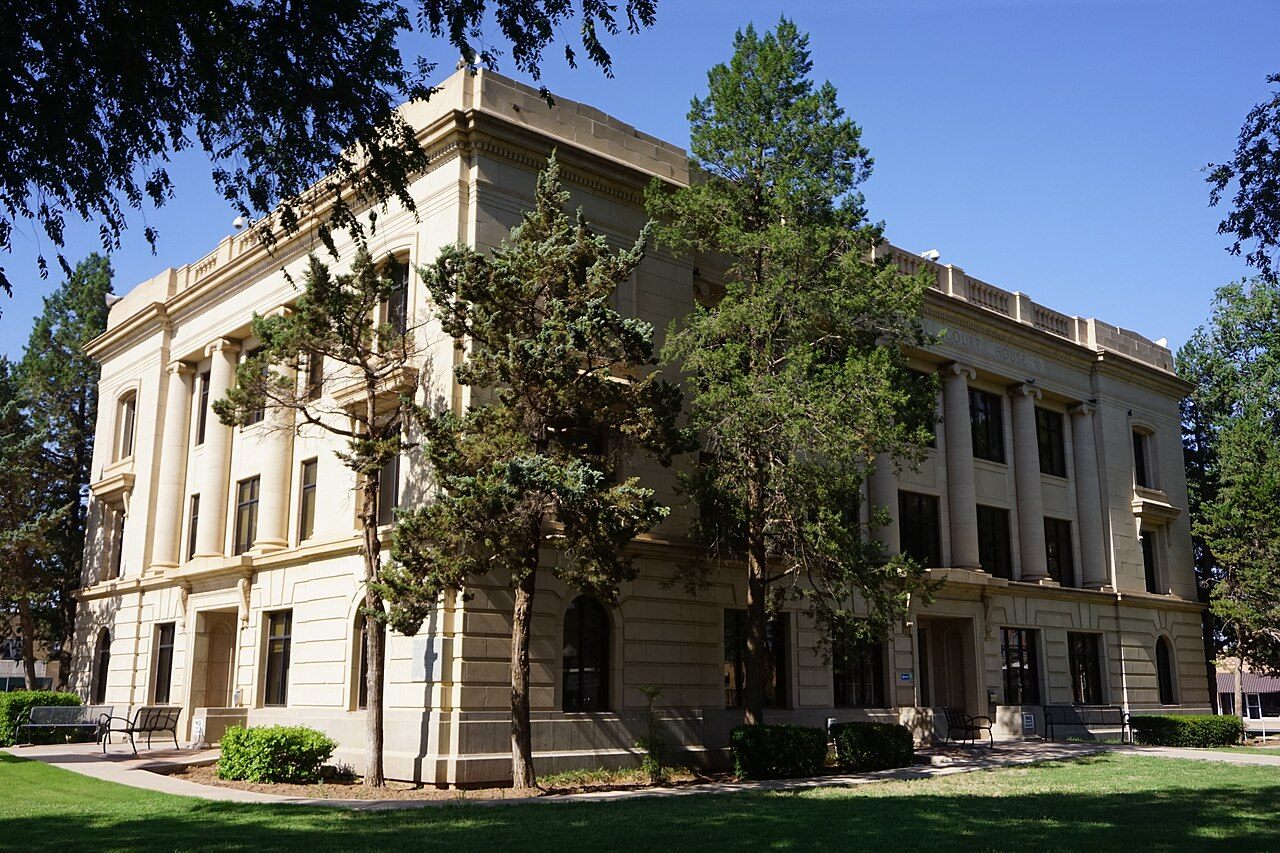
Pictured: the Hockley County Courthouse in Levelland, Texas, the county seat where sheriff's deputies and the Texas Highway Patrol coordinated their investigation of the November 2–3, 1957 encounters — not the rural highways outside town where witnesses like Pedro Saucedo reported the object up close, for which no contemporaneous photograph is known to exist.
Theoretical Alignment
Levelland does not align cleanly with any single hypothesis, which is precisely why it has remained contested for nearly seven decades. The U.S. Air Force's ball-lightning explanation is undermined by the physics of documented ball lightning — small, seconds-long, tied to an active storm — none of which matches ten independent, minutes-long, low-altitude encounters spread across a 4-hour window and a roughly 15-mile radius with no storm cell over the area. The Extraterrestrial Hypothesis is not proven by the case, but the specificity and mechanical consistency of the reported engine-and-headlight failures — observed by strangers who had no contact with one another, across different vehicle makes and model years — is difficult to wave away as coincidence, rumor, or misperception. The Psycho-Social Hypothesis struggles to explain why the very first witness of the night, a farm laborer with no radio bulletin to prime him, reported the identical electromagnetic signature that a Texas Tech engineering freshman would report two hours later ten miles away. Levelland is best understood as a genuine, still-unresolved electromagnetic-interference event whose ultimate cause — natural, technological, or otherwise — was never adequately investigated by the agency responsible for explaining it.
Background
Levelland, the county seat of Hockley County, sat in November 1957 at the intersection of two very different kinds of anxiety. Nationally, the country was in the grip of "Sputnik fever": the Soviet Union had launched Sputnik 1 on October 4, 1957, and would launch Sputnik 2, carrying the dog Laika, on November 3 — the very date the Levelland encounters were still unfolding. Astronomer J. Allen Hynek, then serving as the U.S. Air Force's scientific consultant on Project Blue Book, was simultaneously coordinating the Smithsonian's civilian Moonwatch satellite-tracking program, a workload he later cited as a reason his review of the Levelland reports had been rushed. The launches also triggered a documented nationwide spike in UFO reports through October and November 1957 — the "1957 UFO flap" — as ordinary Americans, primed to look up at the sky for the first time in the Space Age, began noticing and reporting lights they might otherwise have ignored.
Locally, Levelland was an unremarkable South Plains farm town of roughly 10,000 residents, built on cotton and a young oil field, bisected by a grid of dark, arrow-straight farm-to-market roads with no streetlights for miles outside town. It was against this backdrop — a nation nervously scanning the heavens and a farm county with wide-open sightlines and empty roads — that Levelland Police Department night dispatcher Patrolman A.J. Fowler picked up the phone just before 11:00 PM on Saturday, November 2, and took the first of what would become roughly fifteen calls before his shift ended.
Complete Timeline
| Date | Event |
|---|---|
| Oct. 4, 1957 | The Soviet Union launches Sputnik 1, triggering a wave of public sky-watching and a documented nationwide increase in UFO reports through the following weeks. |
| ~10:50–11:00 PM Nov. 2, 1957 | First encounter. Farm laborers Pedro Saucedo and Joe Salaz, driving a pickup truck four miles west of Levelland on Route 116, see a blue flash and a brilliantly lit, torpedo-shaped object roar low overhead. Their truck's engine and headlights die; Saucedo jumps from the cab in fear. The object departs and the truck restarts normally. |
| ~10:55 PM | An unnamed married couple driving northeast of Levelland see a bright flash; their headlights and car radio cut out for several seconds before recovering. |
| ~11:55 PM–12:00 AM Nov. 3, 1957 | Jose Alvarez, driving roughly eleven miles north of Levelland, reports the same pattern: his engine dies as a luminous object approaches and restarts once it moves off. |
| ~12:05 AM | Jim Wheeler encounters a brilliantly lit, egg-shaped object roughly 200 feet long blocking the road east of Levelland near Whitharral. His truck's engine and lights fail and restore after the object lifts away. |
| ~12:05–12:15 AM | The Newell Wright encounter. Texas Tech College engineering freshman Newell Wright, about ten miles east of Levelland, sees a bluish-green, flat-bottomed, egg-shaped object on or beside the highway. His ammeter needle swings toward discharge, his headlights dim, and his engine sputters and dies; he coasts to a stop near the object before it rises and departs, after which his car starts normally. |
| ~12:15–12:25 AM | Farmer Frank Williams reports a pulsating, glowing object; his vehicle's lights and engine fail and are restored once the object departs. |
| ~12:45 AM | Truck driver Ronald Martin, near Whiteface, sees a round, glowing object shift from orange to blue-green as it settles near the road; his truck's engine and lights cut out. |
| ~1:15 AM | James D. Long, in the Smyer area, reports an elliptical object at close range on the roadway; his vehicle fails in the same pattern before the object ascends vertically. |
| ~1:00–1:45 AM | Levelland Volunteer Fire Chief Ray Jones, driving north of Levelland, sees a streak of light; his headlights dim and his engine nearly stalls. |
| ~1:30 AM | The sheriff's sighting. Sheriff Weir Clem and Deputy Pat McCulloch, out on Oklahoma Flat Road investigating the flood of calls, see a brilliant red, oval-shaped light cross the highway roughly 300–400 yards ahead, briefly illuminating the pavement. Their patrol car's engine and electrical system are unaffected at that distance. |
| ~1:30–2:00 AM | The final calls of the night reach dispatcher A.J. Fowler's desk, bringing the total to approximately fifteen separate reports logged since 10:50 PM. |
| Nov. 3, 1957 | Sputnik 2 launches from the USSR carrying the dog Laika, intensifying national space-anxiety and sky-watching on the same calendar day as the second half of the Levelland encounters. |
| Nov. 4, 1957 | The Levelland story breaks nationally via wire services. Newspapers coin nicknames for the object — "the whatsit," "eggnick," "flying egg." Texas state representative J.T. Rutherford of Odessa telegrams Air Force headquarters demanding to know whether the object was a secret U.S. test vehicle. |
| Nov. 5, 1957 | NICAP member James A. Lee of Abilene is widely quoted advocating an extraterrestrial interpretation, giving the case its first national ETH framing. The same day, Staff Sgt. Norman P. Barth of the 1006th Air Intelligence Service Squadron arrives in Levelland — three days after the events — to begin the Air Force's field investigation. |
| Nov. 5–6, 1957 | Barth spends roughly one working day (about seven hours) in Levelland, interviewing only three of the fifteen callers — Saucedo, Wheeler, and Wright — plus Sheriff Clem. He finds no physical trace of a landed craft. |
| Nov. 15, 1957 | The U.S. Air Force issues an official press statement attributing the Levelland reports to "ball lightning" or "St. Elmo's fire" generated by a severe electrical storm, and blaming the vehicle failures on "wet electrical circuits." Project Blue Book, under chief Capt. George T. Gregory, closes the case as "Explained." |
| July 15, 1960 | The Levelland case is raised in a classified Air Force briefing on the UFO program to members of Congress, a measure of how much public controversy the "ball lightning" ruling had generated. |
| July 29, 1968 | University of Arizona atmospheric physicist James E. McDonald testifies before the House Committee on Science and Astronautics' "Symposium on Unidentified Flying Objects," directly rebutting the Air Force's Levelland weather explanation: "there was no lightning or thunderstorm, and only a trace of rain." |
| 1972 | J. Allen Hynek publishes The UFO Experience: A Scientific Inquiry, publicly retracting his 1957 concurrence with the ball-lightning finding and citing Levelland as a foundational Close Encounter of the Second Kind. |
| Oct. 1981 | Mark Rodeghier publishes UFO Reports Involving Vehicle Interference: A Catalogue and Data Analysis for the Center for UFO Studies, using Levelland as a foundational case in a 441-report worldwide survey. |
| 1999–2000 | Researcher Antonio F. Rullán publishes the most exhaustive modern re-investigation of the case, including new interviews with surviving witnesses Newell Wright and A.J. Fowler, 42 years after the events. |
The First Encounter: Saucedo and Salaz
The Levelland case began, as most reconstructions agree, at approximately 10:50 to 11:00 PM on Saturday, November 2, 1957, when Pedro Saucedo and his passenger Joe Salaz were driving a pickup truck along Route 116 roughly four miles west of Levelland. Saucedo later told Patrolman A.J. Fowler that he saw an intense blue-white flash of light near the roadway ahead, and that within seconds a huge, brilliantly luminous, torpedo- or rocket-shaped object rose from near ground level and closed rapidly on the truck. As it passed low overhead, Saucedo reported, both the engine and headlights died instantly and the truck was buffeted by what he described as "a great sound and rush of wind" — sufficiently violent that he threw open the door and dropped to the ground beside the road out of fear the object would strike the vehicle. Once the object had moved off into the darkness, the truck's electrical system returned to normal and the engine restarted without difficulty. Shaken, Saucedo and Salaz drove into town and reported what had happened to the Levelland police desk, becoming the evening's first of roughly fifteen calls.
Saucedo's account would later be the one most aggressively discounted by the Air Force's investigator, who characterized him in the official file as an unreliable witness because of his "grade school education" and an alleged "conflict" in his description of compass directions. Researchers who have re-examined the file, including Kevin Randle, have pointed out that this dismissal says more about the investigator's assumptions than about any documented inconsistency in the substance of what Saucedo reported — the core details of his account (blue flash, low luminous object, engine and lights failing, sound of wind, restoration on departure) are identical in kind to what would independently be reported by a college engineering student two hours later and ten miles away.
The Pattern Repeats: Wheeler, the Married Couple, and Alvarez
Within minutes of Saucedo's call, the pattern began to recur at other locations around the county, each witness apparently unaware of the others' experiences. An unnamed married couple driving northeast of town, around 10:55 PM, reported a bright flash accompanied by several seconds of complete electrical failure — not just their headlights but their car radio as well — before systems resumed normal operation. Shortly after midnight, motorist Jim Wheeler, on a road east of Levelland near the community of Whitharral, came upon a brilliantly lit, egg-shaped object he estimated at roughly 200 feet in length sitting on or immediately beside the roadway. As with Saucedo, his engine and headlights died as he approached and were restored only after the object climbed away. At almost the same time, Jose Alvarez, roughly eleven miles north of town, reported an identical failure-and-recovery sequence. By this point — still well before 1:00 AM — the Levelland Police switchboard had already logged multiple, geographically separated reports describing the same specific mechanical signature, none of which could plausibly have resulted from a single shared hallucination or a rumor spreading by word of mouth, since local radio and newspapers had not yet broadcast anything about the story.
Newell Wright: The Texas Tech Student's Account
Of all the Levelland witnesses, Newell Wright has drawn the most sustained attention from researchers, precisely because his background made him an unusually well-qualified observer of a mechanical and electrical phenomenon. A nineteen-year-old engineering freshman at Texas Tech College, Wright was driving roughly ten miles east of Levelland around 12:05 AM when he spotted a bluish-green, egg-shaped object with a flat underside resting on or immediately beside the highway, which he estimated at approximately 125 feet in length. As he approached, he watched his car's ammeter needle swing sharply toward "discharge" — a specific instrument reading a layperson would be unlikely to notice or think to mention — before his headlights dimmed and extinguished and his engine sputtered to a stop. Wright coasted to a halt a short distance from the object; after a period of several seconds to roughly a minute, it rose vertically and departed, at which point his car started normally with no further malfunction. Wright reported his experience to Levelland police and was one of only three witnesses the Air Force's field investigator interviewed in person. More than four decades later, in 1999, he was one of two surviving witnesses (along with dispatcher A.J. Fowler) interviewed directly by researcher Antonio F. Rullán for the most thorough modern re-investigation of the case, and his account remained consistent with his original 1957 statement.
Midnight to Dawn: Williams, Martin, Long, and Jones
The reports continued at a steady clip through the early morning hours. Farmer Frank Williams, around 12:15 to 12:25 AM, described a pulsating, glowing object that produced the by-now-familiar failure of his vehicle's lights and engine, both restored once the object moved off. Truck driver Ronald Martin, near the community of Whiteface at roughly 12:45 AM, watched a round, glowing object shift in color from orange to blue-green as it descended toward the road ahead of him, his truck's systems failing in the same pattern. At approximately 1:15 AM, James D. Long, in the Smyer area southeast of Levelland, reported an elliptical object at close range on the roadway that produced an identical vehicle failure before rising away vertically. Levelland's volunteer fire chief, Ray Jones, driving north of town sometime between roughly 1:00 and 1:45 AM, saw a streak of light accompanied by dimming headlights and an engine that nearly — but did not completely — stall. By this point in the night, the pattern had been independently reported by a farm laborer, a truck driver, an engineering student, a farmer, and a fire chief, at no fewer than seven distinct rural locations spread across a roughly fifteen-mile radius.
The Sheriff's Department Responds
As the volume of calls mounted, Sheriff Weir Clem and Deputy Pat McCulloch went out on patrol specifically to investigate, initially treating the flood of reports with the skepticism one would expect from law enforcement fielding a night of increasingly strange phone calls. At approximately 1:30 AM, while driving Oklahoma Flat Road roughly four to five miles from town, the two men saw a brilliant, oval-shaped, red light cross the highway an estimated 300 to 400 yards ahead of their patrol car, briefly illuminating the pavement in front of them. Clem later described it as being "like a brilliant red sunset" that "lit up the whole pavement in front of us for about two seconds." Unlike the direct contactees, the sheriff's patrol car — at a substantially greater standoff distance — experienced no engine or electrical disruption, a detail proponents of a genuine electromagnetic-interference explanation point to as consistent with a field effect whose intensity fell off sharply with distance, and which skeptics point to as evidence that whatever Clem and McCulloch saw might have been a separate, more distant phenomenon (a genuine electrical discharge, a meteor, or a reflection) from whatever had disabled the closer vehicles. Whatever its ultimate cause, the sighting placed a sitting county sheriff and his deputy — the very officials responsible for evaluating the night's reports — among the witnesses themselves.
Fifteen Calls in Four Hours: The Police Log
By the time the reports tapered off in the early hours of November 3, dispatcher A.J. Fowler had logged approximately fifteen separate telephone calls describing the phenomenon, originating from locations scattered west, north, and east of Levelland across a roughly four-hour span beginning around 10:50 PM. Researcher Antonio Rullán's later analysis narrowed the count to seven encounters meeting a strict definition — a luminous object within roughly 500 feet of the witness's vehicle producing engine and headlight failure — while other investigators, including James E. McDonald, cited a broader figure of roughly ten vehicles independently stopped within the encounter window. Whichever count is used, the concentration of consistent, independent reports in a single county on a single night has no close parallel in American UFO history before or since, and it is the sheer statistical density of the reporting — not any single dramatic account — that has made Levelland a benchmark case for seven decades of vehicle-interference research.
National Media Firestorm
The story broke nationally on November 4, 1957, carried by the wire services to newspapers across the country. Reporters, uncertain what to call the object, coined a string of nicknames — "the whatsit," "eggnick," "flying egg" — that captured both the public's fascination and its bafflement. Texas state representative J.T. Rutherford of Odessa publicly wondered whether the object might be a secret American research vehicle and sent a telegram to Air Force headquarters in Washington demanding an explanation. By November 5, NICAP member James A. Lee of Abilene had become the most widely quoted voice arguing for an extraterrestrial interpretation, giving the story its first sustained national ETH framing even as the Air Force's own field investigator was only just arriving in town. The case's timing — unfolding on the very night the Soviet Union launched Sputnik 2 — guaranteed it maximum attention during a period in which the American public was already anxiously scanning the night sky.
The Air Force Investigation
The Air Force's response to Levelland has become, in the decades since, almost as controversial as the sightings themselves. Staff Sergeant Norman P. Barth of the 1006th Air Intelligence Service Squadron, based at Ent Air Force Base in Colorado Springs — the unit that had taken over field investigations for Project Blue Book after the 4602nd Air Intelligence Service Squadron was disbanded that same July — was not dispatched to Levelland until November 5, three full days after the sightings had ended. Barth spent roughly a single working day, on the order of seven hours, in and around the town, and interviewed only three of the approximately fifteen callers who had reported the phenomenon: Pedro Saucedo, Jim Wheeler, and Newell Wright, along with a conversation with Sheriff Clem. The remaining nine or more witnesses — including Alvarez, Williams, Martin, Long, and Jones — were never contacted, in several cases apparently because their addresses fell just outside the Levelland city limits Barth had been assigned to cover.
Barth's field report, later declassified and now held in the Project Blue Book archive, found no physical trace of a landed object anywhere in the search area and expressed open skepticism about Saucedo's reliability, describing him in terms that emphasized his limited formal education and an alleged inconsistency in describing compass directions. The investigation's findings were forwarded to Blue Book headquarters at Wright-Patterson Air Force Base, then under the direction of Captain George T. Gregory, who led the project from April 1956 to October 1958 and was known even among his own colleagues for an aggressive determination to close cases with a conventional explanation wherever one could plausibly be constructed. On November 15, 1957, the Air Force issued its official finding: the Levelland reports were the product of "ball lightning" or "St. Elmo's fire," a rare atmospheric electrical phenomenon, generated by a severe electrical storm that had also left the witnesses' vehicles with "wet electrical circuits" prone to short-circuiting. The case was closed in the Blue Book files as "Explained: Astronomical/Weather."
Scientific Reassessment: Hynek's Reversal and McDonald's Rebuttal
At the time, J. Allen Hynek, Blue Book's scientific consultant, went along with the ball-lightning finding, cautiously describing it in internal correspondence as a "possible" explanation. He would later say he was consumed that week with tracking the Soviet Sputnik launches for the Smithsonian's Moonwatch program and gave the Levelland file less scrutiny than it deserved. Fifteen years afterward, in his landmark 1972 book The UFO Experience: A Scientific Inquiry, Hynek published an unusually direct retraction: "I am not proud today that I hastily concurred in [the Air Force's] evaluation as 'ball lightning' on the basis of information that an electrical storm had been in progress in the Levelland area at the time. This was shown not to be the case." He went further, noting that "had I given it any thought whatsoever, I would soon have recognized the absence of any evidence that ball lightning can stop cars and put out headlights." Hynek subsequently listed Levelland among the foundational examples of what he termed a Close Encounter of the Second Kind — a UAP encounter that leaves a measurable physical effect — in the very taxonomy he invented to classify UFO reports.
University of Arizona atmospheric physicist James E. McDonald pursued the weather question further and independently. Testifying before the House Committee on Science and Astronautics' 1968 "Symposium on Unidentified Flying Objects," McDonald told Congress that "ten vehicles were stopped within a short area, all independently in a two-hour period. There was no lightning or thunderstorm, and only a trace of rain." McDonald's broader argument — echoed by later researchers including Kevin Randle — was not merely that the weather record contradicted the Air Force's premise, but that the phenomenology itself was wrong: naturally occurring ball lightning, even under generous assumptions, does not remain stable and mobile for minutes at a time, does not appear repeatedly at ten separate locations over four hours, and has never been documented to selectively interrupt an automobile's ignition system from a stand-off distance. Randle has additionally pointed to a color discrepancy the Air Force's own explanation glossed over: while ball lightning and St. Elmo's fire are typically blue-white or violet in color (consistent with a corona discharge), Sheriff Clem specifically described the object he and Deputy McCulloch saw as glowing "brilliant red" — a detail Randle argues, if accurate, undercuts the official finding on its own terms.
The Congressional Dimension and Vehicle-Interference Research
Levelland's influence outlasted the news cycle of November 1957 by decades. The case was controversial enough within the Air Force's own UFO program that it was specifically raised in a classified 1960 congressional briefing, and it resurfaced eleven years later as the centerpiece of James E. McDonald's direct rebuttal to Congress in 1968 — one of the few occasions an active U.S. government UFO explanation was challenged, point by point, on the record of a congressional hearing. When Mark Rodeghier and the Center for UFO Studies undertook the first systematic worldwide catalog of vehicle-interference reports in 1981, ultimately compiling 441 cases, Levelland served as the model against which every subsequent report was implicitly measured, both for the specificity of its witness accounts and for the number of independent observers concentrated in a single incident. That vehicle-interference category would go on to include the 1976 Tehran UFO Incident, in which military-grade weapons and communications systems — not a 1950s automobile ignition — reportedly failed under similar close-proximity conditions, suggesting to some researchers a common underlying phenomenon operating across a twenty-year span and a vast difference in technological sophistication.
Key Witnesses
Pedro Saucedo
Saucedo and passenger Joe Salaz were the first to report the phenomenon, at approximately 10:50 to 11:00 PM on Route 116 west of Levelland. Saucedo described a blue flash, a low-flying, brilliantly lit, torpedo-shaped object, a "great sound and rush of wind" as it passed overhead, and his truck's engine and headlights failing before recovering once the object departed. The Air Force's field investigator dismissed his reliability on the basis of his limited formal education and an alleged directional inconsistency — a characterization modern researchers have criticized as a credibility judgment untethered from any actual contradiction in his account, especially given how closely it matches statements later given independently by far more formally credentialed witnesses.
Joe Salaz
Salaz was riding with Pedro Saucedo during the night's opening encounter and corroborated Saucedo's account of the blue flash, the low-flying luminous object, and the truck's sudden electrical failure. As a passenger rather than the driver, his statement to police was brief, but it provided the first independent corroboration of the pattern that would repeat across the county for the next four hours.
Jim Wheeler
Shortly after midnight, Wheeler encountered a brilliantly lit, egg-shaped object roughly 200 feet long on or beside the road east of Levelland near Whitharral. His vehicle's engine and lights failed on approach and recovered once the object climbed away. Wheeler was one of only three witnesses the Air Force's investigator interviewed directly.
Jose Alvarez
Driving roughly eleven miles north of Levelland around midnight, Alvarez reported the same failure-and-recovery sequence as the other witnesses: his engine died as a luminous object neared his vehicle and restarted once it moved away. Alvarez was not among the witnesses the Air Force chose to interview.
Newell Wright
Wright's account is widely regarded as the single most technically credible in the case. Around 12:05–12:15 AM, roughly ten miles east of Levelland, he watched his car's ammeter needle swing toward "discharge" as a bluish-green, flat-bottomed, egg-shaped object approached; his headlights dimmed, his engine sputtered and died, and he coasted to a stop before the object rose and departed, after which his car started normally. As an engineering student, Wright's ability to correctly identify and describe an unusual instrument reading lends his testimony a specificity that lay witnesses could not have supplied. He was interviewed both by the Air Force in 1957 and, 42 years later in 1999, by researcher Antonio Rullán, giving a consistent account across four decades.
Frank Williams
Around 12:15 to 12:25 AM, Williams reported a pulsating, glowing object accompanied by the failure of his vehicle's headlights and engine, both of which returned to normal once the object departed — a sequence matching the six witnesses who had already called in before him.
Ronald Martin
Near the community of Whiteface at roughly 12:45 AM, Martin watched a round, glowing object change color from orange to blue-green as it descended toward the roadway ahead of him. His truck's engine and headlights failed in the same pattern reported by every prior witness that night.
James D. Long
At approximately 1:15 AM, in the Smyer area southeast of Levelland, Long reported an elliptical object at close range on the roadway, his vehicle's electrical system failing before the object ascended vertically and departed.
Ray Jones
Driving north of Levelland sometime between roughly 1:00 and 1:45 AM, Jones — a public official with firefighting and emergency-response responsibilities — saw a streak of light accompanied by dimming headlights and a nearly stalled engine, adding another occupationally credible witness to the night's cumulative record.
Sheriff Weir Clem
Clem personally fielded the growing wave of phone calls at the Levelland police desk and drove out with Deputy Pat McCulloch specifically to investigate. At approximately 1:30 AM on Oklahoma Flat Road, the two men saw a brilliant, oval, red light cross the highway roughly 300 to 400 yards ahead, briefly lighting the pavement — a sighting Clem described as being "like a brilliant red sunset." As the officer responsible for evaluating the night's reports, his own firsthand encounter is one of the case's most significant details.
Deputy Pat McCulloch
McCulloch was riding with Sheriff Clem on Oklahoma Flat Road when the two men observed the brilliant red light crossing the highway ahead of their patrol car around 1:30 AM, corroborating his superior's account in real time and adding independent law-enforcement testimony to the case.
Patrolman A.J. Fowler
Fowler worked the police desk through the entire night of November 2–3, 1957, personally taking all approximately fifteen incoming calls describing the object and creating the dispatch log that remains the single most important contemporaneous record of the case. In 1999, more than four decades later, Fowler was one of two surviving witnesses interviewed directly by researcher Antonio Rullán for the most thorough modern reconstruction of the night's events.
The Five Observables Assessment
The Five Observables framework, developed by former AATIP director Luis Elizondo, is used to classify UAP encounters based on performance characteristics that exceed known technology:
Assessment: Levelland is not a high-performance flight case in the modern sensor-documented sense — there is no radar track and no instrumented speed or altitude data, so hypersonic velocity and trans-medium travel are simply not addressed by the evidence. Several witnesses described the object rising away with what they characterized as unusual speed or a sudden vertical departure, which is suggestive of an anomalous acceleration profile but rests entirely on unaided visual estimation and is therefore classified as speculative rather than confirmed. Anti-gravity lift is not directly claimed by any witness and is marked N/A. The most distinctive "observable" in this case does not appear on Elizondo's original five-item list at all: a repeatable, close-range electromagnetic interference effect on internal-combustion ignition systems, reported independently by ten or more witnesses. Levelland's evidentiary significance lies less in exotic flight performance than in this specific, mechanically detailed, and widely corroborated EM-interference signature.
Evidence Assessment
Supporting Anomalous Origin
- Approximately fifteen independent calls logged by police in under four hours, from witnesses with no connection to one another
- A consistent, specific, three-stage electrical failure signature (dimming, stalling, full recovery) reported across ten or more separate vehicles
- Newell Wright's technically precise ammeter observation, corroborated in a 1999 interview 42 years after the event
- Independent corroboration from Sheriff Weir Clem and Deputy Pat McCulloch, the law-enforcement officers evaluating the reports
- Both J. Allen Hynek and James E. McDonald, reviewing the U.S. Weather Bureau's own records, found no active storm during the encounter window
- Hynek's own 1972 public retraction of his 1957 concurrence with the Air Force's finding
- No mundane, shared point of mechanical failure has ever been identified across the affected vehicles
Supporting Conventional Explanation
- No physical trace, debris, or photographic evidence was recovered by the Air Force search team or by any witness
- A genuine weather system had brought rain, thunderstorms, and lightning to parts of West Texas in the days preceding the sightings
- The Air Force's field investigator found Pedro Saucedo's account unreliable
- Later witnesses that night may have been influenced by word of the earlier reports spreading through the small community
- No instrumented (radar, magnetic, radiological) data exists to independently corroborate any account
- The case relies entirely on testimonial evidence gathered or reconstructed, in the strongest instances, only years to decades after the fact
Why "Disputed"
The Levelland case earns a DISPUTED classification because its official government explanation and the documentary evidence used to test that explanation point in opposite directions, and because the case has never been reopened despite that contradiction being demonstrated, in detail, by two independent scientists working decades apart. What is not disputed: the Levelland Police Department logged roughly fifteen independent calls in under four hours describing the same phenomenon; the Air Force's own scientific consultant, J. Allen Hynek, later admitted in print that the weather rationale behind the "ball lightning" finding was factually wrong; physicist James E. McDonald reached the identical conclusion independently and testified to it before Congress; and the Air Force's field investigation, by its own internal record, interviewed only three of the fifteen callers over the course of a single working day before the case was closed. What remains genuinely unresolved is what, if anything, was physically present on those roads on the night of November 2–3, 1957 — a natural electrical phenomenon not yet adequately described by atmospheric science, a still-unidentified technology, or some combination of misperception and coincidence that has so far eluded any single investigator's full reconstruction. Until a mechanism is demonstrated that can account for the specific, repeated, ignition-disabling signature reported independently by ten or more credible, unconnected witnesses — including a sheriff and his deputy — the case remains open in every sense that matters, regardless of its closed status in the Project Blue Book files.
Sensor & Instrumentation Detection Profile
Levelland predates virtually all of the instrumented sensor technology used to study modern UAP encounters — there was no FLIR, no radar cross-referencing, no cockpit gun-camera footage, and no cell-phone imagery. The only "instrumentation" available to the witnesses was their own vehicles, and it is precisely that fact which gives the case its evidentiary weight. Nineteen-year-old Newell Wright, a Texas Tech College freshman studying engineering, watched his car's ammeter needle swing hard toward "discharge" in the seconds before his headlights dimmed and his engine died — a specific, technically literate observation that a frightened bystander could not have invented on the spot and that a hoaxer would have had no reason to include. Multiple witnesses independently described the same three-stage electrical signature: headlights dimming before going out completely, the engine sputtering rather than cutting instantly, and both systems recovering simultaneously and without any lingering malfunction once the object had moved away. That signature is consistent with a strong, transient, localized electromagnetic or electrostatic field interacting with the low-voltage ignition and charging systems of 1950s-era vehicles — point-contact distributors, coil-and-condenser ignition, and 6-volt or 12-volt electrical systems that were, as later vehicle-interference researchers such as James McCampbell documented, genuinely susceptible to external field disruption. No civilian or military radar coverage of rural Hockley County existed in 1957 to cross-reference the sightings, and the Air Force investigation made no attempt to test or measure the electromagnetic properties of the reported phenomenon; the sole surviving "sensor data" is the internally consistent pattern recorded independently in ten separate witness statements and the Levelland Police Department's dispatch log.
Environmental & Geospatial Context
Levelland sits on the flat, treeless Llano Estacado (the South Plains) roughly 30 miles west of Lubbock, at the center of Hockley County. In 1957 it was a farming community of roughly 10,000 people, its economy built on cotton and the recently developed Slaughter oil field. The terrain around town is flat, open cropland crossed by a grid of unlit farm-to-market roads — conditions that gave every motorist an unobstructed, multi-mile line of sight and that made a low, bright object exceptionally conspicuous against the night sky. The encounters were reported along roads radiating west, north, and east of town, within roughly a ten-to-fifteen-mile radius, consistent with witnesses genuinely encountering something moving through the same general airspace over an extended period rather than all converging on one fixed location.
The weather is the single most contested variable in the entire case, because it is the foundation of the Air Force's official explanation. Multiple secondary accounts note that a weather system had produced rain, thunderstorms, and lightning over parts of West Texas in the days and hours before the sightings began, and the Air Force's investigating officer characterized the region as gripped by a "severe electrical storm" that produced "wet electrical circuits." When physicist James E. McDonald and astronomer J. Allen Hynek independently reviewed the U.S. Weather Bureau's hourly observations for Lubbock and Levelland for the specific hours of the encounters — roughly 10:50 PM to 1:30 AM — both concluded that no active thunderstorm was in progress during that window. McDonald told a congressional committee in 1968 that the witnesses reported "no lightning or thunderstorm, and only a trace of rain." Hynek, in his 1972 book, wrote that his own initial concurrence with the ball-lightning finding rested on information "that an electrical storm had been in progress in the Levelland area at the time," adding flatly, "this was shown not to be the case." Contemporary witness statements describe overcast skies, mist, and light wind — not the towering cumulonimbus activity required to generate ball lightning by any accepted mechanism. This is the environmental fact on which the entire official explanation turns, and it is the fact the Air Force's field investigation never rigorously tested.
Observer Credibility & Occupational Profile
The Levelland witness pool is unusually broad and occupationally diverse for a single-night UFO event: migrant farm laborers, a truck driver, a college engineering student, a volunteer fire chief, a married couple, and finally a county sheriff and his deputy, none of whom knew each other or coordinated their accounts. Pedro Saucedo, the first caller, was dismissed by the Air Force's investigator largely on the grounds of his "grade school education," a characterization researcher Kevin Randle and others have criticized as a credibility judgment based on class and education rather than on any actual inconsistency in what Saucedo reported happening to his truck. By contrast, Newell Wright was a nineteen-year-old engineering freshman at Texas Tech College — precisely the kind of technically trained observer whose testimony investigators normally weight heavily — and his account of his ammeter's behavior is one of the most specific, mechanically literate descriptions in the entire case file. Volunteer fire chief Ray Jones and Levelland Police night dispatcher Patrolman A.J. Fowler held positions of public trust and had no discernible motive to fabricate or exaggerate. Most significantly, Sheriff Weir Clem and Deputy Pat McCulloch were not passive bystanders drawn into the story after the fact — they were the law-enforcement officers actively fielding the flood of incoming calls, and their own independent sighting occurred while they were driving out specifically to investigate reports they initially suspected might be exaggeration or panic. A sitting sheriff reporting a UFO sighting while on duty, in front of his own deputy, is a materially different category of testimony than an anonymous phone call, and it is one the Air Force's seven-hour field investigation never seriously grappled with.
Physical & Material Assays
No debris, scorch marks, soil samples, photographs, or any other tangible physical trace of the Levelland object was ever recovered, and this absence is one of the strongest arguments skeptics raise against a genuinely anomalous interpretation of the case. Unlike Socorro, which left landing-gear impressions and burned vegetation, Levelland produced nothing a laboratory could analyze. What the case does contain, in place of physical trace evidence, is a large sample of independently reported mechanical malfunctions across a genuinely diverse fleet of civilian vehicles — different owners, different makes, different model years, different locations — all exhibiting the identical, specific failure-and-recovery signature within the same narrow time window. Proponents argue that this pattern is itself a form of physical evidence: whatever interacted with those vehicles' ignition and charging systems left no crater or residue, but it left a statistically improbable cluster of near-simultaneous, mechanically consistent equipment failures that conventional automotive science of the period could not otherwise explain. No vehicle sustained any permanent damage; every witness reported that engines, headlights, and (in one case) a car radio returned to full normal function within seconds of the object's departure, with no residual electrical fault reported afterward — a detail that itself argues against a mundane malfunction (loose battery cable, dead alternator, moisture-fouled points) coincidentally striking ten unrelated vehicles the same night.
Historical Precedents & Archive Matches
Levelland is widely treated by UFO researchers as the founding, type-defining case of the "vehicle interference" sub-category of Close Encounters of the Second Kind — incidents in which a proximate UAP is reported to disable a car's ignition and electrical systems. Mark Rodeghier of the Center for UFO Studies (CUFOS) used Levelland as a cornerstone case in his 1981 catalog of 441 worldwide vehicle-interference reports, and it remains the most frequently cited example in that literature because of the sheer number of independent witnesses concentrated in one night and one county. Within the site's own case files, Levelland's electromagnetic-interference signature echoes forward almost twenty years to the Tehran UFO Incident of September 1976, in which Iranian Air Force F-4 Phantom jets lost weapons-system and communications functionality on final approach to an intercept — a case the Defense Intelligence Agency itself called "a classic." It also stands alongside the Socorro landing of 1964 as one of the small number of Project Blue Book "Unidentified"-adjacent cases involving direct law-enforcement testimony. The specific claim that a UAP can induce transient ignition failure in nearby vehicles recurs across the international UFO literature — from the 1976 Tehran case to numerous entries in Rodeghier's and later researcher Mark Cashman's compilations — making Levelland less an isolated anomaly than the first well-documented instance of a pattern investigators would go on to log hundreds of times over the following decades.
Material Analysis
The Levelland case is unusual among well-documented UFO encounters in that it produced no physical trace evidence whatsoever — no debris, no soil disturbance, no scorch marks, no photographs — despite multiple witnesses describing the object at or near ground level on public roads. Its evidentiary basis instead rests entirely on the internal consistency of a large body of independent testimony describing a specific, mechanically detailed electromagnetic effect on civilian vehicles.
The Ignition-Interference Signature
Across the roughly ten direct-contact witnesses, the reported sequence of vehicle failure is remarkably uniform: headlights dim before extinguishing completely, the engine loses power and stalls rather than cutting instantly, and both systems return to full normal function within seconds of the object's departure, with no lasting damage or fault in any vehicle afterward. Newell Wright's observation that his ammeter swung toward "discharge" immediately before his lights and engine failed is the case's single most technically specific data point, suggesting a transient draw or induced current in the vehicle's charging circuit rather than a simple loss of spark. 1950s-era vehicles used mechanical point-contact distributors, low-voltage coil ignition systems, and 6- or 12-volt electrical architectures that later researchers into vehicle-interference cases, including James McCampbell, have argued were genuinely vulnerable to disruption by strong external electric or magnetic fields — a mechanism distinct from, and considerably more exotic than, the "wet electrical circuits" the Air Force blamed for the failures.
The Absence of Trace Evidence
Staff Sgt. Norman Barth's Air Force team searched the reported encounter sites and found nothing — no burn marks, no depressed or disturbed soil, no unusual residue — though the search occurred three days after the events and covered only a fraction of the reported locations. Proponents note that an object that never physically touched down, and that generated its effects through a field rather than direct contact, would be expected to leave no trace; skeptics counter that the absence of any corroborating physical evidence, even indirect (such as damaged vegetation, tire-track evidence of drivers stopping abruptly, or contemporaneous photographs from any of the fifteen callers), leaves the entire case dependent on testimony that cannot be independently verified.
Supporting an Anomalous Interpretation
- Ten or more mutually unconnected witnesses, of diverse occupation and background, independently reported an identical, mechanically specific failure-and-recovery sequence within a single four-hour window
- Newell Wright's ammeter observation is a technically precise detail inconsistent with fabrication by a layperson and consistent with a genuine induced electrical effect
- Sheriff Weir Clem and Deputy Pat McCulloch, the law-enforcement officers evaluating the reports, had their own independent sighting while actively investigating
- Multiple vehicles of different makes and model years were affected and recovered fully with no shared, mundane point of failure (battery, alternator, distributor moisture) identified
- Both J. Allen Hynek and James E. McDonald, working independently and years apart, concluded the weather record did not support the Air Force's own stated rationale
Supporting a Conventional Explanation
- No physical trace, debris, or photographic evidence of any kind was ever recovered despite an active, if brief, Air Force search
- A weather system had produced rain and lightning over parts of West Texas in the days before the sightings, lending surface plausibility to an electrical-phenomenon explanation even if the precise timing does not match
- The Air Force's investigator considered several witness accounts, including Saucedo's, unreliable
- No independent instrumented data (radar, radiological, magnetic) exists to corroborate any witness's account
- Widespread regional media coverage after the first few calls could theoretically have shaped or embellished the accounts of the later witnesses that night
The Conventional Explanation Candidate
Three principal terrestrial explanations have been proposed for the Levelland reports since 1957. Each deserves serious evaluation, because unlike many UFO cases, Levelland has an official government explanation on record that can be directly tested against the documentary evidence.
1. Ball Lightning / St. Elmo's Fire (The Official Explanation)
ImplausibleThe U.S. Air Force's formal position, issued November 15, 1957 and never revised, is that the witnesses saw ball lightning or St. Elmo's fire generated by a severe regional electrical storm, and that their vehicles' "wet electrical circuits" shorted out independently of the light phenomenon. Harvard astronomer Donald Menzel, the era's most prominent UFO skeptic, defended a version of this explanation in his 1963 book The World of Flying Saucers, arguing that ball lightning's inherently transient, unrepeatable nature made the case impossible to disprove and that the "overwhelming probability" favored a natural electrical phenomenon over an exotic craft. The explanation has genuine surface appeal: ball lightning is a real, if poorly understood, atmospheric phenomenon, and a storm system had indeed passed through parts of West Texas in the days before November 2.
The explanation runs into serious difficulty on both meteorological and physical grounds. When J. Allen Hynek and James E. McDonald independently reviewed the U.S. Weather Bureau's hourly station data for Lubbock and Levelland, both concluded no active thunderstorm was in progress during the actual encounter window of roughly 10:50 PM to 1:30 AM — witnesses described overcast, misty conditions, not the towering convective activity ball lightning requires. The best modern scientific documentation of natural ball lightning, a 2014 spectroscopically confirmed event captured by Chinese researchers during a thunderstorm on the Qinghai Plateau, showed a luminous sphere roughly five meters across that formed at the base of an actual cloud-to-ground lightning strike and dissipated after 1.64 seconds — a single, brief, storm-tethered event, categorically unlike ten reappearances of a 100–200-foot object hovering for up to five minutes at separate locations spread across four hours with no lightning strikes reported by any witness. No verified scientific observation of ball lightning has ever documented the phenomenon selectively disabling a nearby vehicle's ignition system. The weather record contradicts the explanation's own premise, and the physical behavior required of "ball lightning" in this case — size, duration, mobility, repeatability, and selective ignition interference — exceeds anything documented in the scientific literature on the phenomenon, before or since.
2. Mass Hysteria / Media Contagion
ImplausibleA second explanation holds that Pedro Saucedo's initial, dramatic report triggered a night of suggestible copycat sightings as word spread by police radio, party-line telephone, and word of mouth through a small farming community already primed by weeks of Sputnik-era sky anxiety. Under this view, later witnesses may have misidentified ordinary lights — another car's headlights on a distant road, a reflection, ball lightning, or simple automotive trouble — and unconsciously reshaped their accounts to match what they had already heard was happening nearby.
This explanation struggles against the timeline. Several of the closest-together reports, including Saucedo's opening encounter and the married couple's sighting roughly five minutes later, occurred before any public bulletin could plausibly have reached other motorists already out on the road; the Levelland Police Department was still receiving its very first calls at that point, not yet broadcasting anything. It also fails to explain why Newell Wright, a technically literate engineering student with every incentive to describe events accurately rather than sensationally, reported the same specific ammeter and ignition behavior as Saucedo, a farm laborer with no scientific training, despite the two men never having met. A rumor can transmit "I saw a UFO and my car died," but it cannot easily transmit the specific, mechanically correct detail of an ammeter needle swinging toward discharge to someone who did not independently observe it. This explanation is implausible for the encounters as a whole, though it cannot be fully ruled out as a contributing factor for the latest calls of the night, made after regional radio traffic and word of mouth had likely begun to spread.
3. Meteor / Bolide Activity
ImplausibleEarly November falls within the tail of the Taurid meteor shower, and a bright fireball entering the atmosphere can produce a brilliant, colorful flash visible over a wide area, occasionally accompanied by electrophonic sound effects. Some early wire-service speculation floated a meteor as a possible cause for at least the initial flash reported by Saucedo.
A meteor explanation cannot account for the defining characteristics of the Levelland reports. Meteors are single, seconds-long, sky-transiting events; they do not hover at low altitude beside a road, do not reappear at ten separate locations over a four-hour span, and have no documented mechanism for disabling a nearby vehicle's electrical system, let alone doing so repeatedly and consistently with a clean recovery each time. The theory might plausibly explain an isolated, unconnected sky-flash report elsewhere in Texas that same week, but it does not fit the specific, repeated, ground-level, vehicle-interference pattern that defines the Levelland case. Meteor phenomenology does not match the duration, altitude, repetition, or vehicle-interference signature reported by any Levelland witness.
The Assessment: Why the Official Explanation Failed
Of the three conventional candidates, none survives close comparison with the documentary record. The Air Force's own explanation is undercut by weather data its own scientific consultant later admitted was wrong, and by a field investigation that spent roughly one working day in town, interviewed only three of fifteen witnesses, and dismissed the most detailed early account on grounds of the witness's education rather than any inconsistency in his statement. Mass hysteria cannot account for the earliest, most isolated reports or for the specific technical detail supplied by an engineering-trained witness. A meteor cannot account for a low-altitude object reported repeatedly, at separate locations, disabling vehicles for minutes at a time. What remains is a genuinely unresolved case: a documented, repeatable electromagnetic-interference effect, reported independently by a uniquely large and occupationally diverse witness pool including two law-enforcement officers, for which no fully satisfying conventional mechanism — natural or fabricated — has ever been demonstrated.
Related Cases
Confirmed Documents & Official Records
The complete declassified Air Force investigative file, including Staff Sgt. Norman Barth's field report, witness statements, and the official "ball lightning" finding, hosted via FOIA release.
UNCLASSIFIED (released via FOIA)Official transcript of the Congressional hearing at which Dr. James E. McDonald directly rebutted the Air Force's Levelland weather explanation before Congress.
PUBLIC RECORDSearch Government Archives Directly
Further Reading — Recommended Literature
The UFO Experience: A Scientific Inquiry
Hynek's landmark work, including his own public retraction of the Levelland ball-lightning finding and the introduction of the Close Encounters classification system that Levelland helped define.
The World of Flying Saucers: A Scientific Examination of a Major Myth of the Space Age
The leading skeptical case for the ball-lightning and mass-misperception explanations of Levelland and comparable UFO reports of the era.
UFO Reports Involving Vehicle Interference: A Catalogue and Data Analysis
The foundational academic study of the vehicle-interference phenomenon, cataloging 441 worldwide cases with Levelland as a central reference point.
The UFO Controversy in America
A definitive academic history of American UFO research placing Levelland within the broader 1957 sighting wave and the government's evolving investigative posture.
Watch the Skies!: A Chronicle of the Flying Saucer Myth
A book-length, case-specific account of the November 1957 sightings, witness statements, and the Air Force investigation.
Essential Viewing
No Videos Available
Sources
- "Levelland UFO case." Wikipedia. en.wikipedia.org
- Hynek, J. Allen. The UFO Experience: A Scientific Inquiry. Henry Regnery Co., 1972.
- Menzel, Donald H. & Boyd, Lyle G. The World of Flying Saucers: A Scientific Examination of a Major Myth of the Space Age. Doubleday, 1963.
- Clark, Jerome. The UFO Encyclopedia: The Phenomenon from the Beginning. Omnigraphics, 1998.
- Jacobs, David M. The UFO Controversy in America. Indiana University Press, 1975.
- Peebles, Curtis. Watch the Skies!: A Chronicle of the Flying Saucer Myth. Smithsonian Institution Press, 1994.
- Rullán, Antonio F. "The Levelland Sightings of 1957: Analysis of the Evidence and Evaluation of the Ball Lightning Hypothesis." NICAP, Oct. 18, 1999, rev. March 26, 2000. nicap.org
- Rodeghier, Mark. UFO Reports Involving Vehicle Interference: A Catalogue and Data Analysis. Center for UFO Studies, October 1981. Listed at cufos.org
- McDonald, James E. Testimony, "Symposium on Unidentified Flying Objects." Hearings before the House Committee on Science and Astronautics, 90th Congress, 2nd Session, July 29, 1968. nicap.org
- U.S. Air Force. Project Blue Book Case File: Levelland, Texas, November 2–3, 1957. Released via FOIA, hosted at theblackvault.com
- NICAP. "UFO Report — Pedro Saucedo, Levelland, TX, November 2, 1957." nicap.org
- Randle, Kevin D. "A Different Perspective: Levelland, Texas Revisited." A Different Perspective (blog), June 2014. kevinrandle.blogspot.com
- Randle, Kevin D. "Levelland and the Four Witnesses." A Different Perspective (blog), June 2020. kevinrandle.blogspot.com
- The Black Vault. "The Vault Files: The Levelland UFO Incident (1957)." theblackvault.com
- Dudding, George. The Levelland UFO Case. CreateSpace Independent Publishing Platform, 2016.
- Cen, Jianyong; Yuan, Ping; Xue, Simin. "Observation of the Optical and Spectral Characteristics of Ball Lightning." Physical Review Letters, vol. 112, no. 3, January 2014. link.aps.org
- Booth, B.J. "1957 — The Levelland, Texas UFO Landings." UFO Casebook. ufocasebook.com
- "Hockley County, Texas, 2 to 3 November 1957: The Levelland UFO Sightings." The Cold File. thecoldfile.com
- McCampbell, James M. "UFO Interference with Vehicles and Self-Starting Engines." NICAP. nicap.org
- Center for UFO Studies. "CUFOS Publications & Databases: Books." cufos.org
- Texas State Historical Association. "Levelland, TX." Handbook of Texas Online. tshaonline.org
- Associated Press wire coverage, November 4–16, 1957, as compiled and cited in Rullán (1999/2000) and Randle (2014, 2020).
- U.S. Weather Bureau. Local Climatological Data, Lubbock, Texas, November 1957 (hourly observations), as reviewed by McDonald (1968) and Hynek (1972).
See something inaccurate? Have additional information or sources?
Suggest an Edit →Last Updated: August 2026