
The Trans-en-Provence Sighting
At around 5:00 PM on January 8, 1981, Renato Nicolaï, a 55-year-old retired mason working on his own property in Trans-en-Provence, a small commune in France's Var department, heard a faint whistling sound and watched a lead-gray, saucer-shaped object descend into a lower terrace of his garden, hover briefly, and then climb away in near-total silence, vanishing over the treeline in under a minute. What made the case extraordinary was not the sighting itself — a single, uncorroborated witness account of a landed craft is one of ufology's most common report types — but what happened next: French gendarmes reached the property within a day, and the case was referred to GEPAN, the government UAP study unit inside CNES, France's national space agency. Over the following two years, GEPAN engineer Jean-Jacques Velasco coordinated soil and vegetation sampling that was distributed to four separate government-linked laboratories, including a detailed biochemical workup of nearby wild alfalfa by INRA researcher Michel Bounias. The resulting Note Technique concluded that a real, still-unexplained physical event had mechanically compressed and thermally altered the soil and measurably disrupted plant chlorophyll in a pattern that tracked distance from the trace — a level of formal, government-funded physical-trace analysis that remains almost unique in the case history of ufology, and one GEPAN's modern successor agency, GEIPAN, still classifies as officially unidentified more than four decades later.
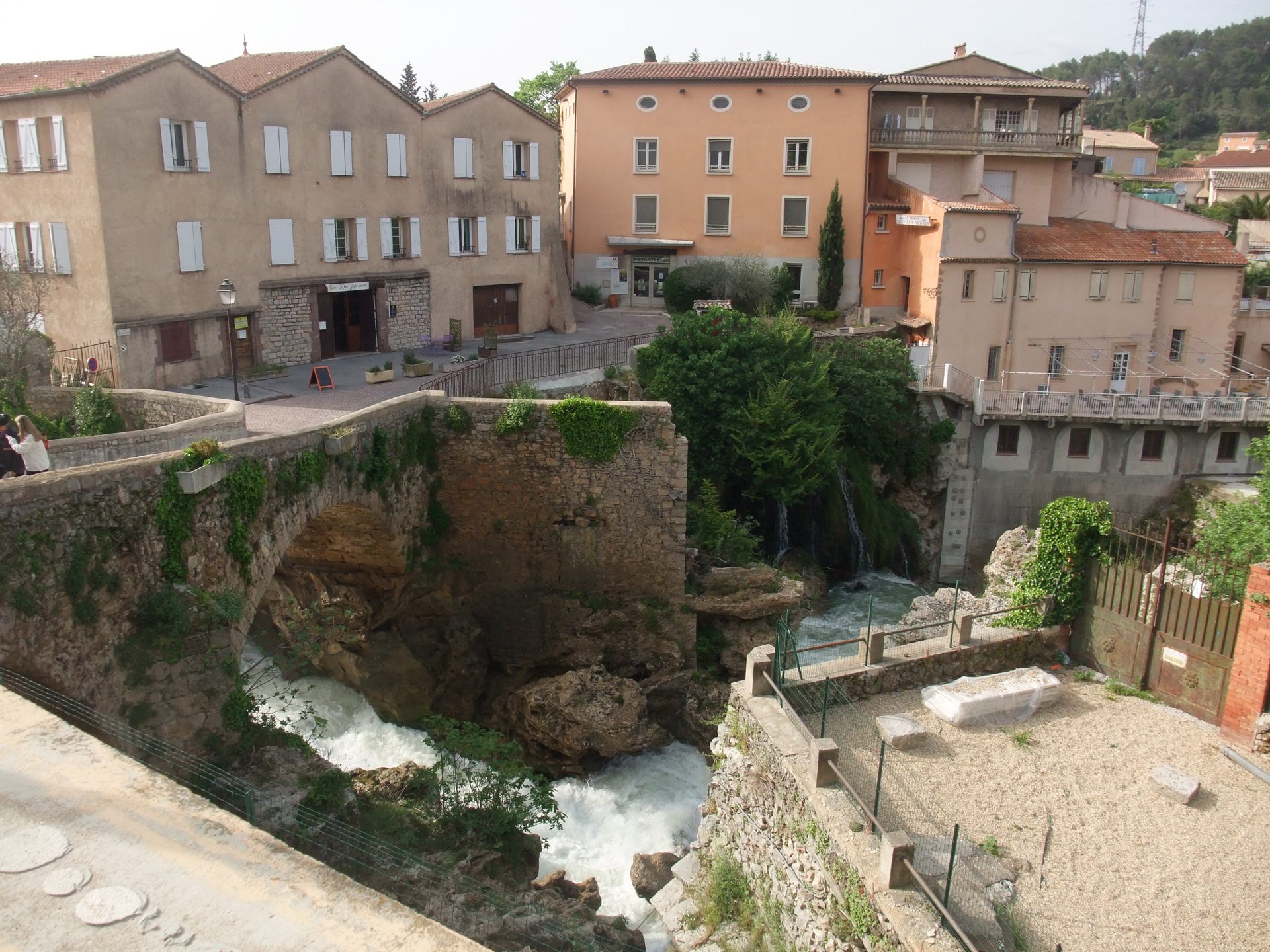
Pictured: the village of Trans-en-Provence, Var, France — the commune where Renato Nicolaï's property is located, not the actual landing site, which sat on private land outside the town center. No public-domain or rights-clear photograph of the original 1981 trace or the witness's terrace is known to exist; GEPAN's own site photographs remain held within CNES/GEIPAN's archival case file rather than freely licensed.
Theoretical Alignment
Trans-en-Provence occupies an unusual position among UAP hypotheses because its strongest evidence was gathered not by ufologists but by a national space agency's own engineers and a government agricultural-research biologist working with standard laboratory instruments. That distinction pushes its Extraterrestrial Hypothesis alignment higher than almost any single-witness sighting could earn on testimony alone: GEPAN's mechanical, thermal, and biochemical findings were independently reproduced across four separate laboratories and describe a genuinely difficult-to-fabricate signature — a soil ring compressed under an estimated four to five tons of mechanical pressure, heated briefly to several hundred degrees Celsius, and surrounded by alfalfa whose chlorophyll pigmentation dropped in a smooth gradient with distance from the trace's center. It is capped at 30% rather than higher because GEPAN's own final report explicitly declined to identify a cause, and because a real, still-unresolved conventional candidate — ordinary vehicle tire marks from a turnaround point on the property's access track — has never been definitively excluded by a controlled comparative test. The Interdimensional Hypothesis has little to offer a case built around a physical, metallurgically mundane-sounding craft description and a conventional compression/heating signature, earning only a residual score. The Psycho-Social Hypothesis explains the sighting portion about as well as it explains any single, sincere witness account, but it cannot on its own generate a laboratory-measured chlorophyll gradient correlated with physical distance from a specific point in a field — whatever produced that pattern was a real, external physical or chemical process, not a trick of memory, which is precisely why this case has remained a fixture of "best physical evidence" discussions in ufology for more than forty years even as its central cause remains formally unresolved.
Background
By January 1981, French ufology had a formal government partner that no other country's UFO research community could claim. In 1977, engineer Claude Poher, with the approval of then-CNES director general Yves Sillard, established the Groupe d'Etudes des Phénomènes Aérospatiaux Non-identifiés (GEPAN) as a small technical unit inside the Centre National d'Etudes Spatiales (CNES), France's national space agency, headquartered in Toulouse. GEPAN's mandate was narrow but genuinely unusual for a government body: to collect, systematically investigate, and scientifically evaluate reports of unidentified aerospace phenomena submitted through France's national gendarmerie, which had been directed to forward such reports rather than dismiss them outright. Unlike the U.S. Air Force's Project Blue Book, which had closed in December 1969 amid persistent criticism that its investigations were shallow and its conclusions predetermined, GEPAN was conceived from the outset as a scientific research group empowered to commission real laboratory analysis of physical evidence when a case warranted it — a mandate that would be tested directly, and unusually thoroughly, by the events in a small hillside garden in the Var four years later.
Renato Nicolaï, a 55-year-old retired mason living on a disability pension since a 1973 heart condition, had no connection to any of this institutional history and no documented prior interest in UFOs. He lived on a modest property on a hillside above the small commune of Trans-en-Provence, a town of a few thousand people in the Var department, and on the afternoon of January 8, 1981 he was doing nothing more dramatic than working on a small stone enclosure meant to protect a water pump on the upper terrace of his garden — ordinary, unglamorous home-maintenance labor, on a day that would otherwise have left no record at all.
Complete Timeline
| Date | Event |
|---|---|
| 1977 | Claude Poher establishes GEPAN within CNES, France's national space agency, as a formal government unit to scientifically investigate UAP reports referred through the national gendarmerie. |
| January 8, 1981, ~5:00 PM | Renato Nicolaï, working on a masonry water-pump enclosure on his property's upper terrace in Trans-en-Provence, hears a faint whistling sound and observes a lead-gray, saucer-shaped object descend into the lower terrace below him. |
| Same afternoon | The object hovers briefly at close range for approximately 30–40 seconds before ascending rapidly and silently, departing over the treeline without visible flame or smoke. |
| January 9, 1981 | Nicolaï reports the encounter to the local gendarmerie, reportedly suspecting he may have witnessed a secret military device. |
| January 9–10, 1981 | Gendarmes visit the property, interview Nicolaï, photograph the circular ground trace, and collect initial soil and wild-alfalfa samples from the site and surrounding area. |
| Within days | Gendarmerie investigators record their assessment that the witness's demeanor "does not allow doubting his credibility," and refer the case to GEPAN at CNES. |
| February 17, 1981 | GEPAN engineer Jean-Jacques Velasco conducts a detailed on-site investigation, roughly 40 days after the sighting, documenting the trace's dimensions and collecting further samples for laboratory distribution. |
| 1981–1983 | Soil and vegetation samples are analyzed by four independent government-linked and university laboratories, including a dedicated biochemical workup of alfalfa pigment content by INRA biologist Michel Bounias. |
| March 1983 | GEPAN publishes its findings as Note Technique n°16, describing mechanical compression consistent with roughly four to five tons of pressure, transient heating to an estimated 300–600°C, and a distance-correlated chlorophyll deficit in nearby alfalfa, while declining to identify a definitive cause. |
| 1988 | GEPAN is restructured and renamed SEPRA (Service d'Expertise des Phénomènes de Rentrée Atmosphérique) within CNES, continuing to maintain the Trans-en-Provence file among its most significant unresolved cases. |
| 1990 | Velasco publishes "Report on the Analysis of Anomalous Physical Traces: The 1981 Trans-en-Provence UFO Case" in the peer-reviewed Journal of Scientific Exploration, Vol. 4, No. 1, making the case's technical findings available to English-language researchers in detail for the first time. |
| 1990 | Jacques Vallée discusses the case at length in his book Confrontations: A Scientist's Search for Alien Contact, citing it as among the most rigorously documented physical-trace cases in the international record. |
| 2005 | SEPRA is restructured again into GEIPAN (Groupe d'Etudes et d'Informations sur les Phénomènes Aérospatiaux Non identifiés), with an explicit new mandate for public transparency. |
| 2007 | GEIPAN begins publicly releasing its historical case archive, including the Trans-en-Provence file, and skeptical French researchers David Rossoni, Éric Maillot, and Éric Déguillaume publish Les OVNI du CNES: 30 ans d'études officielles (1977–2007), offering the case's most detailed published critique. |
| 2007–present | GEIPAN's periodic internal re-reviews of its archived cases affirm the Trans-en-Provence file's Category D ("unidentified after investigation") classification, without identifying any procedural flaw serious enough to reclassify it. |
A Whistle on the Terrace: Renato Nicolaï's Sighting
Renato Nicolaï's account, preserved in the gendarmerie's original interview and later summarized in GEPAN and GEIPAN's own published case materials, begins with nothing more dramatic than a faint mechanical whistle cutting through an otherwise quiet Provençal afternoon. Working on the upper terrace of his property, building a small stone enclosure around a water pump, Nicolaï looked up to see an object descending toward the lower terrace of his garden, a short distance away and somewhat below his own elevated vantage point. He described it, in terms that have been translated and repeated across the case's subsequent French and English coverage with only minor variation, as shaped like two saucers or shallow plates joined rim to rim — a distinct thickened band or ridge running around its circumference — lead-gray in color, roughly 2.5 meters in diameter and between 1.5 and 1.8 meters tall. Below the object's body, he reported two circular protrusions he took to be either landing feet or intake/exhaust structures, along with what appeared to be two smaller circular openings resembling hatches.
The object made no loud noise; the whistling sound Nicolaï first heard continued as a faint background presence rather than a roar, consistent throughout what he estimated as a thirty-to-forty-second observation. It descended smoothly, without visible means of propulsion, hovered at very low altitude — near enough to the ground that its later mechanical trace registered as a distinct, bounded compression pattern rather than a diffuse disturbance — and then, after its brief stationary period, ascended abruptly and vertically, departing without any flame, exhaust, or smoke that Nicolaï could identify, before disappearing toward the northeast over the treeline bordering his property. He did not report any physical sensation, injury, or missing time associated with the sighting itself, distinguishing this case from several other landing reports in which witnesses describe physiological aftereffects; his own account of what happened to him personally ends, in effect, with the object's departure.
The Gendarmerie's First Investigation
What elevated Trans-en-Provence beyond an isolated, unverifiable eyewitness account was Nicolaï's own decision, the following day, to report what he had seen to the local gendarmerie — reportedly because he suspected he might have witnessed some kind of secret military aircraft or device rather than something explicitly otherworldly, a detail that has been widely cited as inconsistent with someone seeking UFO-related publicity. Gendarmes visited the property on or around January 9, 1981, interviewed Nicolaï directly, and examined the site themselves rather than relying solely on his description. They found and photographed a distinct, roughly circular ground disturbance exactly where Nicolaï said the object had hovered: an annular compressed zone with a harder, lighter-colored crust than the surrounding soil, accompanied by faint radial marks. Investigators collected an initial soil sample and cuttings of the wild alfalfa growing in and around the trace for preservation, then proceeded to interview Nicolaï in enough depth that their own written assessment, later summarized in GEIPAN's official case file, concluded plainly that his behavior "does not allow doubting his credibility" — an evaluation delivered by law-enforcement officers with no connection to ufology and no evident motive to inflate the case's importance. It was this gendarmerie referral, standard procedure under the reporting arrangement GEPAN had established with France's national police four years earlier, that routed the case to CNES in Toulouse rather than letting it end as an unverified local report.
Jean-Jacques Velasco and GEPAN's Site Investigation
Jean-Jacques Velasco, an engineer working within GEPAN's small technical team at CNES, traveled to Trans-en-Provence for a detailed on-site investigation on February 17, 1981, roughly forty days after the sighting — a gap that, while it inevitably raised questions about sample degradation and site disturbance in the intervening weeks, still fell well within the window physical-trace investigators such as Ted Phillips in the United States considered workable for meaningful analysis. Velasco measured and documented the trace in detail: two concentric circles of compacted soil, approximately 2.2 and 2.4 meters in diameter, forming a roughly ten-centimeter-wide hardened band with a crust about a centimeter thick, distinctly lighter in color than the undisturbed soil beyond its edge, along with faint streak marks radiating outward from specific points on the ring's circumference. He collected further soil and vegetation samples during this visit for distribution to outside laboratories, and continued to manage the case's investigation and eventual publication for years afterward, ultimately becoming one of the most prominent figures in the history of French government UFO research — he would go on to lead GEPAN's successor agency, SEPRA, later in the 1980s. Velasco's own retrospective assessment of the case, published in both GEPAN's internal technical notes and his later peer-reviewed 1990 paper, consistently held that Trans-en-Provence represented the strongest physical-trace evidence GEPAN had gathered in its history, without ever claiming the evidence proved an extraterrestrial or otherwise exotic origin.
Four Laboratories, One Ring: The Mechanical and Thermal Findings
The material at the center of the Trans-en-Provence case did not pass through a single laboratory or a single analyst's hands, which is a meaningful part of why it has remained credible to researchers who are otherwise skeptical of most UFO physical-trace claims. Soil samples were distributed to four separate government-linked and university laboratories for independent physical and chemical analysis, each examining different aspects of the trace without, according to GEPAN's own published account, being told in advance what conclusion the agency expected. Their combined findings, assembled into GEPAN's Note Technique n°16 in March 1983, described a soil sample mechanically compressed under an estimated four to five tons of pressure — a level of load investigators noted was difficult to reconcile with any obviously available conventional source at the site, since no heavy machinery, digging equipment, or structural foundation was present at that exact spot before or after the sighting. Thermal and mineralogical analysis indicated the soil had also been heated, briefly, to somewhere in the range of roughly 300 to 600 degrees Celsius, a temperature range investigators associated with the crust's altered color and hardness rather than any visible scorching or burn pattern, alongside trace deposits of iron, iron oxide, phosphates, and zinc identified on and within the compacted crust. Crucially, investigators found no evidence within the ring itself of digging-tool marks, conventional vehicle tread patterns, or footprints other than those consistent with the witness's own approach to the site after the object had already departed — a finding GEPAN considered central to ruling out the most obvious mundane explanations, though, as later critics would argue, not necessarily sufficient to rule out every conventional possibility.
Michel Bounias and the Alfalfa Chlorophyll Gradient
The case's single most distinctive and most debated finding came not from the soil itself but from the ordinary wild alfalfa growing in and around it. Michel Bounias, a biologist with France's Institut National de la Recherche Agronomique (INRA) whose earlier doctoral research had examined plant trauma responses to radiation exposure in collaboration with France's atomic energy commission, undertook a detailed biochemical analysis of alfalfa leaf samples collected at set distances from the center of the trace, comparing them against control samples taken roughly ten meters away, well outside the visible ring. His analysis reported a measurable reduction in key photosynthetic pigments that tracked distance from the trace in a smooth, physically plausible gradient rather than an all-or-nothing pattern: overall chlorophyll content was reduced by roughly 30 to 50 percent in the plants closest to the ring, with the carotenoid-family pigments beta-carotene and violaxanthin showing still steeper reductions — on the order of 57 percent and 80 percent respectively in the most affected samples — before returning gradually toward normal, unaffected levels at greater distances from the center. Later reporting on the case noted that the affected alfalfa's pigmentation appeared to recover over the following months, consistent with a discrete, time-limited exposure event rather than an ongoing soil contamination. Bounias himself proposed that a brief, intense pulse of non-ionizing electromagnetic radiation, potentially in the microwave range, offered a physically plausible mechanism for disrupting photosynthetic pigment synthesis in exactly this kind of spatially graded pattern, though he was careful to present this as his own working hypothesis for how such damage might occur, not as a demonstrated cause of the Trans-en-Provence trace specifically. GEPAN's own official report treated the biochemical finding with visible caution, stating that current scientific understanding of plant biochemical trauma remained, in the investigators' own words, "too fragmented" to support a firm causal conclusion, even as the agency's report affirmed the pigment-reduction gradient itself as a real, laboratory-documented measurement rather than an artifact of methodology.
GEPAN's Official Conclusion and the "Major Event" Finding
When GEPAN finally published its consolidated findings in Note Technique n°16 in March 1983, more than two years after the sighting, the agency's language was notably restrained given the strength of its own physical data. Rather than endorsing any specific interpretation, the report concluded that a genuine, significant physical event had occurred at the site — producing the mechanical deformation, transient heating, and probable material deposition its four contributing laboratories had independently documented — while explicitly declining to identify what that event actually was. This combination of confident physical description paired with an openly unresolved causal conclusion is precisely what has kept the case scientifically credible to researchers who remain skeptical of most UFO claims: GEPAN was not asserting an extraordinary origin, only that something real and measurable, beyond what any witness account alone could establish, had left its mark on that specific patch of ground. Under the classification system GEPAN and its successor agencies have used since, refined over the following decades into a four-tier A through D scale weighing both a report's inherent "strangeness" and the internal consistency of its evidence, Trans-en-Provence was placed in Category D — cases in which the underlying phenomenon remains unidentified after a genuine, completed investigation, as opposed to cases dismissed for lack of workable data. GEIPAN, the modern successor agency that began publicly releasing its historical case archive in 2007, has repeatedly reaffirmed that classification in subsequent internal reviews, without identifying any procedural flaw in the original 1981–1983 investigation serious enough to warrant reclassifying the case as identified or explained.
Jacques Vallée, the Sturrock Panel, and International Reception
Trans-en-Provence quickly became a touchstone case for researchers arguing that ufology's future depended on physical, laboratory-testable evidence rather than testimony alone. Jacques Vallée, the computer scientist and astronomer whose own research consistently emphasized physical and statistical evidence over anecdote, discussed the case at length in his 1990 book Confrontations: A Scientist's Search for Alien Contact, citing GEPAN's multi-laboratory methodology as a model for how a UFO investigation ought to be conducted, regardless of what conclusion it ultimately reached. Velasco's own 1990 paper in the Journal of Scientific Exploration — the peer-reviewed journal most closely associated with the Society for Scientific Exploration, which later convened physicist Peter Sturrock's 1997 Pocantico workshop reviewing the strongest available physical evidence associated with UFO reports — placed the case's full technical findings before an English-language scientific audience for the first time, ensuring it could be evaluated by researchers outside France's own UFO research community. The case has since been cited across numerous popular and academic summaries of ufology's physical-evidence record, at times described, in secondary coverage tracing back to a characterization attributed to Popular Mechanics, as among the most completely and carefully documented sightings on record — a description this catalogue treats as a widely repeated editorial judgment rather than a scientific finding in its own right, but one that reflects how unusual it remains, even decades later, for a national government's own scientists to have directly managed a UFO case's physical evidence chain from gendarmerie collection through peer-reviewed publication.
The Tire-Track Theory and the Hoax Question
No honest account of Trans-en-Provence can ignore its most substantial skeptical challenge, developed most thoroughly by French skeptics affiliated with the Observatoire Zététique research group, whose members later published the case's most detailed published critique in the 2007 book Les OVNI du CNES: 30 ans d'études officielles (1977–2007). Their central argument holds that the trace's two concentric arcs more closely resembled ordinary tire-skid or wheel-turning marks than a genuinely novel compression pattern, and that the property's access track was known to be used periodically by vehicles executing turns near the terraces — with at least one neighbor's later recollection raising the possibility that a tractor or similar agricultural vehicle maneuvering on the site could plausibly have produced marks resembling the documented trace. Critics in this tradition have also argued that GEPAN moved too quickly past this conventional explanation without subjecting it to the same rigorous, side-by-side physical testing applied to the exotic hypothesis, and have separately raised methodological concerns about the delay between the sighting and full laboratory processing, arguing that weeks of exposure to weather and foot traffic before Velasco's February 17 site visit could have introduced contamination or environmental artifacts difficult to fully rule out after the fact. The same critics have pointed to an unrelated case as a reason for broader caution about Bounias's biochemical methodology specifically: years later, Bounias applied a similar "traumatic factor" interpretive framework to plant damage reported in the 1997 Nort-sur-Erdre case, which subsequently turned out to be a hoax perpetrated by children — a genuine embarrassment for that particular analytical approach, even though it does not, on its own, invalidate the specific pigment measurements Bounias recorded at Trans-en-Provence sixteen years earlier.
Proponents of the case's authenticity have offered direct rebuttals to each of these points rather than dismissing them outright. On the tire-track theory specifically, they note that GEPAN's own laboratory analysis found the crust's thermal signature — heating to an estimated 300 to 600 degrees Celsius — and its mechanical compression profile difficult to reconcile with an ordinary rotating tire, which would be expected to produce shear and scuffing patterns rather than the smooth radial compression and heating GEPAN's laboratories documented, and that no skeptical researcher has, to date, produced a controlled experimental replication showing that a real vehicle turning on similar soil actually reproduces the full combination of mechanical, thermal, and mineralogical findings rather than only the trace's superficial circular shape. On the Bounias question, defenders note that his 1981 alfalfa analysis was conducted and published years before the unrelated Nort-sur-Erdre case, using standard, independently verifiable pigment-extraction chemistry rather than the more subjective "traumatic factor" interpretive framework later criticized in that separate 1997 case, meaning the two episodes, while fair to discuss together as a pattern worth scrutinizing, are not methodologically identical. Neither side of this dispute has produced the kind of dispositive, head-to-head experimental test that would definitively settle the matter, and that unresolved tension — genuinely rigorous physical evidence on one side, a genuinely plausible if never fully tested conventional alternative on the other — is precisely why GEIPAN itself has continued to carry the case as Category D rather than reclassifying it as identified in either direction.
Legacy: A Government Space Agency's Own Trace Case
More than four decades after Renato Nicolaï's brief encounter on his own garden terrace, Trans-en-Provence remains one of the very few UFO cases in the world investigated from the ground up by a national government's own dedicated scientific unit, using standard forensic-laboratory methodology rather than the volunteer, civilian-organization framework that produced most of ufology's other landmark physical-trace cases. GEPAN's successor agencies, SEPRA and then GEIPAN, have continued to maintain the file as one of their most cited examples of a genuinely unresolved Category D case, releasing it as part of their broader 2007 public-archive transparency initiative and periodically re-reviewing it without finding grounds to reclassify it as either identified or dismissed. It appears regularly in international surveys of ufology's strongest physical evidence, is frequently paired with Delphos, Kansas as the two most laboratory-scrutinized landing traces on record, and continues to generate both dedicated documentary coverage and renewed skeptical re-examination in France, where the Observatoire Zététique's critique remains the most substantial published counter-argument. Nicolaï himself gave few subsequent public interviews and largely avoided the sustained media attention some other trace-case witnesses experienced, leaving GEPAN's own technical notes, rather than any personal account he continued to elaborate over the following decades, as the case's primary enduring record.
Circumstantial Evidence
- Local gendarmes independently examined, photographed, and sampled the trace within roughly a day of the report, without having witnessed the object themselves, and formally assessed Nicolaï's credibility as sound.
- GEPAN's four-laboratory analysis found no digging-tool marks, conventional vehicle tread impressions, or unexplained footprints within the trace itself, ruling out the most obvious low-effort hoax methods.
- The trace's mechanical compression (estimated 4–5 tons) and transient heating (estimated 300–600°C) were independently confirmed across multiple laboratories rather than resting on a single analyst's judgment.
- Michel Bounias's chlorophyll and carotenoid pigment reductions in nearby alfalfa followed a smooth, physically plausible gradient correlated with distance from the trace center, a pattern difficult to attribute to random measurement noise or investigator expectation.
- Nicolaï reported the sighting to law enforcement suspecting a possible secret military craft, a detail read by proponents as inconsistent with a witness seeking UFO-related publicity.
- GEPAN and its successor agencies have re-reviewed the case repeatedly since 1983, including during GEIPAN's 2007 public-archive release, without ever identifying a procedural flaw serious enough to reclassify it as explained.
- The Observatoire Zététique's tire-track counter-theory has never been confirmed through a controlled experimental replication reproducing the trace's full mechanical, thermal, and biochemical signature, leaving it a plausible but unproven alternative.
Key Witnesses
Renato Nicolaï
A 55-year-old retired mason living on a disability pension since a 1973 heart condition, Nicolaï was working on a small masonry water-pump enclosure on his property's upper terrace when he observed a lead-gray, saucer-shaped object descend, hover briefly, and depart. He was the sole witness to the object itself. He reported the sighting to the gendarmerie the following day, reportedly suspecting a secret military device rather than anything explicitly extraterrestrial; investigators who interviewed him assessed his credibility positively. He gave few subsequent public interviews about the case.
Jean-Jacques Velasco
The GEPAN engineer who led the agency's detailed on-site investigation on February 17, 1981, documenting the trace's precise dimensions and coordinating soil and vegetation sample collection for laboratory analysis. Velasco managed the case through its multi-year investigation and eventual 1983 publication, later authored the case's definitive 1990 English-language peer-reviewed paper in the Journal of Scientific Exploration, and went on to head GEPAN's successor agency, SEPRA, later in the 1980s.
Michel Bounias
An INRA biologist whose doctoral research examined plant trauma responses to radiation exposure, Bounias conducted the case's central biochemical analysis, documenting a distance-correlated reduction in chlorophyll and carotenoid pigments in wild alfalfa collected near the trace. His finding of a smooth, physically graded pigment deficit remains the case's most distinctive and most debated piece of physical evidence.
The Five Observables Assessment
The Five Observables framework, developed by former AATIP director Luis Elizondo, is designed to classify witnessed UAP flight performance against the limits of known technology. Trans-en-Provence, like other landed physical-trace cases in this catalogue, is a difficult structural fit for that framework: it is a brief, close-range, single-witness landing and departure, not an instrumented flight-dynamics event with tracked speed, altitude, or maneuvering data. Most of the observables below reflect what a single witness impressionistically described over thirty to forty seconds rather than anything independently measured, and the assessment says so plainly rather than inferring performance characteristics no instrument ever recorded.
Assessment: Anti-Gravity Lift is rated speculative because Nicolaï described the object descending, hovering, and ascending with no visible support structure and no reported downwash, propeller noise, or exhaust plume — consistent with a genuinely novel lift mechanism, but based entirely on one witness's brief visual impression rather than any instrumented measurement. Instant Acceleration is similarly speculative: the object's final ascent was described as rapid and essentially vertical, but no timed or instrumented measurement of its actual speed or acceleration exists. Hypersonic Velocity is rated absent, since no witness or investigator ever claimed the object reached extreme speed comparable to cases involving trained radar or aviation observers. Low Observability is rated present, distinctively for this catalogue, because the object was consistently described as producing only a faint whistling sound with no visible engine flare, exhaust, or bright self-illumination — genuinely quiet and visually unobtrusive for its reported size, a detail corroborated indirectly by the fact that no other resident of the small commune reported seeing or hearing it during its brief appearance. Trans-Medium travel does not meaningfully apply to a case that took place entirely near ground level over a garden terrace with no medium transition of any kind, marking this as fundamentally a landed CE2 physical-trace report rather than a flight-performance data point. As with Delphos, the case's true evidentiary weight rests almost entirely on the ground it left behind, not on any performance characteristic of the object while airborne.
Evidence Assessment
Supporting Anomalous Origin
- Gendarmerie investigators independently examined, photographed, and sampled the trace within roughly a day, corroborating its physical existence without having witnessed the object, and formally assessed the witness as credible.
- GEPAN's four-laboratory analysis found no digging-tool marks, conventional tire-tread impressions, or unexplained footprints within the ring itself.
- Independent laboratories consistently confirmed the trace's mechanical compression (4–5 tons) and transient heating (300–600°C), rather than resting on a single analyst's interpretation.
- Michel Bounias's alfalfa pigment analysis found a smooth, distance-correlated chlorophyll and carotenoid deficit, a pattern difficult to attribute to measurement noise or investigator bias.
- Nicolaï reported the sighting suspecting a secret military device, not seeking UFO publicity, and gave few subsequent media interviews.
- GEPAN's own 1983 conclusion and GEIPAN's repeated later re-reviews have never identified a procedural flaw sufficient to reclassify the case as explained.
Supporting Conventional Explanation
- The sighting of the object itself rests on a single witness with no independent corroboration of its appearance or flight behavior.
- French skeptical researchers affiliated with the Observatoire Zététique have argued the trace's shape closely resembles ordinary tire-skid marks from a vehicle turning on a track known to be used for that purpose near the site.
- Roughly forty days elapsed between the sighting and GEPAN's most thorough site investigation, leaving time for weather and foot traffic to potentially alter the trace before full documentation.
- Michel Bounias later applied a similar biochemical "traumatic factor" interpretive framework to an unrelated 1997 case that turned out to be a children's hoax, raising broader questions about that methodology's reliability.
- No controlled experimental replication has ever definitively shown that an ordinary vehicle cannot reproduce the ring's combined mechanical, thermal, and chemical signature.
Why "Disputed"
The Trans-en-Provence Sighting earns a DISPUTED classification because it combines an unusually strong institutional and physical-evidence record with the same fundamental single-witness limitation that constrains nearly every landing case in this catalogue. On the strength side: this is the rare UFO case in which a national government's own scientific agency, not a volunteer civilian investigator, managed the entire physical-evidence chain, from gendarmerie photography and sample collection within roughly a day of the report, through a detailed forty-day follow-up site investigation by a trained engineer, to laboratory analysis distributed across four independent institutions and a dedicated biochemical workup by a credentialed agricultural-research biologist. Those laboratories converged on a coherent, internally consistent physical signature — multi-ton mechanical compression, several-hundred-degree transient heating, and a smoothly distance-graded reduction in plant pigmentation — that GEPAN itself, notably, never overstated into a claim of extraordinary origin, instead publishing a genuinely cautious "unidentified" conclusion that its successor agency GEIPAN has continued to uphold through repeated internal review, including its 2007 public-archive release. On the other hand, the sighting itself still rests on one uncorroborated witness for every detail of the object's appearance and behavior; a real, physically coherent alternative explanation — ordinary tire or vehicle-turning marks on a track known to be used for that purpose — has been argued in detail by French skeptical researchers and has never been definitively tested against the site's full mechanical and thermal profile in a controlled experiment; and Michel Bounias's biochemical interpretive approach, however independently verifiable his original 1981 pigment measurements were, was later applied by the same researcher to an unrelated 1997 case that turned out to be a children's hoax, a genuine reason for caution about the broader methodology even where it does not directly undercut the earlier data. That is precisely the profile of a genuinely disputed case: not one built on weak or superficial evidence, but one in which credentialed government scientists on one side and equally serious, methodologically careful skeptics on the other have examined the same physical record directly and still reached no final consensus.
Sensor & Instrumentation Detection Profile
No radar, aircraft, or automated government sensor detected the Trans-en-Provence object as it happened; the entire encounter took place over roughly thirty to forty seconds on a private rural terrace with no aviation or military facility positioned to record it. What sets this case apart from the overwhelming majority of UFO reports is what happened in the weeks and months afterward: rather than relying on witness memory alone, French gendarmes collected physical soil and plant samples within roughly twenty-four hours of the report reaching them, and GEPAN subsequently distributed those samples, along with fresh samples gathered during its own site visit, to a set of independent scientific laboratories for physical, chemical, and biological analysis. The instrumentation applied to this case was accordingly all analytical rather than observational: standard laboratory equipment for soil mechanics (to estimate the compressive load that produced the ring), thermal and mineralogical analysis (to estimate peak heating and identify trace elements such as iron, iron oxide, phosphates, and zinc deposited on the crust), and, in Michel Bounias's work at France's National Institute for Agronomic Research (INRA), pigment-extraction chemistry applied to alfalfa leaf samples collected at set distances from the trace. As with Delphos, Kansas, Trans-en-Provence is not an instrumented sighting in the radar-visual sense; it is an instrumented aftermath, in which the physical record left behind, not any direct measurement of the object itself, carries the case's entire evidentiary weight.
Environmental & Geospatial Context
Trans-en-Provence is a small hillside commune in the Var department of the Provence-Alpes-Côte d'Azur region of southeastern France, threaded by the Nartuby river and set among the terraced, olive- and vine-covered slopes typical of inland Provençal countryside, a short distance inland from the Mediterranean coast near Draguignan. Nicolaï's property sat on one of the area's characteristic stepped garden terraces, with an upper level where he was working on a small masonry structure to enclose a water pump, and a lower terrace roughly at eye level below where the object reportedly descended. Early January in this part of Provence typically brings clear, cool, dry afternoons rather than the damp Atlantic weather further north, and no witness or investigator report describes any unusual meteorological conditions — no fog, temperature inversion, or storm activity — that might account for an optical misperception. The site's rural isolation cuts both ways evidentially: it means there was no nearby industrial, agricultural-vehicle, or aviation source obviously capable of producing the ring by mundane means, but it also means Nicolaï was entirely alone at the critical moment, with no neighboring witness in a position to independently confirm the object's appearance, only the physical aftermath it left behind. Investigators later noted that the property's access track was used periodically by vehicles turning around near the terraces — a detail that became central to the case's most substantial skeptical counter-theory, discussed later in this file.
Observer Credibility & Occupational Profile
The case rests on a single named witness with no documented prior interest in UFOs and no obvious motive to fabricate an elaborate, physically corroborated hoax. Renato Nicolaï, 55 years old at the time, was a retired mason living on a disability pension he had received since 1973 for a heart condition; on the afternoon of January 8, 1981 he was engaged in exactly the kind of small, mundane home-improvement task — building a low masonry enclosure to protect a water pump — that lends itself to an unplanned, unexpected observation rather than a staged one. When gendarmes interviewed him the following day, their own contemporaneous assessment, later summarized in GEIPAN's published case file, held that "the behavior of the witness does not allow doubting his credibility," an evaluation delivered by investigators with no stake in the case's outcome and no connection to ufology. Nicolaï reported the object to the gendarmerie himself, apparently believing at first that he might have witnessed a secret military device rather than anything explicitly extraterrestrial — a detail proponents read as inconsistent with someone seeking UFO-related publicity. Early published accounts of the case, respecting French privacy norms around ordinary citizens, referred to him under the pseudonym "Renato Collini" before his real name entered the public record. Working against a completely frictionless credibility assessment is the same limitation present in nearly every trace case: Nicolaï was the only person who saw the object itself, meaning the sighting narrative cannot be cross-checked against a second independent account the way multi-witness cases can, and the entire evidentiary weight of the case therefore shifts onto the physical trace and its subsequent laboratory analysis rather than resting on testimony corroboration.
Physical & Material Assays
Trans-en-Provence is, above nearly every other consideration, a physical-evidence case, and the material record is unusually well documented for exactly the reason that a national space agency's own engineers, rather than volunteer investigators, managed the chain of custody. The trace itself consisted of two concentric compacted-soil circles, roughly 2.2 and 2.4 meters in diameter, forming a hardened annular band about ten centimeters wide with a crust roughly one centimeter thick, lighter in color than the surrounding earth, accompanied by faint radial streaking marks extending outward from the ring at several points. Gendarmes photographed and sampled the site within about a day of Nicolaï's report; GEPAN engineer Jean-Jacques Velasco conducted a more thorough follow-up site visit on February 17, 1981, roughly forty days after the sighting, collecting additional soil and vegetation samples for distribution to independent laboratories. The resulting analysis, eventually published by GEPAN as Note Technique n°16 in March 1983 and later detailed in English by Velasco in the peer-reviewed Journal of Scientific Exploration in 1990, concluded that the ring's soil had been mechanically compressed under an estimated four to five tons of pressure and had been heated, briefly, to somewhere between roughly 300 and 600 degrees Celsius — a striking combination given that no scorching, digging-tool marks, footprints other than the witness's own, or conventional vehicle tracks were found inside the immediate trace area itself. Laboratory analysis also identified trace deposits of iron, iron oxide, phosphates, and zinc on the compacted crust, consistent with either a genuine unexplained heating/mechanical event or, skeptics have argued, ordinary agricultural or mechanical residue already present in the soil before the sighting.
The case's most distinctive physical finding, however, came from vegetation rather than soil. Michel Bounias, a biologist at France's Institut National de la Recherche Agronomique (INRA) with prior doctoral research on plant trauma responses to radiation exposure, analyzed wild alfalfa (lucerne) samples collected at increasing distances from the ring's center, comparing pigment concentrations against control samples taken roughly ten meters away. His analysis reported a measurable, distance-correlated deficit in key photosynthetic pigments in the plants closest to the trace — on the order of a 30–50% reduction in chlorophyll content in the most affected samples, with more specific carotenoid-family pigments (beta-carotene and violaxanthin) showing still steeper reductions closest to the ring's center, before diminishing back toward normal at greater distances and, according to Bounias's account, gradually recovering over subsequent months. GEPAN's own report characterized the biochemical findings cautiously, noting that current scientific understanding of plant stress responses was, in its own words, "too fragmented" to support a confident causal interpretation, even as it recorded the pigment gradient as a genuine, laboratory-measured phenomenon rather than a subjective impression. Bounias himself proposed that a brief, intense burst of non-ionizing electromagnetic radiation, potentially in the microwave range, could plausibly disrupt photosynthetic pigment production in exactly this kind of pattern, though this remained his own working hypothesis rather than a proven mechanism.
Historical Precedents & Archive Matches
Trans-en-Provence belongs to the same narrow evidentiary category as a small number of other internationally significant Close Encounter of the Second Kind cases in which a witnessed landing left a measurable physical trace subjected to real laboratory analysis. It is most frequently compared to the November 1971 Delphos, Kansas ring case in the United States, in which physical-trace investigator Ted Phillips and, decades later, two independent chemists documented a persistent, chemically distinct soil ring — a case sharing Trans-en-Provence's structural DNA of a single rural witness, a durable physical mark, and genuinely contested chemistry. It is also regularly discussed alongside the January 1966 Tully, Australia "saucer nests" case and the April 1964 Socorro, New Mexico landing investigated directly by police officer Lonnie Zamora and the U.S. Air Force, both of which established plaster-cast and photographic ground-trace documentation as a serious investigative practice years before GEPAN existed. What sets Trans-en-Provence apart from all of these American cases is institutional: it is the product of an actual government space agency's in-house scientific investigation unit, rather than of civilian or military ad hoc field investigation, making it arguably the closest thing in the international case record to a UFO investigation conducted with the resources, laboratory access, and procedural rigor of a genuine state scientific inquiry. Within France itself, GEPAN and its successor agencies GEIPAN went on to investigate several other notable landing and trace reports, including the January 1982 Nancy-Amancé case, but no French case since has matched Trans-en-Provence's combination of biochemical, mechanical, and thermal findings converging on a single, tightly bounded physical site.
Material Analysis
Trans-en-Provence's entire evidentiary case is a material analysis, making this section the functional core of the file. The trace consisted of two concentric compacted-soil circles roughly 2.2 and 2.4 meters in diameter, forming a hardened, lighter-colored annular crust about a centimeter thick and ten centimeters wide, with faint radial streak marks extending outward at several points — documented first by gendarmerie photography within about a day of the sighting, then in greater technical detail by Jean-Jacques Velasco's February 17, 1981 site visit. Samples from both visits were distributed to four independent laboratories, whose combined findings, published in GEPAN's March 1983 Note Technique n°16, described mechanical compression consistent with roughly four to five tons of pressure, transient heating to an estimated 300 to 600 degrees Celsius, and trace mineral deposits of iron, iron oxide, phosphates, and zinc on the crust. A parallel biochemical analysis by INRA biologist Michel Bounias found a distance-correlated reduction in chlorophyll and carotenoid pigments in wild alfalfa growing near the trace, most pronounced closest to the ring's center and diminishing with distance before recovering over the following months. GEPAN's own report treated the plant findings with explicit caution, while affirming the underlying measurements as genuine rather than an analytical artifact.
Supporting a Genuine Anomaly
- Four independent laboratories, rather than a single analyst, converged on a consistent mechanical, thermal, and mineralogical profile for the trace.
- The alfalfa pigment deficit followed a smooth, physically plausible gradient correlated with distance from the trace's center, a pattern not easily explained by chance or investigator expectation.
- No digging-tool marks, conventional tire treads, or unexplained footprints were found within the ring itself.
Supporting a Natural or Mundane Origin
- The trace's basic circular, arced geometry is consistent with ordinary tire-skid or wheel-turning marks, according to skeptical researchers who examined the site's access-track history.
- GEPAN's own report explicitly stated that scientific understanding of plant biochemical trauma was "too fragmented" to support a firm causal interpretation of Bounias's pigment findings.
- Roughly forty days passed before the most detailed site investigation, leaving a window in which weather or foot traffic could have altered the trace prior to full documentation.
Conventional Explanation Candidates
Three distinct terrestrial explanations have been proposed for the Trans-en-Provence case across more than four decades of investigation and critique, and each deserves individual evaluation rather than being treated as a single undifferentiated "skeptical" position.
1. Ordinary Vehicle Tire Marks
The first and most substantial candidate, developed most thoroughly by researchers affiliated with the Observatoire Zététique and published in Les OVNI du CNES (2007), holds that the trace's two concentric arcs were produced by an ordinary vehicle — potentially a tractor or similar agricultural machine — executing a turn on a portion of the property's access track known to be used for that purpose, with at least one neighbor's later recollection cited in support. This candidate deserves serious consideration because it requires no exotic mechanism at all, only mundane, well-documented rural vehicle use.
Where the Tire-Track Theory Falls Short
Its central weakness is that it accounts, at most, for the trace's superficial circular shape, not for the full combination of findings GEPAN's four laboratories documented: an estimated four-to-five-ton compression signature, thermal heating to an estimated 300–600°C with no visible scorching, and a smoothly distance-graded biochemical pigment deficit in nearby alfalfa. No skeptical researcher has published a controlled experimental replication showing that an ordinary tire-turning event reproduces this full mechanical, thermal, and biochemical signature rather than only its outward geometry, and GEPAN's site investigators reported finding no conventional tire-tread pattern, as opposed to a compression ring, within the trace itself.
2. Delayed Investigation and Sample Contamination
The second candidate holds that the roughly forty-day gap between the sighting and Jean-Jacques Velasco's most detailed site investigation allowed weather exposure, foot traffic, or other environmental factors to alter the site in ways that could have been mistaken for, or contributed to, the trace's unusual chemical and thermal profile. This candidate deserves consideration because analytical delays are a genuine, well-recognized source of error in any field-evidence investigation, UFO-related or otherwise.
Where the Delayed-Investigation Theory Falls Short
Gendarmes had already photographed and sampled the site within roughly a day of the report, well before any forty-day delay could apply, and their initial documentation was broadly consistent with what Velasco's later, more detailed investigation recorded — meaning the trace's basic geometry and character were established close to the time of the sighting, not solely reconstructed from a much later visit. The theory also does not offer a specific mechanism by which ordinary environmental exposure would produce a smoothly distance-graded chlorophyll deficit in nearby alfalfa rather than a random or uniform pattern.
3. Hoax or Fabrication by the Witness
The third candidate holds that Nicolaï staged the entire event, including artificially producing the ground trace, whether using a vehicle, a heated tool, or some other deliberate method. This candidate deserves consideration because deliberate fabrication is among the most common explanations proposed for isolated single-witness physical-trace cases generally.
Where the Hoax Theory Falls Short
Gendarmerie investigators who interviewed Nicolaï directly and examined the site independently concluded that his demeanor "does not allow doubting his credibility," an assessment delivered by officials with no stake in the case's outcome; Nicolaï sought no publicity from the case and gave few subsequent media interviews; and the specific combination of multi-ton mechanical compression, several-hundred-degree transient heating with no visible scorching, and a laboratory-measured, distance-graded plant-pigment deficit would have required specialized knowledge, equipment, and laboratory-grade precision entirely disproportionate to what a retired mason on a modest disability pension could plausibly have arranged in his own back garden.
Each conventional candidate offers a genuinely mundane mechanism for part of the case, but none accounts for the full combination of the trace's mechanical, thermal, and biochemical signature as documented across four independent laboratories, and none has ever been tested directly against the site's physical evidence to the point of confirmation or elimination.
Related Cases
Confirmed Documents & Official Records
France's national space agency's own public case archive, including the GEPAN investigation summary, classification (Category D), and links to the underlying technical documentation held by CNES.
UNCLASSIFIED / PUBLIC ARCHIVEGEIPAN's own published explanation of the four-tier classification system used to rate Trans-en-Provence and every other case in its archive.
UNCLASSIFIED / PUBLIC ARCHIVESearch Government Archives Directly
Further Reading — Recommended Literature
Confrontations: A Scientist's Search for Alien Contact
Discusses the Trans-en-Provence case at length as a model of rigorous physical-trace investigation, from one of ufology's most methodical researchers.
Ovnis : L'Évidence
Written by the GEPAN engineer who personally led the Trans-en-Provence site investigation and went on to head France's official UFO study unit, SEPRA, drawing on decades of government case files.
Les OVNI du CNES : 30 ans d'études officielles (1977–2007)
The case's most detailed published skeptical critique, including the tire-track counter-theory and a methodological review of GEPAN's history, from French researchers affiliated with the Observatoire Zététique.
Physical Traces Associated with UFO Sightings: A Preliminary Catalog
The foundational American physical-trace catalog, useful for situating Trans-en-Provence's mechanical and thermal findings within the broader international ground-trace evidentiary record.
The UFO Encyclopedia, 4th Edition
The definitive UFO reference work, with an extensively cited entry situating Trans-en-Provence among the small number of UFO cases with genuine government-agency laboratory-analyzed physical evidence.
Essential Viewing

1981: Trans en Provence Case UFO Landed
A focused English-language case history covering Renato Nicolaï's sighting and GEPAN's physical-trace investigation.

Le Seul OVNI Validé Par La Science ?
A French-language analysis examining GEPAN's scientific methodology and why the case remains officially unresolved.
L'OVNI de Trans-en-Provence
A French-language documentary short revisiting the site, the witness's account, and the GEPAN investigation.

1981. Cet Incident OVNI en France Reste Inexplicable Même Aujourd'hui
A French-language retrospective on why the case remains classified as unresolved more than four decades later.
Sources
- GEIPAN / CNES. "TRANS-EN-PROVENCE (83) 08.01.1981" (official case file). cnes-geipan.fr
- GEIPAN / CNES. "Classification" (official A/B/C/D methodology). cnes-geipan.fr
- GEIPAN / CNES. "Its history" (GEPAN/SEPRA/GEIPAN institutional history since 1977). cnes-geipan.fr
- GEIPAN / CNES. "Mission & Geipan." cnes-geipan.fr
- CNES. "GEIPAN" project overview. cnes.fr
- Velasco, Jean-Jacques. "Report on the Analysis of Anomalous Physical Traces: The 1981 Trans-en-Provence UFO Case," Journal of Scientific Exploration, Vol. 4, No. 1, pp. 27–48 (1990). scientificexploration.org
- "Trans-en-Provence case," Wikipedia. en.wikipedia.org
- "Affaire de Trans-en-Provence," Wikipédia (French). fr.wikipedia.org
- "GEIPAN," Wikipedia. en.wikipedia.org
- "Trans-en-Provence," Wikipedia (commune). en.wikipedia.org
- The Black Vault Case Files. "Trans-en-Provence, France, Physical Trace Case – January 8, 1981." theblackvault.com
- Bibliotecapleyades. "UFO Briefing Doc – 1981: Physical Trace Case in Trans-en-Provence, France." bibliotecapleyades.net
- Observatoire Zététique / Book-e-book. "13. « Trans-en-Provence » (1981)," excerpt from Les OVNI du CNES. zetetique.fr
- Association française pour l'information scientifique (AFIS). "Trente ans d'études du CNES, OVNI et extra-terrestres." afis.org
- Rossoni, David, Éric Maillot, and Éric Déguillaume. Les OVNI du CNES: 30 ans d'études officielles (1977–2007), Book-e-book, 2007. amazon.com
- Britannica. "Today in History – January 8: UFO Sighting at Trans-en-Provence, France." britannica.com
- RealClearHistory. "Did UFO Land in Trans-en-Provence?" realclearhistory.com
- Cosmoquest / 365 Days of Astronomy. "April 21st: The Trans-en-Provence UFO Case." cosmoquest.org
- ARTL▼RK. "The Trans-en-Provence UFO Sighting." artlark.org
- Infinity Explorers. "The Trans-en-Provence UFO Encounter." infinityexplorers.com
- Moonlit Myths (Substack). "The Trans-en-Provence UFO." moonlitmyths.substack.com
- Think About It Docs. "1981: Trans-en-Provence Physical Trace Case." thinkaboutitdocs.com
- Amazon.com. "Confrontations: A Scientist's Search for Alien Contact," Jacques Vallée. amazon.com
- Amazon.com. "Ovnis : L'Évidence," Jean-Jacques Velasco. amazon.com
- Wikimedia Commons. "File: Trans en Provence.jpg" (CC BY-SA 2.0, hero image source). commons.wikimedia.org
- Clark, Jerome. The UFO Encyclopedia, 4th Edition, Visible Ink Press, 2023 (entry on the Trans-en-Provence case).
- Vallée, Jacques. Confrontations: A Scientist's Search for Alien Contact, Ballantine Books, 1990 (discussion of the GEPAN investigation and its methodology).
See something inaccurate? Have additional information or sources?
Suggest an Edit →Last Updated: August 2026