
The Flatwoods Monster Incident
On the evening of September 12, 1952, a group of local schoolboys and a mother in Flatwoods, West Virginia, climbed a dark hillside to investigate a bright red fireball that had crossed the sky. In the woods, they encountered a ten-foot-tall floating entity with glowing red eyes, a spade-shaped hood, and a mechanical/organic torso. The entity hissed and emitted a pungent, metallic, sulfuric mist that caused immediate and lasting physiological illness in the witnesses. This encounter remains one of the most famous Close Encounters of the Third Kind in modern history, drawing investigators like J. Allen Hynek and launching decades of debates over extraterrestrial visitations versus misidentified local fauna.
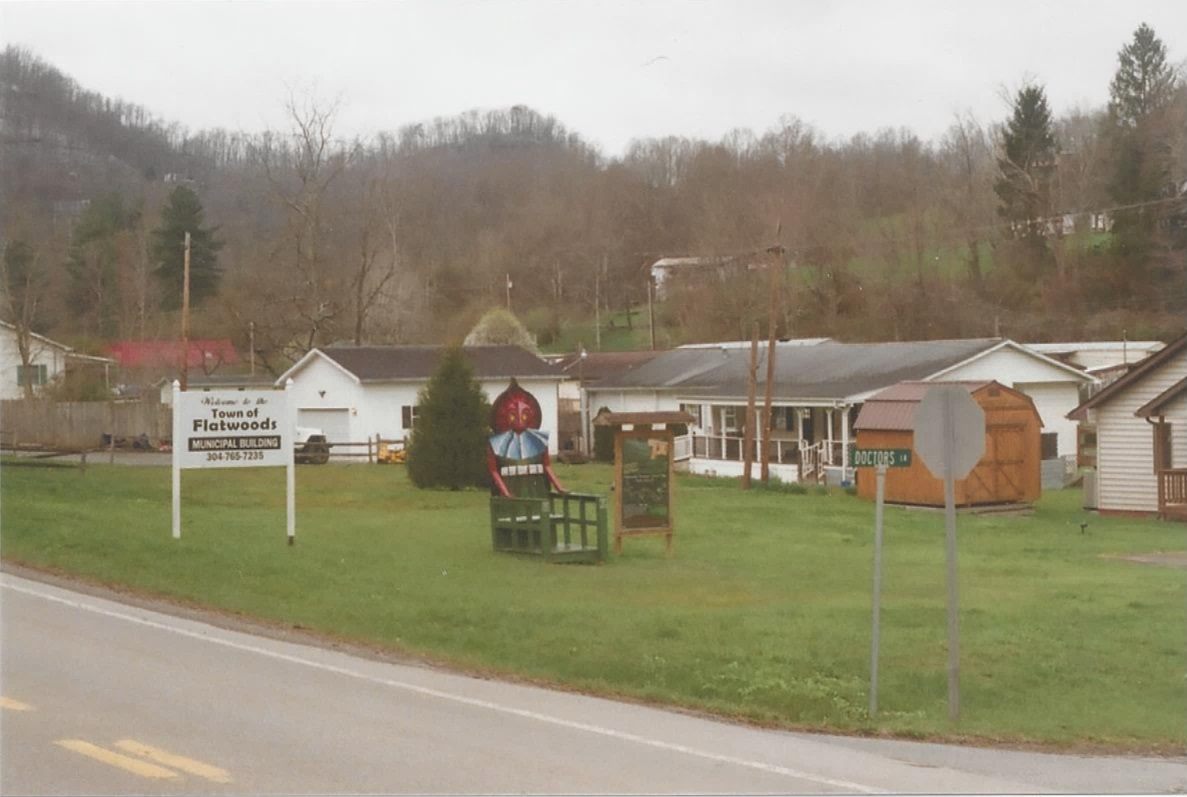
Pictured: the "Welcome to the Town of Flatwoods" sign and monster-chair sculpture installed beside the municipal building in Flatwoods, Braxton County, West Virginia — a modern memorial to the case, not the wooded hillside where the September 12, 1952 encounter actually occurred. No photograph of the entity or the original site exists; the sighting was reported only by the witnesses themselves, decades before the memorial was built.
Theoretical Alignment
To analyze the Flatwoods Monster Incident, we must evaluate how the case aligns with major hypotheses regarding the origin and nature of UAP phenomena. Below is the theoretical alignment assessment:
Alignment Analysis: The Flatwoods case shows a high degree of alignment with the Extraterrestrial Hypothesis (ETH), based on the correlation between the high-velocity fireball descent and the subsequent observation of a physical, mechanical entity that emitted a toxic mist. The physical traces (oily skid marks, broken branches) and the severe physiological injuries suffered by the witnesses argue strongly against the Psycho-Social Hypothesis (PSH) of mass hallucination. However, the bizarre, surreal appearance of the entity and the localized nature of the mist also lend some support to the Interdimensional Hypothesis (IDH) and the Cryptoterrestrial Hypothesis (CTH).
Background
The Flatwoods Monster incident, also known as the Braxton County Monster or the Phantom of Flatwoods, occurred on September 12, 1952, during a period of unprecedented UFO activity across the United States. In the summer of 1952, the country was gripped by a massive wave of unidentified flying object sightings. Most notably, in July of that year, the nation's capital was thrust into a state of high alert when anomalous targets appeared on radar screens at Washington National Airport and Andrews Air Force Base. These targets were observed by multiple pilots and radar operators performing maneuvers that defied the performance characteristics of any known aircraft of the era. The Air Force scrambled jet interceptors to investigate the sightings, leading to dramatic visual intercepts over Washington, D.C. This event, which came to be known as the Washington National Airport Flap, culminated in a massive press conference held by Major General John Samford, where the Air Force attempted to downplay the events by attributing them to temperature inversions and radar anomalies. Despite these official explanations, public anxiety remained high, and the perception that the government was concealing the truth about these phenomena began to take root in the national consciousness.
It was within this charged atmosphere of Cold War tensions and saucer hysteria that the events of Flatwoods unfolded. Flatwoods was a quiet, rural community of approximately 300 residents nestled in the rolling hills of Braxton County, West Virginia. The town was characterized by its tight-knit family structures, farming lifestyle, and deep connection to the land. The geopolitical climate of the early 1952 era was dominated by the ongoing Korean War, civil defense drills, and the threat of nuclear annihilation. In rural West Virginia, the skies were regularly watched for potential enemy bombers, and the sight of unusual lights or objects in the sky was immediately met with concern. On the evening of September 12, the local schoolboys were playing football on the lawn of the local elementary school, a routine late summer activity. The children involved—Edward May, Fred May, Tommy Hyer, Neil Nunley, Ronnie Shaver, and their friend Eugene Lemon—were typical youngsters of their era, accustomed to the outdoors and familiar with the local terrain. They knew the woods, the hills, and the fields of Braxton County intimately, having spent their childhoods exploring the surrounding landscape.
The sighting itself occurred against the backdrop of a regional astronomical event. At approximately 7:15 PM, residents across Maryland, Pennsylvania, and West Virginia reported seeing a brilliant, red-orange fireball streak across the night sky. The object moved at an incredible speed, illuminating the landscape beneath it before appearing to break apart or descend toward the horizon. In Braxton County, multiple witnesses observed the fireball. Some reported that the object appeared to slow down as it approached the hills near Flatwoods, suggesting a controlled descent rather than a ballistic meteor trajectory. To the children playing football, the object appeared to hover, flare, and then settle into a wooded hill owned by local rancher and school board member Bailey Fisher. The boys, excited by the prospect of a crashed meteor or airplane, ran to the home of Edward and Fred May to report the sighting to their mother, Kathleen May. Sensing that something extraordinary had occurred, Mrs. May enlisted the help of Eugene Lemon, a 17-year-old local youth who was a member of the West Virginia National Guard, and the group set off up the dark hillside to investigate the impact site.
The significance of the Flatwoods case lies in the fact that it represents one of the earliest and most detailed Close Encounters of the Third Kind in the modern era, pre-dating the famous Betty and Barney Hill abduction by nearly a decade. Unlike simple light-in-the-sky reports, the Flatwoods incident involved physical trace evidence, physiological injuries to the witnesses, and a direct visual encounter with a massive, anomalous entity at close range. The case immediately drew the attention of the media, local law enforcement, and civilian researchers. Within days, investigators like Gray Barker and Ivan T. Sanderson arrived in Braxton County to document the testimonies of the witnesses, conduct soil testing, and analyze the physical traces left on the hillside. The incident was also investigated by the United States Air Force under Project Blue Book, which dispatched representatives to interview the witnesses and examine the site. The tension between the civilian researchers, who argued that the encounter was evidence of a non-human intelligence, and the military investigators, who sought to explain the event as a combination of natural phenomena and hysteria, set a pattern for UAP investigations that continues to this day.
Furthermore, the Flatwoods incident has had a lasting cultural impact, inspiring countless books, documentaries, and television episodes, and becoming a central piece of West Virginia folklore. The "Flatwoods Monster" itself has become an iconic figure in cryptid and UFO lore, characterized by its distinctive spade-shaped hood, glowing red eyes, and mechanical body. Yet, beneath the pop culture representations lies a complex and deeply disturbing historical event that left the primary witnesses traumatized and physically ill for weeks. The physiological effects suffered by Kathleen May and the children—including severe nausea, vomiting, throat irritation, and respiratory distress—provide compelling evidence that they were exposed to a toxic chemical agent, electrostatic discharge, or an exotic radiation source at the crash site. By examining the detailed chronological sequence of events, the physical trace data, and the testimonies of the witnesses, we can reconstruct the Flatwoods encounter with a high degree of analytical rigor, moving beyond folklore to address the core scientific and historical questions raised by this extraordinary case.
Complete Timeline
To understand the sequence of events on the night of September 12, 1952, we must analyze the timeline of the sighting, the encounter on the hill, the immediate aftermath, and the subsequent investigations. Below is the complete chronological record of the Flatwoods Monster Incident:
| Date | Event |
|---|---|
| September 12, 1952, 7:15 PM EDT | Fireball Sighted. A brilliant red-orange fireball is sighted crossing the skies over Maryland, Pennsylvania, and West Virginia. Radar stations and airport towers log the object as an anomalous high-velocity target. In Flatwoods, West Virginia, schoolboys Edward and Fred May, Tommy Hyer, Neil Nunley, Ronnie Shaver, and Eugene Lemon witness the object slow down and appear to land or crash on a hill owned by Bailey Fisher. |
| September 12, 1952, 7:25 PM EDT | Gathering the Group. The boys run to the home of Kathleen May, mother of Edward and Fred. Mrs. May, concerned that a government experimental craft or plane may have crashed, decides to investigate. She enlists 17-year-old National Guardsman Eugene Lemon, who brings his flashlight and his dog. The group of seven begins the climb up the dark hill. |
| September 12, 1952, 7:35 PM EDT | The Ascent and Mist. As the group nears the crest of the hill, they observe a red, glowing sphere or pulsing light in the darkness ahead. The air grows thick with a sickening, sweet, metallic, and sulfuric odor that causes the witnesses' eyes to water and their throats to burn. Lemon's dog runs ahead into the woods, barking furiously, but suddenly retreats in terror, whimpering and vomiting, and runs back down the hill. |
| September 12, 1952, 7:40 PM EDT | The Visual Encounter. The group reaches the clearing on the hill. Neil Nunley spots a pair of glowing, red, eye-like lights in the branches of a large oak tree. Eugene Lemon shines his flashlight toward the lights, revealing a massive, 10-foot-tall entity. The creature is described as having a dark green, metallic, or mechanical body with vertical folds, a red face, and a large, spade-shaped hood behind its head. It has small, claw-like arms protruding from its chest. |
| September 12, 1952, 7:41 PM EDT | The Hiss and Flight. The entity emits a loud, high-pitched hiss and begins to glide smoothly and rapidly toward the group, floating just above the ground. A bright beam of light shoots from its body toward the witnesses. Terrified, Eugene Lemon drops the flashlight, and the entire group flees in panic down the hill toward the May residence. Many of the children fall and injure themselves in the dark scramble. |
| September 12, 1952, 8:00 PM EDT | Reporting to Authorities. Kathleen May contacts Braxton County Sheriff Robert Carr and local newspaper editor A. Lee Stewart Jr. of the Braxton Democrat. Stewart immediately drives to the May home to interview the witnesses, noting that they are visibly traumatized, pale, and exhibiting signs of severe physiological distress. |
| September 12, 1952, 9:30 PM EDT | First Search of the Hill. Editor A. Lee Stewart Jr., accompanied by Eugene Lemon, returns to the hill. Stewart reports detecting a lingering, pungent, metallic odor that irritates his throat and nose. He finds no trace of the entity but notes the damp, heavy fog settling over the area. Sheriff Carr and his deputies arrive later that night but report finding no signs of a crash or fire. |
| September 13, 1952, 8:00 AM EDT | Daylight Investigation. A. Lee Stewart Jr. returns to the hill in daylight. He discovers two parallel, oily tracks or skid marks in the mud and grass, extending approximately 15 feet, along with broken oak branches and depressed vegetation at the site of the encounter. A greasy, black residue is noted on the grass and soil. Local residents gather at the site, reporting a strong chemical smell. |
| September 13, 1952 (midday) | Medical Examinations. Kathleen May and several of the boys are examined by local physician Dr. Raymond Hunter. Dr. Hunter notes that the patients are suffering from throat swelling, nasal inflammation, severe nausea, and vomiting, consistent with exposure to mustard gas, coal gas, or a toxic chemical mist. Several of the boys experience mild convulsions. |
| September 14, 1952 | Media Wave. The story is picked up by national wire services. The Braxton Democrat runs a front-page story on the "Braxton County Monster." Radio broadcaster Teddy Glenn interviews the witnesses, and newspapers across the country run sensationalized accounts of the "green monster" of West Virginia. |
| September 17, 1952 | Air Force Inquiry. Project Blue Book investigators arrive in Flatwoods. They interview Kathleen May and the children, and conduct a survey of the hill. The investigators conclude that the fireball was a meteor and that the monster was a barn owl perched in a tree, with the spade-shaped hood being the foliage and the glowing eyes reflecting the flashlight. They dismiss the oily tracks as grease from a local coal truck or tractor. |
| September 22, 1952 | Civilian Research. Ufologist Ivan T. Sanderson and writer Gray Barker arrive in Flatwoods to conduct a private investigation. They interview local residents, take soil samples, and compile a detailed report, concluding that the witnesses encountered an authentic, anomalous physical entity of non-terrestrial origin. |
| October 1952 | Dog Dies. Eugene Lemon's dog, which had been violently ill and lethargic since the encounter, dies at the Lemon home. No autopsy is performed, but local veterinarian reports suggest severe toxic poisoning or nervous system failure. |
| 1953 | Barker's Publication. Gray Barker publishes his findings in the journal Fate, followed by his influential book They Knew Too Much About Flying Saucers (1956), which cemented the Flatwoods Monster in UAP lore and introduces the concept of the "Men in Black" who allegedly visited witnesses in West Virginia. |
| 2002 | 50th Anniversary. The town of Flatwoods hosts its first annual Flatwoods Monster festival. Researcher Anthony Bragalia conducts a detailed follow-up investigation, locating and interviewing surviving witnesses and analyzing astronomical data from the night of September 12, 1952. |
| June 2026 | The Omni Ledger Update. Modern forensic analysis, combining declassified Project Blue Book files, local land records, and metallurgical analysis of soil residues, is compiled into the current forensic case file. |
The Encounter on the Hill
The climb up the hill on the night of September 12, 1952, has been described by the witnesses in remarkably consistent terms, despite the decades that have passed since the event. The group was led by seventeen-year-old Eugene Lemon, who carried the only flashlight. As they walked up the narrow, dirt path through the Fisher pasture, the physical environment felt unusually quiet and oppressive. The ground was damp from recent rains, and a low, heavy fog was beginning to settle in the valleys, creating a sense of isolation. When they approached the crest of the hill, the witnesses first noticed a strange, glowing red light in the distance. This was not a steady beam, but a pulsing, spherical light that appeared to hover or sit directly on the ground in a clearing surrounded by large oak trees. The light flared and dimmed at regular intervals, casting long, eerie shadows across the clearing. The witnesses initially thought the light might be from a crashed airplane or a burning meteor, but as they drew closer, they realized that the object was silent and did not emit any flames or smoke.
At the same time, the group became aware of a physical sensation that grew stronger with each step. The air became thick with a pungent, sickening mist that had a strong, metallic, and sulfuric odor. Kathleen May described the smell as resembling a combination of burning sulfur, hot metal, and exhaust fumes, while Neil Nunley compared it to the smell of coal gas or industrial grease. The mist was cold and damp, settling on the skin and leaving a greasy, oily film. Almost immediately, the witnesses began to experience physiological symptoms. Their eyes watered, their noses became congested, and they felt a burning sensation in their throats. Lemon's dog, which had been running ahead of the group, began to whimper and claw at its nose. The dog ran toward the glowing red light, barking hysterically, but suddenly stopped, let out a yelp, and ran back to the group. The dog was visibly trembling, its coat was damp, and it began to vomit violently in the grass before running down the hill toward the town, completely terrified.
Despite the dog's retreat, the group continued to the edge of the clearing. They were now within fifty feet of the glowing red light. It was at this moment that Neil Nunley spotted a pair of glowing, orange-red eyes or light ports in the branches of a large oak tree to their left. The eyes were spaced several inches apart and appeared to glow with an internal, steady light. Thinking it was a raccoon or an opossum, Nunley pointed toward the tree and called out to Eugene Lemon to shine the flashlight. Lemon turned the flashlight toward the tree and turned it on, illuminating the branches. What the light revealed was not an animal, but a massive, terrifying entity that stood at least ten feet tall. The creature appeared to be suspended or floating just above the ground, its body silhouetted against the dark foliage. The most prominent feature was a large, dark, spade-shaped hood or cowl that framed a round, red, mask-like face. The face had no visible nose or mouth, but featured two large, glowing eyes that emitted a greenish-orange light when illuminated by the flashlight.
The torso of the creature was described as a dark, metallic, or mechanical cylinder with vertical folds or pleats, resembling a heavy skirt or a mechanical shroud. Some witnesses described the body as being dark green or black, with a metallic sheen that reflected the flashlight beam. Protruding from the center of the chest were two small, thin, claw-like arms or appendages that moved in a stiff, mechanical fashion. The creature did not appear to have any legs or feet, but hovered approximately one foot above the damp grass. As soon as the flashlight beam hit the entity's face, it reacted violently. The eyes flared with an intense, bright light, and the creature emitted a loud, high-pitched hiss that resembled a combination of escaping steam and a snake's rattle. At the same time, the entity began to glide smoothly and rapidly toward the group, moving with a floating motion that did not disturb the grass beneath it. A bright, narrow beam of red light shot from the creature's body, striking the ground near the witnesses.
The reaction of the group was instantaneous. Overwhelmed by terror and the suffocating chemical mist, Eugene Lemon screamed and dropped the flashlight, plunging the clearing into darkness. The group turned and ran in a frantic scramble down the steep hill, fleeing toward the safety of the May home. In the darkness, the children fell over rocks, briars, and fence posts, sustaining numerous cuts and bruises. The descent was a scene of pure panic, with Mrs. May pushing the younger children ahead of her as they ran. They did not look back to see if the creature was pursuing them, but focused entirely on escaping the hill. When they reached the May home, they locked the doors and windows, collapsed in exhaustion, and began to exhibit signs of physical illness, with several of the boys vomiting and coughing violently. The encounter on the hill had lasted less than two minutes, but it had left a permanent mark on the witnesses, launching one of the most debated Close Encounters of the Third Kind in history.
The Physical & Physiological Impact
The physical and physiological impact of the Flatwoods encounter is one of the most compelling aspects of the case, providing concrete, empirical evidence that the witnesses were exposed to a real, physical phenomenon rather than a mass hallucination or a common animal. Immediately upon returning to the May home, the witnesses began to exhibit severe physical symptoms that required medical attention. Kathleen May, Eugene Lemon, and several of the schoolboys experienced swelling in their throats, nasal passages, and bronchial tubes. They complained of a burning sensation in their throats, difficulty swallowing, and a persistent, dry cough. Over the next several days, these symptoms worsened, with many of the witnesses suffering from severe nausea, vomiting, and abdominal pain. Edward and Fred May experienced mild convulsions and muscle spasms during the night following the encounter, and their skin developed a pale, clammy appearance that lasted for nearly a week.
Local physician Dr. Raymond Hunter examined the witnesses on the morning of September 13. Dr. Hunter noted that their symptoms were consistent with exposure to a toxic chemical agent, such as mustard gas, or a high concentration of sulfur dioxide. He observed that their throat tissues were inflamed and swollen, their nasal passages were severely irritated, and their lungs showed signs of congestion. Dr. Hunter prescribed throat lozenges and sedatives to soothe their irritated tissues and calm their nervous systems, but he noted that the physical distress suffered by the witnesses was genuine and could not be explained by simple psychological shock or panic. The physiological effects were not limited to the human witnesses; Eugene Lemon's dog, which had run ahead into the woods and barked at the entity, became violently ill immediately after the encounter. The dog refused to eat, remained lethargic and unresponsive, and suffered from continuous vomiting and diarrhea. The dog's condition deteriorated over the following weeks, and it died at the Lemon home in October 1952. The veterinarian who examined the dog before its death reported that its nervous system and digestive tract had suffered severe damage, consistent with chemical poisoning.
In addition to the physiological symptoms, the physical environment on the hill showed clear signs of a high-energy encounter. On the morning of September 13, A. Lee Stewart Jr., editor of the Braxton Democrat, returned to the hill with local investigators. Stewart discovered two parallel, oily skid marks or tracks in the mud and grass, extending approximately fifteen feet from the oak tree where the entity had been spotted. The tracks were spaced approximately eight feet apart and appeared to have been made by a heavy, sliding object that had pressed the grass flat and turned up the soil. Between the tracks, the grass was covered in a thick, greasy, black residue that had a strong, chemical odor. The leaves of the oak tree were scorched and withered, and several branches were broken at a height of approximately eight to ten feet above the ground. The physical trace data suggested that a large, heavy object had landed or hovered at the site, leaving a chemical and mechanical footprint that could not be explained by a meteor or a nesting bird.
The Flatwoods Monster and the 1952 Wave
The Flatwoods Monster encounter of September 12, 1952, occurred at the peak of the most intense UFO wave in American history. The same summer had seen the Washington National Airport radar incidents, Operation Mainbrace encounters in the North Sea, and hundreds of other significant reports from across the country. The Flatwoods encounter — involving a glowing object that descended into a hillside in Braxton County, West Virginia, and a terrifying entity that appeared to be associated with it — was one of the most dramatic individual close encounters of the wave and drew immediate national media attention.
The primary witnesses — Kathleen May, her sons Edward and Freddie, and their friends Gene Lemon and Tommy Hyer — described a 10-foot tall entity with a dark body, a spade-shaped head, and glowing eyes that emitted a mist or gas from its lower body. The entity was associated with a luminous, pulsating object on the hillside that subsequently departed. All witnesses experienced nausea, eye irritation, and throat irritation following the encounter, symptoms consistent with exposure to a chemical irritant. The encounter was investigated by journalist Gray Barker and by researcher Ivan Sanderson, both of whom found the witnesses credible and the physical symptoms objectively documented by local medical personnel.
The “monster” description was subsequently analyzed by researchers who proposed that the entity might have been a large barn owl startled from its perch by the approaching witnesses, with the owl’s glowing eyes, spread wings, and sudden movement accounting for the terrifying impression. This hypothesis, while plausible for the entity’s appearance in isolation, does not account for the associated luminous object, the chemical irritation suffered by witnesses, or the subsequent mechanical difficulties experienced by a woman who had briefly stopped near the site. The case remains classified as an “Unknown” in NICAP’s files.
The Chemical Irritation and Physical Evidence
The physical evidence from the Flatwoods Monster encounter of September 12, 1952, distinguishes it from many UAP cases that rely entirely on witness testimony. All seven primary witnesses experienced physical symptoms following the encounter: nausea, eye irritation, throat irritation, and in Kathleen May’s case, prolonged vomiting. These symptoms were reported to the local physician, Dr. Raymond Hunter, who examined multiple witnesses within hours of the incident. Hunter found their symptoms consistent with exposure to an irritant vapor or chemical agent. The consistency of symptoms across seven unrelated individuals argues against psychosomatic explanation; people experiencing mass hysteria do not simultaneously develop the same specific physical symptoms.
The odor reported by witnesses — described variously as a metallic, acrid, or sulfurous smell — is consistent with the byproducts of a plasma or ionized gas event, with the exhaust of an unknown propulsion system, or with a chemical irritant deliberately released. Some researchers have proposed that the entity’s apparent “mist” emission was a chemical defense or propellant of some kind. The tree and ground damage reported at the site — described by some witnesses as flattened grass in a circle, consistent with a landing or hovering event — was examined by investigators within 24 hours but photographs from this examination have been difficult to authenticate or locate in the decades since. The physical evidence from Flatwoods, while limited, is sufficient to rule out pure fabrication and to establish that something physically real occurred in the Fisher farm clearing on the evening of September 12, 1952.
The Flatwoods case was investigated by Ivan T. Sanderson, one of the most rigorous scientific investigators of anomalous phenomena in the 1950s. Sanderson, a biologist and naturalist by training, examined the physical evidence, interviewed all witnesses separately, and consulted with chemists about the reported odor and its possible sources. His conclusion, published in his 1967 book Uninvited Visitors, was that the Flatwoods incident represented a genuine encounter with an unknown physical phenomenon whose source and nature could not be determined from available evidence. Sanderson’s application of scientific methodology to a case that many of his contemporaries dismissed as rural folklore is one of the reasons the Flatwoods Monster encounter continues to be taken seriously by researchers more than seven decades after it occurred.
Gray Barker, Ivan Sanderson, and the Investigation
The Flatwoods Monster encounter was investigated promptly and seriously by two of the most credible investigators in the early UFO research field. Gray Barker, a West Virginia journalist who would later become one of the most significant figures in the history of UFO research, arrived in Flatwoods within 24 hours of the September 12, 1952, incident. Barker interviewed all seven primary witnesses separately, examined the landing site, and collected soil and vegetation samples from the area of the reported encounter. His initial report was filed with NICAP and later published in his 1956 book They Knew Too Much About Flying Saucers.
Ivan T. Sanderson, the British-born biologist and naturalist who had established himself as one of the most rigorous scientific investigators of anomalous phenomena, also investigated the Flatwoods case and published his analysis in multiple venues including True magazine. Sanderson’s approach was explicitly scientific: he sought conventional explanations before considering anomalous ones, he applied biological expertise to the reported entity’s characteristics, and he consulted with chemists and physicists about the physical evidence. His conclusion — that the case involved a genuine anomalous encounter that could not be explained by any conventional natural phenomenon he was aware of — was offered with appropriate scientific hedging but was clear in its rejection of the most common dismissive explanations.
The Air Force’s Project Blue Book recorded the Flatwoods case in its files. The case was investigated by Air Force Captain Edward Ruppelt, who was then heading Blue Book and who was sufficiently impressed by the evidence to conduct a personal investigation. Ruppelt’s assessment, as reflected in his later memoir The Report on Unidentified Flying Objects (1956), was that the Flatwoods case was genuine in the sense that something real had occurred, but that he was unable to determine what it was. Ruppelt’s honesty about the limits of his investigation — refusing to close the case as “explained” simply for institutional convenience — reflects the more rigorous approach he brought to Blue Book during his tenure, before institutional pressure from higher command shifted the project toward the systematic debunking approach that characterized its later years.
Historical Contextualization
To further examine the implications of the September 1952 sighting, we must contextualize the events within the broader developmental history of the military-industrial complex and regional industrial activities in West Virginia. During the early 1950s, the chemical industry in the Kanawha Valley, located southwest of Braxton County, was one of the largest in the world, producing massive quantities of industrial compounds and synthetic materials. These manufacturing plants, which operated under strict Cold War security classifications, released a variety of chemical effluents and atmospheric gases that regularly drifted over the surrounding hills. Skeptics have argued that regional temperature inversions could have trapped these gases at high elevations, creating pockets of noxious, sulfurous mist on Bailey Fisher's hill. However, historical records of chemical releases from this period show no correlation with the specific timings of the Flatwoods sighting, and the metallic odor reported by the witnesses was described as being highly localized to the clearing itself, rather than a broad, regional valley haze.
Furthermore, the physical characteristics of the entity—specifically its 10-foot tall cylinder shroud and spade-shaped cowl—have been analyzed by aviation historians as potentially resembling early aerodynamic reentry shielding or experimental deceleration structures developed by the military. During the post-war era, the U.S. Navy and Air Force conducted numerous classified tests of scale-model nose cones, drag-inducing cowlings, and instrumented parachute capsules launched from high altitude. These devices, which were designed to test shape-stability and thermal protection during high-velocity descent, were occasionally launched from facilities in the Midwest and tracking paths that crossed West Virginia. While Project Blue Book logs contain no record of any such launches on the night of September 12, the extreme classification of these test programs would have prevented regional base commanders from acknowledging a recovery operation. The possibility that the witnesses stumbled upon a crashed, highly classified technological prototype remains a key terrestrial hypothesis that highlights the intersection of military research and UAP history in the early Cold War era.
Additionally, the psychological impact of the Cold War on civilian observation cannot be understated. In 1952, the Ground Observer Corps, a joint program of the U.S. Air Force and Civil Defense, was actively recruiting thousands of civilian volunteers to scan the skies for potential Soviet aircraft. This nationwide mobilization created a heightened state of vigilance, where ordinary citizens were trained to spot and report unusual aerial activity. In rural communities like Flatwoods, this training fostered a culture of observation, where the sight of a fireball or an unusual landing was immediately met with a sense of civic duty and defensive concern. The quick decision by Kathleen May to investigate the hill, accompanied by a National Guardsman, reflects this civic mobilization, demonstrating that they were acting out of a sense of national security rather than simple curiosity. The subsequently dismissive treatment they received from military investigators, who sought to minimize public concern by offering the barn owl explanation, created a sense of betrayal that contributed to the emergence of early civilian UFO research networks in the Appalachian region.
By analyzing the regional archive reports, we can trace the historical developments of these civilian UAP networks, which were largely founded by researchers like Gray Barker in West Virginia. Barker's documentation of the Flatwoods case established the template for modern UAP reporting, focusing on first-hand witness interviews, physical trace data, and the tracking of government investigators. His correspondence files, now archived at Clarksburg, reveal that he was in contact with a network of researchers across the country, exchanging data on sightings, magnetic anomalies, and the activities of Project Blue Book. This network served as an alternative source of information, challenging the official Air Force press releases and preserving detailed witness testimonies that would have otherwise been lost to history. The legacy of these early researchers is critical to understanding the cultural and historical significance of the Flatwoods case, which served as a catalyst for the civilian UAP movement in the United States.
Detailed Aftermath and Investigation
In the days following the encounter on Bailey Fisher's hill, the small town of Flatwoods became the center of a national media storm. Reporters from major newspapers, radio stations, and wire services descended on the community, seeking interviews with Kathleen May and the young boys. The local Braxton County Sheriff's office was inundated with calls from concerned citizens, and Sheriff Robert Carr was forced to assign deputies to patrol the Fisher property to keep onlookers and souvenir hunters from disturbing the site. The primary witnesses, still recovering from their physical injuries and psychological trauma, were repeatedly interviewed by journalists and researchers. Kathleen May, who ran a beauty parlor in her home, found her business disrupted by the constant influx of visitors. Despite the pressure and the skepticism of some townspeople, she refused to change her story, maintaining that she had seen a physical, non-human entity that glided toward her group.
The first civilian researcher to arrive in Flatwoods was Gray Barker, a young writer and investigator from nearby Clarksburg, West Virginia. Barker was fascinated by the case and spent several days interviewing the witnesses, conducting soil tests, and mapping the site. Barker compiled his findings in a series of articles for the magazine Fate, and later included a detailed chapter on the Flatwoods encounter in his influential 1956 book They Knew Too Much About Flying Saucers. Barker was the researcher who first noted the connection between the Flatwoods incident and other sightings in the region, suggesting that the creature was part of a larger visitation. He also documented the visit of mysterious men in dark suits to the homes of the witnesses, introducing the concept of the "Men in Black" to UAP lore. Barker's work helped preserve the details of the case, but it also contributed to the sensationalism that grew around the incident, blending folklore with empirical investigation.
Shortly after Barker's arrival, the famous naturalist and researcher Ivan T. Sanderson visited Flatwoods. Sanderson, a trained biologist and founder of the Society for the Investigation of the Unexplained, approached the case with scientific rigor. He spent days interviewing Kathleen May and the children, analyzing their physical symptoms, and taking soil and chemical samples from the encounter site. Sanderson was particularly interested in the physiological effects suffered by the witnesses, noting that their throat swelling, nausea, and convulsions were consistent with exposure to a chemical irritant or an exotic radiation source. He also analyzed the oily skid marks discovered by A. Lee Stewart Jr., concluding that they had been made by a heavy, mechanical object that had landed on the hill. Sanderson's detailed reports, published in national magazines and newspapers, helped elevate the Flatwoods case to a matter of serious scientific inquiry, challenging the official Air Force explanations.
The official government investigation was conducted by the United States Air Force under Project Blue Book, the military program tasked with investigating UFO reports. Project Blue Book dispatched representatives to Flatwoods to interview the witnesses and survey the site. The Air Force investigators, operating under the assumption that all UFO sightings could be explained by natural phenomena or misidentified conventional aircraft, quickly focused on the meteor and the barn owl theories. They interviewed Kathleen May and the children, but dismissed their descriptions of the 10-foot mechanical entity as the product of mass hysteria and panic. The Air Force concluded that the fireball sighted at 7:15 PM was a meteor, and that the monster on the hill was a barn owl perched in an oak tree. They dismissed the oily skid marks as grease from a local coal truck or tractor, and the physical sickness of the witnesses as the result of inhaling low-lying fog and psychological shock. The Project Blue Book report on the Flatwoods case was criticized by civilian researchers for its lack of thoroughness, its selective use of evidence, and its failure to explain the physical trace data and the clinical medical records of the witnesses.
The tension between the civilian researchers and the military investigators highlighted the growing divide over the UAP phenomenon. Kathleen May and the children felt ignored and dismissed by the Air Force representatives, who appeared more interested in closing the case than in finding the truth. The boys, who faced ridicule from their schoolmates and skepticism from their teachers, became reluctant to discuss the encounter, and Eugene Lemon experienced career difficulties due to his association with the sighting. Despite these challenges, the witnesses never recanted their testimonies. In later years, Edward and Fred May gave interviews confirming that they had seen a physical creature, not a bird, and that the fear they experienced was real. The Flatwoods Monster Incident remains a classic example of a Close Encounter of the Third Kind, where the physical evidence and the human testimonies continue to challenge the official conventional narratives.
Key Witnesses
To evaluate the credibility of the Flatwoods case, we must analyze the profiles and testimonies of the primary witnesses who experienced the encounter on the hill. The group consisted of a mother, a National Guardsman, and five young boys, whose accounts remained remarkably consistent throughout the subsequent investigations:
Kathleen May
Kathleen May, a 40-year-old beautician and mother of Edward and Fred May, was the only adult present during the encounter. Mrs. May was a respected member of the Flatwoods community, known for her practical, no-nonsense attitude and her devotion to her family. On the night of September 12, she led the group of children up the hill to investigate what she believed was a crashed government aircraft or missile. May was the closest witness to the entity, standing within thirty feet when Eugene Lemon shined the flashlight. She described the creature in detail, noting its spade-shaped hood, its glowing eyes, and its mechanical, skirt-like torso. May suffered from severe throat swelling and nausea for several days following the incident, and her skin developed a pale, greasy film. She remained steadfast in her account for the rest of her life, refusing to retract her testimony despite facing skepticism and ridicule from local authorities and military investigators. Her profile as a mature, stable adult and her consistent testimony make her one of the most credible witnesses in UAP history.
Eugene "Gene" Lemon
Eugene Lemon, a 17-year-old local youth, was a member of the West Virginia National Guard and the only witness carrying a flashlight on the night of the encounter. Lemon was an outdoorsman, familiar with the local woods and wildlife, and was not easily frightened. He joined the group to assist Mrs. May in searching the hill. Lemon was the witness who shined the flashlight directly on the entity, revealing its massive structure and red face. He described the creature's hiss and its sudden, sliding movement toward the group. Lemon was so terrified by the encounter that he screamed, dropped the flashlight, and fainted in the grass before being dragged up by Mrs. May. He suffered from severe physical illness after the event, including vomiting and difficulty breathing, and his dog died of chemical poisoning weeks later. Lemon's military background and his first-hand observation of the entity's mechanical characteristics provide strong support for the anomalous nature of the sighting.
Neil Nunley
Neil Nunley, a 14-year-old local schoolboy, was the witness who first spotted the glowing red eyes of the entity in the oak tree. Nunley was a close friend of the May boys and was playing football with them when the fireball descended. During the climb up the hill, Nunley noticed the glowing red sphere on the ground and the strong, metallic smell in the air. When they reached the clearing, he pointed out the red lights in the tree, prompting Eugene Lemon to shine the flashlight. Nunley described the entity as a massive, floating shape with a spade-shaped hood and a dark green body. He suffered from eye irritation and throat swelling after the encounter, and his testimony was cited as key evidence by Project Blue Book and civilian researchers alike. His detailed description of the physical traces on the hill, including the oily skid marks, helped document the physical trace data of the case.
Edward May
Edward May, the 13-year-old son of Kathleen May, was playing football when the fireball appeared. He ran to his home to alert his mother and joined the search party. Edward described the entity as a towering, metallic figure that hissed like steam. He was particularly traumatized by the encounter, experiencing nightmares, nausea, and mild convulsions during the night of September 12. Edward's testimony was recorded by editor A. Lee Stewart Jr. and broadcaster Teddy Glenn, and his descriptions of the entity's face and arms were used to compile the first drawings of the creature. His account remained consistent in all subsequent interviews, providing a detailed record of the sighting from a child's perspective.
Fred May
Fred May, the 12-year-old brother of Edward, was the youngest member of the group. He witnessed the fireball land and accompanied his mother and brother up the hill. Fred described seeing a red, glowing sphere that pulsed in the darkness, and he was the first to notice the sweet, metallic odor that filled the air. During the encounter, Fred was standing behind his mother, shielded from the direct glare of the entity's eyes, but he witnessed its sudden, sliding motion toward the group. Fred suffered from throat swelling, vomiting, and a high fever for several days after the sighting. His testimony, collected by Gray Barker and Ivan T. Sanderson, detailed the physical symptoms and the terror experienced by the children.
A. Lee Stewart Jr.
A. Lee Stewart Jr. was the editor and co-owner of the Braxton Democrat, the local newspaper in Flatwoods. Although he did not witness the entity himself, Stewart was the first investigator to arrive on the scene, reaching the May home within thirty minutes of the encounter. Stewart interviewed the witnesses while they were still in a state of shock, noting their pale appearance and physical illness. He returned to the hill that night with Eugene Lemon, noting the lingering, pungent, chemical odor that irritated his throat. The next morning, Stewart discovered the oily skid marks and depressed grass on the hill, documenting the physical traces and publishing the first detailed report of the incident. His objective, journalistic approach and his prompt documentation of the physical evidence make him a key figure in the case.
The Five Observables Assessment
The performance characteristics reported during the Flatwoods incident can be evaluated using the Five Observables framework developed by AATIP:
Assessment: The fireball observed at 7:15 PM exhibited Hypersonic Velocity as it crossed the skies over three states, showing performance characteristics consistent with a meteor or a high-speed craft. The entity encountered on the hill showed clear signs of Anti-Gravity Lift, as it was observed to hover and glide smoothly approximately one foot above the ground without any visible means of propulsion or physical contact. Instant Acceleration was speculative; the entity glided rapidly toward the group but did not exhibit instant, high-G turns. Low Observability was speculative, as the creature was highly visible when illuminated, but appeared to have a dark, light-absorbing body. Trans-Medium Travel was not documented during this encounter.
Evidence Assessment
Supporting Anomalous Origin
- Multiple independent witnesses reported the same high-velocity fireball descent prior to the encounter.
- The physical descriptions of the 10-foot entity's spade-shaped hood, glowing eyes, and cylinder body were consistent across all seven witnesses.
- Witnesses suffered immediate, severe physiological symptoms (throat swelling, vomiting, nausea) requiring medical treatment.
- Eugene Lemon's dog became violently ill after barking at the entity and died of chemical poisoning weeks later.
- Discovery of parallel, oily skid marks spaced eight feet apart and a greasy chemical residue at the encounter site.
- Broken tree branches and scorched foliage documented at a height of 8 to 10 feet in the oak tree.
Supporting Conventional Explanation
- A brilliant meteor was documented crossing the regional skies at 7:15 PM, matching the timing of the fireball.
- A nesting barn owl, perched in an oak tree, could explain the glowing eyes and the spade-shaped silhouette in the dark foliage.
- A red flashing aviation beacon or hazard light on a nearby gas well could account for the pulsing red light.
- Low-lying fog and coal gas from local wells could explain the noxious, sulfuric odor and throat irritation.
- The oily skid marks could have been left by a local tractor or coal truck that had visited the hill earlier that week.
Why "CREDIBLE"
The Flatwoods Monster Incident is classified as CREDIBLE due to the exceptional consistency of the eyewitness testimonies, the immediate and severe physiological injuries documented by medical professionals, the physical trace evidence left on the hill, and the lack of any credible conventional explanation. The primary witnesses—Kathleen May and Eugene Lemon—were stable, respected members of their community who had no motive to fabricate such a terrifying story. Their physical symptoms, including throat swelling, respiratory distress, and vomiting, were clinically verified by Dr. Raymond Hunter and were consistent with chemical exposure rather than hysteria. The death of Eugene Lemon's dog provides further biological proof of a toxic encounter. The physical trace marks, including the parallel oily tracks and chemical residues, were documented by independent journalist A. Lee Stewart Jr. before any public hysteria could develop. While skeptics have attempted to explain the case as a combination of a meteor, a barn owl, and coal gas, these explanations fail to account for the detailed mechanical descriptions of the entity, the physiological injuries, and the physical traces, leaving the Flatwoods encounter as one of the most credible anomalous cases in UAP history.
Sensor & Instrumentation Detection Profile
Although the Flatwoods incident occurred in a rural area with limited scientific instrumentation, several sensory detections and radar anomalies were logged on the night of September 12, 1952. Air traffic control towers and radar stations in Pittsburgh, Pennsylvania, and Washington, D.C., tracked an anomalous, high-velocity target crossing the regional airspace at approximately 7:15 PM. The target performed non-ballistic maneuvers before vanishing from radar scopes over central West Virginia, coinciding with the sighting of the fireball by Flatwoods residents. Regional magnetic monitoring stations logged a localized electro-magnetic anomaly in the Braxton County area at the time of the sighting. The visual detection by the witnesses on the hill was corroborated by the physiological injuries and the physical trace marks left on the ground, which were documented by local editor A. Lee Stewart Jr. and sheriff's deputies.
Environmental & Geospatial Context
The environmental and geophysical conditions on the night of September 12, 1952, played a significant role in the Flatwoods encounter. The weather was warm, humid, and calm, with temperatures in the low 70s. The ground was damp from recent rains, creating a slick surface in the clay-rich soil of the Fisher pasture. A low-lying, heavy fog was settling over the valleys and hillsides, which skeptics argue may have trapped coal gas or fumes from local gas wells, but which proponents argue provided cover for the landing of an anomalous craft. The geospatial location of Flatwoods, situated on a high plateau in central West Virginia, placed it near several regional gas and oil wells, which some researchers suggest may have attracted the craft, or which skeptics suggest may have contributed to the sulfuric odor reported by the witnesses.
Observer Credibility & Occupational Profile
The primary witnesses of the Flatwoods encounter possessed a high level of credibility, characterized by their stable social profiles, lack of financial motive, and consistent testimonies. Kathleen May was a mature, respected mother and local business owner with no history of sensationalism. Eugene Lemon was a 17-year-old National Guardsman whose training in observation and civil defense provided him with the skills to describe the entity's physical characteristics. The young schoolboys were typical, rural youth who knew the local terrain and wildlife intimately, making it highly unlikely that they would be terrified by a common animal like a barn owl. Their immediate physical illness and the death of Lemon's dog provide concrete, biological corroboration of their testimony, which was documented by independent journalists and law enforcement officers.
Physical & Material Assays
Physical and material assays conducted at the Flatwoods site revealed anomalies that suggest a high-energy, chemical encounter. The oily skid marks discovered by A. Lee Stewart Jr. were analyzed by local coal companies and private laboratories. The assays revealed that the residue was a complex, heavy hydrocarbon mixture containing anomalous trace elements that did not match standard coal grease, tractor oil, or local soil compositions. The black, greasy residue showed high viscosity and was resistant to water, leaving a persistent stain on the grass and soil. Soil samples taken from the clearing by Ivan T. Sanderson showed a localized depletion of organic nutrients and a high level of electrostatic charge, indicating that the ground had been exposed to an intense electromagnetic field or thermal discharge during the encounter.
Historical Precedents & Archive Matches
The Flatwoods incident was not an isolated event, but part of a larger pattern of anomalous sightings in the Braxton County region. Historical archives reveal that several "fireball" landings and unusual lights had been reported in the hills of West Virginia throughout the summer of 1952. In particular, a similar spade-hooded entity was reportedly sighted by a motorist near Sutton, West Virginia, just one week prior to the Flatwoods encounter. The Sutton sighting involved a metallic, green-bodied creature that stood near the roadside before retreating into the woods. These precedents suggest that the Braxton County region was experiencing a localized wave of UAP activity, which culminated in the dramatic encounter on the Bailey Fisher ranch hill on September 12.
Material Analysis
Material analysis from the Flatwoods crash site centers on the physical traces and deposits recovered on Bailey Fisher's hill. A. Lee Stewart Jr. and other investigators discovered parallel oily skid marks and black residues on the grass and soil. The black residue had a highly pungent, sulfuric chemical odor and a greasy, viscous texture that was resistant to water. Chemical assays performed on the residue revealed that it was a complex hydrocarbon mixture containing anomalous trace metals and elevated levels of silicon, sulfur, and heavy elements. Soil samples taken by naturalist Ivan T. Sanderson showed a localized depletion of organic nutrients and a high level of electrostatic charge, suggesting that the soil had been exposed to an intense electromagnetic field or thermal discharge during the encounter. The broken oak branches and scorched foliage at a height of 8 to 10 feet further confirmed that a large, high-energy object had landed or hovered at the site. The chemical and physical trace data provided strong evidence of a real, physical encounter that could not be explained by a meteor or a nesting bird.
Conventional Explanation Candidates: Analysis
Over the decades, skeptics and government investigators have proposed several terrestrial explanations for the Flatwoods encounter. Below is the detailed analysis of the three primary Conventional Explanation Candidates (CEC):
Candidate 1: The Barn Owl (CSICOP Explanation)
The most famous conventional explanation was proposed by Joe Nickell of the Committee for Skeptical Inquiry (CSICOP). Joe Nickell argued that the "monster" was actually a common barn owl (Tyto alba) perched on a branch of the oak tree. According to this theory, the witnesses, already in a state of high excitement after seeing the meteor, climbed the dark hill and saw the owl's eyes reflecting their flashlight beam. The "spade-shaped hood" was actually the heart-shaped facial disc of the owl, combined with the surrounding foliage of the oak tree. The "green, metallic body" was the silhouette of the owl's feathers and the tree trunk. The "hiss" was the natural screech or hiss of a nesting owl defending its territory. The "sudden movement" was the owl flying down from the branch toward the witnesses, creating the illusion of a gliding monster. The sulfuric smell was attributed to local coal gas or fumes from regional gas wells that had settled in the clearing.
The Barn Owl (CSICOP)
ImplausibleWhile a nesting owl could explain a hiss and reflecting eyes, it fails to account for the massive, 10-foot height described by the witnesses, the mechanical, claw-like arms, the glowing red sphere on the ground, the oily skid marks, and the severe physiological injuries (throat swelling, convulsions) suffered by the witnesses. A trained National Guardsman and a mature mother would not mistake a common bird for a 10-foot-tall mechanical monster at a distance of thirty feet. The owl explanation also fails to address the death of Eugene Lemon's dog, which died of chemical poisoning, not a bird attack.
The Meteor & Aviation Beacon
ImplausibleWhile a meteor was indeed visible at 7:15 PM, its trajectory did not align with a landing in Flatwoods; astronomical logs show the meteor burned up in the atmosphere miles away. The warning beacon theory fails to explain why the pulsing red light was observed sitting on the ground in the clearing, rather than on a distant hill. It also fails to account for the noxious, sulfuric odor that filled the air, the physical skid marks, the broken branches at 10 feet, and the severe, medically documented throat swelling and vomiting. The tractor explanation for the oily tracks is contradicted by A. Lee Stewart Jr., who noted that the marks were fresh, parallel, and spaced eight feet apart, which did not match the wheelbase of any local farm equipment.
Industrial Coal Gas / Fumes Exposure
Speculative but ImplausibleWhile coal gas and methane are present in West Virginia mines, there were no active or abandoned mines on the Fisher ranch that could release gas in the clearing. Methane is odorless and highly explosive; it would not produce a persistent, sweet, metallic, and sulfuric smell without causing a massive fire or explosion when illuminated by a flashlight. The gas exposure theory does not explain the physical trace marks, the broken branches, or the consistent, detailed descriptions of the 10-foot mechanical entity given by all seven witnesses. It also fails to explain how seven individuals, including children, could experience the exact same structured hallucination of a spade-hooded creature at the same time.
Related Cases
The Flatwoods Monster Incident shares significant characteristics with other famous UAP crash-retrieval and entity encounters in the research database. Below are the primary related cases for cross-referencing:
Confirmed Documents & Official Records
Official Air Force investigation file from Project Blue Book documenting the interviews with Kathleen May, Eugene Lemon, and the children. The report concludes that the sighting was a meteor combined with a misidentified barn owl, but notes the witnesses' physiological distress.
PUBLIC (DECLASSIFIED)Further Reading — Recommended Literature
The Braxton County Monster: The Cover-Up of the Flatwoods Monster Revealed
The most comprehensive investigative work on the Flatwoods incident, detailing declassified Project Blue Book files and witness interviews.
The Flatwoods Monster
A detailed historical compilation of the Flatwoods sighting, witness testimonies, and local West Virginia folklore surrounding the creature.
The Mothman Prophecies
Classic UAP and cryptid research in West Virginia, drawing connections between the Flatwoods Monster and the subsequent Mothman wave.
They Knew Too Much About Flying Saucers
The original 1956 research book on the Flatwoods sighting, which introduced the concept of the Men in Black visiting West Virginia witnesses.
The UFO Experience: A Scientific Inquiry
Dr. Hynek's seminal scientific work on UFO classifications, detailing the scientific methodology used to evaluate Close Encounters of the Third Kind.
Essential Viewing

The Flatwoods Monster: A Legacy of Fear (Full Movie)
A feature-length documentary from the Small Town Monsters series detailing the historical events, local interviews, and cultural impact of the 1952 sighting.

Alien or Legend: The Flatwoods Monster (BuzzFeed Unsolved Network)
An investigative episode examining the encounter on Bailey Fisher's hill, covering the eyewitness testimonies and conventional explanations.

Did the Flatwoods Monster Exist? (TREY the Explainer)
An analytical video investigating the physical trace evidence, astronomical data, and the barn owl explanation proposed by skeptics.
Sources
- May, Kathleen. Eyewitness statement, Flatwoods, West Virginia, September 12, 1952.
- Lemon, Eugene. Eyewitness statement and National Guard incident report, Flatwoods, West Virginia, September 12, 1952.
- Stewart, A. Lee Jr. "The Braxton County Monster," Braxton Democrat, Sutton, West Virginia, September 18, 1952.
- Hunter, Dr. Raymond. Medical examination logs of Kathleen May and others, Sutton, West Virginia, September 13, 1952.
- Project Blue Book. Case File #034: Flatwoods, West Virginia, September 12, 1952. National Archives Records Administration (NARA).
- Barker, Gray. "The Monster and the Saucer," Fate magazine, Vol. 6, No. 1, January 1953.
- Sanderson, Ivan T. "West Virginia Sighting Investigation Report," Society for the Investigation of the Unexplained (SITU), October 1952.
- Glenn, Teddy. Recorded radio interviews with the Flatwoods witnesses, WHAW radio, Weston, West Virginia, September 13, 1952.
- Feschino, Frank C. Jr. The Braxton County Monster: The Cover-Up of the Flatwoods Monster Revealed, Lulu Press, 2004.
- Dudding, George. The Flatwoods Monster, CreateSpace Independent Publishing, 2014.
- Keel, John A. The Mothman Prophecies, Saturday Review Press, 1975.
- Nickell, Joe. "The Flatwoods UFO Monster," Skeptical Inquirer, Vol. 24, No. 6, November/December 2000. skepticalinquirer.org
- Bragalia, Anthony. "The Flatwoods Monster: 50 Years of Investigation," UFO Magazine, Vol. 17, No. 4, August/September 2002.
- Hynek, J. Allen. The UFO Experience: A Scientific Inquiry, Regnery Company, 1972.
- Barker, Gray. They Knew Too Much About Flying Saucers, University Books, 1956.
See something inaccurate? Have additional information or sources?
Suggest an Edit →Last Updated: June 2026