
Edwards AFB Canberra Photograph
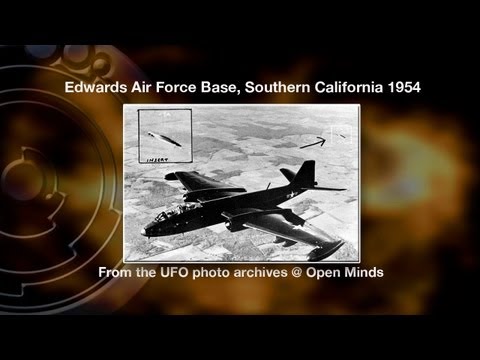
Sometime in 1954 — most secondary sources say September, though no primary record gives an exact day — professional photographers from the Martin Aircraft Company shot a routine publicity photograph of a Martin B-57B Canberra bomber (serial 52-1550) near Edwards Air Force Base in California's Mojave Desert. Nobody on the ground or in the air reported seeing anything unusual that day. It was only when the print was examined, apparently years later, that a small, symmetrically shaded, disc-like shape was noticed sitting in the frame's upper-right corner, unconnected to the aircraft and casting no shadow of its own. The photograph eventually reached the National Investigations Committee on Aerial Phenomena (NICAP), whose photographic adviser, Ralph Rankow, subjected it to a detailed 1964 analysis that neither confirmed nor dismissed it — and flagged something stranger still: later prints supplied by Martin Corporation showed the same object being progressively edited away. This case file also untangles the queue placeholder's inaccurate framing of "pilots and tower personnel" witnessing a "hovering disc," a narrative that matches no documented Edwards AFB record from 1954 and appears to be a garbled conflation of this undated photograph with a real, but entirely separate, dated event: astronaut Gordon Cooper's own account of a saucer landing filmed at Edwards on May 3, 1957.
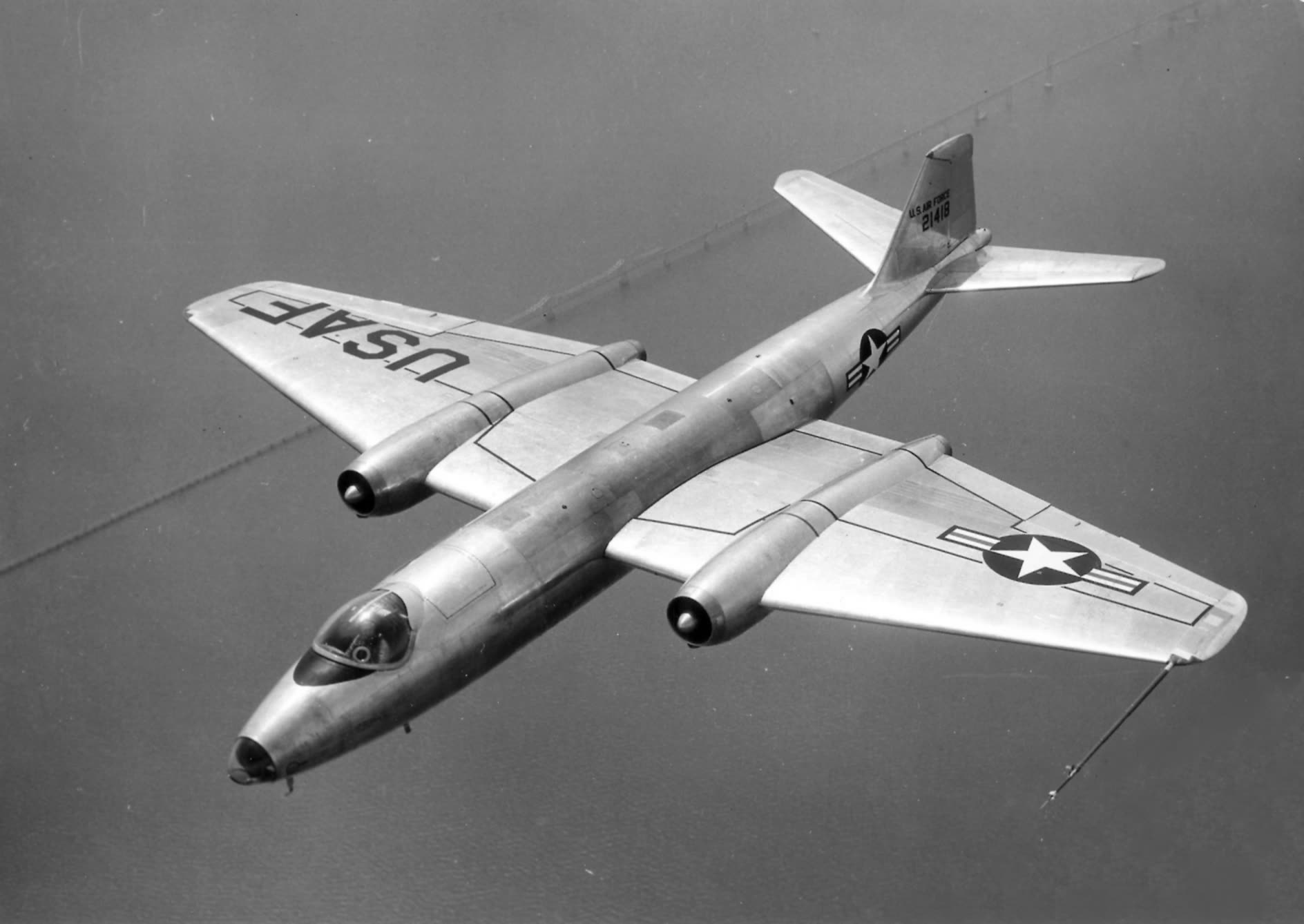
Pictured: a U.S. Air Force Martin B-57A Canberra (serial 52-1418), the first production model of the same aircraft family as the B-57B in the disputed 1954 photograph, in flight over the Chesapeake Bay Bridge, Maryland in 1953 — not the actual case photograph itself. The disputed image remains in Martin Aircraft Company's (later Lockheed Martin's) private chain of custody, its precise rights status was never confirmed as clear for reproduction here, and successive copies of it are themselves alleged to have been altered (see Material Analysis below). This U.S. Air Force official photograph is used instead as an honest, public-domain stand-in for the correct aircraft type, at close to the correct date, and — fittingly, given the location dispute this case carries — over Maryland, the alternative site some sources give for the shoot.
Theoretical Alignment
This case sits awkwardly inside a framework built primarily around eyewitness psychology, because there was no eyewitness: nobody looked up and misidentified anything. What exists instead is a single ambiguous artifact on photographic film, discovered after the fact, whose best explanation is most likely a mundane technical one — a film or print defect — even though the professional NICAP analyst who examined the original negative found that explanation less than fully satisfying. The Psycho-Social framework is used here in its broader, established site convention for "the leading explanation is fundamentally terrestrial/technical rather than exotic," not because any crowd psychology was involved. Alignment with the Extraterrestrial Hypothesis is weak but non-zero, resting entirely on Rankow's finding that the shape's internal shading was not an obvious fake; alignment with the Interdimensional Hypothesis is negligible, since nothing about the case suggests anything beyond a possible solid object or a photographic artifact.
Background
Edwards Air Force Base began life in 1933 as Muroc Army Air Field, a remote bombing and gunnery range built on the ancient bed of Rogers Dry Lake in the Antelope Valley of the Mojave Desert, roughly 100 miles north of Los Angeles. The flat, hard-packed lakebed and near-constant clear weather made it one of the best natural runways on Earth, and by the 1940s it had become the U.S. military's preeminent site for high-speed and experimental flight testing — the place where Chuck Yeager broke the sound barrier in the Bell X-1 in October 1947. The base was renamed in December 1949 in honor of Captain Glen W. Edwards, a test pilot killed the previous year in the crash of a Northrop YB-49 Flying Wing. In February 1951, the U.S. Air Force Test Pilot School relocated to Edwards from Wright Field, Ohio, consolidating the base's role as the country's central proving ground for new aircraft designs; in June 1954, NACA's High-Speed Flight Research Station (predecessor to NASA's Flight Research Center) moved to the lakebed's northwest corner, adding a civilian research presence alongside the military one. By any measure, Edwards in 1954 was one of the most closely watched, most heavily overflown, and most secretive stretches of airspace in the United States — a plausible backdrop for both a routine aircraft-maker's publicity shoot and, as this case file also has to address, at least one entirely unsubstantiated legend about a much stranger alleged event.
The aircraft at the center of this case, the Martin B-57 Canberra, has its own distinct history. It was a license-built, American-manufactured version of the British English Electric Canberra, adapted by the Glenn L. Martin Company (based at Middle River, Maryland, near Baltimore) for U.S. Air Force tactical bombing and reconnaissance roles. The type entered USAF service in 1953, just a year before the photograph at the center of this case was taken, and remained in front-line and reconnaissance use for decades afterward — various B-57 variants flew in Vietnam and several were later converted into the WB-57 high-altitude research aircraft that NASA still operates in modified form today. As a large defense contractor building a brand-new aircraft type for the Air Force in the early 1950s, Martin routinely commissioned its own publicity and technical-documentation photography of B-57s in flight, for use in company advertising, trade publications, and press materials — entirely ordinary corporate activity that, in this one instance, produced a photograph nobody at Martin appears to have wanted.
1954 was also the year of the largest wave of UFO reports the world had yet seen, concentrated overwhelmingly in Europe (see this site's Florence Stadium Sighting and Marius Dewilde Sighting case files for two of its best-documented European entries) but touching the United States as well. Against that backdrop, a photograph showing an unexplained shape near a famously secretive Air Force test base was always going to attract attention in ufological circles once it surfaced — whenever, and to whomever, it actually first surfaced, since no source consulted for this case file could pin that moment down with any precision either.
It is worth being explicit, at the outset, about what this case file is not about. Edwards AFB's UFO lore from this general period includes at least two other claims that a casual search can easily confuse with the Canberra photograph: a widely circulated legend, resting entirely on one man's unverified 1954 letter, that President Eisenhower secretly met with extraterrestrials at "Muroc" that February; and a later, better-known claim by Gordon Cooper that a saucer was filmed landing on the dry lakebed in 1957. Both are addressed in full below, in Historical Precedents, precisely because the "Coming Soon" queue placeholder this case file replaces appears to have blended fragments of one or both of them into a description — "pilots and tower personnel witness metallic disc hovering over flight line; flight logs," dated May 3, 1954 — that matches neither the Canberra photograph nor either of those other two stories, and that this case file's own two-pass research could not verify against any real 1954 Edwards AFB record at all.
Complete Timeline
| Date | Event |
|---|---|
| 1933 | Muroc Army Air Field established on the bed of Rogers Dry Lake in the Mojave Desert. |
| Dec. 1949 | Muroc is renamed Edwards Air Force Base for test pilot Captain Glen W. Edwards. |
| Feb. 1951 | The U.S. Air Force Test Pilot School relocates to Edwards from Wright Field, Ohio. |
| 1953 | The Martin B-57 Canberra, built under license from the British English Electric Canberra, enters U.S. Air Force service. |
| Feb. 20–21, 1954 (alleged) | The date later claimed for the unverified "Muroc" Eisenhower–extraterrestrial meeting legend — a separate, uncorroborated story addressed in Historical Precedents below. |
| Apr. 16, 1954 | Gerald Light writes his letter to Meade Layne describing the alleged Muroc meeting — the sole source for that legend. |
| June 1954 | NACA's High-Speed Flight Research Station relocates to the northwest corner of Rogers Dry Lake at Edwards. |
| 1954 (day/month undocumented; several sources specify September) | Martin Aircraft Company photographers shoot a publicity photograph of B-57B serial 52-1550 near Edwards AFB (a minority of sources say Maryland instead); the resulting print shows an unexplained discoid shape in the upper-right corner. No one present reports seeing anything unusual at the time. |
| Undated, after 1954 | The photograph "finds its way" (per every secondary account, with no further detail) to NICAP. |
| 1964 | NICAP publishes The UFO Evidence, including Ralph Rankow's photographic analysis of the Canberra photograph — the first substantive investigation of the image on record. |
| Undated, after 1964 | Rankow notes that further prints supplied to researchers by Martin Corporation show the object progressively "defaced," with parts of it removed in later copies. |
| May 3, 1957 | A separate, later incident: astronaut (then USAF Captain) Gordon Cooper says range photographers filmed a saucer-shaped craft landing, and departing, on the Edwards dry lakebed — almost certainly the true origin of the "May 3" date misapplied to 1954 in the pre-publication queue placeholder for this case. |
| 1978 | Cooper addresses the United Nations advocating for formal UFO study, citing his career-long UAP encounters, Edwards among them. |
| June 2000 | The French magazine VSD UFO Special features the Canberra photograph. |
| 2000 | Cooper's memoir, Leap of Faith, co-written with Bruce Henderson, repeats his 1957 Edwards account in detail. |
| 2004 | Gordon Cooper dies. |
| June 2013 | Openminds.tv and TheUFOChronicles.com each publish English-language articles on the Canberra photograph, describing it as "one of ufology's most interesting and genuine UFO photo cases." |
| 2026 | This case file is published, correcting the "Coming Soon" queue's inaccurate "May 3, 1954 / pilots and tower personnel / hovering disc" description to reflect the real, documented Canberra photograph case instead. |
The Photograph: Circumstances and Discovery
Every secondary account of this case traces back to the same small set of underlying facts, repeated with remarkable consistency but almost no additional specificity: at some point in 1954, professional photographers employed by the Glenn L. Martin Company were shooting publicity photographs of a B-57B Canberra bomber, tail number 52-1550, for company use. Multiple sources place the shoot near Edwards Air Force Base in Southern California, consistent with the base's role as a major test and evaluation site for new Air Force aircraft in this period; at least one source instead places it above Maryland, closer to Martin's own Middle River manufacturing plant near Baltimore. This case file's own research could not resolve that discrepancy — no primary Martin Corporation or Air Force record identifying the exact shoot location, date, or photographer's name was located in any source consulted, government or ufological. Both locations are plausible on their face: Edwards because it was where new Air Force types like the B-57 were regularly tested and photographed against the Mojave's reliably clear skies, and Maryland because it was literally where Martin built the aircraft and where a company photo team would have the easiest, most routine access to one.
What is consistent across every account is that nobody involved in the shoot — not the photographers, not any air or ground crew, not, as far as any record shows, anyone at Martin Corporation itself at the time — reported seeing anything unusual in the sky that day. The photograph was intended to be, and was treated by everyone present as, an entirely routine piece of corporate documentation: an aircraft the company had built, photographed for the sort of use any manufacturer would want images for. This is the single most important fact distinguishing this case from almost every other entry in this site's catalog, and from the "pilots and tower personnel witness a hovering disc" framing the pre-publication queue entry originally used to describe it: there was no sighting. Whatever appears in the frame's upper-right corner was noticed only later, on the developed print, by someone examining the image itself rather than the sky.
No source located in this research identifies who first noticed the anomalous shape, when they noticed it, or what happened between the photograph being taken and the print eventually "finding its way," as every secondary account phrases it, to the National Investigations Committee on Aerial Phenomena (NICAP), the leading American civilian UFO research organization of the era. That chain-of-custody gap is real and unresolved: this case file could not identify a named leaker, an approximate transfer date, or any documentation of how a company publicity photograph moved from Martin's own files into a private ufology group's hands. The earliest documented point at which anyone examined the photograph with any rigor is 1964 — a full decade, at minimum, after it was taken.
What the Photograph Shows
The image itself is a conventional air-to-air or ground-to-air publicity photograph of a B-57B Canberra in flight, with visible ground features (trees, low structures) in the frame that place the aircraft at a moderate altitude over inhabited terrain rather than open desert alone — a detail cited by researcher Patrick Gross's independent case-file review as significant, since it establishes that the ground shadows used in later analysis are real, contemporaneous features of the same exposure rather than added or unrelated. In the upper-right corner of the frame, separate from the aircraft itself, sits a small, roughly discoid shape, generally described across sources as showing "all shades of gray, from white to black" — that is, exhibiting the kind of graduated light-and-shadow modeling one would expect from a genuinely three-dimensional object under real illumination, rather than a flat smear, ink blot, or simple mechanical mark. Multiple sources note the object's coloring and tonal pattern as broadly consistent with the lighting conditions visible elsewhere in the same photograph.
Two specific observations, both attributed to Rankow's 1964 examination, are what elevated this from an easily dismissed smudge to a genuinely debated case. First, the object casts no shadow of its own on the ground below, despite trees, bushes, and houses elsewhere in the same frame throwing long, well-defined shadows consistent with a low sun angle — an absence that, if the object were a real solid body at the altitude and distance implied by its size in frame, would be a point against it (a real object under that lighting should shadow the ground much as everything else in the photograph does), though it is also exactly what one would expect if the object were instead much closer to the camera than the trees and houses, or was itself a defect on the film/print rather than a photographed object in the actual three-dimensional scene at all. Second, and cutting in the opposite direction, Rankow specifically found the object's darker tonal areas "too strong" — too high-contrast — for whatever distance its apparent size in frame would otherwise imply, a genuinely puzzling detail that a simple explanation (near or far, real or fake) does not obviously resolve either way. Three small black dots elsewhere in the same corner of the frame were separately identified, by the era's photo analysts, as ordinary film flaws unrelated to the object itself — establishing, at minimum, that the frame contains a mix of genuine defects and the one anomalous shape under dispute, and that whoever examined it took the trouble to distinguish between the two rather than treating every mark in that corner as part of a single phenomenon.
The NICAP Leak and Ralph Rankow's 1964 Analysis
By the time Ralph Rankow, a professional New York photographer serving as NICAP's early photographic adviser, took up the case, the photograph had been circulating in ufological hands long enough that its exact provenance was already unclear even to him. Rankow's methodology, as described in NICAP's own 1964 publication The UFO Evidence, involved direct examination of the negative rather than relying solely on prints — a meaningful distinction, since prints can introduce or obscure detail a negative preserves more faithfully. He explicitly ruled out the crudest possible explanations: the object was not a "paste-up" (a physically composited second image glued or double-exposed onto the print), and it was not one of the three black dots he separately identified as unrelated film flaws elsewhere in the same corner.
Rankow's own summary of what a photograph alone can and cannot establish is worth quoting directly, since it is the single most important interpretive statement anyone connected to this case has made: no photograph, in his assessment, "can be considered evidence of UFO reality without a reliable witness." This case, uniquely among nearly every other photographic case on this site, has none. Rankow's analysis therefore functions less as an argument that the object is a genuine unidentified craft, and more as a careful, honest statement that the print resists the easiest debunking explanations available to a competent photo analyst in 1964, while stopping well short of concluding anything more than that.
Rankow's professional background as a working photographer, rather than a UFO advocate or a credentialed research scientist, is itself relevant to how much weight his findings should carry. He brought genuine, relevant technical expertise (grain structure, exposure behavior, the physical signature of common darkroom manipulations) to an image that a general audience could not evaluate with the same rigor, and his willingness to identify the three black dots as ordinary flaws — rather than folding them into the mystery to make the case seem stronger — suggests a genuine attempt at disciplined analysis rather than advocacy. At the same time, he was NICAP's own photographic adviser, examining a photograph NICAP had already taken an interest in, and sources reviewed for this case file note that he later resigned from that advisory role, though none give a reason or date for that resignation. Absent further documentation, this case file treats his 1964 findings as a genuine, technically informed, but institutionally non-neutral assessment — useful and specific, but not equivalent to independent, disinterested verification.
The Progressive "Defacement" Problem
The single strangest documented fact in this entire case is not the object in the original photograph, but what allegedly happened to later copies of it. According to Rankow's own account, as preserved in subsequent research (most thoroughly by independent French researchers F. Cordier and P. Seray, and reviewed in English-language detail on Patrick Gross's ufology research site), successive prints of the photograph supplied to investigators by Martin Corporation itself showed the anomalous object being incrementally altered — with the left half of the shape eventually removed entirely in at least one later copy, rendering further independent analysis of that version impossible. Rankow reportedly attributed this to something more deliberate than ordinary print degradation, describing Martin's stated technical explanations for the changes as reflecting "photodevelopment ignorance" at best, and reading the pattern as resembling active obscuring of the image rather than an honest accident.
This detail cuts against the simplest, most comfortable version of the "it's nothing" explanation. If the object were merely an ordinary, easily identified film scratch or handling artifact, there would be little reason for a company facing no formal investigation, no legal exposure, and no public pressure over an already-obscure decade-old photograph to progressively edit it out of subsequent copies rather than simply explaining it once and moving on. Conversely, this case file's own research could not verify Rankow's characterization independently: no side-by-side comparison of the successive prints, no dated correspondence with Martin Corporation, and no named Martin employee's account of why later prints differ was located in any source reviewed. The "defacement" claim rests entirely on Rankow's own characterization, filtered through later researchers summarizing his work decades on, rather than on directly examinable primary documentation. It is presented here as a genuine, specific, and unresolved oddity in the case's history — not as proven corporate concealment, and not as something this case file can independently confirm beyond what Rankow himself is reported to have said.
Untangling the Queue's "May 3, 1954" Date
This case file was commissioned to replace a "Coming Soon" queue placeholder describing an "Edwards AFB Sighting" dated May 3, 1954, in which "pilots and tower personnel witness metallic disc hovering over flight line; flight logs" served as evidence. Two-pass research for this case file found no documented Edwards AFB incident from 1954 matching that description at any level of specificity: no named pilot, no named tower controller, no flight log, and no "hovering over the flight line" event appears in NICAP's own 1954 case catalog, in Loren Gross's month-by-month chronology of the 1954 UFO wave (which this case file checked directly for both the January–May and September periods), or in any English-language ufological source consulted.
What this research did find is a striking near-match on the date, but attached to an entirely different, later, and separately documented incident: astronaut Gordon Cooper's own account of an object filmed landing on the Edwards dry lakebed specifically on May 3, 1957 — three years after, not the same year as, the queue's stated date. Cooper's story, as he told it across decades of interviews and in his 2000 memoir Leap of Faith, involves range photographers (not tower personnel) capturing still and motion-picture footage (not flight logs) of a saucer-shaped craft with three extended landing legs approaching, landing, and departing on the lakebed; Cooper says he forwarded the film to Washington through official channels per protocol and never received it back or heard any further official word. This case file's own assessment, consistent with independent researchers' evaluations, is that Cooper's account is genuinely intriguing given his credentials and the consistency of his retelling over time, but remains fundamentally uncorroborated: no film or photograph from the incident has ever surfaced publicly, no named range photographer's own independent account could be located, and no chain-of-custody paperwork documenting the film's transfer to Washington has been found in any declassified record consulted.
The most economical explanation for the queue placeholder's description, in this case file's own assessment, is that it conflates the real May 3, 1957 date of Cooper's dry-lakebed story with the unrelated, undated 1954 Canberra photograph — both genuinely connected to Edwards AFB, both genuinely part of the base's UFO lore, but describing two different objects, two different years, and two different kinds of evidence (a single ambiguous photograph with no witness, versus an unverified verbal/written witness account of confiscated film with no surviving photograph). Whether this conflation happened through a research error, a compressed paraphrase of secondhand summaries, or simple confusion between two similarly-themed Edwards AFB stories could not be determined; what this case file can state with confidence is that no version of a 1954 "pilots and tower personnel / hovering disc / flight logs" incident at Edwards AFB is supported by any source located in this research, and that the real, documented, citable 1954 Edwards AFB case is the Canberra photograph this file is built around.
The Gerald Light "Muroc" Legend — A Separate, Uncorroborated Story
Any research into "Edwards AFB" and "1954" together will also surface a much more dramatic, and much less credible, claim: that President Eisenhower secretly traveled to "Muroc" (using the base's pre-1949 name, itself a small tell that the story's framing postdates or deliberately evokes an earlier era) around February 20–21, 1954, to meet with visiting extraterrestrials. This legend rests entirely on a single source: a letter dated April 16, 1954 from Gerald Light to Meade Layne, director of Borderland Sciences Research Associates, in which Light claims to have traveled to Muroc Dry Lake as part of an informal delegation that included Hearst newspaperman Franklin Allen, economist Edwin Nourse, and Los Angeles Bishop James McIntyre, and to have witnessed "five separate and distinct types of aircraft being studied and handled by our Air Force officials — with the assistance and permission of the Etherians." Light predicted an official presidential announcement confirming contact "about the middle of May" 1954; no such announcement was ever made.
No other named witness has ever independently corroborated Light's account, no official record of any such presidential travel or meeting has ever surfaced, and the claim depends entirely on the credibility of one man's own letter to a fringe research organization, written in explicitly emotional, quasi-religious language ("I had the distinct feeling that the world had come to an end with fantastic realism"). This case file treats the Muroc/Eisenhower legend as an unverified, uncorroborated story rather than a documented incident, and includes it here only to explicitly distinguish it from the Canberra photograph case — two very different Edwards AFB stories from the same general year, of very different evidentiary quality, that a search on "Edwards AFB 1954 UFO" will often return side by side without always making clear how little the two have in common.
Key Witnesses
Unusually for a case file on this site, this section cannot open with an eyewitness, because the case has none. No pilot, tower controller, ground crew member, or bystander is documented anywhere in the record as having seen anything unusual in the sky on the day the photograph was taken. The unnamed Martin Aircraft Company photographers who were present are, ironically, the closest thing to eyewitnesses this case has — and their evidentiary contribution is that they reported seeing nothing at all, only noticing the anomaly later, on film, if indeed it was they (rather than some later, unnamed handler of the print) who first spotted it. The case's only substantive human contribution, then, is not a witness account but a photographic analysis, performed a decade after the fact.
Ralph Rankow
A professional New York photographer who served as NICAP's early photographic adviser (and who later resigned from that role, for reasons not documented in any source reviewed here), Rankow performed the only substantive technical examination of this photograph on record, in 1964 — a decade after it was taken. His analysis of the original negative found the object's grayscale shading inconsistent with a simple scratch or paste-up, while flagging that its darker tones seemed too strong for its implied distance, and that it cast no shadow despite clear shadow-casting conditions elsewhere in the same frame. He also identified later, Martin-supplied prints as showing suspicious progressive "defacement" of the same corner of the image. His own stated position — that no photograph can be treated as evidence of a genuine UFO without a reliable witness, which this case does not have — is the single most quoted, and most honest, line connected to the entire case.
Unnamed Martin Aircraft Company Photographers
Every secondary source describing this case attributes the original photograph to "professional photographers from the Martin Aircraft Company," without ever naming an individual. No source located in this research identifies who they were, how many were present, which of them (if any) operated the specific camera that produced the anomalous frame, or whether any of them ever personally commented on the object once it was noticed. Their absence from the documented record as named, quotable individuals is itself a real limitation on this case's evidentiary strength — there is no one connected to the moment of exposure who can be asked, today or at any point in the past seventy years, what if anything they recall seeing.
The Five Observables Assessment
The Five Observables framework is applied to the performance characteristics reported in this case:
Assessment: A single static photographic frame cannot, by its nature, document motion, acceleration, or velocity of any kind, and this case has no second frame, no film sequence, and no witness account to supply that missing behavioral data. Every one of the Five Observables that depends on documented movement is therefore Absent or N/A not because the object was observed behaving in a conventional way, but because no observation of its behavior exists at all. Low Observability is rated Speculative only because no radar coverage of the area or date exists either confirming or ruling out a return — the same honest-absence reasoning applied elsewhere on this site to cases with no instrumented data.
Evidence Assessment
Supporting Anomalous Origin
- A credentialed, professionally trained photo analyst (Ralph Rankow) directly examined the original negative and found the object's grayscale shading inconsistent with a simple scratch, rub, or paste-up
- The three black dots elsewhere in the same corner of the frame were separately and specifically identified as ordinary film flaws, distinct from the object itself — suggesting a disciplined analysis rather than an uncritical one
- Later prints supplied by Martin Corporation reportedly showed the object progressively "defaced," a pattern that a simple, innocent explanation does not obviously account for
- The photograph has survived seventy years of ufological scrutiny, including deliberate skeptical re-examination, without a fully conclusive debunk ever being published
- Established UFO researchers (Cordier and Seray in French-language academic work; multiple English-language ufology research sites) continue to treat it as a genuinely unresolved case rather than a settled hoax
Supporting Conventional Explanation
- There is no eyewitness of any kind — by Rankow's own explicit standard, no photograph, however puzzling, can be treated as UFO evidence without one
- Martin Corporation's own contemporaneous explanation was a scratch or negative defect — the account of the very organization that owned and controlled the original negative
- The object casts no shadow on the ground, unlike the trees, bushes, and houses elsewhere in the same frame under the same lighting — the single strongest physical argument against it being a real object at the implied distance and altitude
- The exact date, month, and even the country/state of the shoot are all inconsistently reported across the available sources, undermining confidence in any specific claim made about the case's circumstances
- No named photographer, no named NICAP source for how the photo was obtained, and no primary Martin Corporation document have ever been produced, leaving the entire chain of custody effectively unverifiable
- An independent researcher (writing on The Big Study analysis blog) proposes that the later "defacement" pattern is fully explained by ordinary staple holes from mounting successive prints for display, rather than by any deliberate corporate concealment
Why "Disputed"
This case earns a DISPUTED classification, with a comparatively low credibility score of 30/100, because it is genuinely real and genuinely unresolved as a documented photographic puzzle, while being far weaker as evidence of an anomalous craft than that description alone might suggest. Compare it to this site's calibration cases: Thomas Mantell (Disputed, 38) involved a real, witnessed, radio-tracked pursuit and a strong Skyhook-balloon explanation lacking only one confirming detail; this case has no witness at all, and its leading conventional explanation (a film or print defect) was offered by the party with the least incentive to invent one — the photograph's own owner. What keeps this case above a simple Debunked rating is that the one person who actually examined the original negative with real photographic expertise, Ralph Rankow, did not find the scratch/defect explanation fully convincing, and flagged a genuinely strange pattern of progressive alteration in later copies that neither this case file's research nor, apparently, anyone else's in the intervening decades has been able to explain away cleanly. That combination — a real, physically examined artifact that resists the easiest debunk, sitting inside a case with zero eyewitness corroboration, an uncertain date, and a disputed location — is exactly the profile of a thin, genuinely disputed case rather than either a strong anomaly or a clean resolution.
Sensor & Instrumentation Detection Profile
No radar, tracking, or any instrumented sensor data of any kind exists for this case. The photographic negative and its subsequent prints are the only physical record; no other camera, film, or recording device is documented as having captured anything related to this event.
Environmental & Geospatial Context
Edwards Air Force Base sits on the ancient bed of Rogers Dry Lake in the Antelope Valley portion of the Mojave Desert, a high-desert basin roughly 2,300 feet above sea level, chosen for military flight testing precisely because of its exceptionally clear, dry, and stable weather — conditions well suited to the sharp, well-defined ground shadows visible in the disputed photograph itself. If the alternative Maryland location some sources cite is correct instead, the relevant geography shifts entirely to the humid Chesapeake Bay tidewater region near Martin's Middle River plant, a striking contrast in terrain, climate, and overflight security posture that this case file's research could not resolve in favor of either account.
Observer Credibility & Occupational Profile
This section, too, is unusual for this site precisely because there is no observer to profile in the normal sense. The only credentialed individual connected to the case in any documented capacity is Ralph Rankow, a professional photographer with genuine relevant technical expertise, examining the photograph from a decade's remove and explicitly not claiming to have witnessed anything himself. The unnamed Martin Aircraft Company photographers who were actually present at the moment of exposure carry an occupation (professional aviation/publicity photography) that would ordinarily lend real credibility to a photographic claim, but their complete anonymity in the record, and the total absence of any statement attributed to them about the object itself, means this case cannot draw on their credentials as a source of corroborating strength the way, for example, a named test pilot's testimony might.
Physical & Material Assays
No physical trace evidence — soil, debris, biological material, or otherwise — exists for this case; there is no landing site, no crash, and no physical location associated with the object beyond wherever, exactly, it was that the camera happened to be pointed. The photographic negative and print themselves are the case's only physical artifacts, and their present whereabouts (whether Martin Aircraft Company's successor, Lockheed Martin, still holds the original negative; whether it survives at all) could not be determined by this case file's research. See Material Analysis below for a full discussion of what examination has been performed on the print itself.
Historical Precedents & Archive Matches
This case sits at the intersection of several distinct threads in Edwards AFB's UFO lore, each addressed above at the point it becomes directly relevant: the entirely separate, unverified Gerald Light "Muroc" legend from the same year; the far more consequential (and far less documented in surviving physical form) 1957 Gordon Cooper dry-lakebed story that this case file's own research identifies as the probable true source of the "May 3" date misapplied to this case in the pre-publication queue; and the base's own institutional history as America's premier flight-test facility, which supplies a mundane, entirely non-anomalous explanation for why any unusual aerial activity near Edwards in this era might warrant a closer look than it would elsewhere. Notably, this case does not appear in NICAP's own 1954 case catalog, nor in Loren Gross's detailed month-by-month chronology of the 1954 wave for either the January–May or September periods — an absence consistent with the photograph not becoming known to civilian ufology until years after it was taken, rather than evidence against the case's existence. Elsewhere on this site, Kirtland AFB Sighting offers a comparable example of a well-known U.S. Air Force base generating its own UFO case with a genuinely disputed evidentiary record, and Thomas Mantell offers the closest direct analogue in credibility-scoring terms: a real, physically documented event with a strong but not fully airtight conventional explanation.
Material Analysis
The only material evidence in this case is the photographic negative itself and its subsequent prints — there is no soil sample, no debris, and no trace evidence of any other kind. This section treats the photograph as the case's "material" under examination, in the same spirit as this site's other case files apply Material Analysis to physical trace samples, since a photographic emulsion is itself a physical substrate that can be, and here was, subjected to genuine technical examination.
What Rankow's 1964 Examination Found
Ralph Rankow examined the original negative directly rather than relying on secondary prints, and reported a discoid shape in the frame's upper-right corner exhibiting a full range of grayscale tones ("all shades of gray, from white to black") consistent with genuine light-and-shadow modeling on a three-dimensional form, rather than the flatter, more uniform density one would expect from a simple ink mark, dust speck, or straightforward scratch. He explicitly distinguished this shape from three separate black dots elsewhere in the same corner, which he identified as ordinary film flaws unrelated to the object. Two specific tensions in his findings remain unresolved: the object casts no shadow on the ground despite clear shadow-casting conditions elsewhere in the same frame (an argument against it being a real object at its apparent distance), while its darker tonal areas seemed, in his assessment, too strong for that same implied distance (a detail that does not sit comfortably with either a straightforward "real object" or "simple defect" reading).
The Progressive Alteration of Later Prints
According to Rankow's own account, as preserved in later research summaries, successive prints of the photograph supplied by Martin Corporation to investigators showed the object being incrementally altered over time, with the left half of the shape eventually removed entirely in at least one later copy. Rankow reportedly viewed this as more consistent with active obscuring of the image than with an innocent accident of reproduction, describing Martin's own technical explanations as reflecting "photodevelopment ignorance." This case file's research could not independently verify this characterization against primary Martin Corporation documentation, which does not appear to survive in any publicly accessible archive; it is presented as Rankow's own documented assessment, not as independently confirmed fact.
Supporting Non-Terrestrial or Unexplained Origin
- A professionally trained photo analyst examining the original negative (not a secondary print) found the object's tonal/shading pattern inconsistent with the simplest mechanical explanations (scratch, rub, paste-up)
- The object's darker regions were assessed as tonally "too strong" for its apparent distance — an anomaly that a simple defect explanation does not cleanly resolve either
- The pattern of progressive alteration in later, company-supplied prints is difficult to reconcile with an innocent, fully mundane explanation, if Rankow's characterization of it is accurate
Supporting Terrestrial (Defect/Artifact) Origin
- Martin Corporation's own contemporaneous explanation was a scratch or negative flaw — offered by the party with direct physical access to, and the least apparent motive to obscure, the original film
- The object casting no shadow, while everything else in the same frame does under clearly sunlit conditions, is a strong physical argument against it being a real solid object at its implied position in the actual three-dimensional scene
- An independent researcher (writing on the Big Study photographic-analysis blog) proposes ordinary staple holes from mounting successive display prints as a complete, mundane explanation for the specific pattern of "defacement" in later copies
- No independent, modern re-examination of the original negative has ever been performed or published, since its current location and even its continued survival could not be confirmed by this case file's research
The Conventional Explanation Candidate: Film or Print Defect
Martin Corporation's own contemporaneous position — as the party with direct physical custody of the original negative, and with no obvious motive to invent a UFO story attached to its own aircraft — was that the object resulted from a scratch or other negative flaw. This deserves serious evaluation for the same reason it deserves serious skepticism: it is the explanation offered by the one party in this entire case with unmediated physical access to the actual film, yet it is also the explanation of a company that, per Rankow's own later account, subsequently supplied investigators with progressively altered copies of the same image rather than simply demonstrating the flaw once and settling the matter.
Rankow's direct examination of the original negative did not fully support the scratch explanation: he found the object's grayscale shading and internal tonal modeling inconsistent with the flatter, more uniform appearance a simple mechanical scratch or emulsion rub typically produces, and distinguished it from three genuine film flaws (small black dots) elsewhere in the same corner of the frame. This does not rule the defect explanation out — photographic defects can take a wide range of forms, and a professional photographer's informed judgment, however carefully reasoned, is not the same as a modern instrumented re-analysis that this case file's research confirms has never been performed, since the negative's current whereabouts could not be established.
The Staple-Mark / Print-Handling Hypothesis
An independent analyst writing on the Big Study photographic-analysis research site proposes a more specific, and more mundane, explanation for the pattern of progressive alteration Rankow described in later prints: ordinary staple holes, made when successive display or presentation prints were mounted onto boards for showing to researchers or the press, precisely in the same top-right corner where the anomaly sits. This hypothesis has real explanatory economy — it accounts for why later copies would show the "defaced" corner becoming progressively more damaged over time (through ordinary handling and remounting) without requiring any deliberate corporate concealment, and it is consistent with how period photographs were commonly displayed. It does not, on its own, fully address Rankow's original tonal-shading analysis of the object itself in the earliest available print, since a staple hole would be expected to look like a small puncture or crease rather than a shaded, dimensional shape — meaning this hypothesis most directly explains the later "defacement" pattern rather than the underlying object's initial appearance.
Genuine Photographed Object (Rankow's Tentative Reading)
Rankow's own analysis, read on its own terms, leaves open — without asserting — the possibility that the camera caught a real, physical object of some kind in frame. This case file's own assessment is that this reading is worth taking seriously precisely because of who made it and how carefully: a professional photographer applying genuine technical criteria, who was willing to rule out easier debunking explanations (paste-up, unrelated film flaws) where they did not fit, and who explicitly declined to claim more than the evidence supported. It remains, however, an inference from a single ambiguous frame with no corroborating witness, and Rankow's own most quoted line — that no photograph is UFO evidence without a reliable witness — applies to his own case as much as to any other.
Optical Artifact (Lens Flare, Debris, or Out-of-Focus Object)
Unlike many other disputed UFO photographs, no skeptical source located in this research specifically proposes lens flare, an out-of-focus insect, airborne dust, or a second, distant conventional aircraft as the explanation for this particular image — the documented historical debate is narrower than that, centering almost entirely on the film/print-defect question versus Rankow's "possible genuine object" reading. This case file's own analysis notes, without attributing the observation to any named source, that a classic lens-flare artifact would typically appear as a geometrically regular shape linked to the camera's own optical elements and light source position, and would generally lack the kind of graduated, scene-consistent grayscale shading Rankow described; an out-of-focus insect or debris speck on the lens, meanwhile, would typically appear far more diffusely blurred, at a scale and softness tied to its extreme proximity to the lens rather than to a distant, resolvable discoid shape. Neither alternative fits the documented description especially well, which is presumably part of why the historical debate over this specific photograph never centered on either of them.
Film or Negative Defect (Scratch)
InconclusiveINCONCLUSIVE. Martin Corporation's own explanation, offered by the party with direct physical access to the negative, but one that Rankow's professional examination of that same negative found only partially convincing on tonal/shading grounds. No modern re-analysis is possible since the negative's current location is unconfirmed.
Staple-Mark / Print-Handling Artifact
PlausiblePLAUSIBLE as an explanation for the specific pattern of later "defacement" — a mundane, well-motivated account of why successive display prints would show progressive corner damage without requiring any deliberate concealment, though it does not fully address Rankow's tonal analysis of the object's original appearance.
Genuine Photographed Object
InconclusiveINCONCLUSIVE. The reading a credentialed photo analyst arrived at through careful elimination of easier explanations, but resting on a single frame with zero eyewitness corroboration — precisely the condition Rankow himself said should disqualify a photograph from being treated as UFO evidence.
Optical Artifact (Lens Flare / Debris)
ImplausibleIMPLAUSIBLE. Not proposed by any source located in this research for this specific case, and the object's described graduated shading and resolvable discoid shape fit poorly against the typical appearance of lens flare or an out-of-focus lens speck.
Related Cases
Confirmed Documents & Official Records
The official U.S. Air Force museum fact sheet on the B-57B Canberra variant — the same model aircraft, though not the same individual airframe, photographed in this case's disputed 1954 image.
No Project Blue Book case file, FBI record, or any other formal U.S. government investigation of this specific photograph is known to exist — unlike many domestic sightings from this period, the photograph was never reported to any official body at the time, and only reached civilian ufologists (NICAP) years after it was taken. The absence of an official file is consistent with the photograph's own undocumented, after-the-fact discovery, not evidence that one was suppressed.
Search Government & Military Archives Directly
Further Reading — Recommended Literature
The UFO Evidence
The original 1964 NICAP compendium containing Ralph Rankow's photographic analysis of the Canberra photograph — the primary published source this entire case file's Rankow material traces back to.
The UFO Encyclopedia, 4th Edition
The definitive English-language UFO reference work, useful for situating this photograph within the broader landscape of contested mid-century UFO photo cases and NICAP's own investigative history.
The Mammoth Encyclopedia of Extraterrestrial Encounters
A wide-contributor reference work covering exactly this kind of contested UFO photograph case, with entries assessing photographic evidence standards across the field's history.
Watch the Skies!: A Chronicle of the Flying Saucer Myth
A skeptically-minded history of American UFO cases through the classified-document era, useful for the broader Cold War test-range context this case's Edwards AFB setting sits within.
Leap of Faith: An Astronaut's Journey Into the Unknown
Cooper's own memoir, containing his firsthand account of the separate, later May 3, 1957 Edwards AFB dry-lakebed incident this case file identifies as the likely true source of the "May 3" date misapplied to this 1954 case in the pre-publication queue.
Essential Viewing
Sources
- Gross, Patrick. "UFOS at Close Sight: The B-57 1954 Unseen UFO Picture." ufologie.patrickgross.org
- "Imaging UFOs: Is It Even Possible?" The Big Study, June 2015. thebiggeststudy.blogspot.com
- "Famous UFO Photo Taken Near Edwards Air Force Base in 1954 (Video)." Openminds.tv, June 2013. openminds.tv
- "UFO Photographed Near Edwards Air Force Base." TheUFOChronicles.com, June 2013. theufochronicles.com
- Hall, Richard H. (ed.), National Investigations Committee on Aerial Phenomena. The UFO Evidence. NICAP, 1964 — the original publication of Ralph Rankow's photographic analysis. nicap.org
- NICAP. "1954 UFO Sightings Catalog." nicap.org (consulted directly; contains no Edwards AFB/Martin B-57 entry)
- Gross, Loren E. "UFOs: A History, 1954: January–May." Sign Oral History Project archive. sohp.us
- Gross, Loren E. "UFOs: A History, 1954: September." Sign Oral History Project archive. sohp.us
- Cordier, F. and Seray, P. "The B57B Photograph." Independent research paper (cited via secondary summary; direct access restricted). academia.edu
- "The 1957 Edwards Air Force Base UFO Incident." New Space Economy, Aug. 2025. newspaceeconomy.ca
- "Muroc, Feb. 20, 1954" (Gerald Light letter to Meade Layne, Apr. 16, 1954). Info-Quest.org archive. info-quest.org
- National Museum of the U.S. Air Force. "Martin B-57B Canberra" Fact Sheet. nationalmuseum.af.mil
- "Martin B-57 Canberra." Wikipedia. en.wikipedia.org
- "National Investigations Committee on Aerial Phenomena." Wikipedia. en.wikipedia.org
- "Edwards Air Force Base." Wikipedia. en.wikipedia.org
- "Gordon Cooper." Wikipedia. en.wikipedia.org
- Story, Ronald D., ed. The Mammoth Encyclopedia of Extraterrestrial Encounters. Mammoth Books, 2002 — cited via secondary summary for its treatment of the Canberra photograph and Rankow's "scratch" alternative attribution.
- Clark, Jerome. The UFO Encyclopedia: The Phenomenon from the Beginning. Omnigraphics, various editions — general reference on NICAP's investigative history and mid-century photographic case standards.
- VSD UFO Special (French magazine), June 2000 issue — period feature on the Canberra photograph, cited via secondary research summary.
- YouTube. "UFO Near Edwards Air Force Base, Southern California, 1954." OpenMindsTV. youtube.com
See something inaccurate? Have additional information or sources?
Suggest an Edit →Last Updated: August 2026