
Kirtland AFB Sighting
Over several nights beginning August 8, 1980, U.S. Air Force security policemen guarding the Manzano Weapons Storage Area — a National Stockpile Site for nuclear weapons adjoining Kirtland Air Force Base, Albuquerque, New Mexico — independently reported a fast-moving, brilliantly bright light that stopped suddenly over the adjacent Coyote Canyon test range before climbing away at high speed. A Sandia Corporation security guard and a New Mexico State Patrolman filed separate, corroborating reports on the following two nights, and a six-hour regional radar blackout was logged five days later. Air Force Office of Special Investigations agent Richard Doty compiled the reports into a still-surviving declassified complaint form — but within months, the same case became entangled with civilian investigator Paul Bennewitz's parallel, far more dramatic claims and a documented, later-admitted Air Force disinformation campaign that fed Bennewitz fabricated documents about alien bases and secret treaties. This file separates what the primary security-police paperwork actually documents — three nights of an unidentified light, credibly witnessed by on-duty military and civilian personnel, never independently resolved — from the substantially more elaborate "37-foot saucer" and MJ-12-adjacent claims that later popular retellings have folded into the same story, but which trace instead to a document researchers consider a probable fabrication.
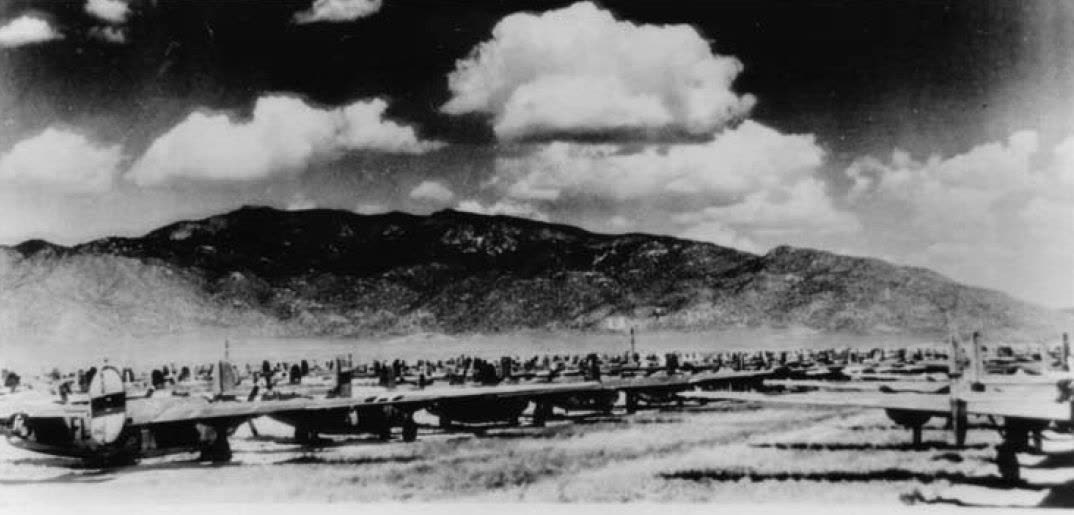
Pictured: a 1946 U.S. Army Air Forces photograph of aircraft storage at Kirtland Field — not a photograph of the 1980 sightings or of the still-restricted Manzano Weapons Storage Area itself, which has never had a public-domain photograph of the incident released. No rights-clear image of the actual event, the Coyote Canyon test range, or any of the named witnesses is known to exist; this file uses the earliest verifiable public-domain photograph of the host installation instead.
Theoretical Alignment
The Kirtland/Manzano case scores low on the Extraterrestrial Hypothesis relative to other nuclear-site cases in this catalog, not because the underlying witness testimony is weak — three named, on-duty security policemen and, independently, a Sandia Corporation guard and a state patrolman all described an unexplained light near a restricted nuclear-weapons site within days of each other — but because no instrumented data of any kind was ever obtained of the object itself, and the surviving record was subsequently and provably contaminated by an unrelated Air Force disinformation operation that makes it unusually difficult to separate the credentialed original reports from later invention. The Psycho-Social component scores unusually high for exactly that reason: this is one of a small number of cases in this catalog where a documented, government-run campaign of deliberate deception is itself a major part of the case's own evidentiary history, distinct from ordinary memory drift or media exaggeration. Neither framework fully addresses the case's real center of gravity, which is procedural and institutional: a legitimate, declassified security incident at a U.S. nuclear-weapons storage facility that was never resolved through a released follow-up investigation, and was instead overtaken by a scandal involving a different, later civilian investigation into the same general area.
Background
By 1980, the installation known as Kirtland Air Force Base was itself the product of a 1971 merger of three formerly separate commands. Kirtland Field, activated under Strategic Air Command in March 1946 and renamed Kirtland Air Force Base in January 1948, had long served as the region's host installation. Sandia Base, built on the former Oxnard Field beginning in 1945 as the relocated home of the Manhattan Project's "Z Division," became the nation's principal nuclear-weapons engineering, assembly, and testing site from 1946 to 1971 (its laboratory function was spun off as the civilian Sandia National Laboratories in 1979). The Manzano Weapons Storage Area, built beginning in 1947 under the classified designation "Site Able" and formally renamed Manzano Base on February 22, 1952, was one of the original six U.S. National Stockpile Sites — roughly 122 earth-covered concrete "igloos" and mountainside tunnels spread across some 2,880 acres in the Manzano foothills, holding a substantial share of the American nuclear arsenal. All three installations merged into a single Kirtland Air Force Base on July 1, 1971, concurrent with the redesignation of the Defense Atomic Support Agency as the Defense Nuclear Agency (DNA), the agency later referenced in the Aug. 13–14, 1980 radar-jamming document. By August 1980, security for Manzano's weapons-storage magazines was the responsibility of the 1608th Security Police Squadron, commanded by Maj. Ernest E. Edwards, with routine patrols covering both the storage igloos themselves and the adjoining Coyote Canyon area, an instrumented Sandia Laboratories/Air Force Weapons Laboratory test range that had operated a laser aircraft-tracking system since 1968.
It was against this backdrop — a hardened Cold War nuclear-storage complex, staffed by security-cleared personnel and sitting directly next to an active weapons-test range — that a sequence of independent sighting reports began arriving at Kirtland's AFOSI district office in the second week of August 1980. Those reports were compiled into a single complaint form by Special Agent Richard Doty, whose subsequent, entirely separate involvement in a documented disinformation campaign against a civilian investigator has since come to dominate the case's popular reputation far more than the original security-police paperwork itself.
The broader institutional climate mattered too. The Defense Nuclear Agency, formally stood up only nine years earlier from the wartime-era Defense Atomic Support Agency, carried direct responsibility for the physical security doctrine governing every U.S. nuclear-weapons storage site, at a moment when Cold War planners were acutely sensitive to any anomaly near a stockpile location — a sensitivity this catalog documents just as clearly at Malmstrom and Minot. Any unexplained aerial activity reported by on-duty security police at a National Stockpile Site was, by definition and regardless of its ultimate cause, an event that triggered formal AFOSI documentation as a matter of standing security procedure, independent of whether investigators privately suspected a mundane or an anomalous origin.
Complete Timeline
| Date | Event |
|---|---|
| Feb. 22, 1952 | "Site Able" is formally renamed Manzano Base and passes to Air Force operational control as one of six original U.S. National Stockpile Sites. |
| July 1, 1971 | Kirtland, Manzano, and Sandia Bases merge into a single Kirtland Air Force Base; the Defense Atomic Support Agency becomes the Defense Nuclear Agency. |
| 1979 | Albuquerque physicist and businessman Paul Bennewitz begins independently filming lights and recording radio signals from his home overlooking the Manzano Weapons Storage Area. |
| Aug. 8, 1980, ~2350 hrs | Three 1608th Security Police Squadron members — SSgt Stephen Ferenz, ATC Martin W. Rist, and Amn Anthony D. Frazier — report a very bright light roughly three miles north-northeast of their position, traveling at great speed before stopping suddenly over Coyote Canyon, then departing vertically at high speed. |
| Aug. 9, 1980 | A Sandia Corporation security guard, an independent civilian employee and former U.S. Army helicopter mechanic, separately reports "a round disk shaped object" near an alarmed structure; his radio reportedly fails when he attempts to call it in, and he explicitly rules out a helicopter based on the object's flight characteristics. |
| Aug. 10, 1980 | A New Mexico State Patrolman, independent of Kirtland's chain of command, reports an object landing in the Manzano area between Belen and Albuquerque. |
| Aug. 13–14, 1980, 1630–2215 hrs | The Albuquerque radar approach control system, including civil air traffic radar, goes dark for roughly six hours; Defense Nuclear Agency monitoring reportedly detects apparent interference from an easterly bearing. The complaint form concludes only that "the presence of hostile intelligence jamming cannot be ruled out." |
| Aug. 22, 1980 | Three additional 1608th SPS personnel file further sighting reports, compiled into the same complaint file. |
| Sept. 2–14, 1980 | AFOSI Special Agent Richard Doty finalizes and signs the consolidated AFOSI Complaint/Report Form covering the Aug. 8–Sept. 3 reporting period. |
| Oct. 24, 1980 | Bennewitz approaches 1608th SPS commander Maj. Ernest Edwards with his own films and recordings, raising concern about a possible threat to the weapons-storage site; Edwards asks Manzano guards to continue reporting unusual activity. |
| Oct. 26, 1980 | Doty and Jerry Miller, a former Project Blue Book field investigator then serving as Chief Scientific Advisor at Kirtland's Air Force Test and Evaluation Center, interview Bennewitz at his home and examine his film and audio material. |
| Nov. 10, 1980 | Bennewitz formally briefs Air Force officials, including Doty, at Kirtland AFB. |
| Nov. 17, 1980 | A SECRET-marked document titled "PROJ. AQUARIUS DOC." begins circulating, claiming photo analysis of a 37-foot-diameter disc with a "trilateral insignia" and referencing a group called "MJ Twelve." Researchers, including UFO author William Moore, later identify this document as very likely fabricated. |
| 1981–1988 | Doty, with Moore's knowing participation, feeds Bennewitz an escalating stream of fabricated documents about underground alien bases and secret treaties; Bennewitz's mental health deteriorates severely, culminating in hospitalization in August 1988. |
| Jan. 1983 | An Air Force Intelligence Service memo internally identifies the Aquarius-adjacent leaked material as "a fake for several reasons." |
| 1985 | Researchers Bruce Maccabee and Moore publish "UFO Landings Near Kirtland AFB, or Welcome to the Cosmic Watergate" through the Fund for UFO Research, arguing a follow-up Air Force investigation exists and has been withheld. |
| Apr. 15, 1986 | The National Security Agency denies a FOIA request for "Project Aquarius" records, citing classification. |
| July 1, 1989 | William Moore publicly admits, at a MUFON symposium, to having knowingly participated in the AFOSI disinformation campaign against Bennewitz. |
| 2003 | Paul Bennewitz dies in Albuquerque. |
| 2005 & 2013 | Greg Bishop's Project Beta and the documentary Mirage Men publish detailed accounts of the disinformation campaign, cementing its place in popular ufology alongside the original 1980 sightings. |
The August 8 Sighting: Ferenz, Rist, and Frazier
The documented record begins at approximately 2350 hours on August 8, 1980, when three members of the 1608th Security Police Squadron, on duty in Charlie Sector on the east side of the Manzano Weapons Storage Area, reported a very bright light in the sky roughly three miles north-northeast of their position. Per the AFOSI complaint form, the light "traveled with great speed and stopped suddenly in the sky over Coyote Canyon," remained motionless for a period, then departed "in a vertical direction at a high rate of speed." SSgt Stephen Ferenz, the area supervisor, filed the report jointly with ATC Martin W. Rist and Amn Anthony D. Frazier. The description that survives in the primary document is comparatively restrained: a bright light performing maneuvers — stop, hover, then near-instantaneous vertical departure — that the witnesses considered inconsistent with any aircraft they were familiar with, but without the more elaborate structural detail (a defined saucer shape, visible markings, an occupant) that later popular retellings sometimes attach to this specific night.
The August 9 Sandia Guard Sighting
The following night, a security guard employed by Sandia Corporation — entirely outside the Air Force's own chain of command, protecting Sandia's adjoining nuclear-weapons engineering facilities — independently reported "a round disk shaped object" near an alarmed structure, which then "ascended in a vertical direction at a high rate of speed." According to the compiled complaint form, his radio would not function when he attempted to call in the sighting. The document notes that this guard was a former U.S. Army helicopter mechanic, and that he specifically considered and ruled out a helicopter as the explanation based on the object's flight characteristics — a detail this file treats as a genuine, if informal, piece of self-administered witness scrutiny rather than an independently verified technical finding, since no outside investigator appears to have separately tested or corroborated his mechanical judgment.
The August 10 State Patrolman Report
A New Mexico State Patrolman, independent of both the Air Force and Sandia Corporation, separately reported an object landing in the general Manzano area between the town of Belen and Albuquerque on August 10. The surviving complaint-form summary of this report is brief, without the detailed maneuver description present in the Aug. 8 and Aug. 9 accounts, but its significance lies in its independence: a third, wholly separate institutional chain — state law enforcement, with no connection to Kirtland's security apparatus or Sandia's guard force — logged an unusual aerial/ground report in the same vicinity within 48 hours of the first sighting.
The August 13–14 Radar Blackout
Five days after the initial Coyote Canyon sighting, the AFOSI complaint form documents a roughly six-hour failure of the entire radar approach control system serving Albuquerque, including civil air traffic radar at Albuquerque International Airport, spanning 1630 to 2215 hours on August 13–14, 1980. Defense Nuclear Agency personnel monitoring the incident reportedly detected apparent interference arriving from an easterly bearing. This detail is frequently folded into popular retellings as if it were a radar track of the object itself — but the primary document's own conclusion is narrower and more cautious: "the presence of hostile intelligence jamming cannot be ruled out," language describing a possible signals-intelligence/electronic-warfare concern, not a confirmed detection of an unidentified craft. No surviving primary document in this file's research directly links the Aug. 13–14 radar failure to the Aug. 8–10 sightings beyond their rough geographic and temporal proximity within the same compiled complaint file.
August 22 and the Close of the Complaint Form
Three additional 1608th Security Police Squadron personnel filed further sighting reports on August 22, 1980, which were compiled into the same AFOSI complaint file alongside the earlier reports. Special Agent Richard Doty, of Kirtland's AFOSI district office, finalized and signed the consolidated form during the first two weeks of September 1980, covering the reporting period of August 8 through September 3. No publicly released Air Force document establishes what, if any, formal follow-up investigation was conducted after the complaint form was filed — a gap researchers Bruce Maccabee and William Moore explicitly raised in their 1985 published analysis, arguing that "no such incident at an atomic facility, even if explainable by mundane causes, would go without further investigation," and that a follow-up report likely exists but has never been released.
Enter Paul Bennewitz
Paul Bennewitz, a physicist and the founder of Thunder Scientific Corporation, an Albuquerque instrumentation manufacturer, lived on a hill in the Four Hills neighborhood with a direct line of sight to the Manzano Weapons Storage Area. Beginning in 1979 — a year before the security-police sightings addressed above — Bennewitz had already begun independently filming what he believed were unidentified aerial objects from his rooftop and recording radio signals he associated with the activity. His investigation ran in parallel to, rather than as part of, the official security-police reporting chain documented in the AFOSI complaint form. On October 24, 1980, roughly six weeks after Doty signed the original complaint form, Bennewitz approached 1608th SPS commander Maj. Ernest Edwards directly, expressing concern that the activity he had documented represented a genuine security threat to the weapons-storage site. Edwards, in turn, asked Manzano's guards to continue reporting unusual sightings — a request that formally drew Doty and AFOSI into direct contact with Bennewitz's civilian investigation for the first time.
On October 26, 1980, Doty and Jerry Miller — a former Project Blue Book field investigator at Wright-Patterson AFB, then serving as Chief Scientific Advisor at Kirtland's Air Force Test and Evaluation Center — visited Bennewitz at his home and reviewed his film and audio recordings. Miller's own assessment, as later reported by researchers who interviewed him, was that the film footage "clearly shows that some type of unidentified aerial objects were caught on film," while he found the accompanying electronic tape recordings inconclusive and reached no determination on whether the observed activity posed an actual security threat to the weapons-storage area. Bennewitz formally briefed Air Force officials at Kirtland, again including Doty, on November 10, 1980.
Bennewitz's own technical background made him an unusually credentialed, and therefore unusually persuasive, civilian investigator to draw the Air Force's attention in the first place. Beyond running Thunder Scientific Corporation, which manufactured precision instrumentation and held government contracts, he had academic training in physics and considerable practical skill in radio-signal analysis — skills he applied to what he believed were intercepted electronic transmissions associated with the lights he was filming. By early 1983, per a wire-service report picked up by national outlets, Bennewitz had come to believe he was decoding actual computer communications from the observed craft, and had connected his Manzano-area observations to separate, contemporaneous rumors of an underground extraterrestrial base near Dulce, New Mexico and to the regional cattle-mutilation reports already circulating across the rural Southwest. It was this expanding, increasingly elaborate belief system — not the comparatively restrained original security-police sightings — that AFOSI's subsequent disinformation campaign deliberately exploited and amplified rather than corrected.
The Doty–Moore Disinformation Campaign
What happened next is the best-documented and most consequential part of the entire Kirtland/Manzano story, even though it concerns Bennewitz's civilian investigation rather than the original August security-police sightings. Rather than conducting or disclosing a conventional follow-up investigation, Doty — joined, by his own later account and by William Moore's public 1989 admission, at the direction of Air Force counterintelligence — began supplying Bennewitz with an escalating stream of fabricated documents describing underground alien bases beneath Archuleta Mesa near Dulce, New Mexico, secret extraterrestrial treaties, and an elaborate mythology involving a body called "MJ Twelve." Moore, who had co-authored the influential 1980 book The Roswell Incident and was independently investigating the same general subject, told a MUFON symposium audience on July 1, 1989 that he had knowingly participated in the operation, later stating in terms researchers have widely quoted that the goal was to keep Bennewitz "occupied" and discredit his claims rather than genuinely investigate them. The sustained psychological pressure of the operation is now understood to have contributed materially to Bennewitz's severe mental-health decline; he was hospitalized at a psychiatric facility in August 1988 and died in 2003. Air Force spokesperson Susan Cooksey, in a December 5, 1983 letter to Albuquerque television station KOB-TV, stated that AFOSI had reviewed a circulated document purporting to summarize the Bennewitz photographs and "confirmed it is a hoax" — a statement that addresses one specific circulated document rather than resolving the status of Bennewitz's original film material or the separate August 1980 security-police sightings.
The Disputed "Project Aquarius" Document
The single document most responsible for this case's outsized popular reputation is a purported AFOSI/Air Force Intelligence Service memorandum dated November 17, 1980, marked SECRET, and titled in circulated copies "1980 PROJ. AQUARIUS DOC." It claims photo analysis identified "a cylinder shaped unidentified aerial object" and a separate "saucer shaped" craft with an "approximate diameter [of] 37 feet" bearing a "trilateral insignia," describes a covert program called Project Aquarius run in coordination with NASA, and references a restricted-access body called "MJ Twelve." This is the specific document from which the case's most dramatic and frequently repeated claims — the precise 37-foot saucer diameter, the trilateral marking, the direct MJ-12 connection — actually originate, not the original security-police complaint form. Its authenticity is widely disputed: an internal Air Force Intelligence Service memo from January 1983 concluded the material was "a fake for several reasons," and Moore's own 1989 admission that he had knowingly distributed altered, embellished versions of circulating Bennewitz-related documents directly implicates the same disinformation apparatus already established in the Doty/Moore campaign. A related document in the same FOIA-released packet records the National Security Agency's April 15, 1986 denial of a separate FOIA request for "Project Aquarius" records, citing classification — a refusal proponents cite as evidence something real is being withheld, and which skeptics note is also exactly the outcome a well-run disinformation campaign designed to be unfalsifiable would produce. This file treats the Project Aquarius document's specific factual claims as unverified and probably fabricated, and explicitly does not extend its credibility to the separate, earlier, and comparatively modest August 1980 security-police sightings.
A Separate Case Sometimes Conflated With This One: Craig Weitzel
Researchers examining the Kirtland archive should also be aware of a distinct July 16, 1980 sighting near Kirtland involving Civil Air Patrol cadet Craig Weitzel, reported to Doty roughly three weeks before the Manzano security-police sightings began. An anonymous 1981 letter to the civilian research group APRO embellished Weitzel's account with claims of a landing, an occupant, and a "Man in Black" visit; when researcher Benton Jamison tracked Weitzel down in 1985, Weitzel disavowed those added elements as someone else's fabrication layered onto his original, more modest report. The "Weitzel Hoax" is frequently cited alongside the Manzano case in secondary UFO literature because both involve Doty and the same general period and location, but it is a separate witness, a separate date, and a separately documented instance of third-party embellishment — not additional evidence for or against the August 8–22 Manzano sightings themselves.
Where This Case Fits the Broader "UFOs and Nukes" Pattern
Kirtland/Manzano is frequently cited, alongside this catalog's own Malmstrom and Minot files, as a supporting data point for the broader thesis — most closely associated with researcher Robert Hastings and explored in depth on this site's UFOs and Nuclear Weapons theory page — that nuclear-weapons storage and delivery sites experience a disproportionate rate of reported UAP activity. The comparison is instructive precisely because of how differently each case's documentary record has held up: Malmstrom's core anomaly is an independently engineered hardware failure with a surviving Boeing investigation report, while Kirtland/Manzano's core evidence is multiply-corroborated but purely testimonial, and its surrounding record carries a documented contamination problem the Montana case does not share. Hastings' own published treatment of Kirtland, discussed above, leans almost entirely on the Bennewitz thread rather than adding independent primary detail to the original security-police reports — a pattern Benjamin Radford's general critique of the "UFOs and nukes" literature (that it often "rehashes" earlier reports without new verifiable evidence) arguably fits more comfortably than it does some of this catalog's other nuclear-site files.
Key Researchers
- Bruce Maccabee — Navy optical physicist and UFO researcher who, with William Moore, published the 1985 analysis arguing an Air Force follow-up investigation of the Manzano sightings exists and has been withheld.
- William Moore — Co-author of the 1985 Kirtland analysis and, separately, the central figure who publicly admitted in 1989 to knowingly participating in the AFOSI disinformation campaign against Bennewitz — making him simultaneously one of the case's investigators and one of its documented sources of fabricated material.
- Robert Hastings — UFOs-and-nukes researcher whose own published account of the case focuses almost entirely on the Bennewitz photography narrative and the disinformation campaign against him, rather than adding new primary detail to the original security-police reports.
- Richard Doty — The AFOSI agent who both compiled the original security-police complaint form and later ran the disinformation campaign against Bennewitz; his own admitted role in fabricating material is central to why this case's documentary record requires unusually careful source separation.
- Benjamin Radford — Skeptical Inquirer deputy editor whose general critique of "UFOs and nukes" claims — that they largely rehash old, previously inconclusive reports without new verifiable evidence — has been applied to Hastings' broader body of work and is relevant context for evaluating this case's popular retellings, though this file did not locate a Radford analysis addressing Kirtland/Manzano by name specifically.
Key Witnesses
SSgt Stephen Ferenz
The senior of three security policemen on duty in Manzano's Charlie Sector on August 8, 1980, Ferenz filed the initial report of a very bright light that stopped suddenly over Coyote Canyon before departing vertically at high speed. His report, filed jointly with two subordinates, anchors the AFOSI complaint form.
ATC Martin W. Rist & Amn Anthony D. Frazier
Serving alongside Ferenz on the night of August 8, 1980, Rist and Frazier independently corroborated the same fast-moving light and its anomalous stop-and-departure maneuver, becoming named co-witnesses in the primary declassified document.
Unnamed Sandia Corporation Security Guard
Reporting on August 9, 1980 — independently of the Air Force chain of command — this guard described a "round disk shaped object" near an alarmed structure and, drawing on his own mechanical training, explicitly ruled out a helicopter based on the object's flight performance. His radio reportedly failed when he tried to call in the sighting.
Paul Bennewitz
A civilian investigator whose independent 1979–1980 filming and radio-signal recordings from his own rooftop overlapped the same general area as the security-police sightings, but on a separate timeline and evidentiary track. His approach to Air Force officials in October 1980 drew AFOSI into direct contact with his investigation and, unintentionally, triggered the disinformation campaign that came to define the case's public reputation.
Jerry Miller
The case's one credentialed technical evaluator, Miller reviewed Bennewitz's film material on October 26, 1980 and concluded it showed genuine unidentified objects, while finding the accompanying audio data inconclusive and reaching no threat determination — a rare instance in this case of an on-the-record, qualified assessment rather than either advocacy or dismissal.
The Five Observables Assessment
The Five Observables framework is applied here to the credibly documented August 8–10 sightings; it is not extended to the disputed "Project Aquarius" claims, which this file treats separately as probable fabrication.
Assessment: Anti-Gravity Lift is rated speculative: witnesses describe a light that stopped suddenly and hovered motionless, with no reported rotor noise, exhaust, or engine sound, but there is no instrumented lift data to confirm this over a distant light source. Instant Acceleration is rated speculative, resting on the primary document's own description of the object departing "in a vertical direction at a high rate of speed," a witnessed but not instrument-timed maneuver. Hypersonic Velocity is rated absent, since no verifiable velocity figure was ever recorded. Low Observability is rated speculative only because some secondary, popular accounts link the object to the Aug. 13–14 radar blackout; this file flags that connection as unconfirmed, since the primary document itself frames the blackout as possible signals jamming rather than a radar-evasion event. Trans-Medium travel is rated absent; no medium transition was reported in any account. Overall, this case's Five Observables profile is speculative rather than confirmed across the board — a pattern consistent with a credible but instrumentally unconfirmed visual sighting, not a technologically characterized craft.
Evidence Assessment
Supporting Anomalous Origin
- Three named, on-duty, security-cleared USAF security policemen jointly and independently reported a fast-moving light performing an anomalous stop-and-vertical-departure maneuver over a restricted nuclear-weapons test range.
- An entirely independent civilian Sandia Corporation guard, employed under a separate chain of command, corroborated an unidentified disk-shaped object the very next night, and explicitly ruled out a helicopter based on his own mechanical training.
- A third independent institutional source — a New Mexico State Patrolman with no Kirtland affiliation — logged a report of an object landing in the same general area within 48 hours.
- A credentialed evaluator with Project Blue Book field experience, Jerry Miller, examined separate film evidence and stated on the record that it "clearly shows that some type of unidentified aerial objects were caught on film."
- No official Air Force investigation of the original August 1980 security-police sightings has ever been publicly released, a gap researchers Bruce Maccabee and William Moore explicitly and publicly raised as early as 1985.
Supporting Conventional Explanation
- The sightings occurred directly over Sandia's own Coyote Canyon Test Complex, an active, instrumented Department of Energy/Air Force Weapons Laboratory range that had operated laser-based aircraft-tracking equipment since 1968.
- The case's documentary record is uniquely compromised: the very same AFOSI office, and within months the same case, became the center of a proven, admitted government disinformation campaign that fabricated related documents, including the specific "37-foot saucer" claim most responsible for the case's dramatic popular reputation.
- No radar track, gun-camera image, or photograph of the original Aug. 8–22 object has ever surfaced in any verified primary source, and the Aug. 13–14 radar blackout is explicitly framed in the primary document itself as possible signals jamming, not a track of the sighted object.
Why "Disputed"
This file rates the Kirtland/Manzano sightings DISPUTED at 43/100 because the case combines a genuinely above-average corroboration pattern with an unusually severe documentary-contamination problem, and neither can be waved away to produce a cleaner verdict. On the positive side: this is one of relatively few cases in this catalog where three separate, non-overlapping institutional authorities — Air Force security police, a private defense contractor's independent guard force, and state law enforcement — reported unusual aerial activity in the same location within a 48-hour window, all captured in a still-surviving declassified government document rather than reconstructed decades later from memory. On the negative side: no instrumented confirmation of any kind exists for the original object; no follow-up investigation was ever publicly released, despite researchers explicitly requesting one since 1985; and, most unusually for a case in this catalog, the same investigating office and, within months, an overlapping cast of individuals became the proven source of a documented disinformation campaign that fabricated related material (the "Project Aquarius" document's specific 37-foot-saucer and MJ-12 claims) explicitly designed to be repeated as fact. That combination — real, multiply-corroborated witness testimony sitting inside a documentary record that its own investigating agency later admitted to deliberately polluting — is precisely what "Disputed" is meant to capture: not a case confidently explained away, and not a case confidently proven, but one where separating genuine signal from admitted, engineered noise is unusually difficult even by the standards of Cold War-era nuclear-site UAP cases. The numeric score sits below this catalog's Malmstrom (58) and above its Mantell (38) rating for a specific, deliberate reason: Kirtland/Manzano's underlying witness corroboration is broader across independent institutions than either of those cases, but it lacks Malmstrom's one genuinely hard, independently engineered data point — the missile hardware failure itself — and it carries a unique, documented liability neither of those files shares, a proven disinformation operation run by the very office that produced the case's primary paperwork. A future declassification of any surviving Air Force follow-up investigation, the one document Maccabee and Moore explicitly and publicly asked for as early as 1985, remains the single development most likely to move this rating in either direction.
Sensor & Instrumentation Detection Profile
No radar, photographic, or FLIR data of the original Aug. 8–22 object survives in any verified primary source. The one instrumentation-adjacent event in the file is the Aug. 13–14, 1980 radar incident: the AFOSI complaint form states that the entire radar approach control system serving Albuquerque, including civil air traffic radar, went dark for roughly six hours (1630–2215 hrs), and that Defense Nuclear Agency monitoring detected apparent interference arriving from an easterly bearing. Crucially, the document itself does not claim this jamming was caused by the object seen five days earlier — its own conclusion is only that "the presence of hostile intelligence jamming cannot be ruled out," a formulation squarely about possible foreign signals interference, not a radar track of an unidentified craft. Separately, and on a different evidentiary footing entirely, civilian investigator Paul Bennewitz made his own film and audio recordings of lights over the area from his home beginning in 1979; Jerry Miller, a former Project Blue Book field investigator, examined this material on October 26, 1980 and concluded the footage "clearly shows that some type of unidentified aerial objects were caught on film," while calling the accompanying audio/electronic tape data inconclusive. That film has never been released for independent, modern analysis and should not be conflated with the original security-police sightings it followed by roughly two months.
Environmental & Geospatial Context
The Manzano Weapons Storage Area sits in the foothills of the Manzano Mountains southeast of Albuquerque, immediately adjacent to the Coyote Canyon area — itself a large, active Department of Energy/Air Force restricted test range used by the Air Force Weapons Laboratory, Sandia Laboratories, and the Defense Nuclear Agency, including Sandia's own Coyote Canyon Test Complex, established in the 1950s for laser-based tracking of airborne test vehicles. This is a geospatial detail the primary complaint form itself confirms: witnesses placed the light directly over Coyote Canyon, the same terrain where instrumented test-range activity was already routinely conducted. The August sighting nights occurred in full darkness (2350 hrs on Aug. 8; overnight on Aug. 9–10), typical of New Mexico's clear, dry high-desert late-summer conditions; the primary document does not address weather as a factor one way or the other. The Aug. 13–14 radar blackout instead spanned late afternoon into night (1630–2215 hrs), a period that would have included both daylight test-range operating hours and full darkness. Albuquerque's high-desert elevation, roughly a mile above sea level, and its typically low humidity and minimal light pollution outside the city core would have afforded unusually clear, long-range visual conditions for observers positioned on Manzano's exposed hillside patrol routes, a factor favoring accurate distance and motion perception over one favoring misidentification of a distant, low-altitude light source.
Observer Credibility & Occupational Profile
Every primary witness in the original security-police complaint form was an on-duty, security-cleared individual performing an assigned protective function at a nuclear-weapons site, not a chance civilian observer. SSgt Stephen Ferenz, the area supervisor for Charlie Sector, filed the initial Aug. 8 report jointly with ATC Martin W. Rist and Amn Anthony D. Frazier; three additional 1608th Security Police Squadron personnel filed further reports on Aug. 22. The following night's witness, an unnamed Sandia Corporation security guard, sat entirely outside the Air Force chain of command — a genuinely independent civilian employer whose own guard force protected Sandia's adjoining nuclear-weapons engineering facilities — and, notably, was a former U.S. Army helicopter mechanic who explicitly considered and ruled out a helicopter based on the object's flight characteristics before filing his own report. A New Mexico State Patrolman, an independent civilian law-enforcement officer with no Kirtland affiliation at all, reported an object landing in the same general area on Aug. 10. This combination — three separate, non-overlapping chains of institutional authority (Air Force security, a private defense contractor's guard force, and state law enforcement) independently reporting unusual aerial activity in the same location within roughly 48 hours — is a stronger multi-source corroboration pattern than many single-employer cases in this catalog, even though none of the individual reports include instrumented confirmation.
Physical & Material Assays
No physical trace evidence — landing marks, burn patterns, metallic fragments, or radiation readings — connected to the object has ever been documented in any primary source located for this file, despite the sightings occurring on and immediately adjacent to one of the most heavily monitored and physically surveyed pieces of ground in the country. This absence is itself informative: a facility with this level of security instrumentation and physical patrol coverage would be expected to generate a ground search report if a landing were seriously suspected, and no such report has surfaced in the declassified record. The one physical-evidence-adjacent claim in the case — Bennewitz's photographic and film material, and the later-fabricated "Project Aquarius" document's specific claim of photo analysis showing a 37-foot-diameter disc with a "trilateral insignia" — belongs to the separate, disputed civilian thread addressed later in this file, not to the original security-police sightings, and its authenticity is treated by researchers as doubtful at best.
Historical Precedents & Archive Matches
Kirtland/Manzano sits within the same "UFOs and nuclear sites" pattern this catalog documents at Malmstrom Air Force Base (1967) and Minot Air Force Base (1968), and shares a broader family resemblance with the United Kingdom's Rendlesham Forest incident (1980), where a UAP was reported near a NATO tactical nuclear-weapons storage area the same December. New Mexico's own nuclear-weapons infrastructure was already the center of one of this catalog's oldest documented waves: the Green Fireballs phenomenon of 1948–49, whose sightings clustered around the exact same triangle of Los Alamos, Kirtland, and Sandia Base three decades earlier, and which was likewise investigated in part by Kirtland's own AFOSI district office. Within the Kirtland archive specifically, this file's research also surfaced a documented, wholly separate incident: on November 4, 1957, Civil Aeronautics Administration tower controllers R.M. Kaser and E.G. Brink briefly tracked an egg-shaped object crossing the Kirtland runway on both radar and by direct visual sighting, a case Project Blue Book ultimately closed with the finding "possible aircraft." That 1957 sighting is the actual subject of the Wikipedia article titled "Kirtland AFB UFO sighting," which several lower-quality aggregator sites and even some search-engine summaries incorrectly present as covering the 1980 Manzano case instead — a conflation this file explicitly corrects. The two incidents share only a host installation and a general regional pattern of Kirtland-area reports stretching back to the 1948–49 Green Fireballs wave; they involve different witnesses, different decades, and entirely separate documentary trails, and should never be cited interchangeably.
Material Analysis
No physical trace evidence connected to any object has ever been recovered or documented at either the Aug. 8 Coyote Canyon site or the Aug. 9 Sandia-guarded structure, despite both locations sitting inside one of the most heavily patrolled and physically monitored security perimeters in the country. This absence is genuinely informative rather than merely an evidentiary gap: a facility built to guard nuclear weapons maintained routine ground-search and perimeter-inspection capability as a matter of course, and no declassified document located for this file records a ground search being conducted or reported. The only "material" evidence connected to the broader case — Bennewitz's film and audio recordings, and the disputed Project Aquarius document's claim of formal photographic analysis showing a 37-foot disc — belongs to the separate civilian investigation and its subsequent, admitted disinformation contamination, not to the original security-police sightings, and neither has ever been released for independent, modern forensic re-analysis.
Supporting a Genuine, Unresolved Sighting
- Three independent institutional sources reported unusual aerial activity in the same location within 48 hours, a pattern of corroboration that is difficult to attribute to a single observer's error or expectation bias.
- A credentialed technical evaluator with prior Project Blue Book field experience examined separate film material and stated on the record that it showed genuine unidentified objects.
Supporting a Mundane (if Unresolved) Cause
- No physical trace evidence of any craft or landing — ground disturbance, burn marks, metallic fragments, or radiation signatures — has ever been recovered, despite the location's exceptional security-patrol coverage.
- The sightings occurred directly over an active, instrumented aerial test range already equipped with laser-tracking systems and other unusual, classified test articles during this general period.
The Conventional Explanation Candidate: Instrumented Test-Range Activity
The most straightforward, fact-grounded conventional candidate holds that the Aug. 8–10 sightings represent misidentified activity connected to Sandia Laboratories' own Coyote Canyon Test Complex, a real, active instrumented range in exactly the terrain where witnesses placed the object, which had operated laser-based tracking equipment for airborne test vehicles since 1968 and continued expanding that capability into the 1980s (a second-generation laser tracker began operations there in 1982). Separately, and without directly identifying it as the explanation for this specific case, this file's research found that Kirtland's Air Force Weapons Laboratory was known to operate visually unusual towed aerial test targets and directed-energy test articles during this same general period — reporting by the defense-journalism outlet The War Zone identified one such classified, SR-71-shaped "diagnostic tow target," the TDU-X program, photographed at Kirtland around 1980 for infrared/electronic-countermeasures testing. This file does not claim that specific object was what witnesses saw; it is offered only as verified, general context establishing that Kirtland's own test community was actively flying unusual, non-standard aerial test articles in the same period and general vicinity as the sightings. Sandia's own Coyote Canyon Test Complex, established southeast of the laboratory's main technical area in the 1950s, had already operated an early precision laser-tracking system there since 1968, specifically built to provide time-space-position data on airborne test vehicles — the exact kind of capability that could plausibly account for a fast-moving light that "stopped suddenly" and then departed vertically, if the object being tracked, rather than the tracking beam or the target vehicle itself, was what witnesses actually saw. A second-generation system, Laser Tracker II, began operating at the same site in 1982, indicating an active and expanding test-range program bracketing the August 1980 sightings on both sides.
Aircraft or Helicopter Misidentification
The most common general explanation offered for military light sightings — a misidentified aircraft or helicopter — is comparatively weak as the leading candidate for this specific case. The Aug. 9 Sandia guard, a former Army helicopter mechanic, explicitly considered and rejected a helicopter based on the object's flight characteristics, and no fixed-wing aircraft flight plan or radar track has been located that would place a conventional aircraft over Coyote Canyon at the reported times. This candidate cannot be entirely excluded given the total absence of instrumented confirmation, but it is not well supported by the one witness account that specifically engaged with and rejected it.
Disinformation-Driven Embellishment of a Modest, Genuine Sighting
A third candidate addresses not the original lights themselves but the case's outsized popular reputation: that a real but comparatively modest security-police sighting of an unexplained light was subsequently amplified, via a proven and admitted Air Force disinformation campaign, into a far more dramatic public narrative involving a precisely measured 37-foot saucer, trilateral markings, and an MJ-12 connection that the primary complaint form never actually contains. This candidate is very strongly supported for the embellishment layer specifically — the Project Aquarius document's fabrication is independently corroborated by an internal 1983 Air Force memo and William Moore's own 1989 public confession — but it does not, by itself, explain away the original, comparatively restrained Aug. 8–10 witness reports, which predate and are textually distinct from the fabricated material.
Instrumented Test-Range Activity (Coyote Canyon)
InconclusiveGrounded in verified facts about an active, instrumented test range at the exact reported location, but no researcher or Air Force statement has explicitly attributed these specific sightings to range activity, and the witnesses' own described maneuvers are not clearly matched to any specific documented test article.
Aircraft or Helicopter Misidentification
ImplausibleDirectly addressed and rejected within the primary witness testimony itself by an observer with relevant mechanical training, and no aircraft flight record has surfaced placing a conventional aircraft at the reported time and location.
Disinformation-Driven Embellishment
Plausible Explains Reputation, Not OriginStrongly evidenced by an internal 1983 Air Force memo and William Moore's own 1989 confession for the case's most dramatic later claims, but does not address or explain away the original, more modest August 1980 witness reports themselves.
Related Cases
Confirmed Documents & Official Records
The primary declassified document compiling the Aug. 8–Sept. 3, 1980 security-police, Sandia guard, and state patrolman sightings, plus the Aug. 13–14 radar-blackout report, signed by AFOSI Special Agent Richard Doty.
Declassified / civilian FOIA releaseThe NSA's formal refusal to release records related to the disputed "Project Aquarius" document, citing classification — hosted alongside the same document set as the original AFOSI complaint form.
UNCLASSIFIED (denial letter itself is public)Search Government Archives Directly
Further Reading — Recommended Literature
UFOs & Nukes: Extraordinary Encounters at Nuclear Weapons Sites
The standard reference on the UAP-nuclear connection, situating the Kirtland/Manzano case within the broader pattern of reported nuclear-site sightings this catalog also documents at Malmstrom and Minot.
Project Beta: The Story of Paul Bennewitz, National Security, and the Creation of a Modern UFO Myth
The definitive account of the disinformation campaign that overtook this case, drawing on Bennewitz's family and colleagues, Doty, and Moore.
Mirage Men: An Adventure into Paranoia, Espionage, Psychological Warfare, and UFOs
A journalistic investigation into the Doty-era Air Force disinformation apparatus, tracing its methods and its lasting distortion of the Kirtland/Manzano case's public record.
The UFO Encyclopedia, 4th Edition
The definitive UFO reference work, with an extensively cited entry separating the documented 1980 security-police sightings from the later Bennewitz/MJ-12-adjacent embellishments.
Case MJ-12
A detailed skeptical investigation of the MJ-12 mythology the disputed "Project Aquarius" document invokes, useful for understanding how that specific fabrication fits the wider MJ-12 disinformation pattern.
Essential Viewing

'Mislead the Public' Ep. 3 Official Clip | UFO | SHOWTIME Documentary Series
SHOWTIME's official clip from its 2021 documentary series, covering AFOSI's disinformation campaign against Paul Bennewitz following his reports near the Manzano Weapons Storage Area.
Richard Doty's Shocking UFO Revelations! (Paul Bennewitz)
Jimmy Akin's Mysterious World examines Doty's own later admissions about the Kirtland/Manzano-era disinformation campaign against Bennewitz.
Sources
- National Investigations Committee on Aerial Phenomena (NICAP). "AFOSI Complaint/Report Form" (transcription of the declassified Aug.–Sept. 1980 Kirtland AFB complaint file). nicap.org
- NICAP. "Kirtland AFB, NM, Aug. 9, 1980" case directory (background and Bruce Maccabee commentary on the withheld follow-up investigation). nicap.org
- CUFON (Computer UFO Network). Kirtland AFB FOIA document mirror, including the disputed "Project Aquarius" document and the 1986 NSA FOIA-denial letter. cufon.org
- UFO Casebook. "Kirtland Air Force Base 1980 UFO Landing" (case summary citing Maccabee, Doty, and Francis Ridge). ufocasebook.com
- Hastings, Robert. "UFOs Filmed Hovering Over U.S. Air Force Nuclear Weapons Storage Area." ufohastings.com
- "Paul Bennewitz," Wikipedia (biography, chronology of the AFOSI/Doty disinformation campaign, hospitalization, and death; used lightly for background and cross-checked against primary sources above). en.wikipedia.org
- "Robert Hastings (ufologist)," Wikipedia (biography and Benjamin Radford's general critique of Hastings' nuclear-sites research; used lightly). en.wikipedia.org
- "Sandia Base," Wikipedia (facility history, Z Division relocation, and the 1971 Kirtland merger; used lightly for institutional background). en.wikipedia.org
- "Kirtland Underground Munitions Maintenance and Storage Complex," Wikipedia (coordinates and history of the modern successor facility to the Manzano WSA; used lightly). en.wikipedia.org
- "Kirtland Air Force Base," Wikipedia (general installation history, Strategic Air Command activation, and Air Force Special Weapons Center disestablishment; used lightly). en.wikipedia.org
- Trevithick, Joseph & Rogoway, Tyler. "That Mysterious Black Target From Kirtland AFB Was Related To A Program Called TDU-X," The War Zone, May 28, 2021 (verified general context on unusual classified test articles flown at Kirtland circa 1980; not presented as a direct explanation for this case). twz.com
- Hayakawa, Norio. "Coyote Canyon Area Still Off-Limits to Kirtland Air Force Base Personnel in Albuquerque, New Mexico," Civilian Intelligence News Service, March 4, 2016 (independent field researcher's account of the test range's continued restricted status and its role in the Manzano case's disinformation history). noriohayakawa.wordpress.com
- Wikimedia Commons. "Kirtland Aircraft Storage 1946.jpg" (U.S. Army Air Forces photograph, public domain, source for this file's hero image). commons.wikimedia.org
- Maccabee, Bruce, & Moore, William L. "UFO Landings Near Kirtland AFB, or Welcome to the Cosmic Watergate," Fund for UFO Research, 1985 (as referenced and summarized in the NICAP case directory above; full original text not independently located online).
- Hastings, Robert L. UFOs & Nukes: Extraordinary Encounters at Nuclear Weapons Sites, AuthorHouse, 2008 (revised 2017).
- Bishop, Greg. Project Beta: The Story of Paul Bennewitz, National Security, and the Creation of a Modern UFO Myth, Pocket Books, 2005.
- Pilkington, Mark. Mirage Men: A Journey into Disinformation, Paranoia and UFOs, Constable, 2010.
- Clark, Jerome. The UFO Encyclopedia, 4th Edition, Visible Ink Press, 2023 (Kirtland AFB/Manzano incident entry).
- Randle, Kevin D. Case MJ-12, Anomalist Books, 2018 (background on the MJ-12 mythology the disputed "Project Aquarius" document invokes).
See something inaccurate? Have additional information or sources?
Suggest an Edit →Last Updated: August 2026