
The Green Fireballs of New Mexico
Beginning in late November 1948, residents, airline pilots, and military personnel across central New Mexico began reporting a brilliant, pure-green fireball that streaked silently and near-horizontally through the night sky — instantly at full brightness, holding a constant glow, and vanishing without the sound, debris, or dust trail of an ordinary meteor. What alarmed Washington was not the color but the geography: the sightings clustered directly over Los Alamos and Sandia Base, the two installations that designed, engineered, and assembled the entire United States atomic arsenal. When University of New Mexico meteor astronomer Dr. Lincoln La Paz witnessed one himself on December 12, 1948, and judged it "most certainly not a conventional meteorite fall," the Air Force convened a February 16, 1949 conference inside the classified Los Alamos Scientific Laboratory itself, drawing physicists Dr. Edward Teller, Dr. Norris Bradbury, Dr. Frederick Reines, and atmospheric-physics authority Dr. Joseph Kaplan into a debate none of them could resolve. The result was the classified Project Twinkle, a purpose-built camera network that spent two years trying, and ultimately failing, to put a single confirmed photograph of a green fireball on the record.
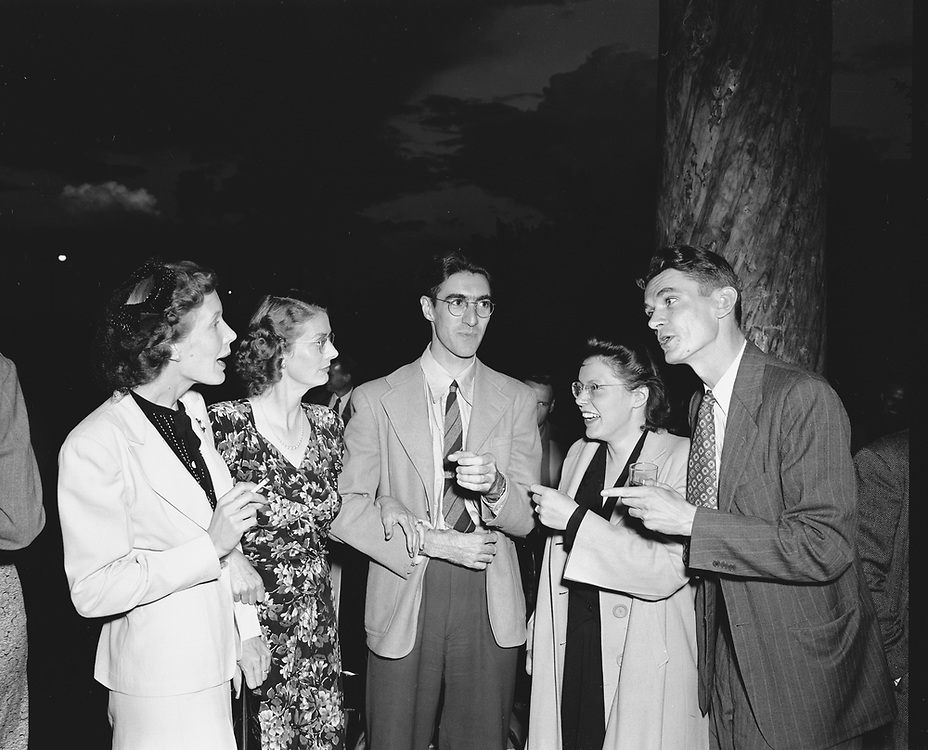
Pictured: Los Alamos Laboratory scientists and staff (including Betty Brixner, Robert D. Richtmyer, Elizabeth Graves, and Charles Critchfield) at a social gathering at Fuller Lodge in Los Alamos, August 1946 — not a photograph of an actual green fireball, nor of the classified February 1949 conference itself, but a genuine period photograph of the same close-knit Los Alamos scientific community, taken roughly two years before that community would confront the phenomenon. No photograph of an actual green fireball is known to exist in any public archive — the purpose-built Project Twinkle camera network described in this file spent two years trying and failing to obtain one — and the 1949 conference itself was never photographed; only a declassified text transcript survives.
Theoretical Alignment
The Green Fireballs case resists easy sorting into any single framework, and this file's modest ETH score reflects that honestly rather than inflating it for drama. No witness, including the physicists who watched from their own front porches, ever described a structured craft, an occupant, or a clearly artificial trajectory change — only a brilliant, uniformly green light behaving in ways that the era's foremost meteor specialist insisted a meteor should not. The non-trivial ETH figure exists because the phenomenon was never conventionally solved even by the scientists most motivated to solve it, and because those same Los Alamos physicists floated, in the declassified transcript itself, the possibility of an unmanned atmospheric-testing probe as one candidate explanation. The modest Psycho-Social score reflects not crowd hysteria — the primary 1948–49 witnesses were overwhelmingly trained pilots, counterintelligence agents, and research scientists making sober, contemporaneous reports — but the genuine Cold War anxiety (fear of Soviet reconnaissance devices hovering over America's only atomic-weapons production sites) that shaped how urgently the case was investigated.
Background
By late 1948, central New Mexico held a concentration of nuclear secrets unmatched anywhere else on Earth. Los Alamos National Laboratory, the birthplace of the atomic bomb, remained the country's primary nuclear-weapons design laboratory under director Dr. Norris Bradbury, who had succeeded J. Robert Oppenheimer in 1945. Roughly sixty miles to the southeast, on the outskirts of Albuquerque, Sandia Base handled the final engineering, ordnance assembly, and non-nuclear component work for every atomic weapon in the American arsenal, operating under the Armed Forces Special Weapons Project. Adjoining it, Kirtland Air Force Base — renamed from Kirtland Army Air Field on January 13, 1948 — served as the host installation for the region's atomic-weapons infrastructure and the base for the Air Force Office of Special Investigations' 17th District. And at the University of New Mexico in Albuquerque proper, Dr. Lincoln La Paz had founded the Institute of Meteoritics in 1945, building it into the nation's foremost academic center for meteor and meteorite research and giving the region a resource no other part of the country possessed: a professionally trained astronomer whose entire career was built on rigorously distinguishing real meteors from everything that merely looked like one.
The broader national mood was tense. The Berlin Blockade, then in its sixth month, had brought the United States and the Soviet Union to their most dangerous postwar confrontation yet. Just seven months earlier, Captain Thomas Mantell had died pursuing an unidentified object over Kentucky, and the Air Force's Project Sign — soon to be reorganized into the more dismissive Project Grudge — was still groping toward a coherent policy on how seriously to take "flying saucer" reports at all. Against that backdrop, any unexplained aerial phenomenon repeatedly appearing directly over the country's most classified atomic-weapons facilities was never going to be treated as a curiosity. It was treated, from nearly the first report, as a potential national-security emergency.
Complete Timeline
| Date | Event |
|---|---|
| 1945 | Dr. Lincoln La Paz founds the Institute of Meteoritics at the University of New Mexico, becoming the region's foremost professional authority on meteors and meteorites. |
| Late November 1948 | Residents around Albuquerque begin reporting brief "green flares" or streaks in the night sky, initially dismissed by some observers as ordinary flares or fireworks. |
| December 5, 1948, ~9:27 PM | A USAF C-47 transport crew, reportedly captained by a pilot recorded in secondary accounts as Captain Goede, sights a green ball of fire rising from the eastern slopes of the Sandia Mountains and leveling into horizontal flight — the same crew had seen a similar object roughly twenty-two minutes earlier near Las Vegas, New Mexico. |
| December 5, 1948, ~9:35 PM | Minutes later, the captain of Pioneer Airlines Flight 63, a civilian DC-3, radios Kirtland Air Force Base to report a large fireball approaching his aircraft nearly head-on near Las Vegas, New Mexico, changing color from orange-red to green and appearing "as big, or bigger, than a full moon." |
| December 6–14, 1948 | Sightings continue on multiple nights, reported by additional aircrews, AFOSI field agents, and civilian observers across northern New Mexico. |
| December 8, 1948 | Two pilots report a fireball lasting roughly two seconds, "much more intense" than a standard military flare. |
| December 12, 1948, evening | Dr. La Paz personally witnesses a fireball near Starvation Peak, close to Bernal, New Mexico, alongside USAF Captain Charles Phillips and Civil Air Patrol officer Allan Clark; triangulating from the group's combined bearings, La Paz calculates the object's speed at roughly 39,000–43,000 miles per hour over a nearly level 25-mile path. |
| December 20, 1948 | A fireball is reported descending at a roughly 45-degree angle before leveling into fully horizontal flight — a trajectory pattern La Paz would repeatedly cite as physically inconsistent with a falling meteoritic body. |
| December 20, 1948 | La Paz writes formally to the U.S. Air Force, stating the fireballs display characteristics "atypical of meteors." |
| December 28, 1948 | Further sightings are logged, closing out a month in which green fireballs were reported on at least nine separate nights. |
| January 13, 1949 | Army Intelligence at Fourth Army Headquarters in Texas circulates a memo suggesting the phenomena could represent "radiological warfare experiments by a foreign power," explicitly citing their recurrence near sensitive installations as grounds for continued scientific investigation. |
| January 30, 1949 | A major fireball event is independently observed by more than 100 witnesses across New Mexico and West Texas, becoming one of the most widely corroborated single sightings of the entire wave. |
| February 16, 1949 | A classified conference convenes inside the Los Alamos Scientific Laboratory, attended by Dr. Norris Bradbury, Dr. Edward Teller, Dr. Frederick Reines, Dr. Joseph Kaplan, Dr. La Paz, FBI representatives, Atomic Energy Commission security officials, Armed Forces Special Weapons Project representatives, and senior military officers. The group confirms the phenomenon's reality — nearly everyone present has personally seen one — but reaches no consensus on its cause, dismissing meteorites, aurora, and weather balloons while stopping short of endorsing any alternative. |
| 1949 (ongoing) | Colonel Doyle Rees, commanding the 17th District of the Air Force Office of Special Investigations at Kirtland, organizes the accumulated reports into three categories — green fireballs, discs and variants, and other unknowns — and forwards a categorized summary to Brigadier General Joseph F. Carroll, USAF Director of Special Investigations. |
| 1949 (calendar year) | Documented sightings for the year total at least 26 at Los Alamos, 17 at Sandia Base, and 12 at Holloman Air Force Base, per figures later compiled in the Project Twinkle record. |
| December 1949 | Following the Cambridge Research Laboratory's recommendation at the February conference, the Air Force formally authorizes Project Twinkle, a dedicated camera-tracking investigation, with an initial $20,000 half-year contract awarded to Land-Air, Inc. |
| February 1950 – March 1951 | Project Twinkle operates camera stations near Holloman Air Force Base and White Sands, initially co-organized by Lt. Col. Frederick Oder and Dr. Joseph Kaplan and field-led by Dr. Anthony Mirarchi, Chief of the Air Composition Branch, until October 1950. |
| April 27, 1950 | Twinkle's theodolite crews photographically track four high-speed objects, triangulating their size at roughly 30 feet and altitude near 150,000 feet — the program's single most substantial data return, though never confirmed as a match to the 1948–49 green fireballs specifically. |
| May 24, 1950 | Eight objects are visually observed; two are separately tracked and filmed, showing uniform motion over intervals of 1.0 and 14.6 seconds. |
| August 31, 1950 | Following a V-2 rocket launch at White Sands, multiple objects are tracked sporadically from several directions; an attempted F-86 fighter intercept fails to locate any of them. |
| October 1950 | Dr. Louis Elterman assumes direction of Project Twinkle from Dr. Mirarchi. |
| November 1951 | Elterman's final report formally concludes Project Twinkle unsuccessful; no green fireball was ever conclusively photographed, and the program is quietly discontinued amid budget pressure from the Korean War. |
| 1952 | Capt. Edward J. Ruppelt, newly appointed head of the reorganized Project Blue Book, reviews the Green Fireballs and Project Twinkle files. |
| 1956 | Ruppelt's memoir, The Report on Unidentified Flying Objects, devotes a full chapter to the Green Fireballs, Project Twinkle, and Project Grudge, bluntly summarizing Twinkle's outcome: "It was a bust. Absolutely nothing was photographed." |
| October 19, 1985 | Dr. Lincoln La Paz dies in Albuquerque, having never accepted a conventional explanation for the fireballs he investigated. |
| July 10, 2026 | The U.S. Department of War publishes its fourth tranche of declassified UAP records under the Presidential Unsealing and Reporting System for UAP Encounters (PURSUE), including a 25-page transcript of the February 16, 1949 Los Alamos conference — drawing renewed national media coverage to the case more than seventy-five years later. |
First Reports: Late November 1948
The earliest green fireball reports around Albuquerque in late November 1948 were unremarkable enough to be dismissed. Residents described brief green streaks or flares in the night sky, and initial explanations leaned toward ordinary military flares, fireworks, or run-of-the-mill meteors — explanations that, for a few weeks, satisfied nearly everyone who heard them. What changed that calculus was not any single dramatic sighting but persistence: as December 1948 opened, the reports did not taper off the way a novelty or a brief meteor shower normally would. They intensified, and they began arriving from witnesses whose professional judgment was considerably harder to dismiss than a startled resident glancing out a window.
December 5, 1948: Two Aircrews, One Night
The case's decisive turn came on the night of December 5, 1948. At approximately 9:27 PM, a USAF C-47 transport crew flying near the Sandia Mountains watched a green ball of fire rise from the eastern slopes, arch upward, and then level into horizontal flight — a trajectory pattern that would recur throughout the wave and that no witness described as consistent with a falling object. The same crew had observed a similar fireball roughly twenty-two minutes earlier near Las Vegas, New Mexico, and it was the combination of two independent sightings in a single flight that prompted them to file a formal report.
Minutes later, at roughly 9:35 PM, the captain of Pioneer Airlines Flight 63, a civilian DC-3 en route toward Las Vegas, New Mexico, radioed Kirtland Air Force Base directly. He and his co-pilot had watched a large green fireball approach their aircraft nearly head-on, changing color from orange-red to green as it closed, appearing "as big, or bigger, than a full moon" before descending toward the ground. Secondary published accounts of the case — drawing, as best can be reconstructed, on the same underlying Air Force witness statement — render the captain's surname with minor spelling variation as either "Van Lloyd" or "van Lloyd"; this file follows the more frequently cited rendering while flagging the discrepancy rather than presenting either spelling as beyond dispute. What is not in dispute is the substance of his report: a startled, professionally trained pilot who genuinely believed, for a moment, that his aircraft was on a collision course with an unidentified object.
It was this pair of independent, same-night, professionally filed reports — one military, one civilian, minutes apart, converging on the same general description — that transformed the green fireballs from a minor local curiosity into a matter Kirtland's intelligence officers felt obligated to escalate. Within days, they had contacted the one man in the region uniquely qualified to evaluate whether what these pilots had seen was actually a meteor: Dr. Lincoln La Paz.
Dr. La Paz Enters the Investigation
Few scientists anywhere were better positioned to adjudicate the December 5 reports than Lincoln La Paz. A mathematician by original training, La Paz had built, over two decades, one of the country's most successful careers in observational meteoritics — recovering and cataloguing genuine meteorite falls across the Southwest using rigorous multi-witness triangulation, and founding the University of New Mexico's Institute of Meteoritics in 1945 specifically to formalize that work. When Kirtland's intelligence officers brought him the December 5 reports, La Paz did exactly what his training prescribed: he began systematically locating and interviewing witnesses, reconstructing each fireball's apparent trajectory from independently gathered bearings, and calculating predicted impact zones the same way he would for any suspected meteorite fall.
What he found troubled him. The trajectories, reconstructed from independent witness bearings, were consistently far flatter than physics predicts for a body falling under gravity from meteoric altitude. The witnesses, again and again, described the light appearing at full intensity instantaneously rather than building gradually as an entering meteor typically does. And when La Paz searched the calculated impact zones using the same methodology that had reliably recovered real meteorite fragments for him elsewhere in New Mexico, he found nothing at all — no fragment, no crater, no trace.
December 12, 1948: La Paz Witnesses One Himself
Whatever residual skepticism La Paz might have retained about the witness reports evaporated on the evening of December 12, 1948, when he saw a fireball with his own eyes. Observing near Starvation Peak, close to Bernal, New Mexico, alongside USAF Captain Charles Phillips and Civil Air Patrol officer Allan Clark, La Paz watched an object travel from east to west in what he later described as "almost perfectly level flight." Triangulating from the three observers' combined bearings across a baseline of roughly 25 miles, he calculated a speed in the range of 39,000 to 43,000 miles per hour — a figure so far outside normal meteor behavior that, if accurate, it alone would have been extraordinary.
When the declassified transcript of the February 1949 Los Alamos conference resurfaced in 2026, it was this specific December 12 event that La Paz used to make his case to the assembled physicists. He told the group the fireball was "most certainly not a conventional meteorite fall," describing an object that appeared "in full intensity instantly," maintained a genuinely constant brightness rather than the flare-and-fade pattern of a true bolide, and broke apart into distinctly "bright green" fragments along its near-horizontal path. He was equally emphatic about what was missing: no accompanying sound. La Paz called the total absence of any sonic boom, whistle, or shockwave "the most implausible feature of all," pointing out that meteorites bright and large enough to be visible across hundreds of miles typically generate noise loud enough, in his professional experience, to break windows and stampede cattle. A fireball of the reported size and speed producing complete, total silence was, to the man who had spent two decades cataloguing how real meteors actually behave, simply not credible as a natural fall.
The Wave Intensifies: December 1948 – January 1949
Sightings continued through the remainder of December 1948, documented on at least nine separate nights — the 5th, 6th, 7th, 8th, 11th, 13th, 14th, 20th, and 28th — and into January 1949. On December 20, 1948, one report described a fireball descending at roughly a 45-degree angle before abruptly leveling into fully horizontal flight, a maneuver La Paz would repeatedly cite as physically inconsistent with anything falling passively under gravity. That same day, La Paz formalized his growing concern in writing, notifying the U.S. Air Force that the fireballs displayed characteristics "atypical of meteors." By January 1949, the pattern had become impossible for military intelligence to treat as background noise: on January 13, Fourth Army Headquarters in Texas circulated a memo raising the explicit possibility that the phenomena represented "radiological warfare experiments by a foreign power," a formulation that reflects just how seriously the Cold War security establishment was weighing the sightings' persistent concentration over atomic-weapons infrastructure. On January 30, 1949, the wave produced its single most widely witnessed event: a fireball independently observed and reported by more than 100 people across New Mexico and West Texas.
Alarm at the Top: OSI and the Fear of Foreign Surveillance
As the volume and geographic concentration of reports grew, responsibility for tracking them consolidated at Kirtland Air Force Base under Colonel Doyle Rees, commanding officer of the 17th District of the Air Force Office of Special Investigations. Rees organized the accumulating reports into three working categories — the green fireball phenomenon specifically, discs and other craft-like reports, and unclassified miscellaneous unknowns — and transmitted a categorized summary up the Air Force intelligence chain to Brigadier General Joseph F. Carroll, then serving as the Air Force's Director of Special Investigations. Everyone touched by the case, in Ruppelt's later summary of the period, seemed to have seen one personally: Kirtland's own intelligence officers, Air Defense Command personnel, La Paz, and, soon enough, some of the most distinguished scientists at Los Alamos itself. That degree of firsthand exposure among the very officials responsible for evaluating the threat is a large part of why the case escalated as fast and as far as it did — all the way to a classified scientific conference inside the nation's premier nuclear-weapons laboratory.
The February 16, 1949 Los Alamos Conference
The conference convened on February 16, 1949, inside the Los Alamos Scientific Laboratory, and its attendee list reads like a roster of the Manhattan Project's living legacy. Laboratory director Dr. Norris Bradbury, who had personally succeeded J. Robert Oppenheimer four years earlier, hosted a room that included thermonuclear-weapons pioneer Dr. Edward Teller; theoretical physicist Dr. Frederick Reines, then a Los Alamos group leader who would go on to win the 1995 Nobel Prize in Physics for the discovery of the neutrino; UCLA upper-atmosphere physicist Dr. Joseph Kaplan, one of the country's leading authorities on the chemistry and physics of the stratosphere; and Dr. La Paz, representing the case's meteoritics expertise. FBI representatives, Atomic Energy Commission security officials, Armed Forces Special Weapons Project personnel, and senior military intelligence officers rounded out the room.
The 25-page transcript, declassified and released to the public only on July 10, 2026 as part of the fourth tranche of the Department of War's PURSUE disclosure initiative, records a genuinely contentious scientific debate rather than a rubber-stamp dismissal. La Paz walked the group through the December 12 sighting in detail, laying out his color, trajectory, silence, and no-debris objections one by one. Proponents of a natural origin countered that documented green-tinted meteors do exist, that flat-appearing trajectories can result from simple viewing-angle geometry rather than genuinely level flight paths, and that the timing — squarely within the annual Geminid meteor shower's active period — was suggestive. According to the transcript, at least one attendee stated flatly that "nothing like this…has ever been observed in the case of meteorite drops," rejecting the pure-meteor explanation outright. Teller is recorded pressing La Paz on the specifics of the December 12 event's intensity and duration, probing the astronomer's data rather than simply accepting or dismissing it. The conference reached genuine consensus on only one point: the phenomenon was real, and every attendee accepted that. On its cause, the group could not agree, ultimately characterizing the fireballs only as "probably" some kind of natural phenomenon — a qualifier that, read plainly, concedes real and lasting uncertainty among America's most credentialed physicists. The meeting's most striking secondary detail, drawn from the same transcript, is that Los Alamos scientists present floated their own alternative hypothesis largely unprompted: that the fireballs might represent unmanned probes released from a craft hovering at extreme altitude, testing atmospheric conditions around a newly nuclear-armed planet without revealing a larger vehicle's presence — a speculative aside from men not given to speculation, and a detail that later researchers have seized on precisely because of who suggested it.
Before adjourning, the conference recommended that the Air Force's Cambridge Research Laboratory establish a dedicated photographic tracking effort to finally settle the question with hard data. That recommendation became Project Twinkle.
Project Twinkle: A Camera Network Built to Catch a Fireball
Formally authorized in December 1949, Project Twinkle represented the Air Force's most serious instrumented attempt to resolve the case. An initial half-year, $20,000 contract went to Land-Air, Inc. to establish camera stations near Holloman Air Force Base and White Sands — territory chosen deliberately, since the fireballs had been logged there too (12 sightings in 1949 alone, alongside 26 at Los Alamos and 17 at Sandia Base). The equipment was genuinely sophisticated for its era: cinetheodolites capable of recording precise azimuth and elevation angles alongside a visible time reference, Mitchell motion-picture cameras fitted with spectrum gratings to capture color data that could be directly compared against La Paz's "vivid green" versus ordinary meteor "pale, yellowish-green" distinction, and Signal Corps electromagnetic-frequency measuring equipment to check for any radio-frequency signature accompanying a sighting. The program was co-initiated by Lt. Col. Frederick Oder and Dr. Joseph Kaplan — the same Kaplan who had sat across from La Paz at the February 1949 conference — and its field operations were led first by Dr. Anthony Mirarchi, Chief of the Air Composition Branch, and then, from October 1950, by Dr. Louis Elterman.
The original plan called for three fully staffed camera stations operating continuously. In practice, chronic underfunding and personnel shortages meant only one station was ever fully operational at a time, and crews were frequently relocated reactively toward wherever the most recent report had come from rather than maintaining fixed, continuous surveillance — a methodology poorly suited to catching an unpredictable, seconds-long phenomenon. The program did record some genuine data: on April 27, 1950, theodolite crews tracked four high-speed objects, triangulating them at roughly 30 feet across and an altitude near 150,000 feet; on May 24, 1950, eight objects were observed with two tracked and filmed over intervals of 1.0 and 14.6 seconds; and on August 31, 1950, following a V-2 rocket launch at White Sands, multiple objects were tracked sporadically from several directions, with an attempted F-86 fighter intercept failing to locate any of them. None of these tracked events, however, was ever conclusively confirmed as a genuine match to the specific green fireball phenomenon that had triggered the program in the first place.
A Program That Photographed Nothing
By November 1951, Dr. Elterman's final report formally concluded the project unsuccessful. Where the program's own analysis could account for tracked objects at all, it attributed them to "ordinary man-made objects such as airplanes, balloons, [and] smoke rockets" — but it never produced the one thing the entire program had been built specifically to obtain: a single, confirmed photograph of an actual green fireball matching the December 1948 – January 1949 description. Budget pressure from the Korean War, which had begun the previous year, gave the Air Force a convenient and largely uncontested reason to let the program quietly lapse rather than continue funding it. When Edward J. Ruppelt reviewed the Green Fireballs and Project Twinkle files after taking over the reorganized Project Blue Book in 1951–52, his verdict, later published in his 1956 memoir, was characteristically blunt: "It was a bust. Absolutely nothing was photographed." Even researchers more sympathetic to the anomalous interpretation have generally agreed with that narrow factual assessment while disputing what it should be taken to mean — a purpose-built, multi-year, professionally staffed camera program failing completely is either strong evidence the phenomenon simply stopped occurring in a form the cameras could catch, or evidence the underlying phenomenon was never common or cooperative enough for 1950-era tracking technology to capture at all, however real the original 1948–49 sightings had genuinely been.
The 2026 Declassification: A Transcript Resurfaces
For more than seventy-five years, the February 16, 1949 Los Alamos conference existed in the public record only through secondhand summary — principally Ruppelt's own chapter and the small circle of researchers who had pieced together its outline from FOIA-released fragments and interviews. That changed on July 10, 2026, when the U.S. Department of War published its fourth tranche of declassified Unidentified Anomalous Phenomena records under the Presidential Unsealing and Reporting System for UAP Encounters, an initiative launched at the direction of the sitting administration to expedite the review and release of historical UAP-related government records. Among the roughly 40 files in that release — drawn from the Pentagon, NASA, the CIA, the FBI, and the Department of Energy — was the actual 25-page transcript of the 1949 conference itself, preserved in the collections of Los Alamos National Laboratory's National Security Research Center, which by its own account fields a steady trickle of FOIA requests about the case every year. The transcript's release did not resolve the underlying mystery; if anything, it confirmed in the participants' own recorded words just how genuinely unresolved the room had left it. But it did, for the first time, let the public read exactly what Edward Teller asked Lincoln La Paz, and exactly how La Paz answered him.
Key Witnesses
Dr. Lincoln La Paz
The case's central investigator and, on December 12, 1948, one of its own witnesses. A mathematician-turned-meteoriticist who had built a genuinely successful career recovering real meteorites across the Southwest, La Paz applied that same rigorous methodology to the green fireballs and concluded, repeatedly and in writing, that they were "atypical of meteors" — too flat in trajectory, too vivid in color, too silent, and unaccompanied by any recoverable debris despite methodical searching. He never accepted a conventional explanation before his death in 1985.
Dr. Edward Teller
The future "father of the hydrogen bomb," Teller attended the February 16, 1949 conference and, per the declassified transcript, personally pressed La Paz for specifics on the December 12 sighting's intensity and duration — the questioning of a rigorous physicist testing an astronomer's data, not a dismissal of it.
Dr. Norris Bradbury
J. Robert Oppenheimer's handpicked successor as laboratory director, Bradbury hosted the February 1949 conference inside his own institution, lending it the full institutional weight of the nation's primary nuclear-weapons design laboratory.
Dr. Frederick Reines
A Los Alamos physicist since 1944, Reines attended the 1949 conference years before his career-defining discovery of the neutrino alongside Clyde Cowan, work that earned him the 1995 Nobel Prize in Physics. His presence underscores how far up the Laboratory's own scientific hierarchy the green fireball question reached.
Dr. Joseph Kaplan
A leading authority on the chemistry and physics of the stratosphere and a pioneer of the science of aeronomy, Kaplan brought the conference's deepest expertise in genuinely rare atmospheric-electrical phenomena. He went on to personally co-initiate Project Twinkle later that year, carrying the case from the conference room into an active, multi-year field investigation.
Colonel Doyle Rees
The military intelligence officer most directly responsible for compiling and escalating the case, Rees organized incoming reports into three working categories and forwarded a formal summary to Brigadier General Joseph F. Carroll, USAF Director of Special Investigations — the administrative chain that turned scattered pilot reports into a matter for the nation's top nuclear-security officials.
Brig. Gen. Joseph F. Carroll
The senior Air Force intelligence official to whom Colonel Rees's Kirtland-based summaries were transmitted, Carroll's involvement placed the Green Fireballs case within the same chain of command responsible for counterintelligence at the nation's most classified installations — formal confirmation of how seriously the sightings were weighed as a potential security threat.
C-47 Aircrew (Captain, recorded as "Goede")
On the night of December 5, 1948, this crew reported two independent green fireball sightings within roughly twenty-two minutes of each other — near Las Vegas, New Mexico, and again over the Sandia Mountains — the first same-night, multi-sighting military report of the wave.
Pioneer Airlines Flight 63 Captain (recorded as "Van Lloyd")
Minutes after the C-47 crew's report on December 5, 1948, this captain radioed Kirtland Air Force Base directly to describe a large fireball approaching his DC-3 nearly head-on, appearing "as big, or bigger, than a full moon" — a civilian, commercially licensed pilot's account that closely corroborated the military sighting reported the same night.
The Five Observables Assessment
The Five Observables framework, developed by former AATIP director Luis Elizondo, is used to classify UAP encounters by performance characteristics exceeding known technology of their era. Applied to the Green Fireballs, the framework returns a genuinely mixed result:
Assessment: Anti-Gravity Lift is rated absent: no witness, including the trained physicists among them, ever described a visible propulsion mechanism of any kind. Instant Acceleration is rated speculative on the strength of La Paz's own repeated, specific testimony that the December 12, 1948 fireball appeared "in full intensity instantly" rather than building gradually — a genuinely unusual claim from a rigorous professional observer, though also explainable as simple combustion ignition rather than true instantaneous acceleration. Hypersonic Velocity is rated speculative because La Paz's own triangulation of the December 12 event yielded an extraordinary 39,000–43,000 mph estimate; this file treats that figure cautiously, since it derives from a single ground-triangulation exercise rather than instrumented radar or photographic confirmation, and speeds of that order were never independently reproduced by Project Twinkle's later camera program. Low Observability is rated absent: every fireball in the case was, by definition, extremely conspicuous, visible to over 100 independent witnesses in the January 30, 1949 event alone. Trans-Medium travel is rated absent; no water or space transition was ever reported. Taken together, the data support a genuinely unresolved phenomenon rather than either a clear exotic craft or an open-and-shut conventional explanation.
Evidence Assessment
Supporting Anomalous Origin
- The single most qualified scientific witness in the case — a professional meteor astronomer with two decades of successful meteorite-recovery fieldwork — personally observed a fireball and concluded it was "most certainly not a conventional meteorite fall."
- Multiple independent, professionally trained witnesses (commercial and military aircrews) reported closely convergent descriptions on the same night, December 5, 1948, without any opportunity to coordinate their accounts beforehand.
- Repeated, methodical searches of calculated impact zones, using techniques that had reliably recovered real meteorites elsewhere, produced zero fragments across dozens of investigated events.
- A purpose-built, two-year, multi-station camera program specifically designed to photograph the phenomenon produced not a single confirmed image of it.
- The scientists most professionally equipped and most institutionally motivated to find a mundane explanation — assembled at a classified conference inside the nation's own nuclear-weapons laboratory — could not agree on one.
Supporting Conventional Explanation
- The wave's onset in early December 1948 coincides with the annual Geminid meteor shower's active period, a documented natural source of unusually bright, sometimes green-tinted fireballs.
- Green-colored meteors are a genuinely documented natural phenomenon, typically attributed to nickel and magnesium emission lines during atmospheric entry.
- The February 1949 conference itself, despite extensive internal disagreement, formally concluded the phenomenon was "probably" natural in origin, and Project Twinkle's 1951 final report similarly attributed its own tracked objects, where identifiable at all, to conventional man-made sources.
- Most meteors, including genuinely bright bolides, are entirely consumed in the atmosphere and leave no recoverable fragment, meaning the absence of debris is not, on its own, decisive evidence against a natural origin.
Why "Disputed"
This file rates the Green Fireballs case DISPUTED rather than "Credible" or "Debunked" because its two strongest facts point in genuinely opposite directions and neither can be honestly resolved from the public record. What is not seriously in dispute: this is one of the best-corroborated and most professionally credentialed sighting waves in the catalogue, anchored by a career meteor specialist's own direct, instrumented observation and endorsed as a real, unexplained phenomenon by a room of physicists who had every institutional and professional incentive to close the file with a mundane answer and did not. Also not in dispute: the case's single leading conventional candidate — a natural bolide or meteor swarm, timed to the Geminid shower — has genuine, unresolved objections raised by the era's most qualified witness, and a purpose-built camera program spent two full years and a real federal budget trying and failing to settle the question with hard data. What keeps this file from a higher rating is equally real: zero physical evidence was ever recovered despite dozens of methodical searches, the phenomenon was never radar-confirmed or photographically captured by any instrument, La Paz's own most dramatic claims (the 39,000–43,000 mph velocity estimate above all) rest on a single ground-triangulation exercise rather than independently reproduced instrumented data, and the official 1949 and 1951 investigative conclusions, however unsatisfying to La Paz personally, were never formally overturned. A case this thoroughly investigated by this many credentialed people, that still could not produce a single photograph, fragment, or radar return in three years of dedicated looking, is exactly what this site's "Disputed" rating exists to describe.
Sensor & Instrumentation Detection Profile
For a case this institutionally significant, the instrumented record is strikingly thin. New Mexico had no dedicated air-defense radar coverage in 1948–49, so every sighting in the original wave was naked-eye or, at best, aircraft-cockpit visual observation. Dr. La Paz brought the only rigorous instrumentation available — ground-survey triangulation methods adapted from his meteor-recovery fieldwork, used to reconstruct the December 12, 1948 fireball's altitude, speed, and path from multiple witness bearings. The Air Force's only purpose-built instrumented response, Project Twinkle (1949–1951), deployed cinetheodolites (angle-measuring tracking cameras), Mitchell motion-picture cameras fitted with spectrum gratings for color analysis, and Signal Corps electromagnetic-frequency measuring equipment at stations near Holloman Air Force Base and White Sands. Despite two years of operation, the program never obtained a confirmed photograph, spectrogram, or EM signature specifically tied to a genuine green fireball — the handful of objects its cameras did track (April and May 1950) were fast-moving high-altitude lights of uncertain nature, not verified green fireballs matching the 1948–49 description.
Environmental & Geospatial Context
The overwhelming majority of reports describe clear, dry, high-desert New Mexico night skies — conditions that rule out simple weather-related misidentification (cloud reflections, ball lightning triggered by storm activity, aircraft lights diffused by haze) for most of the core wave. Geospatially, the sightings clustered with unusual precision around a roughly 100-mile radius of Albuquerque encompassing Los Alamos to the north, Kirtland Air Force Base and Sandia Base immediately southeast of the city, and extending south to Holloman Air Force Base and White Sands — a pattern investigators and later researchers alike have repeatedly noted maps almost exactly onto the nation's most classified atomic-weapons infrastructure of the period. December, when the wave began, also falls within the annual Geminid meteor shower's active window, a fact weighed heavily by proponents of a natural explanation and addressed directly in the Conventional Explanation Candidate section below.
Observer Credibility & Occupational Profile
Few cases in this catalogue can match the raw institutional credentials of the Green Fireballs witness pool. The primary reporting witnesses across the December 1948 wave were commercial and military aircrews flying scheduled and transport routes — trained observers reporting through official channels, not casual bystanders. Behind them stood the investigative and scientific apparatus of the nation's Cold War nuclear program: Colonel Doyle Rees, commanding the 17th District of the Air Force Office of Special Investigations at Kirtland, personally organized and forwarded the accumulating reports; and the era's leading American meteor astronomer, Dr. Lincoln La Paz, founder and director of the University of New Mexico's Institute of Meteoritics, personally investigated dozens of reports and witnessed one himself. The February 1949 conference assembled arguably the single most scientifically distinguished witness panel of any case on this site: Manhattan Project veterans and future Nobel laureate Dr. Frederick Reines, thermonuclear-weapons pioneer Dr. Edward Teller, Los Alamos Laboratory director Dr. Norris Bradbury, and upper-atmosphere physicist Dr. Joseph Kaplan, several of whom had personally observed a fireball themselves before the meeting even began.
Physical & Material Assays
No physical trace of any green fireball was ever recovered, despite genuinely determined efforts to find one. This absence is itself significant: La Paz used the same field-triangulation and impact-zone-search methodology that had successfully allowed him to recover numerous real meteorites elsewhere in New Mexico, and he applied it specifically and repeatedly to green-fireball reports — without ever finding a single fragment, crater, or piece of fusion-crusted material. Project Twinkle's later search for physical or photographic confirmation was similarly, and completely, unsuccessful. The single unresolved physical detail in the secondary literature is a claim, sourced to Kevin Randle's published analysis rather than to a declassified primary document, that copper particles were recovered following a fireball event and judged inconsistent with a conventional meteorite's typical composition; this claim has not been corroborated in the declassified conference transcript or in La Paz's own contemporaneous correspondence and is treated in this file as unverified.
Historical Precedents & Archive Matches
The Green Fireballs case sits at a pivotal moment in the still-forming Air Force UFO investigative bureaucracy, arriving barely a year after the Roswell incident and Thomas Mantell's fatal January 1948 pursuit, and while Project Sign was transitioning into the more skeptically postured Project Grudge. Unlike Roswell or Mantell, however, this case was never handled primarily by Wright-Patterson's UFO desk at all — it was run, almost entirely, out of Kirtland's own Air Force Office of Special Investigations and the Los Alamos and Sandia security apparatus, reflecting how seriously the possibility of Soviet surveillance devices over America's atomic-weapons infrastructure was taken at the height of the Cold War, just months before the Soviet Union's first successful atomic test in August 1949. The case's institutional lineage — a locally run, security-driven investigation escalating into a dedicated classified research program — directly parallels the later White Sands 1951 radar-visual-photographic sighting, whose own Air Force documentation was compiled at the very same Holloman Air Force Base that hosted Project Twinkle's primary camera station.
Material Analysis
No physical material connected to any green fireball has ever been recovered, examined, or catalogued — a genuinely unusual outcome given how much effort went into looking. Dr. La Paz did not treat the absence of debris passively; he actively and repeatedly applied the same field-triangulation and impact-zone-search protocol that had reliably located real meteorite falls for him elsewhere in New Mexico, and came back empty-handed every time. Project Twinkle's later, better-funded, and more technologically sophisticated search for physical or photographic confirmation fared no better. The single unresolved claim in the secondary literature — that copper particles inconsistent with ordinary meteoritic composition were recovered after one fireball event — is sourced only to a later published researcher's account rather than to any document in the declassified conference transcript or NARA's Project Blue Book holdings, and this file treats it as unverified rather than established fact.
Supporting a Genuinely Unusual Stimulus
- A professional meteoriticist's own field-proven recovery methodology, applied dozens of times to calculated impact zones, never once produced a fragment.
- A dedicated, multi-year, professionally staffed camera program built specifically to capture photographic or spectrographic proof obtained none.
Supporting a Mundane, Fully-Consumed Meteoric Origin
- The overwhelming majority of bright meteors, including genuine bolides far larger than most reported green fireballs, are entirely vaporized in the atmosphere and leave no recoverable material at all.
- Project Twinkle's practical failures — understaffing, only one of three planned camera stations operational, reactive rather than continuous surveillance — are independently well-documented and offer a mundane, non-conspiratorial explanation for why no photograph was obtained, regardless of what the fireballs actually were.
The Conventional Explanation Candidate: Natural Bolide / Meteor Swarm Misidentification
The explanation the February 1949 conference itself ultimately, if reluctantly, endorsed holds that the green fireballs were an unusual but fundamentally natural meteoric phenomenon — likely tied to the annual Geminid meteor shower, which peaks in mid-December, precisely when the 1948 wave began. Green coloration in bright meteors is a real, documented phenomenon, generally attributed to nickel and magnesium emission lines excited during high-speed atmospheric entry, and flat-appearing trajectories can plausibly result from simple viewing-angle geometry rather than genuinely level flight paths when witnesses at different distances and bearings are not perfectly triangulated. This candidate deserves serious weight precisely because it was the conclusion reached by the scientists best equipped to evaluate it, meeting under conditions of real institutional urgency rather than casual curiosity.
Where the Bolide Theory Falls Short
Its central weakness is that the era's single most qualified witness — La Paz himself, whose entire career was built on correctly distinguishing meteors from everything that resembles one — personally rejected it after direct observation, on three specific and consistently repeated technical grounds: a trajectory too flat for a body falling under gravity, a color distinctly more saturated than the pale green of documented meteors, and a total absence of the sound and shockwave that meteorite falls of the reported scale reliably produce. The conference itself could not fully resolve his objections; its "probably natural" conclusion is a hedge, not a refutation, and Project Twinkle's subsequent two-year search for corroborating instrumented data found none.
Ball Lightning / Rare Atmospheric-Electrical Phenomenon
A second candidate proposes a rare atmospheric-electrical phenomenon akin to ball lightning — a genuinely documented, if poorly understood, natural effect that can produce a glowing, colored, silently moving sphere. This candidate has some appeal for explaining the total absence of sound, since ball lightning is not associated with sonic booms. It struggles considerably, however, against the case's best-documented core evidence: ball lightning events are typically brief, localized, and associated with thunderstorm activity, none of which matches the clear-sky, multi-mile, sustained horizontal transits that La Paz and dozens of other witnesses independently described, and it offers no ready explanation for the phenomenon's specific, repeated concentration directly over Los Alamos, Sandia, and Kirtland rather than randomly across the broader region.
Classified or Foreign Military Ordnance
A third candidate, taken seriously enough by Army Intelligence to circulate formally on January 13, 1949, holds that the fireballs represented either a classified U.S. weapons test or a foreign (implicitly Soviet) reconnaissance or radiological-warfare device, given their persistent concentration over the nation's atomic-weapons infrastructure. This candidate is historically important as a genuine measure of Cold War anxiety, but it has never been substantiated: no U.S. program has ever been declassified or acknowledged as the source, no debris or hardware consistent with a foreign device was ever recovered, and the sightings' multi-year persistence across a wide, unpredictable geographic pattern is a poor match for a single covert test program, which would more plausibly produce a tighter cluster of events around specific, deliberate test dates.
Natural Bolide/Meteor Swarm Misidentification
Plausible InconclusivePlausible: favored by the 1949 conference's own formal, if reluctant, conclusion. Inconclusive: never reconciled with La Paz's specific trajectory, color, and acoustic objections, and never independently confirmed by Project Twinkle's dedicated instrumentation.
Related Cases
Confirmed Documents & Official Records
The Department of War's official public release portal for declassified UAP records, including the fourth tranche (July 2026) containing the 25-page transcript of the February 16, 1949 Los Alamos green fireball conference.
DECLASSIFIEDThe official announcement of the fourth PURSUE release, which included the declassified 1949 Los Alamos Atomic Energy Commission conference file discussed throughout this case.
UNCLASSIFIED (announcement)National Archives finding aid for the roughly 130,000 pages of Project Sign, Project Grudge, and Project Blue Book case files transferred from Wright-Patterson AFB, including the Green Fireballs and Project Twinkle documentation (Record Group 341).
UNCLASSIFIED (declassified)LANL's own account of the green fireball FOIA record, confirming the National Security Research Center's holdings on the case and the steady stream of public requests it still receives.
UNCLASSIFIEDSearch Government Archives Directly
Further Reading — Recommended Literature
The Report on Unidentified Flying Objects
Written by the first Project Blue Book chief to systematically review the Green Fireballs and Project Twinkle files; his blunt "it was a bust" verdict on Twinkle remains the most influential single account of the case's outcome.
Watch the Skies!: A Chronicle of the Flying Saucer Myth
A rigorously documented, skeptically minded history of American UFO cases that situates the Green Fireballs within the broader Project Sign-to-Grudge institutional transition of 1948–49.
The UFO Controversy in America
A historian's early scholarly account of the Air Force's postwar UFO investigations, including the escalation of the green fireball reports through Project Grudge and into Project Twinkle.
Project Blue Book Exposed
A detailed case-by-case review of Blue Book's most significant files by a veteran researcher who has separately published an extended analysis of the Green Fireballs case and Project Twinkle specifically.
The UFO Encyclopedia, 4th Edition
The definitive UFO reference work, with an extensively cited entry on the Green Fireballs that catalogues the full witness roster, the 1949 conference, and Project Twinkle's documented failures.
Essential Viewing
Newly Released UFO Files Detail Mysterious "Green Fireballs"
Local news coverage (LOCAL 12) of the July 2026 PURSUE declassification, including the 1949 Los Alamos conference transcript.
New UFO Files: "Green Fireballs" Among Other Mysterious Objects
National news coverage (The National Desk) of the same 2026 declassification release, focused specifically on the green fireball documents.
The Report on UFOs, Part 4: Green Fireballs, Project Twinkle, Little Lights, and Grudge
An audiobook reading of Edward J. Ruppelt's own primary-source chapter on the case, direct from his 1956 memoir.
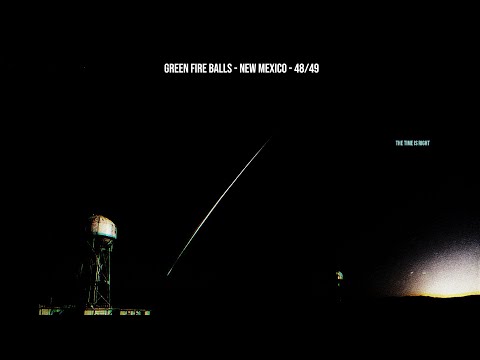
Green Fireballs over New Mexico (48/49)
A narrative overview of the 1948–49 wave, the La Paz investigation, and the February 1949 Los Alamos conference.
Sources
- "Green fireballs," Wikipedia. en.wikipedia.org
- Ruppelt, Edward J. The Report on Unidentified Flying Objects, Doubleday, 1956, Chapter Four ("Green Fireballs, Project Twinkle, Little Lights, and Grudge"). en.wikisource.org
- National Investigations Committee on Aerial Phenomena (NICAP). "The Nuclear Connection: The New Mexico Sightings." nicap.org
- Newsweek. "UFO Files Reveal 1949 Los Alamos 'Green Fireball' Mystery," 2026. newsweek.com
- HISTORY.com. "When Mysterious Green Fireballs Worried the US Government." history.com
- Los Alamos National Laboratory. "FOIA Requests at the National Security Research Center," The Vault, 2024. lanl.gov
- CBS News. "Pentagon Releases New Batch of UFO Files: 'Unlike Anything I Had Seen,'" July 2026. cbsnews.com
- National Archives and Records Administration (NARA). "Project BLUE BOOK — Unidentified Flying Objects" research guide. archives.gov
- U.S. Department of War. "Presidential Unsealing and Reporting System for UAP Encounters (PURSUE)." war.gov
- U.S. Department of War. "Department of War Publishes Fourth Release of Unidentified Anomalous Phenomena Files," July 10, 2026. war.gov
- Hangar 1 Publishing. "The Green Fireballs: The True Story of a Cold War UFO Mystery." hangar1publishing.com
- Randle, Kevin D. "A Different Perspective: Project Blue Book — Episode 6 — Green Fireballs," A Different Perspective blog, February 2019. kevinrandle.blogspot.com
- UFO Connect. "Project Twinkle: The U.S. Air Force's Green Fireball Investigation." ufoconnect.com
- "Lincoln La Paz," Wikipedia. en.wikipedia.org
- "Joseph Kaplan," Wikipedia. en.wikipedia.org
- "Norris Bradbury," Wikipedia. en.wikipedia.org
- "Frederick Reines," Wikipedia. en.wikipedia.org
- "Kirtland Air Force Base," Wikipedia. en.wikipedia.org
- Wikimedia Commons. "Cocktail party attendees at Fuller Lodge, 1946" (Los Alamos National Laboratory photographic archive). commons.wikimedia.org
- Clark, Jerome. The UFO Encyclopedia, 4th Edition, Visible Ink Press, 2023 (entry on "Green Fireballs").
- Peebles, Curtis. Watch the Skies!: A Chronicle of the Flying Saucer Myth, Smithsonian Institution Press, 1994, Chapter 3.
- Jacobs, David M. The UFO Controversy in America, Indiana University Press, 1975, pp. 60–64.
- Randle, Kevin D. Project Blue Book Exposed, Barricade Books, 1996.
See something inaccurate? Have additional information or sources?
Suggest an Edit →Last Updated: August 2026