
The White Sands Radar-Visual-Photographic Sighting
On the morning of July 14, 1951, on one of the most heavily guarded military installations in the United States, two Army radar operators tracked a fast-moving, unidentified target crossing their scopes at a guided-missile tracking station near White Sands Proving Ground, New Mexico. At almost the same moment, a separate tracker who had been watching a U.S. Air Force B-29 Superfortress through binoculars swung onto a large object flying near the bomber — and a fourth observer, camera already in hand for routine range photography, shot roughly 200 feet of 35mm film of it. Because of the object's altitude, the film reportedly showed only "a round, bright spot," but the underlying convergence — independent radar detection, independent visual confirmation, and motion-picture film, all captured within moments of each other by trained government and contract personnel on a range built to track missiles moving at thousands of miles an hour — is what has kept the case alive in UFO literature for seven decades. It is also, unusually even by the standards of this catalogue, a case almost entirely without a paper trail: the underlying Air Force report is missing from the Project Blue Book microfilm, the Air Force itself has stated the case is not in its files, none of the four observers' names survive in any published account, and the film — unlike comparable movie-camera cases such as the Mariana film or the Tremonton footage — has never been publicly released or independently analyzed.
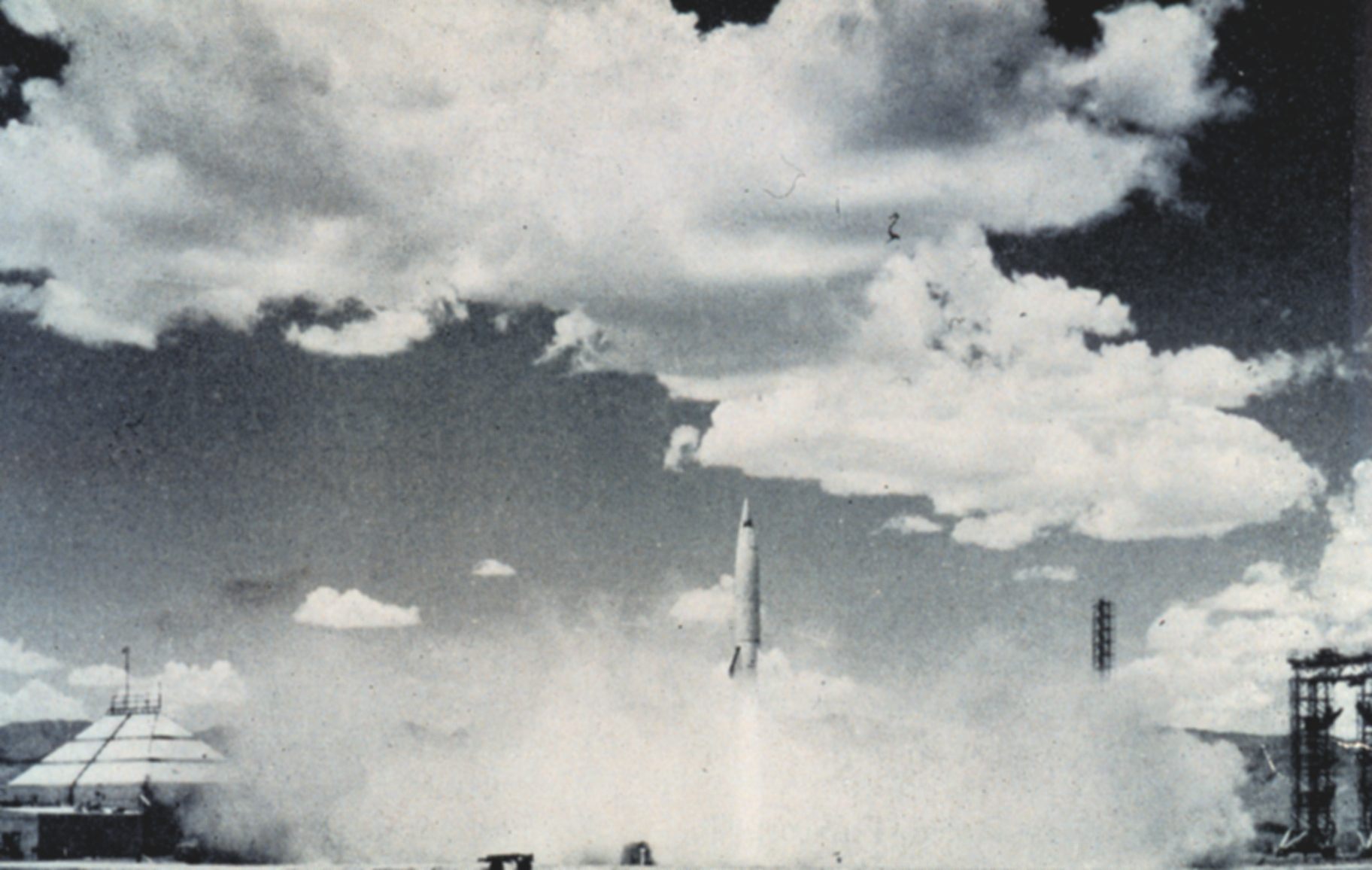
Pictured: a V-2 rocket lifting off from White Sands Proving Ground, New Mexico, on April 2, 1948 — the same guided-missile range, in the years surrounding the July 1951 sighting, captured mid-launch amid the smoke and gantry towers of a routine period test. This is not a photograph of the object itself; no photograph of the sighting survives. The case's own 35mm film was never publicly released and the underlying Air Force report (EHO-41) is missing from the Project Blue Book archive, leaving only generic period rocket-testing imagery like this one to illustrate the range where it occurred.
Theoretical Alignment
This case resists confident alignment with any single framework because its core problem is not interpretive but evidentiary: almost nothing about it can actually be checked. The Extraterrestrial Hypothesis draws modest support from the multi-instrument convergence — two independent radar operators, an independent visual tracker, and a photographer all registering the same fast-moving, unusual target within moments — the same kind of layered corroboration that strengthens cases like the Washington, D.C. flap. But without the underlying EHO-41 report, without witness names to interview, and without public access to the film itself, there is no way to test that impression the way Robert Baker tested the Mariana footage or William Hartmann tested it for the Condon Committee. The Interdimensional Hypothesis finds essentially no purchase: nothing in the secondhand accounts suggests materialization, portal activity, or any of IDH's usual explanatory territory. The Psycho-Social Hypothesis is rated low for a specific, structural reason — the observers were on-duty government and contract personnel performing technical tracking work on a restricted range, not a public crowd primed by saucer headlines, which removes the mass-misperception and media-contagion mechanisms PSH depends on. What elevates this case analytically is not the strength of any one hypothesis but the sheer improbability of its documentary vanishing act: a report a Project Blue Book chief personally cited by number, describing multi-instrument confirmation on a top-security missile range, simply is not in the file where it should be.
Background
White Sands Proving Ground was established on July 9, 1945, carved out of the older Alamogordo Bombing and Gunnery Range specifically to give the U.S. Army a secure, isolated facility for testing captured German rocket technology after World War II. Under Operation Paperclip, physicist Wernher von Braun and dozens of other German rocket engineers were relocated to Fort Bliss, Texas, and White Sands beginning in 1945, directing high-altitude firings of captured V-2 rockets at the range for the next several years. The first V-2 static test fired at White Sands on March 15, 1946; the first full launch followed on April 16, 1946; and by October 1946 a camera mounted on a V-2 had captured the first photograph of Earth ever taken from outer space, from an altitude of roughly 65 miles. Between 1946 and 1951, technicians launched 67 of the roughly 100 captured V-2 rockets transported to the range, and by 1950 the range and its allied installations had logged 235 Army and Navy missile launches, 329 Air Force missile launches, and 604 separate drone flights — an extraordinary tempo of guided-missile and rocket activity for a single stretch of New Mexico desert. Von Braun's own tenure at White Sands ended before the case described in this file: the Secretary of the Army approved the transfer of his Fort Bliss group to the newly designated Redstone Arsenal in Huntsville, Alabama, on October 28, 1949, and von Braun arrived in Huntsville in April 1950, more than a year before the July 1951 sighting.
By 1951, White Sands' mission had broadened well beyond the V-2 program into a full multi-service guided-missile test range, jointly used by the Army, Navy, and Air Force and sometimes referred to administratively as the New Mexico Joint Guided Missile Test Range. The adjoining Air Force installation, originally established in 1942 as Alamogordo Army Air Field, had been renamed Holloman Air Force Base on January 13, 1948, in honor of Col. George V. Holloman, an early pioneer of guided-missile research. Through 1950 and 1951, Holloman's 2nd Guided Missiles Squadron (reactivated October 25, 1950) supported development testing of the MATADOR surface-to-surface missile and a scaled RASCAL test vehicle nicknamed "Shrike," while a new Drone Detachment, established in September 1951, began flying radio-controlled target drones in support of live missile intercept tests — the lineage that would become the 3225th Drone Squadron. Civilian contractor Land-Air, Inc. operated the range's network of Askania cinetheodolite optical-tracking stations, the same instruments used for missile-trajectory measurement and, as it happened, for capturing several of the range's unexplained aerial sightings on film. This was the operational environment — one of the most secure, most heavily instrumented, and most rapidly expanding missile-testing complexes on Earth — into which the July 14, 1951 sighting arrived.
The case became publicly known only because Edward J. Ruppelt, who took over the Air Force's UFO investigation (soon renamed Project Blue Book) in early 1951, referenced it by document number in one of his internal Project Grudge/Blue Book status reports and again in a later interview with LOOK magazine. Marine Corps Major Donald E. Keyhoe, drawing on sources inside and adjacent to the Air Force's investigation, published a fuller (if still name-free) account of the sighting in his 1953 book Flying Saucers from Outer Space. Between them, Ruppelt's internal citation and Keyhoe's public account are the entire foundation on which every later reference to this case — including the modern compilations maintained by NICAP and Project 1947 — ultimately rests.
Complete Timeline
| Date | Event |
|---|---|
| July 9, 1945 | White Sands Proving Ground is formally established out of the older Alamogordo Bombing and Gunnery Range. |
| 1945–1949 | Under Operation Paperclip, Wernher von Braun's team directs high-altitude V-2 firings from the range; the U.S. Army, Navy, and Air Force jointly expand it into a multi-service guided-missile test facility. |
| June 27 & 29, 1947 | Separate early White Sands-area sightings are logged — a glowing object reported by an Army officer, and a rotating silvery disc independently reported by Naval Research Laboratory personnel — distinct, thinner precedents to the 1951 case. |
| January 13, 1948 | The adjoining Alamogordo Army Air Field is renamed Holloman Air Force Base, after Col. George V. Holloman. |
| December 1948 | Astronomer Lincoln La Paz begins investigating the "Green Fireballs" phenomenon reported near Los Alamos, Sandia, and the White Sands/Holloman area. |
| February 1950 | The first instrument post of Project Twinkle, the Air Force's green-fireball observation program, is established at Holloman Air Force Base. |
| April 27, 1950 | Land-Air, Inc. Askania theodolite crews independently track and film four unidentified high-altitude objects near White Sands during preparations for a missile test. |
| April 15, 1950 | Von Braun's team arrives at Redstone Arsenal, Huntsville, Alabama, ending his direct role at White Sands more than a year before the case described in this file. |
| May 29, 1950 | A second, separately reported multi-station filming of unidentified objects reportedly occurs at White Sands. |
| October 25, 1950 | The 2nd Guided Missiles Squadron is reactivated at Holloman AFB, supporting MATADOR and Shrike/RASCAL missile testing through 1951–52. |
| July 14, 1951 (morning) | Two radar operators at a White Sands guided-missile tracking station detect a fast-moving unidentified target; a separate tracker observing a B-29 with binoculars independently sees a large object near the bomber; a fourth observer exposes roughly 200 feet of 35mm film of the object. |
| July 25, 1951 | Report EHO-41, dated from Holloman Air Force Base, is later cited as the Air Force's internal record of the sighting — a document that does not survive in the Project Blue Book microfilm collection. |
| 1951 (later) | Edward J. Ruppelt, newly installed as head of the Air Force's UFO investigation, cites the case by report number in an internal status report (Status Report #5) and later references it in an interview with LOOK magazine. |
| September 1951 | Drone Detachment No. 1 is established at Holloman AFB to support guided-missile intercept testing — the lineage of the later 3225th Drone Squadron. |
| October 10–11, 1951 | Separate radar-and-visual UFO sightings near Holloman, involving both ground personnel and the crew of a manned Skyhook balloon, are later catalogued by Project Blue Book as unidentified. |
| December 1951 | Project Twinkle is formally discontinued, its final report concluding it found "no indication" the green-fireball sightings were anything but natural phenomena — a conclusion Lincoln La Paz publicly disputed. |
| 1953 | Maj. Donald Keyhoe publishes Flying Saucers from Outer Space, giving the July 1951 White Sands case its fullest public account (p. 48), describing the radar detection, the binocular sighting near the B-29, and the film. |
| 1956 | Ruppelt's memoir, The Report on Unidentified Flying Objects, is published, referencing White Sands' broader history of unusual reports without providing further primary detail on the July 1951 case specifically. |
| 1976 | Project Blue Book's approximately 130,000 surviving pages are transferred to the National Archives; no EHO-41 report or equivalent White Sands July 1951 document is found among them. |
| 1979 | UFO researcher Todd Zechel, following a successful FOIA lawsuit against the CIA, claims the July 1951 film and two earlier White Sands cinetheodolite films were forwarded to the CIA's Office of Scientific Intelligence — an allegation not corroborated in the CIA's own later declassified history of its UFO-related activities. |
| May 1, 1958 | White Sands Proving Ground is formally redesignated White Sands Missile Range, the name it carries today. |
| 1997 | Kevin D. Randle's Project Blue Book Exposed catalogues the systemic pattern of missing and mishandled Blue Book case files of which the vanished EHO-41 report is one documented example. |
| 2020s | Researchers at Project 1947 and NICAP continue to list the case among Blue Book-adjacent reports whose primary documentation has never been located, rating it a low-confidence "preliminary" entry precisely because of that gap. |
The Morning of July 14, 1951
Every detail that survives about the sighting itself traces back to two secondhand accounts — Ruppelt's internal Air Force citation and Keyhoe's 1953 book — that agree on the same basic sequence. On the morning of July 14, 1951, at a guided-missile tracking station on the White Sands range, two Army radar operators picked up a fast-moving, unidentified target on their scope. Radar crews on the range were trained specifically to distinguish missile telemetry, aircraft traffic, and instrument artifacts from one another as a matter of daily operational necessity, which is precisely why their independent judgment that the target was anomalous carries more evidentiary weight than an equivalent report from an untrained civilian observer would.
At what accounts describe as essentially the same moment, a separate tracker — assigned to keep the range's optical watch on a U.S. Air Force B-29 Superfortress that was airborne nearby, presumably in connection with the day's test or support operations — swung his binoculars toward a large object flying in proximity to the bomber. Keyhoe's account is explicit that this was an independent sighting, not one prompted by the radar operators' report: the tracker was already watching the B-29 for unrelated reasons and simply saw the object appear near it. This detail matters analytically in the same way the Capital Airlines correlation mattered in the Washington, D.C. flap the following year — an independent visual sighting occurring in rough temporal and spatial correlation with an independent radar detection is a materially stronger form of corroboration than either alone.
A fourth individual, described only as "another observer," then sighted the object and used a 35mm movie camera to expose roughly 200 feet of film — on the order of several hundred individual frames at standard silent-camera speeds of the era. Because of the object's high altitude, the film reportedly showed the object only as "a round, bright spot," without resolvable structural detail — a limitation common to virtually all long-range, unmagnified amateur and semi-professional aerial photography of the period, and one shared by the contemporaneous Mariana and Tremonton, Utah films. No account records how long the sighting lasted in total, what direction the object was traveling, what altitude the radar operators calculated for it, or what became of the B-29 once the object was noticed nearby it. These are not omissions this file can responsibly fill in: they simply are not present in either of the two primary secondary sources (Ruppelt's citation and Keyhoe's book) from which the entire case is reconstructed.
The Paper Trail: Report EHO-41 and the Missing Document
What distinguishes this case from most other Blue Book-era sightings in this catalogue is not the sighting itself but what happened to its documentation afterward. Multiple UFO research compilations — including Project 1947's folio of "lost files" and NICAP's case archive — identify the underlying Air Force document as Report EHO-41, dated July 25, 1951, from Holloman Air Force Base. That designation appears to originate from Ruppelt's own internal Air Force status reports; as the newly installed head of the Air Force's UFO investigation in 1951, Ruppelt had direct access to incoming case files and cited this one by number in what researchers refer to as his Status Report #5, and again discussed it in a later interview conducted for LOOK magazine.
Yet when Project Blue Book's roughly 130,000 surviving pages were transferred to the National Archives and Records Administration in 1976 and later microfilmed as Record Group 341, no EHO-41 report, and no equivalent White Sands case file dated July 1951, has ever been located among them. The U.S. Air Force has stated directly to researchers that this case does not appear in its files at all. That leaves investigators in an unusual evidentiary position: a knowledgeable Air Force insider cited a specific, dated, numbered document describing exactly this event while he had official access to the files, but the document itself subsequently disappeared from the very archive built to preserve it. This is not, by itself, proof of a deliberate cover-up — wartime- and Cold War-era government recordkeeping across many agencies suffered genuine, mundane losses through misfiling, reclassification, and simple administrative churn, and Kevin Randle's book-length audit of the Blue Book files documents numerous other cases with comparably incomplete paper trails that have no plausible connection to any conspiracy. But it does mean that, unlike almost every other case in this catalogue, White Sands' July 1951 sighting cannot be checked against a surviving primary government document at all — every fact in this file ultimately traces back to two secondary human accounts.
Ruppelt, Keyhoe, and the Fight Over the Record
Edward J. Ruppelt and Donald Keyhoe occupied very different institutional positions relative to this case, and their divergent treatments of it illustrate the broader tension that ran through early-1950s American UFO investigation. Ruppelt, a decorated World War II bombardier who took over the Air Force's UFO desk (soon renamed Project Blue Book) in early 1951, had direct, official access to incoming reports and cited the White Sands case as one data point among the roughly 15-per-month reports his young program was then receiving; his 1956 memoir, The Report on Unidentified Flying Objects, more broadly observed that "White Sands Proving Ground in New Mexico chalked up the first of the many sightings that this location would produce," reflecting his sense that the range was a recurring hotspot rather than a one-off anomaly.
Keyhoe, a retired Marine Corps major and increasingly prominent UFO author, had no official Air Force access but cultivated sources inside and adjacent to the investigation throughout the early 1950s. His 1953 book Flying Saucers from Outer Space gave the July 1951 case its fullest public description — the radar detection, the independent binocular sighting near the B-29, and the film — concluding, in a line later researchers have quoted repeatedly, that even though the film "showed only as a round, bright spot," it was nonetheless "proof—this was no hallucination." Keyhoe would go on to found the National Investigations Committee on Aerial Phenomena (NICAP) in 1956, using cases like this one as part of his broader argument that the Air Force was in possession of far more corroborated evidence than it was publicly acknowledging. The friction between these two accounts — an Air Force insider who cited the case almost in passing as one report among many, and an outside advocate who treated it as significant proof — previews the exact same dynamic that would play out on a much larger public stage the following year during the Washington, D.C. flap, where Ruppelt again found himself institutionally positioned between skeptical superiors and researchers convinced the Air Force was undercounting genuine anomalies.
The Broader White Sands Pattern: Green Fireballs and Project Twinkle
The July 1951 sighting did not occur in isolation. Beginning in December 1948, military and civilian personnel around Los Alamos, Sandia National Laboratory, and the White Sands/Holloman corridor began reporting a distinctive phenomenon researchers came to call the "Green Fireballs" — brilliant, intensely lime-green lights that moved slowly for their apparent altitude, produced no sound, and followed flat rather than arced trajectories inconsistent with typical meteoric fireballs. University of New Mexico astronomer and meteor specialist Lincoln La Paz, founder of the university's Institute of Meteoritics, was asked by the Air Force to investigate; after plotting flight paths and interviewing more than a hundred witnesses, La Paz concluded by December 1948 that the objects' characteristics were "atypical" of ordinary meteors and, in his professional judgment, likely artificial — possibly secret American test devices, or possibly Soviet surveillance technology exploiting the region's concentration of nuclear-weapons research.
La Paz's persistent, credentialed dissent from the natural-phenomenon explanation led directly to the creation of Project Twinkle, an Air Force-funded instrumented observation program intended to photograph and triangulate future green-fireball sightings using a network of cinetheodolite stations. The first instrument post was established at Holloman Air Force Base in February 1950, staffed jointly by two Air Force officers and Land-Air, Inc. contract personnel — the same civilian optical-tracking contractor whose theodolite crews had already filmed unidentified objects near White Sands in April and May 1950. Chronic underfunding meant Twinkle never grew beyond a single fully equipped station, and when the project was formally discontinued in December 1951, its final report concluded there was "no indication" the green fireballs were anything but natural phenomena and recommended no further expenditure — a conclusion La Paz, whose scientific credentials on meteor phenomena were unmatched among the project's skeptics, continued to dispute for years afterward.
The relevance to the July 14, 1951 sighting is contextual rather than direct: nothing in any surviving account describes the object as green, fireball-shaped, or otherwise matching the Green Fireballs' specific visual signature, and this case should not be treated as a Green Fireballs sighting. What the Project Twinkle history does establish is that, in the exact months surrounding this case, the White Sands/Holloman corridor already had a dedicated, federally funded instrument-observation program specifically built around the premise that something worth tracking, photographing, and triangulating was recurring in the skies above this stretch of New Mexico — a premise serious enough that the Air Force itself had staffed and funded an observation post barely a mile or two from where the July 1951 case took place. That institutional backdrop is part of why Ruppelt's own assessment, cited above, was that White Sands was a genuine recurring hotspot rather than a source of one-off, easily dismissed reports.
The Zechel Claim: A Film at the CIA?
The most contested single claim associated with this case did not originate with Ruppelt, Keyhoe, or any Blue Book document, but from later FOIA-driven research. Todd Zechel, a former Army Security Agency and NSA communications specialist who became a prominent UFO researcher in the late 1970s and co-founded Citizens Against UFO Secrecy (CAUS) after winning a landmark 1979 Freedom of Information Act lawsuit that forced the CIA to acknowledge thousands of previously denied documents, later asserted that several pieces of photographic evidence missing from the public Blue Book files had been quietly routed to the CIA's Office of Scientific Intelligence during the 1950s. Zechel specifically named three White Sands-area films in this claim: the April 27, 1950 cinetheodolite footage, the May 29, 1950 multi-station footage, and the 35mm film shot on July 14, 1951.
This claim deserves serious but cautious treatment. Zechel's underlying FOIA litigation record is real and well documented — his 1977 lawsuit, filed with attorney Peter Gersten and the group Ground Saucer Watch, genuinely did compel the CIA to release material it had previously denied existed, a fact reported at the time by The Washington Post and numerous other outlets. That track record lends his broader claims more weight than an unsourced rumor would carry. However, this file's own review of the CIA's own official, declassified 1997 historical study of its UFO-related activities — Gerald K. Haines' "CIA's Role in the Study of UFOs, 1947–90," the same document cited in this site's Washington, D.C. case file — found no mention whatsoever of White Sands, Holloman, cinetheodolite footage, or any film matching this description; that study's discussion of CIA photographic-evidence review focuses specifically on the Mariana and Tremonton footage examined by the 1953 Robertson Panel, and on a separate set of 1952 Cleveland photographs reviewed later in the 1950s. The absence of corroboration in the CIA's own subsequent accounting does not disprove Zechel's claim — agency historical self-reporting is not infallible, and Zechel's broader FOIA work demonstrated the CIA had in fact concealed UFO-related material before — but it means the claim remains, at best, an allegation from a credentialed but non-official source, not a documented fact, and this file treats it accordingly.
Circumstantial Evidence
- The sighting occurred on White Sands Proving Ground, one of the most secure, heavily instrumented, and closely monitored military installations in the United States — a location built specifically to detect and track fast-moving objects.
- Three independent forms of detection — radar, binocular visual observation, and 35mm film — reportedly converged on the same object within the same short window, a rare multi-instrument correlation for a 1951-era report.
- The visual sighting near the B-29 was, per Keyhoe's account, made independently of and not prompted by the radar detection, strengthening the correlation between the two.
- Edward J. Ruppelt, while serving as the Air Force's own UFO investigation chief with direct access to incoming files, personally cited this case by report number — an internal, non-public acknowledgment that the underlying documentation existed.
- The underlying Report EHO-41 is absent from the Project Blue Book microfilm collection at the National Archives, and the U.S. Air Force has stated the case is not in its files at all — an unusually complete documentary vanishing act for a case an insider explicitly cited by number.
- The case occurred within a broader, multi-year pattern of unexplained White Sands-area radar, visual, and film sightings (1947, April and May 1950, and later reports in October 1951), suggesting a locally recurring phenomenon rather than an isolated incident.
- The Air Force's own contemporaneous Green Fireballs investigation and Project Twinkle observation post, headquartered at the same base, demonstrate the military itself considered the White Sands/Holloman corridor worth dedicated instrumented monitoring during this exact period.
Key Researchers
- Edward J. Ruppelt (1923–1960) — Head of the Air Force's UFO investigation from 1951 to 1953, the earliest and most institutionally credible source to cite this case's existence, via internal status report and a later magazine interview.
- Donald Keyhoe (1897–1988) — Retired Marine major and UFO author whose 1953 book Flying Saucers from Outer Space gave the case its fullest public account; later founder of NICAP.
- Lincoln La Paz (1897–1985) — University of New Mexico meteor astronomer who led the concurrent Green Fireballs investigation centered on the same White Sands/Holloman corridor, providing this case's most important regional and institutional context.
- Jerome Clark — UFO historian whose reference work, The UFO Encyclopedia, catalogues the White Sands-area sightings of this era within the broader documentary record of the early Blue Book period.
- Kevin D. Randle — Retired military intelligence officer whose Project Blue Book Exposed documents the systemic pattern of missing, mishandled, and reclassified Blue Book files of which this case's vanished EHO-41 report is one specific example.
- Todd Zechel — FOIA researcher and CAUS co-founder whose disputed claim that the July 1951 film was routed to the CIA's Office of Scientific Intelligence remains uncorroborated by the CIA's own declassified history, but is treated seriously here given his separately documented, successful FOIA litigation record against the agency.
- Jan Aldrich — Director of Project 1947, whose archival research project has compiled and preserved the primary citation trail (Ruppelt's status report, Keyhoe's book, and related NICAP documentation) that this case file relies on.
Key Witnesses
Radar Operator No. 1 (unnamed)
One of two Army radar operators staffing a guided-missile tracking scope on the morning of July 14, 1951, who first detected the fast-moving, unidentified target. No name, rank, or unit for either operator survives in any published account; their observation is known only through Ruppelt's internal citation and Keyhoe's 1953 book.
Radar Operator No. 2 (unnamed)
The second of the two radar operators who independently confirmed the anomalous target on the tracking scope. Both operators' professional training in distinguishing missile telemetry and known aircraft traffic from genuine unknowns is the primary basis for treating their joint detection as credible despite the absence of their names.
The B-29 Tracker (unnamed)
Assigned to keep binocular watch on a U.S. Air Force B-29 Superfortress operating near the range that morning, this observer independently spotted a large object flying near the bomber — a sighting Keyhoe's account is explicit was not prompted by, or made in response to, the radar operators' detection, making it a genuinely independent visual corroboration rather than a suggested or leading observation.
The Film Photographer (unnamed)
A fourth observer who, on sighting the object, exposed roughly 200 feet of 35mm film of it — film that, per every source discussing this case, has never been publicly released or independently examined. This individual's identity, equipment specifics beyond "35mm camera," and subsequent fate of the exposed reel are not recorded in any source available to this file.
Capt. Edward J. Ruppelt
Not a witness to the sighting itself, but the individual whose internal citation of the case — by report number, in a status report written while he had direct access to incoming Air Force files — is the earliest and most institutionally credible acknowledgment that the case existed at all. His later published observation that White Sands "chalked up the first of the many sightings" the location would go on to produce reflects his professional assessment of the range as a genuine recurring hotspot.
Maj. Donald Keyhoe
The source of the case's fullest public account, published in his 1953 book Flying Saucers from Outer Space (p. 48), drawing on sources inside and adjacent to the Air Force's UFO investigation. Keyhoe's framing of the film as imperfect but genuine proof — "no hallucination" — became the template later researchers used to discuss the case.
The Five Observables Assessment
The Five Observables framework, developed by former AATIP director Luis Elizondo, is used to classify UAP encounters by performance characteristics exceeding known technology of their era:
Assessment: Surviving accounts describe the radar target only as "fast-moving," with no preserved numeric speed, altitude, or acceleration data — radar operators trained to distinguish it from known missile and aircraft traffic evidently judged its performance anomalous, but the absence of any surviving figures means both Instant Acceleration and Hypersonic Velocity can be rated no higher than speculative. Anti-Gravity Lift is rated absent: no witness described hovering, a visible propulsion mechanism, or any craft structure at all — only a fast-moving radar target and, on film, an undifferentiated bright point of light. Low Observability is rated absent for the same reason it is absent in most of this catalogue's best-corroborated cases: the object was, if anything, unusually conspicuous, simultaneously visible to radar, to the naked eye through binoculars, and to a 35mm camera. Trans-Medium travel is absent; no transition between air, water, or space was ever reported.
Evidence Assessment
Supporting Anomalous Origin
- Independent radar and visual detections, by different trained observers performing unrelated tasks, reportedly converged on the same object within moments of each other.
- All observers were on-duty government or contract technical personnel trained to distinguish real aircraft and missile hardware from artifacts, not untrained bystanders.
- Edward Ruppelt, the Air Force's own UFO investigation chief, cited the case by specific report number while he had direct institutional access to the underlying file.
- The sighting fits a documented, multi-year pattern of unexplained radar, visual, and film reports specific to the White Sands/Holloman corridor, rather than standing as an isolated one-off claim.
- The Air Force's own contemporaneous, federally funded Green Fireballs/Project Twinkle program demonstrates the government itself treated this exact region as worthy of dedicated instrumented monitoring during this period.
Supporting Conventional Explanation / Non-Corroboration
- No named witnesses survive in any account, making independent verification, interview, or credibility cross-checking permanently impossible.
- The underlying government report (EHO-41) is missing from the Blue Book files, and the U.S. Air Force states the case is not on record at all — leaving every detail dependent on two secondary human accounts (Ruppelt's citation and Keyhoe's book).
- The film, unlike the comparable Mariana or Tremonton footage, has never been publicly released or independently analyzed, so no photogrammetric or forensic examination has ever confirmed what it actually shows.
- White Sands and Holloman in 1951 hosted an exceptionally high volume of routine guided-missile, drone, and rocket-sled test activity, plus active USAF Skyhook balloon operations — any of which could plausibly account for an unfamiliar radar/visual target on a given morning absent the missing report's operational details.
- Project Twinkle's own final 1951 report concluded the broader category of unusual regional aerial phenomena it was built to investigate showed "no indication" of being anything but natural — the Air Force's institutional position on this general class of report from the same base in the same year.
Why "Disputed"
This case earns a DISPUTED classification rather than "credible" or "open" because its evidentiary core — a real, multi-instrument sighting involving trained personnel on one of America's most secure guided-missile ranges — is itself not seriously in question, while almost everything needed to evaluate it further has been lost, withheld, or never released. What is not disputed: Edward Ruppelt, while running the Air Force's own UFO investigation with direct file access, cited a specific, dated, numbered Air Force report describing exactly this event, and Donald Keyhoe's 1953 book independently corroborated the same basic sequence of radar detection, visual confirmation, and film. What remains genuinely unresolved is everything downstream of that: no named witness has ever been identified or interviewed; the underlying government report cannot be located in the Blue Book archive despite an insider's citation of it; the film has never been publicly released for the kind of photogrammetric analysis that at least partially resolved comparable cases like Mariana; and the specific radar readings, flight path, and duration of the sighting are simply not preserved anywhere in the public record. A case with this combination — a real, multiply-corroborated event acknowledged even from within the government's own investigation, paired with a near-total absence of the primary documentation and physical evidence needed to test it further — is the textbook definition of "disputed" on this site's rating scale: not debunked, because no conventional explanation has ever actually been matched to the specific circumstances (there is no equivalent of a dated Skyhook launch log or radiosonde balloon record tying a known object to this exact morning); and not fully credible, because the evidentiary chain is too badly broken to support strong confidence in either direction.
Why This Case Persists in the UFO Literature
Given how little verifiable detail survives, it is fair to ask why this sighting has remained a fixture of Blue Book-adjacent research for over seventy years rather than fading into the enormous pile of undocumented, second-hand UFO claims that circulate without institutional traction. The answer is almost entirely about who first put it on the record. Unlike the great majority of uncorroborated 1950s reports, this one was not first surfaced by a UFO magazine, a contactee, or an anonymous tip — it was cited, by document number, by the man the U.S. Air Force itself had placed in charge of separating credible unknowns from noise. Ruppelt had every institutional incentive to be conservative in what he flagged as worth tracking; his own memoir is candid about cases he considered weak or explainable, and he did not treat every report that crossed his desk as significant. That he specifically cited Report EHO-41 — by number, in an internal document never intended for public consumption at the time — is the detail that has kept researchers returning to this case across multiple generations, from Keyhoe's 1953 book through the ongoing Project 1947 archival effort. A case an insider flagged and that then vanished from the surviving files is analytically more interesting, not less, than a case that was well-documented from the start; it raises a genuine, still-open question about the completeness of the historical record itself, independent of whatever the object over White Sands that July morning actually was.
Sensor & Instrumentation Detection Profile
Three distinct forms of detection instrumentation were reportedly in play within the same short window: military ground radar (operated by two named-but-unrecorded radar operators at a guided-missile tracking station), optical tracking via binoculars (used by a third observer who was in the process of tracking a B-29 bomber as part of routine range operations), and a 35mm motion-picture camera, which a fourth observer used to expose approximately 200 feet of film — on the order of several hundred frames at typical 1950s movie-camera frame rates. This is precisely the kind of layered, multi-sensor detection profile the U.S. government's own later programs (from the CIA-convened Robertson Panel through the modern All-domain Anomaly Resolution Office) have identified as the strongest possible category of report: independent instruments, of different physical types, operated by different trained personnel, correlating on the same object at the same time. What breaks that strength in this specific case is retrievability. The radar operators' logs, the report describing the tracker's observation, and the exposed film itself were reportedly gathered into a single Air Force document — referred to in secondary sources as Report EHO-41, dated July 25, 1951, from Holloman Air Force Base — but that report is not present in the Project Blue Book microfilm collection held by the National Archives, and the U.S. Air Force has stated the case does not appear in its files at all. The film, per every source that discusses it, "has never been released," meaning no independent photogrammetric analysis of the kind performed on the Mariana or Tremonton footage has ever been possible.
Environmental & Geospatial Context
White Sands Proving Ground (renamed White Sands Missile Range on May 1, 1958) occupies roughly 3,200 square miles of the Tularosa Basin in south-central New Mexico, ringed by the San Andres and Sacramento mountain ranges — terrain deliberately chosen after World War II because its isolation and controllable airspace made it ideal for tracking captured V-2 rockets and, later, a rapidly expanding portfolio of American guided missiles. By 1951 the range and its adjoining Holloman Air Force Base together hosted an extraordinary concentration of optical and electronic tracking infrastructure: cinetheodolite and Askania optical-tracking stations operated under contract by Land-Air, Inc., ground radar installations supporting missile guidance and range safety, and (relevant to the broader context discussed below) the first instrument post of the Air Force's Project Twinkle green-fireball observation network, established at Holloman in February 1950. In other words, this was among the most heavily instrumented patches of sky in the entire United States in July 1951 — a range built specifically to detect, track, and photograph fast-moving objects, staffed by personnel whose entire job was distinguishing real targets from artifacts. No surviving account records the specific weather conditions on the morning of July 14, though the described tracking activity (visual, radar, and photographic observation of a B-29 in flight) implies conditions clear enough for routine optical range work to be underway.
Observer Credibility & Occupational Profile
Every reported observer in this case was, by occupation, exactly the kind of trained, on-duty technical witness this site's credibility framework weighs most heavily: two radar operators staffing a guided-missile tracking scope, a tracker specifically assigned to keep optical watch on a B-29 in flight, and a photographer equipped and ready to expose range-documentation film — none of them incidental bystanders, all of them performing a technical job that required distinguishing real aircraft and missile hardware from anomalies as a matter of routine duty. That is the case's strongest asset. It is also, paradoxically, tied to its greatest weakness: because none of their names survive in any published source, none of the individualized credibility-assessment tools this site applies elsewhere — verifying military service record, cross-checking later public statements, assessing consistency over repeated interviews — can be applied here at all. The witnesses are known only by function, not by name, rank, or unit, which is itself an unusual and notable gap for a Blue Book-adjacent case involving four separate people and a purportedly official report.
Physical & Material Assays
No debris, trace residue, or recovered physical artifact of any kind is associated with this case, and none has ever been claimed. The only physical evidence that reportedly existed was the roughly 200 feet of exposed 35mm film — and unlike the Mariana or Tremonton footage, that film was never placed into any chain of custody accessible to outside investigators. No frame count, no photogrammetric measurement, no optical density or reflectivity analysis, and no expert testimony about the film's contents exists anywhere in the public record beyond the secondhand description that it showed "a round, bright spot" because of the object's high altitude. This is the single most consequential absence in the entire case file: a piece of physical, potentially testable evidence is reported to exist, but has been functionally unavailable for scientific examination for over seventy years.
Historical Precedents & Archive Matches
The July 1951 sighting was neither the first nor the last unusual aerial report logged at White Sands. As early as June 1947 — the same month as Kenneth Arnold's founding sighting near Mount Rainier — the range logged its own early reports: on June 27, 1947, an Army officer reported a glowing white object passing over the range, and two days later, on June 29, 1947, Naval Research Laboratory personnel stationed at White Sands for rocket-instrumentation work separately reported a rotating, silvery disc crossing the sky at high speed. (This 1947 Naval Research Laboratory sighting, distinct from and considerably thinner in documentation than the July 1951 case, is sometimes conflated with it in less careful secondary accounts; this file treats them as the two separate events the primary sources describe.) The pattern continued through 1950: on April 27, 1950, contract theodolite crews operating for the missile range independently tracked and filmed four unidentified high-altitude objects during preparations for a missile test, and a similar multi-station filming reportedly occurred on May 29, 1950. Set against that seven-year run of White Sands-area radar, visual, and film reports, the July 1951 case is not an isolated anomaly but the best-corroborated entry in a locally recurring pattern — discussed further below in the context of the concurrent Green Fireballs investigation and Project Twinkle, both of which were headquartered at the same facility.
Material Analysis
No physical debris, trace residue, or recoverable artifact of any kind is associated with this case, and none has ever been claimed. The only physical evidence that reportedly existed — roughly 200 feet of exposed 35mm film — has never been placed in any chain of custody accessible to independent researchers, meaning it has never been subjected to any of the material-analysis techniques (frame-by-frame photogrammetry, optical density measurement, film-stock dating, or expert authentication) applied to comparable cases like the Mariana or Tremonton footage. This is a fundamentally different situation from a case with no physical evidence at all: here, physical evidence is reported to exist, but has been functionally unavailable for seventy-plus years, which means its absence from the analytical record reflects access, not non-existence.
Supporting a Genuine, Undocumented Anomaly
- Multiple, independently tasked, trained technical personnel reportedly converged on the same object using different detection methods within a short window.
- The case's earliest institutional source (Ruppelt) had no motive to fabricate an internal citation in a status report never intended for public consumption at the time he wrote it.
Supporting Caution / Non-Verification
- With no surviving primary document and no publicly released film, no material analysis of any kind has ever actually been performed on this case's central physical evidence.
- Every fact in the public record is at least two removes from the original observers, filtered through Ruppelt's brief citation and Keyhoe's secondhand narrative account.
The Conventional Explanation Candidate: A Guided-Missile or Drone Test Article
A Guided-Missile or Drone Test Article
InconclusiveGiven White Sands' extraordinary tempo of guided-missile, target-drone, and rocket testing in 1951 — hundreds of Army, Navy, and Air Force missile launches and over 600 drone flights logged in the years just before this sighting — the single most plausible mundane candidate is that the radar operators and observers detected an experimental test article, target drone, or support aircraft connected to that morning's range activity, one whose specific identity and flight profile would have been recorded in the very report (EHO-41) that has since gone missing. This deserves serious consideration precisely because of how much routine hardware was moving through this exact airspace on any given day in mid-1951, including newly reactivated MATADOR and scaled RASCAL ("Shrike") test vehicles and the freshly stood-up drone detachment's early target-drone flights.
Skyhook or Other High-Altitude Balloon
InconclusiveThe Air Force publicly attributed a large share of 1951-era New Mexico sightings, including several logged at Holloman that October, to Skyhook balloon operations — and Holloman was, by this period, the U.S. Air Force's prime Skyhook launch site, governed by the Cambridge Research Laboratories. This candidate is weakened for the July 14 case specifically by the described behavior: a Skyhook balloon drifts with prevailing winds and ascends slowly, which fits poorly with a target radar operators characterized as "fast-moving." It cannot be ruled out given how little detail survives, but it fits the specific description less comfortably than it fit the October 1951 sightings the Air Force did formally associate with balloon operations.
Conventional Aircraft with Sun-Glint Reflection
InconclusiveA third candidate, structurally similar to the official explanation later applied to the Mariana and Tremonton films, holds that the object was a conventional aircraft — potentially even the B-29 itself or an escort/support aircraft operating near it — whose polished metal skin produced a bright sunlight reflection that both the binocular tracker and the film photographer registered as a distinct, glowing object. This candidate is bolstered by the simple fact that a B-29 and, by definition, other aircraft were confirmed to be in the air in the immediate vicinity that morning. It is weakened by the radar operators' independent detection of a target whose behavior they judged anomalous enough to report through official channels, a judgment reflection glare alone does not typically produce on a trained radar crew.
Without the underlying EHO-41 report's operational details — the recorded radar altitude, speed, heading, and cross-reference against that morning's actual test and flight schedule — none of these three candidates can be confirmed or eliminated with any real confidence. This is the same evidentiary gap that prevents the case from being rated "credible" rather than "disputed": the absence of documentation cuts against certainty in both directions equally.
Related Cases
Confirmed Documents & Official Records
The CIA's own declassified historical accounting of its UFO-related activities; reviewed for this case file and found to contain no reference to White Sands, Holloman, or any 1951 cinetheodolite/35mm film, relevant to evaluating the disputed Zechel claim discussed above.
UNCLASSIFIED (declassified)Finding aid for Project Blue Book's 94 rolls of microfilm (T-1206) and related UAP textual holdings — the archive searched, without success, for the Report EHO-41 document this case's secondary sources describe.
UNCLASSIFIEDOfficial National Archives history of Project Blue Book's origins and recordkeeping, useful background on how and why individual case files such as this one could go missing from the surviving collection.
UNCLASSIFIEDSearch Government Archives Directly
Further Reading — Recommended Literature
Flying Saucers from Outer Space
The book that first gave this case its fullest public account (page 48), drawn from Keyhoe's contacts inside and adjacent to the Air Force's UFO investigation.
The Report on Unidentified Flying Objects
Written by the Air Force officer who personally cited this case by report number while running Project Blue Book, and whose account of White Sands as a recurring "hotspot" frames this file's Background section.
Project Blue Book Exposed
A twenty-year audit of the Blue Book files documenting the systemic pattern of missing, mishandled, and reclassified case documentation of which this case's vanished EHO-41 report is a specific example.
Watch the Skies!: A Chronicle of the Flying Saucer Myth
A rigorously skeptical, well-documented history of the early Air Force UFO era, useful context for evaluating the Green Fireballs/Project Twinkle backdrop against which this case unfolded.
The UFO Encyclopedia, 4th Edition
The definitive UFO reference work, situating the White Sands-area sightings of this era within the broader documentary record of the early Project Blue Book period.
Essential Viewing
No Videos Available
A genuine search turned up no video content specifically and primarily about this case. Several general documentaries touch on the broader Green Fireballs/Project Twinkle history of the same base, but none focus on the July 14, 1951 sighting itself, so none are included here per this site's standard against padding with mismatched content.
Sources
- Project 1947. "Radar and Visual UFO Sighting, White Sands Missile Range, July 14, 1951." project1947.com
- Project 1947. "Folio — The Lost Files" (index of missing/unreleased Blue Book-era case documentation). project1947.com
- NICAP. "UFO Report: White Sands Radar/Visual Case, July 14, 1951" (compiled by Dan Wilson; RADCAT Category 9). nicap.org
- NICAP. "UFO Casebook 1951" (case-list entry: "July 14, 1951; White Sands, New Mexico…UFO sped near B-29, tracked on radar; 200 ft. of 35 mm film reportedly shows bright round spot"). nicap.org
- NICAP. "The New Mexico Sightings" (compilation of White Sands-area cases, 1947–1952). nicap.org
- NICAP. "UFO Report: White Sands Proving Grounds, April 27, 1950" (Land-Air Askania theodolite case; includes discussion of the Todd Zechel CIA claim). nicap.org
- Keyhoe, Donald E. Flying Saucers from Outer Space, Henry Holt and Company, 1953, p. 48.
- "Flying Saucers from Outer Space," Wikipedia. en.wikipedia.org
- Ruppelt, Edward J. The Report on Unidentified Flying Objects, Doubleday, 1956.
- Ruppelt, Edward J. The Report on Unidentified Flying Objects, full text, Project Gutenberg. gutenberg.org
- "Edward J. Ruppelt," Wikipedia. en.wikipedia.org
- "Lincoln LaPaz," Wikipedia. en.wikipedia.org
- "Green fireballs," Wikipedia. en.wikipedia.org
- UFO Casebook. "Project Twinkle" (green-fireball observation program history, including La Paz's dissent from the project's 1951 negative final report). ufocasebook.com
- History.com. "When Mysterious Green Fireballs Worried the US Government." history.com
- Central Intelligence Agency. Haines, Gerald K. "CIA's Role in the Study of UFOs, 1947–90," Studies in Intelligence, 1997. cia.gov
- ParadigmResearchGroup.org. "Topics in Ufology: Todd Zechel" (biography and FOIA litigation history). paradigmresearchgroup.org
- "White Sands Missile Range," Wikipedia. en.wikipedia.org
- "White Sands V-2 Launching Site," Wikipedia. en.wikipedia.org
- "Holloman Air Force Base," Wikipedia. en.wikipedia.org
- White Sands Missile Range Museum. "A Brief History of White Sands Proving Ground, 1941–1965." wsmrmuseum.com
- U.S. Army, Redstone Arsenal Historical Information. "Dr. Wernher von Braun" (biography, including transfer date from White Sands/Fort Bliss to Redstone Arsenal). history.redstone.army.mil
- Federation of American Scientists. "The 6555th, Chapter I, Section 2 — Activities at Holloman, Eglin and Patrick AFB, 1950–1951." spp.fas.org
- Randle, Kevin D. Project Blue Book Exposed, Da Capo Press, 1997.
- Clark, Jerome. The UFO Encyclopedia, 4th Edition, Visible Ink Press, 2023.
- Peebles, Curtis. Watch the Skies!: A Chronicle of the Flying Saucer Myth, Smithsonian Institution Press, 1994.
See something inaccurate? Have additional information or sources?
Suggest an Edit →Last Updated: August 2026