
The Mariana UFO Film
Shortly before 11:30 AM on August 15, 1950, Nick Mariana, general manager of the Great Falls Electrics minor-league baseball club, was inspecting the empty grandstand at Legion Park with his secretary, Virginia Raunig, when a flash of light drew his eye to two bright, silvery, disc-shaped objects crossing the sky. He ran for his car, grabbed his 16mm movie camera, and shot roughly sixteen seconds of Kodachrome color film as the objects receded to the northwest — one of the earliest motion-picture UFO records in history, and among the first ever subjected to sustained government and independent scientific analysis. Over the next eighteen years the footage was examined and re-examined by the Air Force's own Air Technical Intelligence Center (twice, with contradictory results), a CIA-convened panel of scientists, a Douglas Aircraft physicist working for a Hollywood documentary, and the University of Colorado's federally funded Condon Committee — each arriving at a different verdict. Mariana, for his part, insisted for the rest of his life that the Air Force had quietly removed the film's clearest, most damning frames before returning it to him. Seventy-plus years later, no single explanation commands consensus, and Project Blue Book's own paper trail still shows the case bouncing between "probable aircraft" and "unidentified" more than once.
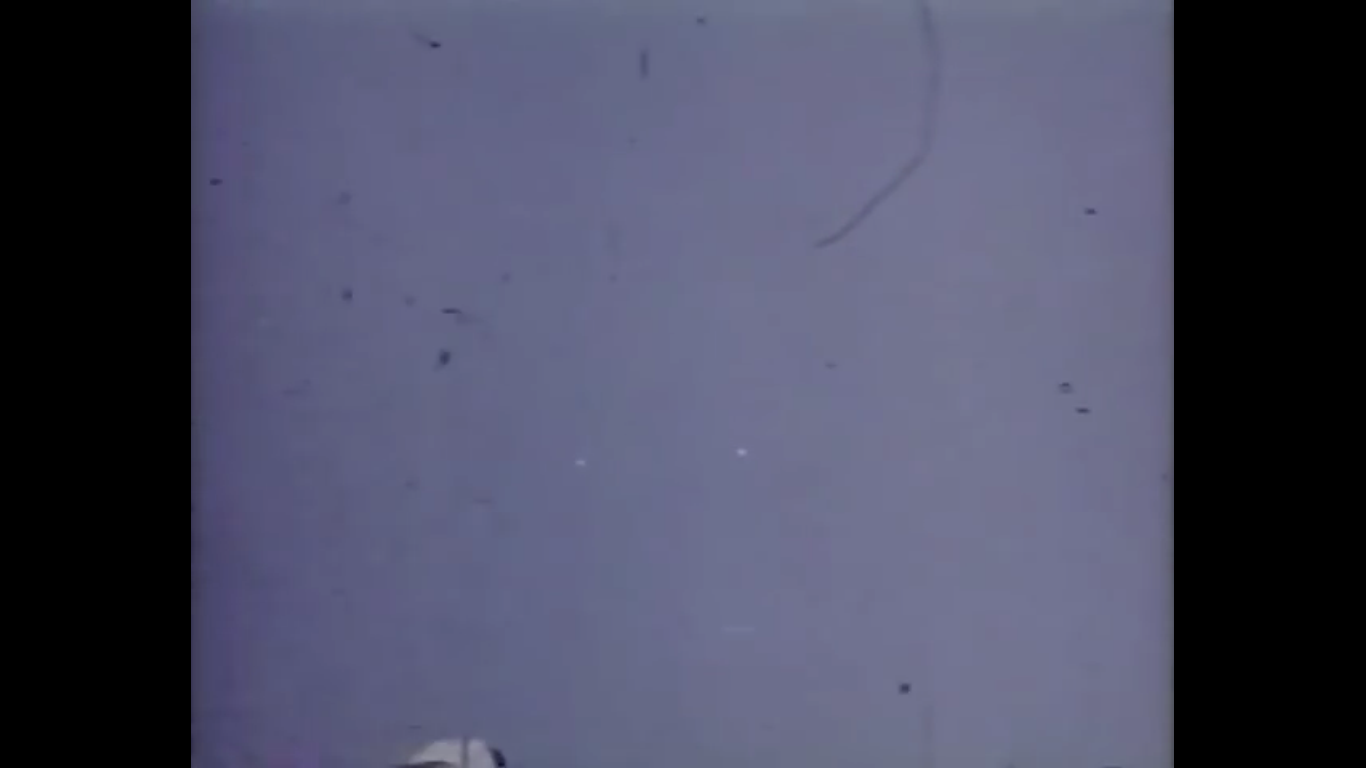
Pictured: an actual surviving frame from Nick Mariana's original 16mm Kodachrome footage, one of the two faint points of light he tracked across roughly sixteen seconds on August 15, 1950 — genuine primary evidence from the case itself, not a stand-in image. The frame is heavily degraded by decades of copying, scratching, and color shift, and, per Mariana's own account, is drawn from a reel he always maintained had already lost its clearest, closest-approach frames before it was returned to him by the Air Force.
Theoretical Alignment
Like McMinnville, this is fundamentally an authenticity-and-identification dispute over a small amount of physical film, not a case that maps cleanly onto the standard hypothesis triangle. The Extraterrestrial Hypothesis earns a modest rating because, if the objects genuinely were not the F-94 jets the Air Force initially blamed, the footage shows exactly the kind of structured, apparently controlled, non-ballistic motion ETH proponents point to — but that "if" is precisely what three independent technical analyses (Baker in 1956, Ruppelt's 1952 Air Technical Intelligence Center team, and Hartmann's 1968 Condon Committee study) could rule out the conventional aircraft explanation without being able to positively confirm. The Interdimensional Hypothesis finds no purchase whatsoever — nothing in the footage, the witness testimony, or seventy-five years of technical literature suggests materialization, portal activity, or any of IDH's usual explanatory territory. The Psycho-Social Hypothesis is rated low for the same structural reason it is low in the McMinnville file: this is a two-witness, single-camera case whose entire evidentiary weight rests on frame-by-frame measurements of film geometry and reflectivity, not on the kind of mass misperception, media contagion, or belief-driven testimony PSH is built to explain. To the extent social dynamics matter at all, they show up in how the case was handled afterward — a baseball promoter's showman instincts, a national magazine's mockery, a Hollywood documentary crew's commercial interest — rather than in what Mariana and Raunig actually saw.
Background
By August 1950, the American "flying saucer" phenomenon was just over three years old, dating to Kenneth Arnold's June 1947 sighting near Mount Rainier, and had already produced the Air Force's short-lived Project Sign, its more dismissive successor Project Grudge, and a national wave of press coverage that spring following the McMinnville photographs. Nick Mariana was, that summer, the general manager of the Great Falls Electrics, the city's entry in the Class-C Pioneer League, which that particular season played under the sponsor-branded nickname "Selectrics." Mariana had no documented connection to UFO reporting or the emerging saucer subculture before that August morning; he was, by every account, simply a baseball executive doing routine pre-game rounds of the club's home field.
On the morning of August 15, 1950, Mariana and his nineteen-year-old secretary, Virginia Raunig, walked out onto the grounds of Legion Park to inspect the empty stadium ahead of that evening's game. A bright flash of reflected light caught Mariana's attention, and looking up he saw two bright, silvery, disc-shaped objects hanging in the northern sky, rotating slowly and appearing to hover before beginning to move off. He estimated each object at roughly fifty feet in diameter and perhaps three feet thick, separated from one another by about fifty yards, and initially essentially stationary before accelerating to a speed he judged at somewhere between two hundred and four hundred miles per hour. Raunig, standing beside him, saw the same two objects, though for a shorter interval — by most accounts only five to ten seconds — before Mariana broke away and sprinted for his car.
Mariana kept a Revere 16mm movie camera in his vehicle, already loaded with daylight Kodachrome color film. He retrieved it, ran back toward the field, and began filming as the two objects continued moving across the sky, tracking them through his viewfinder for roughly sixteen seconds — on the order of 315 individual frames — before they shrank to indistinct points of light and passed out of view to the northwest. He would later recall that, moments after he stopped filming, he saw two aircraft coming in to land at the nearby Air Force base, a detail that would become central to every subsequent government explanation of what he had captured.
Complete Timeline
| Date | Event |
|---|---|
| June 1947 | Kenneth Arnold's sighting near Mount Rainier launches the American "flying saucer" era. |
| May 11, 1950 | Paul and Evelyn Trent photograph the McMinnville, Oregon disc, nine weeks before the Great Falls sighting, feeding the same national wave of press coverage. |
| August 15, 1950, ~11:25–11:30 AM | Nick Mariana and Virginia Raunig observe two silvery, rotating discs above Legion Park; Mariana films roughly sixteen seconds of the objects on 16mm Kodachrome color stock. |
| Mid-to-late August 1950 | The Great Falls Tribune publishes an account of the sighting; Mariana screens the film informally for local civic groups, including the Central Roundtable Athletic Club, over the following weeks. |
| October 1950 | At the suggestion of an acquaintance, Mariana's film is forwarded to the Air Force. Captain John P. Brynildsen interviews Mariana and arranges for the reel to be sent to Wright-Patterson Air Force Base's Air Technical Intelligence Center (ATIC) for analysis, filed under Project Grudge. |
| Late 1950 | ATIC's initial analysis concludes the objects were "in all probability" two F-94 jet interceptors reflecting sunlight; Lt. Col. Ray W. Taylor returns the film to Mariana with a cover letter stating photo analysts found nothing "of unusual nature." |
| Late 1950 – 1951 | Mariana and several people who had seen the original footage before the Air Force took possession of it state that roughly thirty frames — showing the objects largest, closest, and most clearly rotating — are missing from the returned reel. The Air Force acknowledges removing one damaged frame and denies removing more. |
| January 1951 | Journalist Bob Considine publishes "The Disgraceful Flying Saucer Hoax" in Cosmopolitan, mocking Mariana's account alongside other prominent early UFO cases. |
| 1951 | Mariana files a slander suit against Considine over the article's characterization of him. |
| July 1952 | Newly installed Project Blue Book chief Edward Ruppelt arranges a second Air Force review of the film, on the condition that no further frames be removed. ATIC analysts rule out birds, balloons, and meteors and conclude the F-94 jets "weren't anywhere close to where the two UFOs had been," reclassifying the case an "unknown." |
| January 14–18, 1953 | The CIA-convened Robertson Panel, chaired by Howard P. Robertson, reviews the Mariana film alongside the similar July 1952 Tremonton, Utah footage and Blue Book's other strongest cases, reclassifying Great Falls as showing "reflections of aircraft known to have been in the area" — dropping the earlier "possible" qualifier. |
| 1955 | Douglas Aircraft Corporation physicist Robert M. L. Baker Jr. begins an eighteen-month photogrammetric study of a 35mm duplicate of the film, borrowed via Sam Goldwyn Studios, for producers Greene-Rouse Productions. |
| September 1955 | Mariana's slander suit against Bob Considine is formally dropped. |
| March 1956 | Baker publishes "Photogrammetric Analysis of the 'Montana' Film Tracking Two UFOs," concluding the official jet-reflection explanation is "quite strained." |
| May 9, 1956 | United Artists releases Unidentified Flying Objects: The True Story of Flying Saucers, incorporating Mariana's footage, an on-camera interview with Mariana, and Baker's analysis. |
| 1966–1968 | The University of Colorado's Air Force-funded Condon Committee reinvestigates the case as Case 47. Field investigator Roy Craig flags a discrepancy over the Electrics' published home-game schedule; psychologist David Saunders regards the film as strong evidence; astronomer William Hartmann conducts the Committee's principal photoanalysis. |
| January 1969 | The Condon Report is published. Hartmann's chapter concludes the aircraft explanation "is not possible," while stopping short of endorsing an extraordinary origin. |
| 1968 | Baker testifies before the House Committee on Science and Astronautics that, after his detailed study, "neither of these hypothesized natural phenomena explanations had merit." |
| 1974–1998 | Skeptics Philip J. Klass and Robert Sheaffer each publish comparative-photograph and case-survey arguments reasserting the jet-reflection explanation in their respective books. |
| 2008 | Great Falls' Pioneer League baseball club renames itself the Great Falls Voyagers, a nod to the city's UFO legacy. |
| 2020s | Copies of the film and the underlying Project Blue Book case file are held by the U.S. National Archives and Records Administration and have since been digitized and made publicly viewable online, including on Wikimedia Commons. |
The Sighting at Legion Park
The core account, repeated by Nick Mariana without material change across nearly two decades of Air Force, documentary, and academic interviews, is straightforward. Shortly before 11:30 AM on August 15, 1950, he and his secretary Virginia Raunig were walking the grounds of Legion Park, the Electrics' home field, ahead of that evening's game. A bright flash of reflected light drew Mariana's eye upward, where he saw two intensely bright, silvery, disc-shaped objects hanging in the sky to the north, apparently rotating and briefly stationary before beginning to move. He estimated their size at roughly fifty feet across and perhaps three feet thick, separated from each other by about fifty yards, "looking as if they were covered of polished aluminium, shining and bright." Raunig, standing with him, independently saw the same two objects for a shorter span of time — most accounts put her direct observation at five to ten seconds — before Mariana broke off and ran for his car.
Mariana's Revere turret-type 16mm camera was already in the vehicle, loaded with daylight Kodachrome film left over from other uses. He retrieved it, ran back into the open, and filmed the two objects continuously for approximately sixteen seconds as they receded toward the northwest, tracking them until they had shrunk to two faint points of light and finally vanished from view. Baker's later photogrammetric analysis would find that the objects grew steadily smaller and dimmer across the surviving footage rather than displaying any sudden disappearance consistent with a balloon losing its uniform reflective surface — a detail proponents of the film's authenticity would repeatedly cite. Mariana recalled that within moments of finishing the shot, he saw two aircraft coming in to land at the Air Force base a few miles away — a detail he volunteered rather than one investigators extracted from him, and one every subsequent official explanation of the case would seize on.
From Legion Park to Wright-Patterson: The First Air Force Investigation
Unlike the Trents in Oregon, Mariana did not sit on his film. The Great Falls Tribune ran an account of the sighting within days, and Mariana spent the following weeks screening the developed footage informally for local civic and sports groups, including the Central Roundtable Athletic Club — a pattern of behavior consistent with both a showman enjoying a good story and a witness who genuinely believed he had captured something remarkable. By Mariana's own account, it did not occur to him personally to notify the military; an unidentified acquaintance who had seen the film reportedly wrote to Wright-Patterson Air Force Base on his behalf, prompting the Air Force to make contact.
In October 1950, Captain John P. Brynildsen, an Air Force officer connected to the local base, interviewed Mariana and arranged for the film to be sent to the Air Technical Intelligence Center (ATIC) at Wright-Patterson Air Force Base in Ohio for analysis under the Project Grudge case file later catalogued as 1950-08-9615640-Great Falls-Mont. A small but persistent discrepancy dates to this handoff: Brynildsen reportedly told reporters he had "picked up about eight feet of film," while his own official transmittal message to Wright-Patterson cited "approximately fifteen feet of moving picture film" — roughly double the quantity, and an early, officially documented sign of how loosely the reel's custody was being tracked from the very start.
ATIC's photo-analysis unit reviewed the footage and concluded that the objects were, "in all probability," two F-94 jet interceptors known to have been operating from the nearby Air Force base that morning, their fuselages catching and reflecting direct sunlight in a way that obscured any identifying detail and produced an impression of rotation. Lieutenant Colonel Ray W. Taylor returned the reel to Mariana with a cover letter stating the Air Force's "photograph analysts could not identify anything of unusual nature" in it — a conclusion that, on its face, closed the case as a straightforward misidentification of ordinary military aircraft.
The Missing-Frames Controversy
It was at this point, rather than at the moment of filming, that the case's most enduring and least resolved dispute began. Mariana said that when the reel came back from Wright-Patterson, roughly thirty frames were missing from its beginning — specifically the frames he and others recalled as showing the two objects at their largest, closest, and most clearly rotating, with what witnesses who had seen the original footage before the Air Force took possession of it described as a distinctive "notch or band" along each object's outer edge, by which the rotation itself could be seen. Mariana could not produce independent documentation proving the frame count of the original reel before it left his hands, which is itself a direct consequence of how casually the film had been handled up to that point — screened at civic clubs, passed informally between hands, never logged or sealed in any evidentiary sense.
The Air Force's position, then and later, was that its photo lab had removed at most a single frame, and that one only because it was physically damaged during the analysis process; officials specifically and repeatedly denied removing the roughly thirty frames Mariana described. When the Condon Committee revisited the question in the late 1960s, field investigator Roy Craig found the surviving witness testimony genuinely mixed: some who recalled having seen the film before it went to the Air Force supported Mariana's account of missing footage, while others who might have been expected to remember such striking imagery said they had never seen it at all, or could not confirm its contents with confidence. Craig, weighing that inconsistency against a former Mariana secretary's blunt characterization of her old boss as fundamentally "a promoter," leaned toward skepticism about the missing-frames claim specifically, without being able to disprove it outright. No Air Force document surfaced in any subsequent investigation, declassification, or Freedom of Information Act request definitively resolving, one way or the other, exactly how many frames the reel contained before and after its first trip to Wright-Patterson — which is why this file treats the missing-frames claim as Mariana's consistently repeated and partially corroborated assertion, not as an established fact.
Ruppelt's 1952 Re-Examination
The case might have ended there had Edward J. Ruppelt not taken over Project Blue Book that spring. Ruppelt, who brought a more methodical, less dismissive approach than his Project Grudge predecessors, arranged in July 1952 for a second Air Force analysis of the Mariana footage — securing Mariana's cooperation specifically on the condition that the Air Force commit, this time, not to remove any additional frames. ATIC's photo lab conducted a more thorough review than the 1950 pass, and its conclusions directly contradicted the original finding: analysts determined the objects were not birds (moving too fast and too steadily), not meteors (moving far too slowly and on the wrong trajectory), and, most significantly, not simply the two F-94 jets after all.
"The two jets weren't anywhere close to where the two UFOs had been…we studied each individual light and both appeared too steady to be reflections. We drew a blank on the Montana Movie, it was an unknown."
That assessment, from Ruppelt's own later account, reclassified the Mariana film as a genuine Blue Book "unknown" — the agency's formal designation for a case its own analysts could not explain by conventional means — directly reversing the "probable aircraft" verdict issued less than two years earlier by the same Air Technical Intelligence Center. Ruppelt's 1956 memoir, The Report on Unidentified Flying Objects, documented this reversal candidly, part of a broader pattern in the book of Ruppelt privately expressing more uncertainty about supposedly "solved" cases than the Air Force's public statements ever acknowledged.
The Robertson Panel and the Return to "Aircraft"
Ruppelt's "unknown" verdict did not stand for long. In January 1953, the CIA convened a panel of physicists and other scientists, chaired by Caltech's Howard P. Robertson, to review Blue Book's strongest unresolved cases over four days of closed sessions. The Robertson Panel examined the Mariana footage alongside a similar, more recent film shot by Delbert Newhouse over Tremonton, Utah in July 1952 — the two most substantial pieces of motion-picture UFO evidence then in the Air Force's possession — and, working from the same general reflections-off-aircraft-and-birds framework the original 1950 analysts had used, concluded both films most likely showed "reflections of aircraft known to have been in the area." For the Mariana case specifically, this reclassified the file from Ruppelt's "unknown" back to a flat "aircraft," dropping even the qualifying "possible" language of the original 1950 verdict.
It is worth being precise about what kind of finding this was. The Robertson Panel's charter and stated recommendations were substantially about public policy — the panel explicitly urged the Air Force to strip UFO reports of "the special status they have been given" and to undertake public education and, in its own members' words, "debunking" to reduce the volume and alarm associated with sighting reports. Its review of individual case files, including Mariana's, was conducted quickly, without the months of frame-by-frame photogrammetric measurement Baker or Hartmann would later apply, and its conclusions functioned as much to close the book on Blue Book's most publicized "best evidence" as to settle the underlying physics. That does not make the panel's aircraft conclusion wrong, but it does mean the 1953 verdict rests on a different, thinner evidentiary basis than either the more skeptical 1952 ATIC review that preceded it or the more rigorous technical analyses that followed.
Robert Baker's Photogrammetric Analysis and the 1956 Documentary
The most technically detailed defense of the film's authenticity came not from a UFO researcher but from a mainstream Hollywood production. In 1955, producers Clarence Greene and Russell Rouse of Greene-Rouse Productions, then developing a United Artists documentary on the flying-saucer phenomenon, borrowed a 35mm duplicate of Mariana's film via Sam Goldwyn Studios and commissioned Robert M. L. Baker Jr., a UCLA-trained physicist then working as a special assistant to Dr. William Klemperer at Douglas Aircraft Corporation, to conduct an independent photogrammetric analysis. Baker spent roughly eighteen months measuring the footage frame by frame using equipment at both Douglas and USC, and, separately, staged comparative test filming of a DC-3 aircraft at known distances to calibrate how reflective aircraft actually appear on film under similar conditions.
His March 1956 report, "Photogrammetric Analysis of the 'Montana' Film Tracking Two UFOs," found the official jet-reflection explanation "quite strained." Baker's calculations showed the geometry did not resolve cleanly at any plausible distance: at roughly two miles, jets should have been clearly resolvable as aircraft rather than featureless discs; at ten miles, matching the objects' apparent motion would have required speeds close to 600 miles per hour, well above a landing approach; and at twelve miles — the distance his own DC-3 comparison test suggested might reconcile the image size — the objects' recorded angular movement implied a speed exceeding what 1950-era jet aircraft, including the F-94, were capable of sustaining at that altitude and configuration. He further noted that the objects maintained what he characterized as a broadly constant elliptical shape across the sequence and dimmed and shrank gradually rather than vanishing abruptly, a pattern he read as more consistent with a physically rotating, disk-like object retreating into the distance than with an aircraft banking in and out of a sun-reflection angle.
Baker's findings reached a wide public audience through Unidentified Flying Objects: The True Story of Flying Saucers (also released simply as U.F.O.), a 92-minute documentary directed by Winston Jones and released by United Artists on May 9, 1956. The film incorporated Mariana's original color footage, an on-camera interview with Mariana recounting the sighting, and a segment walking through Baker's technical breakdown — giving the case, and its unresolved status, national theatrical distribution six years after the fact. Baker did not treat his own findings as proof of an extraordinary craft; his conclusion was narrower and more careful, holding only that the specific jet-reflection explanation as originally proposed did not survive close quantitative scrutiny. He reaffirmed that position in 1968 testimony before the House Committee on Science and Astronautics, telling Congress that after his detailed study "neither of these hypothesized natural phenomena explanations had merit" — ruling out both the aircraft-reflection theory and a competing bird-reflection hypothesis the Air Force had floated in later internal memoranda.
The Condon Committee and Hartmann's Analysis
By the mid-1960s, sustained public and congressional pressure over UFO reports led the Air Force to fund an independent university-based review, formally titled the Scientific Study of Unidentified Flying Objects and commonly called the Condon Report after its director, physicist Edward U. Condon of the University of Colorado. The Mariana footage was reexamined as Case 47, immediately following the Committee's McMinnville investigation (Case 46) in the same Section IV of the published report, and assigned to the same principal photographic-case investigator, astronomer William K. Hartmann.
Field investigation was led by physical chemist Roy Craig, who raised a genuine chronological puzzle: newspaper archives of the Electrics' 1950 home schedule appeared to show no home games between August 9 and 18, complicating the presumption that Mariana was necessarily at the ballpark preparing for a game that specific afternoon. Craig did not resolve this discrepancy conclusively, and later researchers examining the same newspaper record have offered competing readings of exactly what it does and does not rule out; this file treats the date discrepancy as a documented, unresolved wrinkle rather than a settled objection, consistent with how the Committee itself left it. Psychologist David Saunders, a principal investigator on the broader Condon project and the architect of its UFOCAT sighting database, was privately the Committee member most persuaded that the Mariana film represented strong evidence of a genuine anomaly — a position that, combined with his role in leaking an internal memo suggesting the Committee's overall conclusions had been predetermined, contributed to his dismissal from the project in 1968.
Hartmann's own frame-by-frame photoanalysis found no evidence of tampering or optical fakery in the surviving footage, and confirmed Baker's earlier observation that the objects held a broadly constant elliptical shape across the sequence, arguing against a simple explanation involving camera panning artifacts. Hartmann further developed the aircraft-landing detail Mariana had volunteered from the start, writing that "Witness I [Mariana] reported seeing two planes coming in for a landing behind him immediately following the filming, thereby accounting for those aircraft" — treating the landing jets as a separate, real, but independent event rather than as the objects captured on film. His published verdict, one of the most frequently quoted lines in the case's literature, was carefully calibrated: "the aircraft explanation is not possible, but it does not prove that the objects are spacecraft. It leaves the film depicting unidentified flying objects." As with McMinnville, this made Great Falls one of only a small handful of the Condon Report's roughly ninety case studies left without a confident conventional explanation — a genuinely rare outcome from a federally funded study whose top-line conclusion recommended against further government UFO investigation.
The Skeptical Case: Klass, Sheaffer, and the Jets
The modern skeptical case for the Mariana film rests less on new technical measurement than on reasserting and popularizing the original 1950 and 1953 aircraft-reflection findings against Baker's and Hartmann's later reservations. Philip J. Klass, the longtime Aviation Week & Space Technology senior editor and the era's most prominent professional UFO debunker, argued for the jet-reflection explanation in part by comparing a still photograph of sunlight reflecting off an aircraft's fuselage directly against frames of the Mariana footage, contending the visual similarity supported the original Air Force conclusion. That comparative-photograph method is more impressionistic than Baker's or Hartmann's frame-by-frame geometric and photometric measurements, and researchers sympathetic to the film's authenticity have argued it does not directly engage with the specific distance-and-speed mismatches Baker's report identified.
Robert Sheaffer, whose shadow-geometry analysis of the McMinnville photographs became the modern standard-bearer for skepticism on that case, has similarly grouped the Great Falls footage among the classic-era "best" UFO photographic and film evidence he argues does not, on close examination, withstand scrutiny, situating it within the same broader reflections-off-known-aircraft framework the Air Force applied in 1950 and again in 1953. Because this file could not independently verify a specific, case-by-case technical rebuttal from Sheaffer of Baker's distance-and-speed calculations or Hartmann's constant-ellipse observation, his position here is presented as a general application of the standing aircraft-reflection explanation rather than as a distinct new finding — consistent with how Sheaffer's published work treats the case as one entry in a broader survey rather than a dedicated case study of the kind McMinnville received from him.
Taken together, the skeptical case for Great Falls is genuinely serious — it has the backing of the Air Force's own two formal investigations (1950 and, via the Robertson Panel, 1953), and two F-94 jets were unambiguously airborne in the area that morning, landing minutes after the filming stopped, by Mariana's own account. What the skeptical case has never fully answered, on the technical record as it survives, is Baker's specific geometric objection that no single plausible distance simultaneously satisfies the objects' apparent size, their angular rate of movement, and the performance envelope of a 1950-era F-94 — the same objection Ruppelt's own 1952 ATIC team and Hartmann's 1968 Condon Committee analysis each independently reached by different methods.
The Considine Feud and Mariana's Lawsuit
The case's cultural and legal afterlife took an unusually combative turn in January 1951, when veteran Hearst/International News Service columnist Bob Considine published "The Disgraceful Flying Saucer Hoax" in Cosmopolitan, a broadside against the most prominent early UFO cases, Mariana's film among them. Mariana, who felt the piece went beyond ordinary skeptical commentary into personal defamation — branding him, in his own later characterization of the article's implications, "a liar, prankster, half-wit, crank, publicity hound and fanatic" — filed a slander suit against Considine. The litigation dragged on for more than four years before being formally dropped in September 1955, without a public trial verdict resolving the underlying factual dispute one way or the other. Whatever its legal outcome, the willingness of a small-city baseball executive to sustain a multi-year lawsuit against a nationally syndicated columnist over the characterization of his UFO account is, at minimum, difficult to reconcile with a simple, low-stakes publicity stunt.
Cultural Legacy
Great Falls has never entirely let go of its 1950 moment. More than one hundred additional UFO reports have been logged in and around the city in the decades since, making it one of the most frequently cited UFO "hot spots" in North America — a reputation researchers attribute at least in part to the ordinary presence of a major Air Force installation and its associated aircraft traffic, rather than to any single continuing anomaly. In 2008, the city's Pioneer League baseball franchise, by then playing as the Great Falls White Sox, rebranded itself the Great Falls Voyagers, an explicit nod to Mariana's film and the city's broader association with the UFO phenomenon — a rare case of a minor-league sports franchise adopting its identity directly from a UFO case connected to its own front office six decades earlier. Mariana himself remained a fixture of Montana sports media for decades afterward, hosting the regional radio program "Nick's Picks" for twenty-six years, and by all accounts never sought to make the 1950 sighting the center of his public identity the way some contactees and witnesses in other cases did.
Circumstantial Evidence
- Mariana showed the developed film to multiple local civic groups for weeks before it reached the Air Force, behavior more consistent with a witness eager to share a remarkable experience than with someone planning a deliberate, secretive hoax.
- Mariana pursued a multi-year slander lawsuit against nationally syndicated columnist Bob Considine over the 1951 Cosmopolitan article mocking his account, a costly and sustained response inconsistent with a simple, low-stakes publicity stunt.
- Neither Mariana nor Raunig ever altered their core description of the sighting across nearly two decades of repeated Air Force, documentary, and Condon Committee scrutiny.
- The Air Force's own Air Technical Intelligence Center reversed its explanation between 1950 ("probable aircraft") and 1952 ("unknown"), only for the CIA-convened Robertson Panel to reverse it again in 1953 — a documented pattern of official inconsistency that predates and is independent of any UFO-proponent argument.
- Two independent, credentialed technical analysts — Douglas Aircraft physicist Robert Baker in 1956 and Condon Committee astronomer William Hartmann in 1968, using different methods roughly a decade apart — each concluded the specific F-94 jet-reflection explanation could not account for the film's geometry.
- The specific claim that roughly thirty frames were removed from the film during its first Air Force analysis has never been resolved with documentary certainty on either side; it remains Mariana's consistently repeated assertion, partially corroborated by some contemporaneous witnesses and disputed by others.
- No analysis on any side of the dispute — the Air Force's, Baker's, or Hartmann's — found any evidence of optical fakery, double exposure, or in-camera trickery in the surviving footage itself.
Key Witnesses
Nick Mariana
Spotted and filmed the two objects while inspecting Legion Park ahead of a game, capturing roughly sixteen seconds of 16mm color footage. A career sports promoter with no prior UFO-reporting history, Mariana showed the film widely before it reached the Air Force, insisted for the rest of his life that dozens of its clearest frames had been quietly removed during Air Force analysis, and sued columnist Bob Considine for slander rather than accept public mockery of his account. He never altered his core description of the sighting across nearly two decades of repeated official and independent scrutiny.
Virginia Raunig
Nineteen years old at the time, Raunig independently observed the same two silvery, rotating discs alongside her employer before he broke away to retrieve his camera. Her direct observation window was shorter than Mariana's — most accounts put it at five to ten seconds — making her an important corroborating witness to the sighting's opening moments rather than to the film's full contents.
Edward J. Ruppelt
Personally arranged the July 1952 re-examination of the Mariana film on the condition no further frames be removed, and concluded — contrary to the original 1950 finding — that the F-94 jets "weren't anywhere close to where the two UFOs had been," reclassifying the case an "unknown." His 1956 memoir documented this reversal candidly, at odds with the Air Force's public position after the 1953 Robertson Panel review.
Robert M. L. Baker Jr.
Conducted an eighteen-month photogrammetric analysis of the film in 1955–56 for a United Artists documentary, concluding the jet-reflection explanation was "quite strained" because no single plausible distance reconciled the objects' apparent size, angular speed, and a 1950-era jet's performance envelope. Reaffirmed that finding in 1968 congressional testimony.
William K. Hartmann
Conducted the Condon Committee's principal 1968 photoanalysis of the footage as Case 47, immediately following his parallel investigation of the McMinnville photographs. Found the objects held a constant elliptical shape across the sequence and concluded the aircraft explanation "is not possible," while explicitly declining to endorse an extraordinary origin.
Roy Craig
Led the Condon Committee's on-the-ground reinvestigation, surfacing a discrepancy between the claimed sighting date and Great Falls' published 1950 home-game schedule, and weighing conflicting witness recollections about the missing-frames claim. Leaned skeptical of Mariana's account of Air Force tampering without disproving it outright.
The Five Observables Assessment
The Five Observables framework, developed by former AATIP director Luis Elizondo, is designed to classify witnessed UAP flight performance against the limits of known technology of their era. As with McMinnville, the Mariana case is a poor structural fit for that framework: it is roughly sixteen seconds of film shot by one witness, not an extended, instrumented flight-dynamics encounter, so most of the standard performance observables were never actually reported by anyone rather than genuinely absent from an observed craft. The assessment below reflects that honestly rather than inferring capabilities no one witnessed.
Assessment: Anti-Gravity Lift is rated speculative only because the objects were described as apparently stationary or hovering at first sighting — but that description comes from witness recollection rather than the surviving film, which begins after the objects were already in motion, so it cannot be treated as confirmed. Instant Acceleration and Hypersonic Velocity are both rated absent: Mariana's own speed estimate topped out around 400 mph, well within period jet aircraft performance, and no instrumentation beyond estimation by eye was ever available to measure it more precisely. Low Observability is rated absent because the objects were bright, reflective, and easily filmed on a consumer camera from a considerable distance — the opposite of a stealthy or hard-to-detect craft. Trans-Medium travel is rated absent, as no transition between air, water, or any other medium was reported. As in the McMinnville file, the larger point is structural: sixteen seconds of a receding light source simply does not generate the kind of sustained flight-performance data the Five Observables framework was built to organize, and assigning confident ratings to categories nobody actually witnessed would misrepresent what the film can and cannot show.
Evidence Assessment
Supporting Anomalous Origin
- Edward Ruppelt's 1952 Air Technical Intelligence Center reexamination concluded the F-94 jets "weren't anywhere close to where the two UFOs had been," directly reversing the original 1950 explanation.
- Robert Baker's 1955–56 photogrammetric analysis for Douglas Aircraft found no plausible distance that simultaneously reconciled the objects' apparent size, angular speed, and a 1950-era jet's performance envelope, calling the jet-reflection theory "quite strained."
- William Hartmann's 1968 Condon Committee analysis independently reached a similar conclusion, finding "the aircraft explanation is not possible" — one of only a handful of the Condon Report's roughly ninety case studies left without a confident conventional explanation.
- Neither Mariana nor Raunig ever altered their account of the sighting across nearly two decades of repeated scrutiny by parties with every incentive to catch inconsistencies.
- Mariana pursued a costly, multi-year slander lawsuit against a nationally syndicated columnist rather than quietly accept mockery of his account, behavior inconsistent with a low-stakes publicity hoax.
- No investigation on any side of the dispute found evidence of optical fakery or in-camera trickery in the surviving footage.
Supporting a Conventional / Aircraft Explanation
- The Air Force's original 1950 Air Technical Intelligence Center analysis and the CIA-convened Robertson Panel's 1953 review both concluded the objects were reflections from two F-94 jets confirmed to have been airborne in the area that morning.
- Mariana himself reported seeing two aircraft land at the nearby Air Force base immediately after he finished filming, placing jets in the vicinity at the relevant time by his own account.
- Philip Klass and Robert Sheaffer have each reasserted the jet-reflection explanation, with Klass specifically arguing a comparative still photograph of sun-reflecting aircraft resembles the filmed objects.
- Condon Committee field investigator Roy Craig found the Great Falls Electrics' published 1950 home-game schedule difficult to reconcile with an August 15 pre-game inspection, an unresolved discrepancy some skeptics cite against the claimed circumstances.
- The film's chain of custody was genuinely uncontrolled for years, and the specific missing-frames claim central to the case for anomalousness has never been documented with certainty.
- A former Mariana secretary's characterization of him as fundamentally "a promoter," cited by Craig, has been read by skeptics as circumstantial evidence relevant to assessing his showmanship-driven handling of the footage.
Why "Disputed"
The Mariana film earns a DISPUTED classification because, more than almost any other case in this catalogue, its own official government record cannot agree with itself. The Air Force's Air Technical Intelligence Center called the objects "probable aircraft" in 1950, called them an "unknown" after Edward Ruppelt's more careful 1952 reexamination, and then, via the CIA-convened Robertson Panel in 1953, called them "aircraft" again — three formal government verdicts in three years, each reached by credentialed analysts, each contradicting at least one of the others. Layered on top of that institutional inconsistency are two independent, non-ufological technical analyses — Douglas Aircraft physicist Robert Baker's 1955–56 photogrammetric study and Condon Committee astronomer William Hartmann's 1968 analysis — conducted a decade apart, using different methods, for different audiences (a Hollywood documentary and a federally funded scientific review, respectively), that each independently concluded the specific jet-reflection explanation did not hold up under quantitative scrutiny. Neither of those analysts, it should be stressed, concluded the objects were extraordinary; both concluded only that the leading conventional explanation, as stated, was insufficient. Set against all of that is a genuinely unresolved missing-frames claim that cannot be proven either way, an uncorroborated date-schedule discrepancy, and modern skeptics who continue to find the original aircraft explanation persuasive. That combination — not weak evidence, but strong, specific, and repeatedly self-contradicting evidence, argued over by credentialed government analysts and independent scientists alike for more than seventy years without final resolution — is exactly what this site's rating scale reserves the "Disputed" designation for.
Sensor & Instrumentation Detection Profile
This case has exactly one instrument: Nick Mariana's personal Revere turret-type 16mm movie camera, fitted with an f/1.9, three-inch lens, its diaphragm set to f/22 and focus at infinity, loaded with daylight Kodachrome color film exposing at sixteen frames per second. There was no radar, no second camera, no audio recording (the camera had none), and no professional photographer or trained aerial observer present. Mariana shot roughly sixteen seconds of continuous footage — on the order of 315 individual frames — before the objects passed out of frame. Every subsequent piece of "instrumentation" brought to bear on the case was applied to prints or copies of this same reel, years or decades after the fact: the Air Force's Air Technical Intelligence Center (ATIC) photo lab in 1950 and again in 1952; Douglas Aircraft physicist Robert M. L. Baker Jr.'s eighteen-month photogrammetric study in 1955–56; and astronomer William Hartmann's 1968 analysis for the Condon Committee. As with McMinnville, this absence of any independent cross-check is the single most important structural fact about the case: every conclusion anyone has ever reached about the Mariana film is a conclusion about roughly sixteen seconds of 1950-vintage consumer film stock, not about a corroborated sensor track.
Environmental & Geospatial Context
Great Falls, Montana sits on the open plains of north-central Montana, a few miles from what was then Great Falls Air Force Base (renamed Malmstrom Air Force Base in 1955, after the events described here). The sighting occurred at midday under a clear sky — conditions witnesses and every subsequent investigator agree on, which removes cloud, haze, or low-sun-angle refraction as a candidate explanation in the way temperature inversion functioned in the contemporaneous Washington, D.C. flap two years later. The specific geospatial fact that shaped the entire seventy-five-year debate is that two F-94 jet interceptors from the Air Force base were independently confirmed to have been airborne in the general vicinity that same morning, with Mariana himself later recalling that he saw two aircraft coming in for a landing at the base immediately after he stopped filming. Whether those two aircraft were the same objects he had just photographed, seen from an angle and distance that made them appear as stationary, rotating discs rather than jets in level flight, is the entire conventional-explanation debate in miniature.
Observer Credibility & Occupational Profile
Nick Mariana was, by every account, a natural promoter — a baseball front-office executive who spent decades in Montana sports media and was comfortable in front of a camera and a crowd. That showman's instinct cuts both ways in assessing his credibility: it explains why he showed his film to civic groups for weeks before anyone thought to send it to the Air Force, and it is exactly the trait Roy Craig's Condon Committee investigation seized on, quoting a former Mariana secretary's blunt assessment that "what you have to remember in all this is…that Nick Mariana is a promoter." At the same time, Mariana never wavered from his account of what he saw and filmed across nearly two decades of repeated Air Force, documentary, and academic scrutiny, was not shown to have any history of hoaxing before or after 1950, and took the unusual step of suing journalist Bob Considine for slander in 1951 rather than quietly accepting being called "a liar, prankster, half-wit, crank, publicity hound and fanatic" in print — a costly, multi-year legal fight (not dropped until September 1955) that a purely publicity-seeking hoaxer would have had little reason to pursue. Virginia Raunig, nineteen at the time and Mariana's employee rather than a partner in any promotional scheme, corroborated the initial sighting independently, though by her own account she watched for only a matter of seconds before Mariana ran for the camera, leaving her a materially thinner witness to the film's contents than to the sighting itself.
Physical & Material Assays
As with McMinnville, the only physical evidence in this case is the film itself — there is no debris, no soil sample, no metallurgical assay, and no claim of any recovered object. That makes the reel's own chain of custody unusually consequential, and it is, again, genuinely poor by any modern evidentiary standard: developed film sat with Mariana for weeks while he screened it informally for local groups; an unidentified acquaintance, not Mariana himself, first suggested and apparently arranged for it to reach the Air Force; Captain John P. Brynildsen picked it up in October 1950 under circumstances murky enough that his own public and official statements about how much footage he collected did not match; and the reel changed hands repeatedly over the following years — returned to Mariana by Lt. Col. Ray W. Taylor in late 1950, sent back to Wright-Patterson for a second look in 1952, examined via a 35mm duplicate borrowed from Sam Goldwyn Studios by Robert Baker in 1955, and finally reviewed again by the Condon Committee in 1966–68. At no point in that twenty-year odyssey was the film held under anything resembling a controlled chain of custody, and the one specific claim of physical tampering at the center of the case — that roughly thirty frames were removed — has never been resolved with documentary certainty on either side.
Historical Precedents & Archive Matches
The Mariana film arrived in the middle of the same 1950 "flying saucer" surge that, nine weeks earlier, had produced the McMinnville Trent photographs in Oregon — and it is McMinnville, more than any other case in this catalogue, that the Mariana film is most directly comparable to. Both are two-witness, single-camera, daylight photographic cases; both were investigated by the same Condon Committee team under astronomer William Hartmann, filed back-to-back in the Condon Report's Section IV as Case 46 (McMinnville) and Case 47 (Great Falls); and both were left without a confident conventional explanation by that federally funded, generally skeptical study — a genuinely rare double result. The case is also the direct visual and procedural precursor to the July 1952 radar-visual film cases of that later wave and to the Robertson Panel's own companion case, the July 1952 Tremonton, Utah film shot by Delbert Newhouse, which the panel reviewed alongside Mariana's footage using the same reflections-off-aircraft-and-birds framework. Within Blue Book's broader statistics, film and photographic evidence of any kind remained a small minority of the roughly 12,600 cases the program eventually logged, which is part of why the Mariana and Trent footage have each individually attracted a volume of specialist technical analysis wildly disproportionate to the roughly thirty combined seconds of film they represent.
Material Analysis
As with McMinnville, the only "material evidence" that has ever existed in this case is the film itself — there is no debris, no soil sample, no metallurgical assay, and no claim of any recovered physical object. That makes the reel's own physical history unusually important, and, as detailed above, it was not controlled by any evidentiary standard for most of its existence: developed and screened informally for weeks before reaching the Air Force; handled by at least four different custodians (Mariana, Brynildsen, ATIC's photo lab, and Taylor) in its first year alone; duplicated onto 35mm stock and passed through a Hollywood production company in 1955; and examined again by an academic committee more than fifteen years after the sighting. Every technical finding in this case — the 1950 and 1952 ATIC assessments, the Robertson Panel's 1953 review, Baker's 1956 photogrammetric report, and Hartmann's 1968 Condon Committee analysis — was performed on prints, duplicates, or the original of this same reel, meaning the entire analytical debate has been conducted within the boundaries of what can be extracted from roughly sixteen seconds of 1950 consumer color film, without any additional physical evidence ever entering the case.
Supporting a Genuine, Unconventional Object
- Baker's and Hartmann's independent photogrammetric measurements, a decade apart, both found the specific jet-reflection geometry did not resolve at any plausible distance.
- The objects' gradual dimming and shrinking across the sequence, rather than an abrupt disappearance, was read by both analysts as more consistent with a physically retreating object than a simple reflection artifact.
Supporting Aircraft Reflection
- Two F-94 jets were independently confirmed airborne from the nearby Air Force base that morning, with Mariana himself reporting two aircraft landing immediately after he stopped filming.
- The Air Force's original 1950 analysis and the CIA-convened Robertson Panel's 1953 review both concluded the film showed reflections from those aircraft, and Klass's and Sheaffer's later comparative analyses have supported the same conclusion.
The Conventional Explanation Candidate: Reflections from F-94 Jet Interceptors
The leading terrestrial explanation, first proposed by ATIC's 1950 photo-analysis unit and reaffirmed by the CIA-convened Robertson Panel in 1953, holds that Mariana filmed sunlight reflecting off the fuselages of two F-94 jet interceptors that were genuinely airborne from the nearby Air Force base that morning — the same two aircraft, on this account, that Mariana recalled seeing land moments after he stopped filming. It deserves serious evaluation because it is the only explanation consistent with a documented, independently confirmed fact: those jets really were in the area at the relevant time, which is not true of any competing conventional candidate.
Where the Jet-Reflection Theory Falls Short
Its central weakness is quantitative. Robert Baker's 1955–56 photogrammetric analysis found no single distance at which the objects' apparent size, their angular rate of movement across the frame, and a plausible F-94 flight profile could all be reconciled simultaneously — at distances close enough to explain the apparent size, the implied speed exceeded what the aircraft could sustain in that configuration; at distances that matched a landing approach's likely speed, the objects should have been small enough to be far less conspicuous than witnesses described. William Hartmann's independent 1968 Condon Committee analysis, using different methods, reached the same structural conclusion a decade later, finding the aircraft explanation "not possible." Ruppelt's own 1952 Air Technical Intelligence Center team, working before either of those more rigorous outside analyses, likewise concluded the specific F-94s "weren't anywhere close to where the two UFOs had been."
A Genuine Unconventional Object
The alternative explanation — that Mariana filmed an actual, unidentified craft, coincidentally in the same general sky as, but distinct from, the F-94s that landed shortly afterward — is the residual position both Ruppelt's 1952 team and Hartmann's 1968 Condon Committee analysis were left with after ruling out the specific aircraft-reflection mechanism. Neither investigator went further to claim an extraordinary origin; both explicitly stopped at "unexplained." This candidate is strengthened by the consistency of Mariana's and Raunig's testimony and by the absence of any established hoax motive, but it has never produced independent corroboration beyond the single reel of film.
A Simple, Undetected Misidentification or Partial Hoax
A third, more minimal explanation holds that Mariana genuinely filmed something ordinary — whether the F-94s after all, despite Baker's and Hartmann's reservations, or some other conventional aerial phenomenon — and that the case's persistent "unexplained" reputation owes more to the missing-frames controversy, the film's poor chain of custody, and Mariana's own promotional handling of the story than to any genuine anomaly in what was actually recorded. This candidate is difficult to rule out precisely because the disputed missing frames — the ones witnesses said showed the objects largest, closest, and most clearly rotating — are not available for any modern re-analysis; researchers on every side of the debate are limited to assessing the roughly 285 frames that do survive.
Reflections from F-94 Jet Interceptors
Plausible ContestedThe only candidate consistent with independently confirmed aircraft in the area, but contested by two independent, non-ufological technical analyses a decade apart, each of which concluded the specific reflection geometry does not resolve at any workable distance.
Related Cases
Confirmed Documents & Official Records
The declassified Air Technical Intelligence Center case file on the Mariana sighting, including correspondence, witness statements, and the original photo-analysis findings, digitized and hosted on Wikimedia Commons.
UNCLASSIFIED (declassified)The complete text of the Air Force-funded Condon Report, whose Section IV photographic case studies include the Mariana film as Case 47, investigated by William K. Hartmann.
UNCLASSIFIEDNational Archives finding aid for Project Blue Book (RG 341) and related UFO/UAP textual and film holdings, including the Mariana case materials referenced in this file.
UNCLASSIFIEDSearch Government Archives Directly
Further Reading — Recommended Literature
The Report on Unidentified Flying Objects
Written by the Project Blue Book chief who personally reopened the Mariana file in 1952 and privately concluded the F-94 jets could not account for it — the single most important primary account of how the case's "unknown" verdict was actually reached.
UFOs Explained
The foundational skeptical treatment of classic American UFO cases, including Klass's comparative-photograph argument for the jet-reflection explanation he applied directly to the Mariana footage.
UFO Sightings: The Evidence
Sheaffer's broader skeptical casebook, which groups the Great Falls footage among the classic-era "best" UFO film evidence he argues does not withstand close technical scrutiny.
Project Blue Book Exposed
A detailed case-by-case review of Blue Book's most significant files by a researcher who has separately called the Mariana film "one of the strongest cases supporting the existence of UFOs."
Scientific Study of Unidentified Flying Objects
The full Condon Report, containing William Hartmann's Case 47 investigation of the Mariana footage and his carefully hedged conclusion that the aircraft explanation "is not possible."
Essential Viewing
Nick Mariana Talks About His 1950 UFO Sighting
Archival interview footage of Nick Mariana himself recounting the Legion Park sighting and the filming of the two objects, via Eyes On Cinema.
Nick Mariana UFO Footage (1950) — Great Falls, Montana
A focused case history covering the sighting, the film's chain of custody, and the competing Air Force explanations.
Nick Mariana UFO Footage — Footage Only
A direct presentation of the surviving 1950 film footage itself, without narration, for viewers who want to examine the primary evidence firsthand.
Sources
- "Mariana UFO film," Wikipedia. en.wikipedia.org
- NICAP. "The Great Falls (Montana) UFO Film." nicap.org
- Gross, Patrick. "UFOs at Close Sight: The Great Falls, Montana UFO Color Film, August 15, 1950." ufologie.patrickgross.org
- The Black Vault. "The Great Falls, Montana UFO Film" (Case Files). theblackvault.com
- UFO Casebook. "1950, The Great Falls, Montana UFO Film." ufocasebook.com
- UFOScans.com. "Great Falls, Montana Sighting Incident Report — 15 August 1950." ufoscans.com
- The History Museum (Great Falls). "Mariana UFO Incident: Great Falls' Visiting Voyagers." greatfallshistorymuseum.org
- MiLB.com. "Mariana spots, films UFO in 1950." milb.com
- Baseball Reference Bullpen. "Great Falls Electrics." baseball-reference.com
- "Great Falls Electrics," Wikipedia. en.wikipedia.org
- "Great Falls Voyagers," Wikipedia. en.wikipedia.org
- "Bob Considine," Wikipedia. en.wikipedia.org
- "Robert Sheaffer," Wikipedia. en.wikipedia.org
- "Robert M. L. Baker Jr.," Wikipedia. en.wikipedia.org
- "Condon Committee," Wikipedia. en.wikipedia.org
- Gross, Patrick. "Scientists and UFOs: Dr. David R. Saunders." ufologie.patrickgross.org
- Wikimedia Commons. Category: Mariana UFO incident. commons.wikimedia.org
- Wikimedia Commons. "File: Project Blue Book report - 1950-08-9615640-GreatFalls-Mont.pdf" (declassified case file, public domain). commons.wikimedia.org
- Wikimedia Commons. "File: Nick Mariana UFO Footage 1950 Great Falls Montana.webm" (public domain). commons.wikimedia.org
- Wikimedia Commons. "File: OVNI mariana.png" (public domain film frame, source of this file's hero image). commons.wikimedia.org
- National Archives and Records Administration. "Records Related to Unidentified Flying Objects (UFOs) and Unidentified Anomalous Phenomena (UAPs): Textual and Microfilm." archives.gov
- National Capital Area Skeptics. "Condon Report — Full Text, Table of Contents." files.ncas.org
- Project 1947 / National Capital Area Skeptics. "1968 UFO Symposium: Statement of Dr. Robert M. L. Baker, Jr." files.ncas.org
- Dr. Robert M. L. Baker Jr. Curriculum Vitae. drrobertbaker.com
- Charlie's Ballparks. "Legion Park, Great Falls, Mont." charliesballparks.com
- "Centene Stadium (Great Falls, Montana)," Wikipedia. en.wikipedia.org
See something inaccurate? Have additional information or sources?
Suggest an Edit →Last Updated: August 2026