
The Minot AFB UFO Incident
In the early morning hours of October 24, 1968, security police and missile maintenance airmen scattered across the Minuteman I intercontinental ballistic missile complex surrounding Minot Air Force Base, North Dakota, began reporting a large, self-luminous, color-shifting object drifting and hovering near their launch facilities. Over the next three and a half hours the sighting grew into one of the most thoroughly instrumented UFO encounters in the U.S. Air Force's own archive: Minot RAPCON vectored a returning Strategic Air Command B-52H Stratofortress, call sign JAG-31, toward the reported position, and navigator Captain Patrick McCaslin and radar navigator Major Charles Richey tracked a radar return — at times "as big or bigger than a KC-135" — that held a steady three-mile separation through a full 180-degree turn before instantaneously closing to one mile between radar sweeps. Both of the bomber's UHF transmitters went dead the instant the return closed in, then came back the instant it withdrew — twice. Ordered back around for a visual pass, copilot Captain Bradford Runyon Jr. and evaluation pilot Major James Partin banked low over a stationary, glowing, structured object on the ground before it winked out. Less than half an hour after the B-52 landed, both the outer- and inner-zone intrusion alarms tripped simultaneously at the remote Oscar-7 missile silo, whose gate was found unlocked. Strategic Air Command's own investigating officer, Lt. Col. Arthur Werlich, forwarded 145 pages of radio transcripts, radarscope film, and sworn witness statements to Project Blue Book, whose chief, Lt. Col. Hector Quintanilla, ultimately closed the file by attributing the radar and radio anomalies to "plasma, similar to ball lightning" — an explanation that even Werlich's own report flagged as leaving four separate occurrences "unexplained at this level."
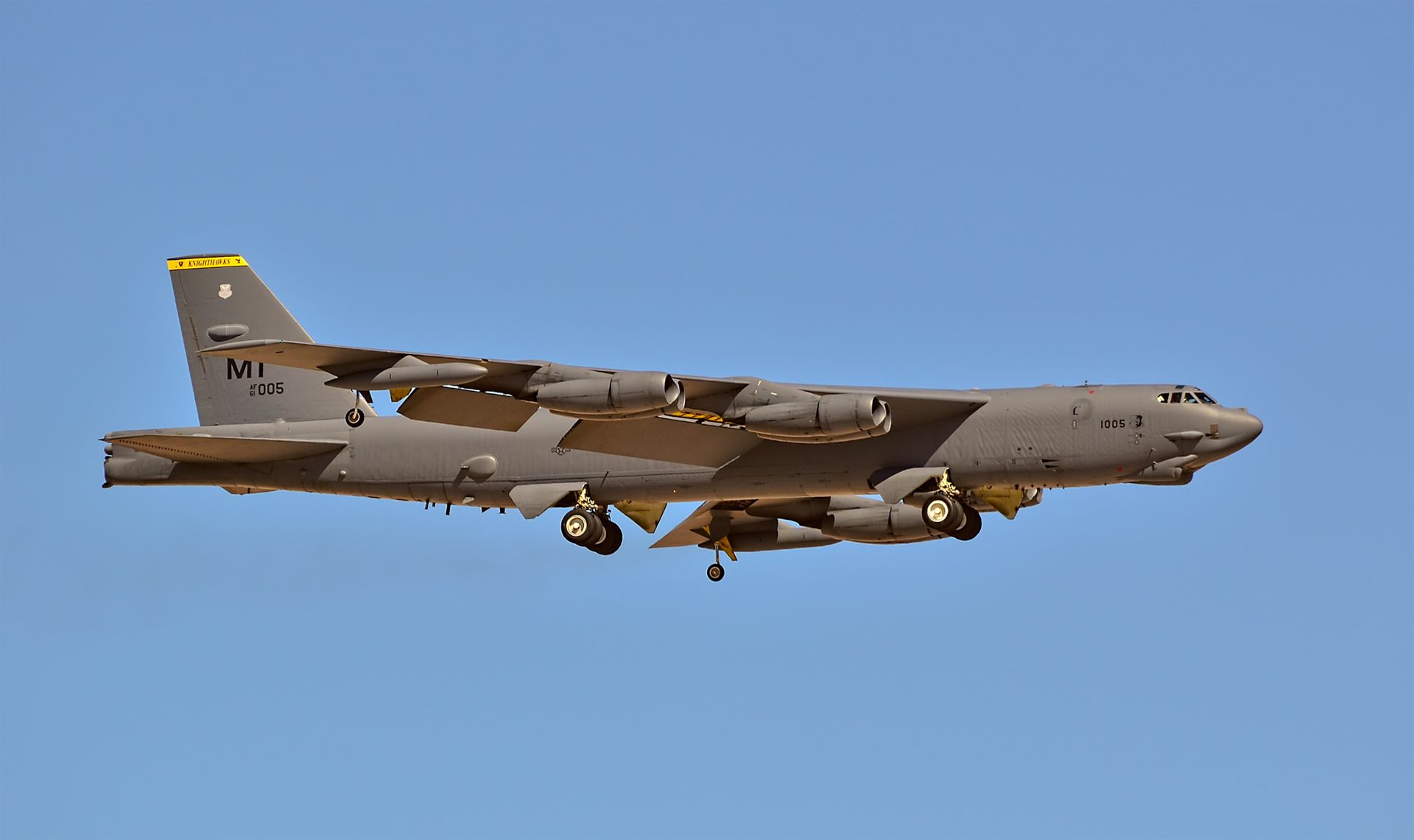
Pictured: a U.S. Air Force B-52H Stratofortress of the same type flown by JAG-31 that night, photographed in 2015 — not the incident aircraft, and not a photograph of the object itself. No photograph of the object was ever taken by any of the ground or air witnesses; the case's only visual/instrument record consists of the B-52's 35mm radarscope film and the ground crews' written and radioed descriptions, so this file illustrates the aircraft type involved rather than the sighting.
Theoretical Alignment
The Minot case earns a moderately elevated ETH alignment for reasons that are unusually well documented compared to most files in this catalogue: a radar return large enough to be flagged as bigger than a KC-135 tanker, a closing maneuver investigators themselves described as covering roughly two and a half miles in three seconds, and two separate, temporally precise UHF radio blackouts that began and ended in exact correlation with the object's proximity on radar. None of that proves an extraterrestrial craft — no propulsion mechanism, occupant, or recovered material was ever documented — but it is a genuinely harder data set to wave away with a single glance than the "lights in the sky" reports that make up the bulk of the historical record. The Psycho-Social Hypothesis scores low but non-zero: the ground witnesses were dispersed across several separate, non-adjacent launch facilities and were not in a position to simply repeat one another's story in real time, yet Lt. Col. Werlich's own investigation shows how quickly a chaotic, multi-hour, multi-witness event can accumulate contradictory or reconstructed detail under institutional pressure to produce a tidy report. The Interdimensional Hypothesis finds essentially nothing to work with here; nothing in the record suggests trans-dimensional or "high strangeness" behavior beyond the object's lights, its radar signature, and its interference with radio equipment.
Background
By October 1968, Minot Air Force Base had grown into one of Strategic Air Command's largest and most strategically significant installations, a dual-mission base covering more than 5,000 acres and hosting roughly 5,700 military personnel. Its two host organizations formed a complete leg of the American nuclear triad in miniature. The 91st Strategic Missile Wing operated 150 LGM-30B Minuteman I intercontinental ballistic missiles, dispersed across roughly 8,500 square miles of surrounding farmland and organized into three squadrons (the 740th, 741st, and 742nd) of five ten-missile flights each, lettered alphabetically. Every Launch Control Facility paired a hardened, manned underground Launch Control Center — staffed around the clock by two Missile Combat Crew Commanders — with unmanned remote Launch Facilities housing the missiles themselves, each ringed by intrusion-detection sensors and periodically visited by security and maintenance teams. The 5th Bombardment Wing (Heavy), the base's other host unit, flew fifteen B-52H Stratofortress bombers and fifteen KC-135 Stratotanker refuelers, maintaining continuous nuclear alert postures capable of launch within ten minutes and flying a steady schedule of training missions — airborne refueling practice, low-level routes, and simulated bombing runs — around the clock.
Nothing about the night of October 23–24, 1968 was scheduled to be unusual. A B-52H, tail number carrying the radio call sign JAG-31, was midway through a routine ten-hour training sortie, its crew — aircraft commander Capt. Don Cagle, copilot Capt. Bradford Runyon Jr., radar navigator Maj. Charles Richey, navigator Capt. Patrick McCaslin, electronic warfare officer Capt. Thomas Goduto, and gunner Technical Sergeant Arlie Judd Jr. — flying with an additional evaluation pilot, Maj. James Partin, aboard to assess the crew's proficiency. Out across the darkened missile field to the base's south and east, ordinary overnight security and maintenance rotations were similarly underway at Oscar Flight and November Flight, where teams were performing scheduled work, including a Target Alignment Team working underground inside a launch facility silo under above-ground security escort. Around 2:15 AM, that routine overnight rhythm was interrupted by the first of what would become a cascade of reports describing a large, glowing, maneuvering object — a sighting that, unlike the great majority of UFO reports from the Blue Book era, would ultimately draw in ground security personnel, missile maintenance technicians, radar approach controllers, and an airborne nuclear-alert bomber crew all within a single, documented three-and-a-half-hour window.
Complete Timeline
| Time (CST) | Event |
|---|---|
| 2:15 AM | A1C R. McDowell and A1C W. Johnson, the Camper Team at Oscar-6 Launch Facility, report a strange light to Flight Security Controller SSgt. William Smith Jr. at Oscar-1 Launch Control Facility. |
| 2:30 AM | Smith personally observes the glowing object near O-6, roughly 15° elevation to the south. Simultaneously, A1C Robert O'Connor and A1C Lloyd Isley of the 91st Minuteman Maintenance Squadron, driving toward November-7 Launch Facility, see a luminous object hovering near the eastern horizon that appears to parallel their truck along the gravel road. |
| 3:00 AM | The Minot Base Operations Dispatcher begins logging radio communications with ground observers across the missile field. |
| 3:08 AM | Flight Security Controller SSgt. James Bond at November-1 Launch Control Facility relays the maintenance team's sighting to Wing Security Control, describing the object as "reddish orange in color, a very large object, with flashing green and white lights." |
| 3:20–3:25 AM | Ground observers at three separate Launch Control Facilities — Oscar, Juliet, and Mike Flights — independently report two similar objects separating in opposite directions and later passing beneath one another before rejoining. |
| 3:30 AM | A1C Joseph Jablonski and A1C Gregory Adams, dispatched from N-1 to N-7, observe a second object identical to the first converging from the east before it disappears; Jablonski separately reports numerous smaller points of light "like shooting stars but they were actually maneuvering," streaming from the object toward Oscar Flight. |
| 3:34 AM | B-52H JAG-31, of the 23rd Bombardment Squadron, requests clearance to the WT TACAN fix at Flight Level 200, roughly midway through a ten-hour training sortie. |
| 3:35 AM | Minot RAPCON radios the B-52 crew: "Look out toward your one o'clock position for the next 15 or 16 miles and see if you see any orange glows out there…Somebody is seeing flying saucers again." Aircraft commander Capt. Don Cagle steps back to the bunk area, leaving copilot Capt. Runyon and evaluation pilot Maj. Partin at the controls. |
| 3:40+ AM | O'Connor and Isley estimate the object at 300–400 yards, "probably as big as a B-52"; Jablonski describes it as "long and slender with lots of lights on it," cycling between white, amber-red, and green, and vanishing and reappearing as it turned. |
| 3:52 AM | RAPCON tells the B-52 crew the object is "being picked up by the weather radar also, should be at your 1:00 position 3 miles now." Runyon replies the crew has "no airborne radar contact" and is "in some pretty thick haze right now." Navigator Capt. McCaslin asks radar navigator Maj. Richey to switch to Station Keep (360°) mode; a return appears roughly 3 miles off the right wing — "a weak return…the next scan, there was a very strong return…It was as big or bigger than a KC-135." |
| 3:53 AM | As the B-52 begins its standard 180-degree turnaround over the WT fix, the radar return moves in step with the aircraft, maintaining a constant three-mile separation — McCaslin later recalls it "moved out at the same rate we were turning in…must've moved 6, 7, 8 miles to the northeast to accommodate the turn we made." The onboard 35mm radarscope camera begins filming. |
| 3:56 AM | B-52 requests, and is cleared for, a routine approach and descent toward Minot AFB. |
| 3:58 AM | The radar return abruptly closes from three miles to one mile in less than a single antenna sweep — roughly two and a half miles in three seconds by Werlich's own later estimate. At the same instant, both of the B-52's UHF transmitters go dead (receivers remain functional). McCaslin: "From one scan to the next…we lost two-way communications with the tower…this thing's one mile off our left wing now…The ability to close 2 miles and stop instantaneously was…something I'd never seen on radar." |
| 3:59–4:00 AM | RAPCON, unaware the crew's transmitters are dead, requests a SIF/IFF "squawk ident" to confirm receipt and separately contacts the Minot control tower to arrange a low approach in case of radio trouble. |
| 4:02 AM | The radar echo disappears roughly 14 nautical miles northwest of the runway at about 9,000 feet, at the same moment the B-52's UHF transmitters begin working again. Runyon, asked whether the object's disappearance coincided with the radio trouble, confirms: "that's exactly when they started." |
| 4:06 AM | B-52 completes a missed approach and turns onto crosswind leg, heading 335°, at 3,200 feet. |
| 4:13 AM | RAPCON asks if the crew is "observing any more UFOs"; the pilots say no. Controller notes "the personnel from the missile sites advise that they don't see anything anymore either." |
| 4:21–4:24 AM | Runyon requests vectors for a surveillance approach with an intended 4:40 AM touchdown. After a further missed approach, an order relayed to the crew directs the B-52 to abandon landing and fly one more pattern specifically to overfly the reported object visually. Runyon later recalled reluctance: "someone told us to go back around and overfly the thing…The request was made after our radios came back in." |
| 4:24–4:26 AM | On downwind leg (heading 290°), Runyon and Partin observe a large, bright orange, glowing object stationary on or near the ground roughly 15 miles distant. Partin's AF-117 statement: "an unusually bright light I had never seen at night in this area…looked like a miniature sun placed on the ground below the aircraft." |
| 4:26 AM | The Base Operations Dispatcher's log notes the object as "direct S/W of N-1 moving north then lights went out." |
| ~4:27 AM | The B-52 turns onto base leg roughly one mile south of, and above, the object. Runyon, banking over it for approximately ten seconds, describes "a dark square, a rectangle and then this red, a dull red around it…a metallic cylinder, sort of like stainless steel or shiny aluminum…a crescent-shaped object attached to the other end of the cylinder," illuminated "just about as if it was daylight," with interior colors he recalls as green and yellow. He estimates the object at roughly 200 feet long, 100 feet wide, and 50 feet high. |
| 4:27–4:28 AM | As the B-52 banks over the object, both UHF transmitters again lose transmission capability mid-word; RAPCON notes the transmission "broke off…in mid-word, not mid-sentence, just the word broke off." McCaslin, relaying the pilots' account: "it was an elliptical shape, kind of a cough drop-shaped thing, glowing orange with a boomerang exhaust, or boomerang-shaped exhaust." |
| 4:40 AM | B-52 completes a full-stop landing. Maj. Partin reports to Base Operations for debriefing as requested; the crew disperses. McCaslin later recalled waking his wife: "You're never going to believe what I saw tonight." |
| 4:49 AM | Both outer-zone and inner-zone intrusion alarms activate simultaneously at Oscar-7 Launch Facility, 24 miles north of the base. SSgt. Smith dispatches Security Alert Team airmen Donald Bajgiar and Vennedall. O'Connor, driving past, observes the site's overhead security lights on and its personnel-access hatch cover standing open. Smith later recalled: "the lock was undone on the gate…we know somebody was on the site." |
| Following days | Brig. Gen. Ralph Holland formally debriefs the full B-52 crew; SSgt. Richard Clark analyzes the radarscope film; the 91st Strategic Missile Wing separately investigates the Oscar-7 break-in. |
| October 28, 1968 | Project Blue Book chief Lt. Col. Hector Quintanilla receives Lt. Col. Werlich's Basic Reporting Data at Wright-Patterson AFB. |
| November 1, 1968 | Quintanilla consults Foreign Technology Division staff; Mr. Goff suggests the sightings "may have been precipitated by some type of ionized air plasma similar to ball lightning." |
| November 13, 1968 | Quintanilla files Blue Book's final case report, attributing ground sightings chiefly to the B-52 aircraft itself and the star Sirius, the radar/radio anomalies to "plasma similar to ball lightning," and the air-visual sighting possibly to the star Vega, a ground light, or plasma; the Oscar-7 break-in is treated as unrelated. "No further investigation by the Foreign Technology Division is contemplated." |
First Light: The Oscar and November Flight Ground Sightings
The chain of events that would become Blue Book Case #12,548 began quietly, in the way most military UFO reports do: with a single junior enlisted team on a routine overnight assignment noticing something that didn't fit the pattern of a normal night on the missile field. At 2:15 AM, Airmen First Class R. McDowell and W. Johnson, the Camper Team providing above-ground security for a Target Alignment Team working inside the silo at Oscar-6 Launch Facility, radioed a strange light to Staff Sergeant William Smith Jr., the Flight Security Controller on duty at Oscar-1 Launch Control Facility. Fifteen minutes later, at 2:30 AM, Smith stepped outside and saw it himself — a glowing object sitting at roughly 15 degrees elevation to the south. At almost exactly the same moment, several miles away, Airman First Class Robert O'Connor and Airman First Class Lloyd Isley of the 91st Minuteman Maintenance Squadron were driving a gravel access road toward November-7 Launch Facility when they noticed a luminous object hovering near the eastern horizon. What made the moment unsettling, in O'Connor's own later account, was not the light's brightness but its behavior: "I noticed that farmer's yard light, and then I saw it raise up and start paralleling our truck going down the road." An object that had briefly looked like an ordinary farmyard light lifted off the ground and began keeping pace with their vehicle.
By 3:00 AM the Minot Base Operations Dispatcher had begun formally logging radio traffic from the field, and eight minutes later Flight Security Controller Staff Sergeant James Bond, on duty at November-1 Launch Control Facility, relayed O'Connor and Isley's report up to Wing Security Control in terms that would recur throughout the night's reporting: "reddish orange in color, a very large object, with flashing green and white lights." Between 3:20 and 3:25 AM the case took its strangest turn yet, when ground observers at three separate, non-adjacent Launch Control Facilities — Oscar, Juliet, and Mike Flights, spread across a wide swath of the missile field — independently reported not one object but two: a pair of similar lights that separated in opposite directions, maneuvered independently for a period, then passed beneath one another and appeared to rejoin. Around 3:30 AM, Airman First Class Joseph Jablonski and Airman First Class Gregory Adams, dispatched from November-1 out to N-7, watched what they took to be a second object, identical to the first, converge from the east on a path that brought it close before it vanished. Jablonski's report added a detail none of the other witnesses mentioned: numerous smaller points of light that he described as "like shooting stars but they were actually maneuvering," appearing to stream from the main object toward Oscar Flight. By 3:40 AM and after, O'Connor and Isley had closed to an estimated 300 to 400 yards from the object and judged it "probably as big as a B-52," while Jablonski, watching from his own vantage point, called it "long and slender with lots of lights on it," cycling between white, amber-red, and green, and repeatedly disappearing and reappearing at different points in the sky as it apparently turned.
JAG-31 Inbound: RAPCON Brings a B-52H Into the Search
While the missile field's ground reports accumulated, a routine training sortie was underway in the sky above. B-52H JAG-31, of the base's 23rd Bombardment Squadron, was roughly midway through a ten-hour training mission, its regular crew — aircraft commander Capt. Don Cagle, copilot Capt. Bradford Runyon Jr., radar navigator Maj. Charles Richey, navigator Capt. Patrick McCaslin, electronic warfare officer Capt. Thomas Goduto, and gunner Technical Sergeant Arlie Judd Jr. — flying with an additional evaluation pilot, Maj. James Partin, along to assess crew proficiency. At 3:34 AM, the crew requested clearance to the WT TACAN fix at Flight Level 200. A minute later, Minot RAPCON's controller made what began as an offhand, half-joking radio call: "Look out toward your one o'clock position for the next 15 or 16 miles and see if you see any orange glows out there…Somebody is seeing flying saucers again." Aircraft commander Cagle, apparently unwilling to spend his own attention on what he took to be a distraction from the training mission, excused himself to the bunk area at the rear of the aircraft, leaving Runyon and the evaluation pilot Partin at the controls — a decision that meant Cagle would miss virtually the entire encounter that followed, and that the aircraft's command authority for the balance of the sortie effectively passed to two men who had not planned on making any consequential decisions that night.
The Radar Encounter: Three Miles, Then One
At 3:52 AM, RAPCON radioed the crew with a more specific claim: the object was "being picked up by the weather radar also, should be at your 1:00 position 3 miles now." Runyon's reply was unpromising for anyone hoping for an easy visual: the crew had "no airborne radar contact" and was "in some pretty thick haze right now." Navigator McCaslin asked radar navigator Richey to switch the aircraft's own AN/ASB-16 radar to Station Keep mode, a 360-degree surveillance setting normally used to monitor for other traffic. What appeared was, in McCaslin's own words, first "a weak return…The next scan, there was a very strong return at that location about 3 miles off our right wing…It was as big or bigger than a KC-135." As the B-52 began its scheduled standard 180-degree turnaround over the WT fix — an entirely routine maneuver, unrelated to the sighting — the radar target did something no aircraft, weather cell, or ground clutter return should do: it moved to preserve its exact three-mile separation from the bomber throughout the turn, tracking the B-52's own change of heading almost in lockstep. McCaslin recalled the return "moved out at the same rate we were turning in…it must've moved 6, 7, 8 miles to the northeast to accommodate the turn we made" — a description of intelligent, formation-holding behavior rather than a fixed ground feature or an independent, uncoordinated aircraft. The crew activated the aircraft's onboard 35mm radarscope camera, and it is this activation, more than any other single decision made that night, that ultimately gave the Minot case its unusually strong evidentiary record: fourteen individual frames of film, rather than memory alone, documenting what the crew's own radar was displaying.
At 3:56 AM the crew requested, and received, clearance for a routine approach and descent toward Minot. Two minutes later, at 3:58 AM, the case's single most cited anomaly occurred. Between one radar antenna sweep and the next — Werlich's own later analysis calculated the interval at roughly three seconds — the return covering three miles collapsed to one mile, a closure of approximately two and a half miles in three seconds, or on the order of 3,000 miles per hour by his estimate. At the identical instant, both of the B-52's UHF radio transmitters went silent; the receivers kept working normally, so the crew could still hear RAPCON, but nothing they said reached the ground. McCaslin's account of the moment carries a rare note of genuine unease from an otherwise procedurally minded crew: "From one scan to the next…at that point, we lost two-way communications with the tower…this thing's one mile off our left wing now…The ability to close 2 miles and stop instantaneously was…something I'd never seen on radar." Copilot Runyon separately recalled that the sudden repositioning visibly startled radar navigator Richey, whose voice over the interphone carried what Runyon read as genuine alarm at the possibility of a collision. Unaware their transmissions weren't getting through, RAPCON asked the crew to "squawk ident" on their IFF transponder to confirm receipt, and separately alerted the Minot control tower to prepare for a possible radio-out low approach. At 4:02 AM, the radar echo vanished from the scope roughly 14 nautical miles northwest of the runway at about 9,000 feet — the same instant the B-52's transmitters came back online. When the controller, reviewing the sequence afterward, asked whether the radio trouble had coincided with the object, Runyon's answer was direct: "that's exactly when they started."
Ordered Back Around: The Visual Overflight
By 4:13 AM, with the radar target gone and no fresh ground reports coming in — RAPCON told the crew "the personnel from the missile sites advise that they don't see anything anymore either" — it would have been entirely reasonable for the encounter to end there, filed away as an unusual but concluded radar anomaly. Instead, in the minutes after the crew's radios came back online following a further missed approach, an instruction reached the B-52 through channels the surviving transcript does not fully identify — Runyon's later recollection places it as coming through after their communications were restored, from someone with the authority to redirect a Strategic Air Command bomber crew mid-pattern — ordering the aircraft to abandon its scheduled landing and fly one additional circuit specifically to overfly the reported object visually. Runyon did not disguise the crew's reluctance: "someone told us to go back around and overfly the thing…The request was made after our radios came back in." Navigator McCaslin's own account captures the crew's mood by that point in a long and increasingly strange night: "They wanted us to go around and do a visual and our pilot was reluctant to do that, but he agreed to go around and take a look…everybody had had about enough of it."
On the downwind leg of that additional pattern, heading roughly 290 degrees, Runyon and evaluation pilot Partin — effectively in command of the aircraft in Cagle's continued absence — saw what neither man had expected: a large, bright orange, glowing object sitting stationary on or near the ground roughly 15 miles ahead. Partin's own AF-117 sighting-report form, filed within days, describes "an unusually bright light I had never seen at night in this area…looked like a miniature sun placed on the ground below the aircraft." The Base Operations Dispatcher's own contemporaneous log, kept independently of the aircrew, records the object at 4:26 AM as sitting "direct S/W of N-1 moving north then lights went out" — a detail that places a ground-based dispatcher watching the same phenomenon from an entirely separate vantage point at effectively the same moment the airborne crew was converging on it visually.
As the B-52 turned onto its base leg roughly one mile south of the object, banking to keep it in view, Runyon had what remains the case's single most detailed direct visual account of any structured craft in this catalogue's Blue Book-era files. Over roughly ten seconds of close observation, he later described "a dark square, a rectangle and then this red, a dull red around it…a metallic cylinder, sort of like stainless steel or shiny aluminum protruding from the end of this thing…a crescent-shaped object attached to the other end of the cylinder," so brightly self-illuminated that "the light illuminating from it had the cylinder completely illuminated just about as if it was daylight." He recalled colors visible from inside the structure rather than merely on its surface: "the colors I saw really weren't on the outside; they were back inside…I could see some lights, and it seems to me like I can remember green and yellow." His estimate of its dimensions — roughly 200 feet long, 100 feet wide, and 50 feet high — would, if accurate, place the object well beyond the size of any aircraft that could plausibly have been airborne, unlit, and unlogged in that airspace that night. As the bomber banked directly over the object, both UHF transmitters failed for a second time; RAPCON's own log captured the failure with unusual precision, noting the transmission "broke off…in mid-word, not mid-sentence, just the word broke off." McCaslin, relaying what the two pilots had seen to the rest of the crew, offered his own paraphrase of their description: "it was an elliptical shape, kind of a cough drop-shaped thing, glowing orange with a boomerang exhaust, or boomerang-shaped exhaust." The B-52 completed its landing at 4:40 AM without further incident. Partin reported directly to Base Operations for the debriefing RAPCON had earlier requested; the rest of the crew dispersed for what remained of the night. McCaslin's own account of arriving home captures, better than any formal report could, just how far outside the ordinary the previous hour had been: he woke his wife and told her, "You're never going to believe what I saw tonight."
The Break-In at Oscar-7
Barely nine minutes after the B-52 touched down, at 4:49 AM, both the outer-zone and inner-zone intrusion-detection alarms activated simultaneously at Oscar-7 Launch Facility, a remote, unmanned Minuteman silo roughly 24 miles north of the base. Security personnel who worked the missile field considered the simultaneous trip of both zones exceptional: the inner-zone sensors were specifically hardened against the kind of routine environmental nuisance trips — wind, wildlife, weather — that more commonly set off the outer perimeter alone. Staff Sergeant Smith immediately dispatched Security Alert Team airmen Donald Bajgiar and Vennedall to secure the site. O'Connor, driving past O-7 on his way back to base, independently noticed the facility's overhead security lighting active and its personnel-access hatch weather cover standing open — an unusual state for an unmanned launch facility with no scheduled maintenance that night. "I saw the light on the missile site…the support building cover was open, the hatch that opened over the top of the combinations for the access…that was open and I thought it very strange," O'Connor recalled. Smith's own memory of the response converged on the same detail: "The key thing if I remember correctly was that the lock was undone on the gate…we know somebody was on the site." Whether the intrusion had any connection to the night's aerial sightings was never established. Lt. Col. Werlich's investigation ultimately floated the possibility of an unauthorized prank by someone with a key — noting, in a later conversation with a Blue Book staff officer, that at least three similar break-ins had occurred at Minuteman sites in the preceding two to three years, several traced to former security personnel — but no investigative conclusion was ever forwarded to Blue Book, and the Oscar-7 intrusion remains, in the case's own official paperwork, one of four occurrences Werlich himself listed as unexplained.
Reporting Up the Chain: SAC, Blue Book, and Lt. Col. Werlich
Because the incident directly involved active nuclear missile-alert facilities and a Strategic Air Command bomber crew, it moved up the SAC chain of command with far more institutional urgency than a typical civilian UFO report. Lt. Col. Arthur Werlich, chief of the 862nd Combat Support Group's Operations Division at Minot AFB, was designated the base's investigating officer under Air Force Regulation 80-17, the standing directive governing UFO report handling. Werlich's investigation moved quickly: Major Partin was debriefed at Base Operations within hours of landing; Staff Sergeant Richard Clark undertook technical analysis of the radarscope film; Brigadier General Ralph Holland personally conducted a formal debriefing of the full B-52 crew; and the 91st Strategic Missile Wing opened its own separate inquiry into the Oscar-7 break-in. By October 28, Werlich had compiled and forwarded his Basic Reporting Data — the standardized preliminary summary AFR 80-17 required — to Blue Book chief Lt. Col. Hector Quintanilla at Wright-Patterson Air Force Base. In his own final assessment forwarded up the chain, Werlich attempted to explain the great majority — by his own estimate, roughly 80 percent — of the ground sightings as misidentifications of the B-52 itself, reasoning that the bomber's varied flight paths across the several hours in question made a coincidental correlation plausible. He nonetheless explicitly identified four separate occurrences he considered impossible to correlate or explain at his level of investigation: the cause of the radar echo itself, the loss of the B-52's UHF transmission capability, the air-visual sighting's rough correspondence in time and place with a ground observation, and the Oscar-7 security break-in.
Werlich's Investigation and Its Critics
Werlich's handling of the case has itself become a significant secondary subject of study, chiefly through the multi-decade research of independent CUFOS-affiliated investigator Thomas Tulien, whose 2023 monograph-length analysis of the full 145-page Blue Book file identifies a series of specific problems with the investigating officer's own methodology and conclusions, independent of what the underlying witnesses actually reported. Tulien's review found that Werlich's report understated the ground sightings' actual starting time, describing the earliest ground observations as beginning around 3:00 AM — the point at which the Base Operations Dispatcher began formally logging radio traffic — when the AF-117 witness statements Werlich had personally collected showed the Oscar-6 Camper Team's first report at 2:15 AM, some 45 minutes before the B-52 even requested its TACAN clearance. That timing discrepancy matters directly to Werlich's own "80 percent was the B-52" explanation for the ground sightings, since it places a substantial share of the earliest and most detailed ground reports well before the aircraft most witnesses would supposedly have misidentified was even airborne in the relevant area, flying, according to the case file, above 20,000 feet with no landing lights active — conditions difficult to reconcile with ground witnesses' consistent description of a low, large, brightly self-luminous object at close range. Tulien's analysis also found that Werlich's early message traffic had acknowledged RAPCON's own weather radar as an independent, corroborating detection of the object alongside the B-52's airborne radar, before his later communications with Blue Book asserted flatly that "only one radar set" had picked it up — a shift in position Tulien's review characterizes as unexplained rather than as a documented correction. Werlich's interview technique drew further scrutiny: in his own follow-up questioning of O'Connor and Isley, he reportedly asked directly whether they had "seen the B-52 come towards the object," a leading formulation critics argue risked shaping the witnesses' recollection toward confirming his preferred explanation rather than eliciting an independent account. Finally, Tulien's reconstruction concludes that Werlich's report conflated two separate events that actually occurred roughly 26 minutes apart — the ground observers' final sighting near N-7, which had concluded by approximately 4:02 AM, and the B-52 crew's later air-visual sighting at 4:24–4:28 AM — treating them in his official narrative as effectively simultaneous and mutually corroborating when the surviving logs place them well apart in time.
Blue Book's Verdict: Sirius, Vega, and "Plasma Similar to Ball Lightning"
Quintanilla's Foreign Technology Division review began on November 1, 1968, when Blue Book staff member Mr. Goff proposed to his chief that "the sightings may have been precipitated by some type of ionized air plasma similar to ball lightning" — a hypothesis that would go on to anchor the case's official resolution twelve days later. Quintanilla's final report, dated November 13, 1968, assigned separate conventional explanations to each component of the night's events: the ground observations were attributed chiefly to misidentifications of the B-52 aircraft itself and, secondarily, the bright star Sirius; the radar return and the coincident UHF radio loss were attributed to "plasma similar to ball lightning"; the B-52 crew's close-range air-visual sighting of a structured, illuminated object was attributed, in descending order of the report's own confidence, to the star Vega, an unspecified ground light, or plasma; and the Oscar-7 security break-in was treated as unconnected to any of the aerial phenomena. The report's closing line left no ambiguity about Blue Book's intent to move on: "No further investigation by the Foreign Technology Division is contemplated."
The explanation has drawn sustained, specific technical criticism in the decades since, most thoroughly from Tulien's own detailed case analysis. Conventional atmospheric ball lightning, as documented in the physics literature, is characteristically a brief phenomenon lasting on the order of seconds, occasionally up to a minute or two under unusual conditions — a duration difficult to reconcile with a radar return that, according to the case file's own timeline, remained intermittently trackable across a period of roughly ten minutes and was independently visible to ground observers for stretches of well over an hour. Ball lightning also has no established mechanism for producing a radar cross-section "as big or bigger than a KC-135," nor any documented capacity to selectively disable an aircraft's UHF transmitters twice, at precisely correlated moments, while leaving its receivers, IFF transponder, and every other electrical system aboard fully functional. The stellar-misidentification component of the explanation drew its own direct rebuttal from the witness closest to the object during its most structured appearance: when later pressed on the Vega explanation for the air-visual sighting, navigator McCaslin's objection was procedural and geometric rather than emotional: "This thing was at or near the ground. How could it be a star if you're looking at the ground?" — a star, however bright, cannot appear below the horizon line from an aircraft banking to look down at a stationary object on the ground. Quintanilla's own later remarks about the broader difficulty of evaluating extended, multi-witness cases like Minot are themselves sometimes cited by researchers as an inadvertent admission of Blue Book's institutional limits: "This business of two hours is too long to make an accurate report," a comment that speaks less to what actually happened over Minot's missile field that night than to how poorly equipped the Air Force's own UFO-evaluation apparatus was, by 1968, to handle a case of this length and complexity on its own terms.
Circumstantial Evidence
- Ten or more named, on-duty U.S. Air Force personnel — missile-field security controllers, maintenance airmen, RAPCON controllers, and a fully qualified "S-crew" B-52H bomber crew — gave substantially consistent, officially documented accounts within days of the encounter.
- The B-52's own radar independently tracked a return that held a constant three-mile separation through a full 180-degree turn before closing to one mile between consecutive antenna sweeps, cross-checked in real time by two qualified crewmen.
- Fourteen 35mm radarscope photographs were taken during the encounter and preserved in the declassified Blue Book case file, a rare instrumented documentary record rather than testimony alone.
- The B-52's UHF transmitters failed twice, both times precisely correlated with the object's closest proximity on radar, while receivers and the IFF transponder remained functional throughout — a pattern independently logged by RAPCON's own ground-based transcript.
- Ground witnesses at three geographically separated Launch Control Facilities independently reported two objects maneuvering together between 3:20 and 3:25 AM, without means to coordinate a shared false account in real time.
- The Base Operations Dispatcher's independent ground log placed an object "S/W of N-1" at 4:26 AM, within minutes of the airborne crew's own visual sighting from an entirely separate vantage point.
- Both outer- and inner-zone intrusion alarms activated simultaneously at Oscar-7 Launch Facility minutes after the B-52 landed, with a subsequently confirmed defeated gate lock — a verifiable security-log fact rather than eyewitness recollection alone.
- Independent researcher Thomas Tulien's decades-long review of the full 145-page Blue Book file documents specific, unaddressed factual and methodological problems in Blue Book's own "plasma"/stellar explanation, rather than resting the case's unresolved status on testimony alone.
Minot's Other UFO History and the Kenneth Arnold Coincidence
The October 1968 case did not emerge from a UFO-free local history. North Dakota news retrospectives and secondary UFO compilations describe an earlier, considerably less rigorously documented report from March 5, 1967, involving a radar-tracked object reportedly hovering over the same missile complex, and a further June 6, 1968 sighting involving military police responding to a report near a missile silo. Neither of these earlier Minot reports approaches the October 1968 case's depth of primary documentation — no comparable AF-117 statement set, radarscope film, or multi-agency investigation survives for either — and this file treats their more dramatic secondary-source details (including claims, sourced only to lower-tier compilations rather than primary Blue Book records, that a missile was found "armed and unlocked in launch mode" during the June 1968 incident) with appropriate skepticism rather than presenting them as established fact alongside the well-documented October case. Separately, researcher Robert Hastings' decades of interviews with retired missile-launch personnel gathered at least one additional, distinct account from a different Minot veteran describing 1960s-era console anomalies during a reported sighting near a launch control facility — a testimony this file notes as a related but separate data point from the specific, well-documented events of October 24, 1968, not a corroborating detail of that particular night.
A stranger, purely historical coincidence ties the city of Minot to the origin of the UFO phenomenon itself. Kenneth Arnold, the private pilot whose June 24, 1947 sighting of nine fast-moving objects near Mount Rainier gave the world the term "flying saucer," spent part of his childhood and school years in Minot, North Dakota, according to North Dakota's own public broadcasting service. Two decades before the term Arnold's sighting popularized would be applied to events over his old hometown's own missile field, the future father of the "flying saucer" era was, by all accounts, just another Minot schoolboy — a footnote researchers occasionally cite as one of the odder small-world coincidences in American UFO history, though not one that carries any evidentiary weight for the 1968 case itself.
Legacy: The Minot Case in UAP Research Today
Minot has become, within the specific sub-field of nuclear-facility UAP research, one of the two or three most frequently cited case studies, alongside the March 1967 Malmstrom Air Force Base incidents. Robert Hastings' research book UFOs & Nukes: Extraordinary Encounters at Nuclear Weapons Sites, built from more than four decades of interviews with over 170 retired military personnel, treats Minot as a key data point in his broader argument that unidentified objects have repeatedly appeared at American nuclear weapons facilities since the earliest years of the Cold War; Hastings organized a landmark September 2010 National Press Club conference in Washington, D.C. at which several former missile-launch officers, though not Minot veterans specifically, testified publicly for the first time about similar experiences at other SAC bases. Independent researcher Thomas Tulien's own multi-decade documentation project — beginning with a May 2000 interview with copilot Bradford Runyon and culminating in a full, publicly hosted archive of primary-source Blue Book documents, radar analyses, and a detailed narrative reconstruction — represents, by a considerable margin, the single most thorough independent investigation the case has ever received, and has been formally credited by the Center for UFO Studies for its methodological rigor. More recently, the case has drawn renewed attention amid the broader 2020s wave of Congressional and public interest in UAP disclosure, cited by contemporary UAP journalism outlets as a benchmark example of what a well-documented, multiply-corroborated military case looks like on paper, whatever one ultimately concludes about the object's true nature.
Key Witnesses
A1C Robert O'Connor
One of the first two ground witnesses, O'Connor watched a light he first mistook for a farmyard lamp lift off and pace his and Isley's truck along a gravel road near November-7 Launch Facility around 2:30 AM. He and Isley later closed to an estimated 300–400 yards and judged the object "probably as big as a B-52." O'Connor also independently observed the Oscar-7 launch facility's open access hatch and active security lighting minutes after the B-52 landed.
A1C Lloyd Isley
Traveling with O'Connor toward November-7 Launch Facility, Isley independently corroborated the object's size, proximity, and pacing behavior, and separately reported hearing a sound resembling jet engines and watching the object's color shift from white to green to dim amber during his own extended overnight observation.
SSgt. William Smith Jr.
The first NCO to receive a ground sighting report, at 2:15 AM, and to observe the object himself fifteen minutes later. Smith coordinated the Security Alert Team's response to the Oscar-7 intrusion alarm at 4:49 AM and personally confirmed the site's gate lock had been defeated, one of the case's clearest documented physical-security anomalies.
A1C Joseph Jablonski
Dispatched from November-1 to N-7 around 3:30 AM, Jablonski independently reported a second object converging from the east and, uniquely among the ground witnesses, described numerous smaller points of light "like shooting stars but they were actually maneuvering" streaming from the main object toward Oscar Flight.
Capt. Bradford Runyon Jr.
Effectively in command of the aircraft after Capt. Cagle withdrew to the bunk area, Runyon gave the case's single most detailed direct visual account of any structured object in this archive's Blue Book-era files, describing a metallic cylindrical section, a crescent-shaped attachment, and internally lit green and yellow coloring during a roughly ten-second low pass. Decades later, researcher Thomas Tulien's May 2000 interview with Runyon became the seed of the most detailed independent investigation the case has ever received.
Capt. Patrick McCaslin
The B-52's most extensively quoted crew member, McCaslin directed radar navigator Richey to Station Keep mode, tracked the anomalous return through the aircraft's 180-degree turn and its instantaneous one-mile closure, and later flatly rejected Blue Book's proposed stellar explanation for the air-visual sighting on simple geometric grounds: a star cannot appear below an aircraft looking down at the ground.
Maj. Charles "Chuck" Richey
Operating the aircraft's AN/ASB-16 radar from Station Keep mode, Richey produced the return McCaslin described as "as big or bigger than a KC-135" and activated the 35mm radarscope camera that recorded fourteen surviving frames of film — the case's single strongest piece of instrumented documentary evidence. Copilot Runyon recalled Richey's own voice carrying genuine alarm when the return closed to one mile in a single sweep.
Maj. James Partin
Aboard to assess the crew's proficiency, Partin found himself effectively sharing command of the aircraft after Capt. Cagle withdrew, and was one of the two pilots who visually observed the stationary, glowing object during the low overflight. His signed AF-117 statement — describing "a miniature sun placed on the ground below the aircraft" — is among the case's primary surviving documents, and he was the first crew member formally debriefed at Base Operations after landing.
Lt. Col. Arthur Werlich
Designated under Air Force Regulation 80-17 to investigate the incident, Werlich compiled witness statements, radarscope film, and radio transcripts into a 145-page report forwarded to Project Blue Book. He explicitly identified four occurrences — the radar echo, the UHF radio loss, the air-visual/ground-visual correlation, and the Oscar-7 break-in — as unexplained at his level, even as his own methodology, timeline, and witness-interview technique later drew documented criticism from independent researchers.
Lt. Col. Hector Quintanilla
Received Werlich's report on October 28, 1968 and issued Blue Book's final case disposition on November 13, attributing the ground sightings to the B-52 and the star Sirius, the radar and radio anomalies to "plasma similar to ball lightning," and the air-visual sighting to Vega, a ground light, or plasma. His own acknowledgment that "two hours is too long to make an accurate report" is frequently cited by researchers as evidence of Blue Book's institutional limits in evaluating extended, multi-witness cases.
The Five Observables Assessment
The Five Observables framework, developed by former AATIP director Luis Elizondo, is used to classify UAP encounters by performance characteristics exceeding known technology of their era:
Assessment: Instant Acceleration is rated present because it is the one observable in this case actually captured on an instrument rather than inferred from testimony: the B-52's own radarscope recorded a return closing roughly two and a half miles between consecutive antenna sweeps, a closure rate Lt. Col. Werlich's own analysis calculated at approximately 3,000 miles per hour, cross-checked in real time by two qualified crew members. Anti-Gravity Lift is rated only speculative: O'Connor's account of the object "raising up" off the ground to pace his truck implies a form of unpowered or silent lift, but no witness described the specific liftoff moment in enough mechanical detail to distinguish genuine anti-gravity behavior from a simple, if unusually smooth, vertical climb. Hypersonic Velocity is likewise rated speculative rather than present: a calculated 3,000 mph closing speed is extraordinary for any known 1968 aircraft but falls short of the conventional hypersonic threshold (roughly Mach 5, or about 3,800 mph at altitude), and the estimate itself rests on a single radar-sweep interval rather than a sustained, independently verified track. Low Observability is rated absent: every account, ground and airborne, describes a brightly self-luminous, highly conspicuous object, the opposite of a stealthy signature. Trans-Medium travel is rated absent, as no witness reported any transition between air, land, or water.
Evidence Assessment
Supporting Anomalous Origin
- Ten-plus independent, on-duty military witnesses, spread across geographically separated locations, gave consistent, near-immediate, officially documented accounts.
- A radar return exhibited formation-holding behavior through a 180-degree turn and then closed roughly two and a half miles in three seconds — an instrumented, not merely testimonial, anomaly.
- Fourteen radarscope photographs survive as a rare instrumented documentary record of the encounter.
- Two precisely correlated UHF radio failures, independently logged by RAPCON, align exactly with the object's closest approach on radar on both occasions.
- The Base Operations Dispatcher's independently kept ground log corroborates the airborne crew's visual sighting in both time and general location.
- The Oscar-7 intrusion-alarm activation and defeated gate lock represent a verifiable physical-security anomaly, documented independently of any single witness's testimony.
- Independent researcher Thomas Tulien's detailed technical review identifies specific, unaddressed weaknesses in Blue Book's own official explanation, rather than the case resting purely on unresolved-by-default status.
Supporting Conventional Explanation
- Lt. Col. Werlich's contemporaneous investigation attributed roughly 80 percent of ground sightings to the B-52 aircraft itself, a mundane explanation offered by the officer with the fullest access to the case's full body of evidence.
- Project Blue Book's Foreign Technology Division formally attributed the radar and radio anomalies to atmospheric plasma and the visual sightings to bright stars, a conventional explanation the Air Force never retracted.
- No independent civilian radar, camera, or sensor system outside RAPCON and the B-52's own equipment corroborated the encounter, leaving the case dependent on military-internal instrumentation and testimony.
- The case's overnight, multi-hour, multi-location structure creates genuine opportunities for witnesses to have observed several different, unrelated stimuli — the B-52 itself, bright stars, ground lights, and a genuine anomaly — that were later merged into a single narrative, a possibility Werlich's own report explicitly raised.
- Werlich's own timeline and interview technique have been documented as methodologically flawed, but flaws in the investigation do not, by themselves, prove the underlying sightings were anomalous rather than conventional.
Why "Credible"
The Minot AFB Incident earns a CREDIBLE rating on this site's scale because it combines an unusually wide and technically qualified witness pool with a rare, multiply-instrumented data set, while stopping short of the independent, non-military corroboration that would justify a "Verified" rating. On the strength side: ten or more on-duty Air Force personnel, spread across geographically separated locations and unable to coordinate a shared account in real time, reported closely matching phenomena within a single documented window; two qualified aircrew members cross-checked an anomalous, formation-holding, instantaneously closing radar return in real time and preserved fourteen frames of radarscope film to document it; two separate UHF radio failures, independently logged by ground controllers, correlated precisely with the object's closest radar approach on both occasions; and independent researcher Thomas Tulien's decades-long, document-level review of the full 145-page Blue Book file has identified specific, still-unaddressed factual and procedural problems with the Air Force's own "plasma"/stellar explanation, rather than the case's unresolved status resting on vague suspicion alone. On the other hand, the case lacks any corroboration from outside the military chain of command — no independent civilian radar, camera, or witness ever confirmed any part of the encounter — and Blue Book's own investigating officer attributed the large majority of the ground sightings to the B-52 aircraft itself, an explanation that, however contested in its details, was never formally withdrawn by the Air Force. That combination — an unusually broad, credentialed, and partially instrumented body of evidence, set against genuine investigative gaps and a real if disputed official conventional explanation — places Minot solidly in "credible" territory: one of the most thoroughly paper-trailed UAP cases in the entire Blue Book archive, but not a closed case in either direction.
Sensor & Instrumentation Detection Profile
Few UFO cases in the Blue Book archive combine as many independent instrumented data streams as Minot. The B-52H's own AN/ASB-16 bombing-navigation radar, operated from the radar navigator's station by Major Charles Richey and read out to the rest of the crew by navigator Captain Patrick McCaslin, produced a return McCaslin described switching from "a weak return" to "a very strong return…about 3 miles off our right wing…as big or bigger than a KC-135" within a single antenna sweep. Minot RAPCON's ground radar simultaneously carried what controllers told the crew was a corroborating "weather radar" paint at the same position — a claim Lt. Col. Werlich's own subsequent reporting first acknowledged and then, according to later analysis of his message traffic, effectively dropped, insisting to Blue Book that "only one radar set" had detected the object. A 35mm radarscope camera aboard the B-52 recorded the encounter on film; fourteen individual frames survive in the Blue Book case file and were later analyzed by Staff Sergeant Richard Clark and, decades afterward, by independent radar specialists including Martin Shough and Claude Poher. The aircraft's own UHF transmitters constitute a second, entirely separate instrumented channel: both radios stopped transmitting — while continuing to receive normally — during the two closest-approach windows, first as the radar return closed from three miles to one mile around 3:58–4:02 AM, and again as the crew banked low over the stationary object around 4:27–4:28 AM, with transmission capability returning within seconds of each departure. The aircraft's IFF/SIF transponder was unaffected throughout, a detail investigators have cited on both sides of the case: as evidence the anomaly was narrowly targeted at voice transmission rather than a blanket electronics failure, and, for skeptics, as evidence against any exotic electromagnetic-pulse explanation broad enough to also disable a transponder.
Environmental & Geospatial Context
Late October in north-central North Dakota is reliably clear and cold, and October 24, 1968 was no exception: ground witnesses across the 91st Strategic Missile Wing's dispersed launch complex reported good visibility and dark, largely cloudless skies, while the B-52 crew, operating at higher altitude near their WT TACAN fix, noted patchy haze thick enough that copilot Runyon told RAPCON the aircraft had "no airborne radar contact" on the object at one point despite the ground-based returns. Geospatially, the case unfolds across a strikingly large and disaggregated area: the 91st Strategic Missile Wing's 150 Minuteman I launch facilities were dispersed across roughly 8,500 square miles of farmland surrounding Minot Air Force Base, organized into fifteen ten-missile flights lettered A through O. The initial ground sightings converged on Oscar Flight and November Flight, in the missile field's southern and eastern sectors, while the B-52's own flight path carried the radar and radio anomalies along a corridor running from the WT fix north of the base, through the standard traffic pattern, and out to the Oscar-7 launch facility roughly 24 miles north of the base where the final alarm activation occurred — a wide enough geographic spread that no single stationary observer could have seen the entire sequence of events, a structural fact of the case that later fed both its credibility (independent, geographically separated witness clusters) and its central investigative controversy (whether disparate reports were actually describing the same object at all).
Observer Credibility & Occupational Profile
Every primary witness in the Minot case was an active-duty U.S. Air Force service member performing an assigned operational duty at the moment of the sighting, a witness pool the Air Force's own Strategic Air Command took seriously enough to launch a same-week formal investigation. On the ground, missile maintenance technicians Airman First Class Robert O'Connor and Airman First Class Lloyd Isley of the 91st Minuteman Maintenance Squadron, security controller Staff Sergeant William Smith Jr., and security airmen Airman First Class Joseph Jablonski and Airman First Class Gregory Adams were all performing routine, assigned missile-field duties — none had sought out a UFO sighting, and several were actively engaged in escorting a Target Alignment Team through sensitive underground maintenance work at the moment their reports began. Aboard the B-52H, the witness pool carried unusually heavy technical qualification for a UFO case: aircraft commander Capt. Don Cagle, copilot Capt. Bradford Runyon Jr., radar navigator Maj. Charles Richey, navigator Capt. Patrick McCaslin, electronic warfare officer Capt. Thomas Goduto, gunner Technical Sergeant Arlie Judd Jr., and evaluation pilot Maj. James Partin were all qualified, currently flying Strategic Air Command aircrew, holding the wing's highest "S-crew" (Select Crew) certification at the time of the encounter. Overseeing the investigation was Lt. Col. Arthur Werlich, chief of the base's Combat Support Group Operations Division, whose own competence and thoroughness later became a genuine subject of scholarly dispute (discussed below) independent of the witnesses' own credibility.
Physical & Material Assays
No debris, landing trace, or recoverable material connected to the object itself was ever collected, and no participant in the case has ever claimed otherwise. What the Minot case does possess, unusually, is a rare category of quasi-physical instrumented evidence: the fourteen 35mm radarscope photographs taken aboard the B-52, which recorded the radar return's position, size, and movement on film rather than relying on crew memory alone, and which remain available today as digitized frames in the declassified Blue Book file. A second, more circumstantial physical data point is the Oscar-7 launch facility's own security hardware: Werlich's investigation confirmed that both the outer-zone and inner-zone intrusion-detection systems activated simultaneously at 4:49 AM — an occurrence security personnel considered exceptional, since the inner-zone sensors were environmentally hardened against routine nuisance trips — and that the facility's personnel-access gate was subsequently found unlocked. Neither the film nor the Oscar-7 hardware fault was ever linked to the object by any laboratory test, and Werlich's own report explicitly declined to connect the break-in to the UFO reports, floating an unauthorized-prankster explanation instead; but both remain, unlike the bulk of the ground testimony, verifiable technical and security-log facts rather than eyewitness recollection alone.
Historical Precedents & Archive Matches
Minot sits within a recognizable cluster of Cold War-era reports describing unidentified objects near American nuclear weapons infrastructure, a pattern this site catalogues extensively elsewhere. It shares its core structure — missile-field security personnel reporting an object, followed by an official Strategic Air Command investigation — with the March 1967 Malmstrom Air Force Base incidents, in which all ten missiles of two separate Minuteman flights dropped to "No-Go" status within seconds of security guards reporting hovering objects; researcher Robert Hastings, who later built much of his four-decade nuclear-UAP research program around both bases, treats the two incidents as closely related data points in the same broader pattern. Minot's own local UFO history predates October 1968: North Dakota news accounts and secondary UFO compilations describe an earlier, far less rigorously documented report on March 5, 1967 of a radar-tracked object over the same missile complex, and a June 6, 1968 missile-silo sighting involving military police — neither approaching the October 1968 case's level of multi-witness, multi-instrument documentation, and both resting on considerably thinner sourcing that this file treats with correspondingly greater caution. In a coincidence noted by North Dakota's own public broadcasting service, Kenneth Arnold — whose June 1947 sighting near Mount Rainier coined the term "flying saucer" and opened the modern UFO era — spent his own childhood and school years in Minot, giving the city an odd historical bookend relationship to the phenomenon two decades before its own missile field made national UFO history.
Material Analysis
The Minot case produced no debris, landing trace, or recoverable material connected to the object itself, and no witness or investigator has ever claimed otherwise. Its physical evidentiary record instead rests on two categories of documented, verifiable secondary evidence. The first is the fourteen 35mm radarscope photographs taken aboard the B-52, a form of instrumented documentation rarer in the UFO literature than eyewitness testimony and preserved today in the declassified case file rather than relying on crew memory. The second is the Oscar-7 Launch Facility's own security hardware record: the simultaneous activation of both outer- and inner-zone intrusion alarms, and the subsequently confirmed defeated gate lock, represent a verifiable technical/security-log fact independent of any single witness's account, even though its connection to the night's aerial sightings was never established. Neither category of evidence was ever submitted for laboratory testing in the way a physical sample might be, since neither produced a substance or artifact that could be analyzed; their evidentiary value instead rests on being documented instrument and security-system records rather than purely subjective recollection.
Supporting a Genuine Anomalous Effect
- The radarscope photographs document the return's position and behavior on film, independent of witness memory, and have been reviewed by multiple independent radar analysts over the decades.
- The Oscar-7 alarm activation was severe and unusual enough — both zones tripping simultaneously, with a defeated gate lock — that security personnel treated it as categorically different from routine nuisance trips.
- The two UHF radio failures align precisely, on both occasions, with the object's closest approach on radar, a temporal correlation independently logged by RAPCON rather than reconstructed from crew memory alone.
Supporting a Mundane Origin
- Lt. Col. Werlich's own investigation suggested the Oscar-7 break-in was likely an unauthorized prank by someone with a key, noting several similar incidents at other Minuteman sites in the preceding years unconnected to any UFO report.
- No independent electromagnetic-field measurement was taken during either radio failure, leaving the causal link between the object and the UHF anomaly inferential rather than directly measured.
- Radar returns and radio dropouts can, under some atmospheric and equipment-fault conditions, arise from mundane causes unrelated to any object, a possibility Blue Book's plasma explanation was intended to capture even if its specific technical fit to this case remains contested.
Conventional Explanation Candidates
Three distinct conventional explanations have been formally or informally proposed for different components of the Minot case, and each deserves separate evaluation on its own terms rather than being treated as a single unified theory.
Misidentification of the B-52 Itself (Ground Sightings)
Partially Plausible, IncompleteLt. Col. Werlich's own contemporaneous investigation proposed that roughly 80 percent of the ground sightings could be explained by witnesses observing the B-52 aircraft's own lights during its several hours of flying varied courses in the vicinity, at times low enough or oriented such that its position lights might have appeared unusually bright or colorful against the night sky. This candidate deserves serious consideration because it was offered by the investigating officer with the fullest contemporaneous access to flight logs, radio transcripts, and witness statements, and because a training aircraft genuinely was airborne in the area for much of the relevant window. Its central weakness, identified by Thomas Tulien's later document-level review, is timing: the earliest and most detailed ground sightings, including O'Connor and Isley's close-range observation of an object pacing their vehicle at low altitude, began around 2:15 AM, roughly ninety minutes before the B-52 even requested its TACAN clearance, and the aircraft flew above 20,000 feet with no landing lights active for the relevant portion of its sortie — conditions difficult to reconcile with witnesses' consistent description of a large, low, brightly self-luminous, maneuvering object at close range.
Stellar Misidentification: Sirius and Vega
Partially Plausible, IncompleteBlue Book's final report proposed the bright star Sirius as a partial explanation for some ground sightings and Vega as one of three possible explanations for the B-52 crew's air-visual sighting. Bright stars low on the horizon can, under certain atmospheric conditions, exhibit noticeable scintillation and color-shifting that inexperienced observers sometimes misread as a maneuvering object, and this explanation deserves consideration as a genuine contributing factor for at least some of the night's more distant, less detailed ground reports. It fails badly, however, as an explanation for the case's most detailed and technically corroborated components: navigator McCaslin's direct objection that "this thing was at or near the ground" during the air-visual sighting is a straightforward geometric problem no star, however bright, can resolve, since a celestial object cannot appear below an aircraft's own altitude looking downward at a fixed point on the ground. Nor does stellar misidentification offer any mechanism whatsoever for the case's radar return, its formation-holding behavior through the B-52's turn, or its precisely correlated UHF radio failures.
Atmospheric Plasma / Ball Lightning
Partially Plausible, IncompleteProject Blue Book's Foreign Technology Division ultimately settled on atmospheric plasma, "similar to ball lightning," as its explanation for the radar return and the UHF radio anomalies — the case's two most rigorously instrumented components. This candidate deserves serious evaluation because genuine atmospheric plasma phenomena are documented, if poorly understood, and because some anecdotal reports do associate ball lightning with localized electromagnetic interference. It nonetheless fails on both duration and scale: well-documented ball lightning events typically last on the order of seconds to at most a minute or two, far shorter than the roughly ten-minute radar-trackable window and the more than hour-long ground-visible duration described in the Minot case, and no established ball-lightning mechanism accounts for a radar cross-section "as big or bigger than a KC-135" or for two discrete, precisely time-correlated failures of an aircraft's UHF transmitters specifically, while leaving receivers and IFF equipment fully functional on both occasions.
Each candidate offers a genuine, non-trivial contribution to explaining isolated fragments of a long, multi-witness, multi-location night — but none, individually or combined, accounts for the case's full instrumented core: the radar's formation-holding turn behavior, its instantaneous one-mile closure, the twice-repeated and precisely correlated UHF failures, and Runyon's close-range structured-object description, leaving the Air Force's own official explanation formally unretracted but substantively contested.
Related Cases
Confirmed Documents & Official Records
National Archives finding aid covering UAP-related textual holdings, including the microfilmed Project Blue Book case files — the ultimate archival source of the Minot case's official Blue Book Case #12,548 documentation.
UNCLASSIFIEDResearcher Thomas Tulien's complete digitized set of the 145-page Blue Book case file, including AF-117 witness statements, the Base Operations Dispatcher log, recorded radio transcripts, and all 14 surviving B-52 radarscope photographs.
DECLASSIFIEDSearch Government Archives Directly
Further Reading — Recommended Literature
UFOs & Nukes: Extraordinary Encounters at Nuclear Weapons Sites
The definitive book-length treatment of UFO reports at American nuclear missile and bomber bases, built from over four decades of interviews with 170-plus retired military personnel, including testimony connected to Minot AFB.
UFOs and Government: A Historical Inquiry
A scholarly, four-plus-year research effort documenting how the U.S. government handled UFO reports from WWII through the 2000s, including detailed treatment of the Project Blue Book era in which the Minot case was investigated.
The Hynek UFO Report
Written by Project Blue Book's own longtime scientific consultant, distilling 12,000-plus Blue Book sightings into a critical evaluation of how the Air Force classified and dismissed cases like Minot.
Project Blue Book Exposed
A twenty-year study of declassified Project Blue Book files, useful context for understanding the institutional pressures and shortcuts — like those documented in Lt. Col. Quintanilla's handling of Minot — that shaped the program's official case dispositions.
The UFO Encyclopedia, 4th Edition
The definitive UFO reference work, situating the Minot case within the broader history of Blue Book-era military radar-visual encounters and nuclear-facility UAP reports.
Essential Viewing
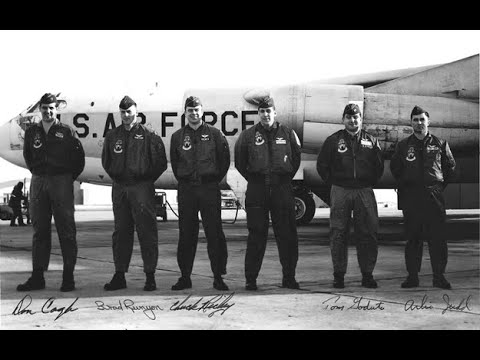
AudioBlog: A 1968 UFO Incident at Minot AFB
Podcast UFO's dedicated case walkthrough covering the ground sightings, the B-52 radar encounter, and the Blue Book investigation.
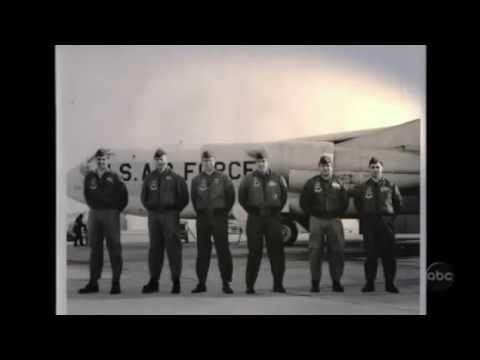
Minot Air Force Base UFO
A focused overview of Blue Book Case #12,548, covering the ground and air-visual sightings.

The Minot Air Force Base UFO Incidents
A retrospective covering Minot's broader 1960s UFO history alongside the well-documented October 1968 case.

Minot AFB UFO Case
A case-file review covering the B-52 radar encounter and the Oscar-7 launch facility break-in.

1968 UFOB Case: Minot AFB Incident in North Dakota
A concise case-library summary covering the timeline, radar encounter, and official Blue Book disposition.
Sources
- Tulien, Thomas. "The Minot AFB UFO Case, 24 October 1968" — full documentation site, narrative, background, and investigation analysis. minotb52ufo.com
- Tulien, Thomas. "Narrative of UFO Events at Minot AFB on 24 October 1968." minotb52ufo.com
- Tulien, Thomas. "Background: Minot AFB, the 91st Strategic Missile Wing, and the 5th Bombardment Wing." minotb52ufo.com
- Tulien, Thomas. "Investigation of UFO Events at Minot AFB on 24 October 1968." minotb52ufo.com
- Tulien, Thomas. "Section 5: Reviewing Werlich's Data and Conclusions." minotb52ufo.com
- Tulien, Thomas. "Section 6: Project Blue Book Evaluation." minotb52ufo.com
- Tulien, Thomas. "Documentation" (primary-source PDF archive: AF-117 forms, Blue Book final case report, radarscope photographs, message traffic). minotb52ufo.com
- Tulien, Thomas. "The Investigation of UFO Events at Minot Air Force Base, North Dakota." Zenodo preprint, DOI 10.5281/zenodo.8331502, September 9, 2023. zenodo.org
- Tulien, Thomas. "A Narrative of UFO Events at Minot Air Force Base, North Dakota." Academia.edu. academia.edu
- Tulien, Thomas. "The Investigation of UFO Events at Minot Air Force Base, North Dakota." Academia.edu. academia.edu
- UAPedia. "Minot Air Force Base Incident (1968)." uapedia.ai
- The Debrief. "The Minot Air Force Base UFO Incident." thedebrief.org
- InForum (Fargo Forum). "'68 UFO Run-In at North Dakota Air Base Still Unresolved." inforum.com
- Above the Norm News. "The 1968 Minot Mystery: When a UFO Stalked a Nuclear Base," September 29, 2024. abovethenormnews.com
- Minot Daily News. "Minot's Age of UFOs," December 2016. minotdailynews.com
- Prairie Public. "Minot UFOs Return," Dakota Datebook, May 29, 2022. news.prairiepublic.org
- Podcast UFO. "A 1968 UFO Incident at Minot AFB" (Part 1). podcastufo.com
- Podcast UFO. "Part 2: A 1968 UFO Incident at Minot AFB." podcastufo.com
- Podcast UFO. "Part 3: A 1968 UFO Incident at Minot AFB." podcastufo.com
- ufocasebook.com. "1968 — Minot Air Force Base, UFO Hovers, Seen by B-52 Crew." ufocasebook.com
- ufocasebook.com. "UFO Incidents over Minot AFB, ND, 1967, 1968" (earlier, less-documented sightings). ufocasebook.com
- Center for UFO Studies (CUFOS). "Thomas Tulien" researcher biography. cufos.org
- Sign Oral History Project (Thomas Tulien). "Project Blue Book," History of the United States Air Force UFO Programs. sohp.us
- Grand Forks Herald. "Author Says UFOs Track Nuclear Arms Race, Cites Minot AFB Incident." grandforksherald.com
- Hastings, Robert. UFOs & Nukes: Extraordinary Encounters at Nuclear Weapons Sites, 2nd Edition, 2017 (case discussion and interview material).
- Clark, Jerome. The UFO Encyclopedia, 4th Edition, Visible Ink Press, 2023 (entry on the Minot AFB case).
- National Archives (NARA). "UAP Textual and Microfilm Records Research Guide" (Project Blue Book microfilm holdings). archives.gov
See something inaccurate? Have additional information or sources?
Suggest an Edit →Last Updated: August 2026