
The Malmstrom AFB Missile Shutdowns
On the morning of March 16, 1967, all ten Minuteman I nuclear missiles of Echo Flight at Malmstrom Air Force Base, Montana, dropped into "No-Go" status within seconds of one another, minutes after a security guard radioed a report of a large, glowing object hovering over one of the flight's remote launch facilities. Eight days later, in the early hours of March 24, 1967, it happened again: at Oscar Flight, roughly 40 miles away, deputy missile combat crew commander 1st Lt. Robert Salas was awakened by his commander, Capt. Fred Meiwald, after security teams reported fast-moving lights and then a glowing red-orange oval object hovering silently over the launch control facility's front gate — and, within minutes, missiles under Salas's command began dropping offline as well. A classified Boeing engineering investigation found no conventional hardware failure sufficient to explain either event. The U.S. Air Force has offered shifting explanations ever since — electrostatic noise in 1967, a "cascading transformer failure" from AARO in 2024, and a classified electromagnetic-pulse test according to 2025 reporting — while researcher Robert Hastings and Salas himself have spent decades arguing the record supports a genuine and still-unexplained UAP encounter. The case is complicated by a real, unresolved conflict in the witness record itself: Echo Flight's own crew, Capt. Eric Carlson and 1st Lt. Walt Figel, have given contradictory accounts of whether a UFO was reported there at all, a dispute carried forward publicly by Carlson's own son.
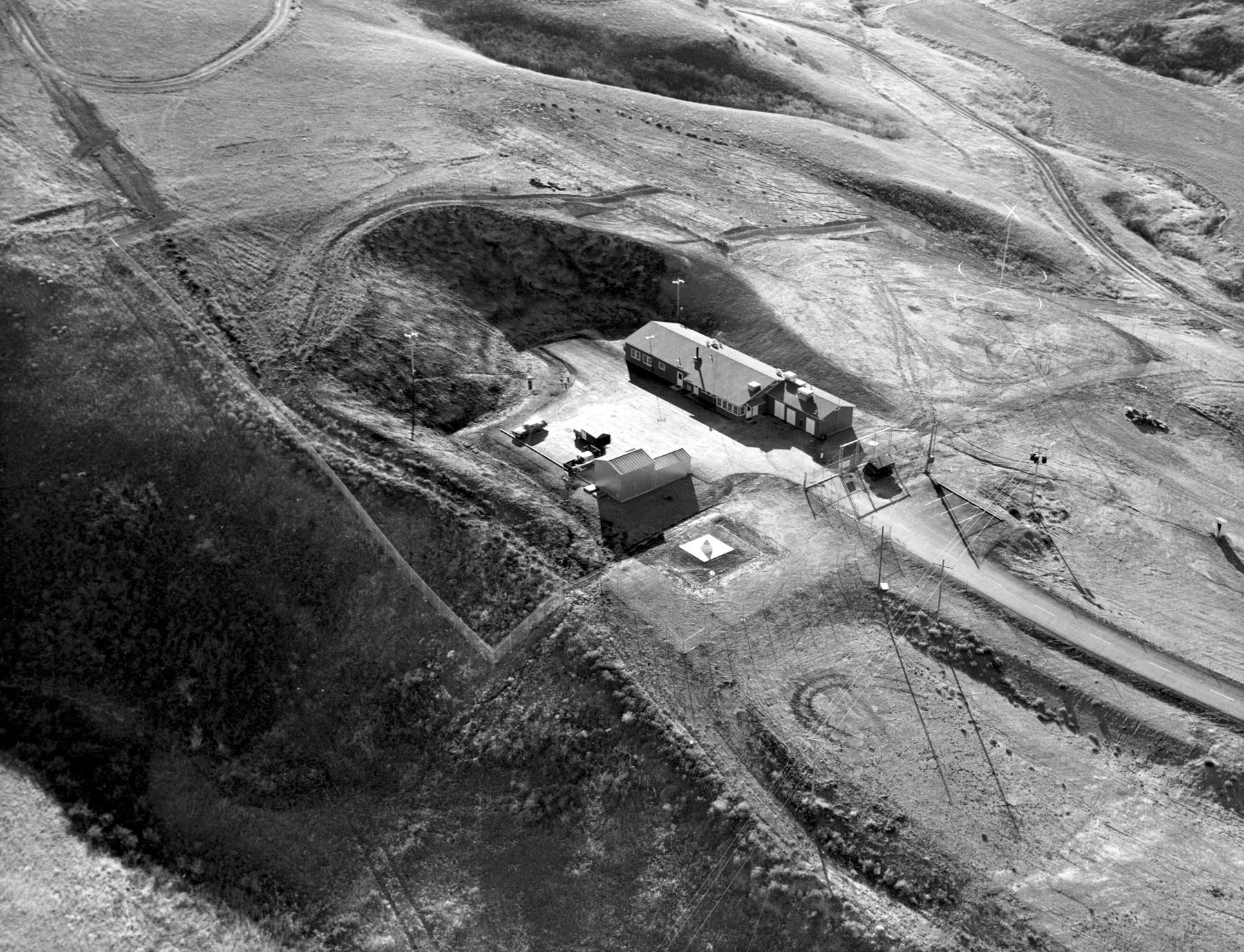
Pictured: a U.S. Air Force aerial photograph of a completed Minuteman launch control facility at Malmstrom, the same style of hardened, partially underground site as Echo and Oscar Flight — not a photograph of either flight specifically, and not documentation of the March 1967 shutdowns or the hovering object reported there. No photograph of the object itself was ever taken; the only imagery connected to the incidents is this kind of routine engineering/facility documentation of the hardware involved.
Theoretical Alignment
The Malmstrom case earns a moderate ETH score primarily on the strength of its human testimony — multiple credentialed, on-duty missile officers and security personnel across two separate flights independently describing a hovering luminous object in close time proximity to an unexplained hardware failure — rather than on any instrumented data confirming the object's structure or performance. The Psycho-Social component is unusually significant for this file because the case's public history has been genuinely shaped by decades of retelling, conflation between the Echo and Oscar Flight incidents, and a bitter, ongoing dispute among the primary witnesses' own families about what was actually said and by whom. Neither framework, however, addresses this case's real center of gravity: a documented, still not conclusively explained failure of hardened Cold War nuclear-missile control systems, twice, eight days apart, each time reported alongside a UFO sighting that official investigators were unable to either confirm or definitively rule out.
Background
The 341st Missile Wing was reassigned to Malmstrom Air Force Base — renamed in 1955 from Great Falls Air Force Base in honor of Colonel Einar Axel Malmstrom, a former base commander killed in a 1954 T-33 training crash — on July 15, 1961, and became fully operational on July 3, 1963, ultimately controlling 150 LGM-30A/B Minuteman I intercontinental ballistic missiles spread across three squadrons and fifteen ten-missile "flights," each lettered with a phonetic-alphabet designation (Alpha through Oscar). Each flight's ten missiles sat in unmanned, hardened underground silos called Launch Facilities, scattered several miles apart across the Cascade County plains, all remotely monitored and, if ordered, launched from a single hardened Launch Control Facility where a two-officer missile combat crew stood 24-hour alert roughly 60 feet underground in a blast-hardened capsule. A small number of Air Force security personnel, organized into mobile Security Alert Teams, patrolled the dispersed Launch Facilities and responded to intrusion alarms.
Robert L. Salas, a 1964 graduate of the U.S. Air Force Academy, arrived at Malmstrom in 1966 as a newly qualified missile launch officer. On the night of March 24, 1967, he was serving as deputy missile combat crew commander at Oscar Flight under crew commander Capt. Fred Meiwald. Eight days earlier, on March 16, the missile combat crew on duty at Echo Flight — commander Capt. Eric Carlson and deputy 1st Lt. Walt Figel — had experienced what would become the more thoroughly, if still incompletely, documented of the two incidents: the shutdown that generated a classified Boeing engineering report and a declassified wing unit-history entry, as opposed to Oscar Flight's incident, which survives primarily through Salas's own testimony and Meiwald's later, partial corroboration. Both crews were flying under the standard, exhausting rhythm of Minuteman alert duty: 24-hour shifts underground, largely isolated from the outside world except for radio contact with their own Security Alert Teams and the wing command post.
The immediate geopolitical backdrop was the peak of the Cold War nuclear standoff: Malmstrom's Minuteman I force represented a substantial fraction of the United States' land-based strategic deterrent, and any anomaly affecting multiple missiles simultaneously was, by definition, a matter of the highest strategic concern — Strategic Air Command's own message traffic on the Echo Flight incident reportedly characterized it as "cause for grave concern." It is against that backdrop, not a vacuum, that both crews' reports of an unidentified hovering object were received, investigated, and then classified.
Complete Timeline
| Date | Event |
|---|---|
| July 15, 1961 | The 341st Missile Wing is reassigned to Malmstrom Air Force Base, Montana. |
| July 3, 1963 | The 341st Missile Wing becomes fully operational with 150 LGM-30A/B Minuteman I ICBMs across three squadrons. |
| 1966 | Robert Salas arrives at Malmstrom as a newly qualified missile launch officer. |
| February 1967 | Precursor UFO reports are logged by military and civilian observers in the Malmstrom region, including near Chester, Montana. |
| March 16, 1967, ~0845 hrs | All ten Minuteman I missiles at Echo Flight, commanded by Capt. Eric Carlson and deputy 1st Lt. Walt Figel, drop into "No-Go" status within seconds of each other. A security guard has radioed a report of "a large round object" hovering over one of the flight's Launch Facilities shortly beforehand; Security Alert Teams dispatched to investigate reportedly describe the same object independently. |
| March 16, 1967 (same day) | Boeing and Air Force engineering teams, including lead investigator Robert Kaminski, begin an emergency on-site investigation of the Echo Flight shutdown. |
| March 16, 1967, ~1450 hrs | A commercial power transformer fault is logged at Launch Facility E-3 — roughly six hours after the shutdown sequence began, a timing gap later cited to rule out this fault as the shutdown's cause. |
| March 24, 1967, overnight | At Oscar Flight, deputy crew commander Robert Salas is woken by crew commander Fred Meiwald after a Security Alert Team, investigating a perimeter intrusion alarm, reports fast-moving lights performing erratic maneuvers, then a glowing, red-orange, oval or disc-shaped object hovering silently over the Launch Control Facility's front gate. One guard is reportedly too shaken to complete his shift. Missiles under Salas's command begin dropping to "No-Go" status; accounts of the final count vary between six and ten, with Salas maintaining all ten were affected. |
| March 24, 1967, overnight (same period) | Near Belt, Montana, roughly 40 miles from Malmstrom, truck driver Ken Williams reports a domed object pacing his vehicle before descending into a canyon; Highway Patrol officer Bud Nader separately reports unusual light in the area. Malmstrom's command post reportedly logs "numerous reports...of UFO sightings" between 2100 and 0400 MST. |
| March 24–25, 1967 | Both Salas and Meiwald, and separately Carlson and Figel, are debriefed by Air Force Office of Special Investigations (AFOSI) agents and required to sign national-security non-disclosure statements regarding the incidents. |
| Spring 1967 | Project Blue Book field investigator Lt. Col. Lewis Chase investigates the Belt, Montana report, concluding with "negative results" after a daylight search; he separately declines to discuss the Echo Flight incident with Condon Committee investigator Roy Craig, citing classification. |
| 1967 (later) | Boeing's classified "Report of Engineering Investigation of Echo Flight Incident, Malmstrom, Mont — 16 Mar 1967" is completed; it finds no definitive engineering cause, with the data suggesting a fault "of the EMP or electrostatic nature" while explicitly ruling out weather and commercial power switching. |
| 1996 | Salas and researcher James Klotz begin systematically locating and interviewing surviving Malmstrom personnel, including Meiwald. |
| 2005 | Salas and Klotz publish Faded Giant, the first detailed firsthand account of the Oscar Flight shutdown. |
| 2008 | Robert Hastings publishes UFOs & Nukes: Extraordinary Encounters at Nuclear Weapons Sites, consolidating decades of interviews including Malmstrom personnel. |
| Sept. 27, 2010 | Hastings organizes a press conference at the National Press Club, Washington, D.C.; Salas and six other retired U.S. military officers testify on the record, carried live by CNN. |
| 2011 | Fred Meiwald, in a taped interview with Hastings, confirms a Security Alert Team reported "a bright object" during the Oscar Flight incident but says he cannot personally corroborate the specific red oval object Salas describes at the gate. |
| 2009–2013 | James Carlson, son of Eric Carlson, publishes Americans, Credulous (also circulated as "Echo Flights of Fantasy"), arguing no UFO was involved at Echo Flight and disputing Hastings's and Salas's characterization of his father's and Figel's recollections. |
| Oct. 19, 2021 | A second National Press Club-adjacent panel again features Salas and other former missile officers discussing UFO incidents at nuclear sites. |
| March 2024 | The All-domain Anomaly Resolution Office (AARO) publishes its Historical Record Report, Volume I, which interviewed several former Malmstrom, Ellsworth, Vandenberg, and Minot personnel about nuclear-site UAP claims. |
| 2025 | AARO Deputy Director Timothy Phillips publicly attributes the 1967 shutdown to a "cascading transformer failure" triggered by an "electrical storm"; a separate 2025 Wall Street Journal report cites AARO officials attributing it instead to a classified electromagnetic-pulse test. Researchers including Hastings note both explanations are directly contradicted by the wing's own declassified unit history. |
Echo Flight: The First Shutdown
The documented core of the Malmstrom story begins at 0845 hours on March 16, 1967, when, in broad daylight, all ten Minuteman I missiles assigned to Echo Flight dropped into "No-Go" status within a span the wing's own unit history describes as occurring "nearly simultaneously." The missile combat crew on duty, commander Capt. Eric Carlson and deputy 1st Lt. Walt Figel, found themselves watching their entire flight's strategic-alert status collapse at once — an event serious enough that Strategic Air Command headquarters message traffic reportedly described it as "cause for grave concern," reflecting the reality that ten nuclear-armed ICBMs going simultaneously unlaunchable, for reasons no one on duty could immediately explain, was itself a national-security emergency independent of any UFO question.
"A Large Round Object"
According to accounts Figel later gave in audiotaped interviews with Hastings and Salas, a security guard radioed a report, shortly before the shutdown began, describing "a large round object" hovering directly over one of Echo Flight's Launch Facilities. Figel has described his own initial reaction as dismissive — joking with the guard, "Yeah, right. What have you guys been drinking out there?" — before deliberately withholding the object description when he dispatched Security Alert Teams to investigate the triggered site alarms, specifically so as not to bias what they reported. According to this account, the teams independently radioed back describing the same large hovering object, without having been told what to look for. It is this detail — independent corroboration from personnel who were not primed with the original guard's description — that Hastings and other proponents cite as the single strongest evidentiary point in the entire Echo Flight narrative.
Oscar Flight: Salas, Meiwald, and the Object at the Gate
Eight days later, in the early hours of March 24, 1967, a broadly similar sequence unfolded roughly 40 miles away at Oscar Flight, near Roy, Montana. 1st Lt. Robert Salas, serving as deputy missile combat crew commander, was resting in the underground capsule when crew commander Capt. Fred Meiwald woke him amid a run of unusual console indications and perimeter security violations. A Security Alert Team, dispatched to investigate an intrusion alarm at one of the flight's Launch Facilities, first reported fast-moving lights executing maneuvers the guards described as inconsistent with any known aircraft — sudden stops, sharp reversals, tight turns without engine noise — before radioing that a glowing, red-orange, oval or disc-shaped object was now hovering silently just outside the facility's perimeter fence. According to Salas's account, a guard's voice came over the radio: "Sir, there's one hovering outside the front gate! ...A UFO! It's just sitting there. We're all just looking at it." At least one member of the security team was reportedly so shaken by the encounter that he required early relief and, in some accounts, medical attention. Within minutes, missiles under Oscar Flight's command began registering "No-Go" indications one after another; Salas has consistently maintained that all ten missiles were ultimately affected, though some secondary accounts describe the confirmed count as closer to six to eight.
The Corroboration Problem
Meiwald's own role in corroborating this account has become one of the case's most closely scrutinized details. In a 2011 taped interview with Hastings, Meiwald confirmed that a Security Alert Team he directed to investigate reported "a bright object; a bright, flying object at low-level," and that the guards involved "were upset and were directed to come back to the LCF." But when asked specifically about Salas waking him to describe a bright red, oval-shaped object over the security fence gate, Meiwald said: "I really don't remember that portion of it, relative to the bright object" — explaining that he had been resting when the first missile or two dropped offline and could speak with confidence only to what happened within Oscar Flight generally, not to the specific gate sighting Salas has always centered his account on. Both officers agree they were debriefed by an Air Force Office of Special Investigations agent afterward and required to sign national-security non-disclosure statements.
The Belt, Montana Landing Report
The same overnight period produced a separate, independently sourced sighting roughly 40 miles southeast of the base. Truck driver Ken Williams reported that a domed object paced his vehicle at 40 to 50 miles per hour near Belt, Montana before descending into a nearby canyon; Williams stopped and approached on foot, describing an intensely bright light that briefly blinded him before the object rose "like a bolt of lightning" and vanished. Montana Highway Patrol officer Bud Nader separately reported unusual luminescence in the area where Williams said a second landing occurred, and Cascade County sheriff's deputies found freshly broken tree branches and disturbed brush at the site, ruling out cattle as the cause without being able to positively identify what had caused the damage. Project Blue Book field investigator Lt. Col. Lewis Chase conducted a daylight search and filed a report concluding with "negative results." Blue Book's own files separately record that Malmstrom's command post logged "numerous reports...of UFO sightings" from the surrounding region between 2100 and 0400 MST that same overnight period — establishing that whatever was or was not seen at Oscar Flight's gate, the broader region was independently experiencing an unusual concentration of aerial reports on the very night of the second missile shutdown.
Radar, Interceptors, and the Overnight Flap
Several secondary accounts, sourced primarily to researcher compilations rather than a surviving citable radar log, add further detail to the March 24 overnight period: an unidentified target allegedly tracked climbing vertically near the missile field, prompting the scramble of two F-106 interceptors, with the object reportedly disappearing from radar as the jets approached and reappearing, climbing to an extreme altitude, once they departed. This file presents that detail with an explicit caveat: unlike the missile telemetry and the Boeing investigation, which rest on the wing's own declassified unit history and a still-extant engineering report, the interceptor-scramble narrative has not been traced by this file's research to a primary Air Defense Command or FAA document, and should be read as a widely repeated but less rigorously sourced part of the case's popular retelling rather than an established fact on the same footing as the missile shutdown itself.
The Boeing Investigation
Because Echo Flight's shutdown generated the more institutionally documented paper trail, it was Echo Flight that received the full formal engineering review. A team from Boeing — the Minuteman system's prime contractor — working alongside the Air Force's Oklahoma City Air Materiel Area, missile guidance contractor Autonetics, and the 15th Air Force, conducted a detailed physical and electrical investigation, producing the classified "Report of Engineering Investigation of Echo Flight Incident, Malmstrom, Mont — 16 Mar 1967." Lead engineer Robert Kaminski stated flatly, in terms later researchers have quoted repeatedly: "There were no significant failures, engineering data or findings that would explain how ten missiles were knocked off alert." The investigation specifically tested and ruled out a transformer fault recorded at Launch Facility E-3 that afternoon, since it occurred roughly six hours after the shutdown sequence began — a timing gap that makes it physically impossible for that fault to have caused the initial failure. The surviving documentation concludes that whatever caused the fault was likely "of the EMP or electrostatic nature," an admission that the underlying physical mechanism was never conclusively identified, only bounded by process of elimination. Kaminski also later acknowledged, separately from his engineering findings, that he had learned airmen reported UFO sightings during the incident — though his own investigative mandate was strictly limited to the hardware, not to the personnel reports.
Debriefing and Silence
Both crews describe a similar aftermath: formal debriefing by an Air Force Office of Special Investigations (AFOSI) agent, and a requirement to sign statements acknowledging the classified nature of what had occurred and agreeing not to discuss it. This is, by itself, unremarkable for any incident touching operational nuclear weapons security in the 1960s — but it is also the mechanism proponents point to when explaining why the case remained essentially unknown to the public for nearly three decades, surfacing only once Salas and researcher James Klotz began independently locating and re-interviewing surviving Malmstrom personnel in the 1990s.
Salas Goes Public
Salas's public advocacy began in earnest in the 1990s and culminated in 2005 with the publication of Faded Giant, co-authored with Klotz, the first detailed firsthand account of the Oscar Flight shutdown to reach a general audience. Salas has never deviated from the core elements of his account across three decades of interviews, congressional-adjacent briefings, and media appearances, including Coast to Coast AM and ABC News. He resigned his Air Force commission in 1971, citing opposition to the Vietnam War, later earned a graduate degree in aerospace engineering, worked for the Federal Aviation Administration, and taught mathematics before his UAP advocacy became his primary public identity; he unsuccessfully ran for the U.S. House of Representatives from California's 26th district in 2020.
The Carlson Rebuttal
The case's sharpest and most sustained public dispute did not come from a skeptic outside the story, but from inside Echo Flight's own crew. James Carlson, son of Echo Flight's commander Eric Carlson, has argued at length, in a self-published 357-page work variously titled Americans, Credulous and "Echo Flights of Fantasy," that no UFO was reported at Echo Flight at all, and that Hastings, Salas, and Klotz have built a "poorly executed" and knowingly false narrative around his father's incident. Eric Carlson himself has told researchers, including Hastings, that he does not recall any UFO reports or related debriefing connected to the incident: "there is no doubt in my mind that there were no reports of UFO's." James Carlson has separately reported that Figel, in later communications with him, disputed the UFO framing as well, stating that "UFOs were not remotely associated with the Echo Flight Incident, or any other equipment failures" at Malmstrom, and that Salas himself "was never involved in any of them (the flights) at all" — a claim consistent with this file's own finding that Salas's documented, firsthand encounter belongs to Oscar Flight, not Echo Flight.
This creates a genuine, unresolved contradiction rather than a simple case of a skeptic versus a believer. In the same audiotaped interviews cited earlier in this file — interviews Hastings maintains were recorded before Carlson's book was published and are not, as Carlson has suggested, a later fabrication — Figel described the "large round object" report and the independent corroboration from the Security Alert Teams in considerable, unprompted detail, and stated that Carlson had been "sitting right there, two feet away" during the radio traffic describing the object, making it difficult, in Figel's account, for Carlson to have simply missed the conversation. Hastings and researcher Kevin Randle have each published detailed rebuttals arguing that Carlson selectively quotes his father and Figel while omitting or reinterpreting their earlier, on-tape statements. This file does not resolve that dispute in either direction; it is presented here, with each side's own words, precisely because the case's popular retelling too often flattens a genuinely contested, multi-sided family and institutional disagreement into a simple "proven" or "debunked" headline.
2010: The National Press Club
On September 27, 2010, Hastings organized a press conference at the National Press Club in Washington, D.C., at which Salas and six other former or retired U.S. military officers — a group that ultimately provided seven notarized affidavits in the accompanying press kit — went on the record by name about UAP incidents at nuclear weapons sites, including Malmstrom, Minot, and F.E. Warren Air Force Bases. The event was carried live by CNN and represented, at the time, the single largest coordinated public disclosure of named, credentialed military witnesses in the history of the UAP-nuclear research field. A follow-up event on October 19, 2021, again featured Salas and several other former officers presenting similar testimony and affidavits to a new generation of press coverage.
2024–2025: AARO Revisits Malmstrom
The Pentagon's All-domain Anomaly Resolution Office (AARO), created in 2022 to investigate historical and ongoing UAP reports across the U.S. government, addressed nuclear-site claims directly in its March 2024 Historical Record Report, Volume I, describing interviews with approximately five former personnel who had served at Malmstrom, Ellsworth, Vandenberg, and Minot Air Force Bases between 1966 and 1977 regarding both sightings and claimed UAP-linked disruptions to launch control facilities. In subsequent public remarks, AARO Deputy Director Timothy Phillips stated that AARO had determined the 1967 Malmstrom shutdown resulted from "a cascading transformer failure" triggered by "an electrical storm," and that AARO "did not see any evidence of UAP or UFO activity in the journals or logs" of nearby airfields and radar stations. A separate June 2025 Wall Street Journal report, citing AARO officials, instead attributed the incident to an unannounced electromagnetic-pulse device test — a materially different explanation from Phillips's own public statement, offered within roughly a year of it.
Both AARO explanations run directly into the same primary-source problem the Boeing investigation itself had already documented nearly six decades earlier. The 341st Strategic Missile Wing's own declassified unit history explicitly states that weather was ruled out as a factor, and that the one documented transformer fault at the site occurred roughly six hours after the shutdown sequence began, making it chronologically impossible as the initiating cause; it also directly contradicts Phillips's claim of no UFO-related log entries, since Project Blue Book's own Malmstrom-area files record "numerous reports...of UFO sightings" logged between 2100 and 0400 MST on the very night in question. Hastings and other researchers have publicized these specific, document-level contradictions since AARO's statements were made, arguing that AARO's account should be evaluated against the primary documents rather than accepted at face value — a criticism this file finds is well-supported by the surviving unit history text itself, regardless of what one ultimately concludes caused the shutdown.
Circumstantial Evidence
- Ten Minuteman I missiles at Echo Flight, and separately ten at Oscar Flight, dropped to "No-Go" status within seconds of one another on two separate occasions eight days apart — a pattern a Boeing-led engineering investigation was unable to fully explain even after direct physical testing of the hardware.
- The 341st Strategic Missile Wing's own declassified unit history explicitly rules out both weather and the site's one documented transformer fault (which occurred roughly six hours too late) as causes of the Echo Flight shutdown.
- Security Alert Team personnel at both flights independently reported a hovering, glowing object in close time proximity to the missile failures, including, per Figel's account, guards who were not told in advance what they were being sent to investigate.
- Project Blue Book's own Malmstrom-region files record "numerous" independent UFO reports logged the same overnight period as the Oscar Flight shutdown, corroborating that the region was experiencing an unusual concentration of aerial activity reports that night.
- Both flight crews were formally debriefed by AFOSI and required to sign national-security non-disclosure statements, consistent with an incident treated as serious and classified regardless of its ultimate cause.
- The Air Force's and AARO's own explanations for the cause have changed at least three times across nearly six decades (undetermined/electrostatic in 1967; transformer failure in 2024; EMP test per 2025 reporting) without ever definitively resolving the case, and the two most recent official statements are difficult to reconcile with each other and with the primary unit-history document.
- Working directly against the case's anomalous reading: the flight where the incident is most thoroughly documented by surviving official paperwork, Echo Flight, is also the flight whose own crew commander flatly denies any UFO was reported at all — a direct, named, on-the-record contradiction from inside the case's own primary source base.
Key Researchers
- Robert Hastings (b. 1950) — The field's leading researcher, whose father's own USAF career brought him to Malmstrom as a teenager. Interviewed more than 150 retired military personnel over four decades and organized the 2010 National Press Club press conference; author of UFOs & Nukes (2008).
- Robert Salas — The Oscar Flight deputy crew commander whose firsthand, on-the-record testimony has anchored the case's public profile since the 1990s; co-author of Faded Giant (2005).
- James Carlson — The case's most sustained internal skeptic, whose self-published research disputes the UFO framing of the Echo Flight incident his father commanded.
- Kevin Randle — Veteran UFO researcher and retired Army lieutenant colonel who has published detailed, source-by-source analysis of the Echo/Oscar dispute and the Belt, Montana sighting, arguing genuine sightings occurred at both flights while cautioning that testimony alone cannot establish causation for the missile failures.
- Brian Dunning — Host of the Skeptoid podcast, whose "SOLVED: The Malmstrom AFB UFO" episode presents the leading skeptical synthesis of the case's conventional explanations.
- Jerome Clark — UFO historian whose UFO Encyclopedia entry catalogues the full witness and researcher roster for both Echo and Oscar Flight incidents.
Key Witnesses
1st Lt. Robert Salas
A 1964 Air Force Academy graduate, Salas was on duty roughly 60 feet underground at Oscar Flight's Launch Control Facility on March 24, 1967, when security teams reported a glowing red-orange object over the front gate and ten Minuteman I missiles under his command dropped to "No-Go" status. He has testified consistently and by name for three decades, co-authoring Faded Giant (2005) and appearing at the 2010 and 2021 National Press Club events.
Capt. Fred Meiwald
Salas's crew commander, Meiwald confirmed to Hastings in a 2011 taped interview that a Security Alert Team reported "a bright object; a bright, flying object at low-level" during the incident, and that at least one guard was too shaken to finish his shift. He said he could not personally corroborate the specific red oval object Salas describes at the gate, having been resting when the first missiles dropped off alert.
1st Lt. Walt Figel
On duty with commander Eric Carlson at Echo Flight on March 16, 1967, Figel described in taped interviews a security guard's report of "a large round object" over a Launch Facility, and Security Alert Teams independently corroborating the sighting. In later statements to his son's researcher, Figel disputed that any UFO was involved — an internal contradiction this file treats as a genuinely unresolved part of the record.
Capt. Eric Carlson
Figel's crew commander at Echo Flight, Carlson has told researchers, including his son James Carlson, that he does not recall any UFO reports or related debriefing connected to the March 16 incident, directly disputing the account attributed to his own crew by Hastings and Salas.
Ken Williams
Reported a domed object pacing his truck before landing in a canyon near Belt, Montana, in the early hours of March 24, 1967 — the same overnight period as the Oscar Flight shutdown roughly 40 miles away. His report was investigated by Project Blue Book field officer Lewis Chase, whose search found disturbed brush but reached "negative results."
The Five Observables Assessment
The Five Observables framework, developed by former AATIP director Luis Elizondo, is used to classify UAP encounters by performance characteristics exceeding known technology of their era. Malmstrom poses a familiar challenge for the framework: witnesses describe a silent, hovering, non-luminous-to-brightly-glowing object with no confirmed flight-performance data, since no radar track of the object itself (as distinct from the missiles' own hardware failure) has been located in a citable primary document by this file's research.
Assessment: Anti-Gravity Lift is rated speculative: witnesses at both flights describe a silent, motionless hover with no rotor wash, exhaust plume, or engine noise, but no instrumented lift data exists to confirm the object was not simply a distant light source. Instant Acceleration is rated speculative largely on the strength of Ken Williams's account of the Belt object rising "like a bolt of lightning" and the reportedly erratic, high-speed maneuvering described by Oscar Flight's security team, neither of which is independently instrument-confirmed. Hypersonic Velocity is rated absent: no witness or document in this file's research offers a specific, verifiable velocity figure for either object. Low Observability is rated speculative, resting on the less rigorously sourced secondary account of the object disappearing from radar as F-106 interceptors approached; because this file cannot trace that detail to a primary Air Defense Command document, it is flagged rather than treated as confirmed. Trans-Medium travel is rated absent; no air-to-water, air-to-space, or other medium transition was reported at either flight. Taken as a whole, the Five Observables data here is thinner and more secondary-sourced than the missile-hardware anomaly itself, which is this case's genuinely strongest and most independently documented element.
Evidence Assessment
Supporting Anomalous Origin
- Ten missiles at two separate flights failed simultaneously on two separate occasions, each time within minutes of an independently reported hovering object, and a dedicated Boeing engineering investigation could not identify a definitive conventional cause even after direct physical testing.
- Security Alert Team members at Echo Flight reportedly corroborated a large hovering object without being told in advance what they were being sent to investigate, according to Figel's account.
- Project Blue Book's own Malmstrom-region files independently record numerous UFO reports logged the same overnight period as the Oscar Flight shutdown, corroborating an unusual regional pattern of activity that night.
- Both crews were formally debriefed and required to sign national-security non-disclosure agreements, consistent with the incidents being treated as serious and classified.
- The government's own explanation for the cause has shifted repeatedly across six decades and remains internally inconsistent as recently as 2024–2025, undermining confidence that any official account has actually resolved the matter.
Supporting Conventional Explanation
- Echo Flight's own crew commander, Eric Carlson, flatly and repeatedly denies that any UFO was reported during the incident he personally commanded — a direct, named contradiction from inside the case's own primary source base, not an outside skeptic.
- Early Minuteman I guidance and control systems had a documented history of electromechanical and electrical-noise-related faults independent of any UFO reports, and Boeing's own investigators concluded the Echo Flight fault was likely electrostatic or EMP-like in nature — a mundane, if unidentified, engineering category rather than an exotic one.
- The Echo/Oscar conflation problem — years of popular retellings attributing Salas's Oscar Flight account to Echo Flight, and vice versa — demonstrates that the case's public narrative has been genuinely unreliable in ways unrelated to whether either underlying event was real.
- Some of the case's most vivid secondary details, including the F-106 interceptor scramble and radar "blink-out," rest on accounts this file could not trace to a primary, citable government document.
- The Air Force's Project Blue Book field investigation of the related Belt, Montana sighting reached "negative results" after a physical, on-site search.
Why "Disputed"
This file rates the Malmstrom AFB missile shutdowns DISPUTED because the case genuinely contains two of the strongest kinds of evidence this catalogue evaluates — multiply-corroborated, credentialed military witnesses, and an independently documented, still-unresolved technical anomaly — sitting directly alongside one of the most concrete, named, on-the-record contradictions found anywhere in this site's case files. What is not seriously disputed: ten missiles at Echo Flight and, eight days later, ten more at Oscar Flight genuinely failed nearly simultaneously; a dedicated Boeing engineering investigation, with direct physical access to the hardware, could not identify a definitive conventional cause for the Echo Flight failure; and the government's own explanation for what happened has changed materially at least three times across nearly six decades, most recently producing two mutually inconsistent official accounts within about a year of each other in 2024 and 2025. What remains genuinely and specifically unresolved, in a way that goes beyond ordinary evidentiary uncertainty, is the status of the UFO reports themselves: Echo Flight's own crew commander, Eric Carlson, denies on the record that any UFO was ever reported during his watch, directly contradicting both the popular narrative and, on Figel's account, his own crewmate's recollection of events Carlson was reportedly present for. A case where the strongest documented anomaly (the missile hardware failure) is essentially uncontested, but the human testimony explaining it is contested from within its own witness pool rather than only from outside skeptics, is precisely the kind of case this site's "Disputed" rating exists to describe honestly rather than force toward a cleaner verdict than the record supports.
Sensor & Instrumentation Detection Profile
Malmstrom is fundamentally a testimony-and-telemetry case rather than a radar-visual one, and the two data streams never fully overlap. The "sensor" record that is genuinely solid is the missile wing's own automated status telemetry: Echo Flight's ten launch facilities registered "No-Go" indications on their strategic-alert status displays nearly simultaneously at 0845 hours on March 16, 1967, a hardware event recorded in the 341st Strategic Missile Wing's own unit history and independently confirmed by the classified Boeing "Report of Engineering Investigation of Echo Flight Incident." Separately, and less rigorously documented, some secondary accounts describe an unidentified target picked up on regional FAA or Air Defense radar in the Great Falls area overnight on March 24, and two F-106 interceptors reportedly scrambled toward it, with the object said to disappear from view as the jets approached and reappear once they departed. This file treats that radar-and-interceptor detail as a secondary, less independently verified claim rather than an established fact on the same evidentiary footing as the missile telemetry, since the strongest primary sources for it are researcher compilations rather than a surviving, citable radar log. No gun-camera, photographic, or FLIR data of any kind exists for either flight's object.
Environmental & Geospatial Context
Both incidents occurred on the high, exposed wheat-and-cattle plains of Cascade County, Montana, where Malmstrom's Minuteman flights were dispersed across dozens of miles of rural farmland, each unmanned launch facility separated from its Launch Control Facility by several miles of unpaved access road. Echo Flight's shutdown at 0845 occurred in clear daylight; the 341st Strategic Missile Wing's own unit history explicitly states that "weather was ruled out as a contributing factor in the incident," directly foreclosing one obvious conventional explanation. Oscar Flight's overnight encounter and the roughly contemporaneous Belt, Montana landing report both occurred in the dark, in the isolated, sparsely populated terrain that made Malmstrom's dispersed missile field notoriously difficult for security patrols to monitor continuously — a geospatial reality period Air Force planners cited as one of the Minuteman program's inherent security vulnerabilities, independent of anything anomalous.
Observer Credibility & Occupational Profile
The case's witness base is unusually credentialed for the UAP field: every primary witness at both flights was an active-duty U.S. Air Force officer or enlisted security specialist performing an assigned nuclear-alert function, not a chance civilian observer. Robert Salas, a 1964 Air Force Academy graduate, and his crew commander Fred Meiwald were qualified missile combat crew officers entrusted with the physical launch keys for ten armed intercontinental ballistic missiles; at Echo Flight, Eric Carlson and Walt Figel held the same qualifications. This credentialing cuts in two directions at once, which is precisely what makes the case genuinely disputed rather than simply corroborated: it means the testimony describing the object comes from trained, security-cleared professionals with strong institutional credibility, but it also means the flat, direct denials offered by some of those same officers — Carlson in particular — carry equal institutional weight, rather than being dismissible as an untrained or unreliable account. Civilian witness Ken Williams, by contrast, was an ordinary truck driver with no known connection to the base, and his report near Belt was investigated independently by Air Force officer Lewis Chase through the standard Project Blue Book field process.
Physical & Material Assays
No physical trace evidence connected to any object has ever been recovered from either flight. What was materially documented and physically inspected was the missile hardware itself: Boeing's investigating engineers, led by Robert Kaminski, physically tested cabling, logic couplers, and support equipment at Echo Flight's launch facilities and launch control equipment building, and were unable to reproduce a fault that matched the observed simultaneous shutdown pattern; their surviving report states plainly that "there were no significant failures, engineering data or findings that would explain how ten missiles were knocked off alert." At the Belt, Montana site, sheriff's deputies and highway patrol officer Bud Nader found broken tree branches and disturbed brush consistent with Ken Williams's account of a landed object, though investigators explicitly ruled out livestock as the cause without being able to positively attribute the damage to anything else; Lt. Col. Lewis Chase's official Blue Book report on the site nonetheless concluded with "negative results."
Historical Precedents & Archive Matches
Malmstrom sits at the founding center of an entire sub-genre of UAP research — the "UFOs and Nukes" pattern this site catalogs in depth on its dedicated theory page — alongside later incidents at Minot AFB (October 1968), F.E. Warren AFB (October 2010), and the United Kingdom's Rendlesham Forest (December 1980), where a UAP was reported near a NATO tactical nuclear weapons storage area. It also sits inside a smaller, specifically Montana pattern: Great Falls, adjacent to Malmstrom, was already the site of one of the earliest and most-analyzed motion-picture UFO records in history, Nick Mariana's August 1950 film, and the region logged a documented local UFO wave in the weeks around the March 1967 shutdowns, including precursor reports near Chester, Montana in February and the landed-object report near Belt on the same overnight period as the Oscar Flight shutdown. Within the broader institutional archive, Malmstrom occupies an unusual position similar to the Kinross Incident: a real, officially documented hardware anomaly whose Air Force investigative paper trail is fragmentary, contested, and has never definitively closed the loop between the missile failures and the UFO reports filed on the very same shifts.
Material Analysis
Malmstrom's material record is split between two very different kinds of physical evidence, neither of which points conclusively toward or away from an exotic explanation. The missile hardware itself was the subject of a genuine, hands-on forensic engineering investigation: Boeing's team, led by Robert Kaminski, physically inspected cabling, logic couplers, and support equipment at Echo Flight's Launch Facilities and Launch Control Equipment Building, tested for commercial power and transformer faults, and concluded the failure mechanism was likely electrostatic or EMP-like in nature without identifying its specific source — a rigorous negative result rather than an absence of investigation. By contrast, no physical trace evidence connected to any hovering object has ever been recovered at either flight. The one site with physical ground evidence at all is the Belt, Montana landing report, where sheriff's deputies and a highway patrol officer documented freshly broken tree branches and disturbed brush, explicitly ruling out livestock as the cause but never positively attributing the damage to anything else before Project Blue Book closed the case with "negative results."
Supporting a Genuine, Unresolved Anomaly
- A dedicated engineering investigation with direct physical access to the affected hardware could not identify a definitive cause for the Echo Flight shutdown, even after explicitly ruling out weather and the site's one documented transformer fault.
- Physical ground disturbance consistent with, though not proof of, a landed object was documented and photographed at the Belt, Montana site by law enforcement personnel independent of the base.
Supporting a Mundane (if Unidentified) Cause
- Boeing's investigators specifically characterized the likely failure mechanism as electrostatic or EMP-like — a known, if unpinpointed, category of conventional electrical fault, not an unclassifiable phenomenon.
- No physical trace evidence of any craft or object — landing marks, burn patterns, metallic fragments, or radiation signatures — has ever been recovered at either missile flight, only at the separate, more ambiguous Belt, Montana site.
The Conventional Explanation Candidate: Electromagnetic Pulse or Electrostatic Interference
The explanation closest to an official Air Force position, and the one with the strongest contemporaneous documentary support, holds that an unidentified electromagnetic pulse or electrostatic discharge — whether from a natural source, a hardware defect in the Minuteman I logic coupler system, or a nearby unannounced military electronic-warfare test — induced a false shutdown signal across Echo Flight's logic control circuits, and that a materially similar mechanism affected Oscar Flight eight days later. It deserves serious weight because it is the actual, physically tested conclusion of Boeing's own 1967 engineering investigation, rather than a later reinterpretation, and because early Minuteman I control and guidance systems are independently documented to have had real vulnerabilities to electrical noise and interference during this period of the program's development.
Where the EMP/Electrostatic Explanation Falls Short
Its central weakness, then and now, is that no one has ever identified a specific, verifiable source for the pulse. Boeing's own report stops at "of the EMP or electrostatic nature" without naming a cause; no declassified document surfaced by this file's research specifies a nearby test, storm, or hardware defect responsible. AARO's 2025 attribution of an unannounced electromagnetic-pulse device test, if accurate, would finally supply that missing source — but it directly conflicts with AARO Deputy Director Timothy Phillips's own separate 2025 public statement blaming a transformer failure and electrical storm, an inconsistency that undermines confidence in either version as a settled, verified answer rather than another still-provisional guess six decades after the fact.
AARO's Transformer Failure/Electrical Storm Theory
A second, more recently offered candidate holds that a "cascading transformer failure" triggered by an electrical storm caused the Echo Flight shutdown. This candidate is attractive to AARO's broader mandate because it requires no unexplained military hardware and no UAP involvement at all. It is directly and specifically contradicted, however, by the primary documentary record this file has been able to review: the 341st Strategic Missile Wing's own declassified unit history states plainly that weather was ruled out as a contributing factor, and that the one documented transformer short at the site (Launch Facility E-3) occurred at approximately 1450 hours — roughly six hours after the 0845 shutdown sequence had already begun, making it chronologically impossible as the initiating cause.
Witness Misperception, Conflation, and Institutional Confusion
A third candidate, favored by skeptics including James Carlson and, in a more measured form, podcaster Brian Dunning, holds that the missile failures were a real but purely conventional hardware event, and that the UFO narrative attached to them is the product of decades of imprecise retelling, memory drift, and the genuine, demonstrable conflation between the Echo and Oscar Flight incidents that this file's own research had to carefully untangle. This candidate is strengthened by the fact that the case's most institutionally documented flight, Echo, is also the one whose own crew commander denies any UFO was reported, and weakened by the fact that it does not, on its own, explain Figel's detailed, dated, pre-controversy taped account of independently corroborated Security Alert Team reports, nor the Project Blue Book files documenting a genuine regional cluster of UFO reports on the same night as the Oscar Flight shutdown.
Electromagnetic Pulse / Electrostatic Interference
Plausible UnresolvedConsistent with Boeing's own 1967 physical investigation, but no specific source was ever identified, and later official explanations remain mutually inconsistent.
Related Cases
Confirmed Documents & Official Records
AARO's first comprehensive historical review, including interviews with former Malmstrom, Ellsworth, Vandenberg, and Minot personnel regarding nuclear-site UAP claims and missile shutdown reports.
UNCLASSIFIED (declassified/public release)National Archives finding aid for the Project Blue Book records transferred from Wright-Patterson AFB (Record Group 341), the collection holding the Belt, Montana field investigation and related March 1967 Malmstrom-region reports.
UNCLASSIFIED (declassified)Finding aid for Project Blue Book's textual and microfilm holdings, useful for researchers attempting to independently locate the 341st Strategic Missile Wing's own contemporaneous incident paperwork.
UNCLASSIFIEDSearch Government Archives Directly
Further Reading — Recommended Literature
UFOs & Nukes: Extraordinary Encounters at Nuclear Weapons Sites
The definitive reference on the UAP-nuclear connection, drawing on more than 150 military interviews and declassified documents, with a detailed treatment of both the Echo and Oscar Flight incidents.
Faded Giant
Salas's own firsthand account of the Oscar Flight shutdown, co-authored with the researcher who helped him locate and re-interview surviving Malmstrom crew members in the 1990s.
Unidentified: The UFO Phenomenon
Salas's later, broader work situating the Malmstrom incident within the larger history of alleged government UFO secrecy, written after decades of public advocacy and additional research.
Need to Know: UFOs, the Military, and Intelligence
An international survey of military UFO encounters with a focus on governmental directives and classified communications regarding nuclear-installation intrusions, including Malmstrom.
The UFO Encyclopedia, 4th Edition
The definitive UFO reference work, with an extensively cited entry separating the documented 1967 Echo and Oscar Flight record from decades of later popular conflation and embellishment.
Essential Viewing
Nuclear Missiles Disabled After UFO Encounter at Malmstrom AFB
A detailed narrative walkthrough of the March 16, 1967 Echo Flight shutdown from Eyes On Cinema, one of this site's approved reputable documentary sources.
NEW DETAILS: 1967 Malmstrom AFB UFO Incident feat. Robert Salas
The VETTED podcast interviews Robert Salas directly about the Oscar Flight shutdown and his decades of public testimony.
SOLVED: The Malmstrom AFB UFO
Skeptic Brian Dunning lays out the leading conventional explanations and the Echo/Oscar Flight conflation problem in detail.

The UFO That Shut Down US Nukes — 1967 Malmstrom AFB Incident
A general-audience documentary overview covering the missile shutdowns, the Boeing investigation, and the case's lasting place in Cold War-era UFO history.
Did UFOs Shut Down Nuclear Missiles at a Military Base?
The Red Web podcast investigates the case's competing witness accounts and the ongoing dispute over what actually happened at Echo and Oscar Flight.
Sources
- "Malmstrom UFO incident," Wikipedia (comprehensive incident summary with citations, including the 341st Strategic Missile Wing unit history excerpts and 2024–2025 AARO statements). en.wikipedia.org
- "Malmstrom Air Force Base," Wikipedia (base and 341st Missile Wing institutional history). en.wikipedia.org
- "Robert Hastings (ufologist)," Wikipedia (biography, research history, and the 2010 National Press Club event). en.wikipedia.org
- "Robert Salas," Wikipedia (biography, military service, and post-Air Force career). en.wikipedia.org
- National Investigations Committee on Aerial Phenomena (NICAP). "Malmstrom Missile Incident, March 16, 1967." nicap.org
- NICAP. "Malmstrom AFB Missile/UFO Incident, Mar 16, 1967" (document archive). nicap.org
- CUFON (Computer UFO Network). "Malmstrom AFB Missile/UFO Incident, March 1967" (personnel names, Boeing investigation team, and witness quotes). cufon.org
- UFO Evidence. "The Malmstrom Air Force Base UFO/Missile Incident." ufoevidence.org
- Project Black Echo. "Malmstrom Close Encounter Reports: Echo Flight, Oscar Flight and the 1967 Missile-UFO Debate." projectblackecho.com
- The UFO Chronicles. "The Echo and Oscar Flight Incidents: UFOs Disabled American ICBMs" (2012). theufochronicles.com
- The UFO Chronicles. "The Echo/Oscar Witch Hunt" (2010, Figel/Carlson dispute). theufochronicles.com
- The UFO Chronicles. "Echo Flight UFO Incident Not Unique: Retired Col. Frederick Meiwald Says 'Bright Object' Also Sighted During Oscar Flight Missile Malfunctions" (2011). theufochronicles.com
- The UFO Chronicles. "The Echo Flight UFO Incident: James Carlson is Still Wrong After All These Years" (2013). theufochronicles.com
- The UFO Chronicles. "UFOs at Missile Base: AARO Deputy Director Misstates Facts" (2025, unit-history contradiction analysis). theufochronicles.com
- Exonews. "Doubts Cast on 1967 Malmstrom AFB UFO Incident" (James Carlson's skeptical case summarized). exonews.org
- Randle, Kevin D. "A Different Perspective: The Belt, Montana UFO Sighting and the 'Attack' on Echo Flight" (2023). kevinrandle.blogspot.com
- Metabunk. "UFOs at Nuclear Weapons Sites (Salas, Malmstrom, Eagle Flight) — Skeptical Resources" (community-compiled skeptical source archive). metabunk.org
- All-domain Anomaly Resolution Office (AARO). "Report on the Historical Record of U.S. Government Involvement with UAP, Volume I" (2024), via Wikisource. en.wikisource.org
- PR Newswire. "Former USAF Officers to Present Evidence of UFOs Tampering with Nuclear Weapons" (October 2021 press conference announcement, Salas quoted on the Oscar Flight/March 24, 1967 date). prnewswire.com
- PR Newswire. "The UFO-Nukes Connection Press Conference: Military Witness Affidavits and Declassified Documents Are Now Available Online" (2010 press-kit materials). prnewswire.com
- Fox News. "Aliens Are Monitoring Our Nukes, Worry Ex-Air Force Officers." foxnews.com
- The Omni Ledger. "UFOs & Nuclear Weapons" theory page (site cross-reference; Echo/Oscar Flight timeline and related nuclear-site cases). omniledger internal
- Wikimedia Commons. "Launch Control Facility after construction at Malmstrom AFB, Montana.jpg" (U.S. Air Force photograph, public domain, source for this file's hero image). commons.wikimedia.org
- Hastings, Robert L. UFOs & Nukes: Extraordinary Encounters at Nuclear Weapons Sites, AuthorHouse, 2008 (revised 2017).
- Salas, Robert, & Klotz, James. Faded Giant: The 1967 Missile Shutdowns at Malmstrom Air Force Base, BookSurge Publishing, 2005.
- Clark, Jerome. The UFO Encyclopedia, 4th Edition, Visible Ink Press, 2023 (Malmstrom AFB incident entry).
- Good, Timothy. Need to Know: UFOs, the Military, and Intelligence, Pegasus Books, 2007 (nuclear-site intrusion cases).
See something inaccurate? Have additional information or sources?
Suggest an Edit →Last Updated: August 2026