
Hawker Sea Fury Sighting
On the night of August 31, 1954 — the sixth anniversary, to the day, of its own commissioning — the Royal Australian Navy's HMAS Albatross air station near Nowra, New South Wales, became the site of one of Australia's best-documented radar-visual UFO encounters. Returning from a routine night cross-country exercise in a single-seat Hawker Sea Fury, Lieutenant James “Shamus” O'Farrell watched two brilliantly lit objects cross his flight path near Goulburn, take up station off his wing, and depart northeast at speeds he described as the fastest he had ever witnessed. What sets the case apart from thousands of other 1950s visual reports is that O'Farrell was not alone in seeing something: Petty Officer Keith Jessop, working the ground-controlled-interception radar display back at Nowra, independently confirmed two additional, unidentified echoes flying in company with O'Farrell's own aircraft — a rare conjunction of trained visual testimony and simultaneous instrumented corroboration that kept the Navy's own file classified for nearly three decades and drew Dr. J. Allen Hynek to personally interview O'Farrell in 1973.
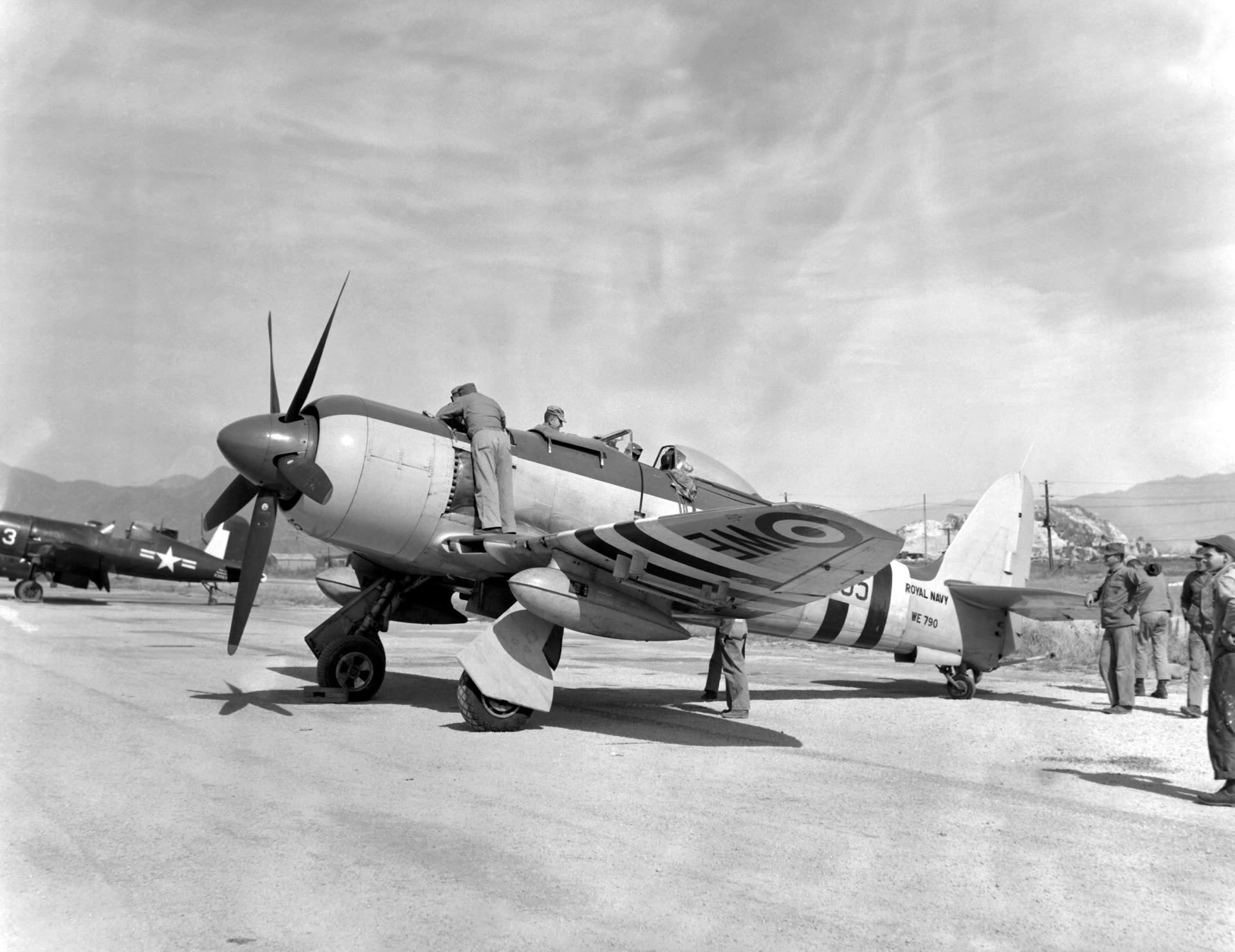
Pictured: a Royal Australian Navy Hawker Sea Fury FB.11 (serial WE790) of 805/808 Squadron being serviced by ground crew at a Korean airbase, circa 1951 — the same aircraft type and the same service branch (RAN) O'Farrell flew, but not a photograph of his actual aircraft or of the August 31, 1954 sighting itself. This particular airframe served aboard HMAS Sydney during the Korean War, three years and a different squadron removed from the Nowra-based night training sortie described in this case. No photograph of O'Farrell's own aircraft on that specific flight, nor of the objects he and Jessop reported, is known to exist — night-flying training sorties in 1954 were not photographed, and no camera or gun-camera footage was running.
Theoretical Alignment
This case aligns more strongly with a genuinely anomalous, technologically-framed interpretation than most single-witness 1950s reports, because the psycho-social explanation's central mechanism — a lone, possibly fatigued observer misreading an ambiguous stimulus — cannot by itself account for an independent, simultaneously-operating ground radar picking up two additional targets in the same position at the same time. A radar operator's scope does not share a pilot's expectations, fatigue, or cultural priming. That said, the case falls well short of a confirmed extraterrestrial encounter: no debris, film, or unambiguous performance data beyond estimated speed exists, the objects were never positively identified as structured craft rather than lighted aircraft, and the loss of the Joint Intelligence Bureau's deeper investigative file leaves permanent, honest gaps that keep this from being treated as more than a well-corroborated, unresolved instrumented sighting.
Background
HMAS Albatross, on the New South Wales South Coast near the town of Nowra, was commissioned on August 31, 1948, as the primary shore base for the Royal Australian Navy's newly formed Fleet Air Arm — meaning the sighting fell precisely on the base's sixth anniversary. The airfield itself had a longer history: identified for development in 1938 and declared operational as RAAF Nowra in 1941, it hosted Bristol Beaufort and Martin Marauder training squadrons through the Second World War before a brief 1944–45 spell as the Royal Navy's HMS Nabbington, supporting British Pacific Fleet carrier operations. Its 1948 commissioning as HMAS Albatross followed the delivery of the Fleet Air Arm's first squadrons aboard the light carrier HMAS Sydney in May 1949, and by 1954 it was the settled home base for the Navy's fixed-wing squadrons, including the Hawker Sea Fury units that had already seen intensive combat service over Korea.
The Hawker Sea Fury itself was, by 1954, a proven and thoroughly combat-tested aircraft rather than an experimental type. A single-seat, piston-engined naval fighter-bomber powered by a 2,480-horsepower Bristol Centaurus 18-cylinder radial engine, capable of roughly 460 mph (400 knots) at altitude, the Sea Fury had entered Royal Australian Navy service in 1948 and flew with 805 and 808 Squadrons from the carriers HMAS Sydney and HMAS Vengeance. Australian Sea Furies flew 2,366 combat sorties over Korea between 1951 and 1953, giving the type's pilots — and the aircraft itself — an unusually well-documented performance envelope against which O'Farrell's own account of the unidentified objects' relative speed could later be measured. By late August 1954, with the Korean War concluded a year earlier, 723 Squadron at Nowra was flying Sea Furies (among other types) primarily in the training and fleet-support role, which is the context for O'Farrell's routine night cross-country exercise that evening.
Australia's 1950s UFO reporting environment differed in one important structural respect from the better-known American experience of the same period. Rather than a single centralized clearing-house comparable to the United States Air Force's Project Blue Book, reports from military personnel were handled internally by each service and, per at least one contemporary account, were subject to a standing order directing all three Australian services to remain "on the alert" for unidentified flying objects and to route resulting reports through service security channels — which is exactly the administrative path O'Farrell's and Jessop's reports took, ending up filed as Navy Office records rather than surfacing through any public reporting program. This meant that, unlike an American case that might eventually appear in a declassified Blue Book case file with a Colorado-style scientific evaluation attached, the Sea Fury case simply disappeared into internal Navy paperwork for 28 years, its existence known only to the small number of people directly involved until a very specific and, as described below, largely accidental press leak in December 1954.
Lieutenant James "Shamus" O'Farrell was 25 years old at the time of the sighting, a serving RAN pilot attached to Nowra. Nothing in the record suggests he had any prior interest in, or public statements about, unidentified flying objects before that August night, nor did he seek out press attention afterward — the case became public only because journalists visiting the base with the Minister for the Navy in December 1954 happened to overhear talk of it, a genuinely passive leak rather than a witness coming forward.
Complete Timeline
| Date / Time | Event |
|---|---|
| Aug. 31, 1948 | HMAS Albatross is commissioned at Nowra, NSW — exactly six years before the sighting described in this case. |
| Aug. 31, 1954, 1858 | Lt. James O'Farrell, flying a Hawker Sea Fury on a night cross-country exercise (Nowra–Young–Temora–Yass–Nowra) at a briefed altitude of 13,000 feet, makes a routine position report to Canberra Civil Air Radio, then switches to 143.64 MHz, his squadron's exercise frequency. |
| Aug. 31, 1954, ~1910 | Southwest of Goulburn, O'Farrell sees "a very bright light closing fast" from his one o'clock position; it crosses ahead of his aircraft and takes station on his port beam, appearing to orbit. A second, similar light appears at nine o'clock, passes about a mile ahead, then moves to rejoin the first object's position. |
| Aug. 31, 1954, ~1910–1915 | O'Farrell radios Nowra and asks whether the station has him on radar. PO Keith Jessop, working the G.C.I. remote display, confirms three echoes — O'Farrell's own aircraft and two additional, unidentified returns — bearing 280°, 32 nautical miles from Nowra, in the vicinity of Marulan. |
| Aug. 31, 1954, ~1915 | Nowra instructs O'Farrell to fly a 180-degree turn so the radar operator can positively distinguish his own aircraft's echo from the two unidentified returns. O'Farrell's and Jessop's original written reports both record his reply as "negative"; the turn is not flown, and radar loses track of the two unidentified returns shortly afterward. |
| Aug. 31, 1954, ~1915–1920 | The two lights reform at O'Farrell's nine o'clock position and depart on a north-easterly heading at what O'Farrell describes as the fastest crossing speed he has ever witnessed, roughly two to three times his own 220-knot cruising speed. |
| Aug. 31, 1954, 1930 | O'Farrell lands at Nowra to a waiting reception committee; the base's Surgeon Commander examines him and rules out alcohol consumption or physical distress before clearing him for duty. |
| Sept. 2, 1954 | O'Farrell and Jessop each file separate written reports on the incident; the Navy classifies the resulting file "top secret," and it is routed through RAAF Intelligence and the Joint Intelligence Bureau. |
| Autumn 1954 | Word of the sighting circulates informally within 723 Squadron; O'Farrell becomes the subject of good-natured ribbing, and newspaper clippings and jokes about the incident are pasted into the squadron's "Line Book" scrapbook, later preserved at the Fleet Air Arm Museum. |
| Dec. 15–17, 1954 | Journalists accompanying Minister for the Navy Sir Josiah Francis on a visit to Nowra hear of the report; the story breaks in the Melbourne Herald, Sun, and Argus, and Francis publicly confirms the essential facts, without naming O'Farrell, on December 16. |
| 1973 | Dr. J. Allen Hynek visits Australia and personally interviews O'Farrell, telling him "your sighting cannot be explained away" and placing it among roughly 13–15 similarly puzzling professional-witness cases known to him worldwide; Australia's Chief Defence Scientist, Dr. John Farrands, separately reviews the file and agrees it "couldn't be refuted." |
| 1982 | The Directorate of Naval Intelligence releases a copy of the original file on request, ending 28 years of classification, and assesses O'Farrell as "an entirely credible witness" who remained "adamant" despite having been "visibly shaken" at the time. |
| 1991 | Ken Llewelyn's book Flight Into the Ages retells the case with several factual errors later identified against the primary file, including a wrong date, an inflated airspeed, and a claim that O'Farrell complied with the 180-degree turn request. |
| 1993 | The television program The Extraordinary stages a dramatic recreation of the incident, interviewing O'Farrell, Jessop, and Australian researcher Bill Chalker. |
| 2012 | Researcher Keith Basterfield locates the original 1954 Navy files (NAA series MP926/1 and SP338/3) and publishes a detailed fact-check documenting the discrepancies between the primary reports and popular retellings. |
| 2017 | A formal request to the Department of Defence for the missing Joint Intelligence Bureau investigative file returns a negative result: the Defence Intelligence Organisation reports it is "unable to find any files on this subject." |
| 2017 | Commodore James "Shamus" O'Farrell dies, having given a consistent core account of the sighting for the rest of his life and having risen, over a 37-year Navy career, to command experience, more than 4,500 flying hours, and a final posting as Naval Attaché in Washington, D.C. |
The Night Cross-Country and First Sighting
The exercise that put Lieutenant O'Farrell over the Southern Tablelands that evening was a routine one: a night cross-country navigation sortie, the kind of proficiency flight every RAN fighter pilot flew regularly, tracing a loop from Nowra out to Young, Temora, and Yass before returning. He was flying a single-seat Hawker Sea Fury, briefed for 13,000 feet, and had made a standard position report to Canberra Civil Air Radio at 1858 before switching to his squadron's own exercise frequency, 143.64 MHz, for the final leg home. Nothing about the flight to that point had been unusual.
At approximately 1910, southwest of Goulburn, O'Farrell caught sight of what he described as a very bright light closing on his aircraft fast, from his one o'clock position — ahead and slightly to his right. He watched it cross directly in front of his Sea Fury and take up a position off his port beam, where it appeared to hold station, orbiting or matching his own speed and heading rather than continuing past him as a normal crossing aircraft would. Almost simultaneously, or in close succession, a second, similar light appeared at his nine o'clock position — his left rear quarter — made a pass roughly a mile ahead of his aircraft, and then moved to occupy the position the first object had held. O'Farrell would later describe the combined effect as watching "a vague shape with the white light situated centrally on top" — not a point of light alone, but a discernible, if indistinct, dark mass with a single light mounted on its upper surface, roughly comparable in scale to a Douglas DC-3 Dakota, a common reference aircraft any RAN pilot of the era would have used instinctively for a size estimate. Critically, he specifically noted the absence of the red and green navigation lights that any conventional aircraft would be required to display at night — a detail that, on its own, rules out the simplest possible explanation (a normally-lit civil or military aircraft flying an ordinary intercept or formation profile nearby) without yet establishing what the objects actually were.
What struck O'Farrell most forcefully, by his own account, was the objects' speed. He was flying at 220 knots, a normal cruising speed for a Sea Fury on a long-range exercise leg, and the two lights crossed his flight path and repositioned themselves at what he judged to be the fastest closing and crossing speeds he had ever personally witnessed in his flying career — a career that, by the time of his retirement three decades later, would encompass more than 4,500 hours and direct familiarity with the performance of most Western fighter types of the era. A trained fighter pilot's subjective speed estimate is not a laboratory measurement, but it is also not naive: O'Farrell had a concrete, professionally calibrated frame of reference for what "fast" meant relative to his own 400-knot-capable aircraft, and his estimate placed the objects at roughly two to three times his own cruising speed during the crossing maneuvers — well within the performance envelope of a contemporary jet fighter under full power, but notably inconsistent with the leisurely, station-keeping behavior the objects displayed only moments earlier while apparently pacing his aircraft.
Radar Confirmation at Nowra
What transforms this from an ordinary, if compelling, single-witness night sighting into one of the more evidentially significant Australian cases is what happened next. Rather than simply continuing home and reporting the sighting after landing, O'Farrell did something a startled or confused witness does not typically think to do in the moment: he radioed Nowra directly, while the objects were still in company with his aircraft, and asked the ground station whether they had him on radar — effectively requesting an independent, contemporaneous instrumented check on what he was seeing, rather than waiting to describe it after the fact.
Petty Officer Keith Jessop was working the Ground Controlled Interception (G.C.I.) remote display at Nowra that evening. Responding to O'Farrell's query, Jessop confirmed that the station had not one but three separate radar echoes on the scope: O'Farrell's own Sea Fury, plus two additional, unidentified returns in company with it. The G.C.I. system placed the contact group at a bearing of 280 degrees and a range of 32 nautical miles from Nowra — a position consistent with O'Farrell's own account of his location southwest of Goulburn, in the general vicinity of the small town of Marulan on the Goulburn–Sydney corridor. This is the single most important fact in the entire case: a ground-based radar operator, working independently of the pilot, with no access to the pilot's visual field and operating a piece of military hardware with no psychology of its own to prime it toward seeing anything in particular, registered two additional targets in the same place, at the same time, as the pilot's own visual sighting. Jessop's own later account of the episode is unambiguous on this point: "We did plot on our radar screen all three objects…wouldn't have got a radar echo…if it had not been a substance that reflected our radar beams" — a radar operator's plain-language way of saying the returns were real, physical reflections and not equipment noise or a scope artifact.
Standard identification procedure for an unidentified radar contact of this kind was to have the known aircraft — O'Farrell's Sea Fury — execute a distinctive maneuver, such as a 180-degree turn, so the ground controller could positively distinguish which echo belonged to the friendly aircraft and track the others independently and with confidence. Nowra duly instructed O'Farrell to make the turn. Here the case's own documentary record contains its most significant internal discrepancy, one only resolved decades later by returning to the original 1954 paperwork rather than relying on later retellings: both O'Farrell's and Jessop's contemporaneous written reports, filed the following week, record O'Farrell's response to the turn request as a flat "negative," and state that the two unidentified returns were not tracked any further after that point. This matters because several popular secondary accounts — and, by some readings, O'Farrell's own later, decades-removed television and interview recollections — describe him as having executed the turn. Researcher Keith Basterfield's 2012 archival review, working directly from the original NAA files rather than from any intermediate retelling, treats the "negative" response and the loss of radar contact immediately afterward as the more reliable version of events, on the straightforward evidentiary principle that documents written within days of an event by the two people directly involved generally deserve more weight than the same people's memories, or a book author's paraphrase of those memories, recalled thirty-plus years later.
Departure and Return to Nowra
With radar contact on the two unidentified returns lost, the two lights O'Farrell had been visually tracking reformed at his nine o'clock position and then departed on a north-easterly heading at what he again described as extremely high speed — the fastest crossing speed of the entire encounter, by his account. The total visual engagement, from the first light's approach to the final departure, appears from the timeline reconstructed in the primary sources to have lasted on the order of five to ten minutes, a substantial period of sustained observation rather than a fleeting glimpse.
O'Farrell completed his approach and landed at Nowra at approximately 1930, to what several secondary accounts describe as a waiting reception committee — word of his in-flight radio exchange with the tower had evidently traveled quickly around the base. He was examined by the station's Surgeon Commander in the sick bay immediately after landing; the examination specifically checked for, and ruled out, alcohol consumption and any signs of physical distress or disorientation, and O'Farrell was cleared for duty. This detail is worth dwelling on: it demonstrates that the Navy's own on-the-spot response to the report was not casual dismissal but an immediate, procedurally appropriate check on the one variable — the pilot's own physical and mental state — that a service medical officer was positioned to assess within the hour, and it came back clean.
The base's informal reaction over the following days and weeks was considerably less solemn. At least one account attributes to Nowra's Captain a dismissive verdict of "flying sauceritis," and O'Farrell became, by his own later good-humored recollection, something of a subject of jokes within 723 Squadron — newspaper clippings and squadron-scrapbook jibes about the incident survive in the unit's "Line Book," now held at the Fleet Air Arm Museum at Nowra. This is a useful corrective against any temptation to imagine the case was treated, at the time, as a matter of high alarm within the squadron itself; whatever the Navy's formal intelligence channels made of the written reports, O'Farrell's own workmates treated the story as a good-natured source of ribbing for a colleague, even while his official written statement went on to be classified "top secret" and routed to RAAF Intelligence and the Joint Intelligence Bureau.
The Aircraft in the Vicinity Question
Any conventional explanation of a radar-visual sighting has to reckon first with what other air traffic, if any, was actually in the area that night, since a real, ordinary aircraft is always the simplest starting hypothesis for an unidentified radar return. The record here is genuinely useful, if imperfect. Contemporary investigation established that a Trans Australia Airlines (TAA) Convair 240 airliner was operating somewhere in the general region that evening, flying a northerly course at approximately 14,000 feet — a detail mentioned in some of the more detailed retrospective accounts but largely omitted from shorter, more sensational retellings of the case. Critically, however, the Convair's altitude and reported track do not straightforwardly match the position and bearing Jessop's radar assigned to the two unidentified returns, and subsequent inquiries specifically found no RAAF or other Australian military aircraft authorized to be operating in the area at the time. This case file's own research could not independently obtain the original flight-following or air-traffic log that would allow a precise, minute-by-minute reconciliation of the Convair's track against the radar bearing/range data Jessop recorded, which is an honest limitation rather than a settled exclusion — but the altitude mismatch and the absence of any other logged traffic are the reasons the Convair has been treated by every serious re-investigation of this case, from the original 1954 Navy inquiry through Basterfield's 2012 review, as an unlikely fit for the two objects O'Farrell and Jessop tracked, rather than as a solved case.
A separate, more recent hypothesis raised informally in online discussion of the case (and, per at least one 2017 "cold case" review by an Adelaide-based researcher, considered seriously enough to warrant a dedicated look) proposes that the two unidentified returns might have been a pair of Commonwealth Aircraft Corporation CA-27 Sabre jet fighters, a type just then entering RAAF service in 1954, potentially on an unlogged or informally coordinated training or ferry flight. Reaction to this hypothesis among researchers who discussed it has been mixed at best — described in the most detailed secondary account located during this research as "possible" but "not very likely" — both because no Sabre sortie for that specific night and route has ever been located in any surviving RAAF record, and because the behavior described (two aircraft closing rapidly, taking up a stationary station-keeping position off a slower aircraft's wing for several minutes, then departing at extreme relative speed with no radio contact, no navigation lights, and no acknowledgment of O'Farrell's own radio calls) is a poor match for a routine, authorized jet training flight, which would ordinarily involve exactly the kind of radio coordination and lighting discipline that was conspicuously absent here.
The December 1954 Press Leak
For nearly four months, the Sea Fury sighting existed only as an internal Navy file, known to O'Farrell, Jessop, their immediate chain of command, and whichever RAAF Intelligence and Joint Intelligence Bureau personnel had reviewed the classified report. That changed abruptly in mid-December 1954, when journalists accompanying Minister for the Navy Sir Josiah Francis on an official visit to the Nowra Fleet Air Arm station picked up on talk of the incident — a passive leak arising from proximity and casual conversation rather than any deliberate disclosure by the Navy or by O'Farrell himself.
The story broke across the Melbourne press on December 15–17, 1954, with the Herald, the Sun, and the Argus all running versions of the account under front-page "flying saucer" headlines, and other Australian papers, including a syndicated piece in the National Library of Australia's own digitized Trove newspaper archive dated December 17, 1954 and headlined "FLYING SAUCERS CONFIRMED BY NOWRA RADAR," following within days. Rather than deny or deflect the story once it broke, Francis chose to publicly confirm its essential outline on December 16, without naming O'Farrell: "It is a fact that on a night cross-country flight from Nowra on August 31, at 13,000 feet above Goulburn, a pilot in a Sea Fury observed two lights on his radar, with vague shapes underneath." Naval authorities went further still, telling the press in terms that were unusually candid for a government statement on the subject: "Naval authorities admitted today that they cannot find any 'human source' for the 'flying saucers' recorded on a radar screen at Nowra." This is a genuinely striking admission for a Cold War-era defense ministry to make on the public record — not a claim that the objects were extraordinary, but an acknowledgment that the ordinary, human explanations investigators would normally reach for first had already been checked and had not panned out.
The press coverage consistently used "flying saucer" terminology and described the story as "sensational" and "mysterious," reflecting both the genuine novelty of an official, on-the-record Navy radar confirmation and the broader mid-1950s cultural moment in which flying-saucer reports were a fixture of newspaper front pages worldwide. Notably, at least one account of the leak specifies that O'Farrell's original written report had been routed, per standing policy, to the security sections of the Navy, Army, and Air Force alike — evidence of a genuine, if quietly administered, tri-service Australian policy of tracking unidentified aerial reports throughout this period, comparable in spirit to (if considerably less publicly documented than) the American Project Blue Book apparatus running concurrently on the other side of the Pacific.
Ground Witnesses: An Honest Accounting
Several secondary accounts of this case — though notably not the primary Navy file that researcher Basterfield examined directly — assert that two additional people independently observed lights in the sky that evening: a Department of Aviation technician who happened to be repairing a non-directional radio beacon (NDB) near Marulan, and an air traffic control officer on duty in the tower at Sydney's Mascot Airport (now Sydney Kingsford Smith), each reportedly seeing lights consistent in position and timing with O'Farrell's own sighting. If accurate, these would meaningfully strengthen the case still further, adding two more independent, professionally-positioned observers to a sighting already corroborated by radar.
This case file's own research, however, could not confirm either claim against a primary source. Basterfield's detailed 2012 fact-check of the original NAA files — the same review that identified and corrected several other popular-account errors discussed above — addresses only O'Farrell's and Jessop's own written statements and does not mention either the Marulan technician or the Mascot controller, and Basterfield's own separate 2017 post about the search for the missing Joint Intelligence Bureau file speculates that any fuller detail on "two additional ground witnesses" might have been contained specifically in that missing JIB file, which the Defence Intelligence Organisation was unable to locate when formally asked in 2017. In other words, the ground-witness claims appear to trace back to secondary ufological literature rather than to either of the two primary Navy documents actually recovered and examined by name, and the one file that might have independently corroborated or debunked them — assuming it ever existed in the form described — cannot currently be found. This case file reports the claims honestly, as widely repeated in the secondary literature, while flagging plainly that they remain unverified against any primary record located during this research, exactly the kind of genuine, unresolved gap the Two-Pass Research standard this site is built on calls for surfacing rather than glossing over.
Hynek's Review and the Missing Files
The case might well have remained a minor, half-forgotten 1954 newspaper story had it not resurfaced nearly twenty years later through the direct interest of Dr. J. Allen Hynek, the Northwestern University astronomer and former scientific consultant to Project Blue Book who, by the 1970s, had become the most prominent serious scientific voice arguing that a genuine residue of unexplained cases persisted after mundane misidentifications were stripped away. During a 1973 visit to Australia, Hynek sought out and personally interviewed O'Farrell about the Sea Fury sighting. His verdict, as O'Farrell recounted it afterward, was direct: "Your sighting cannot be explained away." Hynek reportedly placed the case among a personal list of roughly 13 to 15 similarly puzzling reports from professional aviation witnesses — military pilots, air crew, civil operators, and air traffic controllers — that he had encountered globally and had been unable to resolve through ordinary means. Separately, Dr. John Farrands, at the time Australia's Chief Defence Scientist, reviewed the case file on its own merits and reportedly agreed that it "couldn't be refuted," an independent domestic scientific endorsement of the same conclusion Hynek had reached from outside the country.
The case's evidentiary picture, however, is not entirely one of accumulating confirmation. A genuine and still-unresolved gap concerns the Joint Intelligence Bureau's own investigative file, distinct from O'Farrell's and Jessop's original witness statements, which is presumed to have existed given that the case was explicitly routed to the JIB in 1954 but which has never resurfaced in the hands of any civilian researcher. In 2017, an Adelaide-based UFO researcher wrote formally to Australia's Department of Defence requesting this file; the Defence Intelligence Organisation's Deputy Director responded on July 26, 2017, that "DIO records management staff conducted a search of our archival holdings, but unfortunately were unable to find any files on this subject." Whether this file was destroyed, misfiled, remains buried in an uncatalogued holding, or never contained more than what the two surviving witness reports already show is, on the present evidence, genuinely unknown — and this case file treats that as an honest unresolved question rather than either evidence of concealment or evidence the file never mattered.
Popular Retellings versus the Original 1954 Files
One of the more methodologically useful aspects of this case's modern research history is Keith Basterfield's direct, side-by-side comparison of the original 1954 written reports against the version of the story that had calcified in popular ufological literature by the early 1990s, principally through Ken Llewelyn's 1991 book Flight Into the Ages. The comparison surfaced several concrete, checkable discrepancies. Llewelyn's account gave the date as December 15, 1954 — actually the date the story broke in the press, not the date of the sighting itself, which the original files place unambiguously on August 31. Llewelyn's account gave O'Farrell's airspeed as 330 knots; the original written reports state 220 knots. Llewelyn described the objects' "outline" as "quite distinct"; O'Farrell's own contemporaneous report instead describes only "a vague shape." And, most significantly for assessing the radar-corroboration narrative, Llewelyn's retelling has O'Farrell complying with Nowra's request for a 180-degree identification turn; the original written reports from both O'Farrell and Jessop instead record his reply as "negative," with radar tracking of the two unidentified returns lost shortly afterward rather than continuing through a successful identification maneuver.
None of these corrections change the core, most evidentially significant fact of the case — that a trained radar operator independently registered two unidentified targets in company with the pilot's own aircraft, at the time and place the pilot was visually tracking two lights — but they matter for the case's overall credibility assessment in a more subtle way. They demonstrate that this is a case whose popular retelling drifted from its primary documentary record over nearly four decades, in the ordinary, human way that any often-retold story does, and that a rigorous modern re-investigation returning to the original files can and does catch and correct that drift. A case file's own approach, per the Two-Pass Research standard, is to treat the primary 1954 documents as authoritative wherever they conflict with a later retelling, which is the practice followed throughout this article.
Key Witnesses
Lieutenant James "Shamus" O'Farrell
A 25-year-old RAN fighter pilot at the time of the sighting, O'Farrell went on to become one of the Navy's most experienced aviators, logging more than 4,500 flying hours over a 37-year career and retiring with the rank of Commodore after a final posting as Naval Attaché in Washington, D.C. He gave a consistent core account of the sighting in every interview he gave for the rest of his life, including to Dr. Hynek in 1973 and on the 1993 television program The Extraordinary, and the Directorate of Naval Intelligence's own 1982 assessment described him as "an entirely credible witness" who was "visibly 'shaken' by his experience, but remains adamant that he saw these objects." He died in 2017.
Petty Officer Keith Jessop
The Navy radar technician on duty at Nowra's G.C.I. remote display the night of the sighting, Jessop independently confirmed three simultaneous echoes — O'Farrell's Sea Fury and two additional, unidentified returns — at the exact bearing and range consistent with O'Farrell's own visual account, and filed his own written report on September 2, 1954. He was later interviewed alongside O'Farrell for the 1993 television recreation of the case, and his own summary of the radar data — that the returns "wouldn't have got a radar echo…if it had not been a substance that reflected our radar beams" — remains the case's clearest single technical statement of why the sighting cannot be dismissed as a purely visual, purely subjective event.
Sir Josiah Francis
Not a witness to the sighting itself, but the government minister whose December 1954 visit to Nowra led directly to the story's public leak, and who chose to confirm its essential facts on the record rather than deny them — a decision that preserved the case's contemporary public paper trail via the Trove newspaper archive, even though the underlying Navy file itself would remain classified for another 28 years.
Unnamed NDB Technician, Marulan (Unconfirmed)
Secondary ufological accounts of this case assert that a technician repairing a non-directional radio beacon near Marulan independently saw lights matching O'Farrell's sighting in position and timing. This case file could not locate this witness's name or an independent primary-source account of their testimony; the claim does not appear in Keith Basterfield's direct examination of the two surviving 1954 Navy files, and may originate instead from the still-missing Joint Intelligence Bureau investigative file. Reported here for completeness, with that limitation stated plainly.
Unnamed Air Traffic Control Officer, Mascot Airport (Unconfirmed)
Likewise asserted in secondary accounts to have observed the objects from the Mascot control tower, but equally unconfirmed against any primary document examined during this research. As with the Marulan technician, this case file reports the claim honestly while flagging that it rests on secondary literature rather than a verified primary source.
The Five Observables Assessment
The Five Observables framework is applied to the performance characteristics reported in this case:
Assessment: The objects' ability to hold a stationary position relative to O'Farrell's moving aircraft for several minutes, without visible means of conventional lift or propulsion, is rated speculative for Anti-Gravity Lift only because no altitude or lift instrumentation exists to measure it directly — the behavior itself is consistent with, though not proof of, some form of controlled, non-ballistic flight. Instant Acceleration is rated present on the strength of O'Farrell's specific, repeated description of "the fastest crossing speeds" of his flying career during both the initial approach and the final departure. Hypersonic velocity is rated speculative rather than present because, while a two-to-three-times multiple of a 220-knot cruising speed would place the objects well beyond any 1954 propeller aircraft's performance, it falls well short of true hypersonic flight (Mach 5+) and was never instrumentally measured. Low Observability is explicitly rated absent, and this is worth stating plainly because it cuts against a common assumption in advanced-craft cases: the objects returned strong, unambiguous radar paints on Nowra's G.C.I. set, exactly the kind of ordinary reflective radar signature a conventional aircraft would produce, with no indication whatsoever of any radar-evading characteristic.
Evidence Assessment
Supporting Anomalous Origin
- Two independent, professionally-credentialed observers — a trained fighter pilot and a trained ground radar operator — corroborated each other in real time, using two entirely different sensory/instrumental channels
- Nowra's G.C.I. radar independently registered two unidentified targets at the exact bearing and range consistent with O'Farrell's simultaneous visual sighting, ruling out a purely subjective, single-witness misperception
- The objects displayed no standard aircraft navigation lighting, a specific negative detail O'Farrell volunteered rather than one suggested to him afterward
- The Directorate of Naval Intelligence's own official 1982 assessment rated O'Farrell "an entirely credible witness"
- Two independent, credentialed scientific reviewers — Dr. J. Allen Hynek and Australia's own Chief Defence Scientist, Dr. John Farrands — separately examined the case decades apart and both concluded it could not be conventionally resolved
- No conventional aircraft (RAAF, civil, or otherwise) was positively confirmed to be operating at the reported position and altitude at the time, despite a specific contemporary check for exactly this possibility
- The Navy's own contemporary public statement conceded it could find no "human source" for the radar returns
Supporting Conventional Explanation
- A TAA Convair 240 airliner was confirmed operating in the general region that evening, and while its reported altitude and track do not cleanly match the radar data, this case file could not independently obtain the original flight-following log needed for a precise reconciliation
- All quantitative claims (speed, bearing, range) derive from a single pilot's subjective estimate and a single radar operator's scope reading, rather than from any recorded, reviewable instrument tape or photograph
- O'Farrell's own later, decades-removed retellings contain at least one significant factual drift (the 180-degree turn) from his own original 1954 written statement, demonstrating that even the case's most central and credible witness is not immune to memory drift over a long career of retelling the story
- The claimed additional ground witnesses (the Marulan NDB technician and the Mascot ATC officer) cannot be verified against any primary document located during this research, and may be an artifact of decades of secondary retelling rather than confirmed testimony
- The Joint Intelligence Bureau's own deeper investigative file, which might have definitively resolved the case either way, cannot currently be located, leaving a permanent evidentiary gap that cannot be filled by wishing it were otherwise
- A hypothesized pair of unlogged Sabre jets, while judged an imperfect fit by researchers who have examined it, has not been formally and exhaustively excluded through a complete review of every RAAF sortie log from the period
Why "Credible"
This case receives a CREDIBLE classification, one tier above a case like the Florence Stadium Sighting's "Disputed" rating and broadly comparable to (and, on the specific strength of its independent radar corroboration, arguably somewhat stronger than) the Coyne Helicopter Incident's own "Credible" rating on this site, because it combines several evidentiary strengths that individually are each fairly common in the UFO literature but that are genuinely uncommon in combination. A single credentialed pilot's visual account, however sincere, is common. A single radar operator's unexplained scope return, however puzzling, is also common. What is far less common is the same two people, operating two completely independent sensory and instrumental channels, corroborating each other in real time, about the same two objects, at the same bearing and range, with the pilot's own in-the-moment decision to radio the ground station and ask for a check — rather than simply flying home and reporting a strange light afterward — removing any possibility that the radar confirmation was solicited or shaped by a foreknowledge of what the ground station expected to find.
Set against this are three honest, unresolved gaps that keep the case from a higher "Verified" rating. First, the claimed additional ground witnesses cannot be confirmed against any primary document this research could locate, and may originate from a missing file rather than from confirmed testimony. Second, the Joint Intelligence Bureau's own deeper 1954 investigative file — the one record most likely to have either strengthened the case with additional detail or resolved it conventionally — has been searched for and could not be found by the Department of Defence itself in 2017. Third, while the leading conventional candidates (a misidentified airliner, an unlogged jet training flight, anomalous radar propagation) have each been examined and found wanting on the specific facts, none has been so exhaustively and completely excluded — through, for instance, a full audit of every RAAF sortie log for that exact night — that this case file can rule out a mundane explanation with total confidence rather than with the considerable, but not absolute, confidence the evidence currently supports.
Sensor & Instrumentation Detection Profile
The case's sole instrumented sensor system was HMAS Albatross's own Ground Controlled Interception (G.C.I.) radar, operated in real time by Petty Officer Jessop, which registered three simultaneous echoes at bearing 280°, range 32 nautical miles. The Sea Fury itself, a 1940s-designed single-seat piston fighter, carried no onboard airborne interception radar and no gun camera; O'Farrell's contribution was purely visual, from the cockpit, unaided by any onboard recording equipment. No photographic, film, or magnetic-tape record of either the radar scope or the visual sighting was made or preserved — standard practice for a routine training-flight radio exchange in 1954, not evidence of any deliberate suppression. The only other instrumented check performed was medical rather than technical: the post-flight examination by Nowra's Surgeon Commander, which is a legitimate, if informal, human-factors data point rather than a sensor reading of the phenomenon itself.
Environmental & Geospatial Context
The sighting occurred in the airspace of the Southern Tablelands region of New South Wales, along the Goulburn–Marulan corridor roughly midway between Sydney and Canberra, at an altitude of 13,000 feet on a clear, late-winter night. The town of Goulburn sits at approximately 34.75°S, 149.72°E, at an elevation of roughly 690 meters; Marulan lies a short distance to its east along the same Hume Highway/Main Southern railway corridor. HMAS Albatross itself is located at approximately 34.95°S, 150.54°E, on the NSW South Coast some 75–80 kilometers southeast of Goulburn as the crow flies — consistent with the 32-nautical-mile, bearing-280° radar fix Jessop recorded relative to the station. Late August falls at the tail end of the Southern Hemisphere winter; the sighting's roughly 7:10 PM local timing places it well after sunset on a night flight, in the kind of dark, star-visible sky in which a distant light source is both easier to notice and, without a horizon or ground reference nearby, genuinely harder to range and size accurately by eye alone. No storm activity, precipitation, or other adverse meteorological condition is mentioned in any source reviewed for this case file, and the uninterrupted radar tracking and completed exercise are both consistent with ordinary clear-night flying conditions rather than any unusual atmospheric event.
Observer Credibility & Occupational Profile
The case's evidentiary strength rests substantially on the specific professional credentials of its two primary witnesses. Lieutenant O'Farrell was a serving Royal Australian Navy fighter pilot who would go on to a 37-year career and more than 4,500 flying hours, a record of sustained professional competence that lends weight to his in-the-moment judgment calls (requesting a radar check, declining the identification turn for reasons not fully explained in the surviving record) as those of an experienced aviator rather than a panicked or naive one. Petty Officer Jessop was a trained military radar operator, whose professional competence lay specifically in distinguishing genuine returns from scope clutter, equipment artifacts, and known traffic — exactly the skill set most relevant to assessing whether his "three echoes" call was a real detection rather than a misread scope. Both men were assessed directly by the Navy's own Directorate of Naval Intelligence, which rated O'Farrell "an entirely credible witness," and both were later separately reviewed by two credentialed outside scientific figures — Hynek and Farrands — each of whom reached the same conclusion independently and years apart. The two additional claimed ground witnesses, by contrast, carry essentially no assessable credibility in this case file specifically because their identities, and even the existence of any documented statement from them, could not be confirmed.
Physical & Material Assays
No physical trace evidence of any kind exists in this case — no debris, no ground scarring, no chemical residue, and no photographic or film record. The case's only reviewable "hard" artifacts are documentary: O'Farrell's and Jessop's original written reports, dated September 2, 1954, now held at the National Archives of Australia, and the Navy's own subsequent internal correspondence and 1982 declassification memo. See Material Analysis below for a full discussion of what this documentary record does and does not establish.
Historical Precedents & Archive Matches
The Sea Fury sighting is widely regarded within Australian ufological research, including by Bill Chalker's published survey work, as the country's most significant early Cold War radar-visual case, predating by two years the broadly comparable British Lakenheath–Bentwaters incident of August 1956, which likewise paired a credentialed pilot's visual account with independent, simultaneous ground and airborne radar corroboration and which the Condon Committee itself later called "the most puzzling and unusual case in the radar-visual files." It also invites direct comparison with the American Gorman Dogfight of 1948, another military-pilot visual encounter with a documented ground-control communication trail, and with the Coyne Helicopter Incident of 1973, a multiply-corroborated military-crew case built around an anomalous instrument reading rather than radar. Within Australia specifically, the Sea Fury case sits at the head of a longer thread of credentialed-witness sightings this site also catalogs, including the 1978 disappearance of pilot Frederick Valentich over Bass Strait and the multiply-witnessed 1988 Knowles family encounter on the Nullarbor Plain — a pattern of professionally-observed, evidentially substantial Australian cases spanning more than three decades.
Material Analysis
Unlike crash-retrieval or physical-trace cases, the Sea Fury sighting produced no debris, no ground trace, and no photograph or film of any kind. Its entire evidentiary record is instrumental and testimonial: a radar operator's real-time scope reading (recorded as a written statement rather than as raw tape or photograph), a pilot's visual account, and the surrounding documentary record of the Navy's own internal handling of the case. This absence of physical material is entirely typical for a pure radar-visual case of this era — 1950s G.C.I. radar scopes were not routinely photographed, and Sea Fury cockpits carried no onboard camera — but it does mean that every quantitative claim in the case, including the "three echoes" bearing/range fix and O'Farrell's speed estimate, ultimately rests on human observation and written recollection rather than on any independently reviewable raw data.
The Documentary Record as the Closest Available "Material" Evidence
The nearest thing this case has to physical evidence is the pair of original written reports O'Farrell and Jessop each filed on September 2, 1954, two days after the sighting — contemporaneous enough to predate any meaningful memory drift, and independently valuable precisely because they were written separately by two people describing two different instrument/sensory channels (a cockpit visual account and a radar scope reading) rather than jointly composed after comparing notes. These documents, now held at the National Archives of Australia under series MP926/1 and SP338/3, are what allowed researcher Keith Basterfield to identify and correct the several factual drifts in later popular retellings discussed above, and they remain the single most important primary source for this case — the closest analogue this file has to a physical specimen, in the sense that everything else written about the case, including this article, is ultimately downstream of what these two documents say.
The Medical Examination as a Negative-Evidence Data Point
The post-flight medical examination performed by Nowra's Surgeon Commander, while not a forensic assay of the phenomenon itself, functions as a legitimate negative-evidence check on the pilot's own physical and mental state at the time of the sighting. Its finding — no alcohol, no physical distress, clearance for continued duty — rules out the two most easily falsifiable mundane explanations for a single pilot's anomalous report (impairment and medical crisis) within roughly an hour of the sighting itself, a genuinely useful data point even though it obviously cannot speak to what O'Farrell actually saw.
Supporting Non-Terrestrial or Unexplained Origin
- The written documentary record is internally consistent between two independent authors (O'Farrell and Jessop) describing two independent instrument/sensory channels, with no evidence either report was altered to match the other
- The radar bearing/range fix and the pilot's visual account are geographically and temporally consistent with each other, a correspondence that would be a remarkable coincidence for two unrelated, independently-occurring mundane events
- The immediate post-flight medical examination, performed within the hour, rules out impairment or medical crisis as an explanation for O'Farrell's account
Supporting Terrestrial (Conventional) Origin
- No independently reviewable raw instrument data (radar tape, photograph, recording) survives to allow a modern re-analysis of either the visual or radar components
- A known civil airliner (the TAA Convair) was operating somewhere in the general region that night, even though its precise position and altitude do not cleanly match the reported data
- All quantitative claims rest on human estimation (a pilot's speed judgment, a radar operator's scope reading) rather than on calibrated instrumentation
The Conventional Explanation Candidate
Any conventional explanation for this case has to jointly account for two independent lines of evidence — O'Farrell's visual sighting and Jessop's simultaneous radar detection — rather than explaining either one alone, which is precisely what makes this a harder case to conventionally resolve than a comparable visual-only report. A candidate that explains the radar returns but not the visual sighting, or vice versa, is not a complete explanation of this specific case, however well it might explain a different, single-channel sighting elsewhere.
Conventional Aircraft Traffic
The most natural starting hypothesis for any unidentified radar return is an ordinary aircraft. The confirmed TAA Convair 240 in the general region is the strongest specific candidate located during this research, but its reported altitude (~14,000 feet, northerly track) does not cleanly match the 13,000-foot, apparently station-keeping position Jessop's radar assigned to the two unidentified returns, and no RAAF or other Australian military aircraft was confirmed operating in the area. The informally-raised "unlogged Sabre jets" hypothesis fares no better on the specific facts: it requires an unrecorded, uncoordinated night sortie whose pilots ignored O'Farrell's radio calls, displayed no navigation lights, and flew a station-keeping/high-speed-departure profile with no obvious training purpose — a scenario researchers who have examined it have themselves judged "possible" but "not very likely."
Anomalous Radar Propagation (Ducting)
Temperature-inversion ducting and other forms of anomalous radar propagation are a real, well-documented phenomenon capable of producing spurious or duplicated ("angel") echoes on period radar equipment, and this candidate deserves serious consideration precisely because it targets the instrumented half of this case rather than dismissing it outright. Where it falls short is the joint-explanation problem described above: ducting is a radar-only phenomenon with no mechanism for simultaneously producing a distant pilot's independent, positionally-matched visual sighting of two maneuvering lighted objects. Invoking it here requires either an implausible coincidence (a real, unrelated visual stimulus happening to appear at exactly the bearing and range a spurious radar echo also appeared) or abandoning the visual sighting as a separate, unexplained event — neither of which constitutes a complete conventional explanation of what O'Farrell and Jessop together reported.
Conventional Aircraft Traffic (Convair / Unlogged Military)
ImplausibleIMPLAUSIBLE as a complete explanation. The confirmed TAA Convair's altitude and track do not cleanly match the radar fix, no RAAF traffic was confirmed in the area, and the informally-raised Sabre-jet hypothesis has been judged "possible" but "not very likely" even by researchers who have examined it directly.
Anomalous Radar Propagation (Ducting)
ImplausibleIMPLAUSIBLE as a joint explanation. A real, well-documented radar phenomenon that could in principle produce a spurious echo, but it has no mechanism for simultaneously producing O'Farrell's independent, positionally-matched visual sighting — it explains at most half of what was reported.
Astronomical Object (Planet, Meteor, or Star)
ImplausibleIMPLAUSIBLE. A fixed celestial object cannot cross a flight path, take up a station-keeping position off an aircraft's wing, and then depart at extreme relative speed; a meteor's brief streak does not match several minutes of sustained, position-holding observation, and neither explains a coincident radar return.
Ball Lightning
ImplausibleIMPLAUSIBLE. Ball lightning is strongly associated with thunderstorm activity, and no storm was reported that night; it also has no established, non-speculative mechanism for producing a strong, discrete radar return of the kind Jessop's G.C.I. set registered.
Unlogged/Classified Exercise Traffic
InconclusiveINCONCLUSIVE. A genuinely unlogged or classified military flight remains the one conventional candidate this research could not exhaustively rule out, precisely because the one file most likely to confirm or exclude it — the Joint Intelligence Bureau's 1954 investigative report — cannot currently be located.
Related Cases
Confirmed Documents & Official Records
The Department of Navy's own file containing Lieutenant O'Farrell's and Petty Officer Jessop's original written reports. A related series, SP338/3, control symbol 13/4/10, "Unidentified Objects (Flying — reports of)," is also held by the National Archives of Australia. A digitized copy of the MP926/1 file is additionally mirrored, as a third-party reproduction, on the Internet Archive's public-domain "Australian UFO Files" collection.
The National Archives' own guide to its RAAF- and Navy-held UFO sighting records, confirming that reports of this kind were retained in the national archival collection and describing how to locate them via RecordSearch.
The deeper Joint Intelligence Bureau investigative file, to which this case was reportedly referred in 1954, has not been located. A formal 2017 request to Australia's Department of Defence for this file drew a response from the Defence Intelligence Organisation's Deputy Director stating that "DIO records management staff conducted a search of our archival holdings, but unfortunately were unable to find any files on this subject."
Search Government & Naval Archives Directly
Further Reading — Recommended Literature
The Oz Files: The Australian UFO Story
The definitive book-length survey of Australian UFO cases by the country's most prominent civilian researcher, drawing on declassified government files including the Sea Fury case discussed in this article.
UFOs: A Report on Australian Encounters
Written by the researcher who located and fact-checked the original 1954 Navy files against decades of popular retellings, offering a methodologically rigorous overview of the Australian case record.
The UFO Encyclopedia, 4th Edition
The definitive English-language UFO reference work, situating the Sea Fury case within the broader international catalog of radar-visual military encounters of the 1950s.
The Hynek UFO Report
Written by the scientist who personally interviewed O'Farrell in 1973 and concluded his sighting "cannot be explained away," this book lays out Hynek's broader framework for evaluating exactly this class of professional-witness radar-visual case.
The Report on Unidentified Flying Objects: The Original 1956 Edition
The first insider account of official 1950s UFO investigation, by the man who headed Project Blue Book, useful here for understanding the broader era's official-vs-classified handling of radar-visual military reports like the Sea Fury case.
Essential Viewing
Sources
- "THE 'SEA FURY' RADAR INCIDENT REVISITED." Project 1947. project1947.com
- "The 'Sea Fury' Incident - Nowra, Australia - August 31, 1954." UFO Evidence. ufoevidence.org
- "Navy Sees 'Flying Saucers' on Radar Screen - Goulburn, Australia - December 16, 1954." UFO Evidence. ufoevidence.org
- "The 'Sea Fury Incident' August 31, 1954, Nowra, Australia." The Black Vault Case Files. theblackvault.com
- "Odd history: Nowra had its own alleged UFO sighting, by an HMAS Albatross pilot in 1954." South Coast Register. southcoastregister.com.au
- "The 'Sea Fury Incident' August 31, 1954, Nowra, Australia." UfoAr UFO Research. ufo-archives.blogspot.com
- Basterfield, Keith. "Facts matter - the 1954 Goulburn radar/visual event - part two." Unidentified Aerial Phenomena - Scientific Research, Nov. 2012. ufos-scientificresearch.blogspot.com
- "Can the 'Sea Fury' case Joint Intelligence Bureau files be found?" Unidentified Aerial Phenomena - Scientific Research, June 2017. ufos-scientificresearch.blogspot.com
- "Cold case review - 31 August 1954 - 'Sea Fury' radar/visual." Unidentified Aerial Phenomena - Scientific Research, June 2017. ufos-scientificresearch.blogspot.com
- "Flying saucers: fact or fiction?" National Archives of Australia (official blog). naa.gov.au
- "Australian UFO Files" collection (includes digitized NAA file MP926-1 3079-101-1). Internet Archive. archive.org
- "'FLYING SAUCERS' CONFIRMED BY NOWRA RADAR." Newspaper article, Dec. 17, 1954. Trove, National Library of Australia. trove.nla.gov.au
- "The 'Sea Fury Incident' August 31, 1954, Nowra, Australia." UFO Casebook. ufocasebook.com
- "Josiah Francis." Wikipedia. en.wikipedia.org
- "HMAS Albatross (air station)." Wikipedia. en.wikipedia.org
- "Hawker Sea Fury." Wikipedia. en.wikipedia.org
- "Hawker Sea Fury FB.11 Fighter Bomber : RAN." Australian War Memorial collection record C111142. awm.gov.au
- "File:Sea Fury FB11 RAN Korea.JPEG." Wikimedia Commons (hero image source, public domain U.S. DoD photograph). commons.wikimedia.org
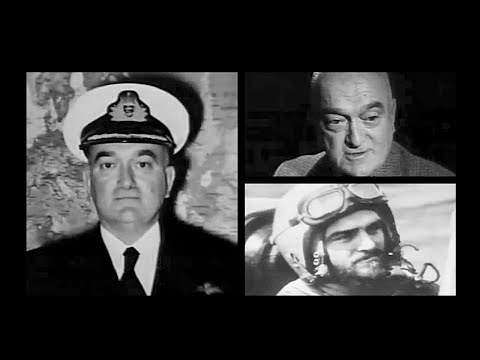
- "Sea Fury Pilot J.A. 'Shamus' O'Farrell Encountered 2 ~Radar Confirmed~ UFOs, Nowra, Australia, 1954." Eyes On Cinema, YouTube. youtube.com
- National Archives of Australia. Series MP926/1, control symbol 3079/101/1, "Unidentified Objects (flying saucers sighted by Navy pilot over Goulburn)." recordsearch.naa.gov.au
See something inaccurate? Have additional information or sources?
Suggest an Edit →Last Updated: August 2026