
The Byland Abbey Manuscript Ghost Stories
A real Latin manuscript exists: British Library Royal MS 15 A XX, on whose blank pages an anonymous monk of Byland Abbey recorded twelve local ghost stories around 1400 CE, later transcribed and published by the medievalist and ghost-story writer M.R. James in 1922. One of those twelve stories does describe a shapeshifting spirit that briefly appears "as it were a revolving haycock with a light in the middle" — a genuinely strange image, and the closest real thing in this manuscript to a "light phenomenon." It is not, however, the source of the claim that circulates across UFO literature: that monks at Byland Abbey watched "a large round silver thing like a disk" fly slowly over them in the year 1290. That specific story is a fully confirmed hoax, invented by two Ampleforth College schoolboys in a joke letter to the Times of London in February 1953, investigated and exposed for the U.S. government's 1968 Condon Report, and admitted to by its own authors — yet it is still the version most often reproduced online, frequently dressed up with invented credentials ("archivally authenticated," "peer-reviewed") that belong to neither the hoax nor the genuine manuscript. This file documents both texts and keeps them separate.
Theoretical Alignment
This file necessarily grades two different things. The genuine manuscript — twelve Latin ghost stories written into blank pages of an older book by an anonymous monk of Byland Abbey — aligns overwhelmingly with the reading nearly every medievalist who has studied it holds: that these are local exempla, cautionary and pastoral tales about restless, unshriven souls, written down to reinforce the doctrine of purgatory and the practical value of confession, absolution, and paid masses for the dead. A weaker but real folk-belief layer sits underneath that pastoral framing, since several stories carry the texture of oral gossip about specific, named local people rather than polished sermon material. The claim that any part of this material describes "a large round silver thing like a disk" flying over the abbey is a different matter entirely: it aligns with the primary sources at approximately zero percent, because it does not come from the primary sources at all. It comes from a 1953 newspaper hoax, detailed at length below.
Sensor & Instrumentation Detection Profile
There is no instrumentation of any kind attached to either thread of this case, which is unsurprising for a medieval manuscript but worth stating plainly for the modern hoax as well. The genuine ghost stories are testimonial folklore filtered twice: first through however the Byland monk who wrote them down in Latin heard them (the text gives no named informants for most of the twelve tales, though several name the human witness — a tailor, a laborer, a servant — involved), and second through the two documented English translations (A.J. Grant, 1924; more recent renderings since). The "silver disc" claim has an entirely different, entirely paper evidentiary chain: a single anonymous letter to a newspaper's correspondence page, printed on February 9, 1953, under an invented byline. No radar, no photograph, no second corroborating account, and — critically — no manuscript were ever produced for the 1290 "sighting," because by the hoaxers' own later admission none ever existed.
Environmental & Geospatial Context
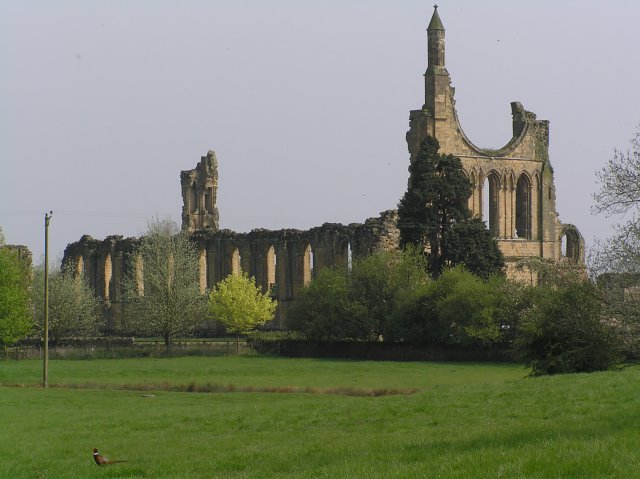
Byland Abbey stands in the Vale of Mowbray at the foot of the Hambleton Hills, near the village of Coxwold in North Yorkshire, England, at approximately 54.203°N, 1.156°W. The genuine ghost stories are set across a tight cluster of real, still-existing North Yorkshire places within a few miles of the abbey and of each other: Ampleforth, Gilling (East and West), and "Ryevaulx" (Rievaulx, site of a separate, larger Cistercian abbey a few miles to the north). This is deliberately local, parish-level geography — sunken lanes, becks (streams), and named fields — not the abbey precinct itself in most of the twelve stories, and it is one of the features scholars point to as evidence the tales reflect genuinely circulating local report rather than invented literary set-pieces. The 1953 hoax borrows this same real regional geography for credibility — it was originally set at nearby Ampleforth Abbey (home to Ampleforth College, the school the hoaxers actually attended) before later ufological authors, evidently confusing the two nearby Yorkshire abbeys, relocated the fabricated "sighting" to Byland Abbey specifically, which only strengthened the false impression of a connection to the real Byland ghost-story manuscript.
Observer Credibility & Occupational Profile
The genuine manuscript's author is anonymous, identified only by modern scholars as "the monk of Byland" or "a monk of Byland," writing in the abbey's own community around 1400. Nothing about his individual identity, office, or education is recorded beyond what the Latin itself shows: a working, if not especially polished, command of monastic Latin, and close familiarity with the specific villages, becks, and family names of the district around the abbey. The scholar responsible for bringing the text to modern attention, Montague Rhodes James (1862–1936), carries an unusually strong and well-documented credential set for exactly this kind of source-critical work: Provost of King's College, Cambridge, and later Provost of Eton College, a leading biblical and apocryphal-literature scholar, a cataloguer of manuscript collections across Cambridge, Oxford, and elsewhere, and, not incidentally, one of the most acclaimed writers of English ghost fiction of his era — a rare combination of professional codicological rigor and a personal, informed fascination with exactly the genre of story he was transcribing. His 1922 English Historical Review article presents a careful Latin transcription with scholarly notes, not a loose retelling.
The 1953 hoax has the inverse credibility profile: its "author," credited in the original Times letter only as a translator named "A.X. Chumley," does not correspond to any identifiable historian, Latinist, or archivist, and the name is now understood to be invented. The real authors were, by the account later given to writer Gavin Gibbons, two schoolboys in the sixth form (the final two years of secondary education) at Ampleforth College who had, by 1956, gone up to Oxford as undergraduates and admitted to Gibbons that they had "forged this document for a joke." Ufologist Jacques Vallée repeated the story in 1965 on the strength of its appearance "in a number of books" rather than any check of an original source; George Adamski and Charlotte Blodget Desmond went further in 1953, printing the fabricated Latin alongside an English translation and concluding outright that "a flying saucer did, in fact, pass over Byland Abbey." None of these popularizers is recorded as having visited the British Library, consulted the Royal manuscripts catalogue, or attempted to verify that a 1290 CE manuscript "recently uncovered" at Ampleforth Abbey was even chronologically possible — it was not: Ampleforth Abbey's own monastic community and buildings date only to the 1890s.
Historical Precedents & Archive Matches
The genuine Byland material sits inside a well-attested medieval English tradition of written ghost narrative rather than standing alone. The closest and most frequently cited comparison is William of Newburgh's late-12th-century Historia rerum Anglicarum ("History of English Affairs"), which includes several detailed accounts of revenants (reanimated corpses) terrorizing communities in the north of England — written some two centuries before the Byland stories but sharing the same core theological anxiety about the unquiet, unabsolved dead. Folklorist Jacqueline Simpson's 2003 article for the journal Folklore, "Repentant Soul or Walking Corpse? Debatable Apparitions in Medieval England," treats William of Newburgh's accounts and the Byland stories as a linked pair, arguing that both blend orthodox purgatorial theology with older, non-Christian folk material in ways that cannot be neatly separated by class or education. As a case study in how a genuine historical hoax later gets grafted onto real folklore for false legitimacy, the 1953 "silver disc" affair also has a documented precedent and near-contemporary: the U.S. government's own 1968 Condon Report (formally, Scientific Study of Unidentified Flying Objects) devotes a section of its history chapter, researched by writer Samuel Rosenberg, to tracing exactly this pattern across several supposed "ancient UFO" reports, Byland/Ampleforth prominent among them, describing how ufological authors had produced "a merry UFO chase of mutual quotation" by copying one another's secondary citations instead of checking primary sources.
Historical & Religious Background
Byland Abbey began life in January 1135 as a Savigniac monastic community, one of several founded during a wave of monastic expansion in early 12th-century Yorkshire; the Savigniac order merged into the larger, stricter Cistercian order in 1147, making Byland Cistercian from that point forward. The community moved site five times over four decades — a story of disputed land, competing nearby foundations, and simple practical unsuitability of early locations — before finally settling permanently near Coxwold in 1177, where the monks began building the large cruciform church and claustral buildings whose ruins survive today. By the later 14th century Byland was well established enough to be described, alongside Rievaulx and Fountains, as one of "the three shining lights of the north" among Yorkshire's Cistercian houses. Like every English monastery, Byland was forcibly dissolved under Henry VIII's Dissolution of the Monasteries, surrendering in November 1538; the site subsequently passed into lay hands (first Sir William Pickering, later the Wombwell family) before eventually coming into public guardianship. Today the ruins are cared for by English Heritage as a Grade I listed scheduled ancient monument, open to visitors.
The Dissolution scattered Byland's own library along with its community. Monastic libraries of Byland's size are estimated to have held several hundred volumes; research compiled by the Medieval Libraries of Great Britain (MLGB3) project has so far identified only around two dozen surviving manuscripts and fragments that can be traced back to Byland's collection, most of them now dispersed across different modern institutions. Royal MS 15 A XX — the volume containing the ghost stories — is one of that small surviving remnant. Its own path into the Old Royal Library is now reasonably well understood in outline: like a substantial number of other Royal-collection manuscripts, it appears to have passed at some point after the Dissolution into the hands of the 17th-century Gloucestershire antiquary and manuscript collector John Theyer (bapt. 1598 – d. 1673), whose personal library of several hundred manuscripts was purchased for King Charles II in 1678. Theyer's manuscripts thereby entered the royal collection assembled by successive English monarchs, a collection of roughly 2,000 volumes that George II formally presented to the newly founded British Museum in 1757 as one of its three founding libraries. The Royal manuscripts transferred, along with the rest of the British Museum's library holdings, to the newly independent British Library upon its establishment in 1973, where Royal MS 15 A XX is held today.
Structurally, the host manuscript long predates its famous marginal additions: it is a 12th- to early-13th-century volume of largely unrelated material — tracts attributed to Cicero and a copy of the Elucidarium, a hugely popular 12th-century Latin dialogue on Christian doctrine composed by the Benedictine theologian Honorius Augustodunensis, covering the nature of God, the soul, and the afterlife in question-and-answer form. That last detail is not incidental: a monk looking for blank space on which to jot down troubling, doctrinally relevant local ghost stories about souls unable to reach heaven would have found no more thematically appropriate spare pages in the whole abbey library than the back matter of a book already devoted to explaining the fate of the soul after death. Sometime around 1400, on folios 140v–143r (in the body of the volume) and folio 163v (near its end), an anonymous member of the Byland community used exactly that space to record twelve short prose narratives in Latin — the "Twelve Medieval Ghost-Stories" this file is chiefly about.
The genre these stories belong to, the exemplum (plural exempla), was a standard preaching and pastoral tool of later medieval Christianity: a short, memorable, often locally rooted anecdote used by clergy to illustrate a moral or doctrinal point in sermons and pastoral instruction. Belief in a "middle state" for souls that were neither securely saved nor irrevocably damned — formalized across the 12th and 13th centuries into the doctrine of Purgatory, and confirmed as official Church teaching at the Second Council of Lyon in 1274 — created enormous pastoral demand for exactly this kind of story: a ghost, typically the reanimated or spiritually restless remains of an ordinary local person who died with an unconfessed sin, an unpaid debt, or an unkept promise, returns to demand that the living intervene on their behalf through confession by proxy, absolution, and paid masses, after which the troubled soul is released and the haunting ends. Every one of the Byland stories that reaches a resolution follows close to this template, and the practical effect of the genre — encouraging parishioners to pay for masses and to take confession and burial rites seriously — served the Church's pastoral and, frankly, financial interests simultaneously. Modern scholars, including Jacqueline Simpson and, more recently, historian Tom Johnson, treat this doctrinal-pastoral function as central to understanding the collection, while also noting, as Simpson does explicitly, that folkloric material older and stranger than official Church teaching — shape-shifting, animal transformation, physical wrestling with the dead — survives inside these ostensibly doctrinal stories largely undigested.
Complete Timeline
| Date | Event |
|---|---|
| Jan. 1135 | A Savigniac monastic community, the future Byland Abbey, is founded in Yorkshire. |
| 1147 | The Savigniac order merges into the Cistercian order; Byland becomes a Cistercian house. |
| 1177 | After five earlier temporary sites, the community settles permanently near Coxwold, North Yorkshire, and begins building the church and cloister whose ruins survive today. |
| Late 14th c. | Byland is reckoned one of the three most prominent Cistercian houses in northern England, alongside Rievaulx and Fountains. |
| c. 1400 CE | The genuine manuscript. An anonymous monk of Byland writes twelve Latin ghost stories into blank pages (ff. 140v–143r and 163v) of an existing 12th/13th-century volume of Cicero and the Elucidarium, later catalogued as Royal MS 15 A XX. |
| Nov. 1538 | Byland Abbey is dissolved under Henry VIII; its library of several hundred volumes is dispersed. Only around two dozen of its manuscripts have since been traced by the MLGB3 project. |
| Bef. 1673 | The host manuscript enters the personal collection of Gloucestershire antiquary John Theyer. |
| 1678 | Theyer's manuscript collection, roughly 300 volumes, is purchased for King Charles II and enters the Old Royal Library. |
| 1757 | George II presents the Old Royal Library, including the future Royal MS 15 A XX, to the newly founded British Museum. |
| Feb. 9, 1953 | The hoax is born. A letter appears in the Times of London, credited to a "translator" named A.X. Chumley, claiming a manuscript "recently uncovered" at Ampleforth Abbey and dated 1290 CE describes monks watching "a large round silver thing like a disk" fly slowly over them. |
| 1953 | George Adamski and Charlotte Blodget Desmond reproduce the hoax Latin text and translation uncritically in Flying Saucers Have Landed, endorsing it as evidence a real craft overflew the abbey. |
| 1954 | H.T. Wilkins repeats the claim in Flying Saucers on the Attack, further embedding it in English-language ufological literature. |
| 1956 | The two Ampleforth schoolboys responsible, by now Oxford undergraduates, privately admit to writer Gavin Gibbons that they "forged this document for a joke." |
| 1965 | Jacques Vallée repeats the claim in Anatomy of a Phenomenon, describing it as "a classical one," while Paul Thomas (pen name of Paul Misraki) relocates the setting from Ampleforth Abbey to the real, nearby Byland Abbey in Flying Saucers Through the Ages, despite noting Gibbons's 1956 confession in the same book. |
| 1922 | The real story reaches print. M.R. James publishes "Twelve Medieval Ghost-Stories," a scholarly Latin transcription of the genuine Royal MS 15 A XX text, in the English Historical Review, vol. 37, pp. 413–422 — three decades before the unrelated 1953 hoax and entirely independent of it. |
| 1924 | A.J. Grant, assisted by Alexander Hamilton Thompson, publishes the first full English translation of the genuine twelve stories in the Yorkshire Archaeological Journal, vol. 27, pp. 363–379. |
| 1967 | Gabriel Green and Warren Smith further embellish the hoax with invented dialogue and characters in Let's Face the Facts About Flying Saucers. |
| 1968 | Writer Samuel Rosenberg formally investigates the claim for the University of Colorado's Condon Report, contacts Ampleforth Abbey directly, and receives written confirmation: "AMPLEFORTH DOCUMENT A HOAX PERPETRATED BY TWO SIXTH FORM BOYS IN LETTER TO TIMES (LONDON)." |
| 1973 | The British Museum's manuscript collections, Royal MS 15 A XX among them, transfer to the newly created British Library. |
| 2003 | Folklorist Jacqueline Simpson publishes "Repentant Soul or Walking Corpse? Debatable Apparitions in Medieval England" in the journal Folklore, treating the genuine Byland stories alongside William of Newburgh's 12th-century revenant accounts. |
| 2009–2010 | Jacques Vallée and Chris Aubeck, in Wonders in the Sky, formally acknowledge the "silver disc" story as a hoax — a public correction from one of the same researchers who had repeated it uncritically in 1965. |
| 2020 | The British Library's Medieval Manuscripts Blog publishes a public guide to the genuine Royal MS 15 A XX ghost stories. |
| 2022 | Historian Tom Johnson publishes "Byland Revisited, or, Spectres of Inheritance" in the Journal of Medieval History, a fresh academic reading of the collection's final story connecting it to real, documented inheritance law. |
| 2023 | Folklore historian Simon Young publishes The Ghosts of Medieval Yorkshire, a modern edition presenting the genuine Latin text and English translation side by side for the first time in one volume. |
| Present day | The genuine manuscript remains catalogued as British Library Royal MS 15 A XX. The "silver disc, 1290" hoax continues to circulate, largely online, frequently and incorrectly conflated with the real Byland Abbey ghost-story manuscript. |
The Primary Text
Two passages matter most here, and they could hardly be more different in character. The first is genuine: it comes from Story I of the real twelve-story collection, as translated into English by A.J. Grant in 1924 and quoted, in this same wording, across the secondary scholarly and popular literature on the manuscript. The second is the confirmed 1953 forgery, quoted here in the wording under which it circulated in ufological literature — not because it is a real primary source, but because seeing its actual invented text, side by side with the genuine manuscript's actual wording, is the fastest way to see how little the two have in common.
Story I — The Genuine Text: "A Revolving Haycock with a Light in the Middle"
The first of the twelve stories concerns an unnamed traveler carrying a sack of beans on horseback near Rievaulx whose horse collapses under him. Continuing on foot with the load on his own back, he encounters a spirit that passes through a rapid sequence of shapes before finally settling into human form and asking for help:
"...he saw as it were a horse standing on its hind feet and holding up its fore feet... Afterwards it appeared to him in the likeness of a revolving haycock with a light in the middle of it..."
Story I ("De quodam mortuo qui..."), Twelve Medieval Ghost-Stories, Royal MS 15 A XX — trans. A.J. Grant, Yorkshire Archaeological Journal, vol. 27 (1924), as widely reproduced in the secondary literature
Plain-English paraphrase: A man carrying beans loses the use of his horse and continues on foot. Along the road he meets something that will not hold one shape: first a rearing horse, then a spinning cone of hay with a glow at its center, and finally an ordinary-looking man. The apparition turns out to be the unquiet spirit of someone locally known who died with unresolved business; it asks the traveler for help, accompanies him partway (carrying his beans, though refusing to cross a stream), and is eventually put to rest once the living man arranges for masses and absolution on the dead man's behalf. That is the entire "light" content of the entire twelve-story collection: a single, brief, explicitly shape-shifting simile — a spinning haystack that glows — embedded in an otherwise ordinary purgatorial ghost story about a stranded traveler and a troubled local soul. It is strange and memorable in exactly the way medieval exempla are meant to be strange and memorable. It does not describe a disc, a craft, a metallic object, or anything in the sky at all; the encounter happens on a country road, at ground level, on foot.
The Second Byland Story Most Often Cited: Snowball the Tailor
The collection's best-known and most fully developed tale, Story II, is set during the reign of King Richard II (1377–1399) and concerns a tailor identified by the surname Snowball, traveling home to Ampleforth from Gilling. He is attacked by a raven throwing off sparks of fire, which becomes a dog dragging a chain, then a she-goat that circles him three times, and finally "a man of great stature, horrible and thin." The spirit reveals it is under excommunication and needs Snowball to secure formal absolution and 180 masses on its behalf, warning him that his own flesh will "rot" and his skin "dry up and fall off" if he fails. Snowball travels to York, pays five shillings to a sequence of chaplains for the written absolution, arranges the masses, buries the parchment of absolution in the spirit's grave, and recovers from the illness the encounter had left him with. Snowball's story is frequently the one modern retellings mean when they refer to "the Byland Abbey ghost story" by name — but it contains no light, globe, disc, or sky phenomenon of any kind. The genuine "light" motif belongs only to the separate, unnamed traveler of Story I. Popular accounts sometimes blur the two tales together, or attach Snowball's name to the light-in-the-sky claim; the primary sources do not support that combination.
The Hoax Text: "A Large Round Silver Thing Like a Disk"
By contrast, the text actually responsible for the "Byland Abbey UFO sighting" claim comes from nowhere in Royal MS 15 A XX. It is the invented Latin-and-translation pair published in the February 9, 1953 letter to the Times of London, credited to the fictitious "A.X. Chumley," and set at the equally real but chronologically impossible location of Ampleforth Abbey in the year 1290:
"...took the sheep from Wilfred and roast them in the feast of SS. Simon and Jude. But when Henry the Abbott was about to say grace, John, one of the brethren, came in and said there was a great portent outside. Then they all went out and LO! a large round silver thing like a disk flew slowly over them, and excited the greatest terror."
The 1953 hoax text, as printed in the Times of London (Feb. 9, 1953) and subsequently reproduced by George Adamski & Charlotte Blodget Desmond, Flying Saucers Have Landed (1953) — a confirmed literary forgery, quoted here for source-identification purposes only
Every internal detail of this passage is either invented outright or historically impossible. Ampleforth Abbey's Benedictine community and its actual buildings date only to the 1890s, making a manuscript "recently uncovered" there and dated 1290 CE a physical impossibility that any archivist could have caught with a single letter of inquiry — and, when the U.S. government's Condon Report finally sent that inquiry in 1968, Ampleforth confirmed by cable that no such document existed and never had. The story's own ufological popularizers eventually said the same thing: Paul Thomas quoted one of the hoax's own perpetrators admitting the forgery in the very same 1965 book that continued to repeat the story, and Jacques Vallée and Chris Aubeck formally retracted it as fiction in their 2010 catalog Wonders in the Sky. No comparably direct confirmation of forgery exists, or has ever been needed, for the real Royal MS 15 A XX — a physical, catalogued, publicly viewable manuscript held continuously by an identifiable chain of owners since at least the 17th century.
Witnesses and the Chain of Testimony
"A Monk of Byland" (anonymous)
The individual actually responsible for the real text at the center of this file. Nothing about his name, office, or personal background survives; scholars refer to him only by his community. His Latin is workmanlike rather than literary, and his stories are dense with real, checkable local place-names and family surnames (Snowball among them), which is one of the reasons folklorists treat the collection as reflecting genuinely circulating oral report from the villages around the abbey rather than invented sermon fiction.
M.R. James (Montague Rhodes James, 1862–1936)
Provost of King's College, Cambridge, and later of Eton College; a leading scholar of biblical apocrypha and manuscript cataloguing, and, separately, one of the most celebrated writers of English ghost fiction of his generation. James transcribed Royal MS 15 A XX's Latin text directly and published it with scholarly apparatus in the English Historical Review in July 1922, three decades before the unrelated 1953 hoax and with no connection to it. His transcription remains the base text underlying every subsequent translation of the genuine stories.
"A.X. Chumley" (fictitious byline)
The credited author of the February 9, 1953 letter that originated the "silver disc" claim. No historian, archivist, or Latinist by this name has ever been identified, and the byline is now understood to be a fabrication by the real authors: two sixth-form pupils at Ampleforth College who, by 1956, had become Oxford undergraduates and admitted in private conversation with writer Gavin Gibbons that they had "forged this document for a joke." One of the two is reported to have died some years later; the survivor, contacted decades afterward, reportedly found continued discussion of his teenage prank "rather tiresome."
Jacques Vallée
Vallée repeated the "silver disc" story in his 1965 book Anatomy of a Phenomenon, describing it as "a classical one" on the strength of its appearance in earlier UFO literature rather than any independent check of a primary source — a textbook case of what Condon Report researcher Samuel Rosenberg called "a merry UFO chase of mutual quotation." To his credit, Vallée and co-author Chris Aubeck formally acknowledged the story as a confirmed hoax in their 2010 historical catalog Wonders in the Sky, making him one of the few original popularizers of the claim to issue a public, on-the-record correction.
The Paleocontact / "Ancient UFO" Interpretation — Anatomy of a Hoax
The claim that medieval monks at Byland Abbey watched a metallic disc cross the sky in 1290 has been a recurring fixture of "ancient astronaut" and historical-UFO literature since the mid-1950s, and it is worth tracing that circulation in detail precisely because it is such a clean case study in how an admitted joke becomes treated as archival fact. The chain begins with the February 9, 1953 letter to the Times of London, printed under the invented byline "A.X. Chumley," claiming a Latin manuscript had been "recently uncovered" at Ampleforth Abbey describing a "great portent" — the silver disc — witnessed by the monks there in the year 1290. The letter was almost certainly intended and read by contemporaries as a lighthearted seasonal joke of exactly the kind British newspapers' letters pages have traditionally carried; nothing in the original text claims scientific or archival authority beyond the fictional translator's byline.
The claim escaped its original satirical context almost immediately. Later in 1953, American contactee-movement figures George Adamski and Charlotte Blodget Desmond reproduced the fabricated Latin passage and its translation at face value in Flying Saucers Have Landed, treating it as genuine historical evidence that "a flying saucer did, in fact, pass over Byland Abbey" — already, at this earliest stage of transmission, silently substituting the real, nearby Byland Abbey for the hoax's original setting of Ampleforth Abbey. British ufologist H.T. Wilkins repeated the story again in 1954's Flying Saucers on the Attack. By the time French author Paul Thomas (a pen name of Paul Misraki) discussed the case in his 1965 book Flying Saucers Through the Ages, he had in hand direct confirmation of the hoax — his own book quotes one of the two perpetrators' 1956 confession to writer Gavin Gibbons, "Two Oxford undergraduates admitted to me in 1956 that they forged this document for a joke" — and nonetheless still included the story, by now permanently relocated to Byland Abbey rather than Ampleforth. Jacques Vallée, also in 1965, cited the same claim in Anatomy of a Phenomenon as "a classical one," evidently drawing on its by-then-widespread appearance in earlier books rather than any fresh check of a primary document. By 1967, Gabriel Green and Warren Smith's Let's Face the Facts About Flying Saucers had expanded the two-sentence hoax into a small scene complete with invented dialogue between named monks discussing their dinner — material with no basis whatsoever in the original 1953 letter, let alone in any medieval source.
The claim was formally investigated and dismantled by writer Samuel Rosenberg as part of his contribution to the U.S. government-commissioned Scientific Study of Unidentified Flying Objects (the 1968 Condon Report), in a chapter on the history of "ancient UFO" claims. Rosenberg traced the story back through the chain of secondary citations described above, then contacted Ampleforth Abbey directly. The reply he received by cable was unambiguous: "AMPLEFORTH DOCUMENT A HOAX PERPETRATED BY TWO SIXTH FORM BOYS IN LETTER TO TIMES (LONDON)." Rosenberg's broader point, still cited by skeptical researchers today, was structural rather than narrowly about one hoax: that ufological authors researching "ancient" sightings were, with some consistency, copying one another's uncredited or loosely credited claims rather than tracing any of them to an actual primary source — producing, in his words, "a merry UFO chase of mutual quotation." Independent researcher Jason Colavito has since compiled the fullest modern account of the case's entire transmission history, and even Vallée himself, together with co-author Chris Aubeck, formally acknowledged the story as fiction in their 2009–2010 catalog Wonders in the Sky — a rare instance of a claim's own original popularizer issuing a public correction, one this site's own editorial standards regard as a model to follow rather than a footnote to bury.
The Mainstream Historical & Folkloric Interpretation
Set the hoax aside entirely, and the genuine Royal MS 15 A XX material has had a substantial, entirely separate life within medieval studies, unconnected to ufology of any kind. Historians and folklorists read the twelve stories as a valuable, unusually candid window into lay religious belief in late medieval northern England — specifically, into how ordinary parishioners and their clergy understood the fate of the soul after death in the period after Purgatory had become settled Church doctrine (formalized at the Second Council of Lyon, 1274). Because the stories are anecdotal, locally specific, and only lightly polished for sermon use, they preserve details — named villages, plausible surnames, small transactional details like Snowball's five shillings paid to a sequence of chaplains — that more formal theological writing of the period tends to omit.
Jacqueline Simpson's 2003 Folklore article, "Repentant Soul or Walking Corpse? Debatable Apparitions in Medieval England," places the Byland stories alongside William of Newburgh's earlier 12th-century revenant accounts and argues against a clean division between "elite" theological content and "popular" folkloric content in either source: shape-shifting, animal transformation, and physical struggle with a corpse-like ghost sit inside the same stories as formal purgatorial doctrine, without the text marking any seam between them. Historian Tom Johnson's 2022 Journal of Medieval History article, "Byland Revisited, or, Spectres of Inheritance," takes a different angle on the collection's final story — concerning a dispute over the inheritance of the sister of one Adam de London — and uses independently surviving legal records to demonstrate that at least some of the human parties named in these "ghost stories" were real, documented people, arguing that the tale encodes genuine anxiety about property and inheritance law rather than functioning purely as devotional fiction. Folklore historian Simon Young's 2023 volume, The Ghosts of Medieval Yorkshire, is the most recent dedicated treatment, presenting a fresh side-by-side Latin-and-English edition of all twelve stories aimed at a general readership while retaining full scholarly apparatus.
None of this modern scholarship treats any part of the genuine collection as describing an aerial object, and none of it makes any claim resembling "archivally authenticated... peer-reviewed [2008]... large silver disc" — a description that, as detailed above, actually belongs to the entirely separate and thoroughly discredited 1953 hoax. This file's authors searched specifically for a 2008 peer-reviewed folklore-journal treatment of the Byland stories, since that citation appeared in this site's own prior working notes on the case, and could not locate one; the closest genuine, verifiable academic folklore-journal treatment identified is Simpson's 2003 Folklore article, alongside Johnson's 2022 Journal of Medieval History piece and Young's 2023 edition. Readers who can supply an exact citation for a distinct 2008 publication are welcome to use this page's "Suggest an Edit" link below; absent that, this file reports honestly that no such source could be verified.
Five Observables Assessment
The Five Observables framework, developed decades later by former AATIP director Luis Elizondo to classify modern UAP performance characteristics that exceed known technology, is included here for structural consistency with the rest of The Omni Ledger's case files. It does not meaningfully apply to either thread of this file: the genuine manuscript describes a ground-level, shape-shifting folkloric encounter with no flight-performance content at all, and the "silver disc" claim is not a performance record of any kind — it is a fabricated two-sentence anecdote with no distance, speed, altitude, or duration data, invented by teenagers rather than observed by anyone.
Assessment: All five categories are marked N/A rather than "absent" in the sense of a genuine phenomenon having been ruled out by testing — neither text in this file offers any flight-performance data of any kind for the framework to evaluate. The genuine manuscript's one "light" motif (Story I's revolving, glowing haycock) is a ground-level shapeshifting simile, not a flight description; the hoax's "silver disc" has no described performance beyond flying "slowly," a detail invented wholesale in 1953.
Comparative Analysis
William of Newburgh's Historia rerum Anglicarum (late 12th century)
The closest genuine literary precedent to the Byland collection is William of Newburgh's Historia rerum Anglicarum, written roughly two centuries earlier, which records several detailed accounts of walking-corpse revenants terrorizing communities in the north of England — a Berwick revenant driven off by a band of townsmen, a "hundeprest" (dog-priest) at Melrose Abbey put down by monks with an axe, and others. Both William's accounts and the Byland stories share a core anxiety — the improperly dead returning to trouble the living — and both were used by Jacqueline Simpson in her 2003 comparative study as evidence that medieval English ghost belief mixed doctrinal and folkloric material more thoroughly than a simple elite/popular divide would suggest.
The Nuremberg & Wickiana Broadsheets: A Contrasting Case of Genuine Provenance
The Omni Ledger's own file on the 1561 Nuremberg celestial phenomenon offers a useful contrast rather than a parallel. That case also involves a centuries-old European document reproduced and argued over by later ufological writers, but the Nuremberg broadsheet itself is a real, continuously provenanced period artifact, preserved via Johann Jakob Wick's Wickiana archive and digitized today by the Zentralbibliothek Zürich — genuinely disputed in its natural-versus-anomalous interpretation, but never alleged to be an outright modern forgery. The Byland "silver disc" claim fails at an earlier stage entirely: it is not a disputed reading of a real period document, because no such period document was ever produced. The distinction matters for evaluating historical UFO claims generally: "old and disputed" and "modern and fabricated" are different failure modes, and conflating them — treating every claim about an old document with the same cautious "disputed" language — would unfairly launder a confirmed hoax into the same evidentiary category as a genuine, if contested, primary source.
Other "Ancient UFO" Claims Debunked by the Same Condon Report Chapter
Samuel Rosenberg's 1968 Condon Report investigation into the Byland/Ampleforth hoax was part of a wider chapter examining a cluster of similarly circulated "ancient astronaut" and historical-UFO claims, cross-referenced elsewhere on this site (see, for instance, the separate scholarly debate around Ezekiel's Wheel and Josef Blumrich's reinterpretation, and the Tulli Papyrus). Rosenberg's broader argument — that authors researching "ancient" sightings routinely copied one another's secondary citations without returning to an actual primary source — describes a general failure mode this site's own editorial policy is specifically designed to avoid, and the Byland/Ampleforth case remains one of the cleanest, most fully documented examples of that failure mode in the entire literature.
Material Analysis
The two threads of this case have entirely different physical evidentiary status, and the contrast is itself the clearest single piece of evidence in the whole file. The genuine manuscript is a real, physical, continuously catalogued object: a parchment volume of the 12th/13th century with a later Latin addition in a distinct hand, held today under a specific British Library shelfmark, viewable by appointment, and traceable through an identifiable (if partly reconstructed) chain of ownership from Byland Abbey's dissolution-era dispersal through John Theyer's 17th-century collection, the Old Royal Library, the British Museum, and finally the British Library. The "silver disc" claim has no equivalent physical evidence at any stage: no manuscript "recently uncovered" at Ampleforth Abbey was ever produced, photographed, catalogued, or examined by any archivist, because the U.S. government's own Condon Report investigation confirmed by direct inquiry to the abbey that none exists.
Supporting the Genuine Manuscript's Authenticity
- Royal MS 15 A XX is a real, physically held, continuously catalogued British Library manuscript with a documented (if partly reconstructed) provenance chain back through the Old Royal Library to Byland Abbey's medieval library
- M.R. James's 1922 transcription and A.J. Grant's 1924 translation are independently verifiable, peer-reviewable scholarly publications in the English Historical Review and the Yorkshire Archaeological Journal respectively
- The stories' dense local geography (named villages, becks, and surnames including Snowball) is independently consistent with real North Yorkshire places and has been used by later scholars, including Tom Johnson, to cross-check specific human parties against surviving legal records
- Modern academic treatment of the manuscript (Simpson 2003, Johnson 2022, Young 2023) has continued for a full century after James's original publication, on grounds entirely unconnected to ufology
Undermining the "Silver Disc" Sighting Claim Specifically
- No manuscript supporting the 1290 "sighting" has ever been produced, examined, or catalogued by any archive; Ampleforth Abbey formally confirmed to Condon Report researcher Samuel Rosenberg in 1968 that none exists
- The claimed 1290 date and Ampleforth Abbey setting are chronologically impossible on their face — Ampleforth Abbey's actual monastic buildings date only to the 1890s
- The credited "translator," A.X. Chumley, cannot be identified as a real historian, archivist, or Latinist and is understood to be an invented byline
- Two of the story's real authors admitted directly, on the record, to writer Gavin Gibbons in 1956 that they "forged this document for a joke"
- The claim's own most prominent popularizer, Jacques Vallée, formally retracted it as fiction alongside Chris Aubeck in their 2010 book Wonders in the Sky
Confirmed Archival & Government Holdings
The British Library's own public account of Royal MS 15 A XX, confirming the shelfmark, folio locations (140v–143r and 163v), and the manuscript's contents and dating.
PUBLIC INSTITUTIONAL RECORDThe U.S. Air Force-funded, University of Colorado-conducted study's own chapter, researched by Samuel Rosenberg, formally tracing and debunking the Byland/Ampleforth "silver disc" claim via direct inquiry to Ampleforth Abbey.
PUBLIC DOMAIN (U.S. Government Report)The Library's public search portal for the Royal manuscripts collection and other Western manuscript holdings, usable to independently verify shelfmarks and provenance notes.
PUBLICLY ACCESSIBLE ARCHIVESearch Primary Archives Directly
Evidence Assessment
Supporting a Genuine Anomalous Phenomenon
- The genuine manuscript does contain one authentically strange, unexplained image — the "revolving haycock with a light in the middle" of Story I — which no scholar has fully explained beyond reading it as a conventional shapeshifting-spirit motif
- The story is embedded in a text whose other, checkable details (place names, the Snowball surname, court-verifiable inheritance facts in the final story) have held up under modern scholarly scrutiny, lending some general credibility to the collection's local grounding
Supporting a Non-Anomalous, Documentary Explanation
- The one real "light" motif is explicitly one stage in a multi-form shapeshifting sequence (horse → glowing haycock → man), a standard device of medieval revenant folklore, not an isolated sky phenomenon
- The specific, evocative "large silver disc" claim that actually drives popular interest in this case is a confirmed, self-admitted 1953 hoax with no manuscript ever produced
- The hoax's own internal details (an 1290-dated manuscript "recently uncovered" at an abbey whose buildings date to the 1890s) are chronologically self-refuting
- A direct U.S. government investigation (the 1968 Condon Report) obtained on-the-record confirmation from Ampleforth Abbey itself that the document never existed
- The claim's most prominent modern proponent, Jacques Vallée, has himself formally retracted it as fiction
Conventional Explanation Candidates
Because this file covers two distinct texts, its Conventional Explanation Candidates (CEC) are split accordingly: one set addressing the genuine manuscript's one light-related motif, and one addressing the "silver disc" claim that actually generates most popular interest in "Byland Abbey" as a UFO case.
1. Confirmed Literary Hoax (the "Silver Disc" Claim)
This is not a competing hypothesis alongside others; it is the documented, self-admitted origin of the claim. A February 9, 1953 letter to the Times of London, credited to a fictitious translator and set at a real abbey whose own buildings postdate the claimed 1290 date by six centuries, was invented by two Ampleforth College schoolboys as a joke, later privately confessed to writer Gavin Gibbons (1956), and formally confirmed as fiction by direct inquiry from the U.S. government's Condon Report investigation (1968) and by the claim's own most prominent popularizer, Jacques Vallée, in print (2010).
Plausibility Rating: CONFIRMED HOAX
2. Conventional Shapeshifting Revenant / Purgatorial Exemplum (Story I's Genuine "Light" Motif)
Read on its own terms, Story I's "revolving haycock with a light in the middle" fits comfortably within the standard medieval revenant-shapeshifting device also seen elsewhere in the same collection (Snowball's raven-dog-goat-man sequence; other Byland stories' bullock without mouth or eyes, and a "revolving piece of canvas"). Folklorists including Jacqueline Simpson read these transformation sequences as a recognized narrative convention signaling an ambiguous, liminal spirit gradually resolving into communicable, human form — not as literal, independently verifiable descriptions of a physical object.
Plausibility Rating: HIGHLY PLAUSIBLE (as the best-supported reading of the genuine text)
3. Genuine Local Oral Tradition, Recorded with Reasonable Fidelity
Multiple independent lines of evidence — the collection's dense use of real, checkable place names, its inclusion of a specific surname (Snowball) still attested in the region, and Tom Johnson's 2022 identification of court-verifiable inheritance facts underlying the final story — support treating the twelve tales as generally faithful (if inevitably compressed and shaped by pastoral purpose) transcriptions of stories that really did circulate among the abbey's lay neighbors around 1400, whatever one concludes about their supernatural content.
Plausibility Rating: LIKELY
4. Genuine Anomalous / Paleocontact Phenomenon
Included for completeness, per this site's standard framework. No positive evidence supports a literal, non-natural aerial encounter in either text. The genuine manuscript's "light" motif is textually inseparable from an explicitly shapeshifting, ground-level folkloric encounter; the "silver disc" claim most associated with an ancient-astronaut reading of "Byland Abbey" is not merely unsupported but affirmatively confirmed, by the claim's own authors and by direct government investigation, to be a fabrication with no underlying manuscript at all.
Plausibility Rating: NO EVIDENCE / CONFIRMED FABRICATION
Why "HOAX"
The Omni Ledger classifies this file as HOAX rather than merely "disputed" or "debunked" because the central claim driving popular interest in "Byland Abbey" as a UFO case — a large silver disc witnessed by monks in 1290 — is not an ambiguous or contested reading of a real document, the way a Nuremberg-style natural-versus-anomalous debate is. It is a documented, dated, self-admitted literary invention with a known point of origin (a February 9, 1953 newspaper letter), known perpetrators (two named-in-outline Ampleforth College schoolboys who confessed on the record in 1956), and formal confirmation of its fictional status from both a direct U.S. government investigation (the 1968 Condon Report) and the claim's own most prominent modern popularizer (Jacques Vallée, in print, 2010). That is a stronger and more specific evidentiary basis than "debunked" ordinarily implies on this site, which is why the hoax stamp, rather than the disputed or debunked stamp, applies here.
At the same time, this file is emphatically not a debunking of the underlying medieval manuscript, which is real, well-provenanced, and independently valuable as a source for medieval English religious and folk belief entirely apart from any UFO question. Royal MS 15 A XX, M.R. James's 1922 publication of it, and the genuine twelve ghost stories it contains — including Story I's authentically strange "revolving haycock with a light in the middle" — are not disputed by this file at all. The HOAX classification applies specifically and only to the "large silver disc, 1290 CE" sighting claim that has been incorrectly, and now for over seventy years, associated with the abbey's name.
Cultural & Scholarly Legacy
The genuine Royal MS 15 A XX material has enjoyed a long, entirely separate life within medieval studies and popular medievalism alike. M.R. James's own reputation as both a serious codicologist and one of the finest writers of English supernatural fiction (his own ghost stories, including "Oh, Whistle, and I'll Come to You, My Lad" and "Casting the Runes," remain in print a century later) has helped keep the Byland material visible to readers who might otherwise never encounter a specialist 1922 journal article. Successive translations and popularizations — A.J. Grant's 1924 Yorkshire Archaeological Journal rendering, informal web transcriptions such as the openly available GitHub edition maintained by digital humanities researcher David Mimno, and Simon Young's 2023 dual-language edition — have kept the twelve stories in active circulation among general readers of medieval ghost lore, largely independent of any ufological interest.
The abbey ruins themselves, managed today by English Heritage, are a modest but genuine visitor destination, and the ghost-story association is now part of the site's popular identity — local heritage writers, walking-tour operators, and regional history bloggers regularly retell Snowball's story and the collection's other tales as part of North Yorkshire's folklore heritage, almost always without reference to the unrelated 1953 hoax.
The hoax, for its part, has had its own durable afterlife, almost entirely confined to ufological and paranormal listicle content rather than historical scholarship. Despite the 1956 private confession, the 1965 published acknowledgment of that confession by one of the very authors still repeating the story, and the 1968 Condon Report's formal government-level debunking, the "large silver disc over Byland Abbey, 1290" claim continues to recirculate on paranormal websites and video content, frequently stripped of any reference to its origin and sometimes dressed up with invented markers of scholarly legitimacy that belong to neither the hoax nor the genuine manuscript. This file exists specifically to break that chain of uncredited repetition for anyone who finds it.
Related Entries
Further Reading — Recommended Literature
The Ghosts of Medieval Yorkshire: The Zombies, Shape-Changers and Ghouls of Byland Abbey
The most recent dedicated edition of the genuine twelve stories, presenting the Latin and English translation side by side for the first time in one volume, with a full scholarly introduction.
Ghosts in the Middle Ages: The Living and the Dead in Medieval Society
The standard academic study of medieval ghost belief and its relationship to Church doctrine, essential context for understanding why exempla like the Byland stories were written down at all.
Montague Rhodes James
The definitive scholarly biography of M.R. James, covering his parallel careers as manuscript cataloguer, medievalist, and ghost-story author — the man who first brought the Byland stories to print in 1922.
Royal Manuscripts: The Genius of Illumination
The British Library's own exhibition catalog on the Royal manuscripts collection — the same collection, formed via the Old Royal Library and George II's 1757 gift, that holds Royal MS 15 A XX today.
Byland Abbey: North Yorkshire
The official English Heritage guidebook to the abbey ruins, covering the site's Cistercian architecture, dissolution, and archaeology in detail.
Essential Viewing
England's Oldest Collection of Ghost Stories, 1400AD — Byland Abbey, N. Yorkshire
Church Searcher — a focused, on-location look at the genuine manuscript and its twelve stories, filmed in the North Yorkshire villages the tales are set in.
The Monk of Byland Abbey, Yorkshire — Haunted History
The Fear Channel — a narrative retelling of the manuscript's origin and several of the twelve stories, framed within the genuine medieval ghost-belief context.
Sources
- James, M.R. "Twelve Medieval Ghost-Stories." The English Historical Review, vol. 37, no. 147 (July 1922), pp. 413–422. academic.oup.com
- Grant, A.J. (trans., with Alexander Hamilton Thompson). "Twelve Medieval Ghost Stories" (English translation). Yorkshire Archaeological Journal, vol. 27 (1924), pp. 363–379.
- "Byland Abbey ghost stories: a guide to medieval ghosts." Medieval Manuscripts Blog, British Library. blogs.bl.uk
- Mimno, David (ed.). "Twelve Medieval Ghost Stories" (transcription/translation repository). GitHub. github.com
- Simpson, Jacqueline. "Repentant Soul or Walking Corpse? Debatable Apparitions in Medieval England." Folklore, vol. 114, no. 3 (2003), pp. 389–402. tandfonline.com
- Johnson, Tom. "Byland Revisited, or, Spectres of Inheritance." Journal of Medieval History, vol. 48, no. 4 (2022), pp. 439–456. eprints.whiterose.ac.uk (open access)
- Young, Simon. The Ghosts of Medieval Yorkshire: The Zombies, Shape-Changers and Ghouls of Byland Abbey. Ghost Series, 2023.
- Colavito, Jason. "The Byland Abbey UFO Sighting: Anatomy of a Hoax." jasoncolavito.com
- "Scientific Study of Unidentified Flying Objects" (The Condon Report), Section V, Chapter 1: "UFOs in History" (Samuel Rosenberg). University of Colorado, 1968. files.ncas.org
- "Byland Abbey." Wikipedia. en.wikipedia.org
- "Royal manuscripts, British Library." Wikipedia. en.wikipedia.org
- "History of Byland Abbey." English Heritage. english-heritage.org.uk
- "Sources for Byland Abbey." English Heritage. english-heritage.org.uk
- "Medieval Ghost Stories: The Chilling Haunts of Byland Abbey." Medievalists.net (2024). medievalists.net
- "Ghost Stories from Byland Abbey." Medieval Histories. medieval.eu
- "Library." The Cistercians in Yorkshire Project, Byland Abbey. dhi.ac.uk
- "Dissolution." The Cistercians in Yorkshire Project, Byland Abbey. dhi.ac.uk
- "The Ghost Stories of Byland Abbey, Part 1" & "Part 2." The Mediaeval Monk. themediaevalmonk.wordpress.com
- File: Byland_Abbey_-_geograph.org.uk_-_5961350.jpg. Photograph by Michael Garlick, 2018. Wikimedia Commons. commons.wikimedia.org
- British Library Archives and Manuscripts Catalogue. searcharchives.bl.uk
- "Jacques Vallée." The Omni Ledger Key Figures. key-figures.html
- "Jason Colavito." The Omni Ledger Key Figures. key-figures.html
- Vallée, Jacques & Aubeck, Chris. Wonders in the Sky: Unexplained Aerial Objects from Antiquity to Modern Times. Tarcher/Penguin, 2010 (hoax retraction).
See something inaccurate? Have additional information or sources?
Suggest an Edit →Last Updated: August 2026