
Ezekiel's Wheel
Around 593 BCE, a Judean priest named Ezekiel — living among deportees on the flat alluvial plain of Babylonia — recorded a vision of a "whirlwind out of the north": a great cloud of fire, four composite living creatures, and beside each of them a set of gleaming wheels, "a wheel within a wheel," their rims "full of eyes round about." Twenty-five centuries later, a retired NASA aerospace engineer looked at the same eleven verses and drew engineering schematics of a landing helicopter. This file separates the verified biblical text from the modern "ancient astronaut" reinterpretation built on top of it, and lays both against the reading nearly every professional Hebrew Bible scholar actually holds: that Ezekiel 1 is a work of visionary, apocalyptic theology — the founding text of an entire tradition of Jewish mysticism — rather than a garbled eyewitness account of a spacecraft.
Theoretical Alignment
Measured against the vocabulary of modern Hebrew Bible scholarship, the "spaceship" reading of Ezekiel 1 aligns weakly with the internal grammar, vocabulary, and literary context of the passage — it requires importing an external technological framework the text does not itself supply and depends on a small number of retranslated or reordered clauses. The reading that Ezekiel 1 is a theophany — a vision of the "glory of the LORD" (kevod YHWH) rendered in the composite, awe-heavy imagery typical of Near Eastern royal and temple art — aligns strongly with the text's own vocabulary (throne, glory, firmament, cherubim), its position at the head of a book of prophetic oracles, and its acknowledged role as the origin point of an entire subsequent mystical tradition (Merkabah mysticism). The psycho-social/cultural-symbolic reading — that Ezekiel processed a genuine, intense religious experience through the only visual vocabulary available to a Judean priest steeped in Jerusalem Temple theology and freshly exposed to Babylonian monumental art — is treated by most historical-critical scholars as compatible with, and largely overlapping, the visionary reading.
Sensor & Instrumentation Detection Profile
This is the single largest evidentiary difference between an "ancient record file" like this one and a modern case file such as Roswell or a contemporary military encounter: there is no independent corroborating "sensor." The entire account rests on one first-person narrator — Ezekiel himself, writing in the first person ("I looked, and behold... I saw... I heard") — with no second witness, no physical trace evidence, no radar log, and no archaeological artifact that can be tied to the event described. What Ezekiel reports registering are his own senses: sight (the whirlwind, the fire, the "colour of amber," the wheels, the throne), sound (wings "like the noise of great waters," a voice from the firmament), and an internal spiritual apprehension ("the hand of the LORD was there upon him"). No other biblical figure, contemporary chronicle, or Babylonian administrative record references the event. This absence of external corroboration is not unusual for ancient religious literature — visionary and prophetic texts across the ancient Near East are characteristically single-witness — but it does mean the text cannot be evaluated using the same evidentiary standards (radar returns, multiple independent witnesses, chain-of-custody physical debris) applied elsewhere on this site to 20th- and 21st-century incidents.
Environmental & Geospatial Context
The vision is explicitly located "in the land of the Chaldeans, by the river of Chebar" (Ezekiel 1:3). Most historical-geographical scholarship identifies the Chebar (Hebrew Kevar) with the naru kabari, a large irrigation canal branching off the Euphrates near the city of Nippur in southern Babylonia (modern Iraq), a region confirmed by cuneiform administrative tablets — including the "Al-Yahudu" archive published in the 2000s–2010s — to have hosted a documented community of exiled Judean deportees, some bearing Yahwistic names, engaged in agriculture and local commerce under Babylonian administration. The physical setting was a flat, hot, heavily irrigated alluvial plain, periodically swept by dust-laden storms sweeping down from the north — the same directionality Ezekiel records for the storm that opens the vision ("a whirlwind came out of the north"). Mesopotamian temple and palace complexes in this region, which Ezekiel and the exile community would have passed or lived near, were adorned with monumental, brightly glazed composite guardian figures and wheeled processional imagery, discussed further in the Textual & Iconographic Analysis section below.
Observer Credibility & Occupational Profile
Ezekiel identifies himself as "the priest, the son of Buzi" (Ezekiel 1:3), a member of the Jerusalem priestly class — likely of the Zadokite line that later chapters of the book favor — deported in the first wave of exile in 597 BCE along with King Jehoiachin. Internal chronology places him at exactly thirty years old at the time of the inaugural vision, the very age at which, under the Torah's own priestly law (Numbers 4:3), a Levitical priest became eligible for full Temple service — a detail widely read by scholars as a deliberate literary marker: the priest who could not serve at the (now inaccessible, soon-to-be-destroyed) Jerusalem Temple instead receives his commission directly from God in a foreign land. His occupational and religious credentials for producing sophisticated Temple-derived symbolic literature are, by any historical standard, extremely strong. The two most prominent modern reinterpreters carry a different, non-overlapping expertise: Josef F. Blumrich (1913–2002) held real, verifiable NASA credentials — chief of the Advanced Structural Development Branch at Marshall Space Flight Center, recipient of NASA's Exceptional Service Medal (1972), with a career spanning Saturn V, Skylab, and Space Shuttle structural design — but no training in Biblical Hebrew, Northwest Semitic philology, or ancient Near Eastern studies. Erich von Däniken, who popularized the Ezekiel-as-spacecraft reading in 1968, held no academic credentials in either engineering or biblical studies. Their critics — scholars such as Moshe Greenberg, Walther Zimmerli, Daniel I. Block, and Michael S. Heiser — hold the inverse credential profile: doctoral training in Hebrew philology and ancient Near Eastern studies, but (obviously) no aerospace engineering background. The credibility question is therefore less about honesty than about which expertise the text actually requires to interpret.
Historical & Religious Background
Ezekiel ben-Buzi was almost certainly born in Jerusalem around 623 BCE, during the reign of the reforming king Josiah, into a priestly family with ties to the Jerusalem Temple. His life was shaped by the collapse of the kingdom of Judah under Babylonian pressure. In 597 BCE, after King Jehoiakim's rebellion against Nebuchadnezzar II of Babylon, the Babylonian army besieged Jerusalem, deposed the eighteen-year-old King Jehoiachin, and deported him along with several thousand members of the Judean elite — nobles, craftsmen, and priests — to Babylonia. Ezekiel was among this first wave of deportees, settled with other exiles at a place called Tel Abib ("mound of the flood/storm," ironically or fittingly echoing the Babylonian flood tradition) on the Chebar canal.
Five years into this exile — by internal dating, "in the thirtieth year… in the fifth day of the month, which was the fifth year of king Jehoiachin's captivity" (Ezekiel 1:1–2), conventionally calculated to July 593 BCE — Ezekiel experienced the vision recorded in chapter 1, which the book presents as his prophetic call. This places the vision roughly six years before the second and final Babylonian conquest of Jerusalem in 586 BCE, when Nebuchadnezzar's forces destroyed Solomon's Temple entirely and deported a second wave of the population. A significant portion of Ezekiel's subsequent forty-eight chapters — dated oracles running from 593 BCE to as late as 571 BCE (Ezekiel 29:17, the latest internal date in the book) — wrestle with exactly this catastrophe: first as an unheeded warning of coming judgment, then, after 586 BCE, as a message of accountability, and finally as an elaborate architectural vision of a restored, idealized future Temple (chapters 40–48).
Critically, Ezekiel's exile placed him inside one of the most visually and architecturally spectacular civilizations of the ancient world at the height of its power. Nebuchadnezzar II's Babylon featured the glazed-brick Ishtar Gate, the Processional Way lined with striding lions, and temple complexes guarded by enormous composite protective statues combining human, bovine, leonine, and avian features. A Judean priest trained in the older, more restrained aniconic tradition of the Jerusalem Temple — where the cherubim were carved wooden figures inside the Holy of Holies, largely hidden from public view — would have been confronted daily with a far more monumental, brightly colored, and public Babylonian visual vocabulary of composite divine and semi-divine guardian beings. Modern biblical scholarship treats this collision of visual cultures as directly relevant to understanding why Ezekiel's call vision, alone among the Hebrew prophets, is rendered in such extraordinarily dense, mechanically detailed, composite imagery.
The Book of Ezekiel occupies an unusual place among the biblical prophetic books: unlike the traditions behind Isaiah or Jeremiah, which read as compilations of a prophet's sayings recorded and edited by later scribes and disciples, Ezekiel is presented throughout in a consistent, first-person literary voice, dated with unusual precision against the reign-years of the exiled king Jehoiachin, and structured with a level of internal architectural and numerical coherence unusual for prophetic literature. This has led many modern critical scholars — while still recognizing later editorial layers, particularly in the concluding Temple-vision chapters — to treat the book as substantially the product of a single sophisticated priestly author working with (or as) a "school" of tradents in the decades following the events described, rather than a loose folk compilation.
Complete Timeline
| Date | Event |
|---|---|
| c. 623 BCE | Traditional birth date of Ezekiel ben-Buzi, calculated from the internal chronology of the book, into a Jerusalem priestly family. |
| 597 BCE | First Babylonian deportation. King Jehoiachin, the royal court, and thousands of Judean elites — including Ezekiel — are exiled to Babylonia after a failed rebellion against Nebuchadnezzar II. |
| 593 BCE | The inaugural vision. "In the thirtieth year… the fifth year of king Jehoiachin's captivity," by the river Chebar, Ezekiel experiences the theophany recorded in chapter 1 and receives his prophetic commission (Ezekiel 1–3). |
| 593–586 BCE | Ezekiel delivers oracles of judgment warning the exile community that Jerusalem's fall is imminent and deserved, drawing hostility from fellow exiles who expected a swift return. |
| 586 BCE | Second Babylonian conquest of Jerusalem. Nebuchadnezzar's forces destroy Solomon's Temple and deport a second wave of the population, vindicating Ezekiel's earlier warnings. |
| c. 573 BCE | Ezekiel receives a second major vision of the divine chariot-throne, this time explicitly identifying the four living creatures as "cherubim" (Ezekiel 10), and a detailed architectural vision of a future, idealized Temple (Ezekiel 40–48). |
| 571 BCE | Latest internally dated oracle in the book (Ezekiel 29:17), concerning Egypt — the last firm date associated with Ezekiel's ministry. |
| 2nd century BCE – 1st century CE | Fragments of at least six separate manuscript copies of Ezekiel are deposited among the Dead Sea Scrolls at Qumran (including 4Q73, 4Q74, and 11Q4), confirming the textual stability of chapter 1 within a few centuries of composition. |
| 1st century BCE – 1st century CE | Priestly-mystical circles associated with the Qumran community produce the "Songs of the Sabbath Sacrifice" (4Q400–407), an early liturgical elaboration on Ezekiel's throne-chariot imagery. |
| c. 200 CE | The Mishnah (tractate Hagigah 2:1) formally restricts public teaching of "the Chariot" (Ma'aseh Merkabah) to a single qualified sage at a time, reflecting the passage's established status as esoteric, dangerous mystical material rather than plain narrative. |
| c. 200–700 CE | The Hekhalot ("Palaces") literature — Hekhalot Rabbati, Hekhalot Zutarti, Ma'aseh Merkabah, 3 Enoch — develops as a mystical corpus describing visionary ascent through seven heavenly palaces toward Ezekiel's chariot-throne. |
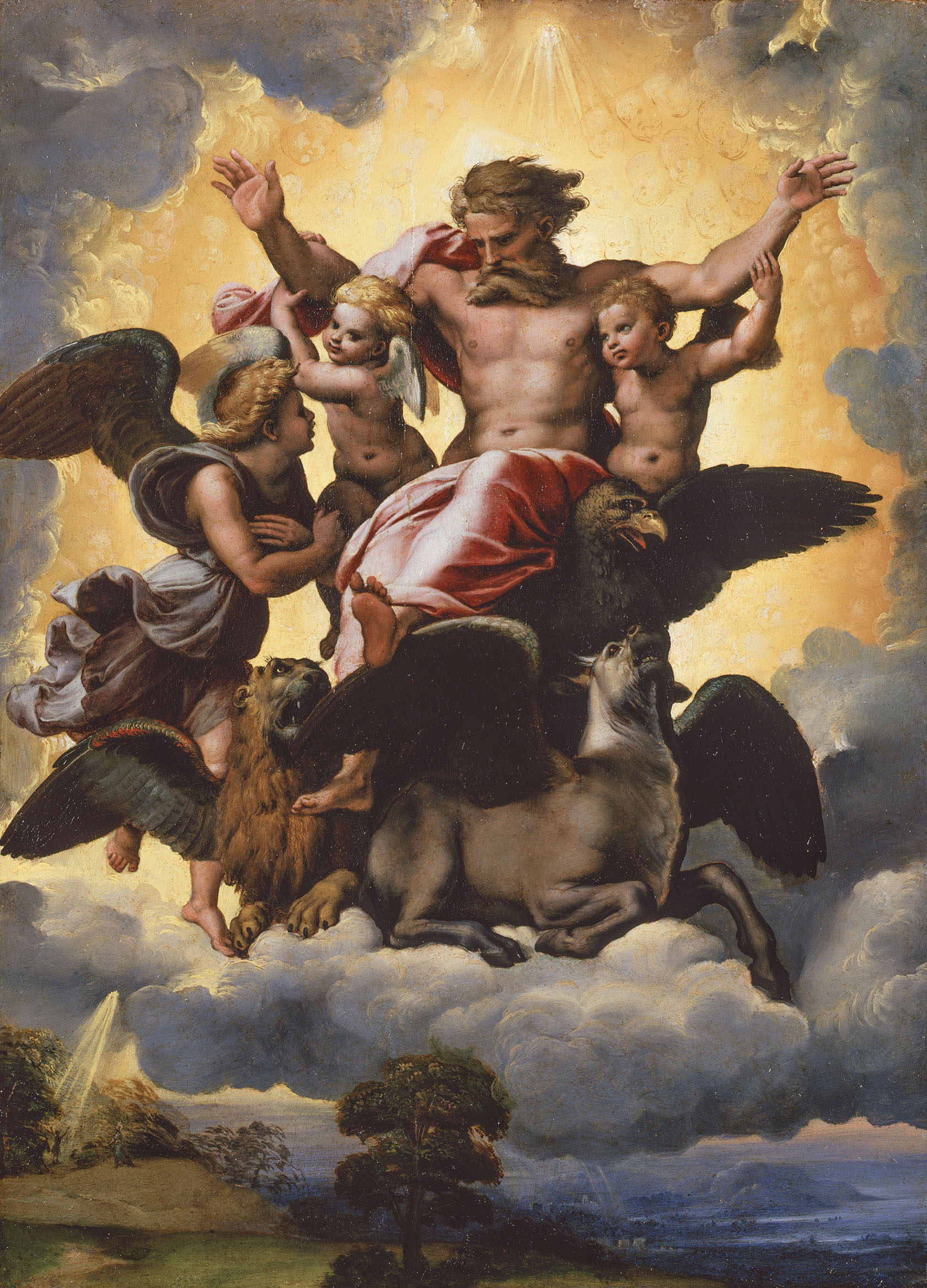
| c. 1518 | Raphael paints Ezekiel's Vision, now in the Palatine Gallery of the Palazzo Pitti, Florence — one of the best-known Renaissance depictions of the theophany. |
| 1968 | Swiss author Erich von Däniken publishes Chariots of the Gods? (English translation), arguing that Ezekiel's account, along with numerous other ancient texts and monuments, records real encounters with technologically advanced visitors misremembered as gods. |
| 1973 | Josef F. Blumrich, chief of NASA's Advanced Structural Development Branch at Marshall Space Flight Center, publishes Da tat sich der Himmel auf ("Then the Heavens Opened") in German, having set out to disprove von Däniken's claim and instead concluded it was correct. |
| 1974 | The English translation, The Spaceships of Ezekiel, is published by Bantam Books, presenting detailed engineering schematics of a hypothesized landing craft and helicopter-like "wheels." |
| 1970s–1990s | The book becomes a staple of ancient-astronaut and paranormal literature while drawing sustained criticism from biblical scholars, Hebraists, and skeptics for its handling of the Hebrew text. |
| Feb. 10, 2002 | Josef F. Blumrich dies in Estes Park, Colorado, at age 88, having continued to defend his interpretation until the end of his life. |
The Primary Text
The following is the King James Version (KJV) — a public-domain English translation first published in 1611 and still among the most widely quoted English renderings of the Hebrew Bible — of the verses in Ezekiel chapter 1 most frequently cited in "ancient astronaut" literature. Quoted here verbatim and in full context, without alteration:
"Now it came to pass in the thirtieth year, in the fourth month, in the fifth day of the month, as I was among the captives by the river of Chebar, that the heavens were opened, and I saw visions of God. In the fifth day of the month, which was the fifth year of king Jehoiachin's captivity, the word of the LORD came expressly unto Ezekiel the priest, the son of Buzi, in the land of the Chaldeans by the river Chebar; and the hand of the LORD was there upon him.
And I looked, and, behold, a whirlwind came out of the north, a great cloud, and a fire infolding itself, and a brightness was about it, and out of the midst thereof as the colour of amber, out of the midst of the fire. Also out of the midst thereof came the likeness of four living creatures. And this was their appearance; they had the likeness of a man. And every one had four faces, and every one had four wings. And their feet were straight feet; and the sole of their feet was like the sole of a calf's foot: and they sparkled like the colour of burnished brass. And they had the hands of a man under their wings on their four sides… As for the likeness of their faces, they four had the face of a man, and the face of a lion, on the right side: and they four had the face of an ox on the left side; they four also had the face of an eagle…
Now as I beheld the living creatures, behold one wheel upon the earth by the living creatures, with his four faces. The appearance of the wheels and their work was like unto the colour of a beryl: and they four had one likeness: and their appearance and their work was as it were a wheel in the middle of a wheel. When they went, they went upon their four sides: and they turned not when they went. As for their rings, they were so high that they were dreadful; and their rings were full of eyes round about them four. And when the living creatures went, the wheels went by them: and when the living creatures were lifted up from the earth, the wheels were lifted up. Whithersoever the spirit was to go, they went, thither was their spirit to go; and the wheels were lifted up over against them: for the spirit of the living creature was in the wheels…
And above the firmament that was over their heads was the likeness of a throne, as the appearance of a sapphire stone: and upon the likeness of the throne was the likeness as the appearance of a man above upon it… This was the appearance of the likeness of the glory of the LORD. And when I saw it, I fell upon my face, and I heard a voice of one that spake."
Ezekiel 1:1–10 (abridged), 1:15–21, 1:26–28 (abridged) — King James Version, public domain
Modern critical translations such as the New Revised Standard Version (NRSV) and the Jewish Publication Society (JPS) Tanakh render the same Hebrew with largely equivalent content but updated vocabulary — for instance "gleaming amber" or "gleaming bronze" in place of the KJV's archaic "amber," and "wheel within a wheel" or "a wheel intersecting a wheel" for the mechanically striking Hebrew phrase ha'ofan betokh ha'ofan. No mainstream translation committee — including those explicitly aligned with conservative or evangelical scholarship — renders the passage as describing mechanical hardware; the interpretive leap to "spacecraft" occurs entirely in secondary literature, not in translation.
Plain-English paraphrase: Five years into exile in Babylonia, on a specific dated day, Ezekiel — a Jerusalem priest now living among deportees by an irrigation canal — sees a violent storm approaching from the north: a churning cloud shot through with fire and a strange gleaming light at its center. Out of the storm emerge four composite beings, each with a human-like body but four faces (human, lion, ox, and eagle) and four wings, moving with perfect coordination and never turning, their bodies flickering like burning coals and lightning. Beside each being is an enormous, glittering wheel-like structure, seemingly made of "a wheel within a wheel," its rim entirely covered in eyes; the wheels move in perfect union with the creatures, rising and stopping together, because — the text says explicitly — "the spirit of the living creature was in the wheels." Above the heads of the four creatures is a crystalline expanse, and above that a throne of sapphire-blue stone, on which sits a radiant, fire-wreathed humanlike figure surrounded by a rainbow-like brightness. Ezekiel identifies this entire vision as "the appearance of the likeness of the glory of the LORD" and falls face-down before it; a voice then speaks to him, commissioning him as a prophet to Israel.
Textual & Iconographic Analysis
Read against its own literary and cultural context rather than against 20th-century aerospace vocabulary, Ezekiel 1 draws on a recognizable ancient Near Eastern visual repertoire that Ezekiel — a priest raised in Temple ritual and now living inside the Babylonian imperial heartland — would have known intimately. Three elements are central:
The Four-Faced Composite Creatures and Mesopotamian Guardian Iconography
Assyrian and Babylonian palace and temple gateways were flanked by monumental lamassu (also called shedu) — colossal guardian statues combining a human head, the winged body of a bull or lion, and (in some renderings) additional composite features, meant to embody strength, vigilance, and divine protection. The Hebrew word for Ezekiel's creatures, keruvim (cherubim), is generally traced by Semitic philologists to the Akkadian karabu, "to bless" or "to pray" — the same root behind the Akkadian guardian-spirit term kuribu. Scholars of ancient Near Eastern iconography, including researchers cataloguing Assyrian palace reliefs, note that composite four-element imagery combining human, lion, ox (or bull), and eagle features recurs across Mesopotamian glyptic and monumental art of exactly this period, and that Judean priestly tradition already possessed its own, older cherubim iconography (carved cherubim flanked the Ark of the Covenant and the doors of Solomon's Temple, per 1 Kings 6). Ezekiel's vision is best read by most scholars as a fusion: existing Israelite Temple cherubim-theology, intensified and elaborated using the far more monumental and publicly visible Babylonian guardian-figure vocabulary that surrounded the exile community daily.
The Wheels (Ophanim) and Wheeled Cultic Furniture
The Hebrew term for the wheels, ofannim (אוֹפַנִּים, singular ofan), is an entirely ordinary Hebrew word used elsewhere in the Bible for mundane wheels — chariot wheels (Exodus 14:25) and the wheeled stands supporting the bronze basins of Solomon's Temple (1 Kings 7:30–33). It only becomes an unusual figure in Ezekiel because of what is attached to it: rims "full of eyes round about," and the explicit claim that "the spirit of the living creature was in the wheels," binding wheel and creature into a single mobile unit that can move instantly in any of four directions "and turned not when they went." It was not until much later Jewish apocalyptic and mystical literature — the Book of Enoch (61:10; 71:7) and, earliest of all in a fully developed angelic sense, the Qumran "Songs of the Sabbath Sacrifice" (4Q405) — that these wheels were formalized as Ophanim, a distinct order of angelic being; the Ezekiel 1 text itself never uses "ophanim" as a proper angelic title, only as the plain word "wheels." This distinction matters for the ancient-astronaut reading, which frequently treats "ophanim" as though it were Ezekiel's own technical term for a piece of hardware, when it is in fact a much later theological label applied retroactively by interpreters working centuries after the text was written.
"Chashmal": A Genuinely Difficult Word
One Hebrew word in the passage, chashmal (חַשְׁמַל, KJV "amber"), is a genuine linguistic puzzle: it occurs only in Ezekiel (1:4, 1:27, 8:2) and nowhere else in the Hebrew Bible, giving translators very little comparative material to work with. Its Akkadian cognate suggests a gleaming, fire-colored precious material; the ancient Greek Septuagint rendered it as elektron, referring to an amber-colored gold-silver alloy (and, separately, to actual amber). Because rubbing amber generates static electricity, the Greek and Latin words for amber later supplied the root for the English word "electric" — and, in a neat historical loop, the Hebrew poet Judah Leib Gordon proposed reviving the obscure biblical word chashmal around 1880 as the modern Hebrew word for "electricity," which it remains today (modern Hebrew now uses the separate, Arabic-derived word inbar for actual amber). This is a genuinely interesting and well-documented piece of translation history — but it documents the difficulty of a rare Hebrew word and its afterlife in 19th-century Hebrew revival, not a physical description of an electrical power source, and it is frequently overstated in popular ancient-astronaut writing as though the Bible itself designates the vision as "electric."
Christian Reuse: Revelation 4 and the Four Evangelists
Ezekiel's four-faced creatures had a long afterlife far beyond Jewish mysticism. The New Testament Book of Revelation directly borrows the imagery: its own throne-room vision (Revelation 4:6–8) describes four "living creatures" surrounding God's throne, the first "like a lion," the second "like a calf" (ox), the third "with a face as a man," and the fourth "like a flying eagle" — the same four-element set as Ezekiel 1, reordered and simplified from four faces per creature to one face per creature. Beginning with the 2nd-century CE bishop Irenaeus of Lyon, Christian exegetes assigned each of these four creatures to one of the four Gospel writers — traditionally, the winged man/angel to Matthew, the lion to Mark, the ox to Luke, and the eagle to John — a symbolic complex known as the tetramorph, which became one of the most reproduced images in medieval and Renaissance Christian art, appearing in illuminated Gospel books, cathedral facades, and altarpieces for well over a thousand years. This is precisely the imagery visible in this file's hero image: Raphael's Ezekiel's Vision places the four evangelist symbols — angel, lion, ox, and eagle — directly around the enthroned, radiant figure, with the prophet himself rendered as a small witnessing figure in the landscape below. The tetramorph is a useful control case for evaluating the paleocontact reading: it demonstrates that Ezekiel's composite-creature imagery was read symbolically and theologically by the very next major religious tradition to inherit it, within a few centuries of the original text, by authors working in the same broad Near Eastern/Mediterranean religious milieu — not as a technical description requiring 20th-century aerospace vocabulary to finally decode.
Material Analysis: The Manuscript Evidence
Physical evidence, in the sense used elsewhere on this site for debris, wreckage, or a chain-of-custody trace-evidence category, simply does not exist for a 6th-century BCE religious text: the entire evidentiary base is the manuscript tradition itself. The standard Hebrew text used for translation today is the Masoretic Text, codified by Jewish scribes (the Masoretes) between roughly the 7th and 10th centuries CE and preserved in complete medieval codices such as the Leningrad Codex and the (partial) Aleppo Codex. Considerably older direct evidence exists in the Dead Sea Scrolls: at least six separate manuscript copies of Ezekiel were recovered from the Qumran caves, including 4Q73 (4QEzekiela), 4Q74 (4QEzekielb, preserving portions of 1:10–13 and 1:16–24), and 11Q4 (11QEzekiel), dating from roughly the 2nd century BCE to the 1st century CE — placing physical manuscript evidence within a few centuries of the book's likely composition and confirming that the core wording of chapter 1 was already textually stable by the late Second Temple period. The ancient Greek Septuagint translation (produced in stages from the 3rd–2nd centuries BCE) preserves a version of Ezekiel that diverges from the Masoretic Text in various details, including some sequencing differences later in the book, and is studied by textual critics as a witness to a possibly distinct early Hebrew exemplar — but the "wheel within a wheel" verses of chapter 1 are substantively consistent across the Masoretic, Qumran, and Septuagint witnesses. In short: the manuscript record is unusually strong for a text of this age, but it is evidence for what Ezekiel wrote, not evidence for what Ezekiel saw.
No Government UFO File Exists for This Case
Ezekiel 1 predates the FBI, the CIA, NARA, AARO, and the very concept of a nation-state government by roughly two and a half millennia, so — unlike this site's modern case files — there is no FOIA-releasable government investigation, no Project Blue Book entry, and no AARO historical report to search for. What this case does have, and what is cited below in place of a government record, is a genuine, verifiable institutional manuscript-archive trail: the physical Dead Sea Scrolls fragments of Ezekiel are curated, cataloged, and digitized by the Israel Antiquities Authority, and the medieval Masoretic base text (the Leningrad Codex) is held and cataloged by the National Library of Russia. These are real, checkable custodial records for the text itself — not evidence for the vision it describes.
The Israel Antiquities Authority's public, searchable digital-archive record and high-resolution imaging for the 4Q73 Ezekiel fragment recovered from Qumran Cave 4 — the closest thing to an official institutional "file" this case has.
PUBLIC DOMAIN (freely accessible)Institutional custodial page for the department holding the Leningrad Codex (Firkovich B19A) — the oldest complete Masoretic manuscript of the Hebrew Bible and the base text underlying most modern translations of Ezekiel 1, including the NRSV and JPS Tanakh quoted elsewhere in this file.
INSTITUTIONAL ARCHIVESearch Related Institutional & Textual Archives Directly
The Paleocontact/Ancient-Astronaut Interpretation
The idea that Ezekiel's vision described a real flying machine did not originate with a biblical scholar or an engineer, but with a travel-industry manager turned bestselling author: Erich von Däniken. In his 1968 book Chariots of the Gods? (the English publisher's title for the German Erinnerungen an die Zukunft, "Memories of the Future"), von Däniken argued that numerous ancient monuments, artworks, and religious texts around the world — the Nazca Lines, the Pyramids, the Moai of Easter Island, and biblical passages including Ezekiel's vision — were in fact garbled folk-memories of real visits by technologically advanced extraterrestrial beings, whom early humans lacked the vocabulary to describe except as "gods" or "angels." Von Däniken's treatment of Ezekiel was brief and impressionistic rather than technical, but it was widely read and directly inspired the far more detailed reinterpretation that followed.
That detailed reinterpretation came from Josef F. Blumrich, an Austrian-born aerospace engineer who had spent 1959 to 1974 at NASA's Marshall Space Flight Center in Huntsville, Alabama, rising to chief of the Advanced Structural Development Branch and contributing to structural design work on the Saturn V rocket, Skylab, and early Space Shuttle concepts — a legitimate, well-documented, and by all accounts distinguished NASA engineering career, for which he received NASA's Exceptional Service Medal in 1972. According to Blumrich's own account, his son mentioned von Däniken's Ezekiel claim to him around 1970, and Blumrich — intending to use his engineering training to debunk it — began working through a German-language Bible translation of Ezekiel 1 verse by verse. He instead concluded that von Däniken was essentially correct, and spent the next several years producing detailed technical drawings reinterpreting the vision as an eyewitness account of a landing spacecraft: the "four living creatures" become four helicopter-like rotor/landing-leg assemblies; the "wheel within a wheel" becomes an omnidirectional wheel mechanism (Blumrich went on to file and receive an actual U.S. patent for an "omni-directional wheel" inspired by this analysis, later cited in some forklift and robotics literature); the "fire infolding itself" and brightness become rocket exhaust and reflected light; and the throne-borne humanlike figure becomes the craft's pilot or commander. He first published the analysis in German as Da tat sich der Himmel auf ("Then the Heavens Opened," Econ Verlag, 1973), then in English as The Spaceships of Ezekiel (Bantam Books, 1974), which included technical appendices with numbered engineering diagrams. Blumrich went further than von Däniken on the theological question: rather than treating "God" as a mistranslation or later gloss, he argued Ezekiel had a series of direct personal encounters with the crew of an alien shuttlecraft — that the "commander" of the vessel took Ezekiel on a helicopter-like aerial journey, landing him at a different location than his starting point, consistent (Blumrich argued) with certain narrative details in chapters 3 and 8.
Specific correspondences Blumrich drew include: the four "living creatures," each with "straight feet" and soles "like the sole of a calf's foot," reinterpreted as four folding landing legs terminating in circular support pads; the wheels' rims "full of eyes round about" reinterpreted as an array of turbine intake or sensor ports; the "noise of great waters… as the voice of an host" produced when the creatures' wings were raised, reinterpreted as jet or rotor noise during takeoff; and the "fire infolding itself" and surrounding brightness reinterpreted as engine exhaust and reflected floodlighting. Blumrich further proposed that the being enthroned "in the likeness of a man" was the craft's commander, and that the strange bodily transportation Ezekiel describes in later chapters — being lifted by "the spirit" and set down elsewhere (e.g., Ezekiel 3:12–14, 8:3) — recorded a passenger's disorientation during an actual aerial transfer between the vessel and the ground, analogous to a modern helicopter passenger.
The book found a large popular audience within ancient-astronaut and paranormal publishing and is still cited today as the flagship "expert" defense of the Ezekiel-as-spacecraft claim, precisely because Blumrich's NASA credentials lent it an air of technical authority that von Däniken's original claim lacked. It received essentially no support from professional Hebrew Bible scholarship, biblical archaeology, or the aerospace engineering community's own peer-reviewed literature; no NASA-affiliated publication or scientific journal has endorsed its conclusions, and Blumrich's employment at NASA reflected his structural-engineering work, not his private theological writing, which he pursued as an independent, off-duty project. Critics — including biblical scholars who have engaged with the book directly — argue that Blumrich's method proceeds backward: starting from the desired conclusion (a spacecraft) and then selecting, retranslating, or reordering individual Hebrew clauses to fit predetermined engineering categories, rather than deriving an interpretation from standard Hebrew philology, ancient Near Eastern comparative literature, or the passage's own literary structure. Reviewers have specifically noted instances where Blumrich's rendering departs from the standard Masoretic Hebrew in ways convenient to the spacecraft reading. His technical drawings are frequently praised as visually impressive — Blumrich was, after all, a trained structural draftsman — but critics note that internally consistent engineering diagrams can be produced for almost any narrative description and do not, by themselves, constitute evidence that the underlying text was describing real hardware.
The Mainstream Scholarly & Theological Interpretation
The dominant reading in both Jewish and Christian biblical scholarship treats Ezekiel 1 as a theophany — a literary vision of the presence and "glory" of God — written in the genre-conventions of ancient Near Eastern royal/throne imagery and early apocalyptic literature, not as a garbled technical report. Several converging lines of argument support this as the field's working consensus, effectively the conventional explanation candidate for the passage's origin and meaning.
Genre and Literary Function
Ezekiel 1 functions within the book as a prophetic call-vision, a recognized ancient Near Eastern and biblical genre (compare Isaiah's throne-room vision in Isaiah 6, and Micaiah's vision in 1 Kings 22:19) in which a prophet is commissioned for a specific task by witnessing an overwhelming vision of divine sovereignty. The text repeatedly hedges its own descriptions with qualifying language of appearance and likeness — "the likeness of four living creatures," "as the appearance of," "as it were," "the likeness of the glory of the LORD" — a stacking of approximating language that most literary scholars read as a deliberate signal that the prophet is straining ordinary vocabulary to describe an experience beyond direct, literal description, rather than issuing a precise technical inventory of a physical object.
A Portable, Mobile Divine Presence
Commentators including Walther Zimmerli and Daniel I. Block emphasize a theological point that only makes full sense in light of Ezekiel's specific historical situation: the vision's most functionally important feature is not any single image but the throne-chariot's demonstrated mobility. In pre-exilic Israelite theology, God's presence was closely tied to a fixed location — the Ark of the Covenant resting in the stationary Holy of Holies inside the Jerusalem Temple. For a priest who had just been forcibly removed from that Temple, and who knew (correctly, as chapters 8–11 go on to describe, and as history confirmed six years later in 586 BCE) that the Temple itself might soon be destroyed, a vision of God's throne mounted on wheeled, self-directing, multi-directional cherubim that can move "whithersoever the spirit was to go" delivers a specific and urgently needed theological message: divine presence is not geographically bound to Jerusalem and does not depend on the survival of any single building. The wheels, in this reading, are not primarily a technological detail at all but a deliberate visual argument for God's freedom to be present with the exile community in Babylonia, hundreds of miles from the Temple. This theological function — reassurance to a displaced, traumatized community that they had not been abandoned by their god merely because they had been removed from his house — is difficult to derive from the spacecraft reading, which has no obvious explanation for why an alien vessel's mobility would matter as a message to Judean exiles, but follows naturally and specifically from the historical circumstances Ezekiel is otherwise known to have been writing in and for.
The Birth of Merkabah Mysticism
The chapter's most durable historical legacy is not engineering but religion: it became the foundational text of Merkabah ("chariot") mysticism, a major stream of Jewish esoteric thought running from roughly the 1st century BCE Qumran community's angelic liturgies through the rabbinic-era Hekhalot ("Palaces") literature of late antiquity and into medieval Kabbalah. Notably, the word "merkabah" (chariot) never actually appears in Ezekiel 1 itself — the term was applied later by rabbinic tradition, which by around 200 CE (Mishnah, tractate Hagigah 2:1) had already restricted public teaching of "the account of the Chariot" to a single qualified scholar at a time, reflecting how early and how seriously the passage was treated as sacred, esoteric material rather than as straightforward narrative. Generations of Merkabah and Hekhalot mystics sought not to reverse-engineer a machine from the text but to spiritually re-enter and ascend through the vision Ezekiel described, treating it as a template for religious experience. Maimonides, the towering 12th-century Jewish philosopher, explicitly warned against any literal or corporeal reading of the vision, insisting it be understood as philosophical/theological allegory precisely because a literal reading risked compromising God's incorporeality.
The Skeptical/Philological Case Against the Spacecraft Reading
Scholars who have directly engaged with Blumrich's and von Däniken's claims (including popular-level rebuttals from trained Hebraists such as the late Dr. Michael S. Heiser, who held a PhD in Hebrew Bible and Semitic Languages) generally raise the same core objections: first, that the "spaceship" reading requires selectively retranslating or reordering specific Hebrew clauses rather than following the text's plain grammar and vocabulary; second, that the imagery Ezekiel uses — composite guardian creatures, wheeled sacred furniture, a sapphire throne — maps cleanly onto known, independently attested ancient Near Eastern temple and palace iconography that Ezekiel would have had direct, everyday exposure to as an exiled priest in Babylon, making an "unknown technology" explanation unnecessary to account for the imagery; and third, that treating a single, several-verse religious text as a precise engineering blueprint requires a degree of interpretive license (assigning specific real-world functions to each visionary detail) that would, if applied consistently to other ancient visionary literature — Isaiah 6, Daniel 7, Revelation 4 — generate an unmanageable proliferation of "ancient spacecraft" claims that even most ancient-astronaut proponents do not endorse. The near-universal scholarly judgment, across both religious (Jewish and Christian) and secular historical-critical camps, is that Ezekiel 1 is best explained as sophisticated visionary theology drawing on the priestly author's own Temple background and his direct exposure to Babylonian monumental art — not as a literal spacecraft. A further, often-overlooked piece of evidence comes from Ezekiel's own book: when the same vision recurs in chapter 10, Ezekiel explicitly identifies the four living creatures by name — "This is the living creature that I saw… and I knew that they were the cherubims" (Ezekiel 10:15, 20) — placing them squarely within an existing Israelite theological category (the Temple's own cherubim, the guardian figures flanking the Ark of the Covenant) rather than leaving them as an unidentified, unprecedented phenomenon. An author recording a genuinely novel encounter with unknown non-human visitors would have little reason to retroactively file that encounter under a familiar, pre-existing category of Temple furniture and divine attendants; an author elaborating an existing symbolic vocabulary of divine presence has every reason to do exactly that.
Conventional Explanation Candidate — Plausibility Rating: HIGHLY PLAUSIBLE (apocalyptic-visionary theophany, shaped by Babylonian iconographic exposure) / IMPLAUSIBLE (literal spacecraft encounter, per the Blumrich/von Däniken reading).
Comparative Analysis
Ezekiel's vision is frequently presented in popular literature as a uniquely inexplicable ancient anomaly, but it in fact sits within a broader, genuinely documented ancient pattern of "chariots," "wheels," and "armies" reported in the sky as religious or prodigious phenomena — a pattern that is itself informative about how ancient societies processed extraordinary visual experiences, whatever their ultimate cause.
Historical Precedents & Archive Matches
- Elijah's fiery chariot (2 Kings 2:11): The closest parallel within the Hebrew Bible itself — a "chariot of fire, and horses of fire" that separates Elijah from Elisha and carries the prophet up "by a whirlwind into heaven." Composed centuries before Ezekiel, it establishes "chariot" as an existing Israelite idiom for divine transport well before Ezekiel's vision.
- Isaiah's throne-room vision (Isaiah 6): An earlier prophetic call-vision featuring six-winged seraphim and the "train" of God's robe filling the Temple — evidence that visionary throne-room imagery was an established genre convention in Judean prophecy before the Babylonian exile, not something Ezekiel invented from nothing.
- Enoch's fiery heavenly throne (1 Enoch 14): The Second Temple-period apocalyptic work known as 1 Enoch, likely composed in stages between the 3rd century BCE and 1st century CE, describes the seer Enoch ascending into a house "hot as fire and cold as ice," beholding "a lofty throne… like the crystal" surrounded by fire, with wheels "like the shining sun." Scholars of Second Temple literature (including specialists cataloguing the Enochic corpus) treat this passage as a direct, close literary reworking of Ezekiel's chariot-throne vision — one ancient Jewish author explicitly building a new apocalyptic vision out of the vocabulary of an older one, within a documented literary tradition rather than an independent sighting.
- Roman "phantom fleet" and shield prodigies (Livy, Ab Urbe Condita, Books 21–22, and Julius Obsequens' Book of Prodigies): The Roman historian Livy records that during the tense years of the Second Punic War (218–217 BCE), Roman witnesses reported "phantom ships" gleaming in the winter sky and "round shields" (parmae) seen over central Italy — both officially recorded by the Roman state as prodigia, divine warning-signs, and used to justify expiatory religious rites.
- Josephus's "armies in the clouds" (Jewish War, Book 6, chapter 5): The Jewish-Roman historian Flavius Josephus records that before sunset on the 21st of the month Artemisius, in the buildup to the destruction of the Second Temple in 70 CE, witnesses reported "chariots and troops of soldiers in their armor… seen running about among the clouds, and surrounding of cities" — one of seven omens Josephus lists as preceding Jerusalem's fall, explicitly compared by Josephus himself to earlier prophetic warnings.
- Vimana traditions in Sanskrit literature: Later Sanskrit epic and mythological literature (the Ramayana, the Mahabharata, and Puranic texts) describes vimanas, flying chariots of the gods. This is a genuine and long-attested motif in Hindu religious literature — but it should be noted honestly that the specific "technical manual," the Vaimanika Shastra, widely circulated in ancient-astronaut literature as ancient aeronautical engineering evidence, was itself produced in the early 20th century (dictated by Pandit Subbaraya Shastry between 1918 and 1923, first published in 1973) and was found by a 1974 Indian Institute of Science engineering analysis to describe aerodynamically inconsistent, non-functional designs; it is not, despite frequent claims otherwise, a genuinely ancient manuscript, and its existence is sometimes conflated with the older, purely literary vimana references in a way that overstates the case.
Taken together, these parallels suggest that "chariots," "wheels," and "armies" moving through storm-clouds functioned across several ancient Mediterranean and Near Eastern cultures as a recurring, culturally available vocabulary for describing overwhelming, ambiguous sky-phenomena or profound religious experience — whether that underlying experience was a genuine unusual atmospheric event (a violent dust or thunderstorm, an optical phenomenon such as a fata morgana mirage, as some skeptics have proposed for the Josephus account), a visionary/religious experience, or straightforward literary convention borrowed from earlier texts. This cross-cultural pattern is more parsimoniously explained by a shared ancient visual and religious vocabulary for the numinous than by independent, unconnected visits from the same advanced non-human technology to Judean, Roman, and Indian witnesses centuries and continents apart. It is also worth noting what does not appear in this comparative record: none of these ancient "sky chariot" traditions — including Ezekiel's — describe recognizably consistent hardware across independent sources, in the way that modern radar-and-camera-corroborated aerial encounters sometimes do. Each ancient account is stylistically embedded in, and largely inseparable from, its own culture's existing religious or literary conventions (Israelite theophany language for Ezekiel, Roman prodigy-reporting conventions for Livy, Second Temple apocalyptic convention for Josephus), which is itself a strong indicator that the controlling variable across these accounts is shared cultural vocabulary rather than a shared external technological visitor.
Evidence Assessment
Weighing this record file requires holding two separate questions apart. The historical, biographical, and bibliographic claims are not seriously in dispute: Ezekiel's text exists and has been stably transmitted; Blumrich held the NASA credentials he claimed; his book, its patent, and its publication history are all independently verifiable. What remains genuinely contested is the single interpretive claim built on top of that history — that the vision Ezekiel describes was a literal, physical encounter with non-human aerospace technology, rather than a visionary theophany expressed through the composite religious and royal imagery available to a Judean priest living in Babylon. The lists below separate the evidence cited on each side of that specific, narrower question.
Cited in Favor of the Paleocontact/Spacecraft Reading
- The passage's own vocabulary is genuinely mechanical-sounding to a modern ear: wheels, rings, a firmament "like the appearance of the terrible crystal," coordinated multi-directional movement, and fire/brightness surrounding the vision.
- Blumrich's NASA structural-engineering credentials were real and verifiable, lending his reinterpretation a degree of technical authority absent from most ancient-astronaut literature.
- Blumrich did produce internally self-consistent engineering diagrams and successfully patented a genuinely novel omnidirectional wheel design he attributed to his analysis of the text.
- The text explicitly states the wheels moved because "the spirit of the living creature was in the wheels" — read by proponents as a plausible ancient description of remote or automated propulsion control.
Cited Against the Paleocontact/Spacecraft Reading
- Every element of the vision — composite guardian creatures, wheeled sacred furniture, a gemstone throne, storm-and-fire theophany imagery — has direct, independently attested parallels in known ancient Near Eastern temple, palace, and Israelite cultic art and literature that predate or are contemporary with Ezekiel.
- No professional Hebrew Bible scholar, Northwest Semitic philologist, or academic biblical archaeologist has endorsed the spacecraft reading in peer-reviewed scholarship.
- Reviewers have documented specific instances where Blumrich's translation departs from the standard Masoretic Hebrew text in ways that conveniently support a mechanical reading.
- The passage is saturated with approximating, non-literal language ("the likeness of," "as the appearance of," "as it were") that most literary scholars read as a signal of visionary, not documentary, intent.
- The text has an unbroken, well-documented two-thousand-year interpretive history (Merkabah mysticism, Hekhalot literature, Maimonidean philosophy, Christian angelology) treating it as theological and mystical in nature, centuries before any technological reading was proposed.
- There is zero independent corroborating evidence of any kind — no second witness, no archaeological artifact, no external record — for a landing event near the Chebar canal in 593 BCE.
- Ezekiel's own book later and explicitly names the four creatures as "cherubim" (Ezekiel 10:15, 20), placing them within a known, pre-existing Israelite theological category rather than leaving them as an unclassified, novel phenomenon requiring an extraterrestrial explanation.
Why DISPUTED
This file is rated DISPUTED rather than DEBUNKED, FOLKLORE, or CREDIBLE because it houses two genuinely different kinds of claims that deserve two different verdicts. The claim that the text of Ezekiel 1 exists, is accurately preserved, and has been interpreted as describing a spacecraft by identifiable modern authors is not in dispute at all — it is well-documented, verifiable history, confirmed by the manuscript record, publication history, and Blumrich's own verifiable NASA career. What is disputed — sharply, and almost entirely along a scholarly/non-scholarly divide rather than a genuinely contested empirical question — is the underlying interpretive claim that Ezekiel witnessed and described actual non-human aerospace technology. That claim rests on a chain of retranslation and inference that professional Hebrew Bible scholarship, Northwest Semitic philology, and ancient Near Eastern archaeology do not support, and it competes against a two-thousand-year-old, textually and historically well-attested alternative reading (visionary theophany, feeding directly into Merkabah mysticism) that fits the vocabulary, genre, and cultural context of the passage considerably better. DISPUTED reflects that this is a real, still-circulating claim made by identifiable, sometimes credentialed proponents — not a fabricated hoax — while making clear that it remains a minority position rejected by the relevant academic specialists, resting on selective translation rather than new manuscript or archaeological evidence.
Key Interpreters
Ezekiel ben-Buzi
The sole named witness and first-person narrator of the vision. A member of the Jerusalem priestly class deported in 597 BCE, Ezekiel dates his own call-vision with unusual precision to "the fifth year of king Jehoiachin's captivity" by the river Chebar. His subsequent forty-eight-chapter book is unusually well-structured and internally dated for prophetic literature, and its opening vision became, within a few centuries, the foundational text of an entire subsequent Jewish mystical tradition (Merkabah mysticism).
Josef F. Blumrich
Austrian-born chief of NASA's Advanced Structural Development Branch at Marshall Space Flight Center (1959–1974), with verified work on the Saturn V rocket, Skylab, and early Space Shuttle structural design, and recipient of NASA's Exceptional Service Medal (1972). Set out to disprove Erich von Däniken's claim that Ezekiel described a spacecraft, concluded instead that it was correct, and published detailed technical schematics reinterpreting the vision as a landing shuttlecraft. Held no formal training in Hebrew philology or biblical studies; his reinterpretation has been rejected by professional biblical scholarship but remains the most technically detailed version of the paleocontact claim in circulation. Died in 2002, having maintained his position throughout his life.
Erich von Däniken
Swiss author whose bestselling 1968 book first popularized the claim that Ezekiel's vision, along with numerous other ancient texts and monuments worldwide, recorded real encounters with technologically advanced non-human visitors. His treatment of Ezekiel was brief and impressionistic rather than technical, but it directly inspired Blumrich's far more detailed engineering reinterpretation six years later. Holds no academic credentials in archaeology, engineering, or biblical studies; his broader body of work has been extensively criticized by professional archaeologists and historians for factual errors and unsupported claims across many of his case studies, not only Ezekiel.
Dr. Michael S. Heiser (1963–2023)
American scholar holding a PhD in Hebrew Bible and Semitic Languages, who wrote and lectured extensively on ancient Near Eastern religion, angelology, and the "divine council" background of biblical literature. Published detailed public-facing critiques of Blumrich's translation choices, arguing that Ezekiel's imagery maps directly onto known, independently attested Babylonian temple and palace iconography and that Blumrich's spacecraft reading required an untrained non-specialist to override the plain sense of the Hebrew text.
Further Reading — Recommended Literature
The Spaceships of Ezekiel
The foundational text of the modern paleocontact reading. A NASA structural engineer's detailed technical reinterpretation of Ezekiel 1 as an eyewitness account of a landing spacecraft, including numbered engineering appendices reinterpreting the four creatures as landing-leg assemblies and the wheels as an omnidirectional drive mechanism.
Chariots of the Gods?
The bestselling ancient-astronaut manifesto that first popularized the claim that Ezekiel's vision, alongside sites worldwide, records real extraterrestrial contact — brief and impressionistic on Ezekiel specifically, but the direct inspiration for Blumrich's later, more technical treatment.
Ezekiel 1–20: A New Translation with Introduction and Commentary
A landmark modern critical commentary by a leading Hebrew Bible philologist, offering rigorous line-by-line linguistic and historical analysis of the vision within its ancient Near Eastern context — the kind of trained Hebraist scholarship the spacecraft reading has never engaged with on its own terms.
The Faces of the Chariot: Early Jewish Responses to Ezekiel's Vision
The definitive scholarly study tracing how Jewish interpreters, from the Second Temple period through the rabbinic era, actually read and responded to Ezekiel's chariot vision — the real interpretive history the paleocontact claim mostly ignores.
Major Trends in Jewish Mysticism
The foundational academic study of Jewish mysticism, including an authoritative account of how Ezekiel's vision became the seed of Merkabah mysticism and, eventually, Kabbalah — the text's genuine, two-thousand-year interpretive legacy, as opposed to the 20th-century spacecraft reading.
Sources
- "Ezekiel 1," King James Version. biblehub.com/kjv/ezekiel/1.htm
- "Ezekiel 1," New Revised Standard Version, Updated Edition. biblegateway.com
- "Book of Ezekiel," Wikipedia. en.wikipedia.org/wiki/Book_of_Ezekiel
- "The Spaceships of Ezekiel," Wikipedia. en.wikipedia.org/wiki/The_Spaceships_of_Ezekiel
- "Merkabah mysticism," Wikipedia. en.wikipedia.org/wiki/Merkabah_mysticism
- "Ophanim," Wikipedia. en.wikipedia.org/wiki/Ophanim
- "About Josef F. Blumrich," spaceshipsofezekiel.com (estate/archive site). spaceshipsofezekiel.com/html/josef-blumrich-bio.html
- Heiser, Michael S. "The Spaceships of Ezekiel — Fraud." drmsh.com. drmsh.com/spaceships-ezekiel-fraud
- "Ezekiel's Vision (Raphael)," Wikipedia. en.wikipedia.org/wiki/Ezekiel's_Vision_(Raphael)
- "File: Raphael - Ezekiel's Vision.jpg," Wikimedia Commons (public domain). commons.wikimedia.org
- "Ezekiel's vision by Raphael," Uffizi Galleries. uffizi.it/en/artworks/ezekiel-raphael
- "Understanding the biblical cherubim in their Near Eastern context," Evangelical Focus. evangelicalfocus.com
- "4Q Ezekiela (4Q73)," Leon Levy Dead Sea Scrolls Digital Library. deadseascrolls.org.il
- "Biblical Dead Sea Scrolls — 4Q74 Ezekiel." dssenglishbible.com/scroll4Q74.htm
- Curwin, David. "Chasmal and amber," Balashon — Hebrew Language Detective. balashon.com
- "Josephus' Armies in the Sky," Strange History (Beachcombing's Bizarre History Blog). strangehistory.net
- Flavius Josephus, The Jewish War, Book VI, Chapter 5 (Whiston translation), Perseus Digital Library. perseus.tufts.edu
- Titus Livius (Livy), The History of Rome, Book 21, Chapter 62, Perseus Digital Library. perseus.tufts.edu
- "Chariots of The Gods, Ships in The Sky: Unidentified Aerial Phenomena of the Past," Ancient Origins. ancient-origins.net
- "Ezekiel's Vision," My Jewish Learning. myjewishlearning.com/article/ezekiels-vision
- "What's Going on with Ezekiel's Vision?" The Gospel Coalition. thegospelcoalition.org
- "Introduction to Merkavah," Voices on Sefaria. voices.sefaria.org/sheets/486151
- "Vimana," Encyclopedia, MDPI. encyclopedia.pub/entry/56700
- "Chariots of the Gods?" Wikipedia. en.wikipedia.org/wiki/Chariots_of_the_Gods
- "Josef F. Blumrich," Kook Science biographical archive. hatch.kookscience.com/wiki/Josef_F._Blumrich
- Greenberg, Moshe. Ezekiel 1–20: A New Translation with Introduction and Commentary. Anchor Bible, Doubleday, 1983.
- Halperin, David J. The Faces of the Chariot: Early Jewish Responses to Ezekiel's Vision. Mohr Siebeck, 1988.
- Scholem, Gershom. Major Trends in Jewish Mysticism. Schocken Books, 1941 (1995 reprint).
- Mishnah, tractate Hagigah 2:1, on the restriction of public "Chariot" teaching (via Sefaria and standard rabbinic sources).
- "Manuscripts Department," National Library of Russia (holder of the Leningrad Codex, Firkovich B19A). nlr.ru/manuscripts
- Israel Antiquities Authority Archives. archives.iaa.org.il
- "What Did Ezekiel See…A Spaceship?" FringePop321 (YouTube). youtube.com/watch?v=mrQf5nPDx3A
Essential Viewing

See something inaccurate? Have additional sources or a translation correction?
Suggest an Edit →Last Updated: August 2026