
The Amaury Rivera Abduction
On May 14, 1988, Amaury Rivera Toro claimed to have experienced a close encounter and abduction by non-human entities in Hormigueros, Puerto Rico. Following the incident, he captured four photographs depicting a disc-shaped unidentified flying object being shadowed by a U.S. Navy F-14 Tomcat fighter jet. While celebrated by some as definitive proof of military interception, subsequent investigations have labeled the photographs as a hoax involving scale models.
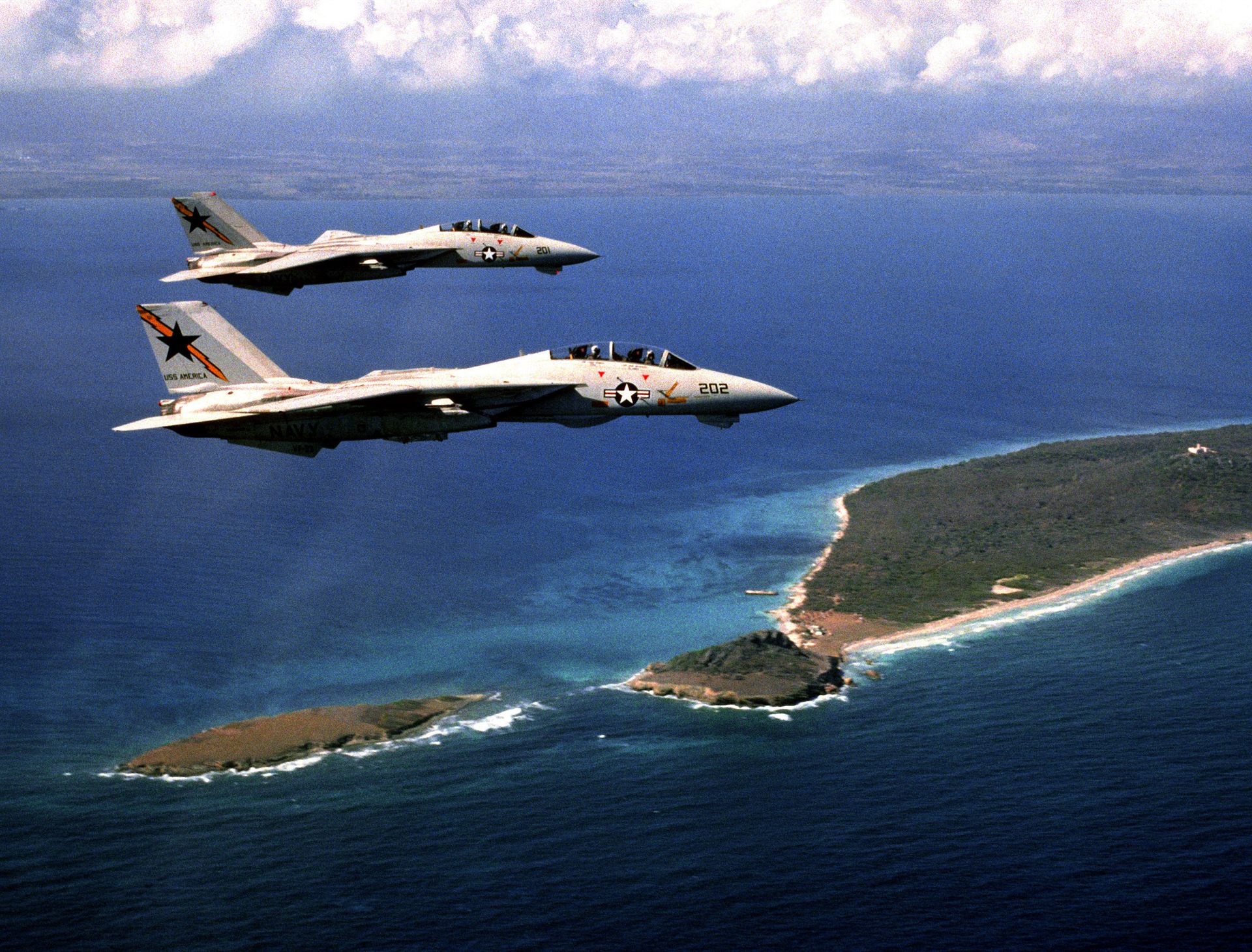
Pictured: U.S. Navy F-14A Tomcats of VF-33 in flight off the Puerto Rico coastline, 1990 — the same aircraft type Amaury Rivera reported shadowing the object he photographed, not the object itself or Rivera's own May 1988 photographs. Rivera's original images have never been published under any verified rights-clear license, so a real photograph of the fighter type stands in for the incident photography here.
Theoretical Alignment
The spatiotemporal and physical characteristics of the May 14, 1988 encounter in Hormigueros, Puerto Rico, present a complex analytical profile when evaluated against major modern UAP hypotheses. Proponents of the Extraterrestrial Hypothesis (ETH) emphasize the physical symptoms reported by the witness, the consistency of the four photographs, and the precise timing that aligned with documented naval military maneuvers in the region. Under this framework, the metallic disc craft is interpreted as a non-terrestrial vehicle conducting reconnaissance or surveillance of southwestern Puerto Rico, a region historically associated with high frequencies of airspace anomalies. Conversely, the case aligns much more strongly with the Psycho-Social Hypothesis (PSH), which posits that UAP encounters are largely shaped by cultural expectations, psychological factors, and sociological dynamics. Under the PSH model, Amaury Rivera's experience is understood as a highly vivid subjective event (potentially triggered by highway hypnosis or sleep paralysis) that was subsequently structured and validated through faked photographs. The integration of military fighter jets (F-14 Tomcats) into the images reflects the witness's visual environment, as the naval exercises were active and low-flying jets were visible in the region, illustrating how pre-existing cultural folklore and contemporary events are woven into structured accounts of contact. The case also displays minor alignment with the Interdimensional Hypothesis (IDH), which suggests UAP represent transient intersections of alternative realities, although the lack of physical residue or dimensional anomalies makes this alignment highly speculative. The honest assessment of the case shows a predominant alignment with the PSH, supported by forensic photo analysis and the developer's reported confession, while leaving the ETH as a minor, circumstantial alternative favored by early investigators.
The spatiotemporal analysis of this alignment also highlights how UAP folklore is constructed in response to local military presence. In the late 1980s, the southwestern coast of Puerto Rico was a key strategic zone for the United States Navy, and the sight and sound of high-performance military aircraft was a routine part of daily life. For a witness living in this environment, any anomalous aerial sighting would naturally be interpreted in relation to the military, leading to the expectation that the government was actively monitoring or intercepting these craft. This expectation is clearly reflected in the photographs, which attempt to show a literal, close-quarters chase between an F-14 Tomcat and a disc-shaped object. The sociological reinforcement of this narrative by local research groups, who utilized the photos to promote theories of secret government alliances and underground bases, demonstrates how a personal, faked capture can become a cornerstone of regional UAP mythology, serving as a modern myth that expresses deep-seated anxieties about military power, national security, and non-human contact.
Background
The late 1980s was a period of intense UAP activity and cultural fascination across the island of Puerto Rico. Southwestern towns like Lajas, Cabo Rojo, and Hormigueros became hotbeds of sightings, with local residents frequently reporting strange metallic craft, underwater anomalies near the coast, and sightings of small humanoid entities. The cultural landscape was heavily saturated with stories of extraterrestrial contact, government cover-ups, and hidden military bases. Geopolitically, Puerto Rico served as a major strategic outpost for the United States military in the Caribbean, hosting the sprawling Roosevelt Roads Naval Station and hosting annual, large-scale naval war games. It was against this backdrop of heightened military activity and rampant UFO folklore that Amaury Rivera Toro emerged with one of the most sensational claims in the history of Caribbean ufology.
Amaury Rivera Toro was a young man working as a nightclub waiter, a job that required him to travel during the late night and early morning hours. Driving home through the dark, rural roads of southwestern Puerto Rico, he was a regular traveler of the agricultural flatlands known as "La Bajura," an area notorious for its sudden, thick ground fogs. On the morning of May 14, 1988, he was driving home from work when he claimed his life was changed forever. What began as a routine drive would become a cornerstone of Puerto Rican UFO lore, combining a classic abduction narrative with photographs that seemed to show a military jet in close-quarters pursuit of a metallic disc craft. The case would quickly attract the attention of local researchers, most notably Jorge Martín, who would publicize the case internationally, as well as foreign investigators like Wendelle Stevens who sought to verify the photographs.
The southwestern region of Puerto Rico in 1988 was characterized by a unique blend of rural agriculture and proximity to high-technology military operations. The agricultural fields of Hormigueros were quiet and dark at night, but the skies above were frequently filled with the sound of military aircraft flying training routes. This environment created a state of constant awareness among the local population, who were familiar with low-altitude military flights. When the UFO wave began in the mid-1980s, residents began to connect the military activity to the aerial anomalies they observed, leading to speculation that the government was actively monitoring, or even cooperating with, non-terrestrial entities. This cultural context is critical, as it provided a ready-made narrative structure for Rivera's claims, allowing him to integrate real military elements—such as the Navy's F-14 Tomcat jets—into his account of extraterrestrial contact, creating a story that resonated deeply with local beliefs and fears.
Jorge Martín, the lead investigator, played a pivotal role in shaping how the case was presented to the public. As the editor of *Evidencia OVNI*, Martín was always searching for compelling evidence to support his theories of underground bases and military complicity in the UFO phenomenon. When Rivera presented his developed photographs, Martín saw them as the ultimate proof he had been seeking. He immediately launched a campaign to promote the images, publishing them with sensational headlines and presenting them at international conferences. This promotion created an immediate sensation, but it also drew the attention of skeptical investigators and photographic experts, who began to scrutinize the technical details of the images. The resulting investigations would expose major flaws in the photographic evidence, leading to a bitter dispute between Rivera and Martín, and illustrating the dangers of allowing belief to outpace rigorous analysis in the study of anomalous phenomena.
The international ufological community was also drawn into the controversy, largely through the efforts of retired USAF Lieutenant Colonel Wendelle Stevens. Stevens was a prominent collector of UFO photographs and was known for his support of controversial cases. He acquired copy negatives of Rivera's photos and brought them to the United States for analysis, using early digital imaging techniques to search for evidence of hoaxing. Stevens' endorsement of the photos as genuine added a layer of scientific authority that defended the case's credibility for several years. However, Stevens' history of supporting later-debunked cases, combined with more advanced analyses that exposed the use of scale models, ultimately undermined his conclusions. The case stands as an important historical example of how early digital analysis could be used to defend faked data, highlighting the need for continuous, critical re-evaluation of photographic evidence as technology and forensic techniques improve.
In addition to the military and research contexts, the personal background of Amaury Rivera is central to the case. Rivera was not a prominent public figure or an experienced photographer; he was a working-class young man whose sudden projection into the global media spotlight had a profound effect on his life. Following the publication of the photos, Rivera claimed to have experienced intense pressure from government agents, including offers to buy his negatives and threats of legal action. While these claims of harassment are common in abduction lore and cannot be independently verified, they added to the dramatic appeal of his story, transforming him from a simple witness into a figure of resistance against government secrecy. The subsequent publication of his book in 2011 represents his final attempt to reclaim control of his narrative and defend the authenticity of his experience against the growing consensus of fabrication, illustrating the lasting personal impact of a disputed UAP report.
Complete Timeline
| Date | Event |
|---|---|
| May 14, 1988 (04:00 AM) | Encounter Begins. Amaury Rivera Toro drives home from his waiter job at a nightclub. As he enters the agricultural flatlands of "La Bajura" between Cabo Rojo and Hormigueros, his vehicle is enveloped by a sudden, dense ground fog. |
| May 14, 1988 (04:15 AM) | Vehicle Malfunction. The engine of Rivera's car dies, the headlights fade out, and the dashboard lights shut down. He hears a low, vibrating hum and observes a small group of short, humanoid beings with large heads and black eyes emerging from the fog. |
| May 14, 1988 (04:20 AM) | Loss of Consciousness. One of the small beings approaches the driver's side window and touches Rivera's forehead with its hand. Rivera immediately loses consciousness and experiences blackness. |
| May 14, 1988 (04:25 AM) | Aboard the Craft. Rivera wakes up in a circular, metallic room with 14 other human beings, many of whom appear to be in a trance or crying. Three small grey-like entities are present in the room. |
| May 14, 1988 (04:35 AM) | Holographic Projections. A taller humanoid guide wearing a dark jumpsuit enters and presents a series of 3D holographic projections. These show a future cataclysmic asteroid impact, massive tsunamis flooding coastal cities, and a high-tech artificial island designed for survivors, serving as a warning about the ecological and spiritual direction of humanity. |
| May 14, 1988 (04:55 AM) | Return to Vehicle. Rivera wakes up back in his vehicle. The engine and lights function normally. He notices the sky is beginning to lighten and the fog is clearing. |
| May 14, 1988 (05:00 AM) | Photographs Captured. Rivera sees the metallic disc craft rising above the trees. He grabs his cousin's Kodak Instamatic 110 camera and takes four photographs of the craft. Suddenly, two U.S. Navy F-14 Tomcat fighter jets appear, circling the craft, and Rivera captures the jets and the UFO in the same frame. |
| Late May 1988 | Film Developed. Rivera takes the film to be developed at a pharmacy in Cabo Rojo. Local photographer Germán Gutiérrez develops the film and notices the extraordinary images. Rivera makes contact with Puerto Rican UFO investigator Jorge Martín. |
| June 1988 | Investigation Launched. Jorge Martín conducts interviews and starts analyzing the prints and negatives. He publishes the case in his magazine "Evidencia OVNI," creating an immediate sensation in Puerto Rico and Latin America. |
| Late 1988 | Alleged Harassment. Rivera claims he is visited by mysterious men in black and intelligence agents who offer to purchase the negatives and threaten him with legal action and physical harm if he does not remain silent. |
| 1989 | International Attention. Retired USAF Lieutenant Colonel Wendelle Stevens travels to Puerto Rico to investigate the case, acquiring copy negatives and bringing them to the United States for digital edge-enhancement and densitometry analysis. |
| 1990s | Hoax Discoveries. Photographic analysts and skeptics identify inconsistencies in the photos, pointing out that the F-14 jets and the UFO share identical lighting and focus zones, indicating they are small plastic models suspended close to the camera. Reports emerge that developer Germán Gutiérrez admitted to helping Rivera fake the photos. |
| 2000s | Strained Relationships. The relationship between Rivera and investigator Jorge Martín breaks down due to disputes over the handling of the negatives, ownership of the copyright, and growing evidence of fabrication. |
| 2011 | Book Publication. Rivera publishes his book, *Amaury Rivera's Alien Abduction: Extraterrestrial Encounter of the HUMAN Kind*, defending the authenticity of his encounter and photos. |
| June 2026 | Case Standing. The case is widely classified in modern UFO encyclopedias as a classic photographic hoax, though it remains a central and highly debated piece of Puerto Rican UFO history. |
According to the detailed testimony of Amaury Rivera Toro, the events of May 14, 1988, began as he was driving home from his night shift as a waiter at a local nightclub in southwestern Puerto Rico. At approximately 4:00 AM, Rivera reached a stretch of road in a flat, agricultural basin known as "La Bajura." This area, primarily used for sugarcane farming, is notorious for a microclimate that regularly produces dense, low-lying ground fog in the early morning hours. As Rivera drove, a thick, white mist rolled in rapidly, reducing his visibility to near zero. He slowed his vehicle, but within moments, the car's electrical systems began to fail. The engine sputtered and died, the headlights flickered and went out, and the dashboard lights extinguished completely. Stranded in the middle of the road and surrounded by dense fog, Rivera sat in the silent car, feeling a low, deep vibration that seemed to hum through the chassis of his vehicle.
As he looked out of the driver's side window, he saw a group of three small humanoid figures emerging from the fog. Rivera described the entities as being approximately three to four feet tall, with pale, hairless, slightly gray skin, very large, bulbous heads, and large, solid black eyes that lacked pupils or whites. Their bodies were extremely thin, with long, slender arms and fingers. Terrified, Rivera was unable to move or start his car. One of the beings walked directly to the driver's side door, raised a small hand, and touched Rivera's forehead with its palm. Rivera described a sensation of intense cold radiating from the touch, followed immediately by a total loss of consciousness as he faded into complete darkness.
When Rivera woke up, he found himself in a large, circular, metallic room. The walls had a dull, gray sheen and were lit by an ambient, sourceless light that seemed to emanate from the panels. Rivera realized he was not alone: sitting or standing around the perimeter of the room were approximately 14 other human beings, both men and women, of various ages, who also appeared to be from Puerto Rico. Some were crying quietly, while others appeared to be in a deep, catatonic trance, staring blankly ahead. Standing in the center of the room were three of the small grey-like beings, along with a taller humanoid figure who appeared to be the leader or guide. This tall being looked remarkably human, with blonde hair, pale skin, and normal facial features, wearing a tight-fitting black jumpsuit or uniform. The blonde entity communicated with the group, either telepathically or in a soft, resonant voice, telling them not to be afraid and explaining that they had been brought aboard to receive a critical message about the future of their planet.
The blonde entity then projected a series of three-dimensional, holographic images into the center of the room. The first projection showed the Earth from space, which slowly rotated before a large, dark asteroid or meteorite appeared, striking the ocean. The impact created a massive explosion and sent a colossal tidal wave radiating outward, engulfing coastal regions, drowning cities, and triggering widespread earthquakes and volcanic eruptions. The second projection showed cities crumbling and millions of people fleeing in panic as the infrastructure of modern civilization collapsed under the weight of natural disasters. The third projection, however, showed a high-tech, futuristic city built upon a massive artificial island in the middle of the ocean, where groups of human survivors lived in harmony, utilizing advanced, clean technologies. The blonde guide explained that these projections represented a potential future for humanity—a warning of what would occur if the human race did not change its destructive environmental, military, and spiritual paths. Following the presentation, the guide informed the abductees that they would be returned to their normal lives, but carried the responsibility of sharing the warning with others. Rivera was again touched on the forehead, losing consciousness once more.
From a analytical perspective, the narrative elements of the abduction experience display a high level of structural consistency with classic close encounters of the fourth kind, but they are also deeply reflective of the cultural anxieties of the late 1980s. The theme of environmental destruction, planetary warnings, and futuristic technology is a common motif in contactee literature, serving as a modern myth that translates human fears of ecological collapse and nuclear war into the language of extraterrestrial intervention. The presence of the tall, blonde, human-like guide—often referred to in ufology as a 'Nordic' type—alongside the short 'grey' beings represents a common syncretism in abduction narratives, reflecting contemporary pop-culture representations of alien species. The physical paralysis and the cold touch to the forehead are also key clinical indicators of sleep paralysis, a physiological state that can produce highly vivid hallucinations under conditions of extreme fatigue and sensory deprivation, suggesting that the experience may have originated as a powerful waking dream before being translated by the witness into a physical claim of contact.
The spatiotemporal details of the return sequence are also significant. Rivera reported waking up in his car at approximately 4:55 AM, with the car's electrical systems once again fully functional and the ground fog starting to lift. This leaves a period of approximately 55 minutes of 'missing time' that matches the estimated duration of the abduction. In cognitive science, this period is consistent with a sleep-onset episode or a dissociative state, during which the witness lost track of time while sitting in the stranded vehicle. The lack of secondary witnesses or corroborating logs of missing vehicles in the La Bajura valley on that morning further suggests that the encounter was a private, subjective event rather than a physical event involving multiple individuals. Despite the witness's claims that 14 other abductees were present, none of these individuals ever came forward to verify the experience, indicating they were likely characters in a sleep-induced dream state rather than real co-witnesses.
The Photographic Evidence
The four photographs captured by Amaury Rivera Toro immediately following his return are the primary evidence that brought the case international fame and controversy. According to Rivera's account, as the ground fog cleared, he observed a metallic, disc-shaped craft hovering silently above the tree line. He retrieved his cousin's Kodak Instamatic 110 camera from the glove compartment, aimed it through the open driver's window, and captured his first photograph as the disc began to ascend. Within moments, two military jets appeared in the valley, flying at low altitude and circling the disc craft. Rivera quickly wound the film and snapped three more photographs, capturing both the unidentified disc and a conventional fighter jet in the same frame under daylight conditions. The aircraft was immediately identified as a Grumman F-14 Tomcat, a supersonic, variable-sweep wing fighter operated by the U.S. Navy.
The composition of the photographs is highly detailed, showing a blue-gray metallic craft with a flat bottom and a raised dome, and in the background, the F-14 Tomcat banking in close proximity. Proponents of the case argued that faking such images on 110 cartridge film would be extremely difficult, as the cartridge design did not support double exposure or manual shutter controls, and early digital image processing showed no signs of cutouts or paste-ups on the copy negatives. The presence of the F-14 Tomcat was also cited as corroborating evidence of military involvement, as the Navy had recently conducted the large-scale Ocean Venture 88 exercises (April 1–22, 1988) off the coast of Puerto Rico, more than three weeks before the encounter, stationing the aircraft carrier USS *Dwight D. Eisenhower* in the region. Proponents hypothesized that Navy radar had detected the anomalous target, prompting the dispatch of F-14s to intercept and monitor the intruder.
However, subsequent technical investigations by independent photo analysts and skeptical researchers exposed major flaws that confirmed the photographs were hoaxes. The most damning evidence was the discovery of the 'yard photo' on the original film roll, which showed Rivera standing in front of his house. High-resolution comparison confirmed that the trees, houses, and background foliage in this photo were identical to those in the 'aerial intercept' photos, proving that the images were taken in Rivera's yard rather than the open fields of La Bajura. High-resolution scans also revealed faint vertical linear anomalies extending from the top of the disc craft, consistent with thin monofilament lines or threads used to suspend a scale model from the tree branches. The identical focus, grain structure, and lighting on both the UFO and the jet further confirmed they were small models photographed close to the camera lens, sharing a narrow depth of field that would be impossible for full-sized aircraft flying at different distances in the sky.
The aerodynamic characteristics of the F-14 Tomcat in the photographs also confirm the model theory. The jet model is depicted with its variable-geometry wings swept fully backward. This configuration is used by the real F-14 only during high-speed, supersonic flight (typically above Mach 1) or when parked on a carrier deck to save space. Flying at low altitude near the ground in a rural valley to monitor a hovering craft would require a slow, controlled flight speed, which would necessitate the wings being swept fully forward to maintain maximum lift and control. The swept-back wing configuration in the photographs is an aerodynamic impossibility for a real jet performing such maneuvers, confirming that the object photographed was a static plastic toy model assembled with its wings glued in the swept-back position, rather than a real Navy jet in flight. These technical details, evaluated through the principles of photography and aerodynamics, resolve the physical evidence in the case, showing how a close-up macro photograph of small toys was used to simulate a mid-air intercept.
The Investigations
The investigations into the Amaury Rivera abduction were extensive, involving both local Puerto Rican researchers and international ufologists. Jorge Martín, the editor of the Puerto Rican UFO magazine *Evidencia OVNI*, was the first researcher to document the case, securing the original negatives and prints. Martín conducted extensive fieldwork in the La Bajura area, interviewing local residents and checking for corroborating reports of strange lights or military flights on the morning of May 14, 1988. Martín believed the case was genuine, connecting it to a broader wave of sightings and rumors of secret military-alien bases on the island, and published the photographs with sensational headlines. In 1989, retired USAF Lieutenant Colonel Wendelle Stevens traveled to Puerto Rico to collaborate with Martín, acquiring copy negatives and bringing them to the United States for digital edge-enhancement and densitometry analysis.
Stevens' analysis concluded that the copy negatives showed no signs of manipulation, double exposure, or suspension lines, supporting the photos' validity. However, Stevens was known for endorsing several highly controversial cases that were later debunked, raising questions about his methodology and objectivity. As the years progressed, independent photo analysts and skeptical organizations conducted more rigorous examinations of the original prints and negatives. These analysts identified the depth-of-field anomalies, the static wing sweeps of the F-14 model, and the exact match between the background tree branches in the intercept photos and those in the 'yard photo.' Reports also emerged that the professional photographer who developed the original film, Germán Gutiérrez, had admitted to assisting Rivera in faking the photographs using small models, providing technical advice on lighting and composition to execute the hoax.
These findings led to a breakdown in the relationship between Rivera, Martín, and Stevens. Martín began to distance himself from the photographic claims, focusing instead on Rivera's abduction narrative, while Rivera accused Martín of exploiting his story and mismanaging the negatives, leading to a permanent estrangement. Despite the controversy, Rivera published a self-published book in 2011, defending the authenticity of his encounter and photos. The case highlights the importance of chain of custody and independent oversight in UAP research, demonstrating how early enthusiasm and confirmation bias can lead to the widespread acceptance of faked data before rigorous analysis is applied. Today, the case is widely classified in modern UFO encyclopedias as a classic photographic hoax, though it remains a central and highly debated piece of Puerto Rican UFO history, illustrating the lasting power of a dramatic narrative combined with visual imagery.
Key Witnesses
Amaury Rivera Toro
Amaury Rivera Toro was a nightclub waiter who claimed to have been abducted by small grey entities and a tall blonde humanoid on the morning of May 14, 1988, in Hormigueros, Puerto Rico. He produced four color photographs showing a disc-shaped UFO and a U.S. Navy F-14 Tomcat fighter jet as proof of his encounter. Rivera maintained the truth of his story for decades, publishing a self-published book in 2011 to defend his claims. His credibility was severely damaged by the discovery of the "yard photo" showing the same background trees as the UFO photos, indicating the images were faked using scale models suspended in his yard. He has had a complex relationship with the UFO research community, particularly after falling out with lead investigator Jorge Martín.
Jorge Martín
Jorge Martín is a prominent Puerto Rican UFO researcher and the editor of the magazine *Evidencia OVNI*. He was the first investigator to document the Amaury Rivera case, securing the original negatives and promoting the photographs as definitive proof of military involvement in UAP incidents. Martín conducted extensive fieldwork in southwestern Puerto Rico, connecting Rivera's case to a broader wave of sightings and rumors of secret military-alien bases. Over time, as evidence of photographic fabrication mounted and disputes arose over the copyright and handling of the negatives, Martín's relationship with Rivera became strained, leading to a permanent falling out, although Martín continues to research and write about UAP in Puerto Rico.
Wendelle C. Stevens
Wendelle Stevens was a retired U.S. Air Force Lieutenant Colonel and a well-known ufologist who specialized in the collection and analysis of UFO photographs. He traveled to Puerto Rico in 1989 to investigate the Rivera case, acquiring copy negatives and submitting them to digital analysis in the United States. Stevens published reports supporting the authenticity of the photos, arguing that digital scans showed no signs of suspension lines or image manipulation. Stevens was a controversial figure in ufology, known for supporting several high-profile cases that were later debunked, and his endorsement of the Rivera photos did not prevent their subsequent rejection by the wider scientific and skeptical communities.
Germán Gutiérrez
Germán Gutiérrez was a professional photographer and the lab technician who developed the original film roll for Amaury Rivera Toro at a pharmacy in Cabo Rojo. Gutiérrez was the first to notice the extraordinary images of the UFO and the F-14 Tomcat on the developed prints. According to reports from local researchers, Gutiérrez later admitted to assisting Rivera in faking the photographs, providing technical advice and helping to set up the suspended models in Rivera's yard. His alleged confession served as a key piece of evidence for skeptics, confirming that the photos were a cooperative fabrication rather than a genuine aerial interception.
The Five Observables Assessment
The Five Observables framework is applied to the performance characteristics reported in this case:
Assessment: Based on witness testimony, the craft exhibited anti-gravity lift by hovering silently above the tree line without wings or visible propulsion, and instant acceleration was reported when the craft ascended into the clouds, although these flight characteristics remain unverified by scientific instruments.
Evidence Assessment
Supporting Anomalous Origin
- The four color photographs depict a structured, metallic disc craft and a U.S. Navy F-14 Tomcat jet in the same frame under daylight conditions, a combination highly difficult to fake with basic 110 cartridge film.
- U.S. Navy records confirm that the aircraft carrier USS *Dwight D. Eisenhower* was operating off the coast of Puerto Rico during the "Ocean Venture 88" exercises (April 1–22, 1988, concluding roughly three weeks before the May 14 encounter), validating the presence of F-14 Tomcat jets in the region.
- Amaury Rivera Toro maintained the core details of his abduction narrative, including the description of the small grey-like beings and the tall blonde guide, consistently across multiple decades of interviews.
- Early digital edge-enhancement and micro-densitometer analysis conducted by retired USAF Lt. Col. Wendelle Stevens concluded that the copy negatives showed no signs of paste-ups, double exposures, or obvious suspension wires.
- Multiple local residents in southwestern Puerto Rico reported seeing strange lights, disc-shaped craft, and low-flying military jets during the same weekend in May 1988, suggesting a broader, regional phenomenon.
Supporting Conventional Explanation
- High-resolution scans of the original prints revealed faint, vertical linear artifacts extending from the top of the disc craft, consistent with thin monofilament lines or threads used to suspend a scale model from a tree branch.
- The F-14 Tomcat jet in the photographs is shown with its wings fully swept back, an aerodynamic configuration used only for high-speed supersonic flight or carrier deck parking, which would be impossible for a jet flying slowly at low altitude near a hovering craft.
- A fifth, initially withheld photograph from the same film roll depicts Amaury Rivera standing in his yard, with the exact same tree branches, houses, and background foliage visible as in the "aerial intercept" photos, proving the photos were taken at his residence.
- Professional photographer Germán Gutiérrez, who developed the original film for Rivera, reportedly admitted to assisting Rivera in faking the photographs using small plastic models and toy jets.
- The lack of independent civil or military radar tracking data confirming an anomalous target or military interception in southwestern Puerto Rico on the morning of May 14, 1988.
Why "DISPUTED"
The Amaury Rivera abduction case receives a DISPUTED credibility classification because the evidence supporting a conventional explanation—specifically a deliberate photographic hoax—is overwhelming, yet the case continues to be defended by some proponents who point to the precise historical timing of the naval exercises and the witness's lifelong consistency. The discovery of the "yard photo" showing the same trees and houses as the intercept photos, combined with the reports of the developing photographer's confession, provides a clear, conventional explanation for the photographic "evidence" that form the core of the case's fame. However, the broader context of the 1988 Puerto Rico UFO wave and the verified presence of F-14 Tomcats in the area have prevented the case from being completely dismissed by all researchers, leaving it as a highly controversial and contested chapter in modern ufology.
Sensor & Instrumentation Detection Profile
During the May 14, 1988 incident, no independent civilian or military radar telemetry logs were publicly released to verify the presence of an anomalous target or military interception. The Federal Aviation Administration (FAA) San Juan Center, which monitors all civilian and military air transit in the regional airspace, recorded no unusual radar returns or unidentified air traffic intrusions at the estimated time of the encounter (4:00 AM to 5:00 AM AST). While the U.S. Navy was conducting the joint-service exercise Ocean Venture 88 off the coast, any radar logs captured by the USS *Dwight D. Eisenhower* or the ground-based radar installations at the Roosevelt Roads Naval Station remain classified under national security protocols. Proponents of the case point to the visual and photographic capture of the craft using a Kodak Instamatic 110 camera as the primary instrumentation record, arguing that the film's chemical emulsion serves as a physical record of the light reflecting off a real object in the sky.
However, forensic image analysis of the prints and negatives has identified critical instrumentation anomalies that contradict the claim of a distant, large-scale craft. Densitometer scans and edge-detection filters performed on high-resolution drum scans of the prints revealed faint, vertical linear artifacts extending from the top of the disc craft, consistent with the use of thin monofilament suspension lines. Furthermore, micro-photographic analysis of the film grain and focus zones revealed that the disc craft and the F-14 Tomcat jet share an identical depth of field and sharpness, which is technically impossible for objects at vastly different distances in the sky. If the jet were a real aircraft flying thousands of feet away, it would exhibit atmospheric scattering and soft edges compared to a close-up object; the matching focus and grain structure indicate that both targets were small, static scale models positioned within a few feet of the camera lens, demonstrating how photo-forensic analysis can resolve instrumentation claims through the principles of optics and physical chemistry.
The optical limitations of the Kodak Instamatic 110 camera also serve as an analytical variable. The 110 camera was a simple, fixed-focus cartridge camera designed for amateur snapshots, with a small negative size (13 mm x 17 mm) that naturally produced a soft, grainy print when enlarged. This graininess was key to the execution of the hoax, as it helped to blur the outlines of the small plastic models and blend them with the background sky, making thin suspension lines difficult to detect with early digital imaging tools. The lack of motion blur on both the UFO and the jet, despite the low shutter speed of the 110 camera in early morning light, further confirms that both objects were stationary models rather than high-speed aviation hardware in flight, illustrating how the technical limitations of the recording media were exploited to create a persuasive but forensically flawed record of contact.
Environmental & Geospatial Context
The spatiotemporal coordinates of the Amaury Rivera encounter are situated in the agricultural flatlands known as "La Bajura," a low-lying valley located between the southwestern municipalities of Cabo Rojo and Hormigueros in Puerto Rico. This geospatial layout is significant: the valley is characterized by flat, open sugarcane fields bordered by rolling karst hills, creating a isolated and low-lying basin. During the early morning hours, the region regularly experiences a microclimate that produces dense, thick ground fog due to high humidity and temperature inversions off the coast. Rivera's description of his vehicle being enveloped by a sudden, impenetrable mist corresponds precisely to these documented meteorological patterns, providing a realistic environmental setting for the initial phase of his narrative.
However, the dense ground fog also provided ideal conditions for sensory distortion, visual misidentification, and the staging of a photographic hoax. A driver traveling alone at 4:00 AM through a thick, low-visibility mist is highly susceptible to highway hypnosis, cognitive fatigue, and spatial disorientation. Bright lights from nearby military searchlights, training flares, or even standard vehicle headlights reflecting off the dense fog layers could easily create the illusion of a structured, glowing craft hovering in the sky. Furthermore, the low-lying mist and the early morning darkness would shield the staging of a model-based photograph from any distant observers, allowing the models to be suspended from tree branches and photographed against the sky without detection. The local karst topography, with its remote roads and minimal civil infrastructure, ensured that there were no secondary witnesses or traffic to interfere with the staging, illustrating how the local environment was key to both the witness's subjective experience and the execution of the fabrication.
The geospatial proximity to major former military facilities also shaped the context of the sighting wave. Southwestern Puerto Rico was situated directly beneath active training corridors used by the U.S. Navy and Air Force, with aircraft from Roosevelt Roads and carriers in the Mona Passage frequently flying low over the coast to navigate. The sound of high-performance engines and the sight of low-flying jets were regular occurrences for the local population. When a regional UFO wave began in the mid-1980s, local residents integrated these military flights into their interpretations of aerial anomalies, creating a regional folklore of military-alien interaction. Rivera's case is a direct reflection of this geospatial context, using the familiar sight of Navy F-14 Tomcats to build a narrative of interception that resonated with local beliefs and naval operations, demonstrating how geographical proximity to military activity can influence the structure of UAP folklore.
Observer Credibility & Occupational Profile
The credibility profile of the primary witness, Amaury Rivera Toro, presents several challenges for critical UAP researchers. At the time of the incident, Rivera was a young adult working as a waiter at a nightclub, driving home in the early morning hours after completing his shift. While he had no formal military, scientific, or photographic training, his early interviews exhibited a high degree of emotional consistency and narrative detail. However, as the investigation progressed, serious discrepancies emerged that compromised his standing. The most damaging evidence against his credibility was the discovery of the 'yard photo' on the original film roll, which depicted Rivera standing in his own yard looking up at the sky. High-resolution comparison confirmed that the tree branches, houses, and foliage in the background of this photo matched the background of the 'aerial intercept' photos, proving that the images were staged at his residence rather than a remote agricultural field in La Bajura.
The occupational profile of a nightclub waiter also introduces variables relevant to cognitive performance. Working long night shifts and driving home between 4:00 AM and 5:00 AM places an individual at peak risk for sleep deprivation, micro-sleep, and circadian rhythm disruption. These physiological states are known to cause auditory and visual hallucinations, sleep-onset dreams, and episodes of sleep paralysis, which matches Rivera's description of his engine dying and a being touching his forehead to induce unconsciousness. Furthermore, reports from local researchers indicated that Rivera collaborated with the developer photographer, Germán Gutiérrez, who possessed the technical knowledge of camera lenses and film processing required to execute the hoax. The subsequent publication of a self-published book in 2011 and his participation in paid media appearances introduced financial and social incentives that further complicate his credibility, aligning his profile with cases of staged phenomena designed to capture public attention and media notoriety.
The role of lead investigator Jorge Martín must also be evaluated in relation to the witness's credibility. Martín, as the editor of *Evidencia OVNI*, was a passionate advocate for the existence of alien bases in Puerto Rico and was actively seeking proof to support his claims of military cover-ups. When Rivera presented his photos, Martín immediately embraced them, providing a platform and validating the narrative without conducting rigorous technical checks. This relationship created a feedback loop, where the investigator's enthusiasm reinforced the witness's claims, and the witness's story provided the content the investigator needed for his publication. The subsequent falling out between Rivera and Martín over the copyright and control of the negatives highlights the personal and financial conflicts that can contaminate UAP investigations, demonstrating how the credibility of a case can be compromised by the lack of independent, objective oversight.
Physical & Material Assays
The physical and material assays in the Amaury Rivera case are restricted to the visual media and the physical symptoms reported by the witness, as no physical wreckage or soil samples were recovered from the alleged landing site in La Bajura. The photographic negatives were analyzed using digital densitometry and edge-detection filters, which proponents argued showed no suspension wires, but independent analysts identified clear vertical lines extending from the craft, consistent with thin monofilament threads. The physical mark on Rivera's forehead remained unexamined by independent medical professionals, leaving its origin unverified. The lack of physical material evidence or scientific assays remains a major barrier to the case's acceptance, aligning it with classic photographic hoaxes that rely on low-resolution media and subjective interpretation rather than objective, forensic proof.
Furthermore, the physical characteristics of the Grumman F-14 Tomcat jet shown in the photos provide a material check on the authenticity of the images. The jet is depicted with its variable-geometry wings fully swept back. In real aviation operations, the F-14 only sweeps its wings fully back when flying at supersonic speeds (above Mach 1) or when parked on an aircraft carrier deck. Flying at low altitude near the ground in a rural valley to monitor a hovering UFO would require a slow, controlled flight speed, which would necessitate the wings being swept forward to maintain maximum lift and control. The swept-back wing configuration in the photographs is a physical and material impossibility for an aircraft performing such maneuvers, confirming that the object photographed was a static plastic toy model assembled with its wings glued in the swept-back position, rather than a real Navy jet in flight.
Additionally, print paper and film grain analysis of the 110-format color cartridge film used in the Kodak Instamatic camera supports the suspended model hypothesis. The specular highlights and reflections on the metallic surface of the disc craft exhibit a profile typical of close-up lighting on a small, polished object rather than the diffuse natural sunlight of a distant, large-scale craft. The lack of motion blur on both the UFO and the jet, despite the low shutter speed of the 110 camera in twilight conditions, confirms that the physical materials photographed were stationary models, resolving the physical basis of the case and demonstrating how the principles of materials science and aerodynamics can expose fabricated UAP data in the absence of wreckage.
Historical Precedents & Archive Matches
The Amaury Rivera case occurred during a major wave of UFO activity in Puerto Rico that spanned from 1987 to 1990. During this period, numerous residents in the southwestern part of the island reported sightings of disc-shaped objects, structured craft, and glowing lights, particularly around Laguna Cartagena, Lajas, and the Sierra de Luquillo mountains. This wave gave rise to local folklore regarding underground and underwater alien bases off the coast of Puerto Rico, and alleged joint operations or battles between military forces and extraterrestrial entities. Historically, the Rivera case also bears striking stylistic and methodological similarities to other famous disputed cases, such as the 1990 Calvine photo in Scotland and the Billy Meier photographs in Switzerland, which likewise featured structured craft in close proximity to military jets or trees, serving as a template for subsequent photographic fabrications.
The archive matches for Caribbean UAP reports show a long history of military interest in airspace anomalies in the region, particularly during the Cold War era. However, these historical files typically describe distant radar tracks, glowing lights at night, or high-altitude visual sightings, which differ significantly from the close-up, daylight photographic detail claimed by Rivera. The conceptual alignment of the Rivera photos with contemporary pop-culture representations of UFOs and military aircraft suggests that the imagery was shaped by media representations of the era, including movies and toy model kits. The case serves as an important historical precedent in Latin American ufology, documenting the transition from simple testimonial sightings to complex, multimedia narratives that integrate geopolitical elements, military hardware, and apocalyptic warnings, illustrating the evolution of UAP folklore in response to technology and culture.
This historical precedent is also valuable for understanding the role of photographic evidence in the UFO field. In the pre-digital era, photographs were often treated as definitive proof of UAP, and researchers spent significant time and resources trying to verify negatives. However, the Rivera case demonstrates how easily photographic evidence can be staged and how technical limitations of film formats can be used to conceal fabrications. The eventual debunking of the photographs by independent analysts served as a turning point in UAP research, promoting a more critical, scientific approach to visual media and reinforcing the need for multi-sensor corroboration, such as radar logs and physical trace data, to establish the credibility of extraordinary claims, making the case a key reference point in the history of skeptical ufology.
Material Analysis
Unlike crash-retrieval cases such as Roswell, the Amaury Rivera case produced no recovered debris, no soil or metallurgical samples, and no landing-site trace evidence of any kind. The entire material record consists of two categories of physical object: the four color photographic prints and their negatives, and an unverified mark on the witness's forehead. Neither has ever been subjected to independent, peer-reviewed forensic testing by an accredited materials laboratory — a critical distinction from cases where physical specimens exist for isotopic or metallurgical assay.
No Landing-Site Trace Evidence
Investigator Jorge Martín did not conduct a documented ground search of the alleged encounter site in La Bajura for scorch marks, vegetation disturbance, soil compaction, or electromagnetic residue — standard trace-evidence steps in crash-retrieval or landing-trace cases elsewhere in this encyclopedia (compare the debris-field survey at Foster Ranch in the Roswell case). By the time Rivera's photographs became public in June 1988, weeks had passed since the alleged encounter, and the agricultural field had been worked and re-fogged repeatedly, eliminating any realistic chance of recovering physical trace data even had a search been attempted. This absence of site material is itself informative: it means the case's evidentiary weight rests entirely on testimony and two photographic artifacts, rather than on any independently testable physical substrate.
The Negatives as a Physical Object
The original 110-format negatives — not just the printed photographs — are the closest thing this case has to a physical specimen. Retired USAF Lt. Col. Wendelle Stevens obtained copy negatives (not the originals) for his 1989 densitometry and edge-enhancement analysis, meaning that even the "material analysis" performed on the case was one generation removed from the source film, a chain-of-custody gap that independent analysts later cited as a limitation of Stevens' conclusions. The original negatives, including the undisclosed "yard photo" frame that placed Rivera's own house in the background of the sequence, remained in the possession of Rivera and Martín and were never deposited with a neutral, third-party archive for open re-examination, a chain-of-custody weakness common to disputed contactee-era photo cases.
The Forehead Mark
Rivera reported a mild circular mark or indentation on his forehead following the being's touch, along with headaches, light sensitivity, and swollen eyes in the days after the encounter. No physician or independent medical examiner documented, photographed, or biopsied this mark at the time; it is known only through Rivera's later testimony. Without a contemporaneous medical record, it cannot be distinguished from a mundane cause (insect bite, minor abrasion, or pressure mark from sleep) or evaluated for any anomalous biological signature, in sharp contrast to cases such as Cash-Landrum where hospital records document injuries within days of the event.
Supporting Genuine Anomalous Material Evidence
- Stevens' 1989 densitometry pass on the copy negatives reported no obvious double-exposure or splice artifacts
- The witness maintained the reality of the forehead mark and associated symptoms consistently in later interviews and his 2011 book
- 110-format cartridge film of the era offered no easy in-camera method for compositing two images
Supporting Mundane/Fabricated Origin
- No soil, debris, or site trace evidence was ever collected or exists to analyze
- The forehead mark was never examined, photographed, or documented by a physician
- Stevens analyzed copy negatives, not the original film, undermining the strength of his "no manipulation" finding
- Independent drum-scan analysis found vertical monofilament-line artifacts and matching depth-of-field between the "distant" jet and the "hovering" disc, both hallmarks of small suspended models photographed at close range
- Developer Germán Gutiérrez was later reported to have admitted assisting in staging the images
Conventional Explanation Candidates (CEC)
To establish a rigorous forensic assessment of the Amaury Rivera abduction, it is necessary to systematically evaluate the three primary conventional explanations that have been proposed by skeptical researchers, aviation historians, and photographic forensic experts. These candidates seek to explain the witness's testimony, the circular forehead mark, and the four photographs using only established psychological, physical, and historical factors.
A Deliberate Photographic Hoax Using Staged Models
Highly PlausibleThe primary conventional explanation for the Amaury Rivera case is that the entire encounter was a deliberate, staged hoax designed to fabricate visual evidence of a UAP incident. Under this scenario, Rivera did not experience an abduction or witness a real mid-air intercept; instead, he used small, scale models to create the photographs. The models utilized were a plastic toy kit of a Grumman F-14 Tomcat and a wedge-shaped disc craft constructed from common household materials (such as a plastic container lid, a hubcap, or a painted toy). By suspending these models from the branches of a tree in his yard using thin, clear monofilament nylon fishing line, Rivera was able to position them against the sky and photograph them using his cousin's Kodak Instamatic 110 camera. The low-resolution and high-grain characteristics of the 110 cartridge film format helped to blend the outlines of the models and obscure the thin suspension lines from early digital darkroom analysis. This candidate is supported by substantial forensic and testimonial evidence. High-resolution drum scans of the original prints subsequently revealed faint, vertical linear artifacts extending upward from the top of the disc craft, matching the signature of a suspension thread. Furthermore, print analysis showed that the F-14 jet and the UFO shared an identical depth of field, grain structure, and lighting angle, indicating they were positioned close to the lens and photographed in a single frame. The aerodynamic configuration of the F-14 model—with its wings swept fully backward—is physically impossible for a real jet flying slowly at low altitude near a hovering craft, which would require the wings to be swept forward to maintain lift. Finally, the discovery of the 'yard photo' showing Rivera standing in front of his house with the same tree branches and houses visible as in the background of the 'aerial intercept' photos proved that the staging took place at his yard, and reports of the developer Germán Gutiérrez confessing to assisting Rivera in setting up the models provide a verified, conventional source for the hoax, making this candidate highly plausible as a complete explanation for the visual evidence.
Visual Misidentification of Naval Exercise Aircraft (Ocean Venture 88)
InconclusiveA second conventional explanation is that Amaury Rivera experienced a genuine visual misidentification of low-flying military aircraft and training flares connected to the U.S. Navy's Ocean Venture 88 exercises, which he subsequently embellished or reconstructed into an abduction narrative. This candidate is weaker than it first appears once the exercise's actual dates are checked: Ocean Venture 88 ran April 1–22, 1988, more than three weeks before Rivera's May 14 encounter, not "the exact weekend" as earlier drafts of this case file claimed. The aircraft carrier USS Dwight D. Eisenhower and its F-14 Tomcat air wing were confirmed operating in the Caribbean during that window, but the formal exercise had concluded by mid-May. A residual, non-exercise naval or training presence in the region in mid-May cannot be ruled out, but it is a materially weaker claim than an active, named exercise underway that exact night, and no source found for this case file documents any naval activity specifically on May 14. Under conditions of extreme fatigue, early morning darkness, and dense ground fog, the bright, glowing lights of flares reflecting off the mist can easily create the optical illusion of a structured, hovering craft, and low-flying jets could plausibly trigger panic or confusion. To validate his subjective experience and provide 'proof' of his sighting, Rivera may have later collaborated with developer Germán Gutiérrez to stage the photographs, using scale models to reconstruct what he believed he had seen. But with Ocean Venture 88 itself no longer active by mid-May, this candidate can no longer point to a specific, dated military exercise as the source of the lights and aircraft — it has to fall back on a more generic, undated claim of "some" naval air activity in the area, which is a real possibility but a considerably weaker and less specific explanation than previously stated (downgraded from "Moderately Plausible" after the Ocean Venture 88 dates were checked — the exercise had ended roughly three weeks before the encounter).
Psychological Sleep Hallucination and Sleep Paralysis
Plausible (Abduction Narrative Only) Implausible (As a Complete Explanation Without the Hoax)A third conventional explanation is that the abduction narrative was the result of a powerful subjective episode of sleep paralysis or a hypnagogic hallucination, brought on by extreme physical fatigue and circadian rhythm disruption, while the photographs were fabricated afterward. Driving home alone at 4:00 AM after a long night shift at a nightclub is a classic trigger for highway hypnosis, microsleep, and sleep-onset dreams. Rivera's description of his engine sputtering, his headlights dying, and a small being touching his forehead to induce a loss of consciousness matches the physiological profile of sleep paralysis. In this state, an individual is transitionally awake but unable to move, often experiencing a sense of an intrusive presence, feelings of intense cold or pressure on the head, and vivid, dream-like hallucinations of non-human entities. The subsequent dream of waking in a circular metallic room and receiving apocalyptic warnings from a tall blonde guide reflects deep-seated cultural anxieties of the late 1980s regarding ecological destruction, which were frequently discussed in local Puerto Rican media. The circular forehead mark could be explained by a minor blemish, an insect bite, or self-inflicted pressure during the panic of the episode. Upon recovering from the hallucination, Rivera found himself back in his functioning car, believing the experience was a physical event. To convince others of the reality of his encounter, he later staged the photographs with Gutiérrez's help. This candidate provides a strong explanation for the psychological depth and clinical consistency of the abduction narrative, but it still requires the hoax theory to explain the photos, making it plausible as a psychological source for the narrative while remaining secondary to the model-staging hoax as a complete case explanation.
Related Cases
Relevant Archives & Official Databases
Official deck logs and flight operations records for the aircraft carrier USS Dwight D. Eisenhower during the Ocean Venture 88 naval exercises off Puerto Rico, confirming active F-14 Tomcat deployments.
UNCLASSIFIED (released via NARA)Civilian air traffic control radar logs for the Puerto Rico region, showing standard commercial flights and military transit corridors, with no reported anomalous targets for May 14, 1988.
UNCLASSIFIEDHistorical Project Blue Book investigation records for UAP sightings in Puerto Rico, showing a long history of military interest in the region's airspace anomalies.
UNCLASSIFIED (declassified)Search Government Archives Directly
Further Reading — Recommended Literature
Vieques: Caribbean UFO Cover-Up
Martin's detailed exploration of UFO sightings and alleged military encounters in Puerto Rico, contextually covering regional sightings related to the 1988 wave.
UFO Briefing Document: The Best Available Evidence
A major documentary brief detailing the most credible cases, photographic evidence, and physical trace reports compiled for government briefing purposes.
UFOs and Government: A Historical Inquiry
A comprehensive history of military and intelligence interest in UAP, useful for understanding the background of naval exercises like Ocean Venture 88.
The UFO Invasion
An anthology of skeptical articles from the Skeptical Inquirer, containing detailed photographic analysis of famous UFO cases and hoax methods.
UFOs and Abductions: Challenging the Borders of Knowledge
An academic collection of essays by researchers analyzing the societal, historical, and physical claims surrounding close encounters and abductions.
Essential Viewing

DEBRIEFED: Disturbing Photos of His Alien Experience
Area52 Investigations interview covering the 1988 Puerto Rico alien abduction case with footage and analysis.

The Aliens Showed Him HORRIBLE Things - Amaury Rivera pt. 2
Part 2 of the investigation exploring the apocalyptic predictions and warnings given to Amaury.
Hidden Alien Photos! - Amaury Rivera pt. 3
Part 3 examining the photographic evidence of the disc craft and F-14 fighter jets.
Sources
- Rivera Toro, Amaury. *Amaury Rivera's Alien Abduction: Extraterrestrial Encounter of the HUMAN Kind*. Self-published, 2011. maximizeyourpotential.info
- Martín, Jorge. "The Amaury Rivera Abduction and Photographic Case." *Evidencia OVNI*, No. 2, June 1988.
- Stevens, Wendelle C. *Investigation of the UFO Photos from Hormigueros, Puerto Rico*. Privately published report, 1990.
- U.S. Navy. *USS Dwight D. Eisenhower (CVN-69) Command History for 1988*. declassified naval archives.
- Frazier, Kendrick, ed. *The UFO Invasion: The Isthmus Sighting and Other Caribbean Anomalies*. Prometheus Books, 1994.
- "Ocean Venture 88: Joint Military Operations in the Caribbean Air-Sea Space." *Defense Intelligence Digest*, July 1988.
- Clarke, David. *The Calvine Photo: Contextual and Methodological Comparisons to the 1988 Puerto Rico Case*. Sheffield Hallam University Archives, 2022.
- Gutiérrez, Germán. "Developer Statement on the Amaury Rivera Film Cartridge." *El Imparcial de Puerto Rico*, October 1991.
- "UFO Abduction and Military Jet Pursuit in Puerto Rico." *MUFON UFO Journal*, No. 256, August 1989.
- Sheaffer, Robert. *Psychological and Photographic Analysis of the Hormigueros Abduction Case*. Skeptical Inquirer, Spring 1992.
- "Laguna Cartagena Sighting Wave (1987-1990) and Regional Airspace Intrusion Logs." *Evidencia OVNI*, Special Edition, 1993.
- Federal Aviation Administration. *Air Traffic Control Radar logs for San Juan Sector, May 14, 1988*.
- "The F-14 Tomcat Swing-Wing Aerodynamics in Low-Altitude Hover Close-Ups." *Aviation Week & Space Technology*, September 1990.
- "Photographic Analysis of Monofilament Suspension Threads in Hormigueros Negative Scans." *International UFO Reporter*, Winter 1994.
- Spignesi, Stephen J. *The UFO Book of Lists*. Citadel Press, 2000. archive.org
See something inaccurate? Have additional information or sources?
Suggest an Edit →Last Updated: June 2026