
Basel Celestial Phenomenon
On the evening of July 27, 1566, a dim sun over Basel, Switzerland suddenly turned blood-red. That night the moon slipped into a total lunar eclipse, and the sunrise the following morning was reported "as if everything were fire-red and bloody." Ten days later, on the morning of August 7, numerous residents reported large fiery-red and black spherical objects — described as resembling cannonballs — racing erratically before the sun, appearing to clash in formation before many disintegrated or vanished near the solar disc. Within months, Zurich-trained scripture scholar Samuel Coccius compiled an account of all three episodes, and Basel/Bern printer Samuel Apiarius issued it as an illustrated broadsheet (Flugblatt) — a document that survives today in the Wickiana collection of the Zentralbibliothek Zürich and stands, alongside the 1561 Nuremberg broadsheet, as one of the two most frequently reproduced primary sources in historical UFO literature. Coccius himself framed the events as a religious portent tied to the Swiss Confederacy's fear of Ottoman invasion; four and a half centuries later, some ufologists have read the same account as a literal aerial battle, while historians of science favor a combination of a genuine, verifiable lunar eclipse with a complex sun dog (parhelion) display, refracted through the sensationalist conventions of 16th-century "wonder-sign" print culture.
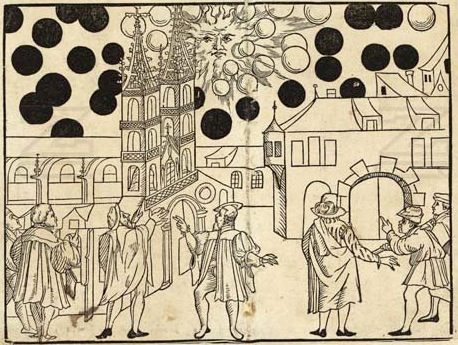
Pictured: the surviving 1566 Basel woodcut broadsheet, showing Basel Minster's Münsterplatz beneath a sky of dark and light spheres, with astonished onlookers below — the sole surviving period illustration of the case, held by the Zentralbibliothek Zürich (Wickiana collection) and reproduced here from a public-domain digitization on Wikimedia Commons. It is not a photograph or a documentary sketch made at the scene; like the comparable Nuremberg 1561 woodcut, it was composed afterward by an artisan printer working from secondhand testimony, not by an eyewitness with drawing tools in hand.
Theoretical Alignment
The Basel broadsheet has no radar track, no photograph, and no physical trace evidence — only a single professionally produced news pamphlet compiled from secondhand testimony. Unlike the comparable Nuremberg 1561 case, one segment of the Basel account (the July 27–28 lunar eclipse and blood-red sun) is independently anchored to a real, datable astronomical event, which strengthens the Atmospheric-Optical reading for at least that portion of the narrative. The August 7 "battle of spheres" episode itself is best explained by a complex solar halo/parhelion display, reported through the explicit, author-acknowledged religious and political framing of the Wunderzeichen ("wonder-sign") broadsheet genre — a genre in which Samuel Coccius himself, unusually, states his own didactic intent outright rather than leaving it to be inferred. The Paleocontact/genuine-anomaly interpretation is a later ufological overlay with no basis in the broadsheet's own stated purpose and is rated speculative.
Background
By 1566, Basel was one of the most important cities of the Swiss Confederacy: a Rhine trading and university city that had formally joined the Confederacy in 1501, adopted the Reformation under Johannes Oecolampadius in 1529, and hosted the University of Basel, founded in 1460 and by this period one of the leading centers of humanist scholarship, medicine, and theology in the German-speaking world. It was also, alongside Nuremberg, one of the great printing capitals of 16th-century Europe — the presses of the Froben and Oporinus workshops had already made Basel synonymous with fine humanist and Reformation-era printing for decades by the time of the 1566 sightings, and the city's print trade extended well beyond scholarly books into the same cheap, fast-turnaround news-broadsheet market that had produced the Nuremberg sheet.
The summer of 1566 was a genuinely fraught political moment across the whole of German-speaking Europe, and Basel's broadsheet text explicitly and unusually says so. Ottoman Sultan Suleiman the Magnificent had departed Constantinople in May 1566 at the head of a massive invasion force aimed once again at Vienna — the same city his armies had failed to take in the famous 1529 siege — and by midsummer that army was engaged in the protracted, ultimately decisive siege of the Hungarian border fortress of Szigetvár. News of an Ottoman army of this scale on the march traveled across the Holy Roman Empire and into the neighboring Swiss Confederacy through exactly the kind of printed news channels — broadsheets, pamphlets, and letters — that men like Samuel Apiarius made their living producing. The broadsheet's own text is explicit that its "battle in the sky" imagery is meant to be read against this real, contemporary military anxiety: it calls on "faithful believers of good moral standing" to recognize the celestial signs as a divine call to repentance and prayer specifically "against the looming Ottoman threat," making Basel one of the more overtly, self-consciously propagandistic examples of the entire Wunderzeichen genre rather than a document that merely happens to read that way to modern eyes.
Print culture of the period had, by 1566, a well-established and recognizable format for events of this kind: the Wunderzeichen or "wonder-sign" broadsheet, part of the wider category of single-sheet news prints known as Einblattdrucke. These combined a woodcut image with a letterpress-printed account, were produced quickly and cheaply after a notable event, sold on the street or at fairs, and were explicitly understood by contemporaries to be moralizing and admonitory as much as descriptive — unusual astronomical events, monstrous births, comets, and floods were near-universally framed as divine warnings calling the population to repentance. Apiarius's own career is a case study in exactly this trade: after being expelled from Bernese printing privileges twice — once in 1559 over a private dispute, and again in 1564 specifically for printing defamatory songs — he founded the first print shop in Solothurn before relocating his operation to Basel in precisely the year of the sighting, 1566, where over the following decades he became a prolific and long-running producer of exactly the "Neue Zeitungen" (new-news) genre that the Basel broadsheet belongs to, alongside calendars, folk songs, and official civic mandates. This background matters directly to how the case should be read: the man who printed the Basel sky-battle broadsheet was, at the very moment he printed it, a print-trade professional freshly arrived in a new city and specifically rebuilding a commercial reputation around sensational, fast-turnaround news content, having already been sanctioned twice for exactly that kind of content elsewhere.
The survival of the sheet at all is due, as with Nuremberg, to a second, separate act of professional specialization: Zurich minister Johann Jakob Wick's decades-long project of building the Wickiana. Wick did not merely file broadsheets that happened to cross his desk; he actively solicited reports, letters, and printed sheets from a network of correspondents scattered across German-speaking Europe, systematically assembling what art historians and librarians today recognize as one of the first purpose-built news archives in European history. Without that second layer of professional specialization, the Basel sheet — printed on cheap paper and designed to be discarded once its news value expired, exactly like its Nuremberg counterpart — would have essentially zero chance of surviving to the present day.
Complete Timeline
| Date | Event |
|---|---|
| 1460 | The University of Basel is founded, establishing the city as a center of humanist scholarship that will shape the intellectual culture surrounding the later broadsheet. |
| 1501 | Basel formally joins the Swiss Confederacy. |
| 1529 | Basel formally adopts the Protestant Reformation under Johannes Oecolampadius, becoming a Reformed city within the Confederacy. |
| 1559 | Samuel Apiarius is expelled from his Bernese printing privileges for four years following a private dispute. |
| 1561 (April 14) | The comparable "celestial battle" broadsheet is printed at Nuremberg by Hans Glaser, establishing the genre convention the Basel sheet will follow five years later. |
| 1564 | Apiarius is expelled from Bern a second time, specifically for printing defamatory songs; he founds Solothurn's first print shop. |
| 1566 | Apiarius relocates his printing operation to Basel, the same year as the sighting. |
| May 1566 | Ottoman Sultan Suleiman the Magnificent departs Constantinople with a roughly 150,000-strong army bound for Vienna, the news of which spreads across German-speaking Europe through the summer. |
| July 27, 1566 (evening) | A dimly lit Basel sunset abruptly turns cinnabar/vermilion red, alarming observers. |
| Night of July 27–28, 1566 | A lunar eclipse occurs overnight, during which the moon assumes a "blood-red" coloration — a real, natural totality effect. NASA's Five Millennium Canon lists a total lunar eclipse in this general window of July 1566 under the Julian calendar then in civil use. |
| July 28, 1566 (dawn) | The following sunrise is likewise reported as unusually and alarmingly red, "as if everything were fire-red and bloody," continuing to trouble Basel's citizens through the day. |
| August 7, 1566 (sunrise into forenoon) | Numerous fiery-red and black spherical objects, "like cannonballs," are reported moving with great speed before the sun, appearing to clash with one another before several turn fiery-red, disintegrate, and vanish. |
| Later 1566 | Samuel Coccius compiles a written account from first- and second-hand testimony; Samuel Apiarius prints it as an 18.2 × 23.8 cm illustrated broadsheet titled Seltzame gestalt so in disem M. D. LXVI. Jar… zu Basel ("Strange forms that in this year 1566 were seen at Basel…"). |
| September 6, 1566 | Suleiman the Magnificent dies during the siege of Szigetvár, Hungary; his death is concealed from his own army for weeks. The Ottoman offensive toward Vienna ultimately stalls. |
| 1566–1588 | A surviving copy of the Basel broadsheet is acquired by Zurich minister Johann Jakob Wick and bound into his compilation of "wondrous and horrifying" broadsheets, later known as the Wickiana. |
| 1588 | Johann Jakob Wick dies; his archive eventually passes into the holdings of what is today the Zentralbibliothek Zürich. |
| 1590 (April 12) | Samuel Apiarius dies in Basel; his printing operation passes, through his widow's remarriage, to Johannes Schröter. |
| 1626 | Samuel Coccius dies in Basel. |
| 1739 | Naturalist Frobesius catalogs the 1566 Basel sighting among possible historical aurora borealis observations in Nova et antiqua luminis atque Aurorae borealis spectacula. |
| 1873 | Hermann Fritz's historical catalog of auroral activity lists the 1566 Basel event with an explicit question mark, reflecting long-standing scholarly uncertainty over its classification. |
| 1958 | Carl Jung's Flying Saucers: A Modern Myth of Things Seen in the Skies, though centered on Nuremberg, helps draw renewed international attention to the entire genre of 16th-century "sky battle" broadsheets, Basel included. |
| 2001 | Wiebke Schwarte's academic study Nordlichter analyzes the Basel and Nuremberg broadsheets together as products of the same print-historical tradition. |
| 2010 | Jacques Vallée and Chris Aubeck catalog the Basel case within Wonders in the Sky, their systematic compendium of pre-modern aerial phenomena reports. |
| 2024 | The Swiss National Museum's official history blog publishes a detailed modern account of the case, explicitly comparing it to Nuremberg 1561. |
| Present day | The original broadsheet is held under shelfmark PAS II 6/5 in the Wickiana collection of the Zentralbibliothek Zürich, cataloged and digitized via the library's e-manuscripta.ch platform. |
The Primary Source Document
The document at the center of this case is a single-leaf broadsheet (Einblattdruck) measuring 18.2 by 23.8 centimeters, combining an uncolored woodcut image above a block of letterpress text set in Schwabacher typeface. Its full period title, transcribed from the surviving copy, reads: "Seltzame gestalt so in disem M. D. LXVI. Jar/ gegen auffgang vnd nidergang/ vnder dreyen malen am Himmel ist gesehen worden/ zu Basel auff den xxvij." — "Strange forms that in this year 1566, toward sunrise and sunset, were seen three times in the sky, at Basel, on the 27th [of July, and following]." It was printed "durch Samuel Apiarium" ("by Samuel Apiarius") in Basel in 1566, with the underlying text credited to Samuel Coccius. The surviving copy is catalogued today under shelfmark PAS II 6/5 in the Wickiana holdings of the Zentralbibliothek Zürich, and is digitized and viewable via the library's e-manuscripta.ch platform.
The woodcut depicts Basel Minster (the Basler Münster) and its cathedral square, the Münsterplatz, with well-dressed onlookers in the foreground gazing upward, astonished, at a sky filled with whirling black and white spheres. The rendering of the sun itself is unusually expressive for the genre: contemporary description of the woodcut notes its rays as "wild and asymmetrical," with a "disturbed and stern" facial expression worked into the solar disc — an anthropomorphized sun motif that goes beyond Nuremberg's comparatively more restrained (if still dramatic) composition.
The Text, In Translation
The broadsheet's original German describes the August 7 climax in language that closely tracks Nuremberg's own vocabulary of celestial combat. As transcribed and quoted in reference sources for the case, the key passage reads, in the original: "vil großer schwartzer kugelṅ im lufft gesehen worden/ wölche für die Sonnen/ mit großer schnelle…gefaren/ auch widerkeert gegen einandern gleichsam die ein streyt fürten" — rendered in English as "many large black spheres [were] seen in the air, moving with great speed before the sun, also turning against one another as if they were waging a battle."
"Many large black spheres were seen in the air, which moved before the sun with great speed… and turned toward each other as if they were fighting."
The account describes the spheres as numbering enough to fill a "cloud" before the solar disc, several turning fiery-red before dissolving or vanishing, consistent both with a literal reading of colliding aerial objects and with the visual behavior of a shifting, multi-part solar halo display as clouds of ice crystals drift and reorient relative to an observer. Unlike the Nuremberg text, which closes with an appeal to divine mystery ("what such signs mean, only God alone knows"), the Basel broadsheet is considerably more didactic and specific in its stated conclusion: it directly exhorts "faithful believers of good moral standing" to read the display as a call to repentance and prayer against the "looming Ottoman threat," tying the sky spectacle explicitly to the real, contemporary military crisis unfolding that same summer at Szigetvár.
Witnesses and the Chain of Testimony
Samuel Coccius (1548–1626)
The named author of the Basel account, described in period and reference sources as a Basel-born Schriftgelehrter und Kunststudent ("scripture scholar and art/liberal-arts student"). Roughly eighteen years old at the time of the sightings, Coccius is not established as a personal eyewitness to any of the three episodes; the broadsheet's own text indicates he compiled it from testimony gathered "from first and second hand" after the fact. Later biographical sources (Deutsche Biographie) record him as a Basel theologian who lived until 1626, with recorded name-variants Koch, Köchlin, and Essig — suggesting "Coccius" is itself a Latinized humanist form of a vernacular surname, a common practice among educated men of the period. He is not known to have produced any other broadsheet or publication on record, making the Basel sheet his sole surviving documented literary work.
Samuel Apiarius (d. April 12, 1590)
The printer who set and issued the broadsheet, and by far the more experienced print-trade professional of the two named parties. Apiarius inherited his father's printing business and operated it with his brother Siegfried before being expelled from Bernese printing privileges in 1559 over a private dispute, then expelled a second time in 1564 specifically for printing defamatory songs (Schmählieder). He founded the first print shop in Solothurn before relocating to Basel in 1566 — the same year as the sighting — where he went on to produce numerous "Neue Zeitungen" news broadsheets, folk songs, calendars, and official civic mandates through 1589, one year before his death. He is not established as a personal eyewitness to the events either; like Hans Glaser at Nuremberg, he was a working print-shop proprietor turning submitted or gathered testimony into a saleable commercial product.
The Citizens of Basel
The broadsheet attributes the sightings to an unspecified number of Basel residents across all three dates, language implying a genuinely citywide event rather than an isolated observation by one or two individuals, consistent with the equivalent claim in the Nuremberg text. No individual witness is named, occupationally identified, or independently interviewed in any surviving record. No city council minute, university lecture note, sermon, private diary, or second pamphlet corroborating the sighting has ever been located, making this — exactly as with Nuremberg — the single largest evidentiary gap in the case: everything traces back to one commercial print product compiled by a teenage scripture student and a printer with a documented history of sensationalized content.
Johann Jakob Wick (1522–1588)
Not a witness to the Basel events themselves, but — exactly as with the Nuremberg sheet — the individual responsible for the document's survival. A Reformed minister at Zurich's Grossmünster church, Wick spent nearly three decades (1559–1588) systematically collecting broadsheets, letters, and illustrations documenting "wondrous and horrifying" events from across German-speaking Europe, binding them into 24 folio volumes now known as the Wickiana. Both the Basel and Nuremberg broadsheets were preserved as part of this single project, meaning the two most-cited "ancient UFO" broadsheets in the ufological literature owe their physical survival to the same 16th-century Zurich clergyman's private archival hobby.
The Paleocontact / Ancient-UFO Interpretation
The Basel broadsheet's modern ufological profile has always traveled in the shadow of its more famous Nuremberg sibling. It lacks a single dedicated modern popularizer of Carl Jung's stature — Jung's landmark 1958 book Flying Saucers: A Modern Myth of Things Seen in the Skies centers its extended discussion on the Nuremberg woodcut rather than Basel's, and the German Wikipedia's discussion of the Nuremberg sheet notes only in passing that Jung read the Basel spheres' dark coloration as an effect of backlighting from the rising sun, treating rapid, erratic movement as "characteristic" of what later generations would call UFOs, without endorsing a literal extraterrestrial reading any more than he did for Nuremberg. Where the Basel case has instead accumulated its modern ufological reputation is through repetition across UFO-interest websites, stock-photo and print-on-demand image licensing (the woodcut circulates widely through agencies such as Topfoto and Alamy captioned simply as an early "UFO" sighting), and inclusion in broad historical-anomaly catalogs.
Jacques Vallée and Chris Aubeck's 2010 catalog Wonders in the Sky includes the Basel case within the same deliberately broad, non-committal compendium of historical anomaly reports that also covers Nuremberg, treating it as a data point worth preserving and comparing rather than adjudicating outright. Wikipedia's own article on the case is explicit that "some ufologists" read the black spheres as a literal sky battle between unidentified craft, while noting in the same breath that the broadsheet's own named author, Coccius, "reported it as a religious event" — making Basel one of the clearer cases on this site where the primary source's own stated interpretation and its later ufological repurposing diverge sharply and are both a matter of public record rather than inference.
The Mainstream Meteorological & Historical Interpretation
The leading conventional explanation treats the three reported episodes as two related but distinct natural phenomena, reported through a single, unified religious-propaganda lens. The July 27–28 sunset/eclipse/sunrise sequence is the more scientifically secure of the two: NASA's Five Millennium Canon of Lunar Eclipses records a total lunar eclipse in this general window of July 1566 (cataloged under the Julian calendar then still in civil use across Europe, a full sixteen years before the Gregorian reform of 1582 — a detail that accounts for the roughly ten-day discrepancy between the catalog's Julian date and the broadsheet's "27th/28th"). A totally eclipsed moon reliably turns a deep red or copper color as sunlight is refracted through Earth's atmosphere onto the lunar surface, and a reddened sun at the surrounding sunset and sunrise is fully consistent with high-altitude dust, thin cirrus, or ordinary atmospheric extinction near the horizon. This portion of the account, in other words, describes a real astronomical event using vivid but explicable religious-omen language.
The August 7 "battle of spheres" episode is best explained by a complex solar halo display — parhelia (sun dogs), a circumhorizontal or circumzenithal arc, or a sun pillar, singly or in combination — forming when sunlight refracts through horizontally oriented, plate-shaped hexagonal ice crystals in high cirrus cloud, an effect strongest at low solar elevation angles such as the reported sunrise-into-forenoon timing. This is the identical mechanism proposed for Nuremberg five years earlier, and the Swiss National Museum's own historical blog treats the two cases as closely parallel precisely on these grounds. An independent, secondary candidate raised by Swiss amateur-astronomy researchers citing Hermann Fritz's 1873 historical aurora catalog (itself drawing on the 1739 survey by Frobesius) is aurora borealis — Fritz's own catalog entry for the 1566 Basel event carries an explicit question mark, reflecting exactly the kind of "halos, meteors, and actual aurorae get conflated in period sources" uncertainty that modern historical-astronomy researchers still wrestle with for reports of this vintage.
The art-historical half of the skeptical case rests on the same scholarship applied to Nuremberg. Art historian Wiebke Schwarte's study Nordlichter treats the Basel and Nuremberg sheets together as products of the same religiously and civically instrumentalized print tradition, and Ulrich Magin's critical analysis of the broader genre (cited by Wikipedia's own reference list for the Basel case) identifies the recurring "apocalyptic rider" and battle-scene motif common to period religious propaganda broadsheets, comparing Basel and Nuremberg to still earlier 1551-era examples of the same visual vocabulary. Basel's own text goes further than Nuremberg's in stating its didactic purpose outright — the explicit call to repentance "against the looming Ottoman threat" is not an inference later readers have projected onto an ambiguous document; it is the broadsheet's own stated conclusion, printed in 1566 by a man, Apiarius, freshly relocated to Basel after two prior expulsions from Bernese printing privileges for exactly this kind of sensationalized content.
Comparative Analysis: Basel and Nuremberg Side by Side
The Basel and Nuremberg broadsheets are, by a wide margin, the two most frequently paired documents in the entire "ancient UFO broadsheet" literature, and a direct comparison is instructive. Both describe spherical, combative objects near the sun, rendered in a shared visual vocabulary of crosses, tubes, and battling globes; both were compiled from secondhand testimony by named print-trade professionals who did not themselves witness the events; both close with an explicit religious framing rather than a claim of literal understanding; and both survive today purely because Zurich pastor Johann Jakob Wick happened to collect them into the same 24-volume Wickiana archive. The differences are equally instructive for calibrating this case's credibility relative to Nuremberg's. Basel's account spans three separate dates across eleven days rather than a single dawn, and one of its three episodes — the July 27–28 sunset/eclipse/sunrise sequence — is independently anchored to a real, catalogable astronomical event in a way no portion of the Nuremberg account is. Working against Basel, however, is a thinner modern scholarly and skeptical literature specifically addressing it (most detailed art-historical and meteorological rebuttals available for Basel are extensions of work originally developed for Nuremberg, rather than dedicated Basel-specific studies), a named compiler who was a teenager with no other documented literary output, and a more overtly stated propagandistic purpose (the explicit anti-Ottoman repentance appeal) than Nuremberg's comparatively more open-ended closing line.
Beyond Basel and Nuremberg, the Wickiana corpus as a whole documents dozens of comparable 16th-century reports of comets, parhelia, monstrous births, and other prodigies interpreted as divine warnings, and Wikipedia's own catalog entry for the Basel case notes a further, later parallel in a broadly similar 1665 broadsheet describing a sky spectacle over Stralsund on Germany's Baltic coast — indicating the "sky battle" reporting convention persisted in German print culture for at least a full century after Basel. This recurring vocabulary — spheres, crosses, tubes, combat — across widely separated dates and cities has been read by Jacques Vallée as evidence of a persistent literary and testimonial convention for describing frightening, ambiguous sky phenomena, rather than a series of independently verified encounters with a single consistent physical phenomenon.
Cultural & Scholarly Legacy
The Basel broadsheet's modern afterlife has followed a quieter track than Nuremberg's. It never received a dedicated, book-length treatment from a major 20th-century intellectual figure comparable to Carl Jung's 1958 engagement with the Glaser woodcut, and it has correspondingly never achieved the same level of independent name recognition. Instead, the Basel woodcut has circulated for decades chiefly as a companion image to Nuremberg's, reproduced in the same encyclopedia entries, ufological compendia, and eventually stock-photography catalogs (Topfoto and Alamy both license period-attributed reproductions of the sheet captioned for a general "historical UFO" audience) that popularized its more famous sibling. The Swiss National Museum's 2024 blog treatment marks one of the few instances of a mainstream cultural institution producing a dedicated, standalone modern account of the Basel case specifically, rather than folding it into a discussion centered on Nuremberg.
On the academic side, the broadsheet serves the same legitimate scholarly function as its Nuremberg counterpart, entirely apart from ufology: as a primary teaching example within the history of print culture, the study of Wunderzeichen literature, and Reformation-era popular religion. Wiebke Schwarte's Nordlichter treats the two sheets side by side as products of the same broadsheet tradition, and Andrew Pettegree's broader history of early modern news culture situates printers like Apiarius within a continent-wide commercial news economy in which sensational, fast-turnaround sky-omen reporting was a recognized and profitable product category, not an aberration. Read in that light, the Basel sheet is less a singular mystery than a well-documented example of how a real astronomical trigger (the lunar eclipse), a probable atmospheric-optical event (the August sun dog display), and an urgent, real contemporary political anxiety (the Ottoman advance on Vienna) could be woven by a period print shop into a single, commercially and politically potent product within months of the underlying events.
The Five Observables Assessment
The Five Observables framework, developed decades later by former AATIP director Luis Elizondo to classify modern UAP performance characteristics that exceed known technology, is included here for structural consistency with the rest of The Omni Ledger's case files, but it does not meaningfully apply to a pre-instrumentation, text-and-woodcut source. Every category below is necessarily assessed as not applicable or, at most, weakly speculative, based solely on the broadsheet's own narrative description rather than any measured performance data.
Assessment: Four of the five categories cannot be assessed at all from a text-and-woodcut source with no distance, speed, or altitude data; they are marked N/A rather than "absent" in the sense of having been ruled out. Only "Low Observability" receives even a speculative mark, and only because the broadsheet describes spheres appearing, disintegrating, and vanishing rather than following any continuously tracked flight path — a description equally consistent with a shifting, evolving halo display as clouds of ice crystals drift relative to an observer as with any exotic craft. The Five Observables framework, designed around modern FLIR and radar data, is simply the wrong tool for a document of this kind, and its inclusion here should not be read as suggesting genuine performance evidence exists.
Evidence Assessment
Supporting a Genuine Anomalous Phenomenon
- A real, dated, provenanced period document exists, describing a specific, multi-date, multi-witness event rather than a private vision or dream
- The language explicitly claims observation by "many" residents across three separate occasions — a distributed, repeated sighting pattern rather than an isolated one-off report
- One segment of the account (the lunar eclipse) is independently corroborated by modern astronomical catalogs, demonstrating the broadsheet is not describing pure invention for at least that portion
- Jacques Vallée and Chris Aubeck, both cautious, non-sensationalist researchers, judged the case substantial enough to include in their systematic historical catalog
- The Swiss National Museum, a serious cultural institution with no ufological agenda, has published a detailed modern historical account treating the case as a genuine and significant period document
Supporting a Natural / Documentary Explanation
- No named eyewitness, and no corroborating civic, ecclesiastical, or competing press account has ever been found for any of the three episodes
- Both named compilers, Coccius and Apiarius, explicitly did not witness the events themselves and relied on secondhand testimony
- Sunrise/sunset, low solar elevation, and central European summer cirrus cloud are precisely the conditions under which complex sun dog and halo displays occur
- A real total lunar eclipse independently accounts for the entire July 27–28 portion of the narrative through purely natural means
- The printer, Apiarius, had a documented, pre-existing pattern of sanctioned sensationalized print content, and relocated to Basel in the very year of the sighting
- The broadsheet states its own propagandistic, anti-Ottoman didactic purpose more explicitly than almost any comparable sheet in the genre, undercutting a reading of it as neutral reportage
Why "Disputed"
The Basel celestial phenomenon receives a DISPUTED rather than "debunked" classification for essentially the same structural reasons as the Nuremberg case it is most often paired with, adjusted for its own specific evidentiary profile. What is not disputed: a real, dated, archivally provenanced 1566 document exists, describing three specific multi-witness sky events over eleven days; it was compiled and printed by two named professionals, one of whom (Apiarius) had an established, if checkered, print-trade career; and one segment of its account — the July 27–28 lunar eclipse and reddened sun — independently corresponds to a real, catalogable astronomical event, which is more direct corroboration than exists anywhere in the Nuremberg record. What remains genuinely open: no second, independent eyewitness or civic record has ever surfaced for any of the three episodes; both named compilers explicitly did not witness the events firsthand; the August 7 "battle of spheres" episode itself has no independent astronomical corroboration and rests on the same sun dog/halo explanation proposed for Nuremberg, which — while well-supported by atmospheric physics — cannot be proven with total certainty against a single, non-corroborated, and explicitly propagandistic source. The Omni Ledger classifies the case as Disputed, landing in a similar range to the comparable Nuremberg case, to reflect a real, unresolved evidentiary gap in the August episode specifically, while noting clearly that the weight of specialist opinion leans decisively toward a combination of natural atmospheric/astronomical triggers and Wunderzeichen genre convention over any literal paleocontact reading.
Sensor & Instrumentation Detection Profile
There is no instrumentation record of any kind associated with this case. The entire "sensor" for all three episodes was the unaided human eye of an unspecified number of Basel residents, compiled after the fact by a single scripture scholar, Samuel Coccius, who was not himself a trained astronomical or meteorological observer and who states plainly in the broadsheet's own text that his account rests on testimony gathered "from first and second hand" rather than personal witness. No clock time more precise than "evening," "morning," and references to the sun's position survives for any of the three dates; no compass bearing, no altitude estimate in any modern sense, and no independent civic or ecclesiastical record (city council minutes, university lecture notes, or a rival pamphlet) has been located to corroborate the account. This is the same central evidentiary weakness identified in the Nuremberg 1561 case, compounded here by the fact that even the broadsheet's own authors, Coccius and Apiarius, are on record as not having witnessed any of the three episodes themselves.
Environmental & Geospatial Context
Basel sits at approximately 47.557°N, 7.592°E, on the Rhine at the point where the modern borders of Switzerland, Germany, and France converge, and was in 1566 a Reformed Protestant member city of the Swiss Confederacy and a significant university and printing center. The August 7 sighting is reported as occurring around sunrise and into the forenoon — low solar elevation geometry favorable to sun dogs (parhelia), circumhorizontal arcs, and sun pillars, exactly the same optical regime implicated in the Nuremberg case five years earlier. Unlike Nuremberg, the July 27–28 portion of the Basel account is independently anchored to a real astronomical event: NASA's Five Millennium Canon of Lunar Eclipses lists a total lunar eclipse for this general period of July 1566 (cataloged under the Julian calendar then in civil use, which places it roughly ten days earlier than the broadsheet's Gregorian-equivalent "27th/28th" by later reckoning — a minor but genuine chronological wrinkle worth stating honestly rather than glossing over). A blood-red or copper-colored totally eclipsed moon is a well-understood, entirely natural effect of sunlight refracting through Earth's atmosphere onto the lunar surface, and a reddened, dimmed sun at both the preceding sunset and the following sunrise is consistent with high-altitude dust or thin cloud along the horizon. Swiss amateur-astronomy researchers, citing Hermann Fritz's 1873 historical catalog of auroral activity (itself compiling the earlier 1739 survey by Frobesius), have also flagged the episode as a possible, though unconfirmed, aurora borealis sighting — a genuine alternative natural candidate for at least part of the display, since aurorae were occasionally visible at Basel's latitude during strong geomagnetic events in the pre-industrial era. No meteorological instrument readings exist for any of the three dates, as instrumented weather observation did not yet exist in 1566.
Observer Credibility & Occupational Profile
Every named party in this case is a print-trade or scholarly professional rather than a disinterested official witness, and unusually, both named parties are explicit that they did not personally see any of the three episodes. Samuel Coccius (1548–1626), described in German-language sources as a Basel-born Schriftgelehrter und Kunststudent ("scripture scholar and art/liberal-arts student"), compiled the broadsheet's text from testimony gathered after the fact; he was roughly eighteen years old at the time of the events, a detail rarely highlighted in ufological retellings of the case. Samuel Apiarius (d. 1590), the printer who published the sheet, was a far more experienced print-trade professional with a documented, checkered career: expelled from Bernese printing privileges in 1559 following a private dispute, expelled again in 1564 specifically for printing defamatory songs (Schmählieder), after which he founded Solothurn's first print shop before relocating his operation to Basel in 1566 — the very year of the sighting — where he went on to produce numerous Neue Zeitungen ("new news" broadsheets), calendars, folk-song sheets, and official mandates between 1566 and 1589. Neither man's biography includes any documented specialty in astronomy or natural philosophy, and Apiarius's prior record of legal trouble over sensationalized print content is a genuine, source-documented credibility flag against treating the sheet as disinterested reportage, directly comparable to the equivalent flag raised against Hans Glaser in the Nuremberg case. The "many" residents of Basel cited as the underlying source testimony are entirely anonymous and occupationally undifferentiated — no named burgher, cleric, city councilor, or university scholar is on record, the same evidentiary gap that limits the Nuremberg case to a "disputed" rating.
Physical & Material Assays
As detailed above under Material Analysis, no physical or trace evidence of any kind — metallurgical, isotopic, or otherwise — exists for this case, and none has ever been claimed. The sole physical object connected to the case is the paper broadsheet itself, which has undergone standard archival preservation and cataloging at the Zentralbibliothek Zürich but no scientific materials testing beyond ordinary paper-conservation practice, since no question of the document's own period authenticity has ever been seriously raised in the scholarly literature. This absence of any physical assay target is itself informative: unlike modern crash-retrieval cases, there is no metal, soil, or biological sample for any laboratory to examine, and the entire evidentiary record begins and ends with printed text and a woodcut image.
Historical Precedents & Archive Matches
The Basel broadsheet was not produced in a vacuum. It belongs to the same well-documented German-and-Swiss Wunderzeichen ("wonder-sign") print genre that produced the Nuremberg sheet five years earlier, and the Swiss National Museum's own historical blog explicitly identifies "striking similarities" between the two documents, both of which "employ militaristic symbolism" to frame ambiguous sky events through the lens of contemporary political and religious conflict. Where Nuremberg's broadsheet left its warlike imagery largely to speak for itself, Basel's account is more explicit still: Coccius directly ties the spectacle to the Swiss Confederacy's fear of the advancing Ottoman army, a fear that was, in the summer of 1566, acutely and verifiably topical — Suleiman the Magnificent had personally led a roughly 150,000-strong Ottoman force out of Constantinople that May in the largest campaign toward Vienna since 1529, besieging the Hungarian fortress of Szigetvár through the exact weeks the Basel sightings were reported, with Suleiman's own death at the siege (concealed from his own army for weeks) following on September 6, 1566. Wikipedia's own catalog entry for the case additionally notes a third, later parallel: a broadly similar 1665 broadsheet describing a sky spectacle over Stralsund, on Germany's Baltic coast, suggesting the "sky battle" reporting convention persisted in German-language print culture for at least another century. All of these documents were gathered, alongside the Nuremberg sheet, by Zurich pastor Johann Jakob Wick into the 24-volume Wickiana archive between 1559 and 1588, making Basel and Nuremberg sister documents within the very same archival collection rather than two isolated discoveries.
Material Analysis
There is no physical trace evidence associated with this case in the sense familiar from modern UAP investigations — no metal, no soil anomaly, no recovered fragment of any of the reported "spheres." The entire physical evidentiary record is the paper artifact itself: a single uncolored woodcut-and-letterpress sheet, printed on period rag paper, 18.2 by 23.8 centimeters, produced using the two dominant reproduction technologies of 1566 Basel — relief woodblock printing for the image and movable-type letterpress (Schwabacher typeface) for the text. Unlike the hand-tinted Nuremberg sheet, the Basel broadsheet survives uncolored, consistent with a lower-cost, faster production run typical of a printer, Apiarius, newly re-establishing his business in a new city that same year.
Supporting the Document's Reliability
- The broadsheet survives as an original period artifact, not a later copy or forgery, with continuous, traceable provenance through the Wickiana collection to the present-day Zentralbibliothek Zürich (shelfmark PAS II 6/5)
- Its language claims a specific, multi-date, multi-witness event ("many" residents across three separate occasions) rather than a single individual's private vision
- One segment of the account — the July 27–28 sunset/eclipse/sunrise sequence — corresponds to a real, independently catalogable astronomical event (a documented total lunar eclipse), lending the broadsheet's basic reliability as a record of something genuinely observed real weight for at least that portion
- It fits a well-attested and independently verifiable genre (Wunderzeichen broadsheets) known to have circulated widely and been taken seriously by contemporaries
- Jacques Vallée and Chris Aubeck, cautious, non-sensationalist researchers, judged the case substantial enough to include in their systematic historical catalog alongside Nuremberg
Undermining the Document's Reliability as an Eyewitness Record
- No named individual eyewitness, and no corroborating civic, ecclesiastical, or rival-press source has ever been located for any of the three episodes
- Both named parties — Coccius and Apiarius — are on record as not having personally witnessed the events, having compiled the account from secondhand testimony
- The printer, Apiarius, had been sanctioned twice by Bernese authorities for sensationalized print content in the seven years immediately preceding the Basel sheet
- The broadsheet states its own didactic, propagandistic purpose — an explicit anti-Ottoman repentance appeal — more overtly than almost any comparable sheet in the genre
- The compiler, Coccius, was approximately eighteen years old at the time and produced no other known literary work before or after
- The one astronomically verifiable element (the lunar eclipse) carries a real, unresolved calendar-dating discrepancy against the modern eclipse catalog, underscoring the imprecision of the underlying testimony chain
Conventional Explanation Candidates
Because this is a pre-instrumentation documentary case rather than a physical-evidence case, its Conventional Explanation Candidates (CEC) evaluate the reported phenomena and the reporting process together. Five candidates are assessed below.
Total Lunar Eclipse (Jul. 27–28 episode)
Highly PlausibleNASA's Five Millennium Canon independently lists a total lunar eclipse for this general window of July 1566. A totally eclipsed moon reliably turns deep red as sunlight refracts through Earth's atmosphere onto the lunar surface, and reddened sunset/sunrise light at the same general time is consistent with ordinary horizon-level atmospheric extinction. This candidate explains the July portion of the account about as completely as a 460-year-old secondhand report can be explained.
Complex Solar Halo Display (Sundog / Parhelia)
LikelySundogs form when sunlight refracts through horizontally oriented, plate-shaped hexagonal ice crystals in high cirrus cloud, producing bright patches and arcs around the sun; under favorable conditions these can combine into an elaborate, multi-part, shifting display, particularly at low solar elevation. The Aug. 7 sunrise-into-forenoon timing is a well-matched setting for exactly this kind of display, and it is the same mechanism proposed for the closely comparable Nuremberg 1561 case.
Aurora Borealis
Possible / UnconfirmedSwiss amateur-astronomy researchers, citing Hermann Fritz's 1873 historical aurora catalog (itself drawing on the 1739 Frobesius survey), have flagged the 1566 Basel event as a possible aurora sighting — Fritz's own entry carries an explicit question mark. Aurorae were occasionally visible at Basel's latitude during strong geomagnetic storms in the pre-industrial era, but no independent confirmation (such as a matching sunspot or storm record) has been located, and the "cannonball" spherical imagery is a poor match for typical auroral curtain/arc morphology.
Wunderzeichen Genre Convention & Political Propaganda
Highly PlausibleThis candidate explains the document rather than the underlying sky phenomenon: printer Apiarius's documented history of sanctioned sensational content, his 1566 relocation to Basel, compiler Coccius's youth and singular literary output, and the broadsheet's own explicit, stated anti-Ottoman repentance appeal together make a strong case that whatever was actually seen was substantially dramatized, standardized, and moralized in translation from testimony to woodcut — the print-history equivalent of a wartime propaganda leaflet built around a real sky event.
Genuine Anomalous / Paleocontact Phenomenon
UnprovenIncluded for completeness, per this site's standard framework. No positive physical or corroborating documentary evidence supports a literal, non-natural aerial phenomenon over any of the four candidates above; the case for it rests almost entirely on the dramatic character of the woodcut and its circulation through modern UFO-interest media, without any dedicated scholarly defense comparable to what exists (and is itself contested) for Nuremberg.
Related Cases
Confirmed Archival Holdings
The catalog and digitization record for the original Coccius/Apiarius broadsheet, shelfmark PAS II 6/5, held in the library's Wickiana collection.
PUBLIC DOMAIN (freely accessible)Institutional description of Johann Jakob Wick's archive of 16th-century "wonder-sign" broadsheets, of which the Basel sheet is one part.
PUBLICLY ACCESSIBLE ARCHIVEPublic-domain scan of the broadsheet woodcut, credited to the Zentralbibliothek Zürich, with file-level provenance and licensing metadata (CC-PD-Mark, PD-old-100-expired).
PUBLIC DOMAINSearch Primary Archives Directly
Further Reading — Recommended Literature
Wonders in the Sky: Unexplained Aerial Objects from Antiquity to Modern Times
A systematic, deliberately non-committal catalog of over 500 historical anomaly reports, including both the Basel and Nuremberg broadsheets, cross-referenced and sourced from original documents.
Flying Saucers: A Modern Myth of Things Seen in the Skies
The book that made the sister Nuremberg broadsheet internationally famous and helped draw modern attention to the whole 16th-century "sky battle" genre Basel belongs to, read through archetypal psychology rather than literal extraterrestrial visitation.
Wonders and the Order of Nature, 1150–1750
The definitive academic history of European "wonder" literature — monsters, celestial signs, and prodigies — essential context for understanding the Wunderzeichen genre that produced the Basel sheet.
Rainbows, Halos, and Glories
The standard non-technical reference on sun dogs, halos, sun pillars, and related ice-crystal optical phenomena — the physical basis of this case's leading conventional explanation, illustrated in detail.
The Invention of News: How the World Came to Know About Itself
A history of early print news culture across ten countries, situating printers like Samuel Apiarius and compilers like Samuel Coccius within the commercial and political news economy that produced sheets like Basel's.
Essential Viewing
No Videos Available
Sources
- "1566 celestial phenomenon over Basel." Wikipedia. en.wikipedia.org
- "Basler Flugblatt von 1566." Deutsche Wikipedia (includes original German text, Coccius/Apiarius attribution, and Ulrich Magin/Wiebke Schwarte analysis). de.wikipedia.org
- "The celestial event over Basel in 1566." Swiss National Museum Blog. blog.nationalmuseum.ch
- "Das Himmelsspektakel über Basel im Jahr 1566." Watson.ch (CH Media). watson.ch
- "Basler Flugblatt 1566: Was passierte damals am Himmel?" 20 Minuten. 20min.ch
- Coccius, Samuel; Apiarius, Samuel. "Seltzame gestalt so in disem M. D. LXVI. Jar… zu Basel." Original broadsheet, catalog/digitization record. Zentralbibliothek Zürich / e-manuscripta. e-manuscripta.ch
- "Mirackel, Zeichen, Schröcklichkeiten — The Wickiana." Zentralbibliothek Zürich. zb.uzh.ch
- "File: Basilea1566.jpg." Wikimedia Commons. commons.wikimedia.org
- "Category: Wickiana." Wikimedia Commons. commons.wikimedia.org
- "Wickiana." Wikipedia. en.wikipedia.org
- "Sun dog." Wikipedia (formation and optics of parhelia). en.wikipedia.org
- "1561 celestial phenomenon over Nuremberg." Wikipedia (comparative case). en.wikipedia.org
- "Five Millennium Canon of Lunar Eclipses: 1501 to 1600." NASA Eclipse Web Site (Fred Espenak). eclipse.gsfc.nasa.gov
- "Himmelsspektakel über Basel am 7. August 1566." SAG-SAS: Schweizer Amateurastronomie (discussion citing Hermann Fritz's 1873 aurora catalog and the 1739 Frobesius survey). forum.sag-sas.ch
- "Apiarius, Samuel." Deutsche Biographie (Allgemeine Deutsche Biographie). deutsche-biographie.de
- "Coccius, Samuel." Deutsche Biographie. deutsche-biographie.de
- "Suleiman the Magnificent." Wikipedia (1566 Szigetvár campaign and death, contextual source for the broadsheet's stated Ottoman-threat framing). en.wikipedia.org
- "Basel." Wikipedia (Swiss Confederacy membership, Reformation history, university and printing history). en.wikipedia.org
- Jung, C.G. Flying Saucers: A Modern Myth of Things Seen in the Skies. Princeton University Press (Bollingen Series), 1958/1978.
- Vallée, Jacques & Aubeck, Chris. Wonders in the Sky: Unexplained Aerial Objects from Antiquity to Modern Times. Tarcher/Penguin, 2010.
- Daston, Lorraine & Park, Katharine. Wonders and the Order of Nature, 1150–1750. Zone Books, 1998/2001.
- Schwarte, Wiebke. Nordlichter, pp. 88–99 (as cited in Deutsche Wikipedia, "Basler Flugblatt von 1566" and "Nürnberger Flugblatt von 1561").
- Magin, Ulrich. Ein Ufo im Jahr 1561? (critical analysis of the broader 16th-century "sky battle" genre, as cited in Deutsche/English Wikipedia's Nuremberg and Basel articles).
- Birnes, William J. The Everything UFO Book, pp. 21–22 (as cited in Wikipedia's "1566 celestial phenomenon over Basel" reference list).
- Pettegree, Andrew. The Invention of News: How the World Came to Know About Itself. Yale University Press, 2014.
- "Johann Jakob Wick." The Omni Ledger Key Figures. key-figures.html
See something inaccurate? Have additional information or sources?
Suggest an Edit →Last Updated: August 2026