
Beatriz Villarroel & the VASCO Project
Since 2017, astrophysicist Beatriz Villarroel — a Nordita (Nordic Institute for Theoretical Physics) researcher jointly affiliated with Stockholm University and the Instituto de Astrofísica de Canarias — has led VASCO (Vanishing & Appearing Sources during a Century of Observations), a peer-reviewed archival-astronomy program that systematically compares mid-twentieth-century photographic sky-survey plates — chiefly the U.S. Naval Observatory (USNO) catalog and the 1949–1958 First Palomar Observatory Sky Survey (POSS-I) — against modern digital surveys, hunting for stellar-like sources present on the old plates but absent today, or vice versa. The project's real, published output includes a 2019/2020 Astronomical Journal paper on missing USNO stars, a 2021 Scientific Reports paper on nine simultaneous transients captured on a single 1950 Palomar plate, a growing citizen-science catalog that by 2025 had logged more than 107,000 short-lived "transients" across the pre-satellite plate archive, and, most controversially, statistical analyses reporting that these transients cluster in time around above-ground nuclear weapons tests and, more weakly, around the volume of contemporaneous UAP reports. Villarroel received the 2021 L'Oréal-UNESCO For Women in Science Prize in Sweden for the underlying "vanishing sources" methodology and was selected in 2022 for the program's International Rising Talents cohort. She also leads a related project, ExoProbe, explicitly framed around searching for extraterrestrial technosignatures — possible probes — within the Solar System. This is fundamentally a case about a real, credentialed scientist doing real, peer-reviewed archival astronomy that sits at an unusually direct intersection with UAP speculation: her methodology has drawn a serious, credentialed rebuttal from astronomers who argue the transients are photographic-plate artifacts, a rebuttal Villarroel and her collaborators have directly answered in the same journals, in an active, unresolved dispute that was still generating new papers as recently as early-to-mid 2026.
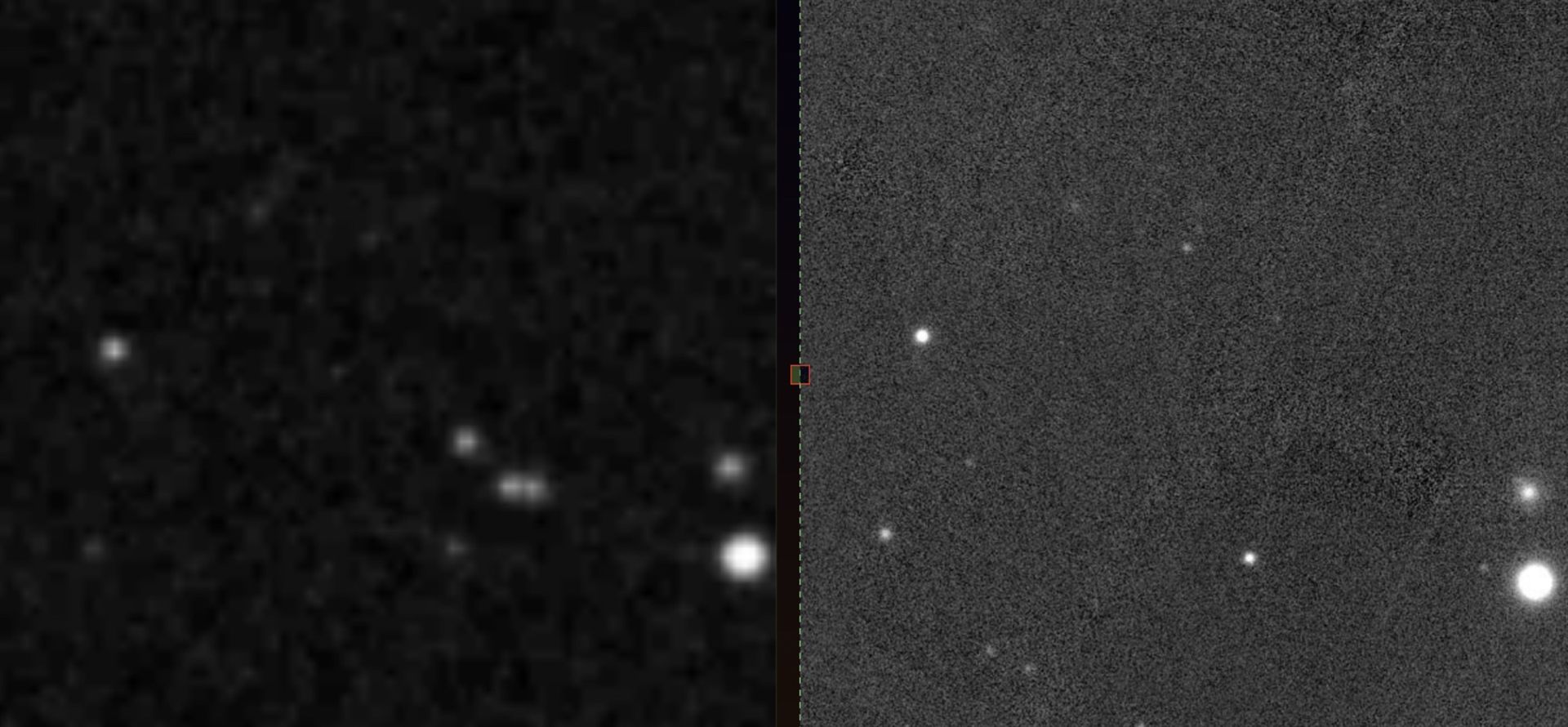
Pictured: an actual published research figure from Villarroel et al.'s 2022 Acta Astronautica paper "A glint in the eye," showing a genuine example of a "triplet glint" — three aligned point-source transients recorded on a single 1950s POSS-I red plate that have no counterpart in modern Pan-STARRS imaging of the same sky region. This is not a photograph of Beatriz Villarroel herself or of any UAP/craft — no rights-clear photograph of Villarroel has been located on Wikimedia Commons or any other public-domain archive, and this case file's central subject is archival data, not a witnessed object. The image is used here because it is the actual evidentiary material this entire case file discusses, released under a CC BY 4.0 license by the paper's own authors via Wikimedia Commons.
Theoretical Alignment
Villarroel's own published papers never claim to have detected extraterrestrial technology — they report a statistical excess of unexplained photographic transients and note, carefully, that a Dyson-sphere-style megastructure or an orbiting non-terrestrial artefact are among several candidate explanations that have not been ruled out, alongside purely natural ones. The moderate ETH score reflects that her own more speculative public and interview commentary (and the framing of the separate ExoProbe project) explicitly names extraterrestrial technosignatures as a live hypothesis worth testing, not that any paper claims confirmation of one. The Interdimensional score is essentially zero; nothing in VASCO's methodology or Villarroel's own writing invokes higher dimensions, consciousness, or non-physical phenomena — every claim is framed in terms of ordinary photons striking a photographic emulsion or a modern CCD. The Psycho-Social score is elevated not because of mass sighting hysteria (there is no crowd of witnesses in this case at all) but because of the significant professional and social conflict this research has generated within the astronomy and SETI communities, discussed at length in this file's coverage of the Geoffrey Marcy collaboration controversy below — a genuine sociological dimension to the case that sits apart from the underlying astrophysics.
Background: From Quasars to Vanishing Stars
Beatriz Villarroel did not begin her career studying UAPs or even transient astronomy. She earned her PhD in astronomy at Uppsala University with a doctoral thesis on active galactic nuclei (AGN) — the supermassive black holes at the centers of quasars — and in 2012 received a Crafoord scholarship from the Royal Swedish Academy of Sciences (the body that administers the Crafoord Prize, one of astronomy's most prestigious awards) specifically for that quasar research. This is a conventionally credentialed astrophysics background, not an outsider's entry point into the field. By her own account, published on her personal Medium blog under her full name, she has combined this scientific career with a lifelong parallel commitment to chamber music as an amateur violinist, describing her research as "unbelievably stimulating and rewarding" and expressing a wish that more early-career scientists could access the same genuine excitement she feels in her work.
The idea that would become VASCO began, by Villarroel's own account and as reflected in the project's earliest published methodology, around 2016: a simple but under-explored question of whether a star could meaningfully "vanish" on a human observational timescale, and whether the answer could be tested empirically rather than left as speculation. Most transient-astronomy research is built around appearing objects — supernovae, novae, gamma-ray bursts — because a sudden brightening is trivially easy to notice against a stable background. An object that simply stops being there is much harder to notice, because absence of detection in a single survey is ordinarily attributed to instrumental limits, not treated as a real astrophysical signal worth chasing. As Villarroel put it in a 2021 interview quoted by Stockholm University's own press office, "much less focus has been given to objects that disappear, because it has simply been assumed that nothing can disappear." Turning that hunch into a research program required exactly the kind of century-scale, two-epoch comparison that had rarely been attempted systematically: taking a genuinely old, well-documented photographic survey and asking, star by star, which of its hundreds of millions of cataloged sources have no counterpart in a modern, far deeper digital survey. VASCO — Vanishing & Appearing Sources during a Century of Observations — formally launched in 2017, built initially around comparing the USNO B1.0 catalog (itself compiled from decades of historical astrographic plates, with typical epochs in the mid-20th century) against the Pan-STARRS DR1 digital survey.
Villarroel built VASCO as a genuinely international, multi-institutional collaboration rather than a solo effort: by the time of her 2021 L'Oréal-UNESCO recognition, the project counted more than 40 members across multiple countries, and its 2019/2020 debut paper alone carried 22 co-authors spanning institutions in Sweden, Spain, Ukraine, the United States, and elsewhere. This scale is itself a meaningful credibility signal distinct from any single finding: whatever one concludes about VASCO's more contested claims, the project has never operated as a one-person effort working in isolation from the broader astronomical community — it has recruited, retained, and published with dozens of credentialed collaborators across nearly a decade, drawing continuing new collaborators (most recently Stephen Bruehl, discussed below) even as controversy around some of its interpretations intensified.
Complete Timeline
| Date | Event |
|---|---|
| 2012 | Beatriz Villarroel receives a Crafoord scholarship from the Royal Swedish Academy of Sciences for her PhD-era quasar/AGN research at Uppsala University. |
| c. 2016 | Villarroel begins developing the idea of systematically searching for "vanished" stars by comparing historical and modern sky surveys. |
| 2017 | The VASCO (Vanishing & Appearing Sources during a Century of Observations) project formally launches, comparing the USNO B1.0 catalog against Pan-STARRS DR1. |
| Sept. 8, 2020 (received) | The VASCO Citizen Science Project manuscript is submitted to the journal Universe. |
| Nov. 12–21, 2019 | VASCO Project Paper I is posted to arXiv (1911.05068) and revised, reporting the first systematic search of ~600 million USNO objects against Pan-STARRS. |
| Dec. 12, 2019 | VASCO Project Paper I, "The Vanishing & Appearing Sources during a Century of Observations project: I. USNO objects missing in modern sky surveys," is published in The Astronomical Journal, Vol. 159, No. 1, article 8 (22 co-authors). |
| June 17, 2021 | Villarroel, Geoffrey W. Marcy, and colleagues publish "Exploring nine simultaneously occurring transients on April 12th 1950" in Scientific Reports (Vol. 11, article 12794), documenting nine point sources on a single POSS-I plate absent from all other plates and modern surveys. |
| 2021 | Villarroel is awarded the L'Oréal-UNESCO For Women in Science Prize in Sweden, "for her unique ability to link astronomy, artificial intelligence and citizen science to identify missing light sources in the night sky." |
| Oct. 2021 | Preprint of "A glint in the eye: Photographic plate archive searches for non-terrestrial artefacts" posted to arXiv (2110.15217), proposing multi-transient alignment as a technosignature search strategy. |
| 2022 | "A glint in the eye" is published in Acta Astronautica, Vol. 194, pp. 106–113. |
| Oct. 27, 2022 | "Launching the VASCO Citizen Science Project" is published in Universe (MDPI), Vol. 8, Issue 11, article 561, formalizing the project's hybrid hypothesis-driven/exploratory/machine-learning citizen-science methodology. |
| 2022 | Villarroel is selected as Europe's representative for the L'Oréal-UNESCO For Women in Science International Rising Talents program, one of 15 laureates worldwide for the initiative's 25th edition. |
| 2023 | Villarroel begins collaborating publicly with Geoffrey Marcy on VASCO-related work, triggering the professional controversy detailed later in this file; a U.S. SETI conference withdraws her invitation to present that specific collaborative work. |
| Sept. 2023 | Villarroel receives Heterodox Academy's Open Inquiry Award for Courage, "for the person who has demonstrated consistent courage in pursuing truth…despite social and professional costs." |
| 2023 | Villarroel delivers a TEDx talk at TEDxZurich, "Why we should search for alien artifacts," arguing for archival, artifact-based technosignature searches as a complement to traditional radio SETI. |
| Oct. 9, 2023 | Preprint of the 2024 MNRAS "bright triple transient" paper connecting a July 19, 1952 Palomar transient to the Washington D.C. flap is posted to arXiv (2310.09035), co-authored with Enrique Solano. |
| Jan. 2024 | Solano & Villarroel et al., "A bright triple transient that vanished within 50 min," is published in MNRAS, Vol. 527, Issue 3, pp. 6312–6320. |
| Feb. 2024 | Nigel Hambly and A. Blair (University of Edinburgh) publish "On the nature of apparent transient sources on the National Geographic Society–Palomar Observatory Sky Survey glass copy plates" in RAS Techniques and Instruments, arguing the transients are photographic-emulsion artifacts. |
| May 2024 | Villarroel meets Stephen Bruehl, a Vanderbilt University Medical Center pain researcher, at a conference; the two begin an independent, "nights and weekends" collaboration extending VASCO's statistical analysis. |
| March 2025 (posted) | Bruehl & Villarroel's nuclear-test correlation manuscript is posted as a preprint on Research Square ahead of peer review. |
| July 2025 | Villarroel, Solano, and Marcy publish "On the Image Profiles of Transients in the Palomar Sky Survey" (arXiv 2507.15896), directly responding to Hambly & Blair's 2024 emulsion-defect argument. |
| Aug. 4, 2025 | Villarroel, Watters, Streblyanska, Solano, Geier, and Mattsson publish "A cost-effective search for extraterrestrial probes in the Solar system" in MNRAS, Vol. 546, Issue 2, article staf1158, formally launching the ExoProbe methodology using Earth's shadow as a search filter. |
| Oct. 17, 2025 | Bruehl & Villarroel publish "Aligned, Multiple-transient Events in the First Palomar Sky Survey" in Publications of the Astronomical Society of the Pacific (PASP), reporting 83 candidate sets of aligned transients and a 39% deficit within Earth's geometric shadow. |
| Oct. 20, 2025 | Bruehl & Villarroel publish "Transients in the Palomar Observatory Sky Survey (POSS-I) may be associated with nuclear testing and reports of unidentified anomalous phenomena" in Scientific Reports, Vol. 15, article 34125, reporting the catalog had grown to 107,000+ transients and describing the nuclear-test and UAP-report correlations. |
| Oct. 20, 2025 | Stockholm University's own press office publishes "Unexpected patterns in historical astronomical observations," summarizing both October 2025 papers for a general audience. |
| Jan. 2026 | Wesley A. Watters, Laura Dominé, Sarah Little, Cameron Pratt, and Kevin H. Knuth post "Critical Evaluation of Studies Alleging Evidence for Technosignatures in the POSS1-E Photographic Plates" to arXiv (2601.21946), challenging the nuclear-test correlation as an artifact of Palomar's own observation schedule. |
| Feb. 2026 | Villarroel, Streblyanska, Bruehl, and Geier publish a formal response to Watters et al. on arXiv (2602.15171), disputing the observation-schedule confound argument. |
| March 2026 | Independent researcher Brian Doherty posts "Independent Replication of Nuclear Test-Transient Correlations and Earth Shadow Deficit in POSS-I Photographic Plates" to arXiv (2604.00056), reproducing the original contingency-table statistics from the published dataset. |
| Spring/Summer 2026 | Additional third-party papers examining geomagnetic-storm suppression effects, independent source-recovery via automated detection, and optical-aberration discrimination of real transients from plate defects continue to appear on arXiv, reflecting an unusually active, still-unresolved live research dispute for a case file published at this date. |
The VASCO Method: Comparing a Century of Sky Surveys
VASCO's core methodology, as formally published in its 2019/2020 debut paper and refined in the 2022 citizen-science paper, is conceptually simple even though executing it at scale is not. The project starts from a historical source catalog — initially the USNO B1.0 catalog, a compilation drawing on decades of ground-based astrographic photographic plates with a faint-end limit around 20th–21st magnitude — and cross-matches every one of its roughly 600 million cataloged objects against a modern digital survey covering the same coordinates, initially Pan-STARRS DR1, which reaches a considerably fainter limit of about magnitude 23.4. Any USNO object with no Pan-STARRS counterpart within a 30-arcsecond search radius becomes a preliminary "missing" candidate. In the 2019/2020 paper, this first pass returned roughly 150,000 preliminary candidates — the overwhelming majority of which are not genuine astrophysical mysteries but ordinary cataloging noise: plate-to-plate positional errors, faint sources near the old survey's detection limit that a deeper modern survey should have picked up trivially, and outright duplicate or spurious entries in the original historical catalog.
Filtering that initial candidate pool down to genuinely interesting cases is where VASCO's actual scientific work happens. The team applied successive cuts — color and proper-motion checks, cross-matching against additional catalogs, and ultimately visual inspection — that narrowed 150,000 candidates to roughly 24,000 for closer study, and finally to on the order of 100 point sources that appeared genuinely present in a single historical epoch and genuinely absent from every other epoch checked, historical or modern. As Villarroel told Popular Science in an interview about the project's methodology, "we have done the best work to remove anything that resembles any artifacts," while cautioning in the same interview that "you would have to exclude all-natural things, and then there might also be new natural phenomena that we don't know about" before reaching for any more exotic explanation. The great majority of VASCO's own published discussion of what these ~100 remaining objects might be leans firmly toward mundane, if individually rare, astrophysics: strong M-dwarf flares, distant supernovae caught only in a single exposure, gamma-ray-burst optical afterglows, or (a genuinely open astrophysical question independent of any UAP framing) massive stars that may collapse directly into black holes without a visible supernova explosion at all — a real, actively studied phenomenon in mainstream stellar-evolution theory, sometimes called a "failed supernova," that would by definition leave a rapidly and permanently vanishing star with no expanding remnant to mark where it once was, unlike historically recorded supernovae such as Tycho's 1572 event or the 1054 explosion that produced the Crab Nebula, both of which left visible remnants precisely because they were genuine supernovae rather than direct collapses.
The VASCO Citizen Science Project: Crowdsourcing the Search
Because visually inspecting tens of thousands of candidate transients is exactly the kind of labor-intensive, pattern-recognition task that does not scale well to a small professional team, Villarroel and collaborators formalized a dedicated citizen-science arm of the project, published as "Launching the VASCO Citizen Science Project" in the MDPI journal Universe (Volume 8, Issue 11, article 561, received September 8, 2022, accepted October 16, 2022, published October 27, 2022). The paper describes a deliberately three-pronged strategy for sifting the candidate pool, combining what the authors call hypothesis-driven, exploratory, and machine-learning approaches. The hypothesis-driven track lets trained team members and experienced volunteers search specifically for objects matching a predefined physical model — a candidate flare star, say, or a specific alignment pattern. The exploratory track instead asks volunteers to flag anything visually unusual without a preconceived category in mind, a deliberate hedge against the well-known risk that a narrowly hypothesis-driven search will only ever find what it already expected to find. The machine-learning track trains classifiers on the growing labeled dataset the first two tracks produce, with an explicit eye toward eventually automating detection of the faintest, most marginal candidates — described in the paper as particularly useful for SETI-style searches, where the entire premise is looking for something that does not fit any existing category well enough to be caught by conventional astronomical pipelines built to find known source types.
Practically, this citizen-science layer runs through a public web-based interface (accessible via the project's own site, vascoproject.org) where volunteers are shown side-by-side historical-plate and modern-survey image cutouts and asked to classify whether a candidate source is present, absent, or ambiguous — a format broadly similar to established platforms like Galaxy Zoo or other Zooniverse-hosted projects, though VASCO runs its own dedicated tooling rather than hosting through Zooniverse itself. This citizen-science infrastructure is what allowed the project's candidate catalog to scale from the roughly 100 objects reported in the 2019/2020 debut paper to the more than 107,000 transients reported across the full POSS-I archive by 2025 — an increase of more than three orders of magnitude that reflects both an expanded search area (moving from the original USNO-vs-Pan-STARRS comparison to a systematic pass through the entire POSS-I plate archive) and the sheer manual throughput volunteer classification makes possible. This scaling is itself double-edged for the case's overall credibility assessment: it demonstrates a genuinely large, methodologically documented dataset rather than a handful of cherry-picked anecdotes, but it also means the final catalog's quality depends heavily on citizen-volunteer classification consistency, a well-known general challenge for crowdsourced science that neither this file nor, as far as this file's research found, any VASCO paper claims to have fully solved.
VASCO Paper I (2019/2020): The Astronomical Journal Debut
VASCO's foundational peer-reviewed publication, "The Vanishing & Appearing Sources during a Century of Observations project: I. USNO objects missing in modern sky surveys and follow-up observations of a ‘missing star,’" appeared in The Astronomical Journal, Volume 159, Number 1, article 8, published December 12, 2019 (posted to arXiv as 1911.05068 in November 2019), with 22 named co-authors led by Villarroel. This paper did the essential, unglamorous groundwork: establishing the cross-matching pipeline against USNO B1.0 and Pan-STARRS DR1 described above, presenting deeper individual follow-up observations of a single tentative "missing star" candidate identified in earlier pilot work, and laying out the roughly 100-candidate shortlist that would seed all of VASCO's later, more headline-grabbing research. Crucially, this debut paper is methodologically conservative in its own conclusions: it frames its ~100 remaining candidates as strong M-dwarf flare, high-redshift supernova, or otherwise-unidentified red transient candidates warranting further study, not as evidence of anything exotic. It is the paper that established VASCO's core scientific legitimacy — peer-reviewed, methodologically transparent, published in a mainstream, well-regarded astronomy journal — well before any of the project's later nuclear-test or UAP-adjacent claims existed.
The Nine Transients of April 12, 1950
VASCO's first genuinely startling individual finding came from a single POSS-I red-sensitive plate exposed on April 12, 1950. Published as "Exploring nine simultaneously occurring transients on April 12th 1950" in Scientific Reports (Volume 11, article 12794, June 17, 2021), with co-authors including Geoffrey W. Marcy, Enrique Solano, and Stefan Geier, the paper documents nine distinct point sources appearing within a roughly 10×10 arcminute patch of sky, all visible on that single plate and absent from a blue-sensitive plate taken about 30 minutes earlier and from a further red-sensitive plate taken six days later — and absent, critically, from every modern CCD-based survey of the same sky region, which reaches several magnitudes deeper than POSS-I ever could. The authors used the 10.4-meter Gran Telescopio Canarias for deep follow-up imaging to roughly 26th magnitude, finding what they described as "possible optical counterparts, although these counterparts could equally well be just" chance positional coincidences — a genuinely hedged, non-triumphalist statement of the actual observational result.
The paper's own discussion systematically works through conventional explanations and finds each wanting on its own terms, while being careful not to claim this rules out an eventual mundane answer. Known transient-source classes — flaring dwarf stars, optical counterparts to fast radio bursts, gamma-ray-burst afterglows, gravitational microlensing events — each occur at a known, empirically measured rate far too low to plausibly explain nine coincident detections in a single small patch of sky within the same half-hour exposure. Airplanes, meteors, and asteroids would be expected to leave a visible streak across a 50-minute exposure as they moved; all nine sources instead appear as sharp, unstreaked point sources, which the paper argues is more consistent with something very brief (well under a second) rather than something moving steadily through the frame for an extended period. The paper explicitly notes that Sputnik-1, the first artificial satellite, did not launch until October 1957, more than seven years after this April 1950 exposure, ruling out ordinary satellite-glint contamination for this specific date. The authors floated fast (sub-second) solar reflections from objects near geosynchronous orbit as one candidate explanation among several, alongside the frank, repeatedly stated caveat that "contamination cannot be excluded as an explanation" for at least some of the nine points, particularly the fainter ones — a genuinely open finding, not a confirmed detection of anything.
"A Glint in the Eye": A Formal Search Strategy for Non-Terrestrial Artefacts
In 2022, Villarroel and collaborators including Lars Mattsson, Hichem Guergouri, Enrique Solano, and Stefan Geier published "A glint in the eye: Photographic plate archive searches for non-terrestrial artefacts" in Acta Astronautica, Volume 194, pages 106–113 (preprint arXiv 2110.15217). This paper is significant less for any single new detection than for formalizing VASCO's technosignature-search logic into an explicit, citable methodology: the authors argue that even a small piece of reflective debris or a passive artefact in or near geosynchronous Earth orbit (GEO) could, in principle, be identified indirectly through searches for multiple simultaneous transients — several separate glints of reflected sunlight — on old photographic plate material exposed before 1957, when no human-made object of that kind could have existed. The paper is explicit that this is a search strategy paper, proposing and justifying a method, rather than a claims-of-detection paper; its practical contribution to the broader case file is the theoretical grounding for why VASCO's later "aligned multiple-transient events" work (discussed below) would matter if confirmed, and why a genuinely artificial GEO object is a mechanistically coherent (if unconfirmed) candidate explanation distinct from either plate artifacts or purely natural transient astrophysics.
The Washington D.C. Flap Connection: A Statistically Interesting Coincidence, Not a Claimed Link
This site's own Washington, D.C. UFO Flap case file already documents the most direct crossover between VASCO's archival work and a specific, previously cataloged UAP incident: a 2024 MNRAS paper (Solano & Villarroel et al., Volume 527, Issue 3, pp. 6312–6320) reporting a "bright triple transient that vanished within 50 min," recorded on two consecutive POSS-I exposures at Palomar Observatory dated July 19, 1952 — the same calendar date as the first night of the Washington radar-visual flap, though the Palomar exposures occurred hours earlier in the day and roughly 2,300 miles from Washington National Airport. A related follow-up flagged a second candidate alignment dated July 27, 1952, coinciding with the flap's better-known second weekend of sightings a week later. This file treats that connection exactly as Villarroel herself has publicly framed it: a statistically interesting temporal coincidence between two independently documented anomalies from the same summer, worth flagging and investigating further, not a demonstrated causal link between an object photographed in California and radar/visual reports made the same night in the nation's capital. No published VASCO paper claims the Palomar transient and the Washington flap involved the same physical object, and this file does not either.
Scaling Up: The 107,000-Transient Catalog and the Nuclear-Test Correlation
VASCO's most consequential and most contested finding to date grew out of an independent, informally organized collaboration that began in May 2024, when Villarroel met Stephen Bruehl — a professor of anesthesiology and pain researcher at Vanderbilt University Medical Center with a long-standing personal interest in the UAP topic dating to a childhood fascination sparked by 1970s Nashville-area sighting reports, later rekindled by 2017 New York Times coverage of the Pentagon's Advanced Aerospace Threat Identification Program. Bruehl has been explicit, including in a Vanderbilt University Medical Center profile of his own work, that this research is conducted "nights and weekends" outside his primary medical-research appointment, and that his department chair, Dr. Warren Sandberg, judged it "legitimate science" provided it used standard scientific techniques — a threshold this file's own research suggests the resulting papers largely meet, whatever one concludes about their ultimate interpretation.
The collaboration's central paper, "Transients in the Palomar Observatory Sky Survey (POSS-I) may be associated with nuclear testing and reports of unidentified anomalous phenomena," was first posted as a preprint on Research Square in early 2025 before undergoing peer review and formal publication in Scientific Reports, Volume 15, article 34125, on October 20, 2025. By this stage the VASCO transient catalog had grown enormously: the paper reports more than 107,000 individually cataloged transients across the full POSS-I archive, appearing on 310 of 2,718 total observation days, with one single day recording 4,528 transients. Two statistical correlations drove the paper's coverage. First, transients were reported to occur significantly more often on dates close to above-ground nuclear weapons tests conducted by the United States, Soviet Union, and United Kingdom between 1951 and 1957 (more than 124 such tests in that window): different summary statistics in different outlets' coverage of the same underlying analysis cite the increase as roughly 45% more likely within a ±1-day window of a test in one comparison and, per Stockholm University's own press description of the same body of work, 68% more likely on the day immediately following a test specifically. Second, and reported with considerably more caution by the authors themselves, transient frequency showed a weaker statistical association with the independently tabulated daily volume of contemporaneous UAP sighting reports, described by Stockholm University's press office as an approximately 8.5% increase in transients per additional UAP report in the underlying regression model.
The authors' own candidate physical mechanisms, laid out directly in the paper, lean toward atmospheric and radiation physics rather than anything exotic: nuclear detonations are a known, real source of ionizing radiation and, "in some circumstances, nuclear radiation is known to cause a visible glow (i.e., Cherenkov radiation)," and the paper notes that upper-atmosphere ionization effects from either solar or nuclear radiation sources would be expected to produce a brief, localized point of light rather than the extended streak a moving physical object crossing a 50-minute exposure would leave — consistent with what the transients actually look like. Former AARO (All-domain Anomaly Resolution Office) director Sean Kirkpatrick, interviewed by Scientific American about this specific paper after leaving that position, offered essentially the same reading: "these transients have both a solar and nuclear overlap," he said, adding "the first thing that comes to mind is solar flare radiation or ionized particle radiation from nuclear testing" producing split-second bursts of upper-atmosphere light — a conventional-physics explanation for the correlation that does not require an artificial or extraterrestrial object at all, and one this file's Conventional Explanation Candidate section below treats as a serious, live alternative alongside the plate-artifact hypothesis.
How Far Does the UAP-Report Correlation Actually Go?
This file treats the reported association between transient frequency and UAP report volume with particular care, because it is the single easiest part of VASCO's published work to overstate. The correlation as published is modest in size, statistically weaker than the nuclear-test association in the same paper, and depends entirely on the accuracy and completeness of whatever historical UAP-report tabulation the authors used as their independent comparison dataset — a dataset itself compiled decades after the fact from incomplete, non-uniform historical reporting sources, not a contemporaneous, controlled instrument record. Neither Villarroel nor Bruehl has claimed, in any paper this file located, that the correlation demonstrates UAP reports and photographic transients share a common physical cause; the published framing throughout is that of two independently interesting statistical patterns worth reporting together because they turned up in the same combined analysis, with the far more mechanistically grounded nuclear-test association doing most of the paper's actual explanatory work. Readers encountering the "UAP reports predict star-plate anomalies" version of this story in UAP-community podcasts or social media should understand it as a real but modest, secondary statistical finding, not the paper's central or best-supported claim.
Aligned Multiple-Transient Events and the Earth-Shadow Deficit
Published the same week as the nuclear-test paper, "Aligned, Multiple-transient Events in the First Palomar Sky Survey" (Bruehl & Villarroel, Publications of the Astronomical Society of the Pacific, October 17, 2025) approached the same underlying transient catalog from a different analytical angle, directly building on the "glint in the eye" search-strategy logic from 2022. The paper identified 83 candidate sets of transients that fall into approximately straight-line spatial alignments across a single plate, with five of those sets showing four or more aligned points; the authors calculated that the single most statistically significant alignment in their sample had roughly a 1-in-10,000 probability of occurring by pure chance given the overall transient density on the plate in question. The paper's second major finding concerns geometry rather than statistics: a roughly 39% deficit of transients detected within the geometric cone of Earth's shadow at geosynchronous-orbit altitude, compared to the surrounding sky region outside that shadow — a pattern the authors argue is exactly what would be expected if a meaningful fraction of the transients are sunlight reflecting off small, passive reflective objects near GEO altitude, since an object sitting inside Earth's shadow cannot reflect direct sunlight back to an observer on the ground regardless of its size or orientation. Villarroel summarized the combined finding for Stockholm University's press office as revealing what she called "a genuine population of phenomena" that correlates with both nuclear tests and UAP reports while showing an Earth-shadow pattern she argues is difficult to reconcile with ordinary natural explanations tied to Earth's own atmosphere or surface.
ExoProbe: A Dedicated Search for Extraterrestrial Probes
Running in parallel to VASCO's archival work, Villarroel leads a second, more forward-looking project called ExoProbe, explicitly framed around locating a hypothetical extraterrestrial probe within the Solar System rather than re-examining historical plates. The project's founding paper, "A cost-effective search for extraterrestrial probes in the Solar system" (Villarroel, Wesley A. Watters, Alina Streblyanska, Enrique Solano, Stefan Geier, and Lars Mattsson, MNRAS, Volume 546, Issue 2, article staf1158, published August 4, 2025), applies the same Earth's-shadow logic pioneered in the aligned-transients work to modern, forward-looking data: the team analyzed more than 200,000 images from the Zwicky Transient Facility using an automated detection pipeline they call NEOrion, specifically searching within Earth's shadow cone — the one region of near-Earth space where sunlight cannot reflect off any object, human-made or otherwise, making any detected flash there unusually hard to attribute to ordinary satellite or debris glint. The 2025 proof-of-concept run flagged thousands of candidate detections, the overwhelming majority of which resolved to meteors, aircraft, or already-cataloged asteroids; one uncatalogued object moving faster than a typical asteroid did not match any existing database entry, though the paper stops well short of calling this a confirmed anomaly and instead treats it as evidence the overall search method is viable. ExoProbe's next planned phase, described in the paper and in supporting coverage, would deploy a coordinated network of telescopes equipped with high-resolution CMOS cameras, each taking rapid one-second exposures simultaneously, so that any genuine sub-second flash detected by two or more separated telescopes at once yields an instant parallax measurement — and therefore a real three-dimensional location — for whatever produced it, a meaningfully more rigorous confirmation standard than any single-telescope photographic-plate detection could ever provide.
Recognition: The L'Oréal-UNESCO For Women in Science Prize
In 2021, Villarroel was awarded the L'Oréal-UNESCO For Women in Science Prize in Sweden, carrying a SEK 150,000 award and a one-year mentoring program through the Young Academy of Sweden. The prize jury's stated citation, confirmed by both Stockholm University's own press office and the Instituto de Astrofísica de Canarias's institutional news page, recognized her "for her unique ability to link astronomy, artificial intelligence and citizen science to identify missing light sources in the night sky" — language that credits VASCO's core archival-astronomy and citizen-science methodology explicitly, not any UAP or extraterrestrial-technosignature interpretation of its results, which at that point in the project's history had barely begun to be published. The following year, in 2022, Villarroel was selected as Europe's representative in the L'Oréal-UNESCO International Rising Talents program, one of 15 laureates worldwide chosen for the initiative's 25th edition, carrying a further €15,000 award alongside international postdoctoral funding from the Swedish Research Council. The prize jury, per the IAC's own announcement, described her as "a recognized expert in the discovery of exotic objects which could throw new light on the mysteries of the Universe," again explicitly naming candidates like "failed supernovae" or genuinely unknown astrophysical processes alongside — not instead of — the more speculative possibility of "evidence of extraterrestrial civilizations." Reflecting on the recognition, Villarroel told the IAC: "it is a real honour…I hope that this recognition will inspire younger women to follow their dreams and to do the science that they really want to."
Villarroel has also received institutional recognition beyond L'Oréal-UNESCO. Nordita's own news page has separately announced that she and colleague Ralf Eichhorn were awarded competitive Swedish Research Council (Vetenskapsrådet, VR) starting grants, with Villarroel's own grant reported at 4.4 million SEK for a project titled "Detection of Fast Transients on Subsecond-Minute Time Scales" — a direct, peer-reviewed national funding-agency endorsement of the technical detection methodology underlying both VASCO and ExoProbe, awarded through Sweden's standard competitive academic grant process rather than through any UAP-specific funding channel.
The Sol Foundation, TEDx, and Public Engagement
Beyond the peer-reviewed literature, Villarroel has become one of the more visible academic faces connecting mainstream archival astronomy to the post-2017 UAP research resurgence. She serves on the Natural Sciences Advisory Board of The Sol Foundation, a UAP-focused research and policy organization that has emerged as one of the more institutionally minded groups in that space, and her Sol Foundation biography page frames VASCO and ExoProbe as complementary halves of a single research direction: one backward-looking (archival plate re-analysis), one forward-looking (active multi-telescope probe search). In 2023 she delivered a TEDx talk at TEDxZurich, "Why we should search for alien artifacts," arguing that after decades of radio-based SETI producing no confirmed detections, a complementary strategy — mining existing astronomical archives and actively searching for physical artifacts rather than only listening for signals — deserves serious scientific investment. She has also appeared on numerous podcasts and interview programs covering the UAP beat, including an August 2025 televised interview with journalist Ross Coulthart on NewsNation's Reality Check program, in which she discussed the aligned-transients and nuclear-test findings for a general audience; this file treats such interview appearances, consistent with the user's sourcing instructions, as secondary commentary on her peer-reviewed work rather than as independent evidence in their own right.
The Skeptical Rebuttal: Hambly, Blair, and the Plate-Artifact Hypothesis
The most sustained, technically detailed scientific challenge to VASCO's transient claims came in February 2024, when Nigel Hambly, an astronomer at the University of Edinburgh with deep, specialist expertise in the SuperCOSMOS photographic-plate digitization system, and co-author A. Blair published "On the nature of apparent transient sources on the National Geographic Society–Palomar Observatory Sky Survey glass copy plates" in RAS Techniques and Instruments (Volume 3, Issue 1, pp. 73–79; arXiv 2402.00497). Rather than working from VASCO's own digitized plate scans, Hambly and Blair examined a separate, independently digitized 150×150 arcminute section of sky using SuperCOSMOS data and their own machine-learning classifier, uncovering hundreds of transient-like sources with what they characterized as narrower, sharper, and rounder profiles than genuine stellar images on the same plates — a signature they attribute specifically to physical flaws in the photographic emulsion itself (dust, processing chemistry artifacts, or small defects introduced during the original plate-copying process) rather than to any real momentary flash of light from the sky. Applying their classifier across the full plate, Hambly and Blair's model flagged approximately 8,000 similar objects as likely spurious artifacts — a scale roughly comparable to VASCO's own reported transient density in the same sky area, which is precisely why the critique carries real weight: if correct, it would explain a large fraction of VASCO's catalog through ordinary plate defects rather than any genuine astrophysical or artificial signal. Hambly's own recommended next step, quoted in Scientific American's coverage of the broader dispute, is direct physical re-examination: "when you actually physically examine the plates under a microscope, you begin to get a feeling for what's real and what's spurious" — a suggestion this file's research found no evidence either side has yet completed systematically across the full catalog.
VASCO's Response: The Optical-Profile Defense
Villarroel did not leave the Hambly & Blair critique unanswered. In July 2025, she, Enrique Solano, and Geoffrey Marcy published "On the Image Profiles of Transients in the Palomar Sky Survey" (arXiv 2507.15896), engaging directly with Hambly and Blair's central profile-shape argument rather than dismissing it. Their counter-argument inverts the interpretation of the same underlying observation: because POSS-I's roughly 50-minute exposures blur ordinary stars slightly through normal atmospheric seeing and imperfect telescope tracking over that long an exposure, a genuine astrophysical flash lasting well under one second — the kind VASCO's own nine-transients and multi-alignment papers argue for — would be expected, on ordinary optical-physics grounds, to appear sharper and rounder than the surrounding smeared stellar images precisely because it was too brief to be affected by the same half-hour of seeing and tracking drift. In other words, Villarroel's team argues that the exact profile characteristic Hambly and Blair treat as diagnostic of a plate defect is equally well predicted by the sub-second-flash hypothesis VASCO has argued for all along — making profile shape alone, in their view, unable to discriminate between the two competing explanations. This is a genuine, substantive scientific disagreement about optical physics and photographic-emulsion behavior, conducted through the normal channels of preprints and peer-reviewed rebuttal papers, and as of this file's research neither side's argument has been definitively settled by a follow-up study both camps accept as conclusive.
The Watters et al. 2026 Critique and Villarroel's Rebuttal
The dispute's most recent major turn came in January 2026, when Wesley Andrés Watters (Whitin Observatory, Wellesley College), Laura Dominé (National Institute of Information and Communications Technology, Japan), Sarah Little and Cameron Pratt (both of the Scientific Coalition for UAP Studies), and Kevin H. Knuth (State University of New York at Albany) posted "Critical Evaluation of Studies Alleging Evidence for Technosignatures in the POSS1-E Photographic Plates" to arXiv (2601.21946). This paper carries particular weight in the dispute for an unusual reason: Watters himself is a co-author, alongside Villarroel, on the entirely separate August 2025 ExoProbe MNRAS paper described above — meaning this is not an outside skeptic dismissing VASCO wholesale, but a working collaborator on one project publicly challenging specific quantitative claims from a related but distinct set of papers, a genuinely healthy sign for how this scientific dispute is actually being conducted. The Watters team's central argument targets the statistical foundations of the nuclear-test correlation directly, contending that Palomar's own historical observation schedule — which nights the telescope happened to be shooting plates at all — may itself be confounded with the nuclear-testing calendar in ways that could produce the reported correlation without requiring any real physical connection between the two, and separately re-examines the Earth-shadow deficit and linear-alignment statistics for similar methodological confounds.
Villarroel, together with Alina Streblyanska, Stephen Bruehl, and Stefan Geier, published a direct, formal response the following month, "A Response to paper Critical Evaluation of Studies Alleging Evidence for Technosignatures in the POSS1-E Photographic Plates by Watters et al. (2026)" (arXiv 2602.15171, February 2026), disputing that the observation-schedule confound fully accounts for their reported statistics and defending the underlying VASCO catalog's construction and peer-review standing. As of this file's research, that exchange — critique and direct, in-kind response, both circulated as preprints within a single month of each other — represents the most current state of the scientific dispute, and no subsequent paper accepted by both camps as resolving the disagreement has yet appeared. A partial, independent data point arrived in March 2026, when independent researcher Brian Doherty posted "Independent Replication of Nuclear Test-Transient Correlations and Earth Shadow Deficit in POSS-I Photographic Plates" (arXiv 2604.00056), reproducing Bruehl and Villarroel's original chi-square contingency analysis (relative risk 1.45, p = 0.011) directly from their published dataset and extending it with a negative binomial regression controlling for precipitation, lunar illumination, and cloud cover — a genuine independent statistical replication of the reported pattern in the existing data, though this file notes plainly that Doherty is described in his own paper as an independent researcher rather than an institutionally affiliated professional astronomer, and that replicating a statistical pattern in an existing dataset is a different and weaker form of confirmation than an independent team re-deriving the same pattern from a wholly separate dataset or from direct physical plate examination.
Professional Controversy: The Geoffrey Marcy Collaboration
Separate from the scientific dispute over transients and correlations, Villarroel's career since roughly 2023 has been marked by a genuinely distinct controversy: sustained professional and social-media backlash over her decision to collaborate with, and continue collaborating with, astronomer Geoffrey W. Marcy. Marcy, a prominent exoplanet-discovery pioneer, retired from the University of California, Berkeley in 2015 after a university investigation substantiated sexual harassment complaints spanning several years; he subsequently issued a public apology, and in 2021 was expelled from the National Academy of Sciences following that history. Marcy is also a listed co-author on several of VASCO's own headline papers discussed above, including the 2021 nine-transients Scientific Reports paper and the 2025 profile-shape rebuttal to Hambly and Blair.
Villarroel has given her own detailed, first-person account of the resulting conflict in a guest post published on physicist Lawrence Krauss's Substack newsletter. By her account, a U.S.-based SETI conference organized at a public academic institution invoked a code-of-conduct provision barring promotion of research by individuals found to have violated professional ethics codes, and withdrew her invitation to present VASCO results specifically because of Marcy's co-authorship; when her first-author 2021 paper with Marcy appeared, social-media criticism escalated to the point of public calls to boycott the paper and, in Villarroel's account, messages accusing her of "participating in rape culture"; a promotion newsletter for SETI-related research she had hoped to be included in declined to cover her work, with its editor reportedly telling her Marcy "had a heavy hand" in it; and a separate SETI-affiliated institute informed her that maintaining an affiliate relationship would require ending her collaboration with Marcy entirely, a condition she refused on grounds of academic freedom and, in her framing, basic due-process norms. Villarroel has stated the resulting stress required emergency medical treatment on at least one occasion, and that the American Astronomical Society's Ethics Committee investigated her complaints about the treatment but ultimately closed the matter without corrective action. Her stated position, in her own words on the Krauss Substack, is not a defense of Marcy's original conduct but an argument about proportionality and due process: "lifelong 'cancellation' without legal redemption is inhumane and cruel," and she has invoked Swedish workplace-harassment law (kränkande särbehandling, victimizing treatment) in describing how she believes the professional consequences she personally faced should be classified.
This file also documents the other side of that specific episode directly, in the words of the person most publicly involved in one of its concrete incidents. Jason Wright, director of Penn State's PSETI Center, wrote a detailed public post on his own AstroWright blog addressing the SETI mailing-list and conference-abstract episode Villarroel describes. Wright confirms that his center's monthly SETI newsletter declined to promote her Marcy-co-authored paper, and directly quotes his own original phrasing that they "don't want to use it to promote Geoff Marcy's work" and that Marcy had "a heavy hand" in the paper — language Wright subsequently and explicitly walked back in the same post, writing: "I do acknowledge the insidious and sexist pattern of presuming that papers led by women must not be primarily their own work," and apologizing to Villarroel directly for that implication. Wright also states plainly that Villarroel was never formally "banned" from his center's activities and remained welcome to present non-Marcy-affiliated research at PSETI symposia, while defending the underlying conference code-of-conduct policy itself as an appropriate mechanism for protecting harassment survivors and other vulnerable community members from being asked to sit through, or implicitly endorse, a harasser's continued professional presence via a co-author credit.
This file draws no conclusion about who was correct in this specific, painful professional dispute — both Villarroel's account of disproportionate, sustained social-media harassment and Wright's articulated rationale for the underlying code-of-conduct policy describe real, legitimate institutional concerns that are, in the abstract, in genuine tension with each other, and this is exactly the kind of contested, ongoing human dynamic this catalogue is not positioned to adjudicate. What is directly relevant to this case file's credibility assessment is narrower and more concrete: the controversy is about co-authorship and professional conduct norms, not about the scientific validity of VASCO's underlying data or statistical methods, and it does not by itself constitute evidence for or against the transient-catalog and correlation claims discussed throughout the rest of this file. Readers should also note that this controversy is the specific, well-documented, real-world source of this file's elevated Psycho-Social Hypothesis alignment score above — a genuine sociological dimension of the case, distinct from and not a substitute for evaluating the underlying astrophysics on its own terms.
Key Figures & Collaborators
Dr. Beatriz Villarroel
PhD in astronomy from Uppsala University (active galactic nuclei/quasars); 2012 Crafoord scholarship recipient. Founded VASCO in 2017 and has led it, alongside a growing 40+-member international collaboration, through the Astronomical Journal, Scientific Reports, MNRAS, Acta Astronautica, and PASP papers discussed throughout this file. Recipient of the 2021 L'Oréal-UNESCO For Women in Science Prize (Sweden) and 2022 International Rising Talents honor, and the 2023 Heterodox Academy Open Inquiry Award for Courage.
Dr. Enrique Solano
Lead author, with Villarroel as co-author, of the 2024 MNRAS "bright triple transient" paper connecting a July 19, 1952 Palomar plate to the Washington D.C. flap; a recurring co-author across VASCO's core papers since the project's 2019/2020 debut.
Dr. Stephen Bruehl
A credentialed medical-research scientist in an unrelated field who began collaborating with Villarroel after meeting at a May 2024 conference, describing the work explicitly as conducted "nights and weekends" outside his primary appointment. Co-authored both October 2025 papers — the nuclear-test/UAP-report correlation study in Scientific Reports and the aligned multiple-transient events study in PASP — that drove VASCO's largest wave of mainstream media coverage to date, and has continued the collaboration into the 2026 rebuttal to Watters et al.
Dr. Nigel Hambly
A specialist in SuperCOSMOS photographic-plate digitization technology whose February 2024 RAS Techniques and Instruments paper with co-author A. Blair is the most detailed published critique of VASCO's transient claims, arguing the sources are photographic-emulsion artifacts rather than genuine astrophysical flashes. Recommended direct microscopic examination of the original glass plates as the most decisive next step — a recommendation this file found no evidence either side has yet fully carried out.
Dr. Geoffrey W. Marcy
A prominent exoplanet-discovery pioneer who retired from UC Berkeley in 2015 following a university investigation that substantiated sexual harassment complaints, and was expelled from the National Academy of Sciences in 2021. Marcy has co-authored several VASCO papers with Villarroel since 2021, including the nine-transients study and the 2025 response to Hambly & Blair; his continued collaboration with Villarroel is the direct source of the "guilt by association" professional controversy documented in this file, which she and Penn State SETI director Jason Wright have each separately described in detailed public accounts presenting different perspectives on the same events.
Wesley Andrés Watters
Co-author with Villarroel on the August 2025 ExoProbe MNRAS paper, and separately lead author of the January 2026 critical re-evaluation of VASCO's nuclear-test correlation and alignment statistics — a working collaborator on one project directly challenging specific claims from a related body of work, illustrating that this dispute runs through ordinary scientific channels rather than a simple insider/outsider divide.
Sean Kirkpatrick
The Pentagon's first AARO director (July 2022–December 2023), interviewed by Scientific American after leaving that position about the Bruehl/Villarroel nuclear-test paper. Offered a conventional-physics reading of the correlation — solar-flare or nuclear-test-generated ionizing radiation producing brief upper-atmosphere glows — and suggested VASCO test the hypothesis using modern geostationary satellite imagery to attempt a direct replica of the historical plate conditions.
The Five Observables Assessment
The Five Observables framework, developed by former AATIP director Luis Elizondo, classifies UAP encounters by performance characteristics exceeding known technology of their era. Because this file documents an archival statistical research program rather than a witnessed craft, every category below is assessed against what the published data itself actually shows — not against speculative UAP-community extrapolation from that data.
Assessment: Anti-Gravity Lift and Instant Acceleration are rated absent: no VASCO paper reports any object exhibiting motion, maneuvering, or acceleration of any kind — every transient discussed is a static point source appearing and disappearing within a single exposure, with no trajectory data at all. Hypersonic Velocity is rated speculative only in the narrow, indirect sense that if a subset of transients represent brief solar reflections off small objects near geosynchronous orbit, as the "glint in the eye" and aligned-transients papers propose as one candidate among several, such an object's orbital velocity would technically exceed atmospheric aircraft speeds — but no paper measures or claims to measure any object's velocity directly. Low Observability is rated speculative on similar grounds: a small, passive reflective object would be effectively undetectable except during the brief instant it reflects sunlight toward an observer, which is the entire premise of the "glint" search strategy, but this is a property of the search method's target, not a documented evasive capability of any confirmed object. Trans-Medium travel is rated absent; nothing in any VASCO paper describes a transition between air, water, or space. Taken together, the Five Observables framework — designed around witnessed craft performance — maps only awkwardly onto this case, underscoring that VASCO's evidentiary claims are statistical and archival in character, not behavioral or kinematic.
Evidence Assessment
Supporting a Genuine, Unexplained Population of Transients
- VASCO's core cross-matching methodology has been peer-reviewed and published across five distinct, indexed astronomy journals since 2019, with no journal retraction or formal correction of the underlying data to date.
- All source plates predate the 1957 Sputnik-1 launch, removing ordinary artificial-satellite glint as an explanation for the historical-epoch detections.
- An independent researcher (Doherty, 2026) reproduced the core nuclear-test contingency statistic directly from the published dataset, and additional third-party preprints on geomagnetic-storm effects and automated source recovery have continued to engage with the catalog through 2026.
- Villarroel's team has directly and substantively answered the leading plate-artifact critique (Hambly & Blair 2024) with a specific, testable optical-physics counter-argument (the 2025 profile-shape paper) rather than ignoring or dismissing it.
- The nuclear-test and Earth-shadow-deficit findings both have a mechanistically coherent, non-exotic candidate explanation (ionizing-radiation-induced atmospheric glow; geosynchronous debris/reflective-object geometry) that the authors themselves foreground, rather than reaching first for an extraterrestrial interpretation.
Supporting a Photographic-Plate-Artifact or Confounded-Statistics Explanation
- Nigel Hambly, a specialist in exactly the relevant plate-digitization technology, found transient-like sources with profile characteristics he attributes specifically to physical emulsion defects, flagging roughly 8,000 similar spurious objects with an independent classifier across a single plate section.
- Watters et al. (2026) argue the Palomar observation schedule itself may be statistically confounded with the nuclear-test calendar, potentially producing the reported correlation without any physical connection between the two.
- Neither side has reported completing the single most decisive proposed test — direct microscopic physical examination of the original glass plates across the full transient catalog — leaving the dispute unresolved by the most rigorous available method.
- The independent statistical "replication" available (Doherty, 2026) re-derives the same result from the same published dataset rather than from a wholly independent dataset or independent plate re-digitization, a meaningfully weaker form of confirmation.
- The UAP-report correlation specifically depends on a decades-old, non-uniform historical UAP-reporting dataset of uncertain completeness, a real methodological weak point the authors themselves have not fully resolved.
Why "Open"
This file classifies the Villarroel/VASCO case as OPEN rather than "Credible," "Disputed," or "Debunked" because none of those labels honestly captures what is actually happening in the live scientific record. "Debunked" would be wrong: no journal has retracted any VASCO paper, no peer-reviewed rebuttal has definitively falsified the underlying transient catalog, and Villarroel's team has directly and substantively answered the most serious critique raised against it (Hambly & Blair's plate-artifact argument) with a specific, testable counter-argument of its own rather than simply ignoring it. "Debunked" also understates how much of VASCO's actual published output — the original 2019/2020 USNO/Pan-STARRS methodology paper chief among them — is uncontroversial, mainstream archival astronomy that nobody in this dispute, on either side, disputes as legitimate. "Credible" would equally overstate the case: a credentialed, specialist critic (Hambly) has produced a technically serious, independently sourced argument that a large fraction of the catalog may be photographic-emulsion artifacts, and a second credentialed critic who is simultaneously a Villarroel collaborator on unrelated work (Watters) has separately challenged the statistical foundation of the nuclear-test correlation specifically — neither challenge has been dismissed by the broader astronomical community, and neither has been conclusively answered to both sides' satisfaction. "Disputed," the label this catalogue reserves for cases with a strong, well-documented conventional explanation that merely lacks one final piece of confirming paperwork, undersells how genuinely unresolved the underlying physics question still is: unlike, say, the Mantell case's Skyhook balloon explanation, no single conventional account here has anything close to consensus support even among the skeptical camp, with plate defects, atmospheric ionizing glow, and pure statistical confounding all still live, only partially tested candidates that do not yet fully agree with each other. What makes "Open" the honest label is the case's defining, unusual feature among everything else in this catalogue: this is not a decades-old historical incident being re-examined with the benefit of hindsight, but an active, ongoing scientific research program that was still generating new peer-reviewed papers, preprint rebuttals, and independent replication attempts within months of this file's own publication — the record is, quite literally, still being written, and any classification claiming final resolution in either direction would be dishonest about the current state of the evidence.
Sensor & Instrumentation Detection Profile
This is an archival-data case, not a live-detection case, so "instrumentation" here means the historical and modern imaging systems whose outputs VASCO cross-compares rather than sensors that tracked a single event in real time. The historical baseline comes from two Cold War-era photographic surveys: the U.S. Naval Observatory (USNO) catalog, compiled from decades of ground-based astrographic plates, and the First Palomar Observatory Sky Survey (POSS-I), shot between 1949 and 1958 on the 48-inch Samuel Oschin Schmidt telescope at Palomar Observatory using photographic glass plates with typical exposure times around 50 minutes, in blue-sensitive (POSS-I O) and red-sensitive (POSS-I E) emulsions. VASCO's modern comparison baseline is digital: Pan-STARRS DR1 (Panoramic Survey Telescope and Rapid Response System, reaching roughly magnitude 23.4, considerably deeper than USNO's ~20–21 limit) for the 2019/2020 missing-star search, and the Zwicky Transient Facility (ZTF) for the newer ExoProbe probe-search work. Villarroel's own 2021 nine-transients paper additionally used the 10.4-meter Gran Telescopio Canarias (GTC) at La Palma for deep follow-up imaging reaching roughly 26th magnitude in the r-band, specifically to check whether any faint present-day counterpart to the 1950 transients could be found. No radar, radio, or infrared instrumentation is involved anywhere in VASCO's methodology; every detection in this case file is optical, photon-counting astronomy, whether captured on 1950s silver-halide emulsion or a 21st-century CCD/CMOS array.
Environmental & Geospatial Context
The entire evidentiary base for this case sits at a single physical location — the dome of the 48-inch Samuel Oschin Schmidt telescope atop Palomar Mountain in San Diego County, California, 5,600 feet above sea level, alongside the parallel USNO plate-archive holdings — but the analytical work happens almost entirely at Nordita in Stockholm, Sweden and, secondarily, at the Instituto de Astrofísica de Canarias in Tenerife, Spain. This geospatial split matters to the case's credibility profile: unlike a sighting case where investigators must reconstruct conditions decades after the fact from witness memory, VASCO's underlying raw material — the physical glass plates and their digitized scans — is a fixed, re-examinable, borrowable archive that any competent astronomer can independently pull and re-analyze, which is exactly what has happened on both sides of the resulting scientific dispute. The single most important environmental fact specific to this case is temporal rather than geographic: POSS-I was shot entirely between 1949 and 1958, meaning every one of its plates predates the October 4, 1957 launch of Sputnik-1 — the archive is, by construction, free of the artificial-satellite contamination that would otherwise be the first, most obvious conventional explanation for any point-source transient found in modern sky surveys. This "pre-satellite" property is the single fact Villarroel and her collaborators lean on hardest to argue their transients deserve a harder look than ordinary modern-era transient searches would.
Observer Credibility & Occupational Profile
Villarroel holds a PhD in astronomy from Uppsala University (thesis on active galactic nuclei/quasars), received a 2012 Crafoord scholarship from the Royal Swedish Academy of Sciences for that quasar research, and holds a substantive research appointment at Nordita — an institute jointly hosted by Stockholm University and the KTH Royal Institute of Technology — with a secondary affiliation at the Instituto de Astrofísica de Canarias. Every headline VASCO paper discussed in this file passed peer review at a real, indexed astronomy journal: the Astronomical Journal, Scientific Reports (part of the Nature portfolio), Monthly Notices of the Royal Astronomical Society (MNRAS), Acta Astronautica, and Publications of the Astronomical Society of the Pacific (PASP) — none of this is self-published or hosted only on a personal blog. Her most direct current collaborator, Stephen Bruehl, is a credentialed research scientist in an unrelated field (a pain researcher and professor of anesthesiology at Vanderbilt University Medical Center) who has been transparent that this is "nights and weekends" work outside his primary academic appointment, a detail this file treats as relevant context rather than as disqualifying — the underlying statistical methods in the papers he co-authors are the same general-purpose tools (contingency-table analysis, regression, cluster analysis) used across many quantitative sciences. On the skeptical side, the credentialing runs the other way just as solidly: Nigel Hambly at the University of Edinburgh is a specialist in exactly the photographic-plate digitization technology (SuperCOSMOS) at issue, and Wesley Andrés Watters of Wellesley College's Whitin Observatory — notably, also a co-author with Villarroel on the unrelated 2025 ExoProbe paper — led the most detailed critical 2026 re-evaluation of her nuclear-test and alignment claims specifically. This is, in short, a genuine credentialed-scientist-versus-credentialed-scientist dispute conducted in the open peer-reviewed literature, not a fringe claimant being ignored by mainstream science.
Physical & Material Assays
There is no physical trace evidence in the conventional UAP-case sense — no soil sample, no metal fragment, no landing-site impression. The "physical evidence" in this case is the photographic plates themselves: silver-halide glass-plate negatives, some now more than 75 years old, held in the Palomar Observatory and USNO archives and digitized for VASCO's automated and citizen-science analysis pipelines. This distinction is the crux of the entire scientific dispute documented in this file. Villarroel's team argues the transients are genuine, momentary optical events — light that actually struck the emulsion for a fraction of a second during the ~50-minute exposure — based on statistical, positional, and (in a 2025 paper) point-spread-function/profile-shape arguments. Her critics argue the same objects are artifacts of the physical plate material itself: dust specks, emulsion defects, chemical processing flaws, or even micro-scale radioactive contamination that can mimic a genuine point source in a digitized scan without ever representing real light from the sky. Both sides agree this question is, in principle, resolvable by direct physical (not just digital) re-examination of the original glass plates under a microscope — a step Hambly has explicitly recommended and that, as of this file's writing, no published paper on either side of the dispute has reported completing systematically across the full transient catalog.
Historical Precedents & Archive Matches
VASCO's single most direct and already-documented connection elsewhere on this site is to the Washington, D.C. UFO Flap of July 1952: a 2024 MNRAS paper co-authored by Villarroel and Enrique Solano reported a "bright triple transient" on POSS-I plates dated July 19, 1952 — the same calendar date as the first night of the Washington radar-visual flap, though the plate exposure occurred hours earlier and roughly 2,300 miles away at Palomar — and a related 2025 follow-up flagged a second candidate alignment on July 27, 1952, coinciding with the flap's second weekend. Villarroel herself has been careful in that context to describe the timing as a statistically interesting coincidence worth investigating rather than proof the two phenomena are connected, and this file treats it the same way. More broadly, VASCO sits inside a long astronomical tradition of "vanishing star" and historical-transient research that predates the UAP framing entirely — astronomers have puzzled over stars cataloged once and never seen again since at least the 19th century, usually attributing them to cataloging errors, plate defects, or genuinely rare natural transients (flare stars, cataclysmic variables, or supernovae whose light curve was only barely caught). What is genuinely new is VASCO's systematic, large-scale, statistically powered search across hundreds of thousands of plate objects rather than isolated single-star anecdotes, and its explicit, published willingness to test correlations against nuclear-test dates and UAP report volume — a step that moves the project's public profile well outside where "vanishing star" research has traditionally sat, and is the single biggest reason it draws both UAP-community enthusiasm and mainstream-astronomy skepticism in roughly equal measure.
Material Analysis
The only physical material at issue in this entire case file is the archival photographic plates themselves — there is no debris, no metal sample, no biological trace, and no landing-site soil to test. This makes the case's "material analysis" a question of media science and forensic imaging rather than metallurgy or chemistry: whether a given point-source signature on a 70-plus-year-old glass photographic plate represents actual light that struck the emulsion during the exposure, or a physical flaw introduced into the emulsion itself at some point between exposure, chemical development, storage, and later digitization. Villarroel's team argues for the former using statistical rarity, positional cross-matching against multiple independent surveys, and (in the 2025 profile-shape paper) point-spread-function arguments grounded in atmospheric-seeing physics. Hambly and Blair argue for the latter using an independently trained machine-learning classifier applied to independently sourced SuperCOSMOS digitizations, on the reasoning that plate defects should be common, spatially non-random on chemical and mechanical grounds, and capable of mimicking a point source closely enough to fool an automated pipeline that was never tuned against a defect-labeled training set. Both explanations are physically coherent; neither has been eliminated by direct evidence as of this file's research, which is the single clearest reason this case remains classified Open rather than resolved in either direction.
Supporting Non-Terrestrial or Genuinely Anomalous Origin (for a Subset of Transients)
- The Earth-shadow deficit reported in the 2025 PASP paper is a geometric signature specifically predicted by a reflective-object hypothesis and not obviously predicted by a pure plate-defect hypothesis, since a chemical or mechanical flaw in the emulsion has no reason to correlate with Earth's shadow geometry at all.
- The linear-alignment statistics reported for 83 candidate sets, with the strongest single alignment calculated at roughly 1-in-10,000 by chance, would require plate-defect distribution to itself be non-random in a specific geometric way if artifacts alone were the full explanation.
Supporting Terrestrial (Photographic-Emulsion) Origin
- Hambly and Blair's independently trained classifier flagged roughly 8,000 similar objects as likely defects across a single plate section using SuperCOSMOS data sourced independently of VASCO's own pipeline.
- No published paper on either side reports having completed direct microscopic physical examination of the original glass plates across the full catalog, the single test both sides agree would be most decisive — an absence that, on its own, keeps the artifact hypothesis fully alive.
The Conventional Explanation Candidate
Because this file documents a statistical, population-level anomaly rather than a single witnessed event, its Conventional Explanation Candidate section evaluates the leading terrestrial/mundane accounts for VASCO's transient catalog as a whole, rather than a single incident.
Photographic-Plate and Emulsion Artifacts
The leading, most directly evidenced conventional explanation is that a substantial fraction — possibly the large majority — of VASCO's cataloged transients are physical defects in the plates themselves: dust specks trapped during exposure or processing, chemical development flaws, small scratches or emulsion inconsistencies, or artifacts introduced during the later digitization and plate-copying process. Nigel Hambly and A. Blair's 2024 study provides the most rigorous, independently sourced evidence for this explanation, directly attributing the sharp, rounded profile of many transients to exactly this mechanism using an independently trained classifier on independently digitized data.
Ionizing Radiation and Atmospheric Glow
A second, mechanistically distinct conventional explanation, favored by former AARO director Sean Kirkpatrick in his public comments and directly discussed in Bruehl and Villarroel's own 2025 Scientific Reports paper, holds that at least the nuclear-test-correlated subset of transients represents real light — but light generated by ordinary atmospheric physics rather than any artificial or extraterrestrial object. Cherenkov radiation from nuclear-test-generated ionizing particles, or brief solar-flare-driven ionization glows in the upper atmosphere, could in principle produce the kind of brief, localized, non-streaking point of light the plates record, without requiring a physical object crossing the frame at all.
Confounded Statistics and Observation-Schedule Artifacts
A third candidate, raised specifically by Watters et al. in their January 2026 critique, does not challenge the reality of the transients directly but instead challenges the statistical inference drawn from them: that Palomar Observatory's own historical schedule of which nights it happened to expose plates may itself correlate with the nuclear-testing calendar for reasons having nothing to do with any physical connection between the two (shared seasonal, logistical, or Cold War-era scheduling factors, for instance), which could produce a statistically significant correlation in the data without any real causal or physical link.
Photographic-Plate/Emulsion Artifacts
PlausiblePLAUSIBLE as the explanation for a substantial fraction of the catalog. Directly evidenced by an independently sourced, independently trained classifier (Hambly & Blair 2024) finding thousands of comparable spurious detections; not yet shown to account for the entire catalog, and directly challenged on optical-physics grounds by Villarroel, Solano & Marcy's 2025 profile-shape response.
Ionizing Radiation / Atmospheric Glow
InconclusiveINCONCLUSIVE. Mechanistically coherent and endorsed by a credible skeptical voice (former AARO director Sean Kirkpatrick) as an explanation for the nuclear-test-correlated subset specifically, but not directly tested against the plate data by any published study located for this file, and does not obviously account for the Earth-shadow-deficit or alignment findings.
Confounded Observation-Schedule Statistics
InconclusiveINCONCLUSIVE. A serious, credentialed methodological challenge (Watters et al. 2026) directly disputed by Villarroel's team in a formal published response the following month; the underlying disagreement over whether the schedule confound fully explains the correlation remains unresolved as of this file's research.
Genuine Non-Terrestrial Reflective Object(s)
UnprovenUNPROVEN. The most exotic candidate, and the one VASCO's own papers treat with the most explicit caution — consistent with the Earth-shadow-deficit geometry and alignment statistics, but not established over the more mundane candidates above, and never claimed as confirmed by Villarroel or any co-author in the peer-reviewed literature reviewed for this file.
Related Cases
Confirmed Documents & Official Records
The Pentagon's official historical review of U.S. government UAP-related activity, whose former director Sean Kirkpatrick separately offered a conventional-physics reading of Villarroel's nuclear-test correlation findings to Scientific American (hosted publicly via Wikimedia Commons after original release by AARO/DoD).
UNCLASSIFIEDThe official DOE archive of over 386,000 declassified documents on U.S. above-ground and underground nuclear testing (1951–present), including the historical test-date records underlying the correlation analyzed in Bruehl & Villarroel's 2025 Scientific Reports paper.
UNCLASSIFIED (declassified)Search Government Archives Directly
Further Reading — Recommended Literature
The Perfect Machine: Building the Palomar Telescope
A definitive history of the Samuel Oschin/Hale telescope complex whose 1949–1958 sky survey produced the very photographic plates at the center of VASCO's entire evidentiary base.
Extraterrestrial: The First Sign of Intelligent Life Beyond Earth
A contemporary Harvard astrophysicist's case for taking archival and observational technosignature searches seriously, written by a scientist facing a broadly parallel mix of institutional interest and professional skepticism to Villarroel's own.
The Eerie Silence: Renewing Our Search for Alien Intelligence
A leading SETI theorist's argument for broadening the search for extraterrestrial intelligence beyond radio signals toward physical artifacts and technosignatures — the same intellectual shift that underpins VASCO and ExoProbe.
UFO: The Inside Story of the US Government's Search for Alien Life Here—and Out There
Places Villarroel's academic technosignature research in the context of the broader post-2017 U.S. government and scientific-community UAP resurgence, including AARO's own institutional history.
Confessions of an Alien Hunter: A Scientist's Search for Extraterrestrial Intelligence
A SETI Institute insider's account of the field's institutional culture and methods — useful context for understanding the SETI-community dynamics at the center of the Geoffrey Marcy collaboration controversy documented in this file.
Essential Viewing

Why We Should Search for Alien Artifacts | TEDxZurich (2023)
Villarroel's own TEDx talk making the case for archival, artifact-based technosignature searches as a complement to traditional radio SETI.
Physicist: Space Objects Appeared, Disappeared Years Before First Satellites (NewsNation, 2025)
Journalist Ross Coulthart's Reality Check interview with Villarroel on NewsNation, discussing the aligned-transients and nuclear-test findings for a general audience.
A Century of Vanishing Stars — Dr. Beatriz Villarroel, VASCO
A long-form interview with Villarroel walking through VASCO's core methodology and the "vanishing star" search from first principles.
Sources
- Villarroel, B. et al. "The Vanishing & Appearing Sources during a Century of Observations project: I. USNO objects missing in modern sky surveys and follow-up observations of a 'missing star.'" The Astronomical Journal, Vol. 159, No. 1, article 8, Dec. 12, 2019. arxiv.org/abs/1911.05068
- Villarroel, B., Marcy, G.W., Geier, S., et al. "Exploring nine simultaneously occurring transients on April 12th 1950." Scientific Reports, Vol. 11, article 12794, June 17, 2021. nature.com
- Villarroel, B., Mattsson, L., Guergouri, H., Solano, E., et al. "A glint in the eye: Photographic plate archive searches for non-terrestrial artefacts." Acta Astronautica, Vol. 194, pp. 106–113, 2022. arxiv.org/abs/2110.15217
- Villarroel, B., Pelckmans, K., Solano, E., et al. "Launching the VASCO Citizen Science Project." Universe, Vol. 8, Issue 11, article 561, Oct. 27, 2022. arxiv.org/abs/2009.10813
- Solano, E., Villarroel, B., et al. "A bright triple transient that vanished within 50 min." Monthly Notices of the Royal Astronomical Society, Vol. 527, Issue 3, Jan. 2024, pp. 6312–6320. arxiv.org/abs/2310.09035
- Hambly, N.C. & Blair, A. "On the nature of apparent transient sources on the National Geographic Society–Palomar Observatory Sky Survey glass copy plates." RAS Techniques and Instruments, Vol. 3, Issue 1, Jan. 2024, pp. 73–79. arxiv.org/abs/2402.00497
- Villarroel, B., Solano, E., & Marcy, G.W. "On the Image Profiles of Transients in the Palomar Sky Survey." arXiv preprint, July 2025. arxiv.org/abs/2507.15896
- Villarroel, B., Watters, W.A., Streblyanska, A., Solano, E., Geier, S., & Mattsson, L. "A cost-effective search for extraterrestrial probes in the Solar system." Monthly Notices of the Royal Astronomical Society, Vol. 546, Issue 2, article staf1158, Aug. 4, 2025. academic.oup.com
- Bruehl, S. & Villarroel, B. "Aligned, Multiple-transient Events in the First Palomar Sky Survey." Publications of the Astronomical Society of the Pacific, Oct. 17, 2025. iopscience.iop.org
- Bruehl, S. & Villarroel, B. "Transients in the Palomar Observatory Sky Survey (POSS-I) may be associated with nuclear testing and reports of unidentified anomalous phenomena." Scientific Reports, Vol. 15, article 34125, Oct. 20, 2025. nature.com
- Watters, W.A., Dominé, L., Little, S., Pratt, C., & Knuth, K.H. "Critical Evaluation of Studies Alleging Evidence for Technosignatures in the POSS1-E Photographic Plates." arXiv preprint, Jan. 2026. arxiv.org/abs/2601.21946
- Villarroel, B., Streblyanska, A., Bruehl, S., & Geier, S. "A Response to paper Critical Evaluation of Studies Alleging Evidence for Technosignatures in the POSS1-E Photographic Plates by Watters et al. (2026)." arXiv preprint, Feb. 2026. arxiv.org/abs/2602.15171
- Doherty, B. "Independent Replication of Nuclear Test-Transient Correlations and Earth Shadow Deficit in POSS-I Photographic Plates." arXiv preprint, March 2026. arxiv.org/abs/2604.00056
- Stockholm University. "Prize to promising astrophysicist." Stockholm University News, 2021. su.se
- Stockholm University. "Unexpected patterns in historical astronomical observations." Stockholm University News, Oct. 20, 2025. su.se
- Instituto de Astrofísica de Canarias. "Beatriz Villarroel is awarded the L'Oréal-Unesco Prize for Women in Science." IAC News. iac.es
- Young Academy of Sweden. "Astronomer and Swedish For Women in Science-prize winner Beatriz Villarroel acknowledged during Paris celebrations." sverigesungaakademi.se
- The Sol Foundation. "Beatriz Villarroel" (Natural Sciences Advisory Board biography). thesolfoundation.org
- Heterodox Academy. "Heterodox Academy Announces 2023 Open Inquiry Award Winners." heterodoxacademy.org
- TED. "Beatriz Villarroel: Why we should search for alien artifacts" (TEDxZurich). ted.com
- Villarroel, Beatriz. "My name is Beatriz Villarroel and I'm a researcher at Nordita in Sweden." Personal Medium post (first-person account). medium.com
- Villarroel, Beatriz. "Guest Post: Beatriz Villarroel on her personal experience with 'Guilt by Association' harassment in Astronomy." Lawrence Krauss's Substack, guest post (first-person account). lawrencekrauss.substack.com
- Wright, Jason. "On Dr. Villarroel, Dr. Marcy, and the PSETI Symposium." AstroWright (Penn State PSETI Center blog). sites.psu.edu
- Lewis, Tanya. "Some Scientists See UFOs in Old Telescope Data. Others See a Teachable Moment." Scientific American. scientificamerican.com
- Live Science. "Some of the universe's stars have gone missing. But where did they go?" livescience.com
- Popular Science. "A hundred stars have disappeared—and researchers aren't ruling out aliens." popsci.com
- Astronomy Magazine. "Stars lost to history." astronomy.com
- IFLScience. "Disappearing Stars In The 1950s Associated With UAPs And Nuclear Weapons Tests." iflscience.com
- EarthSky. "9 weird transients from 1950 still unexplained." earthsky.org
- Space.com. "'Vanishing stars' citizen-science project opens the skies to the public." space.com
- Universe Today. "Scientists Use Earth's Shadow to Hunt for Alien Probes." universetoday.com
- Vanderbilt University Medical Center. "The truth is out there, and Stephen Bruehl is bringing the scientific method to finding it." VUMC News. news.vumc.org
- Nordita: The Nordic Institute for Theoretical Physics. "Nordita Researchers Beatriz Villarroel and Ralf Eichhorn Awarded VR Grants." Nordita News. nordita.org
- All-domain Anomaly Resolution Office (AARO) / U.S. Department of Defense. "Report on the Historical Record of U.S. Government Involvement with Unidentified Anomalous Phenomena, Volume I," March 2024. commons.wikimedia.org
- Nevada National Security Site / U.S. Department of Energy. Nuclear Testing Archive, Public Virtual Reading Room. nnss.gov
- Wikimedia Commons. "An example of a triplet glints in a red POSS-I image from 1950s (solar system SETI).jpg" (hero image source, CC BY 4.0, sourced from Villarroel et al. 2022). commons.wikimedia.org
See something inaccurate? Have additional information or sources?
Suggest an Edit →Last Updated: August 2026