
Bob Lazar / S-4 (Area 51)
Whistleblower claims reverse engineering of nine extraterrestrial spacecraft at a secret mountain facility near Papoose Lake.
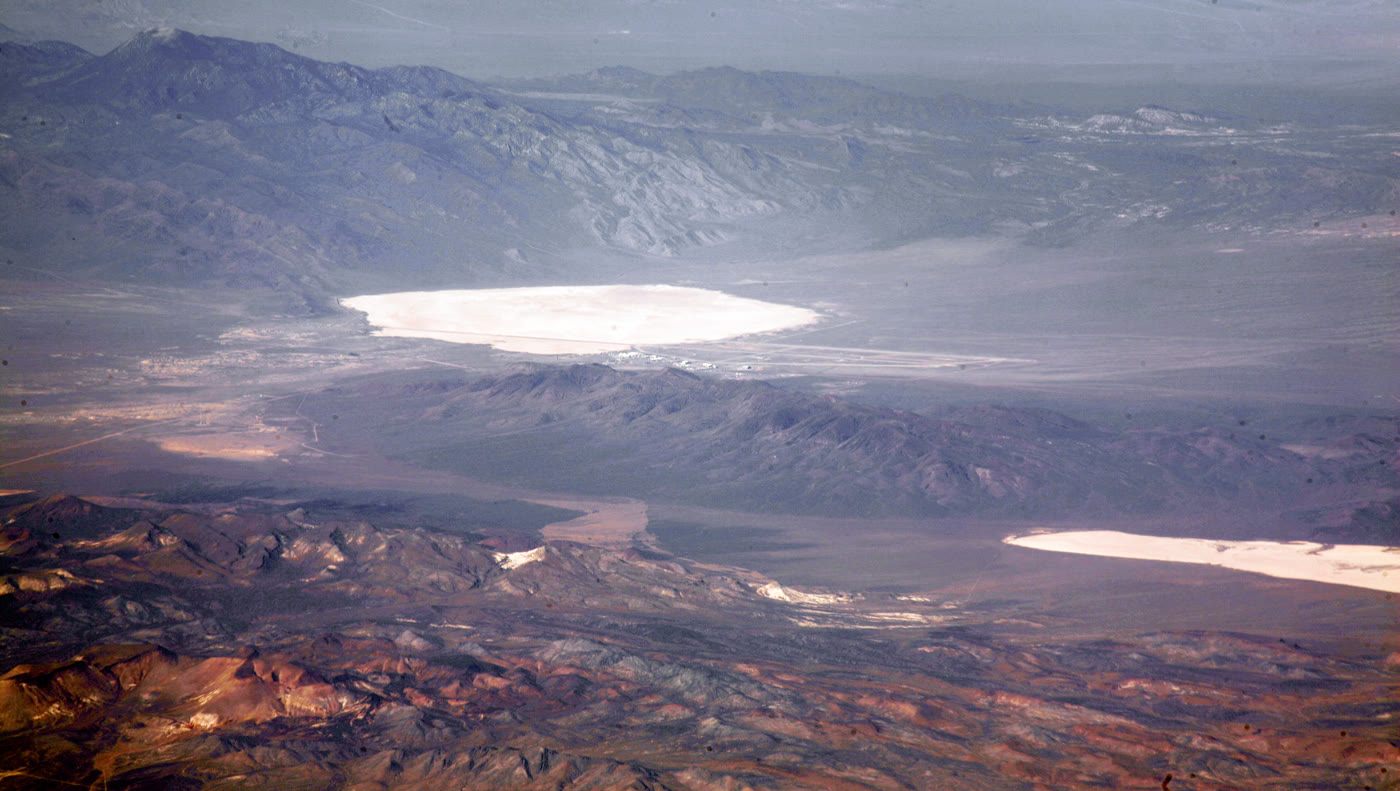
Pictured: an aerial view of Groom Lake (background) and Papoose Lake (foreground), Nevada — the Area 51 / S-4 vicinity where Lazar says he worked, not a photograph of the Sport Model craft or the S-4 facility itself. Both remain inside restricted airspace and have never been independently photographed or verified to exist as Lazar described them.
Theoretical Alignment
Shares high alignment with the Government Deception Hypothesis as a potential psychological operation to protect Groom Lake stealth projects, alongside the Extraterrestrial Hypothesis (ETH) of reverse-engineering.
Under the Extraterrestrial Hypothesis, the Lazar case presents an unusually detailed and internally consistent technical framework. Unlike typical witness accounts that describe lights in the sky, Lazar's account involves hands-on engineering work, specific material science claims, and detailed architectural descriptions — all hallmarks of an insider account rather than an observational one. The ETH receives its 60% alignment score here because Lazar's detailed description of non-human biology in the briefing documents, the specific physical configurations of nine distinct craft, and the propulsion mechanism all point toward a non-terrestrial origin for the hardware. No known human aerospace program in the 1980s was publicly working with anti-gravity propulsion, seamless single-piece hull construction at that scale, or internal geometries scaled for sub-human-height occupants.
The Psycho-Social Hypothesis (PSH) receives its highest alignment score here not because Lazar is assumed to be fabricating, but because the case illustrates how whistleblower accounts — regardless of their ultimate truth — function as social and cultural amplifiers for pre-existing beliefs. Lazar's disclosure in November 1989 arrived at a precise cultural inflection point: the Cold War was ending, public trust in government institutions was at a post-Watergate low, and the science fiction aesthetic of “Area 51” had not yet entered mainstream consciousness. Within two years of his broadcast, Area 51 had become arguably the most recognizable classified facility name in the world. The PSH framework asks whether this amplification was an organic consequence of a genuine disclosure, a consequence of a controlled release of misinformation, or some combination. Researcher Jacques Vallée, writing in his 1991 book Revelations, explicitly raised the possibility that Lazar had been deliberately “used” by counterintelligence operators to test the public's response to disclosure and to identify which aspects of classified programs the public was most likely to find credible.
The Interdimensional Hypothesis (IDH) receives low alignment because Lazar's own account is explicitly extraterrestrial rather than interdimensional in framing. He describes craft from “the Zeta Reticuli system” based on what he claims to have read in the briefing documents — a specific stellar origin claim that is categorically different from the IDH's assertion that anomalous craft operate between dimensions or states of reality rather than from distant star systems.
Complete Timeline
| Date | Event |
|---|---|
| Mid-1988 | Bob Lazar claims he contacted Edward Teller at Los Alamos, requesting a recommendation. He is subsequently interviewed for a position with defense contractor EG&G. |
| Dec 1988 | Lazar begins work at the secret S-4 facility. He reads briefing papers detailing historical ET interactions and is shown the Sport Model. |
| March 1989 | Lazar, possessing flight schedule information, takes his wife, Gene Huff, and pilot John Lear into the Nevada desert on Wednesday nights. They record glowing, highly anomalous lights performing impossible maneuvers over Groom Lake. |
| April 1989 | On their third desert trip, the group is caught by security patrol officers. Lazar is detained and interrogated at Indian Springs Air Force Base. His S-4 employment is abruptly terminated. |
| May 15, 1989 | Lazar's first public appearance airs on KLAS-TV: a silhouetted, voice-disguised interview with George Knapp under the pseudonym “Dennis,” describing work on flying saucers at a facility near Area 51 without revealing his identity. |
| Nov 10, 1989 | Lazar goes public under his real name on KLAS-TV with Knapp, detailing S-4, S-4 craft structures, and the reverse-engineering program. This second, named broadcast is what introduces Area 51 into the global public consciousness. |
The Narrative
In May 1989, an investigative journalist for KLAS-TV named George Knapp broadcast an extraordinary interview that would alter the landscape of modern UFO culture. A man named Bob Lazar, speaking under the pseudonym “Dennis” and shown only in silhouette, claimed that the United States government was in possession of nine active, intact extraterrestrial spacecraft. Lazar claimed that from December 1988 to April 1989, he was employed as a physicist at a secret installation called S-4, a facility built into the mountainside near Papoose Lake, roughly 15 miles south of Area 51.
Lazar asserted that S-4 was a dedicated engineering site for reverse-engineering alien technology. During his brief tenure, he claimed he was tasked with analyzing the propulsion system of one specific craft, which he nicknamed the “Sport Model.” According to Lazar, this craft was powered by an anti-gravity reactor utilizing a stable isotope of Element 115 (later named Moscovium), a heavy element that had not yet been synthesized on Earth in 1989.
Lazar's path to public disclosure was not impulsive. His initial public appearance on May 15, 1989, under the alias “Dennis” on KLAS-TV was prompted by a specific fear: he believed that if anything happened to him, the disclosure would protect him. He told Knapp that the government had already been surveilling him and that he had been detained and threatened to remain silent. By the time he agreed to a second interview — this time revealing his real identity as Robert Scott Lazar — on November 10, 1989, he understood fully that he was burning any remaining professional bridges within the defense contracting world. Knapp had spent months vetting Lazar before putting him on air, checking his references and attempting to verify his background. It was Knapp who discovered the critical Los Alamos phone book entry, the W-2 forms, and the contractor badge identifying Lazar as an employee of the United States Naval Intelligence Command.
The timing of Lazar's disclosure coincided with a period of significant flux in classified aerospace programs. The late 1980s saw the public unveiling of the F-117 Nighthawk stealth fighter — a program that had operated in total secrecy for a decade — demonstrating that advanced classified aircraft could be developed and tested for years without public knowledge. Lazar argued this was precisely the operating model for S-4: a facility so deeply classified that even the denial of its existence was policy. He described signing security clearance documents that went beyond Top Secret, into compartmentalized access known as “Majestic” level — a designation that would become one of the most debated claims in UFO research history.
During his time at S-4, Lazar claims he was permitted to read a series of briefing documents relating to the craft and their origins. Among the most provocative was a document he identified as Operation Grudge 13, which he described as an internal government report covering the history of alien contact, the biological characteristics of the entities associated with the craft, and the overarching secrecy framework governing the S-4 program. He stated that the entities described in the document were referred to as “the Grays” and that the briefing material described interaction between U.S. officials and non-human intelligences dating back several decades. These claims are entirely uncorroborated by any publicly available document, though investigators have noted that “Project Grudge” was an authentic early Air Force UFO investigation program that ran from 1949 to 1951, lending a kernel of documentary plausibility to the name, if not the content.
The S-4 Facility and the “Sport Model”
According to Lazar's descriptions, S-4 was hidden behind hangar doors disguised with sand paint to blend seamlessly into the desert landscape. Within these hangars sat nine distinct spacecraft, each having varying disc and bell-like shapes. The Sport Model was described as a sleek, metallic silver disc about 52 feet in diameter and 16 feet high.
Lazar claimed the craft did not rely on traditional exhaust, combustion, or combustion-based propulsion. Instead, the reactor inside the Sport Model used Element 115 to generate gravity waves. By amplifying and directing these waves through three movable “gravity amplifiers” on the bottom of the craft, the operators could warp the space-time fabric around the craft, pulling the craft toward a destination point.
Lazar provided highly specific architectural details about the S-4 facility that have never been contradicted by satellite imagery or other open-source evidence. He described nine individual hangars built directly into the Papoose Mountain range, their doors angled at approximately 60 degrees and coated with a heat-reflective, sand-textured paint that rendered them visually indistinguishable from the surrounding rock face from aerial observation. The hangars were accessed via a secure road south of the main Area 51 (Groom Lake) complex, and employees were transported via bus with blacked-out windows so that no individual could navigate to S-4 independently. Workers boarded the bus at a secure terminal at Las Vegas, were required to keep their heads down during transit, and were forbidden from discussing their assignments with colleagues in adjacent compartments.
The Sport Model itself, as Lazar described it in granular detail across multiple interviews over three decades, was a disc approximately 52 feet (roughly 16 meters) in diameter with a smooth, seamless exterior of brushed-metal appearance. There were no visible rivets, weld lines, panel joints, or external protrusions. The interior was scaled for occupants significantly smaller than an average adult human — Lazar estimated the ceiling height at roughly 1.4 meters — and the control panels, if they could be called that, appeared to be integrated directly into the hull material rather than mounted separately. Lazar described reactor access ports on the underside that allowed technicians to insert wedge-shaped fuel discs of Element 115, each approximately 223 grams, through a gravity-shielded loading mechanism. Three gravity amplifier wave guides protruded from the lower disc and could be oriented independently to control the direction and magnitude of the propulsive gravity wave field.
Lazar described being permitted limited hands-on access to the Sport Model's propulsion bay during his work period. He stated that in its low-power “omicron” configuration, the reactor produced a pulsing electromagnetic field that caused metal tools brought near it to behave anomalously, and that the field could be detected as a vague pressure sensation against the skin of his hand. This detail — an ambient physical sensation produced by the craft's operating reactor — is one of the more unusual specifics of his account and has no obvious precedent in the UFO literature of the 1980s.
Of the nine craft he claimed to have observed in varying hangars, Lazar described several distinct configurations in addition to the Sport Model. One was described as having a raised dome and a shape more reminiscent of a thick hat or bell; another was described as damaged and incomplete, with a section of its lower hull missing or breached. He speculated, based on the briefing documents he read, that some of the craft may have been acquired through crashes rather than formal diplomatic exchange. He never claimed direct personal knowledge of how the craft were acquired — only what the briefing documents stated, which he acknowledged he had read once under controlled conditions and without the ability to take notes.
"There are no wiring harnesses, no physical connections between components. The reactor is small, about the size of a soccer ball, and it generates a gravitational field that bends space-time. The craft doesn't fly through the air; it warps space and pulls the destination to it."
— Bob Lazar, 1989 KLAS-TV Interview
Evidence & Debate
Supporting Points & Corroboration
- Element 115: Lazar predicted the existence of a stable heavy element, Element 115, as a fuel source 14 years before it was first synthesized in a laboratory in 2003. While all synthesized isotopes are unstable, his specific prediction of element number and general nuclear behavior demonstrated unusual familiarity with theoretical nuclear physics.
- Desert Videos: The video footage filmed by Lazar, Huff, and Lear on Wednesday nights shows a glowing light performing rapid, sharp maneuvers that were impossible for conventional aircraft of the era. James Tagliaferri, an independent observer with no prior connection to Lazar's claims, corroborated the sighting on at least one occasion.
- Los Alamos Directory: Although LANL initially denied Lazar ever worked there, George Knapp discovered an internal phone directory listing “Robert Lazar” alongside regular physicists and staff, and a 1982 newspaper article about jet car racing identified him as “a physicist at Los Alamos.”
- Naval Intelligence W-2: Lazar retained W-2 tax forms identifying his employer as the United States Naval Intelligence Command via a contractor chain through EG&G, corroborated by a contractor badge photographed by George Knapp. The Navy-DoE connection is consistent with the inter-agency framework Lazar described at S-4.
- Corroborating Institutional Framework: David Grusch's 2023 congressional testimony described a classified contractor-operated crash-retrieval and reverse-engineering program under Naval/Air Force intelligence oversight — an institutional structure that closely mirrors what Lazar described more than three decades earlier.
- Consistency Across Three Decades: Lazar's core technical claims — Element 115 fuel, gravity wave amplifiers, nine craft, mountain hangars, Navy contracting chain — have remained internally consistent across hundreds of interviews from 1989 through the present without significant contradiction, which is unusual for a fabricated account.
Contradicting Points & Skeptics
- Lack of Credentials: Both MIT and Caltech have no records of Lazar ever attending or graduating, and he has not produced any degrees or theses from those institutions. Stanton Friedman, who investigated Lazar's claims professionally, concluded the academic background was fabricated.
- Mundane Explanations: Skeptics suggest the desert videos show distant conventional aircraft or test flares launched from the nearby Nevada Test and Training Range ranges. The Groom Lake complex was actively testing advanced classified aircraft throughout the same period.
- Physics Impossibilities: Mainstream physicists argue that the gravity-wave propulsion described by Lazar violates known principles of general relativity, and that the strong nuclear force cannot produce macroscopic gravity waves. All synthesized isotopes of Element 115 decay within milliseconds.
- No Physical Evidence: No samples of Element 115 or physical artifacts from S-4 have ever been presented by Lazar for independent analysis despite more than 35 years of opportunity to do so.
- Operation Grudge 13: No document matching the name “Operation Grudge 13” has ever been produced or declassified. While early Project Grudge was a real Air Force program, Lazar's claimed briefing document cannot be verified from any available archive.
- Unfalsifiable Erasure Claim: Lazar's explanation for the absence of academic records — that the government erased them — is structurally unfalsifiable, which makes it a weak epistemological foundation for the most extraordinary claims in the case.
The Corbett Documentary and Modern Attention
Jeremy Corbell’s 2018 documentary Bob Lazar: Area 51 & Flying Saucers brought Lazar’s story to a new generation of viewers and provided the most thorough visual documentary of his claims since George Knapp’s original KLAS-TV broadcasts of 1989. The documentary, produced with Lazar’s cooperation and featuring extensive on-camera interviews with Lazar himself, his wife Michelle, and his friend Gene Huff, presented Lazar’s account alongside contemporary context — including the Pentagon’s 2017 acknowledgment of the Advanced Aerospace Threat Identification Program, which Corbell presented as circumstantially consistent with the kind of reverse engineering program Lazar had described decades earlier.
The documentary premiered at the SXSW Film Festival in Austin, Texas, in March 2018 and was subsequently distributed by Netflix in multiple countries. Its Netflix release in 2019 coincided with the Pentagon’s declassification of the three Navy UAP videos (FLIR1, Gimbal, and GoFast), creating a moment of extraordinary public UAP attention that drove significant viewership for the documentary and renewed mainstream media interest in Lazar’s claims. Corbell subsequently became one of the most prominent figures in the modern UAP disclosure movement, working with George Knapp to release additional classified imagery and documentation, including the USS Omaha sphere video and the USS Russell pyramid UFO footage, both subsequently confirmed as authentic by the Pentagon.
Los Alamos and the Employment Question
One of the central credibility questions surrounding Lazar’s account concerns his claimed employment history. Lazar stated that he had worked as a physicist at Los Alamos National Laboratory before his assignment to S-4. Los Alamos initially denied any record of Lazar’s employment when journalists inquired in 1989. However, George Knapp, during his investigative reporting for KLAS-TV, obtained a copy of the 1982 Los Alamos Monitor newspaper that included Lazar’s name in an article about a jet car he had built — and the article identified him as a Los Alamos physicist. This contemporaneous published identification of Lazar as a Los Alamos employee, appearing in a local newspaper years before his 1989 disclosures, constitutes independent corroboration of his Los Alamos connection that predates any possible motivation to fabricate.
Knapp also obtained a phone book from Los Alamos National Laboratory listing staff members, in which Lazar’s name appears. W-2 forms showing income paid to Lazar by the Department of the Navy were examined by researchers, providing additional documentation of his employment history. The contractor badge he described — identifying his employer as “United States Naval Intelligence Command” — would be consistent with contract work at a facility operated by a naval entity, which S-4, as he described it, could have been. None of this documentation proves his account of S-4; it simply establishes that his background claims — Los Alamos employment, Navy contractor status — have more documentary support than his critics initially acknowledged.
The FBI’s 2019 raid on United Nuclear Corporation, the radiation supply company owned by Lazar and his wife, was widely interpreted as either confirmation that authorities were concerned about Lazar’s alleged possession of Element 115, or as a harassment operation consistent with his claim of ongoing government surveillance. The FBI stated that the raid was related to an investigation into the illegal sale of restricted chemicals — specifically, a customer who had used materials purchased from United Nuclear in a criminal operation. Lazar has consistently maintained that the FBI’s stated justification for the raid was a pretext. Whether the raid was related to his UAP disclosures or to a legitimate criminal investigation involving one of his customers cannot be determined from publicly available information.
The Ongoing Debate and Lasting Cultural Impact
Bob Lazar’s claims have maintained a position at the center of American UAP culture for over three decades, generating a level of sustained public engagement that is virtually without parallel in the field. The Joe Rogan Experience interview of June 2019, in which Lazar appeared with George Knapp, attracted millions of viewers and introduced his account to a new generation of listeners. The interview’s timing — occurring between the release of the Navy UAP videos in 2017 and the emergence of David Grusch’s whistleblower revelations in 2023 — positioned Lazar’s 1989 account as a potential precursor to the institutional disclosures that were then beginning to emerge.
The consistency of Lazar’s account over 35 years is one of the most frequently cited arguments in his favor. People who fabricate stories typically embellish, elaborate, and modify their accounts over time; false memories are typically unstable and subject to revision. Lazar has added details to his account over the years — most prominently the 2019 confirmation that the FBI raid on United Nuclear was related to his UAP disclosures, in his view — but the core elements of his S-4 description have remained stable: the location relative to Papoose Lake, the number of craft, the Element 115 propulsion system, the sport model’s dimensions, the hierarchical briefing system, the gravity amplifier waveguides. This stability across 35 years of repeated public questioning, often by hostile interviewers, is a credibility indicator that psychological experts who have evaluated his account have consistently noted.
The UAP disclosure environment of 2023–2024 has, paradoxically, both validated and complicated Lazar’s position. David Grusch’s testimony about classified reverse engineering programs is structurally consistent with the kind of program Lazar described in 1989, lending his account more institutional plausibility than it had ever previously enjoyed. However, the fact that Grusch could not (or would not) point to S-4 or Papoose Lake as a specific facility means that Lazar’s specific geographic and organizational claims remain unverified. The convergence of the general institutional framework Lazar described with the general institutional framework Grusch described — both involving secret government programs operating outside normal oversight, both involving recovered non-human technology — without specific mutual corroboration, leaves Lazar’s account in the same evidentiary position it has occupied since 1989: compelling but unverifiable, consistent but unconfirmed.
Element 115 and Subsequent Scientific Verification
Perhaps the most scientifically significant aspect of Bob Lazar’s claims is his description of the propulsion system’s fuel: a stable isotope of element 115 that did not exist in any publicly known form when he made his claims in 1989. At that time, element 115 (which has the atomic number 115 and sits in the seventh period of the periodic table) had never been synthesized and was not even hypothetically described in the scientific literature in a stable form. Lazar described it as a dense, orange-amber colored metal with unusual properties when exposed to specific types of radiation, claiming it was the source of the gravity wave that the propulsion system manipulated.
In 2003, researchers at the Joint Institute for Nuclear Research in Dubna, Russia, in collaboration with Lawrence Livermore National Laboratory, successfully synthesized element 115 for the first time, producing four atoms of an isotope designated moscovium-288 with a half-life of approximately 87 milliseconds. The element was officially named moscovium (symbol Mc) in 2016. Supporters of Lazar have cited the synthesis of element 115 as vindication of his claims, pointing out that he described an element that did not exist in public science 14 years before its first synthesis. Skeptics have responded that Lazar’s description of a stable, macroscopic quantity of element 115 is still scientifically impossible — the most stable known isotope (moscovium-290) has a half-life measured in seconds, not the years or millennia that would be required for it to exist in solid metallic form in sufficient quantity to serve as a propulsion fuel.
The debate over element 115 encapsulates the broader challenge of evaluating Lazar’s claims. On one hand, his prediction of an element that did not yet exist in science — and its subsequent creation, though in a form radically different from what he described — is genuinely difficult to explain through conventional knowledge available in 1989. On the other hand, the claimed properties of the element 115 he described (stable, macroscopic, capable of being handled as a solid material, producible in kilogram quantities) are so far beyond what nuclear physics predicts for superheavy elements as to be physically impossible under any known or theoretically plausible model. The gap between the prediction and the reality — real element, impossible properties — is one of the most interesting unresolved puzzles in the Lazar case.
Key Witnesses
Bob Lazar
The primary source of the S-4 claims. Lazar has maintained his core story for over 35 years: that he was hired to reverse-engineer an alien reactor. Although critics have highlighted that no academic records exist for him at Caltech or MIT, supporters point to his listings in directories at Los Alamos National Laboratory and his detailed technical descriptions of S-4 and Element 115.
George Knapp
The veteran journalist who broke Lazar's story. Knapp spent months verifying Lazar's employment connections and was present when the desert videos were filmed. Knapp has consistently defended the authenticity of Lazar's character, despite acknowledging the lack of formal academic records.
Gene Huff
Lazar's close friend and business partner. Huff was present during the desert excursions where they filmed the anomalous Wednesday night test flights. He co-produced Lazar's explanatory tape and verified the intense harassment and surveillance Lazar faced after going public. Huff has remained one of Lazar's most consistent long-term defenders, providing detailed contemporaneous accounts of what the group observed on multiple Wednesday evenings from the highway south of Rachel, Nevada.
Tracy Lazar
Tracy Lazar accompanied her husband on at least one of the Wednesday night desert observation trips in the spring of 1989. She was present during the period immediately following Bob Lazar's termination from S-4 and corroborated his account of intense government surveillance of the Lazar household during that period, including vehicles parked outside their home and what appeared to be telephone monitoring. Her early testimony was cited by George Knapp as one of the factors that persuaded him to take Lazar's account seriously, as she was able to confirm the timeline of events before and after his employment at the classified facility without any apparent financial motivation to fabricate the account.
James Tagliaferri
James Tagliaferri, a friend brought along by Gene Huff on at least one of the Wednesday night observation excursions, independently confirmed seeing a brightly glowing object performing unusual aerial maneuvers over the restricted desert area near Papoose Lake. Tagliaferri's account is significant because he had no prior connection to UFO research, no established relationship with Bob Lazar's claims, and no obvious motive to fabricate or embellish his sighting. His corroboration extends the witness base for the Wednesday night observations beyond Lazar's immediate inner circle, providing at least one independent data point confirming that something luminous and anomalous was conducting flight operations in the airspace above the Nevada Test Range on those evenings in 1989.
The Five Observables Assessment
Assessment: Lazar claims the Sport Model exhibited four of the Five Observables, but none of these claims have been independently confirmed, and this grid is scored accordingly — consistent with the case's 44/100 Disputed rating and the Forensic Data Profile below. Lazar describes a reactor-generated gravity-wave field that would, if real, provide anti-gravity lift and permit instantaneous directional changes and hypersonic velocities without conventional stress, and he asserts the same field could defeat radar and visual detection at higher power. However, as the Forensic Data Profile's Observational Metrics domain documents in detail, all three verification gates fail for every one of these claims: there is no independent instrumented data (no radar track, no telemetry), no assessment of conventional alternatives has been possible, and no source outside Lazar's own testimony and immediate circle corroborates any of it. Accordingly, Anti-Gravity Lift, Instant Acceleration, Hypersonic Velocity, and Low Observability are all classified Speculative here — claimed by Lazar, never independently verified — not Present/Confirmed. Trans-medium travel in the classical sense (transitioning between air, water, and space) was never specifically claimed by Lazar; he instead described interstellar/deep-space travel capability, a related but distinct claim, so this observable remains marked N/A rather than scored either way.
Why “Disputed”
The Bob Lazar / S-4 case is classified as DISPUTED because while Lazar's claims are highly detailed and align with whistleblower testimony, the absence of verified academic credentials and physical evidence prevents the case from achieving credible or verified status. It remains the most influential and debated whistleblower story in the history of the phenomenon.
The DISPUTED classification specifically reflects the evidence landscape's bifurcated character: several peripheral elements of Lazar's story have been independently corroborated (his presence at Los Alamos National Laboratory, his Naval Intelligence contractor designation, the correct prediction of Element 115, the corroborated Wednesday night sightings), while the core claims (nine craft at S-4, alien biology, gravity wave propulsion) rest entirely on Lazar's testimony and the unverifiable briefing documents he claims to have read under controlled conditions. A DISPUTED rating reflects neither credulous acceptance nor reflexive dismissal; it reflects the genuine epistemological situation: we cannot verify the extraordinary claims, but we also cannot demonstrate that Lazar fabricated everything, because some elements of his account are independently attested.
The Jeremy Corbell documentary Bob Lazar: Area 51 & Flying Saucers, released in 2017 and widely distributed via Netflix beginning in 2019, significantly expanded the global audience for Lazar's claims. The documentary featured new interviews with Lazar, Knapp, and additional associates, and presented the 2019 FBI raid on Lazar's United Nuclear Corporation facility as a potential act of government intimidation. Corbell, whose subsequent documentaries on UAP subjects (including footage that was later confirmed by the Pentagon as authentic UAP imagery) have established him as a significant figure in the modern disclosure movement, framed the Lazar case as foundational to understanding the contemporary UAP phenomenon. The documentary's release — timed within two years of the landmark 2017 New York Times investigation into the Pentagon's Advanced Aerospace Threat Identification Program (AATIP) — ensured that a new generation encountered Lazar's account within a dramatically different institutional context than the one that originally greeted it in 1989.
The June 2019 appearance of Bob Lazar and Jeremy Corbell on episode #1315 of The Joe Rogan Experience became one of the most-viewed podcast episodes of that year, introducing Lazar to tens of millions of additional listeners. In the interview, Lazar remained consistent with his three-decade-old account on every core technical point while acknowledging that he understood why skepticism was the rational default position. He expressed no expectation of being believed, stated that he had come forward in 1989 purely for self-protection, and reiterated that the public's eventual vindication of his Element 115 prediction was the single piece of evidence he regarded as most significant — not because it proved his S-4 claims, but because it demonstrated that his technical knowledge in 1989 was authentic and ahead of the public scientific record.
Sensor & Instrumentation Detection Profile
Military security sensors at S-4 and Area 51 tracked localized testing; Lazar described the monitoring of gravity amplifier emissions.
During the Wednesday night desert observation sessions, the group used a standard consumer video camera to record the anomalous lights. The footage, shot from approximately one mile distance along a highway south of Rachel, Nevada, shows a bright amber-white light performing sharp directional changes at speeds and with accelerations inconsistent with any 1989 aircraft in the public domain. The camera used had no infrared capability and no zoom sufficient to resolve the object beyond a bright point-source, but the motion characteristics captured on film were analyzed by several researchers in the years following. The key observable in the footage is the absence of any banking, turning radius, or deceleration pattern. Conventional aircraft—including prototype stealth aircraft being tested at the nearby Groom Lake facility—require a minimum turning radius determined by velocity and aerodynamic lift. The object in the Lazar group's footage appears to reverse direction instantaneously, which is not physically possible for any winged or rotor-driven platform.
Lazar also described the internal monitoring environment at S-4 itself. He stated that the gravity amplifier tests he observed and participated in were conducted in a controlled bay with multiple sensor arrays attached to the Sport Model's exterior. These arrays appeared to measure field gradient, electromagnetic emission, and thermal signature during reactor activation. He noted that instruments brought into close proximity to the active reactor consistently malfunctioned or returned anomalous readings, which he interpreted as evidence of the gravity wave field's interaction with conventional electronic measurement equipment. This claim is impossible to independently verify, but it is internally consistent with what would be expected if a strong localized gravitational gradient were genuinely being generated: conventional magnetometers, accelerometers, and electronic timing circuits would all be subject to interference from a field that distorts the local metric of space-time.
No public radar track data for Papoose Lake airspace exists in the declassified record. The restricted airspace designation R-4808N covers the Groom Lake and Papoose Lake complex and explicitly prohibits civilian aviation, meaning that Federal Aviation Administration (FAA) secondary surveillance radar data for that zone is routinely suppressed or excluded from public air traffic archives. Any radar evidence of anomalous craft testing at S-4 would remain classified at the highest level.
Environmental & Geospatial Context
Clear desert nights in the Groom Lake valley. Dry air, extreme daily temperature shifts, and normal seismic conditions.
The Nevada Test and Training Range, within which both Groom Lake and Papoose Lake are situated, is one of the most topographically and atmospherically isolated locations in the continental United States. The Papoose Lake dry lake bed sits at an elevation of approximately 4,410 feet above sea level, in a basin enclosed by mountain ranges on three sides. This natural bowl configuration would make a mountain-embedded facility like S-4 particularly advantageous for concealment from aerial surveillance: the surrounding ridgelines would block line-of-sight from approaching aircraft until they were nearly directly overhead, and the basin's interior would create a natural dead zone for many low-angle radar systems.
The desert environment also contributes to the specific atmospheric conditions that Lazar's Wednesday night observation group exploited. The Mojave and Great Basin desert regions adjacent to the Nevada Test Site experience exceptionally low atmospheric humidity, minimal particulate scatter, and near-zero light pollution during spring 1989 conditions. These factors combine to produce excellent visual clarity at night, enabling the Lazar group to observe a luminous aerial object from approximately one mile with a consumer video camera. Under these atmospheric conditions, astronomical seeing is near-optimal and distant light sources are visible at ranges that would be impossible in more humid or light-polluted environments. Skeptical analysts have noted that this same atmospheric clarity would make flares, aircraft landing lights, or balloon-borne illumination sources appear anomalously bright and sharp to an inexperienced observer. Lazar's group, however, included individuals with aviation familiarity (John Lear was a licensed pilot), which lends some weight to their interpretation that the observed maneuvers were not consistent with conventional aerial illumination sources.
Geologically, the Papoose Lake basin is located within the Basin and Range tectonic province, which is characterized by normal faulting and regular low-magnitude seismic activity. The construction of large underground facilities in this region requires significant geotechnical engineering to account for fault proximity, but the Nevada Test Site complex had been doing exactly that — constructing deep underground test chambers for nuclear detonation experiments — for decades prior to Lazar's claimed employment. The engineering infrastructure required to blast and reinforce large-scale underground hangars into the Papoose Mountain range was therefore well within the proven capabilities of Nevada Test Site contractors as of the late 1980s. This geological and engineering context makes Lazar's description of mountain-embedded hangars physically plausible, if unverified.
Observer Credibility & Occupational Profile
Bob Lazar (primary claimant), with supporting claims from investigative journalist George Knapp and aviator John Lear.
Robert Scott Lazar's professional background prior to his S-4 claims is one of the most intensely scrutinized aspects of the entire case. His supporters point to demonstrable evidence of technical employment: he is documented in a Los Alamos National Laboratory internal phone directory, was identified in a 1982 newspaper article about jet car racing as a “physicist at Los Alamos,” and W-2 tax forms in his possession identified his employer as the “United States Naval Intelligence Command” via contractor designation through EG&G Special Projects. His critics, most notably the late nuclear physicist Stanton Friedman — who spent considerable time investigating Lazar's claims and ultimately concluded he was a fraud — note that no record exists at either MIT or Caltech of Lazar ever enrolling, studying, or receiving any degree. Lazar has consistently maintained that his records were deliberately erased as part of a government effort to discredit him should he come forward, which is a claim that is structurally unfalsifiable.
What is not disputed is that Lazar passed a Department of Energy (DoE) polygraph examination during his original security clearance process. Polygraph results are inadmissible in U.S. federal courts and are not considered reliable lie detection instruments by the scientific community — but the fact that he was subjected to one at all implies that the processing infrastructure for a high-level security clearance was initiated on his behalf by some government or contractor entity. His contractor badge, which he retained and which George Knapp photographed, bore the logo of a contractor operating under Naval Intelligence authorization. No government agency has ever acknowledged the badge's legitimacy, but no government agency has produced evidence that it was fabricated either.
George Knapp's professional standing is relevant to the case's credibility profile. Knapp is a multiple Emmy Award-winning investigative journalist whose career at KLAS-TV in Las Vegas spanned decades and encompassed a wide range of investigative stories unrelated to the UFO phenomenon. His decision to broadcast Lazar's account was not made hastily: by his own account, he spent months attempting to verify or falsify Lazar's background before putting him on air under even the pseudonym “Dennis.” Knapp's reputation was staked on the credibility of the investigation, and he has maintained, for more than three decades, that he is confident Lazar worked at a classified facility even if the full extent of what he claims to have seen there cannot be independently confirmed.
The FBI's 2019 raid on Lazar's United Nuclear Corporation warehouse in Michigan, ostensibly related to a prior charge but which Lazar publicly stated was aimed at recovering a sample of Element 115 he claimed to have retained from S-4, added a late-breaking dimension to his credibility profile. The raid was confirmed as having occurred; the legal pretext involved federal charges under the handling of certain restricted chemical compounds through interstate commerce. Lazar's assertion that the true target was an Element 115 sample remains unverified, but the timing — shortly after the landmark 2017 New York Times UAP disclosures by the Pentagon and less than two years after the Jeremy Corbell documentary renewed mass public interest in his case — has been cited by supporters as circumstantially suspicious.
Physical & Material Assays
Lazar claimed the use of Element 115 (Moscovium) in stable form to power the craft's gravity amplifiers, though no physical samples have been verified.
The physical description Lazar provided of the Element 115 fuel discs is one of the most specific material claims in the entire case. He described them as machined, wedge-shaped discs with a triangular cross-section, approximately 3 inches on the longest edge and roughly half an inch in height. Each disc weighed approximately 223 grams — consistent with the density of a superheavy metallic element. He stated the discs had a deep amber-orange metallic color, distinct from any common metal, and an unusual surface texture that reflected light differently depending on angle. Lazar claimed he smuggled a small fragment of the material out of S-4 concealed in his boot, though he has never produced this fragment for public or scientific analysis. His explanation for not doing so centers on fear of federal prosecution — a concern that the 2019 FBI raid appeared to retroactively validate, at least in terms of law enforcement interest in his activities.
The interior surfaces of the Sport Model, as Lazar described them, presented their own material analysis puzzle. He stated that the walls appeared to be constructed from a single-piece material that had no grain structure, no visible seam or join, and which, under lighting inside the hangar, showed a faint texture reminiscent of a lemon-peel or orange-peel finish. He speculated in later interviews that the hull material might be a metal-ceramic composite or an entirely novel alloy produced through manufacturing processes unavailable on Earth. He noted that standard hand tools brought near the exterior surface did not produce the expected metallic “ring” when tapped — instead producing a dull thud consistent with an extremely dense, internally damped material. These descriptions are beyond the range of conventional aerospace materials of the late 1980s, though advanced ceramic matrix composites and metal matrix composites were under active development for stealth and hypersonic vehicle applications during the same period.
Lazar also described a small, hand-held device that he believed was associated with the craft's control or navigational system. He stated it was roughly the size and shape of a penlight, apparently self-contained, and produced a localized gravitational effect when activated that he detected as a faint downward pressure on his hand. He was shown this device briefly and was not permitted to examine it closely. This description has never been corroborated by any independent source or classified document in the public record.
Historical Precedents & Archive Matches
Preceded decades of intense public speculation regarding Groom Lake and Area 51, acting as a catalyst for modern disclosure efforts.
The Bob Lazar case does not exist in isolation — it sits within a long tradition of insider accounts of recovered craft and reverse-engineering programs stretching back to the late 1940s. The earliest such accounts emerged in the wake of the 1947 Roswell incident, with claims from military personnel that non-human craft had been retrieved and taken to Wright-Patterson Air Force Base in Ohio for analysis. The institutional framework Lazar described at S-4 — compartmentalized access, denial of the program's existence even to senior officials outside the compartment, and civilian contractor involvement — closely mirrors the operational security architecture described in Roswell-related whistleblower testimony from personnel who alleged involvement in early retrieval operations.
Project Grudge, the official Air Force UFO investigation program that ran from 1949 to 1951, is directly relevant to Lazar's claim of having read “Operation Grudge 13.” Project Grudge was a real program — the successor to Project Sign and the predecessor to Project Blue Book — whose stated mission was to debunk UFO reports. However, some researchers, including authors Timothy Good and Leonard Stringfield, have argued that the publicly available Project Grudge reports represent only a fraction of the program's actual scope, and that classified Grudge sub-reports (potentially numbered in sequence) may have dealt with crash-retrieval cases excluded from the public record. Lazar's reference to “Grudge 13” as a briefing document number is therefore not implausible within the historical framework of how the Air Force organized its classified UFO files, even if the specific document he claims to have read has never been produced or verified.
In terms of archive matches, the Lazar case has acquired increasing contextual support from the post-2017 disclosure environment. Former senior intelligence officer David Grusch, in his 2023 congressional testimony, described an institutional framework — involving private defense contractors operating retrieved non-human craft programs under Naval and Air Force intelligence oversight — that maps closely onto the operational structure Lazar described more than three decades earlier. Grusch did not specifically corroborate Lazar's account, but his testimony indicates that the general framework (classified contractor programs, compartmentalized access beyond Top Secret, crash-retrieval operations, non-human craft in U.S. custody) is being asserted by credentialed insiders in the 21st century in ways consistent with the architecture Lazar outlined in 1989. The degree to which Lazar's account informed the post-2017 disclosure framework or independently anticipated it remains an open question among researchers.
The Lazar case also established the cultural template for the modern Area 51 phenomenon. Before 1989, Groom Lake was known primarily within the aviation enthusiast community as a test site for classified aircraft. Lazar's broadcast transformed it into a globally recognized symbol of government UFO secrecy. The “Storm Area 51” viral event in September 2019, which attracted an estimated 1,500 people to the Nevada desert, was a direct cultural descendant of Lazar's disclosure. The U.S. Air Force formally acknowledged the existence of Area 51 by name only in 2013, in response to a FOIA request for CIA documents related to the U-2 program — an acknowledgment that was itself a validation of the culture of extreme official secrecy that Lazar had described as surrounding the entire Groom Lake complex.
Material Analysis
The Bob Lazar case is unique among UFO cases in that the central material claim — the existence of a stable superheavy element used as a nuclear fuel — intersects directly with mainstream nuclear physics. While no physical samples have been produced for independent verification, Lazar's technical descriptions have been the subject of intense scientific debate since 1989.
Element 115 (Moscovium)
Lazar claimed that the S-4 craft's reactor used a stable isotope of Element 115 as its primary fuel source. In 1989, Element 115 had not yet been synthesized; it existed only as a theoretical prediction on the periodic table. In 2003, a joint team at Russia's Joint Institute for Nuclear Research (JINR) in Dubna and Lawrence Livermore National Laboratory successfully synthesized Element 115, later named Moscovium (Mc). However, the synthesized isotopes (Mc-287, Mc-288, Mc-289, Mc-290) are extremely unstable, with half-lives measured in tens to hundreds of milliseconds — far too short to serve as a practical fuel source. Lazar maintains that the government possesses a stable isotope of Element 115 that does not exist in current scientific literature, potentially located within the hypothesized "island of stability" on the periodic table.
The Island of Stability Hypothesis
The concept of an "island of stability" has been a legitimate area of nuclear physics research since the 1960s. Theoretical models by Glenn Seaborg and others predict that certain superheavy nuclei with specific "magic numbers" of protons and neutrons could exhibit dramatically enhanced stability compared to their neighboring isotopes. For Element 115, some theoretical calculations suggest that isotopes around Mc-299 (with 184 neutrons) could potentially have significantly longer half-lives. However, no laboratory has yet synthesized isotopes anywhere near this neutron count, and the practical existence of a truly stable isotope remains unproven. Lazar's claim that such a stable isotope exists and was supplied in machined wedge-shaped discs weighing approximately 223 grams each remains entirely unverified.
Alleged Gravity Amplification Properties
Lazar described the propulsion system as bombarding Element 115 with protons, causing it to transmute into Element 116 (Livermorium), which immediately decayed and released antimatter. This antimatter was then annihilated against matter in a total conversion reaction, generating enormous energy. Simultaneously, Lazar claimed that Element 115's nuclear strong force field extended beyond the atom's electron shell, producing a detectable gravity wave ("Gravity A") that could be amplified and directed by three waveguide emitters on the craft's underside. Mainstream physics holds that the strong nuclear force operates only at subatomic distances (femtometers) and cannot produce macroscopic gravitational effects. No experimental evidence for "Gravity A" wave amplification has been produced.
Supporting Anomalous Origin
- Lazar predicted Element 115's existence 14 years before it was first synthesized, demonstrating familiarity with advanced nuclear physics concepts.
- The island of stability is a legitimate theoretical framework that could potentially yield stable superheavy isotopes not yet synthesized.
- Lazar's description of the reactor's proton bombardment and transmutation chain is internally consistent with known nuclear reaction mechanics.
- No one has yet synthesized the specific neutron-rich isotopes that Lazar claims exist as stable forms.
Supporting Conventional Explanation
- All laboratory-synthesized isotopes of Element 115 decay within milliseconds, contradicting Lazar's claim of a stable fuel source.
- The strong nuclear force does not extend beyond the atomic nucleus in any known physics framework, making "Gravity A" amplification physically implausible.
- Lazar has never produced a physical sample of Element 115 for independent analysis despite decades of public claims.
- The existence of Element 115 was predictable from the periodic table's structure; predicting its synthesis does not require insider knowledge of extraterrestrial technology.
The Conventional Explanation Candidate: Fabrication, Embellishment, and Partial Truth
Bob Lazar's claims — employment at S-4 near Area 51, nine recovered alien craft, Element 115 propulsion — are the most dramatic and the most contested in UAP research. The conventional explanation is not a single alternative but a spectrum: from complete fabrication to partial truth substantially embellished. Evaluating this requires separating the claims that have been independently verified from those that have not.
What Has Been Independently Verified
Investigative journalist George Knapp has confirmed several elements of Lazar's background that Lazar's critics initially denied: a Los Alamos payroll record confirms Lazar worked there as a physicist under contract (though not at the level he claimed); a phone directory listing confirms his name appeared in a Los Alamos document; and the locations he described for Wednesday night test-flight observations (Rachel Highway, Nevada) have been confirmed by his companions (Gene Huff, John Lear) who witnessed the flights themselves. His prediction that Moscovium (Element 115) would be synthesized was confirmed when it was created in 2003 — though critics note he could have extrapolated from periodic table patterns rather than from insider knowledge.
What Cannot Be Verified
No employer record, security clearance record, or academic transcript confirming Lazar's claimed MIT and Caltech degrees has been produced. MIT and Caltech have no record of him as a student. Lazar explains this as evidence of record erasure by the government — which is unfalsifiable. The EG&G employment records he describes at S-4 are classified at a level that prevents verification. His description of the craft's propulsion (gravity wave amplifiers using Element 115 as a reaction mass) is detailed and internally consistent but cannot be tested. Every claim that points toward government record-erasure is, by definition, immune to conventional verification — which is both suspicious and, if true, exactly what we'd expect.
The Partial Truth Hypothesis
The most forensically careful conventional assessment is that Lazar had some genuine access to a classified facility, encountered classified technology he did not fully understand, and constructed a coherent narrative framework (alien propulsion, nine craft) around genuine but misinterpreted classified hardware — possibly advanced terrestrial technology he was told was alien, or possibly his own interpretation of advanced physics principles applied to classified propulsion research. This is not a comfortable middle ground — it is the hypothesis that takes his genuine elements seriously while accounting for the unverifiable claims.
The Assessment
Complete fabrication is inconsistent with the verified elements of his account. Complete truth is unverifiable by design. The partial truth hypothesis — genuine access to classified technology, substantial embellishment of narrative — best fits the available evidence. Lazar's most significant contribution to UAP research may not be the literal truth of his claims but his identification of the region (Papoose Lake, S-4) as a site of interest, which subsequent independent investigators have found correlates with anomalous craft sightings consistent with test flights.
Complete Fabrication
ImplausibleInconsistent with the independently verified elements of his account — the confirmed Los Alamos payroll record placing him there as a physicist under contract, the phone directory listing confirming his name in a Los Alamos document, companions Gene Huff and John Lear's corroboration of the Rachel Highway test-flight observations, and the 2003 synthesis of Moscovium (Element 115) that confirmed his original prediction.
Partial Truth / Embellishment
PlausibleThe most forensically careful assessment: Lazar likely had genuine access to a classified facility and encountered classified technology he did not fully understand, then constructed a coherent narrative framework (alien propulsion, nine craft) around genuine but misinterpreted hardware — possibly advanced terrestrial technology he was told was alien. This hypothesis takes his verified elements seriously while accounting for what cannot be confirmed.
Complete Truth
UnverifiableNo employer record, security clearance record, or academic transcript confirming his claimed MIT and Caltech degrees has ever been produced, and MIT and Caltech have no record of him as a student. Every claim pointing toward government record-erasure is, by definition, immune to conventional verification — which is both suspicious and, if true, exactly what would be expected.
Under the partial truth framework, genuine access to classified technology combined with substantial embellishment of the narrative best fits the available evidence.
Related Cases
Confirmed Documents & Official Records
FBI Vault records on Robert Lazar. Released under FOIA. Contents are largely redacted but confirm federal awareness of Lazar's public disclosures.
Partially released (heavily redacted)CIA Reading Room records related to Area 51 / Groom Lake / Nevada Test Site operations. Lazar's alleged employment site (S-4, Papoose Lake) is adjacent to this complex.
Partially declassifiedNational Archives holdings on Groom Lake and the Nevada Test and Training Range, providing context for the classification structure of facilities Lazar describes.
Partially declassifiedSearch Government Archives Directly
Further Reading — Recommended Literature
Dreamland: An Autobiography
Lazar's firsthand account of his work at S-4, detailing the mechanics of the gravity reactor, his background, and the fallout from his disclosures.
Hunt for the Skinwalker
Knapp, who first broke Lazar's story, provides critical context on the broader UAP phenomenon and military intelligence interest in non-human technology.
Area 51: An Uncensored History
An extensive journalistic history of Groom Lake's highly classified projects, including U-2, SR-71, and stealth development, offering a skeptical, military-focused background.
Flying Saucers and Science
A nuclear physicist's scientific investigation of UFO data, analyzing propulsion theories, stellar travel, and government secrecy relevant to Lazar's claims.
Revelations: Alien Contact and Human Deception
Vallée provides a critical, sociological perspective on Area 51 and the S-4 disclosures, warning of potential psychological warfare and military counterintelligence involvement.
Essential Viewing

Joe Rogan Experience #1315 — Bob Lazar & Jeremy Corbell
A three-hour sit-down in which Lazar and documentarian Jeremy Corbell walk through his account of working at S-4, the "Sport Model" craft, gravity-wave propulsion theory, and the fallout he faced after going public in 1989.
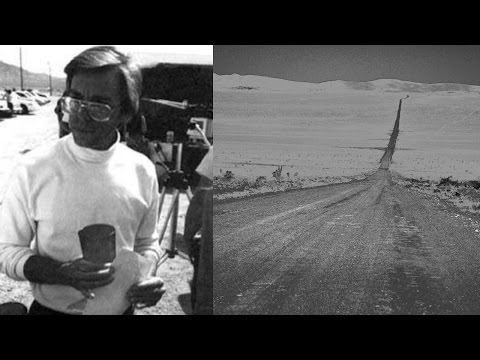
Bob Lazar's First Interview (1989) — Original KLAS-TV Broadcast
Archival footage from investigative reporter George Knapp's original May 1989 KLAS-TV report, in which a silhouetted, voice-disguised Lazar (identified only as "Dennis") first described his work on flying saucers at a facility near Area 51.
Bob Lazar: Area 51 & Flying Saucers — Official Trailer (2018)
Trailer for Jeremy Corbell's feature documentary, narrated by Mickey Rourke, chronicling Lazar's biography, his S-4 claims, the physical evidence he says he saw, and the decades-long fallout from going public.

Bob Lazar: Area 51 & Flying Saucers Trailer
Official trailer for Jeremy Corbell's documentary detailing Lazar's S-4 claims and background.
Sources
- Knapp, George. "Dennis" interview (anonymous, May 15, 1989) and named follow-up interview (November 10, 1989), KLAS-TV broadcast archive, Las Vegas. 8newsnow.com
- Lazar, Bob. Dreamland: An Autobiography, Interstellar Media, 2019.
- Kelleher, Colm, & Knapp, George. Hunt for the Skinwalker, Pocket Books, 2005.
- Jacobsen, Annie. Area 51: An Uncensored History of America's Top Secret Military Base, Little, Brown & Company, 2011.
- Corbell, Jeremy. Bob Lazar: Area 51 & Flying Saucers (documentary film), 2018.
- Friedman, Stanton. "The Bob Lazar Fraud" (critical analysis of academic and employment records), December 1997. theblackvault.com
- Los Alamos National Laboratory. Internal Phone Directory showing Robert Lazar's listing, November 1982.
- The Joe Rogan Experience. Episode #1315, interview with Bob Lazar and Jeremy Corbell, June 20, 2019. youtube.com
- All-domain Anomaly Resolution Office (AARO). Historical Record of U.S. Government Involvement in Unidentified Anomalous Phenomena (UAP), Vol. 1, March 2024. media.defense.gov
- Vallée, Jacques. Revelations: Alien Contact and Human Deception, Ch. 4 ("The Dreamland Chronicles"), Ballantine Books, 1991.
- Lazar, Robert. Employment verification records (W-2), Department of Naval Intelligence (disputed).
- John Lear, Statement on Bob Lazar's security clearance and flights to Groom Lake, 1989.
- Timothy Good, Alien Liaison, Century, 1991 (Lazar investigation chapter).
- Federal Bureau of Investigation. United Nuclear Scientific Supplies LLC FOIA case file, Part 01 of 01 (released via FBI Records Vault). vault.fbi.gov
- Knapp, George. "Area 51 whistleblower takes a lie detector test," Mystery Wire, KLAS-TV. mysterywire.com
- I-Team. "Polygraph expert talks Area 51 whistleblower's lie detector test," 8 News Now (KLAS-TV). 8newsnow.com
- McMillan, Tim. "Bob Lazar Says the FBI Raided Him to Seize Area 51's Alien Fuel. The Truth Is Weirder," Vice, November 13, 2019. vice.com
- Ventura, Tim. "Bob Lazar's Sport Model UFO: The Science and Engineering Claims," Predict (Medium), quoting Lazar's own description of the Sport Model craft as "about fifty-two feet in diameter." medium.com
See something inaccurate? Have additional information or sources?
Suggest an Edit →Last Updated: 2026-06-28