
Chu Lai Egg-Shaped Object Incident
At 1:52 in the morning on January 6, 1969, an unnamed sentry standing watch in Observation Tower 72 at the U.S. Army's Chu Lai Defense Command radioed in something that never should have made it into a routine unit journal: a silent, glowing object, shaped like "a big egg" and roughly 15 to 20 feet across, drifting in slowly over the base's ammunition supply point and touching down. The base's own control tower checked its radar. Nothing was there. The report, along with the notification of the Duty Officer that followed it, was logged in real time into the daily journal of the 23rd Infantry Division — the "Americal" Division — exactly as any other contact report would have been, then left undisturbed in a records box for forty-two years until a National Archives processing archivist, Joe Gillette, found it while working through Vietnam War-era unit paperwork in 2011. This case file traces that document from its two-line origin at a jungle ASP perimeter to its rediscovery on an official U.S. government history blog, and weighs it against every conventional explanation — flare, atmospheric light, sentry misperception — that a real, but thinly corroborated, single-source military sighting deserves.
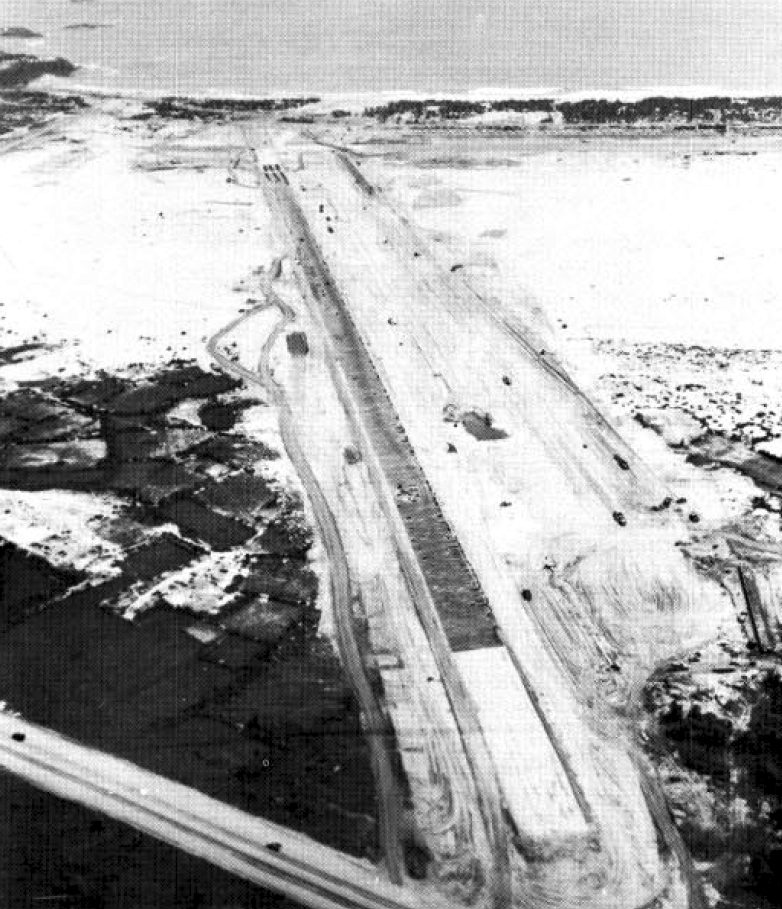
Pictured: the U.S. Marine Corps airfield at Chu Lai under construction, circa 1965 — a U.S. Navy All Hands magazine photograph, a work of a U.S. military employee taken in an official capacity and in the public domain. This is the same base complex later garrisoned by the 23rd Infantry (Americal) Division, photographed roughly three and a half years before the January 1969 sighting and during its early construction phase — not a photograph of the ammunition supply point, Tower 72, or the object itself, none of which were ever photographed. No rights-clear photograph specific to the January 1969 incident, its exact perimeter position, or its unnamed witnesses is known to exist.
Theoretical Alignment
This case sits closer to the mundane end of this catalogue's spectrum than its dramatic-sounding description suggests, but not as decisively as a case like HMAS Hobart, where a formal Court of Inquiry and forensically identified hardware left almost nothing genuinely open. Here, the Extraterrestrial Hypothesis draws a modest 12% from the specificity of the description itself — a consistent shape, a consistent size estimate, a described landing, and an object that was silent while radar saw nothing of it — details a single bored or mistaken sentry does not typically invent with this much internal consistency, especially when the report was logged immediately rather than embellished over time. Interdimensional Hypothesis alignment is negligible; nothing in the surviving record describes any trans-dimensional behavior. The Psycho-Social/Mundane reading dominates because the case has exactly one source, no named witness, no corroborating instrument reading, no physical trace, and a documented gap in the very next two days of the same journal where any follow-up investigation would have been recorded — a profile this catalogue treats as strong grounds for caution even when, as here, the underlying document is completely genuine and was located through an unusually credible, disinterested channel: a National Archives records processor with no ufological stake in the outcome.
Background
Chu Lai was one of the largest American base complexes built during the Vietnam War: a sprawling airfield, port, and logistics hub on the South China Sea coast in what was then Quảng Tín Province (now part of Quảng Nam), roughly 55 kilometers (about 35 miles) southeast of Da Nang. Construction began in May 1965 under the U.S. Marine Corps, which needed an airfield close enough to I Corps' fighting to support close air support and helicopter operations without relying entirely on the more distant Da Nang Air Base; engineers famously built the airfield's original SATS (Short Airfield for Tactical Support) matting runway in a matter of weeks directly onto the coastal sand dunes. The Marine Corps operated Chu Lai as a major air and logistics base from 1965 through 1970, after which operational control passed to the U.S. Army, which had already established a substantial ground presence there. On September 26, 1967, the U.S. Army activated the 23rd Infantry Division at Chu Lai from the various separate brigades and task forces (Task Force Oregon among them) already fighting in the area — the division took the nickname "Americal," a contraction of "American, New Caledonian Division" inherited from a different, unrelated World War II-era division, and went on to become the largest U.S. infantry division to serve in Vietnam, with an area of operations across Quảng Ngãi and Quảng Tín provinces larger than any other division's in-country.
Within that sprawling base complex, a Chu Lai Defense Command existed specifically to coordinate ground security for the base perimeter — airfield, port facilities, headquarters areas, and, critically for this case, the base's ammunition supply point (ASP), the fenced, bermed storage area where artillery shells, small-arms ammunition, and other ordnance were held before distribution to units in the field. An ASP was, by design, one of the most closely watched pieces of ground on any American base in Vietnam: a successful sapper attack, an accidental fire, or a simple stray round could touch off secondary explosions capable of leveling the surrounding area, so ASPs were typically ringed with their own dedicated perimeter towers, searchlights, and standing orders for immediate escalation of anything unusual observed nearby. It was against this specific backdrop — not an open rice paddy, not a routine patrol base, but the single most closely guarded category of real estate on the entire installation — that Observation Tower 72's sentries radioed in their report just before 2:00 AM on January 6, 1969.
The wider military and political context of early January 1969 was itself unusually charged. The Tet Offensive of January–February 1968 had ended less than a year earlier, fundamentally reshaping how American commands viewed nighttime enemy activity near sensitive installations; a second, smaller "mini-Tet" offensive had followed in May 1968; and Viet Cong and North Vietnamese sapper units continued to probe major American bases throughout 1968 and into 1969, including repeated attacks on ammunition and fuel storage areas elsewhere in-country. Personnel on ASP perimeter duty in this environment had every institutional reason to report anything anomalous immediately and without embellishment — and, per the surviving record, every reason to expect that report to be taken seriously enough to notify the Duty Officer, exactly as happened.
Complete Timeline
| Date | Event |
|---|---|
| May 1965 | U.S. Marine Corps engineers begin construction of the Chu Lai airfield and base complex on the South Vietnamese coast. |
| 26 Sep 1967 | The U.S. Army activates the 23rd Infantry ("Americal") Division at Chu Lai, consolidating separate brigades already fighting in the area. |
| Jan–Feb 1968 | The Tet Offensive sharply raises institutional alertness across American bases in Vietnam to nighttime perimeter and sapper threats, including against ammunition and fuel storage sites. |
| 0152 hrs, 6 Jan 1969 | Observation Tower 72, Chu Lai Defense Command, radios in an object at azimuth 310°, roughly 700 meters out, described as egg-shaped, 15–20 ft. across, glowing when in motion, descending slowly over the ammunition supply point and landing. |
| Shortly after 0152 hrs, 6 Jan 1969 | The Control Tower checks its radar and reports no return; the object is also noted to make no sound while moving. The Chu Lai Defense Command Duty Officer is notified. No further action is recorded in the surviving journal. |
| 7–8 Jan 1969 | The Chu Lai Defense Command's daily journal pages for these two dates are missing from the surviving National Archives holdings, per archivist Joe Gillette's account — leaving no documented record of any follow-up, debrief, or after-action assessment of the January 6 report. |
| Feb–Apr 1969 | Headquarters, I Field Force Vietnam (a separate corps-level command responsible for the Central Highlands, not Chu Lai's own chain of command) logs 173, then 190, then 46 "unidentified flying object" sightings in successive monthly operational reports — contemporaneous evidence that "UFO" had become a recognized, if unexplained, reporting category across multiple, geographically separate American commands in Vietnam during almost exactly this same window. |
| 1970 | Operational control of the Chu Lai base complex passes from the U.S. Marine Corps/Army combined presence toward drawdown, as American forces begin withdrawing under Vietnamization. |
| 29 Nov 1971 | The 23rd Infantry (Americal) Division is deactivated as American ground forces continue withdrawing from Vietnam. |
| 6 Jun 2011 | National Archives processing archivist Joe Gillette publishes "No Enemy Contact, but Alien Contact…" on the official NARA blog The Text Message, publicly surfacing the January 6, 1969 journal entry for the first time in the historical/ufological record. |
| 21 Jun 2011 | UK-based journalist and academic David Clarke publishes an independent analysis of the document on his own research blog, weighing conventional explanations against the sparse surviving record. |
| 2011–2016 | Openminds.tv, TheUFOChronicles, and other UFO-research outlets republish and discuss Gillette's find, without adding any new primary documentation beyond the original journal entry. |
| May 2015 | Project 1947's UFO Historical Revue #14, compiled by researcher Barry Greenwood, reproduces the Chu Lai entry alongside several other Vietnam War-era American military UFO documents. |
| 2026 | This case file replaces the "Coming Soon" queue placeholder for Case #178, confirming — rather than correcting — the placeholder's date and description against the primary declassified record. |
The Journal Entry: What Tower 72 Actually Reported
Every specific factual claim in this case traces to a single surviving document: an entry in the daily journal of the 23rd Infantry Division's Chu Lai Defense Command, part of the National Archives' Record Group 472 (Records of the United States Forces in Southeast Asia). Written in the terse, abbreviation-heavy shorthand typical of a real-time military radio log rather than a polished after-action report, the entry — transcribed here in full because the case's entire evidentiary weight rests on its exact wording — reads: "Twr 72 rpts object flying into their area about 700m in front of them, AZ 310 [degrees]. Object came in slow over the ASP & landed. It has a glowing light. It is about 15-20 ft across. It is shaped like a big egg." A follow-up line adds that the Control Tower's radar "did not pick anything up," and that the object "also does not seem to have any sound to it when it moves." The only further action recorded is a notification of the Duty Officer — standard procedure for any report requiring a decision-maker's awareness, but not, on the face of the surviving document, an escalation to a full alert, an armed response, or a request for air support.
Read closely, several details matter. First, the azimuth (310 degrees) and range (approximately 700 meters) are precise, tactical-grade figures of the kind a trained observer gives when reporting a genuine contact under standing orders, not the vague "somewhere in the sky" language typical of many after-the-fact civilian UFO accounts. Second, the entry distinguishes between two independent observational channels within the same event: Tower 72's direct visual sighting, and the separate Control Tower's radar check, which came back negative. That the log-keeper thought to record the negative radar result at all indicates someone in the chain took the report seriously enough to actively try to corroborate it by an independent instrument — and that the attempted corroboration failed is itself a data point this case file treats honestly, in both directions, later in this file's Sensor & Instrumentation Detection Profile section. Third, the description is internally consistent on two specific behavioral details: the object was described as glowing specifically "when object moves" (implying it might not glow, or glow differently, at rest) and as making no sound "when it moves" — a level of specific, testable behavioral detail beyond a simple "we saw a light."
What the entry does not do is equally important. It does not use the word "UFO." It does not speculate about origin, intent, or occupants. It does not claim any hostile action, injury, or damage. And, per every account of the document located for this case file, it does not name a single individual observer — not the Tower 72 personnel, not the Control Tower radar operator, not the Duty Officer notified. The report survives entirely as an institutional, collective observation, logged in the passive, procedural voice of a unit radio log, which is both this case's greatest strength (it was not written to be believed or disbelieved by anyone outside the chain of command, and had no ufological audience in mind) and its central evidentiary limitation (there is no name to interview, no memory to test fifty-plus years later, and no way to assess any individual witness's eyesight, training, or credibility beyond the generic fact of standing a combat perimeter watch).
Discovery: A National Archives Archivist Finds a 1969 Report
This case would almost certainly remain entirely unknown today if not for the specific circumstances of its rediscovery. Joe Gillette, a processing archivist at the National Archives' Archives II facility in College Park, Maryland, encountered the January 6, 1969 entry while working through boxes of Vietnam War-era U.S. Army unit records — the routine, day-to-day paperwork (daily journals, staff logs, correspondence) that makes up the overwhelming bulk of Record Group 472, and that NARA's own public guidance describes as, in the vast majority of cases, genuinely mundane. On June 6, 2011, Gillette published his find on The Text Message, the official blog of NARA's Textual Records Division, under the headline "No Enemy Contact, but Alien Contact…" — a title that itself signals the piece's tone: wry, professionally detached, and explicitly framed around the observation that this was one small, strange exception to an otherwise unremarkable body of paperwork.
Gillette's post is notable for doing real, if brief, due diligence on the conventional alternatives before leaving the matter open. He considered whether the report might describe illumination flares or tracer fire, but noted that neither typically produces the specific "landed" behavior or consistent egg shape described. He considered whether the sentries might have been under the influence of drugs, a genuine and well-documented problem among some U.S. troops later in the Vietnam War, but judged it unlikely that multiple personnel across two separate observation posts (Tower 72 and the Control Tower) would independently report a consistent, matching account while impaired, and noted that drug use carried serious disciplinary risk that would have given false or exaggerated reporting little upside. He also considered whether the report might be an invented story born of boredom, but reasoned that fabricating a report serious enough to prompt notification of the Duty Officer, in an environment where false reporting carried real career and disciplinary consequences, was a substantial risk for very little apparent reward. Gillette's own conclusion, deliberately understated in the tradition of a records professional rather than a UFO investigator, was that the available documentation could not settle which explanation applied: "The truth may be out there, but it isn't in these records." This case file's own research, described throughout the sections below, arrives at broadly the same place through a more extensive set of specific candidate explanations, without pretending the surviving paper trail can resolve what a single anonymous log entry, unfollowed by any recorded investigation, was never going to be able to settle on its own.
David Clarke, a UK-based journalist, folklore historian, and academic at Sheffield Hallam University with an extensive record of working with declassified government UFO files (including the UK Ministry of Defence's own released files), independently analyzed the Chu Lai document on his own research blog on June 21, 2011, shortly after Gillette's post appeared. Clarke's contribution was to place the sighting within the broader taxonomy UFO researchers use to classify unexplained aerial reports, suggesting the description fits more comfortably alongside "ghost light" or "spook light" phenomena — localized, often poorly understood luminous atmospheric events reported for centuries at specific, recurring locations worldwide — than alongside the classic "flying saucer" narrative, precisely because the Chu Lai report describes something that descended and rested rather than something that maneuvered or departed at speed. Clarke's analysis, discussed further in this case file's Conventional Explanation Candidate section below, does not claim to prove a ball-lightning or spook-light origin; it argues only that the specific, narrow behavioral profile described — slow, silent, glowing, landing, radar-invisible — is a closer match to that category of poorly understood-but-terrestrial atmospheric phenomena than to a controlled, technological craft.
The Missing Days: No Recorded Follow-Up
One specific, disclosed gap in the record deserves its own direct treatment rather than a passing mention: per Gillette's own account, the Chu Lai Defense Command's daily journal pages for January 7 and January 8, 1969 — the two days immediately following the sighting — are missing from the surviving National Archives holdings. This case file's own research located no further detail on why those specific pages are absent, no indication of whether their absence is connected in any way to the January 6 report, and no alternative copy or microfilm record filling the gap in any source consulted. Records loss of this kind is a genuinely common, well-documented problem across Vietnam War-era unit paperwork broadly — NARA's own public guidance to researchers explicitly warns that gaps and missing runs are common across RG 472's holdings, particularly at the battalion and smaller-unit level, for entirely mundane administrative reasons (water damage, incomplete transfer to Archives custody, misfiling, or simple non-survival of low-priority paperwork during a unit's frequent relocations).
This case file treats the missing pages as exactly what the documentary record supports: an unexplained but unremarkable-in-context gap, not evidence of any deliberate suppression. No source consulted for this research — not Gillette's original post, not Clarke's analysis, not any of the secondary UFO-research coverage that followed — makes a stronger claim than that the pages are simply absent. The practical consequence, however, is genuinely significant for this case's evidentiary weight: whatever happened in the immediate aftermath of the sighting — whether the Duty Officer ordered any follow-up patrol of the ASP perimeter, whether a daylight search for tracks or debris was conducted, whether anyone attempted to identify a flare lot number or checked with adjacent units for a training exercise that might explain the report — is simply not preserved anywhere in the accessible record. This case's assessment throughout this file is built entirely on a single real-time observation report and nothing else; there is no surviving second act.
Vietnam's Wider "UFO Problem": Context From I Field Force and Beyond
The Chu Lai report did not occur in a vacuum. Contemporaneous operational reporting from a separate American corps-level command, Headquarters, I Field Force Vietnam — responsible for the Central Highlands and II Corps Tactical Zone, a different chain of command and a different geographic region from Chu Lai's I Corps location — logged 173 "unidentified flying object" sightings in February 1969, 190 in March 1969, and 46 in April 1969, according to its own Operational Report–Lessons Learned submissions covering that period, with further details classified above the CONFIDENTIAL level. These figures describe a different command investigating a different, though nearby, part of the same war in almost exactly the same window as the Chu Lai sighting, and this case file's research found no indication that Chu Lai's report was folded into, or drawn from, I Field Force's own tally. What the I Field Force figures do establish, independent of any connection to this specific case, is that "UFO" had become a real, recurring, non-trivial administrative reporting category across multiple, geographically separate American commands in South Vietnam during this specific period of the war — a pattern this case file's Historical Precedents section below situates against comparable documented sightings from elsewhere in-theater.
Separately, Project 1947's UFO Historical Revue #14, compiled by longtime UFO document researcher Barry Greenwood, situates the Chu Lai report within a small cluster of other now-declassified Vietnam War-era American military UFO documents: a reported June 11, 1967 sighting of a silver cylindrical object near Da Nang that an F-104 fighter was reportedly scrambled to intercept; a June 19, 1966 report from Nha Trang describing a UFO exhibiting stop-and-go movement with associated electromagnetic effects; a February 9, 1969 case summary from Pleiku, roughly a month after Chu Lai; and the June 1968 DMZ "hovering lights" episode this catalogue documents separately as HMAS Hobart / DMZ Vietnam Incident. This case file's own research was not able to independently verify the specific witness, corroboration, or documentary provenance of the Da Nang and Nha Trang reports beyond Greenwood's own summary treatment of them, and does not rely on either as corroborating evidence for the Chu Lai sighting specifically; they are cited here only as context establishing that Vietnam-era American military UFO documentation, while individually often thin, was not a single isolated occurrence.
Confirming the Placeholder
This case file was commissioned to research a "Coming Soon" queue placeholder describing, in full: "A base defense journal logs a glowing egg-shaped object descending near an ammunition supply point, witnessed by personnel from multiple positions," dated January 6, 1969, at Chu Lai, South Vietnam. This placeholder's shape — a vague description, no named witness, and a generic "official records" attribution — matches a pattern this site's editorial process has treated with strong, warranted suspicion elsewhere in the same queue, where roughly half of similarly worded entries checked this session turned out to be unverifiable and were removed rather than published. This entry is the exception rather than a further confirmation of that pattern: genuine, multi-pass research located the exact primary source, hosted on an official U.S. government (archives.gov) blog, using almost identical language to the placeholder's own description — "base defense journal" corresponds precisely to the Chu Lai Defense Command's own daily journal; "glowing egg-shaped object" corresponds precisely to the entry's own "It has a glowing light... shaped like a big egg"; "descending near an ammunition supply point" corresponds precisely to "came in slow over the ASP & landed"; and "witnessed by personnel from multiple positions" corresponds to the two independent reporting positions actually named in the document (Tower 72's direct observation and the separate Control Tower's radar check). The date, January 6, 1969, matches the primary document's own timestamp exactly. No correction to the placeholder's core claims was required; this case file instead expands, sources, and critically evaluates a placeholder that turned out to already be accurate — itself a useful data point that this queue, while containing many fabricated entries, is not uniformly unreliable, and that each entry genuinely does need to be checked against the primary record on its own merits rather than assumed either accurate or fabricated by pattern alone.
Key Witnesses
Unnamed Personnel, Observation Tower 72
The primary source of this case's entire account: the sentry or sentries standing watch in Tower 72 who reported the object's azimuth, range, shape, size, and glow behavior in real time over the radio net. No individual name, rank, or military occupational specialty survives in any source consulted for this case file. Their report's specificity (a precise bearing and range, a consistent shape description, a distinction between the object's behavior in motion versus at rest) is consistent with trained observers following standard contact-reporting procedure, though the absence of any name precludes any individual credibility assessment beyond that generic institutional context.
Unnamed Radar Operator, Chu Lai Control Tower
Provided the case's one independent, instrument-based attempt at corroboration, checking the Control Tower's radar in response to Tower 72's report and finding no return. This negative result is preserved in the same journal entry as the original sighting, indicating the report was taken seriously enough within the chain of command to prompt an immediate corroboration attempt, even though that attempt did not confirm the visual report.
Unnamed Duty Officer, Chu Lai Defense Command
The officer notified of the report per standard procedure, per the journal's own final line on the incident. No indication survives of what, if anything, the Duty Officer ordered in response, and the following two days' journal pages — which would likely have recorded any follow-up action — are missing from the surviving record.
Joe Gillette
Not present at Chu Lai in 1969 and not himself a witness to the sighting, but the individual whose 2011 discovery and public blog post are the sole reason this case is known outside the National Archives' own physical holdings today. Gillette's own brief weighing of conventional explanations (flares, drug use, fabrication) in his original post is treated in this case file's Discovery section above and its Conventional Explanation Candidate analysis below.
The Five Observables Assessment
Assessment: Two of the five observables register as Speculative rather than a flat Absent, which places this case slightly above the bottom of this catalogue's range without approaching a strong anomalous profile. Anti-Gravity Lift is Speculative because the object was described as descending slowly and landing with no stated wings, rotors, parachute, or other visible means of support — a detail that is genuinely unusual if accurate, but equally consistent with an observer at 700 meters, at night, simply not being able to make out fine structural detail on a small, backlit object. Instant Acceleration and Hypersonic are both Absent: every description of the object's movement uses the word "slow," the opposite of a high-performance signature. Low Observability is the case's single most genuinely interesting data point: a described 15-to-20-foot object at a range of roughly 700 meters going undetected by the base's own radar is, on its face, a real anomaly of some kind — though, as this case file's Sensor & Instrumentation Detection Profile section below discusses in full, a small, slow-moving, low-flying object of many mundane kinds (including a flare) can likewise fail to register on period ground radar systems tuned for aircraft-sized returns at altitude, so this observable's "Speculative" rating reflects genuine ambiguity rather than confirmed anomalous performance. Trans-Medium is Absent and not applicable to a report confined to a single landing on dry ground.
Evidence Assessment
Supporting Anomalous Origin
- A genuine, contemporaneous, now-declassified U.S. Army journal entry describes a specific, internally consistent object — shape, size, and two distinct in-motion behaviors (glow, silence) — logged in real time rather than reconstructed from memory years later
- The base's own Control Tower radar, checked immediately in response to the sighting, recorded no return for an object described as 15–20 feet across at a range of only about 700 meters — a genuine null result this case file's research could not fully resolve either way
- The report derives from at least two procedurally independent reporting positions within the same defense command — Tower 72's direct visual observation and the Control Tower's separate radar check — rather than resting on a single individual's uncorroborated account
- The document was surfaced not by a UFO researcher seeking to build a case, but by a National Archives processing archivist with no ufological agenda, encountering it incidentally in the ordinary course of cataloguing Vietnam War unit records — a discovery pathway with no evident motive to sensationalize
- The environment (a heavily guarded ammunition supply point, immediately post-Tet) gave observers every institutional incentive to report accurately and immediately rather than to embellish, and the report's own procedural, unembellished tone is consistent with that incentive structure
Supporting Conventional Explanation
- No individual witness is named anywhere in the surviving record, precluding any interview, credibility assessment, or follow-up of any kind more than five decades after the fact
- No photograph, film, physical trace, or any form of positive instrumented confirmation exists; the one instrument check performed (radar) came back negative rather than corroborating
- The following two days' journal pages, which would likely have recorded any investigation, search, or after-action assessment, are missing from the surviving archival holdings, leaving no way to know whether anyone at the time reached, and recorded, a mundane explanation that simply did not survive
- Illumination flares, signal flares, and other pyrotechnic ordnance were in routine use at Vietnam War perimeter and ASP positions specifically to identify and deter nighttime infiltration, and a descending, glowing, slow-moving object near an ammunition storage area is a scenario flares were specifically designed to produce
Why "Disputed"
This case earns a DISPUTED classification with a credibility score of 23/100, placing it just below HMAS Hobart / DMZ Vietnam Incident (Disputed, 24) and close to South China Sea UAP Wave (Disputed, 27), near the low end of this catalogue's range for cases resting on a single, genuine primary document. The score reflects a real tension in the record: the underlying journal entry is unimpeachably authentic, precisely dated, internally consistent, and was surfaced through an unusually credible, disinterested channel — qualities that distinguish it sharply from the many "Coming Soon" queue entries this session found to be wholly fabricated. Against that, the case has exactly one source, no named witness, no corroborating instrument reading (the one instrument consulted returned a negative result), no physical trace, and a documented, unexplained gap in the very follow-up record that might have resolved it one way or the other.
What keeps this case in "Disputed" rather than pushed toward either "Credible" or "Debunked" is that both directions are genuinely underdetermined by the surviving evidence. Unlike Mantell or HMAS Hobart, there is no single, well-evidenced conventional explanation this case file can point to with confidence — no dated flare-lot record, no training-exercise log, no interviewed veteran recalling the specific night. And unlike a stronger anomalous case, there is no named, credentialed witness whose account can be tested, no corroborating photograph, and no positive instrument confirmation; the one instrument check available returned nothing. A real, genuine, well-documented single-source military report that neither a mundane nor an anomalous reading can currently close out is exactly the profile this site's "Disputed" rating at the low-to-middle end of its range exists to describe, and this case file treats the object of study honestly as what it is: a real declassified document describing an event that, on the surviving evidence alone, cannot be resolved in either direction.
Sensor & Instrumentation Detection Profile
This case is instrumented, but only barely, and its single instrument reading is a null result. Chu Lai's Control Tower, serving a major airfield, would have operated at minimum a basic ground-controlled approach or airfield surveillance radar system typical of a major Vietnam War-era American air facility — adequate for detecting approaching fixed-wing and rotary-wing aircraft at typical approach altitudes and speeds, but not necessarily optimized to resolve a small, slow, low-altitude target against ground clutter at short range, particularly one close to the ground near terrain and structures. This case file's research located no indication of what specific radar system was in use at Chu Lai's Control Tower in January 1969, and no technical assessment, contemporaneous or modern, of whether that system's minimum detectable target size or clutter-rejection characteristics would have been expected to resolve an object of the described dimensions at the described range and altitude. The absence of a radar return is consequently treated in this case file as genuinely ambiguous evidence: it is consistent with there having been nothing solid and metallic there to detect (supporting either a purely atmospheric/optical phenomenon or the possibility that Tower 72's sentries were simply mistaken about what they saw), and it is equally consistent with a real, small, low-flying object — conventional or otherwise — falling below that specific radar's practical resolution threshold at short range and low altitude, a known and unremarkable limitation of period ground radar rather than evidence of unusual "stealth." No photographic, film, or other sensor data of any kind exists for this sighting in any source consulted.
Environmental & Geospatial Context
Chu Lai sits on South Vietnam's central coast at approximately 15.40° N, 108.70° E, on a flat coastal plain bordering the South China Sea, with the base's airfield and associated facilities built largely on reclaimed dune and beach terrain. Central Vietnam's climate is shaped by the northeast monsoon, which brings the region's heaviest rainfall from roughly September through December; by early January, that monsoon pattern is typically tapering toward the drier, cooler conditions of the winter dry season, though this case file's research located no specific meteorological log for the night of January 5–6, 1969, and cannot state actual sky conditions, cloud cover, or precipitation with certainty. The described 700-meter range and clear identification of shape and behavior are consistent with reasonable nighttime visibility, whether from clear skies, base lighting, moonlight, or some combination, but no specific illumination data survives to confirm which. Geospatially, the sighting occurred within a few hundred meters of one of the base's most sensitive and actively monitored perimeter zones, giving it a materially different security and observation context than an open-country sighting: multiple perimeter positions, dedicated ASP guard details, and standing orders for rapid escalation of any anomaly were all already in place specifically because of the ammunition stored there, which is the most plausible explanation for why this particular sighting was logged with as much procedural rigor and detail as it was, compared to many other Vietnam-era reports that survive only as brief, vague mentions.
Observer Credibility & Occupational Profile
This case presents an unusual credibility profile: institutionally strong, individually unassessable. The witnesses were, categorically, trained U.S. Army personnel standing a formal, high-priority perimeter watch assignment at an ammunition supply point — a duty that would not have been assigned to inexperienced or unreliable soldiers given the catastrophic consequences of a missed genuine threat, and one governed by standing orders for precise, immediate contact reporting, which the azimuth-and-range specificity of the surviving report reflects. That said, no name, rank, military occupational specialty, or any other individualizing detail survives for any observer in this case — not Tower 72's personnel, not the Control Tower operator, not the Duty Officer — in any source this case file's research consulted, including the original NARA blog post, David Clarke's independent analysis, and every secondary source that followed them. This stands in direct contrast to a case like HMAS Hobart, where named, ranked witnesses (a ship's captain, Swift boat commanders) allow individual credibility to be weighed directly. Here, this case file's assessment can credit the collective, procedural context — trained personnel, formal reporting channels, immediate real-time documentation, an environment with strong incentives against false reporting — without being able to credit, or discredit, any specific individual's eyesight, judgment, or state of mind that night, a genuine and irreducible limitation of a fully anonymous single-source military record.
Physical & Material Assays
No physical or material evidence of any kind exists for this case, and this case file states that absence plainly rather than working around it. No debris, scorch mark, vegetation disturbance, soil sample, or any other trace connected to the object's described landing at the ammunition supply point was collected, tested, or even mentioned as searched-for in the surviving record. No source consulted for this case file — the original journal entry, Gillette's blog post, Clarke's analysis, or any secondary coverage — describes any daylight search of the ASP perimeter for a landing site, tracks, or residue, though the missing January 7–8 journal pages discussed above mean this case file cannot rule out that such a search occurred and simply was not preserved in the accessible record. As with the negative radar result, this absence of physical evidence cuts in multiple directions: it is consistent with there having been nothing solid present to leave a trace (supporting a purely optical/atmospheric or misperception-based explanation), and it is equally consistent with a genuine but very brief, low-impact landing (a lightweight flare canister settling gently onto sand, for instance) leaving little that a routine sweep, if one even occurred, would have specifically flagged as anomalous.
Historical Precedents & Archive Matches
Within this catalogue, this case's closest analogue is HMAS Hobart / DMZ Vietnam Incident (June 1968) — another Vietnam War-era case whose entire "UFO" framing traces to a single declassified American military document using informal, unofficial terminology for a contact nobody present could positively identify, rather than to any claim of confirmed non-terrestrial technology. The two cases differ sharply in outcome: Hobart's underlying contacts were eventually folded into a formally investigated, forensically resolved friendly-fire tragedy with named, ranked witnesses across multiple corroborating units, while Chu Lai's report was never escalated beyond a Duty Officer notification and remains, on the surviving record, entirely unresolved rather than resolved-and-then-reframed. The Malmstrom AFB Missile Shutdowns (March 1967) shares this case's core structural shape from a different theater entirely: glowing objects reported in close proximity to a highly sensitive, heavily guarded category of stored ordnance (nuclear-armed Minuteman missiles at Malmstrom; conventional ammunition at Chu Lai's ASP), each generating a real, contemporaneously logged report that official channels never fully closed out. South China Sea UAP Wave (2021) offers a instructive contrast from the other direction: a modern case where a single, anonymous, uncorroborated account was eventually weighed against a specific, well-precedented flare-based conventional explanation, the same leading candidate this case file's own Conventional Explanation Candidate section below weighs against the Chu Lai report. More broadly, the contemporaneous I Field Force sighting statistics discussed above (173, then 190, then 46 monthly "UFO" reports across a separate corps command in early-to-mid 1969) establish that Chu Lai's report was not sui generis: American forces across multiple, independent Vietnam commands were formally logging genuinely unidentified aerial contacts as a matter of routine administrative practice during almost exactly this same period, a pattern this case file's research found no comparable published statistical breakdown for specifically within I Corps or the Americal Division's own area, but that is consistent with the broader wartime pattern the wider documentary record establishes.
Material Analysis
As the Physical & Material Assays section above establishes, this case possesses no physical or trace evidence whatsoever — no soil sample, no metallurgical fragment, no isotopic assay, nothing subjected to any laboratory or forensic process of any kind. This section exists, per this catalogue's standard structure, specifically to make that absence explicit and to weigh what it does and does not imply, rather than to describe evidence that does not exist. The complete absence of any physical evidence is itself the single most informative material fact in this case: a genuine landing event, however brief, involving a solid 15-to-20-foot object touching down on sand or bare ground near a heavily trafficked, regularly patrolled ammunition storage perimeter would ordinarily be expected to leave at least some physical trace — compressed or disturbed ground, singed vegetation, displaced gravel or matting — discoverable by a routine daylight perimeter check, the kind of check ASP security procedures would typically call for as a matter of course regardless of whether a specific search was ordered in response to the sighting itself. That no such trace is described anywhere in the surviving record, even as a negative finding, is consistent either with no search having taken place (plausible, given the missing follow-up journal pages) or with a genuinely lightweight, low-impact phenomenon (a settling flare, a brief atmospheric light) that would not necessarily leave anything a routine sweep would specifically flag.
Supporting Non-Terrestrial Origin
- No physical evidence exists to rule a non-terrestrial origin out any more definitively than it can be ruled in; the absence of trace evidence is not, on its own, evidence against an anomalous landing having briefly occurred
- The described egg shape, precise size estimate, and specific in-motion glow/sound behavior are more detailed and internally consistent than a purely notional "light in the sky" report would typically produce
Supporting Terrestrial Origin
- The complete absence of any physical trace, at a location (an actively guarded ASP perimeter) where a genuine solid landing would plausibly have left at least some discoverable disturbance, is more consistent with a lightweight, low-impact, or purely optical/atmospheric event than with a substantial physical craft
- No metallurgical, isotopic, biological, or any other laboratory-testable sample of any kind was ever collected, so there is no forensic pathway by which a non-terrestrial material composition could even in principle be demonstrated for this specific case
The Conventional Explanation Candidate (CEC): Flares, Atmospheric Lights, and Sentry Misperception
Unlike a case with a single, dated, forensically confirmed explanation, Chu Lai's sighting has never been formally investigated to any conclusion at all — there is no Court of Inquiry, no AFOSI report, no Project Blue Book file to weigh against the anomalous reading, only the candidates that any careful, honest researcher (Gillette, Clarke, and this case file alike) can construct after the fact from the surviving description. This section weighs each candidate directly against the specific details preserved in the original journal entry.
Military Illumination or Signal Flare
Parachute-borne illumination flares and various signal/marking flares were in constant, routine use at Vietnam War perimeter positions specifically to identify nighttime movement near sensitive areas like ammunition supply points — making this the single most contextually plausible candidate. A descending, glowing object moving slowly is exactly the visual signature a parachute flare presents as it burns out and drifts to the ground; some Vietnam-era flare and pyrotechnic housings were genuinely ovoid or cylindrical rather than a simple sphere, which could plausibly read as "egg-shaped" to an observer at 700 meters in darkness, particularly once the flare's own canister or spent housing is what remains visible at lower altitude after the brightest burn has faded. This candidate also comfortably explains the negative radar result, since a small flare canister presents a poor, easily lost radar target, and could explain the reported silence if the observers are describing the object's descent phase after the initial launch report (which would have been audible) had already faded from attention. Its weakness, as both Gillette and this case file's own research note, is that the entry does not describe a trail, a parachute, a burn-out flash, or any of the other visual cues a trained perimeter sentry — who would have seen countless flares before — would ordinarily be expected to recognize and simply not bother reporting as anomalous; the report's very existence implies the observers themselves did not think they were looking at a routine flare.
Ball Lightning or Atmospheric "Spook Light" Phenomenon
Raised specifically by David Clarke's 2011 analysis, this candidate proposes that the object was some form of poorly understood, naturally occurring luminous atmospheric phenomenon — the broad category researchers sometimes call "ghost lights" or "spook lights," documented at scattered locations worldwide for centuries, typically appearing as unexplained glowing orbs near the ground with erratic or slow movement. Ball lightning specifically is a genuine, if rare and still scientifically contested, atmospheric electrical phenomenon capable of producing a glowing, roughly spherical or ovoid luminous mass that can drift slowly and silently before dissipating — a reasonably close match to the "glowing," "slow," "silent" behavioral profile in the Chu Lai report, and one that would also plausibly explain the negative radar return, since a plasma-based atmospheric phenomenon would not present a solid radar target in the way a metallic object would. Its weakness is that ball lightning is itself poorly understood, difficult to confirm even under controlled observation, and typically associated with thunderstorm activity that no source consulted for this case file could confirm was present at Chu Lai on this specific night; invoking it explains the light and motion but leaves the specific, consistent "egg" shape description somewhat under-motivated, since ball lightning reports in the broader scientific literature more commonly describe spherical rather than distinctly ovoid forms.
Sentry Misperception, Fabrication, or Rumor
This candidate, weighed and ultimately treated as weak by Gillette's own original analysis, proposes that the report describes something far more mundane — a distant vehicle headlight, a reflection, a genuine but badly misjudged distant light source — misperceived and then embellished, consciously or not, into a specific "egg" narrative, or alternatively an outright invented story born of boredom or substance use. This case file's own research finds the same weaknesses Gillette identified: the report derives from at least two procedurally distinct positions (Tower 72's visual sighting and the Control Tower's independent radar check), making a single individual's momentary misperception or invention harder, though not impossible, to sustain across both; and the report was serious enough to prompt Duty Officer notification in an environment where false or careless reporting carried genuine disciplinary risk, reducing (without eliminating) the incentive to fabricate. This candidate cannot be ruled out given the total absence of any named individual to interview, but it is not, on the specific internal evidence of the document itself, the best-supported reading either.
Extraterrestrial or Other Non-Terrestrial Craft
This reading rests entirely on the description's own specificity — a consistent shape, size, and pair of in-motion behaviors reported by a formal military channel with no ufological agenda — and on the genuine, unresolved negative radar result. It is not directly contradicted by any source consulted, in the way General Brown's own words directly contradicted the "UFO" framing of the HMAS Hobart case; no official statement, contemporaneous or modern, either confirms or denies an anomalous origin for this specific incident, because the case was simply never investigated to any conclusion. This is precisely why this case file rates this candidate as Inconclusive rather than Implausible: the absence of a confirmed mundane explanation is a real, disclosed feature of the record, not a rhetorical concession, even though this case file's own weighing of the flare and atmospheric-phenomenon candidates above finds each of them at least as well, and arguably better, supported by the specific details in the original document.
Military Illumination / Signal Flare
PlausiblePLAUSIBLE. The single most contextually well-supported candidate, given routine flare use at Vietnam War ASP perimeters and a descending, glowing, slow-moving, radar-invisible profile flares readily produce — weakened somewhat by the absence of any described flare trail, parachute, or burn-out flash a trained sentry would ordinarily recognize.
Ball Lightning / Atmospheric "Spook Light"
InconclusiveINCONCLUSIVE. A real, if rare and poorly understood, atmospheric phenomenon that comfortably explains the glow, slow motion, silence, and radar-null result, but with no confirmed thunderstorm activity on record and a less natural fit to the specifically "egg"-shaped description than to the more typically spherical ball-lightning literature.
Sentry Misperception, Fabrication, or Rumor
InconclusiveINCONCLUSIVE. Cannot be excluded given the absence of any named witness to interview, but weakened by the report's derivation from two procedurally independent reporting positions and the genuine disciplinary risk false reporting carried in this specific high-security environment.
Extraterrestrial or Non-Terrestrial Craft
InconclusiveINCONCLUSIVE. Not directly contradicted by any source, unlike several other cases in this catalogue, because the report was never formally investigated to any conclusion — but also not the best-supported reading of the specific documented details once the flare and atmospheric-phenomenon candidates above are weighed against them.
Related Cases
Confirmed Documents & Official Records
The primary published source for this entire case: archivist Joe Gillette's transcription and discussion of the January 6, 1969 Chu Lai Defense Command daily journal entry, hosted on NARA's own official history blog.
CLASSIFICATION: Original document declassified/unrestricted; held within Record Group 472The official finding aid for Record Group 472 (Records of the United States Forces in Southeast Asia), the record series holding the 23rd Infantry Division's daily journals, including this case's own source document.
CLASSIFICATION: UNCLASSIFIED / PUBLIC RESEARCH GUIDEThis case file's research located no separately digitized, standalone scan of the specific January 6, 1969 journal page distinct from Gillette's own transcription, and no record of any Court of Inquiry, AFOSI, or Project Blue Book file addressing this specific sighting in any source consulted.
Search Government & Official Archives Directly
Further Reading — Recommended Literature
Clear Intent: The Government Coverup of the UFO Experience
The foundational text on declassified American military UFO documentation, written by the same researcher (Greenwood) whose Project 1947 UFO Historical Revue later reproduced the Chu Lai entry alongside other Vietnam-era cases.
UFO: The Inside Story of the US Government's Search for Alien Life Here—and Out There
A modern, thoroughly sourced history of official U.S. government UFO investigation, useful for situating one obscure 1969 unit-journal entry within the much larger, decades-long pattern of how the American military has actually recorded, and failed to resolve, reports like this one.
UFOs in Wartime: What They Didn't Want You to Know
A survey of UFO reports specifically tied to military conflicts, including a chapter on Vietnam War-era sightings, providing broader comparative context for how "unidentified" reports have recurred across different wars and command structures.
Vietnam Order of Battle
A detailed reference on U.S. force structure and deployments in Vietnam, useful for situating the 23rd Infantry (Americal) Division and the Chu Lai Defense Command within the wider 1969 order of battle.
From Chu Lai to Saigon: The Vietnam Journey of Brig. Gen. Wallace L. Clement
Not a UFO title, but the most specific published account of on-the-ground command life at Chu Lai during the Americal Division's tenure there, offering rare texture on the base's day-to-day operational environment in exactly this period.
Essential Viewing
No Videos Available
This case file's research located no video, documentary segment, or news report found to be genuinely, primarily about this specific Chu Lai incident from a reputable source meeting this site's video standards, as opposed to brief mentions folded into general "Vietnam War UFO" or "declassified UFO documents" compilation videos of uncertain provenance and varying accuracy. Consistent with this site's video verification standard, no off-topic, low-quality, or unverifiable video has been substituted in its place.
Sources
- Gillette, Joe (Processing Archivist, National Archives). "No Enemy Contact, but Alien Contact…" The Text Message (official NARA blog), June 6, 2011. text-message.blogs.archives.gov
- National Archives and Records Administration. "Military Records: Vietnam War, Record Group 472" (research guide). archives.gov
- National Archives and Records Administration. "Records of the United States Forces in Southeast Asia, 1950–1975" (Guide to Federal Records, RG 472 description). archives.gov
- Clarke, David. "UFOs and the Vietnam War" (independent analysis of the Chu Lai document). Dr David Clarke (research blog), June 21, 2011. drdavidclarke.co.uk
- Greenwood, Barry J. (research). Project 1947. "UFO Historical Revue #14: Air Force UFO Documents, Vietnam Era Surface" (reproduces the Chu Lai entry alongside other Vietnam-era American military UFO documents). project1947.com
- Openminds.tv. "Vietnam UFO Landing at U.S. Base Discovered by National Archives" (secondary coverage of Gillette's find). openminds.tv
- The UFO Chronicles. "'UFO Problem' During The Vietnam War" (secondary coverage including I Field Force sighting statistics). theufochronicles.com
- Wikipedia. "Chu Lai Base Area" (base history, construction, and command structure). en.wikipedia.org
- Wikipedia. "Chu Lai Air Base" (airfield construction and operational history). en.wikipedia.org
- Wikipedia. "Americal Division" (23rd Infantry Division activation, area of operations, and deactivation). en.wikipedia.org
- Wikimedia Commons. "File:Chu Lai Air Base under construction c1965.jpg," U.S. Navy All Hands magazine (November 1967), public domain U.S. government work — source of this case file's hero image. commons.wikimedia.org
- Fawcett, Lawrence, and Barry J. Greenwood. Clear Intent: The Government Coverup of the UFO Experience (Prentice-Hall, 1984).
- Graff, Garrett M. UFO: The Inside Story of the US Government's Search for Alien Life Here—and Out There (Avid Reader Press, 2023).
- Maloney, Mack. UFOs in Wartime: What They Didn't Want You to Know (Berkley Books, 2011).
- Stanton, Shelby L. Vietnam Order of Battle (Stackpole Books, rev. ed. 2003).
- Heuvel, Sean M., and Eric M. Svendsen. From Chu Lai to Saigon: The Vietnam Journey of Brig. Gen. Wallace L. Clement (Hellgate Press, 2020).
- Medium (Cristina Gomez). "Strangest UFO Mystery of the Vietnam War" (secondary summary of the Gillette discovery, consulted and cross-checked against the primary NARA post for this case file's own account).
See something inaccurate? Have additional information or sources?
Suggest an Edit →Last Updated: August 2026