
Gulf Breeze UFO Sightings
Beginning on November 11, 1987, Gulf Breeze, Florida contractor Ed Walters produced roughly three dozen Polaroid photographs of a hovering, top-shaped craft over six months, igniting one of ufology's most famous — and most thoroughly documented — photographic controversies. A 1990 discovery of a matching foam model in Walters's former attic, bearing handwriting he acknowledged as his own, turned the case into a landmark study of how a single unverified claim can seed a genuine mass sighting wave.
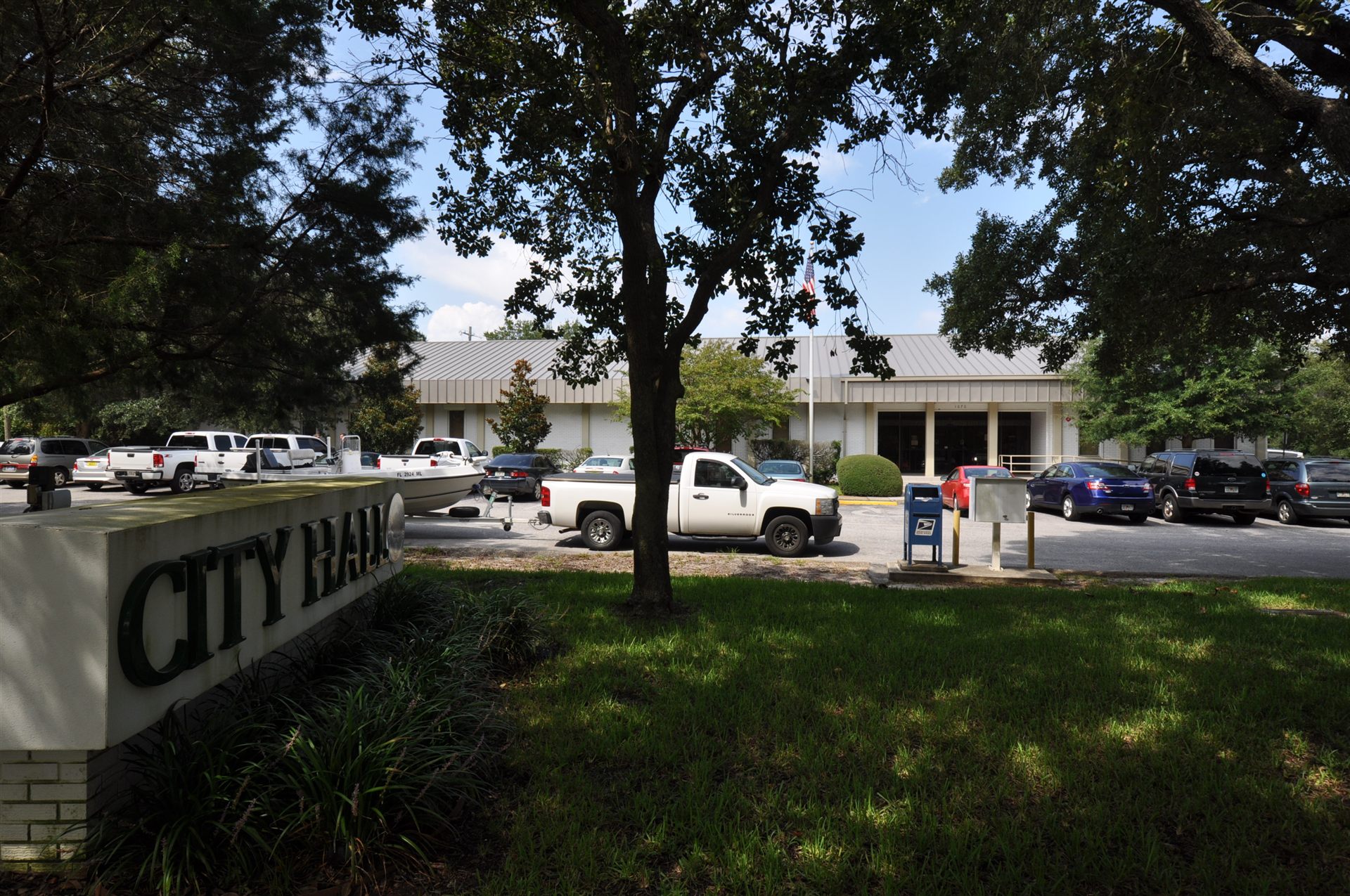
Pictured: Gulf Breeze City Hall in Gulf Breeze, Florida — the town where the sightings occurred, not the disputed photographed object itself. Ed Walters's original Polaroids remain his and his publishers' copyrighted property and their authenticity is itself the subject of this case file; no public-domain or Creative Commons-licensed copy of any Walters photograph, or of the foam model recovered in 1990, could be verified. Readers can view the widely reproduced (but not freely licensed) images via the Google search link above.
Theoretical Alignment
Gulf Breeze is a textbook case study for the Psycho-Social Hypothesis rather than a genuine anomaly. A single, financially and reputationally motivated claimant with a documented forgery conviction produced photographs later matched almost exactly to a recovered physical model; a local newspaper's uncritical publication then seeded a self-reinforcing wave of secondary light and object reports across an entire town over three and a half years. The residual ETH allowance reflects only the small number of independent secondary sightings that a determined skeptic cannot fully attribute to social contagion, misidentification of conventional lights (aircraft, flares, boat traffic on Pensacola Bay), or copycat reporting; it does not reflect any credible evidence tied to Ed Walters's own photographic claims, which the record treats as effectively resolved.
Background
Gulf Breeze, Florida is a small peninsula city in Santa Rosa County, incorporated in 1961, sitting between Pensacola and Pensacola Beach along Florida's Gulf Coast panhandle. In the mid-1980s it was a quiet bedroom community of roughly six thousand residents built around waterfront living, boating, and easy commuting distance to the region's substantial naval aviation infrastructure. Nothing about the town suggested it would become, within a few short years, the site of one of the most publicized, most closely investigated, and most thoroughly litigated UFO photograph controversies in modern American history.
At the center of that controversy was Ed Walters, a self-employed home-building contractor in his early forties who designed and built houses around Gulf Breeze and lived there with his wife Frances Walters and their children. Walters had a criminal record from decades earlier — an eighteen-month sentence in the late 1960s for forgery and auto theft, for which Florida governor Bob Martinez granted him a pardon in March 1990, at the height of the controversy. That earlier conviction, involving exactly the kind of document-fabrication skill later at issue in the case, would become one of the most-cited pieces of circumstantial context once skeptics began compiling their file on him, and it remained essentially unknown to the general public and to most of the journalists covering his UFO claims until years into the controversy.
On the evening of November 11, 1987, Walters reported that a light was shining through a pine tree in his front yard. Stepping outside, he said he saw a bluish-gray, top-shaped craft hovering silently above his property. He ran back inside for an old Polaroid instant camera and took five photographs before, he said, a blue beam of light briefly immobilized him and lifted him slightly off the ground. Days later he brought the photographs to Duane Cook, editor of the community weekly the Gulf Breeze Sentinel, requesting anonymity; Cook published them on November 19, 1987 under the pseudonym "Mr. X," alongside a letter purportedly from the anonymous photographer describing a "dull gray-blue" object roughly the size of a house. Years later it emerged that Walters had written that corroborating "Mr. X" letter himself — a detail skeptics regard as one of the clearest single indicators of intent to deceive in the entire case, since it means the case's very first piece of apparent independent corroboration was self-manufactured.
What happened next transformed a single unverified claim into a genuine regional phenomenon. Over the following six months Walters produced roughly three dozen additional photographs and about ninety seconds of videotape, described repeated close encounters including alleged partial abductions, and became the public face of a sighting wave in which, by various tallies, over one hundred Gulf Breeze-area residents eventually reported their own unexplained lights, discs, or beams between late 1987 and 1991. The Mutual UFO Network (MUFON) sent field investigators within weeks of the first photographs and, within a year, its national leadership was calling Gulf Breeze the best-documented case in the organization's history — an endorsement that would prove deeply consequential, and deeply embarrassing, once the record was re-examined in 1990.
This case file treats those two eras of the story separately and explicitly. The first — Walters's own claims, MUFON's early endorsement, and the national media attention that followed — is examined here in full, on its own terms, because understanding why so many experienced investigators found it initially persuasive is necessary to understand why its later collapse was so consequential for the field. The second era — the 1990 model discovery, the parallel confession from a Walters acquaintance, and MUFON's own internal reinvestigation reaching a hoax conclusion that its leadership then publicly rejected — receives equally detailed treatment, in keeping with this project's standing commitment to documenting the skeptical case with the same rigor applied to the anomalous one.
Complete Timeline
| Date | Event |
|---|---|
| Nov 11, 1987 | Ed Walters reports the first sighting from his home yard, taking five Polaroid photographs of a top-shaped craft and describing brief immobilization by a "blue beam." |
| Nov 17–19, 1987 | Walters delivers photographs and an anonymous "Mr. X" letter — later revealed to be self-written — to Gulf Breeze Sentinel editor Duane Cook, who publishes them Nov. 19. |
| Dec 2, 1987 | Walters reports a second blue-beam immobilization; his wife Frances Walters says she pulled him free. |
| Dec 4, 1987 | MUFON Florida state director Donald Ware and colleague Charles Flannigan open a formal field investigation. |
| Dec 17, 1987 | Walters reports an extensive nighttime encounter involving multiple craft, a liquid/steam discharge he says he sampled, and what he later described under hypnosis as a mutual abduction experience. |
| Dec 24–25, 1987 | The Sentinel publishes photographs from a second anonymous photographer, "Believer Bill," showing three similar craft — early corroboration skeptics later treated with suspicion. |
| Jan–May 1988 | Walters reports additional encounters, including a January 12 close pass on Soundside Drive and a February 7 photograph of Frances attempting to outrun the blue beam. |
| Feb 18 & 23, 1988 | Walters undergoes two polygraph examinations, administered by examiner Harvey W. McLaughlin Jr., who assessed him as truthful on both occasions. |
| May 1, 1988 | Walters's final reported sighting, at Shoreline Park; he says he lost consciousness for roughly an hour. |
| Mid-1988 | MUFON International Director Walt Andrus publicly calls Gulf Breeze "the best case we've ever had." |
| 1988 | CUFOS analysts Robert Boyd and Mark Rodeghier identify photographic inconsistencies and learn from Walters's acquaintances of his history as a self-described prankster. |
| 1989 | Walters publicly acknowledges authorship of the "Mr. X" photographs; MUFON membership and Gulf Breeze tourism both surge on the publicity. |
| March 1, 1990 | Ed and Frances Walters publish The Gulf Breeze Sightings, reportedly commanding a book advance later reported at roughly $200,000, alongside a separate ABC television-rights offer reported at roughly $450,000. |
| March 1990 | Florida Gov. Bob Martinez grants Walters a pardon for his 1967 forgery and auto-theft conviction. |
| June 10, 1990 | The Pensacola News Journal, under reporter Craig Myers, reveals that new owners of Walters's former home found a foam-and-paper UFO model in the attic. |
| June 19, 1990 | The News Journal reports that a Gulf Breeze acquaintance, Tommy Smith Jr., had privately told his attorney father years earlier of Walters's plan to hoax a UFO for profit. |
| Aug–Sept 1990 | MUFON investigators Rex and Carol Salisberry reinvestigate, document hoax indicators including a mismatched reflection geometry and flawed polygraph procedure, and report their findings to Andrus. |
| Oct 1990 | Andrus publicly rejects the Salisberrys' conclusions, siding with a revised distance calculation from Bruce Maccabee; MUFON's Director of Public Education resigns in protest, and skeptic Philip J. Klass separately reports the model's blueprint backing matches a house Walters built before the sightings began. |
| Nov 1992 | Ed and Frances Walters divorce, dividing an estimated $2.5 million in book and media proceeds. |
| Feb 1993 | Tommy Smith Jr. states on camera that he personally witnessed Walters staging double-exposure UFO photographs. |
| 1994 | Ed and Frances Walters publish a second book, UFO Abductions in Gulf Breeze, detailing hypnotic-regression sessions. |
| 2000 | MUFON disconnects its dedicated Gulf Breeze hotline after new reports taper off entirely. |
The Sentinel, "Mr. X," and the Snowball Effect
The role of the Gulf Breeze Sentinel in transforming Walters's private claim into a community-wide phenomenon cannot be overstated. Editor Duane Cook ran a small weekly paper with no investigative-journalism infrastructure and, by his own later account, took Walters's photographs and cover story largely at face value. Publishing them under the pseudonym "Mr. X" — with an accompanying anonymous letter that gave the photographs the appearance of a second, independent voice vouching for their strangeness — created the impression of corroboration where none existed. Investigators later established that Walters wrote the "Mr. X" letter himself. This detail matters more than it might first appear: nearly every subsequent stage of the case's credibility, from MUFON's early field reports to national television coverage, rested in some part on the premise that the Sentinel had been approached by a genuinely reluctant, anonymous local citizen rather than by the same person twice, once as "witness" and once as his own corroborator.
Cook's paper went on to publish further anonymous UFO photo submissions from around town, including a set from a second pseudonymous photographer, "Believer Bill," in late December 1987. Skeptical researchers have never established with certainty whether "Believer Bill" was a separate hoaxer, a Walters-orchestrated second identity, or a genuine additional claimant swept up in the excitement — but the pattern, of a single sensational initial claim followed rapidly by additional "independent" photographic claims from the same small readership, is a recognized signature of a social-contagion sighting wave rather than an evidentiary strength.
Escalation: December 1987 – May 1988
Once MUFON's Donald Ware began a formal investigation in early December 1987, Walters's reported encounters accelerated in both frequency and dramatic content. The December 17, 1987 encounter, which Walters said involved multiple craft, a discharge of "boiling" liquid, and elements later reconstructed under hypnosis as a mutual abduction, marked a significant escalation from the original single-photograph sighting six weeks earlier — a pattern consistent with a narrative growing to match an increasingly attentive and credulous audience. By February 1988 Walters was producing photographs depicting his own wife's alleged encounter with the phenomenon, and by May 1, 1988 he was describing full loss of consciousness. Across this period, Walters's account grew steadily more elaborate, better photographed, and more directly enmeshed with organized UFO research infrastructure — MUFON investigators, a sympathetic optical physicist, and eventually a national television audience — at precisely the pace a hoax constructed for maximum ongoing attention and eventual commercial value would be expected to grow. Notably, several of the most dramatic later claims — the alleged partial abduction of December 17, 1987, and the reported hour-long loss of consciousness on May 1, 1988 — relied on hypnotic regression to be reconstructed in full narrative detail, a technique with a well-established record of producing confabulated or investigator-influenced memories rather than reliably recovering suppressed but accurate ones. That dependency on hypnosis for the case's most extraordinary specific content is itself a methodological weak point independent of anything the 1990 model discovery later revealed.
Early Skeptical Analysis: Willy Smith and CUFOS (1988)
Skepticism toward Walters's photographs did not begin with the 1990 model discovery — it was present, and substantive, from nearly the start. In September 1988, physicist Willy Smith of UNICAT, himself a pro-UFO researcher rather than a movement outsider, published a 26-page technical report documenting what he called "evidence of deception" in the early photographs, including his observation that the object's shape appeared "slightly asymmetrical" in the earliest images and grew progressively more symmetrical in later ones — the pattern one would expect if a hand-built model were being incrementally refined between shoots, not if a single physical craft were being repeatedly photographed. Separately, the Center for UFO Studies published an internal assessment in April 1988 — just five months after the first photograph — characterizing the case as an "apparent hoax," based substantially on the same window-spacing and hull-asymmetry observations Robert Boyd and Mark Rodeghier would continue to refine over the following two years. That two of the earliest, most technically qualified analyses of the case — one from a sympathetic UFO researcher, one from the field's leading scientific study group — independently arrived at skepticism before Walters had published a single book or reached national television is a detail frequently omitted from popular retellings that treat the 1990 model as the first serious challenge to his account.
Forensic photography expert William G. Hyzer, later consulted at MUFON's own request in an attempt to salvage the case's credibility after the Salisberry findings, instead reached his own independent conclusion that the photographs were "double-exposure hoaxes." NASA Jet Propulsion Laboratory scientist Robert Nathan, retained separately by the National Enquirer to evaluate the images before a possible purchase, could not certify them as genuine and flagged evidence consistent with double exposure and manual "cut and paste" compositing; the Enquirer ultimately declined to buy the photographs on that basis, a commercially significant rejection from a tabloid not otherwise known for a high evidentiary bar.
MUFON's Investigation and Endorsement
Donald Ware, a retired Air Force fighter pilot serving as MUFON's Florida state director, became the case's lead field investigator within weeks of the first photograph, ultimately interviewing hundreds of local sighting reports and more than a dozen self-described abductees over the following years. His genuine aviation and technical background lent the early investigation real credibility. Optical physicist Bruce Maccabee, a U.S. Navy researcher with an established record analyzing earlier photographic cases including the McMinnville Trent photographs, examined five of Walters's Polaroids and produced a ninety-page technical report concluding there was "a good chance it's the real thing." Maccabee and MUFON jointly argued that faking the images by double exposure would have required an implausibly large lighting rig — reportedly calculated at roughly 1,000 one-hundred-watt bulbs powered by a 100-kilowatt generator — to produce the observed ground illumination, a technical argument that, for a time, was one of the strongest points in the case's favor.
By mid-1988, MUFON International Director Walt Andrus was publicly describing Gulf Breeze as the best-documented case in the organization's history. That endorsement drove a measurable surge in MUFON's membership and culminated in the organization's first annual symposium held in Pensacola in 1990, which drew hundreds of attendees and prompted local tourism officials to credit the UFO publicity with a meaningful visitor bump — a travel agent later told reporters roughly 600 flights were arranged for conference attendees. The financial and institutional stakes MUFON had by then accumulated in the case's authenticity would become directly relevant two years later, when the organization's own reinvestigation team reached the opposite conclusion.
National Fame and the Financial Record
Gulf Breeze made Walters a minor national celebrity. He appeared on NBC's Unsolved Mysteries on October 5, 1988 (with a follow-up segment October 3, 1990), and later on A Current Affair (1989) and Inside Edition (1990). On March 1, 1990, Ed and Frances Walters published The Gulf Breeze Sightings: The Most Astounding Multiple Sightings of UFOs in U.S. History. Supporters, including researcher Budd Hopkins, had publicly credited Walters with refusing lucrative offers to protect his credibility as a reluctant witness. The Pensacola News Journal's later financial reporting directly contradicted that narrative: it documented a book advance reported at approximately $200,000 and a separate ABC television-rights offer reported at roughly $450,000 — figures that, once public, fundamentally undercut the "reluctant witness with nothing to gain" framing that had done real work in building public sympathy for Walters's account. ABC ultimately dropped its planned dramatization after the 1990 controversy broke.
The Attic Discovery, June 1990
The case's central turning point came on June 10, 1990, when the Pensacola News Journal, led by reporter Craig Myers, reported that the new owners of Walters's former home had found a small UFO model hidden in the attic. The model measured roughly nine inches by six inches and was built from four Styrofoam ceiling-tile plates, cardboard, drafting paper, blue-tinted plastic gel film, a six-inch orange paper ring, a three-inch plastic tube, a two-inch paper ring, and electrical tape at its base, with windows hand-punched around roughly two-thirds of its circumference. News Journal photographers photographed the model against a night sky using an ordinary Polaroid camera and a simple double-exposure technique, producing images that closely matched several of Walters's original photographs — down to the same asymmetrical window spacing and the same slightly uneven hull profile that Robert Boyd of CUFOS had flagged as suspicious nearly two years earlier.
Perhaps the single most damaging detail to emerge from the discovery was on the model's own paper backing: hand-drawn measurements and notations that Walters himself, when shown the material, acknowledged resembled his own handwriting. Skeptic Philip J. Klass subsequently reported that the blueprint paper used as backing material matched drafting paper tied to a specific house Walters had built — one constructed before the November 1987 sightings began, meaning the model could not have been "planted" using paper Walters acquired only after his fame made him a target, as he would later claim. Local police records showed no burglary reports filed at the property during the relevant period, undermining Walters's alternative explanation that the model had been surreptitiously planted by debunkers or government agents to frame him.
Tommy Smith's Confession
Nine days after the model's discovery, on June 19, 1990, the Pensacola News Journal reported that a local attorney had come forward saying his son, Tommy Smith Jr., had told him more than two years earlier — long before the model surfaced publicly — that Walters intended to profit from a staged UFO hoax. In February 1993, Smith went further, appearing on camera to describe personally witnessing Walters constructing double-exposure UFO photographs. Walters disputed Smith's account and it was never tested in a court proceeding, but the timing of the elder Smith's original private disclosure — years before the model discovery gave the claim any public corroboration — is treated by researchers on both sides of the debate as one of the case's more difficult-to-dismiss pieces of evidence, since it could not have been reverse-engineered from later publicity.
MUFON's Internal Civil War: The Salisberry Investigation
Facing a case that had become central to its own institutional identity and fundraising, MUFON assigned husband-and-wife field investigators Rex and Carol Salisberry to formally reinvestigate Walters over August and September 1990. Their findings were unambiguous and damaging: the recovered model included hand-drawn horizontal lines and features that matched details Walters had described in some of his own accounts but that never actually appeared in his released photographs — a strong indicator that the model, not an independently observed craft, was the true reference object behind at least some of his narrative descriptions. They also identified serious procedural flaws in Walters's original 1988 polygraph examinations, including an examiner without accepted forensic-polygraph certification and vague, non-standard scoring language such as "it is felt" in place of rigorous pass/fail analysis. In direct experiments recreating disputed photograph #19, the Salisberrys demonstrated that its reflection geometry was physically implausible at the claimed camera height and altitude, but was easily reproduced with a small hand-held model shot at close range using double exposure.
The Salisberrys reported their conclusions to Walt Andrus in September 1990. Rather than accepting the findings of MUFON's own assigned investigators, Andrus publicly rejected them the following month, instead citing a revised distance calculation from Bruce Maccabee — whose own original figure for the same disputed photograph had shifted from roughly 185 feet to roughly 370 feet, a substantial after-the-fact recalculation that itself called the original photographic analysis into question rather than resolving it. Andrus publicly stated the Salisberrys "do not have grounds to arrive at that conclusion until it is submitted to us," and MUFON's Director of Public Education, Marge Christensen, resigned in protest, telling reporters the organization had "become nothing but a pop club" and that trained investigators had "rushed to judgement and made such rash claims" — a remarkable public rebuke, aimed not at the skeptics but at MUFON's own leadership, from within the organization's own ranks. Both Salisberrys said afterward that they were effectively pushed out of MUFON for reaching a conclusion the organization did not want.
The Wider Flap: Independent Witness Reports
None of this fully resolves the parallel, genuinely independent phenomenon of secondary Gulf Breeze sightings. Between late 1987 and 1991, well over a hundred area residents — described in contemporary local reporting as including a city councilwoman, a county commissioner, tollbooth operators, a couple reporting a disc-shaped object over their waterfront pier, and a family reporting a small craft pursued by military jets — independently reported unexplained lights, discs, or beams around the Pensacola Bay area, including one January 1990 report of a UFO allegedly chased by eight helicopters, which the U.S. Navy publicly denied any involvement in. These reports are not resolved simply by the discovery of Walters's model; they represent a genuine, if far less remarkable, secondary phenomenon most plausibly explained as a combination of conventional misidentification (aircraft, flares, boat and dock lighting reflected off the bay and sound) and the well-documented tendency of intense local media coverage to prime observers to notice, misinterpret, and report ordinary night-sky lights as anomalous once a town's attention has been captured by a famous claim in its midst.
Aftermath
Ed and Frances Walters divorced in November 1992, dividing an estimated $2.5 million in accumulated book and media proceeds — figures that further undercut the earlier public narrative of a reluctant, financially disinterested witness. The couple published a second book, UFO Abductions in Gulf Breeze, in 1994, expanding the story to include hypnotically recovered claims of abductions dating back across Walters's entire life, including recovered-memory sessions describing recurring encounters at roughly eight-year intervals and speculative claims about a multi-generational human-alien genetic program. Ed Walters has never recanted his account and continues to maintain that the recovered model was planted by government agents or organized skeptics to discredit him; he has separately suggested that a stranger with out-of-state license plates was seen entering his old garage before the model's discovery. No evidence beyond his own assertion supports either explanation, and neither addresses the independently sourced handwriting match on the model's blueprint backing or the Smith family's pre-discovery private disclosure. Local police records for the relevant period show no burglary reports filed at the property, which is difficult to reconcile with a claim of unauthorized entry by outside actors.
MUFON, having built substantial institutional capital around the case through the late 1980s and the 1990 Pensacola symposium, quietly disconnected its dedicated Gulf Breeze sightings hotline in 2000 once new reports had effectively ceased — a low-key, unpublicized end to an affair the organization had once called its best-documented case. Duane Cook's Gulf Breeze Sentinel did not long outlast the controversy it had launched; the paper was eventually purchased by the Pensacola News Journal — the very publication whose reporting had done the most to unravel the story it once carried — and ceased independent operation. The case remains a fixture in skeptical literature on UFO photo hoaxes and in popular culture — referenced, among other places, in a 1994 episode of The X-Files in which FBI agent Fox Mulder states outright that he knows the Gulf Breeze photographs "were fakes," and later revisited in television retrospectives including a 1996 Strange But True? episode in which Walters appeared as himself, still defending the original account decades on.
Key Witnesses
Ed Walters
Reported the first sighting on November 11, 1987 and produced roughly three dozen photographs over the following six months. Passed two 1988 polygraph exams administered by a non-specialist examiner. Held a prior 1967 forgery and auto-theft conviction (pardoned 1990). A foam model closely matching his photographed object was recovered from his former home's attic in June 1990, with handwriting he acknowledged as his own on the model's blueprint-paper backing. Has never recanted his account.
Frances Walters
Corroborated several of her husband's reported encounters, including the December 2, 1987 blue-beam incident and her own alleged February 7, 1988 encounter. Co-authored both of Ed Walters's books. As a spouse with a direct financial stake in the case's continued credibility (the couple's book and media proceeds were later valued at roughly $2.5 million at their 1992 divorce), her corroboration carries limited independent evidentiary weight.
Tommy Smith Jr.
A young Gulf Breeze acquaintance of Walters whose father, an attorney, told the Pensacola News Journal in June 1990 that his son had privately disclosed Walters's hoax plans more than two years earlier. Smith himself went on camera in February 1993 describing having witnessed Walters stage double-exposure photographs firsthand. His account was disputed by Walters and never tested in court, but its private, pre-discovery timing is a significant piece of circumstantial evidence.
The Five Observables Assessment
The Five Observables framework is applied to the performance characteristics reported in this case:
Assessment: Even taken entirely at face value, Walters's account describes a craft that was directly observed at close range, repeatedly photographed with a handheld consumer camera, and never displayed extreme velocity or maneuvering — the opposite of low observability, and unsupported by any instrumented measurement of acceleration or speed. Only silent hovering (implying, if genuine, some form of lift without visible propulsion) has any basis even in the uncorroborated narrative, and that narrative is itself directly contradicted by a recovered physical model matching the photographed object in construction and dimension. None of the five observables is supported by independent instrumentation in this case.
Evidence Assessment
Supporting Anomalous Origin
- Walters passed two 1988 polygraph examinations, both scored as truthful by the administering examiner
- Bruce Maccabee's ninety-page technical report found no conclusive evidence of double exposure in the original prints he examined
- Reproducing the visible ground illumination by conventional double exposure would, per Maccabee and MUFON's calculation, have required an implausibly large staged lighting rig
- Well over a hundred Gulf Breeze-area residents independently reported unexplained lights or objects between 1987 and 1991, a phenomenon larger than any single individual's claims
- MUFON's Florida state director Donald Ware, a credentialed former fighter pilot, remained personally convinced of the case's authenticity even after the model discovery
Supporting Conventional Explanation
- A foam-and-paper model closely matching the photographed object, down to window spacing and hull asymmetry, was recovered from Walters's former attic in June 1990
- Handwritten measurements on the model's blueprint-paper backing were acknowledged by Walters himself to resemble his own handwriting, on paper tied to a house he built before the sightings began
- The "Mr. X" letter that first gave the Sentinel photographs the appearance of independent corroboration was later confirmed to have been written by Walters himself
- Tommy Smith Jr.'s father privately reported Walters's hoax intentions in 1988, years before the model surfaced publicly, and Smith later described witnessing the staging directly
- MUFON's own reinvestigation team, Rex and Carol Salisberry, independently reached a hoax conclusion using reflection-geometry experiments and were rebuffed by MUFON leadership rather than refuted on the evidence
- Walters concealed a prior forgery and auto-theft conviction and had a documented reputation among acquaintances as a prankster who spoke of pulling off "the ultimate prank"
- Financial records later showed a roughly $200,000 book advance and a roughly $450,000 ABC television offer, directly contradicting the "reluctant, disinterested witness" narrative built around the case
- Forensic photo expert William G. Hyzer and NASA JPL's Robert Nathan both separately found the images consistent with double-exposure hoaxing rather than a genuine photographed object
Why "Debunked"
Gulf Breeze earns a Debunked stamp because the specific, central evidentiary claim of the case — Ed Walters's photographs — is directly contradicted by physical, forensic evidence rather than merely disputed on interpretive grounds. Most contested UFO photo cases turn on competing readings of ambiguous imagery; Gulf Breeze turned on the literal recovery of the probable prop itself, matching the photographed object's proportions and construction, bearing the claimant's own apparent handwriting on paper traceable to a period before his claims even began. That is corroborated by an independent private disclosure (the Smith family's 1988 account, given years before the model surfaced) and by MUFON's own internal reinvestigation team reaching the identical hoax conclusion through separate technical means — a rare case where the organization most institutionally invested in a sighting's authenticity produced the strongest documented rebuttal to it, only to have that rebuttal overruled by its own leadership for reasons that were organizational and financial rather than evidentiary. A score in the debunked tier, rather than the lowest possible score, reflects one genuine complicating factor: the wider Gulf Breeze sighting wave, in which well over a hundred residents independent of Walters reported their own unexplained lights, is not itself resolved by the model discovery and remains best (if unglamorously) explained as social-contagion misidentification rather than as a component of Walters's specific hoax. It is also worth stating plainly what this rating does not claim: it does not assert that every one of the hundred-plus secondary Gulf Breeze witnesses was lying, mistaken about their own honesty, or complicit in anything. Most were almost certainly reporting real, if conventional, night-sky observations in good faith, made newly notable to them by a town-wide atmosphere Walters's own fabrication had created. The debunked stamp applies specifically and narrowly to the evidentiary claim this case file is built around — Ed Walters's photographs and personal narrative — where the record is, by the standards this project applies across every case, about as conclusively resolved as a UFO photo case gets.
Sensor & Instrumentation Detection Profile
No radar, FLIR, magnetometer, or other instrumented sensor ever recorded the Gulf Breeze object. The entirety of the "hard" evidentiary record consists of consumer-grade Polaroid instant photographs, a single roughly 90-second home-video segment, and two 1988 polygraph examinations of Walters himself administered by an examiner with no radar or optical-analysis training. Bruce Maccabee later suggested Walters use a dual-mounted 35mm/video camera rig to enable stereoscopic triangulation of any future sighting — a genuine attempt to upgrade the case's evidentiary rigor — but no photograph in the released record was produced under that improved protocol before the case collapsed in 1990. The absence of any instrumented corroboration is itself analytically significant given the surrounding infrastructure: Gulf Breeze sits within radar and radio coverage of multiple active naval and Air Force facilities, and a genuinely sustained, months-long pattern of low-altitude aerial incursions over a populated coastal town adjacent to that much military aviation activity would be a plausible candidate for at least incidental radar or air-traffic-control detection. No such detection has ever been reported or declassified in connection with this case.
Environmental & Geospatial Context
Gulf Breeze, Florida sits on the Fairpoint Peninsula, a narrow strip of land bounded by Pensacola Bay to the north and Santa Rosa Sound to the south, within the greater Pensacola metropolitan area — a region dense with military aviation infrastructure, including Naval Air Station Pensacola, Whiting Field, and Eglin Air Force Base's test range corridor to the east. That water-on-three-sides geography became directly relevant to the skeptical photo analysis: CUFOS analyst Robert Boyd identified a rippling distortion in several Walters images consistent with a picture taken near, or reflected off, a body of water. No meteorological log from November 1987 specific to Gulf Breeze has been located in the available record; witness accounts uniformly describe clear or lightly overcast evenings with no storm activity. The peninsula's dense recreational and commercial boat traffic on both the bay and the sound is itself a plausible conventional source for a share of the town's independent secondary light reports, since running lights, anchor lights, and dock floodlights reflected or refracted across open water at night are a well-documented cause of misidentified "hovering" or "pulsing" object reports in coastal UFO literature generally, separate from anything specific to Walters's own claims.
Observer Credibility & Occupational Profile
Ed Walters was a self-employed home-building contractor and building designer — a profession that gave him genuine drafting, blueprint, and small-scale model-construction skills, the same skills a skeptic would expect a successful hoaxer in this exact case to have. He had also served eighteen months in the late 1960s for forgery and auto theft, a fact concealed from the public until after his fame was established and one directly relevant to an evaluation of his credibility as a documentary witness. His wife Frances Walters corroborated several encounters, but as a spouse and eventual co-author with a direct financial stake in the book proceeds, her testimony carries limited independent evidentiary weight. On the institutional side, Donald Ware brought genuine credentials (a retired Air Force fighter pilot and Duke-trained engineer) to the initial MUFON investigation, while Walt Andrus's later handling of the case — publicly rejecting his own reinvestigation team's hoax findings after Gulf Breeze had become MUFON's signature membership-driving case — is itself a credibility factor working against the organization's endorsement. Rex and Carol Salisberry, by contrast, had no comparable institutional or financial stake in the case's outcome when they were assigned to reinvestigate it, and their willingness to report a hoax conclusion at direct cost to their own standing within MUFON is itself a point in favor of their analysis's objectivity — the opposite incentive structure from the one that shaped Andrus's public response.
Physical & Material Assays
The case's single, decisive physical-evidence event cuts against the anomalous interpretation: the June 1990 discovery, in the attic of Walters's former home, of a nine-inch-by-six-inch model built from Styrofoam ceiling-tile plates, cardboard, drafting paper, blue-tinted plastic gel, an orange paper ring, a short plastic tube, and electrical tape — reproduced almost exactly by Pensacola News Journal photographers using ordinary Polaroid double-exposure technique. Separately, Walters described collecting a sample of "boiling" liquid that allegedly leaked from the craft during the December 17, 1987 encounter; no independent laboratory analysis of that sample has ever been published or verified in the case record, itself a significant evidentiary gap given how central the claim was to Walters's own narrative.
Historical Precedents & Archive Matches
Gulf Breeze belongs to a small cluster of "great photographic UFO cases" whose authenticity was fought over for years before being substantially resolved by physical or technical evidence — most directly comparable to the 1950 McMinnville (Trent) photographs and the 1951 Lubbock Lights, both of which Bruce Maccabee also investigated, in each case defending the images' authenticity against skeptical challenge. Gulf Breeze differs from those two earlier cases in one crucial respect: McMinnville and Lubbock never produced a recovered physical prop matching the photographed object, leaving both cases genuinely inconclusive decades later, whereas Gulf Breeze produced exactly that kind of dispositive physical evidence. It is unrelated, despite superficial press conflation, to the 1990 "Gulf Breeze Six" incident, in which six U.S. Army military-intelligence analysts deserted their posts in Augsburg, West Germany and were arrested in Gulf Breeze the same week as that year's MUFON symposium; the two episodes share only a town name and rough timing, not participants or evidence. Some contemporary and later accounts conflated the two stories, or implied the deserters were somehow linked to the UFO case, an association neither Wikipedia's own account nor any contemporaneous reporting substantiates — the deserters' own later statements describe motivations rooted in apocalyptic and Ouija-board-derived religious beliefs, entirely separate and distinct from any connection to Walters or his specific claims.
Material Analysis
The only physical object of forensic significance ever recovered in the Gulf Breeze case is the model discovered in Walters's former attic on June 10, 1990 — and it is evidence for a hoax, not against one. Constructed from four Styrofoam ceiling-tile plates, cardboard, drafting paper, blue-tinted plastic gel film, an orange paper ring roughly six inches across, a three-inch plastic tube, a two-inch paper ring, and electrical tape, the model was small enough to be hand-held roughly at arm's length from a Polaroid lens — exactly the setup the Salisberrys and Pensacola News Journal photographers independently used to reproduce Walters's images. No metallurgical, isotopic, or trace-chemical analysis was possible or necessary; the materials are unremarkable household and craft-store items, and their identity was never seriously disputed once the model surfaced. The claimed liquid sample from the December 17, 1987 encounter represents the case's one potentially more substantive physical-evidence lead — a genuinely testable trace sample, if it existed and were handled properly — but no chain of custody, laboratory report, or independent test result for that sample has ever been published, leaving it an unresolved claim rather than verified evidence either way.
Supporting Non-Terrestrial Origin
- No published chemical analysis of the claimed December 1987 liquid sample has been produced to rule out an anomalous origin, leaving that specific claim technically untested
- Believers note the recovered model's exact provenance and construction date were never conclusively proven in a courtroom setting
Supporting Terrestrial Origin
- The recovered model is built entirely from ordinary hobbyist materials (foam ceiling tile, drafting paper, plastic gel, electrical tape) consistent with a home workshop, not fabrication or transport of genuine debris
- The model's dimensions and construction directly reproduce the photographed object's proportions and asymmetries when re-photographed under the same double-exposure technique
- No independently verified physical trace evidence of any non-terrestrial material has ever been produced in this case
The Conventional Explanation Candidate
Three distinct terrestrial explanations must be evaluated separately, because they operate at different scales: Walters's specific photographic claims, the broader secondary sighting wave his claims triggered, and the residual possibility — championed by MUFON and Bruce Maccabee for years — that something genuinely unexplained underlies the case regardless of Walters's own credibility. Distinguishing these three levels matters because collapsing them together is precisely how the case's defenders and, at times, its harshest critics have each overstated their position: a genuine secondary witness in Gulf Breeze reporting an unusual light in 1989 was not necessarily lying or complicit in Walters's specific hoax, and conversely, the reality of Walters's own fabrication does not retroactively prove every other resident who ever reported a light over the town was mistaken or dishonest. The three candidates below are rated independently for exactly this reason.
Elaborate Photographic Hoax
Highly PlausibleA hand-built foam model, shot at close range against a night sky using ordinary Polaroid double-exposure technique, explains the photographs' proportions, window irregularities, and reflective "waviness" precisely — and the actual model, tied to Walters by handwriting evidence, has been recovered. Combined with the self-authored "Mr. X" letter, the confirmed forgery conviction, the pre-discovery Smith family disclosure, and a clear, well-documented financial motive, this is by far the best-supported explanation for Walters's own claims specifically.
Social Contagion / Mass Misperception
PlausibleThe hundred-plus secondary sightings reported by uninvolved Gulf Breeze residents between 1987 and 1991 are well explained by intense local and national media saturation priming observers to notice, misinterpret, and report ordinary aircraft lights, flares, and reflections off Pensacola Bay boat traffic as anomalous, particularly once national television coverage made the town itself a subject of fascination. This does not require any individual secondary witness to be lying, only to be primed.
Genuine Anomalous Phenomenon Independent of Walters
Unproven / Largely UnderminedChampioned for years by MUFON leadership and, more cautiously, by Bruce Maccabee, this position held that even if some of Walters's claims were embellished, an underlying genuine sighting phenomenon existed in Gulf Breeze. It has been substantially undermined by MUFON's own internal reinvestigation, by Maccabee's own distance recalculation for a key disputed frame, and by the absence of any instrumented (radar, radiometric, or multi-observer triangulated) data independent of Walters's personal photographs.
Related Cases
Honest Assessment: No Federal Case File Exists
Gulf Breeze was never a military-observed or government-investigated incident. It occurred nearly two decades after the U.S. Air Force closed Project Blue Book in 1969, and no federal agency — military, civilian, or intelligence — opened a file, fielded an investigator, or issued any public statement specific to Walters's claims. The case was investigated entirely by private citizens: MUFON's own field investigators, a freelance optical physicist, and eventually an independent newspaper. The only genuine government record connected to the case is Florida Gov. Bob Martinez's March 1990 executive pardon of Walters's unrelated 1967 forgery and auto-theft conviction — a state clemency action, not a UFO investigation. Readers wanting to verify this absence, or check for any later re-examination, can search the federal archives directly below.
Search Government Archives Directly (No Gulf Breeze-Specific Records Exist)
Further Reading — Recommended Literature
The Gulf Breeze Sightings
The primary claimant's own first-person account and photograph collection, essential for understanding the case's original supportive narrative on its own terms before weighing the later evidence against it.
UFO Abductions in Gulf Breeze
The Walters's 1994 follow-up, expanding the story via hypnotic-regression sessions into a lifelong abduction narrative — useful for tracing how the claim evolved after the 1990 model controversy.
War of the Words: The True But Strange Story of the Gulf Breeze UFO
Written by the Pensacola News Journal reporter who broke the 1990 model story, this is the single most detailed investigative account of the case's unraveling, drawn from the author's own original reporting.
Bad UFOs: Critical Thinking About UFO Claims
A leading skeptical researcher's collected case analyses, including his own contemporaneous tracking of the Gulf Breeze case's collapse for Skeptical Inquirer's "Psychic Vibrations" column.
Captured in Gulf Breeze: The Polaroid, the Pentagon, and America's Most Famous UFO Case
A more recent, sympathetic full-length re-examination of the case and its surrounding military geography, useful as a counterweight for readers wanting the strongest modern restatement of the supportive position.
Essential Viewing
Sources
- Craig R. Myers, War of the Words: The True But Strange Story of the Gulf Breeze UFO, AuthorHouse, 2006 — the fullest investigative account by the reporter who broke the 1990 model story.
- Robert Sheaffer, "Psychic Vibrations: Gulf Breeze Flap Fades," Skeptical Inquirer, Vol. 15, 1991. Center for Inquiry archive →
- Robert Sheaffer, review of War of the Words by Craig R. Myers, Skeptical Inquirer, Vol. 31 No. 5, Sept/Oct 2007. Skeptical Inquirer →
- George P. Posner, "Gulf Breeze UFOs," technical case analysis. gpposner.com →
- UPI, "Gulf Breeze sightings divide UFO experts," Jan. 29, 1989. UPI Archives →
- "The Gulf Breeze UFO Incident," PensacolaBeach.com local history feature. pensacolabeach.com →
- "Gulf Breeze UFO: Ed Walters and the Florida Photo Flap," Swear It Happened. swearithappened.com →
- "The initial encounters: November – December 1987," detailed case chronology. astronomyufo.com →
- "Star investigators sent to clarify the situation: August to September 1990" (the Salisberry reinvestigation). astronomyufo.com →
- "Investigation rejected: October 1990" (MUFON leadership's rejection of the Salisberry findings). astronomyufo.com →
- "Gulf Breeze UFO incident," background reference with citations to contemporary newspaper reporting. Wikipedia →
- "Gulf Breeze Six," background on the unrelated 1990 military-desertion incident often conflated with the UFO case. Wikipedia →
- "Gulf Breeze, Florida," municipal geography and demographics. Wikipedia →
- City of Gulf Breeze, "The Gulf Breeze Story," official municipal history. cityofgulfbreeze.us →
- NICAP, "Who Was Bruce Maccabee," biographical archive. nicap.org →
- Ed Walters & Frances Walters, The Gulf Breeze Sightings: The Most Astounding Multiple Sightings of UFOs in U.S. History, William Morrow, 1990.
- Ed Walters & Frances Walters, UFO Abductions in Gulf Breeze, Avon Books, 1994.
- Robert Sheaffer, Bad UFOs: Critical Thinking About UFO Claims, self-published, 2015.
- Gary Covella, Captured in Gulf Breeze: The Polaroid, the Pentagon, and America's Most Famous UFO Case, 2024.
- MUFON (Mutual UFO Network), organizational history and case archive references. mufon.com →
- National Archives and Records Administration, general federal records catalog (consulted; no Gulf Breeze-specific record found). catalog.archives.gov →
- U.S. Freedom of Information Act portal, general federal FOIA request system (consulted; no Gulf Breeze-specific federal case file exists to request). foia.gov →
See something inaccurate? Have additional information or sources?
Suggest an Edit →Last Updated: August 3, 2026