
Hessdalen Lights
Since December 1981, an isolated valley in central Norway has produced recurring, often instrument-corroborated luminous phenomena — investigated continuously by Erling Strand's Project Hessdalen, the longest-running scientific field study of an unexplained light phenomenon anywhere in the world. Radar, magnetometers, and spectrometers have confirmed the lights are a real, physical, energetic event. More than four decades and dozens of peer-reviewed papers later, no single explanation — natural or otherwise — has been proven to account for all of it.
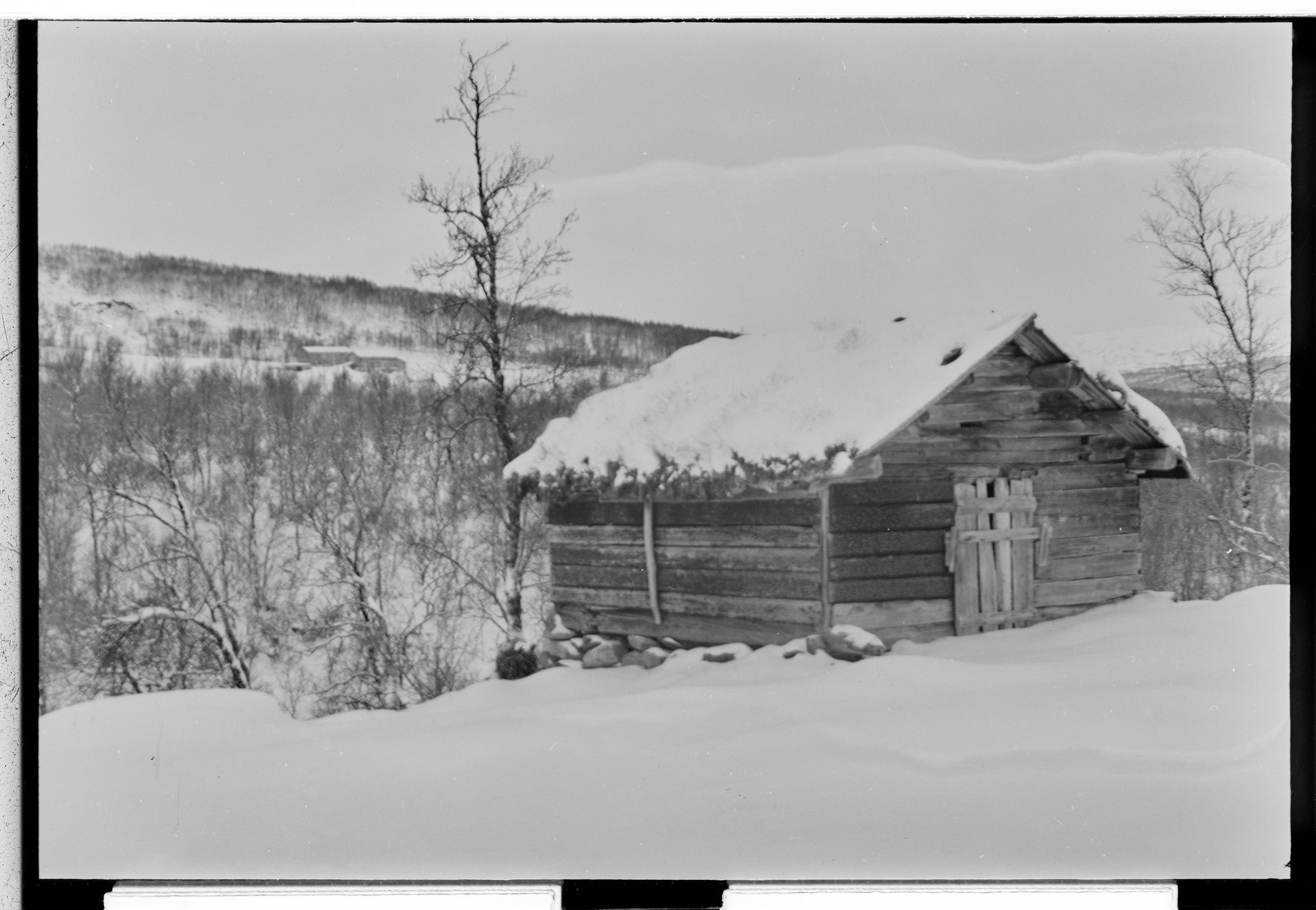
Pictured: the Hessdalen valley and hamlet, Holtålen Municipality, Norway, photographed in winter 1953 by an unknown photographer for the magazine Billedbladet NÅ (National Archives of Norway, CC BY-SA 4.0) — nearly three decades before the 1981 light wave began. No public-domain or rights-clear photograph of the light phenomenon itself is used here: the best-documented instrumented photographs (including Bjørn Gitle Hauge's own 2007 spectrographic capture, published via the European Geosciences Union's Imaggeo archive) are licensed non-commercial-only (CC BY-NC-SA), which this site's own affiliate-linked content cannot lawfully host.
Theoretical Alignment
No credible researcher associated with Project Hessdalen, EMBLA, or the peer-reviewed literature surveyed for this case file has proposed that the lights represent a piloted, intelligently controlled craft of any origin; the case sits almost entirely outside the Extraterrestrial and Interdimensional hypotheses as they are normally framed elsewhere on this site. The scientific debate is instead a naturalistic one — between several competing geophysical and atmospheric plasma models, discussed in full under Historical Precedents and the Conventional Explanation Candidate below. A modest Psycho-Social alignment is warranted for the uninstrumented portion of the 1981–84 wave, when a small, isolated community under sudden media attention almost certainly over-reported ordinary lights (aircraft, planets, mirages) alongside genuine anomalies; the instrumented, radar- and spectrum-confirmed detections since 1984 cannot be explained this way.
Background
Hessdalen is a narrow, sparsely populated valley of a few hundred residents in Holtålen Municipality, in the mountainous interior of Trøndelag county in central Norway. For most of the twentieth century it was known, if at all, for small-scale iron, copper, zinc, and scandium mining — the valley's bedrock hosts thortveitite, a scandium-bearing mineral extracted commercially there in the 1960s, alongside sulfide ore deposits that left the river Hesja running through acidic mine drainage in places. Isolated, informal reports of unexplained lights in the surrounding mountains circulate in local memory reaching back decades before 1981, though no systematic record exists for that earlier period. What changed the valley's history irreversibly was a sudden, sustained wave of sightings beginning in December 1981: farmers Åge and Ruth Marry Moe reported what they described as a "burning fireball" in the evening sky, and within weeks dozens, then hundreds, of similar reports followed from across the small community. By 1982–83, at the wave's peak, residents were logging fifteen to twenty separate light observations per week — an extraordinary density of activity for a valley with only a few hundred inhabitants, and one that quickly drew Norwegian national press attention, UFO researchers from the organizations UFO-Norge and UFO-Sverige, and eventually academic and defense-research interest.
What distinguishes Hessdalen from virtually every other mass-witness light wave in this archive is what happened next: rather than fading into folklore or a single field report, as most such waves do, the valley became the subject of the world's longest continuously maintained scientific field investigation of an unexplained light phenomenon. Erling Strand, then a young electrical engineer, helped organize the first formal field investigation in 1984 and has led or co-led the project in one capacity or another ever since, eventually becoming an associate professor at Østfold University College and Project Hessdalen's project manager from 1993 onward. Early organizational meetings were held at the facilities of Norway's own Forsvarets forskningsinstitutt (FFI, the Norwegian Defence Research Establishment), which helped secure loaned scientific instruments and academic contacts; Project Hessdalen's own organizational history records that it received Norwegian military logistical support between 1983 and 1985. What began as a local curiosity investigated by volunteer UFO researchers had, within three years, become a formally instrumented, internationally collaborative scientific field study — a trajectory almost no other reported UAP phenomenon in the historical record has followed.
Complete Timeline
| Date | Event |
|---|---|
| Pre-1981 | Informal, undocumented local reports of unexplained lights in the mountains around Hessdalen circulate for decades, with no systematic record. |
| Dec 1981 | Farmers Åge and Ruth Marry Moe report a "burning fireball" in the evening sky; multiple further reports (including a "bullet-shaped object") follow within weeks, including a cluster of sightings on December 1. |
| Jan 18, 1982 | A widely reported sighting describes a light tilting slowly up and down as it moved — among the first behavioral descriptions distinct from a simple point of light. |
| 1982–83 | Peak of the wave: residents log 15–20 separate light observations per week; national press coverage brings the first wave of outside UFO researchers (UFO-Norge, UFO-Sverige) to the valley. |
| Summer 1983 | Project Hessdalen is formally established; organizational meetings held at Norway's Defence Research Establishment (FFI) help secure loaned instruments and academic contacts, including seismologists at the University of Bergen and astrophysicists at the University of Oslo. |
| Jan 21–Feb 26, 1984 | First systematic field investigation: a team using spectrographic camera, seismograph, radar, spectrum analyzer, magnetometer, Geiger counter, laser, and IR viewer documents 53 anomalous light observations over five weeks. |
| Jan 5, 1985 | Erling Strand authors Project Hessdalen's Final Technical Report (Part One), the investigation's first formal scientific report. |
| 1985 | A second, smaller field season is conducted; overall sighting frequency has already begun a long decline from the 1982–83 peak. |
| 1993 | Erling Strand becomes Project Hessdalen's ongoing project manager, a role he holds for decades afterward. |
| 1995 | Project EMBLA is founded following meetings at the Istituto di Radioastronomia (IRA) of Italy's National Research Council (CNR), formalizing an Italian–Norwegian research collaboration. |
| 1997–98 | "The Triangle Project": students, engineers, and journalists document a pyramid-shaped light exhibiting repeated vertical bouncing motion. |
| Aug 7, 1998 | The Hessdalen Automatic Measurement Station ("Blue Box") begins continuous, unmanned, 24-hour operation — described by the project itself as the world's first automated anomaly detection and recording system of its kind. |
| Aug 2000 | The first EMBLA optical and ground survey mission is carried out in Hessdalen by Italian and Norwegian scientists (Teodorani, Montebugnoli, Monari and colleagues), adding VLF/ELF/UHF radio monitoring and transmission-grating spectroscopy. |
| 2001 | A second EMBLA optical mission (Teodorani, Strand, Hauge) continues spectroscopic and radio monitoring. |
| Aug 2002 | The EMBLA 2002 mission deploys a low-power pulsed radar at the Hessdalen field camp; the mission's report claims evidence of luminous power output as high as 100 kW. |
| 2003–2004 | Physicist Matteo Leone publishes a multi-part rebuttal of the EMBLA 2002 optical survey, arguing several recorded events are better explained as misidentified planets, aircraft, or temperature-inversion mirages; Teodorani publishes a formal reply defending the original analysis — a genuine, unresolved dispute within the peer research community itself. |
| 2004 | Massimo Teodorani publishes "A Long-Term Scientific Survey of the Hessdalen Phenomenon" in the Journal of Scientific Exploration, calculating radiant power up to 19 kW from self-regulating light-ball clusters and proposing a piezoelectric quartz-strain generation mechanism. |
| 2005 | Bjørn Gitle Hauge publishes "10 Years of Scientific Research of the Hessdalen Phenomena," consolidating a decade of radar, spectroscopy, and magnetometer findings. |
| Sept 20, 2007 | Hauge personally photographs and spectroscopically documents a transient light event using a transmission-grating-equipped camera, later published via the European Geosciences Union's Imaggeo archive. |
| 2010 | Hauge publishes "Investigation & Analysis of Transient Luminous Phenomena in the Low Atmosphere of Hessdalen Valley, Norway" in Acta Astronautica, reporting radar velocities up to roughly 8,500 m/s (~25× the speed of sound) with no corresponding solid-mass radar signature. |
| 2011–2012 | Brazilian physicists Gerson S. Paiva and Carlton A. Taft publish a "dusty plasma" / Coulomb-crystal model in the Journal of Scientific Exploration and Meteorology and Atmospheric Physics, arguing piezoelectricity alone cannot explain the lights' observed internal geometric structure. |
| 2014 | Italian radio engineer Jader Monari proposes a "geological battery" model — the valley's mineral-rich slopes as electrodes and the acidic river Hesja as electrolyte — publicly disputed on energy-scale grounds by Norwegian physicist Bjørn Samset. |
| 2016 | Etienne Caron and Pouya Faridi publish "To Investigate or Not to Investigate? Researchers' View on Unexplored Atmospheric Light Phenomena," surveying the scientific community's engagement with cases like Hessdalen. |
| 2017 | Torbjørn Aamodt publishes a statistical database analysis of Hessdalen sighting records spanning the full study period. |
| 2018 | Vargemezis, Zlotnicki, Hauge, Kjøniksen, and Strand conduct a preliminary VLF electromagnetic ground survey of the valley's near-surface geology. |
| 2021 | Gerson S. Paiva publishes a revised model in Meteorology and Atmospheric Physics attributing the lights to an electrically active atmospheric inversion layer tied to geomagnetic storm activity. |
| 2024 | Vargemezis, Zlotnicki, Hauge, Kjøniksen, and Strand publish a full VLF survey in the Journal of Applied Geophysics, mapping roughly 100 km of subsurface conductive structure across six field campaigns. |
| June 2023 | Project Hessdalen formally registers as a Norwegian non-profit organization (Org. No. 931 580 566), transitioning from an informal academic project to a volunteer-funded citizen-science body led by CEO Fred Pallesen. |
| Sept 2024 | Project Hessdalen hosts its first public field trip and conference, drawing more than 50 attendees from 11 countries across three days of talks. |
| Mar 9, 2025 | The documentary I Filmed UFOs in Norway (LAXAR GANG) is released, covering a modern field expedition to Hessdalen. |
| 2026 | Project Hessdalen continues year-round automated monitoring via the upgraded Blue Box station and plans its annual Field Trip & Conference for late August, alongside continued academic publication of geophysical survey data. |
The 1981–84 Wave and the First Reports
The event that put Hessdalen on the map began, by the account most consistently repeated across primary sources, with farmers Åge and Ruth Marry Moe reporting a "burning fireball" crossing the evening sky in late 1981. Within days, similar accounts multiplied: a December 1 cluster of reports described a bullet-shaped object, a sphere, and other lights moving north toward Trondheim, and by January 18, 1982, witnesses were offering increasingly specific behavioral detail — a light tilting slowly up and down as it traveled, rather than moving in a simple straight line or hovering motionless. What began as a handful of isolated reports escalated, over the following eighteen months, into one of the highest-density UAP reporting rates ever documented for a population this small: at the 1982–83 peak, residents of a valley with only a few hundred people were logging fifteen to twenty separate light observations every week. Sightings were reported by day and by night, in white, yellow, and red coloration, described variously as spherical, elongated, or diffuse, sometimes moving with what witnesses described as extraordinary speed and sometimes swaying slowly, almost hovering. Some observers also reported a physical sensation of heat or nearby electronic interference, though these secondary effects were never independently instrumented during the uninstrumented early period of the wave.
The scale and persistence of the reporting quickly outstripped what local authorities or casual observation could resolve. National Norwegian press coverage brought outside attention, including from the country's established UFO research organizations, UFO-Norge and UFO-Sverige, whose members began the first systematic collection of witness testimony. It was this combination — an extraordinarily high, sustained report rate in a single small, geographically bounded valley, rather than a single dramatic encounter — that made Hessdalen an obvious candidate for genuine scientific field investigation rather than another one-off witness account destined to remain anecdotal.
Project Hessdalen: The 1984 Field Investigation
Project Hessdalen was formally organized in the summer of 1983, with early planning meetings held at the facilities of Norway's Forsvarets forskningsinstitutt (FFI), the Norwegian Defence Research Establishment. FFI's role was logistical and organizational rather than operational — the institute helped secure loaned scientific instruments and academic contacts, including seismologist Jens Havskov at the University of Bergen's Institute for Solid Earth Physics and astrophysicist O. Andreassen at the University of Oslo's astrophysical institute — and Project Hessdalen's own organizational history records that the effort received Norwegian military logistical support between 1983 and 1985. This is a materially different, and much better documented, form of government involvement than the classified intelligence programs associated with cases elsewhere in this archive: it is instrument-loan and academic-networking support for a civilian scientific study, not a security-classified investigation, and no equivalent to a Project Blue Book or AATIP dossier exists in the Norwegian record.
Erling Strand, then a young electrical engineer, took technical and scientific responsibility for the resulting field investigation, run from January 21 to February 26, 1984. A team of researchers and student volunteers deployed a spectrographic still camera, a seismograph, a low-power radar unit, a spectrum analyzer, a magnetometer, a Geiger counter, a laser rangefinder, and an infrared viewer simultaneously across the valley for five weeks. The investigation documented 53 discrete light observations meeting its own criteria for anomalous events, each cross-referenced where possible against multiple instrument channels rather than visual report alone. Strand authored the project's Final Technical Report (Part One) on January 5, 1985, formally establishing Hessdalen's transition from a witnessed local phenomenon into a subject of instrumented scientific record. A second, smaller field season followed in 1985, by which point the overall sighting frequency had already begun the long decline from its 1982–83 peak that would continue for the rest of the decade.
The Quiet Years and the Automated Era Begins
Through the later 1980s and much of the 1990s, Hessdalen's sighting rate fell well below its early-1980s peak, and organized field seasons became less frequent as researchers moved to other projects. The valley never went fully quiet, however, and Strand formally took over as Project Hessdalen's ongoing project manager in 1993, a role that would keep the investigation institutionally alive through its leanest years. A notable resurgence of organized field activity came with "The Triangle Project" of 1997–98, in which students, engineers, and visiting journalists jointly documented a pyramid-shaped light exhibiting a distinctive, repeated vertical bouncing motion — a specific, describable behavior pattern that renewed serious scientific interest in the case after a relatively quiet decade.
That renewed interest culminated on August 7, 1998, with the installation of the Hessdalen Automatic Measurement Station, universally known as the "Blue Box" for the blue shipping container housing its equipment. Built through the joint Norwegian–Italian collaboration between Østfold University College and Italy's National Research Council (CNR), the Blue Box was, in the project's own description, the world's first automated detection and recording system purpose-built for an unexplained light phenomenon: a triggered array of black-and-white and color video cameras capturing frames roughly every 0.8 seconds, a three-axis fluxgate magnetometer, and networked computers logging and transmitting the resulting data continuously, unattended, around the clock. For the first time, Hessdalen did not require a scheduled field expedition to be watched — it was simply always being watched, a structural change that fundamentally altered what kind of evidence the case could accumulate going forward.
The EMBLA International Missions (2000–2002)
Project EMBLA formalized the Italian–Norwegian scientific collaboration that had been building since the Blue Box's installation. Founded in 1995 following meetings at the Istituto di Radioastronomia (IRA) of Italy's CNR, EMBLA brought Italian radio-astronomy specialists — including Stelio Montebugnoli and Jader Monari — together with Østfold University College's Norwegian team for a series of dedicated instrumented field missions. The first EMBLA optical and ground survey ran in August 2000, adding VHF/UHF/VLF/ELF radio spectrum monitoring and, critically, optical transmission-grating spectroscopy capable of resolving the phenomenon's emission-line spectrum directly rather than inferring composition indirectly. Astrophysicist Massimo Teodorani led much of the optical and spectroscopic analysis across this and the subsequent 2001 mission (with Strand and Hauge), personally recording and interpreting spectra during live observation sessions in the field.
The August 2002 EMBLA mission added a low-power pulsed radar unit to the Hessdalen camp, operated by a team including Montebugnoli, Monari, and Bjørn Gitle Hauge alongside Strand. The mission's report claimed evidence of luminous power output as high as 100 kW for some observed events — an extraordinary figure that, if accurate, would represent an energy release well beyond any conventional combustion or discharge process operating at that scale in open air. That claim would not go unchallenged, and the resulting scientific dispute is one of the most genuinely illuminating episodes in the entire case history.
The Leone Rebuttal: A Real, Unresolved Scientific Controversy
In 2003 and 2004, Italian physicist Matteo Leone published a multi-part reanalysis of the EMBLA 2002 optical and photometric survey data, presented through the Italian Committee for Project Hessdalen's own report archive rather than through any outside skeptical organization. Leone's rebuttal did not dismiss the phenomenon wholesale; instead, working from the mission's own recorded data, he argued that a meaningful share of the specific events analyzed in the 2002 report were better explained by known, mundane causes — astronomical bodies (including the planets Jupiter and possibly bright stars such as Arcturus), distant aircraft, and atmospheric refraction effects from temperature-inversion layers, which can make a distant point light source appear to move erratically or hover. Leone's central methodological criticism was that the original 2002 team had, in his view, started from an assumption that the recorded events were genuinely anomalous and worked backward to fit the data to that conclusion, rather than first exhausting conventional explanations.
Teodorani responded directly and publicly, in a piece titled "Some Final Notes on the Rebuttal Phenomenon" (2004), defending the original spectroscopic and photometric interpretation and disputing several of Leone's specific identifications. Both sides of this exchange were published through the project's own official report archive, openly and without editorial suppression on either side — a genuinely rare thing in UAP research, where skeptical critiques are far more often published outside the investigating body's own channels, if at all. This episode matters directly to how this case file assesses credibility: it demonstrates that Project Hessdalen's own scientific participants have subjected each other's strongest published claims to real methodological scrutiny, and that even among researchers who agree the underlying phenomenon is genuine and worth studying, there is no consensus on how much of any given dataset represents a true anomaly versus a misidentified conventional source.
Radar Cross-Section Studies and the Hauge Era
Bjørn Gitle Hauge, an engineering academic at Østfold University College, became one of the case's most consistently productive researchers across the 2000s and 2010s, publishing "10 Years of Scientific Research of the Hessdalen Phenomena" in 2005 and a fuller radar and spectroscopic analysis, "Investigation & Analysis of Transient Luminous Phenomena in the Low Atmosphere of Hessdalen Valley, Norway," in the peer-reviewed journal Acta Astronautica in 2010. Hauge's radar cross-section work is among the case's most cited findings: recorded returns showed velocities as high as roughly 8,500 meters per second, about 25 times the speed of sound, with critically no corresponding solid-mass radar signature of the kind a conventional aircraft, meteor fragment, or drone would produce. This combination — a genuine, instrument-confirmed radar detection with no reflective solid mass behind it — is one of the strongest pieces of evidence that at least some Hessdalen events are a real, physically anomalous energetic phenomenon rather than simple misidentification, whatever its ultimate natural cause turns out to be.
Hauge also personally observed and documented the phenomenon directly. On September 20, 2007, he photographed a transient light event over the Finsa mountain range using a camera fitted with an optical transmission grating, capturing a continuous optical spectrum in the same frame as the light itself — evidence, in his own published assessment, that the light was a plasma rather than a solid, reflective object or simple combustion flame. That photograph, later published through the European Geosciences Union's open scientific imagery archive, Imaggeo, is licensed for non-commercial use only and is not used as this case file's hero image for that reason, but it remains one of the most directly evidentiary photographs associated with any UAP case in this archive: a credentialed researcher's own first-hand instrumented capture, not a secondhand witness photograph of uncertain provenance.
Geophysical Investigations: VLF Surveys and the Valley's Own Geology
A parallel, more recent research thread has focused not on the lights themselves but on what lies beneath the valley that might generate them. Building on the mineralogical fact that Hessdalen's bedrock hosts significant sulfide and rare-earth mineral deposits, geophysicists Georgios Vargemezis and Jacques Zlotnicki, working with Hauge, Anna-Lena Kjøniksen, and Strand, conducted preliminary Very Low Frequency (VLF) electromagnetic ground surveys in 2018, followed by a fuller survey published in the Journal of Applied Geophysics in 2024. Across six field campaigns and roughly 100 kilometers of survey traces, the team mapped a series of near-surface conductive zones, primarily associated with sulfide mineral deposits, forming a roughly 6-by-12-kilometer elliptical pattern tied to the shape and orientation of an underlying gabbro intrusion running southwest to northeast through the valley. Individual conductive bodies were traced from the surface to depths of 100 meters or more. The 2024 paper is explicit that this geophysical mapping does not itself explain the light-generation mechanism; rather, it establishes the physical substrate — a mineralogically unusual, electrically conductive geological structure directly beneath the area where the lights are most frequently observed — that any successful naturalistic model of the phenomenon will eventually need to connect to a specific energy-release process.
The Piezoelectric, Dusty-Plasma, and Combustion Theories
Several distinct, mutually competing naturalistic models have been proposed to explain how Hessdalen's underlying geology might actually generate visible light, and none commands full consensus even among researchers who accept the phenomenon as genuinely anomalous. Teodorani's 2004 survey proposed a piezoelectric mechanism: mechanical strain on quartz-bearing rock under tectonic or seismic stress generates a measurable electrical charge, which can discharge along fault lines and ionize the surrounding air into a self-luminous plasma. This mechanism has real experimental grounding — Brian Brady and W. Rowell's 1986 laboratory paper in Nature confirmed that stressed, fracturing quartz-bearing rock genuinely does emit light and generate transient electric fields — but the effect Brady and Rowell measured in the lab was, by their own account, far too weak on its own to explain a discrete, sustained light visible for minutes at typical Hessdalen viewing distances, and skeptical researchers have separately noted that Hessdalen's own bedrock contains comparatively little quartz relative to sites where the piezoelectric mechanism is more commonly invoked.
Brazilian physicists Gerson S. Paiva and Carlton A. Taft proposed an alternative "dusty plasma" model in a series of papers beginning in 2010–2012, arguing that the piezoelectric mechanism alone cannot account for a specific, puzzling feature of the phenomenon: reported internal geometric structure within individual light events, which a simple ionized-air discharge would not naturally produce. Their model instead invokes Coulomb crystals — self-organizing structures within a dusty, ionized plasma, generated in part by alpha particles from local radon decay interacting with airborne dust — and, in their 2012 paper, a mechanism involving optically thick bremsstrahlung radiation to explain the phenomenon's unusual flat-topped, steep-sided emission spectrum. Paiva returned to the case alone in a 2021 paper, proposing a further-revised model in which the lights are generated within an electrically active atmospheric temperature-inversion layer, with activity correlated to geomagnetic storm conditions and the broader global atmospheric electric circuit rather than to ground-level geology directly.
A separate, older and more contested explanation involves incomplete combustion of airborne mining dust. Spectroscopic detection of titanium and scandium in the lights' spectra — both elements genuinely present in the valley's mined mineral deposits — led to a proposal that windblown dust from historical mining activity was somehow undergoing an incompletely understood combustion process, generating the observed light. Norwegian press coverage at one point declared "the mystery in Hessdalen is solved" on the strength of this theory; the wider research community, including scientists who have continued publishing on the case in the years since, has not treated the combustion-dust hypothesis as a settled or complete explanation, and it remains one candidate among several rather than the field's accepted answer.
The Geological Battery Theory and Its Critics
In 2014, Italian radio engineer Jader Monari, working with a colleague at the University of Bologna, proposed a distinctive electrochemical model: the two sides of the Hessdalen valley, mineralogically rich in zinc and iron on one flank and copper on the other, could function as the two electrodes of a natural galvanic battery, with the river Hesja — whose water carries genuine sulfuric acid drainage from an abandoned mine — acting as the electrolyte connecting them. Monari's team built a miniature laboratory replica using real rock and river-sediment samples from the valley and reported measuring enough electrical current between the two rock types to light a small lamp, direct physical evidence that the proposed electrochemical circuit is at least real in principle. Under this model, gas bubbling up through the electrolyte becomes electrically charged as it rises, producing a luminous, mobile cloud of ionized gas capable of drifting and hovering in ways that mimic intelligent flight.
The theory drew a specific, credentialed rebuttal from Norwegian physicist Bjørn Samset, who publicly questioned whether the distances and charge levels involved in a valley-scale natural battery could plausibly generate anything close to the brightness of an observed Hessdalen light, and separately noted that visible luminescence typically requires temperatures far higher than any electrochemical process at this scale could produce — describing the claimed combination of a cool temperature and sustained visible glow as physically implausible, "almost like hot ice." Samset also criticized the broader research culture around the case, arguing some published claims moved to press coverage faster than the underlying evidence had been independently verified. The geobattery theory and Samset's rebuttal together illustrate a pattern that recurs throughout Hessdalen's research history: a real, lab-tested physical mechanism, genuinely present in the valley's own geology, whose actual contribution to the visible phenomenon remains disputed by other working physicists rather than independently confirmed.
The Skeptical Case: Aircraft, Astronomy, and Optical Effects
The most sustained outside skeptical treatment of Hessdalen comes from science communicator Brian Dunning's Skeptoid podcast (Episode #270), which argues that a substantial share of reported sightings — particularly the modern, ongoing trickle of reports rather than the pre-radar 1981–84 wave — are most economically explained as landing lights from commercial aircraft on the busy Oslo–Trondheim air route, viewed from a northward-facing valley slope at exactly the hours (roughly 9 PM to 1 AM, concentrated in winter months) when night landings under cloud cover are most frequent. Dunning also directly challenges Teodorani's piezoelectric model on two grounds: that repeated freeze-thaw cracking of rock by water in fissures is a mechanical, not primarily electrical, process, and that Hessdalen's bedrock contains comparatively little of the quartz the piezoelectric mechanism specifically depends on. His broader methodological critique — echoing Leone's own, independently reached conclusion about the EMBLA 2002 report — is that some Hessdalen research has proceeded by starting from an assumption of anomaly and working backward to fit instrumented data to it, rather than first exhausting mundane explanations for each individual recorded event. Comparisons are drawn to two well-studied analogous cases elsewhere in the literature: the Marfa Lights of Texas, ultimately traced substantially to distant vehicle headlights and thermal-lensing atmospheric effects, and Australia's Min Min Light, attributed to a superior-mirage effect bending distant light sources into the observer's line of sight.
This skeptical case is genuinely strong for a meaningful subset of Hessdalen's total reported sightings, particularly simple, visual-only, briefly observed lights with no corroborating radar or spectroscopic data. It is markedly weaker, on its own terms, as a complete account of the case's strongest instrumented evidence: the 1984 field investigation's 53 simultaneously multi-instrument-confirmed events, Hauge's radar-tracked returns at velocities and accelerations inconsistent with any aircraft, and repeated spectroscopic captures showing a genuine emission-line optical spectrum rather than a reflected point source of light. No skeptical researcher who has engaged with the case in detail, including Dunning and Leone, has claimed to have fully accounted for this instrumented subset of the record with conventional explanations alone.
Modern Era: Decline, Citizen Science, and Continued Instrumentation (2010s–2026)
Reported sighting frequency fell dramatically from its early-1980s peak: by around 2010, researchers were logging on the order of ten to twenty confirmed observations per year, rather than fifteen to twenty per week. This decline has not been treated by the project as evidence the phenomenon has ended, but rather as a return to a lower, still-nonzero baseline rate more representative of the underlying process, whatever it turns out to be — the Blue Box station has continued recording without interruption. Research continued through the 2010s at a steady, lower-profile pace: the 2016 survey paper by Etienne Caron and Pouya Faridi examined how the wider scientific community engages (or more often, declines to engage) with cases like Hessdalen; a 2017 statistical database analysis by Torbjørn Aamodt reviewed the full historical sighting record; and the geophysical VLF survey work culminated in the team's 2024 Journal of Applied Geophysics publication.
In June 2023, Project Hessdalen formally registered as a Norwegian non-profit organization, transitioning from an informally academic effort into a volunteer-funded citizen-science body led by CEO Fred Pallesen, with an international volunteer team and a roughly five-euro-per-month membership-support model. The organization hosted its first public field trip and conference in September 2024, drawing more than fifty attendees from eleven countries across nine speakers and three days of presentations, and has continued that annual event since, alongside monthly public status meetings held over video call. Current instrumentation includes upgraded high-resolution cameras, a Windows workstation rated for reliable operation down to −40°C, and a distributed multi-sensor tracking system (MUPAS) supplementing the original Blue Box. The documentary I Filmed UFOs in Norway (LAXAR GANG, released March 9, 2025) brought renewed public attention to a modern field expedition to the valley, and the project has continued publishing daily camera archives and raw magnetometer data publicly rather than restricting access to its own research team — an unusually high level of open-data practice for any UAP-adjacent research effort, government or private.
Key Witnesses
Åge and Ruth Marry Moe
Local farmers whose late-1981 report of a "burning fireball" crossing the evening sky over the valley is the earliest documented sighting of what became the modern Hessdalen wave. Their report, followed within days by a cluster of independent sightings from other residents, marks the beginning of the sustained 1981–84 reporting period that eventually drew formal scientific investigation. Neither had any prior involvement with UFO research or reporting.
Erling Strand
Took technical and scientific responsibility for Project Hessdalen's founding 1984 field investigation and has led or co-led the project continuously since, becoming an associate professor at Østfold University College and formal project manager from 1993 onward. Personally observed and helped instrument dozens of recorded events across four decades of fieldwork, and authored the project's first formal technical report in January 1985.
Massimo Teodorani
Led much of the optical spectroscopy and photometric analysis during the EMBLA missions (2000–2002), personally recording and interpreting live spectra of observed events in the field. Published the most comprehensive single scientific survey of the case, "A Long-Term Scientific Survey of the Hessdalen Phenomenon" (Journal of Scientific Exploration, 2004), calculating radiant power outputs up to 19 kW and proposing the case's most widely cited piezoelectric generation mechanism.
Bjørn Gitle Hauge
Led the case's most extensive radar cross-section studies, recording tracked velocities up to roughly 8,500 m/s with no corresponding solid-mass radar return. Personally photographed and spectroscopically documented a light event on September 20, 2007, using a transmission-grating-equipped camera — direct first-hand instrumented observation by a credentialed researcher, later published through the European Geosciences Union's Imaggeo archive.
The Five Observables Assessment
The Five Observables framework, developed by former AATIP director Luis Elizondo to classify UAP performance characteristics that exceed known technology, applies awkwardly to Hessdalen precisely because the phenomenon is not a craft at all — it is a diffuse, radar-tracked energetic light with no reported solid structure. The assessment below reflects that fundamental mismatch rather than treating the case as a conventional craft sighting:
Assessment: There is no report or instrumented evidence of anti-gravity lift or trans-medium transition (air-to-water or otherwise) at Hessdalen. Hauge's radar cross-section work does document genuinely hypersonic velocities (up to roughly 8,500 m/s, about 25× the speed of sound) with what read, on radar, as abrupt velocity changes — both scored Present because they are directly instrument-documented, not merely visually estimated. "Low Observability" is marked Speculative in an inverted sense from its usual meaning elsewhere in this archive: the light itself is optically bright and easily visible, yet radar consistently fails to detect any solid, reflective mass behind it, an anomalous non-signature rather than genuine stealth. None of this indicates a piloted craft; it indicates a real, physically energetic, radar-interactive phenomenon whose underlying nature (plasma, ionized gas, or some other energetic state) is exactly the open scientific question this case file surveys.
Evidence Assessment
Supporting a Genuine, Unexplained Physical Phenomenon
- Radar-tracked velocities up to ~8,500 m/s with no corresponding solid-mass radar signature (Hauge, 2010).
- 53 events simultaneously confirmed across multiple independent instrument channels during the 1984 field investigation alone.
- Repeated optical spectroscopy (EMBLA missions; Hauge, 2007) resolving genuine emission-line spectra consistent with an ionized plasma rather than a reflected point source.
- Continuous, unmanned automated instrumentation (the Blue Box, operating since 1998) has kept recording activity for over 25 years without a single confirmed hoax or equipment-fraud incident.
- Independent, credentialed researchers across four decades (Strand, Teodorani, Hauge, and others) with no prior UFO-advocacy background have staked their own academic reputations on treating the phenomenon as real and worth serious study.
- Peer-reviewed publication in mainstream scientific venues (Nature, Acta Astronautica, Journal of Applied Geophysics, Meteorology and Atmospheric Physics), not exclusively UFO-specialist outlets.
Supporting a Fully Conventional / Multi-Cause Explanation
- Matteo Leone's peer critique found a meaningful share of the specific EMBLA 2002 events better explained by misidentified planets, aircraft, and refraction mirages — a critique the project's own researchers published and engaged with directly rather than suppressing.
- Brian Dunning's Skeptoid analysis argues many modern sightings align closely with landing-light traffic on the Oslo–Trondheim air corridor, viewed from a specific slope at exactly the hours night landings are most common.
- No single proposed naturalistic mechanism (piezoelectric strain, dusty plasma, geobattery, dust combustion, inversion-layer electrification) has achieved consensus acceptance even among researchers convinced the phenomenon itself is real.
- Physicist Bjørn Samset's direct, credentialed rebuttal of the 2014 geobattery model on energy-scale grounds shows genuine, unresolved disagreement between working scientists, not just between believers and skeptics.
- Sighting frequency has fallen roughly a thousand-fold from its 1982–83 peak, consistent with either a genuinely declining natural process or a declining rate of casual visual misidentification as the original wave-era novelty faded.
Why "Credible"
Hessdalen earns a Credible rating — not Verified, and not Disputed — because the case simultaneously clears a bar almost no other cataloged UAP phenomenon reaches, and falls well short of one that would justify a higher score. On the positive side, this is a real, physically detected, radar- and spectroscopically-confirmed energetic phenomenon, established not by witness memory but by over four decades of continuous, purpose-built scientific instrumentation, much of it published in mainstream peer-reviewed venues rather than UFO-specialist outlets alone. Very few cases in this archive can claim radar tracking of genuinely hypersonic velocities with no corresponding solid-mass signature, repeated resolved optical spectroscopy, or a still-operating, unmanned automated recording station with a quarter-century unbroken data record. That combination of corroboration and instrumentation alone would justify a strong score on this site's rubric.
What keeps the score in the mid-range rather than the Verified tier is the strength and multiplicity of credible conventional and semi-conventional explanations, and the genuine, ongoing disagreement among the case's own serious researchers about what fraction of the record each explains. Unlike a case with one dominant, well-evidenced mundane explanation, Hessdalen has several partial explanations in active competition — aircraft misidentification, astronomical bodies, atmospheric refraction, piezoelectric discharge, dusty plasma, geoelectric batteries, and mineral-dust combustion — each with some real evidentiary support and each disputed by other credentialed scientists working on the same case. Crucially, no researcher associated with the project, on any side of its internal disputes, has proposed that the lights represent an intelligently controlled craft; the debate here is exclusively about which natural, energetic process is responsible, not whether one is. That is precisely the profile of a genuine, still-unresolved scientific mystery rather than either a confirmed non-human technology or a fully solved mundane misidentification — which is exactly what the Credible designation is built to capture.
Sensor & Instrumentation Detection Profile
Hessdalen is unusual among cataloged UAP phenomena in having been placed under near-continuous, purpose-built instrumentation for over four decades rather than relying on witness testimony alone. The January–February 1984 field investigation deployed a spectrographic still camera, seismograph, low-power pulsed radar, spectrum analyzer, fluxgate magnetometer, Geiger counter, laser rangefinder, and infrared viewer simultaneously, recording 53 documented light observations. Since August 7, 1998, the Hessdalen Automatic Measurement Station (AMS), universally known as the "Blue Box" for the blue shipping container that houses it, has run twenty-four hours a day: a triggered network of black-and-white and color video cameras (recording a still frame roughly every 0.8 seconds), a magnetometer logging three-axis field components, and networked recording computers that generate tens of gigabytes of raw data daily. The joint Norwegian–Italian EMBLA missions (2000–2002) added VHF/UHF/VLF/ELF radio receivers and optical transmission-grating spectroscopy capable of resolving the lights' emission-line spectrum in real time. Bjørn Gitle Hauge's team subsequently added low-power pulsed radar cross-section studies, recording returns at velocities up to roughly 8,500 meters per second — about 25 times the speed of sound — with no radar signature consistent with a solid, reflective mass. Geophysical VLF electromagnetic ground surveys (2018, 2024) mapped roughly 100 km of subsurface conductive structure across six field campaigns, tying the valley's electrical geology directly to the phenomenon's possible generative mechanism rather than to the lights themselves.
Environmental & Geospatial Context
Hessdalen is a roughly 12-kilometer stretch of a longer valley in Holtålen Municipality, Trøndelag county, in central Norway, centered near 62.7933° N, 11.1883° E — about 120 km south of Trondheim and 35 km north of the historic mining town of Røros. The valley's bedrock hosts a documented, economically mined mineral deposit: thortveitite, a scandium-yttrium silicate, was extracted there in the 1960s, alongside iron, copper, and zinc sulfide ore bodies that gave the valley a small mining economy now largely abandoned. Geophysical VLF surveys published in 2018 and 2024 traced a roughly 6-by-12-kilometer elliptical zone of subsurface electrical conductivity tied to a gabbro intrusion oriented southwest–northeast, with individual conductive bodies (mostly sulfide mineralization) extending from the surface to depths of 100 meters or more. The river Hesja, which runs through the valley floor, carries acidic drainage from an abandoned sulfide mine, a detail central to at least one competing explanation discussed below. Sightings have been logged in every season and weather condition — clear, overcast, and deep winter alike — with no single meteorological variable found to reliably predict activity, though the great majority of reports cluster in the evening and overnight hours, roughly 9:00 PM to 1:00 AM.
Observer Credibility & Occupational Profile
The witness pool splits cleanly into two very different populations, a distinction this case's overall credibility rests heavily on. The first is the local population of Hessdalen itself during the 1981–84 wave: farmers, homemakers, and other rural residents with no UFO-research background, several hundred of whom independently reported lights over roughly three years, with peak weekly report rates of 15–20 sightings during 1982–83 alone. This population's testimony is uninstrumented and subject to the ordinary limits of eyewitness reporting under media and social pressure. The second population is a decades-long, continuously rotating roster of credentialed professionals who have personally observed and instrumentally recorded the phenomenon while running the investigation itself: electrical engineers (Erling Strand, later an associate professor at Østfold University College), astrophysicists (Massimo Teodorani), and engineering academics (Bjørn Gitle Hauge), working alongside Italy's National Research Council (CNR) radio-astronomy institute and, in the case's earliest organizational stage, with facilitation support from Norway's own Defence Research Establishment (FFI). This second group's observations are corroborated by simultaneous, multi-instrument recordings rather than resting on memory alone — a materially stronger evidentiary basis than almost any single-event case in this archive.
Physical & Material Assays
No debris, wreckage, or recovered solid material of any kind has ever been associated with the Hessdalen lights, and no researcher on any side of the debate has ever claimed otherwise — the phenomenon is optical, electromagnetic, and radar-detected, not a landed or crashed object. The closest analogue to a "material assay" is spectroscopic: optical transmission-grating spectra captured during the EMBLA missions and by Hauge's independent fieldwork have repeatedly resolved emission lines attributed to hydrogen, oxygen, nitrogen, silicon, iron, titanium, and scandium — the last two consistent with dust or aerosol content from the valley's own mineral deposits and former mining operations rather than any exotic material. Teodorani's 2004 published survey calculated radiant power outputs as high as 19 kW from clusters of light "balls" exhibiting thermally self-regulating behavior; the 2002 EMBLA report separately estimated peaks near 100 kW, a figure independently disputed on methodological grounds (see the Leone Rebuttal discussion below). No isotopic, metallurgical, or soil-trace analysis applies here, since nothing solid has ever been recovered to test.
Historical Precedents & Archive Matches
Hessdalen is the founding case of an entire subfield of anomaly research usually filed under the "Earth Lights" or Tectonic Strain Hypothesis (TST) umbrella, and its own instrumented history both drew on and generated most of that subfield's key precedents. British writer Paul Devereux's 1977 Dragon Project at the Rollright Stones and geophysicist John S. Derr's 1973 review of earthquake-light literature predate Hessdalen's own 1981 wave and supplied its earliest theoretical vocabulary; neuroscientist Dr. Michael Persinger's parallel Tectonic Strain Theory work, published the same year the Hessdalen wave began, was later applied directly to the valley's own data by Teodorani. Physicist Dr. Harley D. Rutledge's Project Identification (1981) — an American instrumented field study of a similar recurring-light hotspot in Missouri documented in this site's own Piedmont Missouri Wave case file — is the closest prior methodological precedent to Project Hessdalen's own approach, though Hessdalen's continuous, still-operating instrumentation now exceeds it by decades. Elsewhere in this archive, Brazil's Colares / Operation Prato wave (1977) and the American Phoenix Lights (1997) are the closest thematic matches: both involve mass-witnessed luminous phenomena investigated by government or quasi-official bodies, though neither approaches Hessdalen's forty-plus years of continuous, purpose-built scientific instrumentation.
Material Analysis
Hessdalen presents an unusual profile for this section: there is no debris field, no recovered fragment, and no claim by any researcher, on any side of the debate, that a solid object has ever been found. What exists instead is decades of remote spectroscopic and geophysical assay of the phenomenon's immediate environment. Optical transmission-grating spectroscopy during the EMBLA missions and in Hauge's independent fieldwork has repeatedly resolved emission lines consistent with hydrogen, oxygen, nitrogen, silicon, iron, titanium, and scandium — a composition matching the valley's own documented mineral deposits (including the thortveitite once commercially mined there) far more closely than any exotic or artificial material signature. Geophysical VLF ground surveys (2018, 2024) independently confirmed extensive, genuinely unusual subsurface sulfide mineralization and a large gabbro intrusion directly beneath the most active sighting areas, establishing a real geological substrate that several competing generation theories (piezoelectric, geobattery, dusty-plasma) each attempt, in different ways, to connect to the visible light.
Supporting a Genuinely Anomalous Energetic Process
- Spectral emission lines and radiant power calculations (up to 19 kW per Teodorani, 2004) exceed what simple reflected or combustion light would typically produce at reported distances.
- Radar returns with no solid-mass signature are inconsistent with a conventional aircraft, meteor, or drone explanation for the tracked events specifically.
Supporting a Fully Terrestrial, Geological Origin
- Every detected spectral element (hydrogen, oxygen, nitrogen, silicon, iron, titanium, scandium) is a common terrestrial element already documented in the valley's own soil and mineral deposits — nothing exotic has ever been detected.
- Independent VLF geophysical surveys confirm a real, mineralogically unusual, electrically conductive subsurface structure directly beneath the phenomenon's most active zone, providing a plausible (if not yet proven) energy source entirely internal to the valley's own geology.
The Conventional Explanation Candidate: A Naturalistic, Multi-Cause Phenomenon
No single conventional explanation candidate is favored by a majority of the researchers who have worked this case; the honest picture, drawn directly from the published record, is that several partial, genuinely competing naturalistic mechanisms together plausibly account for most, though not conclusively all, of the recorded activity.
Aircraft, Astronomical & Optical Misidentification
Plausible (For a Subset)Brian Dunning's landing-light hypothesis and Matteo Leone's independent reanalysis of the EMBLA 2002 data both identify a genuine, credible share of reported sightings — particularly visual-only, briefly observed events with no corroborating radar data — as distant aircraft, planets, or temperature-inversion mirages. This is very likely true for some fraction of the total historical report count, especially post-1990s as regional air traffic increased, but it does not address the instrumented, radar- and spectroscopy-confirmed subset of events.
Piezoelectric Quartz-Strain Discharge
InconclusiveTeodorani's leading theoretical model has real laboratory support (Brady & Rowell, 1986, Nature) for the underlying physical mechanism, but that lab-measured effect was too weak on its own to explain a sustained, discrete light, and Hessdalen's bedrock contains comparatively little of the quartz the mechanism specifically requires.
Dusty-Plasma / Ionized Mineral Dust
InconclusivePaiva and Taft's Coulomb-crystal dusty-plasma model, and the older combustion-of-mining-dust theory, both have genuine spectroscopic support (titanium and scandium emission lines matching real local mineral deposits), but neither has been independently confirmed as a complete generation mechanism, and the wider research community has not treated either as a settled answer despite earlier press claims to the contrary.
Geological "Natural Battery" Electrification
Implausible (As Sole Mechanism)Monari's valley-as-battery model is grounded in a real, lab-replicated electrochemical effect using actual valley rock and river samples, but physicist Bjørn Samset's direct energy-scale critique — that the claimed mechanism could not plausibly generate visible-brightness luminescence at the temperatures involved — has not been rebutted in the published literature, making it implausible as a complete, standalone explanation, though it may still contribute a minor electrification effect.
Related Cases
Confirmed Documents & Official Records
Norway's own defense-sector research institution, whose facilities hosted Project Hessdalen's founding 1983 organizational meetings and which helped secure loaned scientific instruments and academic contacts for the 1984–85 field investigations. No dedicated classified FFI dossier on the phenomenon itself is known to exist in the public record; this was logistical facilitation for a civilian scientific study, not a security-classified investigation.
PUBLIC RECORD (no classified investigation exists)Official Norwegian state archive service hosting the digitized 1953 Billedbladet NÅ photographic survey of Hessdalen used as this case file's hero image, alongside broader historical and genealogical records for the Holtålen Municipality area.
PUBLIC RECORDFurther Reading — Recommended Literature
Hessdalen Lights!: What's Happening in the Norwegian Mountains?
A case-specific account by a researcher who rented a cabin in Hessdalen and lived there while investigating the phenomenon directly, covering the instrumentation, the residents' own accounts, and the competing scientific theories in plain language.
Earth Lights: Towards an Understanding of the UFO Enigma
The book that coined "Earth Lights" and first proposed a unified geophysical framework for recurring luminous phenomena like Hessdalen's, directly cited in the case's own scientific literature as foundational to the piezoelectric research tradition.
Earth Lights Revelation: UFOs and Mystery Lightform Phenomena
Devereux's follow-up synthesis, incorporating Michael Persinger's neuropsychological research and expanded case studies, situating Hessdalen within the wider global Earth Lights research tradition it helped establish.
Ball Lightning: An Unsolved Problem in Atmospheric Physics
A rigorous physics-literature survey of ball lightning by a former scientific director of TORRO's Ball Lightning Division, essential context for evaluating the plasma-ball and dusty-plasma models proposed for Hessdalen's light clusters.
Space-Time Transients and Unusual Events
The foundational Tectonic Strain Theory text, published the same year the Hessdalen wave began, proposing that rock discharging energy under tectonic stress explains geographic clustering of anomalous light reports — the theoretical seed later applied directly to Hessdalen's own data.
Essential Viewing
Sources
- Massimo Teodorani, "A Long-Term Scientific Survey of the Hessdalen Phenomenon," Journal of Scientific Exploration, Vol. 18, No. 2, pp. 217–251, 2004.
- Bjørn Gitle Hauge, "Investigation & Analysis of Transient Luminous Phenomena in the Low Atmosphere of Hessdalen Valley, Norway," Acta Astronautica, Vol. 67, pp. 1443–1450, 2010.
- G.N. Vargemezis, J. Zlotnicki, B.G. Hauge, A.L. Kjøniksen & E.P. Strand, "Contribution of VLF Electromagnetic Survey to the Investigation of Hessdalen Lights (Norway)," Journal of Applied Geophysics, Vol. 226, 2024.
- Gerson S. Paiva & Carlton A. Taft, "A Mechanism to Explain the Spectrum of Hessdalen Lights Phenomenon," Meteorology and Atmospheric Physics, Vol. 117, pp. 1–4, 2012.
- Gerson S. Paiva, "Hessdalen Lights Produced by Electrically Active Inversion Layer," Meteorology and Atmospheric Physics, Vol. 133, pp. 1447–1454, 2021.
- Brian Brady & W. Rowell, "Laboratory Investigation of the Electrical Phenomena Accompanying Rock Fracture," Nature, Vol. 321, 1986.
- Matteo Leone, "A Rebuttal of the EMBLA 2002 Report on the Optical Survey in Hessdalen," Italian Committee for Project Hessdalen, 2003–2004 report series.
- Gianni Pascoli, "The Hessdalen Lights Seen as the Aerial Counterpart of an Unsuspected Subsoil Phenomenon," Journal of Scientific Exploration, Vol. 38, No. 2, 2024. Read online →
- Brian Dunning, "The Hessdalen Lights," Skeptoid Podcast, Episode #270. Listen / read transcript →
- Project Hessdalen, Official Website — History, Mission & Current Research. hessdalen.org/about →
- Project Hessdalen, Live Station & Volunteer Portal. hessdalen.org →
- Project Hessdalen (Legacy Archive), Field Reports & Scientific Literature 1984–2024. old.hessdalen.org/reports →
- "Hessdalen AMS," Wikipedia. Read online →
- "Hessdalen Lights," Wikipedia. Read online →
- Bjørn Gitle Hauge, "Unexplained Transient Luminous Phenomena in the Low Atmosphere of Hessdalen Valley, Norway," photograph and description, Imaggeo (European Geosciences Union), September 20, 2007. View on Imaggeo →
- ScienceNorway.no (Norwegian SciTech News), "Little Valley — A Giant Battery?" Read online →
- The Local Norway, "UFO Valley Could Work as a Giant Natural Battery," May 14, 2014. Read online →
- Forsvarets forskningsinstitutt (FFI), Norwegian Defence Research Establishment, Official Homepage. ffi.no →
- Digitalarkivet, National Archives of Norway (Riksarkivet), Official Digital Archive Service. digitalarkivet.no →
- File: Hessdalen — Fo30141603210072.jpg (1953 photograph, Billedbladet NÅ), Wikimedia Commons / National Archives of Norway, CC BY-SA 4.0. View file →
- Massimo Teodorani, "Optical Spectrum Analysis of the Hessdalen Phenomenon," EMBLA Project technical report series, 2002–2004.
- S. Montebugnoli, J. Monari, A. Cattani, A. Maccaferri, M. Poloni, C. Bortolotti, M. Roma, B.G. Hauge, E.P. Strand & G. Cevolani, "Measurements with a Low Power Pulsed Radar in the Hessdalen 2002 Camp," EMBLA Project technical report, 2002.
- Erling P. Strand, "Project Hessdalen 1984: Final Technical Report, Part One," January 5, 1985.
- Etienne Caron & Pouya Faridi, "To Investigate or Not to Investigate? Researchers' View on Unexplored Atmospheric Light Phenomena," Project Hessdalen research archive, 2016.
- Torbjørn Aamodt, "Hessdalen Database Analysis," Project Hessdalen research archive, 2017.
- Life in Norway, "Hessdalen Lights: The UFO Mystery of 'Norway's Roswell.'" Read online →
See something inaccurate? Have additional information or sources?
Suggest an Edit →Last Updated: August 2026