
Palo Verde Nuclear Station Drone Swarm
On the nights of September 29 and 30, 2019, plant security officers at the Palo Verde Nuclear Generating Station — the largest nuclear power plant in the United States by generating capacity — watched five or six large drones methodically survey the site's Unit 3 reactor complex for roughly eighty to one hundred minutes each night, spotlights switching off the moment they crossed into restricted airspace. The licensee notified the FAA, FBI, DHS, and the Maricopa County Sheriff's Office within the hour; NRC headquarters staff privately called the week "Drone-a-palooza." A year later, documents obtained under the Freedom of Information Act by independent researcher Douglas D. Johnson revealed both nights had been formally closed by the NRC as unresolved, with the operators' identity and purpose never determined — one entry in a much larger, still-unexplained pattern of at least 57 drone incursions across 24 U.S. nuclear sites between 2015 and 2019. This is a confirmed, extensively documented security incident involving unambiguously conventional aircraft; its mystery is one of attribution and intent, not of anomalous phenomenology.
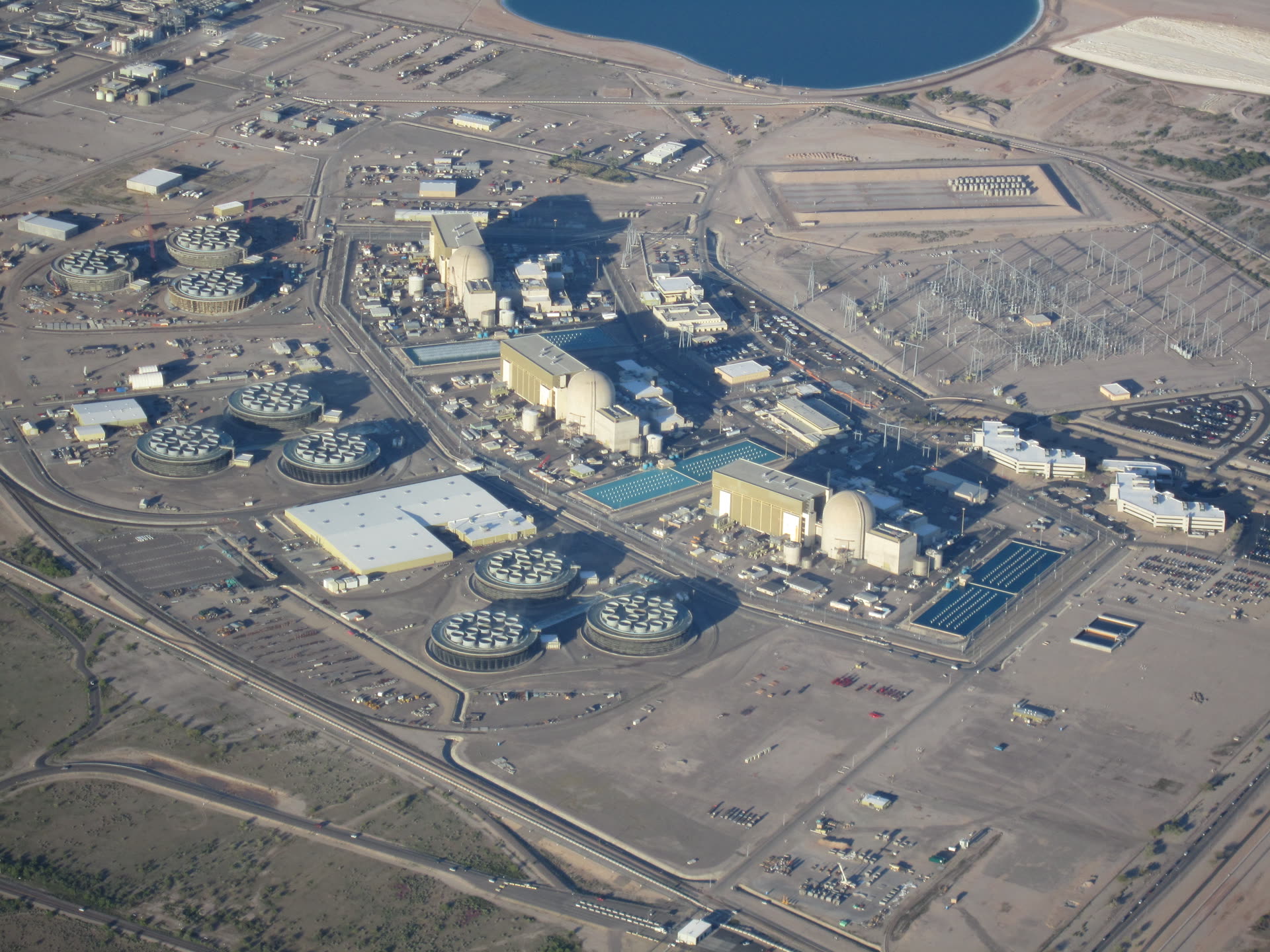
Pictured: an aerial view of the Palo Verde Nuclear Generating Station itself, the real facility overflown on September 29–30, 2019 — not a photograph of the drones. No photograph or video of the drones has ever been publicly released; plant security described them visually and in written incident reports rather than on camera.
Theoretical Alignment
None of the site's three standard theoretical frameworks meaningfully apply to this case, and that is itself the point. The objects were never ambiguous: trained, armed nuclear security officers identified them as drones in real time, on two separate nights, using standard incident-reporting language — there is no competing account in which they were anything else. The Psycho-Social framework, which on other case files describes misperception of an ambiguous stimulus by an untrained or excited crowd, is a poor fit for professional security personnel filing consistent, sober written reports about a class of object they recognized on sight; the low 8% alignment reflects only the unresolved identity of the operators, not any perceptual ambiguity about the aircraft. This case belongs to a different evidentiary category than a classic UAP encounter: it is a confirmed, real-world drone security incident that entered UAP-adjacent discourse because it happened at a nuclear facility and was never solved, not because anything about the drones themselves exceeded known technology.
Background
Palo Verde Nuclear Generating Station sits in open desert roughly fifty-five miles west of downtown Phoenix, near the unincorporated community of Wintersburg in Maricopa County, Arizona. Commissioned between 1985 and 1988 and operated by Arizona Public Service Company (APS) on behalf of a consortium of utility owners, its three Combustion Engineering pressurized-water reactors together make it the single largest power-generating facility of any kind in the United States by output, supplying electricity to roughly four million people across Arizona, California, New Mexico, and Texas. Because the site sits nowhere near a natural river or lake large enough to supply reactor cooling water, Palo Verde is also the only nuclear plant in the world not located on a permanent body of water: it draws treated municipal wastewater piped nearly forty miles from the Phoenix metropolitan area's own 91st Avenue Wastewater Treatment Plant, an engineering solution as unusual as the plant's desert setting.
By 2019, small commercial and prosumer drones had already become a well-documented headache for critical-infrastructure security worldwide. Beginning in October 2014, French authorities recorded a still-unexplained wave of nighttime drone overflights at more than a dozen of the country's nuclear power stations, never resolved to any named operator despite an extensive Gendarmerie Nationale investigation. In July 2018, Greenpeace France deliberately flew a drone disguised as a Super Mario cartoon character into the wall of the Bugey Nuclear Power Plant to publicize the vulnerability — a staged stunt, not a mystery, but one that underlined how easily a small UAS could physically reach a reactor building's exterior. In December 2018, dozens of drone sightings paralyzed Gatwick Airport in the UK for three days, grounding roughly 1,000 flights and never producing a confirmed culprit. Inside the U.S. Nuclear Regulatory Commission, the same trend had already been quietly tracked for years: internal records later confirmed that at least 57 separate drone incursions had been logged across 24 different NRC-licensed nuclear sites between 2015 and 2019, with the annual count rising sharply, from 7 incidents in 2017 to 21 in 2018. A December 21, 2017 incident at Palo Verde itself — also eventually marked "closed unresolved" — meant the plant had already experienced at least one unexplained drone incursion before the much larger, better-documented event that would make it briefly, if belatedly, famous.
None of this prior context was widely known to the public in September 2019. The NRC does not proactively publicize drone-incursion reports at individual reactor sites, treating them as security-sensitive incident data routed through its Headquarters Operations Center (HOO) and its Intelligence Liaison and Threat Assessment Branch (ILTAB) rather than through any public notification process. What happened at Palo Verde over two nights that September would remain almost entirely unknown outside the agency for nearly a year, until a Freedom of Information Act request forced its release.
Complete Timeline
| Date / Time | Event |
|---|---|
| Oct. 2014–2016 | An unexplained wave of nighttime drone overflights at more than a dozen French nuclear power stations is never resolved to a named operator, establishing an international precedent for the phenomenon. |
| Dec. 21, 2017 | A separate, earlier drone incursion at Palo Verde itself is logged by NRC security; it too is eventually closed "unresolved," a fact only surfacing publicly alongside the September 2019 documents. |
| July 2018 | Greenpeace France deliberately flies a drone into the Bugey Nuclear Power Plant as a publicity stunt, demonstrating the physical reachability of a reactor building by small UAS — a staged, claimed event, unlike Palo Verde's unattributed incursions. |
| Apr. 2019 | The Department of Energy's Office of Inspector General publishes a report recommending updated physical-security controls against drone threats at DOE nuclear sites. |
| Sept. 29, 2019, ~20:50 MST | Palo Verde security personnel first observe five to six large drones approaching the Unit 3 reactor's restricted area, spotlights on, from the direction of the perimeter; the lights switch off as the drones cross into the Security Owner Controlled Area. |
| Sept. 29, 2019, ~22:30 MST | Last confirmed sighting of the night, after roughly an hour and forty minutes of on-and-off observation; security posture is elevated and the NRC Resident Inspector is notified. |
| Sept. 29, 2019, before 23:00 MST | Acting Security Section Chief Daphne Rodriguez calls the NRC's Headquarters Operations Center to report the incursion. |
| Sept. 29–30, 2019, overnight | NRC Headquarters Emergency Response Officer Thomas Kendzia logs the incident in the agency's Security Information Database (SID); the FAA (Phoenix and Albuquerque offices), FBI, DHS, and Maricopa County Sheriff's Office are all separately notified. |
| Sept. 30, 2019, ~20:51 MST | Four drones are observed launching from behind a mountain range near Southern Avenue and 371st Avenue, east of the plant, before flying northwest over Unit 1 and back northeast over Unit 3. |
| Sept. 30, 2019, ~23:00–00:20 MST | Maricopa County Sheriff's Office deputies are dispatched with a Palo Verde security team leader to the drones' apparent launch point; the search for an operator is unsuccessful. NRC Emergency Response Officer Donald Norwood logs a second SID entry. |
| Oct. 4, 2019 | NRC Deputy Director Mark Lombard, of the Office of Nuclear Security and Incident Response, writes in an internal email that "This week has been Drone-a-palooza." |
| Oct. 28, 2019 | ILTAB follows up internally seeking a status update on the still-open Palo Verde incidents. |
| Oct. 30, 2019 | The NRC publishes an unclassified summary of a two-year technical review concluding that U.S. nuclear power plants "do not have any risk-significant vulnerabilities that could be exploited" by drones, and declines to require licensees to install drone defenses. |
| Nov. 4, 2019 | Edwin Lyman of the Union of Concerned Scientists publicly calls the NRC's decision "irresponsible." |
| Nov. 25, 2019 | Both the September 29 and September 30 Palo Verde incidents are formally marked "closed unresolved" in NRC's Security Information Database; no operator or motive was ever identified. |
| Dec. 2019 | A third, separate incursion at Palo Verde: two larger, "industrial-sized" drones (roughly three feet across) again overfly the Unit 3 area, despite the licensee's installation of new drone-detection technology after the September events. |
| July 30, 2020 | David Hambling publishes the FOIA-obtained Palo Verde documents in Forbes, breaking the story publicly for the first time; The War Zone (TWZ) publishes a companion investigation the same day. |
| Sept. 7, 2020 | Hambling's follow-up Forbes report reveals the broader pattern: at least 57 drone incursions across 24 NRC-licensed nuclear sites between 2015 and 2019, 85% of them still unresolved. |
The First Night: September 29, 2019
Shortly before 9:00 p.m. local time, armed security officers on patrol at Palo Verde's Unit 3 reactor complex spotted several aircraft approaching the plant's restricted perimeter from outside the Security Owner Controlled Area. According to the incident report later filed with the NRC, the drones displayed spotlights as they approached — illumination that switched off the moment the aircraft crossed into the controlled area, a detail every subsequent account of the case has treated as evidence of some deliberate operational awareness of the site's boundary, rather than a coincidence of a hobbyist simply losing interest in lighting his own craft. Security officers estimated the drones at "over two feet in diameter," flying at roughly 200 to 300 feet above the ground, each displaying red and white flashing anti-collision-style lighting broadly consistent with commercially available large multi-rotor UAS.
Between 5 and 6 individual drones were counted at various points across the night, though not necessarily all simultaneously airborne; the aircraft appeared to circle and re-approach the Unit 3 area repeatedly rather than making a single fly-by, a pattern security officials and later reporting both interpreted as consistent with a deliberate, methodical aerial survey of the reactor complex rather than a chance recreational flight that had wandered off course. The observation period stretched from around 8:50 p.m. to roughly 10:30 p.m. — on the order of one hour and forty minutes of intermittent, on-and-off sighting, a duration multiple outlets have since rounded to "about eighty minutes" of active drone presence over the site specifically. Palo Verde's security posture was elevated from normal in response, and the on-site NRC Resident Inspector, whose job includes exactly this kind of real-time liaison between plant operations and the regulator, was notified as the situation developed.
Shortly before 11:00 p.m., Acting Security Section Chief Daphne Rodriguez placed a call to the NRC's Headquarters Operations Center in Rockville, Maryland — the agency's 24-hour national point of contact for exactly this category of licensee report. On the other end, Headquarters Emergency Response Officer Thomas Kendzia logged the call and created the corresponding entry in the NRC's Security Information Database, the internal system of record that would, ten months later, become the paper trail a FOIA requester could actually obtain. Notification did not stop at the NRC: per standard licensee protocol for a security event of this kind, Palo Verde's operators separately alerted the Federal Aviation Administration's Phoenix and Albuquerque offices, the Federal Bureau of Investigation, the Department of Homeland Security, and the Maricopa County Sheriff's Office, fanning the incident out across five separate federal and local agencies within a matter of hours.
The Second Night: September 30, 2019
The following evening, at almost exactly the same time — roughly 8:51 p.m. — drones returned. This time, security officers were able to observe something they had not caught the night before: the point of origin. Four drones were seen launching from behind a low mountain range near the intersection of Southern Avenue and 371st Avenue, east of the plant, before flying northwest over Unit 1 and doubling back northeast over Unit 3 — the same reactor complex the drones had surveyed the previous night. No spotlights were reported on the second night, though the same red-and-white flashing lighting was again described.
Palo Verde's security team did not elevate its formal posture a second time, judging — reasonably, given the prior night's outcome — that continued close monitoring rather than a fresh alert escalation was the appropriate response to a now-recognized pattern. That did not mean the plant sat passively: a security team leader, accompanied by Maricopa County Sheriff's Office deputies, was dispatched directly to the drones' apparent launch point behind the mountain range in an active attempt to locate whoever was flying them. The search came up empty. No suspect, vehicle, ground station, or physical evidence of any operator was found at or near the site, and no drone was recovered. Observation of the aircraft themselves continued until sometime before midnight, with the last drone activity noted around 11:00 p.m. and NRC Headquarters Emergency Response Officer Donald Norwood, on duty for the overnight shift, logging a second, related Security Information Database entry to track the continuing event alongside Kendzia's original report from the night before.
Security's own contemporaneous language, later quoted directly in FOIA-released records, was blunt about the case's fundamental limitation: personnel were "unable to observe any identifying markings on the UAV's themselves or locate the operator(s)." Without a serial number, a registration marking, a radio-frequency signature tied to a known controller, or a human being caught in the act, there was and remains no investigative thread connecting the drones to any specific person, organization, or motive.
Inside the NRC's Reaction: "Drone-a-palooza"
The FOIA documents Douglas Johnson obtained do more than record the bare facts of what happened at the plant — they capture, in the agency's own internal voice, how seriously (and how wearily) NRC staff took the episode. On October 4, 2019, Deputy Director Mark Lombard of the NRC's Office of Nuclear Security and Incident Response wrote to colleagues that "This week has been Drone-a-palooza" — a flippant phrase that nonetheless stuck, appearing in later internal correspondence and eventually in nearly every press account of the case once the documents became public. Behind the joke sat a genuine institutional concern: multiple internal notes from this period explicitly discuss the incident's relevance to the possibility of a future "adversarial attack" using small unmanned aircraft, and Joseph Rivers, an NRC Senior Level Advisor on Security, is quoted in the released records observing flatly that "restricted airspace will do nothing to stop an adversarial attack" — an unusually candid acknowledgment, for a federal safety regulator, that the existing legal no-fly designation over the plant was simply not a physical deterrent to anyone determined to violate it.
Not every internal reaction was about strategic threat assessment. Laura Pearson, chief of the NRC's Intelligence Liaison and Threat Assessment Branch, pushed back specifically against the practice of calling her duty officers in the middle of the night for updates the branch had no operational ability to act on in real time. "Our folks got calls last night at 2am, which is correct per the procedure," Pearson wrote. "However, I am wondering if there is a way to cut down on calls in the middle of the night for issues that ILTAB can't really do anything about anyway." The exchange led directly to a new, if narrow, internal policy: "Until further notice, do not call the ILTAB duty officer from 10 pm until 6 am for drone flyovers of Palo Verde" — a small but genuinely revealing artifact of how a security bureaucracy adapts, in real time, to a recurring incident it cannot resolve, prioritizing staff sleep over further overnight escalation once the pattern (repeated, unarmed, unidentified drone flights with no immediate safety impact) had become familiar rather than acutely alarming.
The December 2019 Third Incursion
Whatever confidence the NRC's October technical review projected publicly, Palo Verde's own subsequent experience complicated it almost immediately. In December 2019, a further drone incursion was logged at the plant — this time involving only two aircraft, but larger ones, described in FOIA-released records as "industrial-sized" craft roughly three feet across, again exploring the airspace around the Unit 3 reactor. Notably, this incursion occurred despite the licensee having installed new drone-detection technology in the aftermath of the September events specifically to prevent, or at minimum provide earlier warning of, exactly this kind of repeat overflight. The December incident underscores a theme that runs through the broader FOIA dataset as a whole: detection is not the same as attribution, and even a plant actively watching for drones after a well-publicized (internally, at least) incursion could not prevent, explain, or trace a second one three months later.
The FOIA Fight: How the Public Learned About This At All
Douglas D. Johnson, a volunteer researcher affiliated with the Scientific Coalition for UAP Studies (SCU), is the person directly responsible for the Palo Verde case ever reaching public knowledge. Johnson filed a Freedom of Information Act request with the NRC seeking any and all internal records related to drone activity at U.S. nuclear facilities; the resulting document production — internal emails, Security Information Database entries, incident report summaries — is the entire evidentiary basis for both the specific Palo Verde narrative and the wider 57-incursion, 24-site pattern later reported by David Hambling in Forbes and by The War Zone. Without that FOIA request, the September 2019 events would in all likelihood remain buried in an internal federal database indefinitely, exactly as the December 2017 Palo Verde incident, and the other 56 incursions across 23 other sites, effectively were until Johnson's request forced their release.
Johnson's research did not stop at the NRC. He separately filed a FOIA request with the Department of Homeland Security's Cybersecurity and Infrastructure Security Agency (CISA) seeking related material; DHS/CISA declined to release 32 pages of documents it acknowledged existed, citing law-enforcement-related exemptions. That withholding is itself a small but genuine data point about the limits of what the public record can currently establish about this case: a federal agency with some documented involvement or interest in the broader nuclear-site drone pattern has confirmed it possesses additional material it is not releasing, for reasons this case file's own research could not independently evaluate or characterize beyond DHS's stated exemption category.
The Bigger Picture: 57 Incursions at 24 Nuclear Sites
Palo Verde's September 2019 swarm was, in the NRC's own internal accounting, one incident among many. The full FOIA dataset Hambling reported on in September 2020 documented at least 57 separate drone incursions logged across 24 different NRC-licensed nuclear sites between 2015 and 2019, with the reported annual count rising sharply over that period — from 7 incidents in 2017 to 21 in 2018 alone. Named facilities beyond Palo Verde include the Limerick Generating Station in Pennsylvania (5 recorded incidents), the Perry Nuclear Power Plant in Ohio (6 incidents), and Diablo Canyon Power Plant in California (7 incidents), along with incursions reported at the Trojan and Rancho Seco sites, both decommissioned reactors now used for spent-fuel storage rather than active power generation. Fully 49 of the 57 documented incidents — roughly 85% — remain formally unresolved, with no operator, motive, or agency ever identified. Palo Verde's case is therefore not exceptional within this dataset for being unsolved; what makes it exceptional is scale (the largest confirmed drone count at any single U.S. nuclear site in the released data), duration (the roughly eighty-to-one-hundred-minute observation windows on each night are among the longest recorded), and its since-repeated nature, having now documented incursions in December 2017, twice in September 2019, and again in December 2019.
The NRC Declines to Require Drone Defenses
Even as the Palo Verde incidents were still active in NRC's own internal case files, the agency was in the final stages of a separate, longer-running technical review of drone risk to nuclear facilities generally — a process that had been underway for roughly two years by the fall of 2019. On October 30, 2019, the NRC published an unclassified summary of that review's conclusion: that U.S. commercial nuclear power plants "do not have any risk-significant vulnerabilities that could be exploited" by adversaries using commercially available drones in a way that would result in radiological sabotage or the theft or diversion of special nuclear material. On that basis, the Commission formally declined to require licensees — including Palo Verde's own operator, APS — to install dedicated drone-detection or counter-drone defense systems, while stating it would continue to monitor the evolving threat picture.
The decision drew immediate, pointed criticism from outside the agency. Edwin Lyman, acting director of the Nuclear Safety Project at the Union of Concerned Scientists, said on November 4, 2019 that "The NRC's irresponsible decision ignores the wide spectrum of threats that drones pose to nuclear facilities and is out of step with policies adopted by the Department of Energy and other government agencies." Lyman's broader critique noted that the NRC's own narrow technical framing — whether a drone alone could physically breach a reactor's radiological safety systems — sidestepped a wider set of scenarios: a drone assisting a ground-based intrusion team with real-time aerial surveillance, creating a diversion to draw security response away from a second point of attack, or simply demonstrating (as Palo Verde's own September events arguably had) that a plant's physical security posture had no actual means of preventing repeated, sustained overflight of its most sensitive reactor buildings regardless of whether any single flight caused physical damage. Lyman also pointed to an April 2019 Department of Energy Inspector General report recommending updated security controls against drone threats at DOE's own nuclear sites — a different federal agency reaching a materially different risk conclusion from the same underlying technology, in the same general period, about a closely related category of nuclear facility.
The NRC's defenders, and the agency's own public reasoning, pointed to cost and precedent: requiring active counter-UAS systems at every licensed reactor site in the country would represent a substantial new mandatory capital and operating expense for an industry already under significant competitive pressure from cheaper natural gas and subsidized renewable generation, and the NRC has historically deferred aircraft-related physical security questions (including, after the September 11, 2001 attacks, the question of hardening reactor containment against a deliberate aircraft strike) to other layers of the national security and aviation-regulatory apparatus rather than mandating plant-level defenses of its own.
Key Witnesses
Daphne Rodriguez
The security official who placed the initial call to the NRC's Headquarters Operations Center shortly before 11:00 p.m. on September 29, 2019, formally putting the incident on the federal record within hours of the sighting beginning. Her report is the foundational document from which the entire subsequent SID entry, and ultimately the FOIA release, descends.
Ismael Garcia
Reported the second night's incursion on September 30, 2019, including the detail — not observed the first night — that the drones appeared to launch from behind a mountain range east of the plant, a piece of testimony that directly enabled the Maricopa County Sheriff's Office search of that specific location.
Thomas Kendzia
Took Daphne Rodriguez's initial call on the night of September 29 and created the first Security Information Database entry documenting the incident — the internal federal record that, once released under FOIA, became the primary source for this case's entire public timeline.
Donald Norwood
On overnight duty during the September 30 incident, logged the second SID entry documenting that night's drone activity and the unsuccessful Sheriff's Office search for an operator.
Douglas D. Johnson
Not a witness to the original event, but the person whose Freedom of Information Act request to the NRC — and separately to DHS/CISA — produced the entire documentary record this case file, and every press account of it, is built on. Without Johnson's FOIA work, the Palo Verde incidents, like the December 2017 incident and the other 56 incursions in the broader dataset, would in all likelihood remain unknown outside the federal government.
Edwin Lyman
The most prominent outside critic of the NRC's October 30, 2019 decision not to require drone defenses at licensed nuclear plants, calling it "irresponsible" on November 4, 2019 and arguing the agency's narrow risk framing ignored the broader range of ways a drone could assist a real attack, independent of whether that specific drone alone could breach reactor containment.
The Five Observables Assessment
The Five Observables framework is applied to the performance characteristics reported in this case:
Assessment: Every reported flight characteristic in this case is fully consistent with commercially available multi-rotor UAS technology as of 2019 — conventional rotor-based lift, an altitude band (200–300 feet) well within recreational and commercial drone ceilings, a launch point behind terrain consistent with a ground-based human operator using line-of-sight or first-person-view control, and a total flight endurance (roughly 80–100 minutes across intermittent sorties, not one continuous flight on a single battery) that does not exceed what a operator swapping batteries between passes could achieve. Low Observability is rated speculative only because no radar record of the drones exists in the released documents either confirming or ruling out detection — small UAS are frequently missed by air-defense and air-traffic radar systems not tuned for their radar cross-section, a mundane and well-documented limitation, not evidence of any deliberately exotic stealth capability. Nothing in this case's five-observables profile diverges from ordinary consumer or prosumer drone performance.
Evidence Assessment
Supporting a Genuine, Unresolved Security Mystery
- The operators' identity and purpose were never determined despite a five-agency federal and local investigation (NRC, FBI, DHS, FAA, Maricopa County Sheriff's Office) and were formally closed "unresolved" on November 25, 2019
- The drones' behavior — spotlights extinguished specifically upon crossing into the plant's restricted airspace — suggests some operational awareness of the site's legal boundary, arguing against a purely accidental or oblivious recreational flight
- The methodical, repeated approach pattern over roughly 80–100 minutes each night, concentrated specifically on the Unit 3 reactor complex, is consistent with deliberate reconnaissance rather than a chance overflight
- The incident recurred on two consecutive nights, and again in December 2019 despite newly installed detection technology, indicating sustained rather than one-off interest in the site
- NRC's own internal security staff, not outside speculation, explicitly discussed the incident's relevance to a possible future "adversarial attack," and one senior security advisor acknowledged the plant's restricted-airspace designation provided no actual physical deterrent
- The case is one of at least 57 similar incursions across 24 nuclear sites nationwide between 2015 and 2019, 85% of which also remain unresolved — a persistent, unattributed nationwide pattern rather than an isolated local event
Supporting a Mundane (If Unattributed) Explanation
- The objects were never ambiguous: multiple trained, armed security officers identified them immediately and consistently, on two separate nights, as drones — not as an unidentified or anomalous craft of any kind
- Every described physical and flight characteristic (2–3 foot diameter, red/white anti-collision-style lighting, 200–300 foot altitude, multi-rotor configuration, finite flight endurance requiring multiple sorties) is standard commercial/prosumer drone hardware readily available in 2019, not an exotic or unidentified craft type
- The NRC's own two-year technical review, completed independently of the Palo Verde events, concluded that no risk-significant vulnerability at any licensed nuclear plant could be exploited by drones of this kind
- The vast majority (85%) of the broader 57-incursion national dataset is also unresolved, indicating the difficulty of tracing an anonymous civilian drone operator after the fact is a systemic limitation of the investigative tools available, not evidence that anything unusual happened at Palo Verde specifically
- No radar, photographic, video, radiological, or other instrumented anomaly of any kind was recorded on either night; the entire evidentiary record consists of direct human observation and internal agency correspondence, with nothing suggesting the aircraft exceeded known drone capability
Why "Open"
This case receives an OPEN classification — not because the objects themselves remain unidentified in any anomalous sense, but because the underlying security question the NRC itself formally opened on September 29, 2019 was, by its own later admission, never closed to resolution. "Closed unresolved" is the NRC's own internal terminology, and it means exactly what it says: the file was administratively ended, not because an answer was found, but because the investigation reached the limit of what it could determine. No operator was identified. No motive was established. No aircraft was recovered. Unlike a classic "Disputed" case on this site, there is no genuine argument here about what the drones were — every witness, every agency, and every subsequent researcher agrees they were conventional multi-rotor UAS. What remains open is the considerably narrower, but still entirely unanswered, question of who flew them and why, over the largest nuclear power plant in the United States, on two consecutive nights, in a pattern later shown to echo across at least 23 other American nuclear sites. That is a real, still-unresolved federal security matter, documented in the government's own words — which is a different, and in some ways more concrete, kind of "open" than the phenomenological uncertainty this site's stamp usually describes, but "open" nonetheless.
Sensor & Instrumentation Detection Profile
The entire evidentiary record for this case consists of direct visual observation by armed nuclear security officers, corroborated across two separate nights and cross-referenced against independent, contemporaneous internal NRC documentation (call logs, SID entries, and email correspondence) rather than solely witness self-report after the fact. No radar detection of the drones is documented in the released FOIA records, consistent with the well-known difficulty conventional air-surveillance radar has in reliably tracking small, low-flying UAS. No photograph, video recording, or infrared/FLIR imagery of the drones is known to have been publicly released, despite the plant's near-certain use of security cameras generally; whether any camera system captured the drones, and if so why that footage has never surfaced publicly, could not be determined from sources reviewed for this case file. No radiological, electromagnetic, or other instrumented anomaly was reported by any source.
Environmental & Geospatial Context
Palo Verde sits in flat, arid Sonoran Desert terrain roughly fifty-five miles west of Phoenix, near a low, unnamed mountain range to the east of the plant that the September 30 drones were observed launching from behind — terrain that would have offered a nearby operator both cover from direct line-of-sight observation from the plant itself and a plausible ground-level vantage point from which to fly a first-person-view or line-of-sight-controlled aircraft toward the reactor complex. The area is sparsely populated, rural, and free of significant ambient light pollution, conditions favorable to a security officer's ability to visually track a small, lit aircraft against a dark desert sky, and favorable to an operator seeking to avoid being seen approaching a launch site. Both nights fell in late September, within typical Arizona high-desert conditions for the season: clear skies, dry air, and mild overnight temperatures, with no source reviewed reporting any adverse weather, wind, or visibility issue affecting either night's observation.
Observer Credibility & Occupational Profile
The witnesses in this case are professional nuclear security officers — armed, trained personnel operating under NRC-mandated security protocols specifically designed around threat recognition, standardized incident reporting, and interagency notification procedures. Unlike a classic single-witness or civilian-crowd UAP sighting, their testimony is not the only evidentiary layer: it is independently cross-corroborated by contemporaneous internal federal documentation created by a separate set of professionals (NRC Headquarters Emergency Response Officers Thomas Kendzia and Donald Norwood) who had no independent means of knowing what happened at the plant beyond what security reported to them, yet whose call logs, SID entries, and internal correspondence align consistently with the security officers' own account across both nights. This is an unusually strong chain of institutional corroboration for a case of this kind — not because any individual witness held aviation-pilot-grade instrument training, but because the case's core facts rest on multiple independent professional accounts converging on the same narrative, rather than on a single observer's uncorroborated recollection.
Physical & Material Assays
No physical or material evidence of any kind exists in this case. No drone was recovered on either night, despite an active search of the suspected launch point by Maricopa County Sheriff's Office deputies accompanying Palo Verde security personnel. No debris, fragment, component, or trace material connected to the drones has ever been reported, tested, or referenced in any source reviewed for this case file. This absence is itself informative: it is the single largest practical obstacle to ever identifying the operator, since a recovered aircraft would likely have carried a serial number, a radio-frequency identifier, or physical evidence traceable to a specific manufacturer, retailer, or registered owner.
Historical Precedents & Archive Matches
Palo Verde's September 2019 events sit within a documented lineage of unexplained drone activity at sensitive government and critical-infrastructure sites, both domestic and international. The 2014–2016 wave of unattributed nighttime drone overflights at more than a dozen French nuclear power stations remains the closest large-scale international precedent, similarly never resolved to a named operator. Domestically, the December 2017 incident at Palo Verde itself, and the broader FOIA-documented total of 57 incursions across 24 NRC-licensed sites between 2015 and 2019 (including Limerick, Perry, and Diablo Canyon), place this case within a genuine, sustained national pattern rather than an isolated local anomaly. On this site specifically, two earlier-cataloged cases share the same underlying structure of an unidentified aerial object approaching a nuclear or nuclear-weapons-related facility's restricted airspace without resolution: the 1975 SAC Base Intrusion Wave, in which unidentified craft were tracked over nuclear weapons storage areas at multiple Strategic Air Command bases, and the Dimona/Negev Unidentified Object Shootdown, in which an Israeli F-16 shot down an unidentified unmanned object drifting toward the no-fly zone over Israel's own Dimona reactor complex. Both of those cases, unlike Palo Verde, involve objects whose basic nature was never conclusively established even after the fact; Palo Verde's drones, by contrast, were identified immediately as drones by every witness, making it a structurally different, more narrowly attribution-focused mystery even as it shares the broader "unidentified aircraft near a nuclear facility" pattern.
Material Analysis
Because the aircraft in this case are confirmed, conventional, human-manufactured drones rather than an object of disputed origin, the standard terrestrial-versus-non-terrestrial framing this site applies to classic UAP cases does not meaningfully apply here in its usual sense — nobody, including the NRC's own internal security staff, has ever argued the drones themselves were anything but Earth-made technology. The genuinely contested question in this case is instead one of sophistication and actor type: were these off-the-shelf consumer or prosumer drones flown by a hobbyist, criminal, or activist, or something closer to a more capable, possibly professionally or even state-coordinated reconnaissance platform? No physical sample of any kind exists to test that question directly, since no aircraft, component, or fragment was ever recovered from either night.
What the Reported Characteristics Actually Support
The specifications security officers reported — roughly 2–3 foot diameter, red-and-white flashing anti-collision lighting, 200–300 foot operating altitude, and a multi-rotor flight profile requiring intermittent sorties rather than one continuous flight — describe hardware squarely within the large end of the commercially available consumer and prosumer drone market as of 2019, not a military-grade or exotic platform. Nothing in the released documentation describes any capability (unusual speed, silent operation, extreme altitude, jamming-resistant control, or any sensor payload) that would require capability beyond what a well-equipped hobbyist or small commercial operator could purchase directly.
Arguments For a More Sophisticated / Coordinated Origin
- Multiple simultaneous drones (5–6 on the first night) implies either a coordinated multi-operator team or a single operator running a genuine drone swarm/formation system, either of which requires more planning and equipment than a single casual hobbyist flight
- The apparent tactical awareness of the restricted-airspace boundary (spotlights extinguished on crossing into it) suggests either prior reconnaissance of the site's exact legal perimeter or real-time coordination with a lookout, not blind luck
- Repetition across two consecutive nights, using the same approximate timing and target area, indicates sustained planning rather than a single spontaneous flight
Arguments For an Ordinary Commercial/Hobbyist Origin
- Every individual physical specification reported (size, lighting, altitude, endurance) matches standard commercially available hardware with no modification implied
- Consumer drone-swarm and formation-flying software and hardware kits were already commercially and hobbyist-accessible by 2019, meaning multiple simultaneous drones do not by themselves require state-level resources
- The operator(s) were never located despite an active ground search, which is equally consistent with an amateur simply not being caught as with a sophisticated actor successfully evading detection
- Palo Verde is a well-known, highly visible landmark structure in the Phoenix area, plainly identifiable from the air by cooling towers and reactor domes alone — a recognizable target requiring no special intelligence to select, whether the operator's motive was aerial photography, thrill-seeking, or genuine reconnaissance
The Conventional Explanation Candidate: Off-the-Shelf Drones of Unidentified Origin
Unlike most case files on this site, the "conventional explanation" for the Palo Verde drone swarm is not in serious dispute at the level of what the objects were — every witness and every agency involved agrees they were drones. The genuinely open question this section evaluates is a narrower and more specific one: who was most likely operating them, and why. Several distinct candidate explanations have been raised across the FOIA documents, subsequent press reporting, and independent security-policy analysis; none has been confirmed, and the case remains formally unresolved.
Reckless or Curious Hobbyist Activity
The simplest explanation is that one or more recreational drone hobbyists, drawn by Palo Verde's status as a large, visually striking, and widely recognizable landmark structure visible for miles across flat desert terrain, flew close to or over the facility out of curiosity, for aerial photography, or as a deliberate thrill-seeking violation of the well-publicized no-fly restriction over U.S. nuclear plants. This explanation fits the hardware (ordinary large consumer/prosumer drones) but strains against some of the specific behavioral details: the apparent coordination of 5–6 simultaneous aircraft, the repetition across two consecutive nights at nearly the same time, and the extinguishing of spotlights specifically upon entering the restricted area all suggest more deliberate planning than a single spontaneous hobbyist flight typically involves.
Criminal or Pre-Attack Reconnaissance
NRC's own internal security staff took seriously the possibility that the drones represented deliberate reconnaissance — mapping security response times, camera coverage, or patrol patterns — either for a future physical intrusion, an attempted theft of nuclear material (which the NRC's own technical review concluded remained implausible given the facility's actual physical security architecture), or simply to test how the plant would respond to an unauthorized aerial incursion. Senior security advisor Joseph Rivers's own quoted observation that "restricted airspace will do nothing to stop an adversarial attack" reflects genuine institutional concern along these lines, though no evidence in the released documents ties the incidents to any specific criminal plan, individual, or organization.
Activist or Journalistic Stunt
Greenpeace France's 2018 drone flight into the Bugey Nuclear Power Plant demonstrates that deliberate, publicity-motivated drone flights at nuclear facilities are a real, precedented category of event. No environmental, anti-nuclear, or journalistic organization has ever claimed responsibility for the Palo Verde incidents, however — a significant point against this theory, since a genuine activist stunt of this kind is typically followed by a public claim of responsibility intended to generate exactly the media attention Palo Verde's own incidents did not receive until Johnson's FOIA request surfaced them nearly a year later.
Foreign State-Actor or Organized Intelligence-Gathering Activity
The most speculative candidate, raised implicitly by the seriousness of the NRC's own internal "adversarial attack" language rather than by any direct evidence, is that a foreign intelligence service or other organized actor conducted deliberate aerial reconnaissance of a critical U.S. energy facility. No public source reviewed for this case file presents any confirmed evidence — forensic, testimonial, or otherwise — connecting the Palo Verde incidents to any specific state or non-state intelligence effort; this candidate remains entirely speculative, included here because it was a genuine internal concern at the time rather than because any evidence supports it over the other candidates.
Reckless/Curious Hobbyist
InconclusiveINCONCLUSIVE. Fits the hardware and the facility's visibility as a landmark, but strains against the coordinated multi-drone count, the two-night repetition, and the tactical extinguishing of spotlights at the restricted boundary — behavior more deliberate than typical casual hobbyist flight.
Criminal/Pre-Attack Reconnaissance
InconclusiveINCONCLUSIVE. Taken seriously by NRC's own internal security staff and consistent with the methodical, repeated survey pattern observed, but no evidence in the released record ties the incidents to any specific plan, individual, or planned follow-on crime.
Activist/Journalistic Stunt
ImplausibleIMPLAUSIBLE. A real, precedented category of event generally (cf. Greenpeace France, 2018), but no organization has ever claimed responsibility for Palo Verde — a significant omission, since a publicity-motivated stunt is normally followed by exactly that kind of claim.
Foreign State-Actor Intelligence Gathering
InconclusiveINCONCLUSIVE, bordering on speculative. Raised as a genuine internal NRC security concern rather than dismissed out of hand, but entirely unsupported by any direct evidence in the public record reviewed for this case file.
Related Cases
Confirmed Documents & Official Records
The NRC's own official reactor-level record for Unit 3, the specific reactor complex the September 2019 drones repeatedly surveyed, confirming licensee, docket number, and licensing history.
The FAA's official policy page on airspace restrictions over sensitive facilities, including nuclear power plants, describing the restricted-airspace designation the September 2019 drones crossed into and out of.
The underlying NRC Security Information Database entries, internal emails, and incident reports quoted throughout this case file were obtained by researcher Douglas D. Johnson via a Freedom of Information Act request and are not independently mirrored on any NRC public-facing page; see the Sources section below for the press accounts (The War Zone, Forbes) that first published their contents. A related DHS/CISA FOIA request by the same researcher was partially denied; DHS declined to release 32 pages it acknowledged existed, citing law-enforcement-related exemptions.
Search Government & Regulatory Archives Directly
Further Reading — Recommended Literature
Swarm Troopers: How Small Drones Will Conquer the World
Written by the journalist who broke the Palo Verde story in Forbes, this book lays out exactly the kind of low-cost, swarming small-drone capability that made a coordinated 5–6-aircraft overflight of a nuclear reactor complex technically unremarkable by 2019, and why existing air defenses struggle against it.
Eyes in the Sky: The Secret Rise of Gorgon Stare and How It Will Watch Us All
By the founder of the Center for the Study of the Drone, whose own separately published Counter-UAS Systems report is among the standard technical references on why detecting and stopping small drones over sensitive sites remains so difficult in practice.
Predator: The Secret Origins of the Drone Revolution
A detailed history of how drone technology moved from a fringe engineering pursuit to a mainstream capability now cheap and available enough for an unidentified civilian operator to fly a coordinated multi-drone swarm over America's largest nuclear plant.
Nuclear Terrorism: The Ultimate Preventable Catastrophe
A foundational assessment of the real security vulnerabilities and policy gaps around nuclear facilities, useful context for evaluating exactly the kind of risk-tradeoff argument the NRC made in declining to require drone defenses in October 2019.
Wired for War: The Robotics Revolution and Conflict in the 21st Century
An early, still-relevant survey of how remotely piloted and autonomous systems were reshaping security and conflict, laying out the broader technological and policy trend the Palo Verde incident is one small, unresolved data point within.
Essential Viewing
No Videos Available
A reasonable search did not locate any video specifically and primarily about the Palo Verde drone incident from a reputable source. Coverage of this case has been exclusively print/digital journalism (The War Zone, Forbes) rather than broadcast or documentary video.
Sources
- Hambling, David. "'Drone Swarm' Invaded Palo Verde Nuclear Power Plant Last September — Twice." Forbes, July 30, 2020. forbes.com
- Hambling, David. "Dozens More Mystery Drone Incursions Over U.S. Nuclear Power Plants Revealed." Forbes, Sept. 7, 2020. forbes.com
- "The Night A Mysterious Drone Swarm Descended On Palo Verde Nuclear Power Plant." The War Zone (TWZ), July 30, 2020. twz.com
- "NRC Will Not Require Drone Defenses." Arms Control Today, Arms Control Association, Dec. 2019. armscontrol.org
- Union of Concerned Scientists. "NRC Decision Leaves Nuclear Plants Vulnerable to Terrorist Drones," statement by Edwin Lyman, Nov. 4, 2019. ucs.org
- Patteson, Callie. "'Drone swarms' that flew over Arizona nuclear reactor remain MYSTERY as federal probe ends with no answers." The US Sun, July 30, 2020. the-sun.com
- "Mysterious Drone Swarm Flew Over Palo Verde Nuclear Power Plant." DroneXL, July 30, 2020. dronexl.co
- Heberlein, Todd. "Mysterious Overflights: Drone Swarms over Critical U.S. Locations." Jan. 4, 2025. toddheberlein.com
- U.S. Nuclear Regulatory Commission. "Palo Verde Nuclear Generating Station, Unit 3" — Reactor Info-Finder. nrc.gov
- U.S. Nuclear Regulatory Commission. "Palo Verde Nuclear Generating Station, Unit 1" — Reactor Info-Finder. nrc.gov
- Federal Aviation Administration. "No Drone Zone" — Critical Infrastructure UAS Policy. faa.gov
- U.S. Department of Energy, Office of Inspector General. Report on physical security controls against drone threats at DOE nuclear sites, Apr. 2019 (referenced in UCS statement above).
- "Drones love to fly over nuclear power plants, documents reveal." DroneDJ, Sept. 8, 2020. dronedj.com
- "Drone swarms storm Arizona nuclear power plant over 2 days." DroneDJ, July 31, 2020. dronedj.com
- "Mystery over drone swarm above America's largest nuclear power station." Nuclear-News, Aug. 1, 2020. nuclear-news.net
- "Palo Verde Nuclear Generating Station." U.S. Nuclear Regulatory Commission — general facility background. nrc.gov
- Wikimedia Commons. "PaloVerdeNuclearGeneratingStation.jpg," photographed by Cuhlik, Apr. 7, 2010, public domain — source of this case file's hero image. commons.wikimedia.org
- "Palo Verde Nuclear Generating Station." Wikipedia — general facility background (cooling water source, ownership, capacity), used lightly for orientation only. en.wikipedia.org
- "Drone swarm at Arizona nuclear power plant baffles investigators." American Partisan, Aug. 2020 (syndicated coverage of the original TWZ/Forbes reporting). americanpartisan.org
- "The Night A Mysterious Drone Swarm Descended On Palo Verde Nuclear Power Plant." Rocketry Forum discussion thread referencing and quoting the original TWZ investigation. rocketryforum.com
See something inaccurate? Have additional information or sources?
Suggest an Edit →Last Updated: August 2026