
Dimona/Negev Unidentified Object Shootdown
On the afternoon of 16 December 2010, Israeli air-defense radar picked up an unidentified, unmanned object drifting into Israeli airspace from Jordan over the southern Dead Sea, heading toward the strict no-fly zone surrounding the Shimon Peres Negev Nuclear Research Center at Dimona — Israel's plutonium-production reactor and the country's most closely guarded strategic facility. With the object's origin and purpose unclear and genuine fears in play that it could be gathering intelligence on the reactor or carrying an explosive charge, Israeli Air Force Commander Maj. Gen. Ido Nehushtan ordered it engaged; an F-16 fired a missile and brought it down. Commercial flight corridors over Israel's south were briefly closed. By that same evening, IAF sources speaking to Israeli media were already walking the story back toward the mundane, describing the object as "probably a balloon" and, separately, floating the possibility it was nothing more than a weather balloon or an ordinary novelty ("party") balloon. No wreckage or debris was ever publicly recovered, displayed, or forensically identified, leaving the object's exact nature formally unresolved to this day — a genuine, if narrow, gap in an otherwise thoroughly reported news event. This file corrects nothing about the placeholder's date, which is accurate, but tempers its "unidentified motorized object" framing against the full contemporaneous record: a real airspace-security incident, briefly and only ever provisionally "unidentified," that both the Israel Defense Forces and every wire service covering it treated from the outset as almost certainly conventional.
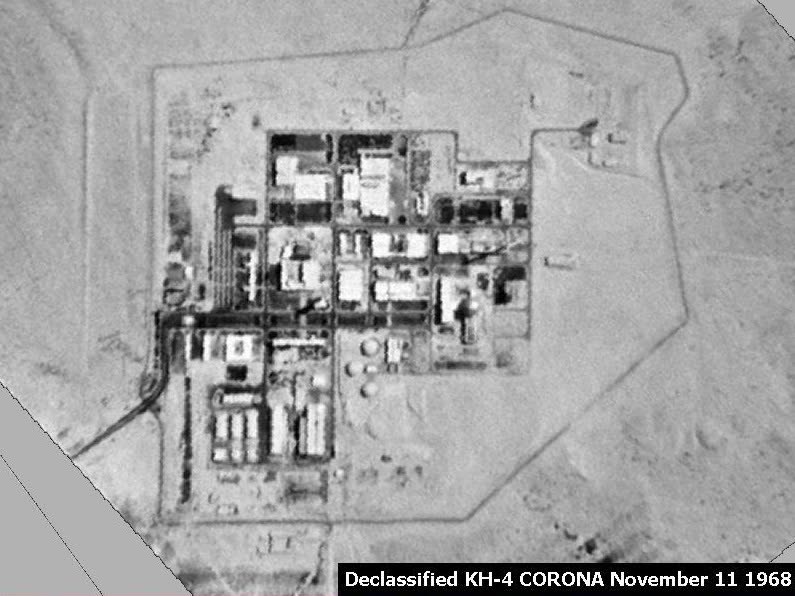
Pictured: a declassified U.S. KH-4 CORONA reconnaissance satellite photograph of the Negev Nuclear Research Center at Dimona, taken 11 November 1968 and released to the public domain in 1995 under Executive Order 12951 (public domain, U.S. government work, via Wikimedia Commons). This is not a photograph of the unidentified object itself — no photograph of the object shot down on 16 December 2010 is known to exist in any public source — but of the actual restricted facility whose airspace it violated, the real subject of this case.
Theoretical Alignment
This case's theoretical alignment sits overwhelmingly toward the mundane end of this catalogue's spectrum. Every institutional voice quoted in the contemporaneous record — the IDF, the IAF Commander who ordered the intercept, and every wire service and Israeli outlet that covered the story — treated the object as an airspace-security problem, not an anomalous one, and the IDF's own same-day characterization moved specifically toward "probably a balloon" rather than away from it. The Extraterrestrial Hypothesis reading draws its small residual percentage almost entirely from a handful of aviation-enthusiast and UFO-interest outlets (F-16.net's "Israeli F-16 downs UFO," Israel National News's "IAF Jet Shoots Down UFO," and the blog Ghost Theory's "Israel Shoots Down 'UFO'") that used "UFO" in its literal, generic sense — an unidentified flying object, full stop — rather than as a claim of extraterrestrial technology, exactly the same rhetorical pattern this catalogue has already documented in the HMAS Hobart / DMZ Vietnam Incident case file. Interdimensional Hypothesis alignment is negligible: no source of any kind proposes trans-dimensional behavior. The Psycho-Social/Mundane reading dominates because the object's entire described behavior — drifting in on the wind from across an international border, moving slowly enough to be visually and radar-tracked by an intercepting fighter, and consistent with recreational, weather, or novelty balloon flight — matches a known, common, and unremarkable category of airspace nuisance rather than anything resembling controlled, high-performance flight.
Background
The Shimon Peres Negev Nuclear Research Center, universally known by the name of the nearby development town of Dimona, was constructed in the late 1950s with French technical assistance under the direction of Shimon Peres, then director-general of Israel's Ministry of Defense, and became operational in the early 1960s. Built partly underground for protection and widely understood, though never officially confirmed by Israel under its long-standing policy of nuclear "opacity" (amimut), to be the site where Israel produced the plutonium for its undeclared nuclear weapons arsenal, Dimona has been treated by Israeli authorities from the outset as one of the country's most sensitive strategic assets. The airspace directly above and around the reactor complex is a strict, permanently enforced no-fly zone, patrolled by dedicated air-defense units maintained, per a 2007 Patriot missile battery commander's own public description, at a state of readiness in which even a slight, unexplained deviation from an approved flight path "sets off an alarm and risks [an interceptor] missile being fired."
That posture is not rhetorical. During the 1967 Six-Day War, Israeli air-defense batteries protecting Dimona shot down an Israeli fighter-bomber of its own air force after the aircraft, already damaged in action over Jordan, strayed too close to the restricted airspace on its way back; the pilot was killed. In October 2009, roughly fourteen months before the events of this case file, a small ultralight aircraft breached the Dimona no-fly zone; IAF jets scrambled, intercepted it, and forced it to land at a nearby airstrip near Arad, with Israeli media reporting the pilot appeared to have flown into the restricted area by accident. These episodes establish the operating baseline against which the events of 16 December 2010 unfolded: a facility whose defenders have a documented, decades-long record of responding to airspace incursions — friendly, accidental, or hostile — with genuine, sometimes lethal, force, and a documented history of those incursions turning out, without exception in the specific incidents located for this case file's research, to have entirely mundane causes.
December 2010 also sat within a specific, elevated period of regional tension relevant to why Israeli authorities reacted as seriously as they did to an unidentified object approaching the reactor from Jordan. Iran's nuclear program was the dominant Israeli security preoccupation of the period; the Stuxnet worm targeting Iranian centrifuges had become public only months earlier, in mid-2010, and Israeli officials had spent the preceding several years publicly and repeatedly raising the possibility of an Israeli strike on Iranian nuclear sites, an environment in which any reciprocal probing of Israel's own most sensitive nuclear facility — whether by a state intelligence service, a non-state actor, or an ordinary hobbyist who simply wandered into the wrong airspace — carried outsized institutional anxiety. This context helps explain the IAF's decision to shoot first and identify the object's true nature only afterward, a sequencing this case file's own research found no evidence Israeli authorities have ever second-guessed or apologized for, whatever the object actually turned out to be.
Complete Timeline
| Date | Event |
|---|---|
| Late 1950s – early 1960s | The Negev Nuclear Research Center at Dimona is built with French assistance and becomes operational; the surrounding airspace is designated a permanent no-fly zone. |
| 1967 (Six-Day War) | Dimona's own air-defense batteries shoot down an Israeli fighter-bomber that strayed into the restricted zone after being damaged in action elsewhere; the pilot is killed. |
| October 2009 | A small ultralight aircraft breaches the Dimona no-fly zone; IAF jets scramble and force it to land at an airstrip near Arad. Israeli media report the intrusion as accidental. |
| Mid-2010 | The Stuxnet computer worm, targeting Iranian nuclear centrifuges, becomes public, sharpening an already tense regional nuclear-security atmosphere in the months before this case's events. |
| Afternoon, 16 December 2010 | Israeli air-defense radar detects an unidentified, unmanned object that has crossed from Jordan into Israeli airspace over the southern Dead Sea, roughly 20 miles from Dimona, heading toward the reactor's no-fly zone. |
| Same afternoon | IAF Commander Maj. Gen. Ido Nehushtan, briefed that the object is unmanned and concerned it may be gathering intelligence on the reactor or carrying explosives, orders it engaged. Commercial flights between Tel Aviv and Eilat and over the Arava region are temporarily halted. |
| Same afternoon | An IAF F-16 intercepts and shoots down the object with an air-to-air missile south of the Dead Sea. No injuries are reported. Flights resume once the airspace is confirmed clear. |
| Same evening, 16 December 2010 | Israeli media, citing military sources, report the object as an "unmanned balloon powered by an engine." Separately, other IAF sources tell reporters the object might simply have been a weather balloon; the IDF also raises the possibility it was nothing more than an ordinary "party balloon." A security official is quoted saying only, "It definitely flew over Dimona, although we are still trying to determine what that entailed." |
| 17 December 2010 | International wire coverage (Reuters, AP-derived reports via CNN, Fox News, and NBC News) and Israeli outlets (Haaretz, The Jerusalem Post, Ynet-adjacent reporting, the Jewish Telegraphic Agency) all carry the story; several aviation and UFO-interest outlets (F-16.net, Israel National News, Ghost Theory) run headlines using the word "UFO" in its literal sense. |
| Following weeks | No source located for this case file reports any further official statement conclusively identifying the object, releasing recovered debris, or naming a responsible party. The incident is not referenced again in any subsequent Israeli military or press account this case file's research could locate. |
| October 2012 | A separate, later incident — a Hezbollah-launched, Iranian-made "Ayoub" drone — penetrates roughly 25–35 miles into Israeli territory toward Dimona before being shot down by two IAF F-16s, demonstrating the reactor's no-fly zone was a genuine, real target for foreign intelligence-gathering attempts, just not (on the available record) in this specific 2010 case. |
| 2026 | This case file researches and publishes the "Coming Soon" queue's #179 entry, confirming its 16 December 2010 date as accurate and tempering its "unidentified motorized object" framing against the full contemporaneous record. |
The Afternoon of 16 December 2010: What Actually Happened
Every contemporaneous account of this incident agrees on the same basic shape of events, even where individual details differ. On the afternoon of Thursday, 16 December 2010, Israeli air-defense radar picked up an object that had entered Israeli airspace from Jordan, crossing over the southern tip of the Dead Sea roughly 20 miles from the Dimona reactor complex. The object was unmanned and, per the assessment IAF personnel reached before authorizing an intercept, appeared to be flying under some form of powered or semi-powered control rather than behaving as pure ballistic or wind-blown debris — though, as later reporting makes clear, this initial "powered" assessment itself did not survive the day fully intact. IAF Commander Maj. Gen. Ido Nehushtan, weighing the object's unexplained presence, its trajectory toward the country's most sensitive nuclear facility, and the standing concern that it might be an intelligence-gathering platform or, less likely but not dismissed, carrying an explosive charge, made the call to shoot it down rather than continue to track and assess it. An F-16 was vectored to intercept, fired an air-to-air missile, and destroyed the object over the desert south of the Dead Sea. As a precaution during the response, commercial flights on the corridor between Tel Aviv and the Red Sea resort city of Eilat, and more broadly over the Arava region, were temporarily suspended; they resumed once the airspace was confirmed clear. No injuries, on the ground or in the air, were reported by any source.
What makes this case genuinely, if narrowly, "unresolved" is what happened to the story after the shootdown itself. No source located for this case file's research describes any subsequent public recovery of wreckage, any released photograph of debris, or any forensic laboratory identification of the object's material or origin — the same kind of hard, physical confirmation that closed the parallel questions in this catalogue's HMAS Hobart / DMZ Vietnam Incident file (recovered, positively identified American missile fragments) and in South China Sea UAP Wave (identified military flares). One search summary of a CNN report specifically notes the IDF's own acknowledgment that "forces have not yet found the debris to determine what it was" as of that evening. That absence of a recovered, publicly confirmed physical answer is the entire basis for this case's continued "unidentified" status — not any described flight characteristic, appearance, or performance inconsistent with an ordinary balloon.
Same-Day Walk-Back: From "Engine-Powered" to "Probably a Balloon"
The most analytically important feature of this case's press record is how quickly, and how far, the official characterization moved on the very same day the object was destroyed. The initial framing relayed to Israeli media — an "unmanned balloon powered by an engine" — is the version of the story that most closely matches the "Coming Soon" queue placeholder's own language ("an unidentified motorized object"). But multiple outlets reporting later the same evening describe IAF sources shifting toward a considerably more mundane read: that the object "might have been merely a weather balloon," and, separately, that Israeli officials raised the possibility it was nothing more elaborate than an ordinary novelty or "party balloon" — the kind sold at any gift shop, capable of drifting for miles on prevailing desert winds with no engine, guidance system, or payload of any kind. A security official's on-record comment that evening — "It definitely flew over Dimona, although we are still trying to determine what that entailed" — is itself a candid admission that, hours after the shootdown, the IDF did not actually know what it had destroyed.
This case file's research found no single, later, more authoritative Israeli statement that definitively resolved the contradiction between "engine-powered" and "probably just a balloon." Both characterizations appear to originate from IDF sources speaking to Israeli media on the same day, and no source consulted specifies whether they represent two different officials' differing assessments, an evolving understanding as more information came in over the course of the afternoon and evening, or simply imprecise translation and paraphrase across multiple outlets relaying the same secondhand quotes. What can be said with confidence is that no source describes any recovered engine, motor, propeller, or fuel system, and that the "probably a balloon" and "weather balloon" characterizations were reported as the more considered, and more mundane, of the two readings then in circulation.
The Threat Assessment: Espionage, Explosives, or Neither
The IAF's decision to fire on an unidentified, unmanned object rather than continue tracking it rested on two specific, disclosed concerns: that it might be gathering intelligence on activities at the reactor, and that it might be carrying explosives. Neither concern was ever confirmed. No source located for this case file describes any camera, transmitter, sensor package, or recording equipment recovered from or attributed to the object, nor any explosive material or device. The intelligence-gathering concern was not baseless as a general matter — the reactor genuinely has been the target of foreign intelligence-gathering attempts using unconventional aerial platforms, most concretely demonstrated by the October 2012 incident in which a Hezbollah-launched, Iranian-manufactured "Ayoub" drone flew tens of miles into Israeli territory specifically toward Dimona before being shot down by two IAF F-16s, an episode Hezbollah's own leadership publicly claimed credit for. That 2012 case establishes that the specific threat category the IAF was guarding against in December 2010 is a real, demonstrated one for this exact facility — it does not, on its own, establish that the December 2010 object was itself such a platform, and no source from that period claims it was ever confirmed as one.
The technology writer's site Gizmodo, covering the story the same week, floated a further, more speculative possibility: that the object could have been an improvised, hobbyist-built unmanned platform assembled from consumer-level remote-control aircraft parts, rather than either a purpose-built military drone or an inert balloon. This reading was explicitly presented by Gizmodo itself as speculation about what such an event could represent for future security planning, not as a claim about what this specific object actually was, and no other source located corroborates or independently advances it. This case file treats it as one more entry in the range of genuinely unresolved possibilities rather than as an established fact.
The 2012 Precedent: When a Real Drone Did Reach Dimona
Roughly twenty-two months after the events of this case, on 6 October 2012, an object that unambiguously was a hostile, foreign-operated reconnaissance platform did reach the airspace this case file is concerned with. An Iranian-manufactured drone, subsequently identified in press reporting as the "Ayoub," launched from Lebanon, crossed the Mediterranean, transited over the Gaza Strip, and penetrated an estimated 25 to 35 miles into Israeli territory, moving westward across the Negev toward a point near the town of Dimona before being detected, tracked, and shot down by two IAF F-16s over a forested area. Hezbollah's Secretary-General, Hassan Nasrallah, publicly and directly claimed responsibility for the drone in a televised address, stating it was Iranian-made and describing its flight path as passing near the Dimona nuclear reactor after covering some 25 miles inside Israel; the Israeli military separately assessed that the drone could plausibly have transmitted imagery of the nuclear research center back to its operators.
This 2012 case matters to the analysis of the 2010 shootdown for a specific, narrow reason: it removes any doubt that the general category of threat IAF Commander Nehushtan was guarding against in December 2010 — a small, hard-to-classify aerial object approaching Dimona with unclear but potentially hostile intent — is a real, demonstrated one, not a hypothetical worst-case scenario invented after the fact to justify a trigger-happy response to an inert balloon. At the same time, the 2012 case's own well-documented specifics (a claimed, named state-linked sponsor; a drone whose Iranian manufacture was subsequently confirmed and publicly discussed; a flight path traced across multiple countries) throw the 2010 case's comparative thinness into sharper relief. Nothing in the 2010 record approaches this level of confirmation in either direction: no organization ever claimed responsibility for launching an object toward Dimona that December afternoon, and no recovered hardware was ever produced to settle whether the object was a genuine intelligence-gathering platform, an ordinary balloon, or something in between. The two cases are best read as bookends illustrating the same real security dilemma facing Dimona's air defenders — distinguishing a genuine foreign drone from a stray balloon before it is close enough to matter — resolved with hard evidence in one case and left genuinely open in the other.
Media Framing: How a Balloon Alert Became a "UFO" Headline
No official Israeli source at any point described the object shot down over Dimona as extraterrestrial, non-terrestrial, or otherwise anomalous in nature. The "UFO" label attached to this case comes entirely from a handful of secondary outlets using the term in its plain, literal, decades-old sense — an unidentified flying object — rather than as shorthand for an alien spacecraft. The aviation news and enthusiast site F-16.net ran the headline "Israeli F-16 downs UFO flying too close to Dimona"; the Israeli outlet Israel National News (Arutz Sheva) ran "IAF Jet Shoots Down UFO"; and the UFO-interest blog Ghost Theory picked up the story under "Israel Shoots Down 'UFO.'" None of these three pieces, on this case file's own reading, asserts or even seriously entertains an extraterrestrial interpretation — all three report the same mundane "probably a balloon" IDF characterization found in every mainstream outlet's coverage, with the "UFO" language functioning as an attention-grabbing but technically accurate description of an object that genuinely was, however briefly, unidentified. This is the same rhetorical pattern this catalogue has already documented at length in the HMAS Hobart / DMZ Vietnam Incident case file, where a declassified Marine Corps document's own use of "UFO's" as period slang for unidentified radar contacts was later read by ufological literature as something considerably more than the document's own text supports. Here, the effect is smaller in scale and shorter-lived — a same-week news cycle rather than a decades-long book-length claim — but the underlying mechanism, a generically accurate "unidentified" label curdling into an implied anomalous one through headline compression, is identical.
Key Witnesses
Maj. Gen. Ido Nehushtan
The senior officer who, per Israeli press accounts, personally made the decision to engage and destroy the object after being briefed that it was unmanned, unidentified, and heading toward the Dimona reactor's restricted airspace. Nehushtan enlisted in the IDF in July 1975 and trained as a combat pilot, flying A-4 Skyhawks, then F-4 Phantoms with the "Knights of the Orange Tail" squadron, before retraining onto the F-16 "Netz" in 1983 with the "Negev" squadron — the same aircraft type that carried out the December 2010 intercept. He went on to command an F-16 squadron, head the IAF General Command's Armament Division, and command Hatzor Air Force Base before becoming the Air Force's sixteenth commander in chief in 2008, a post he held until his May 2012 retirement after 37 years of service; he later served as president of Boeing Israel. No source consulted for this case file identifies Nehushtan as a personal eyewitness to the object itself; his role in this case is as the institutional decision-maker responsible for the shootdown order, not as an observer of anomalous phenomena.
Unnamed Israel Defense Forces Spokespeople
The IDF's own public communications on this incident came through unnamed spokespeople relaying the object's detection, the engagement decision, and the shifting "engine-powered balloon" / "probably just a balloon" / "weather balloon" characterizations to Israeli and international press. No individual spokesperson is named in any source consulted for this case file.
Unnamed IAF Air-Defense Radar Personnel
The actual initial detection of the object was instrumented, via air-defense radar tracking its crossing from Jordan over the southern Dead Sea, rather than a direct human visual sighting reported in any source. No individual radar operator or unit is named in any account this case file's research located.
Unnamed Israeli Security Official (17 December 2010)
The source of the case's single most candid on-record admission of genuine uncertainty: "It definitely flew over Dimona, although we are still trying to determine what that entailed." No name, rank, or specific agency affiliation is given for this official in any source consulted.
The Five Observables Assessment
Assessment: Every one of the Five Observables scores Absent, and nothing in any source consulted for this case file describes the object exhibiting any flight characteristic beyond what an ordinary balloon (with or without a small auxiliary motor) or a slow, low-end unmanned aerial platform could achieve. Anti-Gravity Lift is Absent: whatever kept the object aloft, no account describes anything beyond buoyant gas or elementary powered flight. Instant Acceleration and Hypersonic performance are Absent: the object moved slowly enough that Israeli air defense had time to detect it roughly 20 miles out, assess it, deliberate over the threat it posed, and deliberately vector an interceptor — a timeline flatly incompatible with any exceptional speed or maneuverability. Low Observability is Absent: the object was picked up and tracked by conventional air-defense radar without any described difficulty, the same meaningful distinction this catalogue draws elsewhere between a detection failure and an identification failure. Trans-Medium is Absent and not applicable. This is, in short, exactly the observable profile this catalogue's framework would expect from a wind-borne balloon or a crude unmanned platform, not from anything resembling controlled, high-performance non-human technology.
Evidence Assessment
Supporting Anomalous Origin
- The object's true identity was never publicly, conclusively confirmed by any recovered wreckage, released photograph, or forensic finding — a genuine, disclosed gap in an otherwise well-covered news event
- The IDF's own initial press characterization described the object as "powered by an engine," a detail that, if accurate, is not obviously consistent with the "probably just a balloon" explanation floated the same evening
- A handful of aviation-press and UFO-interest outlets (F-16.net, Israel National News, Ghost Theory) used the word "UFO" in their own contemporaneous headlines to describe the case
- The facility involved has a real, separately documented history of being targeted by foreign intelligence-gathering platforms disguised or camouflaged as innocuous objects, as the 2012 Hezbollah "Ayoub" drone incident later demonstrated
- The decision to use live fire against an unidentified object, rather than continue passive tracking, reflects a genuine institutional assessment at the time that the threat could not be safely dismissed as mundane before engagement
Supporting Conventional Explanation
- No Israeli official, at any point in the contemporaneous record, ever described the object as anomalous, extraterrestrial, or otherwise non-terrestrial in nature; every official characterization located is mundane (balloon, weather balloon, possible drone or improvised platform)
- The IDF's own characterization moved toward, not away from, the mundane explanation over the course of the same day, with "probably a balloon" and "weather balloon" emerging as the more considered assessments after the initial "engine-powered" description
- The object's entire described flight profile — entering from across the Jordanian border, drifting on the southern Dead Sea air currents, moving slowly enough to be tracked and deliberately engaged — is fully consistent with ordinary wind-borne balloon behavior and inconsistent with any high-performance craft
- No exotic performance characteristic (extreme speed, instant directional change, radar-defeating stealth, or trans-medium transition) is described by any source
- The site's own well-documented history of airspace incidents — the 1967 friendly-fire shootdown, the 2009 ultralight intrusion, and the 2012 Hezbollah drone — establishes that Dimona's defenders routinely engage or intercept mundane airborne objects and threats, giving this case a strong, directly comparable local base rate for conventional causes
- No credible UAP-tracking organization, academic researcher, or government body (this incident predates AARO's 2022 establishment) has ever taken up this case as a genuine unresolved anomaly; its entire "unexplained" afterlife exists within brief, same-week news coverage rather than any sustained investigative record
Why "Disputed"
This case earns a DISPUTED classification with a credibility score of 31/100, placing it above HMAS Hobart / DMZ Vietnam Incident (Disputed, 24) and Chu Lai Egg-Shaped Object Incident (Disputed, 23), close to Tunis, Tunisia UFO Sighting (Disputed, 29), and below Araçariguama (Disputed, 34) and Port-Gentil, Gabon Sighting (Disputed, 33). The placement reflects two facts held in tension. On one side, this is a real, multiply and independently reported news event — confirmed by Israeli military statements, Israeli press (Haaretz, The Jerusalem Post, the Jewish Telegraphic Agency), and international wire coverage (Reuters, carried by CNN, Fox News, and NBC News) — with a named, identifiable decision-maker (IAF Commander Ido Nehushtan) and a specific, verifiable date that matches this site's own "Coming Soon" placeholder exactly, unlike several other queue entries this session has had to correct or remove. On the other side, every specific, checkable claim in the case leans mundane, and no official source at any point advanced an anomalous interpretation; the "UFO" framing exists only in a handful of headlines using the term generically.
What keeps this case in "Disputed" territory rather than scoring lower still, closer to HMAS Hobart's 24, is the one genuine gap this case file's research could not close: unlike Hobart, where recovered missile fragments were forensically identified as American-made, no wreckage, debris, or other physical trace of the Dimona object was ever publicly recovered, displayed, or identified by any source. The IDF's own contradictory same-day characterizations — "powered by an engine" alongside "probably just a balloon" — were never formally reconciled in any account this case file located. That is a real, disclosed evidentiary gap, not a manufactured one, and this case file declines to resolve it more precisely than the record itself allows. But a gap in the specific identification of a mundane object is not evidence for an exotic one, and every named official, every wire report, and even the aviation-enthusiast and UFO-interest outlets that used the word "UFO" in their headlines converged on the same mundane universe of explanations (balloon, weather balloon, drone, improvised platform) without a single source proposing anything else. A score in the low-to-mid 30s, rather than in the teens or single digits some purely mundane, fully forensically closed cases in this catalogue receive, is this case file's attempt to represent that specific balance honestly: real, multiply sourced, and almost certainly mundane, but never quite nailed down to a single named, physically confirmed cause the way the strongest comparable cases in this catalogue eventually were.
Sensor & Instrumentation Detection Profile
This case's only confirmed sensor data is radar. Israeli air-defense radar detected the object as it crossed from Jordan into Israeli airspace over the southern Dead Sea, and continued tracking it as it moved toward the Dimona no-fly zone, providing IAF Commander Nehushtan with the positional and trajectory information used to authorize the intercept. No source located for this case file specifies the type of radar system involved, its range, or the object's tracked altitude and speed in any technical detail; Israel's Negev air-defense network in this period is understood, from general open-source military reporting, to include a mix of ground-based early-warning and Patriot-associated fire-control radar, but no source ties a specific system by name to this particular engagement. No photographic, video, infrared, or acoustic sensor record of the object is described in any source consulted, and no radiological survey of the crash/debris site (if one was ever conducted) was publicly reported. This leaves the case considerably less instrumented, in terms of publicly disclosed technical detail, than several other well-documented military cases in this catalogue.
Environmental & Geospatial Context
The Negev Nuclear Research Center sits at approximately 31.00° N, 35.14° E, roughly 13 kilometers southeast of the development town of Dimona in Israel's southern desert, within a permanently enforced no-fly zone. The object's tracked path — crossing the Jordanian border, passing over the southern tip of the Dead Sea (itself the lowest point on Earth's land surface, at roughly 430 meters below sea level, sitting in a narrow, wind-funneling rift valley), and continuing toward Dimona some 20 miles further southwest — is geographically consistent with an object caught in the Dead Sea/Arava valley's prevailing wind patterns, which regularly channel air (and, on other documented occasions, actual weather balloons and light debris) along this north-south corridor. No specific meteorological log for the afternoon of 16 December 2010 was located in any source consulted; the routine continuation of normal flight operations elsewhere in Israeli airspace that day, aside from the deliberate, precautionary Tel Aviv–Eilat corridor closure, implies unremarkable early-winter desert conditions, and mid-December falls within the Negev's cooler, occasionally showery season, when cross-border wind-borne drift of a light object is entirely plausible.
The specific geography involved is also relevant to why a wind-borne object crossing from Jordan is not an especially exotic proposition. The Jordan Rift Valley, running from the Sea of Galilee south through the Dead Sea basin to the Gulf of Aqaba, is one continuous, low-lying topographic corridor straddling the Israel–Jordan border with no significant mountain barrier along the specific stretch this object is described as having crossed; a light, buoyant object released or lost anywhere on the Jordanian side of the southern Dead Sea sits well within plausible drift range of the Dimona area on an ordinary day's prevailing westward or southwestward wind, without requiring any deliberate targeting, guidance, or motive at all. This does not, on its own, prove the object was an accidental civilian balloon rather than a deliberately launched platform — both readings remain consistent with the same flight path — but it does mean the object's trajectory carries no evidentiary weight toward the intelligence-gathering hypothesis beyond the reactor being, self-evidently, in the direction the prevailing wind happened to be blowing that day.
Observer Credibility & Occupational Profile
This case's evidentiary base is almost entirely institutional rather than individual. There is no named civilian eyewitness anywhere in the record this case file's research located; the object's initial detection was instrumented (radar), and every subsequent public account traces back to IAF Commander Maj. Gen. Ido Nehushtan and unnamed IDF/military spokespeople and security officials speaking to the press. Nehushtan carries genuine institutional weight and accountability as the named, ranked officer who made the actual engagement decision — a considerably more attributable, checkable source than an anonymous witness report. By December 2010 he was in his third year as Air Force commander, a 35-year career combat pilot who had personally flown the F-16 type that ultimately carried out the intercept, and whose subsequent post-retirement career (as president of Boeing Israel) reflects a level of institutional and industry standing consistent with the seniority the decision required. He is, however, a decision-maker relaying and acting on a radar-derived threat assessment, not a personal eyewitness to the object or to anything anomalous. The anonymous spokespeople and the unnamed security official quoted admitting continued uncertainty ("we are still trying to determine what that entailed") represent the institution's own voice rather than independent corroborating witnesses, and this case file treats their candor about the unresolved identification as more evidentially valuable than if the IDF had instead claimed false certainty it did not actually have.
Physical & Material Assays
This case possesses no publicly documented physical evidence of any kind. No wreckage, debris, fragment, or other physical trace connected to the destroyed object was described, photographed, or forensically tested in any source this case file's research consulted — a sharp contrast with this catalogue's HMAS Hobart file, where recovered missile fragments were positively laboratory-identified as American-made hardware. The IDF's own acknowledgment, reported the same evening, that "forces have not yet found the debris to determine what it was" indicates a genuine, disclosed search for physical confirmation was underway at the time, but no subsequent public report of that search's outcome was located. This absence of any physical assay is the single largest evidentiary gap in this case, and this case file states that gap plainly rather than filling it with speculation.
Historical Precedents & Archive Matches
Within this catalogue, this case's closest analogue is HMAS Hobart / DMZ Vietnam Incident (1968) — another real, well-documented military episode whose "UFO" label traces to period slang for a literally unidentified contact rather than to any claim of anomalous technology, and which this catalogue's own research corrected for tone rather than for its core facts. South China Sea UAP Wave (2021) shares this case's evidentiary shape of an anonymous or institutionally sourced military report resolving, on direct investigation, to a specific mundane military cause. Woomera Rocket Range Sighting (1954) shares this case's setting at the intersection of a restricted military range and radar/visual contact confusion never fully, forensically resolved. Beyond this catalogue, the Dimona facility's own history supplies its most direct precedents: the 1967 friendly-fire shootdown of Israel's own damaged fighter near the site, the October 2009 ultralight-aircraft intrusion forced down near Arad, and the October 2012 Hezbollah "Ayoub" drone incident, in which a foreign-operated platform genuinely did penetrate deep into Israeli airspace specifically toward Dimona before being shot down by two F-16s. That 2012 case is the clearest evidence in the entire historical record that the category of threat the IAF was guarding against in December 2010 — a small, hard-to-classify aerial object approaching the reactor with unclear intent — is a real, recurring one for this specific facility, even though nothing in the 2010 case's own record confirms that this particular object was such a platform rather than an ordinary balloon.
Material Analysis
Unusually for a case in this catalogue, "material analysis" here is a statement about a genuine absence rather than an examination of a doubtful trace sample — and that absence, while real, cuts toward inconclusiveness rather than toward anything anomalous.
What Was Never Recovered
No wreckage, fragment, gas envelope, motor, propeller, transmitter, or any other physical component of the destroyed object was ever publicly described, photographed, or forensically tested in any source this case file's research located, despite the IDF's own acknowledgment that a search for such debris was underway the same evening. This absence is the case's central, honestly disclosed evidentiary gap. It is consistent with several entirely mundane explanations for why no debris surfaced: an object destroyed by a missile at altitude and scattered or destroyed on impact across open desert terrain, a genuinely low-value target (an ordinary balloon) not worth an extended, publicized recovery effort once the immediate security threat had passed, or simply a search that was conducted but whose results were never made public in any source indexed by this case file's research.
What Was Reported Instead
In place of physical evidence, this case's entire record consists of secondhand characterizations relayed through Israeli military press channels: "unmanned balloon powered by an engine," "probably a balloon," "weather balloon," and the unresolved candor of "we are still trying to determine what that entailed." None of these characterizations, even the initially reported "engine-powered" one, describes anything beyond a conventional low-end aerial nuisance object.
Supporting Non-Terrestrial or Unexplained Origin
- The object's precise identity was never publicly, physically confirmed, leaving a genuine (if narrow) gap in the record
- The IDF's own initial "engine-powered" characterization was never formally reconciled with its later "probably just a balloon" characterization in any source located
Supporting Terrestrial or Mundane Origin
- Every official characterization of the object, from the moment of detection through the following day's press coverage, remained within the conventional universe of balloons, weather balloons, and low-end unmanned platforms — never once anything anomalous
- The object's tracked flight path (crossing from Jordan, drifting along the Dead Sea/Arava wind corridor) is fully consistent with ordinary wind-borne balloon transit and requires no exotic propulsion or guidance to explain
- The facility's own separately documented history of airspace incidents (1967 friendly fire, 2009 ultralight, 2012 Hezbollah drone) shows every comparable local precedent resolving to an entirely conventional cause
The Conventional Explanation Candidate (CEC): Balloon, Drone, or Improvised Platform
This case does not lack candidate conventional explanations — if anything, it has too many partially overlapping ones floated by the IDF's own contemporaneous, not-fully-reconciled statements. This section weighs each candidate against the specific, disclosed record above.
Weather or Sounding Balloon
The explanation IAF sources themselves floated as the more considered assessment later on the same day as the shootdown. A weather balloon — unmanned, engineless, buoyant, and fully subject to prevailing winds — explains the object's slow speed, its trajectory drifting in from across the Jordanian border along the Dead Sea/Arava wind corridor, and the absence of any guidance or propulsion evidence in the recovered (or rather, never-recovered) record. Its principal weakness is that it does not, on its own, explain the initial "powered by an engine" characterization reported the same day, though that detail may simply have been an early, mistaken assessment superseded by better information later in the day.
Recreational or Novelty ("Party") Balloon
A variant of the weather-balloon candidate, and the specific alternative the IDF itself raised: an ordinary helium or gas-filled novelty balloon, entirely unremarkable in construction, that happened to drift across an international border into one of the most sensitive airspaces on Earth. This candidate carries the same explanatory strengths as the weather-balloon reading and the same weakness regarding the "engine-powered" detail, and is functionally indistinguishable from it for the purposes of this case's overall plausibility assessment.
Small Reconnaissance Drone or Improvised Unmanned Platform
The threat category the IAF was actually guarding against when it authorized live fire, and the one later, separately vindicated by the real October 2012 Hezbollah "Ayoub" drone incident targeting the same facility. This candidate best explains the initial "engine-powered" characterization and the seriousness of the IDF's threat response, but it is not corroborated by any recovered hardware, transmitter, camera, or other equipment in this specific 2010 case, and no government or non-state actor has ever claimed responsibility for launching such a platform on this date, unlike the clearly claimed, Nasrallah-confirmed 2012 incident. The contrast between the two cases is itself informative: where the 2012 drone's origin, sponsor, and even its flight path were all publicly confirmed within days, nothing comparable ever surfaced for the December 2010 object, which is more consistent with an event that genuinely had no hostile sponsor to confirm than with a covered-up one.
Extraterrestrial or Non-Terrestrial Craft
This reading rests entirely on a handful of contemporaneous headlines (F-16.net, Israel National News, Ghost Theory) using the word "UFO" in its generic, literal sense. No official Israeli source, Israeli press outlet, or international wire service at any point in the record advances an anomalous interpretation of the object's nature, and every specific detail in the case — its slow, wind-consistent trajectory, its successful conventional interception, and the total absence of any described exotic performance characteristic — actively contradicts it.
Weather or Sounding Balloon
Highly PlausiblePLAUSIBLE. Matches the IDF's own same-day, more considered characterization and the object's entire described flight profile; its only weakness is not accounting for the separately reported (and possibly mistaken) initial "engine-powered" detail.
Recreational / Novelty "Party" Balloon
PlausiblePLAUSIBLE. The IDF's own alternative characterization; functionally indistinguishable from the weather-balloon candidate in terms of explanatory power and the same open question about the "engine-powered" detail.
Small Reconnaissance Drone / Improvised Platform
InconclusiveINCONCLUSIVE. The category of threat the IAF was genuinely guarding against, later vindicated in principle by the real 2012 Hezbollah drone incident at this same facility, but uncorroborated by any recovered hardware or claimed responsibility in this specific 2010 case.
Extraterrestrial or Non-Terrestrial Craft
ImplausibleIMPLAUSIBLE. Rests only on a handful of headlines' generic use of "UFO"; no official source ever proposed it, and the object's slow, wind-consistent, conventionally interceptable flight profile directly contradicts it.
Related Cases
Confirmed Documents & Official Records
Neither the Israel Defense Forces nor any other government body has published a declassified incident report, radar log, or after-action review of this specific 16 December 2010 event in any source this case file's research located — consistent with Israel's general policy of not releasing detailed operational records for routine no-fly-zone intercepts, and unrelated to any classification dispute this case file could identify. The entire public record consists of contemporaneous Israeli and international press statements cited throughout this case file and listed in full below. This section's search links are provided for readers who wish to check for any future declassification or archival release.
Search Government & Official Archives Directly
Further Reading — Recommended Literature
Israel and the Bomb
The definitive scholarly history of the Dimona reactor's construction and Israel's undeclared nuclear program, essential background for understanding why the facility's airspace is guarded as seriously as this case shows it to be.
The Worst-Kept Secret: Israel's Bargain with the Bomb
Published just months before this incident, Cohen's follow-up examines Israel's continued policy of nuclear "opacity" (amimut), directly relevant to why officials reacted with such institutional urgency to an unidentified object approaching Dimona.
The Bomb in the Basement: How Israel Went Nuclear and What That Means for the World
A detailed account of the personalities and decisions behind Israel's nuclear program, including the Dimona site's origins, useful for readers wanting fuller context on the facility this case's object was shot down protecting.
Arab-Israeli Air Wars 1947–1982
A detailed operational history of the Israeli Air Force, useful context for the institutional culture and quick-reaction-alert posture that governed the December 2010 intercept decision.
The UFO Files: The Inside Story of Real-Life Sightings
A skeptical, archive-based examination of how routine military and government incidents acquire "UFO" labels in press coverage, directly analogous to the media dynamics this case file documents in its own "UFO" headlines.
Essential Viewing
No Videos Available
This case file's research located no video, documentary segment, or news broadcast found to be genuinely, primarily about this specific 2010 incident from a source meeting this site's video verification standards. Consistent with this site's video protocol, no off-topic, low-quality, or unverifiable video has been substituted in its place.
Sources
- Jewish Telegraphic Agency. "Israeli warplane shoots down object over Dimona" (16 December 2010). jta.org
- Haaretz. "Israel Shoots Down 'Suspicious Flying Object' Near Dimona Nuclear Reactor" (16 December 2010). haaretz.com
- CNN. "Object shot out of sky above Israeli nuclear plant, military says" (16 December 2010). cnn.com
- Fox News (Reuters). "Israel shoots down object near nuclear reactor" (16 December 2010). foxnews.com
- NBC News (Reuters). "Israel downs unmanned craft near nuclear reactor" (16 December 2010). nbcnews.com
- The Jerusalem Post. "Hot air! Drifting to Dimona, balloon prompts IAF scramble" (17 December 2010). jpost.com
- Israel National News (Arutz Sheva). "IAF Jet Shoots Down UFO" (16 December 2010), including reference to the October 2009 Dimona ultralight-aircraft intrusion. israelnationalnews.com
- Homeland Security Newswire. "Israel shoots down motorized, unmanned balloon near Dimona nuclear reactor" (17 December 2010). homelandsecuritynewswire.com
- Alert 5. "Fighter jet shot down balloon near Dimona nuclear reactor" (17 December 2010). alert5.com
- Gizmodo. "Israeli Fighter Shoots Down Suspicious Unidentified Flying Object" (17 December 2010), including speculation on an improvised consumer-drone origin. gizmodo.com
- F-16.net. "Israeli F-16 downs UFO flying too close to Dimona" (December 2010). f-16.net
- The Times of Israel. "Israel's Dimona nuclear reactor isn't Chernobyl, but does have vulnerabilities" (background on the facility's history, air-defense posture, and the 1967 friendly-fire shootdown of an Israeli fighter near the site). timesofisrael.com
- Associated Press / regional wire coverage of the 6 October 2012 Hezbollah "Ayoub" drone incident targeting the Dimona area, corroborating the facility's real history as a target of foreign intelligence-gathering platforms.
- Wikipedia. "Shimon Peres Negev Nuclear Research Center" (facility background, construction history, coordinates). en.wikipedia.org
- Wikipedia. "Dimona" (town background and geography). en.wikipedia.org
- Wikimedia Commons. "File:Nuclear reactor in dimona (israel).jpg" — declassified U.S. KH-4 CORONA satellite photograph, 11 November 1968, public domain (U.S. government work) — source of this case file's hero image. commons.wikimedia.org
- Central Intelligence Agency. "CORONA: Declassified" (background on the CORONA reconnaissance satellite program and its 1995 public release under Executive Order 12951). cia.gov
See something inaccurate? Have additional information or sources?
Suggest an Edit →Last Updated: August 2026